391
Grunn2019 at SemEval-2019 Task 5:
Shared Task on Multilingual Detection of Hate
Mike Zhang, Roy David, Leon Graumans, Gerben Timmerman University of Groningen
Groningen, the Netherlands
{j.j.zhang.1, r.a.david,
l.r.n.graumans, g.h.r.timmerman}@student.rug.nl
Abstract
Hate speech occurs more often than ever and polarizes society. To help counter this polar-ization, SemEval 2019 organizes a shared task called the Multilingual Detection of Hate. The first task (A) is to decide whether a given tweet contains hate against immigrants or women, in a multilingual perspective, for English and Spanish. In the second task (B), the system is also asked to classify the following sub-tasks: hateful tweets as aggressive or not ag-gressive, and to identify the target harassed as individual or generic. We evaluate multiple models, and finally combine them in an en-semble setting. This enen-semble setting is built of five and three submodels for the English and Spanish task respectively. In the current setup it shows that using a bigger ensemble for English tweets performs mediocre, while a slightly smaller ensemble does work well for detecting hate speech in Spanish tweets. Our results on the test set for English show 0.378 macro F1 on task A and 0.553 macro F1 on task B. For Spanish the results are significantly higher, 0.701 macro F1 on task A and 0.734 macro F1 for task B.
1 Introduction
The increasing popularity of social media plat-forms such as Twitter for both personal and politi-cal communication has seen a well-acknowledged rise in the presence of toxic and abusive speech on these platforms (Kshirsagar et al., 2018). Al-though the terms of services on these platforms typically forbid hateful and harassing speech, the volume of data requires that ways are found to classify online content automatically. The prob-lem of detecting, and therefore possibly limit the hate speech diffusion, is becoming fundamental (Nobata et al.,2016).
Previous work concerning hate speech against immigrants and women such as Olteanu et al.
(2018) observed that extremist violence tends to lead to an increase in online hate speech, partic-ularly on messages directly advocating violence. Also,Anzovino et al.(2018) contributed to the re-search field by (1) making a corpus of misogynous tweets, labelled from different perspective and (2) created an exploratory investigations on NLP fea-tures and ML models for detecting and classifying misogynistic language.
Basile et al. (2019) proposed a shared task on the Multilingual Detection of Hate, where partic-ipants have to detect hate speech against immi-grants and women in Twitter, in a multilingual perspective, for English and Spanish. The task is divided in two related subtasks for both lguages: a basic task about hate speech, and an-other one where fine-grained features of hateful contents will be investigated in order to understand how existing approaches may deal with the identi-fication of especially dangerous forms of hate, for example those where the incitement is against an individual rather than against a group of people, and where an aggressive behavior of the author can be identified as a prominent feature of the ex-pression of hate.
Within this experiment, Task A is a binary clas-sification task where our system has to predict whether a tweet is hateful or not hateful. For Task B, our system has to decide whether a tweet is ag-gressive or not agag-gressive, and whether that tweet targets an individual or generic group, to elabo-rate, a single human or group of people.
2 System Setup
In our approach, we trained multiple classifiers and combined their results into an ensemble model using majority vote.
English Ensemble Setup
The setup of our system optimized for the English classification tasks consisted of the following clas-sifiers:
• Random Forest
• Support Vector Machine (1)
• Support Vector Machine (2)
• Logistic Regression
• BiLSTM
Spanish Ensemble Setup
Due to time restrictions, we used three classifiers for the Spanish tasks:
• Random Forest
• Support Vector Machine (1)
• Logistic Regression
These time restrictions occurred, because we de-cided in the last moment to run our system for the Spanish task too. However, we did not have hate speech specific word embeddings, nor trained a BiLSTM model for the Spanish task. Therefore, we decided to run only three classifiers for both the Spanish tasks.
2.1 Random Forest (RF)
For our RF model we executed a grid search start-ing with the followstart-ing parameters: character n -grams with range: 2-3, 2-4, 1-3, 1-4; word n -grams with range 1, 1-2, 1-3, 1-4 and all combi-nations of them. In the end we used a tf-idf vec-torizer with charactern-grams with range 2-4. As for our parameters also following a grid search we used 400 estimators, entropy as our split criteri-on/estimator, balanced for our class weight and a random seed of 1337. Due to time restrictions, we used the same parameters for the Spanish tasks.
2.2 Support Vector Machine (SVM 1)
Within this subpart of our ensemble model, we used a SVM model from the scikit-learn library (Pedregosa et al.,2011). We used a linear ker-nel, and a weighted class weight. This model used vectorized charactern-grams in range 2-4 using a tf-idf vectorizer as its input.
2.3 Support Vector Machine (SVM 2)
We used a second SVM classifier within our en-semble model, but this time with word embed-dings as its input. This choice is motivated by the hypothesis that introducing different predic-tions given by models trained differently could lead to more insights. We tested four pre-trained embedding representations, which are the fol-lowing: the 300-dimensionalGloVeembeddings and the 25-dimensional GloVe Twitter rep-resentations by Pennington et al. (2014); a 400-dimensional and 100-400-dimensional word embed-ding created from tweets (Van der Goot). Us-ing theGloVeembeddings proved to be superior within our work. The results of each word embed-ding can be found in Table6.
2.4 Logistic Regression (LR)
Following our grid search testing our LR model with a tf-idf vectorizer with the following param-eters: charactern-grams with range: 2-3, 2-4, 1-3, 1-4; wordn-grams with range 1, 1-2, 1-3, 1-4 and all combinations of them, we got the best perfor-mance using a tf-idf vectorizer with charactern -grams with range 2-4. Due to time restrictions, we used the same parameters for the Spanish tasks.
2.5 BiLSTM
Our BiLSTM classifier was only optimized for the English classification task. Hence we decided not to use it in our Spanish setup. In combination with the BiLSTM model we used an attention mecha-nism, as proposed byYang et al.(2016).
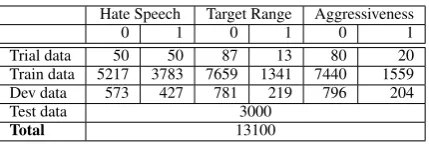
at-Hate Speech Target Range Aggressiveness
0 1 0 1 0 1
Trial data 50 50 87 13 80 20 Train data 5217 3783 7659 1341 7440 1559 Dev data 573 427 781 219 796 204 Test data 3000
[image:3.595.75.290.60.132.2]Total 13100
Table 1: Distribution of English data, labels of the test data were not specified.
Hate Speech Target Range Aggressiveness
0 1 0 1 0 1
Train data 2643 1857 3371 1129 2998 1502 Dev data 278 222 363 137 324 176 Test data 1600
[image:3.595.74.291.176.238.2]Total 6600
Table 2: Distribution of Spanish data. No trial data was available, and test data labels were not specified.
tention mechanism. This mechanism emphasizes the most informative words in the article and gives these more weight.
Our final model uses 512 units in the hidden layer of the BiLSTM, a batch size of 64, the Adam optimizer in combination with the default learning rate of 0.001 and a dropout of 0.4. We trained our model for 10 epochs, of which we saved the model with the lowest validation loss.
3 Data and Preprocessing
For this shared task, the data distribution is seen in Table1and Table2for the train and development data, we assumed the trial data to be train data too. After release of the test data, the distribution would be 69% train, 8% development, and 23% (3000 sentences) test data for the English task, and for the Spanish task 68% train, 8% development, and 24% (1600 sentences) test data. For final sub-mission, we combined the train and development data to train our system on.
The meaning of the binary encoding is as fol-lows, for Hate Speech (HS) and Aggressiveness (AG): 0 or 1, absent and present respectively. For Target Range (TR): 0 or 1, whole group and in-dividual respectively. We notice that there is more data available for the English task than the Spanish one.
With regard to preprocessing, we did this in the following fashion:
• Tokenized with the NLTK TweetTokenizer.
• Replaced URLs with a placeholder suitable for our English embeddings.
• Replaced mentions with a placeholder suit-able for the availsuit-able English embeddings (van der Goot and van Noord,2017).
• Converted words to lowercase.
• Filtered out stopwords using the stopwords from NLTK, either English or Spanish.
• Removing single characters, excluding emoji’s.
For the BiLSTM, we did not do any prepro-cessing. We deemed this might affect the learning curve of the system, since a BiLSTM algorithm often performs well with lots of different data. So, without preprocessing there will be less loss of in-formation and thus a better performing system.
We tested how the preprocessing affected our scores, results are in Table 3 and Table 4. We used the train and development data available to test the preprocessing. We started using all the preprocessing, and in a cumulative way, excluded a preprocess step one by one. So in the end, we would only have tokenization left.
Interesting is that the scores of the RF and SVM 1 model are higher, for both English and Spanish data, when we exclude preprocessing steps. At the step of replacing URLs and usernames with place-holders, we expected the scores to be higher if ex-cluded. Because if the same URL or username occurs often in the training set, and that specific URL or username is always corresponding with a hateful or non-hateful message, our system could wrongly classify a comment in the development set containing that same URL or username. The scores also increase when we exclude lowercas-ing or remove slowercas-ingle characters in addition to the placeholder steps. However, if we omit either low-ercasing or characters alone, the scores do not get better than if we use all preprocessing. This also explains the higher score with the LR model, but if we only disregard the character preprocessing step, the score also does not get better.
4 Results
Span-RF SVM 1 SVM 2 LR BiLSTM All 74.2 73.9 72.7 74.0 -- URL 74.5 73.8 68.4 73.9 -- USERNAME 75.3 74.1 68.3 73.9 -- Lowercase 75.8 73.8 69.2 73.5 -- Stopwords 74.2 72.4 67.9 73.4 -- Characters 75.6 73.0 68.9 75.2 -No preprocess
[image:4.595.310.526.61.262.2](only tokenization) 75.6 73.0 68.9 75.2 77.5
Table 3: Scores with changes in preprocessing for En-glish, scores in bold means that it was higher than using all preprocessing of the respective system.
RF SVM 1 LR
All 78.2 79.9 77.8
- URL 78.7 80.1 77.4 - USERNAME 78.2 78.8 77.9 - Lowercase 75.9 79.6 76.6 - Stopwords 77.3 80.8 76.7 - Characters 75.7 81.0 77.7 No preprocess
[image:4.595.74.289.61.156.2](only tokenization) 75.7 81.0 77.7
Table 4: Scores with changes in preprocessing for Spanish, csores in bold means that it was higher than using all preprocessing of the respective system.
ish task, the final system contains three models, described in the Spanish Ensemble Setup.
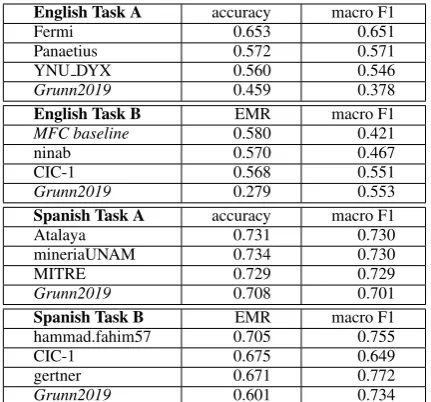
The results on the the various tasks we partici-pated in are listed in Table5. For the English task, we achieved a much lower accuracy and macro f1-score than for the Spanish task. Assuming the data has been distributed fairly for both languages, it could be that the quality of the test data is lower than the train and development data.
These scores were lower in comparison to our results of the individual classifiers on the develop-ment set which are listed in table3and4.
5 Discussion
We compared multiple classification algorithms and combined them into an ensemble model to get a more robust and accurate system. Initially, our system performed reasonably well on the develop-ment set, but when tested on the final test set our performance dropped a fair bit. Overall, the drop in performance was to be expected. During the fi-nal evaluation of the test set our system predicted over 80% as hate speech. Looking at the data we thought a large part of the remaining 20% could also be classified as hate speech. Also the majority class baseline (Basile et al.,2019) ranked second for accuracy, supporting our expectations.
From our results we can conclude that using
English Task A accuracy macro F1
Fermi 0.653 0.651
Panaetius 0.572 0.571 YNU DYX 0.560 0.546 Grunn2019 0.459 0.378 English Task B EMR macro F1 MFC baseline 0.580 0.421
ninab 0.570 0.467
CIC-1 0.568 0.551
Grunn2019 0.279 0.553 Spanish Task A accuracy macro F1 Atalaya 0.731 0.730 mineriaUNAM 0.734 0.730
MITRE 0.729 0.729
Grunn2019 0.708 0.701 Spanish Task B EMR macro F1 hammad.fahim57 0.705 0.755
CIC-1 0.675 0.649
[image:4.595.75.291.212.308.2]gertner 0.671 0.772 Grunn2019 0.601 0.734
Table 5: Scores of our ensemble models on both sub-tasks and languages during testing phase, compared to the top three systems in that subtask.
accuracy macro f1-socre GloVe 300d 0.726 0.727 Glove Twitter 25d 0.680 0.675 Twitter 100d 0.716 0.711 Twitter 400d 0.719 0.717
Table 6: Scores on the English development set of the Support Vector Machine (SVM 2) classifier using dif-ferent word embeddings as input.
a bigger ensemble model for the English tweets performs mediocre in comparison to a smaller en-semble model for detecting hate speech in Spanish tweets.
In the future, we would like to try to improve the performance of our Spanish model, of which our development was cut short due to time restric-tions. We would also like to test our models with more high quality data. It would be interesting to find out whether this helps to improve our models’ performance.
6 Acknowledgements
We would like to thank the organizers of SemEval-20191, the organizers of SemEval 2019 Task 5 -Shared Task on Multilingual Detection of Hate2, and the reviewers for accepting our paper. We would also like to thank R.M. Van der Goot for his guidance and help where needed.
1
[image:4.595.312.525.324.374.2]References
Maria Anzovino, Elisabetta Fersini, and Paolo Rosso. 2018. Automatic identification and classification of misogynistic language on twitter. In International Conference on Applications of Natural Language to Information Systems, pages 57–64. Springer.
Valerio Basile, Cristina Bosco, Elisabetta Fersini, Deb-ora Nozza, Viviana Patti, Francisco Rangel, Paolo Rosso, and Manuela Sanguinetti. 2019. Semeval-2019 task 5: Multilingual detection of hate speech against immigrants and women in twitter. In Pro-ceedings of the 13th International Workshop on Se-mantic Evaluation (SemEval-2019). Association for Computational Linguistics.
Rob Van der Goot. http://www.let.rug.nl/
rob/.
Rob van der Goot and Gertjan van Noord. 2017. MoNoise: Modeling noise using a modular normal-ization system. Computational Linguistics in the Netherlands Journal, 7:129–144.
Rohan Kshirsagar, Tyus Cukuvac, Kathleen McKeown, and Susan McGregor. 2018. Predictive embeddings for hate speech detection on twitter. arXiv preprint arXiv:1809.10644.
Chikashi Nobata, Joel Tetreault, Achint Thomas, Yashar Mehdad, and Yi Chang. 2016. Abusive lan-guage detection in online user content. In Proceed-ings of the 25th international conference on world wide web, pages 145–153. International World Wide Web Conferences Steering Committee.
Alexandra Olteanu, Carlos Castillo, Jeremy Boy, and Kush R Varshney. 2018. The effect of extremist vi-olence on hateful speech online. InTwelfth Interna-tional AAAI Conference on Web and Social Media.
Fabian Pedregosa, Ga¨el Varoquaux, Alexandre Gram-fort, Vincent Michel, Bertrand Thirion, Olivier Grisel, Mathieu Blondel, Peter Prettenhofer, Ron Weiss, Vincent Dubourg, et al. 2011. Scikit-learn: Machine learning in python. Journal of machine learning research, 12(Oct):2825–2830.
Jeffrey Pennington, Richard Socher, and Christo-pher D. Manning. 2014. Glove: Global vectors for word representation. InEmpirical Methods in Nat-ural Language Processing (EMNLP), pages 1532– 1543.