Unsupervised Tokenization for Machine Translation
Tagyoung Chung and Daniel Gildea Computer Science Department
University of Rochester Rochester, NY 14627
Abstract
Training a statistical machine translation starts with tokenizing a parallel corpus. Some languages such as Chinese do not in-corporate spacing in their writing system, which creates a challenge for tokenization. Moreover, morphologically rich languages such as Korean present an even bigger challenge, since optimal token boundaries for machine translation in these languages are often unclear. Both rule-based solu-tions and statistical solusolu-tions are currently used. In this paper, we present unsuper-vised methods to solve tokenization prob-lem. Our methods incorporate informa-tion available from parallel corpus to de-termine a good tokenization for machine translation.
1 Introduction
Tokenizing a parallel corpus is usually the first step of training a statistical machine translation system. With languages such as Chinese, which has no spaces in its writing system, the main chal-lenge is to segment sentences into appropriate to-kens. With languages such as Korean and Hun-garian, although the writing systems of both lan-guages incorporate spaces between “words”, the granularity is too coarse compared with languages such as English. A single word in these lan-guages is composed of several morphemes, which often correspond to separate words in English. These languages also form compound nouns more freely. Ideally, we want to find segmentations for source and target languages that create a one-to-one mapping of words. However, this is not al-ways straightforward for two major reasons. First, what the optimal tokenization for machine trans-lation should be is not always clear. Zhang et al. (2008b) and Chang et al. (2008) show that get-ting the tokenization of one of the languages in
the corpus close to a gold standard does not nec-essarily help with building better machine trans-lation systems. Second, even statistical methods require hand-annotated training data, which means that in resource-poor languages, good tokenization is hard to achieve.
In this paper, we explore unsupervised methods for tokenization, with the goal of automatically finding an appropriate tokenization for machine translation. We compare methods that have ac-cess to parallel corpora to methods that are trained solely using data from the source language. Unsu-pervised monolingual segmentation has been stud-ied as a model of language acquisition (Goldwater et al., 2006), and as model of learning morphol-ogy in European languages (Goldsmith, 2001). Unsupervised segmentation using bilingual data has been attempted for finding new translation pairs (Kikui and Yamamoto, 2002), and for finding good segmentation for Chinese in machine trans-lation using Gibbs sampling (Xu et al., 2008). In this paper, further investigate the use of bilingual information to find tokenizations tailored for ma-chine translation. We find a benefit not only for segmentation of languages with no space in the writing system (such as Chinese), but also for the smaller-scale tokenization problem of normaliz-ing between languages that include more or less information in a “word” as defined by the writ-ing system, uswrit-ing Korean-English for our exper-iments. Here too, we find a benefit from using bilingual information, with unsupervised segmen-tation rivaling and in some cases surpassing su-pervised segmentation. On the modeling side, we use dynamic programming-based variational Bayes, making Gibbs sampling unnecessary. We also develop and compare various factors in the model to control the length of the tokens learned, and find a benefit from adjusting these parame-ters directly to optimize the end-to-end translation quality.
2 Tokenization
Tokenization is breaking down text into lexemes — a unit of morphological analysis. For relatively isolating languages such as English and Chinese, a word generally equals a single token, which is usu-ally a clearly identifiable unit. English, especiusu-ally, incorporates spaces between words in its writing system, which makes tokenization in English usu-ally trivial. The Chinese writing system does not have spaces between words, but there is less am-biguity where word boundaries lie in a given sen-tence compared to more agglutinative languages. In languages such as Hungarian, Japanese, and Korean, what constitutes an optimal token bound-ary is more ambiguous. While two tokens are usu-ally considered two separate words in English, this may be not be the case in agglutinative languages. Although what is considered a single morpholog-ical unit is different from language to language, if someone were given a task to align words be-tween two languages, it is desirable to have one-to-one token mapping between two languages in order to have the optimal problem space. For ma-chine translation, one token should not necessarily correspond to one morphological unit, but rather should reflect the morphological units and writing system of the other language involved in transla-tion.
For example, consider a Korean “word” meok-eoss-da, which means ate. It is written as a sin-gle word in Korean but consists of three mor-phemes eat-past-indicative. If one uses morpho-logical analysis as the basis for Korean tokeniza-tion, meok-eoss-da would be split into three to-kens, which is not desirable if we are translat-ing Korean to English, since English does not have these morphological counterparts. However, a Hungarian wordszekr´enyemben, which meansin my closet, consists of three morphemes closet-my-inessivethat are distinct words in English. In this case, we do want our tokenizer to split this “word” into three morphemesszekr´eny em ben.
In this paper, we use segmentation and to-kenization interchangeably as blanket terms to cover the two different problems we have pre-sented here. The problem of segmenting Chinese sentences into words and the problem of segment-ing Korean or Hungarian “words” into tokens of right granularity are different in their nature. How-ever, our models presented in section 3 handle the both problems.
3 Models
We present two different methods for unsuper-vised tokenization. Both are essentially unigram tokenization models. In the first method, we try learning tokenization from word alignments with a model that bears resemblance to Hidden Markov models. We use IBM Model 1 (Brown et al., 1993) for the word alignment model. The second model is a relatively simpler monolingual tokenization model based on counts of substrings which serves as a baseline of unsupervised tokenization. 3.1 Learning tokenization from alignment We use expectation maximization as our primary tools in learning tokenization form parallel text. Here, the observed data provided to the algorithm are the tokenized English stringen
1 and the
unto-kenized string of foreign characterscm
1 . The
un-observed variables are both the word-level align-ments between the two strings, and the tokeniza-tion of the foreign string. We represent the tok-enization with a stringsm
1 of binary variables, with si = 1indicating that theith character is the final character in a word. The string of foreign words
fℓ
1 can be thought of as the result of applying the
tokenizationsto the character stringc:
f =s◦c where ℓ=
m
X
i=1 si
We use IBM Model 1 as our word-level align-ment model, following its assumptions that each foreign word is generated independently from one English word:
P(f|e) =X a
P(f,a|e)
=X
a
Y
i
P(fi |eai)P(a)
=Y
i
X
j
P(fi |ej)P(ai =j)
and that all word-level alignments a are equally likely:P(a) = 1
n for all positions. While Model 1
posterior probability of a word beginning at posi-tioni, ending at positionj, and being generated by English wordk:
P(si...j = (1,0, . . . ,0,1), a=k|e)
= α(i)P(f |Pek(c)P|(ea)=k)β(j)
where f = ci. . . cj is the word formed by con-catenating charactersithroughj, andais a vari-able indicating which English position generated
f. Hereαandβ are defined as:
α(i) =P(ci
1, si = 1|e) β(j) =P(cm
j+1, sj = 1|e)
These quantities resemble forward and backward probabilities of hidden Markov models, and can be computed with similar dynamic programming recursions:
α(i) =
L
X
ℓ=1
α(i−ℓ)X
a
P(a)P(cii−ℓ |ea)
β(j) =XL
ℓ=1
X
a
P(a)P(cjj+ℓ |ea)β(j+ℓ)
where L is the maximum character length for a word.
Then, we can calculate the expected counts of individual word pairs being aligned (cji, ek) by
ac-cumulating these posteriors over the data:
ec(cji, ek) += α(i)P(a)P(c j
i |ek)β(j) α(m)
The M step simply normalizes the counts:
˜
P(f |e) = Pec(f, e)
eec(f, e)
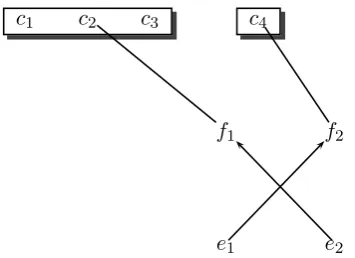
Our model can be compared to a hidden Markov model in the following way: a target word gen-erates a source token which spans a zeroth order Markov chain of characters in source sentence, where a “transition” represents a segmentation and a “emission” represents an alignment. The model uses HMM-like dynamic programming to do in-ference. For the convenience, we refer to this model as the bilingual model in the rest of the paper. Figure 1 illustrates our first model with an small example. Under this model we are not learning segmentation directly, but rather we are learning alignments between two sentences. The
c1 c2 c3 c4
f1 f2
[image:3.595.339.517.59.188.2] [image:3.595.90.276.338.406.2]e1 e2
Figure 1: The figure shows a source sentence
f = f1, f2 = s◦c1. . . c4 wheres = (0,0,1,1)
and a target sentencee = e1, e2. There is a
seg-mentation betweenc3 andc4; thusc1,c2,c3 form f1andc3formsf2.f1is generated bye2andf2is
generated bye1.
segmentation is by-product of learning the align-ment. We can find the optimal segmentation of a new source language sentence using the Viterbi algorithm. Given two sentenceseandf,
a∗ = argmax
a P(f,a|e)
and segmentation s∗ implied by alignment a∗ is
the optimal segmentation offfound by this model.
3.2 Learning tokenization from substring counts
The second tokenization model we propose is much simpler. More sophisticated unsupervised monolingual tokenization models using hierarchi-cal Bayesian models (Goldwater et al., 2006) and using the minimum description length prin-ciple (Goldsmith, 2001; de Marcken, 1996) have been studied. Our model is meant to serve as a computationally efficient baseline for unsuper-vised monolingual tokenization. Given a corpus of only source language of unknown tokenization, we want to find the optimal s given c — s that gives us the highestP(s|c). According to Bayes’ rule,
P(s|c)∝P(c|s)P(s)
Again, we assume that allP(s)are equally likely. Letf =s◦c=f1. . . fℓ, wherefiis a word under
some possible segmentations. We want to find the
sthat maximizesP(f). We assume that
P(f) =P(f1)×. . .×P(fℓ)
substring — every possible segmentation of char-acters — from the sentences. We assume that
P(fi) = Pcount(fi)
kcount(fk)
We can compute these counts by making a sin-gle pass through the corpus. As in the bilingual model, we limit the maximum size off for prac-tical reasons and to prevent our model from learn-ing unnecessarily longf. With P(f), given a se-quence of charactersc, we can calculate the most likely segmentation using the Viterbi algorithm.
s∗= argmax s P(f)
Our rationale for this model is that if a span of charactersf =ci. . . cjis an independent token, it will occur often enough in different contexts that such a span of characters will have higher prob-ability than other spans of characters that are not meaningful. For the rest of the paper, this model will be referred to as the monolingual model. 3.3 Tokenizing new data
Since the monolingual tokenization only uses in-formation from a monolingual corpus, tokenizing new data is not a problem. However, with the bilingual model, we are learningP(f |e). We are relying on information available frometo get the best tokenization forf. However, the parallel sen-tences will not be available for new data we want to translate. Therefore, for the new data, we have to rely only on P(f) to tokenize any new data, which can be obtained by calculating
P(f) =X
e
P(f |e)P(e)
WithP(f) from the bilingual model, we can run the Viterbi algorithm in the same manner as mono-lingual tokenization model for monomono-lingual data. We hypothesize that we can learn valuable infor-mation on which token boundaries are preferable in languagef when creating a statistical machine translation system that translates from languagef
to languagee.
4 Preventing overfitting
We introduce two more refinements to our word-alignment induced tokenization model and mono-lingual tokenization model. Since we are consid-ering every possible tokenf that can be guessed
from our corpus, the data is very sparse. For the bilingual model, we are also using the EM algo-rithm to learnP(f | e), which means there is a danger of the EM algorithm memorizing the train-ing data and thereby overfitttrain-ing. We put a Dirichlet prior on our multinomial parameter forP(f | e) to control this situation. For both models, we also want a way to control the distribution of token length after tokenization. We address this problem by adding a length factor to our models.
4.1 Variational Bayes
Beal (2003) and Johnson (2007) describe vari-ational Bayes for hidden Markov model in de-tail, which can be directly applied to our bilingual model. With this Bayesian extension, the emission probability of our first model can be summarized as follows:
θe|α∼Dir(α),
fi|ei=e∼Multi(θe).
Johnson (2007) and Zhang et al. (2008a) show having smallα helps to control overfitting. Fol-lowing this, we set our Dirichlet prior to be as sparse as possible. It is set atα = 10−6, the
num-ber we used as floor of our probability.
For the model incorporating the length factor, which is described in the next section, we do not place a prior on our transition probability, since there are only two possible states, i.e. P(s = 1) andP(s= 0). This distribution is not as sparse as the emission probability.
Comparing variational Bayes to the traditional EM algorithm, the E step stays the same but the M step for calculating the emission probability changes as follows:
˜
P(f |e) = exp(exp(ψ(Pψ(ec(f, e) +α))
eec(f, e) +sα))
whereψis the digamma function, andsis the size of the vocabulary from whichf is drawn. Since we do not accurately know s, we set sto be the number of all possible tokens. As can be seen from the equation, by settingαto a small value, we are discounting the expected count with help of the digamma function. Thus, having lowerαleads to a sparser solution.
4.2 Token length
0 0.1 0.2 0.3 0.4 0.5 0.6
1 2 3 4 5 6
ref P(s)=0.55 lambda=3.16
0 0.1 0.2 0.3 0.4 0.5 0.6
1 2 3 4 5 6
[image:5.595.94.512.66.211.2]ref P(s)=0.58 lambda=2.13
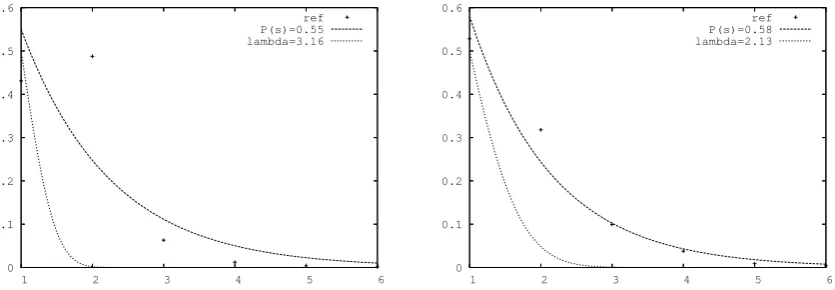
Figure 2: Distribution of token length for (from left to right) Chinese, and Korean. “ref” is the empirical distribution from supervised tokenization. Two length factors —φ1 andφ2are also shown. Forφ1, the
parameter to geometric distributionP(s)is set to the value learned from our bilingual model. Forφ2,λ
is set using the criterion described in the experiment section.
This parameter is beneficial because we want our distribution of token length after tokenization to resemble the real distribution of token length. This parameter is also useful because we also want to incorporate information on the number of tokens in the other language in the parallel corpus. This is based on the assumption that, if tokenization cre-ates a one-to-one mapping, the number of tokens in both languages should be roughly the same. We can force the two languages to have about the same number of tokens by adjusting this parameter. The third reason is to further control overfitting. Our observation is that certain morphemes are very common, such that they will be always observed attached to other morphemes. For example, in Ko-rean, a noun attached with nominative case marker is very common. Our model is likely to learn a noun attached with the morpheme — nominative case marker — rather than noun itself. This is not desirable when the noun occurs with less common morphemes; in these cases the morpheme will be split off creating inconsistencies.
We have experimented with two different length factors, each with one adjustable parameter:
φ1(ℓ) =P(s)(1−P(s))ℓ−1 φ2(ℓ) = 2−ℓλ
The first,φ1, is the geometric distribution, where l is length of a token and P(s) is probability of segmentation between two characters. The second length factorφ2 was acquired through several
ex-periments and was found to work well. As can been seen from Figure 2, the second factor
dis-counts longer tokens more heavily than the geo-metric distribution. We can adjust the value ofλ
andP(s)to increase or decrease number of tokens after segmentation.
For our monolingual model, incorporating these factors is straightforward. We assume that
P(f)∝P(f1)φ(ℓ1)×. . .×P(fn)φ(ℓn)
whereℓiis the length offi. Then, we use the same
Viterbi algorithm to select thef1. . . fn that
max-imizes P(f), thereby selecting the optimal s ac-cording to our monolingual model with a length factor. We pick the value of λ and P(s) that produces about the same number of tokens in the source side as in the target side, thereby incorpo-rating some information about the target language. For our bilingual model, we modify our model slightly to incorporate φ1, creating a hybrid
model. Now, our forward probability of forward-backward algorithm is:
α(i) =XL
ℓ=1
α(i−l)φ1(ℓ)
X
a
P(a)P(ci
i−ℓ|ea)
and the expected count of(cji, ek)is
ec(cji, ek) += α(i)P(a)P(c j
i |ek)β(j)φ1(j−i) α(m)
For φ1, we can learnP(s) for the geometric
dis-tribution from the model itself:1
P(s) = m1 Xm
i
α(i)β(i)
α(m)
We can also fixP(s)instead of learning it through EM. We incorporateφ2 into the bilingual model
as follows: after learningP(f)from the bilingual model, we pick theλ in the same manner as the monolingual model and run the Viterbi algorithm. After applying the length factor, what we have is a log-linear model for tokenization, with two feature functions with equal weights: the length factor andP(f)learned from model.
5 Experiments 5.1 Data
We tested our tokenization methods on two differ-ent language pairs: Chinese-English, and Korean-English. For Chinese-English, we used FBIS newswire data. The Korean-English parallel data was collected from news websites and sentence-aligned using two different tools described by Moore (2002) and Melamed (1999). We used sub-sets of each parallel corpus consisting of about 2M words and 60K sentences on the English side. For our development set and test set, Chinese-English had about 1000 sentences each with 10 reference translations taken from the NIST 2002 MT eval-uation. For Korean-English, 2200 sentence pairs were randomly sampled from the parallel corpus, and held out from the training data. These were divided in half and used for test set and develop-ment set respectively. For all language pairs, very minimal tokenization — splitting off punctuation — was done on the English side.
5.2 Experimental setup
We used Moses (Koehn et al., 2007) to train machine translation systems. Default parameters were used for all experiments except for the num-ber of iterations for GIZA++ (Och and Ney, 2003). GIZA++ was run until the perplexity on develop-ment set stopped decreasing. For practical rea-sons, the maximum size of a token was set at three for Chinese, and four for Korean.2 Minimum error
rate training (Och, 2003) was run on each system afterwards and BLEU score (Papineni et al., 2002) was calculated on the test sets.
For the monolingual model, we tested two ver-sions with the length factorφ1, andφ2. We picked λandP(s)so that the number of tokens on source side (Chinese, and Korean) will be about the same 2In the Korean writing system, one character is actually one syllable block. We do not decompose syllable blocks into individual consonants and vowels.
as the number of tokens in the target side (En-glish).
For the bilingual model, as explained in the model section, we are learningP(f |e), but only
P(f)is available for tokenizing any new data. We compared two conditions: using only the source data to tokenize the source language training data according to P(f) (which is consistent with the conditions at test time), and using both the source and English data to tokenize the source language training data (which might produce better tok-enization by using more information). For the first length factorφ1, we ran an experiment where the
model learnsP(s) as described in the model sec-tion, and we also had experiments whereP(s)was pre-set at 0.9, 0.7, 0.5, and 0.3 for comparison. We also ran an experiment with the second length fac-torφ2 whereλwas picked as the same manner as
the monolingual model.
We varied tokenization of development set and test set to match the training data for each ex-periment. However, as we have implied in the previous paragraph, in the one experiment where
P(f | e) was used to segment training data, di-rectly incorporating information from target cor-pus, tokenization for test and development set is not exactly consistent with tokenization of train-ing corpus. Since we assume only source corpus is available at the test time, the test and the devel-opment set was tokenized only using information fromP(f).
We also trained MT systems using supervised tokenizations and tokenization requiring a mini-mal effort for the each language pair. For Chinese-English, the minimal effort tokenization is maxi-mal tokenization where every Chinese character is segmented. Since a number of Chinese tokeniz-ers are available, we have tried four different to-kenizations for the supervised toto-kenizations. The first one is the LDC Chinese tokenizer available at the LDC website3, which is compiled by Zhibiao
Wu. The second tokenizer is a maxent-based to-kenizer described by Xue (2003). The third and fourth tokenizations come from the CRF-based Stanford Chinese segmenter described by Chang et al. (2008). The difference between third and fourth tokenization comes from the different gold standard, the third one is based on Beijing Uni-versity’s segmentation (pku) and the fourth one is based on Chinese Treebank (ctb). For
Chinese Korean BLEU F-score BLEU Supervised
Rule-based morphological analyzer 7.27
LDC segmenter 20.03 0.94
Xue’s segmenter 23.02 0.96
Stanford segmenter (pku) 21.69 0.96 Stanford segmenter (ctb) 22.45 1.00 Unsupervised
Splitting punctuation only 6.04
Maximal (Character-based MT) 20.32 0.75
BilingualP(f |e)withφ1P(s) =learned 19.25 6.93
BilingualP(f)withφ1P(s) =learned 20.04 0.80 7.06
BilingualP(f)withφ1P(s) = 0.9 20.75 0.87 7.46
BilingualP(f)withφ1P(s) = 0.7 20.59 0.81 7.31
BilingualP(f)withφ1P(s) = 0.5 19.68 0.80 7.18
BilingualP(f)withφ1P(s) = 0.3 20.02 0.79 7.38
BilingualP(f)withφ2 22.31 0.88 7.35
MonolingualP(f)withφ1 20.93 0.83 6.76
[image:7.595.129.474.59.335.2]MonolingualP(f)withφ2 20.72 0.85 7.02
Table 1: BLEU score results for Chinese-English and Korean-English experiments and F-score of seg-mentation compared against Chinese Treebank standard. The highest unsupervised score is highlighted.
English, the minimal effort tokenization splitting off punctuation and otherwise respecting the spac-ing in the Korean writspac-ing system. A Korean mor-phological analysis tool4was used to create the
su-pervised tokenization.
For Chinese-English, since a gold standard for Chinese segmentation is available, we ran an addi-tional evaluation of tokenization from each meth-ods we have tested. We tokenized the raw text of Chinese Treebank (Xia et al., 2000) using all of the methods (supervised/unsupervised) we have described in this section except for the bilingual tokenization usingP(f | e) because the English translation of the Chinese Treebank data was not available. We compared the result against the gold standard segmentation and calculated the F-score.
6 Results
Results from Chinese-English and Korean-English experiments are presented in Table 1. Note that nature of data and number of references are dif-ferent for the two language pairs, and therefore the BLEU scores are not comparable. For both language pairs, our models perform equally well as supervised baselines, or even better. We can
4http://nlp.kookmin.ac.kr/HAM/eng/main-e.html
observe three things from the result. First, tok-enization of training data usingP(f |e)tested on a test set tokenized with P(f) performed worse than any other experiments. This affirms our be-lief that consistency in tokenization is important for machine translation, which was also mentioned by Chang et al. (2008). Secondly, we are learning valuable information by looking at the target lan-guage. Compare the result of the bilingual model with φ2 as the length factor to the result of the
monolingual model with the same length factor. The bilingual version consistently performed bet-ter than the monolingual model in all language pairs. This tells us we can learn better token boundaries by using information from the target language. Thirdly, our hypothesis on the need for heavy discount for longer tokens is confirmed. The value forP(s)learned by the model was 0.55, and 0.58 for Chinese, and Korean respectively. For both language pairs, this accurately reflects the empirical distribution of token length, as can be seen in Figure 2. However, experiments where
P(s)was directly optimized performed better, in-dicating that this parameter should be optimized within the context of a complete system. The sec-ond length factor φ2, which discounts longer
bet-English the two presidents will hold a joint press conference at the end of their summit talks . Untokenized Korean 㥪㑶㩁㡜㧹㳧㖺㨋㔚㔦㘏㑗㗴㒟㨙㳧㐾㧺㐍㑌㳧㖺㑀㑙㛵㑗㣩㞌㱶㲢㖰.
Supervised 㥪㑶㩁㡜 㧹㳧㖺 㨋㔚㔣ㄴ㘏㑗㗴㒟㨙㳧㐾㧺㐍 㑌㳧㖺㑀㑙㛵㑗㣩㞌㱶 㲠ㄴ㖰. BilingualP(f|e)withφ1 㥪㑶㩁㡜㧹㳧㖺 㨋㔚㔦㘏㑗㗴㒟㨙㳧㐾 㧺㐍㑌㳧㖺㑀㑙㛵㑗㣩㞌㱶㲢 㖰.
BilingualP(f)withφ2 㥪㑶㩁㡜 㧹㳧㖺 㨋㔚㔦㘏㑗㗴㒟㨙㳧㐾 㧺㐍㑌㳧㖺㑀㑙㛵㑗㣩㞌㱶㲢㖰.
MonolingualP(f)withφ1 㥪㑶㩁㡜 㧹㳧㖺 㨋㔚㔦㘏㑗㗴㒟㨙㳧㐾 㧺㐍㑌㳧㖺㑀㑙㛵㑗㣩㞌㱶㲢 㖰.
MonolingualP(f)withφ2 㥪㑶㩁㡜 㧹㳧㖺 㨋㔚㔦㘏㑗㗴㒟㨙㳧㐾 㧺㐍㑌㳧㖺㑀㑙㛵㑗㣩㞌㱶㲢㖰.
Figure 3: Sample tokenization results for Korean-English data. The underscores are added to clearly visualize where the breaks are.
ter than the first length factor when used in con-junction with the bilingual model. Lastly, F-scores of Chinese segmentations compared against the gold standard shows higher segmentation accuracy does not necessarily lead to higher BLEU score. F-scores presented in Table 1 are not directly com-parable for all different experiments because the test data (Chinese Treebank) is used in training for some of the supervised segmenters, but these num-bers do show how close unsupervised segmenta-tions are to the gold standard. It is interesting to note that our highest unsupervised segmentation result does make use of bilingual information.
Sample tokenization results for Korean-English experiments are presented in Figure 3. We observe that different configurations produce different tok-enizations, and the bilingual model produced gen-erally better tokenizations for translation com-pared to the monolingual models or the super-vised tokenizer. In this example, the tokenization obtained from the supervised tokenizer, although morphologically correct, is too fine-grained for the purpose of translation to English. For example, it correctly tokenized the attributive suffix ㄴ -n
however, this is not desirable since English has no such counterpart. Both variations of the monolin-gual tokenization have errors such as incorrectly not segmenting 㑀㑙㛵 gyeol-gwa-reul, which is a compound of a noun and a case marker, into㑀 㑙 㛵gyeol-gwa reulas the bilingual model was able to do.
6.1 Conclusion and future work
We have shown that unsupervised tokenization for machine translation is feasible and can outperform rule-based methods that rely on lexical analysis, or supervised statistical segmentations. The ap-proach can be applied both to morphological anal-ysis of Korean and the segmentation of sentences into words for Chinese, which may at first glace
appear to be quite different problems. We have only shown how our methods can be applied to one language of the pair, where one language is generally isolating and the other is generally syn-thetic. However, our methods could be extended to tokenization for both languages by iterating be-tween languages. We also used the most simple word-alignment model, but more complex word alignment models could be incorporated into our bilingual model.
Acknowledgments This work was supported by NSF grants IIS-0546554 and ITR-0428020.
References
Matthew J. Beal. 2003. Variational Algorithms for Ap-proximate Bayesian Inference. Ph.D. thesis, Univer-sity College London.
Peter F. Brown, Stephen A. Della Pietra, Vincent J. Della Pietra, and Robert L. Mercer. 1993. The mathematics of statistical machine translation: Pa-rameter estimation. Computational Linguistics, 19(2):263–311.
Pi-Chuan Chang, Michel Galley, and Christopher Man-ning. 2008. Optimizing Chinese word segmentation for machine translation performance. In Proceed-ings of the Third Workshop on Statistical Machine Translation, pages 224–232.
Carl de Marcken. 1996. Linguistic structure as compo-sition and perturbation. InMeeting of the Associa-tion for ComputaAssocia-tional Linguistics, pages 335–341. Morgan Kaufmann Publishers.
John Goldsmith. 2001. Unsupervised learning of the morphology of a natural language. Computational Linguistics, 27(2):153–198.
Mark Johnson. 2007. Why doesn’t EM find good HMM POS-taggers? In2007 Conference on Em-pirical Methods in Natural Language Processing (EMNLP), pages 296–305, Prague, Czech Republic, June. Association for Computational Linguistics. Genichiro Kikui and Hirofumi Yamamoto. 2002.
Finding translation pairs from english-japanese un-tokenized aligned corpora. In Proceedings of the 40th Annual Conference of the Association for Computational Linguistics (ACL-02) workshop on Speech-to-speech translation: algorithms and sys-tems, pages 23–30. Association for Computational Linguistics.
Philipp Koehn, Hieu Hoang, Alexandra Birch, Chris Callison-Burch, Marcello Federico, Nicola Bertoldi, Brooke Cowan, Wade Shen, Christine Moran, Richard Zens, Chris Dyer, Ondrej Bojar, Alexan-dra Constantin, and Evan Herbst. 2007. Moses: Open source toolkit for statistical machine transla-tion. In Proceedings of the 45th Annual Confer-ence of the Association for Computational Linguis-tics (ACL-07), Demonstration Session, pages 177– 180.
I. Dan Melamed. 1999. Bitext maps and alignment via pattern recognition. Computational Linguistics, 25:107–130.
Robert C. Moore. 2002. Fast and accurate sentence alignment of bilingual corpora. InAMTA ’02: Pro-ceedings of the 5th Conference of the Association for Machine Translation in the Americas on Machine Translation: From Research to Real Users, pages 135–144, London, UK. Springer-Verlag.
Franz Josef Och and Hermann Ney. 2003. A sys-tematic comparison of various statistical alignment models.Computational Linguistics, 29(1):19–51. Franz Josef Och. 2003. Minimum error rate training
for statistical machine translation. In Proceedings of the 41th Annual Conference of the Association for Computational Linguistics (ACL-03).
Kishore Papineni, Salim Roukos, Todd Ward, and Wei-Jing Zhu. 2002. BLEU: A method for automatic evaluation of machine translation. In Proceedings of the 40th Annual Conference of the Association for Computational Linguistics (ACL-02).
Fei Xia, Martha Palmer, Nianwen Xue, Mary Ellen Okurowski, John Kovarik, Shizhe Huang, Tony Kroch, and Mitch Marcus. 2000. Developing Guidelines and Ensuring Consistency for Chinese Text Annotation. InProc. of the 2nd International Conference on Language Resources and Evaluation (LREC-2000), Athens, Greece.
Jia Xu, Jianfeng Gao, Kristina Toutanova, and Her-mann Ney. 2008. Bayesian semi-supervised chinese word segmentation for statistical machine transla-tion. In Proceedings of the 22nd International Conference on Computational Linguistics (Coling
2008), pages 1017–1024, Manchester, UK, August. Coling 2008 Organizing Committee.
Nianwen Xue. 2003. Chinese word segmentation as character tagging. InInternational Journal of Com-putational Linguistics and Chinese Language Pro-cessing, volume 8, pages 29–48.
Hao Zhang, Chris Quirk, Robert C. Moore, and Daniel Gildea. 2008a. Bayesian learning of non-compositional phrases with synchronous parsing. In
Proceedings of the 46th Annual Meeting of the As-sociation for Computational Linguistics (ACL-08), pages 97–105, Columbus, Ohio.