Automatic Extraction of Briefing Templates
Dipanjan Das Mohit Kumar
Language Technologies Institute Carnegie Mellon University
5000 Forbes Avenue Pittsburgh, PA 15213, USA
{dipanjan, mohitkum, air}@cs.cmu.edu
Alexander I. Rudnicky
Abstract
An approach to solving the problem of au-tomatic briefing generation from non-textual events can be segmenting the task into two major steps, namely, extraction of briefing templates and learning aggregators that col-late information from events and automati-cally fill up the templates. In this paper, we describe two novel unsupervised approaches for extracting briefing templates from hu-man written reports. Since the problem is non-standard, we define our own criteria for evaluating the approaches and demonstrate that both approaches are effective in extract-ing domain relevant templates with promis-ing accuracies.
1 Introduction
Automated briefing generation from non-textual events is an unsolved problem that currently lacks a standard approach in the NLP community. Broadly, it intersects the problem of language generation from structured data and summarization. The prob-lem is relevant in several domains where the user has to repeatedly write reports based on events in the domain, for example, weather reports (Reiter et al., 2005), medical reports (Elhadad et al., 2005), weekly class project reports (Kumar et al., 2007) and so forth. On observing the data from these domains,
we notice atemplatized nature of report items.
Ex-amples (1)-(3) demonstrate equivalents in a particu-lar domain (Reiter et al., 2005).
(1) [A warm front] from [Iceland] to [northern Scotland] will move [SE]
across [the northern North Sea] [today and tomorrow]
(2) [A warm front] from [Iceland] to [the Faeroes] will move [ENE] across [the Norwegian Sea] [this evening]
(3) [A ridge] from [the British Isles] to [Iceland] will move [NE] across [the North Sea] [today]
In each sentence, the phrases in square brackets at the same relative positions form the slots that take up different values at different occasions. The cor-responding template is shown in (4) with slots con-taining their respective domain entity types. Instan-tiations of (4) may produce (1)-(3) and similar sen-tences. This kind of sentence structure motivates an approach of segmenting the problem of closed do-main summarization into two major steps of auto-matic template extraction and learning aggregators, which are pattern detectors that assimilate informa-tion from the events, to populate these templates.
(4) [PRESSURE ENTITY] from [LOCATION] to
[LOCATION] will move [DIRECTION] across
[LOCATION] [TIME]
approach that can extract templates containing mul-tiple verbs. As we will see below, both approaches show promise.
2 Related Work
There has been instances of template based sum-marization in popular Information Extraction (IE) evaluations like MUC (Marsh & Perzanowski, 1998; Onyshkevych, 1994) and ACE (ACE, 2007) where hand engineered slots were to be filled for events in text; but the focus lay on template filling rather than their creation. (Riloff, 1996) describes an interesting work on the generation of extraction patterns from untagged text, but the analysis is syntactic and the patterns do not resemble the templates that we aim to extract. (Yangarber et al., 2000) describe another system called ExDisco, that extracts event patterns from un-annotated text starting from seed patterns. Once again, the text analysis is not deep and the pat-terns extracted are not sentence surface forms.
(Collier, 1998) proposed automatic domain tem-plate extraction for IE purposes where MUC type templates for particular types of events were con-structed. The method relies on the idea from (Luhn, 1958) where statistically significant words of a cor-pus were extracted. Based on these words, sen-tences containing them were chosen and aligned using subject-object-verb patterns. However, this method did not look at arbitrary syntactic patterns.
(Filatova et al., 2006) improved the paradigm by looking at the most frequent verbs occurring in a corpus and aligning subtrees containing the verb, by using the syntactic parses as a similarity metric. However, long distance dependencies of verbs with constituents were not looked at and deep semantic analysis was not performed on the sentences to find out similar verb subcategorization frames. In con-trast, in our predicate argument based approach we look into deeper semantic structures, and align sen-tences not only based on similar syntactic parses, but also based on the constituents’ roles with re-spect to the main predicate. Also, they relied on typical Named Entities (NEs) like location, organi-zation, person etc. and included another entity that they termed as NUMBER. However, for specific domains like weather forecasts, medical reports or student reports, more varied domain entities form
slots in templates, as we observe in our data; hence, existence of a module handling domain specific en-tities become essential for such a task. (Surdeanu et al., 2003) identify arguments for predicates in a sentence and emphasize how semantic role infor-mation may assist in IE related tasks, but their pri-mary focus remained on the extraction of PropBank (Kingsbury et al., 2002) type semantic roles.
To our knowledge, the ROUGE metric has not been used for automatic extraction of templates.
3 The Data
3.1 Data Description
Since our focus is on creating summary items from events or structured data rather than from text, we used a corpus from the domain of weather fore-casts (Reiter et al., 2005). This is a freely
avail-able parallel corpus1 consisting of weather data
and human written forecasts describing them. The dataset showed regularity in sentence structure and belonged to a closed domain, making the variations in surface forms more constrained than completely free text. After sentence segmentation we arrived at a set of 3262 sentences. From this set, we selected 3000 for template extraction and kept aside 262 sen-tences for testing.
3.2 Preprocessing
For semantic analysis, we used the ASSERT toolkit (Pradhan et al., 2004) that produces shallow seman-tic parses using the PropBank conventions. As a by product, it also produces syntactic parses of sen-tences, using the Charniak parser (Charniak, 2001). For each sentence, we maintained a part-of-speech
tagged (leaves of the parse tree), parsed, baseNP2
tagged and semantic role tagged version. The
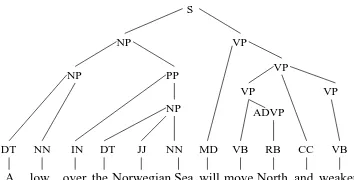
baseNPs were retrieved by pruning the parse trees and not by using a separate NP chunker. The rea-son for having a baseNP tagged corpus will become clear as we go into the detail of our template ex-traction techniques. Figure 1 shows a typical out-put from the Charniak parser and Figure 2 shows the same tree with nodes under the baseNPs pruned.
We identified the need to have a domain entity tagger for matching constituents in the sentences.
1http://www.csd.abdn.ac.uk/research/sumtime/
ADVP
IN
A low overtheNorwegian Sea will move North and weaken
DT NN DT JJ NN MD VB RB CC VB NP
NP
PP
NP S
VP
VP VP
[image:3.612.95.272.70.160.2]VP
Figure 1: Parse tree for a sentence in the data.
ADVP
IN
A low overtheNorwegian Sea will move North and weaken
MD VB RB CC VB NP
NP
PP
NP S
VP
VP VP
[image:3.612.94.271.198.294.2]VP
Figure 2: Pruned parse tree for a sentence in the cor-pus
Any tagger for named entities was not suitable for weather forecasts since unique constituent types as-sumed significance unlike newswire data. Since the development of such a tagger was beyond the scope of the present work, we developed a module that took baseNP tagged sentences as input and produced tags across words and baseNPs that were domain en-tities. The development of such a module by hand
was easy because of a limited vocabulary (<1000
[image:3.612.84.283.597.681.2]words) of the data and the closed set nature of most entity types (e.g thedirectionentity could take up a finite set of values). From inspection, thirteen dis-tinct entity types were recognized in the domain. Figure 3 shows an example output from the entity recognizer with the sentence from Figure 2 as input.
[ A low ]
DIRECTION and weaken
A low over the Norwegian Sea will move North and weaken
ENTITY RECOGNIZER
LOCATION
over [ the Norwegian Sea ]
PRESSURE ENTITY
will move [ North ]
Figure 3: Example output of the entity recognizer
We now provide a detailed description of our clus-tering and template extraction algorithms.
4 Approach and Experiments
We adopted two parallel approaches. First, we
investigated a predicate-argument based approach where we consider the set of all propositions in our dataset, and cluster them based on their verb sub-categorization frame. Second, we used ROUGE, a summarization evaluation metric that is generally used to compare machine generated and human writ-ten summaries. We uniquely used this metric for clustering similar summary items, after abstracting the surface forms to a representation that facilitates comparison of a pair of sentences. The following subsections detail both the techniques.
4.1 A Predicate-Argument Based Approach
Analysis of predicate-argument structures seemed appropriate for template extraction for a few rea-sons: Firstly, complicated sentences with multiple verbs are broken down into propositions by a
seman-tic role labeler. The propositions3 are better
gen-eralizable units than whole sentences across a cor-pus. Secondly, long distance dependencies of con-stituents with a particular verb, are captured well by a semantic role labeler. Finally, if verbs are con-sidered to be the center of events, then groups of sentences with the same semantic role sequences seemed to form clusters conveying similar meaning. We explain the complete algorithm for template ex-traction in the following subsections.
(5) [ARG0 A low over the Norwegian Sea] [AGM-MOD will] [TARGET move ] [ARGM-DIR North ] and weaken
(6) [ARG0 A high pressure area ] [AGM-MOD will ] [TARGET move] [ARGM-DIR
southwestwards] and build on Sunday.
4.1.1 Verb based clustering
We performed a verb based clustering as the first step. Instead of considering a unique set of verbs, we considered related verbs as a single verb type. The relatedness of verbs was derived from Word-net (Fellbaum, 1998), by merging verbs that appear in the same synset. This kind of clustering is not
ideal in a corpus containing a huge variation in event streams, like newswire. However, the results were good for the weather domain where the number of verbs used is limited. The grouping procedure re-sulted in a set of 82 clusters with 6632 propositions.
4.1.2 Matching Role Sequences
Each verb cluster was considered next. Instead of finding structural similarities of the propositions in one go, we first considered the semantic role sequences for each proposition. We searched for propositions that had exactly similar role sequences
and grouped them together. To give an
exam-ple, both sentences 5 and 6 have the matching role sequence ARG0–ARGM-MOD–TARGET–ARGM-DIR. The intuition behind such clustering is straight-forward. Propositions with a matching verb type with the same set of roles arranged in a similar fash-ion would convey similar meaning. We observed that this was indeed true for sentences tagged with correct semantic role labels.
Instead of considering matching role sequences for a set of propositions, we could as well have considered matching bag of roles. However, for the present corpus, we decided to use strict role se-quence instead because of the sentences’ rigid struc-ture and absence of any passive sentences. This subclustering step resulted in smaller clusters, and many of them contained a single proposition. We threw out these clusters on the assumption that the human summarizers did not necessarily have a tem-plate in mind while writing those summary items. As a result, many verb types were eliminated and only 33 verb-type clusters containing several sub-clusters each were produced.
4.1.3 Looking inside Roles
Groups of propositions with the same verb-type and semantic role sequences were considered in this step. For each group, we looked at individual se-mantic roles to find out similarity between them. We decided at first to look at syntactic parse tree similar-ities between constituents. However, there is a need to decide at what level of abstraction should one con-sider matching the parse trees. After concon-siderable speculation, we decided on pruning the constituents’ parse trees till the level of baseNPs and then match the resulting tag sequences.
Scotland
IN
A low overthe Sea
NP NP
PP
NP
NP
NP PP
NP
[image:4.612.314.534.69.151.2]Norwegian A frontal trough IN across
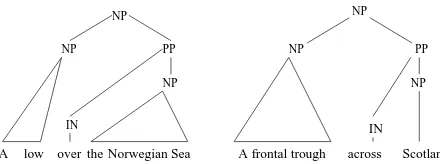
Figure 4: Matching ARG0s for two propositions
LOCATION IN
A low overtheNorwegianSea A frontal trough
IN
across Scotland
PRESSURE ENTITY LOCATION
[image:4.612.315.539.185.248.2]PRESSURE ENTITY
Figure 5: Abstracted tag sequences for two con-stituents
The parses with pruned trees from the preprocess-ing steps provide the necessary information for con-stituent matching. Figure 4 shows matching syntac-tic trees for two ARG0s from two propositions of a cluster. It is at this step that we use the domain entity tags to abstract away the constituents’ syntactic tags. Figure 5 shows the constituents of Figure 4 with the tree structure reduced to tag sequences and domain entity types replacing the tags whenever necessary.
This abstraction step produces a number of unique domain entity augmented tag sequences for a partic-ular semantic role. As a final step of template gen-eration, we concatenate these abstracted constituent types for all the semantic roles in the given group.
To focus on template-like structures we only con-sider tag sequences that occur twice or more in the group.
PRESSURE_ENTITY to DIRECTION of LOCATION will drift slowly WAVE will run_0.5/move_0.5 DIRECTION then DIRECTION
[image:5.612.330.520.203.277.2]Associated PRESSURE_ENTITY will move DIRECTION across LOCATION TIME PRESSURE_ENTITY expected over LOCATION by_0.5/on_0.5 DAY
Figure 6: Example Templates. Upper case tokens correspond to slots. For fixed parts, when there is a choice between words, the probability of the occur-rence of words in that particular syntactic structure are tagged alongside.
4.2 A ROUGE Based Approach
ROUGE (Lin, 2004) is the standard automatic eval-uation metric in the Summarization community. It is derived from the BLEU (Papineni et al., 2001) score which is the evaluation metric used in the Machine Translation community. The underlying idea in the metric is comparing the candidate and the refer-ence sentrefer-ences (or summaries) based on their token co-occurrence statistics. For example, a unigram based measure would compare the vocabulary over-lap between the candidate and reference sentences. Thus, intuitively, we may use the ROUGE score as a measure for clustering the sentences. Amongst the various ROUGE statistics, the most appealing is Weighted Longest Common Subsequence(WLCS). WLCS favors contiguous LCS which corresponds to the intuition of finding the common template. We experimented with other ROUGE statistics but we got better and easily interpretable results using WLCS and so we chose it as the final metric. In all the approaches the data was first preprocessed (baseNP and NE tagged) as described in the previ-ous subsection. In the following subsections, we de-scribe the various clustering techniques that we tried using the ROUGE score followed by the alignment technique.
4.2.1 Clustering
Unsupervised Clustering: As the ROUGE score defines a distance metric, we can use this score for doing unsupervised clustering. We tried hierarchical clustering approaches but did not obtain good clus-ters, evaluated empirically. In empirical evaluation,
we manually looked at the output clusters and made a judgement call whether the candidate clusters are reasonably coherent and potentially correspond to templates. The reason for the poor performance of the approach was the classical parameter estimation problem of determining a priori the number of clus-ters. We could not find an elegant solution for the problem without losing the motivation of an auto-mated approach.
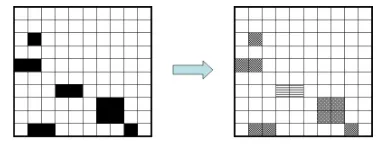
Figure 7: Deterministic clustering based on Graph connectivity. In the figure the squares with the same pattern belong to the same cluster.
Non-parametric Unsupervised Clustering:
Since the unsupervised technique did not give good results, we experimented with a non-parametric clustering approach, namely,
Cross-Association(Chakrabarti et al., 2004). It is a
non-parametric unsupervised clustering algorithm for similarity (boolean) matrices. We obtain the similarity matrix in our domain by thresholding the ROUGE similarity score matrix. This technique also did not give us good clusters, evaluated empiri-cally. The plausible reason for the poor performance seems to be that the technique is based on MDL (Minimum Description Length) principle. Since in our domain we expect a large number of clusters with small membership along many singletons, MDL principle is not likely to perform well.
Deterministic Clustering:
As the unsupervised techniques did not perform well, we tried deterministic clustering based on graph connectivity. The underlying intuition is that
all the sentences X1...n that are “similar” to any
other sentenceYishould be in the same cluster even
though Xj and Xk may not be “similar” to each
other. Thus we find the connected components in the similarity matrix and label them as individual clus-ters.4
4This approach is similar to agglomerative single linkage
We created a similarity matrix by thresholding the ROUGE score. In the event, the clusters obtained by this approach were also not good, evaluated empir-ically. This led us to revisit the similarity function and tune it. We factored the ROUGE-WLCS score, which is an F-measure score, into its component Pre-cision and Recall scores and experimented with var-ious combinations of using the Precision and Recall scores. We finally chose a combined Precision and Recall measure (not f-measure) in which both the scores were independently thresholded. The moti-vation for the measure is that in our domain we de-sire to have high precision matches. Additionally we need to control the length of the sentences in the cluster for which we require a Recall threshold. F-measure (which is the harmonic mean of Precision and Recall) does not give us the required individual control. We set up our experiments such that while comparing two sentences the longer sentence is al-ways treated as the reference and the shorter one as the candidate. This helps us in interpreting the Pre-cision/Recall measures better and thresholding them accordingly. The approach gave us 149 clusters, which looked good on empirical evaluation. We can argue that using this modified similarity function for previous unsupervised approaches could have given better results, but we did not reevaluate those ap-proaches as our aim of getting a reasonable cluster-ing approach is fulfilled with this simple scheme and tuning the unsupervised approaches can be interest-ing future work.
4.3 Alignment
After obtaining the clusters using the Deterministic approach we needed to find out the template corre-sponding to each of the cluster. Fairly intuitively we computed the Longest Common Subsequence(LCS) between the sentences in each cluster which we then claim to be the template corresponding to the clus-ter. This resulted in a set of 149 templates, similar to the Predicate Argument based approach, as shown in figure 6.
5 Results
5.1 Evaluation Scheme
Since there is no standard way to evaluate template extraction for summary creation, we adopted a mix
of subjective and automatic measures for evaluating the templates extracted. We define precision for this particular problem as:
precision= number of domain relevant templatestotal number of extracted templates This is a subjective measure and we undertook a study involving three subjects who were accustomed to the language used in the corpus. We asked the human subjects to mark each template as relevant or non-relevant to the weather forecast domain. We also asked them to mark the template as grammatical or ungrammatical if it is non-relevant.
Our other metric for evaluation is automatic re-call. It is based on using the ROUGE-WLCS met-ric to determine a match between the preprocessed (baseNP and NE tagged) test corpora with the pro-posed set of correct templates, a set determined by taking an intersection of only the relevant tem-plates marked by each judge. For the ROUGE based method, the test corpus consists of 262 sentences, while for the predicate-argument based method it consists of a set of 263 propositions extracted from the 262 sentences using ASSERT followed by a fil-tering of invalid propositions (e.g. ones starting with a verb). Amongst different ROUGE scores (precision/recall/f-measure), we consider precision as the criterion for deciding a match and experi-mented with different thresholding values.
Main Verb Precision Main Verb Precision
deepen 0.67 weaken 0.83
expect 0.76 lie 0.57
drift 0.93 continue 0.97
build 0.95 fill 0.80
[image:6.612.315.539.457.541.2]cross 0.78 move 0.86
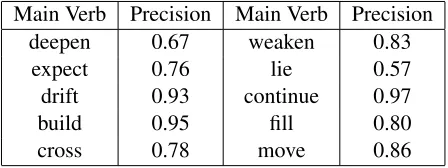
Table 1: Precision for top 10 most frequently occur-ring verbs
5.2 Results: Predicate-Argument Based Approach
κ= 0.69, demonstrating substantial agreement. The precision values are encouraging, and in most cases the reason for low precision is because of erroneous performance of the semantic role labeler system, which is corroborated by the percentage (47.47%) of ungrammatical templates among the irrelevant ones. Results for the automated recall values are shown in Figure 8, where precision values are varied to observe the recall. For 0.9 precision in ROUGE-WLCS, the recall is 0.3 which shows that there is a 30% near exact coverage over propositions, while for 0.6 precision in ROUGE-WLCS, the recall is an encouraging 81%.
0 0.2 0.4 0.6 0.8 1
0.4 0.5 0.6 0.7 0.8 0.9
Recall
Precision Threshold for Matching Test Sentences
ROUGE SRL
Figure 8: Automated Recall based on ROUGE-WLCS measure comparing the test corpora with the set of templates extracted by the Predicate-Argument (SRL) and the ROUGE based method.
5.3 Results: ROUGE based approach
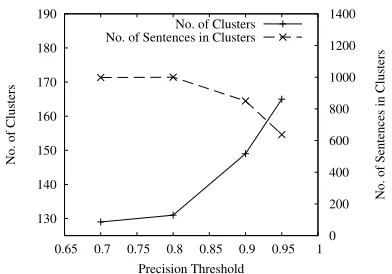
Various precision and recall thresholds for ROUGE were considered for clustering. We empirically set-tled on a recall threshold of 0.8 since this produces the set of clusters with optimum number of tences. The number of clusters and number of sen-tences in clusters at this recall values are shown in Figure 9 for various precision thresholds.
Precision was measured in the same way as the predicate argument approach and the value obtained
was 76.3%, with Fleiss’ kappa measure ofκ= 0.79.
The percentage of ungrammatical templates among the irrelevant ones was 96.7%, strongly indicating that post processing the templates using a parser can, in future, give substantial improvement. During ror analysis, we observed simple grammatical er-rors in templates; first or last word being
130 140 150 160 170 180 190
0.65 0.7 0.75 0.8 0.85 0.9 0.95 1 0 200 400 600 800 1000 1200 1400
No. of Clusters
No. of Sentences in Clusters
[image:7.612.329.525.73.210.2]Precision Threshold No. of Clusters No. of Sentences in Clusters
Figure 9: Number of clusters and total number of sentences in clusters for various Precision Thresh-olds at Recall Threshold=0.8
tions. So a fairly simple error recovery module that strips the leading and trailing prepositions was in-troduced. 20 templates out of the 149 were mod-ified by the error recovery module and they were evaluated again by the three judges. The precision obtained for the modified templates was 35%, with
Fleiss’ kappaκ = 1, boosting the overall precision
to 80.98%. The overall high precision is motivat-ing as this is a fairly general approach that does not require any NLP resources. Figure 8 shows the auto-mated recall values for the templates and abstracted sentences from the held-out dataset. For high preci-sion points, the recall is low because there is not an exact match for most cases.
6 Conclusion and Future Work
[image:7.612.89.282.264.399.2]can extract templates containing multiple verbs. It would also be desirable to establish the generality of the techniques, by using other domains such as newswire, medical reports and others.
Acknowledgements We would like to express our gratitude to William Cohen and Noah Smith for their valuable suggestions and inputs during the course of this work. We also thank the three anonymous re-viewers for helpful suggestions. This work was sup-ported by DARPA grant NBCHD030010. The con-tent of the information in this publication does not necessarily reflect the position or the policy of the US Government, and no official endorsement should be inferred.
References
ACE (2007). Automatic content extraction program. http://www.nist.gov/speech/tests/ace/.
Chakrabarti, D., Papadimitriou, S., Modha, D. S., & Faloutsos, C. (2004). Fully automatic
cross-associations. Proceedings of KDD ’04 (pp. 79–
88). New York, NY, USA: ACM Press.
Charniak, E. (2001). Immediate-head parsing for
language models. Proceedings of ACL ’01 (pp.
116–123).
Collier, R. (1998). Automatic template creation
for information extraction. Doctoral dissertation, University of Sheffield.
Elhadad, N., Kan, M.-Y., Klavans, J. L., & McKe-own, K. (2005). Customization in a unified
frame-work for summarizing medical literature.
Artifi-cial Intelligence in Medicine,33, 179–198.
Fellbaum, C. (1998). WordNet – An Electronic
Lex-ical Database. MIT Press.
Filatova, E., Hatzivassiloglou, V., & McKeown, K. (2006). Automatic creation of domain
tem-plates. Proceedings of COLING/ACL 2006 (pp.
207–214).
Fleiss, J. (1971). Measuring nominal scale
agree-ment among many raters. Psychological Bulletin
(pp. 378–382).
Kingsbury, P., Palmer, M., & Marcus, M. (2002). Adding semantic annotation to the penn treebank.
Proceedings of the HLT’02.
Kumar, M., Garera, N., & Rudnicky, A. I. (2007). Learning from the report-writing behavior of
in-dividuals.IJCAI(pp. 1641–1646).
Lin, C.-Y. (2004). ROUGE: A package for
auto-matic evaluation of summaries. Proceedings of
Workshop on Text Summarization.
Luhn, H. P. (1958). The automatic creation of
litera-ture abstracts. IBM Journal of Research
Develop-ment,2, 159–165.
Marsh, E., & Perzanowski, D. (1998). MUC-7 Eval-uation of IE Technology: Overview of Results.
Proceedings of MUC-7. Fairfax, Virginia.
Onyshkevych, B. (1994). Issues and methodology for template design for information extraction.
Proceedings of HLT ’94(pp. 171–176). Morris-town, NJ, USA.
Papineni, K., Roukos, S., Ward, T., & Zhu, W. (2001). Bleu: a method for automatic evaluation of machine translation.
Pradhan, S., Ward, W., Hacioglu, K., Martin, J., & Jurafsky, D. (2004). Shallow semantic parsing
using support vector machines. Proceedings of
HLT/NAACL ’04. Boston, MA.
Reiter, E., Sripada, S., Hunter, J., Yu, J., & Davy, I. (2005). Choosing words in computer-generated weather forecasts. Artif. Intell.,167, 137–169.
Riloff, E. (1996). Automatically generating
extrac-tion patterns from untagged text. AAAI/IAAI, Vol.
2(pp. 1044–1049).
Surdeanu, M., Harabagiu, S., Williams, J., &
Aarseth, P. (2003). Using predicate-argument
structures for information extraction.Proceedings
of ACL 2003.
Yangarber, R., Grishman, R., Tapanainen, P., & Hut-tunen, S. (2000). Automatic acquisition of domain
knowledge for information extraction.