Manuscript version: Author’s Accepted Manuscript
The version presented in WRAP is the author’s accepted manuscript and may differ from the published version or Version of Record.
Persistent WRAP URL:
http://wrap.warwick.ac.uk/125094 How to cite:
Please refer to published version for the most recent bibliographic citation information. If a published version is known of, the repository item page linked to above, will contain details on accessing it.
Copyright and reuse:
The Warwick Research Archive Portal (WRAP) makes this work by researchers of the University of Warwick available open access under the following conditions.
Copyright © and all moral rights to the version of the paper presented here belong to the individual author(s) and/or other copyright owners. To the extent reasonable and
practicable the material made available in WRAP has been checked for eligibility before being made available.
Copies of full items can be used for personal research or study, educational, or not-for-profit purposes without prior permission or charge. Provided that the authors, title and full
bibliographic details are credited, a hyperlink and/or URL is given for the original metadata page and the content is not changed in any way.
Publisher’s statement:
Please refer to the repository item page, publisher’s statement section, for further information.
Gesture Analysis and Organizational Research: The Development and Application of a Protocol for Naturalistic Settings
Abstract
Gestures are an underresearched but potentially significant aspect of organizational conduct
that is relevant to researchers across a range of theoretical and empirical domains. In
engaging the cross-disciplinary field of gesture studies, we develop and apply a protocol for
analyzing gestures produced in naturalistic settings during on-going streams of talk and
embodied activity. Analyzing video recordings of entrepreneurial investor pitches, we work
through this protocol and demonstrate its usefulness. While doing so, we also explore
methodological tensions in gesture studies and draw out methodological arguments as they
relate to the analysis of these fleeting and often intricate bodily movements. The paper
contributes a generally applicable protocol for the analysis of gestures in naturalistic settings,
and it assesses the methodological implications of this protocol both for research on
entrepreneurship and new venture creation, and for management and organization research
more generally.
Keywords
Gestures, naturalistic settings, investor pitches, organizational presentation, conversation
Introduction
Gestures are an underresearched but potentially significant aspect of organizational conduct
relevant to researchers across a range of domains such as organizational communication
(Jablin & Putnam, 2000), multimodality (Iedema, 2007; Kress & van Leeuwen, 2001), visual
studies (Bell, 2012; Bell, Warren & Schroeder, 2014), metaphor analysis (Cornelissen, 2005;
Cornelissen & Clarke 2010), and conversation analysis (Llewellyn & Hindmarsh 2010), and
for those interested in empirical settings in which gestures often occur such as keynote
lectures (Wenzel & Koch 2018), strategy briefings (Gylfe, LeBaron, Franck & Mantere,
2016) and investor pitches (Clarke, Cornelissen & Healey, 2019). In organizational research,
while the moving bodies of speakers have been drawn into analytic accounts (see Hindmarsh
& Pilnick 2007; Llewellyn, 2014; LeBaron et al., 2016), gestures, defined as movements of
hands and arms that co-occur with speech, as a specific subset of embodied conduct have
been largely overlooked. This is a significant oversight because gestures may be tightly
coupled with the messages and actions that speakers project in natural settings (Kendon,
1972; McNeill, 1985; Kaschak, Madden, Therriault, Yaxley, Aveyard, Blanchard & Zwaan,
2005). Gestures may elaborate upon what is said or add entirely new aspects not present in
speech. In this sense, gestures have been said to play “an integral part of an individual's
communicative effort” (italics in the original) (Kendon, 1983, p. 27).
Gestures have not been pursued in-depth in organizational research perhaps due to
certain barriers to the development of such work. Researchers wishing to investigate gestures
in naturalistic settings confront a variety of daunting methodological questions and
challenges. While there has been some work recently in the organizational domain in relation
to understanding gestures through experimental means, where conditions are orchestrated and
controlled by the researcher (Congdon, Novack & Goldin-Meadow, 2018), there is little
communications that routinely happen in organizations in the form of meetings,
presentations, handovers, discussions, etc. (Streeck, Goodwin & LeBaron, 2011). The
cross-disciplinary field of gesture studies is also a highly specialized domain that draws on
technical frameworks that may be unfamiliar to organizational researchers. For those new to
the area, there is little guidance on basic questions regarding how to record and describe
gestures, how to represent gestures in research papers, which gestural forms commonly run
alongside speech, and which research questions can be addressed by analyzing gestures. The
present paper addresses these concerns. It introduces the field of gesture studies and
empirically illustrates a protocol for gesture analysis in naturalistic settings. In elaborating the
protocol, we produce a gesture analysis of a single original dataset consisting of 54 video
recordings of “investor pitches” that we use to illustrate the value of the protocol, and in
doing so we highlight the role of theoretical assumptions in gesture research.
The paper is organized as follows. First, we introduce the field of gesture studies and
frame a central tension in the field, i.e., between action-oriented approaches that analyze what
gestures do and cognitive approaches that analyze how gestures offer insight into how people
are “thinking.” Literature on “investor pitches” is then reviewed and we argue they present an
interesting context from which to explore the kinds of contribution gesture studies might
make to research on organizational communication. A six-step protocol for gesture research
in natural field settings is then introduced and elaborated on through the analysis of the
“investor pitch” dataset. Here, we aim to contribute a protocol for naturalistic settings, in
contrast to recent research that has focused on manipulating gestures in experimental
conditions and on using experimental methods (Congdon et al, 2018; Clarke et al., 2019).
Through this analysis we reveal what we call an “entrepreneurial gesture code” or a recurrent
set of six gestural forms through which entrepreneurs address matters important to them
discussion and conclusion evaluate the protocol, and we consider how gesture analysis might
enhance studies of entrepreneurship and new venture creation and organizational and
management research more generally.
Gesture Studies: A Brief Introduction
Gesture studies is a multidisciplinary field that cuts across linguistics and the social and
cognitive sciences, and it is based upon a shared set of conjectures: gestures communicate,
have a distinctive character that separates them from general body movements and conform
to recurrent types. These points are briefly discussed below before exploring a central tension
within this multidisciplinary field.
Do gestures play a communicative role? In provocatively challenging this view Rime
and Schiaratura (1991) argue that they do not, suggesting that interlocutors typically fail to
notice gestures, that gestures make no difference to comprehension and that recipients often
fail to link gestures with lexical content. Gestures, they argue, are not communicative. The
field of gesture studies has however assembled compelling evidence against this argument
from studies informed by different methodological traditions. A series of classic experimental
studies (see Kendon, 1994, p.177-187 for a full account) show the importance of gestures in
communication. For example, Berger & Popelka (1971) demonstrate that recipients develop
more accurate understandings when utterances are produced alongside emblems or quotable
gestures (gestures that can be used as substitutes for words e.g. the “peace sign”). In another
experiment, Rogers (1978) played video recordings of people speaking and gesturing to
subjects under three conditions: (1) with sound and vision, (2) with sound and vision but
where the mouth and face of the speaker was blurred, and (3) with only sound. Visual access
comprehension for listeners. Drawing on very different methodological resources, early
microanalytical work in sociology (Heath, 1986; Goodwin, 1986) recovered how people
allow their conduct to be guided in light of interlocutors’ gestural work, for example, when
people point or nod and successfully redirect the visual attention of a companion without any
verbal content.
Second, there is widespread agreement that gestures have defined characteristics that
differentiate them from more general body movements such a fidgeting, postural shifts or
self-manipulations (Bressem & Ladewig, 2011; Kendon, 1996). Gestures are characterized as
distinctive phases of activity that are marked and separate. Schegloff (1984) calls them
“excursions” or movements that shift from a “rest position” through a preparation phase to
the main gesticulation or “stroke” phase, which may be “held” before returning to the rest
position via a “retraction” of some kind (Kendon, 1980, p. 212). As such, gestures have a
“peak” structure (Kendon, 1980) or a semiotic core or central business that is often, though
not always, bounded by a clear beginning and end. Moreover, gestures often display a kind of
symmetry (Kendon, 1996); when recordings are played backwards and forwards, the gesture
looks similar.
While gestures are used in a range of communicative settings for different
communicative purposes (Ekman & Friesen, 1969), researchers have identified particular
patterns through which people display gestures. A number of classifications for these patterns
have been developed (Efron, 1941; McNeill, 1992; De Ruiter, 2000; Cassell, 1998; Kendon,
2015). While each of these classifications is slightly different, they overlap a good deal, and a
shared vocabulary has been emerging. Deictic gestures point to either real or imaginary
persons or objects while emblems or emblematic gestures sometimes called symbolic gestures
the semantic content of speech in a literal fashion, i.e., a person talking about breaking a
tablet in two might motion with his or her hands to mimic breaking something apart. Like
iconics, metaphoric gestures depict imagery present in speech, but unlike iconic gestures the
verbal content does not have a material form, i.e., a person commenting on the length of a
meeting might accompany this comment with a hand rolling motion (Cassell, 1998),
depicting something that has gone “on and on.” Beat gestures (Cassell, 1998), sometimes
called parsing gestures (Streeck, 2008b), do not illustrate the content of speech but work to
divide or “parse” the speech. Kendon (2015) defines three categories of gestures: pragmatic
gestures reveal the action being performed; deictic gestures direct the attention of others; and
representational gestures conjure up objects, persons, spatial relations, etc. that may be literal
or metaphoric.
Gesture studies has developed as an interdisciplinary field based on these shared
conjectures. While the field is pluralistic, Kendon argues that the central tendency of
contemporary gesture studies is to focus on psychological processes. He argues that “for the
most part, the hand movements that people make when they speak have been studied as
representations of the substantive or propositional content of the utterance, seen as providing
clues about the mental or cognitive processes governing speaking” (Kendon, 2017, p. 157).
Links between psychology and gestures can be traced to pioneering nineteenth
century studies such as Tylor’s (1865) Researches into the early history of mankind, which
devotes three chapters to gestures. In the twentieth century, Kendon (2007) notes a series of
developments that framed and animated the psychology of gestures. For example, a search
for “language origins” (Hockett & Ascher 1964) led scholars to systematically codify the
design features of spoken language such that they could be compared to other sign systems in
which other actors engaged; this led, for example, to the analysis of great apes’ gestural
linguistics and Chomsky’s notion of a hardwired “language acquisition device” led
researchers to video record the utterances of very young children, data which revealed the
importance of semantic actions of any type, including gestures exchanged between mothers
and infants (Bates, Benigni, Bretherton, Camaioni, & Volterra, 1979). Alongside the work of
Bates et al. (1979), which linked speech and gestures as manifestations of a general process
came David McNeill’s (1985) influential argument that gestures share with speech a common
“computational stage” and thus form part of the same psychological structure (McNeill, 1985,
p. 350). In focusing on psychological activities occurring during speech, he challenged a suite
of previously secure distinctions, for example, between what is (and is not) “linguistic”
(McNeill, 1985, p.350).
With the protocol that we develop in the present paper we engage the psychology of
gestures by drawing upon cognitive linguistics (see Lakoff, 1987; Langacker, 1987; Talmy,
2000), a framework employed by McNeill (see McNeill & Levy 1982; McNeill 1992) and
others within the field (see Langacker, 2008). Cognitive linguistics, an approach to the
analysis of natural language originating in the late seventies, is concerned with how language
forms our thoughts by allowing us to organize, process and convey information. Specifically,
we draw on the foundational work of Lakoff and Johnson (1980, 1999) who developed
Conceptual Metaphor Theory (CMT). A basic tenet of CMT states that the pervasive use of
verbal metaphor reflects the fact that people think metaphorically and that such metaphors are
manifested in speech, gestures, body movements, and visuals (Forceville & Urios-Aparisi,
2009; Cienki & Müller, 2008). According to Lakoff and Johnson’s (1980, 1999) theory,
language interacts with the body. Conceptual metaphor is “a natural part of human thought . .
. [and] which metaphors we have and what they mean depend on the nature of our bodies, our
interactions in the physical environment” (Lakoff & Johnson 1980, p. 247). Metaphors link
is the conceptual domain from which we draw metaphorical expressions based on concrete,
embodied and easily understood concepts. The “target” domain tends to be abstract and takes
its structure from the source domain through the metaphorical link.
Based on this argument, evidence of how people think of one domain in terms of
another should appear in gestures; “if speakers are thinking in terms of imagery from the
metaphoric source domain, we might expect to see some representation of that imagery in
their gestures” (Cienki, 2016, p. 604). The enactment of metaphors in gestures can therefore
serve as strong confirmation of the active use of a metaphor in an individual’s language and
thoughts and supports “the dynamic creation, and recreation, of metaphoric thought in the
bodily act of online communication” (Gibbs 2008, p. 292; Casasanto & Bottini 2014; Cienki
1998, 2005, 2013; Müller 2008; Sweetser 1998).
While cognitive linguistics is especially good at understanding metaphoric (McNeill
1992) or representational (Kendon, 2017) gestures, we argue for the need to supplement this
predominant focus with microanalytic sensibility (Goodwin, 2000a; Streeck, 2008a)
grounded at the interactional level to recover the social and interactional functions of
pragmatic and deictic gestures (Kendon, 2017). In noting that the field of gesture studies has
tended to privilege psychological processes, Kendon (2017, p. 157) sounds a note of caution
by reminding us that “speaking is also a form of social action, however, and gestures play an
important role in this” (emphasis added). As well as providing clues on how people are
thinking, gestures can also be used to do things. Through the protocol we develop we
therefore draw upon methodological resources from the microanalytic approach (see Streeck,
2008a), which itself engages and draws upon conversation analysis (Sacks, Schegloff &
Conversation analysis (CA) was first developed in the 1960s (see Schegloff 1968;
Sacks et al., 1974; Sacks, 1992) and is now an extensive international discipline focusing on
the organization of body movements, gestures and speech. CA starts from the idea that people
“recognize the shape and character of what is occurring” (Goodwin, 2000a, p. 1491) not from
shared mental models but from the interplay between talk and embodied activity within
sequences of prior and subsequent actions. From a CA perspective, action is investigated in
terms of “contextual configurations” meaning that domains of phenomena that are often
considered so distinct they are treated by separate academic disciplines such as language, the
body and material structures, in CA are analyzed together “as integrated components of a
common process for the social production of meaning and action” (Goodwin 2000a, p. 1490).
Conversation analysis was influential in generating key “observational studies” of
gestures not least because gestures form a domain in which speech, materiality and the body
interact so clearly (see Goodwin, 1980; Goodwin, 2000a; Heath, 1986; Streeck & Hartge,
1992; Streeck, 1993). CA approaches to gestures (e.g., Goodwin, 1979, 1986, 2000a, 2003;
Goodwin & Goodwin, 1986; Hayashi, 2003; Heath, 1986; Sidnell, 2005; Schegloff, 1984;
Streeck, 1993, 1994) have demonstrated how gestures play an important role in interactional
organization or how “speakers parcel out between speech and gesture what they project in
their utterance in ways that vary appropriately in relation to the communicative circumstances
in which they find themselves” (Kendon, 1994, p. 188). In an analysis of medical interviews,
for example, Heath (2002, p. 601) shows how gestures, “demarcate the position, the
scale…and the character of the suffering. They enliven, if only momentarily, different parts
of the body and provide a dramatic display of the symptoms and suffering incurred by the
patient.” Gestures have been shown to serve as cues relevant for the organization of
interactions, i.e., turn-taking (Goodwin & Goodwin, 1986; Schegloff, 1984; Streeck &
responses (Streeck, 1994) and so on. Such work has shown gestures to serve as much more
than a “visual mirror of lexical content,” displaying aspects of meaning not present in the
accompanying stream of speech (Goodwin, 2000a, p. 1498).
In summary, gestures studies is a mature internationally recognized multidisciplinary
field researching a range of diverse issues such as first and second language acquisition
(Ozcaliskan & Goldin-Meadow, 2005; Tellier, 2008), narratives and gestures (Jacobs &
Garnham, 2007) sign languages (Corina & Gutierrez, 2016; Green, 2017) conditions such as
aphasia (Goodwin, 2000b) and language impairment (Sanjeevan et al., 2016), gesture
recognition (by humans and computers) (Cassell, 1998), and robotics (Ng-Thow-Hing, Luo &
Okita, 2010). It is also theoretically pluralistic with diverse frameworks ranging from
semiotics (Bouissac, 2008), ethnomethodology (Goodwin, 2000a), deconstruction
(Montredon, Amrani, Benoit-Barnet, Chan You, Llorca, & Peuteuil, 2008), and microanalysis
(Streeck, 2008a) to cultural studies (Quinn, 2008) and cognitive linguistics (McNeill, 1992).
In building our protocol we have thus made choices regarding which theoretical and
methodological resource to engage. To develop a comprehensive but practically useful
protocol for naturalistic settings, we have used mainstream approaches that grant us access to
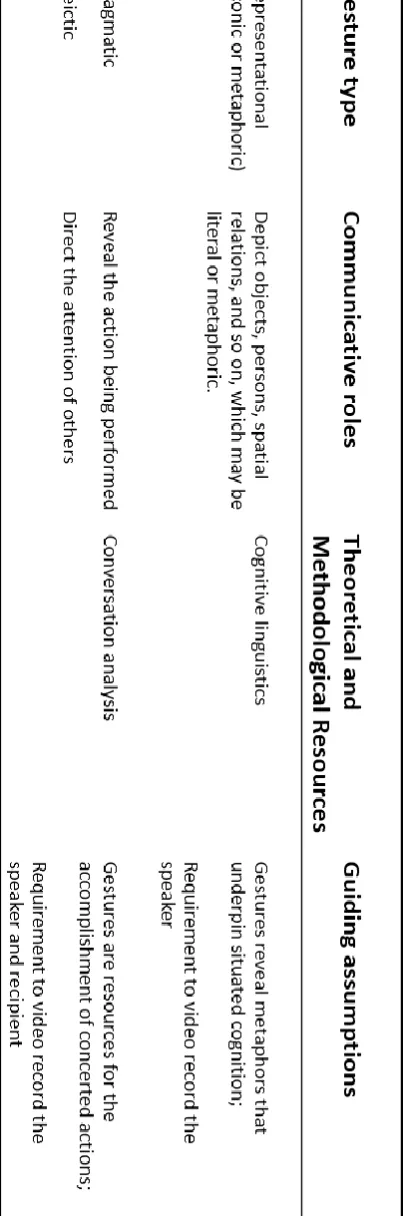
representational, pragmatic and deictic gestures (Kendon, 2017) (see Table 1 below for an
overview of these gesture types, their communicative roles, theoretical and methodological
resources and guiding assumptions). The relations between these approaches and the extent
of their compatibility are addressed later in the paper.
---
INSERT TABLE 1 ABOUT HERE
---
We develop and demonstrate our protocol for the analysis of gestures in naturalistic settings
by examining gestures within the context of “investor pitches” where entrepreneurs are given
a limited amount of time to “sell” their business propositions to an audience of potential
investors (Clarke et al., 2019). The resulting protocol is not specific to entrepreneurial
contexts and is relevant for the analysis of gestures in a wide range of organizational settings
where interpersonal or group communication, understanding or persuasion is important.
The acquisition of investment is a critical step for many entrepreneurs in the early
stages of their ventures; as such, attracting appropriate investors to support their
entrepreneurial ventures is essential if their businesses are to grow and succeed.
Entrepreneurs, however, typically face challenges in convincing investors of their ventures at
this stage due to the “liability of newness” associated with their ideas with often little in the
way of a track record, obvious asset value or profitability to show (Brush, Greene & Hart,
2001; Cassar, 2004). In this context, how entrepreneurs communicate about their ventures is
crucial for convincing stakeholders to support the ventures and securing investment that can
allow these entrepreneurs to further develop their ventures (Bird & Schjoedt, 2009). Most
prior research on entrepreneurial communication has focused on linguistic forms of
communication including how entrepreneurs use specific forms of speech such as rhetorical
argumentation and narratives to impress a particular understanding on stakeholders (Aldrich
& Fiol, 1994; Navis & Glynn, 2010; Van Werven, Bouwmeester & Cornelissen, 2015).
Here we focus on a specific form of entrepreneurial communication, the “investment
pitch,” which has emerged as the industry standard in recent years whereby entrepreneurs
present and describe their venture ideas to prospective investors over a period of five to ten
minutes (Brooks, Huang, Kearney & Murray, 2014; Clark, 2008). As Pollack, Rutherford and
important behaviors that an entrepreneur will enact in the exploitation process.” High levels
of uncertainty characterize such pitches, as investors have to judge the feasibility of a venture
and its future capacity to generate revenue based on the limited information provided in the
pitch. Although a good pitch is unlikely to overcome a baseless or flawed opportunity, having
an excellent idea is not sufficient to ensure funding and “without a good pitch, resources will
not likely be forthcoming” (Pollack et al., 2012, p. 917). In sum, investment pitches offer an
opportunity for entrepreneurs to personally communicate their ideas and a successful
“performance” is essential in gaining support and resources from investors (Cardon, Wincert,
Singh & Drnovek, 2009; Chen, Yao, & Kotha, 2009).
Like research on entrepreneurial communication more generally, previous research on
entrepreneurial pitches has tended to primarily focus on the linguistic and rhetorical strategies
that entrepreneurs use to persuade investors to fund their ideas (Clark, 2008; Pollack et al.,
2012). Mason and Harrison (2003), for example, analyzed the reactions of 30 business angels
to a video recording of an entrepreneur’s real-life pitch presentation and found that the
clarity, content and structure of the presentation featured heavily in business angels’
decisions on whether to invest. Pollack et al. (2012) highlight the pitch as a narrative process
through which entrepreneurs craft and tell a story that engages investors by justifying the
existence of the venture and by convincing them to offer their financial support. While there
have been suggestions that embodied dimensions of pitching may be important, related
research has been limited (Huang & Pearce, 2015). Alongside narrative structures, Chen et al.
(2009) examined the importance of entrepreneurs expressing passion while making pitch
presentations, defining passion as the use of energetic body movements, rich body language
and animated facial expressions. More recently, Clarke et al. (2019) have shown that while
employing verbal strategies in pitching to investors, entrepreneurs also use hand gestures to
We aim to build on this research by attending to the embodied aspects of
entrepreneurial communication observed during pitch presentations. In particular, we argue
that entrepreneurial pitches provide one interesting and high-stake context from which to
examine how gestures are used in organizational communication, and we thereby aim to
contribute to previous literature in these areas, which has overlooked the entrepreneurial body
as a key semiotic domain in pitch presentations.
Protocol for Gesture Analysis in Naturalistic Settings
Below, a six-step protocol for gesture analysis is described drawing upon an original dataset
of video recordings of investor pitches. As we outline above, we see “investment pitches” as
a particularly appropriate setting to develop and apply our protocol given that research is
increasingly showing that effective communication through both speech and gesture is
integral to an entrepreneur’s success (Clarke et al, 2019). However, the protocol we outline
below can be applied far beyond this domain in a wide range of organizational
communication contexts. This could include formal and informal organizational presentations
and interactions (briefings, keynotes, meetings or discussions) either with small or large
groups of individuals. Figure 1 provides a visual overview of this protocol for gesture
analysis in naturalistic settings.
--- INSERT FIGURE 1 ABOUT HERE ---
Step 1: Data collection
Gestures are fleeting and appear in subtle and sudden ways in naturalistic settings.
Attempting to analyze gestures from memory or through note taking would therefore be very
audio-visual capturing of gesture aligns with recent developments in organizational research
where video is fast becoming a key resource for those studying communication and
multimodality (Goodwin 2000a; Gylfe et al., 2016; Heath, Hindmarsh & Luff 2010;
Hindmarsh & Llewellyn 2018). Video analysis allows us to examine “starkly visible
‘extralinguistic’ features,” creating new possibilities for researchers by facilitating microlevel
analysis through the repeated scrutiny and frame-by-frame examination of the same
motion/speech events (Kress, 2011, p. 253; Luff & Heath, 2012).
For the present paper, data were collected by one of the authors who attended
Business Angel pitching events throughout the UK, collecting 54 video-recorded “investor
pitches.” All speakers signed an ethics approval form, and all investors were given a chance
to “opt out,” meaning that any questions they asked would be removed from the digital
record. When introducing the project, our interest in gestures was not revealed to limit the
likelihood of speakers reflexively or playfully gesturing during their presentations.
Videoing interaction is, to differing degrees, intrusive. A common question concerns
whether participants alter their behaviors when videotaped. Entrepreneurial pitches are,
however, routinely videotaped, and the presence of the video camera was not considered at
all unusual. Rather than asking whether videotaping changes participants’ behaviors, an
alternative approach involves considering how people orient themselves to the camera by
thinking in terms of “analytics” rather than “ethics” (Speer & Hutchby, 2003). In our data, for
example, one entrepreneur oriented to our camera through a dietic (pointing) gesture when
explaining the difference between what it costs to make the presented product and its selling
price. Gesturally, he implies that the video will “give the game away.” A camera is thus used
to enable the entrepreneurs to develop a sense that he is letting the investors in on “trade
The video camera was mounted on a tripod and placed at the back of the presentation
room. Decisions on where to point the camera have drawbacks and should be theoretically
informed. In cognitive linguistics, authors such as McNeill define “gesture space only with
reference to the body of the party producing the gesture” (Goodwin, 2000a, p. 88).
Microanalytic approaches (Schegloff, 1988) record both the body of the party making the
gesture and interlocutors to recover how gestures are “oriented to” by others. For our data
this was a challenge, as there were a large number of potential next speakers. At least two
additional cameras would have been needed to capture key angles, which was deemed too
obtrusive. A further approach would have involved allowing the camera to “rove,” but this
also presents drawbacks, it is difficult to anticipate where the next matter of interest will
occur resulting in the researcher being one step behind the action (Heath et al., 2010, p. 41).
Like all data then, ours present limitations; they were produced with a single fixed position
camera focused on each speaker and providing side views of audience members. Future
researchers employing this protocol will also have to make similar trade-offs between being
excessively intrusive and capturing all activity, even in smaller group interactions the
position and distance of the camera must be carefully considered to ensure, for example,
interlocutors are not unduly bothered by its proximity and location.
Step 2: Identify recurrent gestures
For expositional purposes here we only consider how to recover the different embodied
phases of gestures. At this point in the analysis the focus is not on what the gestures “mean”
but rather the aim is to highlight the most common gestural forms in the dataset. In order to
understand the meaning or use of the gesture, the visual form must be combined with the
We performed an initial descriptive coding that first involved viewing and reviewing
the video to identify recurrent gestures throughout the data. As typical in gesture studies, we
focus predominantly on the ‘stroke’ phase of a gesture which is the gesture phase involving
the most distinct exertion of effort as opposed to the preparation phase leading up to the
gesture or the retraction of the hand after the gesture (Kendon, 2004). Our corpus of pitches
revealed a common repertoire of gesture shapes that ran alongside speech: (a) “cutting”
(Kendon, 1994) or “slicing” (Streeck, 2008b), (b) “drawing shapes in the air” that represent
semantic content (Kendon, 1997), (c) “M form” gestures from the center outward and from
the outside inward, (d) the “ring” or “precision grip” (Napier, 1980), (e) parsing gestures
(Streeck, 2008b) and (f) pointing. We found that this framework of key gesture forms,
accounted for much of the gesturing across the sample. These basic gestures are also likely to
be present in many other forms of organizational communication given they have been
extensively identified and detailed in a wide range of settings across the wider gesture
literature (Streeck, 2008b).
Within the present sample, several of these gestures took a readily ideal-typical form
that has been described in prior literature. Such gestures include “the cut” and “precision
grip” (Kendon, 1994; Streeck, 2008b). These were identified relatively simply as was their
recurrence. A further class of pragmatic gestures directing the conduct of others was
identified. These were also quite easy to identify because under the study settings, subjects
typically use these gestures to perform one of two actions: selecting the next speaker or
directing the visual attention of the audience members.
Other cases posed more challenges. In ongoing conduct, speakers cannot be relied
upon to reproduce well-known gestures starting and ending at rest. Rather, arms and hands
often move constantly and sometimes idiosyncratically with one gesture quickly morphing
empirical work. When viewed closely, for example, we found many seemingly random
movements to be parsing out a pragmatic structure, i.e., the hands would rise and fall while
beating out syllables. Below we introduce the “shape” of only the most recurrent gestures
identified from our dataset.
(a) Cutting gestures. In these pitching
environments, one gesture that reoccurred is
the “side-stroke” or “cut” (Kendon, 1994),
and an illustration is provided in extract 1. In
this case, the hands and arms are initially at
rest, and then they take an “excursion”
(Schegloff, 1984). At the prestroke hold, both
hands are raised with fingers out stretched and
with palms facing one another. The stroke
phase involves them being brought together,
after which they are pulled apart to the left
and right with a “swooshing” motion. Of
course, there are subtle variations in practice.
In some cases, the palms of the hand are held
together, as if in prayer, before being moved
apart in a cutting motion.
(b) Drawing shapes in the air. Entrepreneurs also routinely drew shapes in the air (Kendon,
1997). On some occasions, space would be fashioned as a quantitative tableau; gestures made
would be used to depict something “large.” Otherwise, a geographical tableau would be
invoked. The space above the speaker denoted “north,” and the space close to the ground
denoted “south.” Shapes “drawn” tended to be representational.
In the case illustrated below (extract 2), in the “rest” phase the left hand is inert and
the speaker is holding the “clicker” with his right hand. The gesture then begins. At the
prestroke hold both hands are raised apart with palms held open and facing one another. The
gesture then involves three phases. While maintaining the formation, both hands move to the
bottom left and are held there before the right hand moves to the top right with a rare lassoing
motion before both move to the center (phase c). Analytically, the third phase (phase c) is
part of the gesticulation and should not be confused with rest or retraction. With a rapid up
and down motion, his hands mark the space in the center; they are doing something at this
(c) Outward and inward form gestures. Another common gesture was a distinctive
M-shape drawn by the hands either from the center outwards (extract 3) or from the outside
inwards (extract 4).
For the prestroke phase illustrated in extract 3, the hands are drawn together from rest
into the middle. The index fingers of both hands are touching. In the stroke phase they are
drawn apart outwards and then upwards along a curve. On occasion, the hands are moved all
the way across and back to their starting position. In this case, they are held in the final
position (the third image shown below in extract 3) before immediately starting to perform a
In a second example (extract 4), the speaker starts with her hand positioned at the
outside of the M-shape and then moves them inwards. At the preparation phase, the hands are
apart. The stroke phase brings the hands upwards and inwards until they meet. In this case,
the speaker is gesticulating constantly. She moves into the prestroke hold from a prior iconic
gesture to depict the shape of a container and from rest immediately into a parsing gesture.
(d) “The ring.” The gestures mentioned thus far involve hands moving in expressive ways,
but more subtle hand gestures are also significant. One such form reoccurs in our sample and
is called “the ring” or “precision grip” (Napier, 1980). Here, the index or middle finger
connects with the thumb, forming a circular shape to connote specificity or precision in
In the example illustrated above (extract 5) the entrepreneur’s left hand is initially at
rest before being raised with the thumb, index finger and middle finger though without them
touching. The gesture rises and falls. On three occasions the grip moves up and down (for
brevity, not all are shown in the images above). This hand shape may be doing two things at
once, denoting precision (Kendon, 2004) and parsing out semantic structure (Streeck, 2007).
(e) Parsing or “beating” gestures. The most recurrent gestures observed in these materials
are parsing gestures where one hand rises and falls in isolation or in combination with the
other. An example is provided in extract 6 where the speaker repetitively brings his hands
together. In this case, from the images alone it might be assumed that the speaker is counting,
as the right hand pulls back and is brought down upon the little finger as if starting to count
with a number sequence. As with all of the cases considered above, this can only be
determined when the visual form is combined with speech, as one modality elaborates the
(f) Deictic gestures. Finally, while many of the gestures considered above are “metaphorics”
(McNeill, 1992) that communicate images of abstract concepts, pointing is more obviously
involved in practical activity and in the business of directing the visual and embodied conduct
of others (see Goodwin, 2000a). Very often, as is already apparent, entrepreneurs pointed at
their PowerPoint slides and in this way found themselves in a close, expressive and embodied
relation with the material technology in the setting. Pointing directed the visual attention of
audience members to the slides or to specific details presented on particular slides.
Entrepreneurs would point to direct the visual attention of the audience to objects within the
room, and pointing was also a key resource used to manage speaker allocation and
transitions.
Step 3: Link gestures and speech
We next incorporate speech into the analysis by examining how bodies move in relation to
speech. Do gestures merely reflect speech or do they also embellish it? Matters of timing are
also considered; do gestures travel ahead, behind or alongside speech? To the extent that
speech and the body mutually elaborate one another, recipients may grasp the speaker’s
message not from hand movements alone but from the “configuration of activity” (Goodwin,
2000a) as a whole. It is in this step that we begin to see what the gestures are adding to the
communicative account and the features that would ordinarily be neglected if gestures were
not taken into account.
(a) Gestures that reflect speech. In a range of cases the gestures considered above reflected
the lexical content of speech, acting to further emphasize or support the point or argument
business idea as a solution to a problem. This is a commonly recurrent feature of the observed
pitches. Entrepreneurs describe business problems that they are eliminating; problems that
they had initially experienced but can now be eradicated by using their novel product or
service. It is in these communicative environments that we find “side-strokes” or “cutting”
(Kendon, 1994) gestures. In extract 1 the speaker makes a cutting gesture (lines 4) as he
describes how his product removes a major logistical challenge associated with existing
technologies (“you don’t have to worry about that,” lines 12-3).
When we moved through our categories in this fashion incorporating speech, what
emerged was a basic descriptive pattern of the way gestures aided the entrepreneurs in the
communicative challenges they faced. To summarize, (1) the “cutting” (Kendon, 1994) or
“slicing” (Streeck, 2008b) gesture routinely appeared as part of negation-talk where the
entrepreneurs speak about overcoming problems. (2) Entrepreneurs “drew shapes in the air”
particularly when spatially demarcating the markets for their products while (3) “M-form”
gestures denoted expansion or the establishment of new combinations. (4) The “ring” or
“precision grip” (Napier 1980) occurred where points of detail were presented or when
speech. This framework is not exhaustive, and of course there are variations, but it serves as a
useful starting point. We call this combined and refined typification of six gestural forms
used alongside speech an “entrepreneurial gesture code” because the gestures are
omnipresent across the pitches and are closely associated with the business of communicating
entrepreneurial ventures, including matters such as “expansion” (into new markets), new
resource “combinations,” “negation” (eliminating problems), “demarcation” (into different
market segments), and “specificity” (unique selling points). When addressing problems
related to entrepreneurial work, the body is enlisted in recurrent and recognizable ways.
Future researchers drawing on this protocol can similarly develop a specific “code” for their
organizational communication setting of interest based on the common gestural forms used
alongside speech to achieve certain communicative goals in their particular research context.
(b) Gestures that embellish speech. Gestures often do more than simply reflect lexical
content. They often either recast lexical content or add aspects not apparent from speech and
which would otherwise be overlooked if gesturing was not examined. An example is
presented in extract 7 (see also extracts 10 and 11), which highlights the remarkably fine
interplay between speech and the body. Here, in response to a question, the entrepreneur is
explaining how his firm generates its margins. This hinges on the cost of inputs into the
production process. The entrepreneur discusses alternative ways of repairing road surfaces,
claiming that his product, made from recycled car tires and bitumen, is cheaper to make and
use than the alternatives. From his speech alone the entrepreneur is simply listing the cost
(per ton) of the main three alternatives. However, when a gesture is drawn into the account,
we see subtle ways in which the entrepreneur puts a slightly different spin on things, invoking
combines two aspects of the “entrepreneurial gesture code,” namely, “precision grip” and
sketching diagrams or shapes in the air (Kendon, 1997).
As the entrepreneur lists costs (line 1), he also starts his gestural work, raising his
right arm. He draws a series of three lines in the air in the same direction away from his body.
In each case, the line is mapped using the thumb and forefinger, which form a “precision
grip.” The lines are drawn at three different heights, which correspond to a scale of value
running from low (towards the floor) to high (upwards).
When the speaker embarks upon each list item, he moves his hand into position and
holds it there in “preparation” (Streeck, 2002). His hand only moves through the line as part
of the “stroke phase” (Streeck, 2002) as he comes to the cost. The gesture marks not the
pragmatic structure of his speech, i.e., the beginning of each item on the list, but the item of
the preparation and stroke phase than the gap between 500 and 140. The entrepreneur’s cost
advantage hinges on this second gap between bitumen and ground rubber. The numbers are
organized in gestural space to persuasively inflate a sense of the firm’s cost advantages. The
gestures are not simple visual mirrors of lexical content “but a semiotic modality in their own
right” offering additional and complementary information (Goodwin, 2000a, p. 1498).
(c) Timing. Finally, and staying with the same speaker, we consider the matter of timing;
whether speech and gesture coincide or indeed become temporally separated. Consider an
example in this regard (extract 8). Here the entrepreneur is discussing the product that he is
pitching, pellets, a sample of which are on display at the back of the room. Alerting the
audience to this, he gestures towards the table where they are positioned before telling the
audience where they are. His gestural work overtakes his speech. The pointing gesture is fully
extended as he says “or” (line 1), which comes before he tells the investor where the pellets
are displayed (lines 4-5).
The fact that his gestural work occurs ahead of his speech is useful because when an
audience member shifts her gaze to the back of the room (see middle image above), we have
speaker’s gestural work rather than to his speech because she turns to look before the speaker
states where the pellets are. We see here that “gestures communicate” (Kendon, 1994) with
the audience member being guided to find the referent (in this case the entrepreneur’s
product) from the gesture. The data capture her response and thus her sensemaking in how
she has rendered the import of the speaker’s embodied conduct.
Step 4: Link gesture and speech to the material context
We now incorporate materiality into our analysis (Hindmarsh & Llewellyn, 2018). The
entrepreneurs we recorded were often holding a material object in one hand (see extracts 1, 2,
3, 5, 6, 7, and 8), and as we have seen, their gestures often involved two hands. As such,
speakers needed to spontaneously develop local improvisations that allowed them to
incorporate the material object into the gesture. For example, to perform a cutting gesture,
which involves two flat palms, the speaker in extract 1 found a way to press the clicker into
his open palm with his thumb. In extract 2 the speaker sketched shapes in the air to demarcate
his market. He points to the floor with both hands to denote the market for small trucks but he
is holding the clicker in his right hand and thus must adapt. His little and third finger moves
In extract 3, the speaker makes an expansive gesture, drawing an “m-shape” in the air. He
improvises by sketching the curve with the thumb and index finger of his encumbered right
hand.
The clicker does not act in isolation but in tandem with slides projected onto a screen
behind the speaker. Entrepreneurs elaborated on their slides verbally and by gesturing
towards the screen. We found that entrepreneurs often engaged the gesture code narrowly and
infrequently when presenting to slides. The body became progressively less active. Unless
entrepreneurs established localized improvisations, gestures became limited to “parsing,”
“pointing,” and “listing” semantic content with the clicker used as a conductor or baton.
When speakers placed the clicker down before taking questions, a transformation was
often evident. The inert right hand suddenly became active. In extract 9 (further below), for
the duration of the presentation the speaker’s left hand only performed parsing and pointing
gestures. The “gesture code” is engaged in a limited manner. After 18 m 41 s the clicker is
placed down and the mode of bodily engagement has changed. Immediately, both hands
expressively gestured together and towards the audience. When not active, the hands assume
an entirely new “at rest” position, ready to be called into action. To understand patterns of
engagement with a “gesture code” it is necessary when analyzing gesture in any naturalistic
setting to explore how materiality enables and constrains gesturing rather than making
premature assumptions about an interlocutors’ gestural expressivity.
Step 5: Analyze the interactional and pragmatic functions of gestures
Kendon (2017) suggests that gesture studies tend to be positioned between one of two central
poles, i.e., between an action-oriented concern with the pragmatic and interactional work
how people are “thinking.” In this step we consider the pragmatic work performed by the
gestures. Gestures supply people with resources for performing social actions (Kendon, 2017)
and can contribute in a range of ways to multiparty interactions (Schegloff, 1988; Goodwin,
2000a). In the present data corpus, gestures were deployed to perform two recurrent sets of
social actions: (1) speaker allocation, i.e., passing on a question to a co-presenter or selecting
an audience questioner, and (2) guiding the attention of audience members to an object,
person or detail within the room. Examples are considered below.
Methodologically, those analyzing the pragmatic function of gestures can claim
strong evidential basis (Sacks et al., 1974) that gestures do what they claim. An illustration is
already presented above in extract 8. In this case, because the dietic gesture occurred ahead of
speech and because the video captured the embodied response of an audience member who
turned and redirected her gaze before the speaker mentioned the whereabouts of the object,
we were able to gain a strong “evidential warrant” (Sacks et al., 1974) for the claim that the
gesture itself did something, i.e., it guided the audience member’s conduct and directed her
attention within the scene. The analyst can ground his or her interpretations by taking into
consideration the displayed orientations of participants who, confronted with a gesture,
determine and display what they take the gesture to mean. In addition to recovering social
actions performed by gestures, they can be analyzed pragmatically to recover rules and norms
operative within organizational settings. In this sense, gestures are both interactional and
social. As an example, take extract 9 below where the entrepreneur gestures towards an
audience member. From the visual channel alone the gesture itself might be confused with a
blocking gesture. The hand is held in front of the speaker with the palm raised and facing the
recipient as if to request that they stop talking. Quite to the contrary, the gesture is
To grasp how the gesture is oriented to in this fashion, we must consider not just
speech and materiality but also an appreciation of norms within the setting in which the
gesture engages. In this case, the entrepreneur has just placed the clicker down, signaling the
end of the presentation phase of the pitch. He pauses and looks up, accountably scanning the
audience for a question. He orients to a new participation framework (Goffman, 1981). As he
does so, a hand is raised in the audience just wide of the shot. The entrepreneur orients to this
emblematic gesture (i.e., a raised hand) by gesturing towards the investor (captured by the
image above) with his palm raised and facing the recipient. Rather than preventing the
individual from speaking, he is clearly identifying them as the next speaker with a dietic
gesture. This hinges not on the handshape itself or on what the speaker is “thinking”, but on
where the gesture appears in this unfolding sequence. As his gesturing hand moves back to a
resting position, the entrepreneur says, “thank you,” verbally marking the successful
accomplishment of the embodied work performed by their mutually elaborating gestures.
The subtle normative nature of this stretch of embodied conduct is apparent enough.
appropriate time to make a contribution by making a gesture that signals a desire to speak. In
and through this gestural work, the parties “orient to” and reproduce a simple social
constraint that is relevant to the organization of conduct in this setting.
The two examples presented above show how gestures direct the conduct of
interlocutors and how they can thus be understood as intersubjective accomplishments rather
than, for instance, products of mind or some underlying reasoning. For LeBaron and Streeck
(2000, p. 119), gestures “originate neither in the speaker’s mind nor in the process of
speaking…rather gestures originate in the tactile contact that mindful human bodies have
with the physical world.” In the cases considered, clear evidential grounding for analytic
claims is noted, arising from the fact that the gesture relevance was “oriented to” by
participants themselves.
To some extent, whether studies pursue interactional work performed by gestures or
examine the insight that gestures provide into how people are “thinking” (Kendon, 2017) will
reflect prior theoretical commitments. However, we argue that they should also be driven by
pragmatic considerations on the nature of the setting considered – with such theoretical
commitments emerging from observations and initial gestural depictions. When a surgeon
gestures to request a scalpel, the central concern in this setting is pragmatic, i.e., whether the
action implication of the gesture is recognized accurately and swiftly. What the surgeon is
“thinking” is, comparatively, less interesting. In other settings, the reverse is true. In
analyzing the business keynote speeches of Steve Jobs, Wenzel and Koch (2018) describe the
central role of expressive gestures. However, during the examined keynote speeches, gestures
did not play a strong pragmatic role, and audience members could only exhibit collective
affiliation with the message by applauding or cheering. For keynote speeches the key
said. As such, in our data, the pragmatic functions of gestures are largely secondary to what
the gestures represent or convey to an audience. Investors wanted to hear business ideas and
concepts and to be engaged with the entrepreneur’s vision, and it is to this point that we now
turn. Therefore, in future research using this protocol the interactivity of interlocutors in the
specific organizational context will play a role in the level of importance attached to the
pragmatic function of gestures in the analysis.
Step 6: Gestures and metaphors
Finally, we incorporate a specific concern with metaphorical gestures and with the images
that entrepreneurs create through their speech and their body to communicate ideas. This
sixth step is based on strong evidence from the multidisciplinary field of gesture studies
(Cienki, 1998), which shows that a large proportion of gestures across communicative
contexts are metaphorical in nature, depicting abstract ideas through concrete gestural
embodiment and symbolization. In the specific context of entrepreneurship, metaphors can
encode and articulate novel ideas that entrepreneurs have in terms of familiar domains of
understanding that when well-chosen may deeply resonate with, reassure or stimulate
recipients (Cornelissen & Clarke, 2010).
To illustrate the importance of metaphors in gesture using our dataset, we start with
extract 10. Clearly, this extract is laden with metaphorical expressions and imagery. A source
domain for each metaphorical word or expression was developed to characterize the
underlying metaphor (Pragglejaz, 2007). Words used metaphorically are underlined and the
associated source domain codes follow in brackets and capital letters. Many of these
correspond with source domains identified elsewhere within cognitive linguistics (Grady,
In this example, considering the interplay between metaphorical speech and gesture
reveals several interesting general patterns in our material, including gestures that: (1)
embellish verbal metaphors, (2) add metaphorical elements to nonmetaphorical speech and
(3) cue upcoming metaphors used in speech.
As the extract begins, the entrepreneur has both hands apart and facing each other,
palms held flat. In the stroke phase, the right hand moves into a claw-like formation and rises
up and down numerous times in succession. Rather than parsing semantic content, this is a
metaphoric gesture; he is pushing something down, which then rises up. The gesture
represents the company trying to “nail down” (line 2) a solution to security problems in the
cyberspace market. His gestural work is engaging and embellishing the metaphoric content of
his speech. The gesture is not literal; the speaker does not depict the act of hammering down
a nail, but rather emphasizes a “downwards” motion representing the battle to suppress
problems that would otherwise spread.
Gestures can also contribute entirely new metaphorical elements (see also
Cornelissen, Clarke & Cienki, 2012). Consider the second gesture (gesture 2) in extract 10
them so that the backs of his hands are now facing the audience. In the stroke phase he moves
his hands outward in an M shape, and then he turns them so that his palms face the audience
as if he has thrown or flicked something outwards. This gesture elaborates upon the term
“outsourcing” invoked through his speech. His speech addresses how companies often
outsource IT services to “third parties” who might also pass them onto “fourth parties.”
Although “outsourcing” is a highly conventionalized expression, we see that the speaker
physically activates this expression through gesture by moving his hands to enact the
movement of throwing or giving something away. For cognitive linguistics, this gesture
stands as evidence of the speakers’ situated cognition; he is thinking in an embodied fashion
illustrating metaphorically that companies are “handing” work to others.
Metaphoric gestures can also occur ahead of speech, cueing audiences about
forthcoming content. This idea is illustrated when the entrepreneur states that “outsourcing”
results in a number of “security holes.” In this case, he produces a metaphoric gesture before
articulating the verbal metaphor. While shaping his right hand like a claw facing towards the
audience, he moves in a manner that suggests placing an object into a space or “filling holes.”
A second extract (extract 11) is also dense with embedded metaphors. As the extract
begins, the entrepreneur verbally likens digital information about his clients to a sound that
may be “amplified.” There is an accompanying gesture that embellishes this metaphor. In the
preparation phase the entrepreneur’s hands are touching with both palms facing one another
at the center of his body. In the stroke phase he produces an expansive M-form gesture where
both palms move upwards and outwards and then down in an arching motion. The gesture
works together with the verbal content, clarifying the metaphor. The gesture represents not
only a simple increase (in volume), but also an expansion and growth outwards from a central
The outward M-form gesture denoting amplification is quickly followed by a second
gesture, an adaption of the “precision grip” where the index fingers and thumbs of both hands
are arranged as if holding very small objects in order to depict the small number of
“followers” that clients can generate through their own “social media accounts.” A creative
invocation of scale-based gestures is apparent. In extracts 2 and 7, the entrepreneurs invoked
a scale of low/small (towards the floor) to high/large (towards the ceiling). In this extract
(extract 11), the entrepreneur uses the M-form (denoting large) and an adaptation of the
precision grip (denoting small).
In the final gesture in extract 11 (lines 12-14) the entrepreneur moves his hands in
three successive movements as if he is pushing (or “driving”) an object downwards into an
imagined space. He is describing how his social media company can enhance his clients’
online presence by digitally “driving” or “forcing” information into social media sites. He
draws on these familiar embodied movement metaphors to convey meaning to investors in a
From these data we see that metaphors can encode and articulate business ideas in
terms that are already largely familiar to listeners or recipients (Cornelissen & Clarke, 2010).
The metaphors used in speech combine powerfully with gestures and work to compress the
complex development of novel ventures into familiar categories or scenes, and may be crucial
to how entrepreneurs transfer their ideas to the public domain and allow others (employees,
investors, customers, etc.) to better understand the venture, thereby achieving “shared
cognition” (Zietsma, Saparito, Matherne & Davis, 2005; Cornelissen, 2005; Hill &
Levenhagen, 1995).
Metaphoric gestures can help entrepreneurs but also other organizational actors such
as CEOs, strategists, team leaders etc. (Gylfe et al, 2016) to communicate effectively with
others through enabling listeners to understand new ideas or unfamiliar situations through
familiar domains of embodied knowledge (e.g., Alibali, Heath & Myers, 2001; Gibbs, 2006;
Grady, 1997; Lakoff & Johnson, 1999). Specifically, by simulating bodily experiences,
metaphoric gestures play a role in helping us process metaphoric and abstract expressions
(e.g., Boulenger, Shtyrov & Pulvermüller, 2009; Gibbs 2006) and can convey meanings more
directly or more clearly than the accompanying speech (Cienki 1998; McNeill, 1992). As
Gibbs (2008, p. 296) notes, metaphoric gestures combined with speech do not just
communicate redundant information, but they “express something different.” Listeners can
use information from gestures to inform their constructions of meaning and to help activate
embodied intentions and plans for action (Gallese & Lakoff, 2005; Iverson & Thelen, 1999).
Discussion
In the paper we have argued that gestures are a significant aspect of human communication
(Kendon, 2004) that have been largely overlooked in prior organizational research aside
generally (see Hindmarsh & Pilnick 2007; Llewellyn, 2014; LeBaron et al., 2016). The
present paper demarcates gestures as a specific subset of embodied conduct (Kendon, 1994)
and as a distinctive modality with its own forms and discourse functions.
We developed a protocol for gesture analysis in naturalistic settings and have
illustrated this protocol through the analysis of an original corpus of video-recorded
investment pitches. We considered recurrent gestures used to elaborate on and embellish key
entrepreneurial messages through the “entrepreneurial gesture code”, including how aspects
of this code are enlisted to perform social actions in line with a microanalytic approach
(Heath, 1986; Goodwin, 2000a; Streeck, 2008a), and to enliven, introduce and cue abstract
ideas and metaphors drawing on resources from cognitive linguistics. We found investor
pitches to provide a rich context where the gestural expressions of entrepreneurs are likely to
play a role in the impressions that investors form. When entrepreneurs delineate their
markets, explain the basis of their margins and describe their products, these explanations
cannot be reduced to speech or text. We found gestures are rarely passive reflections of
verbal content and that verbal content rarely expresses the totality of meaning conveyed by a
speaker. Examining gesture in these communicative episodes offers us a more holistic
understanding of the verbal and embodied messages and their interplay, which would be
missed if the focus were solely on rhetorical or narrative strategies. Not attending to the
gesture in organizational interactions will allow much of the embodied nature of
communication to go unnoticed.
While there are many gesture forms, we have demonstrated that in particular settings
speakers may draw upon a relatively narrow repertoire. This recurrent use of a small number
of gestures forms is apparent in other gesture research also, for example, in analyzing the
speeches of democratic presidential candidates, Streeck (2008b) identified a “gesture code”
perhaps less idiosyncratic than might be imagined. Moreover, it is therefore possible to gain a
degree of analytic traction from large datasets relatively quickly, as the analyst can identify
recurrent gestures and how they engage with other modalities to perform actions and convey
particular images and metaphors. The protocol we have developed here should enable such
work in other organizational contexts, describing key analytic challenges and illustrating how
they can be addressed: (1) how to video record gestures in an inductively rich but
theoretically informed fashion; (2) how gesture phases (rest; prestroke hold; stoke phase;
poststroke hold or retraction; rest) should be identified and how to deal with complicating
issues; (3) how the relation between gestures and speech can be accessed, identifying gestures
that reflect, embellish, or add content and recovering the temporal relation between gestures
and speech; (4) how to empirically recover the ways in which materiality enables and
constrains gestures; (5) how gestures perform social actions, e.g., how dietic gestures direct
the conduct of interlocutors and how gestures embody norms within social settings; and (6)
how the role of gestures function in the construction and extension of metaphoric content and
in the engaging expression of ideas. Our protocol supplies resources for analyzing the three
main categories of gestures described by Kendon (2015), namely, pragmatic, deictic and
representational.
While presented in a fairly pragmatic fashion, the protocol we have developed crosses
various theoretical lines that divide approaches in terms of their operation and underlying
assumptions. As Kendon (2016) notes, methodological resources for gesture studies have
different histories and theoretical underpinnings which result in differences in foci and
procedures. The microanalytic approach (Streeck, 2008a), which draws resources from
conversation analysis (Goodwin, 1986; 2000a; Heath, 1986; 2012), analyzes the organization
of social actions rather than the articulation of ideas. Streeck (2008b, p.182) is clear that the
questions that cannot be answered by microanalysis.” Microanalysis reveals the detailed
order and organization of gestures’ relations to speech, social norms, participation
frameworks and material contexts. For some researchers, and in some settings, this will not
be enough. For example, in the context of investment pitches if we assume that investors
make decisions at least partially based upon pitches, then we need an analytic account of
“what exactly it is that [investors] react to when they form impressions of [entrepreneurs] and
judgements of the type of persons that they are” (Streeck, 2008b, p.182).
While the microanalytic approach refuses to go “beyond the data,” and grounds
analysis only in the displayed orientation of participants, cognitive linguistics is guided by a
priori theoretical insights, which suggest a particular relationship between speech,
embodiment and the “thinking” subject. Comparatively, it claims more empirical freedom to
infer from speech and embodiment what people are “thinking.” From this theoretical
perspective, metaphors have special importance, depicting scenes essential to human
experience; this provides their use with “human scale” and a “direct and experiential basis”
(Gibbs, 2006, p. 117), and from this basis they can be easily understood (Grady, 1997, 2005;
Lakoff & Johnson, 1999). Metaphors can reduce abstract or new ideas, into existing
embodied understandings that are concrete and more easily understood. The creation of such
human-scale metaphorical scenes (i.e. ideas scaled to a level that can easily be understood in
everyday imagery) and the employment of gestures in their articulation can support the
individual’s communicative goals in both the context of entrepreneurial pitches and other
organizational communicative activities.
Although these approaches are built on different theoretical models and images of
communication and interaction, there are intriguing overlaps between them. Most obviously,