COlnputers
and people
SCIENCE
AND
BUSINESS-August, 1975
Vol. 24, No.8
formerly
Computers and
Automatiof·r--~---~----~-~LIBRARY
USE
,
ONlY
HNIGHT
SCENE"
by Lillian Schwartz
13th Annual -Computer Art Exposition The World of Translation
"All the Language of Thought Calculable like Mathematics" Daily Surveillance Sheet, 1987, from a National Data Bank An Almost-True Theorem Involving Tetrahedral Numbers
n
-:-
Grace
C.
Hertlein, Art Editor
-
Serge Raffet
-
Lawrence M. Clark
-
Dennie Van Tassel
-
Herbert E
.
Salzer and Jeffrey Mogul
2
112
5
1
-Announcing plans for a new quarterly magazine:
COMPUTER GRAPHICS AND ART
To all persons interested in:
Applied Arts and Graphics Architectural Graphics Cartography Systems Computer Aided Design Computer Assisted Instruction
Computer Graphics in Physics, Chemistry, Mathematics, and Other Sciences
Computer Graphics in Business, I ndustry, and Other Branches of Knowledge
in Computer Graphics
Computer Graphics in Literature, Semantics, Fine Arts, Applied Arts, and Other Fields
Interactive Graphics Languages Courses in Computer Graphics
Dear Colleague,
At the present time we are exploring the possibi-lity of publishing a new magazine on interdisciplin-ary computer graphics and computer art aimed at the college level. We need your feedback concerning the graphic interests that you have and that you know of. We want this magazine-to be useful to you and your colleagues.
Accordingly, this is your invitation to submit material and to begin subscribing (or indicate your intention of subscribing) to
COMPUTER GRAPHICS AND ART
a new quarterly to be published starting probably in January 1976, and for which I have been asked to be the editor.
At the present time an advisory board of distin-guished people and a group of contributing editors well known in graphic fields are being assembled. Your suggestions and nominations will be welcome.
You and your colleagues are cordially invited to submit papers, articles, computer graphics, photo-graphs, reviews, computer art, ideas, etc. -- no holds barred -- for us to consider for publication. In addition, your suggestions about authors whom you would like to have papers from will be most welcome. One of our goals is to publish materialB on computer graphics earlYi and then authors can more quickly establish their professional claims for origination of good ideas and programs. Every author receives permission to reprint his or her material unlimited-ly, although the magazine is copyrighted by the pub-lisher.
We look on subscribers as colleagues in a mutual effort, and not as listeners in a lecture room.
Your help and cooperation in this mutual under-taking is warmly invited and will be most appreciated. May we hear from you?
Cordially,
~C-~~
~
~race C. Hertlein
Editor, "Computer Graphics and Art" Associate Professor
Department of Computer Science California State University, Chico Chico, Calif. 95926
Here is your chance for feedback to us:
-(may be copied on any piece of paper)-TO: COMPUTER GRAPHICS AND ART
Berkeley Enterprises, Inc., Chico Branch 555 Vallombrosa, # 35
Chico, Calif. 95926
1. Yes, please enter my anpual subscription to the quarterly COMPUTER GRAPHICS AND ART:
( ) personal, $10; ( ) library, $15
( ) department, ' $15
and bill me.
2. Yes, please record my intention to subscribe annually:
( ) personal, $10; ( ) library, $15
( ) department, , $15
and notify me when plans are firm.
3. I hope to submit for consideration for pub-lication, material on the following topics:
4. I would be particularly interested in cove-rage of the following subjects:
*A
5. I am interested in reading material& by the following authors:
6. Please send me further information on bonuses for subscribing:
( ) Computer Art Reprints
( ) FORTRAN IV programs for computer art ( ) Computer Graphics Bibliography
7. I suggest you send information to my friends and associates whose names and addresses follow:
8. Any Remarks or Comments? ____________________ ___
Name ______________________________ Title ____ __
Organization __________________ _
Address _________________________________________ _
*A - attach paper if needed
IMPORTANT
NOT~(lE
TO: All foreign subscribers to "Computers and People"
(formerly "Computers and Automation") who are
outside the United States, Canada, and Mexico
FROM: Berkeley Enterprises Inc., publisher
As a result of circumstances outside of our
control, we have adopted the following procedure,
effective June 1, 1975:
1. If you had a subscription to our magazine in force
on August 1974, we are sending you free the July
and August issues of 1975.
2. We ask you to write us immediately and tell us
(if possible before August 20, 1975):
(1) up to what date your latest subscription
to our magazine is or was in force;
(2) when your subscription was paid for;
(3) how much you paid; and
(4) in what way you paid.
3. If you have failed to receive any issues to which
you are entitled, please write us at once and ask
for those issues. We shall try to arrange that
those issues are sent to you promptly.
4. Effective June 1, 1975, the price for
subscrip-tions to "Computers and People" outside of the
United States and Canada is as follows:
Without
With
Directory
Directory
Period
Issue
Issue
One Year
$17.50
$32.50
Two Years
34.00
64.00
5. All subscriptions should be ordered directly (or
through your subscription agency) from:
Berkeley Enterprises Inc.
815 Washington St.
Newtonville, Mass. 02160, U.S.A.
Vol.
24, No. 8
August, 1975
Editor and Publisher Assistant Editors Art Editor Software Editor Contributing Editors London Correspondent Advisory Committee Editorial Offices Advertising Contact
Edmund C. Berkeley
Barbara L. Chaffee Neil D. Macdonald G. Scott Wheeler II
Grace C. Hertlein Stewart B. Nelson
John Bennett John W. Carr III Grace C. Hertlein
Linda Ladd Lovett T eel Schoeters
Richard E. Sprague Edward A. Tomeski
Tho mas La nd
Ed Burnett James J. Cryan Beverly Hunter
Berkeley Enterprises, Inc. 815 Washington St. Newtonville, MA 02160
617-332-5453
The Publisher
Berkeley Enterprises, Inc. 815 Washington St. Newtonville, MA 02160
617-332-5453
"Computers and People," formerly "Computers and Automation," is published monthly, 12 issues per year, at 815 Washing-ton St., NewWashing-tonville, MA 02160, by Berkeley Enterprises, I nco Printed in U.S.A. Second Class Postage paid at Boston, MA, and addi-tional mailing points.
Subscription rates: United States, $11.50 for one year, $22.00 for two years. Canada: add $1 a year; elsewhere, add $6 a year.
NOTE: The above rates do not include our publication "The Computer Directory and Buyers' Guide". If you elect to re-ceive "The Computer Directory and Buyers' Guide," please add $12.00 per year to yo~r
subscription rate in U.S. and Canada, and $15.00 elsewhere.
Please address mall to: Berkeley Enter-prises, Inc., 815 Washington St., Newton-ville, MA 02160.
Postmaster: Please send all forms 3579 to Berkeley Enterprises, Inc., 815 Washing-ton St., NewWashing-tonville, MA 02160.
© Copyright 1975, by Berkeley Enter-prises, Inc.
Change of address: If your address chenges, please send us both your new address and your old address (as it ap-pears on the magazine address imprint), and allow three weeks for the change to be made.
4
computers
and people
formerly· Computers and AutomationComputer Art and Computer Graphics
8
28
6
2
Thirteenth Annual Computer Art Exposition, 1975
edited by Associate Professor Grace C. Hertlein, Art Ed itor of Computers and People, Dept. of Computer Science, Calif. State Univ.-Chico, Chico, Calif.
More than 70 examples of computer art with many new and effective variations in technique.
Roster of Computer Artists in the Thirteenth Annual Computer Art Exposition
41 computer artists from Austria, Brazil, France, Germany, Israel, Italy, Japan, Spain, Sweden, United States of America, and Yugoslavia
A Defense of Computer Art and Graphics by Associate Professor Grace C. Hertlein, Art Editor of Computers and People, Dept. of Com-puter Science, Calif. State Univ.-Chico, Chico, Calif.
The pros and cons of recognizing and teaching com-puter art and comcom-puter graphics.
Computer Graphics and Art - Announcement of a new planned magazine
Computers and Language
28
The World of Translationby Mr. Serge Raffet, President, Translation Company of America, Inc., New York
The art and the technique of translation from one natural language to another, in an increasingly complex and international world - with occasional minor assistance from computers.
[A]
[R]
[E)
[F)
[A]
30 "AII the Language of Thought Calculable like Mathematics"[A]
by Lawrence M. Clark, Framingham Centre, Mass.
What is "calculable"? What is the "language of thought"? Is "all the language of thought cal-culable like mathematics" a feasible goal?
Computers and Society
31 Daily Surveillance Sheet, 1987, from a Nationwide Data Bank
by Dennie Van Tassel, San Jose State College, San Jose, Calif.
Some food for thought for anyone concerned with the establishment of a national data bank.
27 I mprovement of the Operations of the Association for Computing Machinery and Some Other Topics - II
by Gerard Sa Iton, Dept. of Computer Science, Cornell Univ., Ithaca, N.Y.
[A]
[ F]
The magazine of the design, applications, and implications of
information processing systems - and the pursuit of truth in
input, output, and processing, for the benefit of people.
7 Recommendations on Social and Political Issues [F]
by Edward D. Napier, Falls Church, Va., and the Editor
7 The June Issue of Computers and People - Comments [F)
by R. D. Jamtgaard, SCIP Academic Computing
Services, Stanford Univ., Stanford, Calif., and the Editor
Computers, Puzzles, and Mathematics
35 Games and Puzzles for Nimble Minds - and Computers [C]
by Neil Macdonald, Assistant Editor
NA YMAN D IJ - A systematic pattern among randomness? NUMBLES - Deciphering unknown digits from arith-metical relations
MAXIMDIJ - Guessing a maxim expressed in digits
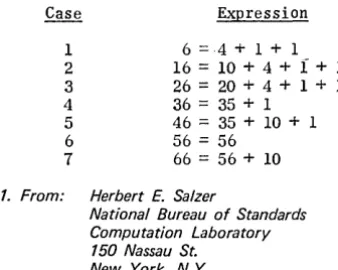
33 An "Almost-True" Theorem Involving Tetrahedral Numbers
Notice
by Herbert. E. Salzer, National Bureau of Standards, New York, and Jeffrey Mogul, Newton, Mass.
When a non-trivial statement in mathematics is true for the first 2500 consecutive cases, with exactly one exception at case 618, the statement becomes intriguing.
3 I mportant Notice to Foreign Subscribers
Monthly magazine, first issue May 1975:
PEOPLE AND THE PURSUIT OF TRUTH
Some of the articles in the May, June, July, and August 1975 issues already published:
The Assassination of President Kennedy: The Involvement of the Central Intelligence Agency in the Plans and the Coverup / Richard E. Sprague
[A]
[F]
The "Oswald Window" (with two photographs) / Neil Macdonald
Substantial Evidence of Conspiracy Ignored by the Warren Commission / Mark Allen and others
Chile and Central Intelligence Agency Intervention, 1964-1973 / Hortensia de Allende
The Coverup of the Coverups: The Protectors of the Assassins / Richard E. Sprague
Zapruder Film Frame 413: Does It Show a Rifleman on the Grassy Knoll? No / R. B. Cutler
For more information, see back cover.
Front Cover Picture
Night Scene by Lillian Schwartz.
For other entries in our 13th Annual Computer Art Exposition, see pages 8-27.
Message from Neil Macdonald:
WOULD YOU LIKE
A COLLECTION
OF THE PUZZLES
PUBLISHED IN
COMPUTERS AND
PEOPLE?
IF SO, WRITE US AND
TELL US WHAT
YOU WOULD LIKE.
MAYBE WE CAN WORK
SOMETHING OUT.
Key
[A] [C) [E) [F) [N] [R]
Article
Monthly Column Editorial
Forum Newsletter Reference
NOTICE
EDITORIAL BY THE
ART EDITOR
A Defense of Computer Art and Graphics
A provocative question arose some days ago, over dinner table conversation. A philosophy student from the University of California at Berkeley said to me, "I would like to read something of yours that defends computer art and graphics."
My first reaction was one of amuSement, because I am convinced computer art and graphics have many val-uable contributions to make to life (and to computer science). However, the more I thought about it and discussed it, the more it seemed to me that computer art and graphics does need a defense.
Many people believe that computer graphics and art do not have immediate practical benefits. "They are convinced that computers are meant primarily for the manipulation and processing of numbers and data. They have not awakened to the fact that computers are practical also for processing words, drawings, images, and symbols. At times a computer is defined as "an information processing machine". But words, images, and symbols are information also. Processing of numbers, "bit chasing", hardware, software, etc., are recognized as practical, present needs of compu-ter science. But practitioners in this large and continually developing field need to be involved also in the "tomorrow" of computer science, which includes more and implied computer images and graph-ics in literally every field of endeavor.
Let's list some of the pros and cons of recogniz-ing and teachrecogniz-ing computer graphics and computer art:
Pros: For Computer Graphics and Art
Utilitarian graphics design in industrial and military uses is being vastly altered by computer technology.
Practical graphics applications in medicine, geography, and architecture are becoming so common that the student who has not been ex-posed to computer graphics is not well-pre-pared.
Applied arts and graphics communication (mass communication, film, television, package de-sign, textile dede-sign, advertising) is rapid-ly changing to include new images achieved by computer graphics.
Computer graphics in every area of graduate study is valuable, and ranges from graphing to simulation and visualization of statis-tical data in many forms.
Graphics instruction for general education can be an enjoyable and easy introduction to com-puters and graphics, including art ..
Computer is a good introduction to alternative problem solving, brain-storming, and exer-cises in inventivity -- all needed by compu-ter scientists.
Computer graphics can serve as beginning or remedial instruction in FORTRAN (and other computer languages) for computer scientists. Exposure to the humanities is achieved by
com-puter graphics and art, and is much needed by computer scientists.
Graphics hardware and software systems are part of graphics, and many different kinds of systems apply.
For humanists who tend to negate computers, computer art is an excellent introduction to computer seience and technology. Personal expression using computer art as a
medium for many kinds of people is now pos-sible; this eliminates long periods of train-ing and affords pleasure and self-expression to many people.
Cons: Against Computer Graphics and Art
Classes using computer graphics systems are expensive, as compared with other classes, even computer classes.
The time requirements are costly and long for computer graphics classes, compared to other classes.
Students need to learn many subjects, and there arc not currently as many jobs in computer graphics as in other fields such as program-ming, systems, etc.
High professional competency, resulting in a job in computer graphics, is not easy to
attainj it requires advanced mathematical and computer science capacities, and as such is not suitable for the mediocre programmer. Too many people take one course in computer
art and then expect to be experts in compu-ter science and in graphics.
Computer graphics in education (computer-assis-tedt managed instruction and video-assisted
instruction) has a significant potential area that lied outside of computer art. In other words, more people can benefit from graphics in education than from art for art's sakeo "Computer art could make a significant
contri-bution if it were not so concerned with empty decoration," according to Jorge Glusberg of Buenos Aires. Computer art could have social significance but does not.
The major problems of the world are not going to be solved by computer art or graphicsj although computer graphics are moderately important in some areas, they are not as im-portant as other subjects.
Conclusion
Computer graphics and art, in my view, has a valuable contribution to make to society, computers, and education. Too often, only token support is given to computer graphics and art (along with token support of computers and the quality of life). Too often the support is advertising slogans and nothing moreo But computer graphics and art (as well as computers) will become valuable to man and the earth if we use them to the advantage of man and the earth. If we use them for money, efficiency, prestige -- without giv-ing heed to people and the genuine quality of life --then we shall have lost a magnificent potential that computer graphics and art and other applications of
MULTI-ACCESS FORUM
RECOMMENDATIONS ON SOCIAL AND POLITICAL ISSUES
1. From: Edward D. Napier 2403 Claremont Dr. Falls Church, Va. 22403
I subscribe to "Computers and People" with some reservations about "editorializing" on some of the more "political and social" issues. And while I or-dinarily respect your sense, I am well aware of your "sentiments" and often disagree with you as I do in your July editorial.
When I can afford to, I prefer to form my own judgments based on arguments presented -- not who presented them. For this reason I do not care one whit what recommendations the ACM or its council might make on a deeply political or social issue. Their competence to make an assertion in a techno-logical area does not naturally extend to areas out-side this special competence. As interesting and provocative as such discussions of political and social issues might be, it would be difficult and if not impossible for ACM to stop short of recommen-dations. As an unnecessary distraction from its central purpose, recommendations could split ACM in-to many nontechnical camps.
It is probable that some good and worthwhile ideas originate and are suffered as a minority opinion. With some indulgence and tender loving care these may grow into the majority opinion. But I hesitate to see such ideas subjected to a majority vote in any organization that is not required to judge these issues. Your frequent use of the attributes of "good, responsible, and humane" to support your own assertions are self-serving and not always justified. In particular. you seem unable to sail by the sirens of "peace and love" without succumbing to their call and losing your perspective. But your bias is known and taken into account.
Which all goes to say. I believe the ACM made a correct decision in ducking political and social issues.
2. From the Editor:
Thank you for your interesting and important let-ter which we hope to publish in "Compulet-ters and People" very promptly.
In a small democracy such as existed in Athens in antiquity at one time, it might be possible for all citizens to be well informed on all issues, and the recommendations of experts even in areas outside of their field of expertness might be unnecessary
even if interesting.
But in a large democracy, or a large society which may approach" a democracy without being one, it is not possible for most citizens to know enough about all of a thousand and one issues to be well informed. In such a situation, the recommendations of profes-sionals in fields outside of their expertness should be interesting, and may be valuable and necessary.
The response to a scientist who is a great chemist and who makes recommendations in the field of war using nuclear weapons cannot be "Your field is chem-istry: stay out of other fields." Dr. Linus Pauling won two Nobel prizes - one in the field of chemistry, and the other in the field of peace.
A great many computer professionals have to study systems in order to adapt computers to be used in such systems. Systems often include political and social factors and issues. The design of a good system may require study of political and social issues. For the Association for Computing Machinery to continue to avoid recommendations in such areas is in my view unfortunate, unwise, and unhelpful --even if the minority recommendation is more valuable than the majority one.
THE JUNE ISSUE OF "COMPUTERS AND PEOPLE" -COMMENTS
1. From: Ron D. Jamtgaard, Associate Director SCI? Academic Computing Services Stanford University
Stanford, Calif. 94305
Thank you for the June issue of "Computers and People". I appreciate the new format very much and laud your efforts as editor. I read the issue from cover to cover. Each article was of significant interest to me.
Please keep up the good work and the great pub-lication.
2. From the Editor:
We thank you for your commendations.
We wish we could hear often from all our readers about what they like and what they do not like in the magazine that we publish.
It is never easy and often almost impossible for an editor to make all the decisions needed to keep all the classes of his readers interested, informed, satisfied, and entertained. Feedback is very de-sirable.
THIRTEENTH ANNUAL COMPUTER ART EXPOSITION
1975
This is the 13th Annual Art Issue for "Computers and People" (formerly "Computers and Automation"). This is also our largest and most varied issue, featuring the work of 41 artists from 11 countries.
Many of the artists (and illustrations) are from the exhibition of the International Conference of Computers and the Humanities, and are reprinted here with special thanks to Professors Rudolph Hirschmann of the German Depart-ment and Robert J. Dilligan, DepartDepart-ment of English, University of Southern California, Los Angeles. Many of the photographs were taken by Dr. Joseph Raben, Editor of "Computers and the Humanities", and developed by C&P's Art Editor, Grace Hertlein.
The selection, design, and layout of the Art Issue Section is by Professor Hertlein. Questions, further information on artists may be obtained from the Art Editor.
We hope you enjoy the wide variety of works in this issue, by some of the most well-known computer artists in the
world, and featuring some very new works not shown in this country before. Student entries are marked with an
as-terisk to give special attention to them, in the hope of eliciting more student works in the future. One of the student
artists is 14 years old - Kelly Lam, of Annandale, Virginia!
Design for Exterior Mural,
Vladimir Bonacic
8
t,
•
•
I
I
Computer Dance,
Analivia Cordeiro
Designs for Sculpture,
J.
Alexanco
a.II[]E]lIlIIIlIa
CI:Ia.1III
DC
II.
-[JI!III
[I
oa[!nm •
[lC [JIB
a
III:IIJCI
• • •
•
a
• •
.:JED
[]
0.-
II.C-
• •
me
C[Jr:EI
•
-[]II •
Ogara,
Canvas by Barbadillo
Untitled work, Waldemar Cordeiro
10
Detail, Waldemar Cordeiro
Bois,
Johannesson
& Kallin
...
....
....
...
...
...
I. • •....
I t . It
....
.
:..
..
.
....
...
...
...
..
•
(
Untitled work, David Garrison
Analog Graphics,
Otto Beckmann
Generative Photography,
K. Holzhauser
•
Detail, M. Stephens
Herringbone Series,
R.
Leavitt
•
Detail, S. Zeigler
, '~,
Analoggrafiken,
Herbert Franke
14
,
• J I
f" •
•
I, , •.
L~
• ... ''i. .' •
I . \ • • •t
~
f '
r"
-
iI •····1· ·
· ,', L' • •
II
I.
r
J
"
','
J.'L.\
h
j~
.J:
,I ; ",
~;
...
~
• • • • .8 • • .. . . ...
~
: . . . .r. ·
'al. • '.'
~~.~
"J
I
t:~.
· ,,':
f'''.'1
f
~I
.. :"):.,'., ,
. . .
~I~,
1f.
"I.
'\.~'~·.H
..
;.I,':':-;~
, • '\.t " ",
I '.
II"
~.,
I
'! :
t -' . ' .... \. :-, • ; ; .~
," +
I J '.u. \
J'( •J~ ~l
.. 'II
It · ·
~
• • Ir
.,l_:.~,
. ,
•
• 'L. • • •
' .
~
, , '
I l ' • • I " " ..
~
l 1"':~.
I~
I ' "
..t~P..'
' ••
·.1·
:. · ..
I' ) ·
I -I.'
~
.1.1
• '
M
.\~,
• • I~
• •~
. . .• , 8 ~., ~1'4 i
.
,
,
.
..
~. t ..
I...
• l~'.::; ::;c c
:
::;
•
i " ·
~
III . ( . . . 't,
r '.
1~
'1
"' Ii,
'''.1
~ • • • ,r-..~ .... ' . . .
.
,
~.,
,I.,'
~ ,~ ~
.•
l..~.~. ~
III ... :.
~
..
~i
...
#1 •
•
~t..
P.
0
Detail,
Sur I,
J.
C. Halgand
:::cc a::
::;::;
0::;:
::; ::;
c::: :::c a:: ::
::; :::;:::;
:0: ::00 :
::: 00 0 ::;
::;: ::: ::; :
:
::;
c c c
: : :: : ::;::;
:
: :
::;
0 0 :
: : 0:::;
::; ::; : ::;::;::;
0
~
;ii:: • • •
en! • •
~
Kubus-Serie,
Klaus Bassett
Untitled work, Sture Johannesson & Sten Kallin
,
•
Computer Dance,
A. Cordeiro
Serigraphy, Gerardo Delgado
Detail of Large Work, Soledad Sevilla
Lenea,
M .. Barbadillo
,
.
.
,t
f
,
Nude Descending a Staircase,
L.
Schwartz
Design for Textile, G. Hertlein
Graphic,
Duane M. Palyl<a
cg
@
g
g
cg
~
r5)
6J
to
2J
6)
~
~
~
~
L5J
e
@
lSJ
~
1iJ
8
;§J
4J
c!J9
Q])
k8
21
k§J
C:!9
6J
e
r2f1
§J
~
SJ
~ ~
G'
~
c§J
c§
®
rs
~GJ
@
@
8
t&J
jj]
2J
§
r8 t2?
~
2J
~
t2}
~
r2iJ
L29
@
L51
~
~
~
e
2J1
~
g
rS
(g Q11
~
r8
S
g
~
@
Q?
k5;
k& 3J
k§:
S
§;
g
c§3
®
~
~
ere
lfP
Qf1
~
r;ff1
t¥
--
--
-:J- ~I---- [ --=t
--il
Il
-+-
I 11I --' / / 011' -:;1m ~--~
~
~
G
Q:J
~ ~ ~
__ I
...JI ~ I -.." , I i <"11--
I"';:> 11//11--
"';:> / , /&J
~
g
@
Q±)
~
tJ;;J
~
"';:>J
II
..::::?I
, I)
"';:>;---
/~
ktJ1
~
cg
~ ~ ~
~
...J--
--./ I <..1,--
-+-
/ ;-1 "';:> /2
~ /~
&1
C;;
Q) QJ1
~
6)
e-o
--
/ __ ...J--
<..-::J
--
/)----
[" --./ --./ / /[,-~ [,-~
C])
@
Qi9
~
/f9
~
Of)
-+-
1/ 1'/
~4-"
c:
--
~--~
QJJ
~
19
~
50
~
5:f}
Ofj
<.. / /Li.
--
0rt-
~ ~--
0--
/ / 1 I' , !--~
QjJ k!])
k9
~
dV
~
~
01
r-
~ /~ ~ (-
'I
,=:
--
..::::? l..~ ~
CO
G
kiJ fO
~ ~
cJi)
Z
~ /-L
) --./7-
-;-1--<.. / /1 n'~
Q:b
~ ~
Q;
Q?J
1fJ
~
tB
~
/--..::.
/ --./ --./ I <.. - - IfJ
--
--
--./ <.. /: ---11/i-
I
'
--~
ttJ
~
QJJ @
~
6lJ
(3tJ
cro
::1 ...J,- __ 1 ~ I/,,- --11 c;--'71
11, ~
'
II
'
I
eo
~
C]
cg
Qf
fl)
ffbJ
(J?
([9
--./"
~ ~
--r-
~
-l.
(I"
--~ --~
19
1;)
QJ1
:;f?J
5iJ
~ ~
::J
~ / /z-~
~,
/'
--
...J--
--
/tto
Q:)
~
kQ
@
5g
cfbJ
'JtfJ
~
--./--
l--LJ
l--,--
fJ
Ir-:...
~ /::J
1 . .
8J
tJ
~
G
2F
~ ~ ~
~
--
-- --
--
/]--
,
/ f/--
<.. .(jz-
/ ~Generative Drawings
from the Cubic Limit Series, Manfred Mohr (This Series was shown in Paris, May-June 1975.)Two Studies by Vilko Ziljak
/ / [II
/ I /
I / / (/ /
)/
/ /
/ / "';:> / /
)
[,,/'v
I~
/ / [" "';:>
i[" I"';:>
/[,-10
l/
')
J
/)(
')
V
-'I /)
[,-1
1[,-/
I 1 I IIi4-
l( II I //..::.
( I
.i-'i-
,..::.
) I~ ~ / ;1
',I '1 [,,1 ~
/,' 1/1
LJ
),
" / 1/...J
J
/,1 ./1 I-J
C
I
-t-l
...j ~'l.
'f
I 11 1/ I l/ (I
i'l I' /20
[I]
[I]
The illustrations are from a book entitled Computer-Picture-Book by Vera Molnar, published in 1974.
The technique described can be used with many forms and is a deformation method. The works from the
book are made by the "conversational method" (CRT screen 2250
+
I 8M 370 computer) with a programin FORTRAN she calls "R ESEAU-TO". This program permits the production of drawings starting from an initial square array of N (30 in this case) concentric squares. The available variables are: the number of concentric squares, the displacement of individual squares, the deformation of squares by changing angles and length of sides, the elimination of lines or entire figures, and the replacement of straight lines by segments of circles, parabolas, hyperbolas and sine curves. Thus, from the initial set an enormous variety of different images can be obtained.
r
-\\~\
c:::---~
-COMPUTERS and PEOPLE for Aug\.lst, 1975
~
t
,
t-\~i
f
,
....
f
,~\Q
~
~\
I~
I
'~
.
'..
I
I
I
II
~
I
~
,
Manifestation 1 Manifestation 2
Varying Manifestations by Sozo Hashimoto of Tokyo. Computer used: FACOM 230-35 with a F6233A Graphic Display System. Programming is in FORTRAN IV. Here are the artist's comments:
"Life is symbolized by many forms all over the world. But phases of life change with the lapse of time and life maintains a dynamic balance. So I expressed forms to symbolize life by the use of a graphic display system and a computer. These works are named 'Varying Manifestation' Series."
Dawn of Creative Computing by Katy Owens, who is working on a Masters Degree in Computer Science at Ball .State
University in Muncie, Indiana. Below, Moon Rise by Katy Owens. Both works are available as serigraphs (silkscreen
prints) from COMPUTRA, Inc., U.S.A., Upland, Indiana. (Dawn of Creative Computing and Moon Rise - ©1975
Katy Owens)
22 COMPUTERS and PEOPLE for August, 1975
Unti1
..
Happy Birthday
by Tom Huston of COMPUTRA, Upland, Indiana
©1973 COMPUTRA
COMPUTRA, or Computer Art for People, Upland, Indiana, 46989, has moderate-priced computer art in a wide range of styles and colors. Readers may send for brochures and prices.
Space Circles
by Charles Bromley Taylor University
©1973 COMPUTRA
24
Untitled Work, R. E. Greenlee (drawn with homemade computer and plotter)
Available from COMPUTRA, Upland, Indiana
Moonbat, John Groener, M.I.T.
COMPUTERS and PEOPLE for August, 1975
.'
•
Above: Nocturne and Man Running by Michael Davis, a student at San Francisco State University. Programmed on a CDC computer in Michael's own language, ARTRAN.
Below left: Untitled work by our youngest contributor, Kelly Lam, age 14, of Annandale, Virginia. Here are Kelly's comments on his work: "This design was created by plotting points on graph paper which were random numbers generated by a Hewlett-Packard HP-65 pocket calculator, which is actually a mini programmable computer. Each point was connected with its preceding one, forming a pattern. An ink tracing was later made."
Below right: Octal Crystal by Jere Truex, student at Taylor University. Available from COMPUTRA, Upland, Indiana
Above: Patrick Porter, graduate student from Blacksburg, Virginia, uses a transformation technique he calls a "modulation" or alteration of an original figure in a series of generative (succeeding, related) works.
His comments: "Modulation is accomplished by considering each line of the drawing as a number of segments (specified by parameter). Each segment of the line is drawn in some manner other than as a straight line connection between the end-points. Rotations and reflections of 'primitive' designs result in generative new works."
Right:
Three on a String by Barbara Dwyer
t
Computer Artists
The response to the Thirteenth Annual Computer Art Exposition of Computers and People was excellent. We received entries from all over the world. We are grateful to all contributing artists. Following is an alphabetical listing of all persons whose artwork appears in this issue. We plan to publish additional entries in future issues of Computers al/d People.
1. A LEXANC 0 , Jose-Luis, Madrid, Spain page 9
2. BAIIDADILLO, Manuel, Malaga, Spain pages 10, 16
3. B~SSETT,Klaus, Stuttgart, Germany page 14
4. BECKMANN, Otto, Wien, Austria page 12
5. BONACIC, Vladimir, Jerusalem, Israel page 8
6. BROMLEY, Charles, COMPUTRA. Upland, Ind. page 23
7. CORDEIRO, Analivia. Sao Paulo, Brazil pages 9, 16
8. CORDEIRO,Waldemar, Sao Paulo? Brazil page 10
9. DAVIS, Michael, San Francisco, Calif. page 25
10. DELGADO Gerardo, Sevilla. Spain pages 16, 17
11. DWYER, Barbara page 26
12. FRANKE. Herbert, Munich. Germany page 14
13. GARRISON. David, Buffalo, N.Y. page 11
14. GREENLEE. W. E •. , .COMPUTRA, Upland, Ind. page 24
15. GROENER, John, M •. I.T., Cambridge, Mass. page 24
16. HALGAND, Jean-Claude, Paris, France page 14
17. HASHIMOTO. Sozo, Tokyo. Japan page 21
18. HERTLEIN, Grace C., Chico, Calif. page 17
19. HOLZHAUSER, Karl, Bielefeld, Germany page 12
20. HUITRIC, Herve, Paris, France pages 11, 15
21. HUSTON, Tom, COMPUTRA, Upland, Ind. page 23
Forum - Continued from page 7
IMPROVEMENT OF THE OPERATIONS OF THE ASSOCIATION FOR COMPUTING MACHINERY AND SOME OTHER TOPICS - II
Gerard Salton
Dept. of Computer Science Cornell University
Ithaca, N. Y. 14853
(Based on a report as Regional Representative to ACM Members in the Northeast Region, June 1975.)
Anaheim Meeting
The ACM Council met for some fourteen hours in Anaheim, California between May 20 and 23 on the oc-casion of the National Computer Conference. I some-times wish that our Council meetings were not tied to the maj or conferences - after all, we don't need all auditorium that seats 5,000 to accommodate the 25
22. JOHANNESSON, Sture, Malmo, Sweden pages 10, 15
230 KALLIN, Sten, Malmo, Sweden pages 10, 15
24. KAWANO, Hiroshi, Tokyo, Japan page 13
25. LAM, Kelly, Annandale, Va •• ~
page 25
26. LEAVITT, Ruth, Minneapolis, Minn. page 13
27. MARQUETTE, Claude, Paris, France page 11·
280 MIKULIC, Tomislaw, Zagreb, Yugoslavia page 15
29. MOHR, Manfred, Paris, France page 19
30. MOLNAR, Vera, Paris, France pages 9, 20
31. NAHAS, Monique, Paris, France pages 11, 15
32. OWENS, Katy, Muncie, Indo .:' page 22
33. PALYKA, Duane, Salt Lake City, Utah page 18
34. PORTER, Patrick, Blacksburg, Va •• ;. page 26
35. SCHWARTZ, Lillian, Bell Labs, Murray Hill, N.J. pages 1, 17
36. SEVILLA, Soledad, Madrid, Spain page 16
37. STEPHENS, Michael, Kansas City, Mo. page 13
38. TRUEX, Jere,. COMPUTRA, Upland, Ind. ',' page 25
39. ZAJEC, Edward, Trieste, Italy page 17
40. ZEIGLER, Stephen, Kansas City, Mo. page 14
41. ZILJAK, Vilko, Zagreb, Yugoslavia page 19
[*
=
student]Council members. However, some people enjoy going to conferences and others are delighted to spend some time near Disneyland. Personally, I can do without the tacky atmosphere that pervades much of Orange County, and I have never thought that the fake deco-rations in plasterboard or the piped-in music at the Disneyland Hotel were stimulating or capable of re-lieving the monotony of the surroundings.
$950,000 Surplus
The ACM news emanating from Anaheim were, I am glad to say, mostly good. The Association seems to be ex.ceptionally well managed at the moment; a great many hard-working people appear to be getting things done; and, most importantly, the finances are in good order. As of March 31 of this year the accumulated surplus exceeded $950,000, and whereas the actual expenses for the current fiscal year were just about equal to budget, the income exceeded the originally
THE WORLD OF TRANSLA TIION
Mr. Serge Raffet, President Traductor
2 rue Remf-Bazin Paris 16, France; and
Translation Company of America, Inc. 500 Fifth Avenue
New York, N. Y. 10036
"Language does in part govern the nature and form of thought, and is closely bound up with the culture of a national or social group."
The World of Translation
"Peter is looking at Paul with his glasses." Al-though this sentence appears to be clear, it may have been badly tr~nslated -- or lead to a wrong trans-lation -- since there is no way of telling whether it is Peter or Paul who is wearing glasses or whether either of them wears glasses at all. In this parti-cular case, the ambiguity is perhaps unimportant. However, should it be a question of business with a foreign client, it is vital to be able to understand correspondence perfectly in order to avoid poten-tially tragic consequences. Translation is a diffi-cult art and a vital part of the modern economy --a tool which is becoming incre--asingly necess--ary_
Yet some Americans seem to be unaware that people speak other languages beyond our borders. Not only do they often write to foreign clients in English without knowing whether or not they will be under-stood, they even write to foreign governments as well. For example, take the case of the machine tools manufacturer in Cleveland who recently wrote in English to the Director of the General Services Administration of France asking to be included on the list of companies which the French Government consults for supplies in his line. The poor French official who showed me the letter the other day in Paris was quite bewildered, for despite his fondness for the United States he doesn't speak a word of English. Fortunately, this attitude is not found everywhere. But it is a serious problem which may result in business being lost to a competitor who has had the foresight to write to a potential client in his own language. All of tnis again reinforces the vital role which translation has to play in the development of the modern world, rivalling finance and transportation in its importance and impact. Translation is, however, infinitely more discreet.
Two factors seem to enhance this importance. First of all, technology is becoming completely interna-tional. Although the English and Americans together once held the lead in world technology, at present half of the technical articles on many diverse sub-jects are published in ten or fifteen foreign lan-guages. The Soviet Union alone publishes nearly , 2,500 journals, reviews, and other publications devoted to chemistry --·and numerous other examples could be cited.
Reprinted with permission from The World of Translation, published by Translation Company of America, Inc., 500 Fifth Ave., New York, N.Y.
28
A second factor is the astonishing development of the activities of international companies. Ef-ficiency requires that the company maintain consis-tent methods and procedures in all its offices which, although being operated in a host of differ-ent languages, remain under the cdiffer-entral control of the home office. And translation assumes a differ-ent kind of importance when political factors come into play. We all remember the violent disorders which caused bloodshed in Belgium several years ago and which were linguistic in origin (Belgium has two official languages: French and Flemish).
The problems of bilingualism have assumed nation-al proportions in Canada. Under a recent law, all legal texts or official documents must be published simultaneously in the two official languages of the country: English and French. Whereas in the past it was possible to publish a text in the original language (usually English) and have the translation in the second official language published later (involving a delay of three to five months on an average), now an official text must remain secret and pending and cannot be published until the per-fect translation is achieved.
And yet the Canadian Government alone employs more than 750 full-time translators as well as 200 free-lance. This service, the Translation Bureau of the Secretary of State, spent nearly $15 million in 1972 to translate 135 million words mostly from English into French. Despite this effort, however, Canadians complain that all too often translators lack the necessary skill to preserve "subtle shades of meaning" in their translations. And while the development of ' exchange programs and travel will undoubtedly increase the volume of translation re-quired, there is no guarantee that a corresponding increase in the number of good translators will re-sult. Indeed, a text that is badly translated may often be even more harmful than one that is not translated at all, for the former is likely to be very misleading and misrepresentative.
A Delicate Art
And sometimes the latter finds it difficult to efface himself completely and assume the personality of the former. Translation is a particularly delicate mat-ter in the sense that the ideal, the perfect trans-lation, does not exist. For language does in part govern the nature and form of thought and is closely bound up with the culture of a national or social group. To go from one language into another is to go from one mode of thought into another, and that is a much more profound problem than merely looking up equivalent words in the dictionary.
But do only "good" translations exist in fact? We are not convinced of it~ First of all, texts to be translated should be clear and unambiguous -- a situation which is rarely the case. The author who knows what hets talking about (in theory) is not always aware that he writes ambiguously. This is so because he is so absorbed in his subject matter that he does not always see other possible interpre-tations of his text. To give a simple example: "Peter looks at Paul with his glasses." This sen-tence appears to be quite clear. However, there is nothing to show whether it is Peter or Paul who is wearing glasses. And furthermore, if it is Paul. nothing proves that he does not have his glasses in his hand or his pocket. Even texts for translation which are not so ambiguous as this example usually reveal a lack of precision when analyzed carefully. Sometimes an author's turgid style is aimed at con-cealing his ignorance of detail or the fact that he has little to say.
In contrast, patents are in a class of their own. In this area, the more vague the text, the better, in order to prevent someone from reconstructing an invention merely from the patent. Yet, at the same time, as large an area as possible must be described so that later patents are threatened.
Frequently, however. a translated text has to be freely adapted in order to be meaningful. For ex-ample, an English bulletin for commercial salesmen recently compared a new sales teChnique to a base-ball game. A literal translation into French using a baseball game as an example would obviously have had little meaning for Frenchmen. Thus, some other comparison -- soccer or tennis -- had to be chosen.
As a consequence, we reach a paradoxical situation which may be summed up as follows: Translation, con-sidered to be a craft of the highest order, is
in-dispensable to the economy while at the same time misunderstood and unappreciated by technicians in
general. Translation is indispensable to virtually all technical or commercial exchanges between coun-tries speaking different languages since the percen-tage of Americans who read even French, German, or Spanish is very small and the percentage of foreign-ers who read English is no greater. Moreover, the employees of a firm have commitments other than translating documents.
Translation is misunderstood in that people
mis-takenly believe that since translation is not an original creation it is a strictly mechanical ac-tivity, requiring little more time than typing. If produced in this spirit, translations are slapdash, not re-read, lack style, and even contain spelling mistakes and mistranslations. Remember that it is on the basis of translations that foreigners will judge the quality and worth of your products and services.
Translation is unappreciated in that industrial-ists, although prepared to spend lavishly on equip-ment and advertising, wrongly practice the strictest
economy when it comes to translating their publica-tions and catalogues, sometimes entrusting the job to a secretary or student who generally has neither the linguistic nor the technical knowledge required.
Translating is one of the most complex and sub-tle of skills, which ideally should combine the following qualities:
A translation must be absolutely faithful to the original text. The latter must, there-fore, be clear and explicit and well under-stood by the translator. Thus, the transla-tor must have an excellent knowledge both of the original language and of the technical field concerned.
A translation must be clearly written in a style which is pleasant to read. The trans-lator must write only in his mother tongue and must know how to write well.
Experience has shown that these two qualities, good technical knowledge and good style, are rarely found in the same person. A series of operations must then follow -- checking, revising, preparing the final copy and typing -- all of which is time-consuming and costly.
Some industrial or commercial companies and gov-ernment agencies have established permanent trans-lation services in order to train their translators to specialize in their own field. On the whole, some results have been good, particularly with re-spect to the systematic use of a special vocabulary. But there are serious disadvantages -- namely, pro-hibitive cost, delays, and inaccuracies. The lat-ter occur when the specialist-translator is called upon to handle a text on a subject outside normal company matters.
But sometimes the problems are even more complex. For instance, when it comes to translating long lists, whether arranged alphabetically or not, the translation requires a great many translators spe-cialized in different fields who will each trans-late those descriptions used in their particular sphere.
In order to do this kind of job within a reason-able period of time and without making mistakes, modern methods of handling information are required: transcription of the original descriptions and their translations on punch cards or tapes, processing by computer, alphabetical arrangement in a particular language, and rapid and easily-handled revisions.
In certain cases, internal translation services are amazingly large (like the service of the Feder-al Government of Canada). However private companies do not usually have a sufficient volume of work on a regular basis to require the full-time services of a team of specialized translators. So they must call upon specialized services for help: the translation companies. And except for a tiny min-ority, these "services" are in fact an individual translator or couple, very often translating at home into only one or two languages and whose range of speCialization is very narrow. Most translators whose "companies" offer a much wider range of lan-guage and technical fields subcontract to others the jobs they are unable to handle themselves.
Translating Everything
product quality, respect for deadlines and consis-tent prices. To meet these standards, a translation company must have at its disposal several hundred specialized translators and a sufficiently large clientele to keep such a staff reasonably busy. In short, the ideal translation company must offer its clients a complete line of services: translation of any document into any language, the organization of conventions and conferences with interpreters, the dubbing of films, tape recording, typesetting and printing, summarizing technical articles, pro-viding guides for visitors, and in general, any
ac-tivity involving a foreign language.
There are very few such companies. Even here in America where there are many large companies, trans-lation is dispersed among thousands of tiny offices most of which work more or less on an individual basis. This explains the success of Translation Company of America, Inc. which is perhaps the only independent specialized translation company offer-ing such a complete line of services and havoffer-ing its own offices abroad.
Translation Services
At the top of the scale there are two distinct categories of translation services:
Offices specializing in one or several speci-fic languages and a particular technical field: these are built around one man who does the translations himself or who personally super-vises them.
Offices offering a more complete line of ser-vices: translation, interpretation, and related services in more languages and more technical fields.
In order to guarantee the processing of all or-ders, such offices must have a considerable number of assistants at their disposal: at least one in each particular field and two in each language (be-cause a translator should translate only into'his native language). Translation Company of America, Inc. has about one thousand associates in New York, as many in Paris, and more in Montreal and other cities.
Indeed, a document should be translated by a specialist qualified in the field concerned (law, medicine, etc.) and then re-read by a proofreader who checks to see that there are rio omissions, er-rors, or lapses of style. Deadlines set by clients, however, often preclude this ideal method. Some years ago it was even hoped that the difficulties of translation might be solved by computer. This led, especially in the United States, to extensive and extremely costly research programs, prolonged over a period of several years because it was found that the difficulties involved are tremendous. And vocabulary is the least of the difficulties. Al-though one word in German may have two or even ten completely different meanings in English, all mean-ings must be stored in a memory bank and readily available to the translator. Although still very costly, automatic dictionaries are coming into use. These dictionaries are superior to conventional dictionaries in that they save time and may be more easily kept up to date.
Grammar presents a much more complicated problem. Although it may appear simple on the surface, the syntax of natural languages is remarkably complex
and the profound nature of linguistic structures is far from fully understood. We can store vocabulary in the computer but we cannot teach it the grammar and nuances of a language.
Some texts may be read by computer, but at best the machine can produce only the most literal trans-lation. In order to be intelligible to the ordi-nary reader, a text which has been translated by machine has to be revised by highly trained special-ists. In short, although the computer may be a use-ful accessory for jobs such as checking lists, updat-ing, and sortupdat-ing, direct automatic translation is hardly imminent.
So, for the time-being, translation must remain in the hands of humans. And whether translation remains the "thankless twin" it now is, depends on those who need its services. Perhaps one day a computer will succeed in solving all our translation woes. But until that day, the thankless twin will continue to work ••• perhaps to be praised. 0
"All the Language of Thought
Calculable like Mathematics"
Lawrence M. Clark 835 Edmands Road
Framingham Centre, Mass. 01701
Next to my article in the June issue of "Compu-ters and People", the editor quoted one of my goals: "to make all the language of thought calculable like mathematics".
I have been challenged to explain what this goal means.
Calculable
A remarkable and interesting property of mathe-matics is that a mathematical statement can be cal-culated to have exactly the same meaning as another mathematical statement, and that the truth of a statement can be calculated from the truth of other statements.
This is also true a fair amount of the time in ordinary language. If John Jones is a student of Samuel Smith, then Samuel Smith is a teacher of John Jones. If all had a good time at the picnic, then a good time was had by all at the picnic. And very often even in ordinary langugge we calcu-late answers to problems by means of manipulating words and ideas:
I find I have lost my penknife. I can look in the pocket of the pants I wore yesterday. I can look on the floor of the closet where I hang my pants upside down. I can look on the workshop bench where I worked yesterday. And so on. So I go look in each of these plausible places, and in one of them, with joy, I recover my penknife. Here is an example of calculation without using any mathematical language.
Language of Thought
What do I mean by "the language of thought"? This is the language in which people discuss
n-n
r
re
h
s-ea
r s
al
1-!Jcn ort
hc
ut 11
•
DAILY SURVEILLANCE SHEET, 1987, FROM A NATIONWIDE DATA BANK
Dennie Van Tassel Head Programmer San Jose State College 125 S. 7th St.
San Jose, Calif. 95114
(Because of its impact and its timeliness, this is reprinted from
the October
1969issue of "Computers and Automation".)
The "Daily Surveillance Sheet" below is offered as some food for thought to anyone concerned with the establ
ish-ment of the proposed "National Data Bank". Hopefully, it will help illustrate that