© 2019, IRJET | Impact Factor value: 7.211 | ISO 9001:2008 Certified Journal
| Page 4442
COMPARATIVE STUDY ON QUALITY OF BACTERIAL CONCRETE WITH
NORMAL CONCRETE
Santhosh K
1,
Naveen Kumar N
2, Sahana M Kakubal
3, Iranna M Mudur
4, Prakash R
51
Assistant Professor, Department of Civil Engineering, Alva’s Institute of Engineering & Technology,
Moodbidri, India
2,3,4,5
Under graduate students, Department of Civil Engineering, Alva’s Institute of Engineering & Technology,
Moodbidri, India
---***---Abstract
— In recent years, there is increasing interestin the phenomenon of mechanical property recovery in concrete construction using self-healing concrete. The study was motivated by the need to find a solution for the problem of cracking approaching the concept of self-healing concrete. The study was carried out on a bacteria based self-healing concrete using Bacillus Subtilis bacteria .An investigation on the strength assessment of the bacteria-based self-healing concrete by finding out the optimum amount of bacterial content to be added to obtain maximum strength. Bacterially induced calcium carbonate precipitation has been proposed as an alternative and environmental friendly crack repair technique. It is found that microbial mineral precipitation as a result from metabolic activities of favorable bacteria in concrete improved the overall behavior of concrete. It is expected that further development of this techniques will result in a more durable, sustainable and crack free concrete that can be used effectively for constructions in wetatmospheres where corrosion of reinforcement affects the durability, permeability and strength of concrete. Therefore, it is decided to carry out an investigation of determining optimum dosages of bacterial solution required for concrete by forming various concrete cube and Cylinder samples having variations of bacterial solution 20 ml, 30 ml,40 ml and 50 ml. Further these various samples are tested under various laboratory methods. Slump cone test, compressive strength testing, ultrasonic pulse velocity test, and scanning electron microscopes thereby an optimum dosage required is computed. Bacterial concrete is found to be superior as compare to that of conventional concrete in all the aspects of durability. Among the different specimen incorporated it shows that bacterial concrete containing 40ml solution is the optimum dosage required, after which the strength found to be stable or decreased.
Keywords:
Bacillus Subtilis1, Mechanical Strength2,UPV3, SEM4.
I.
I
NTRODUCTIONConcrete is a major material used in the construction field, from the foundation of buildings to the structures of bridges and dams. Several construction techniques
without incorporating concrete have been developed but concrete still continues to be the most important building material for infrastructure. The major shortcoming of concrete is that it tends to crack when subjected to tension. Tiny cracks formed on the surface of the concrete make the whole structure vulnerable due to seepage of water into the concrete, promoting corrosion of the steel reinforcement, thus reducing the life span of the structure.
Self-healing concrete is a solution to this problem of durability of concrete structures and has also received increasing attention as a smart material with interesting potential applications in civil infrastructure. Self-healing materials used in such type of concrete have the ability to heal the damage inflicted on the concrete partially or completely, there by restoring the original functionality of the structure. Self-healing system can achieve a tremendous cost reduction in terms of health monitoring, damage detection and maintenance of concrete structures, assuring a safe service life of the structure.
Self-healing concrete is a product which biologically produces limestone by which cracks on the surface of concrete surface heal. Selected types of the bacteria genus Bacillus, along with calcium-based nutrient known as calcium lactate. The self-healing agents can lie dormant within the concrete for up to two hundred years. When a concrete structure damages and water starts to penetrate in the cracks present in it the bacteria starts to feed on the calcium lactate consuming oxygen and converts the soluble calcium lactate into insoluble limestone. Hence the durability of steel in construction becomes higher.
© 2019, IRJET | Impact Factor value: 7.211 | ISO 9001:2008 Certified Journal
| Page 4443
concrete with increase in the concentration of bacteriaConcrete has a large load bearing capacity for compression load, but the material is weak in tension. Because of this steel reinforcement is provided and the steel bars take over the load when the concrete cracks in tension. However, the cracks in the concrete pose a problem .Due to reasons like freeze-thaw reactions, shrinkage, low tensile strength of concrete etc, cracks occur during the process of concrete hardening and this ultimately leads to weakening of the buildings. If water droplets enter into the concrete structure, due to lack of permeability then it can damage the steel reinforcement present in the concrete member.
II.
R
EVIEW OF PREVIOUS WORKAfter researching and studying the previous literatures of various authors it is found that various works has been conducted in regarding with comparison between conventional and bacterial concrete. Also some literature express the maximum width of cracks healed by the bacterial concrete, some of them highlighted the effect on bacterial concrete in various environmental conditions. But no literature so far indicates the optimum dosage value of bacterial solution required after the insertion in concrete, therefore it needs to be addressed.
III.
M
ATERIALS USEDA.
Cement
The OPC 43 grade which is used in the study conforming to IS12269:1987.
B.
Coarse Aggregate
Coarse aggregate crushed granite of size 20 mm 12 mm used as coarse aggregate. The sieve analysis of coarse aggregates confirms to the specifications of IS 383:1970 for graded aggregate and specific gravity 2.70, Water Absorption 1.70%, Fineness modulus 2.97, and Impact value 12.67%.
C.
Fine Aggregate
M - Sand is used as a fine aggregate conforming to the requirements of IS: 383 – 1970. The M-Sand is artificially manufactured sand, consisting of particles of different sizes proportioned to suite the requirement of Fine Aggregates to be used in structural concrete. The M - Sand used in the mix has a specific gravity of 2.37, Water absorption of 8.5%, Loose Bulk Density of 1667kg/m3 and Roded Bulk Density of 1860kg/m3, Sieve analysis (Fineness modulus) 2.72.
D.
Water
The potable water available in the laboratory, satisfying the requirement of IS 456-2000 is used for mixing the HPC and also curing all the concrete specimens, PH of water used is almost neutral (7).
E.
Bacteria
Bacillus Subtilis is a Surface cultured bacterium collected from Anand Agro Care, Nasik, Maharashtra. We have selected Bacillus Subtilis, since it produces Calcium Carbonate and due to ease of availability. It is also known as Hay-Bacillus or Grass Bacillus, is a gram-positive, Catalane-positive bacterium, found in soil and the gastrointestinal tract of Ruminants and humans.
A member of the genus Bacillus, B. Subtilis is rod-shaped, and can form tough, protective endow-spores, allowing it to tolerate extreme environmental conditions. This bacterium is considered as the best studied Gram-Positive bacterium and a model organism to study bacterial chromosome replication and cell differentiation.
Table No 1: Biochemical Characteristics Bacillus-Subtilis
Sl. No Parameters Details 01 Technology Surface Culture
02 CFU 2x10⁸ cells/ml
03 pH 6.8-7.2
04 Solubility Water Soluble
05 Shelf Life 1 Year
IV.
M
ETHODOLOGYA.
Mix Design
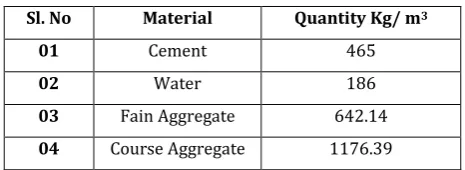
Concrete mix design M30 is defined as the appropriate selection and proportioning of constituents to produce a concrete with predefined characteristics in the fresh and hardened states. Mix design was carried out as per IS: 10262-1982 with respect to the design stipulations and data mentioned.
Table No 2: Mix Proportion
Sl. No Material Quantity Kg/ m3
01 Cement 465
02 Water 186
03 Fain Aggregate 642.14 04 Course Aggregate 1176.39
[image:2.595.317.554.406.497.2] [image:2.595.321.554.647.732.2]© 2019, IRJET | Impact Factor value: 7.211 | ISO 9001:2008 Certified Journal
| Page 4444
Table No 3: Material required
Materials Mix1 Mix2 Mix3 Mix4 Mix5 Cement
(kg/m3) 465 465 465 465 465 Water(ltr) 186 186 186 186 186
F.A
(kg/m3) 642.14 642.14 642.14 642.14 642.14 C.A
(kg/m3) 1176.39 1176.39 1176.39 1176.39 1176.39 Microorga
nisms (ml/m3)
0 20 30 40 50
B
.
Mixing of Concrete
The mixing of the ingredients of Bacterial concrete is done by Hand mixing. Hand mixing should be done in a Metallic tray of large size to take one bag of cement.
C. Casting
The cube specimens of 150x150x150 mm are cast for compressive strength test and cylinders of 100mm dia. and 300 mm height are cast for Split Tensile Test. The specimens are de-molded after 24 hours and immersed in water for curing as per the requirements of codes for 7 days and 28 days of results and discussion.
V.
RESULTSA.
Slump Cone Test
The slump assessment is carried out for Normal concrete and for Bacterial concrete by varying the concentration of Bacterial solution.
Table No 4: Results of slump cone test
0 20 40 60 80
Mix 1 Mix 2 Mix 3 Mix 4 Mix 5
Slu
m
p
in
m
m
Type of mix
Slump Cone test
Chart-1: Variation of slump with mixes
B. Compressive stength
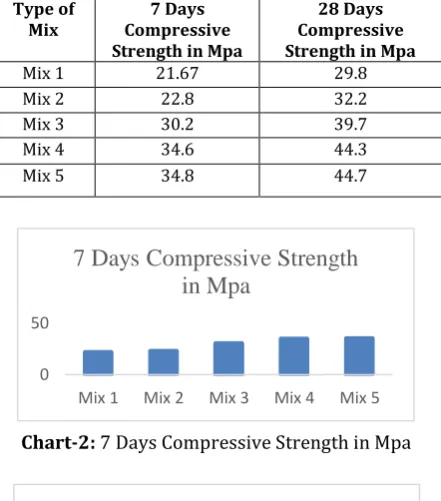
[image:3.595.317.567.83.230.2]The compressive strength of mixes of Concrete specimens is evaluated as per IS516:1959 (reaffirmed in 2004). The results are recorded below.
Table No 5: Results of Compressive Strength
Type of
Mix Compressive 7 Days Strength in Mpa
28 Days Compressive Strength in Mpa
Mix 1 21.67 29.8
Mix 2 22.8 32.2
Mix 3 30.2 39.7
Mix 4 34.6 44.3
Mix 5 34.8 44.7
0 50
Mix 1 Mix 2 Mix 3 Mix 4 Mix 5
7 Days Compressive Strength
in Mpa
Chart-2:7 Days Compressive Strength in Mpa
0 50
Mix 1 Mix 2 Mix 3 Mix 4 Mix 5
C
om
pr
essi
ve
st
re
ng
th
in M
pa
T
ype of Mix
28 Days Compressive Strength
in Mpa
Chart-3: 28 Days Compressive Strength in Mpa
C. Split Tensile Test
Split- tensile strength is indirect way of finding the tensile strength of concrete by subjecting the cylinder to a compressive force. Split tensile test is carried out for
Type of mix Slump (mm)
Mix 1 68
Mix 2 62
Mix 3 59
Mix 4 57
[image:3.595.329.550.333.584.2]© 2019, IRJET | Impact Factor value: 7.211 | ISO 9001:2008 Certified Journal
| Page 4445
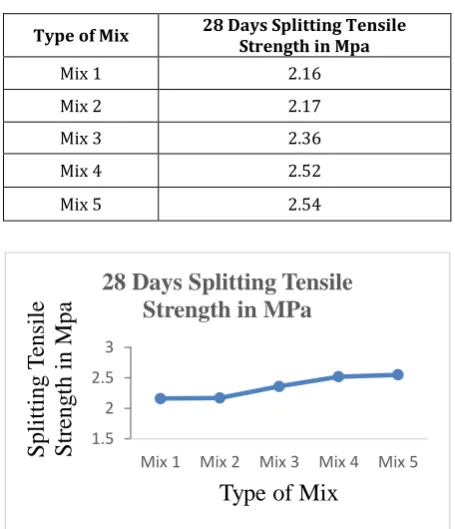
Normal concrete and bacterial concrete by varying theconcentration of bacterial solution. The results of Split Tensile test at different concentration of bacterial solution are tabulated below.
Table No 6: Results of Split Tensile Test
Type of Mix 28 Days Splitting Tensile Strength in Mpa
Mix 1 2.16
Mix 2 2.17
Mix 3 2.36
Mix 4 2.52
Mix 5 2.54
1.5 2 2.5 3
Mix 1 Mix 2 Mix 3 Mix 4 Mix 5
S
pli
tt
ing
T
ensil
e
St
re
ng
th
in Mpa
Type of Mix
28 Days Splitting Tensile
Strength in MPa
Chart-4: 28 Days Splitting Tensile Strength in Mpa
D. Ultrasonic Pulse Velocity(UPV)
The Dynamic Modulus of Elasticity is assessed using indirect method with the help of Ultrasonic Pulse Velocity (UPV) test. Ultra sonic pulse velocity test was carried out to know the presence of voids in the internal structure of the concrete cubes. The UPV method is a NDT – Non Destructive Test method, which determines the quality of concrete.The UPV test is conducted and the dynamic modulus of elasticity of Normal concrete and Bacterial concrete is calculated using formula as per IS 13311(Part 1) – 1992. Results of UPV test is tabulated below.
Table No 7:Results of UPV Test
Type of Mix Time(µs) Velocity (km/s)
Mix 1 33.8 4.432
Mix 2 33.6 4.464
Mix 3 33.2 4.461
Mix 4 30.3 4.950
Mix 5 30.1 4.995
4 4.5 5 5.5
Mix 1 Mix 2 Mix 3 Mix 4 Mix 5
V
elocity
in (km/
s)
Type of mix
Ultrasonic Pulse Velocity
Chart-5: Ultrasonic Pulse velocity in (km/s)
Time in ( µs)
28 30 32 34 36
Mix 1 Mix 2 Mix 3 Mix 4 Mix 5
T
im
e
in
µ
s
Type of Mix
Ultrasonic Pulse Velocity
Chart-6: Ultrasonic Pulse velocity in (km/s)
Dynamic modulus of Elasticity
The Dynamic Modulus of Elasticity is an important property of a concrete. The concrete becomes stiffer at higher value of modulus of elasticity. The Dynamic young’s modulus of elasticity is computed as per IS 13311 (part 1) 1992. The equation used to calculate dynamic modulus of elasticity using UPV test results and Poisons ratio is 0.22.
Ed =ρ *(1-2µ)(1+µ)V2/(1-µ), Where
Ed = Dynamic Modulus of Elasticity ρ = Density, V = Pulse Velocity in m/ sec.
Table No 8: Dynamic Modulus of Elasticity
Type of Mix Dynamic Modulus of Elasticity (Gpa)
Mix 1 42.49
Mix 2 43.11
Mix 3 44.16
Mix 4 53.01
[image:4.595.330.539.86.377.2] [image:4.595.44.272.165.430.2]© 2019, IRJET | Impact Factor value: 7.211 | ISO 9001:2008 Certified Journal
| Page 4446
0 50 100
Mix 1 Mix 2 Mix 3 Mix 4 Mix 5
D
yn
am
ic
M
o
d
u
lu
s
o
f …
Type of mix
Dynamic Modulus of Elasticity
Chart-7: Dynamic Modulus of Elasticity
E. Water Absorption Test
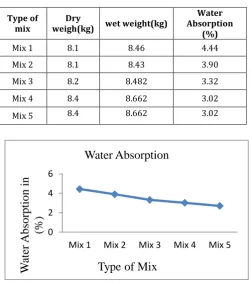
Water absorption has been used as an indicator for assessing the durability of concrete. The results of water absorption test at different concentration of bacterial solution are tabulated below.
Table No 9: Results of Water absorption test
Type of
mix weigh(kg) Dry wet weight(kg)
Water Absorption
(%)
Mix 1 8.1 8.46 4.44
Mix 2 8.1 8.43 3.90
Mix 3 8.2 8.482 3.32
Mix 4 8.4 8.662 3.02
Mix 5 8.4 8.662 3.02
0 2 4 6
Mix 1 Mix 2 Mix 3 Mix 4 Mix 5
W
ate
r
A
bsor
ption in
(%)
Type of Mix
Water Absorption
Chart-8: Water Absorption
F. Chloride Attack
Chloride Attack on concrete is one of the important aspects of Durability of concrete. Here the cubes are immersed in 5% of Nacl solution.
G. Sulphate Attack
Sulphate Attack on concrete is one of the important aspects of Durability of concrete. Here the cubes are immersed in 5% of H2SO4 solution.
H. Scanning Electron Micrscopy (SEM)
The Morphological and Mineralogical composition of the deposited calcium carbonate crystals were investigated using Scanning Electron Microscopy (SEM).
Bacterial concrete
Normal concrete
VI. Conclusions
The experimental study shows that the addition of bacteria Bacillus Subtilis in concrete shows improvements in various properties of concrete in terms of compressive strength, split tensile strength, porosity,
As the bacteria can be produced in the laboratory, it could be proved to be safe and very cost effective.
Bacterial concrete with a concentration of bacteria of 2x10⁸cells/ml was found to give best results out of the samples used.
Hence it could be concluded that this particular concentration give optimum results which is proven by 40% increase in compressive strength and increase in split tensile strength when compared to conventional concrete.
Bacterial concrete exhibited lower rate of water absorption than conventional concrete.
[image:5.595.35.287.317.600.2]© 2019, IRJET | Impact Factor value: 7.211 | ISO 9001:2008 Certified Journal
| Page 4447
concrete, leading to a lesser voids and hence alesser permeability.
Bacterial concrete is less vulnerable. The study accomplishes that the use of bacteria in concrete enhances its strength and durability hence using this type of bacteria for self-healing mechanism in concrete can produce cost effective strong or durable structures.
The experimental study shows that the addition of bacteria Bacillus Subtilisin concrete as 0, 20, 30, & 40 ml/ m3.Out of which 40 ml/m3is the optimum dosage.
VII. References
[1] Abhishek Thakur, Akshay Phogat, Khushpreet Singh “Bacterial Concrete and Effect of Different Bacteria On The Strength And Water Absorption Characteristics Of Concrete” Volume, Issue, September-October 2016, pp. 43–56, Article ID: IJCIET_07_05_006.
[2] E. Schlangen, H. Jonkers, S. Qian , A. Garcia “Recent advances on self healing of concrete” 2010 Korea Concrete Institute, Seoul, ISBN 978-89-5708-180-8. [3 Jasira Bashir, IfrahKathwari, Aditya Tiwary and KhushpreetSingh “Bio Concrete- The Self-Healing Concrete” Indian Journal of Science and Technology, Vol 9(47), DOI: 10.17485/ijst/2016/v9i47/105252, December 2016.
[4]IS code books- 12269 – 1987, 383:1970, 10262-1982. [5] L.Soundari, C.S.Maneesh Kumar, S.Anthoniraj “An Experimental Study On Strengthening Of Concrete By Using Bacterial Mineral Precipitation” Volume 2, Issue 9, December 2015.
[6] M Dhaarani1* and K Prakash “Durability Study on Bacterial Concrete—A Literature Study” Vol. 3, No. 4, November 2014.
[7] Meera C. M, Dr. Subha V. IOSR Journal of Mechanical and Civil Engineering (IOSR-JMCE) e-ISSN: 2278-1684,p-ISSN: 2320-334X, PP 01-07 “Strength And Durability assessment Of Bacteria Based Self-Healing Concrete”. [8] Mayur Shantilal Vekariya, Prof. Jayeshkumar Pitroda “Bacterial Concrete: New Era for Construction Industry” Volume 4 Issue 9- Sep 2013.
[9] .Mohit Goyal, P. Krishna Chaitanya “ Behaviour of Bacterial Concrete as Self Healing Material” Volume 5, Issue 1, January 2015).
[10] Nele De Belie, “Application of bacteria in concrete: a critical review” RILEM Technical Letters (2016) 1: 56 – 61 ISSN 2518‐0231.
[11] Pappupreethi K, RajishaVelluva Ammakunnoth, P. Magudeaswaran “BACTERIAL CONCRETE: A REVIEW” Volume 8, Issue 2, February 2017, pp. 588–594 Article ID: IJCIET_08_02_061
[12] Prerit Middha , A.J Sheth , Supriya Kale “Influence Of Bacteria On Durability Of Concrete By Bacterial Mineral Precipitation” Volume 02, Issue 06; June - 2016 [Issn: 2455-1457].
[13] S.Dinesh1, R.Shanmugapriyan & S.T.Namitha Sheen “A Review on Bacteria – Based Self-Healing Concrete” Vol-3, Issue-1, and 2017 ISSN: 2454-1362.
[14] Srisindhu1, M. Sheik Mohamed Anas “An Experimental Study on Bacterial Concrete” ISSN: 2321-9653; IC Value: 45.98; SJ Impact Factor :6.887 Volume 5 Issue XII December 2017.
[15] S.Soundharya, Dr.K.Nirmalkumar “Study on the Effect of Calcite-Precipitating Bacteria on Self-Healing Mechanism of Concrete (Review Paper)” July- 2014 Volume 1, Issue-4.
[16] Shubham Abhayanath Thakur, Sudesh Atmaram Thombare, Tanvir Liyamuhammed Kadvekar “Bacterial Concrete: A Review” ISSN 2394 – 3386 Volume 5, Issue 2 February 2018.
[17] .Dr. S.Krishnapriya, G.Mathan kumar, S.Sanjay raj , S.Manoj kumar , M.Vinothkumar “Cost Reduction in Bacterial Concrete by using Poultry Feed as an Alternate Substrate” Special Issue ICRTECITA April 2018.