Master thesis - Feedback presentation for physical activity
coaching: by an embodied conversational agent or by a
simple e-mail?
Contents
1 Introduction 9
1.1 Behavior modification . . . 9
1.2 Thesis outline . . . 9
1.3 Goals . . . 11
1.4 Hypothesis . . . 11
1.5 Measurements of success . . . 12
2 Background 13 2.1 SMARCOS ARTEMIS . . . 13
2.2 Goals of SMARCOS . . . 13
2.3 Philips DirectLife . . . 14
2.3.1 Goals of DirectLife . . . 14
2.4 System details . . . 15
2.5 Integration with the projects . . . 15
3 Behavior change support system and embodied agents 17 3.1 Health assistance systems . . . 17
3.2 Use of mobile devices . . . 17
3.3 Emotional influencing . . . 17
3.4 Behavior adjustment psychology . . . 18
3.5 Transtheoretical Model . . . 19
3.5.1 Pre-contemplation(not ready) . . . 19
3.5.2 Contemplation(getting ready) . . . 19
3.5.3 Preparation(ready) . . . 20
3.5.4 Action . . . 20
3.5.5 Maintenance . . . 20
3.5.6 Stable behavior . . . 21
3.5.7 Relapse . . . 21
3.5.8 Stage transitions . . . 21
3.6 Transition . . . 21
3.6.1 Transitional processes . . . 22
3.7 Weapons of persuasion . . . 24
3.7.1 Reciprocation . . . 24
3.7.2 Commitment and consistency . . . 24
3.7.3 Social proof . . . 24
3.7.4 Liking . . . 24
3.7.5 Authority . . . 25
3.7.6 Scarcity . . . 25
3.8 Virtual embodied agents in behavior change support systems . . . 25
3.9 Virtual embodied agents vs pure text systems . . . 25
4 System description 27
4.1 Comparing the consumer system with the experiment system . . . 27
4.2 Key to success . . . 29
4.3 BML . . . 29
4.3.1 Text use model . . . 29
4.3.2 Emotion use model . . . 30
4.4 Elckerlyck . . . 30
4.5 Feedback types . . . 31
4.6 Components . . . 31
4.7 Total experiment system setup . . . 31
4.7.1 WebServer . . . 32
4.7.2 User information extraction . . . 32
4.7.3 Data transfer . . . 33
4.7.4 E-mail server . . . 33
4.8 input . . . 33
4.8.1 Database link . . . 34
4.9 Script generator further examined . . . 34
4.9.1 output . . . 35
4.9.2 Text model . . . 38
4.9.3 Snippet fetching algorithm . . . 38
4.9.4 BML results from scriptgenerator . . . 39
5 Experiment 41 5.1 Procedure . . . 41
5.1.1 Required system results . . . 42
5.1.2 Statistical survey . . . 42
5.2 Measures . . . 43
5.2.1 Likeability . . . 43
5.2.2 Perceived intelligence . . . 43
5.2.3 Trust/fear . . . 44
5.2.4 Effectiveness . . . 44
5.2.5 Persuasiveness . . . 44
5.2.6 Relapse sensitivity . . . 44
5.2.7 Quality of coaching . . . 45
5.2.8 Intention to use longer . . . 45
5.3 Participants . . . 45
5.4 Using the system as a client . . . 47
5.5 E-mail response . . . 49
6 Experiment results 51 6.1 Feedback sessions . . . 51
6.1.1 Quality over quantity . . . 51
6.2 Results . . . 51
6.2.2 Perceived intelligence . . . 52
6.2.3 Fear . . . 53
6.2.4 Intention to use longer . . . 53
6.2.5 Quality of coaching . . . 53
6.2.6 General adherence and interest . . . 53
6.2.7 Performance of users . . . 54
6.3 User experiences . . . 54
6.4 Interpretation of results . . . 55
7 Discussion 57 7.1 Implication for hypothesis . . . 57
7.2 Recommendations . . . 57
7.2.1 Success of method . . . 57
7.3 Useful techniques that are unusable for practical reasons . . . 57
7.4 Techniques that are unusable for this concept . . . 58
7.4.1 What influences can invoke relapse? . . . 58
7.4.2 Commitment . . . 58
7.4.3 Recommitment . . . 59
7.5 Future work . . . 59
7.6 Opportunities . . . 60
8 Conclusion 61 8.1 Final thoughts . . . 61
9 Acknowledgments 62 9.1 Special thanks . . . 62
References 63 10 Appendix 66 10.1 Experiment figures . . . 86
10.1.1 Half way point . . . 86
10.1.2 Sixth week survey . . . 87
10.1.3 Performance of E-mail conversation . . . 87
10.1.4 Performance of E-mail conversation . . . 88
Abstract
”In this study we compare two ways to present feedback by a digital coaching system that helps clients to improve or sustain their physical activity level in daily life. One way is by means of a simple e-mail sent to the user; the other way is by means of an embodied conversational character that reads the feedback message aloud. The comparison is conducted by means of an experiment with 20 test subjects who used the coaching system, monitoring their physical activity by means of an accelerometer, for a period of 6 weeks. 10 of them received feedback by an embodied conversational agent, from here on refered to as ECA, and 10 by means of e-mail.
1
Introduction
There are many ways in which a person can change his or her behavior to a behavior that is closer to what he or she desires, and there are quite a lot of people who wish to change their behavior to increase their own health. In my thesis I will discuss the proceedings and results of an experiment that was conducted in order to produce and analyse a system that is aimed at behavior modifcation, which should improve the health of the people that use the system involved in the experiment. We wish to improve their health by sufficient physical activity which in turn has been shown to improve the general well being of a person[31].
This experiment was set up in cooperation with an existing system, namely the sys-tem used in Philips DirectLife. With DirectLife the participants make use of a behavior change support system, as seen before in other experiments[23]. And in this particular version they are introduced to an agent for health behavior change, similar systems have been demonstrated before by Timothy Bickmore[8]. This specific experiment is not just focussed on creating a behavior change support system, but to improve the quality of presentation method that is used in this behavior change support system. Can we im-prove the quality of the DirectLife program by giving a human like face to the system that is guiding the people following this program?
1.1 Behavior modification
The improvement of the quality of life is achieved in the system by changing the behavior of people, and in order to achieve the desired changes, we need to figure out what the methods we can use and what tactics to use to change the behavioral patterns. The basic concepts for these tactics and weapons are predominantly taken from the field of psychology. We want to influence peoples way of thinking by making use of their current state of mind, if a person wants to change we can support him or her to achieve this or if a person has not yet made up his or her mind then we can give information to help the person make a more informed decision. Changing the participants self image and making use of the expectancies of others is key to change the behavior of a person willing to change[25]. But at the moment the method that is mainly used, DirectLife, to achieve this goal is informing the users of the system by pure text, within this experiment we are going to look whether switching from pure text by e-mail to a form of communication that people can relate to better will result in a better behavior change support system. So we perform an experiment in which we are going to have the same system communicate to its users by two different means, one being the e-mail communication platform, while the other is an embodied conversational agent.
1.2 Thesis outline
2. Background
Firstly I want to give a short outline of all the background information that wwere relevant for this research project. This will introduce the origin of this research, the practical application of it as well as the related projects of this experiment.
3. Behavior change support system and embodied agents
This specific research combines several other fields of study, in this third chapter I will discuss which other papers and studies are used for assumptions and starting points in order to construct this specific study. It treats behavior change support systems and previous experiments that have been done in this field of development such as the many experiments performed by Timothy Bickmore. To better give an idea on how these systems work on human psychology I will also discuss several papers that have served as a base for the DirectLife system and the current exper-iment version, such as the works of Prochaska[15]. One of the last central themes in this research is the virtual embodied agent, in order to see what other behavior change support systems have done with embodied agents to achieve their goal.
4. System description
This chapter deals with the technical details and describes the entire system set up. It first starts by introducting the system as it is currently running in a consumer environment. Then it gives a description of how the system can be adjusted and which components need to be added and/or modified in order to perform a com-paring experiment between the two distinct forms of user interaction i.e. e-mail communication and embodied agent communication. After giving a full layout of the entire system I will further examine the more crucial components which are unique for this experiment in full detail, which should give enough information to understand how the system is able to perform the task at hand in the experiment.
5. Experiment
This chapter will deal with all the elements of the experiment. I will deal with the procedures of the experiment setup, in which I describe how the experiment is setup, the measures I use to quantify my results, the participants of the study. In the following paragraphs I will then continue to explain how the data from the users is handled and processed into the proper form of input that can result into the needed human machine interaction.
6. Results
7. Discussion
This chapter is used to discuss the outcome of the experiment, and put forwards some points of discussion on future work. Aside from that I will defend the elements that were purposely left out for practical reasons or that did not fit the profile of this experiment.
8. Experiment conclusion
The overal conclusion of the research, discussing the found results.
9. Acknowledgments
A graduation thesis cannot be completed with some assistance, here I will thank everybody who assisted me in completing it.
1.3 Goals
The aim of this research is to compare the two methods within the behavior change support system which have the same factual content but a different form of presentation in performing the function. On one hand we have the system where it makes use of pure text feedback in the form of e-mail interaction, while on the other hand the system is expanded with an additional embodied agent who will bring the messages to the user of the system. This will lead us to the following research question: is a virtual embodied agent better(as defined in the next subsection) than e-mail communication when trying to alter human behavior, within the setting of DirectLife? An experiment involving a research version of the current direct life system will be used to find out what the answer to this question is.
1.4 Hypothesis
The hypothesis that I wish to put forward and put to the test is that a system with an embodied conversational agent will perform better in coaching than a system that responds with coaching e-mail. In order to see what is ”better” in this context we need to define several criteria on which we compare both systems and what units of measurement we then are going to use to see which of the two systems scores higher on each of the criteria. For better in this context I will use the following criteria:
1. Effectiveness - How effective are both systems, this is measured by which method has the higher increase in physical activity level are participants that recieve agent coaching more active than participants who recieve coaching by e-mail.
2. Persuasiveness - How well can the system persuade the user to follow the advice that it is giving to the user. This can be measured by how close are participants to reaching their set weekly objectives.
4. Attractiveness - How pleasant is the system to use, this is measured by ratings from the users by inquiry.
5. Perceived intelligence - Is the agent that the people are communicating with con-vincing as an intelligent person to talk to.
6. Trust/fear - Is there any bond forming between system and user, if there is a stronger forming of coach and coachee the system could possibly work more effec-tively this could be demonstrated by how much the person trusts the agent, this is measured by questionaire.
7. Quality of coaching - How do users perceive the quality of the coaching they have recieved. This will be tested by questionaire.
8. Intention to use longer - Are the participants in the experiment planning to use the system after the experiment has ended.
1.5 Measurements of success
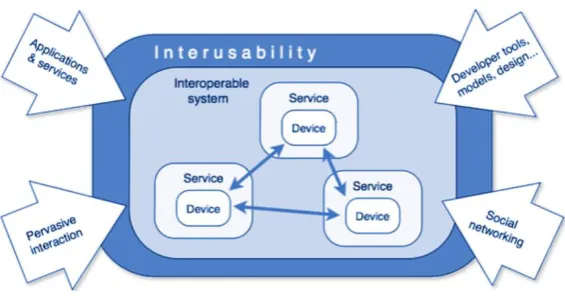
Figure 1: Smarcos overview
2
Background
This experiment is not an individual new piece of research, it is part of a collection of projects, researches and experiments that all involve interconnected embedded systems and immersive environments. The idea of all these systems is to make the gap between humans smaller and make the technology they use as smart as possible and to make technology adaptable to unexpected events. The name of the encompassing project is SMARCOS, and Royal Philips Electronics Incorporated is one of the companies partic-ipating in this project along with the University of Twente.
2.1 SMARCOS ARTEMIS
According to mission statement of SMARCOS (short for smart composites) the aim of the project is to help users of interconnected embedded systems by ensuring their interusability. The concept of this mission is derived from that fact that nowadays, many products connect with web services. SMARCOS allows devices and services to communicate in UI level terms and symbols, exchange context information, user actions, and semantic data. It allows applications to follow the user’s actions, predict needs and react appropriately to unexpected actions. The use cases would be constructed around three complementary domains: attentive personal systems, interusable devices and complex systems control, for this research itself however we are particularly focussing on attentive personal systems.
2.2 Goals of SMARCOS
With the diversity of subjects tackled in the SMARCOS project setting, it is little suprising that their goals are also multilateral. Their ultimate goals were stated as:
3. Reduction of revalidation and recertification effort and time.
4. Improvement of reusability of concept accross multiple sectors e.g. interop devices between domains.
All this should result then in happier users, less redesign, more reusable models and novel services. [1]
2.3 Philips DirectLife
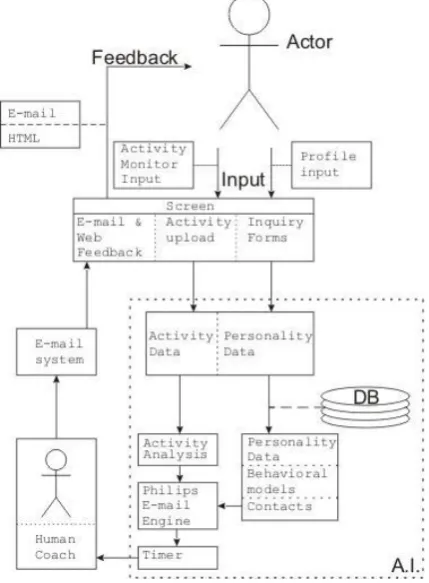
Philips DirectLife is the behaviour altering system that serves as a central theme for the experiment. It is a commercial product in which an triaxial accelerometer is used to keep track of the activity level and activity energy expenditure (AEE) of a system user. The information gathered by this accelerometer, which has been named activity monitor, is processed in combination with several personal profile attributes in order to calculate the activity status of the system user. Based on this profile and activity the system can provide information to a coach, which is at time of writing a real human being, who will then perform his task as coach by sending a coach message in the form of an e-mail to the system user.
The system is set up as an aide to people who wish to improve their own pattern of behaviour and activity, and in its current form is mostly aimed to benefit those people who are involved in work that requires little physical activity, or have otherwise a job that requires them to sit for extensive periods of time.
2.3.1 Goals of DirectLife
The goals of DirectLife vary widely from demonstrating that the company is interested in improving the wellbeing of its customers which can improve on the general attraction of the company brand name. Another point of interest is that it demonstrate that the company is acting within a modern timeframe, being green and health aware is a current issue, so demonstrating interest here and producing a product that can help people toward this more healthy way of Life is also benifitial toward the brand name. Another way that this last element works is used by the possible means of distribution, expecially in the United States.
2.4 System details
The current system works based on personal feedback from human coaches. These coaches are informed by the system in the form of a profile what kind of participant they are dealing with at that moment, the profile will state which of the previously mentioned category the person is in. At the same time the participant carries with him the so called Activity Monitor, which is a battery charged triaxial accelerometer, with a magnetic connector which allows it to connect to a USB device that functions as a docking station. The dock can be connected to the computer via a USB port and as soon as the Activity Monitor is connected to the dock, it will synchronise its content with the server where it is processed on the base of the profile information, the processed data will then be provided to the human coach. This will enable the coach to provide accurate feedback to the participant, stimulating him or her to further improve the pattern of activity.
2.5 Integration with the projects
3
Behavior change support system and embodied agents
The system that we are examining is a behavior change support system which involves the DirectLife system as developed by Philips, which is used as a tool to test a method of conveying a message to a user. One of the two comparing methods of conveying a message involves communication via an embodied agent. Embodied agents have been used in the past as well for behavior change support systems[8][26], and in those previous researches it was demonstrated as an effective method of instruction. This chapter will discuss and elaborate further on similar experiments which have dealt with behavior change support systems, through embodied agents as well as other methods; and it will also deal with the psychological theories on which these systems are built.
3.1 Health assistance systems
Using embodied agents in behaviour alterating systems and health assistence systems has been tested before succesfully on several occasions. An important factor in developing such a system is that users of the system need to find the character more or less relatable in order for the persuasive tactics to work for example it is essential that the embodied conversational agent(ECA) has the ability to generate verbal and nonverbal output [11].
3.2 Use of mobile devices
The use of mobile devices to give personal feedback from an embodied agent on a mobile device is not a novel one. Back in 2002 [9] several researchers already developed a health advisor system that was developed for use on a PDA system. However, the difference with the system in that research was that the agent used was interactive and rendered real time, while the design in this current research is such that the feedback from the agent is rendered in advance, thus resembling the e-mail response much more accurate than it would be if the agent was real time interactive. Another important difference between previous research and current research is the strict seperation between textual and spoken information in the ECA environment. Raw data about performance that involve numbers and statistics in the current system are still displayed as text, while the real coaching aspect in the new system is uttered in the form of spoken (Dutch) text, without any form of subtitles or text balloons. This in order to give some extra feeling of authenticity to the agent.The current system in this experiment is designed as such that it can be adjusted to view on smartphones, and in its current form is already functional for some smart phones, making it comparable to the existing Bickmore[9] experiment and we hope to have results that are in line with the expectations that were created by the Bickmore experiment.
3.3 Emotional influencing
or her personal behavior while using the system. There are a lot of ways in which systems try to influence other people by playing on their emotions. What these systems share is that they try to take a persons current state and from that state they try to convince the person to perform a specific action. The current state is not necessery an emotional one, emotions can also be used as a tool to convince the person to take the action you wish them to take. It has been demonstrated for example that just by playing on someones feelings of guilt can convince people to do actions they would normally not give in to[25], just as their happiness or grief[25]. In the current system that we are looking for we are making use of a simpler principle positive reinforcement, where positive behavior i.e. behavior that is closer to the desired changed behavior gets rewarded, which has been demonstrated effective in health counseling and disease prevention[14], making them associate the change in their behavior with a positive emotion.
In order to achieve our goal, i.e. the adjustment of the behaviour of the user, we are to employ several psychological tools. First of all, we need to classify in which category our user falls.
3.4 Behavior adjustment psychology
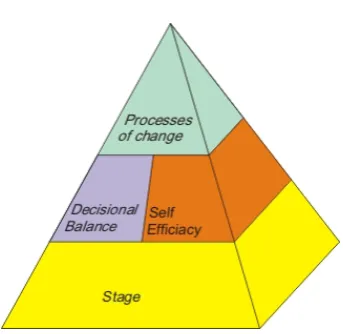
Figure 2: Stages of change Since this is a comparative study about
two destinct presentation methods of feed-back within the same behaviour altering system, it is important to take a look at previous studies in which someone tried to alter or adjust behaviour of people with the same or similar systems. This current system makes use of behavior adjustment psychology the concept on how to achieve change through behavior adjustment psy-chology is illustrated in figure 2 and 3. We try to make users of a behavior change support system go through several stages of change which as a final results should have a permanent change of behavior to a behavioral pattern that is more beneficial to that person. This system that we are
using here is also one that is developed for the internet, where it is not the first one. One of the most prominent areas for future healthcare improvement is the role of the web in fostering improved health and healthier lifestyles[24]. There is a wide range of diseases, health risks, addictions and psychological problems for which researches have reported positive results in managing them via online systems[28].
the basic request of the system is that the user takes his activity monitor and docks it regularly. The user will be reminded of this each time there is a lack of information from the system. The B-change system is to make users comply with the actual goal of the system, this is a bit more difficult but is the actual aim, namely to make the participants more active. The A-change is to not just adjust the behavior of the person temporarely, but to actually change the mentality of the person using the system to make it more effective on the long run. The experiment system we are using is focussing mostly on the C- and B-Change, due to the lack of time of the experiment and given how difficult it is to establish A-change in such a short time.
3.5 Transtheoretical Model
The basic model that is used to see in what current state a participant of the experiment is and what methods can be used to get the person to act as is desired by the system is the Transtheoretical Mode as introduced by Prochaskal[15]. The stages in which the people involved in the experiments are devided are pre-contemplation, contemplation, preparation, action maintanence, stable behavior and relapse. By adjusting the pros and cons within each decision that a participant experiences before a change and influencing the self efficacy of each participant we can make a participant change his or her current state to another one, and if the system works properly then the new stage should be close to stable behavior.
3.5.1 Pre-contemplation(not ready)
Participants at this stage do not intend to start the healthy behavior in the near future (within 6 months), and may be unaware of the need to change. Here they still learn more about healthy behavior: they are encouraged to think about the advantages of changing their behavior and to feel emotions about the effects of their negative behavior on others. Precontemplators typically underestimate the advantages of changing, overestimate the disadvantages, and often are not aware of making such mistakes. These individuals are encouraged to become more mindful of their decision making and more conscious of the multiple benefits of changing an unhealthy behavior.
3.5.2 Contemplation(getting ready)
At this stage, participants are intending to start the healthy behavior within the next 6 months. While they are usually now more aware of the positive sides of changing their behavioral patterns, the negative sides of actually having to go through that change are still in balance with the positive elements. This ambivalence about changing can cause them to keep putting off taking action.
is benefitial to them. They are encouraged to work at reducing the influences of the negative elements of changing their behavior. Important here is not to excessively point out that they need to change, since this highlights the downsides of changing much more than the positive influences that the change will have on their lives[15].
3.5.3 Preparation(ready)
Participants at this stage are ready to start taking action within the next 30 days. They take small steps that they believe can help them make the healthy behavior a part of their lives. For example, they tell their friends and family that they want to change their behavior, resulting in an increase of commitment to the change they are preparing for.
During this stage, participants are encouraged to seek support from friends they trust, tell people about their plan to change the way they act, and think about how they would feel if they behaved in a healthier way. Their number one concern is—when they act, will they fail? They learn that the better prepared they are the more likely they are to keep progressing. So for our system it is important to keep focus on social re-evaluation and generate a relationship of trust between the participant and the coach.
3.5.4 Action
Participants at this stage have changed their behavior within the last 6 months, and need to work hard to keep moving ahead. These participants need to learn how to strengthen their commitments to change and to fight urges to slip back. This is the stage where it is important to keep the decisional balance the way it is, namely in favor of proceeding with the change that has already been put into motion.
Strategies taught here include substituting activities related to the unhealthy be-havior with positive ones, rewarding themselves for taking steps toward changing, and avoiding people and situations that tempt them to behave in unhealthy ways.
3.5.5 Maintenance
Participants at this stage changed their behavior more than 6 months ago. It is important for people in this stage to be aware of situations that may tempt them to slip back into doing the unhealthy behavior—particularly stressful situations.
3.5.6 Stable behavior
The ultimate objective with a behvior change system is to achieve new stable behavior in which the desired original change has become the new daily routine for the user. The change to the new behavioral pattern has been more than 6 months ago and at this point there is no longer a direct danger of relapse present. If the participant has achieved this form of change we can speak of an A-change.
3.5.7 Relapse
If during the stage of maintenence the new stable behavior is not achieved, it will result into a relapse of old habits. This will mean that the participant will have to re-evaluate the pros and cons of his or her current behavior in order to once again go through the entire process of changing.
[image:21.595.339.511.333.500.2]3.5.8 Stage transitions
Figure 3: Graphic representation of behaviour adjustment psychology It has sometimes been argued that the
tran-sitions and categories within the state transi-tional diagram as used by Procheska are some-what arbitrary[32]. To demonstrate that this model is still valid for use in this experiment we can show each of the steps involved dur-ing a transition occurs from one stage to an-other. One of the fundamental elements of achieving each stage change is the element of the participants believe in their own compe-tence or in short their self-efficacy, making use of the predictive qualities resulting from stud-ies on self-efficacy[29] we can use the knowledge about the indivuduals’ self efficacy to stimulate change.
3.6 Transition
3.6.1 Transitional processes
There are several processes that can start a change of state within the participants behavior. The ability to invoke on each process depends on several factors, namely what part of the psychology within the stage of change we wish to adjust, (decisional balance or the self efficacy), the current stage the person is in and the tools, both mechanical and psychological that we have to our disposal. We have the following processes:
1. Helping Relationships— This is the central process of the experiment involved
in this research. It is about the participant finding people who are supportive of their change, by making use of a personal coach. We offer a coach to the partici-pants of the experiment, one coach with one basic set of personal information about the participant and we give this coach the ability to provide the service of a helping relationship. Persuasive technologies developed to date have, for the most part, implemented persuasive techniques inspired by human-human interaction[13]. So the coach we offer here is completely based on the coaches of the current com-mercial DirectLife system, as well as the knowledge of a real life coach. It is very important that both systems try to achieve a close relationship with the partici-pant since a message is more persuasive if it comes from a source with whom the listener perceives a greater affiliation[12].
2. Consciousness-raising— Increasing awareness via information, education, and
personal feedback about the healthy behavior. By giving information in the proper way we wish to push forwards the advantages of changing while at the same time making aware that the disadvantages are less, and the difficulties during change can be overcome, thus shifting the decisional balance in the favor of change.
3. Dramatic relief—Feeling fear, anxiety, or worry because of the unhealthy
be-havior, or feeling inspiration and hope when they hear about how people are able to change to healthy behaviors. By making use of feelings about health problems and stating health risks in a weekly advice, we can use this process to convince a participant to take action to improve his or her daily pattern. This in order to change the daily pattern with a more healthy one. An example of this is that the system makes use of some simple medical references such as pointing out that a lack of steady movement can result in heart disease.
4. Self-re-evaluation—Realizing that the healthy behavior is an important part
of who they are and want to be, this element can be played upon by using the right words when giving the weekly coaching. It is important here that we do not actively instruct the participant of the experiment to do something. Instead of giving instructions, the feedback will be more in order to give general health advice and how this can affect them personally.This should encourage the person to re-evaluate his or her own behaviour.
5. Environmental reevaluation— This is the effect of people realizing how their
by changing their daily routines and activities to more healthy ones. We can make use of this mechanism in two ways. The first one is to point out the benefits to their environment by health tips, this must be done in such a way that it cannot be conceived as an instruction or insult in any way, since these would work counterproductive. The second way is already in use in the web-environment part of the current system, where the participants can sign up in friendship. This will show their environment that they are actively trying to increase their health.
6. Social Liberation—This is about the participant realizing that society is more
supportive of the healthy behavior, this is a point that again can be easily pointed out as one of the advice of the week elements of the coaching. However since there were no direct articles that the coach could refer to, this element was not applied.
7. Self-Liberation— The method of self liberation has to do with believing in one’s
ability to change and making commitments and re-commitments to act on that belief, it is closely related to the psychological principle of consistency and com-mitment, it has been demonstrated by several researches that once an individual publically sets a goal and attempts to it, he or she will keep going to work toward this goal even if its against his or her own intuition later on[25]. The system makes use of these goals by giving the participants of the system the ability to broadcast their achievements or by making them public automatically, and at the same time letting the system set goals for them to adhere to.
8. Reinforcement Management—This process deals with the increasing of the
rewards that come from positive behavior and reducing those that come from negative behavior. During the weekly response coaching in this experiment we make use of basic forms of positive reinforcement to encourage the participant to move more. At the same time the feedback from other people that are involved in the same community of the experiment will also possitively encourage extra activity. At the same time not wearing the activity monitor or not moving enough will put the participant further away from the goals, and this is measured by the system and compared to the goals as they are registered in the system. Reading back on such negative results will generally be experienced as discouraging.
9. Stimulus Control—This is the avoidance or countering stimuli that elicit
prob-lem behaviors. We can invoke this process by using reminders and cues that encourage healthy behavior as substitutes for those that encourage the unhealthy behavior. The most basic ones in this system are the fact that particpants actually bring the activity monitor and docking it with their system so they can actively keep an eye on their behavior, and in that way convince themselves to adjust whenever they see that there is a unhealthy pattern. And from that participants will realize that they are doing something wrong, without the system having to explicitly point it out for them.
10. Counter-Conditioning—This is the process of substituting healthy ways of
research experiment.
3.7 Weapons of persuasion
If we wish to evoke these transitional processes via another person (or in our case virtual human being) we need to examine what psychological mechanisms exist to do so. In ”Weapons of persuasion” several strategies to do just that are pointed out[25].
3.7.1 Reciprocation
The concept of reciprocation is that when a person is providing you a favor, no matter how small or how big, the person automatically gets the feeling that he or she needs to repay that favor in some form. This feeling is not based on rational balance so you can encourage a person to provide a big favor as a response to only a small courtesy [25]. This concept can be used by a coach by attempting to give the participant the feeling that the service the coach is providing is sincere, and the best way to reciprocate is to follow the coach’s instructions.
3.7.2 Commitment and consistency
After a statement is made a person will almost always try to stick to this statement, even if that person has been proven wrong or he has the ”gut feeling” that he has been duped[25]. The system makes use of this system by setting a goal in advance that is optimized for this person, and then every week presenting this goal to the participant in order to try to keep the person consistent.
3.7.3 Social proof
If you see someone that is of the same ”clique” as you, you are more likely to immitate[25]. The concept of social proof is very important in coaching or instruction environments, since it allows us to present to the coachee an coach that can serve this exact purpose. Other studies have shown that this is effective but only if the coach is realistic enough in behaviour and also uses varying methods to bring the information[22]. However, when trying to model a coach as realistic as possible there are some areas of realism known as the uncanny valley[2] that should be avoided, since on one side exaggerated emotion display proves effective, overly realistic display of an artificial human representation turns to invoke more negative feelings.
3.7.4 Liking
predictive of outcomes. When measuring likability for systems we can resort to a stan-dard set of survey questions that have been demonstrated to be effective in analysing how well a person likes the agent that person is interacting with[5].
3.7.5 Authority
If the person has symbols or titels of authority, you are very likely to comply with instructions automatically, even if it goes against almost the very core of your being[25], something that was clearly demonstrated in the Milgram experiments in 1974[21]. Simple tricks can be used to give the actor in the system extra authority, giving the person to communicate with a labcoat has been proven to be effective as well as placing the actor in a proper environment such as an office or similar official surroundings.
3.7.6 Scarcity
If there is few of an item we want it more. If the item seems to be unobtainable soon, we want it the most. It has been demonstrated in several occassions that aquiring can be far more imporant than the actual possession[25]. Since this is a training program with an instructor, there is not a specific object that people can obtain in a specific form, so the only limiting factor in how we can make people desire the product more is by making them aware that they can only use it for a limited amount of time.
3.8 Virtual embodied agents in behavior change support systems
In the past, ECAs have been used in a wide variety of environments to support behavior change. There have been experiments in which they have been used to deal with depres-sion where it turned out that 35 percent prefered an ECA over even a real doctor[16]. Next to that there have also been experiments in dealing with psychological illnesses such as schizophrenia where embodied agents were used to help patients[10].
Next to this there have also been experiments done that are closer to people managing their own personal health where they even managed to determine that the right kind of politeness were key to getting people to keep adhering to their new more healthy behavior and that it is crucial to avoid annoying interruptions [7].
3.9 Virtual embodied agents vs pure text systems
importance, and we need to take control of the rate of speech of the system.
At the same time there are also other studies that have shown that when comparing a system involving an embodied conversational agent with the same system without the embodied agent, for learning it has neither a beneficial nor a detrimental effect[20]. So if we take these findings in account we would expect to have some positive influence from the embodied agent when it comes to coaching, if all the important elements of the systems are correctly setup. For example in an e-mail system the participant can read at his or her own speed, the embodied agent will perform the speech at a pre-defined speed which needs to be calibrated carefully. As mentioned before the same goes for nodding, blinking and gestures as well as gazing. All these should be properly setup to make the agent acceptable for the participant.
3.10 Putting theory to practice
4
System description
[image:27.595.170.385.276.568.2]The current system exists out of several parts, the innerworkings of which we cannot describe in full detail due to the confidential nature of the internal working, instead we will discuss them on a level of functionality. The system relies on several subsystems, and a personal feedback coach. In figure 4 we can see a simple schematic outlining all functional parts of the system. It contains a way to present information to the user, by means of a website and by sending e-mails. It can receive information from the activity monitor through the internet, and by analysis through some undisclosed statistics and heuristics the system is able to catagorize system users. The system will provide a coach with a basic text and profile information, enabling the coach to send the user a personalized coaching e-mail assisting him or her in fullfilling the program.
Figure 4: Consumer system
4.1 Comparing the consumer system with the experiment system
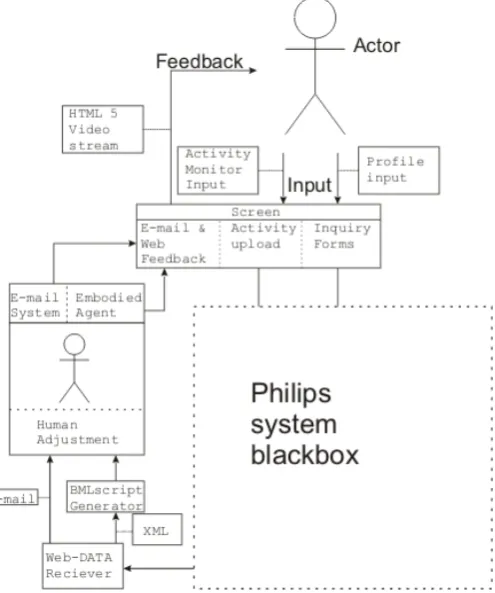
basically provides information to a human coach who then e-mails it for the user to read, the new system performs its role differently.
First of all, the Philips system here has a predefined XML output, which is placed on a data dump server, as seen in figure 7. This server will log all its input and informs the system operator, a human component within the system and in this experiment we will take on this role, that data is available to be processed. In case the data is meant for e-mail presentation the operator will check the e-mail on validity of the content, this is similar to the live system except that the e-mail is generated in full text and in most cases no human intervention is needed.
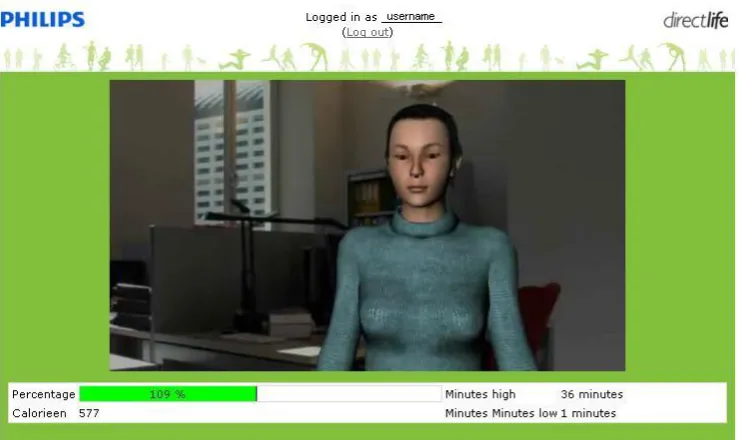
[image:28.595.178.426.304.601.2]In case the data is meant for ECA presentation there will be a generated BML script created by the system from the XML, which will be checked in the same way by the same person who checked the e-mail presentation data. The script shall be performed by ECA and screen captured by the operator, and the result shall be put on the webserver which will inform the participant that new data is available.
4.2 Key to success
When comparing this system to other previously developed behavior change systems they have for the most part been implemented with persuasive techniques inspired by human-human interaction. So when we try to create new persuasive technologies in order to most likely be succesful we need to create a system that resembles human-human interaction the most[13]. And at the same time we wish to create an intimite bond between the agent doing the communication and the participant within the experiment so we can get the desired affiliation[12]. So the key to success in building a new form of persuasive technology is to create interaction that A) simulations human - human behavior, and B) the technology, in this case an embodied agent, needs to be perceived with a greater affiliation.
[image:29.595.339.507.314.617.2]4.3 BML
Figure 6: text use model At some point in the history of development of
XML, people tried to use this standard to cre-ate a formal construct to be able to describe behaviour[18]. This formal construct will then al-low developers to write input for embodied agents that should result in output that represents com-parable behavior and expressions. Seeing as how this should uniformly behave for all kinds of ECA, we can use this as output of our script generation process and as input for our embodied conversa-tional agent, resulting in a script that should also be useful for other agent systems.
4.3.1 Text use model
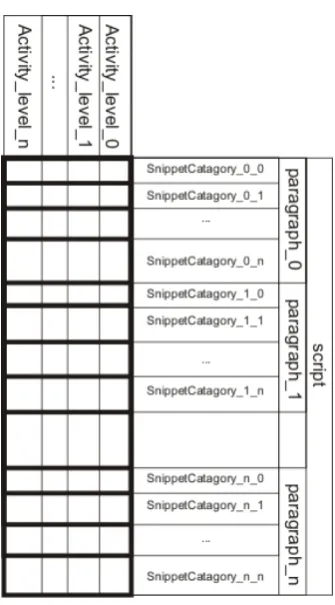
The system that is currently being developed by Philips to automate their e-mail response to Di-rectLife users is called the ”e-mail engine”. During the analysis of the existing e-mail engine we saw that in order to create a proper text, the most ef-fective way is to make use of a combination of snip-pets. These snippets are basically text fragments, that together can form a paragraph of a text, and a combination of paragraphs together can form a script for the embodied agent.
the person and the total function of the script). To be able to find the proper paragraph construction, we need two pieces of information, the first is the total function of the text, as in are we introducing a user to the system or are we giving a standard message or are we trying to do something else. The second is that we need to know who we are addressing. With the help of a personality analysis we are able to determine what kind of person this is and what kind of script build up we should use to achieve maximum effect.
After determining what the general construction of the script should be like, the next step is to determine the function of each of the fragments of the paragraphs. This is a simple linked list, since the function of the paragraph determines series of sentence categories to use. However when we look at the function of the text as a whole the tone of the message should be depending on the activity profile of the user as well, so out of a set of possible fragments we pick the one exact fragment type that is appropriate for the activity profile of this user.
Since this is an automated system, we risk that the user will hear the same message over and over again, in case he or she is performing in a constant pattern (as in the profile does not change, the function of the script category does not change, and the user performance does not change). To prevent repetative scripts, the last part to actually fetch the snippet is modified by a randomizer, by picking randomly from a set of three possible snippets that all carry the same message in the same tone, yet with the word choice slightly altered and the order of words slightly altered.
A schematic oversight of this text model can be found in figure 6, and an example of the output is demonstrated in section 4.8.1.
4.3.2 Emotion use model
The original coaching system makes use of a mild form of positive reinforcement condi-tioning. By always making the coaching message positive it encourages the person to continue going on, but this does endanger the effectiveness in giving correct feedback, since there is little use to compliment someone on doing absolutely nothing toward their set goal. So we present the most positive feedback when closest to a specific goal range under the right conditions.
4.4 Elckerlyck
realisation of the scripts and it is also capable of being expanded with extra emotions, gestures and expressions if required.
4.5 Feedback types
When interacting with a behavior change system like this there are two distinct forms of feedback, one of these is the coach instruction feedback which is the main focus of this research while the other is the response to user questions. This second type is also something which perhaps can be automated but this is outside the field of this research.
4.6 Components
For this research we needed a suitable test environment. There were several restrictions on this test environment, first of all the most constricting factor: time. The total timeframe for complete system development of this experiment is less than 4 months. This means that making use of components that require alot of implementation from the developer side are not an option, all implementations need to be directly usable with a minimal amount of programming. There are several tools that lend themselves perfectly for this experiment, due to the amount of experience we have with them and the relative well fit they are in their most basic form for the task at hand. These tools are a set of programming languages and frameworks and open source components, as well as components developed by other people at the university. Out of all the useful components and tools that are available we have chosen the following:
1. Programming languages
Java, as basic language for the script generation process and external communi-cation with the database.
Ruby, in combination with the rails framework, in order to provide access to the video content and manage safe log in and user accounts. All the Ruby on rails code will run on a Mongrel server which has demonstrated to be stable and reliable.
2. Database
MySQL, since this is the database the developer has most experience working
with, and is also suited to serve as the database background for the rails framework.
3. Embodied agent
Elckerlyck, The ECA for realizing the BML script.
Loquendo text to speech voice Saskia, since this is the only available text
to speech that is female, dutch and can also be integrated with the BML realiser platform of Elckerlyck.
4.7 Total experiment system setup
the DirectLife system. The data-transfer layer is of little interest since it is of temporary use, so it was built up with robust but simple to built server. The videoserver in its testform was built up in such a way that it needed a secure login, such as would be used in the DirectLife current web system, and it can provide a basic structure that can easily be built in in each type of webserver, by using the existing frameworks for it that are well tested and completely open source it demonstrates itself to be quickly implemented, stable and secure. The scriptgenerator has been implemented in Java, this was done because of the necessery external software was written in java as well, which makes everything easier to integrate into one whole system, as well as for the sake of programmer experience, since it is language the developer has most hours of programming experience in. The choice for the Elckerlyck agent is a more complicated one as we have seen in the previous paragraph. The streaming video concept is one that can be used due to the choice for a-synchronous communication.
4.7.1 WebServer
This is a http server which makes use of session locks to communicate with participants of the subject. It is a Mongrel server programmed in Ruby and running on the Rails framework. Based on session locks the system can only send movies of the current user to him, attempts to view other movies will generally result in failure unless the locking system is somehow hacked. In order to further secure privacy, passwords of any user of the system will be encrypted and there is no viewable URL information that can compromise security. Once a participant has made an account on this server he needs to confirm this with e-mail feedback. After all this is done the viewer has access to lists of movie entries that are linked to his or her account, the content of the movies and the movie entries need to be added manually by the system administrator. In a full system this of course will be automated, but that would go beyond the range of this experiment. Once the participant has access to this movie list all he or she needs to do is click the desired coaching video and it will appear. The view of each movie is setup in HTML5 with a fallback to flash in case HTML5 functionality is missing on the client side. The choice for this medium is based on compatibility, HTML5 and flash together are supported by 95 percent of the browsers used and its also supported on mobile devices. In case even this support fails, there are links to three seperate formated downloadable versions to accommodate this last group of users. Any failure to view the movies aside from these are considered beyond the range of this experiment(participants in the experiment will be helped in order to make sure they can view the movies).
4.7.2 User information extraction
by the rest of the system. The exact innerworkings of the system is confidential and therefore cannot and will not be further examined in this research.
4.7.3 Data transfer
After data-generation, this data will be sent via an http medium to the mongrel web-server at the university. Its function is relatively simple: it receives the information, makes an entry in a database that the information is received, then it generates two files. The two files are one e-mail file, that contains the e-mail data as produced by the Philips Direct Life e-mail engine and a second file that contains the XML data as produced by the data analysis system within the Philips system. By storing it in both a database and putting it into files we have a logging and back up system, and a convenient way to loading files into the script generator.
Figure 7: XML input handling
4.7.4 E-mail server
The system will make use of an e-mail server, which is an integrated part of the entire movie server that informs a user as soon as a new instructional coach-ing video is placed on their special video channel. This component makes use of the built in system of post-mail that exists within the Rails framework. It can function properly since the only requirement for correctly delivering mail via this system is to implement the tags that surround the content of the e-mail. For the users of the traditional system a similar system is used only here the e-mail will be send with full content of information regarding the coach instructions, as generated by the already
implemented ”Philips e-mail engine”. Each time one of these e-mails is delivered an entry will be made into a database, allowing this experiment to monitor all send out data closely and keeping track of everything with the help of timestamps of database entries.
4.8 input
In order to obtain a script through this system, it requires a form of input that it can handle. This java program requires an XML schema as input, containing the following pieces of information:
2. Date to put online 3. Calories
4. Percentage of goal reached 5. Stage of change
6. Activity type
One of the components of the experiment environment was the data receiving server, which by HTML forms received the data from Philips, and then took all the relevant content and created an XML file from this, the content is stored in a database, and stored in file format (both input and resulting xml output), and in order to always be informed the information is also sent by e-mail to an account that was specially created for this particular experiment. The special formatted XML can then be fed to the script generator, which in its turn will parse it to the proper parameters to use on the script generating algorithm.
4.8.1 Database link
This class is the mediator between the java program and the database which contains the actual text fragments and the hierarchy of the content of the database. The discription of the content of the database can be found below in the tabels. The database entries are divided over four different tabels, the top level tabel will pick the paragraphs of the script, while the second level tabel will determine which catagory of sentences the script will have, based on this activity information the it will get an index of the lowest level of tabel, which contains three entries for each key. To provide with extra variety within the system a random one will be picked from the three possiblities, the three possiblities will contain the same content, tone and method of addressing, yet the word order is slightly adjusted and with some words replaced with synonyms. Though the scripts are actually created on base of weeknumber, making them unique per week, so it is impossible for one person to recieve the same message twice, it is also rather unlikely (though no t impossible with the exception of the name of the individual) for two people to recieve the same movie, even if all the parameters are the same. The only exception in this is the received message upon a lack of data, since there are only a very small number of possible replies here.
4.9 Script generator further examined
comprehensible and simple to use, and there is also a possibility to generate the scripts by commandline with the proper attributes.
Within the grafical user interface there are several settings that are built in for experiment sake, that are not supposed to be used in practice, but can be useful to optimize the system for actual use, these are the options to adjust user profile input values before they are parsed to the script generating algorithm.
4.9.1 output
Given the general design of the text built up model the eventual content can be described in several layers. The top layer is a story, a story consists out of paragraphs, paragraphs consist out of snippets which are sentences combined with BML fragments. The whole story needs to conform to the BML specifications. By making use of the parameters that are available within the system we can built up a text according to the following schedule:
Table 1: Story lineout paragraph level
week Paragraph ID
0 0,1,2,3,4
1 0,5,11
2 0,6,11
3 0,7,12
4 0,8,13
5 0,9,13
6 0,10,14
6.1 0,15,16
This is the highest level of abstraction, it deals with what type of script it should return and this is based on the week of the program. For example if it is the beginning of the programming, week 0, it will then continue to the next table where it will attempt to fetch in order paragraph 0, 1,2,3 and 4.
Table 2: Content of paragraph.
Paragraph ID Info Category ID
0 BML + salutation 0
1 Intro movie paragraph1 1
2 Intro movie paragraph2 2
3 Intro movie paragraph3 3
Table 2 – continued from previous page
Paragraph ID Info) Category IDs
4 Intro movie paragraph4 4,19
5 Main first feedback 5,6
6 Main second feedback 5,7
7 main third feedback 5,8
8 Main fourth feedback 5,9
9 Main fifth feedback 5,10
10 Main sixth feedback 5,11
11 Closing advice week 1+2 12,16,19
12 Closing advice week 3 13,16,19
13 Closing advice week 4+5 14,16,19
14 Closing advice week 6 15,16,19
15 closing program Info 5,17
16 End of program Farewell 18,19
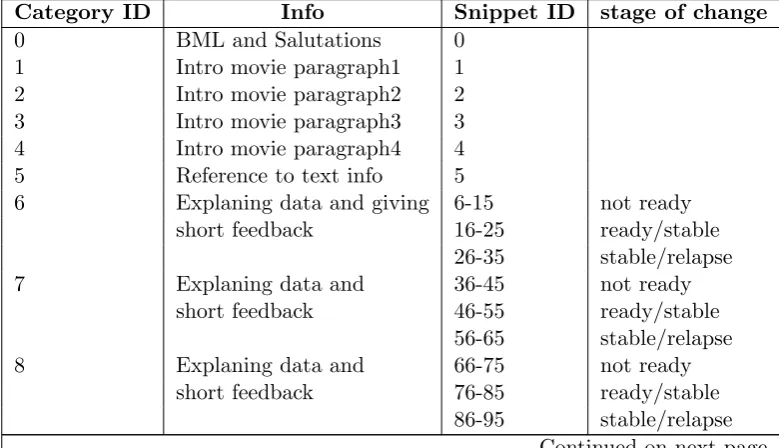
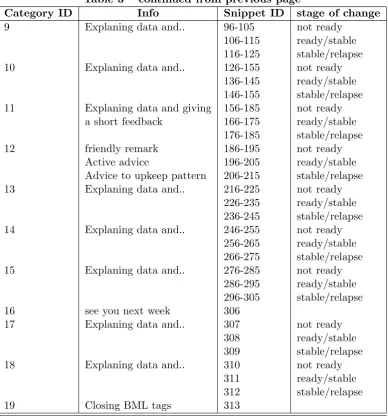
This is the second level of abstraction, it deals with the content of the paragraphs of the scripts, if we continue our previous example we see that paragraph 0 will return snippet category 0, paragraph 1, will return snippet category 1, paragraph 2 will return 2, paragraph 3 will return category 3, and paragraph 4 will return snippet catagory 4 followed by catagory 19. All of these will be fetched from the next level table.
Table 3: Snippet categories.
Category ID Info Snippet ID stage of change
0 BML and Salutations 0
1 Intro movie paragraph1 1
2 Intro movie paragraph2 2
3 Intro movie paragraph3 3
4 Intro movie paragraph4 4
5 Reference to text info 5
6 Explaning data and giving 6-15 not ready
short feedback 16-25 ready/stable
26-35 stable/relapse
7 Explaning data and 36-45 not ready
short feedback 46-55 ready/stable
56-65 stable/relapse
8 Explaning data and 66-75 not ready
short feedback 76-85 ready/stable
86-95 stable/relapse
Table 3 – continued from previous page
Category ID Info Snippet ID stage of change
9 Explaning data and.. 96-105 not ready
106-115 ready/stable
116-125 stable/relapse
10 Explaning data and.. 126-155 not ready
136-145 ready/stable
146-155 stable/relapse
11 Explaning data and giving 156-185 not ready
a short feedback 166-175 ready/stable
176-185 stable/relapse
12 friendly remark 186-195 not ready
Active advice 196-205 ready/stable
Advice to upkeep pattern 206-215 stable/relapse
13 Explaning data and.. 216-225 not ready
226-235 ready/stable
236-245 stable/relapse
14 Explaning data and.. 246-255 not ready
256-265 ready/stable
266-275 stable/relapse
15 Explaning data and.. 276-285 not ready
286-295 ready/stable
296-305 stable/relapse
16 see you next week 306
17 Explaning data and.. 307 not ready
308 ready/stable
309 stable/relapse
18 Explaning data and.. 310 not ready
311 ready/stable
312 stable/relapse
19 Closing BML tags 313
Table 4: Snippet range.
Level Info Activity type
0 no significant activity
1 Under performance active
2 Adequate performance active
3 good performance active
4 Overperformance
5 serious under performance inactive
6 mild underperformance inactive
7 Adequate performance inactive
8 Good performance inactive
9 Overperformance
4.9.2 Text model
This is the central model class in the program. To create a text model, we need to provide the model with the proper parameters which are the weeknumber, the percentage of goal in activity, the stage of change, and the activity type. Based on this information it will contact the database link class, which will provide the proper information from the parameters. The text model consists out of a series of paragraphs, each paragraph by itself consists out of a set of snippetcategories, which all have a set function depending on what paragraph they are in.Then based on the original parameters (i.e. activity type, percentage of goal and stage of change) the right snippet is picked from the possible snippets within each category. If we take the total text and put each snippet in order as set by the paragraphs, we will end up with a full BML script that is able to serve as input to a BML realiser to result into a performance by an embodied agent.
4.9.3 Snippet fetching algorithm
active an non active, where the activity is based on the initial pattern, giving us a range from zero upto nine. The last factor then is the stage of change, here we have three categories, before ready, ready/stable and relapse. For each stage of change category we set the same range of ten possibilities, resulting in a total of thirty possible snippets (maximum) per snippet category. The algorithm is adjusted in such a way that if there are fewer than thirty possibilities present it will scale the score of 0 to 29 on the total range of possibilities that is present at that time, for instance if we just have 1 possible category because of lack of information it will always result index zero.
4.9.4 BML results from scriptgenerator
5
Experiment
The method to validate the difference in performance between the two feedback methods is the experiment. This chapter will deal with which parameters will be measured, how they are measured and how the resulting data will be processed.
5.1 Procedure
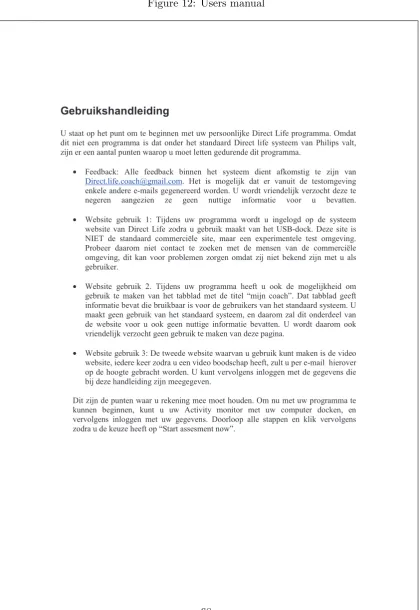
The first step was to get twenty participants to perform the experiment, which would be performed as a single blind study, where the participants would not be aware what forms of feedback exist within the system and only are informed about the form of feedback they themself can expect to personally receive from the system. At the end they are asked to evaluate the performance of the feedback given by the system. After all information(see section 5.3) is gathered and processed, each participant is given an activity monitor and a short manual on how to proceed with the experiment. This man-ual can be found in the appendix as figure 12 on page 59, it deals with several points amongst which the communication, where they were instructed to ignore all e-mail that are automatically generated by the administration system, rather than the coach of the experiment. Both parties within the experiment are being informed of a weekly update via their e-mail, in one group the mail will contain all the information of the last week, while the other group just receives a message that there is a new video waiting for them. Here the coach will give them the information of the previous week. The information that is in the video is exactly mapped on the information that can be found in the e-mail, this in order to avoid that one group is better informed than the other. All participants were introduced to the coach who was named Brenda which is an acronym for BML Realizing natural Direct-life Assistant, while one group only saw the name under each e-mail as sender, the other group would have a short introduction in which the embodied agent introduces herself and tells the participants that she will guide them further. week 1
The next step is the first week of the actual experiment. In the first week, all partic-ipants will have to complete an assessment program. This is a training program that gives no daily feedback on the website, and at the end of the week the system will provide them with feedback about their activity pattern, this will be the first unique feedback message to all participants, it will deal with the results of the assesment and asks for all participants to start their usual programs then and there if there is enough information for the program to run on. If there is a lack of information participants will be asked to select a standard pre-defined program.
week 2 and 3
high activity who run a risk of ”crashing” will be adviced to stick to a pattern that they feel comfortable with and not to overdo it. Another example would be people who are still in the contemplation stage and are not doing too bad but are not reaching their goals yet either, these persons would be informed of health risks of general inactivity and the benefits of long distance walking.
week 4
After this week the half way point of the experiment is reached, and they will be given a feedback session that is reflective of their entire path so far. This is also the moment for the first feedback session for the experiment so all participants are at that point asked to fill in the second survey.
week 5 and 6
Once passed that week only two more feedback moments from the coach to the partic-ipant remain. For these last two weeks similar feedback will be given as for the second and third week. After these last weeks the final survey will be taken as a personal in-terview giving us the total overview of the systems performance with the two seperate coach feedback systems.
5.1.1 Required system results
In order to compare the new feedback presentation method we need clear numbers that can quantify the performance of both feedback presentation methods, there are several aspects of the system that need to be checked. We need to be able to compare the performance in sense of persuasiveness, relapse sensitivity, attractiveness and relatability. For relapse sensitivity we focus on the pure numbers of the test to see which group performs closer to their set goals on average, while persuasion is going to be measured by a combination of survey and numbers such as how close to their goal are the participants during each interval and their physical activity level. The aspects of attractiveness and relatability are examined purely by survey.
5.1.2 Statistical survey
same method, this influence should be present as strongly in both groups. The exact survey forms can be found in the appendix, page 64 to 77.
5.2 Measures
In this research the main focus was on quality of information by gathering as much data per person rather than going for large quantities of participants with relatively shallow information. For each participant we would measure along all the dimensions.
5.2.1 Likeability
This dimension is going to be measured with the aide of a validated set of survey ques-tions to measure performance on attractiveness from an agent system. We will ask each participant to rate the system on a range of 1 to 7 on five Likert-scales that all deal with how attractive they find the agent with which they are communicating. Each of the questions should be answered similarly for the survey to be a valid representation of the attractiveness of the system. The average of each of the question will then serve as an indication how attractive the system is. So in this case the desireable outcome for the feedback method is to have a high score on attractiveness on the survey. The questions that they would be asked to rank on a one to seven likert scale would be, Dislike - like, unfriendly - friendly, unkind - kind, unpleasant - pleasant and awful - nice. Questionnaires that use these Likert scales (though they used five point scales) in other experiments they have been demonstrated to have a reliability Cronbach’s alpha value of well over 0.7 [2][3].
As an addition to the attractiveness of the agent, the attractiveness to the system as a whole will be measured by a set of questions relating to how interested the participants are in actually buying the system. The more interested participants are to buy the sys-tem, the more attractive it is rated.
In addition to this we can also measure for the video group how often and how quickly they watch their video feedback after it has been announced on their e-mail that they have a coaching message waiting for them in their inbox. Since we do not have a method of measuring the responsiveness towards the e-mail group we will have to accept this last set of measurements as a interesting sidenote, but it has no measured element from the e-mail counterpart that it can be compared to.
5.2.2 Perceived intelligence
Incompetent - competent, ignorant - knowledgeable, irresponsible - responsible, unintel-ligent - intelunintel-ligent and foolish - sensible. These Likert scales have been demonstrated to be reliable in other experiments with a Cronbach’s alpha value of 0.75 [3] and 0.769[6].
5.2.3 Trust/fear
This is again measured by using a validated set of questions relating to the amount of fear that the participants experience while interacting with the agent. If the participants feel more anxious or nervous while recieving feedback of the information it can indicate a certain amount of fear or a lack of trust from the participant towards the coach. This could have a negative impact on the performance of the coach. So the desirable outcome for a good system is a low amount of fear. The questions we used for these are those of perceived safety, which are anxious - relaxed, agitated - calm and quiescent - surprised. These scales have been demonstrated to be reliable with a Cronbach’s alpha value of 0.91 with a five points Likert scale[19].
5.2.4 Effectiveness
The effectiveness of the system is determined by the physical activity level of all the participants. This is an absolute number that represents how active each participant is. If we have a continuous set of activity levels for each participant, we can then see how well they have improved over the duration of the program, and we can compare whether there is any significant difference between both feedback methods in sense of effectiveness. So the best outcome for a system is a constant increase of physical activity level for each of the participants within that specific group.
5.2.5 Persuasiveness
Each user will receive a goal to reach during each day of the program. This goal is then set as 100 percent, and the idea is to measure how capable both feedback methods are at keeping the participant performing steadily above 100 percent. The best outcome for each feedback method would be that the participants of the group have a score that is constantly above 100 percent and at a steady high level.
5.2.6 Relapse sensitivity