(
S
)-6-Methyl-
"""
-caprolactone
Maxime A. Siegler,* Huub Kooijman‡ and Anthony L. Spek
Bijvoet Center for Biomolecular Research, Crystal and Structural Chemistry, Utrecht University, Padualaan 8, 3584 CH Utrecht, The Netherlands
Correspondence e-mail: [email protected]
Received 8 February 2008; accepted 15 February 2008
Key indicators: single-crystal X-ray study;T= 150 K; mean(C–C) = 0.002 A˚; Rfactor = 0.027;wRfactor = 0.072; data-to-parameter ratio = 10.7.
The chiral title compound, C7H12O2, a lactone derivative,
features a seven-membered ring that adopts a chair conforma-tion. The crystal structure is stabilized by weak C—H O interactions occurring in the (100) plane. The absolute configuration was assigned on the basis of the enantioselective synthesis.
Related literature
For related literature, see: van Aset al.(2005); van Buijtenen
et al. (2006). For details of the synthesis, see: van As et al.
(2007). For geometry, see: Cremer & Pople (1975).
Experimental
Crystal data
C7H12O2
Mr= 128.17 Monoclinic,P21 a= 6.757 (2) A˚ b= 7.577 (2) A˚ c= 7.586 (2) A˚
= 110.949 (13)
V= 362.71 (17) A˚3 Z= 2
MoKradiation
= 0.08 mm1
T= 150 (2) K 0.350.150.10 mm
Nonius KappaCCD diffractometer Absorption correction: none 10010 measured reflections
889 independent reflections 862 reflections withI> 2(I) Rint= 0.041
Refinement
R[F2> 2(F2)] = 0.027
wR(F2) = 0.072 S= 1.10 889 reflections 83 parameters
1 restraint
H-atom parameters constrained
max= 0.12 e A˚
3
min=0.16 e A˚
[image:1.610.313.565.228.285.2]3
Table 1
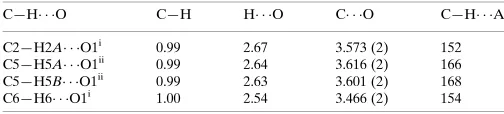
Short-contact C—H O interactions (A˚ ,) found in the (100) plane.
C—H O C—H H O C O C—H A
C2—H2A O1i
0.99 2.67 3.573 (2) 152
C5—H5A O1ii
0.99 2.64 3.616 (2) 166
C5—H5B O1ii 0.99 2.63 3.601 (2) 168
C6—H6 O1i
1.00 2.54 3.466 (2) 154
Symmetry codes: (i)xþ2;y1=2;z; (ii)x;y;zþ1.
Data collection: COLLECT (Nonius, 1998); cell refinement:
DENZO (Otwinowski & Minor, 1997); data reduction: DENZO;
program(s) used to solve structure: SHELXS86 (Sheldrick, 2008);
program(s) used to refine structure:SHELXL97(Sheldrick, 2008);
molecular graphics:PLATON(Spek, 2003); software used to prepare
material for publication:PLATONandMercury(Macraeet al., 2006).
We thank Ir Bart A. C. van As, Dr Anja R. A. Palmans and Professor E. W. Meijer for providing crystals of the title compound. This work was supported by the Council for Chemical Sciences of the Netherlands Organization for Scientific Research (CW-NWO).
Supplementary data and figures for this paper are available from the IUCr electronic archives (Reference: TK2248).
References
As, B. A. C. van, Chan, D., Kivit, J. J., Palmans, A. R. A. & Meijer, E. W. (2007). Tetrahedron Asymmetry,18, 787–790.
As, B. A. C. van, van Buijtenen, J., Broxterman, Q. B., Verzijl, G. K. M., Heise, A., Palmans, A. R. A. & Meijer, E. W. (2005).J. Am. Chem. Soc.28, 9964– 9965.
Buijtenen, J. van, van As, B. A. C., Meuldijk, J., Palmans, A. R. A., Vekemans, J. A. J. M., Hulshof, L. A. & Meijer, E. W. (2006).Chem. Commun.30, 3169– 3171.
Cremer, D. & Pople, J. A. (1975).J. Am. Chem. Soc.97, 1354–1358. Macrae, C. F., Edgington, P. R., McCabe, P., Pidcock, E., Shields, G. P., Taylor,
R., Towler, M. & van de Streek, J. (2006).J. Appl. Cryst.39, 453–457. Nonius (1998).COLLECT. Nonius BV, Delft, The Netherlands.
Otwinowski, Z. & Minor, W. (1997). Methods in Enzymology, Vol. 276, Macromolecular Crystallography, Part A, edited by C. W. Carter Jr & R. M. Sweet, pp. 307–326. New York: Academic Press.
Sheldrick, G. M. (2008).Acta Cryst.A64, 112–122. Spek, A. L. (2003).J. Appl. Cryst.36, 7–13. Structure Reports
Online
supporting information
Acta Cryst. (2008). E64, o607 [doi:10.1107/S1600536808004583]
(
S
)-6-Methyl-
∊
-caprolactone
Maxime A. Siegler, Huub Kooijman and Anthony L. Spek
S1. Comment
The enantiomers (R)- and (S)-6-methyl-ε-caprolactone (6-MeCL) have been recently used as monomer units for chiral oligomerization and chiral polymerization reactions (van As et al., 2005; van Buijtenen et al., 2006). A new two-step enantioselective synthesis of (R)- and (S)-6-MeCL from a racemic mixture of 6-MeCL has been described recently (van As et al., 2007). The present paper describes the crystal structure of (S)-6-MeCL, (I).
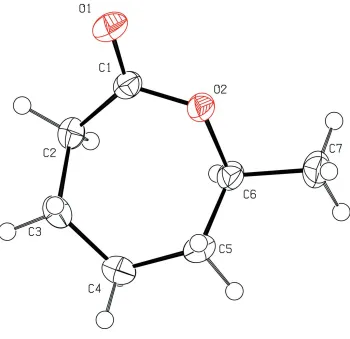
The structure of (I) (Fig. 1) was solved in the non-centrosymmetric space group P21 with Z′ = 1. The stereochemistry at
the chiral center, C6, was assigned S based on the enantioselective synthesis of (S)-6-MeCL, which was reported to yield an enantiomeric excess greater than 99% (van As et al., 2007).
The seven-membered ring (O2/C1—C6) adopts a chair conformation with puckering parameters: Q2 = 0.453 (2) Å, φ2 =
130.6 (2)°, Q3 = 0.653 (2) Å, φ3 = 102.6 (2)° and with a total puckering amplitude Q = 0.795 (2)Å (Cremer & Pople,
1975).
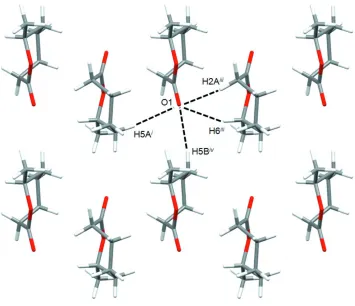
The crystal structure (I) is stabilized by weak C–H···O interactions (Table 1) with the four shortest contacts involving the O1 atom. These short contacts occur between molecules in the (1 0 0) plane, Fig. 2.
S2. Experimental
Details about the synthesis of (S)-6-methyl-ε-caprolactone have been given in a previous paper (van As et al., 2007).
S3. Refinement
Figure 1
Figure 2
The packing of one layer found in the crystal structure of (I) viewed down the a* direction. Molecules are connected by short C–H···O contacts in the (1 0 0) plane. Only one set of short contacts (dashed lines) is shown for clarity. The symmetry codes are: (i) 2 - x, -1/2 + y, -z; (iii) 2 - x, 1/2 + y, -z; (iv) x, y, z - 1.
(S)-3-methyl-2-oxepanone
Crystal data
C7H12O2
Mr = 128.17
Monoclinic, P21
Hall symbol: P 2yb
a = 6.757 (2) Å
b = 7.577 (2) Å
c = 7.586 (2) Å
β = 110.949 (13)°
V = 362.71 (17) Å3
Z = 2
F(000) = 140
Dx = 1.174 Mg m−3
Mo Kα radiation, λ = 0.71073 Å Cell parameters from 7835 reflections
θ = 1.0–27.5°
µ = 0.08 mm−1
T = 150 K Prism, colourless 0.35 × 0.15 × 0.10 mm
Data collection
Nonius KappaCCD diffractometer
Radiation source: rotating anode
862 reflections with I > 2σ(I)
Rint = 0.041
Refinement on F2
Least-squares matrix: full
R[F2 > 2σ(F2)] = 0.027
wR(F2) = 0.072
S = 1.10 889 reflections 83 parameters 1 restraint
Primary atom site location: structure-invariant direct methods
Secondary atom site location: difference Fourier map
Hydrogen site location: difference Fourier map H-atom parameters constrained
w = 1/[σ2(F
o2) + (0.0431P)2 + 0.0282P]
where P = (Fo2 + 2Fc2)/3
(Δ/σ)max < 0.001
Δρmax = 0.12 e Å−3
Δρmin = −0.16 e Å−3
Absolute structure: known chirality of atom C6(S)
Special details
Geometry. All e.s.d.'s (except the e.s.d. in the dihedral angle between two l.s. planes) are estimated using the full covariance matrix. The cell e.s.d.'s are taken into account individually in the estimation of e.s.d.'s in distances, angles and torsion angles; correlations between e.s.d.'s in cell parameters are only used when they are defined by crystal symmetry. An approximate (isotropic) treatment of cell e.s.d.'s is used for estimating e.s.d.'s involving l.s. planes.
Refinement. Refinement of F2 against ALL reflections. The weighted R-factor wR and goodness of fit S are based on F2,
conventional R-factors R are based on F, with F set to zero for negative F2. The threshold expression of F2 > 2σ(F2) is
used only for calculating R-factors(gt) etc. and is not relevant to the choice of reflections for refinement. R-factors based on F2 are statistically about twice as large as those based on F, and R- factors based on ALL data will be even larger.
Fractional atomic coordinates and isotropic or equivalent isotropic displacement parameters (Å2)
x y z Uiso*/Ueq
O1 1.03545 (16) 0.06828 (15) −0.16671 (13) 0.0355 (3) O2 1.11573 (13) 0.04935 (14) 0.13758 (12) 0.0288 (2) C1 0.9754 (2) 0.03155 (18) −0.03896 (16) 0.0258 (3) C2 0.7534 (2) −0.0285 (2) −0.07029 (18) 0.0301 (3)
H2A 0.7594 −0.1422 −0.0042 0.036*
H2B 0.6778 −0.0491 −0.2069 0.036*
C3 0.6274 (2) 0.1054 (2) 0.0003 (2) 0.0356 (3)
H3A 0.6603 0.2261 −0.0311 0.043*
H3B 0.4740 0.0849 −0.0669 0.043*
C4 0.6759 (2) 0.0938 (2) 0.2120 (2) 0.0365 (3)
H4A 0.6389 −0.0260 0.2421 0.044*
H4B 0.5841 0.1787 0.2461 0.044*
C5 0.9066 (2) 0.1315 (2) 0.33415 (18) 0.0303 (3)
H5A 0.9423 0.2528 0.3071 0.036*
H5B 0.9205 0.1274 0.4685 0.036*
C6 1.06592 (19) 0.00512 (19) 0.30521 (16) 0.0267 (3)
H6 1.0098 −0.1181 0.2938 0.032*
C7 1.2785 (2) 0.0148 (3) 0.46522 (19) 0.0403 (4)
H7A 1.3333 0.1356 0.4759 0.060*
H7B 1.3783 −0.0660 0.4396 0.060*
Atomic displacement parameters (Å2)
U11 U22 U33 U12 U13 U23
O1 0.0442 (5) 0.0406 (6) 0.0260 (5) 0.0001 (5) 0.0177 (4) 0.0018 (4) O2 0.0248 (4) 0.0400 (6) 0.0219 (4) −0.0028 (4) 0.0087 (3) 0.0022 (4) C1 0.0305 (6) 0.0245 (6) 0.0221 (6) 0.0029 (5) 0.0093 (5) −0.0007 (5) C2 0.0272 (6) 0.0341 (7) 0.0255 (6) −0.0021 (5) 0.0050 (5) −0.0041 (6) C3 0.0242 (6) 0.0431 (9) 0.0365 (7) 0.0058 (6) 0.0074 (5) 0.0002 (7) C4 0.0298 (6) 0.0451 (9) 0.0382 (7) 0.0031 (6) 0.0166 (5) −0.0030 (7) C5 0.0360 (7) 0.0322 (7) 0.0254 (6) −0.0015 (6) 0.0143 (5) −0.0026 (5) C6 0.0265 (6) 0.0330 (7) 0.0202 (6) −0.0027 (5) 0.0079 (5) 0.0028 (5) C7 0.0311 (6) 0.0598 (11) 0.0252 (6) −0.0040 (7) 0.0043 (5) 0.0070 (7)
Geometric parameters (Å, º)
O1—C1 1.2095 (16) C4—H4A 0.9900
O2—C1 1.3428 (15) C4—H4B 0.9900
O2—C6 1.4659 (14) C5—C6 1.5140 (19)
C1—C2 1.5028 (18) C5—H5A 0.9900
C2—C3 1.539 (2) C5—H5B 0.9900
C2—H2A 0.9900 C6—C7 1.5152 (18)
C2—H2B 0.9900 C6—H6 1.0000
C3—C4 1.523 (2) C7—H7A 0.9800
C3—H3A 0.9900 C7—H7B 0.9800
C3—H3B 0.9900 C7—H7C 0.9800
C4—C5 1.5288 (19)
C1—O2—C6 122.88 (10) C5—C4—H4B 108.6
O1—C1—O2 117.15 (12) H4A—C4—H4B 107.6
O1—C1—C2 123.02 (11) C6—C5—C4 114.69 (12)
O2—C1—C2 119.82 (11) C6—C5—H5A 108.6
C1—C2—C3 112.99 (12) C4—C5—H5A 108.6
C1—C2—H2A 109.0 C6—C5—H5B 108.6
C3—C2—H2A 109.0 C4—C5—H5B 108.6
C1—C2—H2B 109.0 H5A—C5—H5B 107.6
C3—C2—H2B 109.0 O2—C6—C5 112.13 (11)
H2A—C2—H2B 107.8 O2—C6—C7 103.76 (10)
C4—C3—C2 113.05 (12) C5—C6—C7 111.89 (12)
C4—C3—H3A 109.0 O2—C6—H6 109.6
C2—C3—H3A 109.0 C5—C6—H6 109.6
C4—C3—H3B 109.0 C7—C6—H6 109.6
C2—C3—H3B 109.0 C6—C7—H7A 109.5
H3A—C3—H3B 107.8 C6—C7—H7B 109.5
C3—C4—C5 114.64 (11) H7A—C7—H7B 109.5