Second-life retailing: a reverse supply chain perspective
1Loo-See Beh
Faculty of Economics & Administration, University of Malaya, Malaysia Abby Ghobadian
Henley Business School, University of Reading, UK Qile He
Coventry Business School, Coventry University, UK David Gallear
Brunel Business School, Brunel University Nicholas O’Regan
Faculty of Business and Law, University of the West of England, UK
Corresponding author: Abby Ghobadian ([email protected])
Structured Abstract:
Purpose – We examine the role of entrepreneurial business models in the reverse supply chain of apparel/fashion retailers. The paper offers an alternative approach to the “return to the point of origin” prevalent in the reverse chain of manufacturers but less technically and economically feasible in the case of apparel/fashion retailers. This approach, second-life retailing, not only reduces waste but also democratises consumption.
Design/methodology/approach – The paper is based on an extensive literature review, semi-structured interviews with managers of two second-life retailers in Malaysia and observations of a number of stores.
Findings – Using the Business Model Canvas we demonstrate the essential characteristics of second-life retailers. Retailers in our study, unlike retailers in the developed world, combine traditional business models with off-price retailing. There is no clear demarcation between the forward and reverse supply chain used to manage first- and second-hand retailing.
1
Practical implications – The paper demonstrates the potential of innovative business models in the reverse supply chain. It encourages managers to look beyond the “return to the point of origin” and seek imaginative alternatives. Such alternatives potentially could result in
additional revenue, enhanced sustainability and democratisation of consumption meeting triple bottom line objectives.
Originality/value – This paper highlights the importance and relevance of entrepreneurial business models in addressing the reverse supply chain, demonstrating this with the aid of two Malaysian off-price retailers. It also contributes to our nascent knowledge by focusing on emerging markets.
Keywords:
1. Introduction
Supply chain management (SCM) plays a critical role in enhancing competitiveness and ensuring and enabling responsible behaviour across all stages of the supply chain. SCM is a relatively young discipline that extends logistics by integrating the management of operations with that of material and information flow (Handfield and Nichols, 1999). Its initial focus was economic sustainability, based on the premise that an integrated and efficient supply chain potentially minimises monetary risks and increases profits (Fawcett et al., 2008a, 2008b). However, changes in the business environment have brought environmental and corporate social responsibility into sharp focus.
The behaviour of firms with regard to the environment and corporate responsibility plays an increasing role in determining consumer choice (Mohr and Webb, 2005; Hillenbrand et al., 2013). Today, firms that ignore sustainability and corporate responsibility do so at their peril (Utting, 2005; Sweeney and Coughlan, 2008; Ghobadian et al., 2015). The reason for this is twofold. First, technologies such as the World Wide Web, combined with 24-hour news, offer consumers unprecedented access to information, including that of firms’ behaviour (Teece, 1996). Second, the combination of natural events, such as unprecedented weather patterns; wide coverage of the climate change debate; the efforts of non-governmental organisations (NGOs); disasters, such as the fatal fire in a Bangladesh garment factory (Harris, 2013); and better education have raised environmental and corporate responsibility awareness among consumers and stakeholders (Steurer et al., 2012).
Supply chain management has not been immune from the increased attention paid by consumers to the environmental and corporate responsibility behaviour of firms. Other factors heightening the attention managers pay to supply chains’ environmental and social impact include: tougher environmental regulation; regulations designed to protect
discipline for establishing how to integrate environmental and social considerations and practices in order to achieve the goal of sustainability (Seuring and Müller, 2008; Ashby et al., 2012).
Researchers are increasingly attracted to SSCM and a number of publications address
concepts such as reverse logistics (Klausner and Hendrickson, 2000; Schwartz, 2000; Meade and Sarkis, 2002), closed-looped supply chains (Guide et al., 2003; Savaskan et al., 2004; Chuang et al., 2014) and the greening of supply (Ashby et al., 2012; Ahi and Searcy, 2013). However, as Ashby et al. (2012) noted, the manufacturing sector provides the backdrop for the great majority of the current SSCM research.
The reverse service supply chain (RSSC) is more complex than the reverse manufacturing
supply chain because services’ output consists of a bundle comprising tangible and intangible components (Davis and Heineke, 2003). Logically, therefore, the greater the intangible component of a service firm’s output the lower is the potential for reversing the supply chain. Hence we concentrate on services with a significant tangible output. More specifically we focus on the retail trade, concentrating on retailers of apparel and fashion, because of its significance in both developed and emerging economies (Hawley, 2006); complexity of its reverse supply chain; significant impact of effective management of the forward and reverse supply chains on profitability (Abraham, 2011); and the opportunities to integrate
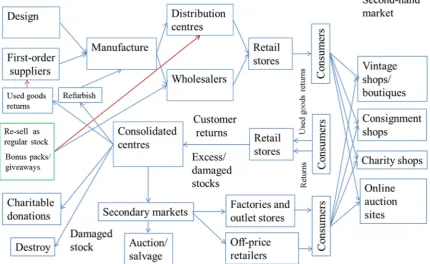
environmental and social considerations (Emmelhainz and Adams, 1999; Zhou, 2009). Based on discussions with a number of major UK apparel retailers, a review of the trade journals, and work by Schwartz (2000), Tibben-Lembke and Rogers (1998) and Dowlatshahi (2000), we have mapped out the typical retail forward and reverse supply chains of apparel and fashion retailers (see Figure 1).
[Insert Figure 1 about here]
Our aim is to examine the reverse supply chain of the apparel and fashion retailers, focusing on a second-life retail business model built on offering discarded stock. Second-life retailers rely on a business model designed to extend the life of the apparel and fashion goods
elements – is less common (Hawley, 2006). For example, a number of large retailers, such as Marks & Spencer and H&M, have experimented with converting used apparel into raw materials for use in the manufacture of new apparel. However, they have abandoned the idea for the time being because the technology to convert used apparel into usable raw material is underdeveloped. This is not to say that converting used apparel back into raw materials is not possible or that it does not take place, but it is important to appreciate that such opportunities are restricted. On the other hand, the apparel and fashion reverse supply chain supports the second-life/second-hand retailing business models that result from market overruns and seconds of the traditional retailers/manufacturers or consumers’ used apparel (Hvass, 2015). More importantly, the second-life business model not only reduces waste but it also
democratises consumption by bringing fashion within the reach of those with lower levels of disposable income – thus addressing both tenets of the World Commission on Environment and Development (WCED, 1987, p. 43). Offering goods and products that are at a stage of either maturity or decline in their life cycles to a new set of customers contributes to the sustainability initiatives of the firm, provides for improving the performance of the business in secondary markets (Meyer, 1999). Secondary markets constitute part of ethical
consumerism’s attempts to minimise or eliminate the harmful effects to the environment or society by reducing disposal (Brace-Govan and Binay, 2010) and making goods available at affordable prices to a broader consumer base.
The paper is structured as follows. In Section 2 we review the key literature; followed by theoretical considerations and discussion of business models in Section 3; and methodology in Section 4. This is followed by case analysis in Section 5 and conclusions and implications in Section 6.
2. The supply chain and sustainability with a focus on retailers
Broadly, a supply chain consists of a number of partners or stakeholders – suppliers, manufacturers, distributors, retailers and customers – and involves flows of materials, resources, information and activities within functional boundaries, and the management of relationships between bounded stakeholders. Reverse logistics (Guidini, 1996) aims at improving the exploitation of used products through recycling, remanufacturing or other forms of recovery – recapturing the value or value creation with new production systems that generate new markets and lead to a reduction in environmental degradation (Lee et al., 1995). Products may reverse direction in the supply chain for a variety of reasons, such as
manufacturing returns, commercial returns (B2B and B2C), product recalls, warranty returns, service returns, end-of-use returns and end-of-life returns.
Reverse logistics has received increasing attention given its potential benefits including enhancing value capture. Reverse logistics has two dominant end purposes for returned materials: reconditioning (high-value recovery) or recycling (low- to no-value recovery) (Simpson, 2010). The alternative to “reconditioning” and to a large extent “recycling” in apparel and fashion retailing is second-life retailing. In this paper we demonstrate how new entrepreneurial business models designed to serve alternative markets offer an alternative route to extending the life of unwanted apparel, reducing waste and creating value.
aiming to improve supply chains’ environmental performance (Holt and Ghobadian, 2009; Lau, 2011, Kumar et al., 2014).
Reverse logistics theory is less mature than that of logistics and SCM (Dowlatshahi, 2000). Moreover, the extant literatures’ treatment of GSCM and SSCM is inconsistent. For example, following an extensive review of the literature, Ahi and Searcy (2013, 2015) identified 22 definitions of GSCM and 12 definitions of SSCM. There are other disagreements, for example, Ahi and Searcy (2013) viewed SSCM as an extension of GSCM (excluding the integration of economic and social considerations), while Svensson (2007) asserted that SSCM incorporates economics, ecological and societal aspects. Moreover, the subject attracts different approaches, for example, in balancing the costs of a sustainable reverse logistics system with environmental and social concerns, Ramos et al., (2014) proposed a
mathematical formulation and a solution approach. Finally, the manufacturing sector dominates the landscape for most SCM, SSCM and GSCM research (e.g. Zhu and Sarkis, 2004; Holt and Ghobadian, 2009; Tseng and Chiu, 2013; Luthra et al.,2014).
We now turn our attention to the retail supply chain – with a particular focus on apparel and fashion retail. In a typical retail forward supply chain the customer stands at the end. The closed-loop supply chain incorporates the returns process enabling the vendors to capture additional value by exploiting alternative markets for returns or overruns (Abraham, 2011; Hvass, 2015). Alternatively, closed-loop reverse supply chains attempt to extract additional value by scrapping the product and recycling its usable parts. In the case of apparel and fashion retailers, as discussed, the latter is not technically or economically feasible on a large scale (Hawley, 2006). A feasible alternative is a complementary business model that allows for the realisation of value from returned/surplus/second goods.
Traditionally reverse logistics is triggered by customers returning defective products to the retail stores, that, acting as “gatekeepers”, would in turn return them to their consolidation centres or suppliers (Atasu et al., 2013). How returns are handled has significant
for reconditioning or refurbishment, or otherwise be destroyed or appropriately disposed of. According to Schwartz (2000) and Tibben-Lembke and Rogers (1998) every reverse logistics system should include the functions of gatekeeping, collection, sortation and disposition. The gatekeeping function determines which products to allow in the reverse logistics system. Collection simply means the accumulation of the products and sortation means deciding what to do with each product. Lastly, disposition is the sending of the products to the desired destination. If the goal is to take returned products during the warranty period, then
collection, storage and delivery will be important. If the goal is more environmentally related, such as reclaiming component parts, then sorting may be more important than the delivery of the parts back into the forward supply chain. Hence there will be a different emphasis on the operations and services provided depending on the goals.
As indicated, some of these returned apparel/fashion goods could then be distributed to secondary markets such as off-price retailers, factory and outlet stores, auction sites, online websites, charity shops, vintage shops/boutiques and consignment shops – or shops that have a combination of these elements. This constitutes the most significant aspect of apparel and fashion reverse logistics (Abraham, 2011; Hvass, 2015). Reverse logistics from the
environmental perspective supports sound practices, such as recycling, reuse,
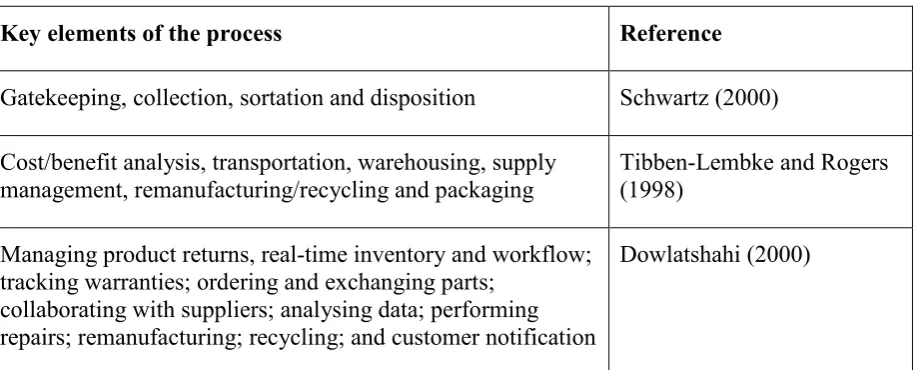
remanufacturing, reconditioning and refurbishing – at various levels of products and materials use. In the case of apparel and fashion retailers, reuse, or second-life, plays the major role (Figure 1). Based on the above, the reverse logistics processes as defined by different researchers are summarised in Table 1.
[Insert Table 1 about here]
3. Theoretical considerations and various business models
Our research draws on the resource-based view (RBV) and the ecological modernisation theory. The RBV stipulates that the development of internal capabilities and resources
(Darnall et al., 2008) assists in extending the scope of flows and boundaries (Sarkis, 2012). It contends that a resource capability is enhanced by attaining strategic fit between resources and opportunities, and gaining added value from the effective deployment of resources. Firm resources must be organised and carefully managed, especially in planning, implementing and controlling the efficient, cost-effective flow of materials, in-process inventory, finished goods and related information from the point of origin to the point of consumption on a forward supply chain. Returning to the point of origin is technically and economically challenging in the case of apparel and fashion retailers. The alternative is a business model that, instead of disposal, extends the life of a product.
Ecological modernisation theory (Berger et al., 2001) can also be used to help identify various boundary relationships and the management of flows – particularly in its linkage to environmental and economic (boundary) performance through technology (technological boundaries) and innovation (knowledge boundaries) arising from stakeholders. In recognising this, ecological modernisation theory emphasises the possibility of a process of re-embedding economic practices with respect to their ecological dimension related to modern scientific, technological and state institutions. Therein, stakeholder theory plays a significant role in management decisions as well as providing flows and managing boundaries within the supply chain (Sangle, 2005; De Brito et al., 2008; Darnall et al., 2009). We will not delve into discussion of these specific theories, but consider these from the perspectives of individual consumers, supplier partnerships and off-price retailers within the supply–demand market opportunities of second-life retailing.
“shared” by multiple competitors (Teece, 2010). As demonstrated in this article, second-life retailing is shared by many vendors within a given industry – as the market is able to capture the benefit that vendors will deliver to customers. In particular, a business model describes the value logic of an organisation in terms of creating and capturing customer value. There are several business model frameworks, such as the Business Model Canvas
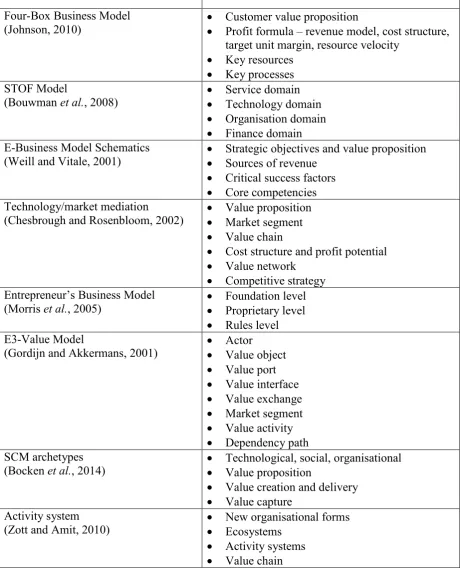
(Osterwalder and Pigneur, 2010), the Four-Box Business Model (Johnson, 2010), the STOF (service, technology, organisation, finance) Model (Bouwman et al., 2008), E-Business Model Schematics (Weill and Vitale, 2001), Technology/Market Mediation (Chesbrough and Rosenbloom, 2002), Entrepreneur’s Business Model (Morris et al., 2005) and e3-Value (Gordijn and Akkermans, 2001). Other sustainable business models include those of Bocken
et al. (2014), Zott and Amit (2010), and Wells and Seitz (2005). While all these frameworks differ in their purpose and context, the essential dimensions are connected in a systematic manner – an overview is provided in Table 2.
[Insert Table 2 about here]
In this paper, we use the Business Model Canvas (Osterwalder and Pigneur, 2010) as the framework to conduct our case studies. This model is widely used, offering a framework to analyse and understand the interfaces between different parts of a business, its environment and customers. It consists of the following nine dimensions.
1. An organisation serves one or several customer segments.
2. It seeks to solve customer problems and satisfy customer needs with value propositions.
3. Value propositions are delivered to customers through communication, distribution and sales channels.
4. Customer relationships are established and maintained with each customer segment. 5. Revenue streams result from value propositions successfully offered to customer
segments.
6. Key resources are the assets required to offer and deliver the previously described elements…
7. …by performing a number of key activities.
9. The business model elements result in the cost structure.
4. Methodology
This paper is based on two case studies, examining the business models of two off-price Malaysian retailers. Off-price retailers play an important role reducing waste and helping to democratise consumption. They are a critical element in the apparel and fashion retailers’ reverse supply chains. Without the off-price retailers most of the surplus stock and seconds would end up in landfill causing environmental damage, increasing costs and reducing margins. We focus on Malaysian firms because they operate in an emerging market where off-price retailing is less developed and more recent. Moreover, the developed world provides the backdrop to much management research and it is important to improve our nascent
understanding of how organisations work in the emerging markets.
We utilised a three-step research strategy. First, we conducted an extensive analytical review of the extant literature. Second, we conducted extensive qualitative interviews with middle-level managers, supervisors and operating executives of the two firms, augmented with observations at several major Kuala Lumpur-based outlets. Third, we carried out a second round of interviews with selected respondents.
5. Findings: the second-life retailing Business Model Canvas – case examples of off-price
apparel retailers
The two retail groups studied were: the Factory Outlet Store (F.O.S) and the Reject Shop
(RS). They were selected because they are leaders in off-price retailing in Malaysia. A closer examination, however, revealed that unlike their counterparts in the developed countries – e.g. TK Maxx and Dress for Less – they operated a mixed business model combining traditional retailing with off-price retailing. They both offered their own labels as well as international brand overruns and seconds purchased at a discount as a part of their second-life retailing operations. Hence they needed competencies and capabilities in two retailing areas. Our case examples sourced stock overruns or discontinued stock from South America (Ecuador, Peru and Chile), South Asia (Bangladesh, India and Pakistan), China and Eastern Europe. Their existence can be explained by the ecological modernisation theory (Berger et al., 2001). These business models owe much to technology (technological boundaries), which facilitate their operations, innovation (knowledge boundaries removed by globalisation and increased connectedness among stakeholders giving rise to global brands and demand for global brands), and overlap between the traditional economic drivers and environmental and corporate responsibility drivers.
F.O.S is an established indigenous retailer operating 50 stores in major shopping complexes throughout Malaysia. It markets its own labels, such as Republic, Fahrenheit and Miss Cindy (not to be mistaken for similar sounding brands popular in the UK), and imported stock lots and overruns of as many international brands, including Ralph Lauren, Tommy Hilfiger, Lacoste, David Beckham, Gap Kids, Levi’s, Michael Kors, Banana Republic, Zara, Gianni Valentino, Abercrombie & Fitch, and Paul Frank as part of its second-life business model. It offers affordable quality apparel, such as graphic tees, polo tees, shirts, denim bottoms, accessories, basic wear and footwear.
On the other hand, RS is a speciality store concept, currently with 33 stores at many leading shopping centres across Malaysia. RS offers international label brands, such as Old Navy, Urban Pipeline, Bang Bang and Waikiki Surf Co – again relying on overruns, seconds and its own-label brands.
with second-life retailing in their business models, the mix is significantly different – with F.O.S more reliant on a second-life business model. In both cases, the range mainly consists of summer clothing, given the weather conditions of the country, but every now and then there is a new batch with warmer clothing, such as sweaters and jackets. The range of clothing offered in each of the two retailers’ stores is significantly different. The variation in the range of offerings is to attain greater alignment with market demand at a micro level, increasing the complexity of merchandising and supply chain management. Both retailers are synonymous with the concept of retailing internationally branded garments at a fraction of the prices charged overseas, although F.O.S has a wider range of stock. Stock is sourced from overseas factories as well as local factories. The advantage of overruns stock is that many of the brands offer relatively new styles, which would otherwise not be available. With their everyday low-price philosophy they are budget friendly and have made clothing affordable to many price-conscious consumers.
Figure 2 illustrates the key elements of the business models of F.O.S and RS. The various elements of the Business Model Canvas are discussed in the following sections.
[Insert Figure 2 about here]
5.1 Key partners
The key partners include payment service providers, technology providers and logistics providers. They are critical to the success of both retailers, and hence significant effort is devoted to creating a close partnership including frequent contacts, links through automated services and personal relationship assistants. These partners perform a key role in facilitating reverse logistics and are briefly described here:-
Payment service provider. Banks are the key payment service providers supplying payment infrastructure and credit facilities.
Logistics provider. Each group has its own logistics provider. RS’s holding company is its logistic provider, whereas F.O.S uses specialist transport providers. Stock is transported on a demand as well as a supply basis – usually more frequently during peak season sales.
Operating a push system (demand) and pull system (supply) simultaneously requires
coordination and bringing together two different sets of routines and capabilities. They both use separate courier service delivery providers to deliver online shopping orders. In both cases, logistics planning was carried out at the head office. The manner in which logistics operational processes are organised and executed is important as it is a key activity of these two retailers. The interviews revealed that logistics were not differentiated based on the type of merchandise, and that the lack of differentiation did not hamper operations. It transpires that a single inward logistics system is capable of meeting the needs of both traditional and off-price merchandise.
5.2 Key activities
These comprise development, maintenance and operations, including financial settlements, inventory and risk-management activities. They involve set-up and infrastructure expansion costs, maintenance and operations throughout all stores in the country. Merchandising is another key activity. Buyers were responsible for specific types of merchandise. Hence, in buying terms, both retailers distinguished between their traditional and second-life
operations.
5.3 Key resources
The RBV stipulates that an organisation’s resources and how they are combined (capabilities) are essential to its success. The key resources in the case organisations are people, such as product designers, buyers, store personnel and warehouse staff. A key capability is the ability to develop relationships with local merchants as well as financial institutions and technology vendors. The tangible resources include payment systems infrastructure, real-time data capture systems, stores location and fittings and fixtures, and marketing and promotion systems. The intangibles include trust and reputation among key stakeholders, i.e. customers, suppliers and key partners. In terms of store personnel, each store has a minimum of a
led by the operating executive together with the store supervisor and storekeeper. Local product designers and local merchants (B2B) provide some of the merchandise.
The forward and reverse logistics process involves the physical movement of products and returned products. The managers interviewed identified the following associated activities: (1) verifying the documentation accompanying each product and return; (2) inspecting the condition and packaging of each product and return; (3) recording any discrepancies with the product specification and return policy; (4) assigning bar codes and distribution and pre-disposition codes for returns; and (5) final inspection of the stocks and finalising the documentation.
Forward and reverse logistics were highly dependent upon the efficiency of human resources, though it may appear that the information technology providers are the key partners. Forward logistics capability was identified by the organisations studied as an important competency for both own-brand and second-life merchandise. It was also pointed out that second-life merchandise offered a greater challenge because of the remoteness of the suppliers, the transportation distance and the complexity of international logistics. Furthermore, buyers had little control over second-life merchandise, in that they could not pre-specify, and their decision was based on the suitability of stock available for their local market. The opportunity for repeat orders was rare.
We also discovered that reverse logistics, irrespective of whether merchandise was own brand or second life, presented a greater challenge. This is because the priority,
understandably, is getting the product out to the customers, rather than dealing with returns “coming back”. Prompt handling of returns is often an issue according to the managers interviewed. This is because the combination of processes that form reverse logistics competencies is complex, and there is a lack of capabilities, a limitation that is faced
especially by B2B merchants as compared to B2C, which are relatively easier to process. The RBV explains many of the practical issues highlighted by our respondents.
5.4 Customer segments
this end own labels were sourced as much as possible locally. Local sourcing offered a number of important advantages including shorter merchandise delivery lead time, reliability, closer relationship, simpler logistics and lower logistics costs. This sourcing strategy offered both retailers important competitive advantages: lower costs; improved margins; faster reaction to changes in taste; and lower stock overruns. The local sourcing also reduced their carbon footprints. Price played a key role in supplier selection; despite this the number of suppliers was kept moderately small but price negotiations were conducted frequently. Offshore sourcing of supplies occurred predominately in relation to the second-life retailing business model. This incurred some hidden costs including procurement, time spent on the acquisition and monitoring progress, and the possibility of lost sales due to late delivery or incomplete delivery (e.g. wrong size ratios, colour mix, style mix). Such hidden costs are less of an issue when sourcing locally. Returning to the off-shore procurement costs, these
included airfares, hotel bills, telephone calls and subsistence payments. These can be
significant, although they were categorised as overhead costs – masking the true costs of off-shore procurement. Interestingly, in some cases, the cost of procurement exceeded the value of the final invoice. Although we were unable to ascertain the environmental impact of long-distance procurement, such as carbon footprint, we estimate this not to be insignificant and this has to be set against the environmental benefit of second-life retailing. Based on our discussion, and assuming the second-life merchandising would otherwise have ended up in a landfill site, we estimate a significant positive environmental impact.
relies on closed-loop supply based on direct-order service contracts and is credit based. Some of the international brands are retagged, relabelled, or even unlabelled, due to the quality of manufacture or product faults. Local onshore suppliers are short term, competitive, low price and value for money, and inevitably there is a reasonable level of trust between the retailers and suppliers. Accordingly, the number of suppliers is small to ensure dependency and dedication. Effective supplier relationships are fostered as well as the planning of
merchandise distribution. For example, to drive sales, special packaging to promote products, and repackaging any unsold inventories for sale the following season, is undertaken for seasonal products such as winter apparel that is sold to these off-price retailers. This means that they are sold on the secondary market in Malaysia immediately following the prime selling season overseas for international brands.
Own-label stock is built around vendor-managed inventory (VMI), which offers both retailers system efficiency in merchandise planning and synchronised production scheduling, enabling them to order stock as required in order to best meet customers’ needs. The system minimises retailers’ stockholding costs and potential for surplus stocks. In turn, the suppliers, via
collaborative planning offered by both retailers, are able to manage production flows more efficiently and to meet the retailers’ demands. To optimise the flow of information and merchandise, retailers employ technology such as barcodes and electronic point of sale (EPoS), which transmit information on size, style and colour of products back to the head office. However, most often, once the stock is sold, then it has gone for good and the retailers move on to the next design, rather than replenish stock. Supply chain management has been created internally and externally to support and supply products effectively to customers. Notably, the responsibility has been shifted to the suppliers in the pre-retailing services (labelling, ticketing, steaming, pressing and packaging for store-ready display), hence this lowers the inventory risks, processing and stockholding costs and services. Distribution of stock and inventory levels are determined at head offices with reduced stock-outs in mind, and some ordered stock is also stored at the various outlets prior to goods being sold. Decisions concerning what activities and operations are appropriate for second-life retailing in the reverse logistics flow are based on the operational goal of the retailers in reverse
of second-life retailing opportunities may be taken by manufacturers, third-party logistics or retailers, as shown in Figures 1 and 2. A high level of coordination and collaboration among these parties is imperative in the second-life retailing business model. Clear and effective cooperation mechanisms and well-defined contractual agreement on terms and conditions between the entities are prevalent.
B2C customers. Customers tend to visit stores frequently to view and purchase fast-moving fashion goods. RS predominately targets fashion-conscious younger people. Its success is built on its low-price philosophy. The target niche and the low price point are reflected in the range of its second-life brands as highlighted previously. F.O.S targets a broader age range and value is reflected in offerings at two different price points (low and medium) as opposed to RS’s single price point (low). F.O.S’s low price point merchandise are mainly own label, while second-life represents the medium price point where top international brands are offered at substantial discounts. This is an interesting point to note and contrasts with the approach of RS and, more importantly, with off-price retailers operating in developed countries.
and reduces handling costs, while increasing the accuracy of delivery and improving in-stock situations of own brands.
The situation with second-life apparel is somewhat different. The procurement is based on availability rather than pre-specification. Both retailers purchase what is available, unlike their own brands, which are pre-specified. The key decision that buyers make is the fit between available second-life stocks and local consumer taste. If the fit exists then the second-life stock is purchased. The availability of real-time sales information and the popularity of merchandise lines assist buyers’ decision making.
F.O.S offers clothing at different key price points – including second-life branded apparel at a significant discount. Hence, F.O.S has a wider customer base and targets a broader age range compared to RS, whose customers tend to be younger and more interested in trendy T-shirts designed, manufactured and sourced locally – as well as some lesser known overseas brands. In view of this, the supply chain and reverse logistics are complex and include a diverse range of local and international suppliers. The complexity of the supply line is such that if it is not effectively managed it can have significant detrimental impact on the bottom line of both retailers. The reverse logistics of second-life vendors form part of F.O.S and RS’s forward supply chains. Second-life merchandise is more important to F.O.S, enabling it to broaden its merchandise range and price points making its proposition attractive to a broad range of price conscious consumers. It is also important to RS in helping to attract customers through its stores. The business model built around second-life retailing in essence
complements the traditional retailing business model contributing to increased revenue, reputation, trust and improved customer service.
Purchased goods can be returned up to three days after purchase, in good condition, for exchange with other products. Goods returned are redisplayed for sale following inventory checks. They are discarded if not fit for display.
5.5 Customer relationships
Unlike RS, F.O.S operates a membership card system that rewards purchasers’ loyalty in an effort to enhance business sustainability. F.O.S offers a superior service experience to its customers, e.g. by providing access to personal sales assistants.
Stock may differ from one store to another in order to better meet the micro-level demand. Closer alignment between the offering and the store’s customer mix is made possible by the IT infrastructure and is reflected in the management of its supply chain. Stock is also
frequently arranged and rearranged in the stores to generate the impression of new stock arrivals.
5.6 Channels
The key channels of promotion are the web and advertising/promotions. Both of these channels are described briefly:
Web. F.O.S utilises social networking sites, such as Facebook, Twitter and Instagram, to promote its stores and merchandise. Its loyalty card scheme, recently introduced, allows accumulation of points and up to a 10% discount. In addition, a RM10 rebate (discount) voucher is given on accumulation of every 500 points, and the scheme offers special birthday discounts, invitations to new store openings, members-only sales, special offers, exclusive deals, warehouse sales and other special events to drive sales and customer loyalty. F.O.S offers a merchandise range compared to RS and is also more competitive. Such incentives to drive sales and customer loyalty have a positive impact on its forward distribution activities. It results in faster speed to market, and provides inbound and outbound transportation support in the supply chain activities in the network of facilities. In turn, this benefits customers, suppliers, stores, distribution centres and the company finances.
shopping malls where large units can be rented relatively cheaply for two to three days to house such sales. When these stocks are not sold, they are redistributed back to the stores for the purpose of recapturing value, while defective items are appropriately disposed of.
5.7 Costs structure
Costs result from the set-up and operation in infrastructure and store expansion. Furthermore, costs also occur from tangibles and intangibles from partners, merchants and customers in addition to staff employment and promotion.
The forward and, to a lesser extent, the reverse logistics processes are a significant cost element impacting on margins and profitability. In normal circumstances, reverse logistics costs are less than 5% of the total supply chain costs. The increased risks and processing costs require the retailers and manufacturers in the supply chain to examine their existing reverse logistics processes to ensure they have full control over the process and subsequent product disposition. Reverse logistics happen in response to an action of a customer or supply chain actor and as such are difficult to anticipate or comprehensively plan for by the retailer. Often the retailers tend to focus on ad-hoc transportation and storage of returned products, and when this happens the retailers lack the capability of balancing cost efficiency (minimal transport expenses and returns inventory). Handling returns properly and tracking all
activities are critical to the maximisation of efficiency. Returns policies establish guidelines that govern when a product is to be returned and under what conditions it will be accepted, alongside establishing an acceptable level of customer service with a view to protecting the organisation’s goodwill. Accurate knowledge of what is returned makes it easier to evaluate returned stocks for possible re-distribution through second-life sales channels.
5.8 Revenue streams
The case organisations drew their revenue from in-store sales of own-brands and off-price retailing or their online sales. They also generated a modest turnover from reversing supplies. Improvement in margins was gained through combining the forward logistics product drop-off with the reverse logistics pick-up creating greater synergies between them. The key is optimising the forward logistics operations because the reverse logistics process is a
consequence of hidden mistakes in the forward supply chain – such as inadequate packaging, inferior materials and poor delivery performance.
5.9 Value proposition
We highlight the value proposition in terms of value consumption, value renewal and price-level attributes in the creative approach of capturing the benefits of forward and reverse supply chain processes. The value proposition of both F.O.S and RS as traditional retailers is fashion at an affordable price. The same proposition applies to the second-life retailing proposition of RS. This is reflected in the brands offered. The value proposition of second-life retailing of F.O.S is slightly different – offering well-known international brands at a fraction of their original price but at a significantly higher price than their own brand. This enables F.O.S to operate at two key price points (low and medium) widening its appeal to a broader age range and level of disposable income. The trendy designs are aimed at lower income and younger adults who have just entered the workforce. Offers and discounts are available throughout all seasons – generating increased sales. Low prices are predicated on low costs and SCM plays a key role here. Technology and short lead times enable a better match between supply and demand as well as customer retention.
The value proposition refers to how items of value, in this case apparel as well as
breakthrough markets and the differentiation is captured in the price-level attribute of the value proposition.
The off-price retailing of apparel has created a new channel of value consumption. The best known and traditional phase of value life cycle is the value derived from consumption. This is the value that comes from the actual use of a product/services and is the dominant part of the value proposition. It is even more interesting to know that value consumption has an added element of value renewal whereby customer utility is extended through such creation of secondary markets, when value consumption at primary markets diminishes.
6. Concluding remarks and implications
The green supply chain, sustainable supply chain and reverse supply chain are subjects of interest to researchers and policy makers. This burgeoning interest is due to many factors including consumers’ increasing awareness and interest, NGOs, regulations and digital technology. Manufacturing provides the backdrop to much of the research. Yet in developing countries service industries account for the major share of GDP – and in emerging markets services are increasing their share of GDP. The paucity of research examining the reverse service supply chain is a significant gap. However, researching services is complex because of the heterogeneity both within and between service sectors.
Here we have focused on apparel and fashion retailers, because forward and reverse supply chain activities are critical to their success and they are also economically important in both developed and emerging economies. The prevalent concept in the reverse manufacturing
supply chain is return to origin – to either refurbish or extract usable components for further use. As we have noted, this is less attractive in apparel and fashion retailing. On the other hand, the reverse supply chain of apparel and fashion retailers offers the opportunity for alternative entrepreneurial business models.
democratises consumption. The business model has diffused to emerging markets in recent years.
This paper examines the business model of two off-price retailers operating in Malaysia using the Business Model Canvas as a framework to guide data collection. This approach –
mapping reverse supply chain approaches against the specific characteristics included in the framework can help us to analyse, illustrate and inform the future design of service business models. Additionally, defining those dimensions in the retailers’ value proposition to
customers and partners provides an overview of the business logic of a service in its
collaboration and integration. The retailers deal with extending the life cycle of merchandise from a cluster of services (retailers), that goes beyond the traditional forward supply chain, extending service offerings via remarketing of environmentally friendly disposal into secondary niche markets.
The Business Model Canvas offers a tool that helps illustrate the concept and adds value to the co-creation of retail businesses, reducing waste and enhancing sustainability through goods being sold on at secondary markets. Here we have demonstrated the applicability of an approach to widening the perspective of retailing to second-life channels, and thus to
Economic and environmental costs are reduced through reusing goods and turning waste into value by bringing these overruns into secondary markets. This brings about a positive
contribution to society and the environment through reduced waste.
Second, the apparel industry of off-price retailers is impacted on by the reverse logistics process where they would be expected to develop the most efficient returns processes; however, their efficiency and effectiveness to develop best practices is still limited where they are struggling to make cost-savings in their distributive operations. As such, companies use a business model that allows them to realise value out of a life-cycle approach for commercial returns, overruns, end-of-use returns or even end-of-life returns.
Finally, this alternative business model serves the dual purpose of business and
environmental sustainability by avoiding the generation of large amounts of waste in landfill sites and maximising efficiency by enhancing the value proposition, value creation and delivery, and value capture. This will inevitably impact upon society’s awareness of reducing waste and will promote second-life retailing as the high-value recovery and reconditioning of goods in reverse supply chains. This is consistent with the research literature of both the reverse supply chain and sustainability.
Further substantial work is needed to better understand the second-life retailing business model and its contribution to sustainability. The various boundaries of many levels of supply chain analysis can be interpreted by different stakeholders mapped by boundaries,
responsibilities and industrial practices of business economic dimensions (Sarkis, 2012). Collaborations between supply chain partners may help to realise financially beneficial and innovative options. Thus the dynamics of these inter-firm relationships may offer insights into the potential of second-life retailing in reverse logistics in creating new markets and profitable operations. An understanding of the implications, in terms of the markets they serve and the markets from which they procure their used products, poses interesting questions for future research.
References
Abbasi, M. and Nilsson, F. (2012), “Themes and challenges in making supply chains
Abraham, N. (2011), “The apparel aftermarket in India: a case study focusing on reverse logistics”, Journal of Fashion Marketing and Management: An International Journal,
Vol. 15 No. 2, pp. 211–27.
Ahi, P. and Searcy, C. (2013), “A comparative literature analysis of definitions for green and sustainable supply chain management”, Journal of Cleaner Production, Vol. 52 No. 1, pp. 329–41.
Ahi, P. and Searcy, C. (2015), “An analysis of metrics used to measure performance in green and sustainable supply chains”, Journal of Cleaner Production, Vol. 86 No. 1, pp. 360–77.
Ashby, A., Leat, M. and Hudson-Smith, M. (2012), “Making connections: a review of supply chain management and sustainability literature”, Supply Chain Management: An International Journal, Vol. 17 No. 5, pp. 497–516.
Atasu, A., Toktay, L. B. and Van Wasenhove, L. N. (2013), “How collection cost structure drives a manufacturer’s reverse channel choice”, Production and Operations Management, Vol. 22 No. 5, pp. 1089–102.
Berger, G., Flynn, A., Hines, F. and Johns, R. (2001), “Ecological modernization as a basis for environmental policy: current environmental discourse and policy and the
implications on environmental supply chain management”, Innovation: The European Journal of Social Science Research, Vol. 14 No. 1, pp. 55–72.
Birtwistle, G., Siddiqui, N. and Fiorito, S. S. (2003), “Quick response: perceptions of UK fashion retailers”, International Journal of Retail & Distribution Management, Vol. 31 No. 2, pp. 118–28.
Bocken, N. M. P., Short, S. W., Rana, P. and Evans, S. (2014), “A literature and practice review to develop sustainable business model archetypes”, Journal of Cleaner Production, Vol. 65, pp. 42–56.
Brace-Govan, J. and Binay, I. (2010), “Consumption of disposed goods for moral identities: a nexus of organization, place, things and consumers”, Journal of Consumer Behaviour, Vol. 9 No. 1, pp. 69–82.
Carter, R. C. and Easton, P. I. (2011), “Sustainable supply chain management: evolution and future directions”, International Journal of Physical Distribution & Logistics
Management, Vol. 41 No. 1, pp. 46–62.
Chesbrough, H. and Rosenbloom, R. S. (2002), “The role of the business model in capturing value from innovation: evidence from Xerox Corporation’s technology spin-off companies”, Industrial and Corporate Change, Vol. 11 No. 3, pp. 529–55.
Chuang, C. H., Wang, C. X. and Zhao, Y. (2014), “Closed-loop supply chain models for a high-tech product under alternative reverse channel and collection cost structures”,
International Journal of Production Economics, Vol. 156, pp. 108–23.
Corbett, C. J. and Kleindorfer, P. R. (2003), “Environmental management and operations management: introduction to the third special issue”, Production and Operations Management,Vol. 12 No. 3, pp. 287–89.
Darnall, N., Jolley, G. J. and Handfield, R. (2008), “Environmental management systems and green supply chain management: complements for sustainability?” Business Strategy and the Environment, Vol. 17 No. 1, pp. 30–45.
Darnall, N., Seol, I. and Sarkis, J. (2009), “Perceived stakeholder influences and
organizations’ use of environmental audits”, Accounting, Organizations and Society, Vol. 34 No. 2, pp. 170–87.
Davis, M.M. and Heineke, J. (2003), Managing Services – Using Technology to Create Value, McGraw-Hill/Irwin, New York.
De Brito, M. P., Carbone, V. and Blanquart, C. M. (2008), “Towards a sustainable fashion retail supply chain in Europe: organisation and performance”, International Journal of Production Economics, Vol. 114 No. 2, pp. 534–53.
Emmelhainz, M. A. and Adams, R. J. (1999), “The apparel industry response to
‘‘sweatshop’’ concerns: a review and analysis of codes of conduct”, Journal of Supply Chain Management, Vol. 35 No.3, pp. 51–7.
Fawcett, S. E., Magnan, G. M. and McCarter, M. W. (2008a), “A three-stage implementation model for supply chain collaboration”, Journal of Business Logistics, Vol. 29 No. 1, pp. 93–112.
Fawcett, S. E., Magnan, G. M. and McCarter, M. W. (2008b), “Supply chain alliances and social dilemmas: bridging the barriers that impede collaboration”, International Journal of Procurement Management, Vol. 1 No. 3, pp. 318–40.
Ghobadian, A., Money, K. and Hillenbrand, C. (2015), Corporate responsibility research: past–present–future. Group & Organization Management, Vol. 40 No. 3, pp. 271–94. Gordijn J. and Akkermans, H. (2001), “Designing and evaluating e-business models”, IEEE
Intelligent Systems, Vol. 16 No. 4, pp. 11–17.
Guide Jr., V. D. R., Harrison, T. P. and Van Wassenhove, L. N. (2003), “The challenge of closed-loop supply chains’, Interfaces, Vol. 33 No. 6, pp. 3–6.
Guidini, R. (1996), “An introduction to reverse logistics for environmental management: a new system to support sustainability and profitability”, Total Quality Environmental Management,Vol. 5 No. 3, pp. 81–7.
Handfield, R. B. and Nichols, E. L. (1999), Introduction to Supply Chain Management, Prentice Hall, Inc., Upper Saddle River, NJ.
Harris, G. (2013), “Bangladeshi factory owners charged in fire that killed 112”, TheNew York Times, 22 December, available at:
www.nytimes.com/2013/12/23/world/asia/bangladeshi-factory-owners-charged-in-fatal-fire.html (accessed 16 September 2015).
Hillenbrand, C., Money, K. and Ghobadian, A. (2013), “Unpacking the mechanism by which corporate responsibility impacts stakeholder relationships”, British Journal of
Management,Vol. 24 No. 1, pp. 127–46.
Holt, D. and Ghobadian, A. (2009), “An empirical study of green supply chain management practices amongst UK manufacturers”, Journal of Manufacturing Technology Management, Vol. 20 No. 7, pp. 933–56.
Hu, G. and Bidanda, B. (2009), “Modeling sustainable product lifecycle decision support systems”, International Journal of Production Economics, Vol. 122 No. 1, pp. 366– 75.
Hvass, K. K. (2015), “Business model innovation through second hand retailing: a fashion industry case”, Journal of Corporate Citizenship, Vol. 2015, No. 57, pp. 11–32. Isaksson, R., Johansson, P. and Fischer, K. (2010), “Detecting supply chain innovation
potential for sustainable development”, Journal of Business Ethics, Vol. 97, pp. 425– 442.
Jain, V., Wadhwa, S. and Deskmukh, S.G. (2009), “Select supplier-related issues in modelling a dynamic supply chain: potential, challenges and direction for future research”, International Journal of Production Research, Vol. 47 No. 11, pp. 3013– 39.
Johnson, M. W. (2010), Seizing the White Space: Business Model Innovation for Growth and Renewal, Harvard Business Press, Boston, MA.
Klausner, M. and Hendrickson, C. (2000), “Reverse-logistics strategy for product take-back”,
Interfaces, Vol. 30 No. 3, pp. 156–65.
Kleindorfer, P. R., Singhal, K. and van Wassenhove, L. N. (2005), “Sustainable operations management”, Production and Operations Management, Vol.14 No. 4, pp. 482–92. Kumar, V., Holt, D., Ghobadian, A., and Garza-Reyes, J. A. (2014), “Developing green
Lau, K. H. (2011), “Benchmarking green logistics performance with a composite index”,
Benchmarking, Vol. 18 No. 6, pp. 873–96.
Lee, J. J., O’Callaghan P. and Alien, D. (1995), “Critical review of life cycle analysis and assessment techniques and their application to commercial activities”, Resources, Conservation and Recycling, Vol.13 No. 1, pp. 37–56.
Linton, J. D., Klassen, R. and Jayaraman, V. (2007), “Sustainable supply chains: an introduction”, Journal of Operations Management, Vol. 25 No. 6, pp. 1075–82. Luthra, S., Garg, D. and Haleem, A. (2014), “Green supply chain management:
implementation and performance: a literature review and some issues”, Journal of Advances in Management Research, Vol.11 No.1, pp. 20–46.
Meade, L. and Sarkis, J. (2002), “A conceptual model for selecting and evaluating third-party reverse logistics providers”, Supply Chain Management: An International Journal, Vol. 7 No. 5, pp. 283–95.
Meyer, H. (1999), “Many happy returns”, Journal of Business Strategy, Vol. 80 No. 7, pp. 27–31.
Mohr, L. A. and Webb, D. J. (2005), “The effects of corporate social responsibility and price on consumer responses”, Journal of Consumer Affairs, Vol. 39 No. 1, pp. 121–47. Morris, M., Schindehutte, M. and Allen, J. (2005), “The entrepreneur’s business model:
toward a unified perspective”, Journal of Business Research, Vol. 58 No. 6, pp. 726– 35.
Nagurney, A. and Toyasaki, F. (2005), “Reverse supply chain management and electronic waste recycling: a multitiered network equilibrium framework for e-cycling”,
Transportation Research Part E: Logistics and Transportation Review, Vol. 41 No. 1, pp. 1–28.
Ramos, T. R. P., Gomes, M. I. and Barbosa-Póvoa, A. P. (2014), “Planning a sustainable reverse logistics system: balancing costs with environmental and social concerns”,
Omega, Vol. 48, pp. 60–74.
Sangle, S. (2005), “Redefining environmental management system boundaries through stakeholder management across product life-cycle”, International Journal of Environment and Sustainable Development, Vol. 4 No. 2, pp. 193–207.
Sarkis, J. (2012), “A boundaries and flows perspective of green supply chain management”,
Supply Chain Management: An International Journal, Vol. 17 No. 2, pp. 202–16. Sarkis, J., Zhu, Q. and Lai, K.-H. (2011), “An organizational theoretic review of green supply
chain management literature”, International Journal of Production Economics, Vol. 130 No. 1, pp. 1–15.
Savaskan, C., Bhattacharya, S. and Van Wassenhove, L. N. (2004), “Closed loop supply chain models with product remanufacturing”, Management Science, Vol. 50 No. 2, pp. 239–52.
Schwartz, B. (2000), “Reverse logistics strengthens supply chain”, Transportation and Distribution, Vol. 41 No. 5, pp. 95–100.
Seuring, S. and Müller, M. (2008), “From a literature review to a conceptual framework for sustainable supply chain management”, Journal of Cleaner Production, Vol. 16 No. 15, pp. 1699–710.
Simpson, D. (2010), “Use of supply relationships to recycle secondary materials”,
International Journal of Production Research, Vol. 48 No. 1, pp. 227–49. Steurer, R., Martinuzzi, A. and Margula, S. (2012), “Public policies on CSR in Europe:
themes, instruments, and regional differences”, Corporate Social Responsibility and Environmental Management, Vol. 19 No. 4, pp. 206–27.
Sweeney, L. and Coughlan, J. (2008), “Do different industries report corporate social responsibility differently? An investigation through the lens of stakeholder theory”,
Journal of Marketing Communications, Vol. 14 No. 2, pp. 113–24.
Teece, D. J. (1996), “Firm organization, industrial structure, and technological innovation”,
Journal of Economic Behavior & Organization, Vol. 31 No. 2, pp. 193–224. Teece, D. J. (2010), “Business models, business strategy and innovation”, Long Range
Planning, Vol. 43 No. 2/3, pp. 172–94.
Tibben-Lembke, R. S. and Rogers, D. S. (1998), “The impact of reverse logistics on total cost of ownership”, Journal of Marketing Theory and Practice, Vol. 6 No. 4, pp. 51–60. Tseng, M.-L. and Chiu, A. S. F. (2013), “Evaluating firms’ green supply chain management
in linguistic preferences”, Journal of Cleaner Production, Vol. 40, pp. 22–31.
Utting, P. (2005), “Corporate responsibility and the movement of business”, Development in Practice, Vol. 14 No. 3/4, pp. 375–88.
WCED (1987). Our Common Future. Oxford University Press, Oxford, UK.
Weill, P. and Vitale, M. R. (2001), Place to Space: Migrating to eBusiness Models, Harvard Business School Publishing Corporation, USA.
Wells, P. and Seitz, M. (2005), “Business models and closed-loop supply chains: a typology”,
Supply Chain Management: An International Journal, Vol. 10 No. 4, pp. 249–51. Zhou, F. (2009), “Study on the implementation of green supply chain management in textile
enterprises”, Journal of Sustainable Development, Vol. 2 No. 1, pp. 75–9.
Zhu, Q. and Sarkis, J. (2004), “Relationships between operational practices and performance among early adopters of green supply chain management practices in Chinese
manufacturing enterprises”, Journal of Operations Management, Vol. 22 No. 3, pp. 265–89.
Table 1. The reverse logistics process
Key elements of the process Reference
Gatekeeping, collection, sortation and disposition Schwartz (2000) Cost/benefit analysis, transportation, warehousing, supply
management, remanufacturing/recycling and packaging
Tibben-Lembke and Rogers (1998)
Managing product returns, real-time inventory and workflow; tracking warranties; ordering and exchanging parts;
collaborating with suppliers; analysing data; performing repairs; remanufacturing; recycling; and customer notification
Table 2. Summary and overview of business models
Models (reference) Dimensions/domains
Four-Box Business Model (Johnson, 2010)
• Customer value proposition
• Profit formula – revenue model, cost structure, target unit margin, resource velocity
• Key resources • Key processes STOF Model
(Bouwman et al., 2008) •
Service domain • Technology domain • Organisation domain • Finance domain E-Business Model Schematics
(Weill and Vitale, 2001) •
Strategic objectives and value proposition • Sources of revenue
• Critical success factors • Core competencies Technology/market mediation
(Chesbrough and Rosenbloom, 2002) •
Value proposition • Market segment • Value chain
• Cost structure and profit potential • Value network
• Competitive strategy Entrepreneur’s Business Model
(Morris et al., 2005) •
Foundation level • Proprietary level • Rules level E3-Value Model
(Gordijn and Akkermans, 2001) •
Actor • Value object • Value port • Value interface • Value exchange • Market segment • Value activity • Dependency path SCM archetypes
(Bocken et al., 2014) •
Technological, social, organisational • Value proposition
• Value creation and delivery • Value capture
Activity system
(Zott and Amit, 2010) •
New organisational forms • Ecosystems
Key partners •Payment service provider •Technology provider for terminals at outlets •Logistics provider (logistics for apparel delivery and courier services) Key activities
•Operation and maintenance of payments for settlements •Inventory
•Returns
•Risk management
Value propositions
•Savings (offers and discounts) •Increase of sales • Decrease of costs •Customer data and
retention •Value for money
(low-price philosophy) •Second-life retail
•Trendy and yuppie
Customer relationships •Registration for membership •Personal assistance (in-store and distribution) •Service provision Customer segments •B2B •B2C Key resources
•Human resources (store personnel, product designers, staff)
•Intangible resources (customers and merchants)
•Tangible resources (payment applications, promotion system)
Channels •Web (Facebook, Twitter, Instagram) •Store •Advertising and promotion Cost structure
•Set up
•Infrastructure and expansions •Operations
•Advertising and promotions
Revenue streams
•Dependent (discount based) and independent customers (regular based)
•Merchant (revenue source)
[image:36.595.68.483.68.386.2](Based on Osterwalder and Pigneur, 2010)