Original Article
Relation of JAGGED 1 and collagen type 1 alpha 1
polymorphisms with bone mineral density in
Chinese postmenopausal women
Li-Qin Zhang1, Hua Liu1, Xian-Feng Huang2
1Department of Gynecology of Affiliated, Hospital, Weifang Medical University, 2428 Yuhelu, Weifang, Shandong Province, P. R. China; 2Orthopaedics Institute, 89 Hospital of PLA, 3770 Beigongxijie, Weifang, Shandong
Province, P. R. China
Received August 3, 2014; Accepted September 1, 2014; Epub September 15, 2014; Published October 1, 2014
Abstract: Osteoporosis is a complex disease characterized by low bone mineral density (BMD), which is determined by an interaction of genetics and environmental factors. Collagen type alpha 1 (COL1A) and JAGGED (JAG1) genes have been implicated in relation to BMD. The aim of this study was to investigate possible association among BMD and rs2273061 of JAG1, rs1107946 and rs1800012 of Col1A1 polymorphisms, as well as their haplotypes with BMD in postmenopausal Chinese women. A structured questionnaire for risk factors was recorded and BMD in lumbar spine and total hip was measured by dual-energy X-ray absorptiomety. Genomic DNA was obtained from 367 postmenopausal Chinese women. Genomic DNA was extracted from EDTA-preserved peripheral venous blood by phenol-chloroform extraction method and analyzed by polymerase chain reaction and restriction fragment length polymorphism (PCR-RFLP). As a result, the rs1800012 polymorphism of COL1A1 showed an association with BMD of the lumbar spine under a dominant model. Besides, haplotype analysis of COL1A1 gene showed that G-G haplo-type presented higher BMD in lumbar spine. No significant association between genohaplo-types and alleles distributions of the rs1107946 polymorphism of COL1A1 and rs2273061 polymorphism of the JAG1 was found. In conclusion, our results suggest that the rs1800012 polymorphism of the COL1A1 and one haplotype were significantly associ-ated with lumbar spine BMD variations in Chinese postmenopausal women.
Keywords: Bone mineral density, polymorphism, JAG1, COL1A1, haplotypes, Chinese postmenopausal women
Introduction
Osteoporosis (OMIM166710) is a common skeletal disorder characterized by low bone mineral density (BMD) and microarchitectural deterioration of bone tissue which increases the susceptibility to fracture and is one of causes of diminished quality of life among
post-menopausal women [1]. Multiple factors influ -ence BMD, however, genetic components play an important role in its pathogenesis with heri-tability > 60% [2]. There are several genes involved in the genetic determination of BMD. In this regard, a large number of polymorphisms in multiple candidate genes have been investi-gated in relation to BMD variations.
Finding a genotype that is a marker for those at risk of lower BMD could enable targeted thera-py before osteoporosis develops. Collagen type
1 alpha 1 gene (COL1A1) is one of these genes that have been implicated in osteoporosis. This gene encodes the 1 (I) protein chain of type I collagen, which makes up 90% of the organic matrix that has a role in bone mineralization
and gives flexibility to the bone [3]. Plenty of
association studies have been performed between COL1A1 and BMD variation and osteo-porosis.One of the most studied single nucleo-tide polymorphisms (SNP) is the Sp1 transcrip-tion factor binding sites rs1800012 (+ 1245 G > T), located in the first intron of the COL1A1 gene, an important region for the regulation of collagen transcription [4]. This polymorphism in the CoL1A1 gene have been found to alter bone
strength by altering binding affinity for the tran -scription factor Sp1. Presence of the T allele
leads to abnormal production of the α1 colla
-gen chain in comparison to the α2 colla-gen
composition and mechanical strength [4]. Another important polymorphism in the pro-moter region of COL1A1 gene, the PCOL2
vari-ance rs1107946 (-1997G/T), was first found significantly associated with lumbar spine BMD
and femoral neck BMD in a cohort of Spanish postmenopausal women by Garcia-Giralt et al. [5]. Liu et al. revealed a strong interaction between PCOL2 and Sp1 variance in a study of elderly Caucasian females [6]. Bustamante et al. reported that COL1A1-1997 G > T and 1245 G > T polymorphisms are associated with increased BMD for lumbar spine [7]. Association studies of these polymorphisms have been conducted in different populations, but no con-sistent results are reached.
Another important candidate gene for predis-position to osteoporosis is the JAGGED 1 (JAG1) gene, which has been reported involved in bone formation. This gene encodes a cell surface protein called Jagged1, one member of the Delta/Serrate domain (DSL) family, which is the ligand binding to Notch receptors. JAG1 is expressed in osteoblastic cells in vivo and in vitro during bone regeneration and its activa-tion is also associated with increased bone mineral deposition [8]. Jagged1 protein is impli-cated in trabecular and endosteal osteoblasts, but not in periosteal osteoblasts, and its expression level increased with intermittent parathyroid hormone treatment [9]. A
genome-wide association analysis identified that the
rs2273061 polymorphism localized in intron 3 of the JAG1 gene was associated with the varia-tions of BMD and osteoporotic fractures in European descent and Asian populations. Additionally, this polymorphism affects the expression of the gene in vitro [10].
The aim of this study is to investigate if there is a possible association between rs1800012 and rs1107946 polymorphisms and their hap-lotypes of the COL1A1 gene as well as rs2273061 polymorphism of the JAG1 gene with the presence of BMD variations in Chinese Han postmenopausal women.
Subjects and methods
Subjects
367 Chinese Han population postmenoapusal women from Department of Gynecology of
Affiliatied, Hospital of Weifang Medical College were included in this study. All subjects were interviewed using a standard questionnaire, including body mass index (BMI), years since menopause, menarche age, tobacco and alco-hol use, physical activity and estrogen replace-ment therapy. All women involved in this study were unrelated individuals and considered postmenopausal if they had not had a menstru-al period within the 12 months prior to the examination. The study was approved by the Hospital of Weifang Medical College. Informed consent was obtained from all women.
BMD measurement
[image:2.612.91.524.96.230.2]Dual-energy X-ray absorptiometry (Norland EXCELL, USA) was used to assess BMD (in grams per square centimeter) at total hip (TH) (trochanter, Ward’s area and femoral neck) and lumbar spine(LS) (L2-L4) according to manufac-turer’s instruction with the patient lying supine on the imaging table. Both machines were cali-brated daily. T score was used to analyze BMD data.
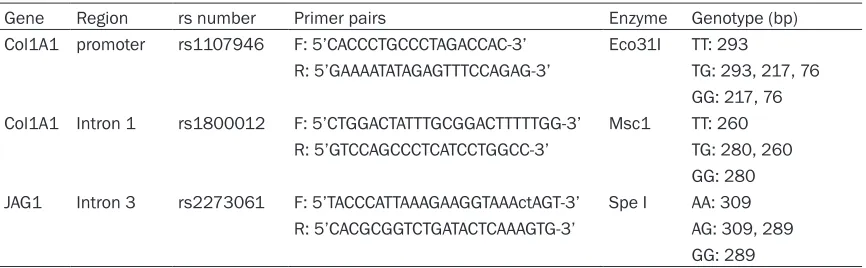
Table 1. Single nucleotide polymorphisms (SNPs) investigated in this study and PCR primers for the genotyping of COL1A1 and JAG1
Gene Region rs number Primer pairs Enzyme Genotype (bp) Col1A1 promoter rs1107946 F: 5’CACCCTGCCCTAGACCAC-3’ Eco31I TT: 293
R: 5’GAAAATATAGAGTTTCCAGAG-3’ TG: 293, 217, 76 GG: 217, 76 Col1A1 Intron 1 rs1800012 F: 5’CTGGACTATTTGCGGACTTTTTGG-3’ Msc1 TT: 260
R: 5’GTCCAGCCCTCATCCTGGCC-3’ TG: 280, 260 GG: 280 JAG1 Intron 3 rs2273061 F: 5’TACCCATTAAAGAAGGTAAActAGT-3’ Spe I AA: 309
Genotyping
Peripheral venous blood samples were obtai- ned from all subjects, and genomic DNA was isolated using the phenol-chloroform extrac-tion method from EDTA-preserved peripheral venous blood. Genotyping of COL1A1 and JAG1 polymorphisms were determined by poly-merase chain reaction and restriction fragment length polymorphism (PCR-RFLP) analysis. PCR
amplification was performed in 2720 Thermal
Cycler (Applied Biosystems, USA) and PCR products were digested by restriction enzymes. The primer sequences, restriction enzymes, and fragment lengths are presented in Table 1.
PCR Amplification of the 293 bp fragment
encompassing the CoL1A1 rs1107946 (-1997
G/T) polymorphic site was performed in 10 μl,
1× buffer containing 10 mM Tris HCl, PH 8.3, 50 mM KCl, 2.5 mM MgCl2, 240 mM dNTPs,
200 ng of template DNA, 0.5 μM of each prim -er, and 1.25 U Taq DNA polymerase (TransGen Biotech, Beijing, China). After initial
denatur-ation at 94°C for 5 min, amplificdenatur-ation was per -formed by 35 cycles of denaturation at 94°C for 40 s, annealing at 56°C for 30 s, and exten-sion at 72°C for 30 s. Final extenexten-sion was allowed to proceed at 72°C for 10 min.
Amplification of the 254 bp fragment encom -passing the CoL1A1 + 1245 G > T polymorphic
site (rs1800012) was performed in 10 μl, 1×
buffer containing 10 mM Tris HCl, PH 8.3, 50 mM KCl, 2.5 mM MgCl2, 250 mM dNTPs, 200
ng of template DNA, 0.5 μM of each primer, and
1.25 U Taq DNA polymerase (TransGen Biotech, Beijing, China). After initial denaturation at
94°C for 5 min, amplification was performed by
35 cycles of denaturation at 94°C for 1 min, annealing at 56°C for 1 min, and extension at 72°C for 1 min. Final extension was allowed to proceed at 72°C for 10 min.
Amplification of the 309 bp fragment encom -passing the JAG1 + A > G polymorphic site
(rs2273061) was performed in 10 μl, 1× buffer containing 10 mM Tris HCl, PH 8.3, 50 mM KCl, 2.5 mM MgCl2, 250 mM dNTPs, 200 ng of
tem-plate DNA, 0.5 μM of each primer, and 1.25 U
Taq DNA polymerase (TransGen Biotech, Beijing, China). After initial denaturation at
94°C for 5 min, amplification was performed by
35 cycles of denaturation at 94°C for 30 s, annealing at 62°C for 30 s, and extension at 72°C for 1 min. Final extension was allowed to proceed at 72°C for 10 min.
After the amplification, PCR reaction products
were separated on a 2-3% agarose gel with TAE buffer. 3 µL aliquots of products were digested with Eco31I, Msc1 and Spe I restriction endo-nucleases (TAKARA) respectively for 12 h at 37°C and subjected to electrophoresis on 10% polyacrylamide gels, with 1× TBE running buffer stained with ethidium bromide and detected under UV light. Samples of known genotype were run as controls and a DNA-free water neg-ative control in each batch.
Statistical analysis
Quantitative variables were summarized as mean and standard deviation and qualitative variables as relative frequencies for all sub-jects. One-way analysis of covariance (ANCOVA)
was used for continuous variables and χ2 test for categorical variables. Deviations from
Hardy-Weinberg equilibrium were test using χ2 test. Data analysis was performed using SPSS16.0 software (SPSS, Chicago, IL, USA). P
< 0.05 was regarded as statistically significant.
Linkage disequilibrium (LD) among polymor-phisms was tested using Haploview 4.2 [11]. Results
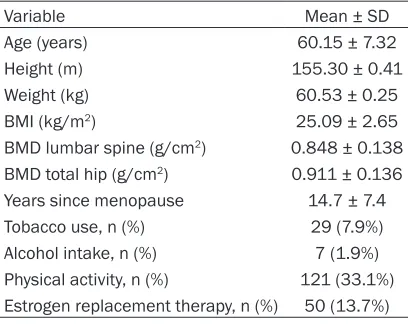
The main demographic and clinical features of 367 postmenopausal women are shown in Table 2. The two SNPs of COL1A1 (rs1107946 and rs1800012) and the SNP of JAG1
[image:3.612.91.295.96.258.2](rs2273061) genotype and allele frequencies Table 2. General characteristics of 367
Chi-nese postmenopausal women
Variable Mean ± SD
Age (years) 60.15 ± 7.32
Height (m) 155.30 ± 0.41
Weight (kg) 60.53 ± 0.25
BMI (kg/m2) 25.09 ± 2.65
BMD lumbar spine (g/cm2) 0.848 ± 0.138
BMD total hip (g/cm2) 0.911 ± 0.136
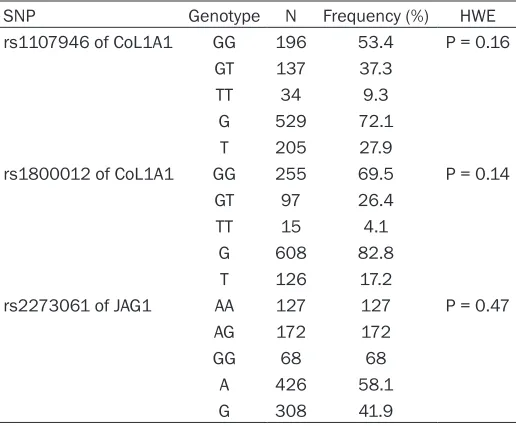
are presented in Table 3. Hardy-Weinberg equi-librium test was performed for the polymor-phisms under study and all these three geno-type frequencies were in Hardy-Weinberg equilibrium.
For rs1107946 and rs1800012 of COL1A1,
There was no significant difference in TH BMD
between Col1A1 genotypes. At the LS, there
was a significant difference in BMD between
Sp1 polymorphism GG genotypes and GT geno-types (P = 0.027). There was also a significant
We found that the rs1800012 polymorphism and G-G haplotype of COL1A1 were associated with BMD variations in lumbar spine.
[image:4.612.91.349.109.322.2]One of the most intensively investigated poly-morphism of COL1A1 affects a Sp1 binding site within intron 1 at 1245 bp relative to the tran-scription start site. COL1A1 gene 1245 G > T has been associated with low BMD and an increased risk of osteoporotic fracture in sev-eral studies [4, 12]. Sevsev-eral association studies about this SNP and its relation to BMD have Table 3. Hardy-Weinberg equilibrium, genotype, and allele
frequencies for the two SNPs of COL1A1and JAG1in post-menopausal Chinese women
SNP Genotype N Frequency (%) HWE
rs1107946 of CoL1A1 GG 196 53.4 P = 0.16
GT 137 37.3
TT 34 9.3
G 529 72.1
T 205 27.9
rs1800012 of CoL1A1 GG 255 69.5 P = 0.14
GT 97 26.4
TT 15 4.1
G 608 82.8
T 126 17.2
rs2273061 of JAG1 AA 127 127 P = 0.47
AG 172 172
GG 68 68
A 426 58.1
G 308 41.9
HWE: Hardy-Weinberg equilibrium.
difference in BMD between GG and TT genotypes (P = 0.019). The Sp1
polymorphism was significantly asso -ciated only with lumbar spine BMD under the dominant model (GG vs. GT + TT); P = 0.017 (Table 4).
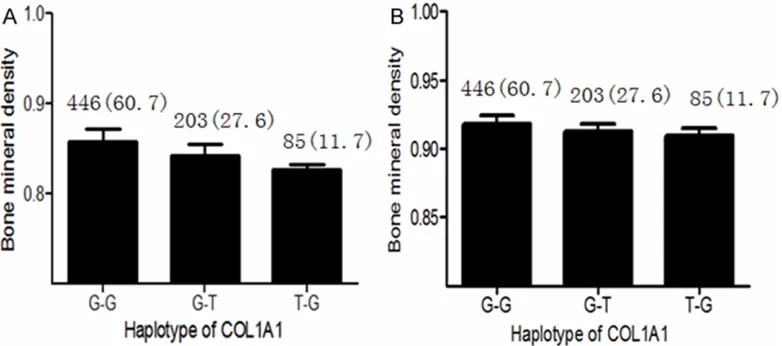
Moreover, data from the genotyping analysis of the two SNPs of COL1A1 (rs1107946 and rs1800012) dem-onstrated the presence of four hap-lotypes: G-G, T-G, G-T and T-T with frequencies of 60.7%, 27.6%, 11.7 and 0.03% respectively (Figure 1). The rare TT haplotype was excluded
due to low frequencies. A significant
association was observed between G-G haplotype and BMD at the lum-bar spine (P = 0.021). The two SNPs of COL1A1 were at high linkage dis-equilibrium (D’ = 0.79). However, the
TH BMD was not significantly associ -ated with any haplotypes.
On other hand, genotype and allele distributions of rs2273061
polymor-phism of the JAG1 showed no signifi -cant differences under any model tested.
Discussion
In this study, we have analyzed the association of two polymorphisms of the COL1A1 gene (rs1800012 and rs1107946) and their haplotypes as well as the rs2273061 polymor-phism of the JAG1 gene with the presence of BMD variations in Chinese postmenopausal women. There was no difference in age, BMI, or smoking status when analyzed by genotypes, allowing comparisons between genotypes to be conducted. Table 4. Bone mineral density in Chinese postmenopausal
women in different genotype subgroups of the COL1A1and JAG1genes
SNP Genotype LS (g/cm2) TH (g/cm2) Mean SD Mean SD rs1107946 of CoL1A1 GG 0.856 0.143 0.919 0.128
GT 0.848 0.128 0.906 0.136 TT 0.851 0.139 0.913 0.141 rs1800012 of CoL1A1 GG 0.863 0.142 0.907 0.136 GT 0.833 0.129* 0.912 0.132
TT 0.831 0.133* 0.909 0.140
GT TT 0.834 0.132* 0.911 0.137
[image:4.612.90.349.393.553.2]been reported previously. Grant SF et al. inves-tigated that GT heterozygotes at the
polymor-phic Sp1 site had significantly lower BMD than
GG homozygotesin two populations of British women and BMD was lower still in T/T homozy-gotes [13]. A meta-analysis of 26 studies
con-firmed the association of the T allele of the
1245 G > T polymorphism with a modest
reduc-tion in BMD and a significant risk of osteopo -rotic fracture [14]. Bustamante et al. reported that COL1A1-1997 G > T and 1245 G > T poly-morphisms are associated with increased BMD for lumbar spine [7]. Our results are in agree-ment with these published works. This study
found a significantly lower BMD at the LS in
postmenopausal women with GT (26.4%) geno-types and TT (4.1%) genogeno-types compared with
GG genotypes (69.5%). There was a significant
reduction in BMD of LS in women with TT and GT genotypes (0.834 g/cm2) compared to GG genotype (0.863) on a dominant model, P = 0.017.
The PCOL2 variances located in the promoter region of COL1A1 gene was associated with BMD of the lumbar spine and femoral neck in postmenopausal Spanish women [5] and a strong interaction between PCOL2 and Sp1 variance was observed in a study of elderly Caucasian females [6]. These results were also
confirmed in Caucasian women from the USA
and from the UK and Japanese [6, 15]. However,
we found no significant differences between
BMD and PCOL2 variances. Our results are in
accordance with those described in a popula-tion-based study of unrelated postmenopausal Mexican-Mestizo Women that showed no asso-ciation between -1997 G > T alleles and BMD [16].
Regarding to linkage disequilibrium (LD) among the two SNPs of COL1A1in our population, we observed higher lumbar spine of BMD in G-G haplotype. We observed that these were in high LD (D’ = 0.79) different from the values described by Mejía et al. for the Mexican-Mestizo women (D’ = 0.84) [16] and values described by Liu et al. for the Caucasian popu-lation (D’ = 0.918) [6]. In agreement with our
results, both authors found a significant asso -ciation only of the haplotype G-G with BMD. GWAS of BMD variations performed by Kung et
al. identified that the rs2273061 of JAG1 was
associated with BMD in three independent cohorts of European descent [10]. In regard to results of the rs2273061 polymorphism, we
didn’t find any association of this SNP with
BMD. Similar data were reported by Kung et al. in the Northern Chinese population [10]. Population diversity may explain these different results.
To our best knowledge, this is the first study to
[image:5.612.92.483.72.245.2]pausal women from Han population. The limita-tion of our study is the small sample size. In conclusion, the rs1800012 polymorphism of COL1A1 showed an association with BMD of the lumbar spine under a dominant model. G-G haplotype of COL1A1 presented higher BMD in lumbar spine. By enlarging the study we hope
that more explanatory and definitive results
can be obtained. And further studies are also necessary in different populations.
Disclosure of conflict of interest
None.
Address correspondence to: Dr. Xian-Feng Huang, Orthopedics Institute, 89 Hospital of PLA, 3770 Beigongxijie, Weifang, Shandong Province, P. R. China. E-mail: [email protected]
References
[1] Ralston SH and Uitterlinden AG. Genetics of osteoporosis. Endocr Rev 2010; 31: 629-662. [2] Ralston SH and de Crombrugghe B. Genetic
regulation of bone mass and susceptibility to osteoporosis. Genes Dev 2006; 20: 2492-2506.
[3] Erdogan MO, Yildiz H, Artan S, Solak M, Tascioglu F, Dundar U, Eser B and Colak E. Association of estrogen receptor alpha and collagen type I alpha 1 gene polymorphisms with bone mineral density in postmenopausal women. Osteoporos Int 2011; 22: 1219-1225. [4] Hubacek JA, Weichetova M, Bohuslavova R,
Adamkova V and Stepan JJ. Genetic polymor-phisms of TGF-beta, PAI-1, and COL1A-1, and determination of bone mineral density in Caucasian females. Endocr Regul 2006; 40: 77-81.
[5] Garcia-Giralt N, Nogues X, Enjuanes A, Puig J, Mellibovsky L, Bay-Jensen A, Carreras R, Balcells S, Diez-Perez A and Grinberg D. Two new single-nucleotide polymorphisms in the COL1A1 upstream regulatory region and their relationship to bone mineral density. J Bone Miner Res 2002; 17: 384-393.
[6] Liu PY, Lu Y, Long JR, Xu FH, Shen H, Recker RR and Deng HW. Common variants at the PCOL2 and Sp1 binding sites of the COL1A1 gene and their interactive effect influence bone mineral density in Caucasians. J Med Genet 2004; 41: 752-757.
[7] Bustamante M, Nogues X, Enjuanes A, Elosua R, Garcia-Giralt N, Perez-Edo L, Caceres E, Carreras R, Mellibovsky L, Balcells S, Diez-Perez A and Grinberg D. COL1A1, ESR1, VDR and TGFB1 polymorphisms and haplotypes in relation to BMD in Spanish postmenopausal women. Osteoporos Int 2007; 18: 235-243.
[8] Nobta M, Tsukazaki T, Shibata Y, Xin C, Moriishi T, Sakano S, Shindo H and Yamaguchi A. Critical regulation of bone morphogenetic pro-tein-induced osteoblastic differentiation by Delta1/Jagged1-activated Notch1 signaling. J Biol Chem 2005; 280: 15842-15848.
[9] Weber JM, Forsythe SR, Christianson CA, Frisch BJ, Gigliotti BJ, Jordan CT, Milner LA, Guzman ML and Calvi LM. Parathyroid hor-mone stimulates expression of the Notch li-gand Jagged1 in osteoblastic cells. Bone 2006; 39: 485-493.
[10] Kung AW, Xiao SM, Cherny S, Li GH, Gao Y, Tso G, Lau KS, Luk KD, LiuJM, Cui B, Zhang MJ, Zhang ZL, He JW, Yue H, Xia WB, Luo LM, He SL, Kiel DP, Karasik D, Hsu YH, Cupples LA, Demissie S, Styrkarsdottir U, Halldorsson BV, Sigurdsson G, Thorsteinsdottir U, Stefansson K, Richards JB, Zhai G, Soranzo N, Valdes A, Spector TD and Sham PC. Association of JAG1 with bone mineral density and osteoporotic fractures: a genome-wide association study and follow-up replication studies. Am J Hum Genet 2010; 86: 229-239.
[11] Barrett JC, Fry B, Maller J and Daly MJ. Haploview: analysis and visualization of LD and haplotype maps. Bioinformatics 2005; 21: 263-265.
[12] Bandres E, Pombo I, Gonzalez-Huarriz M, Rebollo A, Lopez G and Garcia-Foncillas J. Association between bone mineral density and polymorphisms of the VDR, ERalpha, COL1A1 and CTR genes in Spanish postmenopausal women. J Endocrinol Invest 2005; 28: 312-321.
[13] Grant SF, Reid DM, Blake G, Herd R, Fogelman I and Ralston SH. Reduced bone density and osteoporosis associated with a polymorphic Sp1 binding site in the collagen type I alpha 1 gene. Nat Genet 1996; 14: 203-205.
[14] Mann V, Hobson EE, Li B, Stewart TL, Grant SF, Robins SP, Aspden RM and Ralston SH. A COL1A1 Sp1 binding site polymorphism pre-disposes to osteoporotic fracture by affecting bone density and quality. J Clin Invest 2001; 107: 899-907.
[15] Yamada Y, Ando F, Niino N and Shimokata H. Association of a -1997G->T polymorphism of the collagen Ialpha1 gene with bone mineral density in postmenopausal Japanese women. Hum Biol 2005; 77: 27-36.