Maximum Coverage Range based Sensor Node
Selection Approach to Optimize in WSN
Rinku Sharma1, Dr. Rakesh Joon2
1Post Graduate Scholar, 2Assistant Professor, Department of Electronics and Communication Engineering, Ganga Institute of
Technology and Management, Kablana, Jhajjar, India
Abstract: In Wireless sensor network energy optimization is major issues to be concentrated. This paper concentrates on energy saving with maximum sensing range and transmission range of sensor node and finding the minimum hop path between the nodes. An algorithm called Minimum Hop Maximum Range routing (MHMR) has been designed to optimize energy by using maximum coverage range of sensor nodes in WSNs. By using this algorithm an energy effective minimum hop path is selected over the network between the source node and destination node (sink node) to improve the network lifetime and reduce the delay. Simulation results show that proposed algorithm can significantly improve network life time and provide energy efficiency. Keywords: Wireless sensor network, MATLAB, Range, Sensor node.
I. INTRODUCTION
Wireless sensor networks consist of a large number of sensors nodes which are also called motes. These nodes are required to operate in a hostile environment for a maximum duration without human intervention. A sensor node is a small device that includes four main components: a sensing unit for data acquisition, communication unit to allow the transmission/reception of information to/from other connected devices, a microcontroller for local data processing and for memory operations and a power source which is usually a small battery. Wireless sensor networks support a wide range of applications such as target tracking, environmental monitoring, health monitoring in hostile environment [1]. Smart home environment is the important application of Wireless sensor network. Smart home environments can provide custom behaviors for a given individual [2]. Wireless sensor networks exhibits some problems like energy capacity, sensor locations, battery power, sensing range, scalability etc. [3].
To improve the energy efficiency of transmission data, many of energy efficient routing protocol are designed to define the minimum energy consumption path and shortest path between sending node and receiving node. Due to network partitions and some network failures cause data packet loss and the multiple transmissions of data packets in selected path that makes much more consumption of the energy. If energy consumption is increased then network life time is decreased. Therefore, both energy consumption and network lifetime must be balanced [4].
II. FACTORS AFFECTING WSNs DESIGNS
Wireless sensor networks designs are affected from some problems. These factors or problems in wireless sensor network have following aspects:
1) Transmission media: The communicating sensor nodes are connected by the wireless medium in the multi hop wireless sensor network. The wireless link or medium can be organized by radio link, infrared link and optical medium [13]. To start the worldwide communication of these wireless sensor networks, the selected transmission medium should be available worldwide. The International Table of Frequency Allocations contained in Article S5 of the Radio Regulations (Volume 1), species some frequency WSN bandwidths that may be made available for ISM application. Some of these frequency WSN bandwidths are already being used for communication in cordless phone systems and wireless local area networks (WLANs) [5].
2) Power consumption: The Wireless sensor network can only be fitted with a limited power source (<0.5 Ah, 1.2 V). In some application, recharge of the power resources can not possible. The lifetime of sensor nodes are depend on the lifetime of the battery. In a multi hop ad hoc wireless sensor network, each sensor nodes play the double role of data initiator and data router. Hence, power management and power conservation take on additional importance. For these reasons that research person are currently focusing on the design of power-aware protocols and algorithms for wireless sensor networks.
may not be symmetric. Sensor nodes may not be able to have communication in both the forward and reverse directions. Thus, sensor nodes are not bidirectional and it should be consider in the routing protocols in sensor networks [13].
4) Limited hardware resources: Sensor nodes have also limited processing and storage capacities. Thus, sensor nodes can only perform limited computational functions. These hardware constraints present many challenges in software development and network protocol design for Wireless sensor networks, which must consider not only the energy constraint in sensor nodes, but also the processing and storage capacities of sensor nodes [6].
5) Limited energy capacity: Since sensor nodes are battery powered, they have limited energy capacity. Energy poses a big challenge for network designers in hostile environments, for example, a battlefield, where it is impossible to access the sensors and recharge their batteries [6].
III. LITERATURE REVIEW
1) Pandurang Kamat [7], has defined location aware routing approach for secure sensor network. Author defined the work to handle the challenges associated with private network. Author defined a work on secure data transmission in location aware source routing. Author defined a work to improve the secure routing in sensor network. Author analyze the network under privacy characteristics assessments and to provide effective data transfer over network
2) Yean-Fu Wen [8], has defined an effective data aggregation specific routing in communication network. Author defined the battery capacity analysis and energy effective communication in sensor network. Author has estimated the energy consumption over the network. Author has defined the effective cluster construction and data construction for effective aggregative routing. 3) Chunsheng Zhu [9], has improved the geographic routing and duty cycle specific sensor network. Author defined a greedy
forwarding communication over the sensor network. Author defined the greedy based approach to optimize the routing for long distance communication. Author defined the algorithm analysis under different parameters that shows the significant improvement.
4) Amir Hossein Mohajerzadeh [10], has presented an optimal routing approach in sensor network under energy specification analysis and optimal route generation. Author defined a quantize mechanism for effective route generation.
5) Rafael Asorey-Cacheda [11], has defined the maximizing lifetime of WSN by optimally assigning energy supplies. Author suggest a hierarchical network architecture, where nodes with renewable energy sources carry out most message delivery tasks, and nodes equipped with conventional chemical batteries are those with less communication demands.
6) Ahmed Redha Mahlous [12], has defined an intelligent hybrid optimization algorithm based on a Set Cover approach to create clusters, and min-cost max-flow for routing (SCMC) to increase the lifetime of WSNs. Author used linear programming (LP) to model the WSN optimization problem. Author model considered minimizing the energy for all nodes in each set cover and then minimizing the routing energy between the nodes and the base station through intermediate nodes called cluster heads.
IV. RESEARCH METHODOLOGY
This paper is concentrated on reducing the energy usage of sensor nodes and increasing the lifetime of the Wireless sensor network by using algorithm called Minimum Hop Maximum Range routing. Initially, the source and the sink node or destination nodes are specified in the sensor network. The routing path will be generated between these nodes and the parameters are also set for all sensor nodes in the network. The parameters are considered in this paper are transmission distance, sensing range and energy. Based on these all parameters the reliable routing path will be generated and communication will be performed on this path. In the existing work, a minimum distance neighbor node is considered as the effective next node. But in this work, the maximum distance node within the transmission coverage range of the sensor node is considered as next effective node and communication will be performed over that node. The process is repeated till the destination node or sink node is not arrived.
A. Proposed MHMR Algorithm
1) Initially, specify the source node and destination node between which the communication is performed in the sensor network.
2) Define the effective parameters that include distance, energy, delay and maximum coverage range for each sensor nodes.
3) Determine the next effective neighbor node of the current node over which communication is performed.
4) The neighbor node which is at maximum distance from the current node with in transmission coverage range and has high energy is defined as next effective node.
5) Set this node as best neighbor node.
6) Perform communication over this node.
V. RESULT ANALYSIS
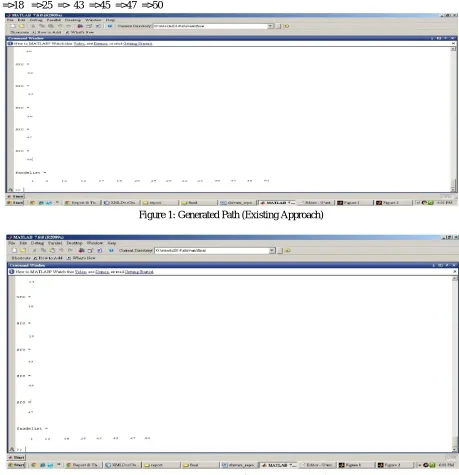
The aim of this paper is to achieve less energy consumption with the maximum sensing range and transmission range of the sensor nodes to improve network lifetime and efficiency. Here, the simulation tool used is MATLAB software. The sensor nodes perform communication using MHMR algorithm and finding minimum hop path between the source node and the sink node. As shown in Figure 1, the generated path between the source node and the destination node for the existing approach over the sensor network. In this figure node 1 is given as source node and node 50 as the sink node or destination node. The path is generated based on the energy, transmission distance. The work is about to perform the selection of the effective energy sensor node. The result of the generated path obtained from the work are given here under
1 =>2 =>12 =>14 =>17 =>18 =>26 =>25 =>20 =>22 =>23 =>46 =>47 =>48 =>50
Figure 2 shows the generated path over the sensor network for proposed approach which is the minimum hop efficient path and consume less energy than existing approach generated path. The path is generated based on the energy, distance and hop consideration. The work is about to reduce the number of hop in communication path so that the energy consumption over the network will be reduced. The result of the generated path obtained from the work are given here under
[image:3.612.75.534.250.725.2]1 =>14 =>18 =>25 => 43 =>45 =>47 =>50
Figure 1: Generated Path (Existing Approach)
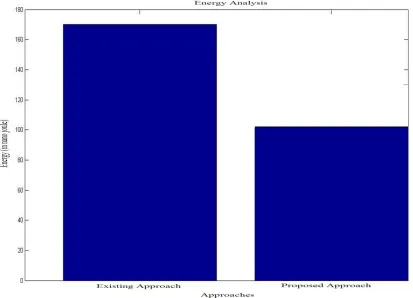
Figure 3: Energy Consumption Analysis (Existing Vs. Proposed Approach)
Here figure 3 shows the energy consumption analysis of existing and proposed approach. As shown in the figure, the proposed work has reduced the energy consumption over the network.
Total energy consumption over the generated path by existing approach is 170 nj (nano joule) and the energy consumption in the generated path by proposed algorithm is 100nj.
Here, figure 4 is showing the hop count analysis of existing and proposed approach. As shown in the figure, the proposed work has reduced the number of intermediate nodes. It also reduces the energy consumption and improves the network life.
VI. CONCLUSION AND FUTURE WORK
Energy saving is considered as main factor in Wireless sensor network. In this paper, we have specified a minimum hop energy efficient communication path over the wireless sensor network. In the proposed work, wireless sensor network consist of fixed position of sensor nodes. The aim of the work is to generate a route that will use less number of intermediate nodes between the source node and the sink node so that the energy consumption over the path is decreased. The result represent that the energy consumption over the route is reduced and network lifetime is also improved. The improvement to the proposed work can be done in different way. In proposed work, sensor nodes position is fixed. So, mobile sensor nodes can also be used in future work to make communication flexible. The energy efficiency of Wireless sensor network will be better proved in future works.
VII. ACKNOWLEDGMENT
I would like to express my greatest gratitude to HOD in ECE department and Principal, GITAM, Kablana, Jhajjar for providing opportunity to do research work. And I also thanks to the people who have helped & supported me throughout this research.
REFERENCES
[1] R. Kay and F. Mattern, "The Design Space of Wireless Sensor Networks" IEEE Wireless Communications Vol.11.No.6 (2004) pp 54–61.
[2] S. Hussain, S. Schaffner and D. Moseychuck, "Applications of Wireless Sensor Networks and RFID in a Smart Home Environment" Proceedings of the 2009 Seventh Annual Communication Networks and Services Research Conference (2009) pp 153157.
[3] Yu Gu," Joint Scheduling and Routing for Lifetime Elongation in Surveillance Sensor Networks", 2007 IEEE Asia-Pacific Services Computing Conference 0-7695-3051-6/07 © 2007 IEEE.
[4] D.Baghyalakshmi,"Low Latency and Energy Efficient Routing Protocols for Wireless Sensor Networks", ICWCSC 2010X 978-1-4244-5137-1/10 ©2010 IEEE.
[5] Yawen Dai," MEBRS: Energy Balancing Route Scheduling in Centralized Wireless Sensor Networks", 1st Int'l Symposium on Quality Electronic Design-Asia 978-1-4244-4952-1/09 ©2009 IEEE.
[6] Yavuz Bogaç Turkogullari," An Efficient Heuristic for Placement, Scheduling and Routing in Wireless Sensor Networks", 978-1-4244-2881-6/08 ©2008 IEEE.
[7] Pandurang Kamat," Enhancing Source-Location Privacy in Sensor Network Routing", Proceedings of the 25th IEEE International Conference on Distributed Computing Systems (ICSCS’05) 1063-6927/05 © 2005 IEEE.
[8] Yean-Fu Wen," Energy-Efficient Data Aggregation Routing and Duty-Cycle Scheduling in Cluster-based Sensor Networks", 1-4244-0667-6/07 © 2007 IEEE. [9] Chunsheng Zhu," Sleep Scheduling Towards Geographic Routing in Duty-Cycled Sensor Networks With A Mobile Sink", 2011 8th Annual IEEE
Communications Society Conference on Sensor, Mesh and Ad Hoc Communications and Networks 978-1-4577-0093-4/11©2011 IEEE.
[10] Amir Hossein Mohajerzadeh," Optimum Routing and Scheduling for Estimation in Wireless Sensor Networks", 2012 2nd International Conference on Computer and Knowledge Engineering (ICCKE) 978-1-4673-4476-0/12©2012 IEEE.
[11] Rafael Asorey-Cacheda, “ On Maximizing the Lifetime of Wireless Sensor Networks by Optimally Assigning Energy Supplies”, Sensors 2013, 13, 10219-10244; doi:10.3390/s 130810219.