Abstract— An important class of rehabilitation equipment is destined for facilitating the recovery of the upper limb affected by lesions or various diseases. The paper presents a study on the bio-mechanics of the arm and forearm, as well as equipment for mobilizing and rehabilitation of the upper limb. The pneumatic drive of the equipment determines its compliant behaviour, based on air compressibility. The equipment described in the paper can be used for the rehabilitation of patients with deficiencies of the upper limb, as well as for training of high-performance athletes. Given its simple and low cost construction, the equipment can be purchased not only by health care units, but also by non-specialist individuals, as it lends itself to home training, without requiring the presence of a physical therapist or technician.
Index Terms— bio-mechanics, pneumatics, rehabilitation, robotic arm.
I. INTRODUCTION
he World Health Organization estimates that every year all over the world 15 million persons are affected by a stroke, leaving 5 million of these permanently disabled. While most post-stroke patients have the ability of recovering the mobility of their lower limbs, many fail in recovering the full functionality of the upper limbs, even after prolonged rehabilitation treatment [1].
Under these circumstances, at present medical units are increasingly required to provide rehabilitation services complementary to surgical and pharmacological treatments. The application of adequate rehabilitation therapies holds increasing importance in many locomotion disabilities of neurological origin, such methods being known as neuro-rehabilitation.
Traditional rehabilitation of the paretic upper or lower limbs involves their manipulation by a physical therapist. Typically rehabilitation treatment is planned based on an ex ante assessment of the subject’s residual abilities and can
last several hours per day; often this can be prolonged exercising, tiresome for both the patient and the physical
Manuscript received January 03, 2011; revised January 18, 2011. Prof. Dr. Eng. Tudor Deaconescu is with the Transilvania University of Brasov, Vice-Dean of the Faculty of Technological Engineering, Department of Economic Engineering and Production Systems, Bd. Eroilor 29, Romania, RO-500036 (phone: 477113; fax: 0040-268-477113; e-mail: tdeacon@ unitbv.ro).
Prof. Dr. Eng. Andrea Deaconescu is with the Transilvania University of Brasov, the Faculty of Technological Engineering, Department of Economic Engineering and Production Systems, Bd. Eroilor 29, Romania, RO-500036 (phone: 0040-268-477113; fax: 0040-268-477113; e-mail: deacon@ unitbv.ro).
therapist. Further more, such therapeutic treatment can stretch over several months, the patients being required to travel each day to the rehabilitation clinic, thus incurring discomfort and significant expenditure.
The partial replacement of the physical therapist’s work and the possibility of conducting rehabilitation exercises at the patient’s home have thus become prime research objectives and have led to the development of a number of robotized systems for the recovery of upper and lower limbs. Rehabilitation equipment is a mechatronic or robotic system capable of providing support to the therapist during application of programmes and customized recovery programmes. Generally rehabilitation equipment includes an actuation and an energy supply module, proprioceptive and exteroceptive sensors necessary for providing information on the status of the machine and the machine-environment interaction, a microcontroller processing the data received from the sensors and generating commands for the motor, as well as a dedicated man-machine interface. A particular advantage of rehabilitation equipment is allowing the patients to conduct semi-autonomous rehabilitation sessions, even at their own home, thus reducing the necessity of employing a full-time physical therapist.
Over the last years innovative robotized systems have appeared on the market of rehabilitation equipment, capable of allowing patients to conduct repetitive and result-oriented motions. Such systems can offer a safe and intensive training programme, improving the efficiency of planning and deployment of medical assistance.
Although the benefit of using such equipment in clinical applications has been only partially proven, still solid arguments can be brought in favour of encouraging researchers to design and develop new rehabilitation systems based on the scientific and technological progress in bio-engineering, bio-medical robotics and mechatronics.
The clinical potential of these machines is evident, as on one hand they assist the physical therapist in administering patient-specific treatment with accuracy and repeatability, as typical for robotized systems, and on the other they facilitate obtaining quantitative and qualitative information on patient status.
Equipment used in robotized rehabilitation accepts, and if necessary completes the motion carried out by the patients as permitted by their residual locomotion capacity; such behaviour is obtained by applying a so-called “assisted as needed” control strategy” [2].
An important class of rehabilitation equipment is dedicated to the recovery of the upper limb, affected by various lesions or diseases. The paper presents such
Pneumatic Equipment for Rehabilitation and
Mobilization of the Upper Limb
Tudor Deaconescu, Member,IAENG, Andrea Deaconescu, Member,IAENG and Teodor Deaconescu
mobility of the arm and forearm, requiring repetitive motions along the same path, however of variable intensity. It has been experimentally established that repetitive motions can improve muscle power and locomotion coordination in patients with neurological lesions.
II. BIO-MECHANICS OF THE UPPER LIMB
To present the number of studies concerning the motions of the human body during physical exercise, sports or rehabilitation activities of the locomotion system have known an impressive evolution. Thus several branches of science have been developed contributing to broadening knowledge related to the specific motions that can be carried out by various parts of the human body. One such branch of science is Bio-mechanics dedicated to the study of the
consequences of mechanical forces on the functional structure of the human individual, regarding the architecture of bones, joints and muscles, as determining factors of motion. Another branch of science is Kinetic Therapy
regarding and deploying motion as the main means of recovery or rehabilitation after trauma, in locomotion system disabilities, etc. Correct application of the concepts of bio-mechanics in kinetic therapy can shorten and improve the quality of post-traumatic or post-surgical recovery and rehabilitation, or can diminish the complex of handicap.
In the field of recovery, an important role in preventing accidents, lesions, muscle rupture and fractures comes to extensive study and knowledge from the bio-mechanical viewpoint of their generation. Recovery and therapy in such cases are significantly improved if not only the bio-mechanical causes of accidents are known, but also the effects of certain solutions of recovery, that may temporarily limit or inhibit motion (like prostheses, casts, fixing or stretching devices).
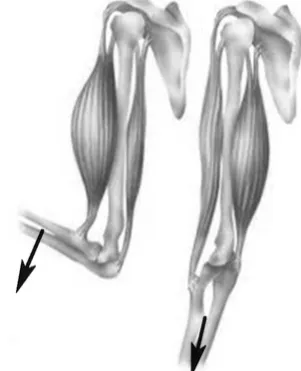
The musculature of the upper limb conducts two types of activity, static and dynamic, respectively. Each of these two types of activity is accompanied by a number of bio-mechanical particularities. Thus, the static activity is the result
[image:2.595.95.246.574.760.2]of the static – isometric contraction of the muscle groups and chains; it does not determine the shortening of the muscle, nor the displacement of body segments or of the body as a whole (Fig. 1).
Fig. 1. Muscle activity: a. maintaining b. consolidation
The static consolidation activity occurs in cases of stable
(suspended) balance, where the general mass centre is located below the supporting base. Here the muscle groups and chains oppose the traction forces, that at joint level act as forces tending to dislocate the joints placing the capsule and ligaments under tension increasing with the magnitude of the strain. The static consolidation effort simultaneously strains the antagonist muscle groups and chains. Hence exercising based on this type of effort simultaneously set both agonist and antagonist muscles into motion.
The static maintaining activity occurs in positions of both
stable and unstable balance, with the contribution of only some (and not all) groups and chains of antagonist muscles. This type of effort is used in locomotion re-education.
The dynamic activity of the upper limb muscles has two
particularities: overcoming and yielding. The dynamic
overcoming activity is the contraction by which the muscle
shortens and mobilizes the bones by a concentric, approaching motion; the antagonist muscles are stretched and thus contribute to the braking of the motion. The dynamic
yielding activity is the contraction where the muscle conducts
its motion by progressive yielding of its status of contraction, correspondingly increasing in length.
Muscle contraction involves either a hardening of the muscle, or a modification of hardness and shape. Several types of contractions are known:
- Isometric (static) contractions induce the hardening of the muscle. They generate an increase in volume and weight of the muscle (thus of the force), by increasing the quantity of sarcoplasma in the muscle fibres and a redistribution of the nuclei, that from a marginal position become central. By isometric contractions the length of the muscle does not change.
- Isotonic (dynamic) contractions induce the shortening of the muscle, maintaining the mechanical tension constant over the entire duration of the muscle shortening.
- Isokinetic contractions are achieved at constant (isokinetic) velocity. They can be achieved y means of special devices, particularly for sports training, eliminating or limiting accelerations. Numerous researches have shown that compared to isotonic training, training based on motion generated by isokinetic contractions holds certain considerable advantages. It is known that training with adequate and correctly dimensioned weights lead to considerable progress of the maximum force or of the force in the area of slow motion. By isokinetic contractions the increase of muscle power is achieved both by the progress of maximum force and of maximum velocity, what represents a considerable advantage. On the other hand, using isokinetic devices offers protection against accidents, as they achieve a permanent correlation between motion velocity and the resistive load.
The few exceptions are the isometric, isokinetic and isotonic motions.
Conducting a certain locomotion act generates different involvements of force, and marks distinctive particularities. Three main ways of force occurrence can be highlighted:
a. Maximum force characterized by:
1. maximum static force, occurring by a contraction of the entire muscle system in order to overcome a resistance exceeding its capacity. In this situation muscle contraction is isometric and occurs without modification of muscle shape and muscle ends approaching, but with a significant increase of muscular tension;
2. the maximum dynamic force is achieved by a maximum contraction as part of a locomotion act. It occurs by the muscle overcoming an external resistance by means of an isotonic contraction causing the shortening of the muscle (the contracting elements shorten, while the length of the elastic ones remains unmodified). In the case of yielding motions, a forced lengthening of the muscle is caused, the force significantly exceeding (by 50-80%) the maximum isometric force that can be developed by the subject.
b. Detente (explosive force or velocity force) is the
capacity of groups of muscles to develop maximum force in a short as possible time.
Detente is determined by the maximum force, but also by another so-called “start-up” force (the capacity of achieving maximum force at the very beginning of the motion), with the effect of obtaining an initial high velocity. In order to have a good détente, either maximum force or muscle contraction velocity have to be increased, or preferable a combination of these two solutions.
c. Resistance mode force represents the capacity of
achieving long-time effort. This form occurrence of force is typical for sports like cycling, combined sports, sports games etc. The intensity is determined in percent (%) of the maximum contraction force, by the number of repetitions or tempo and by the working rhythm (volume). A particular form is the resistance mode détente, an important quality in many sports, requiring the body to carry Out explosive motions in the long term (boxing, fencing, ice skating, games like volleyball, handball, etc).
III. REHABILITATION AND TRAINING EQUIPMENT To present, the technical solutions developed worldwide in the field of upper limb rehabilitation include robotized equipment with as much as three degrees of mobility, destined for the recovery of the shoulder, elbow and hand joints. The most remarkable achievements are known as MIT-MANUS, GENTLE/S, Pneu-WREX, NEREBOT, ReoGo and ARM Guide, as well as CRAMER, RICE WRIST, HAND MENTOR and HWARD (Fig. 2) [6].
All this equipment requires conducting a number of complex motor tasks, by which the final element of the robot carries out motions such as to reach targets in a 2D space.
[image:3.595.313.541.49.383.2]Another category of developed for the training of the upper limb is destined for high-performance athletes or persons wishing to additionally develop their arm and
Fig. 2. MIT-MANUS and GENTLE/S rehabilitation equipment
[image:3.595.308.547.397.768.2]In most cases the presented equipment is actuated electrically or mechanically, what leads to a high rigidity of the construction and a very good positioning and repeatability of the position of the effector element. Their high rigidity, however, renders such robots inadequate for medical rehabilitation, or generally for working in the proximity of man, as rigid behaviour may cause accidents within its working radius. A further inconvenient of actuation by electric motors is that the weight of the robot is about 10 times larger than the manipulated weight, thus generating high energy consumption.
Numerous categories of robots are destined for working in the proximity of humans. In order to work close to men or to interact with these, the new generations of robots need to be capable of safe functioning, meaning preventing undesired collisions between the robot and humans, or, at least minimization of the effect of such. Safe functioning also means compliant robot behaviour, meaning the possibility of continuous control of its rigidity.
An alternative to using electric motors are pneumatic drives. One of the most attractive aspects of pneumatic drives is the low weight of its components, and implicitly favourable response to commands. Such favourable response to commands, also known as compliance, is due to air compressibility, and can consequently be influenced by adjusting control pressure. Compliance is an important feature when man-machine interaction is concerned, or in conducting highly sensitive operations, like the manipulation of fragile objects. Compliance is essential to achieving soft contact and to ensuring a safe interaction of human operators with their working equipment.
Research conducted over the last years at the Transilvania University of Braşov has revealed the advantages of deploying pneumatic actuators in robotics. The paper presents an example of using pneumatic actuation, namely rehabilitation and training equipment for the forearm muscles.
IV. DESCRIPTION OF THE DEVICE
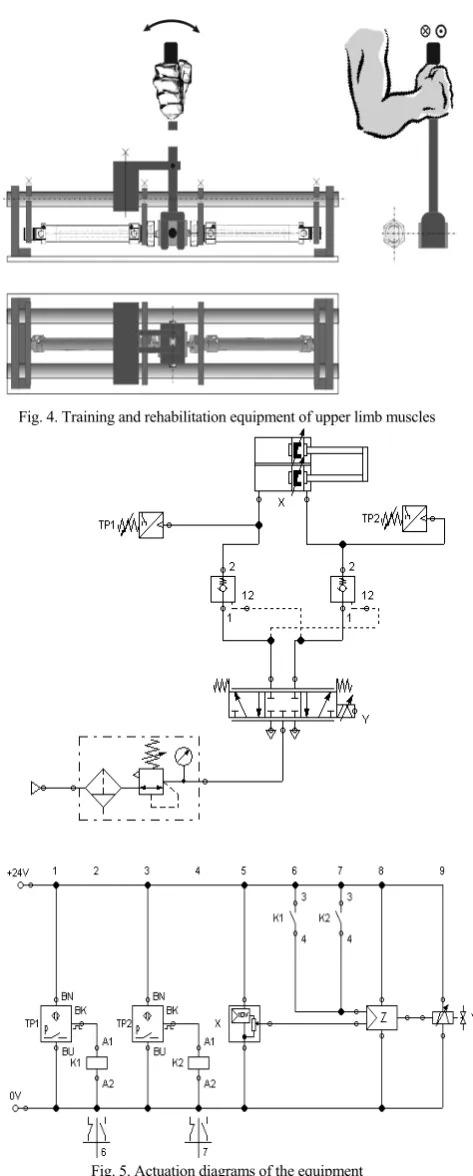
Fig. 4 presents the constructive solution of the considered equipment. The hand of the patient or athlete grabs the handle of a lever and tries to turn it, similar to a Skanderbeg type motion. Resistance to this motion is caused by the force developed by two pneumatic cylinders, the rods of which are linked at their ends. Consequently the two cylinders will work in a tandem, in counter-time (while one carries out the advance stroke, the other one retracts and vice-versa).
Fig. 5 features the pneumatic actuation diagram. It can be noticed that the pneumatic circuit includes two analogue pressure sensors that command a 5/3-way proportional valve, which transforms the analogue electric signals into proportional displacements of its control slide.
[image:4.595.313.550.46.635.2]The two analogue pressure sensors, together with a displacement encoder are connected to a status controller Z. Three parameters can be attributed to the present status controller: position, velocity and acceleration of the pistons. Velocity and acceleration are not measured with sensors; they are calculated by the controller from the differences in position.
Fig. 4. Training and rehabilitation equipment of upper limb muscles
Fig. 5. Actuation diagrams of the equipment
Fig. 6 presents the graphs showing the evolution of the tandem piston strokes, velocity and acceleration, respectively, versus time.
Fig. 6. Characteristic diagrams of the equipment
In order to obtain the various required resisting forces generated by the device, the two analogue pressure sensors can be adjusted accordingly, thus allowing deployment of the equipment for both training of athletes and upper limb muscle rehabilitation.
V. CONCLUSIONS
The paper presents a study on the bio-mechanics of the arm and forearm, as well as original equipment with a single degree of mobility, destined for the training and/or rehabilitation of the upper limb.
It is well-known that rehabilitation equipment currently available on the market place are in most cases electrically actuated, are cost-intensive and display rigid, unfriendly man-machine behaviour. Such equipment can be deployed only in rehabilitation clinics and in the presence of a physical therapist. The high cost of such equipment can be reduced only by using standardized mechanical components, produced in large batches, as well as by replacing electric motors by pneumatic ones. Pneumatic actuation presents the advantage of compliance, namely favourable response to commands, a characteristic due to air compressibility.
The equipment described in the paper, pneumatically actuated, allows both the rehabilitation of patients with deficiencies of the upper limb, and also the training of high-performance athletes. Given its simple and low cost construction, the equipment can be purchased not only by health care units, but also by non-specialist individuals, as it lends itself to home training, without requiring the presence of a physical therapist or technician.
REFERENCES
[1] D. S. Nichols-Larsen, P.C. Clark, A. Zeringue, A. Greenspan and S. Blanton “Factors influencing stroke survivors' quality of life during sub-acute recovery,” in Stroke, vol. 36, 2005, pp. 1480-1484. [2] S. Mazzoleni, P. Dario, M. C. Carrozza and E. Guglielmelli,
“Application of robotic and mechatronic systems to neurorehabilitation”, in Mechatronic Systems. Applications, 2010.
[3] P.W. Duncan, L.B. Goldstein, D. Matchar, G.W. Divine and J. Feussner, “Measurement of motor recovery after stroke”, in Stroke,
[4] H.T. Hendricks, J. Van Limbeek, A.C. Geurts and M.J. Zwarts, “Motor recovery after stroke: a systematic review of the literature“,
Arch Phys Med Rehabil, 2002, Vol. 83, pp. 1629-37.
[5] R. Riener, T. Nef and G. Colombo,” Robot-aided neurorehabilitation of the upper extremities”, Med. Biol. Eng. Comput., 2005, Vol. 43, pp. 2-10.
[6] J. Oblak, I. Cikajlo and Z. Matjačić - Universal haptic drive: A robot for arm and wrist rehabilitation. University of Ljubljana, Copyright (c) 2009 IEEE.
[7] R. Neumann, A. Hildebrandt and E.M. Knubben, “Pneumatic Drive Systems for the Assistance Robotics”, 6th International Fluid Power Conference Dresden, Germany, 2008.
[8] T. Deaconescu and A. Deaconescu, “Pneumatic Muscle Actuated Equipment for Continuous Passive Motion”, in IAENG Transactions on Engineering Technologies Volume 3 , American Institute of
Physics, Melville, New York 2009, Vol. 1174, pp. 311-322. [9] A. Deaconescu and T. Deaconescu, “Bio-inspired