Dramatically Reducing Training Data Size Through Vocabulary
Saturation
William D. Lewis Microsoft Research One Microsoft Way Redmond, WA 98052 [email protected]
Sauleh Eetemadi Microsoft Research
One Microsoft Way, Redmond, WA 98052 Michigan State University, East Lansing, MI 48824
Abstract
Our field has seen significant improve-ments in the quality of machine translation systems over the past several years. The single biggest factor in this improvement has been the accumulation of ever larger stores of data. However, we now find our-selves the victims of our own success, in that it has become increasingly difficult to train on such large sets of data, due to limitations in memory, processing power, and ultimately, speed (i.e., data to mod-els takes an inordinate amount of time). Some teams have dealt with this by focus-ing on data cleanfocus-ing to arrive at smaller data sets (Denkowski et al., 2012a; Rarrick et al., 2011), “domain adaptation” to ar-rive at data more suited to the task at hand (Moore and Lewis, 2010; Axelrod et al., 2011), or by specifically focusing on data reduction by keeping only as much data as is needed for building models e.g., (Eck et al., 2005). This paper focuses on tech-niques related to the latter efforts. We have developed a very simple n-gram counting method that reduces the size of data sets dramatically, as much as 90%, and is ap-plicable independent of specific dev and test data. At the same time it reduces model sizes, improves training times, and, because it attempts to preserve contexts for all n-grams in a corpus, the cost in quality is minimal (as measured by BLEU ). Fur-ther, unlike other methods created specif-ically for data reduction that have similar effects on the data, our method scales to very large data, up to tens to hundreds of millions of parallel sentences.
1 Introduction
The push to build higher and higher quality Sta-tistical Machine Translation systems has led the efforts to collect more and more data. The English-French (nearly) Gigaword Parallel Corpus (Callison-Burch et al., 2009), which we will refer to henceforth as EnFrGW, is the result of one such effort. The EnFrGW is a publicly available cor-pus scraped from Canadian, European and inter-national Web sites, consisting of over 22.5M par-allel English-French sentences. This corpus has been used regularly in the WMT competition since 2009.
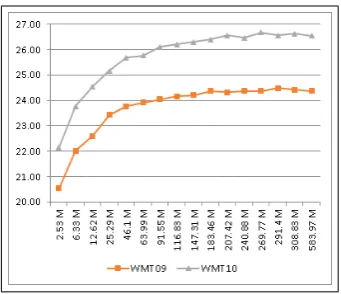
As the size of data increases, BLEU scores in-crease, but the increase in BLEU is not linear in re-lation to data size. The rere-lationship between data size and BLEU flattens fairly quickly, as demon-strated in Figure 1. Here we see that BLEU scores increase rapidly with small amounts of data, but they taper off and flatten at much larger amounts. Clearly, as we add more data, the value of the new data diminishes with each increase, until very little value is achieved through the addition of each new sentence. However, given that this figure repre-sents samples from EnFrGW, can we be more effi-cient in the samples we take? Can we achieve near equivalent BLEU scores on much smaller amounts of data drawn from the same source, most espe-cially better than what we can achieve through ran-dom sampling?
The focus of this work is three-fold. First, we seek to devise a method to reduce the size of train-ing data, which can be run independently of par-ticular dev and test data, so as to maintain the in-dependence of the data, since we are not interested here in domain adaptation or selective tuning. Sec-ond, we desire an algorithm that is (mostly) qual-ity preserving, as measured by BLEU, OOV rates, and human eval, ultimately resulting in decreased training times and reduced model sizes. Reduced
Figure 1: BLEU score increase as more data is added (in millions of words), random samples from EnFrGW
training times provide for greater iterative capac-ity, since we can make more rapid algorithmic improvements and do more experimentation on smaller data than we can on much larger data. Since we operate in a production environment, de-ploying smaller models is also desirable. Third, we require a method that scales to very large data. We show in the sections below the application of an algorithm at various settings to the 22.5M sen-tence EnFrGW corpus. Although large, 22.5M sentences does not represent the full total of the English-French data on the Web. We require an algorithm that can apply to even larger samples of data, on the order of tens to hundreds of millions of sentences.
2 Related Work
In statistical machine translation, selection, prepa-ration and processing of parallel training data is often done to serve one of the following scenarios:
• Low Resource Languages: In languages with low parallel data availability, a subset of a monolingual corpus is selected for human translation ((Ananthakrishnan et al., 2010), (Eck et al., 2005) and (Haffari et al., 2009)).
• Mobile device deployment: For many lan-guages, translation model sizes built on all available parallel data are too large to be hosted on mobile devices. In addition to translation model pruning, a common solu-tion is selecting a subset of the data to be trained on ((Ananthakrishnan et al., 2010) and (Yasuda et al., 2008)).
• Quick turn-around time during development:
A common motivation for training on a sub-set of a parallel corpus is to reduce training time during the development cycle of a sta-tistical machine translation system ((Lin and Bilmes, 2011) and (Chao and Li, 2011a)).
• Noise reduction: Simple noise reduction techniques like sentence length and alpha nu-meric ratio are often used in data preparation. However, more sophisticated techniques have been developed to filter out noise from par-allel data ((Denkowski et al., 2012a) and (Taghipour et al., 2010)).
• Domain Adaptation: Recently there has been significant interest in domain adaptation for statistical machine translation. One of the ap-proaches to domain adaptation is selecting a subset of a data that is closer to the target do-main ((Moore and Lewis, 2010), (Axelrod et al., 2011)).
• Improve translation quality: An interesting area of research is selecting a subset of the training data that is more suitable for sta-tistical machine translation learning ((Okita, 2009)).
In comparison, the goal of this work is to effi-ciently reduce very large parallel data sets (in ex-cess of tens of billions of tokens) to a desired size in a reasonable amount of time. In the related work referenced above two primary methods have been used.
1. Maximizing n-gram coverage with minimal data.
2. Filtering out noisy data based on sentence-pair based features.
One of the earliest and most cited works using the first method is (Eck et al., 2005). In this work, a greedy algorithm is developed to select a subset of the entire corpus that covers most n-grams with minimum number of words. In a later work by the same author, the algorithm was modified to give higher weight to more frequent words. Although this is a greedy algorithm and does not provide the optimum solution, its complexity is quadratic in the number of sentences. Hence it is not practical to run this algorithm over very large data sets.
over (Eck et al., 2005). In this work discriminative training is used to train a maximum entropy pair-wise comparator with n-gram based features. The pair-wise comparator is used to select the highest scoring sentence followed by discounting features used for the sentence, which are drawn from the global pool of features. The complexity of this al-gorithm after training the pairwise comparator is
O(N ×K×log(F)) whereN is the number of
sentences in the entire corpus,Kis the number of
sentences to be selected and F is the size of the fea-ture space. Although this method works well for a constantK, its complexity is quadratic whenK
is a fraction ofN. This method is reported to
im-prove the BLEU score close to1%over the work
done by (Eck et al., 2005).
(Denkowski et al., 2012a) have developed rela-tively scalable algorithms that fit in the second cat-egory above. This algorithm automatically filters out noisy data primarily based on the following feature functions: normalized source and target language model scores, word alignment scores and fraction of aligned words. Sentences that don’t score above a certain threshold (mean minus one or two standard deviations) for all their features are filtered out. In a similar work, (Taghipour et al., 2010) use an approach where they incor-porate similar features based on translation table entries, word alignment models, source and target language models and length to build a binary clas-sifier that filters out noisy data.
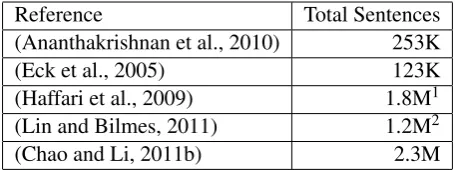
Our work incorporates both methods listed above in a scalable fashion where it selects a sub-set of the data that is less noisy with a reasonable n-gram representation of the superset parallel cor-pus. To put the scalability of our work in perspec-tive we compiled Table 1, which shows the max-imum size of the data sets reported in each of the relevant papers on the topic. Despite the public availability of parallel corpora in excess of tens of millions of sentence pairs, none of the related works, using the first method above, exceed cou-ple of millions of sentences pairs. This demon-strates the importance of developing a scalable al-gorithm when addressing the data selection prob-lem.
The careful reader may observe that an alter-nate strategy for reducing model sizes (e.g., use-ful for the Mobile scenario noted above, but also in any scenario where space concerns are an is-sue), would be to reduce phrase table size rather
Reference Total Sentences
(Ananthakrishnan et al., 2010) 253K
(Eck et al., 2005) 123K
(Haffari et al., 2009) 1.8M1
(Lin and Bilmes, 2011) 1.2M2
[image:3.595.306.534.62.147.2](Chao and Li, 2011b) 2.3M
Table 1: Data Sizes for Related Systems
than reduce training data size. A good example of work in this space is shown in (Johnson et al., 2007), who describe a method for phrase table re-duction, sometimes substantial (>90%), with no
impact on the resulting BLEU scores. The prin-cipal of our work versus theirs is where the data reductions occur: before or after training. The pri-mary benefit of manipulating the training data di-rectly is the impact on training performance. Fur-ther, given the increasing sizes of training data, it has become more difficult and more time con-suming to train on large data, and in the case of very large data (say tens to hundreds of millions of sentence pairs), it may not even be possible to train models at all. Reduced training data sizes in-creases iterative capacity, and is possible in cases where phrase table reduction may not be (i.e., with very big data).
3 Vocabulary Saturation Filter (VSF) The effects of more data on improving BLEU scores is clearly discernible from Figure 1: as more data is added, BLEU scores increase. How-ever, the relationship between quantity of data and BLEU is not linear, such that the effects of more data diminishes with each increase in data size, ef-fectively approaching some asymptote. One might say that the vocabulary of the phrase mappings de-rived from model training “saturate” as data size increases, since less and less novel information can be derived from each succeeding sentence of data added to training. It is this observation that led us to develop the Vocabulary Saturation Filter (VSF).
VSF makes the following very simple assump-tion: for any given vocabulary itemvthere is some point where the contexts forv—that is, the n-gram
1Sentence count was not reported. We estimated it based
on 18M tokens.
2This is a very interesting work, but is only done for
sequences that contain v—approach some level of saturation, such that each succeeding sentence containingvcontributes few or no additional con-texts, and thus has little impact on the frequency distributions over v. In other words, at a point where the diversity of contexts for v approach a maximum, there is little value in adding additional contexts containingv,e.g., to translation models.
The optimal algorithm would then, for each v ∈V, identify the number of unique contexts that containvup to some threshold and discard all oth-ers. An exhaustive algorithm which sets thresh-olds for all n-gram contexts containingv, however, would take a large amount of time to run (mini-mally quadratic), and may also overrun memory limitations on large data sets.
For VSF, we made the following simplifying as-sumption: we set an arbitrary count thresholdtfor all vocabulary items. For any given v, when we reacht, we no longer need to keep additional sen-tences containingv. However, since each instance ofvdoes not exist in isolation, but is rather con-tained within sentences that also contain other vo-cabulary items v, which, in turn, also need to be counted and thresholded, we simplified VSF even further with the following heuristic: for any given sentences, if allv∈V withinshavenot reached t, then the sentence is kept. This has the direct consequence that many vocabulary items will have frequencies abovetin the output corpus.
The implementation of VSF is described in Al-gorithm 1below.
VSF clearly makes a number of simplifying as-sumptions, many of which one might argue would reduce the value of the resulting data. Although easy to implement, it may not achieve the most optimal results. Assuming that VSF might be de-fective, we then looked into other algorithms at-tempting to achieve the same or similar results, such as those described in Section 2, and explored in-depth the algorithms described in (Eck et al., 2005).
4 An Alternative: (Eck et al., 2005) In our pursuit of better and generic data reduction algorithms, we did a number of experiments using the algorithms described in (Eck et al., 2005). In the n-gram based method proposed by this work the weight of each function is calculated using Equation 1, where j is the n-gram length. In
each iteration of the algorithm, the weight of each
Input:ParallelCorpus,N,L
Output:SelectedCorpus
foreachsp∈ParallelCorpusdo S ←EnumNgrams(sp.src,L);
T ←EnumNgrams(sp.tgt,L); selected←f alse;
foreach(s, t)∈(S, T)do
ifSrcCnt [s]<N∨TgtCnt [t]<N
then
selected←true;
end end
ifselectedthen
SelectedCorpus.Add(sp);
foreach(s, t)∈(S, T)do
SrcCnt [s]++;
TgtCnt [t]++;
end end end
Algorithm 1: Pseudocode for implementing VSF.L: n-gram length,N: n-gram threshold.
sentence is calculated and the sentence with the highest weight is selected. Once a sentence is se-lected, the n-grams in the sentence are marked as seen and have a zero weight when they appear in subsequent sentences. Therefore, the weights of all remaining sentences have to be recalculated be-fore the next sentence can be selected. We refer to this algorithm henceforth as the Eck algorithm.
Wj(sentence) = j P i=1
P
unseen ngrams
F req(ngram)
|sentence| (1)
To compare VSF against the Eck algorithm we selected the English-Lithuanian parallel corpus from JRC-ACQUIS (Steinberger et al., 2006). We selected the corpus for the following reasons:
• VSF performance on this particular data set was at its lowest compared to a number of other data sets, so there was room for im-provement by a potentially better algorithm.
Using the Eck algorithm with n-gram length set to one (j←1in Equation 1) only 10% (5,020,194
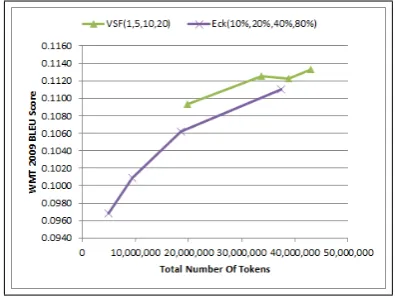
[image:5.595.306.502.261.376.2]tokens total) of the data is sorted, since all n-grams of size one have been observed by that point and the weight function for the remaining sentences returns zero. In other words, since there are no unseen unigrams after 10% of the data has been sorted, in Equation 1, the numerator becomes zero there after and therefore the remaining 90% of sentence pairs are not sorted. This must be taken into consideration when examining the compari-son between unigram VSF and the Eck algorithm with n-gram length set to one in Figure 2. VSF with its lowest setting, that is threshold t=1, se-lects 20% of the data, so this chart may not be a fair comparison between the two algorithms.
Figure 2: Unigram Eck vs. Unigram VSF
In an attempt to do a fairer comparison, we also tried n-grams of length two in the Eck algorithm, where 50% of the data can be sorted (since all uni-grams and biuni-grams are observed by that point). As seen in Figure 3, the BLEU scores for the Eck and VSF systems built on the similar sized data score very closely on the WMT 2009 test set.3
Further exploring options using Eck, we devel-oped the following two extensions to the Eck algo-rithm, none of which resulted in a significant gain in BLEU score over VSF with n-gram lengths set up to three.
• Incorporating target sentence n-grams in ad-dition to source side sentence n-grams.
• Dividing the weight of an n-gram (its
fre-3The careful reader may note that there is no official
WMT09 test set for Lithuanian, since Lithuanian is not (yet) a language used in the WMT competition. The test set men-tioned here was created from a 1,000 sentence sample from the English-side of the WMT09 test sets, which we then man-ually translated into Lithuanian.
quency) by a constant number each time a sentence that contains the n-gram is selected, as opposed to setting the weight of an n-gram to zero after it has been seen for the first time.4
[image:5.595.70.268.291.439.2]In relatively small data sets there is not a signif-icant difference between the two algorithms. The Eck algorithm does not scale to larger data sets and higher n-grams. Since a principal focus of our work is on scaling to very large data sets, and since Eck could not scale to even moderately sized data sets, we decided to continue our focus on VSF and improvements to that algorithm.
Figure 3: Bigram Eck vs. Unigram VSF
5 Data Order
Unlike the Eck algorithm, VSF is sensitive to the order of the input data due to the nature of the al-gorithm. Depending on the order of sentences in the input parallel corpus, VSF could select differ-ent subsets of the parallel corpus that would even-tually (after training and test) result in different BLEU scores. To address this concern we use a feature function inspired by (Denkowski et al., 2012a) which is a normalized combined alignment score. This feature score is obtained by geomet-ric averaging of the normalized forward and back-ward alignment scores which in turn are calculated using the process described in (Denkowski et al., 2012a). To keep the algorithm as scalable as pos-sible we use radix sort. This ordering of the data ensures sentences with high normalized alignment scores appear first and sentences with low normal-ized alignment appear last. As a result, for each n-gram, VSF will choose the top-N highest scor-ing sentence pairs that contain that n-gram.
4Further details of the modifications to the Eck algorithm
5.1 Data Ordering Complexity
Ordering the data based on normalized combined alignment score requires two steps. First, the normalized combined alignment score is com-puted for each sentence pair using an exist-ing HMM alignment model. Next, sentence pairs are sorted based on the calculated score. The computational complexity of aligning a sin-gle sentence pair is O J+I2 where J is the
number of words in the source sentence and I
is the number of words in the target sentence (Gao and Vogel, 2008). Therefore the com-plexity of calculating the combined alignment score would be O N ×(J2+I+I2+J) or
O N ×max(I, J)2 after simplification. Since
radix sort is used for sorting the data, the data can be sorted inO(d×N)wheredis the number of
significant digits used for sorting. Sincedis kept
constant5, the overall computational complexity
for data ordering isO N +N ×max(I, J)2.
6 Experiments
6.1 The Machine Translation and Training Infrastructure
We used a custom-built tree-to-string (T2S) sys-tem for training the models for all experiments. The T2S system that we developed uses tech-nology described in (Quirk et al., 2005), and re-quires a source-side dependency parser, which we have developed for English.6 We trained a
5-gram French LM over the entire EnFrGW, which we used in all systems. We used Minimum Error Rate Training (MERT) (Och, 2003) for tuning the lambda values for all systems, tuned using the of-ficial WMT2010 dev data.
6.2 Test and Training Data
In all experiments, we used the EnFrGW cor-pus, or subsets thereof. 7 We used three test sets 5In experiments described in Section 6 five significant
digits were used for radix sort.
6Further details about the decoders is beyond the scope of
this paper. The reader is encouraged to refer to the sources provided for additional information.
7Because of some data cleaning filters we applied to the
data, the actual full sized corpus we used consisted of slightly less data than that used in the WMT competitions. Every team has its own set of favorite data cleaning heuristics, and ours is no different. The filters applied to this data are focused mostly on noise reduction, and consist of a set of filters re-lated to eliminating content that contains badly encoded char-acters, removing content that is too long (since there is little value in training on very long sentences), removing content where the ratio between numeric versus alphabetic characters
t= Random VSF Ordered VSF
1 1.83 M 1.83 M 1.68 M
2 2.53 M 2.53 M 2.34 M
5 3.62 M 3.62 M 3.35 M
10 4.62 M 4.62 M 4.29 M
20 5.83 M 5.83 M 5.44 M
40 7.26 M 7.26 M 6.83 M
60 8.21 M 8.21 M 7.78 M
100 9.53 M 9.53 M 9.13 M
[image:6.595.331.502.61.199.2]150 10.67 M 10.67 M 10.33 M 200 11.53 M 11.53 M 11.23 M 250 12.22 M 12.22 M 11.97 M All 22.5 M
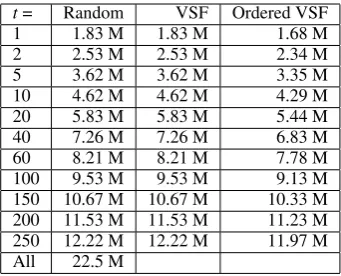
Table 2: English-side Sentence Counts (in mil-lions) for different thresholds for VSF, VSF after ordering the data based on normalized combined alignment score and random baselines.
in all experiments, as well. Two consisted of the WMT 2009 and 2010 test sets, used in the WMT competitions in the respective years. The third consisted of 5,000 parallel English/French sentences sampled from logs of actual traffic re-ceived by our production service, Bing Transla-tor (http://bing.com/translaTransla-tor), which were then manually translated. The first two test sets are publicly available, but are somewhat news fo-cused. The third, which we will call ReqLog, con-sists of a mix of content and sources, so can be considered a truly “general” test set.
To discern the effects of VSF at different de-grees of “saturation”, we tried VSF with different threshold valuest, ranging from 1 to 250. For each tvalue we actually ran VSF twice. In the first case, we did no explicit sorting of the data. In the sec-ond case, we ranked the data using the method de-scribed in Section 5.
Finally, we created random baselines for each t, where each random baseline is paired with the relevant VSF run, controlled for the number of sentences (since t has no relevance for random samples). The differenttvalues and the resulting training data sizes (sentence and word counts) are shown in Tables 2 and 3.
Since our interest in this study is scaling paral-lel data, for all trainings we used the same LM, which was built over all training data (the French side of the full EnFrGW). Because monolingual training scales much more readily than parallel,
t= Random VSF Ordered VSF
1 46.1 M 64.52 M 65.74 M
2 63.99 M 87.41 M 88.12 M
5 91.55 M 121.3 M 120.86 M
[image:7.595.338.496.61.200.2]10 116.83 M 151.53 M 149.95 M 20 147.31 M 186.99 M 184.14 M 40 183.46 M 228.14 M 224.29 M 60 207.42 M 254.89 M 250.68 M 100 240.88 M 291.45 M 287.02 M 150 269.77 M 322.5 M 318.33 M 200 291.4 M 345.37 M 341.69 M 250 308.83 M 363.44 M 360.32 M All 583.97 M
Table 3: English-side Word Counts for different thresholds for VSF, VSF after ordering the data based on normalized combined alignment score and random baselines.
this seemed reasonable. Further, using one LM controls one parameter that would otherwise fluc-tuate across trainings. The result is a much more focused view on parallel training diffs.
6.3 Results
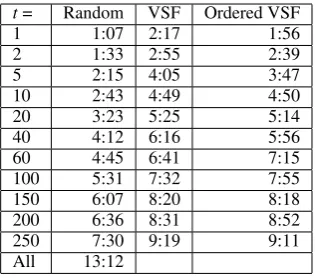
We trained models over each set of data. In ad-dition to calculating BLEU scores for each result-ing set of models in (Table 5), we also compared OOV rates (Table 6) and performance differences (Table 4). The former is another window into the “quality” of the resulting models, in that it de-scribes vocabulary coverage (in other words, how much vocabulary is recovered from the full data). The latter gives some indication regarding the time savings after running VSF at different thresholds.
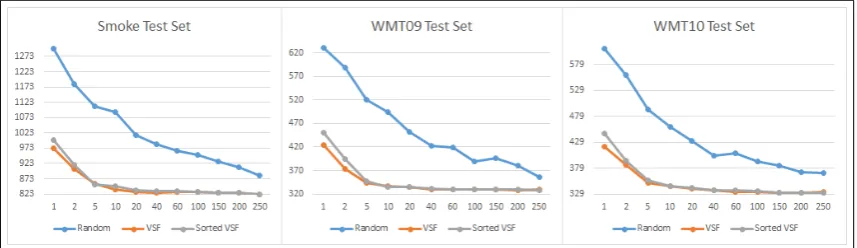
On the WMT09 data set, both sets of VSF models outperformed the relevant random base-lines. On the WMT10 and ReqLog test sets, the pre-sorted VSF outperformed all random base-lines, with the unsorted VSF outperforming most random baselines, except at t=60 and t=200 for WMT10. For the ReqLog, unsorted VSF drops be-low random starting at t=200. Clearly, the t=200 results show that there is less value in VSF as we approach the total data size.
The most instructive baseline, however, is the one built over all training data. It is quite obvi-ous that at low threshold values, the sampled data is not a close approximation of the full data: not enough vocabulary and contextual information is preserved for the data to be taken as a proxy for the full data. However, witht values around 20-60 we recover enough BLEU and OOVs to make the datasets reasonable proxies. Further, because
t= Random VSF Ordered VSF
1 1:07 2:17 1:56
2 1:33 2:55 2:39
5 2:15 4:05 3:47
10 2:43 4:49 4:50
20 3:23 5:25 5:14
40 4:12 6:16 5:56
60 4:45 6:41 7:15
100 5:31 7:32 7:55
150 6:07 8:20 8:18
200 6:36 8:31 8:52
250 7:30 9:19 9:11
All 13:12
Table 4: Word alignment times (hh:mm) for dif-ferent thresholds for VSF, VSF after model score ordering, and a random baseline
we see a relative reduction in data sizes of 32-44%, model size reductions of 27-39%, and per-formance improvements of 41-50% at theset val-ues further argval-ues for the value of VSF at these set-tings. Even at t=250, we have training data that is 54% of the full data size, yet fully recovers BLEU.
7 Discussion
VSF is a simple but effective algorithm for reduc-ing the size of parallel trainreduc-ing data, and does so independently of particular dev or test data. It per-forms as well as related algorithms, notably (Eck et al., 2005), but more importantly, it is able to scale to much larger data sets than other algo-rithms. In this paper, we showed VSF applied to the EnFrGW corpus. It should be noted, how-ever, that we have also been testing VSF on much larger sets of English-French data. Two notable tests are one applied to 65.2M English-French sen-tence pairs and another applied to one consisting of 162M. In the former case, we were able to re-duce the corpus size from 65.2M sentences/1.28B words8 to 26.2M sentences/568M words. The
BLEU score on this test was stable on the three test sets, as shown in Table 7. When applied to the 162M sentence/2.1B word data set, we were able to reduce the data size to 40.5M sentences/674M words. In this case, sorting the data using model scores produced the most desirable results, actu-ally increasing BLEU by 0.90 on WMT09, but, unfortunately, showing a 0.40 drop on WMT10.
The fact that VSF runs in one pass is both an asset and a liability. It is an asset since the algo-rithm is able to operate linearly with respect to the size the data. It is a liability since the algorithm is
[image:7.595.92.272.61.198.2]WMT09 WMT10 ReqLog
t= Random VSF S+VSF Random VSF S+VSF Random VSF S+VSF
1 23.76 23.83 23.84 25.69 25.78 25.68 26.34 26.63 26.67
2 23.91 24.04 24.07 25.76 26.21 26.14 26.54 26.99 26.94
5 24.05 24.29 24.40 26.10 26.40 26.32 26.79 27.22 27.12
10 24.15 24.37 24.45 26.21 26.63 26.32 26.98 27.37 27.62
20 24.20 24.40 24.55 26.30 26.46 26.56 27.22 27.38 27.44
40 24.37 24.43 24.65 26.40 26.55 26.53 27.30 27.38 27.62
60 24.32 24.43 24.64 26.56 26.56 26.61 27.38 27.50 27.64
100 24.37 24.49 24.71 26.46 26.75 26.70 27.37 27.52 27.75
150 24.37 24.61 24.71 26.67 26.67 26.70 27.48 27.62 27.75
200 24.48 24.63 24.69 26.56 26.65 26.78 27.57 27.47 27.72
250 24.41 24.57 24.85 26.62 26.74 26.68 27.63 27.45 27.76
[image:8.595.98.501.64.213.2]All 24.37 26.54 27.63
Table 5: BLEU Score results for VSF, S+VSF (Sorted VSF), and Random Baseline at different thresholds t.
WMT09 WMT10 ReqLog
t= Random VSF S+VSF Random VSF S+VSF Random VSF S+VSF
1 630 424 450 609 420 445 1299 973 1000
2 588 374 395 559 385 393 1183 906 919
5 520 343 347 492 350 356 1111 856 853
10 494 336 335 458 344 344 1092 837 848
20 453 335 335 432 339 341 1016 831 834
40 423 330 331 403 336 337 986 828 833
60 419 329 330 407 333 336 964 831 832
100 389 330 329 391 333 335 950 830 830
150 397 330 330 384 332 332 930 828 828
200 381 328 330 371 331 332 912 827 826
250 356 329 328 370 333 331 884 823 823
[image:8.595.96.501.261.411.2]All 325 331 822
Table 6: OOV rates for VSF, S+VSF (Sorted VSF), and Random Baseline at different thresholdst.
Figure 4: Comparative BLEU scores for two VSF implementations, against a randomly sampled baseline.
[image:8.595.84.513.447.571.2] [image:8.595.85.514.610.734.2]ReqLog WMT09 WMT10
65.2 snts 32.90 26.77 29.05
[image:9.595.81.282.61.95.2]VSF 26.2M snts 33.34 26.75 29.07
Table 7: VSF applied to a 65.2M sentence baseline system.
sensitive to the order of the data. The latter leads to issues of reproducibility: with poorly ordered data, one could easily arrive at a much less than optimal set of data. However, by adding an addi-tional pass to build model scores, and then ranking the data by these scores, we address the serious is-sue of reproducibility. Further, the ranking tends to arrive at a better selection of data.
In an attempt to better understand the behavior of VSF and how VSF changes the n-gram distribu-tions of vocabulary items in a sample as compared to the full corpus, we created log2-scale scatter
plots, as seen in Figure 6. In these plots, uni-gram frequencies of unfiltered data (i.e., the full corpus, EnFrGW) are on the vertical axis, and un-igram frequencies of the VSF filtered data are on the horizontal axis. The three plots show three dif-ferent settings fort. There following observations can be made about these plots:
1. On the horizontal axis before we reach
log2(t), all data points fall on thex=yline.
2. As the threshold increases the scatter plot gets closer to thex=yline.
3. VSF has the highest impact on the “medium” frequency unigrams, that is, those with a fre-quency higher than the threshold.
The third point speaks the most to the ef-fects that VSF has on data: Very low frequency items, specifically those with frequencies below the threshold t, are unaffected by the algorithm, since we guarantee including all contexts in which they occur. Low frequency items are at the lower left of the plots, and their frequencies follow the
x = y line (point 1 above). Medium frequency
items, however, specifically those with frequen-cies immediately above t, are the most affected by the algorithm. The “bulge” in the plots shows where these medium frequency items begin, and one can see plainly that their distributions are per-turbed. The “bulge” dissipates as frequencies in-crease, until the effects diminish as we approach much higher frequencies. The latter is a conse-quence of a simplifying heuristic applied in VSF
(as described in Section 3): t is not a hard ceil-ing, but rather a soft one. Vocabulary items that occur very frequently in a corpus will be counted many more times thant; for very high frequency items, their sampled distributions may approach those observed in the full corpus, and converge on thex=yline. The authors suspect that the BLEU
loss that results from the application of VSF is the result of the perturbed distributions for medium frequency items. Adjusting to highertvalues de-creases the degree of the perturbation, as noted in the second point, which likewise recovers some of the BLEU loss observed in lower settings.
8 Future Work
There are several future directions we see with work on VSF. Because one thresholdtforall vo-cabulary items may be too coarse a setting, we first plan to explore setting t based on frequency, es-pecially for vocabulary in the most affected mid-range (at and above t). If we settbased on uni-grams falling into frequency buckets, rather than one setting for all unigrams, we may arrive ear-lier at a more distributionally balanced corpus, one that may better match the full corpus. That said, additional passes over the data come at additional cost.
Second, we plan to explore applying the VSF al-gorithm to higher order n-grams (all experiments thus far have been on unigrams). Preliminary experiments on bigram VSF, however, show that with even the lowest setting (t=1), we already pre-serve well over 50% of the data.
In this work we only experimented with sorting the data based on the normalized combined align-ment score inspired by (Eck et al., 2005). A third direction for future work would be to consider or-dering the data based on other feature functions presented in Eck,e.g., source and target language model, alignment ratio, as well as and feature functions introduced in (Taghipour et al., 2010), or a combination of all of these feature functions.
(a) VSFt= 1
0 5 10 15 20 25 30
0 5 10 15 20 25 30
Unfiltered Token Log Frequency
Filtered Token Log Frequency
(b) VSFt= 40
0 5 10 15 20 25 30
0 5 10 15 20 25 30
Unfiltered Token Log Frequency
Filtered Token Log Frequency
[image:10.595.94.506.62.188.2](c) VSFt= 200
Figure 6:log2-scale Unigram Frequency scatter plot before VSF versus after VSF
References
S. Ananthakrishnan, R. Prasad, D. Stallard, and P. Natarajan. 2010. Discriminative sample selection for statistical machine translation. InProceedings of the 2010 Conference on Empirical Methods in Nat-ural Language Processing, page 626635.
A. Axelrod, X. He, and J. Gao. 2011. Domain adap-tation via pseudo in-domain data selection. In Pro-ceedings of the 2011 Conference on Empirical Meth-ods in Natural Language Processing, page 355362.
Chris Callison-Burch, Philipp Koehn, Christof Monz, and Josh Schroeder. 2009. Findings of the 2009 Workshop on Statistical Machine Translation. In Proceedings of the Fourth Workshop on Statistical Machine Translation, pages 1–28, Athens, Greece, March. Association for Computational Linguistics.
W. Chao and Z. Li. 2011a. A graph-based bilingual corpus selection approach for SMT. InProceedings of the 25th Pacific Asia Conference on Language, Information and Computation.
WenHan Chao and ZhouJun Li. 2011b. Improved graph-based bilingual corpus selection with sen-tence pair ranking for statistical machine transla-tion. In2011 23rd IEEE International Conference on Tools with Artificial Intelligence (ICTAI), pages 446 –451, November.
Michael Denkowski, Greg Hanneman, and Alon Lavie. 2012a. The CMU-Avenue French-English transla-tion system. In Proceedings of the NAACL 2012 Workshop on Statistical Machine Translation.
Michael Denkowski, Greg Hanneman, and Alon Lavie. 2012b. The CMU-Avenue French-English Transla-tion System. In Proceedings of the NAACL 2012 Workshop on Statistical Machine Translation.
M. Eck, S. Vogel, and A. Waibel. 2005. Low
cost portability for statistical machine translation based in n-gram frequency and TF-IDF. In Inter-national Workshop on Spoken Language Translation (IWSLT).
Qin Gao and Stephan Vogel. 2008. Parallel implemen-tations of word alignment tool. In Software
Engi-neering, Testing, and Quality Assurance for Natural Language Processing, page 4957.
G. Haffari, M. Roy, and A. Sarkar. 2009. Active learn-ing for statistical phrase-based machine translation. In Proceedings of Human Language Technologies: The 2009 Annual Conference of the North American Chapter of the Association for Computational Lin-guistics, page 415423.
Howard Johnson, Joel D. Martin, George F. Foster, and Roland Kuhn. 2007. Improving translation quality by discarding most of the phrasetable. In Proceed-ings of EMNLP, pages 967–975.
William D. Lewis and Chris Quirk. 2013. Con-trolled Ascent: Imbuing Statistical MT with Lin-guistic Knowledge. InProceedings of the Second Hytra (Hybrid Approaches to Translation) Work-shop, Sofia, Bulgaria, August.
H. Lin and J. Bilmes. 2011. Optimal selection of limited vocabulary speech corpora. InProc. Inter-speech.
Robert C. Moore and William D. Lewis. 2010. Intel-ligent Selection of Language Model Training Data. In Proceedings of the ACL 2010 Conference Short Papers, Uppsala, Sweden, July.
Franz Josef Och. 2003. Minimum error rate training in statistical machine translation. InProceedings of the 41st ACL, Sapporo, Japan.
T. Okita. 2009. Data cleaning for word alignment. In Proceedings of the ACL-IJCNLP 2009 Student Re-search Workshop, page 7280.
Chris Quirk, Arul Menezes, and Colin Cherry. 2005. Dependency tree translation: Syntactically informed phrasal smt. InProceedings of ACL 2005.
Spencer Rarrick, Chris Quirk, and William D. Lewis. 2011. MT Detection in Web-Scraped Parallel Cor-pora. InProceedings of MT Summit XIII, Xiamen, China, September.
The JRC-Acquis: a multilingual aligned paral-lel corpus with 20+ languages. In In Proceed-ings of the 5th International Conference on Lan-guage Resources and Evaluation (LREC’2006, page 21422147.
K. Taghipour, N. Afhami, S. Khadivi, and S. Shiry. 2010. A discriminative approach to filter out noisy sentence pairs from bilingual corpora. In 2010 5th International Symposium on Telecommunica-tions (IST), pages 537 –541, December.