Applying UMLS for Distantly Supervised Relation Detection
Roland Roller and Mark Stevenson
University of Sheffield Regent Court, 211 Portobello
S1 4DP Sheffield, UK
{R.Roller,M.Stevenson}@dcs.shef.ac.uk
Abstract
This paper describes first results using the Unified Medical Language System (UMLS) for distantly supervised relation extraction. UMLS is a large knowledge base which contains information about millions of medical concepts and relations between them. Our approach is evaluated using existing relation extraction data sets that contain relations that are similar to some of those in UMLS.
1 Introduction
Distant supervision has proved to be a popular ap-proach to relation extraction (Craven and Kum-lien, 1999; Mintz et al., 2009; Hoffmann et al., 2010; Nguyen and Moschitti, 2011). It has the advantage that it does not require manually anno-tated training data. Distant supervision avoids this by using information from a knowledge base to automatically identify instances of a relation from text and use them in order to generate training data for a relation extraction system.
Distant supervision has already been applied to the biomedical domain (Craven and Kumlien, 1999; Thomas et al., 2011). Craven and Kum-lien (1999) were the first to apply distant supervi-sion and used the Yeast Protein Database (YPD) to detect sentences containing subcellar-localization relations. Thomas et al. (2011) trained a clas-sifier for protein-protein interactions (PPI) using the knowledge base IntAct and evaluated their ap-proach on different PPI corpora.
There have also been recent applications of dis-tant supervision outside the biomedical domain. The use of Freebase to train a classifier, e.g. (Mintz et al., 2009; Riedel et al., 2010), has proved popular. Other, such as Hoffmann et al. (2010), use Wikipedia info-boxes as the knowledge base.
Applications of distant supervision face several challenges. The main problem is ensuring the
quality of the automatically identified training in-stances identified by the self-annotation. The use of instances that have been incorrectly labelled as positive can lower performance (Takamatsu et al., 2012). Another problem arises when positive ex-amples are included in the set of negative train-ing instances, which can occur when information is missing from the knowledge base (Min et al., 2013; Ritter et al., 2013; Xu et al., 2013).
Evaluation of relation extraction systems that use distant supervision represents a further chal-lenge. In the ideal case an annotated evaluation set is available. Others, such as Ritter et al. (2013) and Hoffmann et al. (2011), use Freebase as knowl-edge base and evaluate their classifier on an an-notated New York Times corpus. However, if no evaluation set is available leave-out can be used where the data identified using distant supervision used for both training and testing (Hoffmann et al., 2010).
This paper makes use of the Unified Medical Language System (UMLS) as a knowledge source for distant supervision. It is widely used for biomedical language processing and readily avail-able. The advantage of UMLS is that it contains information about a wide range of different types of relations and therefore has the potential to gen-erate a large number of relation classifiers. To our knowledge, it has not been used as a knowledge source to train relation extraction systems.
Evaluating such as wide range of relation clas-sifiers is not straightforward due to the lack of gold-standard data. As an alternative approach we make use of existing annotated data sets and iden-tify ones which contain relations that are similar to those included in UMLS.
The next section provides a short description of UMLS. We then describe how we acquire existing data sets to evaluate certain relations. In section 4 we present our first results using UMLS for distant supervision.
2 Unified Medical Language System The Unified Medical Language System1 is a set
of files and software which combines different biomedical vocabularies, knowledge bases and standards. The Metathesaurus is a database within UMLS which contains several million biomedical and health related names and concepts and rela-tionships among them. All different names of a concept are unified by the Concept Unique Identi-fiers (CUI). MRREL is a subset of the Metathe-saurus and involves different relationships be-tween different medical concepts defined by a pair of CUIs. Many of them are child-parent rela-tionships, express a synonymy or are vaguely de-fined as broader or narrower relation. Other re-lations are more specific, such ashas location or drug contraindicated for. This work focuses on more specific types of relations.
3 Acquiring Evaluation Data Sets
We examined a number of relation extraction data sets in order to identify ones that could be used to evaluate our system. The aim is to find a data set that is annotated with relations that are similar to some of those found in the UMLS. If an appropri-ate relation can be identified then a relation extrac-tion system can be trained using informaextrac-tion from the UMLS and evaluated using the data set.
To determine whether a data set is suitable we used MetaMap (Aronson and Lang, 2010) to iden-tify the CUIs for each related item. We then com-pared each pair against the MRREL table to deter-mine whether it is included as a relation. To in-crease coverage we also included parent and child nodes in the mapping process.
Table 1 shows the mappings obtained for two of the data sets: the DDI 2011 data set (Segura-Bedmar et al., 2011) and the data set described by Rosario and Hearst (2004).
The DDI data set contains information about drug-drug interactions and includes a single re-lation (DDI). The rere-lations it contained were mapped onto 701 CUI pairs. 266 (37.9%) of these mappings could be matched to the MRREL rela-tion has contraindicated drug. Many of the CUI pairs could also be mapped to theisarelationship in MRREL, but this is a very general relationship and the matches are caused by the large number of these in UMLS rather than it being a reasonable
1https://www.nlm.nih.gov/research/umls/
match for the DDI relation.
The data set described by Rosario and Hearst (2004) focuses on different relationships between treatments and diseases. The two most com-mon relations TREAT FOR DIS (TREAT), denot-ing the treatment for a particular disease, and PRE-VENT (PREV), which indicates that a treatment can be used to prevent a disease. The MRREL isa relationship also matches many of these re-lations, again due to its prevalence in MRREL. Other MRREL relations (may be prevented by andmay be treated by) match fewer CUI pairs but seem to be better matches for the TREAT and PREV relations.
Relation MRREL
DDI (701) has contraindicated drug (266), isa (185), may treat (57), has contraindication (51) PREV (41) isa (11), may be prevented by (5) TREAT (741) isa (172), may be treated by (118)
Table 1: Relation mapping to MRREL
It is important to note that it is not always possi-ble to find a CUI mapping for each entity and the mapping process means that the mapping cannot be guaranteed to be correct in all cases. High cov-erage does not necessarily mean that a corpus is very similar to a certain MRREL relation, just that many of the CUI pairs which have been mapped to the related entities in the corpus occur often to-gether in a certain MRREL relation. However, in the absence of any other suitable evaluation data we assume that high coverage is an indicator that the relations are strongly similar and use these two data sets for evaluation.
4 Distant Supervision using UMLS In this section we carry out two different dis-tant supervised experiments using UMLS. The first experiment will be evaluated on a subset of the DDI 2011 training data set using the MRREL relation has contraindicated drug and has contraindication. The second experiment uses the MRREL relationsmay be treated byand may be prevented by and are evaluated on the Rosario & Hearst data set.
Shared Task 2013 (Roller and Stevenson, 2013). In contrast to our previous work, our classification process relies on the Shallow Linguistic Kernel (Giuliano et al., 2006) in combination with Lib-SVM (Chang and Lin, 2011) taking the kernel as input.
4.1 Experiment 1: DDI 2011
The DDI 2011 data set was split into training and test sets for the experiments. Table 2 presents results that place the distant supervision perfor-mance in context. The naive classification ap-proach predicts all candidate pairs as positive. The supervisedapproach is trained on the training set, using the same kernel method as our distant su-pervised experiments and evaluated on the test set. This represents the performance that can be ob-tained using manually labelled training data and can be considered as an upper bound for distant supervision.
Method Prec. / Recall / F1 naive 0.098 /1.000/ 0.178 supervised 0.428/ 0.702 /0.532
Table 2: DDI 2011 baseline results
The distant supervision approach requires pairs of positive and negative CUI to be identified. These pairs are used to identify positive and nega-tive examples of the target relation from a corpus. Pairs which occur in our target MRREL relation are used as positive CUI pairs. Negative pairs are generated by selecting pairs of CUIs that are occur in any other MRREL relation.
Sentences containing these CUI pairs are iden-tified in the subset of the MetaMapped Medline. In the basic setup (basic), sentences containing a positive pair will be considered as a positive train-ing example. There are many cases where just the occurrence of a positive MRREL pair does not ex-press the target relation. In an effort to remove this noisy data we apply some simple heuristics. The first discards all training instances with more than five words (5w) between the two entities, an approach similar to one applied by Takamatsu et al. (2012). The second discards positive sentences containing a comma between the related entities (com). We found that commas often indicate a sen-tence containing a list of items (e.g. genes or dis-eases) and that these sentences do not form good training examples due to the multiple relations that are possible when there are several items. Finally
we also apply a combination of both techniques (5w+com).
1000 positive examples were generated using each approach and used for training. Although it would be possible to generate more examples for some approaches, for examplebasic, applying the combination of techniques (5w+com) significantly reduces the number of instances available.
Method has contraindication has contraindicated (P./R./F1) drug(P./R./F1) basic 0.146 / 0.371 / 0.210 0.158 /0.598/ 0.250 5w 0.109 /0.641/ 0.187 0.207 / 0.487 / 0.290 com 0.212/ 0.560 /0.308 0.177 / 0.498 / 0.261 5w+com 0.207 / 0.487 / 0.291 0.214/ 0.471 /0.294
Table 3: Evaluation with DDI 2011
Table 3 presents results of the experiments. The results show that all applied techniques for both MRREL relations outperform the naive ap-proach. The best results in terms of F1 score for the has contraindication MRREL relation are obtained using the com selection technique. Applying just 5w leads to worse results than using the basic approach. The situation for has contraindicated drugis different. The classi-fier provides for all techniques a better F1 score than the basic approach. The best results are achieved by using5w+com. It is interesting to see, that both MRREL relations provide similar aver-age classification results, even if both relations are different from the target relation and cover com-pletely different CUI pairs. It is also interest-ing that the MRREL relationhas contraindication has a lower coverage to the DDI relation than has contraindicated drug, but provides slightly better results overall. A problem with the distant supervised classification of these two MRREL re-lations is their low occurrence in our Medline sub-set. Using more training data will often lead to better results. In our case, if we apply the com-bined selection technique, there are fewer positive training instances than are available to the super-vised approach, making it difficult to outperform the supervised approach.
4.2 Experiment 2: Rosario & Hearst
annotating the entities in the sentence according to its relation, the annotations in the data set indicate whether a certain relation occurs in the sentence. This data set does not contain any negative examples. If a sentence contains two entities, it will always describe a certain relation. A supervised classifier is created by dividing the data set into training and test sets. The test set contains 253 different sentences (221 describe a TREAT relation, 15 a PREV relation and 17 involve other relationships). Positive and negative CUI pairs are selected in a different way to the previous experiment. The two most frequent relations in the data set are TREAT and PREV. A classifier for a particular relation is trained using sentences annotated with the corresponding MRREL relation as positive instances. Negative instances are identified using the other relation. For example, the classifier for theTREATrelation is trained using positive examples identified using may be treated by with negative examples generated usingmay be treated by.
Table 4 shows the baseline results on the data set using a naive and a supervised approach on the two original relationsTREAT andPREV. Perfor-mance of the naive approach for TREAT is very high since the majority of sentences in the data set are annotated with that relation.
Data Set Method Prec. / Recall / F1 TREAT naivesupervised 0.874 /0.944/ 0.923 /1.000/ 0.9330.934
[image:4.595.307.527.210.284.2]PREV naivesupervised 0.059 /0.909/ 0.667 /1.000/ 0.1120.769
Table 4: Rosario & Hearst baseline results
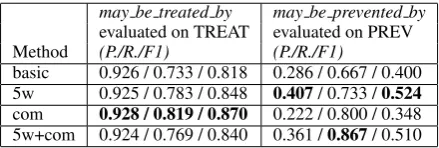
Table 5 shows the results for the various dis-tant supervision approaches. Again, 1000 positive training examples were used to train the classifier. Since the F-Score of the naive and the supervised approaches ofTREATare very high, it is difficult to compete with themay be treated bydistant su-pervised classifier. However, considering that just 15.9% of the TREAT instance pairs of the train-ing set match the MRRELmay be treated by re-lation, the results are promising. Furthermore, the precision of all may be treated by distant super-vised experiments outperform the naive approach. The best results are achieved usingcom as selec-tion technique.
The experiments using the PREV relation for evaluation are more interesting. Due to its low
occurrence in the test set it is more difficult to detect this relation. The distant supervised clas-sifier trained with the may be prevented by rela-tion easily outperforms the naive approach. The best overall F1 scoer results are achieved using the5w technique. As expected the distant super-vised results are outperformed by the supersuper-vised approach. However, the recall for all distantly su-pervised approaches are at least as high as those obtained using the supervised approach.
may be treated by may be prevented by evaluated on TREAT evaluated on PREV Method (P./R./F1) (P./R./F1)
basic 0.926 / 0.733 / 0.818 0.286 / 0.667 / 0.400 5w 0.925 / 0.783 / 0.848 0.407/ 0.733 /0.524
com 0.928 / 0.819 / 0.870 0.222 / 0.800 / 0.348 5w+com 0.924 / 0.769 / 0.840 0.361 /0.867/ 0.510
Table 5: Evaluation with Rosario & Hearst data set
5 Conclusion and Discussion
In this paper we presented first results using UMLS to train a distant supervised relational clas-sifier. Evaluation was carried out using existing evaluation data sets since no resources directly an-notated with UMLS relations were available. We showed that using a distantly supervised classifier trained on MRREL relations similar to those found in the evaluation data set provides promising re-sults.
Overall, our system works with some compo-nents which should be improved to achieve better results. First, we rely on a cheap and fast anno-tation using MetaMap, which might produce an-notation errors. In addition, the use of noisy dis-tant supervised training data decreases the classi-fication quality. An improvement of the selection process and an improvement of the classification method, such as Chowdhury and Lavelli (2013), could lead to better classification results. In future we would also like to make further use of existing data sets with similar relations to those of interest to evaluate distant supervision approaches.
Acknowledgements
[image:4.595.89.270.454.507.2]References
A. Aronson and F. Lang. 2010. An overview of MetaMap: historical perspective and recent
ad-vances. Journal of the American Medical
Associ-ation, 17(3):229–236.
Chih-Chung Chang and Chih-Jen Lin. 2011.
LIB-SVM: A library for support vector machines. ACM
Transactions on Intelligent Systems and Technology, 2:27:1–27:27.
Md. Faisal Mahbub Chowdhury and Alberto Lavelli. 2013. Fbk-irst : A multi-phase kernel based ap-proach for drug-drug interaction detection and clas-sification that exploits linguistic information. In
Second Joint Conference on Lexical and Computa-tional Semantics (*SEM), Volume 2: Proceedings of the Seventh International Workshop on Seman-tic Evaluation (SemEval 2013), pages 351–355, At-lanta, Georgia, USA, June. Association for Compu-tational Linguistics.
Mark Craven and Johan Kumlien. 1999. Constructing biological knowledge bases by extracting informa-tion from text sources. InIn Proceedings of the Sev-enth International Conference on Intelligent Systems for Molecular Biology (ISMB), pages 77–86. AAAI Press.
Claudio Giuliano, Alberto Lavelli, and Lorenza Ro-mano. 2006. Exploiting shallow linguistic infor-mation for relation extraction from biomedical liter-ature. InIn Proc. EACL 2006.
Raphael Hoffmann, Congle Zhang, and Daniel S. Weld. 2010. Learning 5000 relational extractors. In
Proceedings of the 48th Annual Meeting of the As-sociation for Computational Linguistics, ACL ’10, pages 286–295, Stroudsburg, PA, USA. Association for Computational Linguistics.
Raphael Hoffmann, Congle Zhang, Xiao Ling,
Luke Zettlemoyer, and Daniel S. Weld. 2011.
Knowledge-based weak supervision for information extraction of overlapping relations. InProceedings of the 49th Annual Meeting of the Association for Computational Linguistics, ACL ’11, pages 541– 550.
Bonan Min, Ralph Grishman, Li Wan, Chang Wang, and David Gondek. 2013. Distant supervision for relation extraction with an incomplete knowledge
base. In Proceedings of the 2013 Conference of
the North American Chapter of the Association for Computational Linguistics: Human Language Tech-nologies, pages 777–782, Atlanta, Georgia, June. Association for Computational Linguistics.
Mike Mintz, Steven Bills, Rion Snow, and Dan Ju-rafsky. 2009. Distant supervision for relation ex-traction without labeled data. InProceedings of the Joint Conference of the 47th Annual Meeting of the ACL and the 4th International Joint Conference on Natural Language Processing of the AFNLP: Vol-ume 2 - VolVol-ume 2, ACL ’09, pages 1003–1011,
Stroudsburg, PA, USA. Association for Computa-tional Linguistics.
Truc-Vien T. Nguyen and Alessandro Moschitti. 2011. End-to-end relation extraction using distant super-vision from external semantic repositories. In Pro-ceedings of the 49th Annual Meeting of the Associ-ation for ComputAssoci-ational Linguistics: Human Lan-guage Technologies: short papers - Volume 2, HLT ’11, pages 277–282, Stroudsburg, PA, USA. Associ-ation for ComputAssoci-ational Linguistics.
Sebastian Riedel, Limin Yao, and Andrew McCallum. 2010. Modeling relations and their mentions
with-out labeled text. In Proceedings of the European
Conference on Machine Learning and Knowledge Discovery in Databases (ECML PKDD ’10). Alan Ritter, Luke Zettlemoyer, Mausam, and Oren
Et-zioni. 2013. Modeling missing data in distant su-pervision for information extraction. InAssociation for Computational Linguistics Vol. 1 (TACL). Roland Roller and Mark Stevenson. 2013.
Identi-fication of genia events using multiple classifiers. InProceedings of BioNLP Shared Task 2013 Work-shop, Sofia, Bulgaria, August. Association for Com-putational Linguistics.
Barbara Rosario and Marti A. Hearst. 2004. Classi-fying semantic relations in bioscience texts. In Pro-ceedings of the 42nd Annual Meeting on Association for Computational Linguistics, ACL ’04, Strouds-burg, PA, USA. Association for Computational Lin-guistics.
Isabel Segura-Bedmar, Paloma Martnez, and Daniel Snchez-Cisneros. 2011. The 1st ddi extraction-2011 challenge task: Extraction of drug-drug
inter-actions from biomedical texts. In Proceedings of
DDI Extraction-2011 challenge task., pages 1–9. Shingo Takamatsu, Issei Sato, and Hiroshi Nakagawa.
2012. Reducing wrong labels in distant supervi-sion for relation extraction. In Proceedings of the 50th Annual Meeting of the Association for Compu-tational Linguistics: Long Papers - Volume 1, ACL ’12, pages 721–729, Stroudsburg, PA, USA. Associ-ation for ComputAssoci-ational Linguistics.
Philippe Thomas, Ill´es Solt, Roman Klinger, and Ulf Leser. 2011. Learning protein protein interaction extraction using distant supervision. InProceedings of Robust Unsupervised and Semi-Supervised Meth-ods in Natural Language Processing, pages 34–41. Wei Xu, Raphael Hoffmann, Le Zhao, and Ralph