Performance Analysis of Decode and Forward Cooperative
Relaying over the Generalized-K Channel
Ali Dziri1, Michel Terre1, Nidal Nasser2
1CEDRIC-LAETITIA, Conservatoire National des Arts et Metiers, Paris, France; 2College of Engineering, Alfaisal University, Riyadh, KSA.
Email: [email protected], [email protected], [email protected]
Received December 29th,2012; revised February 9th, 2013; accepted February 23rd, 2013
Copyright © 2013 Ali Dziri et al. This is an open access article distributed under the Creative Commons Attribution License, which permits unrestricted use, distribution, and reproduction in any medium, provided the original work is properly cited.
ABSTRACT
In this paper, we analyze the performance of cooperative diversity using adaptive Decode and Forward (DF) relaying over independent but non-necessarily identical flat composite fading channels which include multipath fading and shadowing simultaneously. We have considered the transmission of M-QAM modulated signals over Generalized-K channel model which is very versatile and accurately approximates many of the commonly used channel models as Na- kagami-m, Log-Normal distributions and the mixture of the two distributions for the composite fading. Using an ap- proximation of the Generalized-K pdf by a Gamma pdf, we derive analytical expressions for the outage probability and the Average Symbol Error Probability (ASEP) of the proposed scenario and analyze their dependence on the channel parameters. We assume in our context that the relay decides independently whether or not to forward the signal to the destination based on the received signal quality. Simulations are provided for 16-QAM modulation for both the outage and the ASEP. The obtained results are discussed and proved to be in good agreement with our theoretical analysis.
Keywords: Cooperative; Relay; Generalized-K Distribution; Composite Fading
1. Introduction
Multiple-Input Multiple-Output (MIMO) communication schemes have been widely studied to achieve diversity advantages, increased data rate, and interference suppres- sion. However, one of the disadvantages of MIMO systems is the relatively large size needed of a wireless terminal. This is due to the requirement of an antenna spacing equal to half the wavelength to achieve suffi- ciently uncorrelated signals at the antenna connectors. Recently, it has been shown that cooperative diversity or user cooperation offers spatial diversity when multiple users cooperate to build a virtual antenna array [1,2], benefiting on MIMO advantages. Such a system aims to increase the channel capacity and to improve the link reliability of the wireless communications [2]. To this end, various relaying strategies have been investigated [3,4]. We distinguish mainly two techniques: Amplify and Forward (AF) (also known as analog relaying) and Decode and Forward (DF) (also known as digital relaying). In the former strategy, the relay node amplifies the received signal and then retransmits it. Thus, one disadvantage to be mentioned is the increased noise. In
the latter strategy, the relay detects and possibly decodes the source message and then regenerates and retransmits it. This technique, is more reliable but it requires more processing compared to AF relaying [5]. The focus of this work is on DF relaying strategy.
To evaluate the system performance, we need to consider the propagation channel characteristics. In our context we consider the wireless channel which poses a severe challenge for reliable high-speed communication due to reflection, diffraction, scattering and absorption. To capture and model all these effects, many scientific research were carried out and they were classified mainly into three fading channel types: path-loss, multipath- fading (also known as small-scale fading) and shadowing (also known as large-scale fading).
giving rise to random variations of the received power at a given distance. These fluctuations are experienced on local-mean powers. They are often modeled using a Log- normal distribution [7].
The combination of multipath fading and shadowing effects is usually known as composite fading. A versatile distribution to model the composite fading is the Ge- neralized-K model which demonstrated a superior fit to the measured data over a wide range of physical channel conditions [8,9]. Thus, it has attracted a great deal of research interest recently. In [10], the authors have derived the outage probability, the average channel capacity and the ASEP for different modulated signals over the Ge- neralized-K distribution. In [11], they have evaluated the spatial diversity performance over the Generalized-K channel.
Despite the multiplying number of scientific works on the cooperative diversity techniques mentioned above, most of them are limited to the Rayleigh, Rician, Log- normal and Nakagami-m channels. In [12,13], the au- thors studied the outage and the average error proba- bility of adaptive DF cooperative networks with identical and non-identical Rayleigh fading channels. In [14,15] the authors derived the closed form for the outage pro- bability of an adaptive DF over i.i.d Nakagami-m fading channels. In [16,17], the authors derived the closed form for the outage probability, the ASEP and the average channel capacity based on the MGF expression of the Nakagami-m distribution. In [18], AF cooperative di- versity networks have been investigated under Gene- ralized-K distribution. However, for a DF relaying over shadowed-Nakagami channels modeled by Generalized- K distribution, performance analysis has never done according to our best knowledge. Recently, we have evaluated the outage probability [19], and the ASEP for M-QAM modulated signals [20], of a DF relaying technique over a Generalized-K channel. However, a complete performance analysis for different propagation environments conditions is necessary. Thus, a more de- tailed theoretical analysis will be presented by consi- dering the DF relaying over the Generalized-K channel. The performance metrics under consideration are the outage probability and the ASEP. Different propagation environments will be investigated. The remainder of this paper is organized as follows. In Section 2, we introduce the system model of the DF relaying over the Genera- lized-K fading model. We have introduced an approxi- mation of the Generalized-K pdf by a Gamma pdf which serves for the outage and the ASEP analysis. The closed form derivations for the outage probability and the ASEP of the non cooperative system (direct link) and the cooperative system are presented in Sections 3 and 4, respectively. Simulation results are given in Sections 5 and 6 concludes this paper.
2. System and Channel Models
2.1. Relay System ModelWe consider a dual-hop cooperative wireless system consisting of J2 wireless nodes: one source node , a set of J relay nodes, R R1, 2, , RJ, and a destination S node . We assume that each node has a single antenna and all DRj operate in half-duplex mode. We consider a time-division channel allocation scheme with J1
time slots. In the first time slot, the source broadcasts its message to all the nodes. During the following J time slots, the source stops transmitting and the relays of the decoding set will forward the source information to the destination in a scheduled order. denotes the set of indexes of relays which succeed in decoding correctly the source message for a given required SNR threshold,
i.e., each relay decides whether to forward the source information or not by comparing the received signal power with a decision SNR threshold. The cardinality of
is denoted
Q
Q J . In the considered scenario, we assume that the receivers at the relays and destination have exact channel state information but no transmitter channel state information is available at the source or relays [14].
Let us denote h0, hj and hj
h
as the channel gains corresponding to the direct link, links between the source to the relay and the relay to the destination, respectively. Moreover, j th- hjj t and - h0, hj are supposed independent but not necessarily identical Generalized-K distributions with parameters j
m
m , j s
m for j1, , J
and j m
m , j s
m for j0,1, , J, respectively. Let j and j denote the instantaneous SNR received at the the relay and the destination from the relay, respectively. Thus,
-j th j th
-2 0
j j
Es h
N
and 2
0
j j
Es h
N
where is the transmit energy signal and re- presents the single sided power spectral density of the AWGN. The corresponding average SNR are denoted
Es N0
j
and j. Finally, we denote D
Jj0j as the contribution of all the relays belonging to the set Q and the direct link using the MRC (Maximum Ratio Com- biner) technique.2.2. The Generalized-K Fading Channel Model The small scale multipath fading is usually modeled using Nakagami-m distribution. The envelope of the transmitted signal over the Nakagami fading, X, has a probability density function given as follows
[21] pX
x
2 m 2 m 1e m 2,m m
x m m X
m
m
p x x x
m
0,
where m , , is the fading severity param also the Nakagami parameter,
m
ter cal
0.5mm
led
e ,
X2
, is the average received power and
. is the Gamma function.However, for example in terrestrial and satellite land- mobile systems, the link quality is also affected by slow variation of the mean signal level due to the shadowing from terrain, buildings, and trees. Consequently, multi- path fading are superimposed on shadowing. Hence, the pdf of the envelope of the received signal pX
x will be conditioned on the average power leading to:
2 1 2|
2 m e m ,
m m m x m y m X m m
p x y x x
m y
0, (2)
Consequently, in combined multipath and shadowing fading, (1) can be rewritten as follows
0 |
d , 0,X X
p x
p x y p y y x (3)where is the pdf of the average power which is usually modeled by the Lognormal distribution [21]. To mitigate difficulties to derive closed form of some metric performance measure, using the moment matching me- thod, it has been proposed to use the Gamma distri- bution to model the average power random variations given as follows
p y
1 00 1
e , 0
s s s m m y m s s m
p y y y
m
, (4)
where ms0 reflects the shadowing severity and 0
is the local mean power.
Consequently, the pdf of the received signal envelope due to the composite fading (shadowing and multipath) leads to the Generalized-K distribution which is given by
4 2 1
20, 0.5, 0,
m s m s s m m m m m X m m s m s
p x x K x
m m
x m m
,m (5)
where Km ms m is the modified Bessel function of the
second kind and order msmm and m mm s 0. In the cooperative system, as mentioned in [2], to capture the path-loss effects, we use
20 0 , 1 S D E h d
, 0,,
2 , 1 j j S R j j S R E h d ,
2 , 0, , 1 j j R D j j R D E h d where di j, is the distance between the terminals and , and i j is the path- loss exponent.
Over a Generalized-K fading channel the pdf of the
output instantaneous SNR follows a Generalized-K distribution given by [11]
2 1
2 2
2
0, 0.5, 0,
m s m s s m m m m m m m m s m s p K m m m m
, (6)where m mm s
and is the average SNR over the
considered channel.
In the next section, we deal with the outage probability and the ASEP closed form derivations. To this end, in the cooperative case, we deal with the cdf of the sum of
1
J Generalized-K random variables. As pointed in [22,23], the computation of the cdf expression is not straightforward and requires the use of approximations and asymptotic expansions or the use of the numerical inversion of the characteristic function. An alternative approach, to avoid the analytical difficulties, is to con- sider an approximation of the Generalized-K pdf, given by (6), using the moment matching method by a more tractable pdf [22], as shown in the next subsection.
2.3. The Approximation of a Generalized-K pdf The main goal of this subsection is to give the analytical and main results of the approximation of the Genera- lized-K pdf by a suitable Gamma pdf. This approxi- mation has been developed in two steps [22]:
Approximation of the Generalized-K pdf by a Gam- ma pdf by matching the two first positive moments. Introduction of an adjustment factor for the shape and
the scale parameters of the approximating Gamma pdf.
If we consider the distribution given by (5), the moment of the Generalized-K distribution can be derived as [22]
-n th
0 .n
m s
n
m s m s
m n m n E X
m m m m
(7)
The moment of the approximating Gamma distribution can be expressed as n th
-
n
k n
,E X k n
(8)
where and denote the scale and shape parameters of the approximating Gamma distribution, respectively. k
Matching the two first positive moments of the Generalized-K distribution to those of the approximating Gamma distribution results in
0, and 1
AF k AF
(9)
where 1 1
m s m s
AF
m m m m
in the composite fading channel and max
0AFAF , AFmax
m
is determined by the smallest physical values of m and ms. However, this appro- ximation results in a poor fitting in the lower and upper tail regions as compared to the original pdf. In order to bypass this inaccuracy, an adjustable form has been introduced for the scale and shape parameters of the region-wise approximating Gamma pdf for the two first moments. These parameters are given as follows
01
, , 0, 0,
AF k k
AF
(10)
where the adjustment parameter is chosen so that the pdf (cdf) of the approximating Gamma distribution be- comes as close as desired to the pdf (cdf) of the Genera- lized-K distribution in a certain region of interest. We note that AF AF
0.5
m
m
. Since, the relevant practical range of AF is from zero (for non-fading channels) to 8 (for severe multipath fading and shadowing conditions corresponding to and ), the relevant range of the adjustment factor is
0.5 s 8 8 m .
2.4. Approximation of the pdf of the Sum of N Independent Generalized-K Random Variables
As aforementioned in Subsection 2.3, the pdf of the sum of N Generalized-K random variables can be approxi- mated by a Gamma pdf using the adjustable form.
2
0, 0, 0,
1 1 1
0, 1 0, 1 2 , 0,
N N N
i i i j
i i j i
N N i i N i i N i K N
(11) 0, 1 , N i i N N k k
N 0, (12)
where i 1 1i 1i i1 i i m
m
m s m s
K
m m m m
. and i
s
m are the
shape parameters of the Generalized-K random variable.
-i th
We note that for the i.i.d case, the expressions in (11) and (12) simplify to
0,N AF
N 0, (13)
,
N
N
k kN 0,
AF
(14)
An illustration of the choice of the optimal value of the adjustment factor is given in Section 5.
3. Performance of the Non Cooperative
System (Direct Link)
In the following, we consider the outage probability and the ASEP as performance system metrics.
3.1. Outage Probability
The outage probability represents the probability of unsatisfactory signal reception. It can be defined as the probability that the received SNR is less than a specified SNR threshold value at the destination, denoted th
D
[10]. We consider the direct link composed by the source and the destination node communicating over the com- posite fading channel. The outage probability denoted
is given as [10] out
P
0
0 0
d . thD th
out D
P P
p (15)We note that p0
is given by (6). According to[10], we can derive Pout as follows
0 0 00 0 0 0
1 2
0 0 0 0
0
0 0 0 0
1 2
0 0 0 0
πcsc π
;1 ; 1;
1 1
;1 ; 1;
,
1 1
m
out s m
m
th th
D m m s m
s m s m
ms
th th
D s s m s
m s m s
P m m
F m m m m
m m m m
F m m m m
m m m m
D D (16) where 0 0 0 =m mm s
, csc
is the cosecant function, and
; ; ;
pFq is the generalized hyper-geometric function
[24].
3.2. Average Symbol Error Probability
The ASEP, se, for modulated signals over the fading channel can be obtained by averaging its conditional
P
0
symbol error probability,
h
se
P , under a given SNR in AWGN over the pdf of the received SNR p0
00 d .
se se
P
P p (17)In this paper, we consider M-QAM modulated signals over Generalized-K fading channel. Thus, Pse
canbe expressed as Pse
Aerfc
B
[6], where = 2 2A M , B3 2
M1
and
2 2e d
π t x
0 0
0 0 0 0
0 0 0 0 0 0
2
0 0
1 2, 1 2
2,2
2,3 2, 2, 2
π
m s
m s m s
s m m s m s
m m
se
m s
m m m m
m m m m m m
A B P m m G B (18)
where G
, is the Meijer’s G-function [24].4. Performance of the Cooperative System
4.1. Outage ProbabilityIn the cooperative case, the outage probability out is obtained by the contribution of all the relay nodes belonging to the set Q and the direct link using the MRC (Maximum Ratio Combining) technique. Thus, by using the law of total probability we obtain
P
0
th
out D D
Q J
th
D D
J
P P Q P Q
P Q J P Q
J (19)where P Q
J
is the probability that J nodes cooperate in relaying information to the destination.
thD D
P Q J
is the conditional outage probability in the case of Q J. In the following, we shall derive the expression of P Q
J
and
th
D D
P Q J , respectively. a) Calculation of P Q
J
The probability that the relay-node is in the decoding set Q, is defined as the probability that its SNR,
-j th
j
th, is larger than the threshold SNR at the relay,
-j th
j
. It is given as follows
,
1,j j j
th
A P j J (20) For simplicity, we choose the same threshold for all the relays, i.e, th th
j .
Consequently, Aj is given as follows
d 1 0th
d th jj
A
p
pj , (21)
where pj
j th
is the probability density of the SNR at the - relay. It is given by (6) and its cdf function is given by (16) by setting
j j m s j j m m
. Thus, Aj is de- duced easily.
Let
J denotes a combination that J of Jnodes cooperate in relaying information to the destin- ation and P J as the corresponding probability. Assum- ing that the relay channels are independent, P J can be expressed as
1 1, 1 J J j Jj j j J
P A A
j
. (22) Consequently,
J J .
P Q J P
(23)b) Calculation of
th
D D
P Q J
th
D D
P Q J can be seen as the cdf of
0 J
D j j
, evaluated at th D , i.e. the sum of the J1. Generalized-K random variables correspond to the J1
active links. As mentioned above in Section 2.4, to avoid analytical complexity, the computation of the cdf ex- pression of D can be approximated by the Gamma pdf with the scale and shape parameters given by (11) and (12), respectively. Consequently, D
J1,kJ1
and it is expressed as
1 1 11 11 1
1 J J e J
D k k k J J J k p k
J 1
(24)
where 1 1 0 J J Es N .
Consequently
th
D D
P Q J is given as fol- lows
1 1 1 0 1 , d , th D D th D D th Jinc J D
J
J
P Q J
k k p k
(25)
where inc
, is the incomplete Gamma function.Finally, from (21)-(23) and (25) we derive the outage probability at the destination for the cooperative system as
1 1
1
0 1 1, 1
, 1
D J inc J th
J J
J
J
out j j
J J j j j J J
k k
P A A
k
(26)4.2. Average Symbol Error Probability
In the cooperative case, the ASEP se is obtained by the contribution of all the relay nodes and the direct link. At the MRC output, by considering the same notation as above,
P
se
P can be expressed as follows
0 J
se se se
Q J
P P Q P Q P Q J P Q J
(27)
given by (23). P Qse
J
is the conditional symbol error probability corresponding to the cooperation of theJ branches and the direct link (source-destination). In the following, we shall derive its expression.
a) Calculation of P Qse
J
se
P Q J can be seen as the probability of occur- ring an error when J relays are active. As mentioned in the last section, it can be expressed as
0
D
d ,se se D
P Q J P p
(28)where pD
is given by (24) and P Qse
J
is expressed as
0
D
d .se
P Q J A
erfc B p (29) To evaluate this integral, we use the relationship
12 2
x Q x erfc
which leads to a new integral form as follows
2 0
D
se
P Q J A
Q a p d , (30) where a 2B . Using ([6], (5.1), (5.18)), this integral is deduced as follows.For integer values of kJ1 , P Qse
J
can be written as
1 1
0
1 1 1
2 1
1
4 4 4
J
se
k k
J k
J J J
P Q J
B k B
A
k
k B k B
1
1 . J
J
(31) For non-integer values of kJ1, Pse
Q J
can be written as
11 1
1 2 1 1
2 1 1 1
1 1 1
1 1
1, , 1, .
2 1
J
J J se
k J J
J J
J J
B k
P Q J A C
B k
F k k
B k
(32)
where C
kJ11 2
kJ11
π
.Thus, using (23), (27), (31) or (32), the ASEP Pse can be deduced easily.
5. Simulation Results
In this section, we present Monte-Carlo simulations to illustrate the previous theoretical results for both the
outage probability and the ASEP.
5.1. Outage Probability
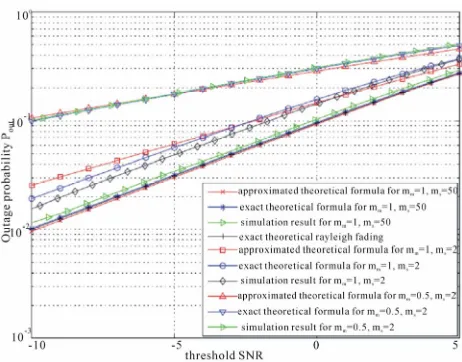
To be more accurate in our illustrations, we have simu- lated the shadowed Nakagami channel by taking into account the Nakagami-m distribution and the Log-nor- mal distribution. For the non cooperative system, Figure 1 depicts the outage probability versus the threshold SNR,
th D
, for a transmit SNR of Es N0 12 dB . The Threshold SNR at the relays is chosen th th
D
. We have considered three different environments with in- creasing propagation hardness:
Generalized-K channel with mm1 and ms50: for high values of ms, greater than 50, we consider that there is no shadowing. It is equivalent to Ray- leigh channel. The corresponding plots in Figure 1, show less outage probability compared to the others configurations. Moreover, they are close each other. We note the robustness of the channel simulation compared to the theoretical rayleigh performance. Besides, we deduce the accuracy of the approximated model compared to the exact formula;
Generalized-K channel with mm1 and ms2; Generalized-K channel with mm0.5 and ms2.
For the two last configurations, we note similar per- formances between the Generalized-K cdf and the appro- ximated Gamma cdf with an optimal value of 1.6
for mm0.5, and 1 for . More precisely,
the optimal value of
1
m
m
is obtained for lower tail approximation, since we are interested in small threshold values. We note just a small difference between theoretical results and simulation which is due to the approximation of the Log-normal pdf distribution by a Gamma dis- tribution to model the shadowing fading.
[image:6.595.308.539.522.703.2]In some cases, it is important to illustrate the outage
Figure 1. Outage probability versus the threshold SNR th D
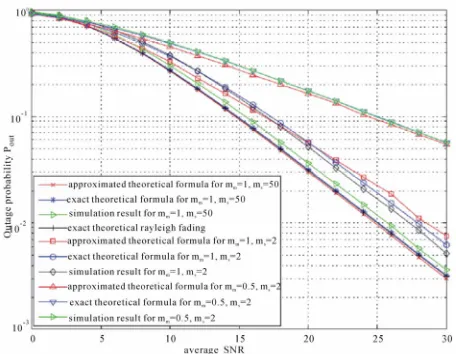
probability measure as function of the average SNR for a given threshold SNR. Figure 2 shows this illustration for for the same parameters of the three con- figurations mentioned above.
5 dB th D
In the cooperative communication scenario, we have omitted the propagation environment relative to Rayleigh case; we have considered the two others environments cases corresponding to mm1,ms2 and mm0.5,
For both cases, we have considered identical Nakagami-m shadowed fading channels for the links of the first hop and those of the second dual hop.
2.
s
m
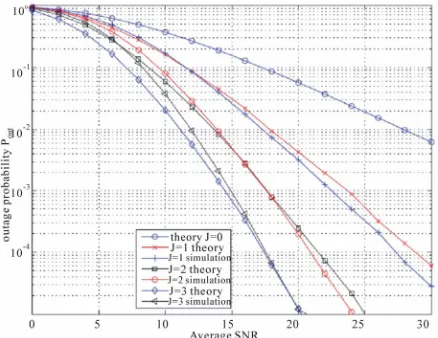
We have considered a number of relay nodes, J = 1, 2, and 3. Similarly to the non cooperative system, we have illustrated:
The outage probability versus the threshold SNR th D
[image:7.595.59.287.301.478.2] for a transmit SNR value of Es N0 12 dB for both the first and the second hops. Figures 3 and 4 show
[image:7.595.60.284.520.697.2]Figure 2. Outage probability versus Es N0 for the non cooperative system.
Figure 3. Outage probability versus the threshold SNR th D
for the cooperative system for mm0.5,ms2.
the obtained results.
The outage probability versus Es N0 for a given threshold SNR th 12 dB
D . Figures 5 and 6 show
the obtained results.
We note that, since we consider i.i.d channels, the optimal value of is the same for all links, as men- tioned in the theoretical analysis. Thus, 1 for mm = 1,
2
s
m and 1.6 for m s . We observe that theoretical results match well simulation results. The little difference is again due to the approximation of the Log-normal distribution by a Gamma distribution. As expected, the use of more relays provides better outage performance.
0.5,
m m 2
5.2. Average Symbol Error Probability
In this subsection, we have illustrated the results relative
Figure 4. Outage probability versus the threshold SNR th D
for the cooperative system for mm , ms2.
[image:7.595.312.535.526.699.2]to the ASEP for 16-QAM modulated signals. We plot the performance curves in terms of the analytical and simulation ASEP versus Es N0 in dB. Similarly to the outage analysis, we consider two scenarii: the non co- operative and the cooperative systems. Figure 7 shows the obtained results for the first scenario.
We note a similar performance between the theoretical Rayleigh curve, the approximated results and the simu- lation results.
For the second scenario, we have considered identical and independent channels with the following parameters and . We have considered a threshold SNR D . To capture the path-loss effects,
we have considered the following distances ,
2
s
m mm1 15 dB th
th
0.7 S R
d , ,
j
R D and , . We have chosen a number of relay nodes, J = 1, 2, and 3. Obtained results are depi- cted in Figure 8. Optimal values of
0.8
d dS D 1
[image:8.595.308.537.85.266.2] are calculated for each Es N0 value. They are given by Table 1.
Figure 6. Outage probability versus Es N0for the co- operative system for mm and ms2.
Figure 7. Average symbol error probability versus Es N0 for the non cooperative system.
[image:8.595.63.282.316.485.2]Figure 8. Average symbol error probability versusEs N0 for mm and ms2.
Table 1. opt versus Es N0.
Es/N0 4 6 8 10 12 14 16
ɛopt 0.67 0.69 0.7 0.71 0.72 0.73 0.74
Es/N0 18 20 22 24 26 28
ɛopt 0.74 0.75 0.75 0.76 0.76 0.76
We note a good match between the simulation and theoretical results. The small difference between theor- etical results and simulation includes the combination of the two approximations: approximation of the Lognormal pdf distribution by a Gamma distribution and the approximation of the Generalized-K distribution by a Gamma distribution. As expected, the use of more relays provides better ASEP performance.
6. Conclusion
[image:8.595.62.282.537.704.2]REFERENCES
[1] A. Nosratinia, T. E. Hunter and A. Hedayat, “Cooperative Communication in Wireless Networks,” IEEE Commu- nications Magazine, Vol. 42, No. 10, 2004, pp. 74-80. doi:10.1109/MCOM.2004.1341264
[2] J. N. Laneman, D. N. C. Tse and G. W. Wornell, “Coop- erative Diversity in Wireless Networks: Efficient Proto- cols and Outage Behavior,” IEEE Transactions on Infor- mation Theory, Vol. 50, No. 12, 2004, pp. 3062-3080. doi:10.1109/TIT.2004.838089
[3] M. O. Hasna and M. S. Alouini, “Outage Probability of Multihop Transmission over Nakagami Fading Channels,”
IEEE Communications Letters, Vol. 7, No. 5, 2003, pp. 216-218. doi:10.1109/LCOMM.2003.812178
[4] M. O. Hasna and M.-S. Alouini, “End-to-End Perform- ance of Transmission Systems with Relays over Ray- leigh-Fading Channels,” IEEE Transactions on Informa- tion Theory, Vol. 1, No. 6, 2003, pp. 1126-1131.
[5] E. Zimmermann, P. Herhold and G. Fettweis, “On the Performance of Cooperative Relaying Protocols in Wire- less Networks,” Special Issue on European Wireless, Vol. 16, No. 1, 2005, pp. 5-16.
[6] M. K. Simon and M. S. Alouini, “Digital Communica- tions over Fading Channels,” 2nd Edition, Wiley-IEEE Press, Hoboken, 2004. doi:10.1002/0471715220
[7] A. J. Coulson, A. G. Williamson and R. G. Vaughan, “A Statistical Basis for Lognormal Shadowing Effects in Multipath Fading Channels,” IEEE Transactions on Com- munications, Vol. 46, No. 4, 1998, pp. 494-502.
doi:10.1109/26.664305
[8] A. Abdi and M. Kaveh, “K-Distribution: An Appropriate Substitute for Rayleigh-Lognormal Distribution in Fad- ing-Shadowing Wireless Channels,” IEEE Electron De- vice Letters, Vol. 34, No. 9, 1998, pp. 851-852.
doi:10.1049/el:19980625
[9] F. Hansen and F. Meno, “Mobile Fading-Rayleigh and Lognormal Superimposed,” IEEE Transactions on Ve- hicular Technology, Vol. 26, No. 4, 1977, pp. 332-335. doi:10.1109/T-VT.1977.23703
[10] P. S. Bithas, N. C. Sagias, P. T. Mathiopoulos, G. K. Karagiannidis and A. A. Rontogiannis, “On the Perform- ance Analysis of Digital Communications over General- ized-K Fading Channels,” IEEE Communications Letters, Vol. 10, No. 5, 2006, pp. 353-355.
doi:10.1109/LCOMM.2006.1633320
[11] P. S. Bithas, P. T. Mathiopoulos and S. A. Kotsopoulos, “Diversity Reception over Generalized-K (KG) Fading Channels,” IEEE Transactions on Wireless Communica- tions, Vol. 6, No. 12, 2007, pp. 4238-4243.
doi:10.1109/TWC.2007.4400789
[12] N. C. Beaulieu and J. Hu, “A Closed-Form Expression for the Outage Probability of Decode-and-Forward Relaying Dissimilar Rayleigh Fading Channels,” IEEE Communi- cations Letters, Vol. 10, No. 12, 2006, pp. 813-815. doi:10.1109/LCOMM.2006.061048
[13] J. Hu and N. C. Beaulieu, “Closed-Form Expressions for
the Outage and Error Probabilities of Decode-and-For- ward Relaying in Dissimilar Rayleigh Fading Channels,”
IEEE International Conference on Communication, Glas- gow, 24-28 June 2007, pp. 5553-5557.
[14] H. A. Suraweera, P. Smith and J. Armstrong, “Outage Probability of Cooperative Relay Networks in Nakagami- m Fading Channels,” IEEE Communications Letters, Vol. 10, No. 12, 2006, pp. 834-836.
doi:10.1109/LCOMM.2006.060834
[15] C. K. Datsikas, N. C. Sagias, F. I. Lazarakis, and G. S. Tombras, “Outage Analysis of Decode and Forward Re- laying over Nakagfami-m in Fading Channels,” IEEE Sig- nal Processing Letters, Vol. 15, 2008, p. 4144.
[16] S. S. Ikki and M. H. Ahmed, “Performance Analysis of Multi-Branch Decode-and-Forward Cooperative Diver- sity Networks over Nakagami-m Fading Channels,” IEEE International Conference on Communications,St. John’s, 14-18 June 2009, pp. 1-6.
[17] S. Ikki and M. H. Ahmed, “Performance Analysis of Co- operative Diversity Wireless Networks over Nakagami-m Channels,” IEEE Communications Letters, Vol. 11, No. 4, 2007, pp. 334-336. doi:10.1109/LCOM.2007.348292 [18] G. P. Efthymoglou, N. Bissias and V. A. Aalo, “On the
Error Rate Analysis of Dual-Hop Amplify-and-Forward Relaying in Generalized-K Fading Channels,” Journal of Electrical and Computer Engineering, 2010, pp. 1-5. doi:10.1155/2010/584594
[19] A. Dziri, D. L. Ruyet, D. Roviras and M. Terre, “Outage Probability Analysis of the Decode and Forward Relaying over the Composite Fading Multipath/Shadowing Chan- nels,” 2010 IEEE Eleventh International Workshop on Signal Processing Advances in Wireless Communications
(SPAWC), Paris, 20-23 June 2010, pp. 1-5. doi:10.1109/SPAWC.2010.5670907
[20] A. Dziri, D. Le Ruyet, D. Roviras and M. Terré, “Symbol Error Probability Analysis of the Decode and Forward Relaying over the Composite Fading Multipath/Shadow- ing Channels,” IEEE International Symposium on Signal Processing and Information Technology, Luxor, 2010, pp. 171-176. doi:10.1109/ISSPIT.2010.5711768
[21] I. Kostic, “Analytical Approach to Performance Analysis for Channel Subject to Shadowing and Fading,” IEEE Proceedings-Communications, Vol. 152, No. 6, 2005, pp. 821-827.
[22] S. Al-Ahmadi and H. Yanikomeroglu, “On the Approxi- mation of the Generalized-K pdf by a Gamma pdf Using the Moment Matching Method,” IEEE Wireless Commu- nications and Networking Conference, Ottawa, 5-8 April 2009, pp. 1-6.
[23] M. Gu and D. A. Abraham, “Using McDaniels Model to Represent Non-Rayleigh Reverberation,” IEEE Transac- tions on Oceanic Engineering, Vol. 26, No. 3, 2001, pp. 348-357.