PARAMETERS FOR VIABLE ARCHITECTURAL
PRACTICE
EREKPITAN O. OLA-ADISA Department of Architecture University of Jos, Jos, Nigeria BOGDA PRUCNAL-OGUNSOTE
Department of Architecture University of Jos, Jos, Nigeria
Abstract
The image of the ‘global architect’ is a pointer to a deeper restructuring in the system of architectural production. Architecture is a vital vehicle of urban restructuring. Ironically, the scope of action for architects and by implication architectural firm viability is increasingly limited by profit ratio, risk- minimising strategies, diversified forms of governance and regulation. The aim of this study was to identify factors or indices that affect viability in architecture practice. Using a sample derived from firms in the Architects Registration Council of Nigeria (ARCON) Register and purposively selecting cities where architectural firms were most concentrated in North Central Nigeria, the principal survey instrument was a structured questionnaire, and a total of one hundred and two (102) questionnaires were collated and analysed. Data from the questionnaires were also analysed using Pearson’s product-moment correlation coefficient, and regression analysis. Results of the study revealed five indices that affect viability in architecture practice.
Key words: business viability, firm market value, firm profitability, organisational strategies, practice ideology
1. Architecture Practice as a Business
Architecture as defined by Schwennsen (1999) is a producer-service business catering to clients in ‘the volatile construction industry’. Due to the growing sophistication of clientele, organisational and marketing aspects are as important as creativity in the business of architecture practice (Winch & Schneider, 1993). In the face of what Porter (2008), calls the five (external) competitive forces, organisational strategies are vital in any architecture business. Winch & Schneider (1993) suggest that internal influences would include perceptions of architects in conceiving practices as businesses rather than mainly creative ventures. Several architects often perceive financial success and marketing strategies as anti-creativity. Cohen, Wilkinson, Arnold &Finn in their 2005 study suggest that for firms to achieve and sustain the viability, they ‘absorb creativity within’ that aim. In other words, architects assert that creativity alone does not guarantee profitability and thereby viability of the architecture firm.
The strength of the business objective however differs from one company to the other. As a result, the modern day individualism and eclectic trends have removed architecture from the root stem of the historic tree where the architect played the role of sole expresser of the vision to the clients. In an era of assertive consumerism, the role of the architect has
changed from the traditional advisory role to user based design partnership, Gofwen, Ola-Adisa & Daniel (2018) observed that while the positive aspects of globalisation of styles created a link through creation of a cultural and technological bridge contributing to the evolution of Nigerian contemporary architecture through modern technologies and ideas on the other hand, the decadence in the lowered standard of living due to non-affordability of decent housing in comparison to the traditional setting creation of high maintenance architecture and copyright infringement through the indiscriminate use of technology to ‘adapt’ already existing designs without recourse to the owner of copyright or climatic impact. The absence of both social and environmental accountability has become the order of the day (Ola-Adisa, 2012).
The practice of present day architecture appears in a state of indulgence and the business of self-gratification, even narcissism, rather than in the search for meaningful direction. Further changes, new technology in industry and commerce, new building codes, other new laws and regulations, inflationary economies of nations, and advances in building technology place an ever-increasing burden on architects. Architects need increased knowledge and skills to cope with the demands. While society continually requires more elaborate buildings than in the past. These buildings must serve more purposes, last longer, and require less maintenance and repair. As in the past, buildings must look attractive, and architects must keep both building construction and operating costs within acceptable limits, or new construction will cease (Ola-Adisa, 2016). In order for today’s architecture firm to succeed, the firm must be viable in design and practice.
2. Theoretical Approach
Several theories have been proposed to explain what makes firms viable. These theories include Organisational and Systems theories which are widely applied in professional organisations. Architecture firms are knowledge-based professional organisations with an expectation of economic, ethical, sociological, and sustainable viability. Organisations as systems undergo life cycles, and architecture firms as professional organisations undergo business life cycles. Veryard (2011) propounds that there are always future expectations for business ventures to become ultimately profitable.
The viability of the business in each stage determines the health and profitability of the business as it grows. Profitability is not limited to the economic sense. For instance, non-profit institutions, like non-governmental organisations, may not be non-profit seeking but are viable if the company can deliver social or another value. Research has recognised four dimensions of viability, namely; robustness, niche viability, sustainability and time -delimited viability (Gilkey, 2010; Veryard, 2011). Veryard (2011) also identified six factors that determined viability including profitability, market value, growth, system (organisational) strategies, survival strategies and culture which includes ideology, beliefs, and myths.
3. Business Viability in Professional Organisations
Viability in its simplest definition means the ability of an entity to survive. Core concepts of viability are Economic Viability, Ethical Viability, Sociological Viability and Sustainability
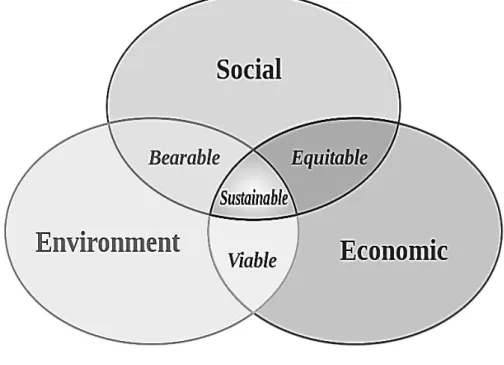
Economic viability of an organisation relates to its profitability. Ethical viability refers to organisations ability to operate within standard acceptable morals dictated by society. Profit therefore cannot be at the expense of the organisation’s ethics. A sociologically viable organisation is socially viable if it provides enough value to justify any internal or external social costs (Veryard, 2011). Other characteristics of sociological viability include manageability and system viability, defined in Figure 1 as the relationship between systems and the environment in which the system operates. Sustainability is viability in a projected future. Sustainable organisations ensure sustained resource consumption, pursuing a social mandate and monitoring the environmental impact of the organisation. Sustainability also ensures political support for the organisation and its image.
In running a business, viability ultimately culminates in profit. Veryard (2011), states where a business is not currently profitable, there is a future expectation of profitability particularly in the early stages of business inception, and when a firm is undergoing economic challenges. Viability and sustainable practice is the unwritten goal of every professional organisation and architecture profession is not an exception. Sustainability in practice ensures issues of continuity and ownership succession are anticipated addressed.
Figure 1: The Relationship Between Sustainability and Viability
Source: Adams (2006)
4. Factors that influence Viable Architectural Practice
One of the hallmarks of viability in practice is the ability of the practice to outlive the founder. Issues of succession and transfer of ownership and ownership transition plans are veritable indices for viability in practice as outlined in Table 1. These indices are tied to firm growth, which is a major factor for firm viability. Architecture firms rely on the creativity and experience of the employees for success, which makes financial valuation difficult. One possible method of measuring practice viability considers different quantitative valuation metrics to arrive at a valuation range. The method then examines a
firm’s qualitative aspects to determine whether to use the higher or, the lower calculated values (Strogoff and Dubinsky, 2005; Ola-Adisa, 2016). These factors produce a range of the firm’s market value, which is one of qualitative indices that can determine the value of the firm (Strogoff and Dubinsky, 2005, Ola-Adisa, 2016). The study found some support for a link between organisational strategies and enhanced viability in Goll, Sambharya & Tucci (2001). They examined top management demographic characteristics and established a direct relationship for viability with a dimension of corporate ideology, which is progressive decision making or corporate strategies. Quantitative and qualitative factors can be categorised as shown in Table 1 and according to the ideologies that influence them. Factors can also be categorised as internal influences on viability in architecture firms.
Table 1 in highlighting quantitative factors identifies Diversification of Services including Arbitration, Architectural Advisory Services, Engineering Services, Feasibility Studies, Interior Design Services, Landscape Architectural Services, Modelling, Project Management, Project Site Master Planning Services, Sales of Building Materials, Urban Planning Services and Valuation.
Increased skill acquisition as a strategy includes Building Information Modelling (BIM); Computer Aided Drafting and Design (CADD); Computer Aided Manufacturing (CAM); Global Positioning Systems (GPS); Computer Aided Manufacturing (CAM)
with Computer Numeric Control (CNC); Animation and Digital Video among others. In addition, which the thrust for the construction of sustainable buildings, the green building certification program LEED or Leadership in Energy and Environment Design is a necessary skill to enable the architect maintain the cutting edge for rating the systems for designs, construction, operation, and maintenance of green buildings.
Table 1: Indices for Viable Architectural Practice
Qualitative Factors Quantitative Factors
Reputation in the marketplace Ability to differentiate the firm from competitors
Quality and depth of portfolio Extent of contacts and resources
Current and potential market penetration Skills and experience of key people
Breadth of client base and geographic reach History of repeat clients
Particular areas of expertise Delivery methods and efficiencies
Ability to obtain new business and deliver it profitably
Steady growth and a healthy backlog of work, resources, assets, and cash flow
Appropriate lengths of time current owners can and will, stay during a transition
Depth of key staff, including next generation of owners in place
Amount and quality of intellectual capital Debt profile if any
Diversification of Services including: Arbitration, Architectural Advisory Services, Engineering Services, Feasibility Studies
Interior Design Services, Landscape Architectural Services, Modelling
Project Management, Project Site Master Planning Services, Sales of Building Materials,
Urban Planning Services and Valuation Source: Ola-Adisa (2016)
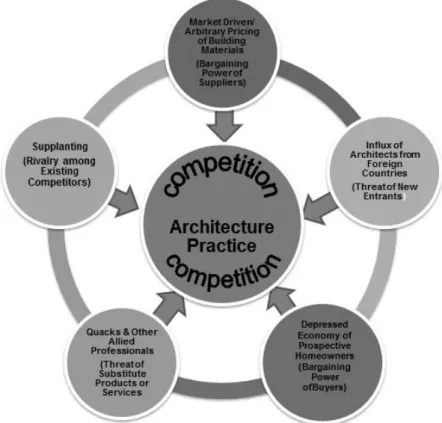
Figure 2: Forces That Shape Architectural Practice Strategy Source: Gofwen, Ola-Adisa & Daniel (2018)
Other indices are suggested by the firms are profitability and organisational strategies. Indices for measuring profit are difficult to ascertain. The profitability index is referred to as the ratio between profit value of future cash flows over the initial investment (Investopedia.com, 2014). In real terms, however, this is largely subjective. Moreover, the typical architecture firm in Nigeria is very discrete with disclosure of firm financial data. Indices for profit are relative, and firms measure their profitability in three ways:
a. Naira profits, though there is no basis for comparison between firms as the amount of the profit is relative and has no bearing.
b. Profit margins, though margins vary as firms differ in ways business is conducted. c. Returns on investment, which is perhaps the most comprehensive way to measure profit. 5. Methodology
The methodological approach used was derived from the array of methods adopted from a rigorous literature review. Two types of tests assessed viability in the selected firms; quantitative and qualitative. The quantitative criteria came through the distribution of a questionnaire survey while the qualitative criteria came through observation, interviews, collation of firm data and use of company profiles.
The selection of companies was derived through purposive sampling from within the seven capital cities in cities in North Central Nigeria The firms selected as the study population came primarily from North Central Nigeria and FCT Architects Registration
Council of Nigeria (ARCON) Register. The reviewed literature outlined the five categories of architectural practices in Nigeria. The specific types of practices selected for the research were:
a. registered firms in the ARCON Register b. registered firms not in the ARCON Register
c. registered architects who do not have ARCON registered firms
The research noted the activities registered technologists who are legally entitled to practice in limited design and building services responsibility. The study did not include the activities of quacks. Quacks range from draughtsmen to persons with ‘backgrounds in architecture’ to related professionals (town planners, engineers, builders.). These professionals along with the quacks often ‘practice’ architecture without the requisite registration. The primary sample populations were the ARCON Registers for Architects and Architecture firms respectively.
The selection technique combined purposive and random selection. The advantage of the technique was the opportunity for deriving a more rigorous and representative analysis. The procedure involved first purposively selecting the cities where architectural firms were most concentrated in North Central Nigeria. The cities were capitals - Abuja, Ilorin and Jos Lafia, Lokoja, Makurdi and Minna. The North Central Zone was selected primarily because of the proximity to the FCT. The sample size derived from the Register of Architectural Firms Entitled to Practice in Nigeria (ARCON, 2012). Random sampling provided individual firms in the cities equal probability of being selected.
6. Results
Literature identified five indices that characterise viability in architectural practice, namely Profitability, Market Value, Growth, Organisational Strategies and Culture. This research, however focused on profitability, market value and growth as core indices for firm viability. Characteristics of sampled architecture firms derived from descriptive statistics are presented in Figures 3 to 9.
a. Profitability
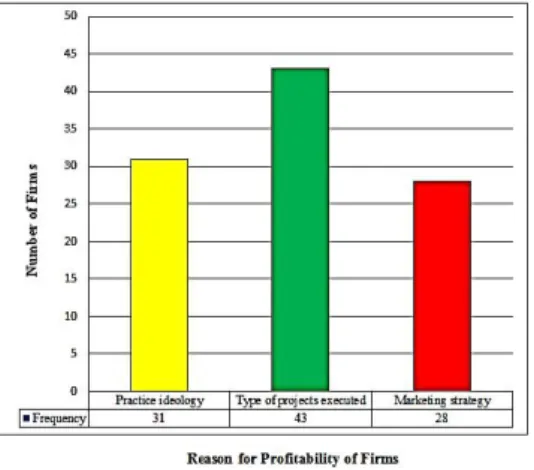
Figure 3 revealed that majority of the firms polled (49 %) perceived their firm’s profitability and by extension viability as fair. Patterns of perception of firm profitability were analysed, and in describing firms’ Profitability Structure, (Figure 4) the data showed that thirty percent of the firms attributed the profit to a practice ideology. Forty-three percent of the firms attributed profit to the types of projects executed, while 27.4 % of firms attributed profitability to marketing strategy.
b. Market value
Figure 5 showed that majority of firms sampled (45%) perceived that their firms had a fair market value. An equally high 40 % perceived that market value of their firms was good, 12% perceived that their market value was very good, while only 5% perceived that their firm’s market value was poor. When analysed with the volume of work over three years, the perceptions were consistent with actual turnover reported.
c. Growth
Growth was measured through annual turnover and estimated project volume over a period of years. Sampled firms’ perception of growth (Figure 6) varied from very good
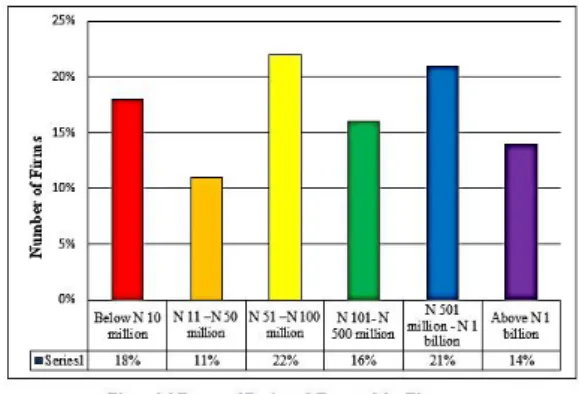
(12%) to fair (50%). Analysis of firms’ estimated project volume in the last three years (Figure 7) showed 9 % of firms polls were below N 10 million, 11 % of respondents estimated N 11-50 million, 21% estimated N 51 -100 million, 16 % N 101- 500 million, 21 % N 501 – 1 billion and 14 % above N 1 billion. Analysis of Financial Range of Proposed Annual Turnover (Figure 8) showed 18% of the firms polled reported an annual turnover of below N10 million. 11% of the firms polled reported between N 11 to N 50 million. 22% of the firms polled between N 51 to N 100 million; 16 % of the firms polled reported an annual turnover of below N 101 to N 500 million; 21% of the firms polled reported an annual turnover of between N 501 million and N 1 billion. 14% of the firms polled reported an annual turnover of greater than N 1 billion. Figure 9 outlined sampled firm’s mode of project remuneration and showed 16 % of the firms polled used the scale of fees; 62 % of the firms used the bid/negotiation method, while 24% percent of the firms used the new NIA Condition of Engagement.
Figure 3: Perception of Profitability in
Sampled Architecture Firms Figure 4: Profitability Structure of SampledArchitecture Firms
Figure 5: Perception of Market Value in
Figure 7: Estimated Project Volume in the
past three years Figure 8: Financial Range of ProjectsTargeted in the next one year
Figure 9: Sampled Architectural Firms’ Mode of Project Remuneration
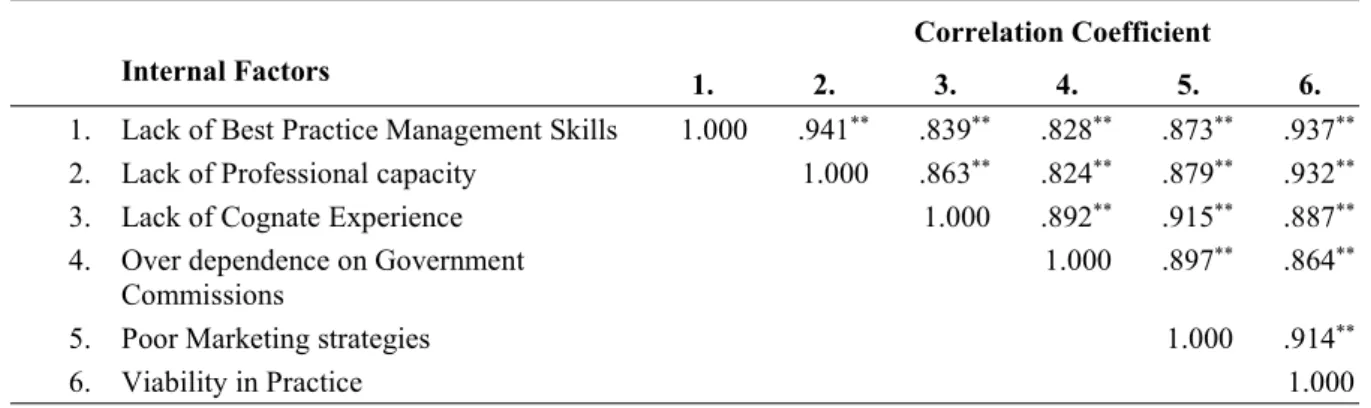
Data generated from Correlation coefficient and regression analysis were used and presented in Tables 2 to 5. Table 2 shows a strong relationship between inherent problems (internal) and viability in practice. Table 3 equally shows a strong relationship between inherent problems (external) and viability in practice. The Correlation coefficient for the model (Table 4) revealed a very strong correlation with R ranging from 0.828 (over dependence on Government Commissions) to 0.941 (lack of professional capacity). Table 3 also revealed a very strong correlation with R ranging from 0.794 (non-recognition of Architecture profession by society) to 0.911 (corruption). The model summary (Table 4) revealed a very strong correlation with R = 0.931, or 93.1 % while the coefficient of determination R2 =
0.867, or 86.7 %. (Enhanced Viability), and is explained by the dependent variables (internal and external factors) in Tables 2 and 3.
The results revealed that architectural firms' inability to adopt formal organisational strategies resulted in internal problems that affected the viability of those firms. The results also revealed that there were several external factors beyond the control of architectural firms' which resulted in problems that affected the viability of those firms. The results also showed that lack of corporate ideologies (ethics and values) created inherent problems such as supplanting and quackery.
Table 2 shows a strong relationship between inherent problems (internal) and viability in practice. Table 3 equally shows a strong relationship between inherent problems (external) and viability in practice. The Correlation coefficient for the model (Table 4) revealed a very strong correlation with R ranging from 0.828 (over dependence on Government Commissions) to 0.941 (lack of professional capacity). Table 3 also revealed a
very strong correlation with R ranging from 0.794 (non-recognition of Architecture profession by society) to 0.911 (corruption). The model summary (Table 4) revealed a very strong correlation with R = 0.931, or 93.1 % while the coefficient of determination R2 =
0.867, or 86.7 %. (Enhanced Viability), and is explained by the dependent variables (internal
and external factors) in Tables 2 and 3.
Correlation (R): 0.5 ≤ R ≤ 1 = Strong correlation/association Correlation (R): R < 0.5 = Weak correlation
*- significant.
This indicates strong correlation between Internal Factors and viability in practice and they are all significant
Table 3: Cross Tabulation of Relationship between Inherent Problems (External Factors) and Viability in Practice
Correlation (R): 0.5 ≤ R ≤ 1 = Strong correlation/association Correlation (R): R < 0.5 = Weak correlation
*- significant.
This indicates strong correlation between External Factors and viability in practice and they are all significant
Table 4: Model Summarybfor Identified Inherent Problems Militating against
Viable Architectural Practice
Model R R Square Adjusted R Square Std. Error of the Estimate
1 .931b .869 .867 6.596
Table 2: Cross Tabulation of Relationship between Inherent Problems (Internal Factors) and Viability in Practice
Correlation Coefficient
Internal Factors 1. 2. 3. 4. 5. 6.
1. Lack of Best Practice Management Skills 1.000 .941** .839** .828** .873** .937**
2. Lack of Professional capacity 1.000 .863** .824** .879** .932**
3. Lack of Cognate Experience 1.000 .892** .915** .887**
4. Over dependence on Government
Commissions 1.000 .897
** .864**
5. Poor Marketing strategies 1.000 .914**
6. Viability in Practice 1.000
Correlation Coefficient
External Factors 1. 2. 3. 4. 5. 6. 7. 8.
1. Non-payment of professional fees 1.000 .861** .911** .868** .910** .794** .756** .907**
2. Quackery 1.000 .975** .725** .760** .724** .754** .899**
3. Corruption 1.000 .816** .829** .763** .765** .927**
4. Supplanting 1.000 .917** .908** .801** .882**
5. Poor Economy 1.000 .835** .768** .866**
6. Non recognition of Architecture
Profession by society 1.000 .878
** .882**
7. Weak regulatory bodies 1.000 .890**
b Predictors: (Constant), internal influences, external influences
Table 5: Correlation of Relationship between Diversification of Services and Viability in Practice
Organisational Strategy:
Diversification of Services Viability in Practice
Correlation Coefficient
1. Mean: Diversification Strategies .898**
2. Arbitration .653**
3. Architectural Advisory Services .885**
4. Engineering Services .815**
5. Feasibility Studies .871**
6. Interior Design Services .843**
7. Landscape Architectural Services .928**
8. Modelling .865**
9. Project Management .924**
10. Project Site Master Planning Services .931**
11. Sales Of Building Materials .730**
12. Urban Planning Services .823**
13. Valuation .864**
Correlation (R): 0.5 ≤ R ≤ 1 = Strong correlation/association Correlation (R): R < 0.5 = Weak correlation
*=significant.
This indicates strong correlation between viability and organisational strategies and they are all significant
7. Discussion
The research analysed three indices that influence viability in architectural practice, namely: a. Profitability
b. Market value c. Growth
From the results, majority of the firms polled (49 %) perceived that their firm’s profitability was fair. Available research asserted that firms own perception of their profitability can be considered valid (Wall et al, 2004 in Oluwatayo & Amole, 2013). This was a vital factor as there was a paucity of information on firm profitability. The paucity of information was largely due to the reluctance of architecture firm principals to make such ‘private’ information available. When analysed with the volume of work over three years, the perceptions were consistent with actual turnover reported. This validation was consistent with the reviewed literature that a firm’s perception of its viability was strongly influenced by the profitability of the firm (Veryard, 2011). These findings have indeed established profitability as a significant factor of viability. Patterns of the ways firms’ perceived their profitability as contained in Figure 4 revealed that a third of the firms sampled attributed their profit to a practice ideology. Forty-two percent of firms however, attributed profit to the types of projects executed, while the remaining third of the firms attributed their profitability to their marketing strategy. Profitability by and large was deemed important to architecture firms. It was also a source of division as many firms were not able to maintain successful partnerships, though the number of partnerships has significantly increased. Inequitable profit sharing was one of the reasons adduced for reluctance for partnership arrangement. Profit however did
not appear to the highest priority of all architecture firms, though it was seen as the highest priority for most. The ‘prestige’ factor in establishing a firm featured higher and in the long run brought higher profits. Most architecture firms interviewed experienced ‘feast or famine’ syndrome. Feast and famine refers to the periods when a firm enjoys patronage (feasting) and when there is a down turn or lull in projects and commissions (famine). Nigerian firms that experienced ‘feast or famine’ often used a number of strategies identified by Kitching, Blackburn, Smallbone & Dixon (2009) including:
1. Cost efficiency strategies 2. Exploitation (retrenchment) 3. Strategies for innovation 4. Exploration (future growth)
In the interviews conducted, firms utilised most of these strategies. The medium sized firms (over 5 architects) often resorted to exploitative retrenchment in the firms, reducing costs. The actual implemental of these strategies however caused bad blood, often belated in newer firms as older more experienced firms often encountered ‘feast or famine syndrome’. From the findings of the study, this was a function of the poor economy (identified as a major external influence) or poor marketing strategy in the part of the firms (Tables 2 and 3).
Architecture firms survived when not making a profit for a number of reasons. Several of the sampled firms diversified into such related services as project master planning (0.931), landscape architecture (0.928) as outlined in Table 5. Some of the firms interviewed had also diversified into non related fields of product manufacturing, sales and even educational services. One firm had a CADD and computer training school on its premises while another had an educational consulting firm also in its premises. Income derived from these other businesses paid for the operational expenses of the architecture firm. They were also able to maintain skeletal architectural staffing by paying the staff small allowances, allowing architectural staffs engage in free-lance activities when commissions were not available and paying performance bonuses when there were commissions.
Architecture firms could also fail while making a substantial profit. While all the firms sampled were reported to be viable, they suggested reasons why architecture firms could make large profits and still be unviable. Non-viability of firms that were making a substantial profit can be attributed to building design failure; for instance, The Pruitt- Igoe Housing Complex which was demolished in 1977. Reasons adduced for non-viability included lack of professional capacity, (0.941); lack of cognate experience (0.839); lack of best practice management shills (0.937); overdependence on government commissions (0.818) and poor marketing strategies (0.873). This was confirmed by San Gabriel Valley Business Journal (2010), in Ames & Welfry’s (1983) assertion that lack of experience, insufficient capital, location, poor inventory and over investment, which are all components of lack of best practice management skills, were the major reasons why firms were not viable.
Though firms also acknowledged that internal factors influence profitability, previous studies had not suggested that practice ideology had a significant effect.
A significant number of firms sampled (46%) perceived that their firms had a fair market value. An equally high 42 % perceived that market value of their firms was good. Seven percent perceived that their market value was very good, while only 5% stated that
their firm’s market value was poor. Market Value perception revealed that most firms were very optimistic about their future and by implication their viability. When the perceptions of market value were examined alongside their projected earnings, the figures suggested that success and survival for the average firm was not necessarily tied to the projected earnings as shown in Figure 5, where 5 % of firms said that their market value was poor. In addition, Figure 5 shows that less than 3 % had projected earnings of N 10 million or less. Perception of a firm’s market value was observed to be rather subjective. The indices of value of architecture firms were not clearly defined, unlike their construction industry counterparts, where volume of work is measured and captured in the National Statistical database. Establishment of a market value index for Nigerian Architecture firms as is practiced in developed nations is imperative through building a database and determining the contributory role of architecture to the Nigerian economy since Nigerian capital market continues to play a vital role.
Growth of firms was measured in annual turnover and estimated project volume over a period of years. Analysis of firms’ estimated project volume (epv) in the last three years (Figure 7) showed that only 25 % of firms had epvs between N 501 and N 1 billion. There was no clear majority of project volumes, as 21 % of firms polled were below N 10 million, 13 % of respondents estimated N 11-50 million 24% estimate N 51 -100 million, 18 % N 101- 500 million, 25 % N 501 – 1 billion and 16 % above N 1 billion. 42 % of the firms polled reported an annual turnover of greater than N 1 billion; showing an increased optimism in prospects.
8. Conclusion
Architecture firms can address remunerations and firm retention strategies to clarify personnel’s management of their resources. Addressing financial resources can also create the framework for these resources to be invested into research and development (at least 1% of the firm’s turnover) or stabilisation firms, which is a rare undertaking for architecture firms, as most seldom believe they can save for a rainy day. Ironically, no firm that wishes to be viable can afford not to.
9. Recommendations
The study identifies the indices of viable architecture practice and recommends that:
1. Entrepreneurial education should form a larger part of the core curriculum of architecture training. Currently entrepreneurial skills are being introduced at the postgraduate curriculum, while appreciation courses are being introduced in the undergraduate curriculum of some Nigerian institutions. A major curriculum review of courses should be undertaken to produce graduates who are business centred.
2. There should be the establishment of a Postgraduate Institute for Architects which will provide the necessary framework to accommodate the formalised and structured development of Nigerian architects to ensure:
a. Acquisition of Best Practice Management Skills b. Professional Competence
References
Adams, W. M. (2006). The future of sustainability, re-thinking environmental and
development in the twenty-first century. In: Report of the IUCN Renowned Thinkers Meeting, pp. 29-32.
Ames, M. D. & Wellsfry, N. (1983). Small Business Management. London: West Publishing Company.
Architects Registration Council of Nigeria (ARCON). (2012). Register of Architectural
Firms Entitled to Practice in the Federal Republic of Nigeria . Lagos: ARCON,
Architects Registration Council of Nigeria (ARCON). (2014). Register of Architectural
Firms Entitled to Practice in the Federal Republic of Nigeria . Lagos: ARCON,
Cohen, L., Wilkinson, A., Arnold, J. & Finn, R. (2005). Remember I am the bloody architect! [Web log post]. Architects, Organizations and Discourses on the Profession. Retrieved from http://wes.sagepub.com/cgi/content/abstract/19/4/775.
Gilkey, C. (2010). The small business life cycle: An overview [Digital Image]. Retrieved from http://www.productiveflourishing.com.
Gofwen, C. N., Ola-Adisa, E.O. & Daniel A. A. (2018). Contemporary Architecture in Nigeria: Evolution or Decadence, Journal of Scientific and Engineering Research, 5(6), 386-393.
Goll, I., Sambharya, R. B. & Tucci, L. (2001). Top management team composition, corporate ideology and firm performance (1). Management International Review, 41 (2), 132-143.
Investopedia.com (2014).
Kitching, J., Blackburn, R., Smallbone, D., & Dixon S. (2009). Business strategies and performance during difficult economic conditions. Retrieved from
http://www.businessstrategies.com.
Ola-Adisa, E. O., Prucnal-Ogunsote B., and Dassah, E. T. (2012). Optimising organisational structures in Architecture firms in North Central Nigeria. Journal of Environmental Sciences, 16 (1 & 2), 45-52.
Ola-Adisa, E. O., (2016). Effects of ideology on viability of architectural practice in North Central Nigeria. Unpublished Doctoral Dissertation, University of Jos.
Oluwatayo, A. A. & Amole, D. (2012). Culture of Architectural firms in Nigeria: An exploratory study. Journal of Construction in Developing Countries, 17 (2), 87-93.
.
Porter, M. (2008). The Five Competitive Forces that Shape Strategy. Harvard
Business Review. (2008). (1) 24-41. Retrieved from
San Gabriel Valley Business Journal. (2010). Where have all the lemonades gone? Retrieved from http://www.s.gvbj.com.
Schwennsen K., (1999). If new practices are the answer: what are the questions? Retrieved from http://www.public.iastate.edu/~kschwenn/ newpractices .pdf.
Strogoff, M., & Dubinsky, P. (2005). Guiding your firm through key development phases. In
AIA Practice Management Digest. Retrieved from http://www.aia.org/nwsltr_pm.cfm.
Veryard, R. (2011). Foundations of business. New York: Leanpub Publishers. Retrieved from http:/www.veryard.com/orgmgt/student.htm.
Winch, G., and Schneider E. (1993). Managing the knowledge-based organization: the case of architectural practice. Journal of Management Studies 30:6 Pp 923-941