Incremental LTAG Parsing
Libin Shen and Aravind K. Joshi
Department of Computer and Information Science University of Pennsylvania
Philadelphia, PA 19104, USA
libin,joshi @linc.cis.upenn.edu
Abstract
We present a very efficient statistical in-cremental parser for LTAG-spinal, a vari-ant of LTAG. The parser supports the full adjoining operation, dynamic predi-cate coordination, and non-projective de-pendencies, with a formalism of provably stronger generative capacity as compared to CFG. Using gold standard POS tags as input, on section 23 of the PTB, the parser achieves an f-score of 89.3% for syntactic dependency defined on LTAG derivation trees, which are deeper than the dependen-cies extracted from PTB alone with head rules (for example, in Magerman’s style).
1 Introduction
Lexicalized Tree Adjoining Grammar (LTAG) is a formalism motived by both linguistic and computa-tional perspectives (for a relatively recent review, see (Joshi and Schabes, 1997)). Because of the intro-duction of the adjoining operation, the TAG formal-ism is provably stronger than Context Free Gram-mar (CFG) both in the weak and the strong genera-tive power. The TAG formalism provides linguisti-cally attractive analysis of natural language (Frank, 2002). Recent psycholinguistic experiments (Sturt and Lombardo, 2005) demonstrate that the adjoining operation of LTAG is required for eager incremental processing.
Vijay-Shanker and Joshi (1985) introduced the first TAG parser in a CYK-like algorithm. Because of the adjoining operation, the time complexity of LTAG parsing is as large as , compared with of CFG parsing, where is the length of the sentence to be parsed. Many LTAG parsers were proposed, such as the head-driven Earley style parser (Lavelli and Satta, 1991) and the head-corner
parser (van Noord, 1994). The high time complexity prevents LTAG parsing from real-time applications.
In this paper, we work on LTAG-spinal (Shen and Joshi, 2005), an interesting subset of LTAG, which preserves almost all of the strong generative power of LTAG, and it is both weakly and strongly more powerful than CFG1. We will present a statistical incremental parsing for LTAG-spinal. As far as we know, this parser is the first comprehensive attempt of efficient statistical parsing with a formal grammar with provably stronger generative power than CFG, supporting the full adjoining operation, dynamic predicate coordination, as well as non-projective de-pendencies2.
2 LTAG-spinal and the Treebank
We first briefly describe the LTAG-spinal formalism and the LTAG-spinal treebank to be used in this pa-per. More details are reported in (Shen and Joshi, 2005).
In LTAG-spinal, we have two different kinds of elementary trees, initial trees and auxiliary trees, which are the same as in LTAG. However, as the name implies, an initial tree in LTAG-spinal only contains the spine from the root to the anchor, and an auxiliary tree only contains the spine and the foot node directly connected to a node on the spine.
Three types of operations are used to connect the elementary trees into a derivation tree, which are
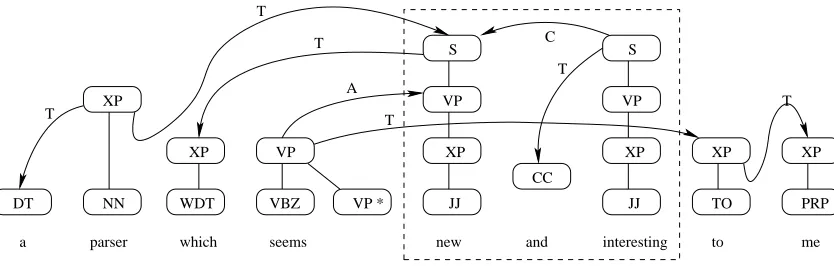
attachment, adjunction and conjunction. We show
LTAG-spinal elementary trees and operations with an example in Figure 1.
In Figure 1, each arc is associated with a character which represents the type of operation. We use T for attach, A for adjoin, and C for conjoin.
1Further formal results are described in (Shen and Joshi,
2005). There is also some relationship of LTAG-spinal to the spinal form context-free tree grammar, as in (Fujiyoshi and Ka-sai, 2000)
2In (Riezler et al., 2002), the MaxEnt model was used to
JJ VP S
JJ VP S
TO CC
VP * VBZ
NN DT
XP
XP
WDT PRP
interesting new and
seems which
parser
a to me
T
T T
T T
A
T
C
VP XP
[image:2.612.99.516.53.186.2]XP XP XP
Figure 1: An example in LTAG-spinal. A=adjoin, T=attach, C=conjoin.
Attachment in LTAG-spinal is similar to sister
adjunction (Chiang, 2000) in Tree Insertion
Gram-mar (TIG) (Schabes and Waters, 1995). It represents a combination of substitution and sister adjunction. The attachment operation is designed to encode the ambiguity of an argument and an adjunct.
Adjunction inserts part of the spine and the foot node of an auxiliary tree into to the spine of another tree. The adjunction operation can effectively do wrapping, which distinguishes itself from sister
ad-junction. It is not difficult to see that adjunction only
happens on the spine of a tree. This property will be exploited in the incremental parser.
Conjunction is similar to what was originally proposed in (Sarkar and Joshi, 1996). However, in LTAG-spinal, the conjunction operation is much eas-ier to handle, since we only conjoin spinal elemen-tary trees and we do not need to enumerate
contrac-tion sets for conjunccontrac-tion. In our formalizacontrac-tion, con-junction can be treated as a special adcon-junction,
how-ever, this is beyond the scope of this paper.
We use the LTAG-spinal treebank described in (Shen and Joshi, 2005), which was extracted from the Penn Treebank (PTB) (Marcus et al., 1994) with Propbank (Palmer et al., 2005) annotations.
2.1 Relation to Traditional LTAG
LTAG-spinal preserves most of the strong genera-tive power of LTAG. It can be shown that LTAG-spinal with adjoining restrictions (Joshi and Sch-abes, 1997) has stronger generative capacity as com-pared to CFG. For example, there exists an
LTAG-spinal grammar that generates !
"$#
, which is not a context-free language.
A spinal elementary tree is smaller than a
tradi-tion LTAG elementary tree which contains all the substitution nodes of the arguments. In the LTAG-spinal formalism, both arguments and adjuncts are expected to be directly attached or adjoined onto a spine. In this sense, LTAG-spinal roughly satisfies
the fundamental TAG hypothesis: Every syntactic dependency is expressed locally within a single el-ementary tree (Frank, 2002). The only difference
is that, in LTAG-spinal, syntactic dependencies are represented via direct or local connections.
To better understand the meaning of this dif-ference, we relate it to Frank’s (2002) model for how the LTAG elementary trees are constructed. In Frank’s model, all the elementary trees are built via
Marge and Move operations, starting with a local lexical array. The resulting LTAG elementary trees
are then combined with adjunction and substitution to build a derivation tree.
(Shieber and Johnson, 1993) showed that this strat-egy is desirable for NLP.
Furthermore, the way that we split a traditional LTAG elementary tree along the spine is similar to the method with which Evans and Weir (1997) compiled the XTAG English Grammar into finite state automata. In their work, this method was de-signed to employ shared structure in a rule-based parser. But here we extend this technique to statisti-cal LTAG parsing.
2.2 Relation to Propbank
In building the LTAG-spinal Treebank, the Propbank information is used in the treebank extraction. As reported in (Shen and Joshi, 2005), tree transforma-tion on PTB are employed to make it more compat-ible with the Propbank annotations. It was shown that 8 simple patterns of the path from a predicate to an argument account for 95.5% of the total pred-arg pairs. Thus, our high-quality parsing output will be very useful for semantic role labeling.
Arguments in Propbank are not obligatory com-plements. Therefore, we cannot treat the Propbank arguments as the arguments in LTAG. The ambigu-ity of argument and adjunct is reflected in the sim-ilarity of substitution and sister adjunction. This is one of the reasons that we do not distinguish substi-tution and sister adjunction in LTAG-spinal.
3 Incremental Parsing
We are especially interested in incremental parsing for the following two reasons. Firstly, the left to right strategy used in incremental parsing gives rise to a drastic boost in speed. Furthermore, there is also a strong connection between incremental parsing and psycholinguistics, and this connection is also observed in the LTAG formalism (Ferreira, 2000; Sturt and Lombardo, 2005).
In recent years, there have been many interesting works on incremental or semi-incremental parsing. By semi-incremental we mean the parsers that al-low several rounds of left to right scans instead of one. Both left-corner strategy (Ratnaparkhi, 1997; Roark, 2001; Prolo, 2003; Henderson, 2003; Collins and Roark, 2004) and head-corner strategy (Hen-derson, 2000; Yamada and Matsumoto, 2003) were employed in incremental parsing. The head-corner
approach is more natural to the LTAG formalism (Evans and Weir, 1997). In our approach, we use a stack of derivation treelets to represent the partial parsing result. Furthermore, the LTAG formalism allows us to handle non-projectivity dependencies, which cannot be generated by a CFG or a Depen-dency parser.
In fact, the idea of incremental parsing with LTAG is closely related to the work on Supertagging (Joshi and Srinivas, 1994). A supertager first assigns the correct LTAG elementary tree to each word. Then a Lightweight Dependency Analyzer (LDA) (Srini-vas, 1997) composes the whole derivation tree with these elementary trees. We use incremental parsing to incorporate supertager and LDA dynamically.
The model of incremental LTAG parsing is also similar to Structured Language Modeling (SLM) in (Chelba and Jelinek, 2000). In SLM, the left con-text of history is represented with a stack of binary trees. At each step, one computes the likelihood of the current word, its tag and the operations over the new context trees.
3.1 Treatment of Coordination
Predicate coordination appears in about 1/6 of the sentences in PTB, therefore proper treatment of co-ordination, especially predicate coco-ordination, is im-portant to parsing of PTB.
Some recent results in psycholinguistic experi-ments (Sturt and Lombardo, 2005) showed a high degree of eagerness in building coordination struc-tures which is absent in a bottom-up approach; A bottom-up parser waits for the second conjunct to be completed before combining the two conjuncts as for example in VP coordination, and then com-bine the coordinated VP with the subject of the left conjunct. Psycholinguistic results suggest that the right conjunct has to have access to the subject NP of the left conjunct. This can be achieved by first building the entire S on the left and then adjoining the right VP conjunct to the VP node of the left con-junct (Sturt and Lombardo, 2005).
3.2 The Parsing Algorithm
There are four different types of operations in our parser. Three of them are described in Section 2. The fourth operation is generation, which is used to generate a possible spine for a given word according to the context and the lexicon.
Our left to right parsing algorithm is a variant of the shift-reduce algorithm with beam-search. We use a stack of disconnected derivation treelets to rep-resent the left context. When the parser reads a word, it first generates a list of possible spinal el-ementary trees for this word, For each elel-ementary tree, we first push it into the stack. Then we re-cursively pop the top two treelets from the stack and push the combined tree into the stack until we choose not to combine the top two treelets with one of the three combination operations (we can also choose not to pop anything at the beginning). Then we shift to the next word. This model is called the Flex Model in this paper.
A potential problem with the Flex Model is that a single LTAG derivation tree can be generated by several shift-reduce derivation steps, which only dif-fer in the order of operations. For example, we have three trees % , & and ' . In LTAG derivation,
% adjoins to & , and & adjoins to ' . Then we have two different shift-reduce derivations, which are (%*)+(&,)-'. / and /(%*)0& 1)-'2 .
Now we introduce the Eager Model, an eager evaluation strategy. Any two elementary trees which are directly connected in the LTAG derivation tree are combined immediately when they can be com-bined in some context. Furthermore, they cannot be combined afterwards, if they miss the first chance. In the previous example, the parser will generate
/(%,)3& 4)5'2 , while (%6) (&7)8'. / is ruled out. Then for each LTAG derivation tree, there exists a unique left-to-right derivation.
The Eager Model is motived by the treatment of coordination in (Sturt and Lombardo, 2005), as we discussed in the previous section. For example, we have the following two sentences.
1. Quimby knows Tom likes Philly steak.
2. Quimby knows Tom likes Philly steak and Jerry likes pizza.
Suppose we are parsing these two sentences, and for each case the current word is likes, the fourth
word. Now we have just the same local contexts for both cases. According to the Eager Model, the parser takes the same action according to the con-text, which is to combine the knows tree and the likes tree. For sentence 2, the second likes tree will be conjoined with the first likes tree later. This is com-patible with the psycholinguistic preference.
In the following section, we will explain the pars-ing mechanism for the Eager Model with an exam-ple. The Flex Model is similar except that the order of operations is flexible to some extent.
3.3 An Example
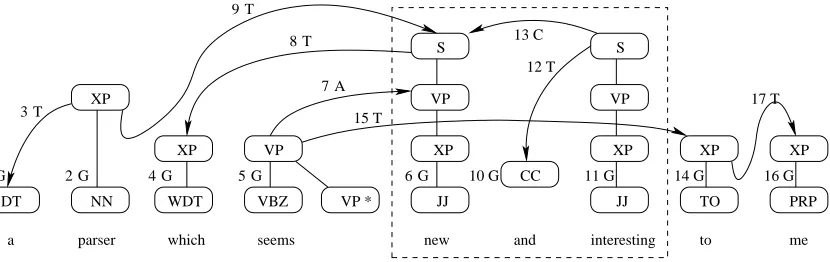
Figure 2 shows the left to right parsing of the phrase
a parser which seems new and interesting to me with
the Eager Model.
In Figure 2, each arc is associated with a number and a character. The number represents the order of operation, and the character stands for the type of operation as in Figure 1. Furthermore we use G to represent Generate.
In step 1 and 2, two disconnected spines are gen-erated for a and parser. The spine for a is attached to the spine for parser on the NP node in step 3.
In step 6, the spine for new, the first conjunct of the predicate coordination, is generated. Then the auxiliary tree for seems is adjoined to the spine for
new at the node VP. the latter is further combined
with which, and is attached to the tree for parser. In step 13, the conjoin operation is used to com-bine the treelet anchored on new and the treelet an-chored on interesting. Alignments between the two spines are built, through which argument sharing is implemented in an implicit and underspecified way.
In step 15, for the spine for to, the visible nodes of the conjoined treelet include nodes on some aux-iliary trees adjoined on the left of the spines, like the root VP node for seems. In this way, a non-projective structure is generated, which is just the same as the wrapping adjoining in LTAG.
3.4 Machine Learning Algorithm
JJ VP S
JJ VP S
TO PRP
CC VP *
VBZ
NN WDT
DT
XP
XP
interesting new and
seems which
parser
a to me
1 2 4 5 6 11 16
17
G
G G G G 14 G G
T
T T
T 9
8
7
G 10 G 12 T
3
A
15 T
13 C
VP XP
[image:5.612.105.520.54.185.2]XP XP XP
Figure 2: Incremental parsing with Eager Model. A=adjoin, T=attach, C=conjoin, G=generate
In this paper, we use the perceptron-like algorithm proposed in (Collins, 2002) which does not suffer from the label bias problem, and is fast in train-ing. We also employ the voted perceptron algorithm (Freund and Schapire, 1999) and the early update technique as in (Collins and Roark, 2004).
3.5 Features
Features are defined in the format of (operation,
main spine, child spine, spine node, context), where
the spine node is the node on the main spine onto which the child spine is attached or adjoined. For
generate, child spine and spine node are undefined,
and for conjoin spine node is undefined. context de-scribes the constituent label or lexical item associ-ated with a certain node. The context of an operation includes the top two treelets involved in the opera-tion as well as the two closest words on both sides of the current word.
9
Context for generate :
- The (-2, 2) window in the flat sentence. - The visible3spines on the topmost treelet.
9
Context for attach and adjoin :
- The (0, 2) window in the flat sentence. - The most recent spine previously attached or adjoined to the same location on the main spine.
- The leftmost child spine attached to the child spines.
- The spines that are visible before the opera-tion and become invisible after the operaopera-tion.
9
Context for conjoin :
- The (0, 2) window in the flat sentence.
3The details are presented in (Shen, 2005).
- The leftmost child spine attached to the main spine, which is the first adjunct.
- The two leftmost children spines attached to the child spine, which is the current adjunct.
We have about 1.4M features extracted from the gold-standard parses, and about 600K features dy-namically extracted from the generated parses in 10 rounds of training with the Eager Model.
4 Experiments and Analysis
We use the LTAG-spinal treebank reported in (Shen and Joshi, 2005). The LTAG-spinal parse for the 39434 sentences extracted from WSJ section 2-21 are used as the training data. Section 24 is used as the development data. Section 23 are used for test4.
We use syntactic dependency for evaluation. It is worth mentioning that, for predicate coordination, we define the dependency on the parent of the co-ordination structure and each of the conjunct pred-icate. For example, in Figure 1, we have depen-dency relation on (parser, new) and (parser,
interest-ing). Compared with other dependency parsers on
PTB, the dependency defined on LTAG-spinal re-veals deeper relations because of the treatment of traditional adjoining and predicate coordination de-scribed above.
In the community of parsing, labeled recall and
labeled precision on phrase structures are often used
for evaluation. However, in our experiments we can-not evaluate our parser with respect to the phrase structures in PTB. As shown in (Shen and Joshi, 2005), various irrecoverable tree transformations
4The LTAG-spinal treebank contains 2401 out of 2416
0.7 0.75 0.8 0.85 0.9
0 2 4 6 8 10
f-score
:
# iteration dev-voted
[image:6.612.330.519.58.196.2]dev train
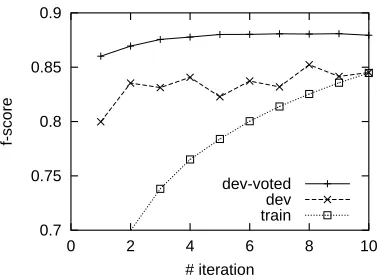
Figure 3: f-score of syntactic dependency on the
de-velopment data with the Eager Model
were used to extract the LTAG-spinal treebank ac-cording the Propbank annotation on PTB. Therefore, we use syntactic dependency for evaluation.
4.1 Eager vs. Flex
We first train our incremental parser with Eager Model and Flex Model respectively. In the training, beam width is set to 10. Lexical features are limited to words appearing for at least 5 times in the training data. Figure 3 and Figure 4 show the learning curves on the training and the development data. The X axis represents the number of iterations of training, and the Y axis represents the f-score of dependency with respected to the LTAG derivation tree.
Since early update is used, the f-score on the training data is very low at the beginning. In both cases, the voted weights provide an f-score which is more than 3% higher. The voted results con-verge faster and are more stable. The result with Flex Model is 0.6% higher than the one with Eager Model, but the parsing time is much longer with Flex Model as we will show later.
We use the voted weights obtained after 10 rounds of iteration for the evaluation on the test data. We achieve an f-score of 88.7% on dependency with the Eager Model, and 89.3% with the Flex Model. The Flex Model achieves better performance because it allows the decision of operation to be delayed until there is enough context information.
4.2 K-Best Parsing
The next experiment is on K-best parsing. As a first attempt, we just use the same algorithm as in the
pre-0.7 0.75 0.8 0.85 0.9
0 2 4 6 8 10
f-score
:
# iteration dev-voted
dev train
Figure 4: f-score of syntactic dependency on the
de-velopment data with the Flex Model
Table 1: F-score of the oracle parse in the 10-best parses on the development data with the Eager Model
algorithm f-score%
top (eager) 87.3
oracle (eager) 88.5
top (eager+combined parses) 87.4 oracle (eager+combined parses) 91.0
vious section, except that we study the oracle parse, or the best parse, among the top 10 parses. The f-score on the oracle in top 10 in the development data is 88.5%, while the f-score of the top candidate is 87.3%, as shown in Table 1. However, we are not satisfied with the score on oracle, which is not good enough for post-processing, i.e. parse reranking.
We notice that from a single partial derivation we can generate a large set of different partial deriva-tions, just by combining the elementary tree of the next word. It is easy to see that these similar deriva-tions may use up the search beam quickly, which is not good for parse search. Many of the new derivations share the same dependency structure. So we revised our learning procedure by combining derivations with the same dependency structure be-fore each shift operation. We repeated the K-best parsing experiments by using Combined Parses as described above, and achieved significant improve-ment on the oracle, as shown in Table 1.
[image:6.612.88.281.58.194.2] [image:6.612.319.530.301.374.2]0.9 0.905 0.91 0.915 0.92 0.925 0.93 0.935 0.94 0.945 0.95
0 20 40 60 80 100
f-score
:
k-best eager + combined
[image:7.612.89.280.59.196.2]flex + combined
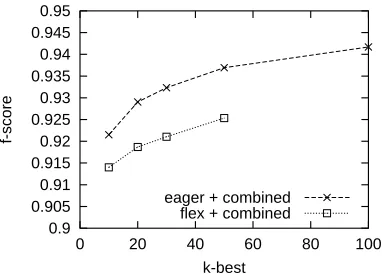
Figure 5: f-score of the oracle on the test data
Table 2: Speed of parsing on the test data set. Here cp? = whether the method of Combined Parses is used; sen/sec = sentence per second; top = top can-didate given by the parser; oracle = oracle of the K-best parses where K equals the width of the beam.
model cp? beam sen/sec f-score%
single best top
flex no 10 0.37 89.3
eager no 10 0.79 88.7
K-best oracle
eager yes 10 0.62 92.2
eager yes 20 0.31 92.9
eager yes 30 0.22 93.2
eager yes 50 0.13 93.7
eager yes 100 0.07 94.2
in parsing. The f-score of oracle in 100-best parsing is 94.2% with the Eager Model + Combined Parses.
4.3 Speed of Parsing
Efficiency is important to the application of incre-mental parsing. This set of experiments is related to the speed of our parser on single best and K-best parsing with both the Eager Model and the Flex Model. All the experiments are performed on a Linux node with two 1.13GHz PIII CPUs and 2GB RAM. The parser is coded in Java.
Table 2 shows that the Eager Model is more than two times faster than the Flex Model, as we ex-pected. The time spent on K-best parsing is propor-tional to the beam width.
5 Discussion and Future Work
The parser proposed in this paper is an incremen-tal parser, so the accuracy on dependency is lower than that for chart parsers, for example like those reported in (Collins, 1999; Charniak, 2000).5 How-ever, it should be noted that the dependencies com-puted by our parser are deeper than those calculated by parsers working directly on PTB. This is due to the treatment of adjunction and coordination.
On the other hand, the LTAG-spinal treebank used in this paper shows a high degree of compatibility with the Propbank, as shown in (Shen and Joshi, 2005), so the LTAG derivations given by the parser are very useful for predicate-argument recognition. We plan to improve the parsing performance by reranking and extend our work to semantic parsing (Mooney, 2004).
Another interesting topic is whether this parser can be applied to languages which have various long-distance scrambling, as in German. It appears that by carefully modifying the definition of
visi-ble spines, we can represent scrambling structures,
which at present can only be represented by Multi-Component TAG (Becker et al., 1991).
6 Conclusions
In this paper, we present an efficient incremental parser for LTAG-spinal, a variant of LTAG which is both linguistically and psycholinguistically moti-vated. As far as we know, the statistical incremen-tal parser proposed in this paper is the first compre-hensive attempt of efficient statistical parsing with a formal grammar with provably stronger genera-tive power than CFG, supporting the adjoining op-eration, dynamic predicate coordination, as well as non-projective dependencies.
We have trained and tested our parser on the LTAG-spinal treebank, extracted from the Penn Treebank with Propbank annotation, Using gold standard POS tags as part of the input, the parser achieves an f-score of 89.3% for syntactic de-pendency on section 23 of PTB. Because of the treatment of adjunction and predicate coordination, These dependencies, which are defined on LTAG-spinal derivation trees, are deeper than the depen-dencies extracted from PTB alone with head rules.
References
T. Becker, A. K. Joshi, and O. Rambow. 1991. Long distance scrambling and Tree Adjoining Grammars. In EACL 1991.
M. Candito. 1998. Building parallel ltag for french and italian. In ACL-COLING 1998.
E. Charniak. 2000. A maximum-entropy-inspired parser. In
NAACL 2000.
C. Chelba and F. Jelinek. 2000. Structured language modeling.
Computer Speech and Language, 14(4):283–332.
D. Chiang. 2000. Statistical Parsing with an Automatically-Extracted Tree Adjoining Grammar. In ACL 2000.
M. Collins and B. Roark. 2004. Incremental parsing with the perceptron algorithm. In ACL 2004.
M. Collins. 1999. Head-Driven Statistical Models for Natural
Language Parsing. Ph.D. thesis, University of Pennsylvania.
M. Collins. 2002. Discriminative training methods for hidden markov models: Theory and experiments with perceptron al-gorithms. In EMNLP 2002.
R. Evans and D. Weir. 1997. Automaton-based parsing for lexicalized grammars. In IWPT 1997.
F. Ferreira. 2000. Syntax in language production: An approach using tree-adjoining grammars. In L. Wheeldon, editor,
As-pects of Language Production. MIT Press.
R. Frank. 2002. Phrase Structure Composition and Syntactic
Dependencies. MIT Press.
Y. Freund and R. E. Schapire. 1999. Large margin classifi-cation using the perceptron algorithm. Machine Learning, 37(3):277–296.
A. Fujiyoshi and T. Kasai. 2000. Spinal-formed context-free tree grammars. Theory Computing Systems, 33(1).
J. Henderson. 2000. A neural network parser that handles sparse data. In IWPT 2000.
J. Henderson. 2003. Generative versus discriminative models for statistical left-corner parsing. In IWPT 2003.
A. K. Joshi and Y. Schabes. 1997. Tree-adjoining grammars. In G. Rozenberg and A. Salomaa, editors, Handbook of
For-mal Languages, volume 3, pages 69 – 124. Springer.
A. K. Joshi and B. Srinivas. 1994. Disambiguation of super parts of speech (or supertags): Almost parsing. In COLING
1994.
A. Kinyon and C. Prolo. 2002. A classification of grammar de-velopment strategies. In COLING 2002 Workshop:
Gram-mar Engineering and Evaluation.
J. Lafferty, A. McCallum, and F. Pereira. 2001. Conditional random fields: Probabilistic models for segmenting and la-beling sequence data. In ICML 2001.
A. Lavelli and G. Satta. 1991. Bidirectional parsing of lexical-ized tree adjoining grammars. In EACL 1991.
M. P. Marcus, B. Santorini, and M. A. Marcinkiewicz. 1994. Building a large annotated corpus of English: The Penn Treebank. Computational Linguistics, 19(2):313–330.
R. Mooney. 2004. Learning semantic parsers: An important but under-studied problem. In AAAI 2004 Spring Symposium on
Language Learning: An Interdisciplinary Perspective.
M. Palmer, D. Gildea, and P. Kingsbury. 2005. The proposi-tion bank: An annotated corpus of semantic roles.
Compu-tational Linguistics, 31(1).
C. Prolo. 2003. LR Parsing for Tree Adjoining Grammars and
its Application to Corpus-based Natural Language Parsing.
Ph.D. thesis, University of Pennsylvania.
V. Punyakanok and D. Roth. 2001. The use of classifiers in sequential inference. In NIPS 2001.
A. Ratnaparkhi. 1997. A linear observed time statistical parser based on maximum entropy models. In EMNLP 1997.
S. Riezler, T. King, R. Kaplan, R. Crouch, J. Maxwell, and M. Johnson. 2002. Parsing the wall street journal using a lexical-functional grammar and discriminative estimation techniques. In ACL 2002.
B. Roark. 2001. Probabilistic top-down parsing and language modeling. Computational Linguistics, 27(2):249–276.
A. Sarkar and A. K. Joshi. 1996. Coordination in tree adjoining grammars. In COLING 1996.
Y. Schabes and R. C. Waters. 1995. A cubic-time, parsable for-malism that lexicalizes context-free grammar without chang-ing the trees produced. Computational Lchang-inguistics, 21(4).
L. Shen and A. K. Joshi. 2005. Building an LTAG treebank. Technical Report MS-CIS-05-15, CIS Dept., UPenn.
L. Shen. 2005. Statistical Natural Language Processing with Lexicalized Tree Adjoining Grammar. Ph.D. proposal, Uni-versity of Pennsylvania.
S. Shieber and M. Johnson. 1993. Variations on incremen-tal interpretation. Journal of Psycholinguistic Research,
22(2):287–318.
B. Srinivas. 1997. Performance evaluation of supertagging for partial parsing. In IWPT 1997.
P. Sturt and V. Lombardo. 2005. Processing coordinated struc-tures: Incrementality and connectedness. Cognitive Science,
to appear.
B. Taskar, C. Guestrin, and D. Koller. 2003. Max-margin markov networks. In NIPS 2003.
G. van Noord. 1994. Head corner parsing for TAG.
Computa-tional Intelligence, 10(4).
K. Vijay-Shanker and A. K. Joshi. 1985. Some computational properties of tree adjoining grammars. In ACL 1985.