Diffusions on Wasserstein Spaces
Dissertation
zurErlangung des Doktorgrades (Dr. rer. nat.)
derMathematisch-Naturwissenschaftlichen Fakult¨
at
der
Rheinischen Friedrich-Wilhelms-Universit¨
at Bonn
vorgelegt von
Lorenzo Dello Schiavo
ausRom (Italien)
Angefertigt mit der Genehmigung der Mathematisch-Naturwissenschaftlichen Fakult¨at der Rheinischen Friedrich-Wilhelms-Universit¨at Bonn
1. Gutachter: Prof. Dr. Karl-Theodor Sturm 2. Gutachter: Prof. Maria Gordina, Ph.D. Tag der Promotion: 26.11.2019
Ai miei insegnanti. To my teachers.
Typeset by the author usingAMS-LATEX, Bib-LATEX. Figures by the author using Tikz, Wolfram Mathematica 11.
Acknowledgements
In fond remembrance of Prof. Dr. Kuwada Kazumasa (桒田和正)
My deepest gratitude goes to everybody, who shared with me their thoughts — mathematical insights, as well as life experiences — and for all the cheerful support and practical help that came, at times in the most unexpected ways.
Foremost, I am grateful to Prof. Dr. Karl-Theodor Sturm for his quiet and observant furtherance of my research, so often prompted, inspired and directed by his questions and remarks.
To Dr.’s Marco Bonacini, Matthias Erbar, Han Bang-Xian (韩邦先), Martin Hues-mann, Flaviana Iurlano, Alessia Nota, Luca Tamanini and Raphael Winter, for their constant mentoring, and for many comments and suggestions about the contents and exposition of the mathematics in this thesis.
To Dr.’s Sebastian Andres, Adolfo Arroyo-Rabasa, Peter Gladbach, Karen Haber-mann, Eva Kopfer, Chiara Rigoni, Sakurai Yohei (櫻井陽平), Gerardo Sosa, Suzuki Kohei (鈴木康平), Prof. Dr. Wu Bo (吴波), Luigi Borasi, Mathias Braun, Martin Br¨uckerhoff-Pl¨uckelmann, Simon Buchholz, Richard H¨ofer, David Hornshaw, Alessandra Occelli, Angelo Profeta, Walker Stern, Mattia Turra, Immanuel Zachhuber and to all members of the Abteilung f¨ur Stochastische Analysis, fellow Ph.D. students, and mem-bers of the vast mathematical community of Bonn, with whom I shared every-day life experiences, and very many happy and a few sad memories.
To Prof.’s Sergio Conti, for having been my mentor in the BIGS graduate program; Patrik Ferrari, for his contagious cheerfulness and his several comments about the combi-natorics results in Chapter 2; Catharina Stroppel, for her patience with my lingering in the diagonal fallacy and her many insightful suggestions concerning representation theory results in Chapter 2; Massimiliano Gubinelli, for the many carb-free meals we shared, and for his paracontrolled-distributions-thinking which proved a valuable point of view on the approximation techniques used in Chapter 5; Eugene W. Lytvynov (Swansea U.), for his very kind hospitality, and for sharing his understanding of Mecke-type identities which proved to be an invaluable tool in the study of random measures; Sergio Albeverio, for his gentle explanations about direct integrals, Dirichlet forms and particle systems; Maria M. Gordina (U. of Connecticut), for our shared teas, her l~-lectures along the Rhine, and her many mathematical comments and helpful suggestions to Chapters 2, 4 and 5; Federico Bassetti (Politecnico di Milano) for sharing with me the understanding of J. Sethuraman’s characterization of the Dirichlet–Ferguson measure as a fixed point prob-lem; Karl-Theodor Sturm, Maria M. Gordina, Christoph Thiele and Markus Cristinziani for being part of my Ph.D. defense Committee.
Since this work would not have been possible without the vaste knowledge and the many references and sources shared with me over the years, my warmest thanks
vi
go to Prof.s Sergio Albeverio, Federico Bassetti (Politecnico di Milano), Nicola Gigli (SISSA), G¨unter Last (KIT) for [101], Willard Miller Jr. (U. of Minnesota) for [124], Mauro Piccioni (Sapienza – U. di Roma) for [107], Anatoly M. Vershik (St. Petersburg State U.) for [161], and to Dr.s Marco Bonacini for [9], Matthias Erbar for [51, 65], Martin Huesmann for [91, 104], Vitalii V. Konarovskyi (U. of Leipzig) for [92], Alessia Nota, Carlo Orrieri (U. degli Studi di Pavia).
Finally, I wish to express my gratitude to:
• the Collaborative Research Center (Sonderforschungsbereich) 1060, the Hausdorff Center for Mathematics, the Bonn International Graduate School in Mathematics and the Bonn Graduate Center, for their financial and non-financial support.
• the Hausdorff Institute for Mathematics in Bonn, for their kind hospitality during theFollow-up Workshop to Junior Trimester Program “Optimal Transportation”
(August 29th – September 2nd, 2016);
• the Departments of Mathematics of Swansea University, ofSapienza – Universit`a di Roma, and of theUniversit`a degli Studi di Pavia for their kind hospitality during my short research stays;
• the Max Planck Institute for Mathematics in Bonn, for their kind hospitality during theIntense Activity Period on Metric Measure Spaces and Ricci Curvature
Summary
The Introduction presents the main subject of the thesis, the construction of a diffusion process on spaces of probability measures. Together with a brief survey of the relevant literature, it collects several tools from the theory of point processes and of optimal transportation.
Chapter 2 appeared as the preprint [39]. It contains a study of the characteristic functionals of Dirichlet–Ferguson measuresDσwith non-negative finite intensity measureσ
over locally compact Polish spaces. Firstly, we compute such characteristic functional as the Dσ-martingale limit of confluent Lauricella hypergeometric functions kΦ2 with
diverging arity k. Secondly we study the interplay between the self-conjugate prior property of Dirichlet distributions in Bayesian non-parametrics, the dynamical symmetry algebra ofkΦ2and P´olya Enumeration Theory.
Chapter 3 appeared as the preprint [41], joint work with Eugene W. Lytvynov (Swansea U., Wales, UK). It contains a new proof of J. Sethuraman’s fixed point characterization ofDσ [145], providing an understanding of the latter as an integral identity of Mecke- or
Georgii–Nguyen–Zessin-type formula.
Chapter 4 appeared as the preprint [38]. It contains the proof of a Rademacher-type result on theL2-Wasserstein spaceP2over a closed Riemannian manifoldM. Namely,
sufficient conditions are given for a probability measurePon (P2, W2), so that real-valued
W2-Lipschitz functions be P-a.e. differentiable in a suitable sense. Some examples of measures satisfying such conditions are provided, mostly in the case whenM =S1.
Chapter 5 appeared as the preprint [40]. It contains two constructions of a Markov diffusion process η• with values in P2. The process is associated with the Dirichlet
integral induced by theL2-Wasserstein gradient and byD
mwith intensity the Riemannian volume measuremof M. When dimM ≥2 we study the properties ofη•, including its
invariant sets, short time asymptotics for the heat kernel and a description by means of a stochastic partial differential equation.
Contents
Summary vii
List of Symbols xi
1 Introduction 1
1.1 Some key ideas . . . 2
1.2 A leading example: configuration spaces . . . 4
1.2.1 Analysis on configuration spaces . . . 4
1.2.2 Geometry on configuration spaces . . . 7
1.3 Differentiation . . . 9
1.3.1 Wasserstein spaces and Otto calculus . . . 9
1.3.2 Differentiation on spaces of measures . . . 11
1.4 Randomness . . . 13
1.4.1 The gamma measure . . . 13
1.4.2 The Dirichlet–Ferguson measure . . . 15
1.4.3 The entropic measure . . . 16
1.5 Evolution . . . 18
1.5.1 Dynamics on spaces of probability measures . . . 18
1.5.2 Dynamics on spaces of measures . . . 19
1.6 Plan of the work . . . 20
1.6.1 The results in Chapter 2 . . . 20
1.6.2 The results in Chapter 3 . . . 20
1.6.3 The results in Chapter 4 . . . 21
1.6.4 The results in Chapter 5 . . . 22
2 Dirichlet characteristic functionals 25 2.1 Introduction and main results . . . 25
2.1.1 Fourier analysis . . . 25
2.1.2 Representations ofSL2-currents . . . 26
2.1.3 Bayesian non-parametrics . . . 31
2.2 Definitions and preliminaries . . . 33
2.2.1 Combinatorial preliminaries . . . 33
2.2.2 The Dirichlet distribution . . . 34
2.2.3 The Dirichlet–Ferguson measure . . . 35
2.3 Proof of Theorem 2.1.1 and accessory results . . . 38
2.3.1 Finite-dimensional statements . . . 38
2.3.2 Infinite-dimensional statements . . . 42
2.4 Proof of Theorem 2.1.4 and accessory results . . . 47
2.4.1 Finite-dimensional statements . . . 47 viii
Contents
ix
2.4.2 Infinite-dimensional statements . . . 58
2.5 Appendix . . . 61
3 A Mecke-type characterization of Dirichlet–Ferguson measures 63 3.1 Introduction . . . 63
3.2 Preliminaries . . . 65
3.3 Proof and corollaries . . . 67
4 A Rademacher-type Theorem on Wasserstein spaces 73 4.1 Introduction . . . 73
4.2 A Rademacher Theorem onP2 . . . 74
4.3 Preliminaries . . . 79
4.3.1 Setting and further notation . . . 79
4.3.2 Lipschitz functions . . . 79
4.3.3 Dirichlet forms . . . 80
4.3.4 Optimal transport . . . 81
4.3.5 Geometry ofP2 . . . 82
4.4 Proof of the main result . . . 84
4.4.1 On the differentiability ofW2-cone functions . . . 84
4.4.2 On the differentiability of functions along flow curves . . . 90
4.4.3 On the differentiability of Lipschitz functions . . . 92
4.4.4 Proof of Theorem 4.2.4 . . . 94
4.5 Examples . . . 95
4.5.1 On Assumption 4.2 . . . 96
4.5.2 On the Smooth Transport Property . . . 98
4.5.3 Normalized mixed Poisson measures . . . 99
4.5.4 The Dirichlet–Ferguson measure . . . 100
4.5.5 The entropic measure . . . 100
4.5.6 An image onP of the Malliavin–Shavgulidze measure . . . 102
4.6 Appendix . . . 103
4.6.1 On the notion of tangent bundle toP2 . . . 103
4.6.2 Auxiliary results on normalized mixed Poisson measures . . . 106
4.6.3 Auxiliary results on the Malliavin–Shavgulidze image measure . . 108
5 The Dirichlet–Ferguson Diffusion 109 5.1 Introduction . . . 109
5.2 Motivations, main results and literature comparison . . . 110
5.3 Preliminaries . . . 121
5.3.1 Dirichlet forms . . . 121
5.3.2 Group actions . . . 121
5.3.3 Riemannian manifolds . . . 122
5.3.4 Spaces of measures . . . 126
5.4 The Dirichlet form . . . 127
5.4.2 Gradient and Dirichlet form onP . . . 132
5.5 The associated process . . . 140
5.5.1 Finite-dimensional approximations . . . 140
5.5.2 A quasi-homeomorphic Dirichlet form . . . 144
5.5.3 Properties of η• . . . 146
5.6 Appendix . . . 149
5.6.1 Measurability properties . . . 149
5.6.2 Quadratic forms . . . 150
5.6.3 Generalized Mosco convergence of quadratic forms . . . 151
5.6.4 Direct integrals of quadratic forms . . . 153
5.6.5 Capacity estimates . . . 157
5.6.6 Operators and domains . . . 158
List of Symbols
1 . . . 32 ·• . . . 32 ·c . . . 81 · . . . 33 ·n . . . 33 ·π . . . 33 ·ˆı . . . 32 ·∗ . . . 74 ~· . . . 32 h · ik . . . 33 [·] . . . 33 k · kX0 . . . 75 . . . 33 ∂wµ . . . 104 ∂w . . . 105 ∂ . . . 105 Greek α . . . 83 Γ . . . 80 γ . . . 82 ∆ . . . 111 δ . . . 10 ∆k . . . 34 ∆k∗ . . . 34 ∆Υ . . . 7 ζ . . . 118 H . . . 66 ισ . . . 6 λ . . . 13 ν . . . 15 µ0n . . . 35 π . . . 10 Πβ . . . 113 Σ· . . . 81 Ts t((α)) . . . 86 T . . . 111 T◦ . . . 111 Υ . . . 5 χ . . . 118 Φ . . . 58 kΦ2 . . . 35 Φ . . . 112 Ψw,t . . . 75 ψw,t . . . 8 Latin Bα,β . . . 4 B . . . 4 Bβ . . . 112 Bε . . . 114 c . . . 81 Cm . . . 101 Cpl . . . 10 cut(x) . . . 98 |D· | . . . 79 D . . . 76 dE . . . 80 d· . . . 94 dExp . . . 6 Diff∞c (M) . . . 7 Dα . . . 34 c Dα . . . 35 divP . . . 76 Dσ . . . 15 c Dσ . . . 25 d∗ . . . 82 d∗2 . . . 83 EA . . . 58 EA,−B . . . 58 Eαi,−αj . . . 52 Eαi . . . 31 E−αi . . . 32 ei . . . 32 ˜ E . . . 19 EΥ . . . 8 ev . . . 36 expµ . . . 82 exp−1 µ . . . 82 Exp L2σ(X;C) . . . 6 F . . . 76 Fcont . . . 77 F C∞ . . . 8 F . . . 77 F0 . . . 77 Fcont . . . 77 fcut . . . 98 fk . . . 51 kFD . . . 34 xixii List of Symbols Gk,θ . . . 4 G1 . . . 118 G(R) . . . 118 GeoAdm . . . 10 G . . . 32 Gexp . . . 32 Gµ . . . 11 gradµ . . . 11 Hs t . . . 112 hst . . . 112 hk . . . 51 I . . . 111 I(x) . . . 98 Jαi . . . 52 L2σ(X;C)n . . . 6 Lαk . . . 28 `· . . . 118 lk . . . 51 Lip . . . 79 M . . . 4 M . . . 111 m . . . 111 c M . . . 123 M . . . 102 M . . . 27 Mσ . . . 27 m . . . 27 mσ . . . 27 SσiMσ . . . 27 Mrk−1 . . . 28 MTW . . . 98 N . . . 15 n±k . . . 51 Opt . . . 74 Pγ . . . 4 P2(T M)µ . . . 82 P∞ . . . 79 P∞,× . . . 79 Pm . . . 79 Pp . . . 9 Preg . . . 81 Pσ . . . 5 q(n) . . . 6 R . . . 86 r· . . . 118 r±k . . . 51 Rσ,λ . . . 13 S . . . 102 S . . . 102 S . . . 27 Sσ . . . 27 Sk . . . 33 Sn(λ) . . . 33 T2M . . . 83 TCL(x) . . . 98 TFL(x) . . . 98 t·γ . . . 83 c W• . . . 112 Ws • . . . 112 Wp . . . 10 X . . . 4 X C∞ . . . 76 X CP . . . 76 X∞∇ . . . 75 X∞ . . . 12 X∞c . . . 8 Xγ . . . 8 Xµ . . . 12 Z∞ . . . 74 b Zm . . . 128 b Zm− . . . 128 b Zm−,ε . . . 128 b Zmε . . . 128 ZG . . . 33 Zn . . . 33 Z∞ . . . 14
Chapter 1
Introduction
As non-trivial translation-invariant measures on any separable infinite-dimensional Banach space do not exist, the quest for well-behaved measures on infinite-dimensional spaces has represented a stimulating problem for decades. Known examples of such measures naturally arise from probability theory: for instance, Wiener measures, Poisson random measures, and more generally the laws of stochastic processes with infinite-dimensional path or state spaces.
The interplay between these laws and the topology and geometry of the underlying spaces is often much subtler than in finite dimensions, even for measures on linear spaces. Again by way of example, this is attested in the case of the Wiener measure by the Cameron–Martin Theorem. Whether finite-dimensional intuitions about basic concepts — like (Riemannian)metric,volume measureorBrownian motion— may be applied to infinite-dimensional settings, is usually settled only on a case-by-case basis.
During the last two decades, the space of probability measures over a Riemannian manifold was put forward as a geometrically amenable infinite-dimensional object: Endowed with the
L2-Kantorovich–Rubinshtein1 distance arising from optimal transportation theory, it inherits metric and geometric curvature properties from the underlying manifold, including Fr´echet-type differentiation, Riemannian calculus, a Levi-Civita connection and parallel transport.
This thesis is aimed at the study of a candidate “volume” measure on the space of probability measures over aclosed Riemannian manifold, and at the construction of a “geometric” diffusion process on the same space. Our interest in these objects stems from three main aspects, roughly corresponding to Chapters 2, 4 and 5 respectively, namely:
• algebraic aspects, related to representations of certain large Lie groups naturally acting on spaces of measures, and to the invariance properties, with respect to such actions, of certain random measures on said spaces of measures;
• geometric aspects, related to the “differential” and “Riemannian” structures induced on spaces of measures by the above group actions, and to their interplay with the (extended)
L2-Wasserstein distance;
• stochasticaspects, related to the existence and properties of Markov diffusion processes generated by the “Laplace–Beltrami” operators associated to the above random measures and “Riemannian” structures.
These correspond to just as many long-term goals, only tangentially addressed in the thesis, and for which the results presented here are but a starting point. Namely,
1Whereas we find the term ‘Kantorovich–Rubinshtein distance’ historically more appropriate (Cf., e.g., [21, p. 796] or [165, p. 119].), we shall in the following adhere to the far more common terminology of ‘Wasserstein distance’.
2 1.1 Some key ideas
• to provide a Lie-algebraic proof of, and a probabilistic interpretation to, Thoma’s clas-sification of the characters of the infinite symmetric groupS∞, incarnated as the Weyl
group of the dynamical symmetry algebra of the Dirichlet–Ferguson measure;
• to find a natural “Riemannian volume” measurePon theL2-Wasserstein spaceP2(M) over any closed Riemannian manifold (M,g) and such that (P2(M),P) inherit the lower Ricci curvature bound ofM, in the sense of either Bakry– ´Emery or Lott–Sturm–Villani curvature(-dimension) conditions;
• to prove the existence of theWasserstein diffusionon the space of probability measures over any closed Riemannian manifold of dimensiond≥2, and to understand the relationship between SDEs onP2(M) and SPDEs onM in roughly the same spirit as in Otto calculus for PDEs.
In this first Chapter, we shall recall some preliminary results, briefly survey the relevant literature about stochastic processes on spaces of measures, and familiarize the reader with the notation. We alternate the mathematical description of the objects of interest with some heuristics drawn from particle systems.
For ease of exposition, all such insights are presented in a sans-serif font and enclosed by a side-rule, like the present paragraph.
Throughout the Chapter, we reference text by a combination of section number, e.g.,§2.3, page number, and paragraph number, e.g.,¶3.
1.1 Some key ideas
We summarize — informally — the main guidelines to follow.
Let Y be a Polish space, G be a connected Lie group acting freely on Y and g be the corresponding Lie algebra. We writeg.y∈Y for the action ofg∈Gon y∈Y. An“increment”
or“direction” is any elementa∈g, and the corresponding“shift” is its imageea via the Lie exponential mappinge:g→G. For fixedu:Y →R, we define the directional derivative ofuin
directionaby setting ∇au(y) := dt t=0u e t a .y ,
whenever this exists. For everyy∈Y we may define — at this point: arbitrarily — a linear “tangent” spaceTyY of admissible directionsa. Provided that we endowTyY with a Hilbert scalar producth · | · iysuch thata7→ ∇auis a continuous linear functional for alla∈TyY, then a gradient∇u(y)∈TyY is induced by the Riesz Representation Theorem and satisfies
∇au(y) =h∇u(y)|aiy , a∈TyY . (1.1.1)
Some representation theory. Suppose further thatY be endowed with a Borel measuren.
Definition(Quasi-invariance). We termnquasi-invariant with respect to the actionG Y if ∀g∈G (g.)]n∼n,
where by n1 ∼n2 we mean that the measures n1 andn2 are mutually absolutely continuous. Further, for any measurable mapf we indicate the push-forward measure by
3
WhenY is aG-homogeneous space (i.e.,G Y is transitive) andnis aG Y-quasi-invariant (probability) measure, a so called quasi-regular representation ofGis induced onL2
n(Y). This representation is unitary, in the sense that its image is a subgroup of the group of unitary automorphisms ofL2n(Y). (For a further account of quasi-invariance and group representations, see§2.1.2.)
In the case whenGis a Lie group acting as above, we denote by∇∗the adjoint of∇with respect to the natural (pre-)Hilbert scalar product on the space Γ(T Y) of (continuous) sections to the tangent bundleT Y, viz.
w1w 2 := Z Y w1y w 2 y ydn(y), w i ∈Γ(T Y).
Thus, a quasi-regular unitary representation is associated with a quadratic energy functional
E(u) :=h∇u| ∇ui . (1.1.2) As it turns out, the G Y-quasi-invariance ofnis usually sufficient to establish that the quadratic form associated to the functional E in (1.1.2) is closable, and generated by the negative “Laplacian”L:=−∇∗◦ ∇. (For the details in the case relevant to us, see§4.4.4¶1, and
Proposition 4.5.6.)
Some metric analysis. WhenY = (Y,r,n) is a metric measure space and∇is compatible with the distanceronY, (in a sense to be made precise) then theG Y-quasi-invariance ofnis a key tool in establishing results about then-a.e. differentiability ofr-Lipschitz functions.
Indeed, providedEbe a densely defined and closable pre-Dirichlet form with carr´e du champ operatorΓ(u)(y) :=|∇u(y)|2
y, its domainD(E) may be regarded as a Sobolev space of typeH 1
. Analogously, the set
{u∈Dloc(E)∩L∞n (Y)|Γ(u)∈L
∞
n (Y)} (properly normed) may be regarded as a Sobolev space of typeW1,∞
. In this setting, the classical Rademacher Theorem and its converse, the so-called Sobolev-to-Lipschitz property, may be formulated as follows.
Property(Rademacher). Ifu∈Lip(Y,r)∩L2
n(Y), thenu∈D(E)andΓ(u)≤Lip[u]2.
Property (Sobolev-to-Lipschitz). If u ∈ D(E) and Γ(u) ∈ L∞n (Y), then there exists an
n-versionu˜ofusuch thatu˜∈Lip(Y,r) andLip[˜u]2≤ kΓ(u)k L∞
n .
Some stochastic analysis. Provided that (E,D(E)) be a regular, strongly local Dirichlet form onL2
n(Y), the standard theory of Dirichlet forms grants the existence of a Markov processy•
with state spaceY, uniquely associated to (E,D(E)). In general, no pathwise construction ofy•
is provided by the theory, and thus it must be achieved by other means. However, several properties ofy•, including e.g., conservativeness or ergodicity, may be restated in the language
of Dirichlet forms. In particular, the strong locality of (E,D(E)) implies the a.s. continuity of the sample pathst7→yt(ω), that is, the processy•is adiffusion.
The simplest example of this construction to bear in mind is as follows: Choose (Y,r,n) =Rd the standard Euclidean space,g∼=G∼=Rdthe (additive, Abelian) group of translations ofY,
andTyY :=Rdfor everyy∈Y. Then,∇is the usual gradient,Lthe usual Laplacian, and the
processy•is but ad-dimensional Brownian motion.
Different choices forY and Gyield constructions in a variety of contexts. In the following, we shall focus on the case whenY is some space of measures on a Riemannian manifoldM
4 1.2 A leading example: configuration spaces
1.2 A leading example: configuration spaces
We start with a brief survey about the free geometric dynamics on configuration spaces, a (by now) classical example of dynamics on spaces of measures which will be of guidance throughout our study. The related theory, now fully developed, allows us to focus on the anticipated interplay of algebra, geometry and stochastic analysis, while momentarily neglecting the more technical aspects that arise in dealing with richer spaces of measures.
Throughout this chapter, we will adhere to the following notation.
Spaces. We introduce the following topological and measure-theoretical objects: • X is a second countable locally compact Hausdorff topological space2;
• M is a (second countable) connected smooth manifold without boundary, possibly en-dowed with a smooth Riemannian metricgsuch that (M,g) is additionally complete and stochastically complete;
• B is the Borel σ-algebra of eitherX orM, depending on context;M+ is the space of
σ-finite Radon measures on eitherXorM, depending on context, endowed with the vague topology if not stated otherwise.
Distributions. We shall make use of the following standard probability distributions: • thePoisson distributionwith parameterγ∈[0,∞],
Pγ(k) :=γ k
k!e
−γ
, k∈N0 ; (Ifγ∈ {0,∞}, then, conventionally,Pγ=δγ.)
• theGamma distribution withshape parameterk >0 andscale parameterθ >0,
Gk,θ(r) := θ −k Γ(k)r k−1 e− r θ , r∈R+ ; • theBeta distributionwithshape parametersα, β >0,
Bα,β(r) :=r α−1
(1−r)β−1
B(α, β) , r∈I .
1.2.1 Analysis on configuration spaces. In the study of random dynamics on spaces of measures several examples naturally arise from physics. In this section, we formalize a simple leading example: Bose gases.
By a Bose gas we shall mean a many-body system of indistinguishable mass-, volume- and charge-less random particles in the Euclidean space. We assume further that
(B1) each particle is solely identified by its position and any two particles do not occupy the
same position with probability1;
(B2) the system obeys theBose–Einstein statistics, that is, the particles are non-interacting and
the system is invariant under particles’ permutation;
(B3) the system is ararefied gas, that is, each finite volume inR3contains only a finite number
of particles;
1.2.1 Analysis on configuration spaces 5
(B4) for a volumeAof size|A|letγA be the number of particles inA. Then,
P(γA= 0) =e
−|A|
.
Mathematically, we shall formalize a Bose gas as a Poisson point process with intensity measure the Lebesgue measure| · |inR3.
Point processes. (Cf., e.g., [102, Chap. 2].) A measure3 γ onX is integral ifγB ∈ N0 for allB∈ B. Apoint processon X is any random element in the space of integral measures onX. For each suchγ, the functionalE(γ·) is a measure onX, termed theintensity measure ofγ.
We say that a point processγis
• proper, if there exists random variablesN∈N0 and (xi)i≤N∈X
N such that γ= N X i=1 δxi P-a.e. ; (1.2.1)
(Let us stress that we allow forxi=xjwheni6=j)
• simple, if it is proper andP(γ{x} ≤1) = 1 for everyx∈X; • locally finite, ifP(γK <∞) = 1 for every compactK⊂X;
• completely independent, if the random variablesγB1, . . . , γBkare independent for every pairwise disjoint B1, . . . , Bk∈ B.
Since particles in a Bose gas are indistinguishable, and exchangeable by property (B2), they are
described by the set (as opposed to: ordered tuple) of their characteristic quantities. By (B1), the
only relevant quantity associated to a particle is its position in space, thus a Bose gas is described by a proper point processγ. Again by (B1), γ is simple, withdiffuse (i.e. atomless) intensity.
By (B3), the processγ is additionally locally finite. Finally, property (B4), together with all of
the previous conclusions, implies thatγ satisfies to the following definition. (This is by R´enyi’s Theorem [102, Thm. 6.10].)
Definition (Poisson measure, e.g., [102, Dfn. 3.1]). APoisson point process with intensity
(measure)σ∈M+ is a completely independent point process onX such that
γB∼PσB , B∈ B .
As it turns out, every such process is a proper point process (up to equality in law, [102, Cor. 3.7]). Its law (uniquely determined by σ, [102, Prop. 2.10(ii)]) is termed the Poisson
(random) measure Pσ. (For further characterizations ofPσ, see Eq. (3.1.1) and Thm. 3.1.1 below.)
Configuration spaces. A setA⊂Xis termedlocally finiteifA∩Kis finite for any compactK⊂
X. Any suchA has the formA={xi}i≤N for someN ∈N0, and is uniquely associated to a Radon measureγof the form (1.2.1), henceforth aconfigurationinX. With customary abuse of notation, we writex∈γwheneverγ{x}>0.
The configuration space Υ (4) overX is the set of all configurations inX, regarded as a topological subspace ofM+. Providedσ∈M+
bediffuse, the Poisson point processγ with intensityσis additionally simple (See [102, Prop. 6.9].) and locally finite (sinceσ is Radon). Thus, its lawPσ is concentrated on the configuration space Υ.
3Here: not necessarilyσ-finite, nor Radon.
4This notation, taken from [51], is not the standard one for configuration spaces, usually denoted by Γ. However, it is here very convenient to reserve the symbol Γ for carr´e du champ operators, as in [51].
6 1.2 A leading example: configuration spaces
Fock spaces. Forσ ∈ M+
, we denote by L2σ(X;C)n thenth symmetric Hilbertian tensor
power ofL2
σ(X;C), and define theBosonic(orsymmetric)Fock space ofL2σ(X;C) Exp L2σ(X;C):= cM
n≥0
L2σ(X;C)n . (1.2.2)
From now onwards, we shall assumeγ to be a Poisson point process with diffuse intensityσ, defined on its sample space Υ. Forσandγas above setq:=γ−σand define thecompensated Poisson multiple stochastic integral
q(n)f:= Z
X×n
f(x1, . . . , xn) dq⊗n(x1, . . . , xn), n∈N0 , f∈L2σ(X;C)n,
as the square-mean limit of any sequence of bounded simple functions inL2
σ(X;C)n. The
following is a standard result of the theory. (See e.g., [152, p. 220].)
Theorem (Chaos Expansion). Letσ,γ andq be as above and letE=EPσ. Then,
(q1) γ7−→q(n)f ∈L2 Pσ(Υ;C); (q2) E q(n)f = 0; (q3) E
(q(n)f)2=n!kfk2σ,n, where k · kσ,n is the Hilbert norm ofL2σ(X;C)n;
(q4) E
q(n)f q(m)g
= 0forn6=m, where the overline indicates the complex conjugate. Furthermore, there is an induced unitary isomorphism of Hilbert spaces
ισ: Exp L2σ(X;C)−→L2Pσ(Υ;C) f:= (f0, f1, f2, . . .)7−→ γ7→ X n≥0 q(n)f n n! . (1.2.3)
An element inL2Pσ(Υ;C)is but the wave-function of a quantum state of a Bose gas. By the Chaos
Expansion Theorem, each such quantum state is uniquely determined by the quantum states of single particles in the gas (i.e., an element of thefirst chaosL2(
R3;C)) via the isomorphism (1.2.3).
Random dynamics. For a self-adjoint operator (A,D(A)) onL2σ(X;C) we termsecond
quanti-zation ofAthe operator on the Fock space Exp L2
σ(X;C)defined by dExp(A) := M n≥0 A⊗1⊗ · · · ⊗1 | {z } n +1⊗A⊗1⊗ · · · ⊗1 | {z } n +· · ·+1⊗ · · · ⊗1⊗A | {z } n , A⊗0:= 0,
that is, the formal differential of Exp(A) :=L
n≥0A⊗n(the normalization byn! being implicit in the norms of the spaces). The operator dExp(A) is densely defined on a natural finitary pre-domain in Exp L2
σ(X;C)
. (See e.g., [17, vol. II.6§1.1].) Furthermore, dExp preserves positivity and (essential) self-adjointness [17, vol. II.6§1.1], and sub-Markovianity (for self-adjoint operators, see [152, Thm. 5.1]).
SupposeP•:= (Pt)t≥0is a Markov semigroup onL 2
σ(X) associated to a reversible Markov processx•:= (xt)t≥0 with state spaceX. As suggested by the Chaos Expansion Theorem, we
may lift the stochastic dynamics ofx•to a unique stochastic dynamics γ•:= N X i=1 δxi • , (1.2.4)
on the configuration space, generated by i.i.d. copiesxi•ofx•. Namely,γ•is the Markov process
with state space Υ associated to the semigroup
1.2.2 Geometry on configuration spaces 7
The dynamics of a Bose gas is given by the second quantization of the dynamics of a singlefree
particle. Indeed, let us assume further that particles in a Bose gas are free: By this we shall mean that each particle moves by Brownian motion. Together with assumption (B2), this implies that
the (random) dynamics of a Bose gas is given by (1.2.4), wherexi
•:= xti
t≥0are i.i.d. Wiener
processes, each with generator the negative standard Laplacian−∆onR3. Thus, the random
dynamics of a Bose gas inR3 is the reversible Markov dynamics with semigroup
Pt:=ι∗dExp e−t∆, (1.2.5) whereιis the isomorphism (1.2.3) induced by the Lebesgue measure onR3.
As a generalization of Bose gases in the Euclidean space, let us now consider a Riemannian manifold (M,g) with volume measuremand Laplace–Beltrami operator ∆g. Equation (1.2.5) hints to the following question:
Question. Are there a “differential structure” and a “Riemannian metric” on Υ such thatPm may be regarded as the associated “Riemannian volume measure” and
∆Υ:=−(ιm)∗dExp(−∆g)
as the corresponding “Laplace–Beltrami” operator?
1.2.2 Geometry on configuration spaces. A positive answer to the above question was provided in the seminal work [7] by S. Albeverio, Yu. G. Kondrat’ev and M. R¨ockner. Indeed, it was the far-reaching intuition of [7] that the configuration space Υ overM inherits geometrical properties ofM.
We start by showing how self-transformations ofM are lifted to self-transformations of Υ.
Representations of large Lie groups. Let Diff∞c (M) be the group of smooth diffeomorphisms ofM equal to the identity outside of a compact set. The natural action of Diff∞c (M) onM lifts to an action of Diff∞c (M) on Υ, given by
ψ.: Υ−→Υ
γ7−→ψ]γ
, (1.2.6)
whereψ∈Diff∞c (M), a configurationγ∈Υ is understood as in (1.2.1), and
ψ]γ:=γ◦ψ
−1
.
As firstly observed by A. M. Vershik, I. M. Gel’fand and M. I. Graev in [162], the Poisson measure isquasi-invariantwith respect to the action (1.2.6), viz.
d(ψ.)]Pm dPm (γ) = Y x∈γ dψ]m dm (x),
and a unitary representationU=UPm of Diff
∞ c (M) is induced onL2Pm(Υ) by letting U(ψ)f (γ) := d(ψ.)]Pm dPm (γ) 1/2 f(ψ−]1γ), ψ∈Diff ∞ c (M).
8 1.2 A leading example: configuration spaces
Differentiation on Υ. LetX∞c be the algebra of smooth compactly supported vector fields on M and, for w ∈ X∞c , let ψw,t
t∈R ⊂ Diff ∞
c (M) be its flow. In the following, we shall regard Diff∞c (M) as the Lie group associated to the Lie algebraX
∞
c . (This identification has some caveats, see e.g., [125,§§6-7].) Forf∈L2Pm(Υ), the action (1.2.6) gives rise to a notion of
directional derivativew.r.t.w∈X∞c , viz. (∇wf)(γ) := dt t=0f ψ w,t .γ (1.2.7) whenever this exists. In order to show that (1.2.7) is non-void, letF C∞⊂
L2
Pm(Υ) be the algebra
of functions of the form
u(γ) =F Z M f1dγ, . . . , Z M fkdγ , for somek ∈N0,F ∈ Cc∞(R k
) and f1, . . . , fk∈ Cc∞(M). A straightforward computation (See e.g., [7, Eqn. (3.7)]) shows that for everyu∈ F C∞
and everyw∈X∞c there exists (∇wu)(γ) = k X i=1 (∂iF) Z M f1dγ, . . . , Z M fkdγ · Z M (dfi)wdγ . (1.2.8)
Tangent spaces toΥ. Compatibly with the form of the directional derivative (1.2.8), set (∇u)(γ)(x) := k X i=1 (∂iF) Z M f1dγ, . . . , Z M fkdγ ·(dfi)x, u∈ F C∞, (1.2.9) and notice that, for fixedγ∈Υ, the function (∇u)(γ)(·) is an element ofX∞c , by compactness of suppfi,i≤k. Let nowXγ denote the completion ofX∞c w.r.t. the pre-Hilbert norm
kwkXγ:= Z M |wx|2gdγ(x) 1/2 .
As in [7], we define atangent space TγΥ to Υ atγ by setting
TγΥ :=Xγ .
As in the abstract case of§1.1, this definition is motivated by the classical Riesz Representation Theorem, in that for everyγ∈Υ and for anywin the dense subspaceX∞c ofXγ one has
(∇wu)(γ) = (∇u)(γ) w Xγ .
At least for short time, particles in a Bose gasγbehave independently of one another. Heuristically, this suggests that the “space of directions” TγΥ along which a configurationγ may move is
“additive” and “total” w.r.t. the space of velocities of each particle. In mathematical terms
TγΥ = c
M x∈γ
TxR3∼=Xγ(R3).
The canonical Dirichlet form onΥ. The Poisson measurePm, the gradient∇defined on the algebra of cylinder functionsF C∞
, and the tangent spacesXγ all concur to the definition of a canonical (pre-)Dirichlet form onL2Pm(Υ), viz.
EΥ (u, v) := Z Υ (∇u)(γ)(∇v)(γ) XγdPm(γ), u, v∈ F C ∞ . (1.2.10)
Theorem (Albeverio–Kondrat’ev–R¨ockner [7, Thm. 4.1], also cf. [96, Thm. 19], [142, Cor. 3.4]). The pre-Dirichlet form(EΥ,F C∞
)is closable. Its closure EΥ,D(EΥ)
is a quasi-regular strongly local Dirichlet form onL2Pm(Υ)with essentially self-adjoint generator(∆
Υ
,F C∞
).
By the standard theory of Dirichlet forms (e.g., [59, 112]), (E,D(E)) is properly associated with a diffusion process with state space Υ, namely the processγ•defined in (1.2.4).
9
Further developments. The detailed study of the Riemannian geometry of (Υ,Pm) carried out in [7] constitutes the starting point of a prolific theory. Subsequent results include M. R¨ockner and A. Schied’s Rademacher Theorem [142] for general measures on Υ endowed the extended
L2-Wasserstein distanceW2 (described below); S. Albeverio, A. Daletskii and E. W. Lytvynov’s work [4], about the de Rham cohomology of (Υ,Pm); L. Decreusfond’s work [36], concerned with optimal transport on Υ; M. Erbar and M. Huesmann’s work [51], about synthetic Ricci curvature lower bounds for the extended metric measure space (Υ, W2,Pm).
Onwards. Starting from the next section, we shall adopt the line of reasoning sketched in§1.1 and just detailed for configuration spaces, to lay the foundations for the definition of a diffusion process on the space of probability measures over a closed Riemannian manifold. The general strategy involves three main aspects: differentiation, randomness, and evolution.
1.3 Differentiation
In this section we discuss some notions of differentiability on spaces of measures in the spirit of§1.1. Namely, we chooseY to be a space of (probability) measures and detail natural actions onY of some (infinite-dimensional) Lie groupsGrelated to either the topology or the geometry of the underlying space.
LetP be the space of probability measures over a closed Riemannian manifoldM. It is a leading intuition in the theory (e.g., [81, 131, 140, 165]), that we may treatPas a kind of infinite-dimensional Riemannian manifold. However, care should be taken that this intuition has its own limitations. Partly for this reason, and before addressingP, let us briefly recall two basic results about Riemannian manifolds which will be of use in the following.
Manifolds. We start with a (smooth) Riemannian manifold (M,g) with intrinsic distancedg. By (M,dg) we mean the metric space underlying to (M,g). For the sake of further comparison, we recall a classical result by S. B. Myers and N. E. Steenrod,
Theorem(Myers–Steenrod [126, Thm.s 1 and 8]). Letψ:M→M. The following are equivalent:
(a) ψ is a (smooth, bijective) Riemannian isometry of(M,g);
(b) ψ is a (bijective) metric isometry of(M,dg);
(c) ψ is a homeomorphism preserving integral arc-length.
and its strengthening, due to R. S. Palais,
Theorem (Palais [133]). The differential structure of (M,g) may be uniquely reconstructed from(M,dg).
1.3.1 Wasserstein spaces and Otto calculus. We say that a metric space (X,d) isgeodesic
if for every choice of xi ∈ X, i= 0,1, there exists a curveγ:I →X, henceforth ageodesic (curve), such thatγi=xi and
d(γt, γs) =|t−s|d(x0, x1).
Definition(Wasserstein spaces). Forp∈[1,∞) we writePpfor the space of Borel probability measuresµonX with finitepth-moment, viz.
Z
X
10 1.3 Differentiation
for some (hence any)x0∈X. We endowPpwith theLp-WassersteinmetricWpdefined by
Wp(µ, ν)p:= inf π∈Cpl(µ,ν)
Z
X×2
d(x, y)pdπ(x, y), (1.3.1)
where Cpl(µ, ν) denotes the set of couplings of the pair (µ, ν). (See Eq. (5.3.13).) The pair (Pp, Wp) is termed theLp-Wasserstein space(overX).
If diamdX <∞, thenPpcoincides, as a set, withP. It is a standard result in the theory (e.g. [10] or [165, Ch. 6]) that (X,d) is separable, resp. complete, compact, geodesic, if and only if so is (Pp, Wp). The reverse implications are a consequence of the fact that theDirac embedding δ:x7−→δx (1.3.2) is an isometry for every p∈[1,∞). In the case when (X,d) is a (separable) geodesic space, Lisini’ssuperposition principle [110] yields a variational characterization ofWpby the so-called
metric Benamou–Brenier formula [110, Cor. 4.3]
Wp(µ, ν)p= min π∈GeoAdm(µ,ν) Z AC(I;X) dπ(γ) Z I dt|γ˙t|p . (1.3.3)
Here|γ˙t|denotes the metric speed of a continuous curve (γt)t∈I and GeoAdm(µ, ν) is the family of Borel probability measuresπon the space AC(I;X) ofX-valued absolutely continuous curves and such that (ev0)]π=µand (ev1)]π=ν, where evt:γ7→γtis the evaluation map. Since the Dirac embedding is an isometry, (1.3.3) yields a version of Myers–Steenrod Theorem, namely:
Corollary. A complete geodesic metricd compatible with a separable topological spaceX is uniquely determined by the metric speed of allX-valued absolutely continuous curves.
Optimal maps and Wasserstein geodesics. In the case when (X,d) = (M,dg) is a closed smooth Riemannian manifold with metricg and volume measure m =mg, the case p= 2 acquires particular relevance.
Theorem (Brenier–McCann, see Thm. 4.3.8). Let µ m. Then for every ν ∈ P2 there existsϕ=ϕµ→ν:M→Rsuch that
exp·(∇·ϕ)]µ=ν and W2(µ, ν)2= Z M d x,expx(∇xϕ) 2 dµ(x).
The functionϕ, termed a Kantorovich potential, is unique up to additive constant among
d2
/2-convex functions onM. (See Dfn. 4.3.5.) Furthermore, the curve of measures
exp·(t∇·ϕ)]µ
t∈[0,1]
is aW2-geodesic connectingµtoν.
The case whenµ6mis essentially more difficult and was completely understood in [63, 64] by N. Gigli. (See§§4.3.4-4.3.5.)
1.3.2 Differentiation on spaces of measures 11
Otto calculus. ForM as above, a heuristic understanding of P2 as an infinite-dimensional Riemannian manifold (e.g., F. Otto [131], J. Lott [111], W. Gangbo–H. K. Kim–T. Pacini [60]) is provided by the celebrated Otto calculus (e.g., [131], R. Jordan–D. Kinderlehrer–F. Otto [81].) Denote byP2mthe space of measures inP2 absolutely continuous w.r.t.m. In a nutshell, solutionsu=u(x, t) to some parabolic PDEs (e.g., the heat equation, resp. the porous medium equation) may be regarded as curves of measures inPm
2 by lettingµt:=u(·, t)m. As it turns out, such curves are gradient flows, i.e. solutions to
˙
µt=−gradµtF ,
whereF is a “free energy” functional onP2m (e.g., the Boltzmann entropy, resp. the R´enyi entropies). Here, ifµt=ρtm, then we put ˙µt:= ˙ρt, the total derivative ofρt. The gradient gradµF is defined in duality with the derivatives ofF along geodesic curves, as follows. By Brenier– McCann’s Theorem, for every µ ∈ Pm
2 and every ν ∈ P2 we may uniquely choose aW2 -geodesicµs:= exp·(s∇·ϕ)]µ for some d2/2-convex ϕ. Note that, for every ϕ ∈ C∞(M), the
functions·ϕisd2/2-convex for sufficiently smalls >0 (See [10, Lem. 1.34]). Thus, we are led to define the‘tangent space’
TµP2:= clµ{∇ϕ|ϕ∈ C∞(M)} ,
where clµdenotes the closure w.r.t. F. Otto’s “Riemannian metric” onP2
Gµ(∇ϕ1,∇ϕ2) := Z M ∇xϕ1 ∇xϕ 2 gdµ(x), ϕ i ∈ C∞(M). (1.3.4) Interpreting∇ϕas a “direction” atµ, we define the‘directional derivative’
(∂ϕF)µ:= ds
s=0F(µs)
with (µs)s∈[0,1]a geodesic as above. Provided thatF be sufficiently nice to grant existence for the above derivative, theGµ-continuity of the linear mapping ∇ϕ7→(∂ϕF)µ yields then the existence of a unique element gradµF∈TµPsuch that
(∂ϕF)µ=Gµ(gradµF,∇ϕ), ϕ∈ C
∞
(M). (1.3.5) It turns out that the metric Gµinduces the distanceW2 (See [131,§4.3].) and, again ifF is nice, then theW2-metric slope ofF coincides with theGµ-module of its gradient, (Cf. [11, Lem. 10.1.5]) viz. |DF|(µ) := lim sup ν→µ |F(ν)−F(µ)| W2(µ, ν) = gradµF Gµ .
1.3.2 Differentiation on spaces of measures. Analogously to the case of configuration spaces, let us firstly introduce some group actions, as follows.
An action in topology. The topology of X is captured by the Abelian Lie algebraCc. We write expCc M+
for the action
ef.:µ7−→ef·µ , f∈ Cc, (1.3.6) whereef is but the exponential of real-valued functions. On the other hand,Pis a homogeneous space for the action expCc P(Cf. [73, 143, 147].)
ef.:µ7−→ e f· µ Z X efdµ , f∈ Cc. (1.3.7)
12 1.3 Differentiation
An action in geometry. When X = (M,g) is a closed smooth Riemannian manifold, its differential structure is captured by the non-Abelian Lie algebraX∞ of smooth vector fields and we write expX∞ Mb+for the action
ew.:µ7−→ew]µ , w∈X
∞
, (1.3.8)
where et w:=ψw,t is the flow of w at time t∈
R. We notice that the latter action restricts
naturally toP and that it is the lift of the natural action Diff∞+(M) M.
Linear geometries onP. As detailed in§5.2 below, the action (1.3.6), resp. (1.3.7), naturally relates to those geometries onM+
b , resp.P, for which the linear combination
t7→µ+tδx , resp. the convex combination
t7→(1−t)µ+tδx ,
is a geodesic curve for every choice ofµ andx∈X. Among these geometries are the linear
geometries inherited by subspaces of the vector spaceMb of finite signed measures, endowed with the total variation norm or the L1-Kantorovich–Rubinshtein norm k · k
1. The latter satisfieskµ−νk1=W1(µ, ν) onP1 and it is in fact maximal among all (semi-)norms on the space of molecules of X that make the Dirac embedding into an isometry. (See e.g., [120, Thm. 1].)
L2-Wasserstein geometry onP2. Similarly to the case of configurations, we defineXµas the completion ofX∞w.r.t. the pre-Hilbert scalar product
w1w 2 µ:= Z M wx1 w 2 x gdµ(x), w i ∈X∞ ,
extendingGµonTµP2 (1.3.4) toXµ, occasionally (e.g., [60]) termed ‘pseudo-tangent space’. A gradient∇is induced for functionsu:P2→Rby the action (1.3.8), satisfying (1.1.1) for the
choiceg=X∞. This gradient extends grad in (1.3.5), in the sense that
(∇u)(µ) ·
µ=Gµ(gradµu,·) on TµP2 , (1.3.9) for allu:P2→Rsuch that either exists. For instance, this is the case whenu∈ F C∞, regarded
as the algebra of cylinder functions induced by smooth potential energies. (Cf. Dfn. 4.2.1.) In fact, ifu∈ F C∞
, then (∇u)(µ)∈TµP2(Xµ.
A heuristic explanation of (1.3.9) is as follows. Ifw∈X∞, then the geodesic flow expx(t wx) and the flowψw,t(x) are tangent to each other att= 0 for allx∈M. (See Lem. 4.4.1.) As a consequence, the corresponding lifted flows on measures exp·(t w·)] andψw,t] are tangent to
each other att= 0 for everyµ∈P2. (Cf. the proof of Lem. 4.4.3.) Thus, the induced directional derivatives and gradients coincide. Additionally, (Xµ,| · |µ)∼= (TµP2,| · |Gµ) as Hilbert spaces for allµin the dense set of purely atomic measures with finite support.
In the following we shall however always distinguish between these two gradients and the relative tangent spaces TµP2 and Xµ. Indeed, the “differential structures” induced by ∇, resp. grad, do differglobally. The difference between grad onTµP2 and∇onXµis accounted for by the corresponding tangent bundles in terms of the global derivations ofZ∞onP2. (See Prop. 4.6.3).
Postponing rigorous statements to §4.6.1, let us argue here heuristically. Firstly, in the previous section we strove for an understanding ofPm
13
understanding for the whole ofP2is however vitiated, in thatP2 has no local structure. By this we mean that for different pointsµ, ν∈P2 the spacesTµP2 andTνP2 neednotbe isomorphic Hilbert spaces, nor even of the same dimension as real vector spaces. The same holds forXµ andXν. Therefore, in spite of the geodesic Myers–Steenrod Theorem, it is a consequence of this “lack of locality” that (any reasonable analogue of) Palais’ Theorem need not hold forP2.
1.4 Randomness
In this section we discuss different choices for reference measures on spaces of measures. Again, we do so in the spirit of§1.1, proposing candidates of measuresnonY satisfying some quasi-invariance properties.
We say that a random measureis the law of anyM+-valued random field. Starting from the Poisson measure Pσ, we introduce several random measures overX. As in the case of configurations, our intuition is partly taken from the physical description of particle systems.
By a non-interacting massive particle systemwe shall mean a many-body system of massive, volume- and charge-less random particles in the Euclidean space. We assume further that
(M1) each particle is uniquely identified by its mass;
(M2) the system does not undergo condensation shocks, that is, each finite volume inR3contains
only a finite amount of mass;
(M3) for a volumeA⊂R3of size|A|and an interval[s, t]⊂R+ letνAs,t be the total mass of
particles inAof mass comprised betweensandt. Then,
lnP(νAs,t= 0) =− |A| ·λ[s, t]
for some measureλ onR+.
Analogously to the case of Bose gases, we shall formalize a massive non-interacting particle system as amarked point process, a pure-jump measure-valued L´evy process with no drift.
1.4.1 The gamma measure. Let ˆX:=X×R+ and ˆΥ be the associated configuration space. AL´evy measure λis any measure onR+ such that
Z
R+
(1∧s) dλ(s)<∞.
For a L´evy measureλ, and forσas in the previous sections, we regard ˆσ:=σ⊗λas the intensity measure of the Poisson random measurePˆσ on ˆΥ. Further letH:Mpa+ →Υ be defined asˆ
H: N X i=1 siδxi 7−→ N X i=1 δ(si,xi) .
As it turns out, H is a bi-measurable bijection onto its image, the space of marked config-urations Mˆpa. (See+ §3.2.) We define the compound-Poisson random measure Rσ,λ onMpa+ as
Rσ,λ:=(H−1)]Pˆσ .
A distinguished example among all compound-Poisson random measures is the gamma measureGσ. Our interest inGσ is mainly motivated by four properties, which we comment about in the next paragraphs.
14 1.4 Randomness
Definition (Gamma measure, e.g., [94, 95, 157] or [102, Ex. 15.6]). We define the gamma measureGσ as
Gσ:=Rσ,λ, dλ(s) :=s−1e−sds .
(For further characterizations ofGσ, see Eq.s (1.4.1), (3.2.3) and Lem. 3.2.1 below.)
Representations of large groups. As shown by N. V. Tsilevich, A. M. Vershik and M. Yor in [157], the gamma measure is quasi-invariant w.r.t. the action (1.3.6) of expCconM+, viz. (Cf. [157, Thm. 3.1].) d(ef.)]Gσ dGσ (ν) = exp − Z X fdσ ·exp Z X e−f−1 dν , f∈ Cc .
It was subsequently shown by Vershik in [161] that there exists a measureL+
σ, unique up to multiplicative constant, mutually absolutely continuous w.r.t.Gσ and invariant w.r.t. the same action. Partly because of this property,Gσ and the so-calledmultiplicative infinite-dimensional Lebesgue measure L+
σ play a rˆole in a long-standing program for the study of representations of measurableSL2-current groups, i.e., groups of measurable bounded functions on a manifold, and with values in the special linear groupSL2. (We postpone a detailed account about the relevant literature to§2.1.2.)
As already noticed in [162] for Poisson random measures,Gσtoo is related to the representation theory of theinfinite symmetric groupS∞, consisting of all permutations ofNwith cofinitely
many fixed points. The main fact behind this connection is that the Laplace transformL[Gσ] of the gamma measure satisfies, for allt∈R,
L[Gσ] (tf) := Z M+ exp t Z X fdν dGσ(ν) =Z∞ t Z X fdσ, t2 Z X f2dσ, . . . , f∈ Cc.
HereZ∞is thecycle index polynomialofS∞, defined by Z∞ a1, a2, . . . :=X m ∞ Y i=1 ami i imimi! ,
where the sum runs over all non-negative multi-indicesmin an arbitrary number of co¨ordinates and with finite length. For instance,Z∞plays an important rˆole in A. Yu. Okounkov’s proof [130,
pp. 28-29] of Thoma’s classification of the characters ofS∞. (See [154, Satz 2, p. 55].) The
finite counterpart ofZ∞, namely the cycle index polynomialZnof the symmetric groupSn, will be of importance throughout Chapter 2.
The extended Fock space. For generalRσ,λ(the analog of) the multiple stochastic integrationισ in (1.2.3), although isometric, is generally not surjective ontoL2
Rσ,λ(M
+
pa;C), and the question arises whether it is possible to give a (Fock) factorization of the latter space. For general L´evy processes, it is known that the answer is affirmative, and in factthe study of the factorizations
generated by an arbitrary process with independent values reduces to the case of the Gaussian and Poisson processes.[163, p. 442,¶4]. Nonetheless, since the first chaos space need not coincide withL2σ(X;C), explicit constructions of such factorizations are generally out of reach. (See [163, §2.6,¶2].)
In the case ofGσ however, Yu. G. Kondrat’ev, J. L. da Silva, L. Streit and G. F. Us showed in [94] that the standard Fock space (1.2.2) may be enlarged to an explicitextended Fock space
(e.g., [95, Eq. (8)]) unitarily equivalent toL2Gσ(M
+
pa;C) (See [95,§2, Thm. 1]). The corresponding
creation and annihilation operators in the extended Fock space ofGσ were later fully understood by Kondrat’ev and E. W. Lytvynov in [95].
1.4.2 The Dirichlet–Ferguson measure 15
The factorization property. Let us assume further that 0< σX <∞. Then, it is not difficult to show thatGσ has intensityσ, and thus it is concentrated on the cone of strictly positive finite measuresMb+\ {0} ∼=P×R+. OnMb+\ {0}we define thenormalization map
N:ν7−→ν:=(νX)−1ν∈P.
Let nowβ:=σX >0, so thatσ =βσ. As shown by T. S. Ferguson in [55], the Gamma measureGσ is (the unique compound-Poisson random measure) factoring viaN, i.e. such that
Gσ=N]Gσ⊗λ0 (1.4.1) for some probability distributionλ0 onR+. In fact, it is not difficult to show thatλ0 =Gβ,1.
(See e.g., [55, 157] or [158, Thm. 3].)
Partial quasi-invariance. It was shown by Yu. G. Kondrat’ev, E. W. Lytvynov and A. M. Vershik in [96] thatGmisnotDiff∞(M) M+-quasi-invariant. Motivated by the very same guidelines for the construction of diffusion processes as in§1.1, the authors overcame this issue by introducing a notion of ‘partial quasi-invariance’ (Dfn. 2.1.2). In essence, in the notation of §1.1, the partialG Y-quasi-invariance ofncoincides with theG Y-quasi-invariance of the restriction of nto eachG-invariant σ-algebra Bn in a filtrationB•:= (Bn)n≥0 onY, withBas terminal σ-algebra. Under suitable measurability conditions, the Radon–Nikod´ym derivativesR•form a
(B•,n)-martingale, convergent ifnisG Y-quasi-invariant in the classical sense.
1.4.2 The Dirichlet–Ferguson measure. The factorization property of the gamma measure calls for the following definition of the Dirichlet–Ferguson measure, our candidate for a “volume measure” onP=P(M).
Definition. TheDirichlet–Ferguson measurewithintensityσ(e.g., [55]) is the random measure Dσ:=N]Gσ .
Ever since T. S. Ferguson’s seminal paper [55], the Dirichlet–Ferguson measureDσ has found numerous applications throughout mathematics and beyond, as it is attested by its several names. (See §2.1,¶2 for a brief account about terminology and applications.) For example, in light of the identificationMb+\ {0} ∼=P×R+, the measure Dσ is occasionally referred to as the
simplicial part ofGσ. (Cf. [158].) Indeed, assume thatX ={1, . . . , k}consist only of a finite number of points, so thatσ=Pki αiδifor someα:= (α1, . . . , ak)∈Rk+. Then,Pcoincides with the standard (k−1)-dimensional simplex ∆k−1, andDσ is but theDirichlet distributionDα of parameterα, (Dfn. 2.2.1 below.) a multivariate generalization of the Beta distributionBα1,α2.
A fixed point characterization. It was firstly shown by J. Sethuraman in [145, §3] that the Dirichlet–Ferguson measure satisfies the following characterization.
Theorem. Let x be an X-valuedσ-distributed random field, r be a B1,β-distributed random
variable with values in[0,1], andηbe aP-distributedP-valued random field. Then, Pis the Dirichlet–Ferguson measureDσ if and only if
η= (1d −r)η+rδx , (1.4.2)
16 1.4 Randomness
Originally presented as a fixed-point characterization, (Cf. [76, p. 28-279].) the distributional Equation (1.4.2) may be understood as a Mecke- or Georgii–Nguyen–Zessin-type formula, as argued in Chapter 3. Indeed, analogous characterizations by means of Palm distributions were long proven in integral form: forPσ by J. Mecke in [119], (forRσ,λ in e.g., [96]) and for general Gibbs measures by H. O. Georgii and, independently, by X. X. Nguyen and H. Zessin (e.g., [129]).
Among the many consequences of (1.4.2) is the fact that, wheneverσis diffuse, the random measureDσis concentrated on the set of purely atomic probability measures with full topological support.
Self-conjugate priors. The characterization (1.4.2) is of use to establish the following result, originally shown in [55] by other means. The precise statement is as follows.
Theorem (Dirichlet-categorical posteriors, e.g., [55, §3, Thm. 1]). Letη be aDσ-distributed random field and letxbe a sample fromη. Then, the conditional distributionDx
σ ofηgivenx
isDσ+δx.
In the jargon of Bayesian non-parametrics:Dσis aself-conjugate prior, that is, the (X-categorical)
posteriorDx
σ ofDσ is itself a Dirichlet–Ferguson measure. This property is of great importance in Bayesian non-parametrics, sinceposterior distributions given a sample of observations from
the true probability distribution should be manageable analytically[55,§1]. Besides, it will also be of importance in relation withSL2-currents, as detailed in Chapter 2.
1.4.3 The entropic measure. As informally argued in Tsilevich–Vershik–Yor [157, p. 276,¶2], the multiplicative measuresL+
σ are — amongα-stable laws — at the opposite of the spectrum from Wiener processes. Partially pivoting on this antithesis, von Renesse–Sturm [140] constructed theentropic measure Pβ, a Gibbs-like measure on P(S1). Mimicking Feynman’s celebrated
heuristics of the Wiener measure, the authors replaced the energy functional on curves with the (relative) Boltzmann entropy on measures, formally letting
dPβ(µ) = 1
Zβ
e−βEnt(µ)dP(µ), µ∈P(S1), (1.4.3) for some (non-existing!) uniform measurePand some normalization constantZβ. (For a rigorous construction onP2(S1), see [140,§3.2] or §4.5.5 below.)
The conjugation map. Let nowM be a closed Riemannian manifold with volume measurem
and setβ:=mM. In the general case whenS1 is replaced byM, the construction of the entropic
measurePm=Pβmwas achieved by K.-T. Sturm in [151,§3], as we detail now.
Forµ∈P2(M) letϕµ:=ϕm→µbe the map given by Brenier–McCann’s Theorem. Sturm defined theconjugation map, a self-homeomorphism ofP2(M) given by
Cm:µ7−→ exp·(∇·ϕcµ)
]m. Here,ϕc is theconjugate Kantorovich potential (Cf.§4.3.4.)
ϕc:x7−→ − inf y∈M 1 2d(x, y) +ϕ(y) .
Definition. Theentropic measure withintensity βis the random measure
1.4.3 The entropic measure 17
Consistently with (1.4.3), the parameterβ, implicit in the definition of m=βm, ought to be understood as aninverse temperature in the sense of statistical mechanics. Indeed, it can be shown (See Cor. 2.3.14) that
lim
β→∞Dβm=δm and βlim→0Dβm=δ]m,
where, in the second expression,δ]m=m◦δ−1 andδis the Dirac embedding (1.3.2).
In statistical mechanical terms, as β → ∞ (that is, for low temperatures), the system
crystallizes to a fixed probability m, whereas, as β→0, the systemthermalizes to a random probabilityδx, wherex in anX-valued random variable with law m. (Cf. Rmk. 2.3.16 below.)
Support properties. The measure Pβ is not the law of a point process. Indeed, as noticed
in [140], it is possible to show thatPβ-a.e.µis supported on a Cantor space5. In the general
case whenM has dimensiond≥2, the study ofPmturns out to be particularly difficult. This is mainly due to the fact that, for general µ, the Kantorovich potentialϕµ is not more than Lipschitz regular. (Cf. Fig. 1.1.)
Figure 1.1: The graph of ϕµ on the unit-area disk for µthe purely atomic measure with atoms as displayed, each with mass equal to the area of the corresponding circle.
Quasi-invariance ofPβ onP2(S1). By parallelizability and dimension, the unit circle witnesses
the coincidence of the Abelian Lie algebra Cc(S1) of smooth real-valued functions with the
Lie algebraX∞(S1) of smooth vector fields. In the form given in§4.5.5, the conjugation map
onP2(S1) interchanges the actions of the two associated groups. As a consequence of this fact, von Renesse–Sturm were able to prove thatPβ is quasi-invariant w.r.t. the action (1.3.8). A
by now complete understanding of this property, subsequently provided by M.-K. von Renesse, 5A topological space homeomorphic to the 1/3-Cantor set.
18 1.5 Evolution
M. Yor and L. Zambotti’s [141] and J. Shao’s [147], suggests however that this quasi-invariance property should not be expected in the general case ofPm.
1.5 Evolution
Except for the case of (Υ,Pm), few other cases appear to have been studied in the literature with Dirichlet forms’ methods, as we detail below.
1.5.1 Dynamics on spaces of probability measures. We present three main examples of stochastic processes on spaces of probability measures constructed via Dirichlet forms methods.
The Fleming–Viot process on (P(X),Dσ). When X is a (locally compact) Polish space, L. Overbeck, M. R¨ockner and B. Schmuland showed in [132] how the gradient induced by the action expCc P relates to the carr´e du champ operator of the Dirichlet form associated to the Fleming–Viot process with parent-independent mutation introduced by W. H. Fleming and M. Viot in [57]. Quasi-invariance properties where subsequently shown by K. Handa [73], and Schied [144] proved the Rademacher Theorem.
The Wasserstein diffusion on(P2(S1),Pβ). In the aforementioned study [140], K.-T. Sturm
and M.-K. von Renesse proved the closability of the Dirichlet form E(u, v) := Z P2(S1) Gµ (∇u)(µ),(∇v)(µ) dPβ(µ), u, v∈ F C∞,
give a characterization of the generator and a proof of the Rademacher and Sobolev-to-Lipschitz properties. Moreover, they provide some understanding of the associated Markov diffusion process, termed theWasserstein diffusion, by showing that it is a solution to an SPDE of the form
dµt= div √
µt dWt+Lwd2 (µt) dt , (1.5.1)
whereW•is a standard Brownian motion. (See (5.2.23wd0) for details, including the definitions
ofLwd
2 and of the space of test functions.)
The Modified Massive Arratia Flow onP2([0,1]). The rather non-amenable form of the “drift” termLwd
2 in (1.5.1) prompted M. K. von Renesse and V. V. Konarovskyi to investigate, again via Dirichlet form methods, solutions to analogous SPDEs on spaces of probability measures. Their starting point is the Modified Massive Arratia Flow constructed by Konarovskyi in [91].
The Modified Massive Arratia Flow describes the motion of (a density of) random massive particles additionally
(A1) locally-in-time non-interactingandfree, that is, each particle moves by Brownian motion
until the first meeting time of two or more particles; (Notice that Brownian particles in the unit interval will necessarily meet in finite time.)
(A2) turbulent, in the sense that, when moving by Brownian motion, particles rearrange
them-selves at a speed inversely proportional to their mass;
(A3) sticky, in the sense that, whenever some massive particles meet, they coalesce to form a
single particle with resulting mass the total mass of the meeting particles.
Konarovskyi was able to construct the Modified Massive Arratia Flow as a stochastic process with values in the Skorokhod space D [0,1];C([0, T])
1.5.2 Dynamics on spaces of measures 19
functional of the standard Arratia Flow, for which all particles have constant mass 1 and coalescence does not alter the mass of particles. Subsequently, von Renesse–Konarovskyi [93] constructed the process via Dirichlet form and identified as a solution to the SPDE
dµt= div( √ µtdWt) + X x∈µt δ00xdt ,
whereW• is a standard Brownian motion andδ00x is the second distributional derivative ofδx. (See (5.2.23af) for details.)
1.5.2 Dynamics on spaces of measures. The same line of reasoning as in [7] was adopted in [96] for the case of Gibbs measures on the coneM+
paof purely atomic Radon measures inM+.
Stochastic dynamics on M+
pa. Let (M,g) be a smooth Riemannian manifold with bounded topology and geometry, andmbe its volume measure. The actions (1.3.6) and (1.3.8) leaveMpa+ invariant, thus, the latter is homogeneous for the action of the (suitably defined) semi-direct product expCc(M)oDiff∞c (M). Although the Gamma measureGmisnot quasi-invariant under this action, Yu. G. Kondrat’ev, E. W. Lytvynov and A. M. Vershik were able to show in [96] the closability of the pre-Dirichlet form
˜ E(u, v) := Z M+ pa ( ˜∇u)(µ)( ˜∇v)(µ) ˜ TµMpa+ dGm(µ).
Here,u,vbelong to a suitable family of cylinder functions (See [96, Eq. (26)]) and the operator ˜∇ is defined by Riesz Representation in duality with the directional derivatives induced by shifts in expCc(M)oDiff∞c (M). The tangent space ˜TµMpa+ is defined as the closure ofC∞c (R+;R)⊗X∞c w.r.t. to the norm kf⊗wkT˜µM+ pa:= Z M |f(µx)|2|wx|2gd˜µ(x) 1/2 (1.5.2) where, ifµ=P
i≤Nsiδxi for someN ∈N0, we letµx:=µ{x}and ˜µ:=
P i≤Nδxi.
The choice ofT˜µMpa+in [96] mimics the analogous choice of tangent spaces to the configuration
spaceΥ. Indeed, the Markov diffusion processµ•associated to E˜,D( ˜E)is precisely the free motion of a massive non-interacting particle system as in§1.4,¶3, satisfying
µ•= X
i≤N
stiδxi
• ,
where thex•’s are i.i.d. Brownian motions on, say,i R3, ands•i are i.i.d. of the forms•i = exp(y•i) wherey•i is a solution to the SDE
dyt= dWt−12exp(yt) dt ,
driven by a standard Brownian motionW•. (Cf. [96, Eqn. (58)].)
Again in analogy with the case ofΥ, the generator of the processµ• is constructed as a (kind of) second quantization of the standard Laplacian onR3, profiting the unitary isomorphism
20 1.6 Plan of the work
1.6 Plan of the work
Let us now summarize some of the results in this thesis in light of the established lexicon.
1.6.1 The results in Chapter 2. The first two chapters are devoted to the study of Dσ measures, mainly over Polish spaces. In light of the program sketched in §1.1, we aim to understand the quasi-invariance properties ofDσ w.r.t. the action (1.3.6) on a general Polish spaceX, and ofDmw.r.t. the action (1.3.8) on a closed manifoldM with volumem. This latter goal will however only be achieved in Chapter 5.
One main tool in establishing the (quasi-)invariance of measures on linear spaces is provided by their Fourier transform, orcharacteristic functional. (Cf. e.g. [7, 96, 157, 159].) WhereasPσ andGσ are (the laws of) measure-valued L´evy processes, the random measureDσ does not fall into this class, since the normalization via N destroys the independent increments property. In particular, it is not possible to compute the characteristic functionalDσc by means of the L´evy–Khintchine formula.
In fact, it is commonly understood that Dirichlet–Ferguson measures belong to a class of distributions that are difficult to deal with by Fourier transformation, such as relatives
of the [finite-dimensional] Dirichlet distributions [79, abstract]. In the specific case of Dσ, the main difficulty consists in that the Fourier transform Dαdk of the Dirichlet distribution with parameterαk— thek-dimensional marginalization ofDσ — coincides with theconfluent formkΦ2 of theLauricella hypergeometric function of typeD, a kind ofk-variate generalization of Gauß’ hypergeometric function2F1. (See Dfn. 2.2.3.) In§2.3, we show that
Theorem. The functional Dσc is the limit fork→ ∞of the discreteDσ-martingale(Dαdk) k. The key observation in order to pass to the limitk→ ∞is that we can rearrange the terms in the infinite-series definition ofkΦ2[αk] to express the latter as the exponential generating function of a sequence ofcycle index polynomialsZnof the symmetric groups Sn(Eq. 2.2.1), computed at suitable expressions inαk. (See Prop. 2.3.5.)
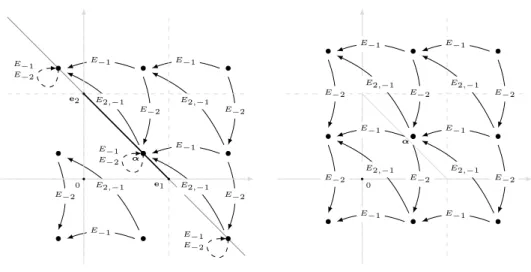
In§2.4, we study the dynamical symmetry algebra of the functionkΦ2. The terminology originates in a series of works by M. Ciftan and W. Miller, Jr. (e.g., [30, 121, 122, 123]) concerned with the ‘dynamical symmetric group’ of boson-operator realizations ofU(n) state vectors. For our purposes however, the dynamical symmetry algebra ofkΦ2 will be the minimal semi-simple Lie algebragk generated by some integro-differential operators, (See (2.4.10).) acting onkΦ2 by
Eαi:kΦ2[α]7−→αi kΦ2[α+ei],
E−αi:kΦ2[α]7−→(1−α1− · · · −αk)kΦ2[α−ei]
, i= 1, . . . , k ,
whereα∈Rk+ andei is theith vector in the canonical basis ofRk.
We show that — on the side of Fourier transforms — the discretization to ∆k−1 of the commutative action (1.3.6) extends to a non-commutative action of the semisimple Lie alge-bragk∼=slk+1. A probabilistic interpretation of this fact is given — on the side of distributions — in terms of the the Bayesian property ofDα, corresponding to the computation (Prop. 2.1.5.) of Dirichlet-categorical posteriors. As detailed in§2.1.2, this property of the Dirichlet distributions turns out to be intimately connected with representations of measurableSL2-currents briefly mentioned above.
1.6.2 The results in Chapter 3. Chapter 3 is a joint work with Prof. E. W. Lytvynov (Swansea University, Swansea, UK). Here, we give an independent proof of Sethuraman’s fixed
1.6.3 The results in Chapter 4 21
point identity (1.4.2), which we rather understand in integral form as the Mecke-type identity Z P dDσ(η) Z X F(η, x, ηx) dη(x) = Z P dDσ(η) Z X dσ(x) Z I F(ηrx, x, r) dB1,β(r), (1.6.1) whereσ=βσ,F:P×X×I→Ris any measurable semi-bounded function, and we setηx:=η{x} andηx
r:=(1−r)η+rδx. Our understanding is derived from the analogous identity (3.1.2) shown by J. Mecke for the Poisson measure Pσ. (See [119, Satz 3.1].) Formula (1.6.1) will be an important tool in establishing the closability of the Dirichlet form (1.6.4) in Chapter 5.
1.6.3 The results in Chapter 4. As shown by M. R¨ockner and A. Schied in [142], the intrinsic distance associated to Albeverio–Kondrat’ev–R¨ockner’s geometry [7] on Υ = Υ(M) is the (extended) L2-Wasserstein distance. The latter is defined by allowing for µ and ν
in (1.3.1) to be arbitrary non-negative (as opposed to: probability) measures6. The works by L. Decreusfond [36] and M. Erbar–M. Huesmann [51] confirmed that this choice is also natural with respect to the (curvature) properties ofM.
More precisely, R¨ockner–Schied [142] showed that the Dirichlet form EΥ
,D(EΥ )
defined in (1.2.10) has both the Rademacher and the Sobolev-to-Lipschitz properties defined in§1.1. In Chapter 4 below we advocate that these properties are natural requirements for a to-be “volume measure” on the spaceP2=P2(M). Combining the proof-strategy of [142] with N. Gigli’s fine analysis of the metric structure ofP2, we give sufficient assumptions for a probability measureP
onP2 to satisfy the Rademacher property.
Theorem. LetPbe a Borel probability measure onP2, quasi-invariant w.r.t. the action (1.3.8)
for everyw∈X∞, and additionally such that, for all finites≤t, forP-a.e.µ∈P Leb1-essinf
r∈[s,t]R w r(µ)>0, where Rwr := d(ψw,r.)] P⊗dr dP⊗dr .
Then, the quadratic form
E(u, v) := Z
P2
Gµ (∇u)(µ),(∇v)(µ)dP(µ), u, v∈ F C∞
is closable. Its closure(E,D(E))is a regular, strongly local Dirichlet form onL2P