Least squares estimation for the subcritical Heston model
based on continuous time observations
M´aty´as Barczy∗,, Bal´azs Nyul∗∗ and Gyula Pap∗∗∗
* MTA-SZTE Analysis and Stochastics Research Group, Bolyai Institute, University of Szeged, Aradi v´ertan´uk tere 1, H–6720 Szeged, Hungary.
** Faculty of Informatics, University of Debrecen, Pf. 12, H–4010 Debrecen, Hungary. *** Bolyai Institute, University of Szeged, Aradi v´ertan´uk tere 1, H–6720 Szeged, Hungary. e–mails: [email protected] (M. Barczy), [email protected] (B. Nyul), [email protected] (G. Pap).
Corresponding author.
Abstract
We prove strong consistency and asymptotic normality of least squares estimators for the sub-critical Heston model based on continuous time observations. We also present some numerical illustrations of our results.
1
Introduction
Stochastic processes given by solutions to stochastic differential equations (SDEs) have been frequently applied in financial mathematics. So the theory and practice of stochastic analysis and statistical inference for such processes are important topics. In this note we consider such a model, namely the Heston model ( dYt= (a−bYt) dt+σ1 √ YtdWt, dXt= (α−βYt) dt+σ2 √ Yt %dWt+ p 1−%2dB t , t>0, (1.1)
where a >0, b, α, β∈R, σ1 >0, σ2 >0, %∈(−1,1), and (Wt, Bt)t>0 is a 2-dimensional standard
Wiener process, see Heston [14]. For interpretation of Y and X in financial mathematics, see, e.g., Hurn et al. [20, Section 4], here we only note that Xt is the logarithm of the asset price at time t and Yt its volatility for each t>0. The first coordinate process Y is called a Cox-Ingersoll-Ross (CIR) process (see Cox, Ingersoll and Ross [9]), square root process or Feller process.
Parameter estimation for the Heston model (1.1) has a long history, for a short survey of the most recent results, see, e.g., the introduction of Barczy and Pap [5]. The importance of the joint estimation of (a, b, α, β) and not only of (a, b) stems from the fact that Xt is the logarithm of the asset price at time t having high importance in finance. In fact, in Barczy and Pap [5], we investigated asymptotic properties of maximum likelihood estimator of (a, b, α, β) based on continuous time observations
2010 Mathematics Subject Classifications: 60H10, 91G70, 60F05, 62F12.
Key words and phrases: Heston model, least squares estimator, strong consistency, asymptotic normality
(Xt)t∈[0,T], T >0. In Barczy et al. [6] we studied asymptotic behaviour of conditional least squares
estimator of (a, b, α, β) based on discrete time observations (Yi, Xi), i = 1, . . . , n, starting the process from some known non-random initial value (y0, x0)∈(0,∞)×R. In this note we study least
squares estimator (LSE) of (a, b, α, β) based on continuous time observations (Xt)t∈[0,T], T > 0,
starting the process (Y, X) from some known initial value (Y0, X0) satisfying P(Y0 ∈(0,∞)) = 1.
The investigation of the LSE of (a, b, α, β) based on continuous time observations (Xt)t∈[0,T],T >0,
is motivated by the fact that the LSEs of (a, b, α, β) based on appropriate discrete time observations converge in probability to the LSE of (a, b, α, β) based on continuous time observations (Xt)t∈[0,T],
T >0, see Proposition 3.1. We do not suppose that the process (Yt)t∈[0,T] is observed, since it can
be determined using the observations (Xt)t∈[0,T] and the initial value Y0, which follows by a slight
modification of Remark 2.5 in Barczy and Pap [5] (replacing y0 by Y0). We do not estimate the
parameters σ1, σ2 and %, since these parameters could —in principle, at least— be determined
(rather than estimated) using the observations (Xt)t∈[0,T] and the initial value Y0, see Barczy and
Pap [5, Remark 2.6]. We investigate only the so-called subcritical case, i.e., when b >0, see Definition 2.3.
In Section 2 we recall some properties of the Heston model (1.1) such as the existence and unique-ness of a strong solution of the SDE (1.1), the form of conditional expectation of (Yt, Xt), t > 0, given the past of the process up to time s with s∈[0, t], a classification of the Heston model and the existence of a unique stationary distribution and ergodicity for the first coordinate process of the SDE (1.1). Section 3 is devoted to derive a LSE of (a, b, α, β) based on continuous time observations (Xt)t∈[0,T], T >0, see Proposition 3.1. We note that Overbeck and Ryd´en [27, Theorems 3.5 and 3.6]
have already proved the strong consistency and asymptotic normality of the LSE of (a, b) based on continuous time observations (Yt)t∈[0,T],T >0, in case of a subcritical CIR process Y with an initial
value having distribution as the unique stationary distribution of the model. Overbeck and Ryd´en [27, page 433] also noted that (without providing a proof) their results are valid for an arbitrary initial distribution using some coupling argument. In Section 4 we prove strong consistency and asymptotic normality of the LSE of (a, b, α, β) introduced in Section 3, so our results for the Heston model (1.1) in Section 3 can be considered as generalizations of the corresponding ones in Overbeck and Ryd´en [27, Theorems 3.5 and 3.6] with the advantage that our proof is presented for an arbitrary initial value (Y0, X0) satisfying P(Y0∈(0,∞)) = 1, without using any coupling argument. The covariance matrix
of the limit normal distribution in question depends on the unknown parameters a and b as well, but somewhat surprisingly not on α and β. We point out that our proof of technique for deriving the asymptotic normality of the LSE in question is completely different from that of Overbeck and Ryd´en [27]. We use a limit theorem for continuous martingales (see, Theorem 2.6), while Overbeck and Ryd´en [27] use a limit theorem for ergodic processes due to Jacod and Shiryaev [21, Theorem VIII.3.79] and the so-called Delta method (see, e.g., Theorem 11.2.14 in Lehmann and Romano [24]). We also remark that the approximation in probability of the LSE of (a, b, α, β) based on continuous time observations (Xt)t∈[0,T], T > 0, given in Proposition 3.1 is not at all used for proving the
asymptotic behaviour of the LSE in question as T → ∞ in Theorems 4.1 and 4.2. Further, we mention that the covariance matrix of the limit normal distribution in Theorem 3.6 in Overbeck and Ryd´en [27] is somewhat complicated, while, as a special case of our Theorem 4.2, it turns out that it can be written in a much simpler form by making a simple reparametrization of the SDE (1) in Overbeck and Ryd´en [27], estimating −b instead of b (with the notations of Overbeck and Ryd´en [27]), i.e., considering the SDE (1.1) and estimating b (with our notations), see Corollary 4.3. Section
5 is devoted to present some numerical illustrations of our results in Section 4.
2
Preliminaires
Let N, Z+, R, R+, R++, R− and R−− denote the sets of positive integers, non-negative
integers, real numbers, non-negative real numbers, positive real numbers, non-positive real numbers and negative real numbers, respectively. For x, y ∈R, we will use the notation x∧y:= min(x, y). By kxk and kAk, we denote the Euclidean norm of a vector x∈Rd and the induced matrix norm of a matrix A∈Rd×d, respectively. By Id∈Rd×d, we denote thed-dimensional unit matrix.
Let Ω,F,P be a probability space equipped with the augmented filtration (Ft)t∈R+
corre-sponding to (Wt, Bt)t∈R+ and a given initial value (η0, ζ0) being independent of (Wt, Bt)t∈R+ such
that P(η0 ∈R+) = 1, constructed as in Karatzas and Shreve [22, Section 5.2]. Note that (Ft)t∈R+
satisfies the usual conditions, i.e., the filtration (Ft)t∈R+ is right-continuous and F0 contains all the P-null sets in F.
By Cc2(R+×R,R) and Cc∞(R+×R,R), we denote the set of twice continuously differentiable
real-valued functions on R+×R with compact support, and the set of infinitely differentiable real-valued
functions on R+×R with compact support, respectively.
The next proposition is about the existence and uniqueness of a strong solution of the SDE (1.1), see, e.g., Barczy and Pap [5, Proposition 2.1].
2.1 Proposition. Let (η0, ζ0) be a random vector independent of (Wt, Bt)t∈R+ satisfying P(η0 ∈
R+) = 1. Then for all a∈R++, b, α, β ∈R, σ1, σ2 ∈R++, and %∈(−1,1), there is a pathwise unique strong solution (Yt, Xt)t∈R+ of the SDE (1.1) such that P((Y0, X0) = (η0, ζ0)) = 1 and P(Yt∈R+ for all t∈R+) = 1. Further, for all s, t∈R+ with s6t,
( Yt= e−b(t−s)Ys+a Rt se −b(t−u)du+σ 1 Rt se −b(t−u)√Y udWu, Xt=Xs+ Rt s(α−βYu) du+σ2 Rt s √ Yud(%Wu+ p 1−%2B u). (2.1)
Next we present a result about the first moment and the conditional moment of (Yt, Xt)t∈R+, see
Barczy et al. [6, Proposition 2.2].
2.2 Proposition. Let (Yt, Xt)t∈R+ be the unique strong solution of the SDE (1.1)satisfying P(Y0 ∈
R+) = 1 and E(Y0)<∞, E(|X0|)<∞. Then for all s, t∈R+ with s6t, we have
E(Yt| Fs) = e−b(t−s)Ys+a Z t s e−b(t−u)du, (2.2) E(Xt| Fs) =Xs+ Z t s (α−βE(Yu| Fs)) du (2.3) =Xs+α(t−s)−βYs Z t s e−b(u−s)du−aβ Z t s Z u s e−b(u−v)dv du, and hence " E(Yt) E(Xt) # = " e−bt 0 −βRt e−budu 1 # " E(Y0) E(X0) # + " Rt 0e −budu 0 −βRt Ru e−bvdv du t # " a α # .
Consequently, if b∈R++, then lim t→∞E(Yt) = a b, tlim→∞t −1 E(Xt) =α− βa b , if b= 0, then lim t→∞t −1 E(Yt) =a, lim t→∞t −2 E(Xt) =−1 2βa, if b∈R−−, then lim t→∞e bt E(Yt) =E(Y0)− a b, tlim→∞e bt E(Xt) = β b E(Y0)− βa b2.
Based on the asymptotic behavior of the expectations (E(Yt),E(Xt)) as t → ∞, we recall a classification of the Heston process given by the SDE (1.1), see, Barczy and Pap [5, Definition 2.3].
2.3 Definition. Let (Yt, Xt)t∈R+ be the unique strong solution of the SDE (1.1) satisfying P(Y0 ∈
R+) = 1. We call (Yt, Xt)t∈R+ subcritical, critical or supercritical if b∈R++, b= 0 or b∈R−−,
respectively.
In the sequel −→P , −→L and −→a.s. will denote convergence in probability, in distribution and almost surely, respectively.
The following result states the existence of a unique stationary distribution and the ergodicity for the process (Yt)t∈R+ given by the first equation in (1.1) in the subcritical case, see, e.g., Cox et al.
[9, Equation (20)], Li and Ma [25, Theorem 2.6] or Theorem 3.1 with α = 2 and Theorem 4.1 in Barczy et al. [4].
2.4 Theorem. Let a, b, σ1∈R++. Let (Yt)t∈R+ be the unique strong solution of the first equation
of the SDE (1.1)satisfying P(Y0∈R+) = 1. Then
(i) Yt−→L Y∞ as t→ ∞, and the distribution of Y∞ is given by
E(e−λY∞) = 1 +σ 2 1 2bλ −2a/σ2 1 , λ∈R+, (2.4)
i.e., Y∞ has Gamma distribution with parameters 2a/σ21 and 2b/σ21, hence
E(Y∞) = a b, E(Y 2 ∞) = (2a+σ12)a 2b2 , E(Y 3 ∞) = (2a+σ12)(a+σ12)a 2b3 .
(ii) supposing that the random initial value Y0 has the same distribution as Y∞, the process
(Yt)t∈R+ is strictly stationary.
(iii) for all Borel measurable functions f :R→R such that E(|f(Y∞)|)<∞, we have
(2.5) 1
T
Z T
0
f(Ys) ds−→a.s. E(f(Y∞)) as T → ∞.
In what follows we recall some limit theorems for continuous (local) martingales. We will use these limit theorems later on for studying the asymptotic behaviour of least squares estimators of (a, b, α, β). First we recall a strong law of large numbers for continuous local martingales.
2.5 Theorem. (Liptser and Shiryaev [26, Lemma 17.4]) Let Ω,F,(Ft)t∈R+,P
be a filtered probability space satisfying the usual conditions. Let (Mt)t∈R+ be a square-integrable continuous local
martingale with respect to the filtration (Ft)t∈R+ such that P(M0 = 0) = 1. Let (ξt)t∈R+ be a
progressively measurable process such that P R0tξ2udhMiu <∞
= 1, t∈R+, and Z t 0 ξu2dhMiu−→ ∞a.s. as t→ ∞, (2.6)
where (hMit)t∈R+ denotes the quadratic variation process of M. Then
Rt 0ξudMu Rt 0 ξ2udhMiu a.s. −→0 as t→ ∞. (2.7)
If (Mt)t∈R+ is a standard Wiener process, the progressive measurability of (ξt)t∈R+ can be relaxed
to measurability and adaptedness to the filtration (Ft)t∈R+.
The next theorem is about the asymptotic behaviour of continuous multivariate local martingales, see van Zanten [28, Theorem 4.1].
2.6 Theorem. (van Zanten [28, Theorem 4.1])Let Ω,F,(Ft)t∈R+,P
be a filtered probability space satisfying the usual conditions. Let (Mt)t∈R+ be a d-dimensional square-integrable continuous
local martingale with respect to the filtration (Ft)t∈R+ such that P(M0 = 0) = 1. Suppose that
there exists a function Q:R+→Rd×d such that Q(t) is an invertible (non-random) matrix for all
t∈R+, limt→∞kQ(t)k= 0 and
Q(t)hMitQ(t)> −→P ηη> as t→ ∞,
where η is a d×drandom matrix. Then, for eachRk-valued random vector v defined on (Ω,F,P),
we have
(Q(t)Mt,v)
L
−→(ηZ,v) as t→ ∞,
where Z is a d-dimensional standard normally distributed random vector independent of (η,v).
We note that Theorem 2.6 remains true if the function Q is defined only on an interval [t0,∞)
with some t0 ∈R++.
3
Existence of LSE based on continuous time observations
First, we define the LSE of (a, b, α, β) based on discrete time observations (Yi n, X
i
n)i∈{0,1,...,bnTc},
n∈N, T ∈R++ (see (3.1)) by pointing out that the sum appearing in this definition of LSE can be
considered as an approximation of the corresponding sum of the conditional LSE of (a, b, α, β) based on discrete time observations (Yi
n, X i
n)i∈{0,1,...,bnTc}, n
∈N, T ∈R++ (which was investigated in
Barczy et al. [6]). Then we introduce the LSE of (a, b, α, β) based on continuous time observations (Xt)t∈[0,T],T ∈R++ (see (3.4) and (3.5)) as the limit in probability of the LSE of (a, b, α, β) based
on discrete time observations (Yi n, X
i
n)i∈{0,1,...,bnTc}, n
A LSE of (a, b, α, β) based on discrete time observations (Yi n, X
i
n)i∈{0,1,...,bnTc}, n
∈N, T ∈R++,
can be obtained by solving the extremum problem
ba LSE,D T ,n ,bb LSE,D T,n ,αb LSE,D T ,n ,βb LSE,D T ,n := arg min (a,b,α,β)∈R4 bnTc X i=1 " Yi n −Yi−1 n − 1 n a−bYi−1 n 2 + Xi n −Xi−1 n − 1 n α−βYi−1 n 2 # . (3.1)
Here in the notations the letter D refers to discrete time observations. This definition of LSE can be considered as the corresponding one given in Hu and Long [17, formula (1.2)] for generalized Ornstein-Uhlenbeck processes driven by α-stable motions, see also Hu and Long [18, formula (3.1)]. For a heuristic motivation of the LSE (3.1) based on the discrete observations, see, e.g., Hu and Long [16, page 178] (formulated for Langevin equations), and for a mathematical one, see as follows. By (2.2), for all i∈N, Yi n −E(Yi n | Fi−1 n ) =Y i n −e−nbYi−1 n −a Z i n i−1 n e−b(ni−u)du=Yi n −e−nbYi−1 n −a Z 1 n 0 e−bvdv = Yi n −Yi−1 n −an if b= 0, Yi n −e−nbYi−1 n + a b(e −nb −1) if b6= 0.
Using first order Taylor approximation of e−nb at b= 0 by 1− b
n, and that of a b(e −b n −1) at (a, b) = (0,0) by −a
n, the random variable Yni −Yi−n1 −
1
n(a−bYi−n1) in the definition (3.1) of the LSE of (a, b, α, β) can be considered as a first order Taylor approximation of
Yi n −E(Y i n|Y0, X0, Y 1 n, X 1 n, . . . , Y i−1 n , Xi−1 n ) =Yi n −E(Y i n| F i−1 n ),
which appears in the definition of the conditional LSE of (a, b, α, β) based on discrete time observa-tions (Yi
n, X i
n)i∈{0,1,...,bnTc}, n
∈N, T ∈R++. Similarly, by (2.3), for all i∈N,
Xi n −E(Xi n | Fi−1 n ) =X i n −Xi−1 n −α n +βYi−n1 Z i n i−1 n e−b(u−i−n1) du+aβ Z i n i−1 n Z u i−1 n e−b(u−v)dv ! du =Xi n −Xi−1 n −α n +βYi−n1 Z n1 0 e−budu+aβ Z 1n 0 Z u 0 e−bvdv du = Xi n −Xi−1 n −αn+βnYi−1 n + aβ 2n2 if b= 0, Xi n −Xi−1 n −α n+ β b(1−e −b n)Yi−1 n + aβ b 1 n− 1−e−nb b if b6= 0.
Using first order Taylor approximation of 2aβn2 at (a, β) = (0,0) by 0, that of
β b(1−e
−b n) at
(b, β) = (0,0) by βn, and that of aβb 1n−1−e− b n b = aβn2 P∞ k=0(−1)k (b/n)k (k+2)! at (a, b, β) = (0,0,0) by
0, the random variable Xi n
−Xi−1
n − 1
n(α−βYi−n1) in the definition (3.1) of the LSE of (a, b, α, β) can be considered as a first order Taylor approximation of
Xi n −E(X i n|Y0, X0, Y 1 n, X 1 n, . . . , Y i−1 n , Xi−1 n ) =Xi n −E(X i n| F i−1 n ),
which appears in the definition of the conditional LSE of (a, b, α, β) based on discrete time observa-tions (Yi
n, X i
n)i∈{0,1,...,bnTc}, n
We note that in Barczy et al. [6] we proved strong consistency and asymptotic normality of conditional LSE of (a, b, α, β) based on discrete time observations (Yi, Xi)i∈{1,...,n}, n∈N, starting
the process from some known non-random initial value (y0, x0) ∈ R++×R, as the sample size n
tends to infinity in the subcritical case.
Solving the extremum problem (3.1), we have
ba LSE,D T ,n ,bb LSE,D T,n = arg min (a,b)∈R2 bnTc X i=1 Yi n −Yi−1 n − 1 n a−bYi−1 n 2 , b αLSET ,n,D,βb LSE,D T ,n = arg min (α,β)∈R2 bnTc X i=1 Xi n −Xi−1 n − 1 n α−βYi−1 n 2 ,
hence, similarly as on page 675 in Barczy et al. [3], we get
ba LSE,D T ,n bbLSET ,n,D =n bnTc −Pbi=1nTcYi−1 n −Pbi=1nTcYi−1 n PbnTc i=1 Yi2−1 n −1 YbnTc n −Y0 −Pbi=1nTc(Yi n −Yi−1 n )Yi−1 n , (3.2) and b αLSET,n,D b βT ,nLSE,D =n bnTc −Pbi=1nTcYi−1 n −Pbi=1nTcYi−1 n PbnTc i=1 Yi2−1 n −1 XbnTc n −X0 −Pbi=1nTc(Xi n −X i−1 n )Yi−1 n , (3.3)
provided that the inverse exists, i.e., bnTcPbi=1nTcYi2−1
n > PbnTc i=1 Yi−1 n 2 . By Lemma 3.1
in Barczy et al. [6], for all n ∈ N and T ∈ R++ with bnTc > 2, we have
P bnTcPbi=1nTcYi2−1 n > PbnTc i=1 Yi−n1 2 = 1. 3.1 Proposition. If a∈R++, b∈R, α, β ∈R, σ1, σ2∈R++, ρ∈(−1,1), and P(Y0∈R++) = 1,
then for any T ∈R++, we have b aLSET ,n,D bbLSET ,n,D b αLSET,n,D b βT ,nLSE,D P −→ ba LSE T bbLSET b αLSET b βTLSE as n→ ∞, where " b aLSET bbLSET # := " T −RT 0 Ysds −RT 0 Ysds RT 0 Y 2 s ds #−1" YT −Y0 −RT 0 YsdYs # = 1 TRT 0 Ys2ds− RT 0 Ysds 2 " (YT −Y0) RT 0 Y 2 s ds− RT 0 Ysds RT 0 YsdYs (YT −Y0) RT 0 Ysds−T RT 0 YsdYs # , (3.4)
and " b αLSET b βTLSE # := " T −RT 0 Ysds −RT 0 Ysds RT 0 Y 2 s ds #−1" XT −X0 −RT 0 YsdXs # = 1 TRT 0 Ys2ds− RT 0 Ysds 2 " (XT −X0) RT 0 Y 2 s ds− RT 0 Ysds RT 0 YsdXs (XT −X0) RT 0 Ysds−T RT 0 YsdXs # , (3.5)
which exist almost surely, since
P T Z T 0 Ys2ds > Z T 0 Ysds 2! = 1 for all T ∈R++. (3.6) By definition, we call ba LSE
T ,bbLSET ,αbLSET ,βbTLSE
the LSE of (a, b, α, β) based on continuous time observations (Xt)t∈[0,T], T ∈R++.
Proof. First, we check (3.6). Note that P(R0T Ysds < ∞) = 1 and P(R0T Ys2ds < ∞) = 1 for all
T ∈R+, since Y has continuous trajectories almost surely. For each T ∈R++, put
AT :={ω ∈Ω :t7→Yt(ω) is continuous and non-negative on [0, T]}.
Then AT ∈ F, P(AT) = 1, and for all ω ∈AT, by the Cauchy–Schwarz’s inequality, we have
T Z T 0 Ys(ω)2ds> Z T 0 Ys(ω) ds 2 , and TR0TYs(ω)2ds−RT 0 Ys(ω) ds 2
= 0 if and only if Ys(ω) = KT(ω) for almost every s ∈
[0, T] with some KT(ω) ∈ R+. Hence Ys(ω) = Y0(ω) for all s ∈ [0, T] if ω ∈ AT and TR0T Ys2(ω) ds−RT
0 Ys(ω) ds 2
= 0. Consequently, using that P(AT) = 1, we have
P T Z T 0 Ys2ds− Z T 0 Ysds 2 = 0 ! =P ( T Z T 0 Ys2ds− Z T 0 Ysds 2 = 0 ) ∩AT ! 6P(Ys=Y0, ∀s∈[0, T])6P(YT =Y0) = 0,
where the last equality follows by the fact that YT is absolutely continuous (see, e.g., Alfonsi [2, Proposition 1.2.11]) together with the law of total probability. Hence P
TRT 0 Y 2 s ds− RT 0 Ysds 2 = 0= 0, yielding (3.6). Further, we have 1 n bnTc −Pbi=1nTcYi−1 n −Pbi=1nTcYi−1 n PbnTc i=1 Yi2−1 n a.s. −→ " T −RT 0 Ysds −RT 0 Ysds RT 0 Y 2 s ds # as n→ ∞,
since (Yt)t∈R+ is almost surely continuous. By Proposition I.4.44 in Jacod and Shiryaev [21] with
the Riemann sequence of deterministic subdivisions ni ∧Ti∈
continuity of (Yt, Xt)t∈R+, we obtain YbnTc n −Y0 −Pbi=1nTc(Yi n −Yi−1 n )Yi−1 n P −→ " YT −Y0 −RT 0 YsdYs # as n→ ∞, XbnTc n −X0 −Pbi=1nTc(Xi n −Xi−1 n )Y i−1 n P −→ " XT −X0 −RT 0 YsdXs # as n→ ∞.
By Slutsky’s lemma, using also (3.2), (3.3) and (3.6), we obtain the assertion. 2 Note that Proposition 3.1 is valid for all b∈R, i.e., not only for subcritical Heston models. We call the attention that (baLSET ,bbLSET ,
b
αTLSE,βbTLSE) can be considered to be based only on
(Xt)t∈[0,T], since the process (Yt)t∈[0,T] can be determined using the observations (Xt)t∈[0,T] and
the initial value Y0, see Barczy and Pap [5, Remark 2.5]. We also point out that Overbeck and
Ryd´en [27, formulae (22) and (23)] have already come up with the definition of LSE (baLSET ,bbLSET )
of (a, b) based on continuous time observations (Yt)t∈[0,T], T ∈ R++, for the CIR process Y.
They investigated only the CIR process Y, so our definitions (3.4) and (3.5) can be considered as generalizations of formulae (22) and (23) in Overbeck and Ryd´en [27] for the Heston model (1.1). Overbeck and Ryd´en [27, Theorem 3.4] also proved that the LSE of (a, b) based on continuous time observations can be approximated in probability by conditional LSEs of (a, b) based on appropriate discrete time observations.
In the next remark we point out that the LSE of (a, b, α, β) given in (3.4) and (3.5) can be ap-proximated using discrete time observations for X, which can be reassuring for practical applications, where data in continuous record is not available.
3.2 Remark. The stochastic integral RT
0 YsdYs in (3.4) is a measurable function of (Xs)s∈[0,T]
and Y0. Indeed, for all t ∈ [0, T], Yt and
Rt
0 Ysds are measurable functions of (Xs)s∈[0,T]
and Y0, i.e., they can be determined from a sample (Xs)s∈[0,T] and Y0 following from a slight
modification of Remark 2.5 in Barczy and Pap [5] (replacing y0 by Y0), and, by Itˆo’s formula, we
have d(Y2 t ) = 2YtdYt+σ12Ytdt, t ∈ R+, implying that RT 0 YsdYs = 1 2 YT2−Y02−σ12 RT 0 Ysds , T ∈R+. For the stochastic integral RT
0 YsdXs in (3.5), we have (3.7) bnTc X i=1 Yi−1 n (X i n −Xi−1 n ) P −→ Z T 0 YsdXs as n→ ∞,
following from Proposition I.4.44 in Jacod and Shiryaev [21] with the Riemann sequence of determinis-tic subdivisions ni ∧T
i∈N, n∈N. Thus, there exists a measurable function Φ :C([0, T],R)×R→R
such that R0TYsdXs= Φ((Xs)s∈[0,T], Y0), since the convergence in (3.7) holds almost surely along a
suitable subsequence, for each n∈N, the members of the sequence in (3.7) are measurable functions of (Xs)s∈[0,T] and Y0, and one can use Theorems 4.2.2 and 4.2.8 in Dudley [13]. Hence the right
hand sides of (3.4) and (3.5) are measurable functions of (Xs)s∈[0,T] and Y0, i.e., they are statistics.
Using the SDE (1.1) and Corollary 3.2.20 in Karatzas and Shreve [22], one can check that " b aLSET −a bbLSET −b # = " T −RT 0 Ysds −RT 0 Ysds RT 0 Y 2 s ds #−1" σ1 RT 0 Y 1/2 s dWs −σ1 RT 0 Y 3/2 s dWs # , " b αLSET −α b βTLSE−β # = " T −RT 0 Ysds −RT 0 Ysds RT 0 Y 2 s ds #−1" σ2 RT 0 Y 1/2 s dWsf −σ2 RT 0 Y 3/2 s dWsf # , provided that TRT 0 Y 2 s ds > RT 0 Ysds 2 , where fWt:=%Wt+ p 1−%2B t, t∈R+, and hence ba LSE T −a= σ1 RT 0 Y 1/2 s dWs RT 0 Y 2 s ds −σ1 RT 0 Ysds RT 0 Y 3/2 s dWs TRT 0 Ys2ds− RT 0 Ysds 2 , bbLSET −b= σ1 RT 0 Y 1/2 s dWs RT 0 Ysds −σ1T RT 0 Y 3/2 s dWs TRT 0 Ys2ds− RT 0 Ysds 2 , b αLSET −α= σ2 RT 0 Y 1/2 s dWsf RT 0 Y 2 s ds −σ2 RT 0 Ysds RT 0 Y 3/2 s dWsf TR0T Y2 s ds− RT 0 Ysds 2 , b βTLSE−β = σ2 RT 0 Y 1/2 s dWfs RT 0 Ysds −σ2T RT 0 Y 3/2 s dfWs TRT 0 Ys2ds− RT 0 Ysds 2 , (3.8) provided that TRT 0 Ys2ds > RT 0 Ysds 2 .
4
Consistency and asymptotic normality of LSE
Our first result is about the consistency of LSE in case of subcritical Heston models.
4.1 Theorem. If a, b, σ1, σ2 ∈ R++, α, β ∈ R, % ∈ (−1,1), and P((Y0, X0) ∈ R++×R) = 1,
then the LSE of (a, b, α, β) is strongly consistent, i.e., baLSET ,bbTLSE,αbLSET ,βbTLSE a.s.
−→ (a, b, α, β) as
T → ∞.
Proof. By Proposition 3.1, there exists a unique LSE baLSE
T ,bbLSET ,αbLSET ,βbTLSE
of (a, b, α, β) for all T ∈R++. By (3.8), we have ba LSE T −a= σ1·T1 RT 0 Ysds· 1 T RT 0 Y 2 s ds· RT 0 Y 1/2 s dWs RT 0 Ysds −σ1·T1 RT 0 Ysds· 1 T RT 0 Y 3 s ds· RT 0 Y 3/2 s dWs RT 0 Ys3ds 1 T RT 0 Ys2ds− 1 T RT 0 Ysds 2
provided that R0T Ysds∈R++, which holds almost surely, see the proof of Proposition 3.1. Since, by
part (i) of Theorem 2.4, E(Y∞), E(Y∞2),E(Y∞3)∈R++, part (iii) of Theorem 2.4 yields
1 T Z T 0 Ysds−→a.s. E(Y∞), 1 T Z T 0 Ys2ds−→a.s. E(Y∞2), 1 T Z T 0 Ys3ds−→a.s. E(Y∞3)
as T → ∞, and then Z T 0 Ysds a.s. −→ ∞, Z T 0 Ys2ds−→ ∞a.s. , Z T 0 Ys3ds−→ ∞a.s.
as T → ∞. Hence, by a strong law of large numbers for continuous local martingales (see, e.g., Theorem 2.5), we obtain b aLSET −a−→a.s. σ1·E(Y∞)·E(Y 2 ∞)·0−σ1·E(Y∞)·E(Y∞3)·0 E(Y∞2)−(E(Y∞))2 = 0 as T → ∞,
where for the last step we also used that E(Y∞2)−(E(Y∞))2 = aσ
2 1 2b2 ∈R++. Similarly, by (3.8), bbLSET −b= σ1· 1 T RT 0 Ysds 2 · RT 0 Y 1/2 s dWs RT 0 Ysds −σ1·T1 RT 0 Ys3ds· RT 0 Y 3/2 s dWs RT 0 Ys3ds 1 T RT 0 Ys2ds− 1 T RT 0 Ysds 2 a.s. −→ σ1·(E(Y∞)) 2·0−σ 1·E(Y∞3)·0 E(Y∞2)−(E(Y∞))2 = 0 as T → ∞.
One can prove
b
αLSET −α−→a.s. 0 and βbTLSE−β a.s.
−→0 as T → ∞
in a similar way. 2
Our next result is about the asymptotic normality of LSE in case of subcritical Heston models.
4.2 Theorem. If a, b, σ1, σ2 ∈R++, α, β ∈R, %∈(−1,1) and P((Y0, X0)∈R++×R) = 1, then
the LSE of (a, b, α, β) is asymptotically normal, i.e.,
T12 b aLSET −a bbLSET −b b αLSET −α b βLSE T −β L −→ N4 0,S⊗ (2a+σ21)a σ2 1b 2a+σ21 σ2 1 2a+σ2 1 σ2 1 2b(a+σ2 1) σ2 1a as T → ∞, (4.1)
where ⊗ denotes the tensor product of matrices, and
S := " σ12 %σ1σ2 %σ1σ2 σ22 # .
With a random scaling, we have
E− 1 2 1,T I2⊗ (T E2,T −E12,T) E1,TE3,T −E22,T −12 0 −T E1,T ba LSE T −a bbLSET −b b αLSET −α b βTLSE−β L −→ N4(0,S⊗I2) (4.2) → ∞ RT i ∈
Proof. By Proposition 3.1, there exists a unique LSE ba LSE
T ,bbLSET ,αbLSET ,βbTLSE of (a, b, α, β). By (3.8), we have √ T(baLSET −a) = 1 T RT 0 Y 2 s ds ·√σ1T RT 0 Y 1/2 s dWs−T1 RT 0 Ysds · σ1 √ T RT 0 Y 3/2 s dWs 1 T RT 0 Ys2ds− 1 T RT 0 Ysds 2 , √ T(bbLSET −b) = 1 T RT 0 Ysds · σ1 √ T RT 0 Y 1/2 s dWs−√σ1T RT 0 Y 3/2 s dWs 1 T RT 0 Ys2ds− 1 T RT 0 Ysds 2 , √ T(αbLSET −α) = 1 T RT 0 Ys2ds ·√σ2T RT 0 Y 1/2 s dfWs−T1 RT 0 Ysds · σ2 √ T RT 0 Y 3/2 s dWsf 1 T RT 0 Ys2ds− 1 T RT 0 Ysds 2 , √ T(βbLSET −β) = 1 T RT 0 Ysds · σ2 √ T RT 0 Y 1/2 s dWsf −√σ2 T RT 0 Y 3/2 s dWsf 1 T RT 0 Ys2ds− 1 T RT 0 Ysds 2 , provided that TRT 0 Ys2ds > RT 0 Ysds 2
, which holds almost surely. Consequently,
√ T b aLSET −a bbLSET −b b αLSET −α b βTLSE−β = 1 1 T RT 0 Ys2ds− 1 T RT 0 Ysds 2 I2⊗ "1 T RT 0 Ys2ds T1 RT 0 Ysds 1 T RT 0 Ysds 1 #! 1 √ TMT = I2⊗ " 1 −T1 RT 0 Ysds −1 T RT 0 Ysds 1 T RT 0 Y 2 s ds #−1 1 √ TMT, (4.3) provided that TRT 0 Y 2 s ds > RT 0 Ysds 2
, which holds almost surely, where
Mt:= σ1 Rt 0Y 1/2 s dWs −σ1 Rt 0Y 3/2 s dWs σ2 Rt 0Y 1/2 s dWfs −σ2 Rt 0Y 3/2 s dWfs , t∈R+,
is a 4-dimensional square-integrable continuous local martingale due to R0tE(Ys) ds < ∞ and
Rt 0 E(Y
3
s) ds <∞,t∈R+. Next, we show that
1 √ TMT L −→ηZ as T → ∞, (4.4)
where Z is a 4-dimensional standard normally distributed random vector and η∈R4×4 such that
ηη>=S⊗ " E(Y∞) −E(Y∞2) −E(Y∞2) E(Y∞3) # .
Here the two symmetric matrices on the right hand side are positive definite, since σ1, σ2 ∈ R++, %∈(−1,1), E(Y∞) = ab ∈R++ and E(Y∞)E(Y∞3)−(−E(Y∞2))2 = a2σ12 4b4 (2a+σ 2 1)∈R++,
and, so is their Kronecker product. Hence η can be chosen, for instance, as the uniquely defined symmetric positive definite square root of the Kronecker product of the two matrices in question. We have hMit=S⊗ " Rt 0Ysds − Rt 0 Y 2 s ds −Rt 0Ys2ds Rt 0Ys3ds # , t∈R+. By Theorem 2.4, we have Q(t)hMitQ(t)>−→a.s. S⊗ " E(Y∞) −E(Y∞2) −E(Y∞2) E(Y∞3) # as t→ ∞
with Q(t) :=t−1/2I4, t∈R++. Hence, Theorem 2.6 yields (4.4). Then, by (4.3), Slutsky’s lemma
yields √ T b aLSE T −a bbLSET −b b αLSET −α b βTLSE−β L −→ I2⊗ " 1 −E(Y∞) −E(Y∞) E(Y∞2) #−1 ηZ L =N4(0,Σ) as T → ∞,
where (applying the identities (A⊗B)> =A>⊗B> and (A⊗B)(C⊗D) = (AC)⊗(BD))
Σ:= I2⊗ " 1 −E(Y∞) −E(Y∞) E(Y∞2) #−1 ηE(ZZ>)η> I2⊗ " 1 −E(Y∞) −E(Y∞) E(Y∞2) #−1 > = I2⊗ " 1 −E(Y∞) −E(Y∞) E(Y∞2) #−1 S⊗ " E(Y∞) −E(Y∞2) −E(Y∞2) E(Y∞3) #! I2⊗ " 1 −E(Y∞) −E(Y∞) E(Y∞2) #−1 = (I2SI2)⊗ " 1 −E(Y∞) −E(Y∞) E(Y∞2) #−1" E(Y∞) −E(Y∞2) −E(Y∞2) E(Y∞3) # " 1 −E(Y∞) −E(Y∞) E(Y∞2) #−1 = 1 (E(Y∞2)−(E(Y∞))2)2 ×S⊗ " E(Y∞)E(Y∞3)−(E(Y∞2))2 E(Y∞) E(Y∞)E(Y∞3)−(E(Y∞2))2 E(Y∞)E(Y∞3)−(E(Y∞2))2 E(Y∞3)−2E(Y∞)E(Y∞2) + (E(Y∞))3 # ,
which yields (4.1). Indeed, by Theorem 2.4, an easy calculation shows that E(Y∞)E(Y∞3)−(E(Y∞2))2 E(Y∞) = a3σ21 4b5 (2a+σ 2 1), E(Y∞)E(Y∞3)−(E(Y∞2))2= a2σ2 1 4b4 (2a+σ 2 1), E(Y∞3)−2E(Y∞)E(Y∞2) + (E(Y∞))3 = aσ12 2b3(a+σ 2 1), E(Y∞2)−(E(Y∞))2 = aσ12 2b2. (4.5)
Now we turn to prove (4.2). Slutsky’s lemma, (4.1) and (4.5) yield
E− 1 2 1,T I2⊗ (T E2,T −E21,T) E1,TE3,T −E22,T −12 0 −T E1,T b aLSET −a bbLSET −b b αLSET −α b βLSE T −β =E− 1 2 1,TI2⊗ (E2,T −E 2 1,T) E1,TE3,T −E 2 2,T −1 2 0 −1 E1,T √ T b aLSET −a bbLSET −b b αTLSE−α b βTLSE−β L −→(E(Y∞))− 1 2I2⊗ E(Y∞2)−(E(Y∞))2 E(Y∞)E(Y∞3)−(E(Y∞2))2 −1 2 0 −1 E(Y∞) × N4 0,S⊗ (2a+σ12)a σ2 1b 2a+σ21 σ2 1 2a+σ2 1 σ2 1 2b(a+σ2 1) σ2 1a L =N4(0,Ξ) as T → ∞, where Ei,T := T1 RT 0 Y i
s ds, T ∈R++, i= 1,2,3, and, applying the identities (A⊗B)>=A>⊗B>,
(A⊗B)(C⊗D) = (AC)⊗(BD), and using (4.5), Ξ:= 1 E(Y∞) I2⊗ E(Y∞2)−(E(Y∞))2 E(Y∞)E(Y∞3)−(E(Y∞2))2 −12 0 −1 E(Y∞) × S⊗ (2a+σ2 1)a σ2 1b 2a+σ2 1 σ2 1 2a+σ2 1 σ2 1 2b(a+σ2 1) σ2 1a × I2⊗ E(Y∞2)−(E(Y∞))2 E(Y∞)E(Y∞3)−(E(Y∞2))2 −1 2 0 −1 E(Y∞) >
= 1 E(Y∞) (I2SI2)⊗ E(Y∞2)−(E(Y∞))2 E(Y∞)E(Y∞3)−(E(Y∞2))2 −1 2 0 −1 E(Y∞) × (2a+σ2 1)a σ2 1b 2a+σ2 1 σ2 1 2a+σ2 1 σ2 1 2b(a+σ2 1) σ2 1a × E(Y∞2)−(E(Y∞))2 E(Y∞)E(Y∞3)−(E(Y∞2))2 −12 −1 0 E(Y∞) ! = b aS⊗ " σ1(2a+σ12)− 1 2 0 −1 ab # (2a+σ2 1)a σ2 1b 2a+σ2 1 σ2 1 2a+σ2 1 σ2 1 2b(a+σ2 1) σ2 1a " σ1(2a+σ21)− 1 2 −1 0 ab # ! =S⊗I2. Thus we obtain (4.2). 2
Next, we formulate a corollary of Theorem 4.2 presenting separately the asymptotic behavior of the LSE of (a, b) based on continuous time observations (Yt)t∈[0,T],T >0. We call the attention that
Overbeck and Ryd´en [27, Theorem 3.6] already derived this asymptotic behavior (for more details on the role of the initial distribution, see the Introduction), however the covariance matrix of the limit normal distribution in their Theorem 3.6 is somewhat complicated. It turns out that it can be written in a much simpler form by making a simple reparametrization of the SDE (1) in Overbeck and Ryd´en [27], estimating −b instead of b (with the notations of Overbeck and Ryd´en [27]), i.e., considering the SDE (1.1) and estimating b (with our notations).
4.3 Corollary. If a, b, σ1 ∈ R++, and P(Y0 ∈R++) = 1, then the LSE of (a, b) given in (3.4)
based on continuous time observations (Yt)t∈[0,T], T > 0, is strongly consistent and asymptotically normal, i.e., baLSET ,bbLSET
a.s. −→(a, b) as T → ∞, and T12 " ba LSE T −a bbLSET −b # L −→ N2 0, "(2a+σ2 1)a b 2a+σ21 2a+σ2 1 2b(a+σ2 1) a #! as T → ∞.
5
Numerical illustrations
In this section, first, we demonstrate some methods for the simulation of the Heston model (1.1), and then we illustrate Theorem 4.1 and convergence (4.1) in Theorem 4.2 using generated sample paths of the Heston model (1.1). We will consider a subcritical Heston model (1.1) (i.e., b∈R++) with a
known non-random initial value (y0, x0)∈R++×R. Note that in this case the augmented filtration
(Ft)t∈R+ corresponding to (Wt, Bt)t∈R+ and the initial value (y0, x0)∈R++×R, in fact, does not
depend on (y0, x0). We recall five simulation methods which differ from each other in how the CIR
process in the Heston model (1.1) is simulated.
In what follows, let ηk, k∈ {1, . . . , N}, be independent standard normally distributed random variables with some N ∈N, and put tk:=kNT, k∈ {0,1, . . . , N}, with some T ∈R++.
Higham and Mao [15] introduced the Absolute Value Euler (AVE) method Yt(N) k =Y (N) tk−1+ (a−bY (N) tk−1)(tk−tk−1) +σ1 q |Yt(N) k−1| p tk−tk−1ηk, k∈ {1, . . . , N},
with Y0(N)=y0 for the approximation of the CIR process, where a, b, σ1∈R++. This scheme does
not preserve non-negativity of the CIR process.
The Truncated Euler (TE) scheme uses the discretization Yt(kN)=Yt(kN−)1 + (a−bYt(kN−)1)(tk−tk−1) +σ1
q
max(Yt(kN−)1,0)ptk−tk−1ηk, k∈ {1, . . . , N},
with Y0(N)=y0, where a, b, σ1 ∈R++, for approximation of the CIR process Y, see, e.g., Deelstra
and Delbaen [10]. This scheme does not preserve non-negativity of the CIR process.
The Symmetrized Euler (SE) method gives an approximation of the CIR process Y via the recursion Yt(N) k = Yt(N) k−1 + a−bYt(N) k−1 (tk−tk−1) +σ1 q Yt(N) k−1 p tk−tk−1ηk , k∈ {1, . . . , N},
with Y0(N) = y0, where a, b, σ1 ∈ R++, see, Diop [12] or Berkaoui et al. [7] (where the method
is analyzed for more general SDEs including so-called alpha-root processes as well with diffusion coefficient √αx with α ∈(1,2] instead of √x). This scheme gives a non-negative approximation of
the CIR process Y.
The following two methods do not directly simulate the CIR process Y, but its square root Z = (Zt:=
√
Yt)t∈R+. If a >
σ2 1
2 , then P(Yt∈R++, ∀t∈R+) = 1, and, by Itˆo’s formula,
dZt= a 2 − σ21 8 1 Zt −b 2Zt dt+σ1 2 dWt, t∈R+.
The Drift Explicit Square Root Euler (DESRE) method (see, e.g., Kloeden and Platen [23, Section 10.2] or Hutzenthaler et al. [19, equation (4)] for general SDEs) simulates Z by
Zt(N) k =Z (N) tk−1 + a 2 − σ12 8 1 Zt(N) k−1 − b 2Z (N) tk−1 (tk−tk−1) + σ1 2 p tk−tk−1ηk, k∈ {1, . . . , N}, with Z0(N)=√y0, where a > σ 2 1
2 and b, σ1∈R++. Here note that P(Z (N)
tk = 0) = 0, k∈ {1, . . . , N},
since Zt(kN) is absolutely continuous. Transforming back, i.e., Yt(kN) = (Zt(kN))2, k ∈ {0,1, . . . , N}, gives a non-negative approximation of the CIR process Y.
The Drift Implicit Square Root Euler (DISRE) method (see, Alfonsi [1] or Dereich et al. [11]) simulates Z by Zt(kN)=Zt(kN−)1+ a 2 − σ12 8 1 Zt(kN) − b 2Z (N) tk ! (tk−tk−1) + σ1 2 p tk−tk−1ηk, k∈ {1, . . . , N}, with Z0(N) =√y0, where a > σ 2 1
2 and b, σ1 ∈R++. This recursion has a unique positive solution
given by Zt(N) k = Zt(N) k−1+ σ1 2 √ tk−tk−1ηk 2 +b(tk−tk−1) + v u u t Zt(N) k−1+ σ1 2 √ tk−tk−1ηk 2 (2 +b(tk−tk−1))2 + a−σ12 4 (tk−tk−1) 2 +b(tk−tk−1)
for k ∈ {1, . . . , N} with Z0(N) = √y0. Transforming again back, i.e., Yt(kN) = (Z (N)
tk ) 2, k ∈ {0,1, . . . , N}, gives a strictly positive approximation of the CIR process Y.
We mention that there exist so-called exact simulation methods for the CIR process, see, e.g., Alfonsi [2, Section 3.1]. In our simulations, we will use the SE, DESRE and DISRE methods for approximating the CIR process which preserve non-negativity of the CIR process.
The second coordinate process X of the Heston process (1.1) will be approximated via the usual Euler-Maruyama scheme given by
Xt(kN)=Xt(kN−)1+ (α−βYt(kN−1))(tk−tk−1) +σ2 q Yt(kN−)1ptk−tk−1 % ηk+ p 1−%2ζ k (5.1)
for k ∈ {1, . . . , N} with X0(N) = x0, where α, β ∈ R, σ2 ∈ R++, % ∈ (−1,1), and ζk,
k∈ {1, . . . , N}, be independent standard normally distributed random variables independent of ηk, k∈ {1, . . . , N}. Note that in (5.1) the factor
q
Yt(kN−1) appears, which is well-defined in case of the CIR process Y is approximated by the SE, DESRE or DISRE methods, that we will consider.
We also mention that there exist exact simulation methods for the Heston process (1.1), see, e.g., Broadie and Kaya [8] or Alfonsi [2, Section 4.2.6].
We will approximate the estimator baLSET ,bbLSET , b
αLSET ,βbTLSE
given in (3.4) and (3.5) using the generated sample paths of (Y, X). For this, we need to simulate, for a large time T ∈ R++, the
random variables YT, XT, I1,T := Z T 0 Ysds, I2,T := Z T 0 Ys2ds, I3,T := Z T 0 YsdYs, I4,T := Z T 0 YsdXs.
We can easily approximate the Ii,T,i∈ {1,2,3,4}, respectively, by
I1N,T := N X k=1 Yt(kN−1)(tk−tk−1) = T N N X k=1 Yt(kN−)1, I2N,T := N X k=1 (Yt(kN−1))2(tk−tk−1) = T N N X k=1 (Yt(kN−1))2, I3N,T := N X k=1 Yt(kN−1)(Yt(kN)−Yt(kN−)1), I4N,T := N X k=1 Yt(kN−)1(Xt(kN)−Xt(kN−)1).
Hence, we can approximate baLSE
T , bbLSET , αbLSET , and βbTLSE by
b a(TN):= (Y (N) T −y0)I2N,T −I1N,TI3N,T T IN 2,T −(I1N,T)2 , bb (N) T := (YT(N)−y0)I1N,T −T I3N,T T IN 2,T −(I1N,T)2 , b α(TN):= (X (N) T −x0)I2N,T −I1N,TI4N,T T IN 2,T −(I1N,T)2 , βb (N) T := (XT(N)−x0)I1N,T −T I4N,T T IN 2,T −(I1N,T)2 .
We point out that ba(TN), bb (N)
T , αb (N)
T and βb (N)
T are well-defined, since
T I2N,T −(I1N,T)2 = T 2 N N X k=1 Yt(kN)− 1 N N X k=1 Yt(kN−1) !2 >0,
and T I2N,T −(I1N,T)2 = 0 ⇐⇒ Yt(N) k = 1 N N X `=1 Yt(N) `−1, k∈ {1, . . . , N} ⇐⇒ Y0(N) =Yt(1N) =· · ·=Yt(NN−)1.
Consequently, using that Yt(1N) is absolutely continuous together with the law of total probability, we have P(T I2N,T −(I1N,T)2 ∈R++) = 1.
For the numerical implementation, we take y0 = 0.2, x0 = 0.1, a = 0.4, b = 0.3, α = 0.1,
β= 0.15, σ1= 0.4, σ2 = 0.3, ρ= 0.2, T = 3000, and N = 30000 (consequently, tk−tk−1 = 0.1,
k∈ {1, . . . , N}). Note that a > σ12
2 with this choice of parameters. We simulate 10000 independent
trajectories of (YT, XT) and the normalized error T
1 2
b
aLSE
T −a,bbLSET −b,αbLSET −α,βbTLSE−β
. Table 1 contains the empirical mean of YT(N) and T1XT(N), based on 10000 independent trajectories of (YT, XT), and the (theoretical) limit limt→∞E(Yt) = ab and limt→∞t−1E(Xt) =α−βab , respectively
(following from Proposition 2.2), using the schemes SE, DESRE and DISRE for simulating the CIR process.
Empirical mean of YT(N) and T1XT(N) SE DESRE DISRE lim t→∞E(Yt) = a b = 1.3333 1.321025 1.325539 1.331852 lim t→∞t −1E(X t) =α− βa b =−0.1 -0.09978663 -0.100054 -0.09941841 Table 1: Empirical mean of YT(N) (first row) and T1XT(N) (second row).
Henceforth, we will use the above choice of parameters except that T = 5000 and N = 50000 (yielding tk−tk−1 = 0.1, k∈ {1, . . . , N}).
In Table 2 we calculate the expected bias (E(θbTLSE−θ)), the L1-norm of error (E|bθLSET −θ|)
and the L2-norm of error E(θbTLSE−θ)2 1/2
, where θ∈ {a, b, α, β}, using the scheme DISRE for simulating the CIR process.
Errors Expected bias L1-norm of error L2-norm of error
a -0.01089369 0.0153848 0.0190123
b -0.007639168 0.01189344 0.01474495
α 0.0001779072 0.00957648 0.0120646
β 0.0001402452 0.007776999 0.009771835
Table 2: Expected bias, L1- and L2-norm of error using DISRE scheme.
In Table 3 we give the relative errors (θb(TN)−θ)/θ, where θ∈ {a, b, α, β}, for T = 5000 using
the scheme DISRE for simulating the CIR process.
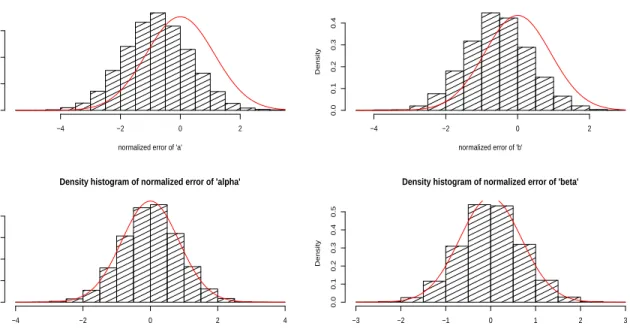
In Figure 1, we illustrate the limit law of each coordinate of the LSE baLSET ,bbLSET ,αbLSET ,βbTLSE
given in (4.1). To do so, we plot the obtained density histograms of each of its coordinates based on 10000 independently generated trajectories using the scheme DISRE for simulating the CIR process, we also plotted the density functions of the corresponding normal limit distributions in red. With the
Relative errors T = 5000 (ba(TN)−a)/a -0.02723421 (bb (N) T −b)/b -0.02546389 (αbT(N)−α)/α 0.001779072 (βb (N) T −β)/β 0.0009349683
Table 3: Relative errors using DISRE scheme.
Density histogram of normalized error of 'a'
normalized error of 'a'
Density −4 −2 0 2 0.0 0.1 0.2 0.3
Density histogram of normalized error of 'b'
normalized error of 'b' Density −4 −2 0 2 0.0 0.1 0.2 0.3 0.4
Density histogram of normalized error of 'alpha'
normalized error of 'alpha'
Density −4 −2 0 2 4 0.0 0.1 0.2 0.3 0.4
Density histogram of normalized error of 'beta'
normalized error of 'beta'
Density −3 −2 −1 0 1 2 3 0.0 0.1 0.2 0.3 0.4 0.5
Figure 1: In the first line from left to right, the density histograms of the normalized errors of T1/2(baT(N)−a) and T1/2(bb
(N)
T −b), in the second line from left to right, the density histograms of the normalized errors of T1/2(αb
(N)
T −α) andT1/2(βb (N)
T −β). In each case, the red line denotes the density function of the corresponding normal limit distribution.
above choice of parameters, as a consequence of (4.1), we have
T12( b aLSET −a)−→ NL 0,a b(2a+σ 2 1) =N(0,1.28) as T → ∞, T12(bbLSET −b) L −→ N 0,2b a(a+σ 2 1) =N(0,0.84) as T → ∞, T12( b αLSET −α)−→ NL 0,aσ 2 2 bσ12(2a+σ 2 1) =N(0,0.72) as T → ∞, T12(βbLSE T −β) L −→ N 0,2bσ 2 2 aσ12 (a+σ 2 1) =N(0,0.4725) as T → ∞.
In case of the parameters a and b, one can see a bias in Figure 1, which, in our opinion, may be related with the different speeds of weak convergence for the LSE of (a, b) and that of (α, β), and
Table 4 contains the skewness and excess kurtosis of T12(bθ (N)
T −θ), where θ∈ {a, b, α, β}, using the scheme DISRE for simulating the CIR process. This confirms our results in (4.1) as well.
Skewness and excess kurtosis T12(
b a(TN)−a) T12(bb (N) T −b) T 1 2( b α(TN)−α) T12(βb (N) T −β) Skewness 0.04915124 0.04544189 -0.02317407 -0.01399869 Excess kurtosis 0.07666643 0.05226811 0.09994108 0.07877347
Table 4: Skewness and excess kurtosis using the scheme DISRE for simulating the CIR process.
Using the Anderson-Darling and Jarque-Bera tests, we test whether each of the coordinates of T12
b
aTLSE−a,bbLSET −b,αbLSET −α,βbTLSE−β
follows a normal distribution or not for T = 5000. In Table 5 we give the test values and (in paranthesis) the p-values of the Anderson-Darling and Jarque-Bera tests using the scheme DISRE for simulating the CIR process (the ∗ after a p-value denotes that the p-value in question is greater than any reasonable signifance level). It turns out that, with this choice of parameters, at any reasonable significance level the Anderson-Darling test accepts that T12(
b
aLSET −a), T12(bbLSET −b), T
1 2(
b
αLSET −α), and T12(βbTLSE−β) follow normal laws. The Jarque-Bera
test also accepts that T12(bbLSET −b), T
1 2(
b
αLSET −α), and T12(βbTLSE−β) follow normal laws, but
rejects that T12(
b
aLSET −a) follows a normal law.
Test of normality T12( b a(TN)−a) T12(bb(N) T −b) T 1 2( b α(TN)−α) T12(βb(N) T −β) Anderson-Darling 0.34486 (0.4857∗) 0.62481 (0.1037∗) 0.34078 (0.4962∗) 0.35232 (0.467∗) Jarque-Bera 6.5162 (0.03846) 4.6077 (0.09987∗) 5.1089 (0.07774∗) 2.9528 (0.2285∗)
Table 5: Test of normalilty in case of y0 = 0.2, x0 = 0.1, a= 0.4, b = 0.3, α = 0.1, β = 0.15,
σ1 = 0.4, σ2 = 0.3, ρ = 0.2, T = 5000, and N = 50000 generating 10000 independent sample
paths using the scheme DISRE for simulating the CIR process.
All in all, our numerical illustrations are more or less in accordance with our theoretical results in (4.1). Finally, we note that we used the open source software R for making the simulations.
References
[1] Alfonsi, A. (2005). On the discretization schemes for the CIR (and Bessel squared) processes.
Monte Carlo Methods and Applications 11(4)355–384.
[2] Alfonsi, A. (2015). Affine Diffusions and Related Processes: Simulation, Theory and
Applica-tions. Springer, Cham, Bocconi University Press, Milan.
[3] Barczy, M., D¨oring, L., Li, Z. and Pap, G. (2013). On parameter estimation for critical
affine processes. Electronic Journal of Statistics 7 647–696.
[4] Barczy, M., D¨oring, L.,Li, Z. andPap, G. (2014). Stationarity and ergodicity for an affine
two factor model.Advances in Applied Probability 46(3)878–898.
[5] Barczy, M. and Pap, G.(2016). Asymptotic properties of maximum likelihood estimators for
[6] Barczy, M.,Pap, G.andT. Szab´o, T.(2016). Parameter estimation for the subcritical Heston model based on discrete time observations. Acta Scientiarum Mathematicarum (Szeged) 82313– 338.
[7] Berkaoui, A., Bossy, M. and Diop, A. (2008). Euler scheme for SDEs with non-Lipschitz
diffusion coefficient: strong convergence. ESAIM: Probability and Statistics 121–11.
[8] Broadie, M. and Kaya, ¨O. (2006). Exact simulation of stochastic volatility and other affine
jump diffusion processes. Operations Research 54(2)217–231.
[9] Cox, J. C.,Ingersoll, J. E.andRoss, S. A.(1985). A theory of the term structure of interest
rates. Econometrica 53(2)385–407.
[10] Deelstra, G. and Delbaen, F. (1998). Convergence of discretized stochastic (interest rate)
processes with stochastic drift term. Applied Stochastic Models and Data Analysis 14(1)77–84.
[11] Dereich, S.,Neuenkirch, A. and Szpruch, L.(2012). An Euler-type method for the strong
approximation of the Cox-Ingersoll-Ross process. Proceedings of The Royal Society of London. Series A. Mathematical, Physical and Engineering Sciences 468(2140) 1105–1115.
[12] Diop, A. (2003). Sur la discretisation et le comportement a petit bruit d’EDS
multidimension-nelles dont les coefficients sont a derivees singulieres. Ph.D Thesis, INRIA, France.
[13] Dudley, R. M. (1989). Real Analysis and Probability. Wadsworth & Brooks/Cole Advanced
Books & Software, Pacific Grove, California.
[14] Heston, S. (1993). A closed-form solution for options with stochastic volatilities with
applica-tions to bond and currency opapplica-tions.The Review of Financial Studies 6 327–343.
[15] Higham D. and Mao, X. (2005). Convergence of Monte Carlo simulations involving the
mean-reverting square root process. Journal of Computational Finance 8(3) 35–61.
[16] Hu, Y.andLong, H.(2007). Parameter estimation for Ornstein–Uhlenbeck processes driven by
α-stable L´evy motions.Communications on Stochastic Analysis 1(2) 175–192.
[17] Hu, Y. and Long, H. (2009). Least squares estimator for Ornstein–Uhlenbeck processes driven
by α-stable motions.Stochastic Processes and their Applications 119(8)2465–2480.
[18] Hu, Y. and Long, H. (2009). On the singularity of least squares estimator for mean-reverting
α-stable motions.Acta Mathematica Scientia 29B(3) 599–608.
[19] Hutzenthaler, M.,Jentzen, A.andKloeden, P.E.(2012). Strong convergence of an explicit
numerical method for SDEs with nonglobally Lipschitz continuous coefficients. The Annals of Applied Probability 22(4)1611–1641.
[20] Hurn, A. S., Lindsay, K. A. and McClelland, A. J. (2013). A quasi-maximum likelihood
method for estimating the parameters of multivariate diffusions. Journal of Econometrics 172
106–126.
[22] Karatzas, I. and Shreve, S. E. (1991). Brownian Motion and Stochastic Calculus, 2nd ed. Springer-Verlag.
[23] Kloeden, P. E. and Platen, E. (1992). Numerical Solution of Stochastic Differential
Equa-tions. Applications of Mathematics (New York) 23. Springer, Berlin.
[24] Lehmann, E. L. and Romano, J. P. (2009). Testing Statistical Hypotheses, 3rd ed.
Springer-Verlag Berlin Heidelberg.
[25] Li, Z. and Ma, C. (2015). Asymptotic properties of estimators in a stable Cox-Ingersoll-Ross
model. Stochastic Processes and their Applications 125(8) 3196–3233.
[26] Liptser, R. S. and Shiryaev, A. N. (2001). Statistics of Random Processes II. Applications,
2nd edition. Springer-Verlag, Berlin, Heidelberg.
[27] Overbeck, L.andRyd´en, T.(1997). Estimation in the Cox-Ingersoll-Ross model.Econometric
Theory 13(3) 430–461.
[28] van Zanten, H. (2000). A multivariate central limit theorem for continuous local martingales.