and Bioinformatics
.
White Rose Research Online URL for this paper:
http://eprints.whiterose.ac.uk/151333/
Version: Accepted Version
Article:
Kahrobaei, Delaram orcid.org/0000-0001-5467-7832, Wood, Alexander and Najarian,
Kayvan (2020) Homomorphic Encryption for Machine Learning in Medicine and
Bioinformatics. ACM Comput. Surv.. ISSN 0360-0300
[email protected] https://eprints.whiterose.ac.uk/ Reuse
Items deposited in White Rose Research Online are protected by copyright, with all rights reserved unless indicated otherwise. They may be downloaded and/or printed for private study, or other acts as permitted by national copyright laws. The publisher or other rights holders may allow further reproduction and re-use of the full text version. This is indicated by the licence information on the White Rose Research Online record for the item.
Takedown
If you consider content in White Rose Research Online to be in breach of UK law, please notify us by
Medicine and Bioinformatics
ALEXANDER WOOD
∗,
University of Michigan, United StatesKAYVAN NAJARIAN,
University of Michigan, United StatesDELARA℧ KAHROBAEI,
University of York, United KingdomMachine learning and statistical techniques are powerful tools for analyzing large amounts of medical and genomic data. On the other hand, ethical concerns and privacy regulations prevent free sharing of this data. Encryption techniques such as fully homomorphic encryption (FHE) enable evaluation over encrypted data. Using FHE, machine learning models such as deep learning, decision trees, and naive Bayes have been implemented for privacy-preserving applications using medical data. These applications include classifying encrypted data and training models on encrypted data. FHE has also been shown to enable secure genomic algorithms, such as paternity and ancestry testing and privacy-preserving applications of genome-wide association studies.
This survey provides an overview of fully homomorphic encryption and its applications in medicine and bioinformatics. The high-level concepts behind FHE and its history are introduced and details on current open-source implementations are provided. The state of fully homomorphic encryption for privacy-preserving techniques in machine learning and bioinformatics is reviewed, along with descriptions of how these methods can be implemented in the encrypted domain.
CCS Concepts: ·Security and privacy→Cryptography;Usability in security and privacy; ·Social and professional topics→Medical information policy.
Additional Key Ωords and Phrases: fully homomorphic encryption, homomorphic encryption, neural networks, machine learning, bioinformatics, data privacy and security, secure outsourcing computation
ACM Reference Format:
Alexander Ωood, Kayvan Najarian, and Delaram Kahrobaei. 0000. Homomorphic Encryption for Machine Learning in Medicine and Bioinformatics.ACM Comput. Surv.0, 0, Article 0 ( 0000), 35 pages. https:⁄⁄doi.org⁄ 10.1145⁄1122445.1122456
1 INTRODUCTION
Increasing access to big data continues to transform medicine. The cost of genome sequencing has reduced dramatically, leading to the proliferation of commercial personalized genetic analysis and enabling large-scale genome sequencing for genetic research, and hospitals collect far more data on patients than clinicians are able to examine. Machine learning techniques harness the power of this data by learning rules from data sets too large or complex for any human to analyze. Transformational applications in clinical medicine include prognosis models trained over massive, many-featured data sets, interpretation of medical imaging, and generation of diferential diagnoses [47, 163].
Authors' addresses: Alexander Ωood, [email protected], University of Michigan, Ann Arbor, United States; Kayvan Najarian, University of Michigan, Ann Arbor, United States; Delaram Kahrobaei, University of York, York, United Kingdom. Permission to make digital or hard copies of all or part of this work for personal or classroom use is granted without fee provided that copies are not made or distributed for proit or commercial advantage and that copies bear this notice and the full citation on the irst page. Copyrights for components of this work owned by others than ACM must be honored. Abstracting with credit is permitted. To copy otherwise, or republish, to post on servers or to redistribute to lists, requires prior speciic permission and⁄or a fee. Request permissions from [email protected].
© 2019 Association for Computing Machinery. 0360-0300⁄0000⁄0-ART0 $15.00
Machine learning on genomic and medical data requires careful consideration of privacy concerns. A breach in the privacy of medical data can have negative consequences for an individual, leading to the passage of laws such as the Health Insurance Portability and Accountability Act (HIPAA) in the United States [94] and the General Data Protection Regulation (GDPR) in the European union [1].
Commercial genomic analysis opens the door to both privacy and civil liberties concerns. The United States federal government and all 50 states allow the creation of DNA databases and admit DNA evidence in courts [196]. This data can afect not just the individual, but also relatives with whom an individual shares DNA [47]. Remarkably, the notorious łGolden State Killer,ž accused of a series of decades-old murders in California, was arrested in 2018 after law enforcement used a commercial genealogy website to locate relatives of the suspect using crime scene DNA. These methods raise concerns over the impact such powerful tools could have on the general population [133].
Privacy-preserving techniques for computation and machine learning can reduce the risk to patients who choose to share their data for personalized medical analysis. Encryption enables patients to secure and prevent third parties from analyzing their data. Ωhile traditional encryption does not generally allow for computation over encrypted data points, fully homomorphic encryption (FHE), described as the łholy grailž of cryptography, enables arbitrary computation over encrypted data [100, 200]. This opens the door to privacy-preserving applications of computational techniques such as machine learning and statistical analysis to genomic and medical data and outsourcing of computation.
This work provides a broad overview of FHE, its history, current techniques and open-source implementations, and the state-of-the-art in applications of FHE for machine learning and statistical analysis in the medical ield. In contrast, previous surveys provide overviews of FHE schemes for mathematicians [102, 190, 200] or engineers [150]. One 2015 survey focuses on genomic applications [20, 160], and another on the state of fully homomorphic encryption research [16], though many new techniques and applications have been presented since its publication . A recent survey provides an overview of FHE but is not focused on applications [6]. Other recent surveys discusses applications of secure outsourced computation more generally [187, 204], while this survey focuses instead on speciics of HE for applications in the medical ield. Additional surveys focus on HE for signal processing [8, 139], hardware implementation [156], theory [17, 117], and lattice cryptography [166].
This survey is targeted towards all who are interested in privacy-preserving techniques in the medical ield using fully homomorphic encryption. This includes clinicians, computer scientists, engineers, developers, graduate students, and any with some background in encryption, genomics, or machine learning. It seeks to introduce readers to the high-level concepts behind fully homomorphic encryption and familiarize readers with terms, deinitions, and schemes necessary to begin applying FHE. A detailed summary of currently available open-source implementations of FHE is given. Applications of FHE for privacy-preserving machine learning in medicine and bioinformatics are reviewed, and methods for performing these privacy-preserving techniques are summarized. This survey gives a comprehensive overview of the applications of FHE in for machine learning in medicine. In particular, details are provided on how to implement privacy-preserving logistic regression, naive Bayes, decision tree, neural networks, and unsupervised learning using FHE. In addition, privacy-preserving methods for DNA⁄RNA sequence comparisons, Hamming and edit distance, genetic testing, and statistical tests for performing genome-wide association studies are reviewed.
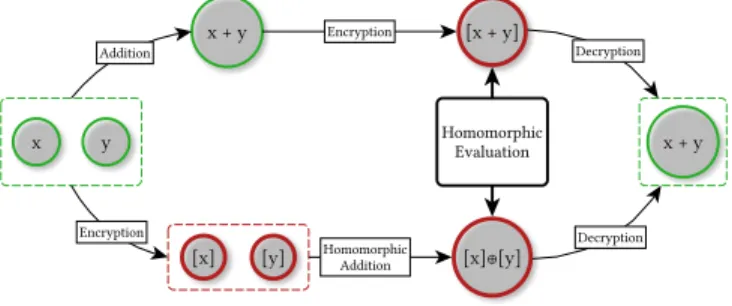
Fig. 1. Under an additive homomorphism, encryption followed by homomorphic addition is equal to addition followed by encryption.
1.0.1 Organization.Section 2 discusses the history of homomorphic encryption, deines the related
terminology, and discusses schemes and techniques in the ield. Section 3 provides an overview of open-source FHE libraries and implementation tools. Section 4 surveys the current status of homomorphic encryption for privacy-preserving machine learning in medicine. Section 6 discusses applications of FHE in privacy-preserving bioinformatics algorithms.
2 HOMOMORPHIC ENCRYPTION
Cryptography was originally developed as a technique for secure communication between multiple parties, where one party encrypts a message and sends it to another party, who then decrypts it [200]. The concept of computing over encrypted data was irst introduced as a łprivacy transformationž by Rivest, Adleman, and Dertouzos in 1978 and developed into the study of homomorphic encryption today [175]. Broadly, homomorphic encryption enables computation over encrypted data. A scheme called additively (or multiplicatively) homomorphic if
[x] ⊕ [y]=[x+y] and [x] ⊗ [y]=[x·y]
for addition and multiplication, respectively, where[m]denotes the encryption of some plaintextm. The symbols⊕and⊗respectively denote the homomorphic addition and multiplication operations in the ciphertext space. In other words, if an encryption scheme is additively homomorphic, then encryption followed by homomorphic addition is equal to addition followed by encryption, a concept illustrated in Figure 1.
A partially homomorphic encryption (PHE) scheme can perform a single operation, such as addition or multiplication, over encrypted data an arbitrary number of times. ElGamal [91] and RSA [176] are multiplicatively homomorphic, although versions of RSA with improved security tend to lose this capability [200]. Goldwasser and Micali's quadratic reciprocity scheme [112, 113] and subsequent improvements [24, 25, 158, 164] led to Paillier's additively homomorphic encryption scheme [165], one of the most well-known HE schemes [93]. Other PHE schemes include adaptations of Paillier [79, 80, 96] and some lattice-based schemes [9, 109, 173].
Ωhile PHE allows for arbitrary computation of a single operation on encrypted data, somewhat homomorphic encryption (SHE) allows for bounded computation of a set of operations. For instance, the somewhat homomorphic BGN encryption scheme can perform unlimited homomorphic addition and a single homomorphic multiplication operation [31].
Fully homomorphic encryption (FHE) enables arbitrary additionandmultiplication over en-crypted data. Because arbitrary functions can be described as Boolean circuits, an encryption scheme that can compute addition and multiplication can theoretically evaluate any function
[166]. Schemes that can perform homomorphic operations over a circuit of some pre-deined depth are called leveled homomorphic encryption (LHE) schemes. In practice, considerations such as execution time, ciphertext noise accumulation, key sizes, ciphertext sizes, and circuit depth limit the class of functions that can be practically computed using FHE⁄LHE.
The irst fully homomorphic scheme was published by Craig Gentry in his 2009 thesis [98, 99]. The introduction of Gentry's revolutionary FHE scheme quickly led to a series of improvements that laid the foundation for a wealth of future work. This development has been categorized in multiple ways. Fully homomorphic encryption schemes have been sorted according to their theoretical underpinnings.
Peikert categorizes FHE schemes into three generations of research [166]. First-generation FHE schemes are based on Gentry's initial breakthrough, with security based on ad-hoc average-case assumptions about ideal lattices or theapproximate GCDproblem, while second-generation FHE schemes are based onlearning with errors (LWE)andring learning with errors (RLWE). He describes third-generation FHE as marked by practical improvements and further reinement of security assumptions. Additional works follow Peikert's blueprint [117]. Acar et al. [6] and Martins et al. [150] describe four categories of FHE schemes: those based on ideal lattice assumptions, the approximate GCD problem, (R)LΩE, and NTRU-like assumptions [6].
FHE research has continued rapidly past Peikert's third generation of schemes. The current generation of FHE research is marked by a focus on open-source implementations, real-world applications, and standardization of methodology and security requirements. The Homomorphic Encryption Standardization Consortium1 has described contemporary FHE as being based in three models of homomorphic computation: Boolean circuits, modular (exact) arithmetic, and approximate number arithmetic [67]. This section provides a high-level overview of the develop of fully homomorphic encryption.
2.1 Gentry’s Breakthrough
Gentry's breakthrough scheme is built upon an abstract algebra construct called a lattice [166]. He begins by constructing a somewhat homomorphic encryption scheme that is able to homomorphi-cally compute low-degree polynomials. Each homomorphic evaluation adds noise to a ciphertext, and the eventual accumulation of too much noise results in an undecryptable ciphertext.
Gentry handles noise by introducingbootstrapping, which reduces the rate of noise accumulation in ciphertexts. A bootstrappable SHE scheme is able to handle its own decryption function. A noisy ciphertext is double-encrypted, then łhomomorphicallyž decrypted using an encryption of the private key. To illustrate, Gentry compares bootstrapping to a locked glovebox, where the glovebox represents encryption, the lock represents the decryption key, and manipulation of items in the box using the gloves represents homomorphic evaluation [100]. Noise accumulation is symbolized by the gloves developing defects from use. Ωhen the gloves become defective the original box and its key are placed inside of a second locked glovebox, where it can be unlocked. Object manipulation continues inside of the second glovebox. Implementing the fully homomorphic properties of Gentry's original scheme is impractical largely due to the computational cost of bootstrapping.
Gentry's bootstrapping method blazed the trail for the irst wave of rapid innovation in FHE [159]. A FHE scheme introduced by Smart and Vercauteren has smaller key and ciphertext sizes, and a SHE version of the scheme was implemented [191]. However, Cramer et al.'s 2016 key-recovery attack compromises this system's security assumptions [73]. Additional variants follow Gentry's blueprint [101, 103, 193]. Gentry and Halevi provided the irst full implementation of Gentry's FHE
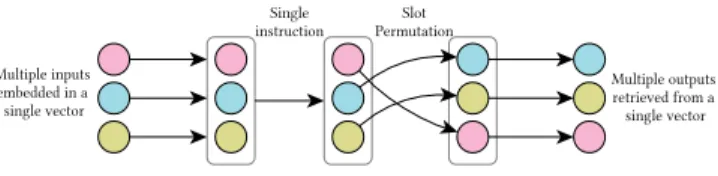
Fig. 2. From let to right, multiple values are embedded within a single vector. A single operation simultane-ously manipulates each value. Slot permutation re-orders the values within the vector.
scheme [104]. In this implementation, a single bootstrapping operation takes up to 30 minutes to run. An implementation on a GPU yielded faster run times but is still impractical for real-world deployment [202].
In another work, Smart and Vercauteren describe an SHE scheme that supports SIMD (Single-Instruction Multiple-Data) operations, enabling parallelization in FHE via ciphertext packing [192]. SIMD instructions parallelize computation by encoding multiple plaintext values within a single ciphertext vector. Ciphertext packing can be used for batch computation in many FHE schemes. Additional usages permute the plaintext slots inside of a packed ciphertext, enabling, for instance, evaluation speedups [107]. These concepts are illustrated in Figure 2. From left to right, multiple values embedded within a vector can be processed via a single instruction, and their slots may be permuted.
2.2 New Theoretical Underpinnings
After Gentry's introduction of an FHE scheme rooted in ideal lattice-based assumptions, a new wave of innovation yielded FHE schemes with diferent theoretical underpinnings [166]. In one category, security is based on thelearning with the errors (LWE)[173] andring learning with errors (RLWE)[147] assumptions. In the second category, security is based on the approximate-GCD problem [126]. Another category of schemes are based on NTRU-like assumptions [124].
2.2.1 R/LWE: BGV Encryption.A series of papers Brakerski and Vaikuntanathan published in
2011 present schemes based on LΩE and ring-LΩE that follow the SHE-bootstrap-FHE model [40, 41]. Their initial SHE scheme, based on LΩE, is turned into a FHE scheme using their modulus reduction and dimension reduction techniques. These reduce parameter sizes of the ciphertext, making decryption independent from the number of levels the scheme can evaluate. Modulus reduction changes the modulus used during encryption to a smaller value while dimension reduction reduces the dimension of the ciphertext.
Joint work with Gentry followed that resulted in the Brakerski-Gentry-Vaikuntanathan (BGV) scheme [39, 43]. BGV removes the need for expensive bootstrapping procedures using techniques such as modulus reduction in order to mitigate noise growth during homomorphic evaluation. Bootstrapping is left as an optional optimization procedure. Ωithout bootstrapping, modulus reduction yields a leveled homomorphic encryption scheme (LHE) that can handle noise up to a pre-speciied circuit depth. Further work on BGV encryption incorporates the batching technique of Smart and Vercauteren in BGV [105, 107] and simpler bootstrapping techniques [106]. Gentry, Halevi, and Smart implement BGV-based LHE to evaluate an AES circuit, the irst homomorphic evaluation of a complex circuit [108].
2.2.2 R/LWE: BFV Encryption.Fan and Vercauteren's 2012 scheme follows the SHE-bootstrap-FHE
not require modulus switching [38]. Because of this, it is commonly referred to as the Brakerski-Fan-Vercauteren (BFV) or the Brakerski-Fan-Vercauteren (FV) scheme. Fan and Vercauteren port Brakerski's LΩE scheme to the ring-LΩE setting and implement SIMD for batch computing. They introduce two variants of this scheme. The irst minimizes error that occurs due to noise accumulation, and the second method reduces the time and space used during computation using techniques similar to modulus-switching methods.
2.2.3 Approximate-GCD Based Schemes.In 2010, van Dijk et al. presented their DGHV scheme
[84], with security based on the approximate greatest common divisor (GCD) problem [126]. This scheme follows Gentry's SHE-bootstrap-FHE blueprint. A subsequent optimization reduces the public key size in DGHV [70]. Further improvements include an extension to batch FHE [55, 68] and more eicient key-reduction and bootstrapping techniques [69]. The bootstrap-free framework of the BGV scheme is extended to the DGHV scheme via a new modulus-switching technique [71].
2.2.4 NTRU-Like Assumptions. Stehle and Steinield's 2011 work introduces a modiication of an
encryption scheme called NTRUEncrypt [124] that makes it as secure as worst-case problems over ideal lattices [194]. López-Alt et al. use the homomorphic properties of NTRUEncrypt to propose the LTV scheme, the irst FHE scheme based on NTRU-like assumptions [145]. Rohlof and Cousins introduce another NTRU-like FHE cryptosystem with modiied bootstrapping techniques and ciphertext representations [177]. Further customization of the LTV scheme is presented by Doröz et al [85], and YASHE, or łyet another somewhat homomorphic encryption schemež [34], removed some non-standard assumptions from LTV. However, despite initial promise, Albrecht et al. present attacks on some of the łoverstretchedž security NTRU-like security assumptions used in LTV and YASHE [11].
2.3 Practical Improvements
From 2012 into 2013 marked the beginning to what Peikert terms the łthird generationž of FHE, which introduced new internal methods used within the schemes [26, 166]. In this new wave, practical improvements simplify and raise the eiciency of FHE schemes [13, 41, 110] and the irst open-source FHE implementations are released [72, 183].
2.3.1 R/LWE-Based Encryption.Gentry, Sahai, and Ωaters published a FHE scheme in 2013, known
as the GSΩ scheme, that is based on LΩE and does not require key-switching [110]. The GSΩ scheme is foundational to a number of following schemes and provides a Boolean circuit-based approach to FHE. This method reduces homomorphic multiplication in most cases to matrix multiplication and introduces the approximate eigenvector method of constructing an FHE scheme. Brakerski and Vaikuntanathan apply modulus and dimension reduction to GSΩ to obtain a leveled FHE scheme [42]. Alperin-Sherif and Peikert introduce faster bootstrapping [13], which is then applied by Hiromasa et al. to a variant on GSΩ that encrypts matrices and supports homomorphic matrix addition and multiplication [123].
2.3.2 Approximate-GCD Based Encryption.Cheon and Stehlé introduce a decision variant on the
approximate-GCD problem that is at least as hard as the LΩE problem, as well as a (non-batched) variant of the DGHV scheme with security based on this new reduction [60]. Benarroch et al. present two more schemes [26]. One of their LHE schemes is non-batched with security based on the approximate-GCD decision problem. The other is a batched scheme with security based in part on the batched approximate-GCD decision problem.
2.4 Implementation & Standardization
The current generation of research is marked by a shift towards real-world, open-source imple-mentation and standardization of FHE methods and security. Technical improvements yielded an assortment of open-source software libraries, which are discussed in Section 3.
Prompted in part by this rapid innovation, starting in 2017 a consortium of experts from the government, industry, and academia formed the Homomorphic Encryption Standardization Con-sortium2and began holding regular workshops to create a community standard for HE. These
workshops led to the development of a Homomorphic Encryption Standard in 2018 [12]. This standard outlines the security assumptions used in major FHE applications, possible attacks, and recommends security parameters for implementations.
The Consortium has described contemporary FHE as being based in three models of homomorphic computation: Boolean circuits, modular (exact) arithmetic, and approximate number arithmetic [67]. The modular (exact) arithmetic approach follows from the groundwork laid in second-generation FHE by R⁄LΩE-based schemes, notably BGV [39] and BFV [38, 92]. This leveled approach evaluates arithmetic circuits over values encrypted modulo an integert, with optional bootstrapping. Recent developments include residue number system (RNS) variants of BFV, which provide speedups for modular arithmetic operations [21, 22, 118]. Improvements to the plaintext space in the BFV scheme allows for homomorphic evaluation of deep circuits with rational number inputs [140] and improved bootstrapping techniques [54].
The Boolean circuit-based approach towards FHE evaluates Boolean circuits over encrypted bits. The major schemes following this approach are known as FHEΩ and TFHE. Ducas and Micciancio's Fasted Homomorphic Encryption in the Ωest (FHEΩ) scheme [88] introduces a ring variant of Alperin-Sherif and Peikert's [13] bootstrapping for the GSΩ scheme [110] and a new homomorphic NAND gate. Bootstrapping runs in less than a second after evaluation of this NAND gate on a single bit. Another Boolean circuit-based scheme, Fast Fully Homomorphic Encryption Over the Torus (TFHE) [64], extends the GSΩ scheme [110] and encodes polynomials over the torus and evaluates over Boolean circuits [61]. Their techniques also apply to the FHEΩ cryptosystem. Recent developments include improved bootstrapping methods for TFHE [62, 63], expansion of the bootstrapping operation in FHEΩ to multiple bits [28, 32], multi-value bootstrapping for TFHE and FHEΩ [49], and refreshing of multiple ciphertexts at the cost of a single refresh procedure [151]. The approximate number arithmetic approach is led by the Cheon-Kim-Kim-Song (CKKS) scheme, also known as Homomorphic Encryption for Arithmetic of Approximate Numbers (HEAAN) [197]. This paper refers to the scheme itself as CKKS and uses HEAAN to refer to the eponymous software. Evaluation of an approximate circuit over a ciphertext returns an approximation rather than an exact result. These approaches are suited for fast polynomial approximation and loating point computations. Fast polynomial approximation in CKKS can evaluate the multiplicative inverse, exponential, and logistic functions, as well as the discrete Fourier transform [197]. Additional works provide bootstrapping improvements [52, 56] and RNS variants [29, 57, 184].
Additional developments include a somewhat homomorphic variation on the GSΩ scheme presented by Genise et al. [97]. This scheme uses an inhomogeneous variant of the NTRU assumption (iNTRU) for security, a stronger assumption than LΩE. This scheme evaluates encrypted, non-deterministic inite automata more eiciently than other existing schemes. Boura et al. present a unifying framework called Chimera that combines the best aspects of the BFV, CKKS, and TFHE schemes [36]. This framework enables switching between the plaintext spaces of the three schemes and describes a collection of bridges to connect the schemes.
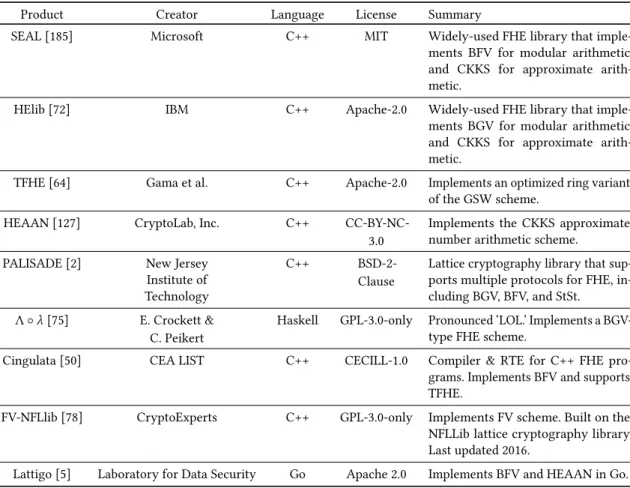
Table 1. Fully Homomorphic Encryption Libraries and Sotware
Product Creator Language License Summary
SEAL [185] Microsoft C++ MIT Ωidely-used FHE library that imple-ments BFV for modular arithmetic and CKKS for approximate arith-metic.
HElib [72] IBM C++ Apache-2.0 Ωidely-used FHE library that imple-ments BGV for modular arithmetic and CKKS for approximate arith-metic.
TFHE [64] Gama et al. C++ Apache-2.0 Implements an optimized ring variant of the GSΩ scheme.
HEAAN [127] CryptoLab, Inc. C++ CC-BY-NC-3.0
Implements the CKKS approximate number arithmetic scheme.
PALISADE [2] New Jersey Institute of Technology
C++
BSD-2-Clause
Lattice cryptography library that sup-ports multiple protocols for FHE, in-cluding BGV, BFV, and StSt.
Λ◦λ[75] E. Crockett & C. Peikert
Haskell GPL-3.0-only Pronounced ‘LOL.' Implements a BGV-type FHE scheme.
Cingulata [50] CEA LIST C++ CECILL-1.0 Compiler & RTE for C++ FHE pro-grams. Implements BFV and supports TFHE.
FV-NFLlib [78] CryptoExperts C++ GPL-3.0-only Implements FV scheme. Built on the NFLLib lattice cryptography library. Last updated 2016.
Lattigo [5] Laboratory for Data Security Go Apache 2.0 Implements BFV and HEAAN in Go.
3 IMPLEMENTING FULLY HOMOMORPHIC ENCRYPTION
The current generation of FHE research has led to eicient, publicly available FHE libraries and software. These libraries continue to develop with respect to cutting-edge FHE research and the recently drafted community standards for homomorphic encryption [198]. Ωhile FHE continues to rapidly increase in eiciency, implementation presents a continuing challenge for non-experts. Implementations must be custom-built, requiring a high level of expertise both as a programmer and as a cryptographer. For example, conversions between plaintext and ciphertext computations are not trivial, noise must be carefully managed to maintain correctness upon decryption, and security parameters must be selected manually [77]. Some early compilers and tools have been introduced to make FHE more approachable and widely usable [4, 50, 167].
An discussion of the major implementations, compilers, and FHE tools is given below. Table 2 provides an overview of the implementations, including the name of the software, its creator, language, license, and a short summary of the implemented schemes.
Microsot’s Simple Encrypted Arithmetic Library (SEAL).The Simple Encrypted Arithmetic Library
(SEAL)3is a popular homomorphic encryption library developed and maintained by researchers in
the Cryptography Research Group at Microsoft Research since 2015. SEAL is self-contained and developed in C++, and includes a .NET wrapper [186]. SEAL has undergone changes in terms of the underlying encryption scheme since 2015. Early implementations of SEAL used a variant on the YASHE scheme [34]. Version 3.3 of SEAL [186] implements the BFV and CKKS schemes. SEAL 3.3 was released in June of 2019 and is available on Microsoft's website [186]. Intel AI has used SEAL's implementation of the CKKS scheme in the Intel HE transformer for nGraph (nGraph-HE)4, a homomorphic backend to Intel's graph compiler for artiicial neural networks [30].
IBM’s Homomorphic Encryption Library (HElib).Shai Halevi and Victor Shoup are creators of the
Homomorphic Encryption Library (HElib)5, another popular FHE library that implements versions of the BGV and CKKS [119]. HElib is implemented in C++ and requires the NTL mathematical library [189]. HElib began with an implementation of the BGV scheme. Re-implementation led to signiicant speedups in March of 2018, and in January of 2019 HElib began to support an implementation of CKKS. HElib is available on Github [72].
Fast Fully Homomorphic Encryption over the Torus (TFHE).Fast Fully Homomorphic Encryption
over the Torus (TFHE)6is an open-source C⁄C++ software for FHE available on Github [64]. It is designed around an earlier library, The Fastest Homomorphic Encryption in the Ωest (FHEΩ), which is no longer maintained[88, 89]. This implementation enables homomorphic evaluation of Boolean circuits on single-bit messages. FHEΩ requires the Fastest Fourier Transform in the Ωorld (FFTΩ) library [95]. TFHE implements a ring variant of GSΩ [110] with optimizations [61, 62, 88]. The CUDA-accelerated Fully Homomorphic Encryption Library (cuFHE)7implements TFHE on CUDA-enabled GPUs in C++ [116]. It includes an optional Python wrapper. Another library, NuCypher fully homomorphic encryption (NuFHE)8, written in Python, implements TFHE
using CUDA and OpenCL [162].
HEAAN.The Homomorphic Encryption for Approximate Numbers (HEAAN) library9implements
the CKKS scheme [127]. HEAAN is written in C++ and uses the NTL library [189]. Since its release in 2016, HEAAN has seen speed improvements including the addition of bootstrapping [57]. HEAAN is available on Github [127].
PALISADE.PALISADE10is a C++ library created by the New Jersey institute of Technology (NJIT)
that uses lattice cryptography primitives to support public-key encryption, several SHE and leveled SHE schemes, proxy re-encryption (PRE), and other multiparty capabilities [170]. PALISADE 1.5.0 was released in March 2019 and is available on GitLab. PALISADE implements versions of a variety of HE schemes: LTV [145], Stehle-Steinfeld (StSt) [194], BGV [39], and BFV [92], and PRE schemes [170]. The authors include LTV for historical purposes, as the scheme itself is no longer considered secure [170].
Λ◦λ (LOL). The Λ◦λ: Functional Lattice Cryptography (‘LOL') library11 is a general lattice
cryptography library that includes an implementation of a BGV-type FHE scheme [76].Λ◦λis
implemented in Haskell and provides methods for high-level implementation of lattice cryptography primitives, including a BGV-type FHE scheme.
4https:⁄⁄github.com⁄IntelAI⁄he-transformer 5https:⁄⁄github.com⁄homenc⁄HElib 6https:⁄⁄github.com⁄tfhe⁄tfhe 7https:⁄⁄github.com⁄vernamlab⁄cuFHE 8https:⁄⁄github.com⁄nucypher⁄nufhe 9https:⁄⁄github.com⁄snucrypto⁄HEAAN 10https:⁄⁄palisade-crypto.org⁄software-library⁄ 11https:⁄⁄github.com⁄cpeikert⁄Lol
A Language and Compiler for Homomorphic Encryption Made easY (ALCHEMY) compiles plaintexts written in a modular domain-speciic language withΛ◦λimplemented on the backend
[77, 167]. The ALCHEMY compiler is able to simplify the implementation process for users by automatically generating many of the parameters.
Cingulata.Cingulata12(pronounced ‘tchingulata,' formally Armadillo) is a compiler toolchain and
runtime environment for C++ FHE programs [50]. It provides a high-level C++ interface for FHE applications over a ‘low-level' implementation of the scheme. Initially Cingulata supported the BFV scheme. In June 2019, support was added for TFHE in gate bootstrapping mode. Cingulata is available on Github [50].
(FV-)NFLlib.FV-NFLlib13implements the FV scheme in C++ [78]. FV-NFLlib is available on Github
and was last updated in 2016.
Lattigo.Lattigo14is recently published lattice-based cryptographic library in Go [5]. It implements
a number of schemes, including versions of BFV [21, 118] and HEAAN [57, 197]
3.1 Other Homomorphic Encryption Libraries
Pyfhel (PYthon For Homomorphic Encryption Libraries) implements homomorphic encryption techniques in Cython using SEAL, HElib, and PALISADE as backends [3]. PySyft is a Python library that implements a variety of privacy-preserving techniques, including homomorphic encryption [180]. Additional libraries implement partially homomorphic encryption and somewhat homomor-phic encryption. The PythonPaillier library implements the partially homomorhomomor-phic Paillier scheme in Python 3 [81]. The CUDA Homomorphic Encryption Library (cuHE) provides a GPU-accelerated implementation of the somewhat homomorphic DHS scheme [85]. TheAwesome Homomorphic Encryption List15is an online resource that is periodically updated with new and developing FHE libraries.
4 PRIVACY-PRESERVING ARTIFICIAL INTELLIGENCE IN MEDICINE
Big data continues to transform medicine by improving prognostic models, aiding clinicians in interpretation of clinical data, and improving diagnostic accuracy [163]. However, health data is highly sensitive and sharing or obtaining medical data is challenging due to privacy regulations such as HIPAA [114]. Cloud computing has great potential in the medical ield in applications such as personal health monitoring tools, but strict privacy regulations have slowed adoption of such technologies [137]. As fully homomorphic encryption becomes increasingly practical and standardized, its applications for artiicial intelligence in the medical domain have grown.
Privacy-preserving machine learning broadly describes a variety of frameworks for training and classiication of sensitive data. These methods can take place between multiple parties that can include the data owner(s), model owner(s), and cloud server(s). Computation can be delegated to the cloud server, which performs some computation over a client's encrypted data. The (encrypted) result is returned to the client, who then decrypts to privately view her result. Privacy-preserving machine learning has applications in personalized medicine [152, 153], DNA sequence analysis [20], and diagnostic tools [137]. Possible models include:
(1)Private outsourced computation: A medical institution uses homomorphic encryption to privately outsource computation-intensive tasks to a cloud server.
12https:⁄⁄github.com⁄CEA-LIST⁄Cingulata 13https:⁄⁄github.com⁄CryptoExperts⁄FV-NFLlib 14https:⁄⁄github.com⁄ldsec⁄lattigo
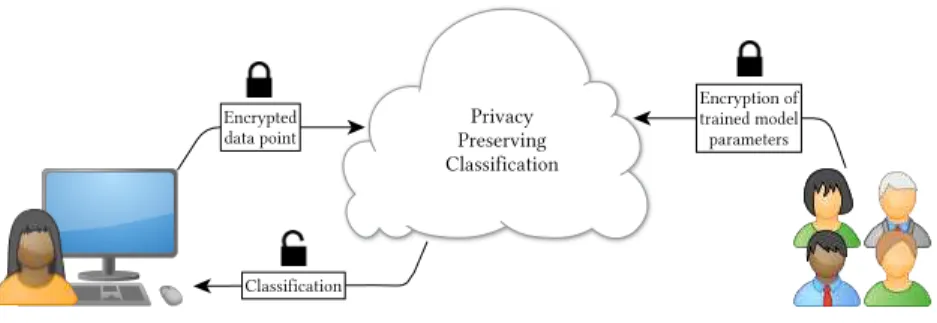
Fig. 3. A privacy-preserving classification model. A user encrypts her private medical data and uploads it to some cloud computing service. Researchers encrypt their trained model parameters under the same public key and upload to the cloud, which performs the required computation for privacy-preserving classification. This result is then returned to the user, who decrypts with her private key.
(2)Private prediction: A client classiies her data using a model owner's trained model without direct access to the trained model and without giving the model owner any partial information about her data. An intermediary cloud server may be used for outsourcing storage and computation. An example of this model is seen in Figure 3. This model assumes no collusion between the client and the server.
(3)Private training: A cloud server trains a classiication model on clients' encrypted data. Private prediction is a major application for FHE techniques [35]. This scenario has applications in health care as well. Clinicians, for instance, could use outside, private diagnostic prediction tools to classify their patients based on their private medical records.
Additional methods develop models of information without speciic knowledge of individual data records using diferent methods [7]. Secure multiparty computation (MPC) techniques such as collaborative learning, private set intersection, Yao's garbled circuits [205], and secret-sharing can be used for this task. Some models focus on the problem of multiple parties jointly training a classiier that is revealed to parties, without sharing individual data points [44, 143, 199]. This model can be useful in the medical ield when multiple hospitals wish to jointly train a model over sensitive patient data that must remain conidential. Diferential privacy, on the other hand, enables responses to queries from a database with protection from re-identiication [90]. Models and classiiers can be constructed from these query responses with a bounded amount of data leakage regarding each data point [35].
This section focuses on applications of homomorphic encryption for privacy-preserving machine learning techniques. The reviewed methods are logistic regression, Naive Bayes, decision tree evaluation, support vector machine, neural networks, and unsupervised clustering. An overview of each method is provided along with techniques for homomorphic implementation.
4.1 Logistic Regression
Logistic regression is a popular method for statistical learning that models two or more outcomes using a logistic function. Logistic regression is widely used in the medical community to predict binary outcomes such as whether a patient needs treatment or not, or whether a condition is present or not [120]. It has been used in applications such as assessing treatment of diabetic patients [27].
Logistic regression models uses linear functions to model the posterior probabilities of the classes. Given a set of points{1,x1,x2, . . . ,xn}, wherexi ∈Rd, and binary classes{−1,1}, the model takes
the form
Pr(Y =−1|X =x)= 1
1+e−βTx .
whereβ is a weight vector and Pr(Y = 1|X =x) =1−Pr(Y =−1|X =x). Training a logistic
regression model involves learning the parameter setβ.
Training a Logistic Regression Model.The parameters in a logistic regression model can be learned
using maximum likelihood estimation. Letpyi(xi;β)=Pr(Y =yi|X =x). The log-likelihood forN
observations with binary class labels is given by
ℓ(β)= N Õ i=1 logpyi(xi;β)= N Õ i=1 yiβTxi −log 1+eyiβ T xi
whereyi ∈ {−1,1}. The log-likelihood can be maximized in multiple ways. Newton's method
approximates the zeros of the gradient ofℓwith iterative updates to
βk+1=βk−
∇βℓ(β)
∇2βℓ(β).
Gradient descent minimizes a cost functionC by moving in the direction of the gradient, the steepest descent. It iteratively calculatesβk+1 =βk−γk∇C(β),whereγk is the learning rate at
iterationk. In the case of logistic regression the cost function is given by the negative log likelihood. Calculating the gradient−∇βℓ(β)of the negative log likelihood yields the iterative formula
βk+1=βk+γk N Õ
i=1
(1−σ(βTx))yixi (1)
whereσis the sigmoid function,σ(x)=1/(1+exp(x)).
Training on Encrypted Data.In 2017, the Center for Integrating Data for Analysis, Anonymization
and Sharing (iDASH) held a competition at its annual iDASH Privacy and Security Ωorkshop calling for methods to train a logistic regression model over encrypted data using HE16. The winning
team used HEAAN to train the model [135].
Training logistic regression models on encrypted data requires HE-friendly modiications to the optimization function. The training methodology should require the least number of iterations for convergence possible due to the expense of homomorphic computation. Kim et al. use Nesterov's accelerated gradient [161], which converges faster than standard gradient descent, to learn the parameter set in their winning algorithm [135]. Nesterov's gradient descent adds a parameterν
that looks further ahead each iteration in order to avoid overshooting minima. It is given by
βk+1=νk−γk∇ℓ(β)
νk+1=(1−αk)βk+1+αkβk
whereαk ∈ (0,1)is a smoothing parameter. The authors approximate the sigmoidσ over the
domain[−8,8]with polynomials of degree 3, 5, and 7. They also introduce an improved method to encrypt a matrix within a HEAAN ciphertext. In this way, the entire data set{x1, . . . ,xN}, where
xi =(xi1, . . . ,xid), can be encoded within a single matrixx=(xi j)1≤i≤n,1≤j≤d. The weightsβk are
encoded in a matrixntimes, where each row represents a copy ofβk. The server can then compute
Equation 1 using a polynomial approximation of sigmoid.
Other approaches to learning logistic regression parameters over encrypted data implement a variety of techniques. Bonte and Vercauteren use Newton's method combined with a Hessian approximation in FV-NFLib [33]. They use a Taylor series approximation in place of the sigmoid function. Crawford et al. approximate the log-likelihood with a Taylor expansion and evaluate a closed-form formula approximation of the logistic regression parameters using HElib [74]. Blatt et al. approximate the sigmoid function with Chebyshev polynomials for an implementation of logistic regression in PALISADE along with a custom variant of the CKKS scheme [29]. Carpov et al. perform logistic regression over data encrypted using TFHE and HEAAN [48]. Additional methods use HElib [201] and gradient descent with a minimax approximation for the sigmoid in SEAL [53]. An earlier method presented by Aono et al. in 2016 trained a logistic regression model using additive HE [15]. However, due to the limitation of encrypted computation to addition, the client is required to perform initial and intermediary plaintext computations.
4.2 Naive Bayes
Ωhen diagnosing a patient, clinicians often search for conditionally independent attributes that may be indicative of a disease [132]. Naive Bayes is a well-known classiier that assumes indepen-dence between data features. The result is a transparent and understandable classiication method that frequently outperforms more sophisticated methods [120]. In medical applications, Naive Bayes has outperformed more sophisticated diagnosis systems, including localization of a primary tumor, prediction of recurrence of breast cancer, and rheumatological diagnosis [138], as well as in applications predicting heart disease [132].
Given a set of classesY and a sampleX, Bayes Theorem states that Pr(Y =Yi|X)=Pr(X|Y =Yi)Pr(Y =Yi)
Pr(X) .
In this formula, Pr(Y =Yi|X)represents the posterior probability of a class given an attribute and
Pr(X|Y =Yi)is the likelihood of an attribute given a class. The classiication of a vectorX is given
simply by taking the maximum posterior probability over all classes and applying Bayes' Theorem: ˆ Y =argmax Yi∈Y [Pr(Y =Yi|X)]=argmax Yi∈Y " Pr(Y =Yi) d Ö j=1 Pr(X =Xj|Y =Yi) # .
The denominator term Pr(X)can be omitted in the equation above becauseX is ixed.
4.2.1 Private Naive Bayes Classification.Bost et al. present a privacy-preserving method for naive
Bayes classiication [35]. In their model, a client learns the classiication of her data pointXwithout learning any partial information about the classiication model or giving away any information about her input. The model's learned parameters are uploaded to a cloud server in encrypted form. Assume each vectorX hasd features, each of which can take on a inite number of possible values. Continuous data can be quantized to satisfy this assumption. The authors formulate the trained Naive Bayes model as two tables. The tableP = (Pi), wherePi =Pr(Y =Yi), provides
the probability of classYi. The tableT is a matrix where the(i,j)th entry is the likelihood of an
attribute given a class,Ti,j =Pr(Xj|Y =Yi).A new data point can be classiied by looking up the
probability for each attribute given each class and computing the argmax of the resulting values. Bost et al. use two partially homomorphic encryption schemes. Algorithm 1 describes a simpliied version of this protocol that uses a single FHE scheme. First, the server encryptsPandT. The client then downloads these tables from the server and homomorphically computes[pi], the classiier
score, for each classi. The client and server then perform a private argmax protocol and the client learns the index ˆiof the largest value forpi.
Algorithm 1:Private Naive Bayes Classiication
Client input:Data pointx ∈Zd, FHE public keyPK.
Server input:TablesP andT, FHE secret keySK.
Client output:The index of the class with the highest classiier score.
1: The server encrypts the tablesPandT.
2: The client homomorphically evaluates
[pi]=[Pi] d Ö j=1 [Ti,j(Xj)] fori=1, . . . ,c.
3: The client uses the server to privately compute ˆi =argmaxipi. 4: The client outputs ˆi.
In order to compute the argmax, the client and server perform a linear sequence of comparisons to determine the largest value. The client randomizes the order that she sends the posterior probability for each class to the server. The server compares this value to the maximum observed value using an encrypted comparison protocol and returns the new maximum value to the client, masked so that she cannot learn a partial ordering on the values. A number of encrypted comparison protocols have been published [35, 195], and additional methods for encrypted comparison are discussed in Section 6.
Bost et al. implement Naive Bayes classiication using the logarithm of the probability distri-butions, wherepi =log(Pr(G =Gi|X)), in order to compute the posterior probabilities using an
additively homomorphic encryption scheme. The scheme can be implemented with or without the logarithm using a fully homomorphic encryption scheme. Sun et al. implement a fully homomorphic version of this scheme [195].
4.3 Decision Trees
Binary decision trees are a classiication method with a representation as a simple diagram consisting of internal decision nodes and terminal leaf nodes. Decision nodes apply a sequence of binary splits to the data and a inal class is assigned based on the value of the terminal leaf node. In Figure 4b, these classes are łosteoarthritisž and łno osteoarthritis.ž Ωhile this example is for qualitative data with two classes, the concept also applies to multi-class data with quantitative features. A binary tree model is straightforward to draw regardless of data dimension. In fact, this method is favored among scientists in the medical community as it is easy to visualize and it łmimics the way a doctor thinksž by łstratify[ing] the population into strata of high and low outcome, on the basis of patient characteristicsž [120]. Decision trees are used for a variety of medical applications, including early diagnosis of myocardial infarction, probability of admittance in the emergency room based on chest pain, and computer-aided decision making in mental healthcare and wound care [169].
During training, a greedy algorithm chooses binary partitions that minimize the classiication error in each region at each step. For the irst split, splitting variablejand split pointsare selected to minimize the node impurity in each of the two resulting sub-regions,R(j,s) ={X :Xj ≤s}
andR′(j,s)={X :Xj >s. The combined node impurity in these regions is minimized by testing
all potential values for the splitting points[120]. The node impurity in regionRis measured by looking at the proportion of classℓvectors in the region. Possible measures for node impurity include classiication error, 1−pkℓ; Gini impurity,Ícℓ=1(1−pkℓ); or entropy,−Ícℓ=1pkℓlogpkℓ.
(a) (b)
Fig. 4. (a) A binary decision tree with decision nodesbi and leaf nodesci. (b) A decision tree for classification
of osteoarthritis of the knee [14].
This process iterates until a stop condition is met. Determining when to stop requires inding a balance between over-itting with a large tree and under-itting with a tree too small to adequately describe the data. Methods include restricting tree depth, restricting number of leaf nodes, and restricting the leaf nodes to a minimum node size. This can be followed by pruning to shrink the tree. Gini impurity and entropy are often used as measures of node impurity during the tree growing stage while the classiication error is often used during the pruning phase [120].
4.3.1 Private decision tree classification.A trained decision treeT can be described by decision
nodesb=(bi)1≤i≤N and terminal nodesc=(ci)1≤i≤M, as in Figure 4a. Evaluation at each decision
node yields a representation of that node as a boolean value, 0 or 1. A new data pointX is classiied withinT by applying the conditionb1 of the decision tree toX, then following the branches
sequentially and applying decision conditions until reaching to a leaf node.X is assigned the class value contained in this leaf node.
Privately classifying data requires hiding both the tree structure from the client and hiding the client's data from the model owner. An intermediary server should learn nothing about either party's information. One approach to hiding tree structure converts a decision tree into its polynomial form [35, 195]. Another approach to hiding tree structure converts a decision tree into a complete binary tree. In either approach, every internal node in the tree must be evaluated, regardless of each binary outcome, in order to mask tree structure. Tree structure can present a computational bottleneck for private decision tree classiication using FHE when tree structure is too large, depending on the speed of the underlying scheme.
Polynomial tree representation.A decision treeT for binary classiication with decision nodes
b=(bi)1≤i≤N and terminal nodesc=(ci)1≤i≤M can be represented as a polynomialPthat outputs
the predicted class of an input data point. Bost et al. [35] describe the a recursive procedure,F, for constructingP given a non-empty treeT:
1: IfT is one leaf node with class assignmentci, thenF (T)=ci.
2: IfT has a decision node, booleanb, with left and right sub-treesT0andT1, returnF (T) =
For example, the tree in Figure 4a has polynomial representation
P(b,c)=b0· [b3· (b5·c6+(b5−1) ·c5)+(b3−1) · (b4·c4+(b4−1) ·c3)]
+(b0−1) · (b2·c2+(b4−1) ·c1).
Protocols for private decision tree classiication using the polynomial form of the tree follow the broad steps based on the work of Bost et al. [35] and outlined in Algorithm 2 below.
Algorithm 2:Private Tree Evaluation
Client input:Data pointX, FHE secret keySK.
Server input:The polynomial formP of a decision tree, FHE public keyPK.
Client output:The index of the leaf node containing the classiication ofX.
1: The client and model owner perform comparisons so that the server learns[bi], the
(encrypted) binary output of each internal node.
2: The server uses[bi]to homomorphically evaluate the polynomialP.
3: The client receives and decrypts the output,[P(X)], to receive their inal classiication. In this setting, privacy-preserving means that the client does not directly learn the evaluation of her data point on each node or the tree structure and the model owner does not learn anything about the client's data point. First, the client and server perform a series of private comparisons to determine the binary output on each internal decision node. Evaluation of each decision node is modeled as comparison of an inputxto a thresholdw, yielding bitb=[x >w]. Private comparison in this setting requires that the client learn no information about the comparison result, and the server only learns the comparison result encrypted under the client's public key.
As with Naive Bayes, a number of private comparison methods using homomorphic encryption are available. Bost et al. implement two partially homomorphic encryption schemes to perform comparisons [35]. Sun et al. [195] implement private decision tree with comparison protocols using a BGV-type FHE scheme. Khedr et al. [134] also implement private decision tree using FHE. They formulate the decision on each node as a word matching problem and perform comparison using their presented encrypted word matching protocol.
Fig. 5. The completion of the binary tree in Figure 4b. The blue nodes denote łdummyž nodes, added to bring all leaf nodes in the tree to the same depth.
Complete binary trees.Another method for hiding tree structure uses
complete binary trees. This model introduces łdummyž nodes in order to impose a uniform depth upon tree structure [203]. The dummy nodes give a random binary output, where each response leads to the same outcome, as in Figure 5.
Ωu et al. use tree randomization to hide the structure of a complete binary tree [203]. Tree randomization constructs a randomized treeT′
from a given treeT with the same classiication output as the original tree, whereT is a complete binary tree withbdecision nodes, via the following process:
1: InitializeT′=T.
2: Randomly choose bitss ={s1, . . . ,sb} ∈ {0,1}b.
3: For eachi, ifsi =1 negate the decision function on the nodeti′of
the treeT′. Swap the subtrees originating at the left and right child nodes.
Step 3 of the above procedure randomly leaves or swaps the left and right sub-trees at each node, ensuring that evaluation of the tree will have a random path after each tree randomization procedure.
During the private complete tree evaluation protocol presented by Ωu et al., a client learns the depth of the tree and no other information about its structure. An overview of this protocol is given below in Algorithm 3.
Algorithm 3:Private Evaluation of Complete Binary Trees
Client input:Data pointX, FHE secret keySK.
Server input:A complete binary treeT with depthd, FHE public keyPK.
Client output:The index of the leaf node containing the classiication ofX.
1: The client sends[xi]to the server fori =1, . . . ,d.
2: The server generates random bitsbi fori=1, . . . ,dand negates the decision function at node
iwheneverbi =1.
3: The server and client perform comparison for each node. The server provides the results to the client in random order according to some permutationπ.
4: The client sends[bπ′(i)]to the server for alli, wherebπ′(i)is the boolean result of each comparison.
5: The server reversesπ on the clients encrypted bits and computesσi =[bi ⊕bi′], correct result
on each node.
6: The server chooses random bitssifori=1, . . . ,dto construct the permuted treeT′and sends
the clientσi′k =στ(i)⊕sτ(i), whereτis the permutation on node indexes ofT arising from the
randomization procedure.
7: The client decrypts and computes the indexI of the leaf node containing the response inT′.
8: The client and server perform an Oblivious Transfer protocol, which allows the client to learn the result on leaf nodeI inT′without revealing the node index to the server.
Lines 1 through 4 allow the client to evaluate each decision node inT. The client is only able to see randomized results of these comparisons, while the server only has access to the encrypted results. The server then reverses the initial permutation and homomorphically computesσi, the
correct result on each node, in Line 5. The server then randomizes the tree sends the client the decision node results in the randomized tree.
The client then uses the randomized decision path to determine the index of the leaf node con-taining the desired output. She retrieves the result associated with this index from the randomized tree using a cryptographic protocol called oblivious transfer [66, 172]. Oblivious transfer enables the client to learn the value contained in a exactly one leaf node in the randomized tree without revealing the node index to the server.
4.4 Neural Networks and Deep Learning
A neural network consists of layers containing nodes that compute functions over values fed from a previous layer. Deep learning uses deep neural networks, which are neural networks with multiple hidden layers between input and output. Ωhile conventional machine learning algorithms rely on feature selection prior to training, deep learning can discover data-driven and complex features from the raw data [65, 152]. The goal is to derive features as linear combinations of the input values, which are then combined in a nonlinear model of the target [120].
Increasing data availability in health care has led to a growing number of applications for deep learning in the medical ield. Implementations have been successful for processing clinical imaging,
prediction and classiication based on aggregated electronic health records, genomics, and analyzing data from wearable devices and smart phone apps [152, 153]. Convolutional neural networks have proven valuable for applications in medical imaging such as UNet [178].
This section irst provides an overview of common layers used in neural networks. This is followed by a summary of existing methods for privacy-preserving neural network classiication and homomorphic methods for evaluating non-linear layers.
4.4.1 Layers in neural networks.Neural networks contain layers such as dense (or fully connected)
layers, convolutional layers, pooling layers, and activation layers. The functions used in some of these layers are not polynomial functions, making the direct application of homomorphic encryption unfeasible. The approximation of non-linear layers by polynomial functions and the bits of precision on inputs and network weights must be chosen to mitigate loss of network accuracy during homomorphic evaluation. Various techniques have been employed for approximating non-linear layers for homomorphic evaluation.
Convolutional layers.Convolutional layers perform feature extraction via discrete convolution. Discrete convolution of vectorsf andдat indexmis given by f ∗д=Í∞i=−∞f(i)д(m−i)wherei
runs over all valid indexes forf andд. This feeds a vector of input valuesf to the next layer in the network by computing its weighted sums with the vectorд. Iff andдare matrices, as in image processing applications, f ∗д= ∞ Õ i=−∞ ∞ Õ j=−∞ f(i,j)д(m−i,n−j).
Convolutional layers are common in image classiication networks, wheref is a sub-region of the image centered at indexmandдis a kernel matrix [120]. After training, the weights of the kernel
дcan be encrypted. As a polynomial function, discrete convolution can be computed using FHE [36, 86].
Activation layers.Activation layers and introduce non-linearity to the neural network model. Convolution layers are generally followed by activation layers. Common activation functions in-clude theReLU(REctiied Linear Unit) function, the sigmoid activation function, and the hyperbolic tangent function. The ReLU function is given byf(x)=max(0,x), and the sigmoid is given by
ϕ(z)= 1
1+exp(−z) .
Homomorphic-friendly variants of these functions are discussed in Section 4.4.2.
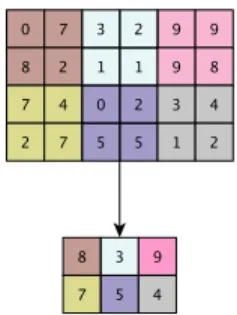
Fig. 6. ℧ax pooling with a
Pooling layers.Pooling layers reduce the dimensionality of the input layer. In image classiication pooling often follows convolution, as in UNet, a popular framework for medical image classiication [178]. Max pooling layers yield the maximum value of some input components, while mean pooling layers yield the mean value of some input compo-nents [86]. For instance, a 2×2 max pool will yield the maximum value in non-overlapping regions in a 2×2 matrix.
Max pooling is not a polynomial function. Mean pooling, which cal-culates the mean value of a collection of input components, is a FHE-friendly function. Experiments have shown that mean pooling is more stable in the presence of perturbations than max pooling [36]. Therefore, mean pooling is advantageous for FHE applications in two ways: ease
of computation and its relative stability in the presence of ciphertext noise accumulation.
Fully connected layer.Fully connected layers appear at the end of the
network, combining all data from the preceding layer. Each node in a fully connected layer is connected to all nodes in the previous layer. The value at each node in the layer is computed as a weighted sum of all values in the previous layer. Thekth node of layerℓ,yℓk, is given by
ykℓ =bk+ Õ
i
yiℓ−1wi,k
whereyℓ−1
i are the node values from the previous layer,wi,kare the weights, andbk is a bias term.
Because this is a polynomial function, it can be evaluated using FHE [36].
4.4.2 Private deep learning. Fully homomorphic encryption is used in a collection of works that
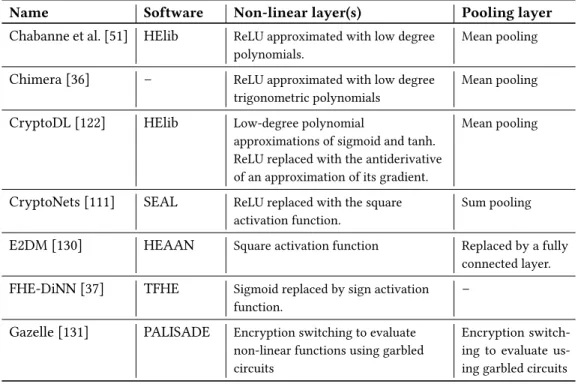
carry out private classiication of encrypted data over a neural network trained in the clear. A summary of these works is provided in Table 2. In these models, an encrypted data point is classiied using either unencrypted or unencrypted trained model parameters. Ωhen the parameters are unencrypted, a client encrypts a data point under their own private key and sends the encrypted value directly to the model owner. Because the model owner applies their (unencrypted) model to this encrypted data point, the client never needs direct access to the model. Encryption of both model parameters and input data would apply to the scenario of outsourcing all computation to an external service.
Dowlin et al.'s methodology, CryptoNets, carries out private classiication over neural networks with unencrypted trained model parameters [111]. CryptoNets replaces ReLU with the square activation function,f(x)=x2. This function is FHE-friendly due to its multiplicative depth of just one. However, the authors point out that the square activation function can yield unstable behavior during backpropagation. Networks deeper than 10 layers may have diiculty training with this activation function. CryptoNets replaces max pooling with sum pooling ś a scalar multiple of the mean. Both training and testing are performed with these modiied functions. The sigmoid function is applied in a inal activation layer during training and is replaced with argmax during classiication.
Use of the square activation function for classiication of encrypted data causes CryptoNets to have low accuracy for networks when there is a high number of non-linear layers. Chabanne et al. extended this approach to greater depth networks using batch normalization with low-degree polynomial approximations for the ReLU function [51]. The authors implemented their framework using BGV encryption [39] with SV ciphertext packing [192] using HElib [72].
Chabanne et al. [51] combine a low-degree polynomial approximation of ReLU with batch normalization. Batch normalization adds a normalization layer to the network before each activation layer in order to control the distribution of the data. After normalization, the activation function chosen to replace ReLU only needs to be accurate on a ixed interval. The authors replace ReLU with 2-, 4-, and 6-degree polynomials that approximate well on the interval[−3,3].
The CryptoDL framework [121, 122], implemented using HElib [72], approximates both the tanh and sigmoid functions with Chebyshev polynomials [122]. Rather than directly approximating ReLU, the authors approximate its derivative, and calculate its antiderivative for use as an activation function. Bootstrapping within the scheme is replaced with additional communication steps between client and server.
Another framework, GAZELLE, uses a combination of additive homomorphic encryption and garbled circuit techniques to implement neural network classiication [131]. Garbled circuits compute non-linear functions such as MaxPool and ReLU with linear-sized circuits. Experiments
Table 2. Frameworks for private (deep) neural network evaluation using FHE. If an open-source FHE imple-mentation was used, it is listed in the Sotware column. The non-linear layer column outlines the activation function used for fully homomorphic implementation, and the pooling layer column describes the FHE-friendly pooling operation.
Name Software Non-linear layer(s) Pooling layer
Chabanne et al. [51] HElib ReLU approximated with low degree polynomials.
Mean pooling
Chimera [36] ś ReLU approximated with low degree trigonometric polynomials
Mean pooling
CryptoDL [122] HElib Low-degree polynomial
approximations of sigmoid and tanh. ReLU replaced with the antiderivative of an approximation of its gradient.
Mean pooling
CryptoNets [111] SEAL ReLU replaced with the square activation function.
Sum pooling
E2DM [130] HEAAN Square activation function Replaced by a fully connected layer.
FHE-DiNN [37] TFHE Sigmoid replaced by sign activation function.
ś Gazelle [131] PALISADE Encryption switching to evaluate
non-linear functions using garbled circuits
Encryption switch-ing to evaluate us-ing garbled circuits
implement the BFV [38, 92] scheme using PALISADE [2] for homomorphic encryption, along with Yao's garbled circuits [205].
The Chimera framework uniies the plaintext spaces of B⁄GV, HEAAN, and TFHE [36]. It includes a method to pack complex exponential values in HEAAN ciphertexts, enabling evaluation of trigonometric polynomials up to a predeined depth. The authors approximate ReLU by low degree trigonometric polynomials by decomposing the graph as a Fourier series.
FHE-DiNN addresses the issue of scale invariance, where noise accumulation in activation layers limits network depth, by applying bootstrapping for noise reduction to each neuron's output [37]. Their network is a discretized neural network with{−1,1}as the input space and integer weights, and they implement the sign activation function. FHE-DiNN uses the TFHE library [64] to implement FHE for deep learning [37].
The encrypted data and encrypted model (E2DM) framework performs classiication of encrypted data using anencryptedneural network model [115]. Implementation uses the HEAAN library and the square activation function [130]. E2DM replaces ReLU with the square activation function and replaces a pooling layer with a fully connected layer that learns parameters to compute an array of weighted sums.
Additional methods use additive homomorphic encryption in conjunction with additional crypto-graphic techniques to perform privacy-preserving classiication on neural networks. The MiniONN framework of Liu et al. combines additive homomorphic encryption, secret sharing, and oblivious transfer for private classiication [144]. This method does not require any changes to the model
during training but does have a higher computation cost for clients. Ma et al. combine additive homomorphic encryption with secret sharing in their non-interactive model [148].
4.4.3 Privacy-preserving model training.Training over encrypted data presents its own challenges.
Training a neural network for a complex classiication problem generally requires analyzing network accuracy to introduce modiications during training. However, training over encrypted data requires the network to be efective on the irst try [51]. In addition, training requires a heavy computational load and the evaluation of many homomorphic operations when performed over homomorphically encrypted data.
Zhang et al. describe a backpropagation method for model training over encrypted data [207]. Between each backpropagation iteration on the cloud, the client must download, decrypt, and re-encrypt the parameters. This avoids the problem of the high computational cost associated with high multiplicative depth from homomorphic operations, but at the cost of high communication complexity. Li et al. [142] present a method for collaborative training of a deep learning model using FHE combined with additional cryptographic techniques. This method is associated with high computation and communication costs. Phong et al. [168] expand upon a method of Shokri and Shmatikov [188]. The authors combine asynchronous stochastic gradient descent with addi-tively homomorphic encryption, allowing multiple participants to jointly train a model without sharing their data sets. Additional methods for privacy-preserving model training use multiparty computation techniques [154, 155, 174, 179].
5 CLUSTERING
Clustering is a method of unsupervised machine learning that groups data points into clusters in order to discover patterns and structure in the data. A data owner may wish to perform privacy-preserving clustering, outsourcing the computational burden of clustering to an external cloud server without giving that server direct access to the data. In the medical setting clustering has been applied to neurological disease data sets, such as Alzheimer's disease, to ind patterns that clinicians would otherwise have diiculty detecting [10].
Thek-means clustering algorithm is a popular clustering method that calculates the center of data clusters, called centroids, by iteratively assigning points to the cluster with the nearest mean then updating the clusters to minimize within-cluster variance [120]. Sakellariou and Gounaris [182] performk-means clustering of encrypted data using Brakerski's FHE scheme [38], but require decryption by a trusted server during analysis. Jäschke and Armknecht present a modiication of
k-means that can be evaluated without intermediate decryption, but the estimated run time for a 2-dimensional data set with 400 points is over 25 days on a CPU [129].
Cheon et al. [58] perform clustering over encrypted data using the mean shift algorithm and HEAAN. Mean-shift clustering separates data into clusters by inding local maxima of a density function, or kernel, via gradient descent. The most common kernels used in mean shift clustering, such as the Gaussian kernel, require non-polynomial operations. The authors implement a HE-friendly kernelKgiven by
K(x,y)=c· (1− ∥x−y∥2)2Γ+1
for a constant parameterscandΓ, and address the computational load of mean-shift clustering by
performing each iteration on a sample of the data, rather than the entire data set.
6 FULLY HOMOMORPHIC ENCRYPTION FOR BIOINFORMATICS
Genome sequencing is now practical on a large scale, and the cost of data storage continues to decrease. As a result, genome sequencing is now commercially available for personalized genetic