Support Vector Machine based
Decoding Algorithm for BCH Codes
V. Sudharsan and B. Yamuna
Department of Electronics and Communication Engineering, Amrita School of Engineering, Coimbatore, Amrita Vishwa Vidyapeetham, Amrita University, India
Abstract—Modern communication systems require robust, adaptable and high performance decoders for efficient data transmission. Support Vector Machine (SVM) is a margin based classification and regression technique. In this paper, decoding of Bose Chaudhuri Hocquenghem codes has been ap-proached as a multi-class classification problem using SVM. In conventional decoding algorithms, the procedure for de-coding is usually fixed irrespective of the SNR environment in which the transmission takes place, but SVM being a machine-learning algorithm is adaptable to the communication envi-ronment. Since the construction of SVM decoder model uses the training data set, application specific decoders can be de-signed by choosing the training size efficiently. With the soft margin width in SVM being controlled by an equation, which has been formulated as a quadratic programming problem, there are no local minima issues in SVM and is robust to outliers.
Keywords—BCH codes, Chase-2 algorithm, coding gain, ker-nel, multi-class classification, Soft Decision Decoding, Support Vector Machine.
1. Introduction
In communication systems, there is an increasing demand for reliable and efficient transmission of data. When data is transmitted over a noisy communication channel, errors are bound to occur. Error control coding techniques are used to detect and correct these errors. The two main types of error correcting codes are block and convolutional codes. Bose Chaudhuri Hocquenghem (BCH) codes are a type of cyclic error correcting block codes with applications in digital, space and satellite communications. Conventional Hard Decision Decoding (HDD) algorithms like Peterson-Gorenstein-Zierler algorithm and Berlekamp-Massey (BM) algorithm have a standard error correcting capability of t=jdmin
2
k
errors. Though these algorithms have a decent error correcting performance for BCH codes, much re-search has been on the Soft Decision Decoding (SDD) al-gorithms to increase the error correction capability. SDD algorithms make use of the channel statistic information, which associates a reliability value to each of the received bit and helps in estimating a more accurate codeword at the receiver.
In the past decade, there has been consistent work on the application of heuristic, evolutionary and artificial intelli-gence techniques to the decoding problem. These tech-niques were more robust and had a faster convergence rate.
On similar lines, Kao and Berber used SVM, a maximum margin classification technique, for decoding convolutional codes [1]. The same has been extended to discuss the ef-fect of channel and modulation techniques for basic error control coding schemes in wireless applications [2]. In this paper, a SVM based decoding algorithm has been proposed for BCH codes. The proposed algorithm can be used for any (n,k,d) BCH code. The decoding problem has been approached as a multi-class classification problem. The SVM decoder has been programmed and performance com-parison has been established against conventional Chase-2 algorithm.
The paper is organized as follows: In Section 2 the ex-isting decoding algorithms for BCH codes are reviewed. Section 3 gives an overview of Support Vector Machines. The proposed decoding algorithm for BCH codes has been explained systematically in Section 4. Section 5 discusses the simulation results of the proposed algorithm followed by conclusion in Section 6.
2. Decoding Algorithms for BCH Codes
BCH codes form a class of powerful error correcting cyclic codes constructed using finite fields. They are known for their multiple error-correcting capabilities and the ease of encoding and decoding [3]. Peterson, gave a decoding algo-rithm for binary BCH codes based on syndrome decoding. Based on his observation on the linear recurrence in BCH codes, he came up with a set of linear equations, solving which the error locations can be obtained [4]. This algo-rithm was further generalized to GF(pm)by Gorenstein and Zierler [5]. Later, Chein devised a fast decoding algorithm for determining the roots of error locating polynomials over finite fields [6].
The Berlekamp-Massey-Forney algorithm is the most commonly used HDD algorithm for BCH codes. The Berlekamp-Massey algorithm is an alternative method to solve Peterson’s linear equations to obtain the error loca-tion polynomial in a simplified manner [7], [8]. Forney proposed an algorithm for determining the roots of error correcting polynomial [9]. Chase, put forth a class of de-coding algorithms that make use of the channel measure-ment information and claimed a two fold increase in error correcting capability over traditional HDD algorithms [10]. The Least Reliable Positions (LRPs) were identified based on the magnitude of each element in the received vector
and the decoded codeword was estimated from a candidate set of probable codewords generated using LRPs. This ad-ditional improvement in performance comes with an addi-tional complexity. Reeve and Amarasinghe proposed a par-allel Viterbi decoder for cyclic BCH codes since the usual algebraic decoding methods are not readily adaptable for soft decoding [11]. Yingquan formulated a list decoding algorithm for BCH codes to correct upto 1−√1−D
er-rors based on Guruswami-Sudan algorithm [12]. A Relia-bility Level List based decoding algorithm for binary BCH codes – which uses the exact reliability values to arrive at the most probable codeword - has been proposed by Ya-muna and Padmanabhan [13]. In the past decade, much effort has been put on the application of heuristic evolu-tionary algorithms like Genetic Algorithm (GA), Particle Swarm Optimization (PSO) and Neural Networks (NNs) to the decoding problem [14], [15]. They were more ro-bust and had a faster decoding convergence. Azouaoui and Belkasmi applied the heuristic GA to BCH decoding to in-crease the robustness and efficiency [16]. These algorithms facilitate easier implementation of decoders for Software Defined Radio (SDR) applications, where adaptability is an important factor. To decrease the hardware complexity, an interpolation based one pass Chase decoder was pro-posed [17] and it was 2.2 times higher in hardware effi-ciency than Berlekamp in terms of throughput over area ratio. Torreset al. attempted a radial basis NN as error correction technique to decode BCH codes [18].
The different hard decision and soft decision schemes pro-posed in literature have different degrees of performance enhancement and complexity. Attempts on performance enhancement or complexity reduction, trading-off one for the other has been an open problem for researchers. The procedure of traditional decoding algorithms has the same computational complexity even at a lower noise level. However, modern communication systems need adaptive decoders that cater to changes in channel characteristics. Given the dynamic requirements of emerging trends in channel decoding, in this paper – SVM – a multi-class classification technique has been applied to the decoding problem. The SVM model which is constructed according to the training data is channel adaptive and hence results in a much better performance than conventional methods.
3. SVMs for Data Classification
Support Vector Machines are a class of supervised learning algorithms based on Statistical Risk Minimization (SRM) principle. SVMs analyze the training data, recognize pat-tern and construct a model. The model is then used for the classification of unknown data. SVMs are generally used for classification and regression [19], [20]. Though SVM was traditionally used for binary classification prob-lems, gradually it was used for multi-class classification problems as well. Cortes and Vapnik formulated a one against all SVM where a multi-class classification prob-lem was converted intoN binary classification problems,
whereN denotes the number of classes [21]. Krebel later came up with a pairwise one versus one approach, involv-ing NC2 binary classifiers and reduced the unclassifiable regions that occur in one versus all SVM [22]. Studies by Abe, Kao, Hsu and Lin [23]–[25] show that one versus one algorithm is best suited for multi-class classification problem. So this approach has been used in the proposed decoding algorithm.
In a binary classification problem, given a set of labeled, linearly separable training data that belong to two differ-ent classes, SVM finds an Optimal Separation Canonical Hyperplane (OSCH), i.e. to achieve the largest minimum distance that separates the data points of one class from the other class and constructs a decision function that de-fines the margin. Each classifier has a subset of training data – decision variables, xi – called the support vectors,
which are the data points that lie closer to the margin and they characterize the margin. Now, any unknown data can be classified to one of the two classes by evaluating the de-cision function for that unknown data. Each support vector (SV) has an associated coefficient vectorwthat defines its role in the classifier. In order to obtain an optimal classi-fier with minimum number of misclassified data, there is necessity to have maximum margin. Here ||w2|| is taken to be the classifier margin.
When the training data are linearly inseparable, we go for a soft margin SVM. To allow inseparability and compensate for the misclassifications, i.e. to accommodate the data that do not have the maximum margin, the non-negative slack variable (ξ) is introduced. Thus for a maximum margin classifier, the SV parameters should be minimized. This has been formulated as a quadratic programming function in SVM. To determine the optimal SV parameters namely coefficient vectorw and bias termb, we need to minimize Eq. (1) given below:
1 2w Tw+C N
∑
i=1 ξi, (1)where: w– coefficient vector,C – margin parameter,ξ – slack variable, with respect to the constraint in Eq. (2):
yi(wTφ(xi) +b)≥1−ξi and ξi≥0, i=1,2, . . . ,N, (2) where: φ(x) – non-linear kernel function, b – bias term, yi – class label.
In order to maximize the generalization ability and to en-hance the classification of non-linear data, the input training data is mapped into a higher dimensional space called fea-ture space using a kernel function. This is called kernel trick. Since the application of SVM to decoding problem comes under the non-linear category, Radial Bias Function (RBF) kernel as given in Eq. (3) has been incorporated to map the input training data into higher dimensional space. Further RBF kernel, which uses Euclidean distance pre-vents the effect of outliers in performance.
K(xi,xj) =e−γkxi−xjk
2
4. SVM Based Decoding Algorithm
for BCH Codes
Consider a BCH (n,k,d) code, consisting of 2k message
words wherekdenotes the number of bits in each message word, n denotes the codeword length and d denotes the minimum distance between codewords. With each message word considered as a class, there areN=2kclasses. These
message words are encoded into a codeword of lengthn. Each bit in the codeword is a feature that defines the class to which the received codeword belongs. Each codeword in theN=2k codeword set has a one to one correspondence
to a unique message word and the codeword is associated with a class labelyi, where1≤i≤N.
SVM based decoding involves two major phases: the train-ing phase and the decodtrain-ing phase. The decoder model trained and constructed in the training phase is used to classify the received sequence in the decoding phase. 4.1. Training Phase
In training phase, an appropriate model has to be con-structed by generating suitable training data. Each code-word of classiis modulated, repeatedM number of times and then corrupted by an Additive White Gaussian Noise (AWGN) of SNR, 0 dB.
Now, we have N×M number of codewords belonging toN different classes, which form the training data for the model. The training is done at a high level of noise at 0 dB, to represent the worst-case scenario and to maximize the generalization characteristic of the decoder. These training data are sent to the pairwise one versus one SVM decoder, where each class of data is compared with another class andNC2classifiers (decision functions) are constructed and support vectors (decision variables) which is usually a sub-set of the training data are obtained.
To develop an optimal model, optimal training parame-ters should be selected namely, the margin parameterC and kernel parameterγ. This is done using a v-fold cross-validation method. In av-fold cross validation, the training
-2.0 -2.5 -3.0 -3.5 -4.0 -4.5 -5.0 -5 -4 -3 -2 -1 0 75 70 65 60 55 50 45 log ( ) 2 g log (C)2 Acc = 77.56%
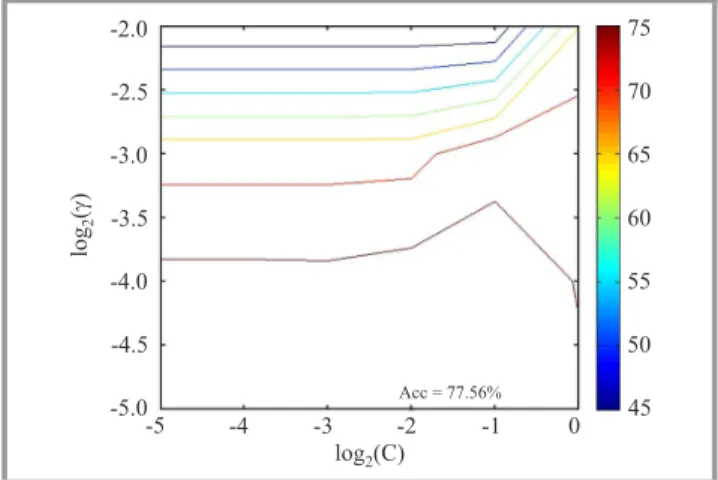
Fig. 1. A 10-fold cross validation done using LIBSVM. (See color pictures online at www.nit.eu/publications/journal-jtit)
data is divided into v equal sized subsets. The model is constructed using v-1 subsets as training data and tested with the one remaining set. For each combination of (C,γ), this process is repeated v times. The contour plots of a 10-fold cross validation for BCH (15, 7, 5) code are shown in Fig. 1. The value of (C,γ) with highest cross validation accuracy is taken as the optimal training parameter. Thus at the end of training phase, we have an optimal decoder model withm(wherem<N×M) support vectors. 4.2. Decoding Phase
In decoding phase, each of the n bit received soft deci-sion sequence is the unknown data that has to be classified into one of the N different classes, i.e. valid codewords. The decoding phase is thus a simple multi-class classifica-tion problem and each classifier is a binary classifier. The noisy received codeword is passed throughNC2classifiers, where each classifier has a set of support vectors generated during the training phase. The received codeword is trans-ferred into the higher dimensional space using the same RBF kernel function and evaluated using the decision func-tion constructed during the training phase. The output of the decision function determines the class to which the re-ceived codeword belongs. This is repeated for all the NC2 classifiers.
Now, each classifier would have given a vote to one of theN different classes. The received codeword gets decoded to the class which gets maximum number of votes. The output here refers to the maximum value of the decision function, which is directly related to the soft value associated with each received bit. This is known as winner – takes – all (WTA) principle [22]. Since there is a one to one corre-spondence between the codeword and the message word, the message word can be directly estimated by observing the class value. The proposed SVM based decoding algo-rithm is given in six steps in Algoalgo-rithm 1.
Algorithm 1: SVM decoding proposal
1: For a (n,k,d) binary BCH code, each message word in the2kset is associated with a class labely
i(N=2k).
2: Each message word is encoded into a n-bit codeword to obtainN unique codewords.
3: Each codeword is then transmittedM times through an AWGN channel with SNR=0dB.
4: These N×M codewords along with their associated class label form the training data. The training data set of one class is compared against training data of another class and henceNC2classifiers are constructed. 5: Each classifier has an associated set of Support Vec-tors (decision variables). Thus, the SVM model is con-structed.
6: The unknown codeword is now passed through the de-coder model and based on the WTA principle, it gets classified to one of theNclasses and the corresponding message is obtained.
5. Simulation Results and Discussions
LIBSVM, a software for multi-class SVM classification and regression, has been used for the construction of SVM model and testing of received codeword [26]. The AWGN channel has been considered and Binary Phase Shift Key-ing (BPSK) is used for modulation. All simulations have been performed using Matlab.
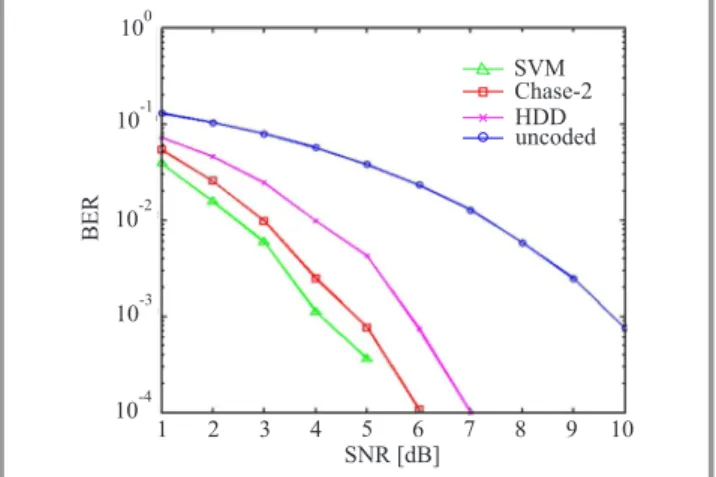
The proposed SVM decoding algorithm has been applied to BCH (15,7,5) code and the performance of SVM based decoding algorithm has been compared against Chase-2 and HDD algorithm as shown in Fig. 2. At a BER of10−3
, the SVM decoder is found to have a coding gain of 0.8 dB over Chase-2 algorithm and a coding gain of 2 dB over HDD algorithm. 100 10-2 10-1 10-3 10-4 1 2 3 4 5 6 7 8 9 10 SNR [dB] BER SVM Chase-2 HDD uncoded
Fig. 2. BER versus SNR plot of BCH (15,7,5) code.
10-2 10-1 10-3 10-41 2 3 4 5 6 7 8 SNR [dB] BER SVM-training size, M = 10 SVM-training size, M = 100 SVM-training size, M = 30 Chase-2
Fig. 3. Performance of SVM decoder for BCH (15,7,5) code at different training size.
Figure 3 shows that the performance of the SVM decoder improves when the training data size is increased. However, the increase in training size in turn increases the number of SVs. This complexity due to increase in SVs can be compensated by puncturing the classifiers, which consis-tently misclassifies the test data set during cross-validation. Though the increase in training size improves the perfor-mance, due to over fitting of data, improvement saturates as shown in Fig. 4.
0 20 40 60 80 100 120140160 180 200 Training size in terms of M
10-1.2 10-1.1
10-1.3
10-1.4
BER
Fig. 4. BER of SVM decoder under different training size with SNR fixed at 1 dB.
Unlike in soft decision decoding algorithms like Chase-2 decoder, SVM based decoder does not involve hard de-cision error correction, thus eliminating HDD complexity completely. However, when the value ofNincreases, more classifiers have to be constructed and this results in addi-tional complexity at the testing phase. This can be over-come by cascading SVM decoders. For aN-class problem, initially one decoder can be modeled to classify them into two classes and then two more decoders can be modeled to further classify them into N2 sub-classes, thus reduc-ing the complexity at each decoder. Thus, the proposed SVM algorithm can be combined with the cascading tech-nique and applied to higher block length codes. The addi-tional complexity due to this process is negligible because training is done only once during the initial setup of the communication system. The complexity at the decoding stage depends directly on the number of support vectors generated, which can be controlled according to the ap-plication thus striking a trade-off between complexity and performance.
6. Conclusion
This paper presents a SVM based decoding technique for BCH codes, where the decoding problem has been ap-proached as a multi-class classification problem. This al-gorithm makes maximum use of the channel measurement information combined with the margin based classifica-tion feature of the SVM to give an optimal decoder es-timate. From the simulation results, it can be seen that the proposed decoding algorithm has a better performance than the conventional Chase-2 algorithm at higher training size. The technique can be applied to higher block length codes by using cascaded SVM. A more generalized de-cision model, convergence to global optimal solution and prevention of outliers are major leads in this algorithm and thus proves to be efficient for the decoding of BCH codes. The proposed SVM based decoding algorithm can be ex-tended to decoding of high performance robust turbo codes as well.
References
[1] J. Kao and S. Berber, “Error control coding based on support vec-tor machine”, inProc. 1st IAPR Worksh. Cogn. Inform. Process., Santorini, Greece, 2008, pp. 182–187.
[2] R. Ramanathan, N. Valliappan, S. Pon Mathavan, M. Gayathri, R. Priya, and K. Soman, “Generalised and channel independent SVM based robust decoders for wireless applications”, inProc. IEEE Int.
Conf. Adv. Recent Technol. in Commun. Comput. ARTCom’09,
Kot-tayam, Kerala, Indie, 2009, pp. 756–760.
[3] R. Bose and D. Ray-Chaudhuri, “On a class of error correcting binary group codes”,Inf. Control., vol. 3, no. 1, pp. 68–79, 1960. [4] W. Peterson, “Encoding and error-correction procedures for the
Bose-Chaudhuri codes”, IEEE. Trans. Inform. Theory, vol. 6,
no. 5, pp. 459–470, 1960.
[5] D. Gorenstein and N. Zierler, “A class of error-correcting codes in
pmsymbols”,J. Soc. Ind. Appl. Math., vol. 9, no. 2, pp. 207–214, 1961.
[6] R. Chien, “Cyclic decoding procedures for
Bose-Chaudhuri-Hocquenghem codes”,IEEE Trans. Inform. Theory, vol. 10, no. 4, pp. 357–363, 1964.
[7] E. Berlekamp, “On decoding binary Bose-Chadhuri-Hocquenghem codes”, IEEE Trans. Inform. Theory, vol. 11, no. 4, pp. 577–579, 1965.
[8] J. Massey, “Step-by-step decoding of the
Bose-Chaudhuri-Hocquenghem codes”,IEEE Trans. Inform. Theory, vol. 11, no. 4, pp. 580–585, 1965.
[9] G. Forney, “On decoding BCH codes”,IEEE Trans. Inform. Theory, vol. 11, no. 4, pp. 549-557, 1965.
[10] D. Chase, “A Class of algorithms for decoding block codes with channel measurement information”, IEEE Trans. Inform. Theory, vol. 18, no. 1, pp. 170–182, 1972.
[11] J. Reeve and K. Amarasinghe, “A parallel Viterbi decoder for block cyclic and convolution codes”, Signal Process., vol. 86, no. 2, pp. 273–278, 2006.
[12] Y. Wu, “New List Decoding Algorithms for Reed-Solomon and BCH Codes”,IEEE Trans. Inform. Theory, vol. 54, no. 8, pp. 3611–3630, 2008.
[13] B. Yamuna and T. R. Padmanabhan, “A reliability level list based SDD algorithm for binary cyclic block codes”,Int. J. Comput.
Com-mun. Control, vol. 7, no. 2, pp. 388–395, 2012.
[14] J. Yuan, L. Wang, Q. He, H. Li, and Y. Wang, “A novel genetic probability decoding (GPD) algorithm for the FEC code in opti-cal communications”, Int. J. Light Elec. Opt., vol. 124, no. 15, pp. 1986–1989, 2013.
[15] J. Yuan, C. He, W. Gao, J. Lin, and Y. Pang, “A novel hard decision decoding scheme based on genetic algorithm and neural network”,
Int. J. Light Electron Opt., vol. 125, no. 14, pp. 3457–3461, 2014.
[16] A. Azouaoui and M. Belkasmi, “A soft decoding of linear block codes by genetic algorithms”, inProc. Int. Conf. Intell. Comput.
Syst. ICICS’2012, Dubai, United Arab Emirates, 2012.
[17] X. Zhang, “An efficient interpolation-based chase BCH decoder”,
IEEE Trans. Circuits Syst. II: Express Briefs, vol. 60, no. 4,
pp. 212–216, 2013.
[18] H. Torres, M. Jamett, C. Urrea, and J. Kern, “Design of a fault tol-erant digital communication system, by means of RBF networks. Comparison simulations with the encoding and decoding algo-rithms BCH (7,4,1)”,IEEE Latin America Trans., vol. 12, no. 8, pp. 1365–1374, 2014.
[19] J. Gokulachandran and K. Mohandas, “Comparitive study of two soft computing techniques for the prediction of remaining useful life of cutting tools”,Int. J. Intell. Manuf., vol. 26, no. 2, pp. 255–268, 2013.
[20] J. Gokulachandran and K. Mohandas, “Prediction of cutting tool life based on Taguchi approach with fuzzy logic and support vector regression techniques”,Int. J. Qual. Reliab. Manage., vol. 32, no. 3, pp. 270–290, 2015.
[21] C. Cortes and V. Vapnik, “Support-vector networks”, Machine
Learn., vol. 20, no. 3, pp. 273–297, 1995.
[22] U. Krebel, “Pairwise classification and Support Vector Machines”,
inAdvances in Kernel Methods: Support Vector Learning, B.
Sch¨ol-kopf, C. J. C. Burges, and A. J. Smola, Eds. Cambridge, USA: MIT Press, 1999, pp. 255–270.
[23] S. Abe,Support Vector Machines for Pattern Classification. Springer, 2005.
[24] J. Kao, “Methods of artificial intelligence for error control coding and multi-user detection”, Ph.D. Thesis, The University of Auckland, New Zealand, 2010.
[25] C. W. Hsu and C. J. Lin, “A comparison of methods for multiclass support vector machines”,IEEE Trans. Neural Netw., vol. 13, no. 2, pp. 415–425, 2002.
[26] C.-C. Chang and C.J. Lin, “LIBSVM: A library for support vec-tor machines”, ACM Trans. Intell. Syst. Technol., vol. 2, no. 2, pp. 27:1–27:27, 2011. Software available at
http://www.csie.ntu.edu.tw/∼cjlin/libsvm
V. Sudharsan is pursuing his
senior year of undergraduate B.Tech. program at the Depart-ment of Electronics and Com-munication Engineering, rita School of Engineering, Am-rita Vishwa Vidyapeetham. His research interests include error control coding, networking, soft computation and artificial intel-ligence.
E-mail: [email protected]
Dept. of Electronics and Communication Engineering Amrita School of Engineering, Coimbatore
Amrita Vishwa Vidyapeetham Amrita University
India
B. Yamuna received her M.E.
in VLSI design and Ph.D. in Er-ror Control coding from Amrita School of Engineering, Amrita Vishwa Vidyapeetham, is work-ing as an Associate Professor in the Dept. of ECE at Am-rita School of Engineering. She has published and presented pa-pers in international journals and conferences. She has re-viewed papers for international and national conferences, and chaired sessions. Her current research interests in-clude coding for reliable communication, spread spectrum communication, VLSI architectures for communication sys-tems, genomic coding and cryptosystems based on error control codes. She is a member of ISTE and IETE. E-mail: b [email protected]
Dept. of Electronics and Communication Engineering Amrita School of Engineering, Coimbatore
Amrita Vishwa Vidyapeetham Amrita University