
ADAPTATION BASED ON LEARNING STYLE AND
KNOWLEDGE LEVEL IN E
-
LEARNING SYSTEMS
by
MOHAMMAD TULAYHAN ALSHAMMARI
A thesis submitted to the
University of Birmingham
for the degree of
DOCTOR OF PHILOSOPHY
School of Computer Science
University of Birmingham
March 2016
University of Birmingham Research Archive
e-theses repository
This unpublished thesis/dissertation is copyright of the author and/or third parties. The intellectual property rights of the author or third parties in respect of this work are as defined by The Copyright Designs and Patents Act 1988 or as modified by any successor legislation.
Any use made of information contained in this thesis/dissertation must be in accordance with that legislation and must be properly acknowledged. Further distribution or reproduction in any format is prohibited without the permission of the copyright holder.
Abstract
Although there have been numerous attempts to build and evaluate adaptive e-learning systems, they tend to be limited in scope, and suffer from a lack of carefully designed and controlled experimental evaluations of their effectiveness and usability. This thesis addresses these issues through the implementation of an adaptive e-learning system and its experimental validation. The design of an adaptive framework and the specific instantiation of its components into a configurable adaptive e-learning system are presented. The domain model of the system deals with computer security. The learner model incorporates the information perception dimension of the Felder-Silverman model of learning style and also knowledge level. The adaptation model generates personalised learning paths and offers adaptive guidance and recommendation.
The thesis also provides an empirical evaluation through three controlled experiments to investigate the effect of different forms of adaptation. Rigorous experimental design, careful investigation and precise reporting of results are taken into account in all the three experiments. The findings indicate that matching the sequence of learning objects to the information perception learning style yields significantly better learning outcome and learner satisfaction than non-matching sequences. They also indicate that adaptation based on the combination of the information perception learning style and knowledge level yields significantly better learning outcome (both in the short- and long-term) and learner satisfaction than adaptation based on either of these learner characteristics alone; this combination is also marked by a significantly higher level of perceived usability compared to a non-adaptive version of the e-learning system.
D
edication
To my Father
To my Mother
Acknowledgments
I would like to express my sincere appreciation to those who have contributed to the production of this thesis and who have supported me through this fascinating journey.
I am extremely grateful to my supervisors, Dr Rachid Anane and Dr Robert Hendley, for their excellent guidance, encouragements and for all the valuable comments and feedback. Their deep insights helped me at all the stages of my research. For this, I am very grateful.
I would also like to give my sincere thanks to the members of the thesis group, Professor Russell Beale and Dr Rami Bahsoon who took the time to provide guidance, and for their regular critical eye and constructive comments.
Many thanks go also to the University of Hail and the Saudi Arabian Cultural Bureau in the United Kingdom for their financial support to purse my PhD., and for making this long journey possible.
Immense thanks go also to my family: to my Father, for never failing to present a semi-serious yet extremely wise and motivating perspective on life; to my Mother for her unconditional, continual support and sincere prayers. Words cannot express how grateful I am to my parents. They taught me the value of striving to fulfil my potential, which led me to never be satisfied with having learnt enough. I am not done yet.
Gratitude and happiness beyond measure go to my wife, for being so amazingly supportive through and understanding of the seemingly random peaks and valleys of the last few years.
Content
CHAPTER 1. INTRODUCTION ... 1
1.1 Overview ... 1
1.2 Background and Motivation ... 4
1.3 Research Questions ... 9
1.4 Research Methodology ... 12
1.5 Research Contribution ... 13
1.6 List of Publications ... 15
1.7 Thesis Structure ... 16
CHAPTER 2. LEARNING BACKGROUND ... 18
2.1 Introduction ... 18 2.2 Learning Theories ... 18 2.2.1 Introduction ... 18 2.2.2 Behaviourism ... 20 2.2.3 Cognitivism ... 21 2.2.4 Constructivism ... 23 2.2.5 Summary ... 24 2.3 Learning Style ... 26 2.3.1 Introduction ... 26
2.3.2 Types of Learning Style ... 27
2.3.3 Learning Style Models ... 29
2.3.3.1 The Dunn and Dunn Model ... 29
2.3.3.2 The Witkin Model ... 30
2.3.3.3 The Myers-Briggs Type Indicator ... 31
2.3.3.4 The Entwistle Model ... 32
2.3.3.5 The Kolb Model ... 33
2.3.3.6 The Honey and Mumford Model ... 34
2.3.3.7 The Felder-Silverman Model ... 35
2.3.4 Issues in Learning Style ... 37
CHAPTER 3. ADAPTIVITY IN E-LEARNING SYSTEMS ... 43
3.1 Introduction ... 43
3.2 E-Learning ... 44
3.2.1 Introduction ... 44
3.2.2 E-Learning and Learning Theories ... 47
3.2.3 Examples of E-Learning Systems ... 50
3.2.4 Issues in E-Learning Systems ... 52
3.3 Adaptive E-Learning Systems ... 54
3.3.1 Introduction ... 54
3.3.2 Models and Frameworks ... 56
3.3.2.1 Introduction ... 56
3.3.2.2 Domain Model ... 59
3.3.2.3 Learner Model ... 62
3.3.2.4 Adaptation Model ... 67
3.3.3 Examples of Adaptive E-Learning Systems ... 72
3.3.4 Usability Issues ... 76
3.3.5 Evaluation Approaches ... 78
3.4 Research Issues ... 82
3.5 Conclusion ... 84
CHAPTER 4. AN ADAPTIVE E-LEARNING FRAMEWORK ... 86
4.1 Introduction ... 86 4.2 Framework Architecture ... 86 4.2.1 Introduction ... 86 4.2.2 Domain Model ... 88 4.2.3 Learner Model ... 89 4.2.4 Adaptation Model ... 89 4.2.5 Auxiliary Components ... 90
4.3 AdaptLearn: Framework Instantiation ... 91
4.3.1 Introduction ... 91
4.3.2 System Architecture ... 93
4.3.3 Domain Model ... 96
4.3.4.1 Learning Style Modelling ... 101
4.3.4.2 Knowledge Level Modelling ... 102
4.3.5 Adaptation Model ... 104
4.3.5.1 Adaptation based on Learning Style ... 105
4.3.5.2 Adaptation based on Knowledge Level ... 107
4.4 Discussion ... 111 4.5 Conclusion ... 114 CHAPTER 5. EVALUATION ... 115 5.1 Introduction ... 115 5.2 Method ... 117 5.2.1 Introduction ... 117 5.2.2 Experimental Issues ... 120 5.2.3 Measurement Tools ... 121 5.2.4 Data Analysis ... 124
5.3 Experiment 1: Learning Style Adaptivity ... 125
5.3.1 Introduction ... 125
5.3.2 Hypotheses ... 126
5.3.3 Procedure ... 127
5.3.4 Results and Discussion ... 128
5.3.4.1 Introduction ... 128
5.3.4.2 Learning Outcome ... 129
5.3.4.3 Learner Satisfaction ... 131
5.3.4.4 Additional Findings ... 133
5.4 Experiment 2: Learning Style and Knowledge Level Adaptivity ... 135
5.4.1 Introduction ... 135
5.4.2 Hypotheses ... 136
5.4.3 Procedure ... 138
5.4.4 Results and Discussion ... 138
5.4.4.1 Introduction ... 138
5.4.4.2 Learning Outcome ... 139
5.4.4.3 Learner Satisfaction ... 144
5.5 Experiment 3: Perceived Usability ... 146
5.5.1 Introduction ... 146
5.5.2 Hypotheses ... 147
5.5.3 Procedure ... 148
5.5.4 Results and Discussion ... 148
5.5.4.1 Introduction ... 148
5.5.4.2 Usability ... 149
5.5.4.3 Learning Outcome ... 151
5.5.4.4 Usability and Learning Outcomes ... 152
5.6 Conclusion ... 153
CHAPTER 6. CONCLUSION ... 157
6.1 Introduction ... 157
6.2 Summary of the Work ... 157
6.3 Research Questions Re-visited ... 158
6.4 Summary of Research Contributions ... 163
6.5 Limitations and Lessons Learnt ... 165
6.6 Future Work ... 169
6.7 Summary ... 174
APPENDIX A: THE INDEX OF LEARNING STYLE ... 176
APPENDIX B: LEARNER SATISFACTION QUESTIONNAIRE ... 177
APPENDIX C: THE SYSTEM USABILITY SCALE (SUS) ... 178
APPENDIX D: A SAMPLE OF THE TEST QUESTIONS ... 179
List of Figures
Figure 1. Curry’s onion model of learning style theories, taken from [Wolf 2007]. ... 27
Figure 2. Kolb’s experiential learning cycle. ... 33
Figure 3. Interface screenshot of Moodle. ... 51
Figure 4. General Scheme of a user-adaptive system [Jameson 2009]. ... 57
Figure 5. Taxonomy of adaptive methods and techniques [Knutov 2012]. ... 68
Figure 6. An example of adaptive media format based on verbal (left) and visual (right) learning styles in Protus [Klasnja-Milicevic et al. 2011]. ... 71
Figure 8. An adaptive e-learning framework. ... 88
Figure 9. The architecture of the AdaptLearn system. ... 94
Figure 10. An example of the presentation output disiplayed by the AdaptLearn interface. ... 95
Figure 11. An example of a domain model structure (IU = instructional unit; LO = learning object). ... 97
Figure 12. A concrete learning object (left) and an abstract learning object (right). ... 98
Figure 13. An abstract representation of the learner model. ... 99
Figure 14. The two learner modelling phases of initialisation and maintenance. ... 100
Figure 15. The information perception dimension (sensory-intuitive). ... 102
Figure 16. Multi-level quantitative overlay model for knowledge level. ... 104
Figure 17. An abstract representation of the adaptation model. ... 105
Figure 18. Learning paths constructed for intuitive and sensory learners. ... 107
Figure 19. An example of recommendation of supplementary learning material related to a specific LO. ... 110
Figure 20. Recommendations, progress feedback and motivational messages. ... 110
Figure 21. Experiment 1: Distribution of participants in the information perception dimension. ... 129
Figure 22. Learning outcome for sensory and intuitive learners. ... 133
Figure 24. Experiment 2: Distribution of participants in the information perception dimension. ... 139 Figure 25. The results of a Tukey post hoc test measuring a number of variables to compare
each pair of experimental groups. The values indicate the significance level (p value).141 Figure 26. Experiment 3: Distribution of participants in the information perception dimension. ... 149
List of Tables
Table 2. The Felder-Silverman learning and teaching style model. ... 37
Table 3. Domain model features. ... 62
Table 4. Learner model features. ... 64
Table 5. Adaptation model features. ... 69
Table 6. The content of a computer security course represented in the domain model. ... 99
Table 7. Knowledge level equations. ... 103
Table 8. Construction of learning paths at the level of instructional units. ... 108
Table 9. Pre-test, post-test and learning outcome results of the matched and mismatched groups. ... 129
Table 11. Satisfaction scores for the experimental groups. ... 144
1
Chapter 1.
Introduction
1.1
Overview
Teaching has shifted from an instructor-centric approach, which focuses mainly on transmitting knowledge from expert to learner, to a learner-centric approach, in which knowledge is constructed by learners who are actively involved in the learning process and are engaged in collaborative work with their peers [Vrasidas 2000]. E-learning systems are expected to support better learner-centric instruction and enable more paced and self-directed learning [Anderson 2008]. E-learning can be generally defined as “the use of the Internet to access learning materials; to interact with the content, instructor, and other learners; and to obtain support during the learning process, in order to acquire knowledge, to construct personal meaning, and to grow from the learning experience” [Ally 2004]. E-learning systems remove distance barriers to education as learners may be spread across widely separated geographical areas. A large number of free, open-source and commercial e-learning systems already exist [Hauger and Köck 2007]. They have been developed and used by several organisations such as universities, schools, and even in business and military sectors to support learners and to manage learning programmes.
There are, however, several issues regarding learner-system interaction with traditional e-learning systems [Hauger and Köck 2007; Shute and Towle 2003; Welsh et al. 2003]. In most systems, the diversity of learners is not often taken into account to a sufficient degree [Hauger and Köck 2007]. People differ in personalities, abilities, experiences, skills, learning styles and preferences. Traditional e-learning systems do not generally take these characteristics into account and do not provide truly personalised and adaptive learning [Brusilovsky 2012].
2
learning systems may successfully retrieve a variety of learning material and resources that technically match a specific query or goal, but they usually fail to provide the most relevant learning material that meets the needs of individual learners [Hauger and Köck 2007]. Instead, learners have to explore, filter and organise a large amount of material; they must focus on system functionality instead of the learning which is their primary task. In addition, a large volume of information may overwhelm learners during the process if they do not know when, where and what to study. This makes it difficult to process information, leading to less effective learning. Traditional e-learning systems tend to provide the same courses and similar learning material in the same sequence to all users, which may be problematic and lead to learner dissatisfaction and increased dropout rates [Sun et al. 2008].
Adaptation is often put forward as a way of tailoring a system to the user’s requirements [Brusilovsky 2012]. Adaptive e-learning systems integrate learner characteristics such as learning style, affective state, skills and knowledge level to provide personalised services, and to recommend relevant instructional material; they are an enhancement to the dominant, one-size-fits-all approach to the development of e-learning systems. A system may highlight appropriate information, recommends what a given learner studies, or constructs personalised learning paths [De Bra and Calvi 1998; Kavcic 2004].
Since this thesis presents research concerning adaptation in e-learning systems in which learning material can be personalised and appropriately sequenced to meet the needs of individual learners, it takes a cross-disciplinary approach that draws from the fields of education and computer science. The specified research questions in this thesis are best answered by combining the theoretical concepts and best practices of these two disciplines; taking each field in isolation is not adequate [Joy 2004].
3
From the field of education come several theories and models of learning, such as behaviourist, cognitivist and constructivist theories [Ertmer and Newby 1993]. It is crucial when designing and implementing e-learning systems to identify how people learn. Understanding the different characteristics of learners is also important in order to meet their requirements. Amongst learner characteristics, learning style and learner knowledge are recognised as important factors in learning [Felder and Silverman 1988; Essalmi et al. 2010]. Learning style is the way in which a learner obtains or perceives information in a learning environment to be processed in a cognitive structure for meaningful information connection and retention in memory [Keefe 1979]. Many educational theorists agree that taking learning style into account in instruction can improve learning [Felder and Silverman 1988; Keefe 1979; Pashler et al. 2008; Dunn et al. 1995]. It is also argued that if a learner has a strong affinity with a particular learning style, the instructional material should match this style to enhance learning [Felder and Silverman 1988]. Learner knowledge is also a fundamental learner characteristic that should be taken into account in systems to enhance learning; it describes the extent to which a learner understands, applies and recalls specific information related to a particular topic [Papanikolaou et al. 2003; Klasnja-Milicevic et al. 2011]. The characteristics of learning style and learner knowledge are central to this research.
In the computer science field, personalisation and adaptation of e-learning systems remains an important issue for researchers. Learner modelling is an important aspect in adaptive e-learning systems; it is concerned with the way learner characteristics such as e-learning style, affective state, skills and learner knowledge are represented, stored and maintained [Chrysafiadi and Virvou 2013b]. The development of adaptive methods and techniques represents an important concern in adaptive e-learning systems. These techniques specify the way that information is presented and sequenced to meet the needs of learners. One focal
4
point of research relates to the development of adaptive models and frameworks which aim to facilitate the implementation of adaptive systems; the frameworks incorporate important components that are necessary to provide adaptation such as the domain model, the learner model and the adaptation model. Another aspect of research is concerned with domain models that store and represent learning material in a way that facilitates the process of adaptation. Domain modelling also deals with the design and implementation of content authoring tools for adaptive e-learning systems [Stash et al. 2004].
This chapter introduces the motivation of this work and relevant background. It also outlines the research questions that are investigated. It then specifies the research methodology, highlights the contribution of this research, and presents a list of peer-reviewed publications which resulted from this work. The structure of this thesis which makes up the rest of the chapters is also provided.
1.2
Background and Motivation
The provision of educational environments and content that take into account individual characteristics such as learning preferences, abilities, skills and knowledge is referred to as personalised learning or adaptive instruction [Park and Lee 2003]. Adapting instructional material and its delivery represents a fundamental role in enhancing learning; adaptive instruction can be traced back several centuries [Snow 1977]. Adaptive instruction can be applied in classes to facilitate the differentiation of teaching approaches to meet the needs of learners [Shute and Towle 2003]. As an approach to providing adaptive instruction based on knowledge level, each learner may, for instance, be assessed by a pre-test that leads to the assignment to a specific instructional unit. Upon completion of each unit a post-test is provided to determine the learner’s knowledge level of the material. The learner is required to
5
achieve a satisfactory level on the completed unit before proceeding to the next appropriate unit. However, adaptive instruction in traditional classroom settings is limited because of the large numbers of students and the limited class time available [Brusilovsky et al. 1998]. Teachers may not always have the time, the resources and the ability to assess, for instance, the knowledge level of each learner and to modify their teaching approaches accordingly [Pask 1976].
With the advent of computer technology, networking and the Web, many e-learning systems were developed to provide learning environments that help learners access learning material and interact with their teachers and other learners. These systems remove the distance barriers to education by offering learning opportunities anytime and anywhere. However, as mentioned earlier, traditional e-learning systems often provide the same learning material, the same presentation and sequence for all learners irrespective of their characteristics such as learning style, affective states, abilities and knowledge levels.
Adaptation is often put forward as a way of tailoring the presentation of learning material and its sequencing in e-learning systems to meet the requirements of the learner [Brusilovsky 2012]. Many adaptive e-learning systems have been developed; they are inspired by work in both the intelligent tutoring system (ITS) and adaptive hypermedia or web-based educational fields [Park and Lee 2003]. ITSs are adaptive educational systems developed with the application of artificial intelligence techniques such as decision trees, fuzzy logic and Bayesian networks to create virtual one-on-one teaching [Self 1999]. In the early 1990s, the development of adaptive hypermedia or web-based educational systems began to meet the requirements of the increased number and variety of learners who had personal computers to access information on the Web. The ultimate goal of adaptive e-learning systems is to personalise learning material and its sequencing, to match the needs of an individual learner
6
as closely as possible in order to enhance learning. These systems integrate learner characteristics such as learning style, skills, abilities, affective state and knowledge level to provide personalised services and recommend relevant instructional material [Brusilovsky 2001; Brusilovsky 2012].
As mentioned earlier, learning style and learner knowledge are recognised as important factors in learning [Felder and Silverman 1988; Essalmi et al. 2010]. Many adaptive e-learning systems that incorporate e-learning style, learner knowledge or a combination of the two have been developed [Alshammari et al. 2014; Essalmi et al. 2015; Hauger and Köck 2007]. ELM-ART was one of the first and most influential [Brusilovsky et al. 1996; Weber and Brusilovsky 2001]. Despite dating from 2001, it remains in use today for learning Lisp programming; it adapts learning material according to the learner’s knowledge level [Weber and Brusilovsky 2015]. CS383 is also an early system that personalises learning material related to a computer systems course, based on learning style [Carver et al. 1999]. MASPLANG is a pioneer in the area, combining both learning style and knowledge level to adapt learning material related to a computer networking course [Peña et al. 2002]. INSPIRE is a popular and important example; it is an intelligent system based on learning style and knowledge level that personalises instruction related to a computer architecture course in an online environment [Papanikolaou et al. 2003].
One recent successful example is Protus [Klasnja-Milicevic et al. 2011], an adaptive e-learning system based on e-learning style and learner knowledge that recommends relevant learning material in the teaching of the Java programming language. The TSAL system takes into account learner interactions with the system and learning style in order to recommend relevant learning material related to mathematics [Tseng et al. 2008]. Limongelli et al.
7
developed the LS-Plan system, integrating both knowledge level and learning style in order to generate personalised learning paths for users [Limongelli et al. 2009].
It is not always evident how to incorporate adaptation into e-learning systems in general and, more particularly, into adaptation based on learning style [Brusilovsky and Millán 2007]. In addition, when learning style is taken into account in adaptive e-learning systems, it is rarely combined with other learner characteristics such as learner knowledge to provide adaptation; moreover, these initiatives are rarely followed by a high quality and thorough empirical evaluation of their effectiveness in combination [Tseng et al. 2008; Truong 2016; Özyurt and Özyurt 2015; Essalmi et al. 2015]. Adaptation based on learning style and learner knowledge and their learning effectiveness in e-learning systems has been regarded as an important area of research because of the inherent complexity of adaptation, the large number of learning style models and dimensions, and the many variables that need to be controlled when evaluating the effectiveness of adaptation, such as prior experience and learner motivation [Brown et al. 2009; Akbulut and Cardak 2012; Mulwa et al. 2011; Gena 2005].
Although there have been numerous attempts to build and evaluate adaptive e-learning systems, there is a lack of carefully designed and controlled experimental evaluation of their learning effectiveness [Akbulut and Cardak 2012; Truong 2016; Özyurt and Özyurt 2015]. Research into learning style-based adaptation has led to a large number of small-scale and short-term applications of learning style models to small samples of learners [Chrysafiadi and Virvou 2013b; Brown et al. 2009; Truong 2016; Akbulut and Cardak 2012; Özyurt and Özyurt 2015]. The results of several studies concerning adaptation based on learning style are non-conclusive, limiting the confidence in generalising their learning effect [Alshammari et al. 2015a]. Another problem is the limited scope of experimental evaluation and the variables that are usually taken into account to determine the effectiveness of adaptation. Several
8
important factors should be considered by taking into account both the pedagogical and usability factors when evaluating adaptive e-learning systems. Brusilovsky and Millán argue that a careful empirical evaluation of the effectiveness of adaptive e-learning systems is more important than proposing novel adaptive techniques with questionable benefits [Brusilovsky and Millán 2007].
With respect to the evaluation of adaptive e-learning systems, evaluation methodologies of human-computer interaction (HCI) have been broadly adopted [Gena 2005]. Among HCI evaluation methods, several researchers insist that experimental evaluation, also known as controlled experimentation, is the most appropriate approach for evaluating adaptive e-learning systems [Weibelzahl 2001; Gena 2005; Brown et al. 2009; Mulwa et al. 2011]. The case has been made that evaluation through experimentation with actual users is important for adaptive systems, as it produces evidence of the usefulness of adaptation [Weibelzahl 2001]. In general, experimental evaluation is concerned with the effectiveness and usability of a system by observation in controlled experiments [Höök 2000; Jameson 2009]; it plays a role in determining the advantages and effectiveness of adaptive systems, and in realistic situations with a fairly controlled approach [Gena and Weibelzahl 2007]. In addition, the appropriateness of this evaluation approach can be justified because the main source of information is usually generated from user-system interaction and users are the main targets of adaptive systems [Mulwa et al. 2011]. Experimental evaluation is chosen as the main method in this study for evaluating the effectiveness of different forms of adaptation, specifically through a number of experiments conducted to answer the research questions. Each experiment has specific objectives and hypotheses.
This research seeks to address the issue of whether the simple fact that adaptivity can be provided in e-learning systems to meet the characteristics of an individual learner – especially
9
learning style and learner knowledge – means that adaptivity should in fact be provided. Are there aspects of learning style that were not investigated thoroughly that might lead to more effective learning, given the large number of existing learning style models? More thorough and carefully planned and conducted empirical evaluation of adaptive e-learning systems is needed; these issues are highly relevant to this work.
1.3
Research Questions
This study addresses four main research questions. These questions concern both the pedagogical and usability aspects of adaptation in e-learning systems. The investigation of the learning effectiveness and learner satisfaction of different forms of adaptation relates to the pedagogical aspect, while the usability aspect involves the investigation of the perceived usability level when providing adaptation.
Learning effectiveness is an essential factor that should be measured when evaluating adaptive e-learning systems [Brown et al. 2006; Paramythis et al. 2010]. Learner satisfaction also represents another important element in learning [Sun et al. 2008]; it is influenced by several affective factors such as motivation and engagement in the interaction, and relates to the extent to which learners believe the system they are interacting with meets their requirements [Shee and Wang 2008].
Another key issue is perceived usability, which relates to the ease of use and learnability of a specific system reflecting the extent to which users are satisfied with the interaction experience. It is expected that a high level of perceived usability when interacting with an e-learning system leads to more satisfied, engaged and motivated learners; this will reflect on their learning achievement [Ardito et al. 2006; Zaharias and Poylymenakou 2009].
10
The four research questions are as follows:
Research Question 1. Does adaptation based on the information perception dimension of learning style enhance learning and does it lead to a high level of learner satisfaction?
The effectiveness of adaptation based on learning style is investigated. More specifically, the information perception or sensory-intuitive dimension of the Felder-Silverman learning style model [Felder and Silverman 1988] was the basis of the implementation; it is recognised as one of the most important learning style dimensions [Felder and Brent 2005; Felder et al. 2002; McCaulley 1990]. It overlaps with and can be found in many different learning style models [Kolb 1984; Myers and McCaulley 1985; Felder and Silverman 1988]. It is correlated with several characteristics including learning styles, career skills and preferences and management styles [Felder and Silverman 1988; Feldman et al. 2014].
However, the information perception dimension of learning style has received scant attention in published research [Akbulut and Cardak 2012; Truong 2016; Özyurt and Özyurt 2015; Feldman et al. 2014]. These facts warrant a study that investigates both the provision of adaptation based on this particular dimension and the evaluation of its learning effectiveness [Alshammari et al. 2015c; Alshammari et al. 2015a].
Research Question 2. How do learning outcome and learner satisfaction vary if an adaptive e-learning system is based on the following learner characteristics:
• The information perception dimension of learning style alone; • Knowledge level alone;
11
Some researchers argue that there are few studies that carefully examine the effect of combining two or more learner characteristics or sources in an adaptive e-learning system [Tseng et al. 2008; Essalmi et al. 2010; Truong 2016]. In particular, learner knowledge is considered one of the important learner characteristics to take into account in adaptive e-learning systems [Brusilovsky and Millán 2007; Papanikolaou et al. 2003; Klasnja-Milicevic et al. 2011]. Furthermore, the major learning theories – whether behaviourist, cognitivist or constructivist in outlook – emphasise the importance of learner knowledge level when planning and delivering instruction [Ertmer and Newby 1993; Snow 1977]. A combination of learning style and learner knowledge are also used as a basis to provide adaptation. An investigation of the learning effectiveness and learner satisfaction when providing adaptation based on each characteristic and in combination are also taken into account.
Research Question 3. Do adaptive e-learning systems based on the information perception dimension of learning style and knowledge level yield higher levels of perceived usability than non-adaptive systems?
Research Question 4. Is there a relationship between perceived usability levels and learning outcomes in adaptive e-learning systems and non-adaptive systems?
Perceived usability remains an issue that requires investigation [Tsandilas and Schraefel 2004; Höök 1998]. When a system is not sufficiently usable, learners may become frustrated and focus on the e-learning system rather than on the learning content [Ardito et al. 2006]. An adaptive e-learning system can be usable in terms of its usage but not in terms of the underlying pedagogical perspective and vice versa [Gena 2005; Höök 2000]. This issue may therefore lead to less effective and less efficient learner-system interaction [Orfanou et al. 2015]. Ardito et al. point out the need for a better understanding of where adaptation in
e-12
learning systems is beneficial and where it is harmful [Ardito et al. 2006]. Zaharias and Poylymenakou also state that “very little has been done to critically examine the usability of e-learning applications” [Zaharias and Poylymenakou 2009]. The perceived level of usability and the relationship between usability and learning outcome when providing adaptation are also investigated in this work [Alshammari et al. 2015b; Alshammari et al. 2016].
1.4
Research Methodology
Since the scope of this research relates mainly to adaptive e-learning systems, the work began by analysing the previous literature to identify and classify major learning theories and the concept of learning style. Then, an investigation of the issues related to adaptation based on learning style and learner knowledge in e-learning systems was carried out including an investigation of usability issues of adaptive e-learning systems and how they are evaluated. The research identified issues which require further study.
A design of a conceptual adaptive framework which draws on past models and frameworks in published research was initially proposed. As an instantiation of that framework, different forms of adaptation based on learning style and learner knowledge are implemented in an adaptive e-learning system. The main goals of developing the system are to:
• validate the proposed framework by taking into account its different components such as
the domain model, learner model and adaptation model;
• evaluate the proposed approach of learning style adaptivity by focusing on the information
perception dimension of learning style;
• evaluate the learning effectiveness and learner satisfaction and how they differ when
13
alone, knowledge level alone and adaptation based on the combination of learning style and knowledge level;
• evaluate the perceived level of usability and its relationship with learning outcome; • validate the ability of the system to accommodate different learner characteristics.
After reviewing relevant theories and research, identifying the main research questions and designing an adaptive e-learning system, the schematic process for each experiment was to develop research hypotheses, identify experimental variables, data collection tools and experimental procedures, select participants, conduct the experiment, collect and analyse data and draw conclusions regarding the research hypotheses [Keppel 1991; Chin 2001].
To improve the execution of the experiments, a pilot test was conducted prior to each experiment with three to four participants. The main objectives of the pilot tests were to check the randomisation process of participants in the experiment’s conditions, technical issues related to the developed system, data collection reliability and consistency, the difficulty level of learning material, experiment duration and issues such as confusion and participant questions.
1.5
Research Contribution
Several important contributions to knowledge in the field of adaptive e-learning systems are made by the research reported in this thesis.
One contribution relates to the review of adaptive e-learning systems taking into account their main components including the domain model, the learner model and the adaptation model; three fundamental components necessary for any adaptive e-learning system in order to provide adaptation [Alshammari et al. 2014]. In addition, usability issues of these systems and how they are evaluated are also covered in the review.
14
Another contribution relates to the proposed adaptive e-learning framework; it can be used as a reference model to design instances of adaptive e-learning systems by focussing on different perspectives of the domain model, the learner model and the adaptation model. Within the overall framework, an adaptive e-learning system has been designed and implemented. The system has been essentially developed as a means to execute a set of experiments in order to validate the proposed framework and to evaluate the effectiveness of different forms of adaptation. The learner model of the system incorporates two learner characteristics: the information perception dimension of learning style and the knowledge level. The system can be configured to provide adaptation based on the information perception dimension of learning style alone, knowledge level alone and a combination of the two characteristics. In addition, computer security is used to demonstrate one particular domain of the system. Computer security has rarely been the domain of adaptive e-learning systems; the work in this thesis, thus, also offers some contribution to computer security education [Alshammari et al. 2015d].
The major contribution of this work comes from the careful design and execution of the experiments, and from the thorough analysis and reporting of the quantitative findings of three experiments with a focus on the pedagogical and usability aspects when providing different forms of adaptation. The three factors of learning effectiveness, learner satisfaction and perceived usability are taken into account when evaluating adaptation. The results of the experiments can offer more evidence for the importance of personalisation and adaptation of learning material and their sequencing to meet the different needs of different learners in e-learning systems.
The three experiments carried out to address the research questions are summarised as follows.
15
• Experiment 1 was conducted to investigate adaptation based on the information perception
dimension of learning style and its effect on learning outcome and learner satisfaction.
• Experiment 2 was carried out to explore the effects of three classes of adaptation and how
they vary in terms of learning outcome and learner satisfaction. The first is based on the information perception dimension of learning style alone, the second is based on knowledge level alone while the third caters to the combination of the two characteristics.
• Experiment 3 was undertaken to evaluate the perceived usability level, using a standard
usability measure, and to investigate the relationship between perceived usability and learning outcome.
1.6
List of Publications
A number of research papers which resulted from this work were accepted and published in international conferences. These papers are listed below:
• M. Alshammari, R. Anane, R. Hendley. An Empirical Evaluation of Adaptation based on
Learning Style and Knowledge level. The 13th International Conference on Intelligent Tutoring Systems (ITS-2016), Zagreb, Croatia, [Accepted].
• M. Alshammari, R. Anane, R. Hendley. Usability and Effectiveness Evaluation of
Adaptivity in E-Learning Systems. The 34th Annual ACM Conference on Human Factors in Computing Systems (CHI-2016), San Jose, USA, pp2984-2991.
• M. Alshammari, R. Anane, R. Hendley. Design and Usability Evaluation of Adaptive
E-learning Systems based on Learner Knowledge and Learning Style. Human-Computer Interaction–INTERACT 2015, Bamberg, Germany, pp584-591.
16
• M. Alshammari, R. Anane, R. Hendley. The Impact of Learning Style Adaptivity in
Teaching Computer Security. The 20th ACM conference on Innovation and technology in computer science education (ITiCSE-2015), Vilnius, Lithuania, pp135-140.
• M. Alshammari, R. Anane, R. Hendley. Students’ Satisfaction in Learning Style-Based
Adaptation. The 15th IEEE International Conference on Advanced Learning Technologies (ICALT-2015), Hualien, Taiwan, pp55-57.
• M. Alshammari, R. Anane, R. Hendley. An E-Learning Investigation into Learning Style
Adaptivity. The 48th Hawaii International Conference on System Sciences (HICSS-48), January 5-8, 2015, Hawaii, USA, pp11-20.
• M. Alshammari, R. Anane, R. Hendley. Adaptivity in E-Learning Systems. The 8th
IEEE International Conference on Complex, Intelligent, and Software Intensive Systems (CISIS 2014), Birmingham, UK, pp79-86.
1.7
Thesis Structure
This thesis is comprised of six chapters including this introduction. Chapter 2 presents the theoretical foundations of learning and outlines several key learning theories. A discussion of these theories and their implications for instruction is included to identify how people learn. In addition, because learners differ in their approaches to learning, the concept of learning style is explored, as it is highly relevant to learning and is central to the present study.
Chapter 3 discuses technology-enhanced learning, also known as e-learning. It begins by outlining the earliest uses of distance learning technology. It also defines e-learning, covering different terminologies, discussing the theoretical implications for e-learning and analysing current e-learning systems, including an analysis of their merits and limitations. The chapter then presents the main concepts of adaptivity in e-learning systems, which is viewed as a
17
solution to some of the drawbacks and limitations of traditional e-learning approaches. The chapter also reviews some existing adaptive e-learning frameworks and systems and investigates how they are evaluated. Usability issues and challenges in adaptive systems are also covered, with research issues highlighted.
Chapter 4 provides an adaptive e-learning framework. It incorporates the major components of analogous systems including the domain model, the learner model and the adaptation model. Within the overall framework, the chapter also describes the design and development of an adaptive e-learning system. The main aims of the system are to validate the proposed framework and to evaluate the effectiveness of different forms of adaptation. The system provides adaptation that takes into account two primary learner characteristics: learning style and learner knowledge. The rationale for choosing these two characteristics is also presented. Chapter 5 evaluates the effectiveness of different forms of adaptation generated by the adaptive e-learning system. It begins by outlining the evaluation method, including dependent and independent variables, data collection tools and data analysis. Three experiments are presented and discussed, each with its own specific objectives and hypotheses. Experiment 1 is concerned with the effectiveness of learning style adaptivity, Experiment 2 examines the effectiveness of adaptation based on the combination of learning style and learner knowledge and Experiment 3 investigates the perceived usability and its relationship to learning outcome. Finally, Chapter 6 concludes the thesis by summarising the work, revisiting the research questions and highlighting and reflecting upon the main contributions of this research. The chapter also highlights the limitations of this study and points to possible future research avenues.
18
Chapter 2.
Learning Background
2.1
Introduction
This chapter presents the theoretical foundations of learning. It identifies different approaches to learning and outlines several key learning theories. A discussion of these theories and their implications in instruction is also included. As learners differ in their approaches to learning, the concept of learning style is also covered; this concept is highly relevant both to learning itself and to this research.
2.2
Learning Theories
2.2.1
Introduction
Learning has been defined in several ways by learning psychologists and educational theorists, and it is a challenge to formulate a universally agreed definition [Ormrod 2012]. However, many definitions of learning have certain elements in common. A definition that integrates the main conceptual approaches to learning is the following: “Learning is an enduring change in behavior, or in the capacity to behave in a given fashion, which results from practice or other forms of experience” [Schunk 1991]. Three features of learning can be elicited from this definition: it involves a change, persists over time and occurs as a result of experience. Learning can also be defined as a process of gaining, acquiring and modifying knowledge, attitudes, skills or behaviours [Bransford et al. 2000; Schunk 1991; Ertmer and Newby 1993]. However, the idea that learning is permanent is debatable, and some researchers have claimed that learning can be forgotten [Anderson 2000].
19
Learning depends on many factors, including the content to be learned or taught, the context or environment in which learning occurs, the characteristics and knowledge level of learners and the learning facilitators and teachers [Anderson 2008]. Other important learning factors include motivation, engagement and the affective state of learners [Keller 1987]. Motivation can be defined as an internal state that arouses people to act or behave in a particular way, and it keeps them engaged in certain activities [Ormrod 2012]. Motivation can be reflected in cognitive, emotional and behavioural engagement in certain activities; it increases time spent on a learning task, an important factor that affects learning outcome [Fredricks et al. 2004]. Another factor related to motivation is affect concerning learners’ feelings, emotion, sentiments and moods [O’Regan 2003]. Affect influences learning as stated by Ormrod that “people can typically store and retrieve information with emotional overtones more easily than they can recall relatively nonemotional information” [Ormrod 2012].
Learning normally occurs when knowledge is gained by the learner [Jonassen 1991]. However, there are two opposing views of how knowledge is gained. These two views – empiricism and rationalism – have existed for centuries and have influenced current learning theories [Hofer and Pintrich 1997]. The view of empiricism is that experience is the main source of knowledge and that knowledge is gained as a result of interactions with the learning environment mainly through sensory channels such as ears, eyes and hands [Schunk 1991]. The view of rationalism is that knowledge is derived from reasoning and information retrieval and arises through the mind without the aid of the senses [Ertmer and Newby 1993; Schunk 1991].
The complexity of learning has led to the development of three fundamental classes of learning theory or schools: behaviourism, cognitivism and constructivism [Ertmer and Newby 1993]. Although there may exist some overlap between these theories, they differ in their
20
conceptualisation and description of learning [Schunk 1991]. Behaviourism, cognitivism and constructivism are described in the following sections because of their importance in describing and understanding learning and because of their relevance to this research.
2.2.2
Behaviourism
Behaviourism is primarily concerned with human behaviour and ignores the processes performed by the human mind [Bechtel and Graham 1998]. Learning is expected to occur when an appropriate response is made to a given environmental stimulus [Skinner 2014]. The stimulus can be illustrated by a learner being presented with a mathematical equation to solve (e.g., 4+3); the learner’s answer (i.e., 7) is the response. The primary concern in behaviourism is to understand the association between the stimulus and response, and how it can be strengthened and maintained [Winn 1990]. The reward or punishment for a new behaviour represents one of the key principles of this theory. According to behaviourism, if a reward is given to a learner for a particular behaviour, it will encourage the learner to repeat the same behaviour in similar situations. In contrast, if a punishment is given, the learner will be less likely to behave in the same way.
Behaviourist theories assume, however, that the learner is a passive recipient of knowledge and that it is the expert’s or teacher’s responsibility to efficiently and effectively transfer knowledge [Mayer 2009]. Environmental factors in learning receive the greatest emphasis, with less focus on other factors, including the learners themselves. The existing knowledge of learners can be evaluated in order to determine the starting point of instruction, but the planning and organisation of stimuli and responses, within the learning environment, represent the critical factors [Mayer 2009; Gao 2003]. Learning content should be arranged in a predefined order, and teachers should use cues (i.e., to initially stimulate the appropriate
21
learner’s response) and reinforcement (i.e., to strengthen correct responses to the target stimulus) [Winn 1990]. These strategies may be effective for recalling, illustrating and applying knowledge. However, language development and the acquisition of high-level skills such as problem solving and critical thinking are not well explained by behaviourist theories [Schunk 1991].
2.2.3
Cognitivism
Cognitive science has prompted learning theorists to de-emphasise some ideas of behaviourism and stress more complex cognitive processes such as problem solving, language development and critical thinking [West et al. 1991]. In contrast to behaviourist approaches to learning, cognitivist theories emphasise the acquisition of knowledge and the learner’s mental processes [Ertmer and Newby 1993; Stepich and Newby 1988; Schunk 1991]. The metaphor of the mind as a computer can be used to describe cognitivist theories: there is an input (information), process and output. Cognitivist theories focus on the way information is received, structured, stored and retrieved by the human mind. Behaviour – what learners do – does not represent a main concern of cognitivist theories; they address mainly what knowing is and how it occurs [Jonassen 1991].
However, both cognitivism and behaviourism emphasise the importance of environmental factors in enhancing learning, and they both view instructional approaches such as explanation, illustration and demonstration as helpful guides for learning. They also share the view that learning is situated in the context of experimentation, practice and the provision of appropriate feedback [West et al. 1991]. Cognitivist and behaviourist approaches may not differ in the way they distinguish the factors that influence learning [Schunk 1991]. Cognitivist theories view the learner as having an active role in the learning process and
22
assume that the learner engages in mental activities such as coding, transforming, storing and retrieving information, which can lead to an appropriate response [Winn 1990]. According to cognitivist theories, understanding or knowledge transfer can be confirmed when a learner successfully stores and retrieves information and acquires the ability to apply knowledge in different contexts [Schunk 1991]. Prior knowledge is also important and should be assessed to establish the ways in which new information can be assimilated into the learner’s mind [Ertmer and Newby 1993].
Cognitivist theories provide explanations of more complex forms of learning such as reasoning, problem solving, critical thinking and information processing [Schunk 1991]. It is important to note that both cognitivist and behaviourist theories have the same goal with respect to instruction: to transfer knowledge to learners as efficiently and as effectively as possible [Bednar et al. 1992]. They both emphasise the view that knowledge can be analysed and decomposed into simple chunks. The use of feedback is central for both behaviourists and cognitivists, but for different reasons. Behaviourists use feedback to adjust behaviour in the desired direction, whereas cognitivists aim to support accurate mental connections [Ausubel et al. 1968]. Moreover, behaviourists focus on the design of the learning environment, whereas cognitivists seek processing strategies that optimise knowledge transfer [Ertmer and Newby 1993].
Cognitivist theories offer teachers a number of insights into instruction [Stepich and Newby 1988]. Teachers should understand that learning outcomes may be affected by different learners’ experiences. Learners’ prior knowledge, abilities and experiences should also be taken into account when organising and structuring new knowledge for optimal learning. Active experimentation and practice during learning supported by appropriate feedback to learners when needed are also important.
23
2.2.4
Constructivism
The assumptions of behaviourism and cognitivism are primarily objectivistic; that is, they assume the world is real and external to the learner. According to these theories, mapping the world structure onto the learner is the main goal of instruction [Jonassen 1991]. Some cognitivists have questioned these objectivistic assumptions and adopted a more constructivist approach to learning and understanding [Bruner 1966]. Constructivism is considered an extension or part of cognitivism, but it has a specific focus. It emphasises the experience resulting from the learner’s interactions with the learning environment, and it conceptualises the learner’s mind as a processor responsible for reasoning, information retrieval and reflection [Schunk 1991; Ertmer and Newby 1993]. Constructivists do not believe knowledge is mind-independent and can be simply mapped onto the learner, as is claimed by cognitivists and behaviourists. Although constructivists do not reject the existence of the external world, they argue that learners create meanings from their interactions with the world and have their own interpretations of their experiences [Bruner 1966].
Both the learning environment and the learner are vital in constructivist approaches. Each interaction between learner and learning environment creates knowledge against the background of the entire history of previous interactions [Knowles 1980]. This suggests that knowledge is linked to both the learning context and the learner’s prior experiences. The learner is assumed to have a very active role and participation in learning who can construct knowledge by elaborating, integrating and synthesising information rather than passively receiving knowledge from the teacher or expert [Jonassen 1991]. The responsibility of a teacher is not to transfer knowledge by lecturing or explaining learning content, but to facilitate the learning process and to organise it into several formats to meet the diverse requirements of learners, such as their prior knowledge and learning abilities [Ertmer and
24
Newby 1993]. In addition, constructivism calls for learner-centric instructional approaches, which support self-directed, self-paced and relatively independent learning as well as immediate application of knowledge [Moore 1989].
Constructivism, however, lacks a concept of structured learning, a limitation that can be, on the one hand, challenging to novice learners who prefer well-organised learning environments and, on the other hand, beneficial to advanced learners who thrive in less structured domains [Jonassen 1991]. Furthermore, learner control, which is emphasised by constructivists, may not always be a productive approach; learners sometimes need to be directed by teachers in order to connect new knowledge to what they already know. Without teacher guidance, learners may develop misconceptions about what they are learning. This may lead some learners to be confused and frustrated about their learning processes. Learners should be provided with a variety of content presentations [Ertmer and Newby 1993]. Knowledge acquisition should be adaptive, taking into account three critical learning factors: concrete experience, abstract concepts and learning environment [Brown et al. 1989].
2.2.5
Summary
It may be the case that learners gain different competencies depending on whether they are exposed to behaviourist, cognitivist or constructivist instructional approaches. This leads to the question as to which learning models are the most effective. Given the complexity of learning, the answer may be dependent mainly on the learning context. In addition, what works for novice learners may not work for advanced learners. Similarly, concepts or problem-solving lessons are not taught in the same way as are facts or examples.
It is critical to provide an appropriate match between learner, content and instructional strategies (i.e., the way that content is delivered to the learner) [Ertmer and Newby 1993;
25
Schunk 1991; Moore 1989; Bransford et al. 2000]. Behaviourist theories may be beneficial when planning content and instructional strategies such as stating learning objectives and providing immediate feedback. Cognitivist theories may be similarly beneficial in their emphasis of appropriate feedback [Ausubel et al. 1968]. However, behaviourist theories neglect the learner’s mind and treat all learners in the same way [Bechtel and Graham 1998]. In contrast, cognitivist theories emphasise that the learner’s mind as an important factor in learning [Stepich and Newby 1988]. More complex forms of learning such as problem solving and critical thinking are also supported by cognitivist theories [Schunk 1991]. Constructivists argue that knowledge is constructed by learners during their interactions with the learning environment [Bruner 1966; Ertmer and Newby 1993]. They also believe that each learner has a unique learning process [Jonassen 1991; Brown et al. 1989]. Constructivism also calls for multiple content presentations for each topic in order to enhance learning [Ertmer and Newby 1993; Schunk 1991].
The behaviourist approach may effectively support the mastery of content (knowing what); the cognitivist approach may more usefully support more complex forms of learning such as problem solving and critical thinking (knowing how); and the constructivist approach may be more suitable for dealing with ill-defined domains through information elaboration and reflection and may better support different learner needs. Prior knowledge and learning tasks should be considered when selecting a specific approach. It is crucial to carefully consider learners’ competence levels and the context of the task when selecting instructional strategies. Nevertheless, according to Ertmer and Newby, “Powerful frameworks for instruction have been developed by designers inspired by each of these perspectives. In fact, successful instructional practices have features that are supported by virtually all three perspective (e.g., active participation and interaction, practice and feedback)” [Ertmer and Newby 1993].
26
2.3
Learning Style
2.3.1
Introduction
According to the cognitivist and constructivist theories of learning, several learning strategies should be integrated to accommodate individual differences and learning style [Cassidy 2004]. For example, different modes of information like visual, verbal and textual may be taken into account to support learning [Clark and Paivio 1991]. Hence, the concept of learning style represents one of the most important issues in learning [Keefe 1979; Dunn and Griggs 2003; Honey and Mumford 1989]. It has been argued that if a learner has a strong affinity for a particular learning style, the learning material and strategies should match this style to enhance learning [Felder and Silverman 1988]. In addition, Coffield et al. stated that “There is a strong intuitive appeal in the idea that teachers and course designers should pay closer attention to students’ learning styles” [Coffield et al. 2004].
Keefe defines learning style as a composition of affective and cognitivist factors that specify the way in which a learner perceives and interacts with a learning environment [Keefe 1979]. According to Honey and Mumford, learning style comprises the observed behaviours and attitudes that indicate an individual’s preferred way of learning [Honey and Mumford 1989]. Researchers typically use the terms ‘learning style’ and ‘cognitive style’ interchangeably, although cognitive style may represent a specific aspect of learning style [Cassidy 2004]. Other commonly used terminology associated with learning style includes ‘learning preferences’, ‘learning skills’, ‘learning strategy’ and ‘approaches to studying/learning’ [Coffield et al. 2004]. Different interpretations and terminologies have led to the development of many learning style models and frameworks.
27
2.3.2
Types of Learning Style
In view of the different terminology related to learning style, and given the existence of a large number of learning models [Coffield et al. 2004], a categorisation of these models can illuminate their key aspects. The model of Curry’s onion can be used to classify learning theories [Curry 1983]. It uses the metaphor of an onion, as shown in Figure 1, which has three primary layers; each learning style corresponds to a particular layer. The main classification criterion in the onion model is the degree of stability over time of the preferences represented by each layer.
Figure 1. Curry’s onion model of learning style theories, taken from [Wolf 2007].
In Curry’s model, the outermost layer of the onion represents instructional preference. It is concerned with various modes of information delivery and may change frequently; instructional preference is assumed to be the least stable over time [Curry 2000]. The middle layer represents information processing styles. They are concerned with the way the brain processes information, which can influence the way learners remember, think and elaborate on information. Information processing styles have greater stability over time than instructional preference. The innermost (core) layer of the onion represents cognitive personality styles; these styles are based on personality traits that have an indirect impact on
28
the way learners interact with the learning environment. Cognitive personality styles are believed to be the most stable over time [Curry 1983; Curry 2000].
Coffield et al. criticise the theoretical foundation of Curry’s onion model because it uses psychoanalytic assumptions rather than quantitative evidence to determine learning style stability. Based on several learning style overviews and on quantitative evidence, they classify learning style models according to ‘families of learning styles’ [Coffield et al. 2004]. The model suggests that there are five families of learning styles as follows.
• Constitutionally based learning styles and preferences. These styles are largely
constitutionally based including the four sensory modalities: visual, auditory, kinaesthetic and tactile. Learning styles belonging to this family are assumed to be fixed and very difficult to change.
• Cognitive structure. Learning styles reflect structural characteristics of the cognitive
system that are embedded in personality construction. The styles belonging to this family are assumed to be generalised habits of thought (i.e., an enduring structural basis for such behaviour).
• Stable personality types. Learning styles are viewed as embedded characteristics within
the personality traits which are assumed to shape all aspects of an individual’s interaction with the environment. These styles and preferences are mostly stable but can change over time.
• ‘Flexibly stable’ learning preferences. Learning styles are viewed as flexibly stable
learning preferences. Although, the preferences can change slightly from one situation to another, there is some long-term stability of learning styles.
• Learning approaches and strategies. Moving on from learning styles to a holistic and
29
learning. These approaches and strategies need to be adapted to match the learning context so that they are frequently changed depending on the situation.
This classification may provide general insights into the concept of learning style. However, some dimensions of learning style appear across different learning style models, and these models may be classified according to different layers, groups or categories.
2.3.3
Learning Style Models
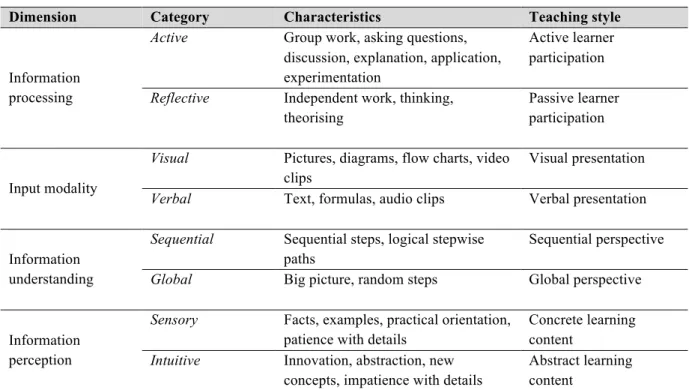
As mentioned above, a large number of learning style models have been developed [Coffield et al. 2004; Felder and Silverman 1988]. Although it is beyond the scope of this work to review and provide substantial descriptions of all these models, a number of learning style models will be selected and reviewed based on their theoretical importance in the field, and the degree to which they are used. The selection process takes into account the five families of learning styles described in the previous section [Coffield et al. 2004]. Table 1 presents some learning style models as examples of each learning style family. Each model will be discussed in this section.
Table 1. Summary of learning style models.
Family of learning style Learning style model
1 Constitutionally based learning styles and preferences Dunn and Dunn
2 Cognitive structure Witkin
3 Stable personality types Myers-Briggs
4 ‘Flexibly stable’ learning preferences Kolb
Honey and Mumford Felder and Silverman
5 Learning approaches and strategies Entwistle
2.3.3.1 The Dunn and Dunn Model
Originally developed in 1974, the Dunn and Dunn model has been improved and extended over the years [Dunn and Dunn 1974]. It comprises five major categories, each of which contains several factors. The environmental category includes sound, temperature, light and seating/furniture design. The emotional category is concerned with motivation, task
30
persistence and responsibility. The sociological category deals with preferences for learning alone, in a pair, in a small group or as part of a team. The psychological category refers to right/left, global/analytic and impulsive/reflective preferences. The physical category contains factors related to perception/modality preferences (visual, verbal), food and drink intake, time of day and mobility.
Dunn and Dunn claim that these traits are fixed preferences and cannot be changed [Dunn and Dunn 1974]. As the theoretical basis of the model assumes simplistic connections between physiological and psychological preferences and brain activity, this claim is questionable. This model has not been available to other researchers – other than those who developed the model – in order to confirm its applicability, reliability and validity [Brown 2007]. Some researchers also argue that this model is not based on robust empirical work [Coffield et al. 2004]. Furthermore, there are different versions of the model for children of different ages, as well as a version for adults. The learning style assessment used is a questionnaire containing over 100 items. Responding to this lengthy questionnaire may become frustrating and tedious.
2.3.3.2 The Witkin Model
This is a cognitive-style model concerned with the way learners perceive, structure and recall information. It categorises learners as field dependent (FD) or field independent (FI) based on Witkin’s work in the 1960s [Witkin et al. 1962]. FD learners tend to have a global perspective and may find it difficult to separate minor details from the big picture or the overall viewpoint. FI learners are very analytical and can concentrate on minor or specific details irrespective of the learning environment.
The cognitive style of learners (FD or FI) can be identified by using the Group Embedded Figures Test; it contains 25 items, and is a reliable and validated tool [Witkin 1971].
Figure
![Figure 1. Curry’s onion model of learning style theories, taken from [Wolf 2007].](https://thumb-us.123doks.com/thumbv2/123dok_us/491553.2558207/39.892.352.599.482.745/figure-curry-onion-model-learning-style-theories-taken.webp)

![Figure 4. General Scheme of a user-adaptive system [Jameson 2009].](https://thumb-us.123doks.com/thumbv2/123dok_us/491553.2558207/69.892.240.712.424.672/figure-general-scheme-of-user-adaptive-system-jameson.webp)

![Figure 5. Taxonomy of adaptive methods and techniques [Knutov 2012].](https://thumb-us.123doks.com/thumbv2/123dok_us/491553.2558207/80.892.256.675.218.875/figure-taxonomy-adaptive-methods-techniques-knutov.webp)


Related documents
We approximate common fixed point of a pair of total asymptotically nonexpansive mappings in the setting of a uniformly convex metric space.. The proposed algorithm is
media site and examined students ’ usage behavior using the Technology Accept- ance Model (TAM) and incorporated additional constructs such as subjective norm, perceived
Ap- plication of varied calcium sources, rates and timing of ap- plication and their interactions had significant e ff ect on the seed endocarp calcium concentration in both
As the Croatian telecommunications and cable television industries are almost completely foreign owned, in addition to terrestrial commercial television at the
While annual statistics of snow depth and duration offer some insight into changes in snow-pack linked to shifts in climatic forcings, higher temporal resolution is use- ful
"If staff members are or can be exposed to psychosocial workload, the psychosocial workload risks are assessed within the framework of the hazard identification and risk
Volumes of South African exports of lemons and limes to the different countries in Western Asia during the last decade are presented in Figure 31.. Note that only those countries
At moderate work rates (50 to 70 % of maximum oxy- gen uptake, or maximum exercise capacity), respirators impede the loss of heat from the face and can result in hyperthermia
