Dormitory Authority of the State of New York Draft Environmental Impact Statement
CCNY Science Building/CUNY ASRC Project Page 22-1
Chapter 22. Alternatives
IntroductionThis chapter evaluates reasonable and practicable alternatives to the Proposed Project following guidance recommended in the CEQR Technical Manual. The alternatives to be considered during an environmental review process should reduce or eliminate impacts of the proposed action while substantively meeting the project sponsor’s goals and objectives. Alternatives identify for the decision makers and general public the possible options to the Proposed Project, in addition to providing the context that is necessary to enable comparisons of potential impacts and effectiveness in meeting project objectives. Alternatives to the Proposed Project have been addressed in sufficient detail to enable the comparison of associated environmental impacts, and in terms of attaining the Proposed Project’s goals and objectives (as identified in Chapter 1, Project Description).
This chapter presents the evaluation of four alternatives, including: the No Build Alternative that assumes the Proposed Project would not be developed; Alternative 1, which would site the three proposed buildings in a linear fashion along the east side of the South Campus; Alternative 2, which essentially represents a “mirror image” of the Proposed Project where the CCNY Science Building and the ASRC I Building would be located immediately north of The Towers and the ASRC II Building situated further north; and Alternative 3, in which the building locations would be identical to the Proposed Project but the buildings would be taller by one story in order to accomplish program needs while eliminating the subsurface level.
Overview
In addition to the No Build Alternative, three build alternatives have been developed and refined based on comments received on the Draft Public Scoping Document. Preliminary site plans for the three build alternatives and the Proposed Project are illustrated in Figure 22-1. With the exception of the No Build Alternative, each alternative would generally satisfy the programmatic goals of the Proposed Project to varying degrees, and could be constructed in conformance with the Zoning Resolution of the City of New York. These four alternatives include:
No Build Alternative. This alternative is the equivalent of the Future No Build Condition that is discussed throughout this document.
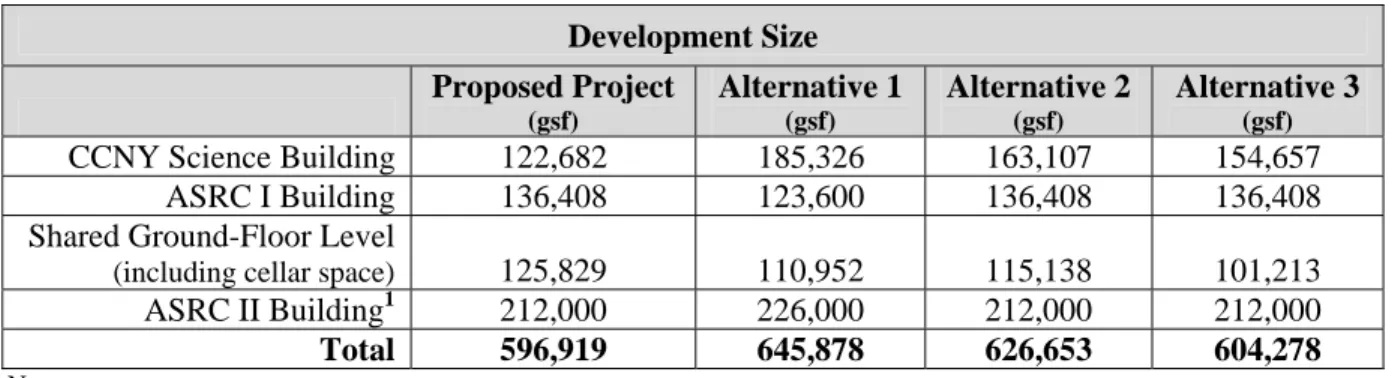
Alternative 1. This alternative explores siting the three buildings on the east side of the South Campus, aligning them in a linear fashion along St. Nicholas Terrace between the SAUDLA Building to the north and The Towers to the south. Phase I of Alternative 1 would involve the construction of an approximately 185,326-gsf, 8-story plus mechanical penthouse CCNY Science Building, and an approximately 123,600-gsf, 5-story plus mechanical penthouse ASRC I Building connected by an approximately 110,952-gsf ground-floor level and cellar. Phase II would consist of constructing an approximately 226,000-gsf, 5-story plus mechanical penthouse ASRC II Building with a connection at the ground-floor level to the CCNY Science Building and ASRC I Building. The full build-out of both phases would total approximately 645,878 gsf (see Table 22-1).
Alternative 2. In Alternative 2, the arrangement of the three proposed buildings would represent a mirror image of the Proposed Project, with the adjacent CCNY Science Building and ASRC I
Dormitory Authority of the State of New York Draft Environmental Impact Statement
CCNY Science Building/CUNY ASRC Project Page 22-2
Building occupying much of the South Campus north of The Towers (with the CCNY Science Building further west), and the ASRC II Building sited on the east side of the campus to the north (just south of the SAUDLA Building). Locating the facilities in this manner would limit the amount of rock excavation necessary to construct them. Phase I of this alternative would entail constructing an approximately 163,107-gsf, 4-story plus mechanical penthouse CCNY Science Building, and an approximately 136,408-gsf, 5-story plus mechanical penthouse ASRC I Building connected by an approximately 115,138-gsf ground-floor level and cellar. Phase II would consist of the construction of an approximately 212,000-gsf, 5-story plus mechanical penthouse ASRC II Building with a connection at the ground-floor level to the CCNY Science Building and the ASRC I Building. The full build-out of both phases would total approximately 626,653 gsf (see Table 22-1). Alternative 2 would take approximately 6 weeks longer to construct that the Proposed Project.
Alternative 3. Alternative 3, which also limits the amount of rock excavation required during construction, locates the three buildings in a manner that is similar to the Proposed Project. However, as this option does not utilize a full subsurface level, the CCNY Science Building would need to be taller by one story in order to accomplish program needs.1 Phase I of Alternative 3 would involve constructing an approximately 154,657-gsf, 4-story plus mechanical penthouse CCNY Science Building, and an approximately 136,408-gsf, 5-story plus mechanical penthouse ASRC I Building connected by an approximately 101,213-gsf ground-floor level and cellar (the smallest shared space among the alternatives but with a similar amount of programmed space as the Proposed Project). Phase II would consist of building an approximately 212,000-gsf, 5-story plus mechanical penthouse ASRC II Building with a connection at the ground-floor level to the CCNY Science Building and the ASRC I Building. The full build-out of both phases would total approximately 604,278 gsf (see Table 22-1). Alternative 3 would take approximately 10 weeks longer to construct than the Proposed Project.
Table 22-1: Comparison of Building Sizes for the Proposed Project and Build Alternatives Development Size Proposed Project (gsf) Alternative 1 (gsf) Alternative 2 (gsf) Alternative 3 (gsf) CCNY Science Building 122,682 185,326 163,107 154,657
ASRC I Building 136,408 123,600 136,408 136,408
Shared Ground-Floor Level
(including cellar space) 125,829 110,952 115,138 101,213
ASRC II Building1 212,000 226,000 212,000 212,000
Total 596,919 645,878 626,653 604,278
Note:
1
The ASRC II Building has not been designed at this time. However, the building program, function and design (including height and number of stories) would be similar to the ASRC I Building. For Alternative 1, due to layout restrictions, the Phase I vivarium could not be expanded, and an additional 14,000 gsf has been added for a separate vivarium for the ASRC II Building.
Source: Flad and Associates, Inc., 2007.
1 In Alternative 3, the shared ground-floor level and cellar would not extend throughout the entire floor plate of the
CCNY Science Building. As the shared ground-floor level and cellar would only cover approximately the southern half of the CCNY Science Building floor plate, this alternative would not utilize a full subsurface level.
Potential Future Campus Development Potential Future Campus Development Potential Future Campus Development Potential Future Campus Development
Proposed Project
Alternative 1
Alternative 2
Alternative 3
The Louis Berger Group, Inc. The Proposed Project and the 3 Build Alternatives: Conceptual Site Plans
Figure 3-8
CCNY Science Building/ CUNY ASRC Project
Figure 22-1 Source: Flad / KPF / gpr
Dormitory Authority of the State of New York Draft Environmental Impact Statement
CCNY Science Building/CUNY ASRC Project Page 22-4
This chapter also presents an overview of the comprehensive planning process that led to the development of the Proposed Project, and briefly reviews the alternatives considered as part of the planning process led by CCNY and CUNY. CCNY and CUNY initiated a planning process which resulted in development of facility programming for the CCNY Science Building and ASRC I Building in 2006. Primary and secondary goals and objectives were identified and developed during that process, which are also presented below.
Methodology
This chapter first presents the background that has led to the Proposed Project, including the planning process and the development of the primary and secondary goals and objectives. Then the alternatives are evaluated via a three-step process. First, the alternatives are described in detail. Next, the alternatives are assessed for environmental impacts with respect to each of the technical areas presented in this EIS, including: land use, zoning and public policy; socioeconomic conditions; community facilities; open space and recreational facilities; shadows; urban design and visual resources; neighborhood character; historic resources; natural resources; infrastructure; solid waste and sanitation services; energy; traffic and parking; transit and pedestrians; air quality, noise, construction impacts; and public health. Finally, the impacts of the alternatives are compared to those of the Proposed Project. Alternatives also are qualitatively assessed with respect to how well they meet the established primary and secondary goals and objectives.
Background
The South Campus master planning process commenced in August 2005 and was completed in January 2006. This 6-month process ran parallel to the programming phase for the three proposed science buildings. Therefore, the design team did not have the advantage of predefined building programs with dimensional parameters to test within the context of the South Campus master planning process. Beyond the normal weighing of long-term advantages and disadvantages of each scheme, this process mandated that the selected master planning option provide enough flexibility for the development of the science buildings’ design as the building programs further matured. Schemes were also studied within the context of hypothetical place holders for future buildings (potential future development sites) to assess long-term South Campus growth potential.
More than a dozen options were explored during the concept design phase. Early in the master planning phase CUNY requested that the design team explore options that would not require removal of the existing CCNY athletic track and field facility. The preservation of this facility was incorporated into the original assessment criteria to measure potential of the first series of schemes. At the same time it was decided that a minimum of 25,000 gsf would be the optimum size for the building floor plates, and that the preferred relationships between the buildings would require a large, shared ground-floor level to be located equidistant from the three buildings. The floor plate size and inherent laboratory module requires a 100-foot deep floor plate in the narrow dimension. The design team tested the floor plate requirement and building relationship against the existing athletic track and field and required zoning setback. It was deemed impossible to fit the buildings with adequate campus circulation on the available site area due to a critical pinch point at the northeast corner of the athletic track and field. Given that preservation of the athletic track and field would substantially compromise the proposed science complex’s functionality, this condition was eliminated from the design criteria.
Dormitory Authority of the State of New York Draft Environmental Impact Statement
CCNY Science Building/CUNY ASRC Project Page 22-5
The space program for the proposed CCNY Science Building and the ASRC Buildings would support a wide range of research initiatives by providing modular components (i.e., utility infrastructure) that can be modified within the laboratory space to support specific research requirements. Flexibility is an inherent requirement of the science research buildings in order to accommodate evolving research needs and research technologies. The proximity of the buildings must establish a close relationship to optimize the use of shared core facilities while encouraging cross-disciplinary interaction and collaboration.
To facilitate cross-disciplinary interaction and collaboration, the CCNY Science Building program has been refined to be thematically organized so that a number of disciplines operate on a single floor and in shared open laboratories and office spaces. This design refinement requires large floor plates of approximately 34,000 gsf. The program for the ASRC Buildings is organized with one discipline per floor with flexible open laboratory, office and core facilities. This program organization requires smaller typical floor plates of approximately 25,000 gsf. In addition, the ASRC I Building program includes a 100-person lecture hall and a café, shared loading dock access and an Electrical Distribution Room to serve all three proposed buildings. The program for the Proposed Project also calls for a shared vivarium and common state-of-the-art imaging facilities that each building would have equal access to.
Goals and Objectives
As presented in Chapter 1, Project Description, the primary intent of the Proposed Project is to establish centralized state-of-the-art research facilities to serve CCNY and all CUNY campuses. The principal design goals and objectives include the following:
Provide needed facilities for CUNY to become a leader in scientific research;
Build a facility to recruit and retain faculty and enable program growth;
Develop an interdisciplinary science community, encouraging cross-discipline interaction;
Provide accessible shared “core facilities,” vivarium, and amenities to support the CCNY Science Building and ASRC Buildings;
Preserve opportunities to accommodate future development on the South Campus;
Provide a flexible design for the buildings (consistent with a “loose-fit, long-life” concept) to support current advanced science research and the ability to adapt to the future of science;
Provide an efficient floor plate at a minimum of approximately 25,000 gross square feet for the ASRC Buildings;
Provide an efficient floor plate at a minimum of approximately 34,000 gross square feet for the CCNY Science Building; and
Incorporate green building design criteria such as those equivalent to Silver standards under the LEED® Green Building Rating System.
Additional secondary objectives were developed during both the master planning process and the refinement of project alternatives subsequent to scoping. These additional criteria are best described as considerations, since they represent factors to be taken into account for the alternatives analysis and are not considered fatal flaws or go/no-go decision points. The additional considerations include: provide a gateway from the North Campus to the South Campus; create a campus environment with buildings at a scale that is lower than or commensurate with the height of existing North Campus buildings and
Dormitory Authority of the State of New York Draft Environmental Impact Statement
CCNY Science Building/CUNY ASRC Project Page 22-6
respectful of the surrounding community; provide a central green space for the campus and future occupants of the proposed buildings; preserve natural features; compatibility with nearby sensitive uses; utilize buildings and existing natural features to organize campus spaces and circulation; provide adaptable and flexible floor plates that are able to support the evolving nature of scientific research use over time; maximize the flexibility for safe use of various chemicals; minimize the amount of rock excavation necessary to construct the Proposed Project; minimize the shadow impacts of the proposed new buildings on St. Nicholas Park; and minimize the distance for primary utility distribution from the NAC Central Utility Plant (located on the North Campus) to the Proposed Project.
South Campus Master Planning Options. As mentioned above, more than a dozen options were explored during the South Campus master planning process. In early 2006, the design team presented seven South Campus master planning concepts to CCNY and CUNY. Of these concepts the two most feasible schemes, Options A and B (described in more detail below), were identified for further study. Due to its strong fulfillment of the established design goals, Option B was identified as the development option to be carried forward for a more detailed analysis.2 However, as a result of concern expressed on behalf of NYSBC regarding the proximity of the proposed buildings to its facility, Option C, as described below, was identified as the Proposed Project that has been assessed in this EIS. This portion of the planning process is discussed below and provides insight into the thought process used in the development and selection of alternatives.
Option A. This scheme would have sited the three buildings very close together along the eastern edge of the South Campus and parallel to St. Nicholas Terrace. The limited north/south dimension of the Development Parcel would have required science buildings that are six to seven stories above grade in this alternative. As the CCNY Science Building program would be best served by a low-rise building with a large floor plate size, this option would not have ideally satisfied that building’s programming requirements. This scheme also would not have ensured maximum flexibility with respect to the future layout and use of the buildings, since the size of the floor plates in this scheme (20,000 gsf) are smaller than the optimal size identified for the proposed science buildings. This option also would not have effectively met the programmatic goals of the proposed science research buildings and would have required a zoning variance or other relief from the zoning requirements of the existing R7-2 General Residence District.
Option B. The triangular layout of the buildings in this option would have enabled the creation of a Campus Green between the ASRC Buildings and the CCNY Science Building, and would have incorporated the shared vivarium and imaging facilities below grade (beneath the Campus Green) in a shared ground-floor level. This alternative would have provided floor plate flexibility since it would have allowed for the development of a lower-scale, 4-story plus mechanical penthouse CCNY Science Building with optimal 34,000-gsf floor plates, and 6-story plus mechanical penthouse ASRC Buildings with almost optimal-sized floor plates of 23,000 gsf. The placement and heights of the buildings in this scheme would have been compatible with the scale of the existing campus, and also would have ensured maximum adaptability in terms of the future layout and use of the buildings and the accommodation of program growth. Option B was eventually eliminated as a possible alternative because of its proximity to the NYSBC facility (and its sensitive equipment).
2
Flad & Associates/Kohn, Pederson Fox & Associates/GPR Planners Collaborative, Inc. Predesign Phase Report, Volume I: Master Planning, Programming, and Concept Development, ASRC/CCNY Science Facility. February 6, 2006.
Dormitory Authority of the State of New York Draft Environmental Impact Statement
CCNY Science Building/CUNY ASRC Project Page 22-7
Option C. This alternative represents a version of Option B that was improved upon and modified to address concerns related to the proximity of the CCNY Science Building to the NYSBC facility. The primary changes included rotating the CCNY Science Building slightly eastward (away from NYSBC), relocating the Electrical Distribution Room (and switch gear and pump rooms) from the CCNY Science Building to the ASRC I Building, relocating the new electrical points of entry and locations of electrical feeders from Convent Avenue to St. Nicholas Terrace (further from NYSBC), and raising the overall elevation of the Proposed Project by approximately 7 feet, 6 inches to reduce the volume of rock excavation. Relative to Option B, the proposed buildings would be further from NYSBC in Option C and would require less excavation to construct. Additionally, in this scheme the locations of certain equipment and activities (that have the potential to result in electromagnetic interference with respect to NYSBC’s sensitive imaging equipment) would be far removed from NYSBC. The CCNY Science Building would be reduced from four to three stories (plus a penthouse level) in this alternative as compared to Option B, and the ASRC Buildings would be reduced from six to five stories (plus a penthouse level).
CUNY and CCNY identified Option C as the Proposed Project that has been evaluated in this EIS. Options A and B were presented as alternatives to the Proposed Project in the Draft Public Scoping Document that was prepared for this EIS. A third alternative that entailed the renovation of existing CCNY facilities, in an attempt to meet the goal and objectives of the Proposed Project, also was included in the scoping document as an alternative to the Proposed Project.
In response to comments received on the Draft Public Scoping Document, the design team revised Option A so that relief from the existing zoning regulations would not be necessary to enable construction of the science research buildings. The revised Option A was presented as Alternative 1 in the Final Public Scoping Document and has been evaluated in this chapter. The design team also developed two additional build alternatives, presented as Alternatives 2 and 3 in the Final Public Scoping Document, which have been assessed in this chapter. Both of these schemes were developed to minimize the potential for construction impacts on the nearby NYSBC facility. Relative to the Proposed Project, Alternative 3 would require less excavation to construct and Alternative 2 would increase the distance between the proposed buildings and the NYSBC facility (in addition to limiting the amount of excavation necessary during construction). The alternative involving the renovation of existing CCNY facilities was eliminated as an alternative to the Proposed Project because it was not considered feasible. Alternatives 1 through 3 were presented in the Final Public Scoping Document and have been summarized in the Overview section of this chapter.
The remainder of this chapter evaluates the No Build Alternative and the three build alternatives to the Proposed Project. The No Build Alternative is presented and assessed first, followed by Alternatives 1, 2 and 3.
No Build Alternative
Description of No Build Alternative. In the No Build Alternative, the Proposed Project would not be implemented and the Project Site would remain similar to its current state. The proposed science buildings would not be constructed, the athletic track and field would not be removed, the vacant Eisner Hall and the off-line Boiler Plant buildings would not be demolished, and the fueling station would not be relocated (or converted to natural gas). No new worker population would be added to the Project Site, other than an increase in the number of CCNY employees that will occur regardless of whether or not the Proposed Project or one of the build alternatives is constructed. The impacts of the Proposed Project,
Dormitory Authority of the State of New York Draft Environmental Impact Statement
CCNY Science Building/CUNY ASRC Project Page 22-8
both positive and negative, would be eliminated. Without the Proposed Project, the objectives outlined in CUNY’s “Decade of Science” initiative (as presented in Chapter 1, Project Description) would not be met.
The No Build Alternative is essentially the same as the Future No Build Condition or the future conditions without the Proposed Project discussed in this document. The No Build Alternative incorporates the No Build projects (planned projects that are reasonably expected to be constructed by the Build Year) that have been identified for the Project Site. As described in Chapter 2, Regulatory and Analysis Framework, these include the SAUDLA Project, the CCNY Utility Project and the NYSBC Phase IV Project. Planned development within the larger study area also is factored into the No Build Alternative for certain technical areas, as appropriate (i.e., traffic, air quality, etc.), as well as an additional background growth factor to account for increases associated with general development and increases in population and employment expected in the future.
The SAUDLA Project is a CCNY initiative involving the renovation of the former “Y” Building that is located on the South Campus of CCNY. The SAUDLA Building will house CCNY’s architecture program that is currently housed in Shepard Hall on the North Campus. The renovated building will contain approximately 138,000 gross square feet of classroom, studio, library, and administrative office space and is expected to be completed in 2008. No new students or additional faculty and staff are expected to be generated by that project, since it entails the relocation of an existing CCNY program.
The CCNY Utility Project also is a CCNY initiative and is expected to be completed in 2009. The primary purpose of the CCNY Utility Project is to upgrade and replace the existing thermal utilities (heating and cooling systems) and signal lines (voice and data) that service the South Campus, including Aaron Davis Hall and the SAUDLA Building from the NAC Central Utility Plant. Primarily located on the Project Site, the CCNY Utility Project will also involve installing new electrical service to the SAUDLA Building from new electrical points of entry on St. Nicholas Terrace.3
The CCNY Utility Project is necessary because the existing thermal utilities servicing the South Campus, which originate in the NAC Central Utility Plant, are in poor condition, with the existing High Temperature Hot Water (“HTHW”) heating system in a critical failure mode. The CCNY Utility Project will replace these deteriorating thermal utilities with new Medium Temperature Hot Water (“MTHW”) piping and separate Chilled Water (“CHW”) piping. A new campus communication duct bank to service the SAUDLA Building will also be installed because the routing for the replacement thermal utilities from the North Campus would interrupt the existing signal and data line system that currently provides campus telephone and computer service (the “campus communication” system). As noted above, this utility work also includes the provision of new electrical service to the SAUDLA Building, which will be installed parallel to the SAUDLA Building’s eastern and northern walls in a trench to the building’s electrical connection at its northwest corner. As part of the new electrical service to the SAUDLA Building, exterior-mounted transformers will be installed on campus adjacent to the incoming electrical service on St. Nicholas Terrace.
Construction of the CCNY Utility Project would last approximately 18 months, commencing in December 2007 and continuing through June 2009. It would be constructed on areas totaling
3 As electrical service points of entry are limited, it is anticipated that future South Campus development, including the
Proposed Project, would need to connect to either the same points of entry or new points of entry located adjacent to those being constructed as part of the CCNY Utility Project.
Dormitory Authority of the State of New York Draft Environmental Impact Statement
CCNY Science Building/CUNY ASRC Project Page 22-9
approximately 1.5 acres within, and adjacent to, the 35-acre CCNY campus and in the streetbed and sidewalks of Convent Avenue and West 135th Street. Similar to the SAUDLA Project, no new students or additional faculty and staff would be generated by this project.
Also situated on CCNY’s South Campus, the NYSBC Phase IV Project involves the further expansion of the NYSBC facility. Expected by its sponsor to be operational by 2012, the expansion would accommodate another ultra-high field nuclear magnetic resonance (“NMR”) system at the north end of the NYSBC-leased area. While currently waiting for development of the new equipment, which is expected to occur within a three-year time frame, NYSBC plans to advance construction of the building expansion so that the equipment could be installed and operated once it becomes available. Construction of the proposed building expansion is expected to occur within the next three years, from 2009 to 2012, with construction duration of approximately 15 months. While the size of the expansion will depend somewhat on instrument specifications (currently unknown), the expansion footprint is expected to cover approximately 4,000 gsf. Complementary laboratory space also would be added to the NYSBC facility as part of that expansion project, by constructing a second story of approximately 3,000 gsf above an existing portion of the facility.4 This project is expected to generate three additional NYSBC employees.
As discussed below, the many positive aspects related to the Proposed Project — such the establishment of centralized, state-of-the-art science research facilities to serve CCNY and all CUNY campuses to enable CCNY and CUNY to remain competitive in terms of attracting faculty, students and grants — would not be present in the No Build Alternative. The negative effects such as those relating to an increase in traffic, increased shadows on St. Nicholas Park, and temporary construction impacts, also would not occur.
Land Use, Zoning and Public Policy
Unlike the Proposed Project, three multi-story science research buildings and a landscaped Campus Green would not be constructed on the Development Parcel in the No Build Alternative. The demolition of two existing structures and the athletic track and field facility, and the relocation of the existing CCNY fleet vehicle fueling station (and conversion to natural gas) also would not occur.
Land use on the Project Site would remain the same as under Existing Conditions, with the exception of the No Build projects that have been identified on the Project Site. The SAUDLA Building will be reoccupied once the renovations are completed in 2008, but no new students or workers will be introduced to the Project Site since that project entails the relocation of an existing program from Shepard Hall to the SAUDLA Building. The CCNY Utility Project, which involves utility upgrades and improvements from the NAC Central Utility to the South Campus, will be finished in 2009 but will not add new students or employees. The NYSBC Phase IV Project, which entails the expansion of the NYSBC existing facility by an estimated 7,000 gsf, is expected to be operational by 2012 and will generate approximately three additional NYSBC employees. The NYSBC Phase IV Project will increase the amount of development on the Project Site relative to Existing Conditions, but will not introduce new types of land use. The Project Site will be further developed with land uses that are consistent with the existing institutional/academic use of the campus.
4 Willa Appel, PhD., Executive Vice President and Chief Operating Officer, New York Structural Biology Center.
Letter to Joanna Oliver, AICP, Environmental Manager, Dormitory Authority of the State of New York, March 26, 2007 (and email correspondence dated September 25, 2007).
Dormitory Authority of the State of New York Draft Environmental Impact Statement
CCNY Science Building/CUNY ASRC Project Page 22-10
There would be no change in zoning in the No Build Alternative and no effect on public policy. The No Build Alternative would be consistent with existing public policy that has been identified and discussed in Chapter 3, Land Use, Zoning and Public Policy. With respect to PlaNYC A Greener, Greater New York, within the open space section of that plan, a new ball field is identified as being proposed on the South Campus. It is assumed that representatives of PlaNYC would meet with CCNY to discuss the potential opportunity to utilize CCNY’s athletic track and field facility as a community open space.5 Similar to the Proposed Project, no zoning changes or actions would be required to develop the No Build projects identified on the Project Site, and the No Build Alternative would be consistent with the existing zoning.
Socioeconomic Conditions
Unlike the Proposed Project, a substantial worker population would not be added to the Project Site in the No Build Alternative. While the NYSBC expansion will result in the addition of approximately three new employees to the Project Site, it would have a negligible effect on the socioeconomic conditions of the study area. The economic benefits to the local economy that would be associated with new employees generated by the Proposed Project, primarily in the form of increased spending at local retail establishments, would not be realized in the No Build Alternative. Additional benefits associated with the Proposed Project also would not be realized in the No Build Alternative, including: the ability to attract/retain science students, facilitating the acquisition of grant funding, and the ability to recruit or retain academic and research professors. Without the proposed science research buildings, CCNY and CUNY would not be able to effectively advance objectives that are critical to institutional prestige and the ability to compete within a highly-competitive global academic climate.6
Population and Housing. The study area population is anticipated to follow current growth trends in the No Build Alternative. The West 127th Street Cornerstone Project, anticipated to be completed in 2010, would introduce up to 250 additional housing units into the socioeconomic conditions study area that extends approximately 800 feet from the boundary of the Project Site. The first of the two build years for the Manhattanville in West Harlem Rezoning and Academic Mixed-Use Development project is anticipated to introduce 99 residential units to the existing housing stock in 2015. Independent of the Proposed Project, given the size of that rezoning, the spill-over effect of development resulting from the rezoning would have the potential to induce changes in the existing residential population. At this time, there are no other known residential developments proposed within the study area. As such, the existing housing stock is not anticipated to undergo any considerable changes. Population and housing forecasts for the study area in the Future No Build Condition are presented in Chapter 4, Socioeconomic Conditions.
In the No Build Alternative, student enrollment and the faculty roster at CCNY are expected to increase. However, CCNY (and the CUNY system as a whole) would likely face considerable challenges with respect to attracting students in the sciences as well as in terms of attracting and retaining science-oriented faculty. As part of the recently-enacted CUNY “Decade of Science” initiative, CUNY has sought to improve both the resources available to students in the sciences and recruit science-oriented faculty. CCNY and CUNY would find it difficult to retain certain science faculty in the No Build
5
It should be noted that CCNY and CUNY were not involved in the development of PlaNYC and have not endorsed this proposal. Refer to the Public Policy section of Chapter 3, Land Use, Zoning and Public Policy, for further information on this citywide plan aimed at increasing the sustainability of the city.
6
Conversation with Gillian M. Small, PhD., University Dean for Research, The City University of New York. September 17, 2007.
Dormitory Authority of the State of New York Draft Environmental Impact Statement
CCNY Science Building/CUNY ASRC Project Page 22-11
Alternative, especially when other institutions would be able to offer facilities that are more suited to their specific research needs. Furthermore, some CCNY researchers would fear that their ability to meet grant deadlines and retain future grant monies would be jeopardized by the existing deficit of research space. At the same time, disciplines related to the biosciences, including structural biology, would continue to benefit from the “Decade of Science” mission in terms of additional funds available to recruit new faculty in these disciplines and for facility upgrades.
CCNY and the larger CUNY system have two of the most racially-diverse student body populations in the country. This diversity has lead CUNY to be one of the country’s premier educational institutions, training under-represented students in the sciences, technology, engineering, and mathematics. A recent article in the New York Times cited that less than three percent of PhDs in mathematics, science and engineering are awarded to African-Americans.7 CCNY is reported to be one of the nation’s largest sources of African-American and Hispanic graduates in the sciences and engineering. These students face a disadvantage in a competitive field without adequate facilities for specialized training.
Economic Activities – Business and Employment. In the No Build Alternative, business and employment within the study area would remain relatively similar to that of existing trends. As identified in the Future No Build Condition section of Chapter 4, Socioeconomic Conditions, modest growth in commercial sectors would be anticipated. In the socioeconomic study area, the West 127th Street Cornerstone Project and the Mink Building Conversion Project would add an additional 316,500 gsf of commercial space to the study area. The build-out of the first phase of the Manhattanville in West Harlem Rezoning and Academic Mixed-Use Development in 2015 would introduce roughly 179,000 gsf commercial space.
Direct and Indirect Displacements. There would be no direct or indirect displacement in the No Build Alternative.
Potential Effects to NYSBC. In the No Build Alternative, research activities performed at NYSBC would continue similar to Existing Conditions. The NYSBC Phase IV Project will result in an approximately 7,000-square-foot expansion of its existing facility.
Community Facilities
Similar to the Proposed Project, the No Build Alternative would not physically displace any community facilities or services within 800 feet of the Project Site. No residential or worker populations would be introduced in the No Build Alternative (other than the three additional NYSBC employees associated with the planned expansion of that facility), so no increased demand for community facilities would be generated and indirect effects would not occur. The No Build Alternative would not affect existing community facilities or services. However, while the Proposed Project would result in improvements to a community facility (CCNY), the No Build Alternative would not.
Open Space and Recreational Facilities
Like the Proposed Project, the No Build Alternative would not result in significant adverse effects to publicly-accessible open space resources and recreational facilities, and would not result in an increase
7
Dormitory Authority of the State of New York Draft Environmental Impact Statement
CCNY Science Building/CUNY ASRC Project Page 22-12
the residential open space user population. No substantial worker population would be introduced to the Project Site, no Campus Green would be created on the South Campus, and the athletic track and field on the South Campus would not be removed in the No Build Alternative. The CCNY men and women’s intercollegiate soccer and track teams would continue to use this private recreational facility, as would high school students in physical education classes at the A. Philip Randolph Campus High School and the High School for Mathematics, Science and Engineering at City College (“MSE”). Since the No Build Alternative would not result in an increase the number of residential or commercial open space users, it would not affect public open space resources.
Shadows
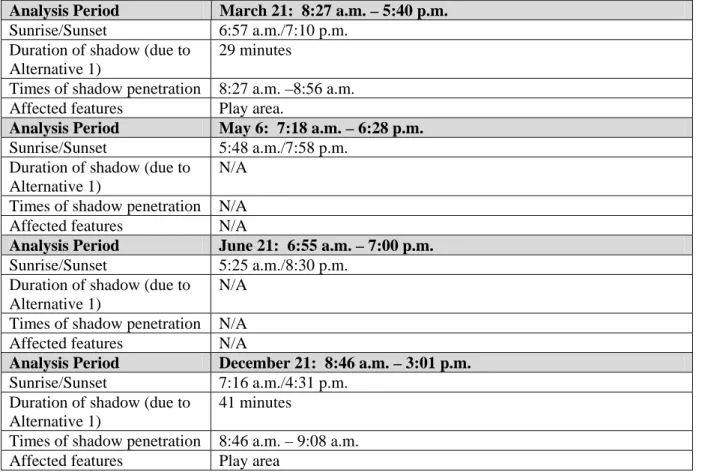
Unlike the Proposed Project, the No Build Alternative would not result in the construction of three multi-story buildings, and there would be no substantial change in shadows relative to Existing Conditions. While the development associated with the NYSBC expansion would result in incremental shadows, the shadows would be minor given the relatively small scale of the expansion, and likely would not have the potential to affect sunlight-sensitive public open spaces or historic resources.
Urban Design and Visual Resources
In the No Build Alternative, urban design characteristics and visual resources of the Project Site would remain similar to Existing Conditions.
Urban Design. Unlike the Proposed Project, the No Build Alternative would not positively affect the urban design of the South Campus by the provision of a more cohesive architectural presence, nor would it help foster a new South Campus identity or create a gateway to the South Campus. While the Proposed Project would establish the eastern South Campus edge with permeable massing that respects required zoning setbacks along St. Nicholas Terrace, and would unify the eastern perimeter of the South Campus by creating a streetwall of clean, modern lines and of similar, and modern construction materials, the No Build Alternative would not. Renovated and new structures will be added to the South Campus as a result of the No Build Projects. However, the new construction will not substantially improve the current visual character of the South Campus, which is typified by abandoned and obsolete structures, disconnected buildings, and awkward functional relationships between structures. The North Campus would continue to exhibit a more traditional college campus feel. In contrast, a mix of architectural styles and two vacant/underutilized buildings would remain on the South Campus.
Visual Resources. In the No Build Alternative, visual resources and view corridors within the study area and Project Site would remain largely unchanged from the current condition. Like the Proposed Project, the No Build projects on the Project Site would not substantially affect visual resources or view corridors, or the context within which historic structures are viewed. The SAUDLA Project involves the renovation and reuse of an existing campus building, and the CCNY Utility Project will be constructed largely underground. Given the limited size and scale of the planned expansion, the NYSBC Phase IV Project will not be large enough to significantly obstruct views of, or through, the campus. Southward and westward views outside of the Project Site, including views of the Hudson River, Midtown Manhattan, the New Jersey shoreline, Riverside and St. Nicholas Parks also would remain unaltered in the No Build Alternative.
Dormitory Authority of the State of New York Draft Environmental Impact Statement
CCNY Science Building/CUNY ASRC Project Page 22-13
Neighborhood Character
Land use, urban design and visual resources, historic resources, socioeconomic conditions, traffic, and noise are the key elements that contribute to and influence the “personality” of a neighborhood or neighborhood character. In the No Build Alternative, the positive effects on neighborhood character that would be expected to result from the Proposed Project would not occur. A more visually-engaging Project Site, a more unified urban design, the removal of two vacant/underutilized buildings, increased spending at local retail establishments by new workers who would occupy the proposed buildings — neighborhood character benefits associated with the Proposed Project — would not occur without the implementation of the Proposed Project.
In the No Build Alternative, the SAUDLA Project, NYSBC Phase IV Project and CCNY Utility Project will result in slight changes to some of the elements that influence neighborhood character. The South Campus would be slightly more densely developed in the No Build Alternative since the NYSBC facility will be expanded. The renovation of the SAUDLA Building will enhance the existing urban design of the South Campus, and additional building bulk will be added to the South Campus as a result of the NYSBC Phase VI Project. While the NYSBC Phase IV Project will add a new structure and the CCNY Utility Project will add new fenced-in transformers, it is anticipated that the development would not be substantial enough to result in visual or contextual impacts to historic architectural resources. The No Build Alternative would not result in substantial changes to the existing levels of traffic or noise. Therefore, neighborhood character would not be substantially altered in the No Build Alternative.
Historic Resources
Like the Proposed Project, the No Build Alternative would not affect archaeological or historic architectural resources.
Archaeology. Unlike the Proposed Project, the No Build Alternative would not have the potential to disturb a former vault/crypt used for burials by the Convent of the Sacred Heart, a potential archaeological resource that may be present underneath the grassy mound situated northeast of the athletic track and field on the South Campus.8 The SAUDLA Project is a renovation of an existing building within the same footprint. The CCNY Utility Project generally will affect portions of the campus that have been previously disturbed by prior construction activity and/or areas with very shallow bedrock characterized by a low potential for intact archaeological resources; other campus areas that do not possess the potential for archaeological resources (since the areas were not utilized for historical occupation in the nineteenth and twentieth centuries); and portions of the streetbed and sidewalk of Convent Avenue that have been previously disturbed, presumably from underground utilities. The CCNY Utility Project also will disturb areas directly adjacent to the existing SAUDLA Building that have had prior disturbance and/or areas with very shallow bedrock characterized by a low potential for intact archaeological resources. The NYSBC Phase IV Project will be located directly north of the existing NYSBC facility and will cause minimal ground disturbance where the building expansion will occur.9 Thus, archaeological resources would not be affected in the No Build Alternative.
8
The Louis Berger Group, Inc. Phase IA Cultural Resource Assessment, City College of New York Campus, Manhattan, New York, 2006. Prepared for DASNY.
9 Willa Appel, PhD., Executive Vice President and Chief Operating Officer, New York Structural Biology Center.
Letter to Joanna Oliver, AICP, Environmental Manager, Dormitory Authority of the State of New York, March 26, 2007 (and email correspondence dated September 25, 2007).
Dormitory Authority of the State of New York Draft Environmental Impact Statement
CCNY Science Building/CUNY ASRC Project Page 22-14
Historic Architecture. As indicated above, new structures will be constructed at the Project Site in the No Build Alternative due to the NYSBC Phase IV Project and the CCNY Utility Project. The SAUDLA Project involves the renovation of an existing building and will not result in the addition of new structures. While the NYSBC facility entails new development, visual or contextual impacts to historic architectural resources likely will not occur given the relatively small scale of the expansion (only adding approximately 7,000 gsf of space to the existing facility). The CCNY Utility Project also includes negligible new aboveground construction — fenced-in, exterior-mounted transformers that will be installed adjacent to the incoming electrical service on St. Nicholas Terrace, southeast of the SAUDLA Building. However, because the transformers will not represent substantial aboveground development, that project will not affect historic resources. In addition, the CCNY Utility Project will involve construction activity (excavation) within 90 feet of the historic A. Philip Randolph Campus High School, a New York City landmark (“NYCL”). Accordingly, that project will incorporate special measures set forth by the New York City Landmarks Preservation Commission (“LPC”) and the New York City Department of Buildings (“NYCDOB”) in the NYCDOB Technical Policy and Procedure Notice #10/88, Procedures for the Avoidance of Damage to Historic Structures (“TPPN #10/88”), to ensure that it will not result in significant adverse impacts to the adjacent historic resource.
Natural Resources
Similar to the Proposed Project, substantial changes to the limited natural resources within and adjacent to the Project Site are not expected to occur in the No Build Alternative. There are no wetlands on the Project Site or within the natural resources study area, and the Project Site is not located within the 100- or 500-year floodplains. Correspondence with USFWS indicates that no federally-listed or proposed endangered or threatened species have been identified within the study area. Similarly, correspondence with the New York State Department of Environmental Conservation (“NYSDEC”) Natural Heritage Unit indicates that no rare or state-listed animals and plants, significant natural communities, or other significant habitats have been identified within the study area (see Appendix A, Agency Correspondence).
Since the SAUDLA Project involves the renovation of an existing building, natural resources would not be affected. The CCNY Utility Project involves utility work, primarily within the footprint of existing streets. As such, that project’s effect on soils and subsurface conditions, including near surface geologic formations, will be negligible. However, that project will require the removal of approximately 10 trees situated around the SAUDLA Building in order to replace the utility lines. Due to the number of trees in the vicinity the CCNY Utility Project, the loss of these trees will not significantly reduce wildlife habitat and no significant impacts to wildlife habitat are anticipated to result from the CCNY Utility Project. The NYSBC Phase IV Project will have a minor effect on soil and groundwater conditions, if any. Since that development would occur near a stormwater catch basin and in close proximity to an area that is reportedly subject to occasionally flooding, an appropriate drainage system would need to be installed and/or proper building materials used to construct the proposed expansion.10
Hazardous Materials
The removal of on-campus structures that may contain asbestos-containing material (“ACM”), polychlorinated biphenyls (“PCBs”) and other hazardous materials (e.g., the Boiler Plant and Eisner Hall), which would occur as part of the Proposed Project, would not occur in the No Build Alternative. In
10
Michael B Gerrard, Arnold & Porter, LLP. Letter to Joanna Oliver, AICP, Environmental Manager, DASNY, March 23, 2007.
Dormitory Authority of the State of New York Draft Environmental Impact Statement
CCNY Science Building/CUNY ASRC Project Page 22-15
the No Build Alternative, any contaminated materials removed from the Project Site would be properly handled and transported off-site to a licensed and permitted disposal/recycling facility, in accordance with applicable local, state and federal regulations.
Since the SAUDLA Project is the renovation of an existing building within the same footprint that would not disturb subsurface areas, hazardous materials impacts are not expected to occur as a result of that building renovation project. No significant adverse effects related to hazardous materials would result from the CCNY Utility Project, since that project will incorporate a soil management plan as well as a health and safety plan (“HASP”) to help control potential contamination found in any urban fill associated with the project footprint. The soil management plan will address the handling, recycling, or disposal of contaminated soil (e.g., urban fill material) in accordance with applicable regulations, should such material be encountered during construction activities. The HASP would include measures to manage exposure to contaminated materials during excavation and construction, should they be present; and also would incorporate sampling and monitoring for the presence of contaminants, as necessary, in accordance with the United States Department of Labor Occupational Safety and Health Administration (“OSHA”) regulations and guidelines. It is assumed that the NYSBC Phase IV Project would incorporate similar procedures, as necessary, to ensure that hazardous materials impacts would not result from that project.
Infrastructure
In the No Build Alternative, existing utility conditions will be altered (replaced and upgraded) as a result of the completion of the CCNY Utility Project, the completion of the SAUDLA Project, and the completion of the NYSBC Phase IV Project.
Water Supply. The three No Build projects will result in an approximate 74,600-gallon-per-day (“gpd”) increase over the existing level of water consumption at the Project Site. In the No Build Alternative, it is estimated that the amount of water consumed by the Project Site would be approximately 747,300 gpd.
Wastewater Treatment. Substantial changes to the sewer system infrastructure serving the Project Site in the No Build Alternative are not expected. Based on the water usage of the Project Site in the No Build Alternative, it is estimated that the No Build projects will generate an additional 60,795 gpd of wastewater to the municipal sewer system over the existing Project Site level of 401,370 gpd, which would be treated at the North River Water Pollution Control Plant (“WPCP”). In the No Build Alternative, the Project Site would discharge approximately 462,165 gpd of wastewater to the sewer system, or 0.37 percent of the existing average dry weather flow at the North River WPCP. This relatively small incremental increase would not impact the operation of this WPCP.
Stormwater Management. Stormwater conditions in the No Build Alternative would remain essentially the same as the Existing Conditions.
Electric Infrastructure and Magnetic Fields. The CCNY Utility Project would provide new electric service to the SAUDLA Building from new electrical points of entry at St. Nicholas Terrace, and would be installed parallel to the SAUDLA Building’s eastern and northern walls to the building’s electrical connection at its northwest corner. As part of the new electric service, exterior-mounted transformers would be installed adjacent to the incoming electrical service on St. Nicholas Terrace. Alternating current (“AC”) magnetic fields would be generated by the new electric service and
Dormitory Authority of the State of New York Draft Environmental Impact Statement
CCNY Science Building/CUNY ASRC Project Page 22-16
transformers. However, similar to the Proposed Project, the levels would be too low to affect sensitive equipment or human health.
Solid Waste and Sanitation Services
The No Build Alternative would generate substantially less solid waste than the Proposed Project since it does not include the construction of three multi-story buildings that would generate daily wastes. The amount of regulated waste produced by Project Site uses also would be substantially less than the Proposed Project, because three multi-story, science research buildings would not be introduced in the No Build Alternative.
Solid Waste. The CCNY Utility Project would not introduce new development but would generate construction debris that would be handled and disposed of in accordance with applicable regulations. Since the New York City Department of Sanitation (“DSNY”) does not collect demolition and construction debris, sanitation services are not expected to be affected by the CCNY Utility Project. Taking into account the additional gross square footage that would be developed as a result of the SAUDLA Project and NYSBC Phase IV Project, the total amount of solid waste generated by the Project Site will increase by approximately 4,350 pounds per week in the No Build Alternative, or 5 percent over Existing Conditions.
Regulated Waste. The amount of hazardous, infectious and low-level radioactive wastes generated by CCNY facilities on the Project Site in the No Build Alternative is expected to remain similar to Existing Conditions. These wastes would continue to be stored, handled and disposed of in compliance with applicable requirements.
Energy
In the No Build Alternative, the amount of energy consumed at the Project Site would be considerably lower than the Proposed Project since three science research buildings would not be introduced to the Project Site.
With the No Build Alternative, the CCNY Utility Project will be completed. That project is necessary because the existing thermal utilities servicing the South Campus, which originate in the NAC Central Utility Plant, are in poor condition, with the existing HTHW heating system in a critical failure mode. The deteriorating thermal utilities will be replaced with new MTHW piping and separate CHW piping. That project also includes the installation of a new campus communication duct bank from the NAC Central Utility Plant to service South Campus buildings, as well as new electrical service to the SAUDLA Building from St. Nicholas Terrace. The electric service will originate at new electrical points of entry that will be constructed southeast of the SAUDLA Building at St. Nicholas Terrace, and will be installed parallel to the SAUDLA Building’s eastern and northern walls to the building’s electrical connection at its northwest corner.
Con Edison would continue to provide electrical and natural gas service to the Project Site in the No Build Alternative. The NAC Central Utility Plant boilers and chillers would continue to be fired by interruptible natural gas service with fuel oil back-up in the No Build Alternative. Since the CCNY Utility Project will not introduce new development, no increase in energy consumption at the Project Site will result from that project. Factoring in the 144,940 gross square feet of development associated with the SAUDLA Project and the NYSBC Phase IV Project, the total amount of energy consumed by the Project Site in the No Build Alternative would increase by approximately 17.0 billion BTUs per year (5
Dormitory Authority of the State of New York Draft Environmental Impact Statement
CCNY Science Building/CUNY ASRC Project Page 22-17
percent) over Existing Conditions, yielding an annual total of 339.5 billion BTUs for the Project Site. It is expected that Con Edison would be able to provide the incremental amount of natural gas and electricity that would be necessary in the No Build Alternative.
Traffic and Parking
The analysis of traffic and parking for the No Build Alternative reflects future background projects and growth that is expected to occur within the traffic study area by the Build Year (as presented in Chapter 16, Traffic and Parking). In the No Build Alternative, like the Proposed Project, no parking shortfall would occur.
Traffic. Although background traffic levels would increase in the No Build Alternative, the greater volumes of traffic generated by the Proposed Project would not be added to the street network. Traffic analyses were conducted for a total of ten (eight signalized and two unsignalized) intersections in the traffic study area. Traffic analysis results indicate that traffic movements that operate at a level of service (“LOS”) D or better in the Existing Conditions are projected to operate at LOS D or better in the No Build Alternative with the exception of one movement at the Amsterdam Avenue and West 125th Street intersection during the a.m. peak hour. All movements that operate at LOS E or F in the Existing Condition are projected to operate at the same LOS for the Future No Build Condition with the exception of one movement at the Amsterdam Avenue and West 125th Street intersection during the a.m. peak hour. The eastbound left-turn movement on West 125th Street at this intersection is projected to worsen from LOS C with 24.5 seconds of delay in the Existing Conditions to LOS E with 72.4 seconds of delay in the No Build Alternative; the westbound left-turn movement on West 125th Street at this intersection is projected to worsen from LOS F with 83.4 seconds of delay in the Existing Conditions to LOS F with 120.0 seconds of delay in the No Build Alternative. For the two unsignalized intersections, all movements analyzed are projected to operate at an acceptable LOS A or B during the peak hours.
Parking. No substantial worker population would be introduced to the Project Site in the No Build Alternative (just the three NYSBC employees associate with the NYSBC Phase IV Project). The curb parking spaces reserved for CCNY faculty and staff on St. Nicholas Terrace and Convent Avenue would not change in the No Build Alternative, and the NAC and Convent Avenue parking lots would be used exclusively by CCNY permit holders. As a result, the projected utilization for CCNY parking would remain the same in the No Build Alternative as in Existing Conditions.
The total parking capacity and utilization rates including CCNY parking spaces and Non-Permit (on-street and off-street) parking spaces in the approximately ¼-mile parking study area were summarized for the No Build Alternative.11 Similar to Existing Conditions, the 11:00 a.m. to 12:00 p.m. period is expected to have the highest utilization rate (90 percent), 4,402 of the 4,909 available spaces occupied on an average weekday when alternate side parking is in effect. The time period with the lowest utilization rate is projected to be from 7:00 a.m. to 8:00 a.m., where only 4,201 out of the 5,486 available spaces (77 percent) would be occupied. The parking utilization rates for the remaining hours of the day are expected to be higher than the Existing Condition utilization rates. It is projected that the available parking spaces
11
The parking study area, comprised of off-street parking facilities and the block faces that were surveyed for on-street parking, is identified on Figure 16-10 in Chapter 16, Traffic and Parking. Generally, the approximately ¼-mile parking study area is bounded by West 144th Street to the north, St. Nicholas Avenue to the east, West 125th Street to the south, and Broadway to the west, but included one facility located just beyond that boundary.
Dormitory Authority of the State of New York Draft Environmental Impact Statement
CCNY Science Building/CUNY ASRC Project Page 22-18
during a typical weekday would range from 507 spaces to 1,285 spaces. No parking shortfall would occur in the No Build Alternative.
Pedestrian Safety. Annual accident data were obtained for 10 key intersections within the study area from NYCDOT for the most recent three-year period from January 1, 2004 to December 31, 2006. A total of 373 accidents occurred at these ten intersections over the three-year period. Of these accidents, approximately 71 percent were non-reportable, approximately 28 percent were reportable, and less than one percent was fatal. Of the 373 accidents, a total of 52 involved pedestrians (almost 14 percent) and eight involved bicyclists (2 percent).
Based on CEQR Technical Manual suggested guidance, an intersection with five or more pedestrian accident occurrences in one year (out of the most recent three-year period for which data is available) is considered a high accident location. The Amsterdam Avenue and West 125th Street intersection is identified as a high accident location in the CEQR Technical Manual. The accident data recorded for the most recent three-year period corroborates that this intersection is a high accident location since nine or more pedestrian accident occurrences are reported in each of the years analyzed. Although the Morningside Avenue and West 125th Street intersection is not classified as a high accident location in the CEQR Technical Manual, six pedestrian accident occurrences were reported in 2006. The remaining eight key intersections in the study area experienced less than five pedestrian accidents in each year of the most recent three-year period.
The No Build Alternative would generate additional vehicle trips through the Amsterdam Avenue and West 125th Street intersection and the Morningside Avenue and West 125th Street intersection, but would not be expected to substantively increase the number of pedestrian crossings at these two high accident locations. Therefore, it is unlikely that increases in traffic volumes would be great enough to have a material effect on pedestrian safety at either intersection.
Transit and Pedestrians
In the No Build Alternative, similar to the Proposed Project, transit operations and pedestrian levels would be expected to remain similar to Existing Conditions.
Transit. Fewer than 200 peak-hour subway or bus transit rides — the threshold used by NYCT to determine transit impacts — would be generated in the No Build Alternative. Thus, NYCT services would not be affected in the No Build Alternative.
Pedestrians. The pedestrian analysis for the No Build Alternative assumes a background growth rate of 0.5 percent per year (as recommended in the CEQR Technical Manual), yielding approximately a 3.5 percent growth through the 2013 Build Year. The No Build Alternative also considers several No Build projects, as presented in the discussion of the Future No Build Condition in Chapter 17, Transit and Pedestrians. The pedestrian analysis for the No Build Alternative, like the Proposed Project, included one study area intersection — Convent Avenue and West 135th Street. The No Build projects would not generate a significant amount of new trips to the Project Site because the anticipated occupants of these buildings are already on campus and/or the number of new trips generated would be negligible. However, as discussed in Chapter 17, some of the projects would affect pedestrian circulation within the Project Site and at the study area intersection.
Pedestrian analysis results indicate that crosswalks at the Convent Avenue and West 135th Street intersection would continue to operate at the same LOS as in Existing Conditions. In the No Build
Dormitory Authority of the State of New York Draft Environmental Impact Statement
CCNY Science Building/CUNY ASRC Project Page 22-19
Alternative, intersection crosswalks would operate at LOS A except the north crosswalk, which would deteriorate from LOS D (20.7 square feet per pedestrian or “sf/p”) to mid-LOS D (19.5 sf/p). This drop in level of service is primarily due the pedestrian volume generated by the SAUDLA development. Thus, in the No Build Alternative, this intersection would be negatively affected and would result in a decrease in pedestrian area occupancies by greater than 1.0 sf/p, a change that may be perceptible to pedestrians. However, the LOS would remain a mid-level D and above 15.0 sf/p (the threshold of LOS D and E).
Air Quality
Like the Proposed Project, considerable changes in air quality conditions would not occur in the No Build Alternative.
Mobile Sources. As presented in the Overview section of Chapter 18, Air Quality, the New York City Department of Environmental Protection (“NYCDEP”) has established screening criteria for modeling the air quality impacts of a project’s induced vehicle trips. If the number of induced vehicle trips fall below the screening criteria, then no modeling is required and the air quality concentrations of the induced traffic are deemed insignificant. No air quality modeling is required for mobile sources because the traffic induced from operation of the No Build projects would fall well below the NYCDEP mobile source screening criteria.
Stationary Sources. Existing ambient air quality data from NYSDEC monitoring stations in New York City were reviewed and evaluated for the study area.12 The ambient air quality data presented in Table 18-5 (see Chapter 18, Air Quality) represent the most recent peak pollutant concentration data monitored by NYSDEC near Project Site. All available pollutant concentrations examined in 2006, including Ozone (“O3”), Carbon Monoxide (“CO”), Particulate Matter with an aerodynamic diameter of ten microns or less (“PM10”), Sulfur Dioxide (“SO2”), Nitrogen Dioxide (“NO2”), and Lead (“Pb”), are below the National Ambient Air Quality Standards (“NAAQS”), except for Particulate Matter with an aerodynamic diameter of 2.5 microns or less (“PM2.5”). In 2006, PM2.5 concentrations exceeded the 24-hour average standard, although annual average PM2.5 levels were below (within) the NAAQS.
The No Build ambient air quality conditions in the study area were predicted using ambient air quality data from NYSDEC monitoring stations and the AERMOD-predicted maximum Future No Build Condition concentrations of CO, NO2, PM2.5, PM10 and SO2 at the worst-case receptor location among all analyzed public access areas and sensitive receptor locations.13 The background data and modeled concentrations are presented in Table 18-5 of Chapter 18, Air Quality.
The analysis results show that the maximum pollutant concentration levels predicted for the worst-case receptor locations, when added to ambient background levels, would not exceed any of the NAAQS for NO2 (annual average), PM10 (hour average), CO (1-hour and 8-hour) or SO2 (3-hour, 24-hour, and annual average). PM2.5 background levels generally exceed the PM2.5 NAAQS. Accordingly, as explained in the Methodology section of Chapter 18, the significance criteria for PM2.5 considers the incremental concentrations from the Proposed Project rather than NAAQS compliance.
12
The study area for the analysis of air quality impacts with respect to stationary sources comprises the area within one-half mile of the NAC Central Utility Plant.
13 Receptor locations included: the new buildings of the Proposed Project, I.S. 223 Mott Hall, P.S. 129 John H. Finley
School, the Schiff House Day Care, The Towers (student residence hall), New York Structural Biology Center, and other on-campus locations of student activities.