© 2015, IJCSMC All Rights Reserved 335
Available Online atwww.ijcsmc.com
International Journal of Computer Science and Mobile Computing
A Monthly Journal of Computer Science and Information Technology
ISSN 2320–088X
IJCSMC, Vol. 4, Issue. 8, August 2015, pg.335 – 347
RESEARCH ARTICLE
Design and Implementation a Smart Greenhouse
Asst.Prof. Khaldun I.Arif, Hind Fadhil Abbas
Computer Science Department, Education College, Thi-Qar, Iraq
[email protected]; [email protected]
Abstract
In recent days; the controlling systems are adapting and implementing irrigation in order to meet
people requirement. The main reason behind this deficiency is that estimating required irrigation amount is a
complex process and need consideration of several significant factors. This paper proposes an efficient
automatic irrigation system based on computing various changes necessary in green house using wireless
sensor network and using server and client web service for control and monitoring. Our model has two main
factors which are reduces the power and controlling and monitoring over long distances. The results
demonstrate that the control model is measure the sensing data and accurate tool for calculating values of
adapted sensors as well as the self-control the output plugged devices. Also, results depict that our system
has several advantageous characteristics, such as: ease of network management and control motors and
valves. There are five sensors adapted in the proposed design system, soil moisture, humidity, temperature,
CO2, and light sensor, each of these sensors has measure changes in environment inside the greenhouse.
Since, irrigation always starts when depletion different ratios available of all sensors to operate the devices
© 2015, IJCSMC All Rights Reserved 336
1.1.
Introduction
The request for food has been growing day by day meanwhile the world population has
been rising. It is noticeable that the agricultural products have to be enlarged in order not to
be faced with starvation and people needs of foods. Greenhouses are the places where
organized crop production took place. The governor of temperature, air humidity, light
intensity, soil moisture, amount of carbon dioxide and wind velocity by specialists
influence productivity. These parameters are related to each other.
The condition of supplying diverse environmental situations for each plant has drove
researchers to use different monitoring systems[1].
It is convinced that the best suitable control system to use is portable system. The
parameters are to be controlled can be handy devices.
It is intended to variety of monitoring for automation by using input parameter
(temperature, light intensity, soil moisture, and the amount of carbon dioxide) in intended
system based on Android devices[2]. Also, the input and output parameters used in
greenhouse control were displayed within Android device. Finally, process of the input and
output parameters of the system were measured and information was given about the rule
© 2015, IJCSMC All Rights Reserved 337
1.2.
Sensors used in Greenhouses
Carbon dioxide (CO2) is the primary greenhouse gas emitted through human activities. Carbon dioxide is naturally present in the atmosphere as part of the Earth's carbon cycle (the natural circulation of carbon among the atmosphere, oceans, soil, plants, and animals). Human activities are altering the carbon cycle—both by adding more CO2 to the
atmosphere and by influencing the ability of natural sinks, like forests, to remove CO2 from the atmosphere. While CO2 emissions come from a variety of natural sources,
human-related emissions are responsible for the increase that has occurred in the atmosphere since the industrial revolution [1].
Advantage of using greenhouse is to grow ornamental and food crops is the ability to provide desirable temperatures for plant growth and development. Providing a desired temperature is neither easy nor cheap. In greenhouse, a significant amount of energy is used to heat and ventilate them to maintain desirable temperature setpoints.
There is wide diversity of soil moisture sensors obtainable for use in greenhouse
manufacture and research applications. Such sensors can play a valuable role in improving uniformity of substrate water content in greenhouses, as well as in automating irrigation based on plant water use. Quantification of spatial variability can be used to improve the design of irrigation systems to better match plant water use. The use of soil moisture
sensors for irrigation control is promising, because it can greatly reduce temporal variability in substrate water content by watering based on actual crop water use [4].
1.3 Arduino UNO kit
Arduino is a kit using microcontroller to make the sense and control more flexible.
© 2015, IJCSMC All Rights Reserved 338
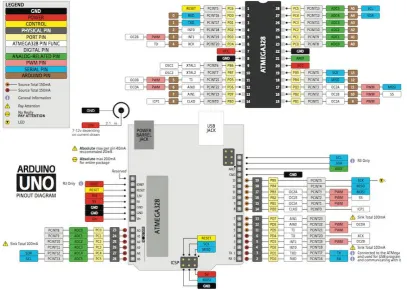
Figure (1) Arduino kit pin out description
The Arduino Uno consists of microcontroller board based on the ATmega328. This
microcontroller has 14 digital input/output pins (of which 6 can be used as PWM outputs),
6 analog inputs, a 16 MHz ceramic resonator, a USB connection, a power jack, an ICSP header, and a reset button.
1.4 The proposed greenhouse design
Plants found in greenhouse is affected by various factors, such as water in soil, and climatic
conditions (temperature, humidity,..etc.). In this work, we've been focused on design and
implementation for monitored climate conditions and to control the different devices on
output (shutter, solenoid valve, and fan). Various inputs (sensors) and output (motors) are
installed and connected to PC via controller circuit (Arduino UNO) determined as data
acquisition. A graphical user interface has been designed using MS Visual Basic 2012 to
© 2015, IJCSMC All Rights Reserved 339
1.4.1 Hardware Description
The hardware design has been using Arduino UNO kit which consists of microcontroller ATMega32 and has multi inputs and outputs besides this microcontroller designed with ADCs and PWM. Below will describe each part of inputs and outputs used during design.
Inputs (Sensors)
A. DHT11 (Humidity and Temperature Sensor)
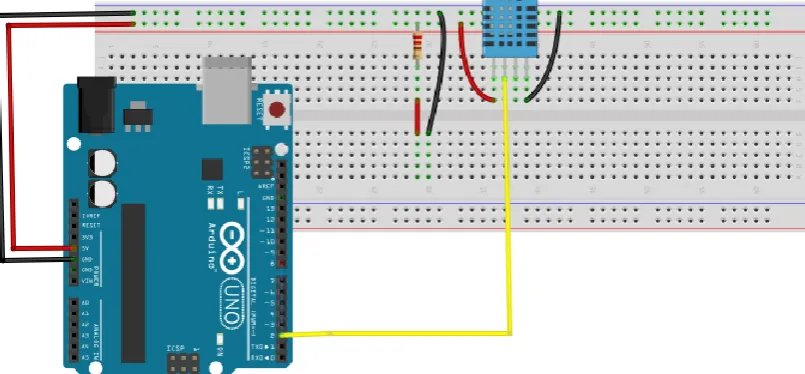
DHT11 sensor is used to measure temperature and humidity values, the DHT11 as shown in figure (2) the output of this sensor is digital and it has fast response time, good accuracy, and high resolution.
Figure (2) Wiring DHT11 sensor with Arduino UNO
© 2015, IJCSMC All Rights Reserved 340
B. LDR
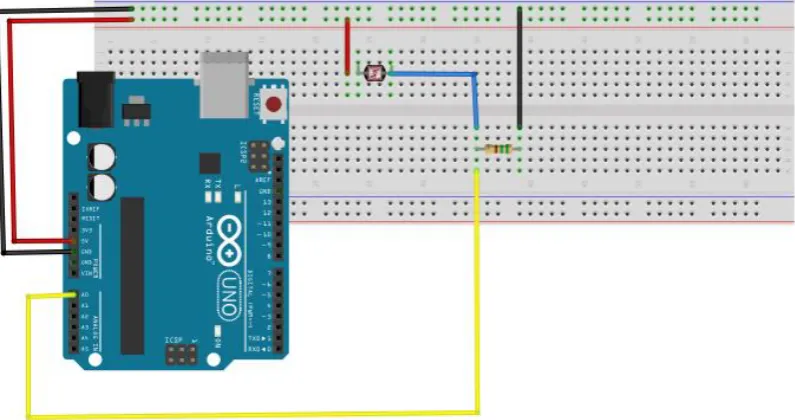
This sensor has located on outside of the greenhouse to receive the “sun” light. The LDR as shown in figure (3) receives flux (light intensity) and feedback loop moves the servo motor into the direction to close or open the shutter.
Figure (3) schematic circuit diagram of LDR sensor
C. CO2 Gas Sensor
In this research, we choose CO2 sensor. The detection range of CO2 sensor is
© 2015, IJCSMC All Rights Reserved 341
Figure (4) Schematic circuit diagram of co2 gas sensor
The level of CO2 gas is fixed such that when it goes above 30% the control device exhaust fan will get on by indicating relay and below it the reverse action takes place.
D. Moisture sensor
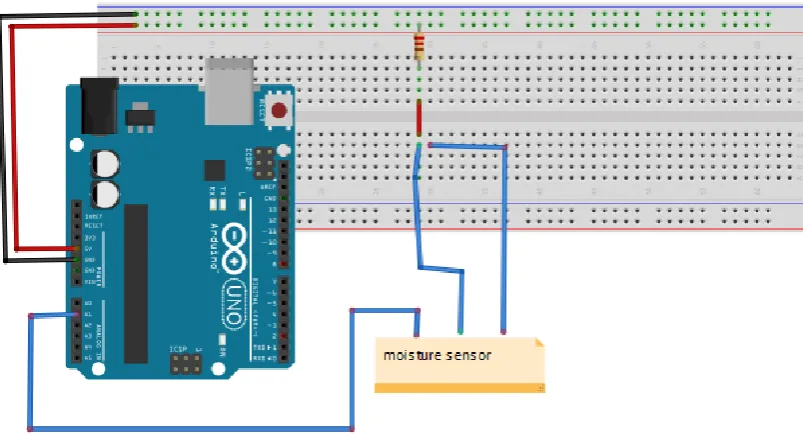
Other sensor is detection module soil moisture sensor had been used for greenhouse for monitoring and this module has the important benefit in process of irrigation. The schematic diagram of sensor is show in Figure (5).
© 2015, IJCSMC All Rights Reserved 342
The set threshold value of sensing data of moisture soil sensor has been conditioned to
switch the solenoid valve on output port. When the soil has get dry (less than 50%), will send a command to output port to operates the solenoid valve to start irrigating the soil.
2.2.2. Output Devices (Drivers)
A. Shutter
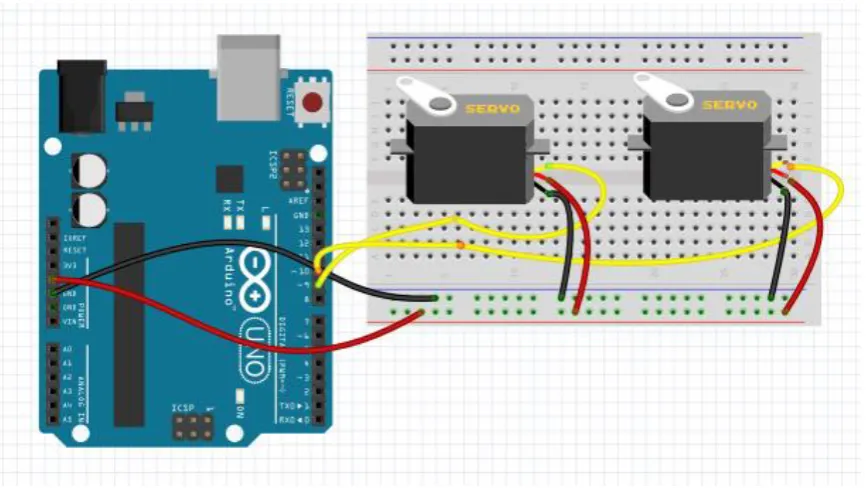
The light and temperature inside greenhouse has been controlled by shutter which operated using servo motor. The main concept of the ventilation is based on both light and temperture throughout the greenhouse, and as soon as the value set of light
reaches different values will control device to open or close the shutter by moves the servo to the angle based on the value of light intensity. The circuit design of the servo motor shown in figure (6).
Figure (6) Schematic circuit diagram of shutter control
There has been used two servo motors, and has controlled by PWM Vpwm (1ms to 2ms for a
180° range). The maximum angle is (180o) for full opened and the minimum angle is (0o) in
© 2015, IJCSMC All Rights Reserved 343
B. Fan Control
In the proposal design, if the temperature inside the greenhouse rise above 50 degree, there are two fans will be run. One if the fan operated to exhaust the heated air from inside greenhouse, meanwhile, other fun will operate to let the fresh air get inside the greenhouse. The schematic circuit of fan's driver illustrated in figure (7).
Figure (7) Schematic circuit diagram of fan' driver
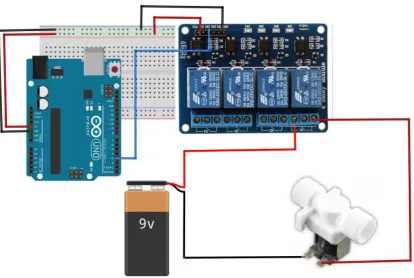
C. Solenoid Valve Control
© 2015, IJCSMC All Rights Reserved 344
Figure (8) Schematic circuit diagram of solenoid valve control
3. System Monitoring Design
In client side (data logger interface) has been designed a Windows application to
display data of sensors and transceiver the data to/from web server. The system monitoring
designed to monitor different real-time data transmitted via interfaced electronic circuit
deigned to get data of various sensors.
The system monitoring design in client side has been designed using Microsoft Visual
© 2015, IJCSMC All Rights Reserved 345
Figure (9) Design of proposed system monitoring
4. Server Database Design
The design of the server in this project used to publish the data of sensors and control
commands uploaded by remote system monitoring. Google Docs server has provides several
types of documents (word, spreadsheet, and presentation documents). In this project, we've
design a spreadsheet to upload and retrieve data from master system monitoring and remote
system monitoring. The number of fields needed in the server design is (6) fields represent
© 2015, IJCSMC All Rights Reserved 346
Figure (10) Spreadsheet design in Google Docs server
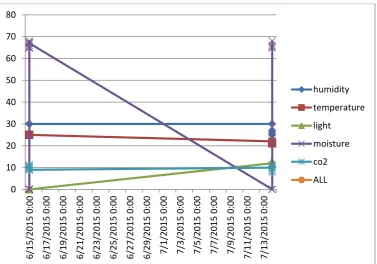
The relation between the data of sensors and the time show in figure below
Figure (11) the data of sensors and time
© 2015, IJCSMC All Rights Reserved 347
References
1-Gene Giacomelli; "Designing the Greenhouse to Meet Your Expectations: What’s Your
Technology Level?", Controlled Environment Agriculture Center CEAC, The University
of Arizona, Tucson, 2004.
2-Feng Chen, Yong-Ning Tang, and Ming-Yu Shen; "Coordination Control of
Greenhouse Environmental Factors"; International Journal of Automation and
Computing, 2011.
3-Oliver L. Iliev, Ahmad Zakeri, Pavle Sazdov and A.M. Baytelieva, "A Fuzzy Logic
Based Approach for Integrated Control of Protected Cultivation"; University of
Wolverhampton, School of Technology, United Kingdom.;World Applied Sciences
Journal 24 (5): 561-569, 2013.
4-M.W. van Iersela and S.E. Burnettb; "The Use of Soil Moisture Probes for Improved
Uniformity and Irrigation Control in Greenhouses"; Proc. IS on High Technology for