Pattern-based Program Visualization
Daniela da Cruz1, Pedro Rangel Henriques1, and Maria Jo˜ao Varanda Pereira2 1 University of Minho - Department of Computer Science,
Campus de Gualtar, 4715-057, Braga, Portugal
{danieladacruz,prh}@di.uminho.pt
2 Polytechnic Institute of Braganc¸a
Campus de Sta. Apol´onia, Apartado 134 - 5301-857, Braganc¸a, Portugal
Abstract. The aim of this paper is to discuss how our pattern-based strategy
for the visualization of data and control flow can effectively be used to animate the program and exhibit its behavior. That result allows us to propose its use for Program Comprehension. The animator uses well known compiler techniques to inspect the source code in order to extract the necessary information to visualize it and understand program execution.
We convert the source program into an internal decorated (or attributed) abstract syntax tree and then we visualize the structure by traversing it, and applying vi-sualization rules at each node according to a pre-defined rule-base. No changes are made in the source code, and the execution is simulated.
Several examples of visualization are shown to illustrate the approach and support our idea of applying it in the context of a Program Comprehension environment.
1
Introduction
PCVIA, Program Comprehension by Visual Inspection and Animation, is a research project looking for techniques and tools to help the software engineer in the analysis and comprehension of (traditional or web-oriented) computer applications in order to maintain, reuse, and re-engineer software systems.
To build up a Program Comprehension environment we need tools to cope with the overall system, identifying its components (program and data files) and their relation-ships; complementary to those, other kind of tools is also necessary in order to explore individual components. These tools—that are our concern along the paper—deal with single programs instead of the complete set of programming units (the application), and their purpose is to extract and display static or dynamic data about a program to help the analyst to understand its structure and behavior.
Depending on the actual program facet we want to explore, different approaches to inspection and visualization can be followed. We are experiencing that in the context ofPCVIA. We are developing a tool that does not modify the source program and uses abstract interpretation techniques, aiming at an easy and systematic adaptation to cope with different programming languages. In the Section 2 of this paper, we are going to discuss this approach and the generated visualizations. To attain such an objective, we parse the source program and build a decorated syntax tree and a symbol table,
that are kept in memory to support all the other subsequence operations (visualization and animation), while the program itself is discarded and is not compiled (it will not be executed in the target machine). Following this approach we implementedAlma, a program animation system.
We show some visualizations created byAlma.Almafacilitates the representation of abstract program concepts and can be useful in circumstances where there are not specific tools to visualize programs written in the language. The produced visual rep-resentation contains information about instructions and data, that will allow the user to get the perception of the program’s execution behaviour and the changes in the value of variables.
1.1 Related work
During our study of the state of the art we found several software handling tools: classic Program Comprehension (PC) tools; software visualization tools that can be also seen as program understanding tools; development environments that use visual or textual representation to help the programmer; tools that are used just in some specific tasks of software maintenance; graph visualization tools that can be used for some program visualization tasks; and teaching tools.
Almost all of these tools were constructed for some specific language and are to-tally dependent of that language. Most of them use parsers automatically generated, and compiler techniques to process information. These parsers are used to transform the source code in order to instrument it with inspection functions or special data types. They can be also used to construct an internal representation of the program. This repre-sentation can be then systematically used to generate explanations, statistics, structured information, visualization or animation of programs.
Some examples of tools that create and use internal representation as the core of the tool are: Moose [1], CANTO [2] or Bauhaus [3]. In Moose (a reengineering tool) the information is transformed from the source code into a source code model. Moose sup-ports multiple languages via the FAMIX languages independent meta-model. In almost all cases a parser is constructed to directly extract information to generate the appropri-ate model. The CANTO environment has a front-end (for C) which parses the source code and creates an intermediate file with structural, flow and pointer information. Then a flow analysis tool is used to compute flow analysis on the code. The front-end also creates an abstract syntax tree that is used by an architectural recovery tool which recog-nizes architectural patterns. The Bauhaus system has tools that use compiler techniques which produce rich syntactic and semantic information creating a low level representa-tion of programs.
Almafollows this kind of approach — well-known language processing techniques are applied to visualization and animation.Almauses a parser to construct an internal representation of the program and then uses a set of pattern based rules to inspect the code.
A first difference is thatAlmacan be easily prepared to cope with a new language; it is simply a matter of building a map between language concepts andAlmanodes, and nothing more is needed. Another difference is thatAlmais not a tool to analyze an application (a set of modules) and extract information for its comprehension. Instead of
that,Almaaims at aiding to understand a program by visual inspection of its structure and by animation. Of course, one of its handicaps is that more complementary tools are needed to comprehend an application. Another disadvantage is that the visual represen-tations can be not so beautiful as those produced by tools dedicated to a language or a problem class; but, on the another hand the system is more generic.
TKSee [4] or SeeSoft [5] are some examples of tools that collect statistic informa-tion about the source program and then this informainforma-tion is shown in a structured way without changing the source code. TKSee permits users to search the whole system for files, routines or identifiers whose name or lines match a certain pattern and build hi-erarchies to organize the information. SeeSoft also extracts statistical information from a variety of sources (like version control systems, programmer purpose and static and dynamic analysis) and shows the information using different coloured lines.
2
DAST Approach
In this section, we discuss the approach to program inspection and visualization fol-lowed in the context ofAlma, one of thePCVIAtools under development. Although not a classic tool for program comprehension, we believe that it can truly contribute to this task, at the program understanding level (as argued in the Introduction).
Almais a system for program visualization and animation. The purpose of such a family of tools is to help the programmer to inspect data and control flow for a given program (a static view of the algorithm realized by the program — visualization), and to understand its behavior (a dynamic view of the algorithm — animation).
The core of such tool is language independent; it is similar to a compiler’s back-end that takes as input an abstract representation, and implements the visualizer and the an-imator components in a systematic way. To process a concrete programming language, the tool is specialized providing a dedicated front-end that converts the input programs into that internal abstract representation. As an intermediate representation, between the
front-end and the back-end, we chose aDAST—Decorated Abstract Syntax Tree. In this paper we do not want to introduce or explainAlmain detail; our purpose is just to discuss the information we need to extract from the source program, how do we
do it, the format under which this information is represented, and how is it visualized
to help the user to understand the program.
3
Patterns: the information to extract
In contrast to the most common animators, we are looking forward to building a more generic system, in the sense that it can animate any algorithm and that it can be easily adapted to work with different programming languages. To go in that direction, it is essential to find out a set of program patterns that we know how to deal with (display and rewrite). That is, we need to discover the information, common to a set of programming languages, that describes the structure and semantics of the program, and that we know how to store and to display (we intend to create a set of rules to systematically visualize those patterns).
An analysis of the programming languages, belonging to the universe we want to deal with, allows us to state that all of them have common entities, like: literal values and variables (atomic or structured), assignments, loops and conditional statements,
write/read statements and functions/procedures.
After the common entities have been identified, we must find a way to describe them at an abstract level, in order to establish a generic set of rules to handle them in a language independent way. The solution is a set of elementary programming patterns.
In this paper, we consider that a pattern is a tree that represents an abstraction of a programming concept; it is composed by two parts: a structural component (given by a grammar production) and a semantic component (given by a set of attribute occurrences affected to the symbol that labels each tree-node).
These patterns capture the abstract syntax of each entity (value or operation) in order to preserve and keep, via attributes, the necessary information to express its static semantics.
This set of patterns can be compared with the instruction set of a machine. At com-pile time, the statements of a program, in the source language, are mapped into the proper instructions of the target machine (translation from high-level to low-level, or machine-level). In the same way, with our approach, the statements of a program are translated into patterns (in this case, from high-level to an abstract-level). For example, in an high-level language, the reference to a variable in an expression means the access
to its stored value. The corresponding machine instructions have to load the variable
value into the stack or accumulator; in the assembly language of a stack machine these instructions are something like: PUSH var address, followed byLOAD. Similarly, in our approach, this operation will be mapped, in our internal representation, to the pattern that matches a variable; similar to assembly language, we get the value of this variable from the attribute where it was stored at parsing time.
4
Program representation: Pattern Tree
Once we decided the information that we need to extract from a source language, we must now find a way to represent it. The internal representation chosen to store these patterns is aDAST[6][7] that describes the meaning of the program we intend to rep-resent and visualize, being separated from any particularity of a source language. This
DASTis specified by an abstract grammar independent of a concrete source language. ThisDASTis intended to represent the program in each execution point.
Consider the following program in some imperative source language: a=2;
write((a+10)*2);
Clearly, we have two different statements: an assignment and an I/O statement (write). One possible representation for it could be the syntax tree shown in Figure 1(a): Figure 1(b) shows the pattern tree (DAST) chosen in our approach. Each node in a concreteDASTwill match and instantiate a specific pattern. These tree nodes are im-plemented with attributes, whose values are obtained during the information extraction phase, and describe the characteristics of the source program to preserve.
(a) Syntax Tree representation of the program
(b) Pattern Tree representation of the program.
Looking at Figure 1(a), we see that assignment node has two children—a variable
name, and a value—and an implicit type. So, the correspondingDAST pattern will use three attributes:name,valueandtype. Bellow, we list the patterns considered in our approach, as well as some of the attributes used in each one.
– Constants —value,type;
– Variables —name,value,type;
– Assignments — left-side:variable name, right-side:expression;
– Arrays — particular case of variable, have one more attribute:dimension;
– Conditional If/Then —boolean expression(1) to evaluate,set of statements to execute in case (1) is true;
– Conditional If/Then/Else —boolean expression(2) to evaluate,set of statementsto execute in case (2) is true,set of statementsto execute in case (2) is false;
– Loops —boolean expression(3) to evaluate,set of statementsto execute in case (3) is true;
– Read — (variable)name,value,type;
– Write —expression;
– Functions/Procedures —tablefor local variables,arguments,set of statements, return value(for functions).
The visualization and animation are internally supported by trees. At first, the
pro-gram tree is constructed, representing a static visualization of the entire source propro-gram.
Then, an execution tree is constructed representing the dynamic facet of the program. The rewriting and visualizing processes are applied precisely to this second tree; the first one will be only used as a repository of nodes. For example, when an instruction is executed three times, three instances of the corresponding nodes will be copied from the program tree to the execution tree.
In order to simulate the execution, all the pattern instances have one common at-tribute:isEvaluated. This attribute is mainly used to control the rewrite process (necessary for program animation) —it indicates if the tree had already been evaluated or not yet.
5
Pattern extraction and implementation
To extract information from a concrete source program its is necessary to parse it. This operation will be responsible for by a front-end built specifically for the concrete lan-guage under consideration. The front-end will be in charged of identifying the source language constructs and map them to the DAST patterns. To develop such a
front-end we will use a compiler generator based on an attribute grammar. Our choice was
LISA [8, 9].LISA is implemented in the programming languageJava, following an object-oriented approach either in its internal implementation or in the attribute gram-mar it accepts. To generate a front-end for a specific source language, we use the syntax and static semantics of that language specified by its grammar, and then we add to each production new attribute evaluation rules (computing statementsinLISA’s met-alanguage) to build the internal representation of the correspondingDASTpattern. For example, consider a grammar derivation rule (production) to define the assignment statement in some imperative language. Its definition in LISA’s metalanguage using attribute evaluation templates is:
rule extends Assign {
ASSIGN ::= DESIGNATOR \= EXPR \; compute { ALMA_ASSIGN_VAR<ASSIGN, DESIGNATOR.name, EXPR.value, DESIGNATOR.type> }; }
ALMA ASSIGN VAR is a template and has the three attributes mentioned in subsec-tion 4 — the variablename,valueandtype.
Each template is previously defined in anAlmalibrary and has the generic form shown below:
template<attributes X_in, Y_in, Z_in,...> compute NODETYPE {
X_in.dast = new Node(Y_in, Z_in,...); }
Notice thatNODETYPEidentifies the type of theDASTnode to be built corresponding to the pattern found (one of those listed in page 1029).
As we are using theLISAtool to automatically produce the extractor, we also de-cided to implement the patterns (subsection 3) reusing someLISAclasses. It was very easy to identify and understand the data structures and methods used by theLISA sys-tem to process a given attribute grammar specification or a source program — they are properly encapsulated in classes with attributes and methods. So the coding of patterns became straightforward, due to the reuse ofCSyntaxTreeandCTreeNodeclasses to build the internal tree representation. As an immediate consequence, all the facilities provided by LISA to manipulate the attributed tree became available to process the
DAST. This consequence made the development of theAlmaback-end (anotherJava
class that implements the visualizer and animator) much easier and faster; to code that class, we kept the object oriented approach followed inLISA.
6
Pattern visualization
At this point, we had already decided which information to extract, how to extract it, how to represent it, thus making how to visualize it is a natural consequence of the previous decisions.
Once we have a pattern tree as the intermediate representation between the
front-end and the back-front-end, theDASTwill be used to construct a visual representation for the source program. Each pattern will be extended with one additional attribute:vr, that contains the corresponding visualization rule. Thus, the visualization of a program is obtained by making a top-down traversal over theDAST, applying the specified rule to each node instance. The first traversal produces a picture of the entire program before execution. So, the animation of a program will be done by multiple top-down traversals to theDAST, until program is totally rewritten.
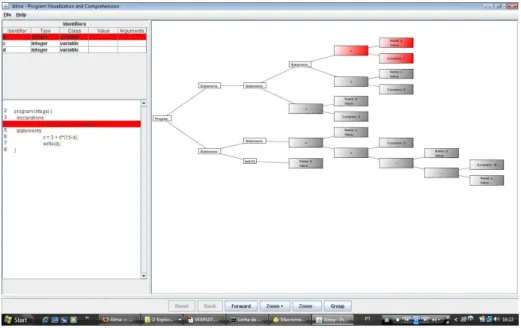
Figure 1 shows the visualization of a program, using the pattern tree corresponding to the source program shown in the bottom-left sub-window.
Figure 1 and figure 2 show the animation of aLISSprogram.LISS[10] is a lan-guage where all variables are initialized at declaration time (with explicit values or default ones). Figures 3, 4 and 5 (subsection 6.2) are related with C language.
6.1 Arrays and Structured Data Types
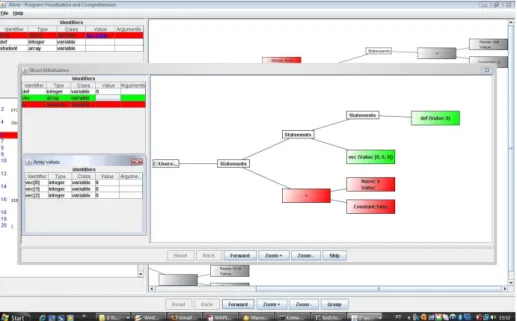
For arrays and structured data types we chose a different way to show their initialization. The initialization of variables of this kind is usually more difficult to understand; when a variable of one of those data types is initialized, a new sub-window is shown, giving the user the opportunity to see in detail the attribution of values to each component or to skip all the steps at once.
Figure 2 shows the sub-window to initialize a structured variable. After a variable is initialized in the respective row of the identifiers table, will appear a link ”See table” to the current value of this variable. In the case of an array, will appear the values at each index (figure 2). In the case of a structured data type will also appear a local identifiers table.
Fig. 2. Struct initialization and local table with values of an array variable
6.2 Function and procedures
To animate functions or procedures, a new window is opened each time the subpro-gram is invoked. This window is divided into parts: the first one is used to animate the parameters passing process; and the second one, to animate the execution of the function/procedure body. In case of subprograms without parameters, the first window (related with parameters passing) is omitted.
To illustrate the function call mechanism—suspending the execution of the invoker, evaluating and passing actual values to the function formal parameters, executing the
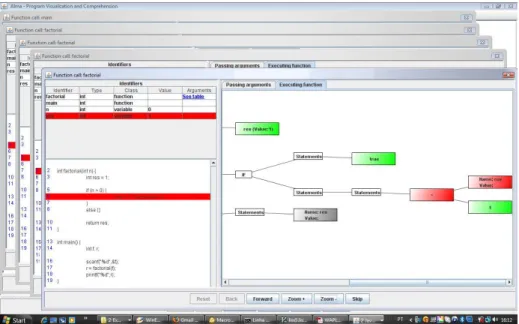
function body, returning a value and resuming the invoker execution—we include Fig-ures 3, 4 and 5 that are concerned with the animation of a classic program written inC
language. The program under consideration in this example is composed by two
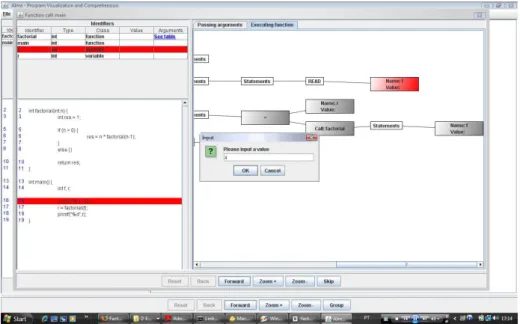
func-Fig. 3. Invoking the main function
tions:main()that prints the factorial of a given integer, invoking a function to do the computation; andfactorial()that receives a parameter and computes recursively its factorial. The first screen displayed byAlmafor this example, corresponds directly to the program tree, and shows that program global structure.
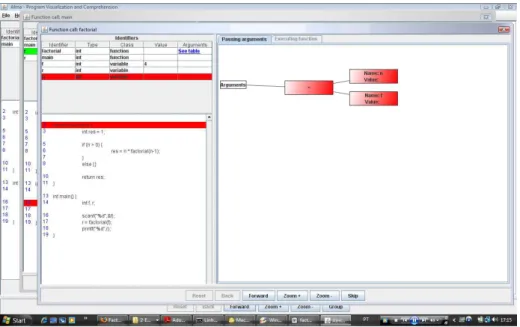
Automatically the Animator invokes functionmain(), opening a second window to show inside it themain()execution. Figure 3 is a screen-shot of themain()state corresponding to the execution of thereadstatement; notice theinput windowthat appears in the middle of the screen to get a new value from the user. This picture also illustrates the mapping of a concreteCinstruction,scanf(%d,&f), into theAlma’s abstract patternread. The next two figures (Fig. 4 and Fig. 5) illustrate the invocation offactorial()function. The first describes the parameter passing (immediately after executing thecallstatement, a new window is opened and the animation of the evaluation and assignment of the actual parameter is displayed). The second (Fig. 5) corresponds to the execution of the third recursive invocation offactorial(). No-tice that a new window is opened for each function invocation; a new identifier table and a new tree are displayed in order to animate that new execution process.
For each function, a local identifier table is created, and it is possible to map each row of this table to the visualization of the function body execution. When the function
execution ends, the local table disappears, and the return value is transferred to the previous identifier table.
Fig. 4. Parameters passing to factorial function
7
Conclusion
To help the software engineer to understand the behavior of a given program (in the context of program comprehension environments), it is necessary to extract and collect from it static data—concerned with variable/type declarations and statement structure— and dynamic data—concerned with the data and control flows.
The objectives of our approach are two-fold: to show the program structure (the hierarchy of the statements); and to illustrate the execution flow and how it affects the program state. For that purpose we just have to parse the source program in order to: collect the information that defines its state (values and variables); and to find out its structure. A symbol table (or definition table) and an abstract syntax tree are enough to store this information. The visualization process is then performed by a systematic tree traversal, applying straightforward rules to each tree pattern, and to the correspondent row in the symbol table and line in the source text.
In our approach, we no longer need the source program; furthermore, after extract-ing information and buildextract-ing theDAST, we are able to give visual details helpful to get easily an operational view of the program. This approach does not modify the source program, and relies upon a visualization/animation engine (the Back-End of the tool)
Fig. 5. Calling recursively the factorial function – Executing the function
that is independent of the source language (and, of course, of the algorithm); thus, tun-ing the tool to analyze programs in different languages is not an hard task.
In order to useAlmafor a new language we just have to construct a front-end for that language. This front-end will map each source language concept to anAlmapattern. To startAlmadevelopment, we have created a front-end forLISSlanguage, enabling us to begin the tests. Recently, we have followed a similar systematic process to construct another front-end, this time forClanguage. Using an attribute grammar (based on a publicCFGforC) andLISAgenerator, this front-end was developed very fast.
We also believe thatAlma can be very useful to visualize more declarative lan-guages, like functional/logic programming lanlan-guages, or specification lanlan-guages, but we will work out this point as future work.
HenceAlmapatterns correspond to the Turing machine basic operations, we argue they suffice to deal with the common imperative programming languages.
To cope with other paradigms, as referred above, possibly it will be necessary to upgrade the patterns library to include some others that can contribute to a more clear understanding of their specificities.
Almasystem can be particulary useful for domain specific languages and other special languages that don’t have any kind ofPCtool implemented. For these languages a newPCtool would be constructed from the scratch. As we already said usingAlma
a specificPCtool can be easily prepared.
We are convinced that presentAlmaanimations really help on program understand-ing — they show a program execution simulation with data and control flow informa-tion. However, this statement will be measured in the near future, via usability tests.
References
1. Ducasse S., Gˆırba T., Lanza M.: Moose: an agile reengineering environment. In: ESEC-FSE’05, Lisbon, Portugal (2005).
2. Antoniol G., Fiutem R., Lutteri G., Tonella P., Zanfei S., Merlo E.: Program understanding and maintenance with the canto environment. In: IEEE International Conference on Software Maintenance (ICSM’97), Bari, Italy (1997).
3. Raza A., Vogel G., Plodereder E.: Bauhaus—a tool suite for program analysis and reverse en-gineering. Technical report, Department of Programming Languages, Institute for Software Technology, University of Stuttgart (2006).
4. Herrera F.: A usability study of the tksee software exploration tool. Master’s thesis, Univer-sity of Ottava (1999).
5. Eick S., Steffen J., Jr E. S.: Seesoft—a tool for visualizing line oriented software statistics. IEEE Transactions on Software Engineering 18 (1992) 957–968.
6. Moher T. G.: PROVIDE: A process visualization and debugging environment. In: IEEE Transactions on Software Engineering. Volume 14. (1988) 849–857.
7. Reiss S.: PECAN: Program development systems that support multiple views. IEEE Trans-actions on Software engineering (1985).
8. Mernik M., Zumer V., Lenic M., Avdicausevic E.: Implementation of multiple attribute grammar inheritance in the tool lisa. ACM SIGPLAN not. 34 (1999) 68–75.
9. Mernik M., Lenic M., Avdicausevic E., Zumer V.: Compiler/interpreter generator system LISA. In: IEEE Proceedings of 33rd Hawaii International Conference on System Sciences. (2000).
10. da Cruz D., Henriques P. R.: Liss—the language and the compiler. In: Proceedings of the 1.st Conference on Compiler Related Technologies and Applications, CoRTA’07—Universidade da Beira Interior, Portugal. (2007).