This is the author’s version of a work that was submitted/accepted for pub-lication in the following source:
Panahi, Sirous, Watson, Jason, & Partridge, Helen (2013) Towards tacit knowledge sharing over social web tools. Journal of Knowledge Manage-ment,17(3).
This file was downloaded from: http://eprints.qut.edu.au/59259/
c
Copyright 2013 Emerald Group Publishing Ltd.
Notice: Changes introduced as a result of publishing processes such as
copy-editing and formatting may not be reflected in this document. For a definitive version of this work, please refer to the published source:
1
Towards Tacit Knowledge Sharing over Social
Web Tools
Author Details (please list these in the order they should appear in the published article)
Author 1 Name: Sirous Panahi Role: PhD student
Department: Information Systems
University/Institution:Queensland University of Technology Town/City: Brisbane
State (US only): Country: Australia
Author 2 Name: Dr. Jason Watson Role: Course coordinator
Department: Information Systems
University/Institution: Queensland University of Technology Town/City: Brisbane
State (US only): Country: Australia
Author 3 Name: Professor Helen Partridge Role: Course coordinator
Department: Information Systems
University/Institution: Queensland University of Technology Town/City: Brisbane
State (US only): Country: Australia
NOTE: affiliations should appear as the following: Department (if applicable); Institution; City; State (US only); Country.
No further information or detail should be included
Corresponding author: Sirous Panahi
Corresponding Author’s Email: [email protected] Please check this box if you do not wish your email address to be published
Acknowledgments (if applicable):
Biographical Details (if applicable):
Sirous Panahi is based at the school of Information Systems, QUT, Brisbane, Australia. He is also based at the department of Medical Library and Information Science, TUMS, Tehran, Iran
Jason Watson and Helen Partridge are both based at the school of Information Systems, QUT, Brisbane, Australia.
2
Structured Abstract:Purpose
Researchers debate whether tacit knowledge sharing through Information Technology (IT) is actually possible. However, with the advent of social web tools, it has been argued that most shortcomings of tacit knowledge sharing are likely to disappear. This paper has two purposes: firstly, to demonstrate the existing debates in the literature regarding tacit knowledge sharing using IT, and secondly, to identify key research gaps that lay the foundations for future research into tacit knowledge sharing using social web.
Design/methodology/approach
This paper reviews current literature on IT-mediated tacit knowledge sharing and opens a discussion on tacit knowledge sharing through the use of social web.
Findings
First, the existing schools of thoughts in regards to IT ability for tacit knowledge sharing are introduced. Next, difficulties of sharing tacit knowledge through the use of IT are discussed. Then, potentials and pitfalls of social web tools are presented. Finally, the paper concludes that whilst there are significant theoretical arguments supporting that the social web facilitates tacit knowledge sharing there is a lack of empirical evidence to support these arguments and further work is required.
Research limitations
The limitations of the review includes: covering only papers that were published in English, issues of access to full texts of some resources, possibility of missing some resources due to search strings used or limited coverage of databases searched.
Originality/value
The paper contributes to the fast growing literature on the intersection of KM and IT particularly by focusing on tacit knowledge sharing in social media space. The paper highlights the need for further studies in this area by discussing the current situation in the literature and disclosing the emerging questions and gaps for future studies.
Keywords:
Tacit knowledge, Knowledge sharing, Social web, Web 2.0, Information Technology
Article Classification: Literature review
For internal production use only
3
Towards Tacit Knowledge Sharing over Social
Web Tools
1.
Introduction
Facilitating tacit knowledge sharing among individuals, such as the sharing of experiences, skills, know-how, or know-whom, and also retaining this knowledge in organizational memory has always been of interest to organizations (Taylor, 2007). However, finding the right conditions, incentives, and mechanisms for sharing this unstructured knowledge has long been a major issue of organizations and knowledge management (KM) research (Allen, 2008). Prior research shows that various factors affect the tacit knowledge sharing behavior of individuals in the forms of enablers, motivators, inhibitors, or facilitators (e.g. Chennamaneni and Teng, 2011, Joia and Lemos, 2010, Li et al., 2010).
Information Technology (IT) has been regarded as one of the main enablers of knowledge sharing activities. However, currently there is no consensus on whether IT can facilitate tacit knowledge sharing. Traditionally, IT has been criticized for ignoring one of the main components of KM which is „people‟. It has been argued that traditional IT had been more focused on information management rather than facilitating interaction among the knowledge holders which is necessary for tacit knowledge sharing (Huysman and Wulf, 2005, Marwick, 2001). That is why researchers argued that for tacit knowledge sharing technologies are needed that provide free-form, real-time, and interactive communication and collaboration platforms (Mitri, 2003, Marwick, 2001).
With the advent of social web initiatives, several studies argued that these new emerging technologies may provide new opportunities to facilitate tacit and experiential knowledge sharing among experts (Hsia et al., 2006, Abidi et al., 2009, Osimo, 2008, Steininger et al., 2010). Despite the current arguments, there is still a lack of understanding about the potentials and pitfalls of social web for tacit knowledge sharing, in part because of the complexity of the concept of tacit knowledge, and also due to existing contradictory views on IT ability for tacit knowledge sharing. In fact, researchers have diverse views on what tacit knowledge actually is and if it is possible to share via IT. Furthermore, while several studies have examined and conceptualized the role of IT in the KM processes (Wild and Griggs, 2008, Song, 2007, Skok and Kalmanovitch, 2005, Sher and Lee, 2004, Mvungi and Jay, Lopez-Nicolas and Soto-Acosta, 2010, López et al., 2009, Hendriks, 1999, Franco and Mariano, 2007, Ahsan et al., 2010), there is still a limited research on the viability of social web tools to facilitate tacit knowledge sharing.
Using the literature, this paper critically analyzes the role of IT, particularly social web tools, as well as the difficulties of tacit knowledge sharing utilizing information technology. This conceptual paper has two purposes: firstly, to demonstrate the existing controversial debates in the literature regarding tacit knowledge sharing using IT, and secondly, to identify key research gaps that lay the foundations for future research into tacit knowledge sharing using social web tools. This study discloses a theoretical discussion in the field of social web tools and tacit knowledge sharing, which have implications for new business models whose experts are not always physically co-located but must exchange their critical experiential knowledge.
The remainder of this paper is organized as follows. First, definitions are provided for the main terms used in the paper. Next, methodology used in this paper is described. Then, existing schools of thought in the realm of information technology for tacit knowledge sharing are introduced. After that, difficulties of tacit knowledge sharing through the use of IT are discussed. This is followed by presenting example studies of tacit knowledge sharing in online environment. Next, potentials and pitfalls of different social web tools are outlined. Finally, discussions and conclusions are made by identifying the gaps in the literature for future studies.
2.
Definitions
4
knowledge and social web. Tacit knowledge which was first used by Michael Polanyi is the knowledge that people usually acquire individually or as a group in the workplace as in the process of learning by doing. It is always viewed in contrast to explicit knowledge which is articulated, written down, or published academic knowledge found in books, manuals, papers, etc. In contrast, tacit knowledge is more dependent on its holder, attached to a person‟s mind, difficult to communicate easily, and deeply grounded in an individual‟s action and experience. Nonaka and Takeuchi (1995) have identified two elements of tacit knowledge: cognitive and technical. Cognitive dimension includes beliefs, ideas, paradigms, values, intuition, and mental models. Technical dimension is more related to “know-how”, crafts and “informal skills” which are commonly accepted definition of tacit knowledge (Leonard and Insch, 2005, Haldin-Herrgard, 2000, Nonaka, 1994). Figure 1 shows the potential distribution of tacit knowledge examples within Nonaka and Takeuchi‟s two dimensions.
FIGURE 1:TACIT KNOWLEDGE EXAMPLES IN NONAKA‟S TWO DIMENSIONS,ADOPTED FROM (NONAKA, 1994)
Another term used commonly in this paper is social web. Broadly social web refers to a new wave of World Wide Web technologies that are known with characteristics such as multiple-way communication, user-generated content, possibility for global networking, multi-media oriented, and user friendly (Panahi et al., 2012). The main focus of social web technologies is on enabling users to be more active on the internet; to produce, participate, collaborate and share knowledge or communicate with other people (Lindmark, 2009). Examples of social web technologies include blogs, wikis, social networking sites, micro-blogging, social bookmarking, etc. The combination of those features and associated tools have made social web as a good channel for knowledge sharing activities.
3.
Methodology
The methodology used in this paper was literature review analysis. The purpose was to review the existing literature about the viability of tacit knowledge sharing through the use of social web tools in order to demonstrate and identify key research gaps in the field. To achieve the goal, the topic first was searched in popular KM online databases such as ProQuest, Ebsco-Host, Emerald, Web Of Science, Elsevier, ScienceDirect, and Google Scholar/books. The search query was carefully chosen to retrieve as far as possible all relevant literature. Examples of search terms and combinations are provided below:
Gut feeling Intuition Mental models Hunches Intelligence Emotions Insights Opinions Belief Perspective Ideas Ideals Understanding Values Creativeness Judgment Assumptions Perceptions Paradigms Schemata Viewpoints Visions Technical Dimension Know-how Skills Hands-on experience Knowing-in-action Problem solving Tips Tricks Best practices Tactical approaches Expertise Rules of thumb Lessons learned Crafts Cognitive Dimension Routines
5
“Tacit/implicit+knowledge+sharing/transfer/dissemination/exchange+web2.0/social web/social media /social networks/blogs/wikis/online/virtual communities, etc.”
Two limitations were applied to the search query: language which was limited to English and year of publication which was limited to 2000-2013 due to fact that social web was introduced after 2000. After reviewing the abstracts of sources and also ensuring about the quality of them (published in peer-reviewed publications), the remaining articles, about twenty sources, were finally selected for an in-depth analysis. However, to provide a detailed discussion about the research gap there was also a need to review KM literature in the areas of ICT support for tacit knowledge sharing as well as the literature about enabling conditions of tacit knowledge sharing, which led to the review of over one hundred sources. The resources were carefully read to determine the research gap and also to develop a conceptual connection between past KM literature in the area of ICT contribution to tacit knowledge sharing and the potentials of current social web tools.
4.
IT and tacit knowledge sharing
There is a major debate among researchers about whether information technology (IT) can have a role in tacit knowledge sharing among individuals. Some, particularly those who conducted their study before introduction of social web tools, insist that tacit knowledge sharing through using IT is too limited if not absolutely impossible to achieve (Flanagin, 2002, Johannessen et al., 2001, Hislop, 2001, Haldin-Herrgard, 2000). Others argue that IT can facilitate tacit knowledge sharing although it may not be as rich as face-to-face interactions (Harris and Lecturer, 2009, Hildrum, 2009, Alavi and Leidner, 2001, Stenmark, 2000, Falconer, 2006, Lopez-Nicolas and Soto-Acosta, 2010, Marwick, 2001, Sarkiunaite and Kriksciuniene, 2005, Chatti et al., 2007, Selamat and Choudrie, 2004, Murray and Peyrefitte, 2007). Each school has its own reasons and explanations.
Advocates of the first school of thought implicitly/explicitly are advocates of viewing knowledge as a category, absolutely tacit or absolutely explicit (Mohamed et al., 2006, Johannessen et al., 2001, Hislop, 2001). They believe that the nature of tacit knowledge as a highly personal knowledge that resides in human brains makes it impossible to be shared not only by language but also through IT. They view tacit knowledge as that which is not expressible and articulable by using common language or even that which is not always accessible to the holder of knowledge. In view of this school, this type of knowledge can only be acquired through personal experience at workplace and can only be shared as tacit without even being converted to explicit. They can only be shared through active and direct communication, mechanisms such as observing, mentoring, apprenticeship, mutual involvement, participation, story-telling, etc. Therefore, this school observes a minimum level for IT to have a role in tacit knowledge capturing and sharing. For example, Johannessen et al. (2001) assert that tacit knowledge cannot be digitalized and shared by means of internet, E-mails, or group-ware applications.
In contrast, the second school of thought admits that IT can contribute to tacit knowledge sharing, although this may not be as rich as face-to-face tacit knowledge sharing. This school views knowledge as being on a continuum that can have a different degrees of tacitness (Jasimuddin et al., 2005, Chennamaneni and Teng, 2011). In their perspective, IT can easily facilitate sharing of knowledge with a low to medium degree of tacitness and fairly support sharing of knowledge with a high degree of tacitness. In addition, based on Nonaka and Takeuchi‟s (1995) knowledge creation theory, they assert that tacit knowledge sharing not only includes tacit-to-tacit conversion (socialization) but also tacit-to-explicit (externalization) and explicit to tacit (internalization) conversions too (Marwick, 2001, Lopez-Nicolas and Soto-Acosta, 2010, McDermott, 1999, Sarkiunaite and Kriksciuniene, 2005). In addition, Nonaka and his colleagues (Nonaka et al., 2000) in an update to their original model stressed that knowledge conversions can take place in a virtual ba (space) too. In other words, they believed to the possibility of tacit knowledge sharing through ICT support.
Advocates of IT-mediated tacit knowledge sharing demonstrate that IT can facilitate tacit knowledge sharing processes through supporting various conversions of tacit-explicit knowledge, although it may not be as rich as face-to-face interactions. IT can support tacit knowledge creation and sharing by
6
providing a field that people freely express their personal new ideas, perspectives, and arguments; by establishing a positive dialog among experts; by making information more available and then enabling people to arrive at new insights, better interpretations, etc (Alavi and Leidner, 2001). For instance, McDermott (1999) notes that IT can facilitate conversion of tacit-to-explicit knowledge. Stenmark (2000) argues that tacit knowledge sharing is not outside the reach of IT support. He suggests that instead of trying to capture and manage tacit knowledge, IT solutions should be designed to provide an environment in which experts can be located, communicate with each other, and sustain social interactions. The results of this social interaction over IT will be better flow and exchange of tacit knowledge. Falconer (2006) also by providing evidence from IT and e-leaning research domains refutes previous studies asserted that tacit knowledge sharing cannot be facilitated by IT and strongly emphasizes on the significant potential of IT in effective communication of tacit knowledge.
Knowledge creation model (also called SECI1 model) developed by Nonaka and Takeuchi (1995) has been the theme of several research articles to study IT role playing for knowledge sharing (Marwick, 2001, Lopez-Nicolas and Soto-Acosta, 2010, Sarkiunaite and Kriksciuniene, 2005, Chatti et al., 2007). Nonaka and Takeuchi‟s SECI model presents four phases for knowledge conversions: socialization (tacit to tacit), externalization (tacit to explicit), combination (explicit to explicit) and internalization (explicit to tacit). Three of these conversions, socialization, externalization, and internalization, are the main processes of tacit knowledge sharing (Sarkiunaite and Kriksciuniene, 2005). Some researchers attempted to make a link between existed IT tools and tacit knowledge conversions by using SECI model (See Table1).
TABLE 1:MECHANISMS AND TECHNOLOGIES FOR KNOWLEDGECREATING AND SHARING
Face to Face IT assisted
Socialization (tacit to tacit) - Team meetings - Discussions - Interpersonal interactions - Apprenticeship - Participation - Observation Externalization (tacit to explicit) - Dialog with team - Answering questions - Story-telling - Metaphors/analogies
Socialization
(tacit to tacit) - Online real-time meetings - Synchronous communication (Chat)
- Online community of practice - Groupware systems - Social media Externalization (tacit to explicit) - Answering questions - Annotations - Blogs/Wikis - Discussion forums - Collaborative systems - Groupware systems - Phone/video conferencing Combination (explicit to explicit) - Books - Papers - Reports - Presentations - Indexes, etc. Internalization(explicit to tacit) - Learning by doing - Learning from books, reports, presentations, lectures, etc.
Combination
(explicit to explicit) - All forms of technologies - Text search - Document categorization - Podcast/Vodcast - Blogs/Wikis - RSS - Mashups Internalization (explicit to tacit) - Visualization - Video/Audio presentations - Online learning - E-mail - Webpage
Adopted from: (Marwick, 2001, Sarkiunaite and Kriksciuniene, 2005, Chatti et al., 2007)
Marwick (2001) reflects that at the moment IT contribution for tacit knowledge sharing is less efficient than face-to-face meetings and weaker than explicit knowledge sharing. However, he expected that gradual progress in accommodating human dimension in development of new tools such as synchronous collaboration systems, expertise locators, discussion forums, and high-band width videoconferencing will contribute to the formation and communication of tacit knowledge much better than before. This is where current social web tools might be partially helpful and needs further study.
Lopez-Nicolas and Soto-Acosta (2010) also found that ICT can influence all knowledge creation processes identified in SECI model. Their study shows that IT can affect socialization of knowledge by facilitating interactions among individuals; externalization process by developing community-based electronic discussions and chat rooms; combination process by supporting sorting, adding, combining, and categorizing existing information; and finally supports internalization process by facilitating informal conversations and discussions, and making the information more available.
1
7
Although they found a limited evidence for support of socialization and externalization processes through the use of ICT. They recommend for further study to examine the interplay of different types of ICT for tacit knowledge sharing. Sarkiunaite & Kriksciuniene (2005) also by using SECI model generalize that high level of IT use positively affects informal relationships between individuals, which in turn facilitate job-related tacit knowledge sharing.
Among the existing schools of thoughts discussed above, perspectives of second school (advocators of IT-mediated tacit knowledge sharing) seem more reasonable and acceptable than the earlier one. Tacit knowledge cannot be regarded as binary digit (0 or 1), pure tacit or pure explicit. The notion of the “degree of tacitness” or “the degree of explicitness” is more meaningful when examining the type of knowledge shared in a specific context (Chua, 2001, Chilton and Bloodgood, 2010). In addition, constraining tacit knowledge sharing mere to tacit-tacit conversion (socialization) may not be a good examination of the tacit knowledge sharing phenomenon through IT assisted communications. Every knowledge (including explicit knowledge) has components of tacit dimension (Polanyi, 1966/2009, Hislop, 2001). Therefore, every tacit-tacit as well as tacit-explicit conversions and vice versa could be regarded as a tacit knowledge sharing phenomenon (Marwick, 2001, Lopez-Nicolas and Soto-Acosta, 2010, McDermott, 1999, Sarkiunaite and Kriksciuniene, 2005). This is what missed in the most investigations of IT- facilitated tacit knowledge sharing.
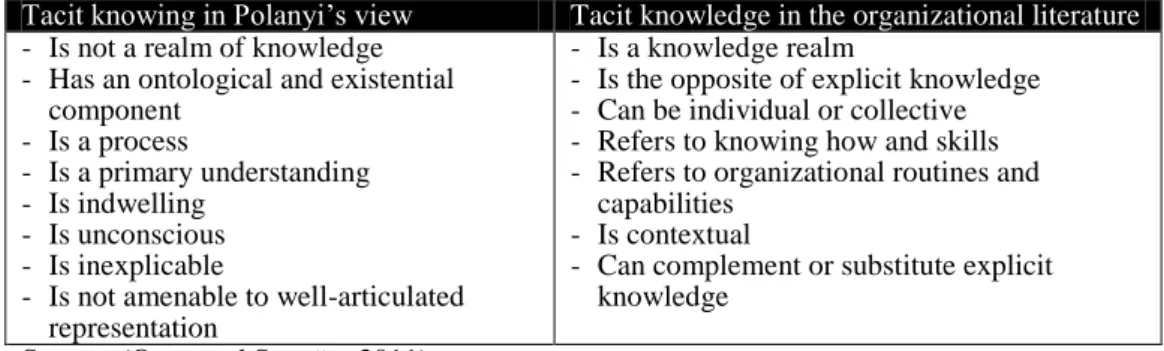
Another thing that could be considered in the investigations of IT-assisted tacit knowledge sharing is the differences exist between “tacit knowledge” and “tacit knowing”. Oguz & Sengün (2011) actually made a distinction between “tacit knowledge”, the term largely used by organizational literature, and “tacit knowing”, the term originated first by Polanyi (See table 2). Polanyi defines “tacit knowing”, in the realm of ontological structure, as a process instead of “tacit knowledge” as a category of knowledge (tacit versus explicit). For Polanyi, “tacit knowing” is procedural in nature, knowing how to do things based on the idea of “dwelling”, “the way one dwells with the world as he/she tries to know it”. Oguz & Sengün (2011) argue that what organizational literature uses the term “tacit knowledge” is more close to Ryle‟s (1949) view of “knowing-how” instead of Polanyi‟s “tacit knowing”.
TABLE 2: A COMPARISON OF TACIT KNOWING AND TACIT KNOWLEDGE
Tacit knowing in Polanyi‟s view Tacit knowledge in the organizational literature
- Is not a realm of knowledge - Has an ontological and existential
component - Is a process - Is a primary understanding - Is indwelling - Is unconscious - Is inexplicable
- Is not amenable to well-articulated representation
- Is a knowledge realm
- Is the opposite of explicit knowledge - Can be individual or collective - Refers to knowing how and skills - Refers to organizational routines and
capabilities - Is contextual
- Can complement or substitute explicit knowledge
Source: (Oguz and Sengün, 2011)
Considering the differences between “tacit knowing” and “tacit knowledge” outlined by Oguz & Sengün (2011), obviously “tacit knowing”, the knowledge with high degree of tacitness, is not easily accessible and transferable by IT. This has been shown by a lot of first school of thought researchers in the past. Therefore, the organizational definition of “tacit knowledge” is more applicable and adoptable for research on IT for tacit knowledge sharing.
Apart from theoretical issues discussed above, there are also practical issues in tacit knowledge sharing. For example, it is argued that face-to-face communication is no longer the principal way of tacit knowledge sharing, particularly where experts are not always geographically co-located, but must change their experiential tacit knowledge. Therefore, today the use and optimization of IT for facilitating tacit knowledge sharing is almost inevitable (Sarkiunaite and Kriksciuniene, 2005). IT certainly can enable individuals to share their tacit knowledge by providing better mechanisms for processing, delivery and exchanging of their valuable knowledge as well as by building an environment that allows experts to locate each other and socially interact about their job related issues (Selamat and Choudrie, 2004, Marwick, 2001, Falconer, 2006). Researchers suggested variety of IT
8
tools for facilitating tacit knowledge sharing which are ranging from communication tools (e.g. instant messaging and discussion forums) to collaborative systems, multi-media sharing tools, video conferencing, online communities and web 2.0 tools such as blogs, wikis, and social networks (Song, 2009, Marwick, 2001, Lai, 2005, Wan and Zhao, 2007, Harris and Lecturer, 2009, Hildrum, 2009, Mitri, 2003, Murray and Peyrefitte, 2007, Smith, 2001, Khan and Jones, 2011, Yi, 2006, Nilmanat, 2009, Ardichvili et al., 2003, Parker, 2011, Mayfield, 2010, Davidaviciene and Raudeliuniene, 2010, Murphy and Salomone, 2012).
5.
Difficulties of tacit knowledge sharing through IT
Prior researchers have addressed several theoretical, individual, cultural, and technical difficulties regarding tacit knowledge sharing. For instance, Haldin-Herrgard (2000) notes five difficulties in sharing tacit knowledge: perception (unconsciousness of holding knowledge); language (and its limit in expressing hard to verbalizing forms of expertise); time (long time required to process and internalize new knowledge); value (immeasurableness value of some kind of tacit knowledge); and distance (the need for face-to-face Interaction). Hislop (2003) also highlights that the embodied nature of tacit knowledge and its embededness in social and cultural values make it more difficult to be successfully shared. However, he agrees that the degree of tacitness is the most significant factor that influences tacit knowledge sharing mediated by IT. Inherently elusiveness of tacit knowledge, unawareness of holding some kinds of tacit knowledge by individuals, unwillingness to share, fear of losing that valuable knowledge and eventually losing competitive advantage are other issues mentioned by Stenmark (2000) for tacit knowledge sharing.
Some of the difficulties mentioned above relates to personal or organizational ability and willingness to share tacit knowledge which is not the focus of this paper. Factors which are mainly applicable to ICT mediated tacit knowledge sharing are more of interest in this paper, which are discussed as following.
Sharing mechanisms. Theoretically, tacit knowledge is conceptualized as personal knowledge that is
deeply embedded in individual‟s mind, her/his action, experience, and involvement in a particular context (Nonaka, 1994). Therefore, transferring and sharing this unstructured, uncoded knowledge is not as simple as explicit, coded knowledge (Jasimuddin et al., 2005, Yang and Farn, 2009). For capturing and sharing this knowledge, mechanisms other than language such as face to face interaction, observing, mentoring, personal experience, and so on are more appropriate. As discussed in the previous section, this perspective has affected most of the opposers of ICT facilitated tacit knowledge sharing (Hildrum, 2009). Although face-to-face contact is the ideal way to share tacit knowledge but it is not always accessible. People simply do not have access to experts or their colleagues all the time. In addition, face-to-face interaction is not the singular important way of tacit knowledge exchanging. There are other ways of tacit knowledge sharing which are important and doable using IT, such as demonstration (or imitation) of skills through the use of videos, story-telling and share practical day-to-day experience, developing technical discussions using ICT, and so on (Hildrum, 2009). Furthermore, as already discussed, if tacit knowledge sharing is viewed as not only tacit to tacit but also tacit to explicit and explicit to tacit conversions (Marwick, 2001, Lopez-Nicolas and Soto-Acosta, 2010, McDermott, 1999, Sarkiunaite and Kriksciuniene, 2005) it could be argued that each of these conversions can be facilitated by using different mechanisms. Tacit to tacit conversion (socialization), particularly in the case of sharing knowledge with a high degree of tacitness, may need more of face to face communication than others phases of tacit-explicit conversions such as externalization or internalization which could be easily facilitated through the help of ICT.
Degree of tacitness. The degree of knowledge tacitness is a controversial issue and affects
individuals‟ ability to share their tacit knowledge. Researchers have argued that the tacit-explicit dichotomy of knowledge may not be appropriate. They advocate viewing knowledge as a continuum rather than as a category (Jasimuddin et al., 2005, Chennamaneni and Teng, 2011). Ambrosini & Bowman (2001) propose that tacit knowledge can be different in terms of the degree of tacitness. As Figure 2shows it can encompass A: too deeply ingrained tacit skills with a highest degree of tacitness which may be totally unavailable to the knower, B: imperfectly articulated tacit skills that cannot be
9
articulated through the normal use of words and may be accessed through the use of metaphors and storytelling, C: readily articulated tacit skills which are primarily unarticulated but could be expressed readily if individuals were simply asked the right questions, D: and finally explicit skills with a lowest degree of tacitness which can easily be articulated and transferred using any knowledge sharing mechanisms. In addition, Chennamaneni and Teng (2011) assert that tacit knowledge can be ranged from low to high. They conclude that knowledge with a low to medium degree of tacitness can be shared if appropriate knowledge sharing mechanisms are used. Furthermore, the degree of knowledge tacitness might be variable from person to person. It could be tacit for someone while at the same time the same knowledge could be explicit for another.
High
A: Deeply ingrained tacit skills B: Tacit skills that can be imperfectly articulatedC: Tacit skills that can be articulated
Low
D: Explicit skillsFIGURE 2:DEGREE OF TACITNESS (AMBROSINI AND BOWMAN,2001)
Richness of media and issue of social cues. Social interaction is the main prerequisite for tacit
knowledge sharing (Yang and Farn, 2009, Song, 2009, Nonaka and Takeuchi, 1995, Polanyi, 1966/2009). Social interaction is richer when media supports natural language, immediate feedback, social cues, and social presence for both source and receiver of message (Chua, 2001, Daft and Lengel, 1986). IT can support this richer interaction by real-time synchronous communications in forms of spontaneous chatting, commenting, video and text based conferencing, etc. (Marwick, 2001). However, IT support is not as rich as face-to-face meetings so far (Marwick, 2001, Murray and Peyrefitte, 2007). Missing certain social cues such as body language, emotional feelings, eye contact, and so on are argued to be major pitfalls of most computer aided communications (Hislop, 2001, Hooff and Weenen, 2004). There is no doubt that IT facilitated communication is not so far as rich as face to face contact. However, social cues and direct face-to-face communication are more important when the knowledge shared contains a high degree of tacitness (Chennamaneni and Teng, 2011). For knowledge with a low to medium degree of tacitness people prefer to use existing technologies to overcome geographical distance, time, and cost barriers (Gordeyeva, 2010). In addition, with the advent of high band width connections and video conferencing technologies which resemble face to face interaction, most caveats of IT richness in tacit knowledge sharing are likely to disappear (Lopez-Nicolas and Soto-Acosta, 2010).
Lack of trust: Trust is regarded as one of the essential factors for tacit knowledge sharing (Holste and
Fields, 2010, Yang and Farn, 2009, Song, 2009, Lai, 2005, Castelfranchi, 2004). Potential lack of past or future associations and eventually lack of trust among users is viewed as an issue for tacit knowledge sharing in computer mediated communications. Building online communities and increasing communication among individuals is suggested as one solution to increase trust among individuals (Raisanen and Oinas-Kukkonen, 2008). On the other hand, anonymous sharing is viewed as a positive aspect of virtual knowledge sharing where tacit knowledge is risky or when people are not confident enough (Raisanen and Oinas-Kukkonen, 2008, Yi, 2006).
The solution to the most of these deficiencies as proposed by some researchers is to create a positive online social environment for interpersonal interactions and knowledge sharing (Sarkiunaite and Kriksciuniene, 2005). However, there are also other issues associated with virtual tacit knowledge sharing such as separation, lack of psychological safety, lack of social obligation to give feedback, lack of shared language and understanding (McKenzie and Potter, 2004).
6.
Online tacit knowledge sharing-selected studies
This section provides example studies which are mainly focused on tacit knowledge sharing in online environments. The purpose is first to show that tacit knowledge sharing occurs in online environment,
10
and then to ground the discussion for demonstrating the existing research gap in the field which will be discussed later in the „discussions‟ section. Followings are examples of studies explored tacit knowledge sharing in online space.
Hara and Hew (2007) in their case study of an online community of health-care have discovered that the most important activity that nurses undertake in online communities is associated with practical tacit knowledge - including institutional practice, personal opinion, and suggestion. Their study focuses more on the type of knowledge and the factors (individual, social, and technological) that help to sustain knowledge sharing within community of practice (CoP). IT contribution has not adequately been addressed in their research except for the asynchronity feature of technology. They suggest for further studies in other online communities.
Yi (2006) compares strengths and weakness of both face-to-face and online externalization of tacit knowledge. She suggests a need for further studies to investigate online externalization of tacit knowledge by examining different types of online tools and environments. Hildrum (2009) challenges the traditional arguments of inability of ICT in facilitating tacit knowledge sharing. By conducting a case study in Cisco‟s network of partner firms, he shows that interpersonal tacit knowledge sharing can happen with novel internet based applications such as online social networks, CoPs, and e-learning technologies which connect technicians from all over the world.
Curran et al. (2009) have studied practice knowledge seeking and sharing among rural and urban clinicians in a virtual community of emergency practice. Using content analysis of discussion boards followed by a questionnaire, they found that the majority of clinicians in online communities are interested in the practice of their peers in order to benchmark best practices (basis of tacit knowledge). They conclude that online social networks can be an important place for sharing personal or collective experiential knowledge as well as explicit based knowledge types in the healthcare setting, particularly where resources are limited (e.g. in rural and urban emergency).
Orzano et al. (2008) acknowledge that tacit knowledge sharing is better facilitated by employing social tools which facilitate interaction and socialization among individuals. Chatti et al. (2007) views social media and other web 2.0 tools as an ideal fit with Nonaka‟s SECI knowledge creation theory, facilitating all socialization, externalization, combination, and internalization processes. Nilmanat (2009) have analyzed contents of discussion threads in an online community in order to show tacit knowledge exchange through image sharing. Finally, Chennamaneni and Teng (2011) link the communication media, particularly web 2.0 tools, with the degree of tacitness of knowledge. They suggest that web 2.0 tools can be used for low to medium degree of tacit knowledge. Knowledge with a high degree of tacitness requires high rich media such as video conferencing and face to face communication.
More recently, Murphy and Salomone (2012) studied the relationship between revealing personal identities and its effect on tacit knowledge sharing in online learning environments. They invited for further research on conceptualizing tacit knowledge in online space. Jarrahi and Sawyer (2013) also showed that social web tools, particularly public ones such as Twitter, blogs and LinkedIn, are effective platforms for sharing informal knowledge and innovative ideas within and across organizations through facilitating expert and expertise locating, socializing, reaching out, and horizon broadening. Their findings, although, has not been discussed directly in relation to tacit knowledge, the factors identified in the study are highly associated with tacit knowledge sharing.
The aforementioned studies all indicate that tacit knowledge sharing takes place in online environments to some extent. Each study has investigated different aspects of different online tools by adopting different theories and acquiring different findings. However, few studies attempted to study tacit knowledge sharing in social web environments (Gordeyeva, 2010). The following section will discuss the main contributions of different social web tools for tacit knowledge sharing.
7.
Tacit knowledge sharing and potential/pitfalls of social web tools
Tacit knowledge sharing in online environments through different web 1.0 and web 2.0 tools was the focus of few research studies which were presented in the previous section. Researchers are still
11
debating whether online web tools can help tacit knowledge sharing. However, with the recent development of social web tools and communities as well as the development of new high-band width connections which allows more real-time interactions, it has been argued that most shortcomings of tacit knowledge sharing are likely to disappear (Lopez-Nicolas and Soto-Acosta, 2010). Indeed, ease of use, informality, openness, multi-media oriented, and community based features of social media applications build an environment in which social interactions and tacit knowledge sharing are better facilitated (Abidi et al., 2009, Steininger et al., 2010, Hsia et al., 2006, Dave and Koskela, 2009, Zheng et al., 2010, Gordeyeva, 2010).
Social web appears to support tacit knowledge sharing in many ways by triggering sociality and informal communication among experts, giving opportunities to harness individuals‟ collective intelligence of , providing a collaborative as well as a brainstorming space for new knowledge creation, making personal knowledge visible, and reducing the time and effort needed for knowledge sharing (Gordeyeva, 2010). Social web tools vary in form and have different abilities to facilitate tacit knowledge sharing. The tools include blogs, Wikis, Podcasts/Vodcasts, social networking sites, social bookmarking, multimedia sharing tools, RSS, etc. The potentials and pitfalls of each tool in supporting tacit knowledge sharing are discussed below.
Blogs and Microblogs. Blogs support tacit knowledge sharing by establishing a space that gives
everyone a voice, enabling people to have discussions, annotate and document immediately their thoughts, and to capture or share personal knowledge and insights in a friendly environment (Chatti et al., 2007, Gordeyeva, 2010). Allowing people to talk about their personal experiences is one of the main mechanisms for sharing tacit knowledge (Ardichvili et al., 2003). Blogs provide such a space for story-telling which might be their most important benefit for the externalization of tacit knowledge. Immediate feedback on blog posts is helpful for transferring tacit knowledge too (Wan and Zhao, 2007). The other potential of blogs in facilitating tacit knowledge is that it enables users to support their ideas and stories by embedding multimedia files (such as images and audio-video presentations) for further explanation of something or demonstration of a practical skill. Microblogs such as Twitter and Yammer also provide opportunities for broadcasting as well as keeping up-to-date with new advancements, trends, and publications. They are also helpful in networking and strengthening socialization within and across organizations (Jarrahi and Sawyer, 2013), which are essential for tacit knowledge creation and sharing.
Wikis. Wikis can affect both externalization (writing down personal knowledge) and internalization
(processing the information offered by Wiki and integrating it into the individual knowledge) of tacit knowledge (Cress and Kimmerle, 2008). It assists tacit knowledge sharing by providing a field for collaborative knowledge capturing and sharing accompanied with social interactions. It is one of the best examples for harnessing collective intelligence (Chatti et al., 2007, Gordeyeva, 2010).
Social networking sites (SNS). The main role of SNSs in sustaining tacit knowledge flow is in
building voluntarily based social community of practices (CoP), which is essential for tacit knowledge sharing (Chatti et al., 2007, Parker, 2011, Hildrum, 2009). SNS‟s enable to locate experts, foster peer-to-peer relationships, promote technical discussions, and provide areas for socializing and personal knowledge sharing (Raisanen and Oinas-Kukkonen, 2008, Hildrum, 2009). Embedded instant messaging and discussion forums support concurrency and the co-presence of users in SNS environments which help to trade tacit practical knowledge among participants (Raisanen and Oinas-Kukkonen, 2008). In addition, SNSs increase the level of interpersonal trust through establishing closer and more frequent communication among members which are both necessary for the effective transfer of tacit knowledge (Gordeyeva, 2010).
Multimedia sharing tools (Podcasts/Vodcasts). These tools are particularly useful in the
internalization process of knowledge sharing which can enhance the learning and conceptualizing of existing knowledge. In addition, they are useful in demonstrating technical know-how and transferring hands-on experiences which may not be expressible by verbalization or through other formal documentation methods (Chatti et al., 2007). The ability to comment, rate, and develop a meaningful discussion about multimedia files shared on social media channels is another advantage of these channels in facilitating tacit knowledge sharing.
12
RSS. RSS seems to be more appropriate for explicit knowledge sharing. It usually gathers and distributes already published knowledge in different places (e.g. blogs) (Chatti et al., 2007). However, it increases the visibly of information published in other places which in turn indirectly helps to disseminate tacit knowledge widely.
Social bookmarking. Although social tagging plays a role of indexing in structured knowledge
sharing, it can also help tacit knowledge sharing by connecting people with common interests and harnessing individuals‟ collective intelligence as they allocate, organize, and share personalized tags with each other (Chatti et al., 2007). In addition, it can be used as an annotation tool by adding new tags for specific contents (Raisanen and Oinas-Kukkonen, 2008). Sometimes, tagging can resemble highlighting key ideas in a book with a marker, enabling the transfer of underlying logic and key information (Gordeyeva, 2010). Another effect of social tagging on tacit knowledge sharing is to locate experts with similar interests by following their personalized tags (Parker, 2011).
In spite of several positive impacts of social web tools on facilitating tacit knowledge sharing, there also pitfalls associated with tacit knowledge sharing in social web environments. For example, authors‟ credentials are not always assessable in the social web. Consequently, there might be a lack of trust or reluctance to accept what has been shared on the social web. Some social web tools (e.g. Wikis) lack personal satisfaction, such as personal recognition or branding, since others are constantly editing the content of these tools. The authors may not directly see the effects of their writing or cannot keep up with or satisfy the modifications to their own contribution. Immediate access and feedback is one of the main factors in tacit knowledge sharing. Although social web tools are now available anywhere anytime, they are still not allowed in all workplaces. In addition, their immediacy is incomparable with face-to-face communication with colleagues, where people have physical proximity, intimacy, common understanding, etc. Tacit knowledge is more context-dependent. Discussions on the social web may be taken out of context, place, or date and eventually lose relevancy and impact.
Tacit knowledge is strongly linked with personal or organizational competitive advantage. People would be unwilling to share their cutting-edge knowledge in social web spaces as doing so may sacrifice their position in the organization or the market. There are also issues with privacy and maintaining confidentiality in the social web environment, which is one of the main barriers in online tacit knowledge sharing which holds back people from using these tools for that purpose. Safety and security are essential for tacit knowledge sharing. Therefore, people might be more cautious with using tools that have the potential to jeopardize their jobs.
The richness of media used for tacit knowledge sharing is another important factor, particularly in the case of sharing knowledge with a high degree of tacitness. Although social web enables the sharing of user-created audio video files that have the potential to demonstrate hands-on experience, which is also supported by the ability to comment, provide feedback, and develop discussions, it is still far from face-to-face communication which is much richer than IT-mediated communications. As mentioned earlier, losing social cues such as body language, emotional feelings, eye contact, and so on is argued to be a major pitfall of most computer-aided communications (Hislop, 2001, Hooff and Weenen, 2004). Time management is another concern in social media. It takes time to filter out good quality information as well as developing relationships with highly trusted people on social media. Social media could also be full of useless information if users do not know how to filter information and who to follow.
8.
Discussion and direction for further studies
Information and communication technology (ICT) has been regarded as one the main enablers of knowledge sharing in this century. However, in terms of tacit knowledge sharing the literature analysis in this paper revealed that there are currently different perspectives regarding the potential role of ICT in facilitating tacit knowledge sharing among individuals. Indeed, there are supporting and opposing arguments on whether ICT can facilitate tacit knowledge sharing. In other words, it can be argued that the role of ICT in tacit knowledge sharing is currently uncertain. Despite the fact that organizations are highly interested in facilitating experts‟ tacit knowledge sharing within the
13
organizations, a little research has been done in the area of ICT for tacit knowledge sharing (Haldin-Herrgard, 2000). This could be considered as a major gap of literature in KM field that needs further investigation.
Meantime, information technology is constantly changing and bringing new opportunities for knowledge sharing. Social web technology is one of the recent technologies that recently captured the attention of some researchers. That is, with the advent of social web technologies a group of researchers now assert that social web may facilitate tacit knowledge sharing. In their opinion, these technologies may have the ability to alleviate some of the issues and challenges exist in the tacit knowledge sharing process among experts. For example, Khan and Jones (2011) suggested that, as new social web technologies emerge in forms of online social networks, blogs, and wikis and are being used widely in organizations, these new ways of communication and communities must be addressed in the discussions on tacit knowledge sharing. Hsia, et al. (2006), Abidi (2009), and Steininger, et al. (2010) also addressed that social web technologies are effective tools to facilitate transfer of tacit knowledge among clinicians. Few studies also attempted to make a link between social web technologies and the knowledge creation processes, including tacit knowledge conversions (Marwick, 2001, Lopez-Nicolas and Soto-Acosta, 2010, Sarkiunaite and Kriksciuniene, 2005, Chatti et al., 2007, Murphy and Salomone, 2012).
Apart from these few theoretical arguments in the literature, there has been a lack of academic research investigating contributions of social web to tacit knowledge sharing exclusively. In addition, it was noticed that although these studies have briefly talked about potentials of social web for tacit knowledge sharing, most of them indeed lack the empirical data support for the arguments stated in their paper. Furthermore, the tools examined in relation to tacit knowledge sharing in the literature were mainly traditional web-based technologies. Social web, which is presumed to be more appropriate for building an environment that may facilitate tacit knowledge sharing (Abidi et al., 2009, Steininger et al., 2010, Hsia et al., 2006, Dave and Koskela, 2009, Zheng et al., 2010), was not the main focus of these studies. In other words, the role of social web for tacit knowledge sharing is currently unknown in the literature. This is while social web is popular nowadays and widespread growing use of Web 2.0 tools among employees and organizations needs further investigation (Hughes et al., 2009).
Many dimensions of tacit knowledge sharing in social web environments have not been examined yet. Many questions are still unanswered and need to be explored in different social web platforms and also different organizational contexts. Examples of research questions might be: How and to what extent are social web tools effective in facilitating tacit knowledge sharing? What are the potentials of social web technologies in this regard? How do social web platforms comply with the requirements of tacit knowledge sharing? What is needed to improve the capacity of social web initiatives in this regard? What are differences between face-to-face versus online tacit knowledge sharing over social media? What are the capabilities of different social web tools? What are the barriers (technical, legal, motivational, etc.)? There are definitely many other questions which need to be investigated in context of these technological trends regarding tacit knowledge sharing behavior.
In order to responds to these questions, Information Systems (IS) research needs to evolve to help organizations and individuals adapt to the changes made by social web technologies in the workplace (Guo, 2009, Manoj and Andrew, 2007). More exploration and deeper understanding is needed to capture and share experts‟ experiential knowledge, particularly if social web is used. There is a need to update the literature in this domain by re-examining the new emerging web solutions for tacit knowledge sharing. There is a need to re-conceptualize tacit knowledge sharing in social web era. And, there is a need to support the theoretical arguments with appropriate empirical data from variety of fields.
Investigating the potentials of social web for tacit knowledge sharing may have significant implications for organizations whose employees are working from different geographical locations across the states or the globe. The teams that may not always physically co-located but need to exchange their critical knowledge and experiences effectively. Studying tacit knowledge sharing in social web platforms can also reveal challenges and pitfalls of using these tools for tacit knowledge
14
sharing. The findings of such studies then may help decision makers and also designers to better approach social web platforms considering the specific needs of professionals.
Finally, it is worth to mention that technology itself is insufficient for the effective transfer of tacit knowledge as suggested by socio-technical theory (Parker, 2011). Thus, social web tools can be regarded as complementary rather than substitute for traditional mechanisms of tacit knowledge sharing.
9.
Conclusions
Due to globalization and need for faster and effective communication, currently a lot of businesses moved to employing web-based technologies as one of their main communication tools. Social web technology has been viewed as one of the recent enablers of tacit knowledge sharing in the literature. It has been argued that ease of use, informality, openness, multi-media oriented, and community based features of social web platforms may create a great ba (shared context) for social interactions and hence increase the chance of tacit knowledge sharing among knowledge seekers. However, despite the theoretical discussions in the literature arguing that tacit knowledge sharing takes place in social web environments, it was noticed that there is still lack of empirical studies supporting these arguments. There is a need to re-examine these recent web technologies in terms of their efficacy and capacity for tacit knowledge sharing, the most critical knowledge of people and organizations. Reviewing the literature, this paper showed that the use and optimization of IT, particularly moving to research and possibly use of social web tools, is essential for facilitating tacit knowledge sharing in the new business models in the information age.
This paper highlighted the need for further studies in this area by discussing the current situation in the literature and disclosing the emerging questions and gaps for future studies. The study outlined a series of research questions that might worthwhile to be investigated in different social web tools and also different organizational contexts. At this level, this paper contributed to the fast growing literature on the intersection of KM and ICT particularly by opening a new discussion in the area of tacit knowledge sharing in social web environments which has not already been adequately discussed thus far in the literature.
Although it was attempted to cover as far as possible all literature related to the topic, however, limiting the search query to English language, issues of access to full texts of some the retrieved resources, possibility of missing some resources due to search strings used in the search queries and also due to limited coverage and functions of databases might still be considered as limitations of this review.
Finally, the authors commit to publish the findings of an empirical study which has been recently conducted in this regard in healthcare context in the near future.
10.
References:
Abidi, S. S. R., Hussini, S., Sriraj, W., Thienthong, S. & Finley, G. A. 2009. Knowledge sharing for pediatric pain
management via a Web 2.0 framework. Studies in Health Technology and Informatics, 150, 287-291.
Ahsan, K., Shah, H. & Kingston, P. Knowledge management integration model for IT applications with hooking RFID technology. 2010. World Scientific and Engineering Academy and Society (WSEAS), 244-249.
Alavi, M. & Leidner, D. E. 2001. Review: Knowledge management and knowledge management systems:
Conceptual foundations and research issues. MIS quarterly, 107-136.
Allen, J. P. 2008. How web 2.0 communities solve the knowledge sharing problem. IEEE International
Symposium on Technology and Society. Fredericton, Canada IEEE.
Ambrosini, V. & Bowman, C. 2001. Tacit knowledge: Some suggestions for operationalization. Journal of
Management Studies, 38, 811-829.
Ardichvili, A., Page, V. & Wentling, T. 2003. Motivation and barriers to participation in virtual
knowledge-sharing communities of practice. Journal of Knowledge Management, 7, 64-77.
Castelfranchi, C. 2004. Trust mediation in knowledge management and sharing. Lecture Notes in Computer
Science (LNCS), 2995, 304-318.
Chatti, M. A., Klamma, R. & Jarke, M. The Web 2.0 driven SECI model based learning process. Seventh IEEE International Conference on Advanced Learning Technologies (ICALT 2007), 2007. IEEE.
15
Chennamaneni, A. & Teng, J. T. C. An integrated framework for effective tacit knowledge transfer. Seventeenth Americas Conference on Information Systems (AMCIS 2011), 2011 Detroit, Michigan. Chilton, M. A. & Bloodgood, J. M. 2010. Measuring the dimensions of tacit and explicit knowledge: Enhancing
knowledge management. In: JENNEX, M. (ed.) Ubiquitous developments in knowledge management:
Integrations and trends. IGI global.
Chua, A. 2001. Relationship between the types of knowledge shared and types of communications channels
used. Journal of Knowledge Management Practice, 2.
Cress, U. & Kimmerle, J. 2008. A systemic and cognitive view on collaborative knowledge building with wikis.
International Journal of Computer-Supported Collaborative Learning, 3, 105-122.
Curran, J. A., Murphy, A. L., Abidi, S. S. R., Sinclair, D. & Mcgrath, P. J. 2009. Bridging the gap: Knowledge
seeking and sharing in a virtual community of emergency practice. Evaluation & the Health Professions, 32,
314-327.
Daft, R. L. & Lengel, R. H. 1986. Organizational information requirements, media richness and structural design.
Management science, 554-571.
Dave, B. & Koskela, L. 2009. Collaborative knowledge management- A construction case study. Automation in
Construction 18, 894–902.
Davidaviciene, V. & Raudeliuniene, J. ICT in tacit knowledge preservation. 6th International Scientific Conference on Business and Management, 2010 Vilnius, Lithuania 822-828.
Falconer, L. 2006. Organizational learning, tacit information, and e-learning: A review. The Learning
Organization, 13, 140-151.
Flanagin, A. J. 2002. The elusive benefits of the technological support of knowledge management.
Management Communication Quarterly, 16, 242-48.
Franco, M. & Mariano, S. 2007. Information technology repositories and knowledge management processes.
Journal of Information and Knowledge Management Systems, 37, 440-451.
Gordeyeva, I. 2010. Enterprise 2.0: Theoretical foundations of social media tools influence on knowledge
sharing practices in organizations. Master, University of Twente.
Guo, C. 2009. A cross cultural validation of perceptions and use of social network service: An exploratory study.
Ph.D., Mississippi State University.
Haldin-Herrgard, T. 2000. Difficulties in diffusion of tacit knowledge in organizations. Journal of Intellectual
Capital, 1, 357-365.
Hara, N. & Hew, K. F. 2007. Knowledge-sharing in an online community of health-care professionals.
Information Technology & People, 20, 235-261.
Harris, R. & Lecturer, P. 2009. Improving tacit knowledge transfer within SMEs through e-collaboration.
Training, 33, 215-231.
Hendriks, P. 1999. Why share knowledge? The influence of ICT on the motivation for knowledge sharing.
Knowledge and process management, 6, 91-100.
Hildrum, J. M. 2009. Sharing tacit knowledge online: A case study of e-Learning in Cisco's network of system
integrator partner firms. Industry & Innovation, 16, 197-218.
Hislop, D. 2001. Mission impossible? Communicating and sharing knowledge via information technology.
Journal of Information Technology, 17, 165-177.
Hislop, D. 2003. Linking human resource management and knowledge management via commitment: A review
and research agenda. Employee relations, 25, 182-202.
Holste, J. S. & Fields, D. 2010. Trust and tacit knowledge sharing and use. Journal of Knowledge Management,
14, 128-140.
Hooff, B. V. D. & Weenen, F. D. L. V. 2004. Committed to share: Commitment and CMC use as antecedents of
knowledge sharing. Knowledge and process management, 11, 13-24.
Hsia, Z. L., Lin, M. N., Wu, J. H. & Tsai, H. T. 2006. A framework for designing nursing knowledge management
systems. Interdisciplinary Journal of Information, Knowledge, and Management, 1, 14-21.
Hughes, B., Joshi, I., Lemonde, H. & Wareham, J. 2009. Junior physician's use of Web 2.0 for information
seeking and medical education: a qualitative study. International Journal Of Medical Informatics, 78,
645-655.
Huysman, M. & Wulf, V. 2005. The role of information technology in building and sustaining the relational base
of communities. The Information Society, 21, 81-89.
Jarrahi, M. H. & Sawyer, S. 2013. Social technologies, informal knowledge practices, and the enterprise. Journal
of Organizational Computing and Electronic Commerce.
Jasimuddin, S. M., Klein, J. H. & Connell, C. 2005. The paradox of using tacit and explicit knowledge: Strategies
16
Johannessen, J. A., Olaisen, J. & Olsen, B. 2001. Mismanagement of tacit knowledge: The importance of tacit
knowledge, the danger of information technology, and what to do about it. International Journal of
Information Management, 21, 3-20.
Joia, L. & Lemos, B. 2010. Relevant factors for tacit knowledge transfer within organisations. Journal of
Knowledge Management, 14, 410-427.
Khan, O. J. & Jones, N. B. 2011. Harnessing tacit knowledge for competitive advantage: An internal social
network approach. Journal for International Business and Entrepreneurship Development, 5, 232 - 248.
Lai, I. L. A. 2005. Knowledge management for Chinese medicines: A conceptual model. Information
Management & Computer Security, 13, 244-255.
Leonard, N. & Insch, G. 2005. Tacit knowledge in academia: a proposed model and measurement scale. The
Journal of Psychology: Interdisciplinary and Applied, 139, 495-512.
Li, Z., Zhu, T. & Wang, H. 2010. A study on the influencing factors of the intention to share tacit knowledge in
the university research team. Journal of Software, 5, 538-545.
Lindmark, S. 2009. Web 2.0: Where does Europe stand? EUR - Scientific and Technical Research series.
Luxembourg: Institute for Prospective Technological Studies (IPTS).
Lopez-Nicolas, C. & Soto-Acosta, P. 2010. Analyzing ICT adoption and use effects on knowledge creation: An
empirical investigation in SMEs. International Journal of Information Management, 521-528.
López, S. P., Peón, J. M. M. & Ordás, C. J. V. 2009. Information technology as an enabler of knowledge
management: An empirical analysis. Knowledge Management and Organizational Learning, 4, 111-129.
Manoj, P. & Andrew, B. W. 2007. Research issues in social computing. Journal of the Association for
Information Systems, 8, 336.
Marwick, A. D. 2001. Knowledge management technology. IBM Systems Journal, 40, 814-830.
Mayfield, M. 2010. Tacit knowledge sharing: Techniques for putting a powerful tool in practice. Development
and Learning in Organizations, 24, 24-26.
Mcdermott, R. 1999. Why information technology inspired but cannot deliver knowledge management.
California management review, 41, 103-117.
Mckenzie, J. & Potter, R. 2004. Enabling conditions for virtual tacit knowledge exchange. In: TRUCH, E. (ed.)
Leveraging corporate knowledge. Aldershot, UK: Gower.
Mitri, M. 2003. Applying tacit knowledge management techniques for performance assessment. Computers &
Education, 41, 173-189.
Mohamed, M., Stankosky, M. & Murray, A. 2006. Knowledge management and information technology: can
they work in perfect harmony? Journal of Knowledge Management, 10, 103-116.
Murphy, G. & Salomone, S. 2012. Using social media to facilitate knowledge transfer in complex engineering
environments: a primer for educators. European Journal of Engineering Education, 1-15.
Murray, S. R. & Peyrefitte, J. 2007. Knowledge type and communication media choice in the knowledge
transfer process. Journal of Managerial Issues, 19, 111-133.
Mvungi, M. & Jay, I. 2009. Knowledge management model for information technology support service.
Electronic Journal of Knowledge Management, 7, 353-366.
Nilmanat, R. Image usage and tacit knowledge sharing in online communities. International Conference on Computing, Engineering and Information, 2009 Fullerton, CA. IEEE, 343-346.
Nonaka, I. 1994. A dynamic theory of organizational knowledge creation. Organization Science, 5, 14–37.
Nonaka, I. & Takeuchi, H. 1995. The knowledge-creating company, New York, Oxford University Press.
Nonaka, I., Toyama, R. & Konno, N. 2000. SECI, Ba and leadership: A unified model of dynamic knowledge
creation. Long Range Planning, 33, 5-34.
Oguz, F. & Sengün, A. E. 2011. Mystery of the unknown: Revisiting tacit knowledge in the organizational
literature. Journal of Knowledge Management, 15, 445-461.
Orzano, A. J., Mcinerney, C. R., Scharf, D., Tallia, A. F. & Crabtree, B. F. 2008. A knowledge management model:
Implications for enhancing quality in health care. Journal of the American Society for Information Science &
Technology, 59, 489-505.
Osimo, D. 2008. Web 2.0 in government: Why and how. JRC scientific and technical reports. Seville, Spain:
Institute for Prospectice Technological Studies (IPTS), Joint Research Center (JRC), European Commission. Panahi, S., Watson, J. & Partridge, H. 2012. Social media and tacit knowledge sharing: Developing a conceptual
model. World Academy of Science, Engineering and Technology (WASET). Paris, France.
Parker, M. 2011. Exploring tacit knowledge transfer: How community college leaders ensure institutional
memory preservation. PhD, Northcentral University.
17
Raisanen, T. & Oinas-Kukkonen, H. A system architecture for the 7C knowledge environment. 17th European-Japanese Conference on Information Modelling and Knowledge Bases, 2008 Pori, Finland. 217-236.
Ryle, G. 1949. The concept of mind, Chicago, University of Chicago Press.
Sarkiunaite, I. & Kriksciuniene, D. 2005. Impacts of information technologies to tacit knowledge sharing:
Empirical approach. Informacijos mokslai, 69-79.
Selamat, M. H. & Choudrie, J. 2004. The diffusion of tacit knowledge and its implications on information
systems: The role of meta-abilities. Journal of Knowledge Management, 8, 128-139.
Sher, P. & Lee, V. 2004. Information technology as a facilitator for enhancing dynamic capabilities through
knowledge management. Information & Management, 41, 933-945.
Skok, W. & Kalmanovitch, C. 2005. Evaluating the role and effectiveness of an intranet in facilitating knowledge
management: A case study at Surrey County Council. Information & Management, 42, 731-744.
Smith, E. A. 2001. The role of tacit and explicit knowledge in the workplace. Journal of Knowledge
Management, 5, 311-321.
Song, D. 2009. The tacit knowledge-sharing strategy analysis in the project work. International Business
Research, 2, 83-85.
Song, H. 2007. The role of information and communication technologies in knowledge management: From
enabler to facilitator. Doctor of Philosophy, RMIT University.
Steininger, K., Rückel, D., Dannerer, E. & Roithmayr, F. 2010. Healthcare knowledge transfer through a web 2.0
portal: An Austrian approach. International Journal of Healthcare Technology and Management, 11, 13-30.
Stenmark, D. 2000. Leveraging tacit organizational knowledge. Journal of Management Information Systems,
17, 9-24.
Taylor, H. 2007. Tacit Knowledge: Conceptualizations and operationalizations. International Journal of
Knowledge Management, 3, 60-73.
Wan, L. & Zhao, C. Construction of a knowledge management framework based on web 2.0. International Conference on Service Systems and Service Management, 2007 Chengdu IEEE, 5341-5344.
Wild, R. & Griggs, K. 2008. A model of information technology opportunities for facilitating the practice of
knowledge management. VINE, 38, 490-506.
Yang, S. C. & Farn, C. K. 2009. Social capital, behavioural control, and tacit knowledge sharing--A
multi-informant design. International Journal of Information Management, 29, 210-218.
Yi, J. 2006. Externalization of tacit knowledge in online environments. International Journal on E-learning, 5,
663-674.
Zheng, Y., Li, L. & Zeng, F. Social media support for knowledge management. International Conference on Management and Service Science (MASS), 2010 Wuhan.