Eindhoven University of Technology Department of Mathematics and Computing Science
Precise XSS Detection with Static
Analysis using String Analysis
By Henri Hambartsumyan
Thesis submitted in partial fulfilment of
the requirements for the degree of
Master of Science
in
Computer Science
at the
Eindhoven University of Technology
January 30, 2011
Supervision: dr. J.I. den Hartog
dr. E. Poll ir. B. Seghers
Abstract
Static analysis is one of the techniques at hand in order to aid in improving the security of software. Yet, also static analysis is far from perfect. Although in theory static analysis has much advantages over dynamic analysis, in practice static analysis often encounters problems in the form of moderate accuracy. Users of static analyzers for security purposes often have to dig through literally hundreds of warnings looking for real dangers. The research done for this thesis is focused on improving the accuracy of the produced results such that the user of the static analyzer wastes less time looking over false positives and at the same time he does not get a false sense of security due to false negatives.
This thesis will start with an introduction explaining the problem (section 1) and give back-ground information on static analysis (section 2). Then, some of the currently available static analyzers will be reviewed (section 3). In section 4 a new approach will be proposed in order to enhance the accuracy for detecting XSS, followed by a validation of the results of the proposed solution in section 5. Finally a conclusion will be drawn section 6 and some future work will be presented in section 7.
Table of Contents
1 Introduction 6
1.1 Research question & objectives . . . 7
1.2 Outline . . . 8
1.3 Acknowledgements . . . 8
2 Static Analysis 10 2.1 Compiler Basics . . . 12
2.2 Technical Details of Static Analysis . . . 14
2.2.1 Program-flow Analysis . . . 14
2.2.2 Data-flow Analysis . . . 16
2.2.3 Taint Analysis . . . 18
2.2.4 Pattern Matching . . . 19
2.3 Security Vulnerability Detection . . . 20
2.3.1 SQL Injection . . . 20
2.3.2 Cross Site Scripting . . . 21
2.3.3 Buffer Overflow . . . 22
2.3.4 Command Injection . . . 23
2.3.6 Unsafe Use of Mutable Objects . . . 24
2.3.7 Hardcoded passwords . . . 25
2.3.8 Information Disclosure . . . 26
3 Review of Static Analysers 27 3.1 Methodology . . . 27 3.2 Tools . . . 29 3.2.1 Fortify 360 . . . 29 3.2.2 RIPS . . . 30 3.2.3 Pixy . . . 31 3.2.4 PHP String Analyzer . . . 31 3.2.5 Other tools . . . 32 3.3 Tool performance . . . 33 3.3.1 Fortify 360 SCA . . . 36 3.3.2 Pixy . . . 38 3.3.3 RIPS . . . 39 3.3.4 PHP SA . . . 40
3.4 Common Problems for Reviewed Tools . . . 41
3.5 Conclusion . . . 44
4.1 General understanding . . . 45
4.2 Detailed Inner Working . . . 48
5 Validation & Performance 52 5.1 High Level Results . . . 52
5.2 Solved Problems . . . 53 5.3 Unsolved Problems . . . 56 5.4 Other limitations . . . 56 6 Conclusion 58 7 Future Work 59 A Code Samples 63 A.1 XSS . . . 63 A.2 Injections . . . 68
B Raw Scan Results 74 B.1 Scanned File . . . 74
B.2 Fortify . . . 79
1
Introduction
Security vulnerabilities in software account for a large part to the insecurity of current IT systems. Writing secure software requires great expertise in this area and is extremely time consuming. Hence, a lot of software that has been developed and is being developed is not secure in the broadest sense of the word. Finding these security vulnerabilities in existing source code requires the same expertise and is even more time consuming. Unfortunately, this is an unavoidable fact which is currently being faced by the industry [19, 7].
In order to facilitate this process, a lot of research has been done in the academic world as well as in the corporate world. One of these research topics is “Static Analysis”. In static analysis one is concerned with analyzing the source code in its original form in order to find potential security vulnerabilities. Here, “source code in original form” refers to the input to the static analyzer which should be the original source code as written by the developer without any automated optimizations or transformation. Note that does not restrict the analyzer to perform transformation on the source code during the analysis process.
Static analysis comes with some advantages and limitations. As pointed out nicely in [8], static analysis for a developer is comparable to a spell checker for a writer. Even the best spellers make mistakes when writing. By having a good spell-checker, a good speller can eliminate most of his mistakes. However, a bad speller who has a spell-checker does not become a good speller. The same applies to developers; a skilled developer can get the advantage of static analysis, although it is not perfect. However, the unskilled developer can eliminate the obvious mistakes, but the more subtle or uncommon ones will remain. A high-level overview of the advantages and disadvantages of static analysis in general is given below.
• Advantages static analysis:
– Pinpoint the exact location in the original code. – Can propose fixes for the developer.
– Is relatively fast and scales well.
– Can be performed during development, sometimes even when the code is not fully compiling.
• Disadvantages static analysis:
– Trade-off between false positives and false negatives. Impossible to exclude both. – The results depend on the quality of the rules.
– Very hard to find logical errors leading to security vulnerabilities.
Another approach for automated vulnerability identification in software is dynamic analysis. In dy-namic analysis, the analyzer analyzes the application while it is being executed and tries to identify security vulnerabilities or active exploitation of vulnerabilities. In theory, this is easier because one has more information regarding the state of the application. For example, variable values can all be just looked up in the memory, hence theorem proofing and reasoning become superfluous. Nevertheless, this approach has a major disadvantage, vulnerabilities can only be found if the vulnerable code is executed. Often, vulnerabilities are hidden in corner cases. If such a corner case is not part of the test cases, the vulnerability will never be discovered. Hence, the false negative rate can become too high. Moreover, since missing the corner cases is the first reason security vulnerabilities arise, dynamic analysis is not sufficient from a security point of view.
1.1
Research question & objectives
The main question the thesis should answer is “How and how much can the accuracy of the results produced by static analysis for security vulnerabilities be improved?”.
Sub question which have to be answered:
• How can performance (including accuracy) be measured or estimated? (subsection 3.1)
• What are specific or general weaknesses of existing tools undermining the accuracy? (subsec-tion 3.3 & subsec(subsec-tion 3.4)
– Why do they exist?
• How can these weak points be improved such that the overall result becomes more accurate? (section 4)
Although these questions, as proposed above, may seem vague without specifying a combination of language, platform and application type, the idea is to first research for what specific combination(s) the results can be the most interesting. After this initial phase, the research will focus on these combinations of language, platform and application type. After the initial phase of the project where the research question was better scoped, the project focused on XSS in PHP applications.
1.2
Outline
First, this document will present a more in-depth view on techniques used for and theories behind static analysis. Furthermore, the document will zoom in on using static analysis to find security vulnerabilities. The reader is expected to have deep knowledge of software security and especially the existing vulnerabilities and ways to exploit them.
Next, the performance of currently existing tools will be reviewed based on samples of code with intentionally planted security vulnerabilities. An important aspect in this review is to understand in which cases tools produce false negatives or false positives. Understanding this is crucial to this thesis since the goal is to improve the accuracy of such tools.
Hereafter, the thesis will discuss the bottlenecks discovered in existing tools with a strong emphasis on how to improve this bottleneck. In order to see if the proposed solutions are not only correct in theory but also in practice, a proof of concept will be developed. This proof of concept will be tested using the same code samples as used before in order to test the effectiveness. Moreover, a few new code samples will be presented as input in order to see if the proof of concept only works due to overfitting or that the improvements are of a more persistent nature.
Finally, the conclusion of this thesis will be presented, thereby evaluating the result and proposing possible future improvements.
1.3
Acknowledgements
First of all, I would like to express my gratitude and appreciation to the three people who helped me and supervised this thesis. Bart Seghers from PwC helped me in the day-to-day work, he helped me to setup the project, gave interesting ideas and always provided his valuable insight to the topics at discussion. Many good ideas, as well as outstanding feedback, originated from Bart Seghers, for which I want to thank him. Jerry den Hartog supervised me and directed me throughout the project with his ideas from a scientific point of view. He helped me with every question I had and every problem I encountered. The discussions we had always broadened my perspective and I never left his room with unanswered questions. I want to thank him for that. Finally, Erik Poll, who is officially not my supervisor, but due to his expertise in this area he provided me with ideas, answers and feedback on the topics at hand. Although Erik Poll formally did not have any time for me, he did his utter best to help me in any way he could. Hereby, I want to thank him for all the effort and all the valuable ideas and feedback he provided me from his area of expertise.
Next, I would like to thank PwC and my team Security & Technology who provided me the chance to taste the experience of working in such a great team of professionals. My gratitude to everyone with whom I had discussions during — for example — lunch, you all provided me valuable insights in your area of expertise inside the broad field of “Security & Technology”.
Finally, my gratitude to Fortify Software, represented to me by Taylor McKinley. Fortify Software offered me an educational license for “Fortify 360” which provided me a competitive baseline for the possibilities of static analysis. I want to thank Fortify Software for giving me this chance.
2
Static Analysis
In the context of computer science, static analysis refers to the automated process of analyzing code without running the code that is being analyzed. One tries to understand the semantics in order to reason about and deduce properties from this code. In general, these results are used to draw conclusion concerning the code. Examples of such conclusion could be the quality of the code (measured by a given metric), reverse engineering code to give humans a structured view, a variety of different kinds of flow analysis, etc.
Depending on the goal of the user, a wide variety of techniques for static analysis are available ranging from very simple searches using regular expressions until theorem proofers for finding correctness proofs.
The main advantage of static analysis compared to dynamic analysis is the fact that with dynamic analysis, one can only find problems once they occur. Dynamic analysis uses the executing states and state changes of the code for its analysis. If some state is not reached during execution, dynamic analysis cannot produce any result concerning that state. The analyzer is not even aware of the existence of that state.
However, since at runtime more information is available to the analyzer, the number of false negatives is much lower compared to static analysis. Recently, a growing trend for static analysis is the annotation of the code by the developers in some formalism in order to provide the static analyzer more information to reason with. This approach is usually referred to as “Design by Contract”. Examples of such an approach for static analysis is JML [17, 5], Spec# [3], Eifel [20]. By providing pre-conditions, post-conditions, loop invariants, class invariants, restrictions on input and output etc, the static analyzer is able to deduce more properties and hence proof correctness in a more complete way. Doing so brings the advantages of dynamic analysis partially to static analysis. Of course, the developers still has to create the annotations, so the completeness of the correctness proof still depends on correctness and completeness of the annotations.
Static analysis, however, has one large disadvantage. Rice’s theorem [28] states that static analysis cannot perfectly determine any nontrivial property of a general program. This means that static analysis can never reach 100 per cent precision and 100 per cent recall for every possible input (see Equation 1 and Equation 2 on page 12 for the definition of precision and recall). Rice’s theorem states that checking any nontrivial property of a program can be reduced to the halting problem, which is undecidable [30]. Of course, there are approximations that produce results which are either not complete (i.e. there may be false negatives) or not sound (i.e. there may be false positives), usually both, in form of a trade-off.
if a given model conforms the specifications. The model is deduced from code and the specification is given in some formalism (e.g. propositional logic or temporal logic). The model itself usually has the form of a deterministic finite automaton. A model checker then checks if the provided model is the correct with respect to the specification. In the context of this thesis, model checking can be exploited to check the presence or absence of some properties in the source. An example of such property is “each variable is only freed once”. Such a property is converted to the formalism accepted by the model checker and checked against the model (i.e. code). However, a large issue in model checking is the so called “state explosion problem” [31].
The following sections in this chapter will give more details on the different techniques used for static analysis and the last section of this chapter will discuss how static analysis can be used for the purpose of finding security vulnerabilities.
The general process on how static analysis works on a high level is depicted in Figure 1
Figure 1: High level overview of static analysis, from [8]
The process always starts with source code in any form. The analyzer produces some kind of model based on the source code. This model is a representation of the source code where details of the underlying grammar for the programming language are abstracted away. This creates a more straight-forward model of the source code. A common example of such representation is the so called “Abstract Syntax Tree (AST)” [1].
Creating such models from source code is similar to what a compiler does. Moreover, a lot of techniques used for static analysis are borrowed from the compiler field. For that reason, the next section will
give an introduction to the field of compilers.
Once the model of the source code is built, the analysis should be performed. Input to the analyzer is the model and “Security Knowledge”. The security knowledge which serves as input for the analyzer is in the form of rules, propositions or automaton. The analyzer then checks if there is a match between the model and the security knowledge.
The analyzer outputs a list of matches which are potential security vulnerabilities. However, this output is in “raw” format and should be post-processed in order to present a nice report for the user. Note, that the post-processing is not only about lay-out. The post-processor can also decide to sort and filter the output for an optimal view to the user.
Measuring the accuracy of a error-prone process is often done in terms of precision and recall. In words, precision means the number of correctly found vulnerabilities from the set of all found vulnerabilities. Recall refers to the number of correctly found vulnerabilities from the set of all existing vulnerabilities.
P recision= T rueP ositive
T rueP ositive+F alseP ositive (1)
Recall= T rueP ositive
T rueP ositive+F alseN egative (2)
In an ideal situation, one wants to have no false negatives and no false positives. From a security point of view, false negatives are the worst. It creates the false sense of security and moreover it potentially leaves a vulnerability in the code. However, having too many false positives is also not desired. It can become very hard to manually process all the results of the analysis. The person going through the list of false positives is discouraged and gets the impression that all results are wrong. Consequently he may overlook an important true positive.
2.1
Compiler Basics
As mentioned earlier, the field of static analysis is closely related to the field of compilers. As a matter of fact, a lot of techniques used for building a model from source code are equivalent to the techniques used for compilers. This section will give a short basic introduction to the field of compilers which is needed for a thorough understanding of static analysis.
One of the most important terms in the field of compilers is the context-free grammar. Each pro-gramming language is a context-free grammar. Below, the formal definition of a CFG is given as a reminder. Readers who are not familiar with this topic are referred to [16]
A context-free grammar is a 4-tuple: G= (N,Σ, P, S) where
• N is the (finite) set of non-terminals • Σ is the (finite) set of terminals
• P represents the production rules given byN×(N∪Σ)* • S is the start symbol, withS∈N
• Finally, it should hold thatN∩Σ =∅
Simply stated, building a model from source code is transforming a program with certain semantics expressed in a certain programming language (sayS) to another programming language (sayT) thereby respecting the semantics. This translation is a function ϕ: S →T where T is the target language. The functionϕis said to be a correct translation, if for everyx∈S it holds thatϕ(x)≡x, where≡ denotes semantic equivalance. The translation functionϕis the“compiler”.
For common high-level programming languages, the compilation is a threefold process. The first step is the transformation of the source code into a uniform sequence of symbols which extract all the syntactical details of the programming language (e.g. comments, spaces, newlines, tabs, etc). This process is called lexical scanning.
Next, the row of symbols which is obtained from lexical scanning are checked against the context-free grammar of the programming language. If the inputted symbols are a derivation of the CFG (context-free grammar), a parse tree is built and later converted to an abstract syntax tree. Transforming the parse tree to an abstract syntax tree is to make analysis easier. Parse trees are the most direct tree representations of the source code, which correspond one-to-one to the production rules of the grammar. Since the grammar for programming languages is designed to make parsing easy and non-ambiguous, it is not the most efficient representation for performing analysis. Hence, the transformation into an abstract syntax tree where parse ambiguity is not an issue anymore. Moreover, context conditions (i.e. is a variable defined, is it defined in the correct scope, is it used after definition, is it only defined once, etc) can be checked more easily on an abstract syntax tree than on a parse tree.
Finally, the abstract syntax tree is converted to the target language using production rules. Usually, the target language is some form of assembler code (native or for a virtual machine). Since this final translation step is outside the scope of static analysis, no further details will be given on this topic. The reader is referred to [1] for more information on the topic of converting an AST to the intended language.
Generally speaking, a CFG is non-deterministic, which makes it hard to parse. The easiest and most naive way of parsing a non-deterministic CFG is by backtracking. Nevertheless, there exits a subset of
all CFGs which are deterministic to parse, these grammars are called the LL(1) grammars [16]. The determinism allows the creation of efficient acceptors, which, given an input stringxand a grammar Gcan determine ifxis part of the language created by grammarG.
2.2
Technical Details of Static Analysis
This section will discuss some important techniques and approaches which are used in the field of static analysis. Please note that this list is far from complete. Only techniques which are relevant for this thesis or which are considered important [8, 1], are discussed in this section. Program flow analysis and data flow analysis are used in static analysis for different purposes, while tainting analysis is very specific for security purposes. For more in depth information regarding techniques used for static analysis see [24]. This book gives an in-depth overview of the different approaches for analyzing programs.
2.2.1
Program-flow Analysis
In order to have more accurate results, an analyzer should be able to distinguish the different paths that can be taken. By analyzing these paths, it should become clear what conditions hold in which branch and if security vulnerabilities exist by taken some path. To make this clear, consider the following example.
Listing 1: Basic example
1 i f ( f a l s e ) 2 { 3 u n s a f e ( ) ; 4 } 5 e l s e 6 { 7 s a f e ( ) ; 8 }
An analyzer which doesn’t perform flow analysis, will report that there is a call to an unsafe function on line 3. This is not true since this code will never call the functionunsaf e(). A static analyzer which performs program-flow analysis will detect this, and prevent a false positive in the results. Now, consider the following example:
Listing 2: Annotated example
1 x = q 2 {x=q} 3 i f ( x < y ) 4 {x < y∧x=q∧q < y} 5 x = y 6 {x=y∧x! =q∧q < y} 7 e l s e 8 {x >=y∧x=q∧q >=y} 9 x = x + 1 10 {x > y∧x=q+ 1∧q >=y} 11 {(x > y∧x=q+ 1∧q >=y)∨(x=y∧x6=q∧q < y)} 12 i f ( x > y ) 13 u n s a f e 1 ( ) ; 14 i f ( x < y ) 15 u n s a f e 2 ( ) ;
In this example, the code is annotated with red assertions. From this code, one cannot say for sure if the functionunsaf e1() will be called since it depends on the value ofq. It is often the case that the value of some variable is only known at runtime, so when performing static analysis, it is not possible to say ifunsaf e1() will be called.
Forunsaf e2() we are more lucky, when reasoning about the possible values ofxandyin this program, we can deduce with certainty that x will never be smaller than y. So we can safely assume that unsaf e2() will never get called, hence that there is no security problem here.
From Listing 2, we can conclude that performing program-flow analysis requires automated reasoning. Although automated reasoning is generally speaking not a problem and there are theorem proofers that can do this quite efficiently, there are two major problems. The biggest problem was already mentioned, viz. that some information is only available at runtime, hence the proofs are not always strong enough. The second problem is closely related but a more practical one; data flows throughout the whole application making it hard to keep track of it. Especially in the presence of pointers and aliasing. The developer can help with this problem by annotating the code (Design by Contract) with pre-conditions, assumptions, post-conditions and invariants. This makes proofing theorems in some cases easier, however, having wrong annotations can pose a threat to security. Also in the presence of global variables and threads, the assertions can become invalidated by another thread introducing race conditions on the assertions.
Another approach to program flow analysis is to first identify all possible traces throughout the code. In Listing 2, there are 8 possible traces when performing only a syntactical analysis. When automated reasoning is applied — thereby only looking at the precondition of each statement as a whole (i.e. if-else is one statement having one post-codition) — 4 traces are left. For each of these 4 paths, one has to identify if it contains any insecure code, and if so, report it back to the user. The advantage
of this approach over only automated reasoning is that it produces a trace for the user in order to manually analyze it.
2.2.2
Data-flow Analysis
Data-flow analysis is a way to keep track of the data in the source code while it is assigned to variables and propagates throughout the code. The basic idea of data-flow analysis is quite simple, however, due to the complexity of modern day programming languages, there are some complications (see [24]). First, consider an easy example.
Listing 3: Data flow through variables
1 public s t a t i c void Main ( s t r i n g [ ] argv ) 2 { 3 s t r i n g c a p s ; 4 i f ( a r g v . Length > 1 ) 5 caps = C a p i t a l i z e ( argv [ 1 ] ) ; 6 } 7 private s t a t i c s t r i n g C a p i t a l i z e ( s t r i n g input ) 8 {
9 return input . ToUpperCase ( ) ; 10 }
In this example, all the green marked variables are derived from the initial input “argv[1]”. So each green mark variable inherently has a flow relation with the initial input. Nevertheless, even in this primitive example, difficulties can arise. Imagine that the function T oU pperCase() is replaced by CalculateSHA1(), which calculates and returns the SHA1 hash of the input. One can argue if 1) the result is still related to the original input and 2) if it is desired to have a relationship between the original input and the hashed value.
The complications come up when pointers are allowed. Aliasing and pointers make it hard to track data across memory. Consider the following list of assignments in C.
Listing 4: C memory issues
1 i n t∗ a ; i n t∗ b ; i n t∗ c ; 2 a = new i n t; c = new i n t[ 5 ] ; 3 ∗a = 5 ; 4 b = a ; 5 ∗( c+2∗s i z e o f(i n t) ) = ∗b ; // t h i s i s e q u a l t o (∗c ) [ 2 ] = ∗b ; 6 b = 0 x 1 2 3 4 f f f f
In this example, it becomes already hard to follow the data. Especially, when variablec (which is a pointer to an array) is index by pointer arithmetic.
It becomes impossible when an arbitrary memory value is assigned to b. When performing static analysis, it is impossible to tell if the memory value is a valid memory address (for example point to a). So data flow analysis becomes impossible in this case.
Finally, consider an example where static data-flow analysis is made impossible because of unpre-dictable branches in the code.
Listing 5: Input data
1 i f ( x > y ) // x i s i n p u t n o t known a t c o m p i l e−t i m e 2 a = x ; 3 e l s e 4 a = y ;
In this example it is impossible to deduce which variable flows into the variablea, given that the value ofxis not know at compile time (e.g. user or network input). In the best case, a static analyzer can deduce that after executing the code in Listing 5, a has the value ofxor y.
A well-known and useful technique in the world of compilers for partially overcoming and formalizing this problem is Static Single Assignment (SSA, see [10]). SSA prescribes that a function may assign each variable only once. When in a normal function a variable is assigned multiple times in a function, the variable is split into multiple variables with an indexed subscript. The following example demonstrates this.
Listing 6: A snippet in normal form and in SSA form
1 // Normal form 2 x = x + 1 ; 3 i f ( x > y ) 4 a = x ; 5 e l s e 6 a = y ; 7 8 //SSA form 9 x2 = x1 + 1 ; 10 i f ( x2 > y1 ) 11 a2 = x2 ; 12 e l s e 13 a3 = y1 ; 14 a4 = ϕ( a2 , a3 )
When the analyzer is not sure how the data flows throughout the program, the so calledφ-function is used to indicate that there is a choice between multiple possible values. Also, note that the indexing of a begins with 2 since we assume thatais already initialized with a default value.
Using SSA, it becomes easy to determine where the value of each variable comes from, which is exactly the purpose of data-flow analysis. Another consequence of SSA is the so called “constant propagation”. Constant propagation states that whenever some variable is assigned a constant value, the constant can replace all occurrences of that variable. In the context of static analysis for security purposes, this technique can be useful to find hardcoded secrets (i.e. password or private keys).
The purpose of data-flow analysis in the security context is to be able to perform a tainting analysis, which is the topic of the next section.
2.2.3
Taint Analysis
Although security vulnerabilities can occur almost everywhere in a program, they become a threat when an attacker is able to exploit it. For the most common vulnerabilities, it holds that an attacker is only able to exploit the vulnerability if he is able to “control the correct data” (e.g. buffer overflow, xss, sql injection).
An analysis technique used to find such vulnerabilities where controlling the data is required for successful exploitation is called taint propagation. In software, the usual ways an attacker can control data is by means of user-input (keyboard, mouse, etc), network-input and environment manipulation. So when the analyzer follows all data which enters the program through one of these three ways, it should be able to differentiate between potential dangerous data (i.e. tainted data) and safe data (i.e. untainted). The places where externally controlled data can enter the application are called “sources”. Different functions in libraries are inherently vulnerable for exploitation and require validation. These places in the program are called “sinks”. Examples of common sinks are functions which execute SQL on a database (SQL injections), functions that print output to the screen (cross site scripting) and function that manipulate memory directly (buffer overflows). The rule-of-thumb of taint analysis is that only untainted data may enter sinks. Note that in order to assess if data flows from a source to a sink, data-flow analysis is required. One can see taint analysis as an analysis on “a higher level” which uses data-flow analysis for finding security vulnerabilities.
It is too restrictive to prohibit tainted data from any source to flow to a sink. The solution is to have special function which can remove the taint from data (i.e. sanitize input). These functions are the input-validators which take tainted data as input and transform them into untainted data. On the contrary, there are functions which add taint to untainted data. An example is string concatenation, when a tainted string is concatenated to an untainted string, the resulting string should be tainted.
Listing 7: Taint propagation 1 f g e t s ( b u f f e r , s i z e o f( b u f f e r ) , s t d i n ) ; 2 i f ( b u f f e r ) 3 { 4 s t r c p y ( s e c B u f f e r , b u f f e r ) ; 5 t h i r d B u f = makeSafe ( b u f f e r ) ; 6 sys tem ( ” l s ” + s e c B u f f e r ) ; 7 sys tem ( ” l s ” + t h i r d B u f ) ; 8 }
Consider Listing 7, in this case, the source is the C function fgets. It taints the variable buffer, since it reads user input from the standard-in without any validation (except for the length). The next function which is executed, stcpy, is a sink since it requires that the input is validated to prevent buffer overflows. On the other hand, it also propagates the taint to the output buffer. On line 5, the buffer is sanitized and the output of makeSafe is copied to the variable thirdBuf. Finally, on line 6 and line 7 both buffers are fed into the function “system”. This function requires that the input is untainted, hence by taint propagation we can say that line 6 is unsafe because the input is tainted while line 7 is safe, given that the makeSafe function is implemented correctly.
The idea of tainting is very bright, however, there are also limitations. Listing 7 is carefully crafted to demonstrate the limitations. Consider line 4, the function strcpy is a source and a sink at the same time. It is a source since the input is copied from the second argument to the first argument without sanitizing the content of the strings. So if the input is tainted, the output should also be tainted. At the same time, strcpy is a sink since the length of the input should be sanitized to prevent buffer overflows. If one wants to meet this condition, then the variable buffer should become untainted if the sizeof(buf f er) ≤sizeof(secBuf f er). Imagine a function which checks this and removes the taint from buffer. Then strcpy gets as input a safe string and produces as output a “safe” string. Of course, the problem arises when this “safe string” is fed into system. Safeness depends on the context and so should tainting be. In an ideal case, a variable should have multiple taints indicate for which purpose a variable is tainted and for which it is already sanitized.
2.2.4
Pattern Matching
Finally, this section will discuss a less sophisticated, but very useful group of techniques for static analysis. In this thesis, this collection of similar techniques will often be referred to as “pattern matching”. The most basic example of pattern matching is the find function, which is available in every programming environment. Often IDEs also offer to search with regular expressions. An often used tool for basic static analysis is the Linux command line tool “grep”. Grep can perform regular expressions searches in files offering customizable search and display options. Such search functions are
often referred to as “context-insensitive search”. Of course, the reason for this name is that the search function has no intelligence especially designed for static analysis. It is not aware of the programming environment, the programming language and the security risk which can be involved in a given context. Pattern matching is used in the security context to find security antipatterns in source code. These antipatterns often can indicate that something is going on. For example, using certain C functions is very dangerous from a security perspective, using pattern matching to find such functions may produce very good results with a very small effort.
A more advanced class of pattern matching algorithms is the so called “context-sensitive search”. Each algorithm in this class is designed for a specific search purpose. Of course, for this thesis the interest is static analysis. One name that appears often in the literature in this context is PQL ([18]). PQL stands for “Programming Query Language” and introduces — among other — a way to simply search for user-defined patterns in source code. A query in PQL is the smallest code snippet which violates some design rule - which is in this case a security constraint. By performing data-flow analysis, PQL can perform a search of related statements on the same data to improve the accuracy of results.
2.3
Security Vulnerability Detection
In the previous section, a list of different techniques was given for analyzing source code. Each described method has its advantages and its disadvantages with respect to ease of use, accuracy and vulnerability types that can be detected.
This section will cover some of the most common vulnerabilities (for a complete list, see [29, 13]). For each type of vulnerability, a short description of the problem will be given including a reason of occurrence. Moreover, this section will describe how this vulnerabilities can be found using a static analyzer. It should be clear to the reader that not each vulnerability can be detected with the same approach. Note that this list is not complete and not in any particular order. The vulnerabilities presented here are vulnerabilities which are relevant to discuss in the context of static analysis, because static analysis can aid in the detection of such vulnerabilities as explained throughout [8]. Besides, the selection of these vulnerabilities is based on their occurrence in production environments, based on statistics from [27, 13].
2.3.1
SQL Injection
In order for applications to communicate with databases, a common language has been developed. This language is called the Structured Query Language. SQL is nowadays the most popular query language, it is supported by all major relational databases. Applications that want to communicate
with the database send SQL queries to the database. A SQL query is a combination of control sequences and data. The problem arises when the data — which is potentially user input — is not sanitized. Whenever the data contains control sequences, these sequences will be executed by the database, leading to undesired queries.
From a development point of view, there are three ways to prevents SQL injections. Arguable the best solution is to use prepared statements [25] to prevent SQL injections. With prepared statement, the control sequences of the query are explicitly split from the data. The developer first writes his query with variables indicating the location of the data inside the query. Then, the data is separately added to this “prepared” query. Due to the explicit separation of data and control, control sequences in data will be treated as data.
Another approach is to create and store the queries on the database, with variables where data should be inserted. These stored queries are referred to as “stored procedures”. Upon a call to the stored procedure, the actual data for the variables in the query are given as function arguments. The main disadvantage is that for each possible query an application wants to executed, the database should be programmed.
The final solution is to sanitize input “manually”. Some APIs provide ways to sanitize SQL input, how-ever, sanitizing input is really hard. Moreover, it should be database specific since different characters have different meaning for different databases.
Detecting SQL injections works in general best with taint propagation, since it is a classical “lack of input validation” vulnerability. The challenge in this case is to define the source, the sink and the propagation rules correctly such that the accuracy is high. Moreover, context-awareness is an issue. Having manual validation which escapes quotes in an unquoted query does not enhance security compared to no validation at all.
2.3.2
Cross Site Scripting
Cross site scripting (XSS) is notoriously hard to prevent in modern web application. Every once in a while, XSS vulnerabilities are discovered on major websites. Examples of major websites where XSS vulnerabilities were recently found are Google1, Facebook2, MySpace3 and VeriSign4. XSS is hard to prevent since websites want to give the user the freedom to input freely anything they like, which comes with a price. Validation filters which are loose can often be exploited by smartly crafted strings, while validation filters which are strict prohibit legitimate user input. Finding the right balance is quite hard. 1http://www.xssed.com/archive/domain=www.google.com 2http://www.xssed.com/archive/domain=www.facebook.com 3http://www.xssed.com/archive/domain=www.myspace.com 4 http://www.xssed.com/archive/domain=www.verisign.com
The problem with detecting XSS with static analysis is twofold. First, there is no uniform way to sanitize the input, it depends on the needs of the application how the filter should function [26]. Second, for usability, browser often accept html which is not completely correct/well-formed. This makes it even harder to build a proper XSS filter. A well known way in Internet Explorer 6 to evade XSS filters was to use the backtick symbol instead of the single quote.
Due to the variety of ways for filtering, it is hard to detect statically for XSS. Currently, the best known approach for finding XSS with static analysis is to assume that validation function correct and check if these validation functions are used before outputting tainted data. However, as described before, the validation process depends on the application and the location, hence the analyzer will miss potential XSS vulnerabilities. Another approach is to additionally report all output where the input has gone through a XSS filter with low priority and all output which has not been sanitized with a high priority. However, this approach leads to a lot of false positives.
In [33], Wassermann and Su propose a new method of static analysis for finding XSS flaws without assuming that the validation is correct. The idea is to use an extended context free grammar in conjunction with Finite State Transducers. See the paper for the details.
There is however one main disadvantage to the method described in [33], which is ignored by the authors. Building a FST is far from trivial and unfortunately, the authors only give unrealistically simplified examples. Although this is a very interesting technique for static analysis, even for other vulnerabilities besides XSS, there is very limited literature. Later, Wasserman and Su proposed an enhanced method ([34]) based on string analysis to detect XSS. Although this approach is similar to the approach in this thesis, the key difference is the context sensitive analysis, which is not performed by the proposal of Wasserman and Su. Although this approach is more accurate compared to tainting analysis, there is no real implementation of this idea except from the proof-of-concept implemented by the authors.
To decrease the false positive rate of a static analyzer, the analyzer can require to annotate code which is used for sanitizing input, this way, taint propagation in conjunction with data-flow analysis can detect output which has not gone through the sanitization function. Hence, the sanitization function is left for manual review, which is acceptable in practice since this prevents reviewing the whole codebase. Instead, reviewing the sanitization function and parts of the codebase where the sanitization function is not used prior to outputting, is enough. Note that this does not prevent XSS completely, depending on the type of output, the sanitization function should be different. See [26] for more info.
2.3.3
Buffer Overflow
Historically, buffer overflows were the most common and notorious security vulnerabilities in software ([9]) because a lot of software was written in traditional and unsecure languages. Nowadays, languages as Java and C#, which run inside a sandbox, are not prone to buffer overflows (aside from some minor
corner cases which are outside the scope). Hence the shift to XSS being the most reported bug [27]. Detecting buffer overflows is hard because they occur in a lot of different ways. One of the techniques that can be used for finding buffer overflows is tainting analysis (see subsection 2.2.3). This works because inherently, non-trivial buffer overflows often occur when writing to memory using some “dan-gerous” function (i.e. sink). Writing internal data to memory which is not large enough will result in undefined behavior but is in itself not exploitable unlike writing user-input. Unfortunately, taint analysis only will not catch calculation errors which lead to buffer overflows. Moreover, the “validation function” for sinks is often a simpleif statement which checks if the destination is large enough. Another approach is described in [32]. This analysis method is described in detail in the paper, but in short the idea is to statically derive the range of integer as accurate as possible. Then, constraints are defined on the variables of different functions in the form
The range of the first variable must be a subrange of the second variable.
Yet another approach is described in [11], here the authors try to combine all known techniques into one analyzer for enhanced accuracy of the results. This approach is quite complex and requires annotations (i.e. Design by Contract), performs constraint solving, theorem proofing, pointer analysis, and integer analysis.
Unfortunately, due to the complexity of buffer overflows it is very hard to have a low false negative rate. The C/C++ language allows for direct memory manipulation which is so complex that static analysis cannot be very accurate. The best approach known until know is to combine all the different analysis techniques to decrease the false negative rate. However, this implies also a higher false positive rate.
2.3.4
Command Injection
Command injection is occurring occasionally [27], but fortunately it is in general quite easy to spot command injections. Command injection can occur in very specific sequence of events. This sequence can be detected by means of data-flow analysis combined with tainting analysis.
Command injections occur when improperly sanitized user input is inputted in functions which execute a command outside the boundary of the current application. A common form of command injection is executing OS commands from a web application.
The catch with detecting command execution, is that it is possible to detect if data flows from a source to a potential “command injection sink” using taint propagation, however, there is no one function for validating input to system commands. Sanitization of input strongly depends on the needs of the
application under review, the system which is used to inject commands, etc.
A possible improvement here to reduce the number of false positives is to require sanitization functions for commands which are potentially vulnerable for command injection. Only such functions can remove taint from tainted data. This leaves only the sanitization function for manual review.
2.3.5
TOCTOU
TOCTOU (i.e. Time of Check, Time of Use) is a common race condition, sometimes leading to a security vulnerability. TOCTOU is most common when accessing (system) resources [12]. The most common pattern where a boolean expression is checked and depending on the result of the check some potentially vulnerable statement is executed.
TOCTOU can be subdivided into two categories, the first category is concerned with accessing system resources and hence is referred to as OS-level TOCTOU. By manipulating the operating system be-tween the time of check and the time of use, an attacker may get an advantage and perform operations on files with the rights of the exploited application.
The second category is concerned with TOCTOU at the application layer. An example here is access control policy enforcement, which is explained in more detail in [4]. Since such specific operation can actually be classified as business logic, they are very hard to detect in general with static analysis and hence are outside the scope of this project.
OS related TOCTOU are detectable by context sensitive pattern matching as described in subsec-tion 2.2.4. Such TOCTOUs are inherent when using combinasubsec-tion of system calls. Moreover, detecting is made even easier because there are no correct ways of doing it right when using the combination of vulnerable functions.
2.3.6
Unsafe Use of Mutable Objects
In some programming languages (especially managed languages), the programmer does not have to specify explicitly if a function argument is passed by reference or passed by value. If in such a case a programmer passes a mutable object - which contains security sensitive data - to an unsafe external function, the object can be mutated as a side effect of the function call.
Consider the following example:
1 package j a v a . l a n g ; 2 public c l a s s C l a s s
4 private O b j e c t [ ] s i g n e r s ; 5 public O b j e c t [ ] g e t S i g n e r s ( ) 6 { 7 return s i g n e r s ; 8 } 9 }
This is an example from JDK 1.1. In this example, all the signers of a class are returned in order to validate if the signature of a class is correct. The problem occurs because objects of the type “Object” are mutable and the returned type is a reference to an “array of objects”. Consequently, the caller ofgetSigners() receives a reference to the private variablesignersand thus the caller can replace an item inside the array by simply assigning a new value to an object inside the array.
Detecting every single place in the code where a mutable object is passed by reference as argument or returns a reference to a mutable object is easy. Unfortunately, most of these occurrences will be on purpose at best and not harmful in the worst case. In languages such as Java or C# where almost each object is mutable and passed by reference, this would create an enormous list of false positives. Since it is impossible to distinguish which use is vulnerable, finding such issues is not effective with static analysis. Fortunately, this is a very minor class of security issues.
A possible solution will be to manually aid the static analyzer by means of annotations. One can annotate variables which should be “private”, meaning that no reference may leak outside the class. This way, a static analyzer can narrow the search scope and check if annotated private variables are not leaked.
2.3.7
Hardcoded passwords
Passwords are in general strings and an application contains many hardcoded strings which are not harmful for security. To detect hardcoded passwords in a sound way, one should search for variables with a specific name that strongly suggest a password. Examples of such variable names are:
• password
• pwd
• passwd • pass
If a variable with such a name is assigned a constant value, then a warning should be given indicating that passwords should not be hardcoded or that a wrong variable name is chosen.
Another approach is to perform a reverse analysis, thereby finding function where keys/passwords are arguments and check if these arguments have a constant value. This can be checked by rewriting the code into SSA form (see subsection 2.2.2).
2.3.8
Information Disclosure
Information disclosure often occurs when two different control paths in a security sensitive context lead to different outputs. In such case, a potential attacker can for example derive from the output which path was taken.
Another usual way where information is leaked is in error message, diagnostics messages and when exceptions occur. By default - especially in debugging environments - the default behaviour is to show all error messages and output as much information as possible to make the life of developers easier. It is very important to disable all such debugging output by default. Since such output is usually a configuration setting, there is no point in doing static analysis on the source code. Only when ones want to ensure, that even with the wrong configuration, no information is leaked, there would be use for static analysis. However, since this is an uncommon situation, it is outside the scope of this project.
3
Review of Static Analysers
Reviewing the performance of static analysis tools is a new field with little literature, hence, there are no standardized methods for benchmarking. The most common way to benchmark the performance of a (static) analyzer, is by analyzing open-source software with known vulnerabilities; examples of this approach are [32, 6, 22, 15, 18, 33, 34]. Unfortunately, this method is very inaccurate and the results of such a benchmark are relative. From the produced results, one can deduce how many false positives are generated, however, making a statement on the number of false negatives is very hard. And especially in the security context, false negatives are important. In more formal terms, one can give an indication of the precision of the results, but not on the recall.
In order for this thesis to give more insight in the performance of the tool, simple code snippets are created which are designed in such a way to push the limits of the static analyzer. These snippets, as given in Appendix A will try to force the analyzer in producing a false positive or a false negative. By doing so, one can (partly) deduce the inner working of the analyzers and therefore get a better idea of the accuracy.
In the next section, the testing methodology will be described (subsection 3.1), hereafter (i.e. subsec-tion 3.2), the tools that will be used for the benchmark will be discussed including a motivasubsec-tion for the choice of the tools. Hereafter, the performance of the tools will be discussed in detail (subsection 3.3). Next, the problems which were common among all tested tools will be discussed (subsection 3.4) and finally a conclusion will be drawn in subsection 3.5.
Note that the analysis that is performed for this thesis is a qualitative analysis and not a quantitative analysis. The main motivation for a qualitative analysis is that understanding how a tool behaves andwhy it does so, is a better indicator of the overall quality compared to performing benchmarks on random code samples and generalize the conclusions.
3.1
Methodology
In order to get a feeling of the performance of the tools, code snippets are designed by the author in two main categories, XSS and (SQL) injections. These two categories are chosen based on the OWASP Top 10 vulnerabilities op 2010 [27]. Other vulnerability categories are not considered since this thesis´ main focus is XSS.
The code snippets are created by analyzing vulnerabilities reported in BugTraq5(a database of security 5http://www.securityfocus.com
vulnerabilities) and the author’s knowledge of XSS and SQL injections. The snippets are created in such a way that the vulnerability is not for a static analyzer and yet subtle enough to be human made. Therefore, the code snippets are representative for flaws which are found in real applications. In each snippet, the developer has tried to perform validation but failed due to minor errors. The challenge for the static analyzer is to find these minor errors. Moreover, a true positive is only marked as true positive in this benchmark if the motivation given by the analyzer is also correct. Requiring a correct motivation is part of the qualitative analysis.
Besides the performance with respect to accuracy of the results, the aspects “usability”, “Limita-tions”, “customization” and “price” are taken into account. Although from a scientific point of view these aspects are less interesting, when used in a business environment they become important. The importance of these aspects will be covered in the next paragraphs.
Usability In a business context, the aspect usability is important because of the learning curve that is required to use a tool properly and the efficiency for using the tool. A tool with a steep learning curve and requiring relatively much time to configure and perform a single analysis is not considered efficient according to users6 who were shortly interviewed concerning the issue of usability. While a tool which has a smooth user-interface and reading a tutorial is enough to use the tool properly is much more efficient and hence more attractive in a business/enterprise environment. Also the easiness of customization is considered to be important aspect in usability, according to the interviewed potential. Limitations Each tool has strengths and weaknesses. Notable weaknesses of each tool are discussed in order to provide the reader a viewpoint with respect to weaknesses of the tool as such. This aspect of the tool is not necessarily limited to the accuracy of the results but can be any weakness such as crashes, bugs, language detection, etc.
Customization Each application is unique and hence requires tailoring of the analysis for optimal performance. Imagine an application which uses a single regular expression to sanitize user-input before writing to screen. This is one of the many possible approaches to prevent XSS. Another approach is to perform the sanitization “inline” before writing to screen. Moreover, this sanitization is done by replacing characters with simple string replaces instead of using regular expression. This example illustrates the need for tailoring of the analysis. If an analyzer is not customizable by the user, chances are that the user will not be able to correctly “learn” the analyzer the specific details of his application. Customization in static analyzers usually means the possibility for the user to extend the rules (see Figure 1 in section 2) of the analyzer such that the accuracy increases. The ability to customize an analyzer can vary from no customization possibilities (i.e. rules are encapsulated inside the application) until fully customizable rules adjustable with a GUI. No customization is being rated as the lowest while fully customizable rules will be rated as the highest for this aspect. Another form of customization is the possibility to customize the analyzer in such a way that newly discovered vulnerabilities can be detected.
Price The price of a static analyzer is in a business context an important aspect when reviewing tools. From a business point of view, the costs of the tool should be less than the advantages (i.e. turnover, reputation, new business development, etc). And one of the aspects that contribute to the total cost of using the tool is the price of the tool itself. Therefor, price is taken into account when reviewing the tools. Since from a scientific point of view the price is the least interesting, the parts regarding the price will be concise.
3.2
Tools
This section will give a short introduction and a motivation for the tools which are chosen to be reviewed in addition a little bit of background information on the tool will be given to provide the reader a context.
3.2.1
Fortify 360
Fortify is one of the leading commercial tools for static security analysis. Fortify offers its product in two forms. First, they offer their software as a service (SaaS). Users can upload their codebase to the Fortify servers, where the code is analyzed. A report is sent back with the results of the analysis. Second, Fortify offers “Fortify 360”, which is a complete solution for security audits. It contains a static analyzer which is discussed in more detail below. The dynamic analyzer, also part of Fortify, is out of scope for this research. Moreover, Fortify allows for security bug tracking and quality assurance, as part of the complete security assessment solution.
The choice to include the results of Fortify in this thesis are twofold. First, as mentioned earlier, Fortify is one of the leading companies in the field of static security analysis. Therefore, one can expect the best overall performance accompanied by the newest techniques in the field of static analysis. It is expected that any fundamental shortcoming of this tool would be an open research area. Second, the performance of Fortify sets a baseline for the accuracy of static analysis. This research will be aimed to improve the accuracy achieved by Fortify.
Fortify uses a number of techniques discussed earlier to produce its results. One of the most impor-tant technique used by Fortify for the purpose of analyze specifically PHP code is tainting analysis (subsection 2.2.3). In the snippets which were scanned using Fortify, all warnings generated relating XSS and SQL injection were found using tainting analysis. This is deduced by looking at the individ-ual warnings, each warning regarding XSS and SQL injection, Fortify identified a source and a sink. Moreover, all function in between were considered, in order to identify potential validation functions. The data is being tracked in every statement where each default PHP function can either add, remove or leave the tainting flags. Each type of vulnerability which can be detected using taint-analysis is has its taint flag which is set or unset when data travels form source to sink. The data-flow analysis which
is performed is inter-procedural as well as intra-procedural. Also this is deduced from the results pro-duced by Fortify. In the presented trace which leads to a vulnerability, all intra-procedural functions are shown and analyzed.
Note that taint-analysis is not the only analysis technique applied by the static analyzer of Fortify. However, the other techniques which are used are not discussed here since they are used to detect other vulnerabilities. Hence, they’re out of scope for this research.
Since Fortify does not provide documentation on its inner workings, the details described in the previous paragraph are deduced from the “Custom Rules Editor” (a tool to create custom rules for the analysis).
The results in this thesis are based on thestaticanalyzer of “Fortify 360 v2.6.5” called “Fortify SCA”. The performance of Fortify is discussed in subsection 3.3.1.
3.2.2
RIPS
RIPS is an open-source static analyzer for PHP. It is currently in development and is not yet very mature. RIPS is, besides RATS7, currently the only open source static security analyzer supporting PHP which has a supporting community. For all other open-source static analyzers the development has either stopped (i.e. there is no update on Pixy since 2007) or there is no support for PHP (i.e. ITS4, OWASP LAPSE, PQL).
Inspecting the source code of RIPS reveals the techniques which are used by RIPS. RIPS performs tainting analysis and a very simple form of data-flow analysis to track data from source to sink. There are no research papers describing RIPS or its workings, therefor all the information is extracted by inspecting the source code. The source code is at implementation level, hence the ideas and the theory behind it are very hard to deduce.
RIPS requires a webserver with support for PHP in order to run it. As a matter of fact, RIPS is developed in PHP, which has as advantage that it can run on any platform as long as there is a webserver. Moreover, it can be used as a service from a central place. The disadvantage is that it requires additional infrastructure (i.e. webserver, php installation) to run. Hence it is not a standalone application. Another disadvantage is that the capabilities of the user-interface of a webapplication are still more restrictive compared to the capabilities of a desktop application.7Rough Auditing Tool for Security,https://www.fortify.com/ssa-elements/threat-intelligence/rats.html
3.2.3
Pixy
Pixy is a static analyzer for PHP especially focused on finding XSS and SQL injections, other flaws are not found by Pixy. Although Pixy is no more actively developed, it is still on of the best open-source tools available for analyzing PHP. It performs good dataflow analysis and has advanced features which are not available in other analyzers. According to the paper introducing Pixy [15], it performs flow-sensitive (subsection 2.2.1) interprocedural data-flow analysis. Moreover, the context-sensitive data-flow analysis makes it possible to detect SQL injections with more precision than simple tainting analysis.
Consider the functionmysql real escape string(), in ordinary tainting analysis, one would consider that this function removes taint with respect to SQL sinks. However, this rule of thumb can lead to false negatives if the result ofmysql real escape string() is not used properly in the query. Such an example is given in Listing 32 on page 70. mysql real escape string() makes a string safe to be inserted inside an SQL query such that the string cannot escape the context and change the semantics of the query. This is achieved by means of sanitizing characters with a special meaning for MySQL8. However, in Listing 32, the data which is inserted in the query is not quoted. MySQL allows for unquoted variable values to be separated by a whitespace, therefore, one can change the semantics of the query by simply having a correctly formed SQL injection starting with (whitespace)space one or more characters. Pixy positively identifies such cases where sanitization functions are used improperly and warns the user about the potential dangers.
The only paper describing Pixy is the initial paper when the tool was released. During time, Pixy re-ceived several updates, with the feature for detecting SQL injections being the most striking. However, none of these features are described in newer papers, so most information about the inner working of the tool should be derived form the source-code.
3.2.4
PHP String Analyzer
PHP String Analyzer (PHP SA) is a research tool that approximates the HTML output of a single PHP file. The output of the file is given as a Context Free Grammar. The paper [22] mentions that the tool can be used to find XSS flaws. This is done by providing a regular expression of undesired HTML which is should not be present in the output. PHP SA can check if this regular expression is a sublanguage of the CFG, thereby providing proof if that is the case. By deducing these results PHP SA is based on formal methods and automaton theory. As described in [22, sec 5], the transformation from source code to CFG is a complex process involving multiple steps and assumptions on the language behavior. Moreover, the transformation from the model to a CFG, simplification of the CFG or calculating the so called “regular intersection” (i.e. intersection between a regular grammar and a CFG) are features
which come with PHP SA. This thesis will show why the possibilities of these tool are not yet fully exploited in the context of web security and in section 4 a more robust approach will be introduced to detect XSS using the functionality offered by PHP SA.
The current abilities of PHP SA are expected to produce a lot of false positives since no distinction is made between output which was meant by the developer of the page and output which can be injected by an attacker. Consider the following regular expression which should check if a CFG contains XSS:
< script > .∗?< /script >
The regular expression matches any output of the CFG which starts with a script tag, followed by any string followed by a closing script tag. PHP SA now checks if the page will contain such output by calculating the intersection of the regular expression given above (in PREG notation without delimiters) and the CFG of the whole page analyzed. Besides from the limited scope of the regular expression, there is another problem. It is very common that a page contains javascript in the form described above which is meant to be by the developer of the application. In that case, one cannot speak of a XSS vulnerability, it is rather part of the functionality of the application. Therefore, PHP SA in its current form is not suited to find XSS flaws.
Another note regarding PHP SA is that is can only be used to find client side problems since the tools focuses on the output of a PHP script.
3.2.5
Other tools
Other tools which were considered for this research are given below including a reason why they’re not chosen to be reviewed.
PQL TheProgramQueryLanguage, is a meta-languages used to find (anti)patterns in Java code. The idea of PQL is that software security vulnerabilities are often antipatterns in the program source code. Hence, by searching for such patterns, one can (partially) find such security vulnerabilities. However, the PQL approach is more advanced as using regular expressions since one can specify dataflow in the queries which leads to higher accuracy of results. PQL is not used in this research since it is focused on Java, moreover, I did not saw any direct way to improve accuracy of current tools by using PQL.
ITS4 ITS4 is an open-source tool freely provided by Cigital. It is an analyzer for C and C++ code which scans for known dangerous functions and reports the dangers. ITS4 is not used for this research since the expected results where quite. Moreover, it is only suited for C/C++ code.
CodeScan CodeScan is a general security analyzer which does analysis on PHP, ASP and ASP.NET for a wide variety of security vulnerabilities. CodeScan was not used in this research since it was not possible to get an educational or trial license.
CodeSecure CodeSecure is a SaaS security analyzer for ASP.NET, VB.NET, C#, Java/J2EE, JSP, EJB, PHP, Classic ASP and VBScript. CodeSecure was not used since it was not possible to get an educational or trial license.
Coverity Coverity is one of the first static analyzers. In the past is was mainly aimed at C and C++ code. Recently, the analyzer is also capable of analyzing C# and Java code. Coverity is often praised for its good results, unfortunately, also Coverity does not provide educational nor trial licenses. OWASP O2 OWASP O2 is a project of OWASP which aids security experts. Static analysis of .NET code is one of the parts of O2. According to the website, O2 is:
The O2 platform represents a new paradigm for how to perform, document and distribute Web Application security reviews. O2 is designed to Automate Security Consultants Knowledge and Workflows and to Allow non-security experts to access and consume Secu-rity Knowledge.
Unfortunately, O2 is still in development phase and the static analyzer did not function correctly. Consequently, O2 is not used in this research.
OWASP LAPSE LAPSE is another OWASP project aimed at security analysis. LAPSE comes as a Eclipse plugin and is able to analyze Java J2EE web applications and targets the most common web application vulnerabilities. Also LAPSE is in development phase and did not function correctly.
3.3
Tool performance
This section will present the results of the analysis performed on the four tools described in the previous section using the code samples from section A.
Fortify performs best because it is able to find a lot of different types of vulnerabilities quite accurately. Although the results are quite full of false positives, Fortify avoids missing vulnerabilities. Pixy, on the other hand, is only able to find two types of vulnerabilities, XSS and SQL injections. However, for these two vulnerabilities, Pixy is superior with respect to Fortify. For this reason, Pixy is marked as second best tool of this analysis. RIPS and PHP SA are not accurate enough to be used in real-life
settings. The number of false positives and false negatives for RIPS and the number of false positives for PHP SA are too high to make an effective analyzer.
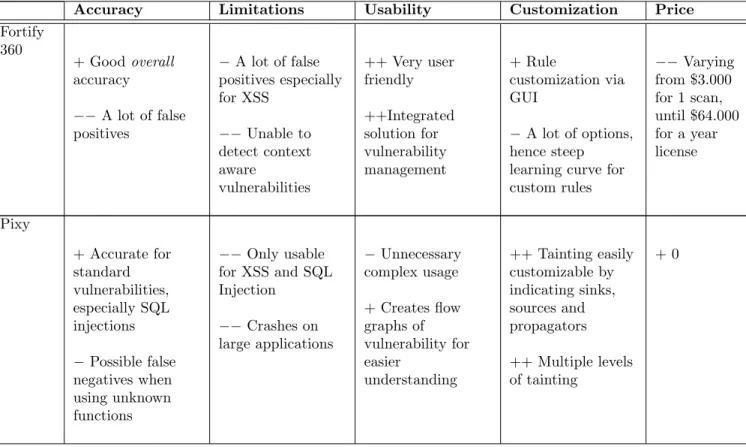
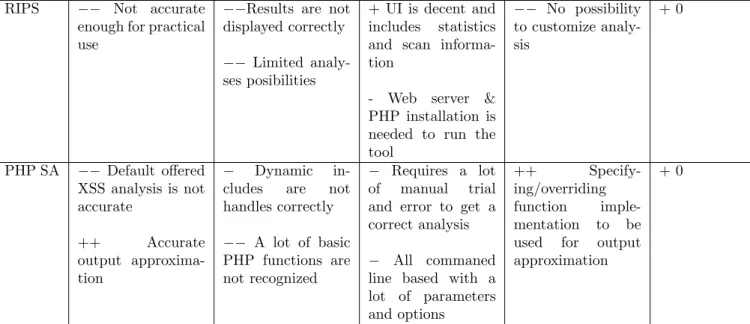
A short overview of the results of the review for the tested tools is given below in tabular form. Each of the aspect which are reviewed are presented as a column in the next table. On each row, a number of positive and negative remarks are given for each tool. Positive remarks are marked with a + while negative ones are marked with a−. Similarly, very good remarks are preceded by a ++ while very bad ones are preceded by a−−. The table below is a short overview of the most notable findings, in the following subsections, the results of each tool are considered in more detail. Moreover, as a separate appendix to this document, the raw results produced by the tools are included.
Table 1: Overview of notable performance findings
Accuracy Limitations Usability Customization Price
Fortify 360 + Goodoverall accuracy −−A lot of false positives −A lot of false positives especially for XSS −−Unable to detect context aware vulnerabilities ++ Very user friendly ++Integrated solution for vulnerability management + Rule customization via GUI −A lot of options, hence steep learning curve for custom rules −−Varying from $3.000 for 1 scan, until $64.000 for a year license Pixy + Accurate for standard vulnerabilities, especially SQL injections −Possible false negatives when using unknown functions −−Only usable for XSS and SQL Injection −−Crashes on large applications −Unnecessary complex usage + Creates flow graphs of vulnerability for easier understanding ++ Tainting easily customizable by indicating sinks, sources and propagators ++ Multiple levels of tainting + 0
RIPS −− Not accurate enough for practical use
−−Results are not displayed correctly −− Limited analy-ses posibilities
+ UI is decent and includes statistics and scan informa-tion
- Web server & PHP installation is needed to run the tool −− No possibility to customize analy-sis + 0 PHP SA −− Default offered XSS analysis is not accurate ++ Accurate output approxima-tion − Dynamic in-cludes are not handles correctly −− A lot of basic PHP functions are not recognized − Requires a lot of manual trial and error to get a correct analysis − All commaned line based with a lot of parameters and options ++ Specify-ing/overriding function imple-mentation to be used for output approximation
+ 0
Regarding the analysis performed by the different tools, below is a table with common problems found in (almost) all the tools. Each cell indicates how the tool performs relative to other tools regarding a common pitfall, which are explained in more detail in subsection 3.4. These problems indicate how the tools perform on unusual input. Note that the table below only gives an overview of the common problems and how these are handled, this table isnot about the general performance.
Table 2: Overview of common issues affecting accuracy Fortify Pixy RIPS PHP SA
Custom validation 0 0 �
![Figure 1: High level overview of static analysis, from [8]](https://thumb-us.123doks.com/thumbv2/123dok_us/1061147.2640991/11.918.152.766.528.826/figure-high-level-overview-static-analysis.webp)