WU International Taxation Research Paper Series No. 2017 - 02
International Taxation and the Role of
Organizational Form Choices for Group
Structures Multinationals
Harald Amberger
Saskia Kohlhase
Editors:
Eva Eberhartinger, Michael Lang, Rupert Sausgruber and Martin Zagler (Vienna University of Economics and Business), and Erich Kirchler (University of Vienna)
International Taxation and the Role of Organizational Form
Choices for Group Structures of Multinationals
Harald Amberger
Vienna University of Economics and Business Department of Finance, Accounting and Statistics
Tax Management Group [email protected]
Saskia Kohlhase* Erasmus University Rotterdam Rotterdam School of Management Department of Accounting and Control
March 2017
We are grateful to the Research Data and Service Centre (RDSC) of the Deutsche Bundesbank for granting access to the MiDi database. We appreciate helpful comments from Dan Collins, Eva Eberhartinger, Ursa Kosi, Adrian Kubata, Kevin Markle, Jon Medrano, Heeijin Ohn, Benjamin Osswald, Jochen Pierk, Thorsten Sellhorn, and Steve Utke, participants at the 6th Conference on Current Research in Taxation in Bonn and seminar participants at the
University of Mannheim, Vienna University of Economics and Business, the Westfälische Wilhelms-Universität Münster, the University of Iowa, and the Erasmus University Rotterdam. Harald Amberger gratefully acknowledges financial support from the Austrian Science Fund (FWF): W 1235-G16.
* Corresponding Author: Saskia Kohlhase (Erasmus University Rotterdam, Rotterdam, The Netherlands, E-Mail: [email protected], Phone: +31/10/4082153).
International Taxation and the Role of Organizational Form
Choices for Group Structures of Multinationals
Abstract
We examine whether, when, and to what extent international taxation affects group structures of multinationals by way of organizational form choices. Analyzing micro-level data on inbound foreign direct investment relations in Germany, we find that multinationals are tax-sensitive when choosing an organizational form for a foreign affiliate. We document that a one standard deviation increase in the tax burden difference between a corporate (i.e. subsidiary) and a non-corporate (i.e. flow-through) organizational form is associated with a 3.57 percentage point higher probability of establishing a flow-through. This effect, which predominantly results from differences in repatriation taxes between organizational forms, is economically meaningful and comparable to the effects of non-tax determinants. In cross-sectional tests, we find that income-shifting opportunities, limited liability, group structure adjustment costs, and host-country experience moderate the tax-sensitivity. Taken together, our findings suggest that international taxation has far-reaching implications for group structures of multinationals.
JEL-Classification: M41, H25, H73, K34
I. INTRODUCTION
In recent years, group structures of multinationals have caught the attention of the general public, policy makers, and academic scholars. Group structures with affiliates in several countries enable multinationals to shift income into tax havens and to exploit loopholes in tax systems.1 Despite the implications of this topic, evidence on how the taxation of cross-border economic activities (i.e. international taxation) shapes group structures is limited to the location of affiliates (Mintz and Weichenrieder 2010, Dyreng, Lindsey, Markle, and Shackelford 2015), internal ownership chains (Lewellen and Robinson 2013), and the decision to maintain separate taxation of affiliates for income-shifting
purposes (Buettner, Riedel, and Runkel 2011).2 Moreover, these studies exclusively examine corporate affiliates as one organizational form multinationals might select for their affiliates. Our study takes a broader perspective in analyzing group structures, as we examine the sensitivity of multinationals to international taxation when choosing an organizational form for a newly established foreign affiliate (i.e. organizational form choices). Thus, we inquire whether, when, and to what extent international taxation affects organizational form choices.
The lack of evidence for the effect of international taxation on the organizational form choices of multinationals is surprising, as organizational forms have been on the tax-policy agenda for several years due to qualification conflicts between tax systems resulting in double taxation or double non-taxation of foreign profit (OECD 1999). Moreover, recent anecdotes suggest that multinationals establish non-corporate affiliates for tax-avoidance purposes (ICIJ 2014).3 Thus, the lack of knowledge regarding the drivers of organizational
1 Recent reports from Dutch regulatory filings suggest that Google saved $3.6 billion in worldwide taxes in the
year 2015 through a group structure known as “Double Irish and a Dutch Sandwich” (Wood 2016). This group structure has reportedly been used by several other multinationals (e.g., Apple). Particularities of tax systems combined with the fundamental freedoms of the European Union enable multinationals to shift taxable income into tax havens (e.g., via tax-deductible royalty payments) diminishing effective tax rates.
2 International taxation summarizes all taxes levied on foreign profit (Huizinga, Laeven, and Nicodème 2008,
Huizinga and Voget 2009, Barrios, Huizinga, Laeven, and Nicodème 2012; see Section 2.1).
3 The group structure of Amazon includes a tax-exempt limited partnership in Luxembourg, which enables
form choices hinders informed tax-policy debates and makes it difficult to assess the relevance of organizational forms for tax avoidance.
In our setting, we analyze an investing entity that is part of a multinational. The investing entity is located in a home country and establishes a new affiliate in a host country (Figure 1).4 The available organizational forms are divided into two categories: (1) a
corporate (i.e. subsidiary) and (2) a non-corporate (i.e. flow-through) form. Each category exhibits distinct characteristics that shape their tax and non-tax costs and benefits.
International taxation determines the tax effects of organizational forms and the tax burden on foreign profit earned in the host country. In case the investing entity establishes the new affiliate as a subsidiary, this organizational form induces a higher tax burden on foreign profit and thus a tax disadvantage. This tax-burden difference results from
dividend-withholding taxes levied on a subsidiary’s dividend distributions in the host country by way of a repatriation tax. A flow-through avoids dividend-withholding taxes but the home country taxes foreign profit when earned. With regard to non-tax cost and benefits, a subsidiary offers limited liability (Gordon and MacKie-Mason 1994, Ayers, Cloyd and Robinson 1996) but induces higher compliance costs due to more extensive regulatory and financial reporting requirements (Demirguc-Kunt, Love, and Maksimovic 2006, Cerutti, Dell’Ariccia, and Martinez Peria 2007).
When establishing a new affiliate in the host country, the investing entity faces a trade-off between tax and non-tax costs and benefits, and selects the organizational form with the best cost-benefit relation (Hodder, McAnally, and Weaver 2003, Scholes, Wolfson, Erickson, Hanlon, Maydew, and Shevlin 2014). This suggests that investing entities are sensitive to the tax disadvantage of a subsidiary in organizational form choices. Thus, we
4 The investing entity is located in either the same country as the ultimate parent of the multinational (direct
investment) or in a different country (indirect investment). Due to missing data on the entire group structure, we limit our analysis to the effects of international taxation on organizational form choices of the investing entity. However, we separately examine direct and indirect investment in Section 5.3.
hypothesize that a larger tax-burden difference between a subsidiary and a flow-through increases the probability of establishing the new affiliate as a flow-through.
Notwithstanding our hypothesis, several arguments suggest that we might not find the expected effect. First, multinationals might mitigate the tax disadvantage of a subsidiary by deferring the repatriation of foreign profit (Foley, Hartzell, Titman, and Twite 2007, Blouin and Krull 2009). This strategy is beneficial if home country corporate income tax rates or dividend-withholding tax rates vary over time (e.g., through tax holidays or new double tax treaties). Second, multinationals might repatriate foreign profit without triggering the effects of international taxation. Common strategies include income shifting (e.g., via tax-deductible payments; see Hines and Rice 1994, Collins and Shackelford 1997, Collins, Kemsley, and Lang 1998, Klassen and Laplante 2012) or treaty shopping where multinationals engage in indirect investment to exploit beneficial double tax treaties (Mintz and Weichenrieder 2010, Dyreng et al. 2015). Third, non-tax aspects (e.g., limited liability) might affect organizational form choices (Demirguc-Kunt et al 2006, Cerutti et al. 2007) and mitigate the tax-sensitivity of investing entities. Based on these arguments, we contend that it is an empirical question whether, when, and to what extent international taxation affects organizational form choices.
To test our hypothesis, we use the Microdatabase Direct Investment (MiDi) of the Deutsche Bundesbank. The MiDi database provides anonymized micro-level data on the stock of in- and outbound foreign direct investment (FDI) relations in Germany and contains information on the organizational form of these investments. Our sample covers inbound FDI relations that result in a new affiliate in Germany between 2005-2013.5 We observe 2,182 organizational form choices of investing entities that are part of multinationals located in 59 home countries. These home countries include major economies (e.g., the United
5 Limiting our analysis to one host country does not affect the generalizability of our results. First, organizational
form choices occur in one regulatory environment mitigating the effect of host country characteristics. Second, although tax systems differ in details, international taxation applies to most country combinations (Huizinga et al. 2008, Huizinga and Voget 2009, Barrios et al. 2012). Third, Germany is a high-tax country and the fourth largest economy (IMF 2016), where economic rather than tax-avoidance motives drive investment.
States, the United Kingdom, and Japan) and account for more than 99 percent of all inbound FDI relations recorded in the MiDi database. Due to variations in tax rates and tax systems across home countries and over time, our setting is unique to identify and estimate the effect of international taxation on organizational form choices of multinationals.
Descriptive statistics indicate that 24.43 percent of the organizational form choices in our sample result in a flow-through. This result underlines the relevance of flow-throughs for group structures of multinationals. Results from our first set of tests suggest that investing entities are tax-sensitive in organizational form choices. The tax burden difference between a subsidiary and a flow-through, which predominantly results from differences in repatriation taxes, has an economically meaningful effect: a one standard deviation increase in the tax disadvantage of a subsidiary is associated with a 3.57 percentage point higher probability of establishing a flow-through. We find comparable effects for non-tax determinants. A one standard deviation increase in the profitability of the new affiliate, for instance, reduces the probability of establishing a flow-through by 5 percentage points.
Our second set of tests examines whether income-shifting opportunities decrease the tax-sensitivity. We find that investing entities are less tax-sensitive if the new affiliate has high internal debt or is established in an industry with high intangible-asset intensity (Hall, Helmers, Rogers, and Sena 2014). These results suggest that repatriation strategies that do not trigger the effects of international taxation (e.g., income shifting) decrease the tax-sensitivity in organizational form choices. Deferring the repatriation of foreign profit, however, does not affect the tax-sensitivity.
The third set of tests exploits cross-sectional variation in the relevance of non-tax aspects associated with organizational form choices. First, we examine new affiliates established in capital-intensive industries raising the benefit of limited liability (Liu 2014). Consistent with this argument, we find that investing entities are less tax-sensitive in these industries. Second, we compare genuine investment (i.e. greenfield investment) with mergers
or acquisitions (i.e. M&A). M&A enables multinationals to adapt a pre-existing group structure to international taxation at low cost (Huizinga and Voget 2009). Thus, we predict and find that investing entities are more tax-sensitive in organizational form choices for M&A. Third, we examine the effect of host-country experience. Since experienced investing entities exhibit knowledge on tax-efficient group structures (Feller and Schanz 2017), we find a higher tax-sensitivity for these investing entities. These results suggest that non-tax aspects, in the form of limited liability, group structure adjustment costs, and host-country experience, moderate the tax-sensitivity of investing entities in organizational form choices.
In our fourth set of tests, we assess the robustness of our results. First, we replace the tax burden difference with the dividend-withholding tax rate and find consistent results. Second, we add the tax burden difference on capital gains from selling the new affiliate. Including this additional tax determinant does not alter our results. Third, we examine the legal origin of the home-country legal system (LaPorta, Lopez-de-Silanes, and Shleifer 2008) and find that institutional similarities between countries do not drive our results. Fourth, we compare new affiliates that belong to a subgroup in Germany with those that do not hold shares in another German affiliate. We find that international taxation affects group structures irrespective of whether the new affiliate belongs to a subgroup or not. Lastly, we modify our sample and show that our results are insensitive to excluding observations from regulated industries or observations with a tax burden difference equal to zero, and to excluding investing entities located in a tax haven (Gravelle 2009).
The final set of tests provides further evidence for the effect of international taxation on organizational form choices of multinationals. First, we subdivide flow-throughs into partnerships and branches. Some types of partnerships induce limited liability but retain a lower tax burden. Thus, we expect and find that investing entities are tax-sensitive when deciding between a subsidiary and a partnership while the benefit of limited liability dominates the choice between a subsidiary and a branch. Second, we examine treaty
shopping as a potential strategy to mitigate the tax disadvantage of a subsidiary. We find that the tax-sensitivity does not differ between direct and indirect investment. Thus, treaty
shopping does not affect our main results.
Our study makes several contributions to the literature. First, our findings increase the understanding of how international taxation shapes group structures of multinationals. International taxation has far-reaching implications for the structure multinationals adopt for their cross-border economic activities as it not only affects the location of affiliates (Mintz and Weichenrieder 2010, Dyreng et al. 2015) but also their organizational forms. This finding is relevant as each organizational form induces distinct tax and non-tax costs and benefits. Moreover, the relevance of flow-throughs indicates that prior studies that examine corporate affiliates seem to have overlooked significant parts of existing group structures.
Second, our results add to research on the effects of taxation on organizational form choices where prior studies have mainly examined stand-alone firms (Gordon and MacKie-Mason 1994, Ayers et al. 1996). We extend these findings by investigating organizational form choices in a cross-border setting.6 In this regard, we identify distinct drivers of cross-sectional variation in the effect of taxation (i.e. income-shifting opportunities, group structure adjustment costs, host-country experience) that differ from domestic settings. Moreover, the relevance of flow-throughs suggests that multinationals might use organizational forms as part of a broader tax-avoidance strategy.
Lastly, our study informs current tax-policy initiatives to curb tax avoidance and income shifting (e.g., OECD Action Plan on Base Erosion and Profit Shifting). These
initiatives aim to ensure profit taxation in the host country and thus increase the relevance of host country taxation and repatriation taxes (e.g., dividend-withholding taxes). Our results suggest that legislation leading to an asymmetric taxation of subsidiaries and flow-throughs
6 Petroni and Shackelford (1995) and Goolsbee (2004) are noteworthy exceptions. Both studies, however, examine
increases the probability that multinationals select a flow-through for cross-border economic activities.
The remainder of this study is organized as follows. Section 2 discusses the
theoretical background and derives our hypotheses. Section 3 describes our sample and the research design. Section 4 presents our main results. Supplementary analyses are presented in Section 5. Section 6 summarizes our main results and concludes.
II. THEORETICAL BACKGROUND AND HYPOTHESIS DEVELOPMENT International Taxation and Tax Effects of Organizational Forms
Figure 1 outlines our setting of an investing entity that selects an organizational form for a new affiliate in Germany, the host country in our study. The investing entity is part of a multinational and is located in the same country as the ultimate parent of the multinational (e.g., the United States: direct investment) or in a different country (e.g., Luxembourg: indirect investment). We define two categories of organizational forms: (1) subsidiaries and (2) flow-throughs.7Subsidiaries are legally independent corporate forms while flow-throughs comprise non-corporate forms (e.g., partnerships, branches, and permanent establishments) that belong to the investing entity. Profit earned in a foreign subsidiary or flow-through is subject to three layers of taxation that shape the tax effects of organizational forms. These three layers are (i) host country corporate income tax, (ii) dividend-withholding tax levied on a subsidiary’s dividend distributions, and (iii) corporate income tax levied in the home country of the investing entity (e.g., Huizinga et al. 2008).
INSERT FIGURE 1 HERE
The first layer of international taxation is the host country corporate income tax ℎ
(Layer 1 in Figure 1). A subsidiary exhibits unlimited tax liability while the investing entity is
7 In supplementary tests, we subdivide flow-throughs into (i) partnerships and (ii) branches. As these sub-groups
exhibit similar tax effects, and to increase the generalizability of our findings, we limit our main analysis to two categories of organizational forms (i.e. subsidiaries and flow-throughs).
subject to limited tax liability in the host country when choosing a flow-through. Nonetheless, the host country taxes profit earned in both organizational forms at ℎ (e.g., Article 7
OECD Model Tax Convention, OECD 2014). For Germany, ℎ equals to 44.38 percent for the first sample years but reduces to 29.83 percent after the year 2007.8
The second layer of international taxation is the dividend-withholding tax levied
on a subsidiary’s dividend distributions in the host country (Layer 2 in Figure 1). This tax is deferred until foreign profit is repatriated to the investing entity (Foley et al. 2007, Blouin and Krull 2009). Thus, has the character of a shareholder-level tax (Scholes et al. 2014,
Utke 2016) and a repatriation tax (Desai, Foley, and Hines 2001). The German tax rate on dividend distributions to non-EU countries and to countries without a double tax treaty was 26.38 percent but was reduced to 15.83 percent after the year 2008. The Parent-Subsidiary Directive abolishes for dividend distributions to EU countries.
The Parent - Subsidiary Directive requires the investing entity to hold at least 10 percent in the shares of a subsidiary
. As we limit our analysis to investing entities that hold at least 25 percent in the shares of a new affiliate (see Section 3.2), in our sample the dividend - withholding tax rate for investing entities located in EU countries equals zero.
9 For home countries that have a double tax treaty with Germany, depends on the treaty and ranges from 5 percent to 15 percent. A flow-through fully avoids the second layer of international taxation.10
The third layer of international taxation is the home country corporate income tax (Layer 3 in Figure 1). To mitigate double taxation, the home country either exempts
ℎ
8 These tax rates include a solidarity surcharge and the local business tax (Gewerbesteuer) administered by German
municipalities. We present average tax rates as municipalities enjoy (limited) leeway in setting tax rates.
9 The Parent-Subsidiary Directive requires the investing entity to hold at least 10 percent in the shares of a
subsidiary. As we limit our analysis to investing entities that hold at least 25 percent in the shares of a new affiliate (see Section 3.2), in our sample the dividend-withholding tax rate for investing entities located in EU countries equals zero.
10 Some countries levy a tax on the profit distributions of a branch to achieve an equal taxation of a subsidiary and
a branch. An example is the 30 percent U.S. Branch Profit Tax levied on distributions of U.S. branches to non-resident shareholders (IRC §884(a)). The tax rate equals and may be reduced through a double tax treaty.
foreign profit from ℎ (territorial tax system) or taxes foreign profit at ℎ while
granting a tax credit for and ℎ (worldwide tax system).
Territorial tax systems differ in the extent to which foreign profit is exempt from . Home countries either fully exempt foreign profit or tax a fraction at . If
ℎ ℎ
, the investing entity is subject to home country corporate income tax notwithstanding
> 0
an existing territorial tax system.11 As a result, for an investing entity located in a home country with a territorial tax system, the tax burden on foreign profit earned in a subsidiary
or a flow-through is given by
,
= ℎ +
(
1‒ ℎ)
∗ +(
1‒ ℎ)
∗ ∗ ℎ.
= ℎ +
(
1‒ ℎ)
∗ ∗ ℎUnder a worldwide tax system, the home country taxes foreign profit earned in a subsidiary when repatriated to the investing entity.12 To mitigate double taxation, the home country grants a direct or indirect tax credit, which is limited to ℎ in both cases.13 If the
home country grants a direct tax credit, is credited and the investing entity is subject to
home county corporate income tax in excess of
(
1‒ ℎ)
∗ . An indirect tax credit additionally includes ℎ , and the investing entity is subject to home country corporateincome tax in excess of ℎ +
(
1‒ ℎ)
∗ . When choosing a flow-through, the home country taxes foreign profit when earned and grants a tax credit for ℎ . Thus, the investingentity is subject to home country corporate income tax in excess of ℎ . As a result, for an
11 Belgium and Italy, for instance, operate a territorial tax system and exempt 95 percent of foreign profit. Thus, 5
percent of foreign profit remains taxable at ℎ .
12 This feature enables multinationals to defer the repatriation of foreign profit and to benefit from variation in
or over time (e.g., through tax holidays or new double tax treaties).
ℎ
13 The United States operate a worldwide tax system with deferral and an indirect tax credit. Similar tax systems
investing entity located in a home country with a worldwide tax system, the tax burden on foreign profit earned in a subsidiary or a flow-through is given by
, (direct tax credit)
= {ℎ +
(
1‒ ℎ)
∗ ; ℎ +(
1‒ ℎ)
∗ ℎ }, (indirect tax credit)
= {ℎ +
(
1‒ ℎ)
∗ ; ℎ }.
= {ℎ ; ℎ }
Some home countries neither exempt foreign profit from ℎ nor grant a tax credit
for and ℎ , which results in double taxation. As a result, for an investing entity located in a home country that does not grant any relief from double taxation, the tax burden on foreign profit earned in a subsidiary or a flow-through is given by
,
= ℎ +
(
1‒ ℎ)
∗ + ℎ.
= ℎ + ℎ
In Table 1, we derive the tax burden difference between a subsidiary and a flow-through for each tax system. In contrast to a flow-flow-through, a subsidiary induces a tax
disadvantage if the investing entity is located in a home country with a territorial tax system or in a home country that does not grant any relief from double taxation. This is due to dividend-withholding taxes, which are not offset by a tax credit in the home country. If the investing entity is located in a home country with a worldwide tax system, the tax
disadvantage depends on host and home country corporate income tax rates and the extent of tax credit.14
INSERT TABLE 1 HERE
14 The tax burden difference might be negative if the investing entity is located in a home country that operates a
worldwide tax system for flow-throughs and a territorial system for subsidiaries. Most home countries in our sample, however, operate a uniform tax system for foreign profit earned in either organizational form.
Hypothesis Development
The standard model to analyze organizational form choices was developed by MacKie-Mason and Gordon (1997) and extended by Goolsbee (1998, 2004). These studies examine the decisions of sole entrepreneurs (i.e. stand-alone firms) to incorporate or not in a domestic setting. While tax and non-tax determinants of organizational form choices of multinationals seem to differ from those documented for stand-alone firms, Luna and Murray (2010) argue that the economic framework and its implications are equally valid in a cross-border setting. Thus, when choosing an organizational form for a new affiliate in the host country, the investing entity faces a trade-off between tax and non-tax costs and benefits and selects the organizational form with the best-cost benefit relation.
With respect to tax costs and benefits of organizational forms, the theoretical analysis above suggests that a subsidiary exhibits a tax disadvantage. This predominantly results from higher repatriation taxes in the form of dividend-withholding taxes.15 Hartman (1985)
theoretically analyzes the economic effects of repatriation taxes and demonstrates that these taxes do not affect the repatriation decision of multinationals. Although assuming a subsidiary in the host country, this result nonetheless questions the decision relevance of differences in repatriation taxes (i.e. the tax disadvantage of a subsidiary) for organizational form choices.16
Hartman (1985), however, relies on the restrictive assumptions that repatriation taxes are unavoidable (e.g., through income shifting; see Altshuler and Grubert 2003) and that tax rates are constant over time. These assumptions are unlikely to hold in practice. Tax holidays or new double tax treaties, for instance, lower home country corporate income tax rates and dividend-withholding tax rates.17 As a result, multinationals face tax-rate uncertainty and the 15 Further tax costs and benefits concern special tax regimes (Elschner 2013), tax loss rules, or tax base effects.
With respect to these aspects, the German tax system does not differentiate between organizational forms.
16 Hines and Rice (1994) and Weichenrieder (1996) extend this finding and show that multinationals may reinvest
foreign profit in risk-free financial assets. This strategy allows a costless deferral of repatriation taxes.
17 During sample years 2005-2013, Germany reduced the dividend-withholding tax rate from 26.38 percent to
15.83 percent and signed and/or renewed ten double tax treaties with Argentina, Azerbaijan, Belarus, Croatia, Georgia, Ghana, Kyrgyzstan, Singapore, Syria, and Tajikistan. Moreover, the Parent-Subsidiary Directive became effective for dividend distributions to Bulgaria, Croatia, and Romania as these countries joined the European
investing entity becomes sensitive to the tax disadvantages of a subsidiary. Several empirical findings support these arguments. Foley et al. (2007) and Graham, Hanlon, and Shevlin (2011) analyze the U.S. tax system and find that repatriation taxes diminish incentives to repatriate foreign profit while increasing (re-)investment in the host country (Hanlon, Lester, and Verdi 2015, Edwards, Kravet, and Wilson 2016). As an increase in the tax disadvantage of a subsidiary raises the tax benefit of a flow-through, we formulate the following hypothesis for the effect of international taxation on organizational form choices:
H1: The tax disadvantage of a subsidiary in comparison to a flow-through is positively associated with the probability of establishing a flow-through.
The theoretical analysis of international taxation suggests that the tax effects of organizational forms arise if multinationals repatriate foreign profit through dividend distributions. Thus, repatriation strategies that do not trigger the effects of international taxation might mitigate the tax-sensitivity in organizational form choices. Income shifting is an example of such a repatriation strategy where multinationals shift foreign profit earned in the host country into low-tax countries or tax havens (Hines and Rice 1994, Collins and Shackelford 1997, Collins et al. 1998, Dyreng and Markle 2016). This behavior avoids the host country corporate income tax and might additionally result in lower
dividend-withholding taxes.18 Common income shifting schemes exploit discretion in setting arm’s-length transfer prices for intermediate inputs (Klassen and Laplante 2012), cost-sharing arrangements (De Simone and Sansing 2016), and tax-deductible payments between affiliates (e.g., interest or royalty payments). By reducing the amount of foreign profit repatriated through dividend distributions, income shifting mitigates the tax disadvantage of a subsidiary and the investing entity is expected to become less sensitive to international taxation. Thus,
Union. Lastly, the double tax treaty with Brazil was terminated raising the dividend withholding tax rate from 15 percent to 26.38 percent.
18 Income shifting induces costs that are either fixed or vary with the amount of income shifted (Huizinga and
Laeven 2008). These costs include initial setup costs (e.g., for foreign affiliates), compliance costs (e.g., for the transfer pricing system), and administrative costs (e.g., coordination or agency costs; Dyreng and Markle 2016).
we formulate the following cross-sectional hypothesis for the effect of income-shifting opportunities on the tax-sensitivity in organizational form choices:
H2: The association between the tax disadvantage of a subsidiary and the probability of establishing a flow-through decreases with income shifting opportunities.
Non-tax costs and benefits of organizational forms mainly result from their legal characteristics and are likely to affect the tax-sensitivity of investing entities. A subsidiary offers limited liability (Gordon and MacKie-Mason 1994, Ayers et al. 1996) and reduces risk by limiting the potential loss of the investing entity to the equity stake in the new affiliate.19 At the same time, a subsidiary induces higher compliance costs due to more extensive regulatory and financial reporting requirements (Demirguc-Kunt et al. 2006) and higher coordination costs due to its legal independence (Goolsbee and Maydew 2002). When
choosing a flow-through, the potential loss of the investing entity is unlimited and includes all obligations of the new affiliate. Compliance costs of a flow-through, however, are lower, as multinationals might enter the host country through licenses granted to a pre-existing affiliate (Cerutti et al. 2007).20
The outlined benefit of limited liability seems particularly valuable in capital-intensive industries (e.g., manufacturing or wholesale) characterized by the high importance of tangible assets. Investment in tangible assets increases the potential loss of the investing entity and raises the benefit of limited liability (Liu 2014). This suggests that an investing entity in a capital-intensive industry attributes more weight to the benefit of limited liability resulting in a lower tax-sensitivity. Thus, we formulate the following cross-sectional hypothesis for the effect of limited liability on the tax-sensitivity in organizational form choices:
19 The capital requirement to establish a subsidiary in Germany as a limited liability company (Gesellschaft mit beschränkter Haftung) equals EUR 25,000. Thus, without additional guarantees (MacKie-Mason and Gordon 1997) the potential loss of the investing entity is limited to this amount.
20 Other non-tax costs and benefits of organizational forms are less relevant for multinationals. Capital market
access, for instance, is a relevant aspect for stand-alone firms (Gordon and MacKie-Mason 1994, Scholes et al. 2014) while multinationals may raise equity or debt capital globally and finance foreign activities through internal capital markets (Desai, Foley, and Hines 2004).
H3a: The association between the tax disadvantage of a subsidiary and the probability of establishing a flow-through decreases with the importance of limited liability.
Aside from limited liability, further non-tax aspects may affect the tax-sensitivity in organizational form choices. For instance, investing entities might select an organizational form for either a newly founded affiliate (i.e. greenfield investment) or an existing firm that is acquired (i.e. M&A). While non-tax decisions (e.g., financing or investment) dominate
organizational form choices for greenfield investment, M&A enables multinationals to adapt a pre-existing group structure to international taxation at low cost (Huizinga and Voget 2009). This suggests that the investing entity attributes more weight to the tax disadvantage of a subsidiary in organizational form choices for M&A resulting in a higher tax-sensitivity. Thus, we formulate the following cross-sectional hypothesis for the effect of group structure
adjustment costs on the tax-sensitivity in organizational form choices:
H3b: The association between the tax disadvantage of a subsidiary and the probability of establishing a flow-through increases in organizational form choices for M&A.
Establishing a new affiliate may also involve a market entry in the host country. In contrast to an initial market entry, multinationals with host-country experience exhibit knowledge of tax-efficient group structures (Feller and Schanz 2017). This suggests that an experienced investing entity attributes more weight to the tax disadvantage of a subsidiary resulting in a higher tax-sensitivity. Thus, we formulate the following cross-sectional hypothesis for the effect of host-country experience on the tax-sensitivity in organizational form choices:
H3c: The association between the tax disadvantage of a subsidiary and the probability of establishing a flow-through increases with host country experience.
III. DATA AND RESEARCH DESIGN MiDi Database and Supplementary Data Sources
As our main data source, we use data on inbound FDI relations provided by the MiDi database of the Deutsche Bundesbank.21 This database includes anonymized micro-level data on the stock of in- and outbound FDI relations in Germany starting in the year 1999. As the German Foreign Trade and Payments Regulation (Außenwirtschaftsverordnung) mandates annual reports on FDI relations, data availability is independent of financial reporting requirements. Penalties and data appraisal techniques ensure high data quality (Lipponer 2011, Schild and Walter 2015) making the MiDi database superior over most commercial data sources.
An inbound FDI relation has to be reported to the Deutsche Bundesbank if an investing entity holds at least 10 percent in the shares or voting rights of a subsidiary or a partnership with a balance sheet total of more than EUR 3 million. A branch and a permanent establishment has to be reported if the business assets amount to EUR 3 million and over (Lipponer 2011, Schild and Walter 2015).
The MiDi database provides detailed information on the affiliate associated with the inbound FDI relation including an identifier for its organizational form. Data on the investing entity and the ultimate parent of a multinational is limited to an identifier for the investing entity, the ultimate parent, and the respective home countries. Thus, we are able to disentangle direct investment from indirect investment (Figure 1). We supplement data from the MiDi database with information on dividend-withholding tax rates, home and host country corporate income tax rates, tax base determinants, and the tax system in the home country. We hand-collect this data from public sources (e.g., Ernst & Young Worldwide Corporate Tax Guides, Ernst & Young 2005-2013).
Sample Selection
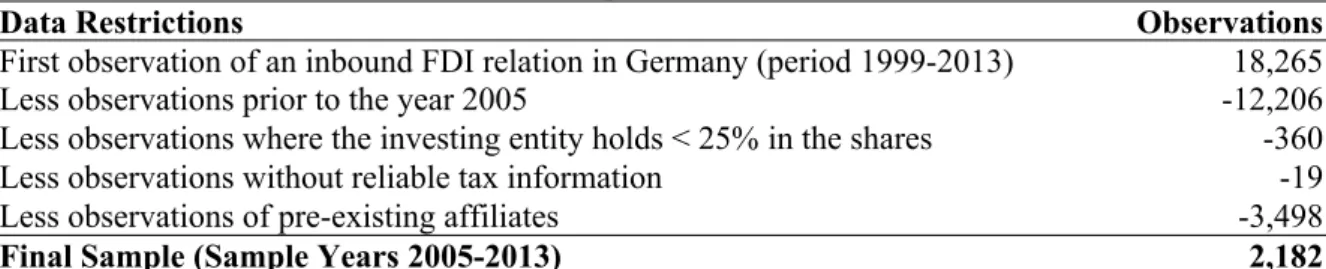
To construct a sample of organizational form choices, we identify the first observation of an inbound FDI relation in Germany for the period 1999-2013 (18,265 observations).22 First, we drop observations prior to the year 2005 as the information to differentiate between new affiliates and pre-existing affiliates is unavailable (12,206 observations). Second, we drop observations where the investing entity holds less than 25 percent of the shares of a new affiliate (360 observations). This threshold ensures that the investing entity is able to
influence the organizational form choice.23 For a new affiliate with multiple investing entities, we keep the observation for the main investor. Third, we delete observations where the
investing entity is located in a home country without tax information (19 observations). Lastly, we drop observations of pre-existing affiliates, as the first observation in the MiDi database results from passing the reporting threshold and does not involve an organizational form choice (3,498 observations). For sample years 2005-2013, these restrictions result in a sample of 2,182 organizational form choices. The new affiliates in our sample are either established through greenfield investment (1,051 observations) or M&A (1,131 observations). Table 2 summarizes the sample selection.
INSERT TABLE 2 HERE
The investing entities facing an organizational form choice in our sample are located in 59 home countries. These countries account for more than 99 percent of all inbound FDI relations recorded in the MiDi database. 45 countries exhibit a double tax treaty with
Germany while 14 countries have sizeable inbound FDI relations without a double tax treaty. For each home-country year, we apply the formulas in Table 1 to compute the tax burden
22 We analyze inbound FDI relations of investing entities because the tax burden difference between a subsidiary
and a flow-through does not exist in a domestic setting. Thus, we disregard observations where the investing entity establishes a subsidiary or a flow-through indirectly through another German affiliate.
23 We derive this threshold from German corporate law. Strategic decisions require the consent of more than 75
percent of the shareholders (Sperrminorität). Thus, an investing entity holding at least 25 percent of the shares of a new affiliate is able to influence strategic decisions (e.g., organizational form choices). Our inferences are unchanged when requiring a threshold of 50, 75 percent, or 100 percent.
(1)
difference between a subsidiary and a flow-through. Differences between home countries and changes over time imply variation in tax rates and tax systems. Thus, we observe variation in the tax burden difference (Table 3) and in dividend-withholding tax rates (Table 4).
INSERT TABLE 3 HERE INSERT TABLE 4 HERE Research Design
To model an organizational form choice and to test our hypotheses, we estimate the following logistic regression model:24
ln ‒
1‒ ‒ = 0+1+∑++ +.
and is the probability that the
‒ =
(0 +1+∑)
1 +(0 +1+∑)
investing entity j establishes the new affiliate i as a flow-through. Unless indicated otherwise, we measure all variables in year t, which is the year of the organizational form choice. The dependent variable FLOW-THROUGH is an indicator variable with the value of one if the new affiliate is established as a flow-through, and zero otherwise (i.e. as a subsidiary).
TAXWEDGE is the tax-burden difference between a subsidiary and a flow-through on foreign profit earned in the host country, and captures the tax disadvantage of a subsidiary. Consistent with H1 and the argument that investing entities are sensitive to international taxation in organizational form choices, a larger tax burden difference raises the tax benefit of a flow-through. Thus, we expect a positive coefficient on .1
Vector X includes variables to control for additional determinants of organizational form choices. First, we include affiliate-level controls. We add LN(EMPLOY) as the logarithm of total employees and LN(ASSETS) as the logarithm of total assets to proxy for size. Large
affiliates increase the potential loss of the investing entity (Liu 2014) which raises the benefit of limited liability induced by a subsidiary. Thus, we expect for both variables a negative effect on FLOW-THROUGH. LOSSYEAR is an indicator variable with the value of one if the new affiliate reports a loss in year t.25 We again expect a negative effect as losses indicate risk, raising the benefit of limited liability (Ayers et al. 1996).
Furthermore, we add LEVERAGE as the debt ratio. Debtholders demand financial statement information (Armstrong, Guay, and Weber 2010), which is more extensive for a subsidiary. Thus, we expect that LEVERAGE reduces the probability of establishing a flow-through. We also include ROA as net profit over total assets to control for profitability but do not make a directional prediction for the effect on FLOW-THROUGH. We include
BROWNFIELD as an indicator variable with the value of one if the new affiliate is established through M&A, and zero otherwise (i.e. greenfield investment). We expect a negative effect for BROWNFIELD, as shares in a subsidiary are more readily transferable than shares in a flow-through making M&A for a subsidiary less costly.
To control for the repatriation of foreign profit, we add DISTRIBUTION as an indicator variable with the value of one if the new affiliate distributes foreign profit in year
t+1. As dividend-withholding taxes are levied on a subsidiary’s dividend distributions making the repatriation of foreign profit more costly for this organizational form (Foley et al. 2007, Blouin and Krull 2009), we expect a positive effect of DISTRIBUTION on
FLOW-THROUGH. We add INTERNDEBT and INTANGIBLES to control for income-shifting
opportunities. INTERNDEBT is the ratio of related-party debt to total assets and
INTANGIBLES an indicator variable with the value of one if the new affiliate is established in an industry with high intangible-asset intensity (e.g., pharmaceuticals or chemicals; Hall et al. 2014). Income shifting via tax-deductible payments enables multinationals to repatriate
25 In untabulated tests, we extend LOSSYEAR to two years and three years of consecutive losses. These tests result
foreign profit without triggering the effects of international taxation. This mitigates the tax disadvantage of a subsidiary and we expect for both variables a negative effect on
FLOW-THROUGH.
Second, we control for characteristics of the investing entity. We add NUMINV as the number of inbound FDI relations of the investing entity in Germany. A high number of inbound FDI relations indicates that risk is spread across several affiliates, reducing the benefit of limited liability in the new affiliate. Thus, we expect a positive effect on FLOW-THROUGH. We include HOLDINGS as the percentage of shares held by the investing entity in the new affiliate to capture cooperation among investing entities. As cooperation requires trust and commitment (e.g., through unlimited liability), the probability of establishing a flow-through is expected to decrease in HOLDINGS. We add DIRECTFDI as an indicator variable with the value of one if the investing entity engages in direct investment, and zero otherwise (i.e. indirect investment). We do not make a directional prediction as multinationals engage in indirect investment to benefit from double tax treaties (Mintz and Weichenrieder 2010,
Wamser 2011) or to exploit regulatory differences between countries (Cerutti et al. 2007). The first strategy requires a subsidiary to obtain tax treaty entitlement, while the second strategy involves a flow-through operating through licenses granted to a pre-existing affiliate.
Third, we control for characteristics of the home country of the investing entity. We add LN(DIST) as the natural logarithm of the distance between the capital city of the home country and Germany to control for coordination costs of the new affiliate. As a flow-through implies lower coordination costs than a subsidiary (Goolsbee and Maydew 2002), we expect a positive effect of LN(DIST) on FLOW-THROUGH. Lastly, we add YEAR and INDUSTRY as fixed effects to capture year shocks and time-invariant industry characteristics that may affect organizational form choices. We estimate heteroscedasticity-robust standard errors clustered at the investing-entity level to account for serial correlation in the data (Petersen 2009).26 26 Our main inferences are unchanged when using alternative clusters (industry, year, home country of the investing
To test our cross-sectional hypotheses, we modify Equation (1) and include interaction variables that partition our sample into subsamples in which theory predicts differences in the tax-sensitivity of investing entities. We explain these tests in more detail below.
IV. RESULTS Descriptive Statistics
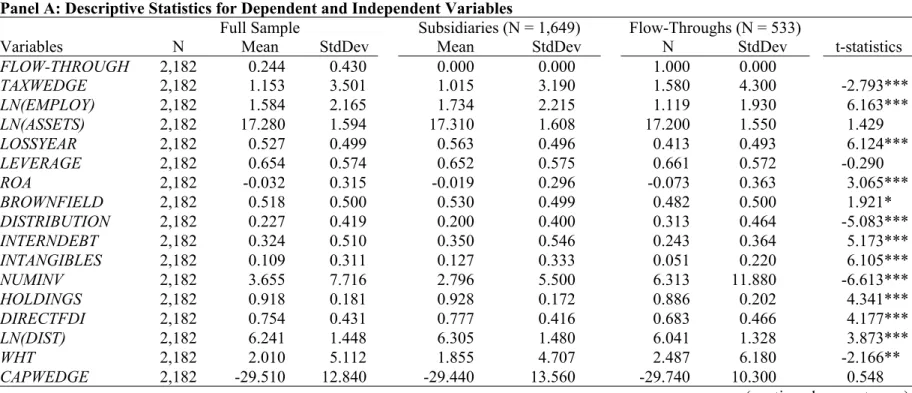
Our sample of organizational form choices includes 1,649 subsidiaries and 533 flow-throughs. Thus, the unconditional probability of establishing a flow-through is 24.43 percent (533/2,182). Table 5, Panel A shows descriptive statistics for the full sample and for
subsamples of subsidiaries and flow-throughs. A t-test indicates that the mean tax burden difference in the flow-through subsample is higher than in the subsidiary subsample (TAXWEDGE, p < 0.01). This result is consistent with H1 and the argument that investing entities are tax-sensitive in organizational form choices.
As we observe more subsidiaries than flow-throughs, further determinants affect organizational form choices. Flow-throughs have fewer employees (LN(EMPLOY), p < 0.01), a lower profitability (ROA, p < 0.01), and a lower ratio of related-party debt to total assets (INTERNDEBT, p < 0.01). In addition, flow-throughs are less likely to report a loss
(LOSSYEAR, p < 0.01) and to be established through M&A (BROWNFIELD, p = 0.06) or in an industry with high intangible-asset intensity (INTANGIBLES, p < 0.01). In contrast, flow-throughs are more likely to distribute foreign profit (DISTRIBUTION, p < 0.01). An investing entity that establishes a flow-through has a higher number of inbound FDI relations
(NUMINV, p < 0.01), holds a lower percentage of shares in the new affiliate (HOLDINGS, p < 0.01), is less likely to engage in direct investment (DIRECTFDI, p < 0.01), and is located in a less distant home country (LN(DIST), p < 0.01). Total assets (LN(ASSETS), p = 0.15) and the debt ratio (LEVERAGE, p = 0.77), however, do not differ between subsamples.
Panel B presents organizational form choices per sample year. The number of new affiliates increases in sample years 2005-2007 and after the year 2010. We observe a lower number of new affiliates for sample years 2008-2010, which is likely due to the global financial crisis. The proportion of throughs varies over time with the relevance of flow-throughs increasing in sample years 2007-2009 and again after the year 2010.
Panel C presents organizational form choices per industry.27 We observe the highest number of new affiliates in the financial services industry, and the lowest in the transportation industry. The number of flow-throughs is highest in the energy supply and construction industries, and lowest in the wholesale and manufacturing industries. These differences suggest that industry-level determinants affect organizational form choices.
Panel D presents organizational form choices per home country of the investing entity.28 We observe the highest number of new affiliates for investing entities located in neighboring countries (Luxembourg, the Netherlands) and major economies (the United States, the United Kingdom). Consistent with variation in the tax burden difference, the relevance of each organizational form varies across home countries.
INSERT TABLE 5 HERE
Table 6 presents Pearson correlation coefficients for univariate correlations between dependent and independent variables. TAXWEDGE exhibits a positive correlation with
FLOW-THROUGH (p < 0.01), which is in line with H1. Correlations between the remaining independent variables and FLOW-THROUGH are largely consistent with our expectations. As most variables are correlated, we draw our inferences from multivariate tests below.
INSERT TABLE 6 HERE
27 We aggregate observations based on one-digit NACE Rev. 2 codes to ensure a meaningful analysis.
28 We present home countries with at least three observations per organizational form that result from three distinct
investing entities. Our sample includes another 32 home countries that do not fulfill this confidentiality requirement.
Baseline Regression Results: Tax-Sensitivity in Organizational Form Choices
We begin by testing H1, which predicts that the probability of establishing a flow-through increases with the tax disadvantage of a subsidiary. Table 7 presents regression results based on Equation (1).29 In column 1, the coefficient on TAXWEDGE is positive and significant (p < 0.01), which indicates that the probability of establishing a flow-through increases in the tax burden difference between a subsidiary and a flow-through. In column 3, including control variables in the regression leads to similar inferences.30
Results for further determinants are generally consistent with our expectations. The probability of establishing a flow-through decreases if the new affiliate reports a loss
(LOSSYEAR, p < 0.01). Moreover, the probability decreases with the profitability of the new affiliate (ROA, p = 0.05) and with the percentage of shares held by the investing entity (HOLDINGS, p < 0.01). Flow-throughs are less likely to be established in case of M&A (BROWNFIELD, p < 0.01), in case of industries with high intangible-asset intensity (INTANGIBLES, p < 0.01), and in case the investing entity engages in direct investment (DIRECTFDI, p < 0.01). In contrast, the probability of establishing a flow-through is positively associated with the repatriation of foreign profit (DISTRIBUTION, p = 0.02) and the number of inbound FDI relations (NUMINV, p = 0.08). In column 5, excluding
TAXWEDGE does not alter our results.
In columns 2, 4, and 6, we report marginal effects to assess the economic significance of our results. A one standard deviation increase in TAXWEDGE is associated with a 3.57 percentage point higher probability of establishing a flow-through (column 4). As the
unconditional probability of establishing a flow-through is 24.43 percent, this effect suggests a 14.55 percent (3.57 percent/24.43 percent) increase in the proportion of flow-throughs. In
29 To facilitate a meaningful comparison of variables, we standardize independent variables to have a mean of zero
and a standard deviation of one prior to estimating regressions.
30 The area under the receiver operating characteristic curve (ROC curve) suggests that our regressions exhibit
acceptable predictive power (Hosmer, Lemeshow, and Sturdivant 2013). The regression in column 3, for instance, correctly predicts the organizational form for 78 percent of our observations.
comparison, a one standard deviation increase in ROA is associated with a 5 percentage point lower probability of establishing a flow-through. Thus, the economic effect of TAXWEDGE
on FLOW-THROUGH is comparable to the effect of non-tax determinants. As corroborating evidence, we conduct a likelihood ratio test which suggests that adding TAXWEDGE as an explanatory variable increases the model fit of our regressions (χ² = 14.65, p < 0.01). Overall,
these results support H1: The tax disadvantage of a subsidiary in comparison to a flow-through affects group structures of multinationals by way of organizational form choices.
INSERT TABLE 7 HERE
Cross-Sectional Regression Results: Income-Shifting Opportunities and Tax-Sensitivity H2 predicts that income-shifting opportunities decrease the tax-sensitivity of investing entities. To test this, we modify Equation (1) and present results in Table 8. First, we interact
TAXWEDGE with HIGH_INTDEBT, which is an indicator variable with the value of one if the ratio of related-party debt provided by foreign affiliates to total assets of the new affiliate is above the sample median. Income shifting, for instance via interest payments, enables multinationals to repatriate foreign profit without triggering the effects of international taxation. Thus, we expect and find a lower tax-sensitivity for new affiliates with high related-party debt indicated by a negative and significant coefficient on
TAXWEDGE#HIGH_INTDEBT (column 1, p < 0.01).31 An F-test suggests that the effect of
TAXWEDGE on FLOW-THROUGH for new affiliates with high related-party debt (β1+β3) is
indistinguishable from zero (p = 0.79).
Second, we interact TAXWEDGE with INTANGIBLES to proxy for royalty payments on intangible assets. Consistent with the previous test, we expect and find a lower tax-sensitivity for new affiliates established in an industry with high intangible-asset intensity 31 In untabulated tests, we define HIGH_INTDEBT based on total related-party debt including debt provided by
domestic affiliates in Germany. As total related-party debt is a less direct proxy for income-shifting opportunities than related-party debt provided by foreign affiliates, the coefficient on TAXWEDGE#HIGH_INTDEBT is negative but only marginally significant (p = 0.10). The effect of TAXWEDGE on FLOW-THROUGH for new affiliates with a high ratio of total related-party debt to total assets (β1+β3) is different from zero (p = 0.07).
indicated by a negative and significant coefficient on TAXWEDGE#INTANGIBLES
(column 3, p = 0.09). An F-test suggests that the effect of TAXWEDGE on
FLOW-THROUGH for new affiliates established in an industry with high intangible-asset intensity
(β1+β5) is indistinguishable from zero (p = 0.39). Taken together, these results support H2:
Repatriation strategies that do not trigger the effects of international taxation (e.g., income shifting) eliminate the tax-sensitivity of investing entities in organizational form choices.
We further examine whether the immediate repatriation of foreign profit affects the tax-sensitivity of investing entities. As deferring the repatriation of foreign profit reduces the tax disadvantage of a subsidiary, the tax-sensitivity might depend on whether investing entities anticipate the timing of profit repatriation in organizational form choices. To provide a formal test, we interact TAXWEDGE with DISTRIBUTION. In column 5, the coefficient on
TAXWEDGE#DISTRIBUTION is insignificant (p = 0.18).32 This result suggests that investing entities are sensitive to the tax disadvantage of a subsidiary independent of whether or not the repatriation of foreign profit is deferred.
INSERT TABLE 8 HERE
Cross-Sectional Regression Results: Non-Tax Aspects and Tax-Sensitivity
H3a, H3b, and H3c predict that variation in the relevance of non-tax aspects associated with organizational form choices moderates the tax-sensitivity. To test these hypotheses, we modify Equation (1) and interact TAXWEDGE with indicator variables for non-tax aspects. We present results in Table 9. First, we examine the benefit of limited liability and interact
TAXWEDGE with MANU_WHS, which is an indicator variable with the value of one if the new affiliate is established in the manufacturing or wholesale industry. As the importance of tangible assets increases the benefit of limited liability in these industries, we expect and find a lower tax-sensitivity for new affiliates established in the manufacturing or wholesale
32 An F-test suggests that the effect of TAXWEDGE on FLOW-THROUGH for new affiliates that distribute foreign
industry, indicated by a negative and significant coefficient on TAXWEDGE#MANU_WHS
(column 1, p = 0.09).33 An F-test suggests that the effect of TAXWEDGE on
FLOW-THROUGH for new affiliates in these industries (β1+β3) is indistinguishable from zero
(p = 0.24). These results support H3a: The benefit of limited liability eliminates the tax-sensitivity of investing entities in capital-intensive industries.
Second, we examine group structure adjustment costs and interact TAXWEDGE with
BROWNFIELD, which is an indicator variable with the value of one if the new affiliate is established through M&A. M&A enables multinationals to adapt a pre-existing group structure to international taxation at low cost. Thus, we expect and find a higher tax-sensitivity in organizational form choices for M&A, indicated by a positive and significant coefficient on TAXWEDGE#BROWNFIELD (column 3, p = 0.06). These results support H3b: Low group-structure adjustment costs increase the tax-sensitivity of investing entities in organizational form choices for M&A.34 The insignificant coefficient on TAXWEDGE (p = 0.17) suggests that non-tax decisions (e.g., financing or investment) dominate organizational form choices for greenfield investment.
Third, we examine host-country experience and interact TAXWEDGE with MSUBS,
which is an indicator variable with the value of one if the investing entity has at least one additional inbound FDI relation in Germany. An experienced investing entity has knowledge of tax-efficient group structures. Thus, we expect and find a higher tax-sensitivity for
experienced investing entities, indicated by a positive and significant coefficient on
TAXWEDGE#MSUBS (column 5, p = 0.03).35 These results support H3c: Host-country experience increases the tax-sensitivity of investing entities. The insignificant coefficient on
33 We drop observations from regulated industries (energy supply, financial services, information and
communication) due to distinct non-tax benefits of organizational forms in these industries (Demirguc-Kunt et al. 2006, Cerutti et al. 2007).
34 An F-test suggests that the effect of TAXWEDGE on FLOW-THROUGH in organizational form choices for
M&A (β1+β5) is larger than zero (p < 0.01).
35 An F-test suggests that the effect of TAXWEDGE on FLOW-THROUGH for experienced investing entities
TAXWEDGE (p = 0.10) suggests that non-tax aspects dominate organizational form choices of inexperienced investing entities.
INSERT TABLE 9 HERE
The above tests suggest that non-tax decisions dominate organizational form choices for greenfield investment, while the tax-sensitivity of investing entities increases with host-country experience. To further examine these effects, we form subsamples for greenfield investment and M&A and re-estimate the previous regression for each subsample. We present the results in Table 10. In column 1, the coefficient on TAXWEDGE#MSUBS is positive and significant for greenfield investment (p = 0.01). An F-test suggests that the effect of
TAXWEDGE on FLOW-THROUGH for experienced investing entities (β1+β3) is close to
significance (p = 0.10). In column 3, the coefficient on TAXWEDGE#MSUBS is insignificant for M&A (p = 0.19).36 These results suggest that host-country experience increases the tax-sensitivity in organizational form choices for greenfield investment while investing entities are tax-sensitive in organizational form choices for M&A independent of host-country experience.
INSERT TABLE 10 HERE
V. ROBUSTNESS TESTS AND SUPPLEMENTARY ANALYSIS Robustness Tests
We conduct several tests to assess the robustness of our results. First, we include additional tax variables and home-country controls. In Table 11, column 1 we replace
TAXWEDGE with WHT, which is the dividend-withholding tax rate levied on a subsidiary’s dividend distributions and simultaneously the main driver of the tax burden difference. In line with our main results, the coefficient on WHT is positive and significant (p < 0.01). Moreover, the economic effect of WHT in column 2 is similar to the effect of TAXWEDGE in our main 36 An F-test suggests that the effect of TAXWEDGE on FLOW-THROUGH for experienced investing entities
tests (Table 7, column 4). In column 3, we add CAPWEDGE, which is the tax burden difference between a subsidiary and a flow-through on capital gains from selling the new affiliate. The coefficient on CAPWEDGE is insignificant (p = 0.38), while the coefficient on
TAXWEDGE remains positive and significant (p < 0.01). Thus, international capital gains taxation is not a tax determinant for organizational form choices.37 In column 5, we control for the legal origin of the home-country legal system to rule out that institutional similarities between countries induce non-tax preferences for organizational forms (LaPorta et al. 2008). The coefficient on TAXWEDGE remains positive and significant (p < 0.01). Thus, home-country legal systems do not affect our results.38
INSERT TABLE 11 HERE
Second, we modify our sample and present results in Table 12. In column 1, we interact TAXWEDGE with STANDALONE, which is an indicator variable with the value of one if the new affiliate does not hold shares in another German affiliate. The coefficient on
TAXWEDGE is positive and significant (p < 0.01), while the coefficient on
TAXWEDGE#STANDALONE is insignificant (p = 0.65). This indicates that international taxation affects group structures of multinationals irrespective of whether the new affiliate belongs to a subgroup in the host country or not. In column 3, we drop regulated industries due to the distinct non-tax benefits of organizational forms in these industries (Demirguc-Kunt et al. 2006, Cerutti et al. 2007). Our results are unchanged. In column 5, we drop
observations with a tax burden difference equal to zero.39 Although reducing our sample size, we still find a positive and significant coefficient on TAXWEDGE (p = 0.06). To address the concern that our results are driven by observations from tax havens and do not generalize to other settings, we drop organizational form choices if the investing entity is located in a tax 37 This result is consistent with the argument that the investing entity engages in the host country with a long-term
perspective (i.e. going concern).
38 In untabulated tests, we control for the legal origin of the home-country legal system of the ultimate parent. Our
main inferences are unchanged.
39 This mainly concerns observations from the European Union where the Parent-Subsidiary-Directive eliminates
haven according to Gravelle (2009).40 In column 7, the coefficient on TAXWEDGE is positive and significant (p < 0.01). Thus, observations from tax havens do not affect our results.
INSERT TABLE 12 HERE
Third, we alter our regression model and re-estimate Equation (1). In untabulated tests, we exclude industry and year-fixed effects to address econometric concerns raised by Greene (2004). In addition, we replace the logistic regression with a probit regression and a linear probability model. We continue to find positive and significant coefficients on TAXWEDGE. Taken together, these robustness tests corroborate our main results.
Heterogeneity in Flow-Throughs and Tax-Sensitivity
Thus far, we have treated flow-throughs as a uniform category of organizational forms. The MiDi database enables us to subdivide flow-throughs into partnerships and branches, which differ in the degree of liability.41 Some types of partnerships induce limited liability for the investing entity while retaining tax and non-tax benefits of a flow-through (e.g., lower tax burden, less extensive financial reporting requirements).42 Branches, in contrast, necessarily induce unlimited liability. Thus, the benefit of limited liability might be less relevant when choosing between a subsidiary and a partnership as an organizational form for the new affiliate but gains relevance when choosing between a subsidiary and a branch.
To test this, we modify Equation (1) and present results in Table 13. We estimate a multinomial logistic regression with PARTNERSHIP-BRANCH as a dependent variable. This categorical variable has the value of zero if the new affiliate is established as a subsidiary, one if established as a partnership, and two if established as a branch.43 The regression includes 40 From the home countries in Table 3, we drop observations of investing entities located in the British Virgin
Islands, Cyprus, Jersey, Liechtenstein, Luxembourg, Mauritius, and Switzerland (see Gravelle 2009).
41 The sub-category of branches also includes permanent establishments. We do not subdivide subsidiaries into (i)
public limited company (Aktiengesellschaft) and (ii) private limited company (Gesellschaft mit beschränkter Haftung) as these sub-categories do not differ in the degree of liability.
42 Partnerships induce limited liability if established in the legal forms of a Gesellschaft mit beschränkter Haftung & Compagnie Kommanditgesellschaft (GmbH&Co KG) or a Aktiengesellschaft & Compagnie Kommanditgesellschaft (AG&Co KG). These legal forms are comparable to a U.S. Limited Liability Company
(LLC). Due to missing data, we are unable to identify the precise legal form of the new affiliate and to further subdivide partnerships.
subsidiaries and partnerships in column 1 and subsidiaries and branches in column 2. In line with our expectation, the coefficient on TAXWEDGE is positive and significant in column 1 (p < 0.01) but insignificant in column 2 (p = 0.84). This asymmetric effect suggests that investing entities are tax-sensitive when deciding between a subsidiary and a partnership, while the benefit of limited liability dominates the choice between a subsidiary and a branch. Treaty Shopping and Tax-Sensitivity
Our main tests suggest that the tax disadvantage of a subsidiary affects organizational form choices of investing entities. One strategy to mitigate the tax disadvantage of a
subsidiary is treaty shopping, whereby multinationals engage in indirect investment and strategically locate an affiliate in a third country to benefit from double tax treaties (Mintz and Weichenrieder 2010, Dyreng et al. 2015). Thus, indirect investment driven by treaty shopping might reduce the tax-sensitivity of investing entities in organizational form choices.44
To examine whether treaty shopping decreases the tax-sensitivity, we interact
TAXWEDGE with DIRECTFDI, which is an indicator variable with the value of one if the investing entity engages in direct investment. We present results in Table 13. In column 3, we find a positive and significant coefficient on TAXWEDGE (p = 0.02), while the coefficient on
TAXWEDGE#DIRECTFDI is insignificant (p = 0.22).45 These results provide no evidence that treaty shopping affects the tax-sensitivity of investing entities.
INSERT TABLE 13 HERE VI. CONCLUSIONS
In this study we examine whether, when, and to what extent international taxation affects the organizational form multinationals choose for a newly established foreign affiliate.
43 The 533 flow-throughs in our sample include 469 partnerships and 64 branches.
44 At the same time, indirect investment might be driven by non-tax aspects, for instance to exploit regulatory
differences across countries (Cerutti et al. 2007).
45 An F-test suggests that the effect of TAXWEDGE on FLOW-THROUGH for direct investment (β1+β3) is larger