An Efficient Clustering Algorithm for Market Basket Data Based on Small Large
Ratios
Ching-Huang Yun and Kun-Ta Chuang and Ming-Syan Chen
Department of Electrical Engineering
National Taiwan University
Taipei, Taiwan, ROC
E-mail: [email protected], [email protected], [email protected]
Abstract
In this paper, we devise an efficient algorithm for cluster-ing market-basket data items. In view of the nature of clus-tering market basket data, we devise in this paper a novel measurement, called the small-large (abbreviated as SL) ra-tio, and utilize this ratio to perform the clustering. With this
SL ratio measurement, we develop an efficient clustering
algorithm for data items to minimize the SL ratio in each group. The proposed algorithm not only incurs an execution time that is significantly smaller than that by prior work but also leads to the clustering results of very good quality.
Keywords —Data mining, clustering analysis, market-basket data, small-large ratios.
1 Introduction
Mining of databases has attracted a growing amount of attention in database communities due to its wide applica-bility to improving marketing strategies [3][4]. Among oth-ers, data clustering is an important technique for exploratory data analysis [5][6]. In essence, clustering is meant to di-vide a set of data items into some proper groups in such a way that items in the same group are as similar to one another as possible. Market-basket data analysis has been well addressed in mining association rules for discovering the set of large items. Large items refer to frequently pur-chased items among all transactions and a transaction is rep-resented by a set of items purchased [2]. Different from the traditional data, the features of market basket data are known to be high dimensionality, sparsity, and with mas-sive outliers [7]. The authors in [8] proposed an algorithm for clustering market-basket data by utilizing the concept of large items to divide the transactions into clusters such that similar transactions are in the same cluster and dissimilar
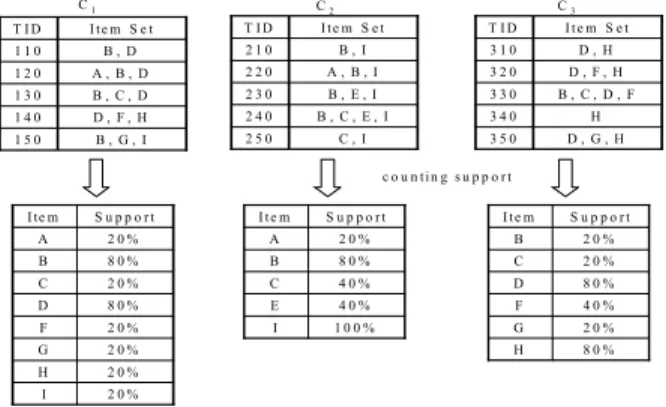
1 5 0 1 4 0 1 3 0 1 2 0 1 1 0 T I D D , F , H B , G , I B , C , D A , B , D B , D I t e m S e t C1 C2 C3 2 0 % F 2 0 % G 2 0 % H 8 0 % D 2 0 % I 2 0 % 8 0 % 2 0 % S u p p o r t C B A I te m 4 0 % E 1 0 0 % I 4 0 % 8 0 % 2 0 % S u p p o r t C B A I t e m 4 0 % F 2 0 % G 8 0 % H 8 0 % 2 0 % 2 0 % S u p p o r t D C B I t e m c o u n t i n g s u p p o r t 2 5 0 2 4 0 2 3 0 2 2 0 2 1 0 T I D B , C , E , I C , I B , E , I A , B , I B , I I t e m S e t 3 5 0 3 4 0 3 3 0 3 2 0 3 1 0 T I D H D , G , H B , C , D , F D , F , H D , H I t e m S e t
Figure 1. An example database for clustering market-basket data.
transactions are in different clusters. This algorithm in [8] will be referred to as algorithm Basic in this paper, and will be used for comparison purposes. An example database for clustering market-basket data is shown in Figure 1.
In view of the nature of clustering market basket data, we devise in this paper a novel measurement, called the small-large (abbreviated as SL) ratio, and utilize this ratio to per-form the clustering. Thesupportof an itemiin a clusterC, SupC(i), is defined as the percentage of transactions which
contain this itemiin clusterC. For the clusteringU0shown
in Figure 1, the supportSupC1(A)is 20% andSupC1(B)
is 80%. An item in a cluster is called a large item if the sup-port of that item exceeds a pre-specifiedminimum support S(i.e., an item that appeared in a sufficient number of trans-actions). On the other hand, an item in a group is called a small item if the support of that item is less than a pre-specifiedmaximum ceiling E(i.e., an item that appeared in a limited number of transactions). To model the relation-ship between minimum supportSand maximum ceiling E, the damping factorλis defined as the ratio of E to S, i.e.,
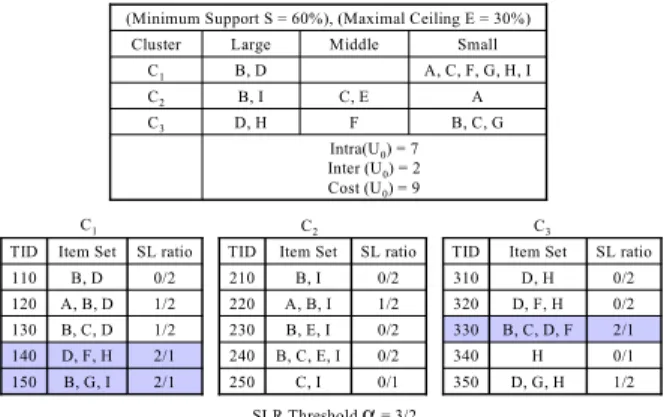
(Minimum Support S = 60%), (Maximal Ceiling E = 30%) B, C, G F D, H C3 C, E Middle Intra(U0) = 7 Inter (U0) = 2 Cost (U0) = 9 A A, C, F, G, H, I Small B, I C2 B, D C1 Cluster Large B, G, I D, F, H B, C, D A, B, D B, D Item Set 2/1 2/1 1/2 1/2 0/2 SL ratio 150 140 130 120 110 TID C1 C2 C3 C, I B, C, E, I B, E, I A, B, I B, I Item Set 0/1 0/2 0/2 1/2 0/2 SL ratio 250 240 230 220 210 TID D, G, H H B, C, D, F D, F, H D, H Item Set 1/2 0/1 2/1 0/2 0/2 SL ratio 350 340 330 320 310 TID SLR Threshold α = 3/2
Figure 2. The large, middle, and small items in clusters, and the corresponding SL ratios of transactions.
λ = E
S. In addition, an item is called a middle item if
it is neither large nor small. For the supports of the items shown in Figure 1, if S = 60% and E = 30%, we can obtain the large, middle, and small items shown in Figure 2. In C2={210,220,230,240,250}, B and I are large items. In
addition, C and E are middle items and A is a small item. Clearly, the portions of large and small items represent the quality of the clustering. Explicitly, the ratio of the num-ber of small items to that of large items in a group is called small-large ratio of that group. Clearly, the smaller the SL ratio, the more similar the items in that group are. With this SL ratio measurement, we develop an efficient clustering al-gorithm, algorithm SLR (standing for Small-Large Ratio), for data items to minimize the SL ratio in each group. It is shown by our experimental results that by utilizing the SL ratio, the proposed algorithm is able to cluster the data items very efficiently.
This paper is organized as follows. Preliminaries are given in Section2. In Section3, an algorithm, referred to as
algorithm SLR (Small-Large Ratio), is devised for cluster-ing market-basket data. Experimental studies are conducted in Section4. This paper concludes with Section5.
2 Preliminaries
We investigate the problem of clustering market-basket data, where the market-basket data is represented by a set of transactions. A database of transactions is denoted by D = {t1, t2, ..., th}, where each transaction ti is a
set of items {i1, i2, ..., ih}. For the example shown in
Figure 1, we are given a predetermined clusteringU0 =<
C1, C2, C3 >, where C1 = {110,120,130,140,150},
C2 = {210,220,230,240,250}, and C3 = {310,320,330,340,350}.
2.1 Large Items and Small Items
The concept of large items isfirst introduced in mining association rules [2]. In [8], using large items as similar-ity measure of a cluster is utilized in clustering transac-tions. Specifically, large items in clusterCj are the items
frequently purchased by the customers in cluster Cj. In
other words, large items are popular items in a cluster and thus contribute to similarity in a cluster. While rendering the clustering offine quality, it is noted that the execution efficiency of the algorithm in [8] could be further improved due to its relatively inefficient steps in the refinement phase. This could be partly due to the reason that the similarity measurement used in [8] does not take into consideration the existence of small items. To remedy this, a maximal ceilingEis proposed in this paper for identifying the items of rare occurrences. If an item whose support is below a specified maximal ceilingE, that item is called a small item. Hence, small items in a cluster contribute to dissimi-larity in a cluster. In this paper, the simidissimi-larity measurement of transactions is derived from the ratio of the number of large items to that of small items. In the example shown in Figure 1, with the minimum supportS= 60% and the max-imum ceiling E = 30%, we can obtain the large, middle, and small items by counting their supports. InC1, item B
is large because its support value is 80% (appearing in TID 110, 120,130, and 150) which exceeds the minimum sup-portS. However, item A is small inC1because its support
is 20% which is less than the maximum ceiling E.
2.2 Cost Function
We useLaI(Cj, S)to denote the set of large items with
respect to attribute I in Cj, and SmI(Cj, E) to denote
the set of small items with respect to attribute I in Cj.
For a clusteringU ={C1, ..., Ck}, the corresponding cost
for attribute I has two components: the intra-cluster cost IntraI(U)and the inter-cluster costInterI(U), which are
described in detail below.
Intra-Cluster Cost:The intra-cluster item cost is meant to represent for intra-cluster item-dissimilarity and is mea-sured by the total number of small items, where a small item is an item whose support is less than the maximal ceilingE. Explicitly, we have
IntraI(U) =|∪kj=1SmI(Cj, E)|.
Note that we did not useΣk
j=1|SmI(Cj, E)|as the
intra-cluster cost since the use ofΣk
j=1|SmI(Cj, E)|may cause
the algorithm to tend to put all records into a single or few clusters even though they are not similar. For exam-ple, suppose that there are two clusters that are not sim-ilar but share some small items. If large items remain
large after the merging, merging these two clusters will reduceΣk
j=1|SmI(Cj, E)|because each small item
previ-ously counted twice is now counted only once. However, this merging is incorrect because sharing of small items should not be considered as similarity. For the clustering U0 shown in Figure 2, the small items ofC1are{A, C, F,
G, H, I}. In addition, the small item ofC2is{A}and the
small items ofC3are{B, C, G}. Thus, the intra-cluster cost
IntraI(U0)is 7.
Inter-Cluster Cost:The inter-cluster item cost is to rep-resent inter-cluster item-similarity and is measured by the duplication of large items in different clusters, where a large item is an item whose support exceeds the minimum support S. Explicitly, we have
InterI(U) =Σkj=1|LaI(Cj, S)|−|∪kj=1LaI(Cj, S)|.
Note that this measurement will inhibit the generation of similar clusters. For the clusteringU0 shown in Figure 2,
the large items of C1 are {B, D}. In addition, the large
items ofC2are{B, I}and the large items ofC3are{D, H}.
As a result,Σk
j=1|LaI(Cj, S)|= 6 and|∪kj=1LaI(Cj, S)|
= 4. Hence, the inter-cluster costInterI(U0)= 2.
Total Cost:Both the intra-cluster item-dissimilarity cost and the inter-cluster item-similarity cost should be consid-ered as the total cost incurred. Without loss of generality, a weightwis specified for the relative importance of these two terms. The definition of item costCostI(U0)with
re-spect to attributeIis:
CostI(U0) =w∗IntraI(U0) +InterI(U0).
If the weightw > 1,IntraI(U0)is more important than
InterI(U0), and vice versa. In our model, we let w =
1. Thus, for the clustering U0 shown in Figure 2, the
CostI(U0)is7 + 2 = 9.
2.3 Objective of Clustering Market-Basket Data
The objective of clustering market-basket data is“We are given a database of transactions, a minimum support, and a maximum ceiling. Then, we would like to determine a
clustering U such that the total cost is minimized”. The
procedure of clustering algorithm we shall present includes two phases, namely, the allocation phase and the refinement phase. In the allocation phase, the database is scanned once and each transaction is allocated to a cluster based on the purpose of minimizing the cost. The method of allocation phase is straightforward and the approach taken in [8] will suffice. In the refinement phase, each transaction will be evaluated for its status to minimize the total cost. Explicitly, a transaction is moved from one cluster to another cluster if that movement will reduce the total cost of clustering. The refinement phase repeats until no further movement is
required. The goal of this paper focuses on designing an efficient algorithm for the refinement phase.
3 Algorithm SLR for Clustering
Market-Basket Data
In this section, we devise algorithm SLR (Small-Large Ratio) which essentially utilizes the measurement of the
small-large ratio (SL ratio) for clustering market-basket
data. For a transactiont with one attributeI,|LI(t)|
rep-resents the number of the large items intand|SI(t)|
repre-sents the number of the small items int. The SL ratio oft with attributeIin clusterCiis defined as:
SLRI(Ci, t) = |
SI(t)|
|LI(t)|
.
For the clustering shown in Figure 1, C1 = {110,120,130,140,150}, C2 =
{210,220,230,240,250}, and C3 =
{310,320,330,340,350}. Figure 2 shows that the minimum support S = 60% and the maximal ceiling E = 30%. For TID 120, we have two large items {B, D} and one small item {A}. Thus, the SL ratio of TID 120 isSLRItem(C1,120) = 12 = 0.5. Similarly, the SL ratio
of TID 240 isSLRItem(C2,240) = 22 = 1, because TID
240 has 2 large items{B, I}and 2 small items{C, E}. As mentioned before, although algorithm Basic utilizes the large items for similarity measurement, algorithm Basic is exhaustive in the decision procedure of moving a transac-tiontto clusterCjin current clusteringU ={C1, ..., Ck}.
For each transaction t, algorithm Basic must compute all costs of new clusterings whentis put into another cluster. In contrast, by utilizing the concept of small-large ratios, algorithm SLR can efficiently determine the next cluster for each transaction in an iteration, where an iteration is a refinement procedure from one clustering to the next clustering.
3.1 Description of Algorithm SLR
Figure 3 shows the main program of algorithm SLR, which includes two phases: the allocation phase and the
re-finement phase. Similarly to algorithm Basic [8], in the al-location phase, each transactiontis read in sequence. Each transactiontcan be assigned to an existing cluster or a new cluster will be created to accommodatetfor minimizing the total cost of clustering. For each transaction, the initially allocated cluster identifier is written back to thefile. How-ever, different from algorithm Basic, algorithm SLR com-pares the SL ratios with the pre-specifiedSLR thresholdα
some transactions might not be suitable in the current clus-ters. Hence, we define anexcess transactionas a transac-tion whose SL ratio exceeds the SLR thresholdα. In each
iteration of the refinement phase, algorithm SLRfirst com-putes the support values of items for identifying the large items and the small items in each cluster. Then, algorithm SLR searches every cluster to move excess transactions the
excess pool, where all excess transactions are collected to-gether. After collecting all excess transactions, we compute the intermediate support values of items for identifying the large items and the small items in each cluster again. Fur-thermore, empty clusters are removed. In addition, we read each transactiontp from the excess pool. In line 8 to line
14 of the refinement phase shown in Figure 3, we shallfind for each transaction the best cluster that is the cluster where that transaction has the minimal SL ratio after all clusters are considered. If that ratio is smaller than the SLR thresh-old, we then move that transaction from the excess pool to the best cluster found. However, if there is no appropriate cluster found for that transactiontp,tp will remain in the
excess pool. If there is no movement in an iteration after all transactions are scanned in the excess pool, the refi ne-ment phase terminates. Otherwise, the iteration continues until there is no further movement identified. After the
re-finement phase completes, there could be some transactions still in the excess pool that are not thrown into any appro-priate cluster. These transactions will be deemed outliers in thefinal clustering result. In addition, it is worth mentioning that algorithm SLR is able to support the incremental clus-tering in such a way that those transactions added dynam-ically can be viewed as new members in the excess pool. Then, algorithm SLR will allocate them into the appropri-ate clusters based on their SL ratios in existing clusters. By treating the incremental transactions as new members in the excess pool, algorithm SLR can be applied to clustering the incremental data efficiently.
3.2 Illustrative Example of SLR
Suppose the clusteringU0 =< C1, C2, C3 >shown in
Figure 1 is the clustering resulted by the allocation phase. The cost of U0 examined by the similarity measurement
is shown Figure 2. In this experiment, the minimum sup-portS= 60%, the maximal ceilingE= 30%, and the SLR thresholdα= 3
2. In the refinement phase shown in Figure
4, algorithm SLR computes the SL ratio for each transac-tion and reclusters the transactransac-tions whose SL ratios exceed
α. Figure 5 is thefinal clusteringU1 =< C10, C20, C30 >
obtained by applying algorithm SLR to the clusteringU0.
First, algorithm SLR scans the database and counts the sup-ports of items shown in Figure 1. In C1, the support of
item A is 20% and the support of item B is 80%. Then, algorithm SLR identifies the large and small items shown
/*Allocation phase*/
1) Whilenot end of the file do { 2) Read the next transaction t;
3) Allocate tto an existing or a new cluster Cito minimize Cost(U);
4) Write <t,Ci>;
5) } /*while*/
/*Refinement phase*/
1) do{
2) not_moved=false;
3) calculate each cluster’s minimum support, large items and small items; 4) move out all excess transactions from each cluster to excess pool; 5) eliminate any empty cluster;
6) afresh calculate each cluster's minimum support, large items and small items; 7) whilenot end of excess pool{
8) Read the next transactiontpfrom excess pool;
9) Search for the best choosing clusterCjthattpwill have the smallest SLR
in Cj;
10) iffind Cj{
11) removetpfrom excess pool; 12) movetpto clusterCj;
13) not_moved=true; 14) } /*if*/ 15) } /*while*/
16) } while (not_moved); /*do*/
Figure 3. The overview of algorithm SLR.
in Figure 2. InC1, item A is a small item and item B is a
large item. For the transactions in each cluster, algorithm SLR computes their SL ratios in that cluster. In C1, the
large items are {B, D}and the small items are{A, C, F, G, H, I}. For transaction TID 120, item{A}is a small item and items {B, D}are large items. Thus, the SL ra-tio of TID 120 isSLRItem(C1,120) = 12 which is smaller
thanα. However, for transaction TID 140, items{F, H}are
small items and item{D}is the only large one. The SL ra-tio of TID 140 is SLRItem(C1,140) = 21, larger thanα.
After the SL ratios of all transactions are determined, algo-rithm SLR shall identify the excess transactions and move them into the excess pool. Three transactions, i.e., TIDs 140, 150, and 330, are identified as the excess transactions as shown in Figure 2. After collecting all excess transac-tions, we compute the intermediate support values of items for identifying the large items and the small items in each cluster again. The intermediate clustering ofU0is shown in
Figure 4. For each transaction in the excess pool, algorithm SLR will compute its SL ratios associated with all clusters, except the cluster that transaction comes from. Note that an item that is not shown in the clusterCi can be viewed
as a small item because its support will be one when the corresponding transaction is added intoCi. For transaction
TID 140 moved fromC1,SLRItem(C2,140) = 30 = ∞
with three small items {D, F, H} in C2. On the other
hand, SLRItem(C3,140) = 12 with one small item{F}
C2 C1 C3 1/2 Excess Pool B, C, D, F 330 150 140 TID B, G, I D, F, H Item Set 2/1 Small/Large Excess Pool TID 330 {B, C, D, F} TID 150 {B, G, I} TID 140 {D, F, H} 1/2 1/2 C’1 C’2 C’3 B, C, D, F 330 130 120 110 TID B, C, D A, B, D B, D Item Set B, G, I 150 C, I 250 240 230 220 210 TID B, C, E, I B, E, I A, B, I B, I Item Set D, G, H 350 H 340 D, F, H 140 320 310 TID D, F, H D, H Item Set F, G D, H C3 A C, E B, I C2 A,C B, D C1 Small Middle Large Cluster
(Minimum Support S = 60%), (Maximal Ceiling E = 30%) The Intermediary of clustering U0
Figure 4. Using small-large ratio to recluster the transactions by algorithm SLR.
the smallest SL ratio isSLRItem(C3,140) = 12 which is
smaller thanα= 3
2. Thus, transaction TID 140 is
reclus-tered toC3. Figure 4 shows that algorithm SLR utilizes the
SL ratios to recluster transactions to the most appropriate clusters. The resulting clustering isU1 =< C10, C20, C30 >.
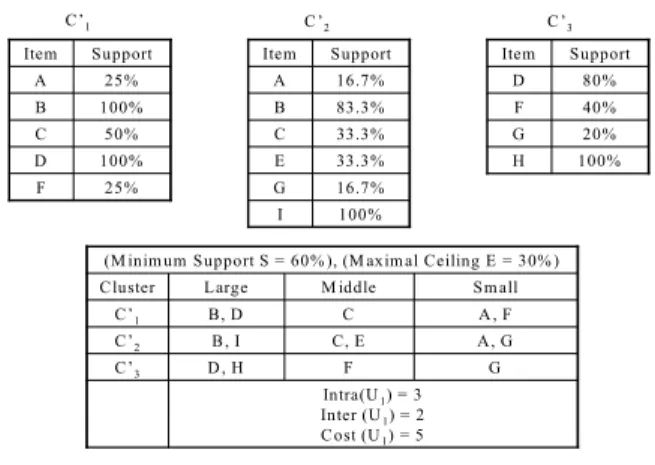
In the new clustering, algorithm SLR will compute the sup-port values of items for all clusters. Figure 5 shows the supports of the items in C0
1, C20,andC30. Algorithm SLR
proceeds until no more transaction is reclustered. The clus-teringU1is also thefinal clustering for this example and the
final costCostI(U1) = 5, which is smaller than the initial
costCostI(U0) = 9.
4 Experimental Results
To assess the performance of algorithm SLR and algo-rithm Basic, we conducted several experiments for cluster-ing various data. We comparatively analyze the quality and performance between algorithm SLR and algorithm Basic in the refinement phase.
4.1 Data Generation
We take the real data sets of the United States Congres-sional Votes records in 1984 [1] for performance evalua-tion. The file of 1984 United States congressional votes contains 435 records, each of which includes 16 binary at-tributes corresponding to every congressman’s vote on 16 key issues, e.g., the problem of the immigration, the duty of export, and the educational spending, and so on. There are 168 records for Republicans and 267 for Democrats. We
(M inim um Support S = 60% ), (M axim al Ceiling E = 30% )
G F D , H C’3 C, E C M iddle Intra(U1) = 3 Inter (U1) = 2 Cost (U1) = 5 A, G A , F Sm all B, I C’2 B, D C’1 Cluster Large 100% D 25% F 50% 100% 25% Support C B A Item 16.7% G 33.3% E 100% I 33.3% 83.3% 16.7% Support C B A Item 40% F 20% G 100% H 80% Support D Item C’1 C’2 C’3
Figure 5. The clustering U1 =< C10, C20, C30 >
obtained by algorithm SLR.
set the minimum support to 60%, which is the same as the minimum support setting in [8] for comparison purposes.
To provide more insight into this study, we use a well-known market-basket synthetic data in [2], as the synthetic data for performance evaluation. This code will generate volumes of transaction data over a large range of data char-acteristics. These transactions mimic the transactions in the real world retailing environment. The size of the transaction is picked from a Poisson distribution with mean|T|, which is set to 5 in our Experiments. In addition, the average size of the maximal potentially large item sets, denoted by|I|, is set to 2. The number of maximal potential large item sets, denoted by|L|, is set to 2000. The number of items, denoted by|N|, is set to 1000 as default.
4.2 Performance Study
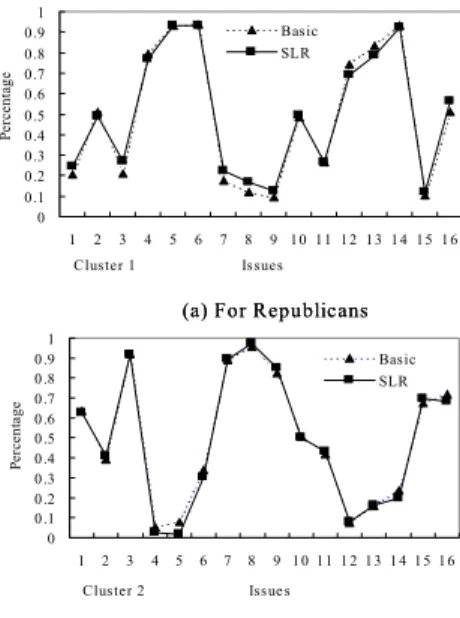
In the experiment for the real data,S= 0.6andα= 2.5, andλvaries from 0.4 to 1, whereλis the damping factor. Figure 6 shows the results of two clusters, cluster 1 for Re-publicans and cluster 2 for Democrats. It shows that these two results are similar to each other in the percentages of the issues in cluster 1 and cluster 2. Recall that an iteration is a refinement procedure from one clustering to the next clustering. Figure 7 shows the comparison of the execution time between algorithm SLR and algorithm Basic in each it-eration. It can be seen that although algorithm SLR has one more iteration than algorithm Basic, the execution time of algorithm SLR is much shorter than that of algorithm Basic in every iteration.
We next use the synthetic data mentioned above in the following experiments. It is shown by Figure 8 that as the database size increases, the execution time of algorithm Basic increases rapidly whereas that of algorithm SLR
in-(a) For Republicans
(b) For Dem ocrats Cluster 1 0 0.1 0.2 0.3 0.4 0.5 0.6 0.7 0.8 0.9 1 1 2 3 4 5 6 7 8 9 10 11 12 13 14 15 16 Issues Pe rc en ta ge Basic SLR Cluster 2 0 0.1 0.2 0.3 0.4 0.5 0.6 0.7 0.8 0.9 1 1 2 3 4 5 6 7 8 9 10 11 1 2 13 1 4 15 16 Issues Pe rc en ta ge Basic SLR (a) For Republicans
(b) For Dem ocrats Cluster 1 0 0.1 0.2 0.3 0.4 0.5 0.6 0.7 0.8 0.9 1 1 2 3 4 5 6 7 8 9 10 11 12 13 14 15 16 Issues Pe rc en ta ge Basic SLR Cluster 2 0 0.1 0.2 0.3 0.4 0.5 0.6 0.7 0.8 0.9 1 1 2 3 4 5 6 7 8 9 10 11 1 2 13 1 4 15 16 Issues Pe rc en ta ge Basic SLR
Figure 6. The percentage of the issues in clus-ter 1 and clusclus-ter 2.
creases linearly, indicating the good scale-up feature of al-gorithm SLR.
5 Conclusion
In view of the nature of clustering for market basket data, we devised in this paper a novel measurement, called the small-large ratio. We have developed an efficient clustering algorithm for data items to minimize the SL ratio in each group. The proposed algorithm is able to cluster the data items very efficiently. This algorithm not only incurs an
Execution time of each iteration
0 100 200 300 400 500 1 2 3 4 Iteration E xe cu ti on t im e ( in c loc ks ) SLR Basic
Figure 7. Execution time of algorithm SLR and algorithm Basic in each iteration.
0 500000 1000000 1500000 2000000 2500000 3000000 3500000 5000 10000 15000 20000
The number of transactions (size of database)
E xe cut io n t ime ( in c locks ) Basic SLR
Figure 8. Execution time of algorithm SLR and algorithm Basic as the number of
transac-tions|D|varies.
execution time that is significantly smaller than that by prior work but also leads to the clustering results of very good quality.
Acknowledgments
The authors were supported in part by the Ministry of Education Project No. 89-E-FA06-2-4-7 and the National Science Council, Project No. NSC 89-2218-E-002-028 and NSC 89-2219-E-002-028, Taiwan, Republic of China.
References
[1] UCI Machine Learning Repository.
http:://www.ics.uci.edu/˜mlearn/MLRepository.html. [2] R. Agrawal and R. Srikant. Fast Algorithms for Mining
As-sociation Rules in Large Databases. Proceedings of the 20th International Conference on Very Large Data Bases, pages 478–499, September 1994.
[3] A. G. Buchner and M. Mulvenna. Discovery Internet Market-ing Intelligence through Online Analytical Web Usage Min-ing.ACM SIGMOD Record, 27(4):54–61, Dec. 1998. [4] M.-S. Chen, J. Han, and P. S. Yu. Data Mining: An Overview
from a Database Perspective. IEEE Transactions on Knowl-edge and Data Engineering, 8(6):866–833, 1996.
[5] A. K. Jain, M. N. Murty, and P. J. Flynn. Data Clustering: a Review.ACM Computing Surveys, 31(3):264–323, Sep. 1999. [6] D. A. Keim and A. Hinneburg. Clustering Techniques for the Large Data Sets - ¿From the Past to the Future.Tutorial notes for ACM SIGKDD 1999 international conference on Knowl-edge discovery and data mining, pages 141–181, Aug. 1999. [7] A. Strehl and J. Ghosh. A Scalable Approach to Balanced,
High-dimensional Clustering of Market-baskets. Proceed-ings of the 7th International Conference on High Performance Computing, December 2000.
[8] K. Wang, C. Xu, and B. Liu. Clustering Transactions Using Large Items.ACM CIKM International Conference on Infor-mation and Knowledge Management, pages 483–490, Nov. 1999.