Education in the context of HIV/AIDS
The impact of HIV/AIDS on
education and institutionalizing
preventive education
Roy Carr-Hill, Kamugisha Joviter Katabaro,
Anne Ruhweza Katahoire, Dramane Oulai
A paper copy of this publication may be obtained on request from: [email protected]
To consult the full catalogue of IIEP Publications and documents on our Web site: http://www.unesco.org/iiep
Co-operation Agency (Sida) has provided financial assistance for the publication of this bookle
Published by:
International Institute for Educational Planning/UNESCO 7 - 9 rue Eugène-Delacroix, 75116 Paris
ISBN: 92-803-1221-9 © UNESCO 2002
The impact of HIV/AIDS
on education and institutionalizing
preventive education
Roy Carr-Hill, Kamugisha Joviter Katabaro, Anne Ruhweza Katahoire, Dramane Oulai
The views and opinions expressed in this booklet are those of the author and do not necessarily represent the views of UNESCO, the IIEP or UNICEF. The designations employed and the presentation of material throughout this review do not imply the expression of any
opinion whatsoever on the part of UNESCO, the IIEP or UNICEF
concerning the legal status of any country, territory, city or area or its authorities, or concerning its frontiers or boundaries.
The publication costs of its study have been covered through a grant-in-aid offered by UNESCO and by voluntary contributions made by several Member States of UNESCO, the list of which will be found at the end of the volume.
Published by:
International Institute for Educational Planning 7-9 rue Eugène-Delacroix, 75116 Paris
e-mail: [email protected]
IIEP website: http://www.unesco.org/iiep. Cover design: Pierre Finot
Typesetting: Linéale Production Printed in IIEP’s printshop ISBN: 92-803-1221-9
5 Pages List of tables 6 List of diagrams 8 List of abbreviations 9 Preface 11 Summary 17
A. Impact of HIV/AIDS on education systems 23
I. Introduction 24
II. HIV/AIDS and the education sector: impacts
on demand, supply and quality 33
III. Other impacts of HIV/AIDS on children and families 50
IV. Monitoring the impact of HIV/AIDS and the
education sector 70
V. Micro-level impacts 85
VI. Policy options 95
B. Education as an instrument of prevention 99
VII. Institutionalizing HIV/AIDS education 100
VIII. Problems and possibilities 126
C. Annexes 139
I. Summary of effects 140
II. Case studies of impact on Kenya and Tanzania 145
III. Case studies of impact on teacher absences 150
IV. Case study of orphans and households in Uganda 157
V. Macro trends in education enrolment and number
of teachers 164
VI. Life skills programmes in the region 167
VII. Pro-change approach 176
VIII. Cost-effectiveness of interventions in developing
countries 179
6
LIST OF TABLES
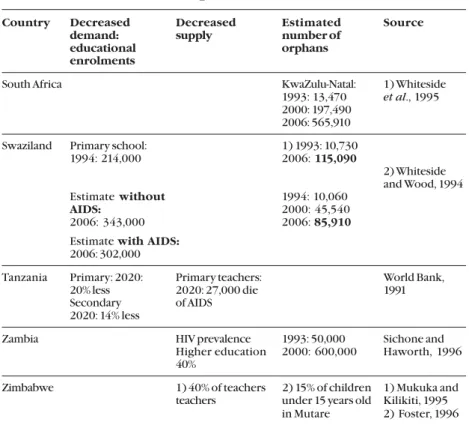
Table 4.1 HIV sero prevalence estimates, decreased educational
demand and supply, and estimated number of orphans
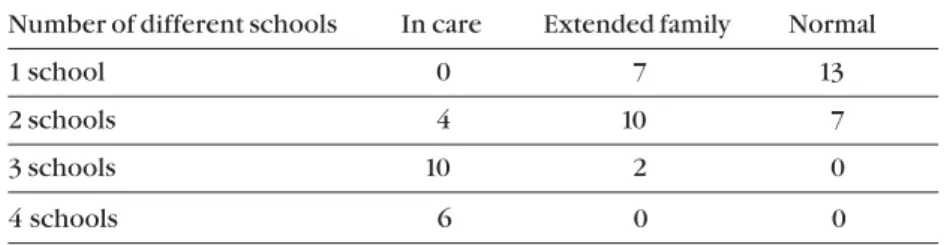
Table 5.1 Number of different schools (interviews with
20 children)
Table 8.1 Annual costs per infection averted or per contact for
interventions to prevent HIV (in US$) Annexes
Table 1 Expenditure by production companies on AIDS
Table 2 Central African Republic: Supply of education
Table 3 Numbers leaving the teaching force
Table 4 Length of service
Table 5 Number of schools closed because of lack of teachers
Table 6 Ivory Coast: Numbers of pupils in five sub-districts
Table 7 Comparison of numbers of pupils, schools, classes and
teachers
Table 8 Turnover of teachers
Table 9 Absences and length of service
Table 10 Uganda: Age and school status
Table 11 Breakdown of who children live with
Table 12 Years behind in education according to sex
Table 13 Mean average of years behind in education according
to orphanhood status
Table 14 Years behind in education according to whom living
with
Table 15 Mean average of years behind in education according
7 and pupil/teacher ratio in sub-Saharan Africa
(38 countries)
Table 17 Trends in pupil/teacher ratios in primary schools
(percentage increase or decrease)
8
LIST OF DIAGRAMS
Diagram 1 The impact of HIV/AIDS on education
Diagram 2 Impact of HIV/AIDS on children
Diagram 3 Effects of HIV/AIDS on teachers in UPE
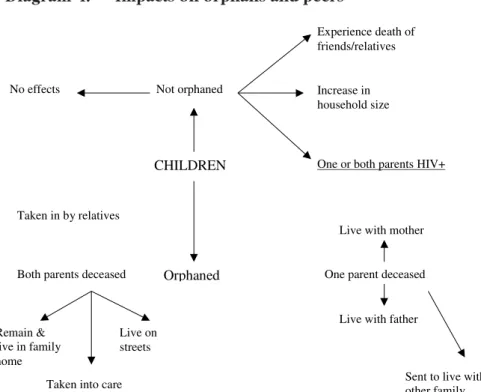
Diagram 4 Impacts on orphans and peers
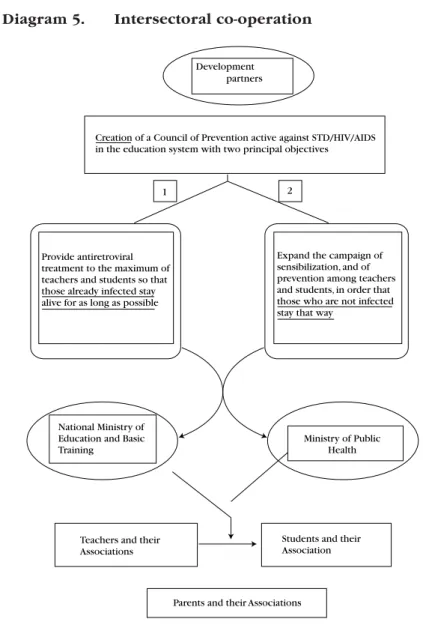
Diagram 5 Intersectoral co-operation
9
AIDS Acquired Immune Deficiency Syndrome
DRENFB Regional Directors of Basic Training in National
Education
EFA Education for All
ESAR East and Southern Africa Region
ESARO Eastern and Southern Africa Regional Office
GER Gross Enrolment Rate
HIV Human Immuno-Deficiency Virus
IEC Information, Education and Communication
IWGE International Working Group on Education
LSP Life Skills Programmes
MOE Ministry of Education
MOH Ministry of Health
NER Net Enrolment Rate
NGO Non-Governmental Organization
SCI Sara Communication Initiative
SHEP School Health Education Programme
SSA Sub-Saharan Africa
STD Sexually Transmitted Disease
STI Sexually Transmitted Infection
TB Tuberculosis
UNAIDS Joint United Nations Programme on HIV/AIDS
UNICEF United Nations Children’s Fund
UPE Universal Primary Education
11 Today HIV/AIDS has become the number-one killer disease of men
and women in many countries in Africa. Since HIV was first identified in 1983, over 65 million people have been infected, of whom 25 million have died, and the majority of these cases are in sub-Saharan Africa. At the end of the year 2000, an estimated 40 million adults and children were living with HIV or AIDS and 28.1 million (70 per cent) of those were in sub-Saharan Africa.
UNAIDS recently-published data on HIV/AIDS indicate that 7 out of 10 newly infected people are in Africa and 85 per cent of those who have died of AIDS, and 95 per cent HIV/AIDS orphans, are in Africa. The economic and social impact of the pandemic has now reached alarming levels in these countries. The increasing spread of the pandemic in Africa is causing a human disaster, in contrast to the situation in the countries of the north, where the epidemic appears to be under control for most population groups.
Although eastern, southern and western regions of Africa were heavily infected areas, the majority of new cases are reported to be in Southern Africa. UNAIDS estimates show signs that the incidences of HIV in 2000 had stabilized in sub-Saharan Africa, but new infection still totalled 3.8 million in the Region. The same estimates indicate that at the end of 1999, 35.8 per cent of the people aged 15-49 were afflicted with HIV or AIDS in Botswana, and that, respectively, around 25 per cent of the same age group in Swaziland and Zimbabwe, 23.5 per cent in Lesotho, 19.9 per cent in Namibia, South Africa and Zambia were living with HIV or AIDS.
A number of studies are now available on the socio-economic consequences of the pandemic in many countries. A recent study in Namibia estimates that AIDS cost the country almost 8 per cent of
12
The impact of HIV/AIDS on education and institutionalizing preventive education
GNP in 1996. Another analysis predicts that Kenya’s GDP will be 14.5 per cent smaller in 2005 than it would have been without AIDS, and the income per person will be 10 per cent lower. A different study carried out by FAO and UNDP on the impact of HIV/AIDS on the commercial agriculture sector in Kenya indicates that the increase in HIV/AIDS cases creates steady rising costs (medical and funeral expenses) and losses in profits and profitability for the companies. Many of the agro-estates could not achieve production targets during the past two years due to HIV morbidity. UNAIDS (2000) indicates that in South Africa, the epidemic is projected to reduce growth by 0.3-0.4 per cent annually, resulting by the year 2010 in a gross domestic product (GDP) 17 per cent lower than it would be without AIDS and wiping US$22 billion off the country’s economy. The rise in morbidity and mortality rates as a result of HIV/AIDS tends to increase staff turnover, which disrupts activities of firms across productive sectors in many African countries.
The rapid spread of HIV/AIDS in countries south of the Sahara over the past decade is no longer a health problem, but a major cause for the ongoing development crisis. Education is one of the many sectors that are being devastated by the spreading of the pandemic in those countries. In the absence of appropriate responses in this sector, the human resource infrastructure of these countries will be decimated by this epidemic and their economic output will continue to decline. Subsequently, the social costs of the pandemic will continue to rise.
The IIEP has a long-standing interest in human resource development in Member States. Foreseeing the risks of a negative impact of HIV/AIDS on education, the Institute organized an international seminar on the theme in 1993. The report of that seminar, which was widely circulated, emphasized the need for planners and education managers to have a better understanding and
13 assessment of the impact of HIV/AIDS on education in order for
them to design new practical methods for delivering educational services that cater for HIV/AIDS-affected students and educational personnel and help to prevent new infections. The report also strongly stressed the necessity for donor agencies and governments to co-ordinate their activities in order to include HIV/AIDS prevention activities in all their development policy strategies. In October 2000, the Institute organized another seminar on HIV/AIDS and education. The deliberations in the seminar showed that the situation has worsened since that foreseen in the early 1990s.
The majority of the IIEP trainees come from countries in the South Sahara region, where the impact of HIV/AIDS on education is most severe. Throughout discussions with the Institute’s trainees and among its staff, there was felt the need for a training programme with special sessions on this major challenge to education development. It is to meet this felt need that the initiative was taken to write this book, with the strong hope that it will contribute to sharing information and facilitate awareness of this major development crisis among the concerned international community and national policy-makers, especially among those in the most infected countries of South Saharan Africa.
The objective of this book on The Impact of HIV/AIDS on Education and Institutionalizing Preventive Education is to provide a compilation of various research findings on the impact of HIV/AIDS on education in countries south of the Sahara, which is the world’s most infected region. It also presents different options available to the education ministries and government decision-makers with regard to the use of education as an instrument to mitigate the effect of HIV/AIDS, as well as a tool for its prevention.
The first part of this book presents information on the impact of HIV/AIDS on education in a way that sometimes appears controversial,
14
The impact of HIV/AIDS on education and institutionalizing preventive education
as the difficulties of assessing and separating the impact of HIV/AIDS from the effects of other factors such as economic and social adjustment programmes on the education systems remain unresolved. Collecting relevant data on HIV/AIDS and education, at the macro as well as at the micro level, is fraught with difficulties linked mostly to the nature of the problem and the social and cultural environment where this occurs. These difficulties are perceived through the various findings presented in the book. The induced challenges, for education managers to plan and monitor the future development of the system using available data on the HIV/AIDS impact, are enormous. Existing data on the impact of HIV/AIDS on education are scarce and vary greatly in their quality because of the difficulties in measuring the impact and therefore need to be interpreted with care if sound prevention programmes are to be based on them.
How to institutionalize HIV/AIDS preventive education is the focus of the second part of the book, which analyzes the different possible options which education sectors may use in various environments to fight HIV/AIDS. Special attention is paid to those programmes (curriculum alteration, peer counselling during school hours, teacher training, awareness campaign etc.) that may be institutionalized. Information is presented on the various life skills programmes and other preventive programmes that have been tried in a number of countries, and on the factors underlining their successes or failures. Criteria required for successful preventive measures within or outside the school setting are discussed and the difficulties faced by government and ways to overcome these hurdles in designing instruments which aim at preventing, or mitigating, the impact of AIDS on education are laid out.
The first group of readers of this book includes IIEP trainees and students in educational planning and administration, educational planners, managers and government policy-makers who have the
15 responsibility of designing and implementing educational
development programmes as well as running the daily operation of the system. The book also targets policy-makers in other sectors, especially the health and economic sectors, whose involvement in the fight against HIV/AIDS is indispensable for a successful outcome. The third group targeted by the book is the international community and aid agencies involved in assisting countries in their educational development.
The study was made possible thanks to finance from UNAIDS and the collaboration of many colleagues from UNESCO Headquarters who contributed to the initial discussions on the design of this book. I am grateful to the authors, Roy Carr-Hill, Anne Katahoire, Kamugisha Joviter Katabaro and Dramane Oulai, for their contributions to this book. I am hopeful that the book will demonstrate its usefulness not only for planning practitioners, but also for policy decision-makers in combating the challenges posed by HIV/AIDS to the development of education.
17 As a new millennium dawns, the HIV/AIDS pandemic continues
to ravage Sub-Saharan Africa (SSA): at least 40 million people are infected with HIV in sub-Saharan Africa. Much of the impact of HIV/ AIDS afflicts children and women: indeed the bulk of new AIDS cases are among young people, aged 15-25 and females are disproportionately affected. The ability of girls and women to protect themselves from HIV is constrained by their status in society.
Decades of improvements in social welfare are likely to be undermined by the uninhibited progression of the epidemic. Life expectancy in some countries has already started on a downward spiral and is expected to drop to 30 years or less in nine sub-Saharan countries by the year 2010. AIDS-related mortality has begun to eliminate the gains made in child survival over the past 20 years.
Children will be the most affected as a result of HIV/AIDS as they live with sick relatives in households stressed by the drain on their resources. They will be left emotionally and physically vulnerable by the illness or death of one or both parents. Subsequently, children who have lost one or both parents are more likely to be removed from school, to stay home to care for the sick and to be pulled into the informal economy to supplement lost income. This is especially the case for girls.
The first part of this collection describes the impact of HIV/AIDS on the education sector especially in sub-Saharan countries at both a macro and micro level; and, drawing on the experience of a few country case studies, discusses the practicability of implementing a range of indicators for monitoring the impact of HIV/AIDS on the education system. Without basic information of this kind, it is impossible to plan.
The impact of HIV/AIDS on education and institutionalizing preventive education
18
In the first section we show how AIDS epidemic is beginning to have a serious impact on the education sector, specifically on the demand for, supply of, and the management and quality of education provided at all levels. As a result of HIV/AIDS, there are relatively fewer children needing education. Fewer children are being born because of the early death of one or both parents. Moreover, families will find it increasingly difficult to afford to send their children to school. The pandemic also impacts on the numbers and availability of teachers.
The decline in the number and availability of teachers is illustrated through case studies of reports from Inspectorates in Central African countries. Their experiences demonstrates that it is feasible to ‘track’ the spread of AIDS through the teaching stock by examining the flows out of the system and in particular the length of absence for illness; in contrast, it is not in practice possible to obtain ‘early warning’ of the spread of the pandemic by examining medical records.
Assessing the impact on demand and quality is difficult. Whilst the fall in the number of teachers appears to be in parallel to the fall in the enrolment, fewer students in the education system and lower demand for places in education programmes, may lead to a smaller supply of facilities and places. Schools that have enrolments below a certain minimum may be closed and the remaining pupils moved to other schools. Even if facilities continue to be available, it may be difficult to ensure community support from the parents for the teachers and materials. The quality of learning outcomes and education will almost certainly be affected by increased problems of teacher absenteeism, and loss of teachers, education officers, inspectors, planning and management personnel.
The problem of monitoring the impact on demand is even more complicated. In particular given the state of existing EMIS in many
19 countries, it is concluded that, at a national or district level, it may
not be appropriate to introduce a further set of indicators where the current basic data on enrolment, participation and repetition are not reliable. Whilst it is indeed very important to know the numbers affected by AIDS and in particular, of orphans, it is concluded that ascertaining parental status routinely would pose an additional burden on already over-stretched teachers. Instead the major planning effort would have to be based on the interpretation of movements in the basic enrolment and repetition.
Whatever the impact, the increased randomness of educational provision will make planning more difficult, and will have to lead even further away from the systemic models of the past. Already the international trend is to suggest devolution and flexibility of policy making, although such trends are not yet widespread in SSA. In development terms, this means a shift from administration to management (see Carron and Ngoc Chau, 1995).
However, it is also clear that the impact of the pandemic depends very importantly on the specific local culture and economy and so, in the second section, we examine the impact at a micro level. We suggest a theoretical framework for examining the micro impact illustrating with a detailed case study in Uganda. This is based on a recognition of the different stakeholders in the local education sector: children, parents, teachers, community and schools.
Importantly, these micro studies suggest that some of the generalisations made at the macro level – for example that fewer families will want to sent their children to school – cannot be sustained. However, it does appear to be true that children orphaned by AIDS are falling behind in their primary education due to drop out and repetition. Clearly it is important to monitor this and, on this basis, we propose the development of an additional ‘optional’ set of indicators to be used at the local level.
The impact of HIV/AIDS on education and institutionalizing preventive education
20
The final section in this first part examines the possible options that are open to Ministries, national NGOs and to community based organisations to instigate the impact of pandemic. We consider the impediments to recruitment and training and ways around them.
The second part of the paper describes the urgency and need for education systems everywhere affected by the pandemic to respond to the challenge of the negative impact of HIV/AIDS. Young people, between 5 and 14 years, both in school children and out of school youth, offer a window of hope in stopping the spread of HIV/AIDS if they can be reached by Educational Programmes. In the absence of a
cure, the best way to deal with HIV/AIDS is through prevention by
developing and/or changing behaviour and values.
Education systems have an essential role to play in reviewing the pandemic that threatens it. However, given that effective programmes have to operate at the local level, the demonstration in section three of the first part of the complexity of the relationship between HIV/ AIDS and the socio-economic context, also has implications here. Specifically we ‘cannot just fly-in/import’ a life skills programme; indeed, the rationale for a tightly developed, uniform set of modules – as against a set of teachers – has not been established. In the first section we describe the range of responses that have been developed drawing on a variety of experiences of UNICEF and others.
This part of the paper also presents an overview of the education systems in seven countries in Sub-Saharan Africa that have attempted to impart life skills to children and young people. To date, however, few of these programmes that are targeting children and young people with information about HIV/AIDS meet the criteria for minimally effective education programmes. Many countries in the region are just beginning to explore the concept of life skills and how to advocate for it to be accepted and adopted into the education system.
21 In the second section, we discuss what would be involved in
institutionalising a response to HIV/AIDS; and in section three how to implement such a programme. Towards the need of this section, we suggest a series of ‘process’ indicators to monitor them. Finally, in the fourth section, we consider the problems of evaluating such programmes and, in particular the difficulties of assessing cost-effectiveness.
24
I.
INTRODUCTION
Effects of HIV on countries in ESAR
As a new millennium dawns, the HIV/AIDS pandemic continues to ravage sub-Saharan Africa. African countries now account globally for 70 per cent of new infections and four-fifths of AIDS-related deaths. The pandemic is concentrated in the so-called AIDS belt stretching from East through Central and Southern Africa, where infection rates are now between 20 and 30 per cent of the sexually active population. The bulk of new AIDS cases are among young people, aged 15-25 and females are disproportionately affected.
These countries will almost certainly experience the most severe demographic effects of HIV/AIDS over the next 25-30 years after the epidemic has peaked. Decades of improvements in social welfare are likely to be undermined by the uninhibited progression of the epidemic. AIDS-related mortality has begun to eliminate the gains made in child survival over the past 20 years. Life expectancy will drop to 30 years or less in nine sub-Saharan countries by 2010. Populations of Botswana, Zambia and Zimbabwe would have had life expectancies of 60-70 years without AIDS, but will have life
expectancies of only 30 years with HIV/AIDS.1
In Kenya and Uganda, infant mortality rates are projected to increase by 50 per cent and child mortality rates to double. In Malawi, due to AIDS deaths, the 1997 population census shows that the overall population growth rate is now only 1.9 per cent per annum compared with a projected growth rate of 3.2 per cent in the 1987 census.
HIV/AIDS will continue to cause fundamental social and economic changes that will affect educational opportunities and the demand 1. USAID. 1998. “Children on the brink”. Washington: USAID.
25 for labour. HIV/AIDS does not strike the population equally. The most
recent years have shown that young people are disproportionately affected. Worldwide, some 50 per cent of all new HIV cases occur in youth between the ages of 15 and 24 years.2 This is a severe threat to
the whole society: these young people may have some productive years living with the HIV infection, but sooner or later they will develop AIDS and become dependent on care from family members. HIV/AIDS thus strikes people in their most productive years, severely disrupting the economic and social base of whole families and societies.3
Costs to the economy of absenteeism and reduced productivity may be higher than the costs of eventual deaths. HIV/AIDS will significantly slow the growth of the labour force and will create labour shortages in several sectors, including the education sector. The loss of women’s labour in the home and in agriculture will create critical deficits in food supplies. The epidemic will continue to have a profound impact on families and communities, on the availability of social services, access to health services and the rate of poverty at the household level. Children will be the most affected since they will be required to take the place of adults in the labour market, particularly in households that are highly dependent on subsistence farming.
One way of assessing the impact of HIV/AIDS on education systems therefore relates to the impact of AIDS on the overall economy and reduced labour productivity of the country. Investment in education depends very much on a sound economy. Whilst this is very important, it is not considered in detail here (case studies of
the impact in Kenya and Tanzania are given at Annex 2). The second
2. World Bank. 1999.“Intensifying action against HIV/AIDS in Africa: responding to a development crisis”, p. 8.
The impact of HIV/AIDS on education and institutionalizing preventive education
26
way of assessing the impact of HIV/AIDS on education systems is to focus on the direct effects on aspects of the social fabric which are themselves directly related to the functioning of the system of education. The effects include AIDS deaths leading to changes in population structure, increased numbers of dependants (orphans and the aged), increased health-care costs, the collapse of social and traditional values and support mechanisms, low school enrolments and attendance.
The most dramatic effect is death of the parents but, unfortunately, the problems children face as a result of HIV/AIDS will have started long before their parents die, as they live with sick relatives in households stressed by the drain on their resources. Children are left emotionally and physically vulnerable by the illness or death of one or both parents, as numerous letters to newspaper editors in eastern and southern Africa already testify. Subsequently, children who have lost parents are more likely to be removed from school and pulled into the informal economy to supplement lost income. Given what we know about gender discrimination, it seems likely that this will impact especially on girls. Strains on households and families may result in increases in child abuse and neglect, while girls already face increased pressure to marry at younger ages, again, due to AIDS.
On the macro level, the appropriate indicators for assessing the impact of AIDS on education are straightforward. They are enrolment trends, school attendance, drop-out and promotion rates, the growth rate of the number of orphaned children. Geographical differences in these indicators (and, more generally, in educational performance) should correspond to the nature of the spread of AIDS in individual countries. Similarly, the death rate of teachers, pupils and parents is yet another important indicator to show the impact of the pandemic. This paper will focus on a few such indicators, as elaborated below.
27
A potential framework for assessing the impact
The HIV/AIDS epidemic has a multiple impact on education, at the structural, quantitative and qualitative levels. This impact can also be identified at both national and regional/local levels - down to each
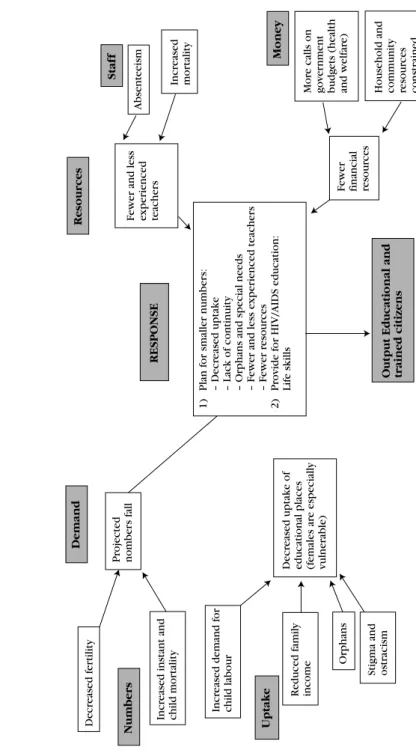
single family and child. The model on the next page (Diagram 1) is
taken from the World Bank’s HIV/AIDS and education: a human
capital issue (1998c). The model gives an overview of the expected effects on the education system. Kelly (1999) has also developed a framework for looking at the impacts, which is summarized in Annex 1.
Assessing impact at the national level
Teacher posting becomes increasingly difficult. Experience from Zambia shows that trained teachers are concentrated in the urban areas. This is nothing new, but the HIV/AIDS epidemic enhances this trend. There has been a steady increase in the number of teachers who, on medical grounds, must be posted near to hospitals, properly staffed clinics or medical centres.4 Providing qualified staff for the
rural areas thus becomes even more difficult than it used to be. The loss of trained and experienced teachers and interruption of teaching programmes due to illness will reduce the quality of education. Research shows that what teachers know and are able to do is one of the most significant determinants of what students learn. A study performed by Armour – Thomas et al. in 1989 found that teacher qualifications accounted for more than 90 per cent of the variation in student achievement in mathematics and reading across all grade levels.5 The loss of the most qualified and experienced
teachers hence represents a serious threat to the quality of education.
4. M.J. Kelly. 1999. “The impact of HIV/AIDS on schooling in Zambia”,p .2.
The impact of HIV/AIDS on education and institutionalizing preventive education 28 Pr ojected nomber s f all Decr eased uptake of
educational places (females ar
e especiall y vulner a b le) 1) Plan f or smaller number s: – Decr eased uptake – Lac k of continuity
– Orphans and special needs – F
e w er and less e xper ienced teac her s – F e w er r esour ces 2) Pr o vide f or HIV/AIDS education: Lif e skills Decr eased f e rtility Numbers Demand Resour ces Staf f Money RESPONSE Uptake
Output Educational and trained citizens
Incr
eased instant and
c hild mor tality Incr eased demand f o r c hild la bour Reduced f amil y income Orphans
Stigma and ostr
acism F e w er and less e xper ienced teac her s Absenteeism Incr eased mor tality F e w er financial resour ces Mor e calls on g o v e rnment budg ets (health and w elf ar e)
Household and community resour
ces constr ained Diagram 1.
29 The HIV/AIDS epidemic will require a change in the content
and role of education: Curricula must be changed to meet the pupils’ needs, and must focus more on life skills such as decision-making and interpreting social settings. A change of curriculum is also needed in order to reach marginalized groups. The HIV/AIDS epidemic has accentuated the need for a relevant curriculum to cope with the situation. In many countries, the existing curriculum is already too overcrowded, so comprehensive alterations are needed to adjust the curriculum to the national and local reality. These changes need to be initiated from the national level, in order to secure national coverage and high quality. It is however of great importance that actors from all levels participate in this reform. A study by Fullan and Miles in 1992 warns that the symbols of reform (new legislation, task forces, commissions, reports, plans etc.) are sometimes confused with the substance of change. If a true change is to occur, considerable work at grass-roots level is required. Changes such as a revision of curricula need to make adequate contact with and provision for the teachers on whom the success or failure of the reforms greatly
depend.6 The teacher’s role may also experience a change. HIV/AIDS
necessitates psychological support for the children from affected families, and teachers find that they are increasingly being used as counsellors for pupils. In Zambia, programmes in counselling are being established in the universities and some teacher training institutions in order to prepare the teachers for this role.7
Impact at regional/local level
Teacher absenteeism. People living with AIDS are of ten periodically ill. When teachers are absent due to illness or medical treatment, the children are often left without schooling due to
6. Andrew Burke. 1999. “School effectiveness: the centrality of the teacher’s role”, p. 15. 7. M.J. Kelly. 1999. “The impact of HIV/AIDS on schooling in Zambia”, p. 6.
The impact of HIV/AIDS on education and institutionalizing preventive education
30
shortage of teacher replacements. Sometimes the sick leaves are so frequent that the Education Office chooses to give the teacher notice in order to secure stable schooling for the children.8 If the teacher is
given notice, an immediate replacement is also needed to cater for the educational needs of the children. When a teacher dies from AIDS, he/she is seldom replaced immediately due to cumbersome administrative structures and general teacher shortage. This will diminish the pupils’ returns from schooling, and reduce the quality of education as such. This reduction of quality will, in a longer-term perspective, reduce parents’ willingness to enrol their children. Why use time and money on low-quality schooling instead of keeping the children at home where they can work and even add to the family income?
• Children (especially girls) drop out or never enrol in order to nurse sick parents or siblings. In a long-term perspective, this may reduce the hard-won returns on efforts to increase girls’ education. Uneducated girls will themselves become especially vulnerable to HIV/AIDS due to lack of HIV/AIDS information and reduced income possibilities.
• Children drop out of school to engage in income-generating activities. A reduction of financial means at household level will lead to reduced affordability – fewer children will be able to start/ complete their schooling. If the breadwinner of the family is taken ill, some children need to engage in income-generating activities to keep the family economy at a minimum level.
• In the rural areas, AIDS-illness in the family will demand greater participation from children in seasonal agricultural
work. Children are kept home in these periods, missing out on
weeks of schooling.
31 • Children drop out due to the cost of schooling. If a family
member becomes severely ill, scarce economic resources may be spent on medical treatment. Sometimes, one or more children are taken out of school in order to save money for medicines or alternative treatment. Unfortunately, in many places unscrupulous ‘doctors’ are taking advantage of the desperate situation in which many families are. They sell ‘miracle’ medicines at exorbitant prices, tapping the AIDS-affected families for savings and social security.9
• Children from AIDS-affected families are under emotional strain. Considering the prevalence of HIV/AIDS in sub-Saharan Africa, a great number of schoolchildren will come from AIDS-affected families. Most of these children are under constant emotional strain, worrying about their sick family members, or the family’s financial situation etc. These are not optimal conditions for learning. In addition to this, prejudice and stigma may cause social exclusion. This in turn can depreciate their emotional well-being, and thus interfere with their ability to learn.
• Children with AIDS are frequently kept home from school due to illness, or are taken out of school. It is not unreasonable to believe that some parents see the costs of schooling as unnecessary if the child is not able to attend or performs badly due to illness.
The earlier IIEP workshop on the impact of AIDS on education in 1993 focused on the supply and demand for education and the scourge of AIDS. In particular, it was shown that many countries, particularly the developing ones, were likely to face many problems in the provision of education because of the impact on the teaching stock. But, the education systems in both developed and developing countries are concerned with issues of demand for and supply of
The impact of HIV/AIDS on education and institutionalizing preventive education
32
education. These concerns range from equal access to education, enrolment, funding of education, provision of resources and adequate quality in order to both attract and retain children.
Despite all these problems, the impact and devastation to the education system have not been calculated or determined systematically, simply because there is little information available at the country or regional level. This paper has two key purposes: (a) to review, synthesize and disseminate existing information on the impact of HIV/AIDS on education systems, and to discuss the practicability of introducing a simple yet reliable monitoring system; and (b) to review, analyze and disseminate available information on ways in which HIV/AIDS prevention can be introduced into education programmes.
This paper, seven years later, focuses on how AIDS has impacted on the supply, demand, the quantity and quality of education because of the impact on the teaching stock. In doing this, the paper draws experiences from different countries in the sub-Saharan Africa region.
33
ON DEMAND, SUPPLY AND QUALITY
An overview
Education and training are critical for long-term development. The provision and growth of quality education has been directly linked to positive economic development, emancipation and health dividends. However, HIV/AIDS is a real threat to the education sector and thus potentially to human resource-based development. HIV/AIDS has a multiple and negative impact on education. It affects three key areas at the local, district, provincial and national levels. These are: • the demand for education;
• the supply of education;
• the quality and management of education.
HIV/AIDS is decreasing the demand for education
The number of children needing education at different levels is important for planning and formulation of policy. It is important to note here immediately the difficulty of coming up with clear-cut indicators to reflect the impact of AIDS. The conditions prevailing in many developing countries do not allow clinical diagnosis and testing of HIV/AIDS status and persistent denial complicates any retrospective recording of cause of death; and, of course, on a macro level, there are many other changes such as structural adjustment programmes which cloud interpretation.
The pattern of demand
The pattern of demand for education may change. As a result of
The impact of HIV/AIDS on education and institutionalizing preventive education
34
early death of one or both parents. Some of these children are born HIV + and most die before reaching school-going age. At the individual level, a child’s opportunity for a bright future is lost or destroyed since the child may become infected or is affected by HIV/AIDS. This means lower school enrolments. In Zambia, for example, primary-school enrolments stagnated between 1990 and 1996 and it is estimated that this was due in part to HIV-related causes.
The opportunity costs and the affordability of the direct costs involved also decrease the demand for education. Families may find it more difficult to release children from domestic and agricultural tasks during the day, and caring for ill adults or other family members. Therefore, fewer children will be able to complete or even start their primary-school education even if they do not themselves fall ill. The trauma, stigma and discrimination related to the illness or death of family members can also make some children fail to complete their education. The lower motivation provided by an extended family and the earlier marriage of girls also limit expanded enrolment.
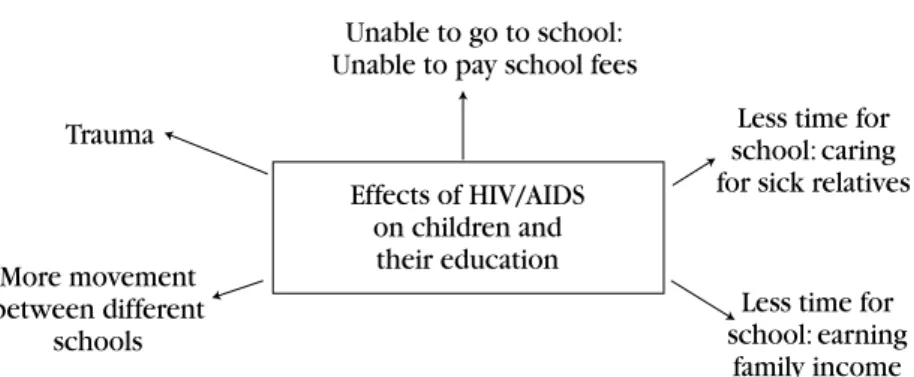
The effect on the affordability of education includes a number of issues: the direct loss of family income, due to AIDS, from the illness and death of productive members of the family and the loss of income due to the costs of treatment, care and funerals. High expenditure on treatment and funeral ceremonies and care of AIDS patients have significantly reduced the family savings for education (Tibaijuka, 1997; Mkoyogo and Williams, 1991). The effects can be summarized as in Diagram 2.
Many countries in sub-Saharan Africa have experienced the impact, while in other countries the impact is still unnoticeable. There are instances of a decrease in the numbers of children admitted to certain levels of education. This scenario may be a reflection of fewer children
35 wanting education and fewer parents wanting to send their children
to school or being able to afford to educate their children. Diagram 2. Impact of HIV/AIDS on children
It has been estimated that in Zambia, the numbers of street
children swelled from 35,000 in 1991 to over 75,000 in 199610, and
known cases of child abuse (physical and sexual) are now beginning to be discussed in public. Another study11 anticipates that in Botswana
there may be as many as 150,000 orphans by the end of this century. Other levels that will suffer because of the HIV/AIDS impact on educational demand are early childhood education and higher education. Impact studies on early childhood care and education and higher education are still lacking in many developing countries. Firstly the increase in the demand for early childhood education may be necessitated by the need to care for young infants, as traditional child-minders are required for more productive labour in the farms
10. Hunter, S. 1998. “Orphan programming in Zambia: developing a strategy for very young children in Zambia”, UNICEF Lusaka, 1998.
11. Hunter, S. 1998. “Stimulating orphan programming in Botswana: developing a supportive environment for exploration”, UNICEF Gaborone, 1998.
Unable to go to school: Unable to pay school fees
Effects of HIV/AIDS on children and
their education
Less time for school: caring for sick relatives
Less time for school: earning family income More movement between different schools Trauma
The impact of HIV/AIDS on education and institutionalizing preventive education
36
particularly in the absence of the mother following death due to AIDS. This will mean withdrawing some children from school. Cost-sharing policies recently introduced in many developing countries will aggravate the situation. Higher education will not grow, as many households cannot afford to pay for their children. The situation may be worse for AIDS households where the breadwinner has already died.
The need to make a costly investment in children feared to have been infected by the HIV virus is curtailed by the fact that some family members regard it as a waste of limited family resources (Bertozzi, 1991). The instabilities within the families and communities due to migration of widows and orphanhood and the early marriages of young (school) girls have shown negative effects on the demand for education. Many subsequent studies have shown that these reasons have continued to affect the need for education in many different ways.
While the demand for education would be expected to go up to cater for children whose parents are bedridden or have died because of AIDS, the cost involved has proved to be beyond the capacities of many families. This is true for higher education where more trained people would be required to fill in the gaps left due to massive deaths of students and their trainers.
School enrolment
Studies both pre- and post- the 1993 IIEP conference on the impact of AIDS on education show a strong relationship, suggesting that school enrolment in AIDS-affected areas declined as a consequence of the pandemic – for Tanzania (Katabaro, 1993), for Uganda (Katahoire, 1993). A World Bank study in Tanzania suggested that HIV/ AIDS may reduce the number of primary-school children by 22 per
37 cent and secondary-school children by 14 per cent as a result of
increased infant and child mortality as well as lower attendance (World Bank, 1992). UNAIDS estimates the number of children orphaned because of AIDS at 1.1 million in 2000. Many of these children will not attend school.
Sumra (1995) compared enrolment levels in Tanzania. Giving an example of one region most affected by AIDS, he said:
“The enrolment rates are quite low in Kagera region…One recent phenomenon that has been variably cited is the effect of AIDS. As more and more children suffer the trauma of being orphans, it has affected enrolment in schools”.
The enrolment rate stood at 44.9 per cent of all children of school-going age (7-13 years). Some schools in Bukoba district were reported to have less than 50 per cent of the children’s population in their catchment areas. This pattern has been observed in other parts of Tanzania, where high levels of the pandemic have been reported (Tibaijuka, 1997; Urassa et al., 1997). Recent visits to the same region show that some classes have less than 30 pupils in place of 45 (source: school files in Kagera). In the absence of a systematic study it may be difficult to associate this decrease to AIDS alone. It is also not clear as to how many schools have closed down because of the pandemic. Data from other countries concur with these observations (Webb, 1997; Foster et al., 1997). Foster et al. (1997) report that the enrolment rate in some areas in Zambia was low mainly due to AIDS.
Preliminary estimates suggest that in Zambia, Swaziland and Zimbabwe, the number of children of primary-school age will be more than 20 per cent lower than pre-HIV/AIDS projections by 2010 and a high percentage of these will be orphans with very limited resources and incentives to enter the system (cited by Gachuhi, 1999). The
The impact of HIV/AIDS on education and institutionalizing preventive education
38
Ministry of Education, Swaziland suggests that in 1999 the number of six year olds was 6 per cent lower than it would have been in the absence of AIDS. The same study estimates that by 2016, there will be 30 per cent fewer six year olds and 17 per cent fewer 18 year olds.
School attendance
In Tanzania there has been a general decline of school attendance and AIDS has been associated with it for various reasons. First, children in households with an AIDS patient were likely to remain absent from school because of the need for care of a sick member of the family (World Bank, 1997; Mukoyogo and Williams, 1990). School-going children, especially girls, are seen to be the only alternative care providers in many families. This is particularly so if the (remaining) parent is sick (Nindi, 1991; World Bank, 1997).
Another reason has been associated with the declining financial capacity for the AIDS-affected households to meet the school-related costs. Most of the family resources are saved in order to cater for the sick parent/member (Tibaijuka, 1997). The medical costs for AIDS-related diseases have been observed to be high and unaffordable to many families in the developing world (Ainswoth, 1993; Tibaijuka, 1997). The tendency has been to withdraw from other family expenditure, including education, to take care of the medical costs. Consequently, schoolchildren are forced to engage in casual labour as a way to assist their families in food supply and other needs. In many ways this affects school attendance (Katabaro, 1999; Mukoyogo and Williams, 1990; Tibaijuka, 1997).
A study conducted in Kagera, Tanzania, revealed that children from certain types of foster households attended school less often than children from other types of households (Katabaro, 1999). In Zambia, Foster et al. (1996) have shown that orphaned children attended school less often than non-orphans; see also earlier studies in Uganda
39 and Tanzania (Katahoire, 1993; Katabaro, 1993). In an in-depth study
conducted in Uganda on 20 students in a district hard-hit by AIDS, 19 of the students reported having been absent from school for periods ranging from five weeks to one-and-a-half terms during the past year. The most common responses given for absenteeism were lack of school fees and helping with the care of AIDS patients at home.
Drop-out
There is lack of information about children who drop out of school as a consequence of AIDS-related problems and those children who do so because of other reasons. It is clear, however, that children who lose their parent(s) are more likely to abandon school because of failure to meet the costs of schooling (Mukoyogo and Williams 1990). General poverty levels and cultural factors still play significant roles in some districts as causes of high drop-out rates (Sumra, 1995). It can be argued here that while poor economic performance in many countries cannot be attributed fully to the impact of AIDS, it appears this impact correlates highly with the declining patterns in the education sector.
It is clear that declining enrolment in many countries of sub-Saharan Africa is already a fact of life. The lack of hard data in respect of infection rates for the school-age population makes it difficult to identify how far this decline has been accelerated by HIV/AIDS due to both reduced growth rates and the inability to take up places.
HIV/AIDS is decreasing the supply of education
HIV/AIDS is decreasing the supply of education. On the supply
side of education, many governments are faced with the problem of providing the resources that can make the process of education take place. These resources range from human (teachers, management and
The impact of HIV/AIDS on education and institutionalizing preventive education
40
parents) to material objects (reading and writing materials), payment of fees and other related costs.
The supply of education not only depends on the availability of teachers and teaching-learning materials in schools, but also to the capability of the education systems to man the whole sector. Schools that have enrolments below a certain minimum may be closed and the remaining pupils moved to other schools. The mere presence of school buildings without willing and solvent parents to send their children to school amounts to failure on the part of the government to provide sound education. Changes (falls) in the numbers of trained teachers, provision of teaching-learning materials, school buildings and management as indicators of the supply of education on the part of the governments are insufficient, because they do not directly show that what happens in these aspects are the result of AIDS. These indicators have to be deployed with caution so that we can remind ourselves of closely linked and intertwined factors that impede the supply of education in developing countries.
Moreover, if there are fewer students in the education system and lower demand for places in education programmes, then there may (should) be a decreased supply of facilities and places. Solutions such as the introduction of multigrade teaching, might tax the current capacity of affected school systems which are unprepared for new responses to the situation.12
The supply of education will also be affected by issues of finance. Since enrolment is declining, so will be the number of financial supporters of the system whose contributions are essential for such items as chalk, books, school maintenance and supplementar y allowances for teachers. Thus, the absolute investment in education will probably be less than anticipated.
41 One indicator of the supply of education is the enabling
environment on the part of the community in general, and individual families in particular, to send children to school with at least the bare minimum requirements. The lower enrolment in Kagera (Sumra, 1995; World Bank, 1997) was observed to cut across all families although it was only significant in poorer households. This means that there were other reasons for lower enrolment apart from AIDS (World Bank, 1997). The average income per capita in the general population and that of families affected by AIDS is too low to support children’s schooling. In Tanzania, for example, the per capita income is as low as US$180.00 (equivalent to Tsh.144,000). This is further complicated by the high costs of care and medical treatment of AIDS patients (see Tibaijuka, 1997). For example, medical charges for a household with an AIDS victim have been estimated to be about US$500.00. It is therefore likely that the majority of families in the developing countries are unable to provide an enabling environment for their children to attend school.
Number of teachers
The number of teachers in post is a function of many factors, including the capacity to train teachers, the retention of teachers in the classroom and the health conditions of those already in the field. Teachers, like many others, are not spared by HIV/AIDS so that, even if facilities continue to be available, there may be a lack of teachers and other personnel to provide teaching services. It is clear that the number of trained teachers is decreasing. Teachers who are infected may try to transfer to another area or, once visibly ill, ’abscond’ and disappear. In Zambia, the number of teachers dying from AIDS is greater than the output from all teacher-training colleges. The Ministry of Education reported that 680 teachers (2.2 per cent) died in 1996 and 1,300 more teachers died in 1998. The number is expected to rise to approximately 2,000 a year by the year 2005. This
The impact of HIV/AIDS on education and institutionalizing preventive education
42
is five-six teachers dying per day.13 In one of Kenya’s eight provinces,
it is reported that as many as 20-30 teachers die each month from AIDS of a total of all teachers. There is also evidence to suggest that teachers may be at higher risk from HIV than other groups since they have higher incomes than other people in rural areas and therefore greater mobility, which is a known HIV risk factor.
In Namibia, the incidence of HIV infection among teachers is also assumed to be well above that for the population as a whole, which is currently between 20 and 25 per cent.14 By 2010, therefore, at least
3,500 serving teachers may have died in Namibia, but this figure could be as high as 6,500. In Mozambique, nearly 3.1 per cent of all Mozambican children under the age of 15 years are estimated to be HIV+.
About 14 per cent of all children will be living in a family affected by HIV/AIDS. They will help care for sick adults, and may contact tuberculosis (TB). Many girls will be forced out of school to provide care, or replace the labour of sick and dying adults. On the whole, there will be fewer students to educate. However, the reality of it is that there will also be fewer educators and managers who will be able to teach in school and manage the system.
Thus the death rate of teachers because of AIDS can be an important indicator of the impact of AIDS on education. In many countries, although information about the deaths of teachers may be included in school/district annual reports to the central Ministry of Education, they are not always co-ordinated. For example, in both Kenya and Tanzania, officials said that there were no consistent data to show the number of teachers who die because of AIDS. Data reported in literature are based on estimates.
13. Kelly, M. Prof. “The inclusion of an HIV/AIDS component in BESSIP”, Lusaka, 1998. 14. HIV/AIDS and the Education Sector Strategic Plan: Paper prepared for the Education
43 In Tanzania, for example, it is estimated that 27,000 teachers will
have died due to AIDS by the year 2020. The lack of a systematic method to appraise the death rate of teachers makes it difficult to establish the impact of AIDS on the teaching force. Eighteen known cases of teachers to have died of AIDS were reported in one rural district in Tanzania.
Another aspect that may interfere with teachers’ performance is their commitment to the extended family members. In communities where the extended family system is still practised, teachers may find it difficult to avoid activities that involve their respective family members. Teachers are expected to attend relatives in critical conditions and this can take their time from school activities. Depending on the duration of time a patient takes before death (sometimes extending to a year), the school curricula may suffer if the time extends to more than one month.
Funeral ceremonies in the community are yet other dimensions which claim teachers’ time. This may be more serious if the rate of deaths as a result of AIDS increases. In one community the number of deaths due to AIDS accounted for 56 per cent of the total (Tibaijuka, 1997). The frequency of deaths can be as high as two within one week in some areas. If this is converted into man-hours over a period of time, then the impact on education is immense given the number of teachers involved.
The theoretical framework suggested that one of the problems for the system, when suffering from the full effect of the virus, could be a shortage of qualified teachers. As the government goals from the same document say, the aim is “to ensure that 75 per cent of teachers are qualified” (UNPAC, 1993).
The impact of HIV/AIDS on education and institutionalizing preventive education
44
The effect of the increase in class sizes has been that teachers have been retrenched. This is part of the readjustment programme, reducing the spending on education. As a result, teachers in the urban area reported that there is a surplus of qualified teachers at present in the urban area, rather than a shortage of teachers as had been suggested. The situation in the rural areas, however, was not addressed through this study, and the effects of AIDS may be being felt more there.
Case studies of impact on teacher numbers and attendance
There have been a number of case studies of the impact of HIV/ AIDS on education. Earlier examples tended to look at all aspects from a macro labour market point of view (see Annex 2). Whilst most recent ones have tended to follow Kelly’s model, which is more
comprehensive, very few have provided detailed evidence of the
impact on teacher numbers and attendance. Studies in the Central African Republic and the Ivory Coast, where attempts have been made along these lines to identify the precise impacts on teacher
numbers and attendance, are included as Annex 3.
Whilst they were able to document the numbers of deaths and the impact on teaching stock, it proved impossible to identify how many had died of AIDS. In both cases, the study teams therefore based their analysis either on the assumption that all early deaths were due to AIDS or via a comparison of the numbers of early deaths in these years with years prior to the HIV/AIDS epidemic.
The same studies also estimated the impact on teachers’ attendance by looking at the length of time such a teacher was likely to be absent because of illness. They showed a significant but not substantial impact.
45
HIV/AIDS is decreasing the management and quality of education
The quality of learning outcomes and education will be affected by several confounding factors which will emerge as the pandemic takes a deeper hold in the ESAR countries. Already, education systems have begun to experience increased problems of teacher absenteeism, and loss of inspectors as well as teachers, education officers, planning and management personnel. There will be a less qualified teaching force, as trained and experienced teachers are replaced with younger and less well-trained teachers. It is quite apparent that as AIDS continues to take its toll, there will be schools with no headteachers and no inspectors of schools. This has a negative impact on the education system’s ability to plan, manage and implement policies and programmes.
The school itself may also be affected by the psychological effects of having infection, illness and death in its midst. There is likely to be discrimination, ostracism and isolation in the classroom and school of those pupils and teachers who are infected or ill or are members of affected families. Teachers may face the suspension of social and health benefits and/or dismissal from the system. Pupils may face formal suspension by the system or be pressured to leave school if they have not already been pushed or dropped out.
Education managers
We can also look at the impact of AIDS from the education management perspective. Personnel in the management of educational institutions are not immune from both direct and indirect effects of AIDS. Death cases have been reported at all levels of education management. Like in other areas, it is difficult to state with certainty the causes of these deaths (at least in a scientifically proven procedure). Education managers at different levels of education
The impact of HIV/AIDS on education and institutionalizing preventive education
46
management (e.g. Ministry/regional/district ward headquarters) face the same situation as teachers as they have to attend their relatives who have suffered or are suffering because of AIDS. The impact on individual families who experience loss and/or have to attend an AIDS patient, sooner or later transcends the family borders, to the workplace. This means loss in terms of man-hours if many people have to remain absent from duty. This also has implications on the services to be rendered to the school.
In light of the changes in demand and supply of education, the whole educational process will change accordingly. While teachers and pupils affected by the epidemic in one way or the other may face discrimination, ostracism and isolation, the process of education will change in terms of time devoted to teaching and learning, availability of materials and funds to support schooling. AIDS may complicate the processes of education in several ways. These can be understood if we focus on the quality and quantity of education.
The changes in the quality and quantity of education may be due to the net result of the various kinds of impact on the demand, supply and process of education. The education system may experience loss in financial and human resources which translates to reduced enrolments, high drop-out rates, increased numbers of teacher transfers and diminished sources of funding for teaching-learning materials. The system may also suffer to a large extent in terms of efficiency and effectiveness. With high death rates of teachers, the alternative choice may be the use of untrained teachers, which compromises quality. Poor school attendance for both teachers and pupils have severe repercussions on the curricula and, therefore, the quantity of education offered could be limited.
47 Qualitative impact
The other type of impact is the qualitative one. Here some of the issues are more obvious. AIDS has allowed more public discussion of the full extent of the prejudice and fear held in most people concerning illness and sexuality. These were present before AIDS, particularly in relation to teenage unmarried sex, pregnancy and expressions of sexuality. The political sensitivity in relation to AIDS may have made these things more obvious. Also, as has always been the case, the issue of power lies not far behind. The tensions within education are sometimes used by those in authority (both senior pupils and teachers) to take advantage of those who are more vulnerable – girls in general and, more particularly nowadays, the growing number of orphans. With the common belief that younger people are less likely to have AIDS, there has been a growing pressure on younger people by older people to have sex.
The qualitative effects on teachers are clear. Makuka and Kalikiti (1995) write that AIDS cases and deaths among teachers have had various perceived negative impacts:
• teachers become over-concerned about their health and therefore
become nervous and depressed;
• teachers are frequently absent;
• teachers’ attitudes to work deteriorate;
• teachers become unable to perform well;
• there is a negative psychological impact on children;
• an average of four teacher hours were lost per week per school in
1995 in urban areas;
• combined morbidity and mortality rates represent a 25 per cent
increase in public expenditure to maintain recruitment and staffing at current levels.
The impact of HIV/AIDS on education and institutionalizing preventive education
48
Whilst teachers will undoubtedly have a lot of stress and the same kinds of outcomes as a result of other factors (notably the absence of pay), the existence of AIDS will inevitably lead to greater stress.
Sichone and Haworth (1996) point out that:
“HIV infection levels in those that have received higher education are in the region of 40 per cent or more (v. general population: 25 per cent urban, 13 per cent rural)”.
This is not only likely to remove more teachers from education, but it also affects the atmosphere and mood of the classroom. Teachers who are sero-positive, not surprisingly, tend to become unconfident and unmotivated. There is also discrimination against teachers and pupils who are known to be infected. This in turn prevents disclosure, and is psychologically and medically problematic. It also has obvious cost implications. The effects can be summarized as in Diagram 3.
49 Diagram 3. E ff e c ts o f H
IV/AIDS on teachers in UPE
Caring f
o
r
HI
V+ f
a
m
ily
U
n
a
b
le
to
tea
ch
du
e
to
s
ic
k
ne
ss
In
cre
as
ed
w
o
r
k
lo
a
d
Te
ac
her
HI
V+
Te
ac
her
no
t
HI
V+
St
ig
m
a
tiza
ti
o
n
fr
o
m
co
m
m
u
n
it
y
F
ear
o
f ab
u
si
n
g
ch
il
dre
n
N
o
t w
a
n
ti
n
g
to
te
a
ch in
re
gi
on
s
w
h
er
e H
IV
is
h
ig
h
T
h
e e
ffect
of
H
IV/
A
IDS
on
tea
ch
er
s a
nd t
h
e
pri
mary
e
ducati
on
sy
st
em
50
III.
OTHER IMPACTS OF HIV/AIDS ON CHILDREN AND
FAMILIES
The impact of the pandemic on children in developing countries is very large indeed (Webb, 1997; Foster et al., 1996). Hardest hit are those children who cannot find ‘comfortable’ alternative homes. Unlike in the developed countries, where there are sound welfare structures such as subsidized health cover, health insurance and a state-supported programme devised in advance (Geballe et al., 1995) to cater for orphaned children, the capacity of developing countries to support its orphans is far less certain. There are already indications in Tanzania that primary education and health-care services are becoming overwhelmed (Galabawa, 1994; Ishumi, 1994; Kiwara, 1994). The near certainty that more children will be orphaned due to AIDS in developing countries (WHO/GPA, 1995) and the prospect that traditional coping mechanisms to support orphans are now on the verge of collapse, means it is time to re-examine critically the situation of AIDS in these communities. Although different support programmes in affected areas have been initiated, the traditional coping mechanism of incorporating children into the extended family remains the most viable option as a base for community life. This option should be guided by informed decisions. For example, Hunter and Williamson (1997) have argued that “changes in family structure originate in historical patterns of labour migration and long-term economic trends” and that these can be associated with high risks of HIV infection and failure to cope with AIDS-related problems.
Different categories of orphans in need of care and support may require specialized forms of skills and support services, which are still lacking. Street children, for example, will demand different levels of attention than those adopted within their extended families or
51 children in orphanages. At present, the distribution of support is
unclear: patterns of adoption must be clarified if further external support and meaningful intervention in essential services such as education are to succeed.
The absence of a clear government policy regarding the school attendance of orphaned children, their payment of fees and other school requirements has several practical implications. There is need to review some of the regulations that guide the provision of primary education in order to ensure equal access for all children. The reduction in the number of school sessions per day is a timely response to some related problems in severely affected areas in Tanzania. Orphans may find the change more advantageous to them than it is for non-orphans because of their extra involvement in domestic chores (World Bank, 1997). Cross and Whiteside (1996) noted that review of school timetables and other activities can help to accommodate orphans’ concerns.
Orphans
The growth in the number of orphans in the region has been occurring for some time. AIDS will add further to the numbers. Coping with orphans stretches even the most extensive kinship system. Much of the care-giving that could absorb orphans is based on grandmothers. When the grandmothers inevitably die, care normally passes to the next generation, but it is likely that AIDS already affects many of that generation, so that families of orphans will have to be headed by adolescent orphans.
Whiteside and Wood (1994) note that orphans:
“Will not be able to afford school fees, uniforms and books; will not be likely to attend school because they will need to work in
The impact of HIV/AIDS on education and institutionalizing preventive education
52
order to survive, and if they do attend school they will probably perform less well because of the lack of secure home support ... they are also likely to drop out of school earlier”.
However, within some communities this is being attended to. Foster (1996) writes of the FOCUS (Families, Orphans, and Children Under Stress) programme in Zimbabwe for visiting and supporting families with, and/or headed by, orphans, that:
“... by 1995, 30 women volunteers were making some 700 visits each month to about 250 needy families”.
The reality of dealing with orphans in a school system is that their psychological deprivation makes schooling that much more difficult. The new additional numbers of orphans resulting from AIDS-related death