SOFTWARE ENGINEERING DATA SETS
A thesis submitted towards the degree of
Doctor of Philosophy
by
GERNOT ARMIN LIEBCHEN
School of Information Systems, Computing and Mathematics
Brunel University
Data quality is an important issue which has been addressed and recognised in research communities such as data warehousing, data mining and information systems. It has been agreed that poor data quality will impact the quality of results of analyses and that it will therefore impact on decisions made on the basis of these results. Empirical software engineering has neglected the issue of data quality to some extent. This fact poses the question of how researchers in empirical software engineering can trust their results without addressing the quality of the analysed data. One widely accepted definition for data quality describes it as ‘fitness for purpose’, and the issue of poor data quality can be addressed by either introducing preventative measures or by applying means to cope with data quality issues. The research presented in this thesis addresses the latter with the special focus on noise handling.
Three noise handling techniques, which utilise decision trees, are proposed for application to software engineering data sets. Each technique represents a noise handling approach: robust filtering, where training and test sets are the same; predictive filtering, where training and test sets are different; and filtering and polish, where noisy instances are corrected. The techniques were first evaluated in two different investigations by applying them to a large real world software engineering data set. In the first investigation the techniques’ ability to improve predictive accuracy in differing noise levels was tested. All three techniques improved predictive accuracy in comparison to the do-nothing approach. The filtering and polish was the most successful technique in improving predictive accuracy. The second investigation utilising the large real world software engineering data set tested the techniques’ ability to identify instances with implausible values. These instances were flagged for the purpose of evaluation before applying the three techniques. Robust filtering and predictive filtering decreased the number of instances with implausible values, but substantially decreased the size of the data set too. The filtering and polish technique actually increased the number of implausible values, but it did not reduce the size of the data set.
data sets, which were modelled on the real data set used in the previous evaluations to ensure domain specific characteristics. These simulated versions of the data set were then injected with noise, such that the real extent of the noise was known. After the noise injection the three noise handling techniques were applied to allow evaluation. This procedure of simulating software engineering data sets combined the incorporation of domain specific characteristics of the real world with the control over the simulated data. This is seen as a special strength of this evaluation approach.
The results of the evaluation of the simulation showed that none of the techniques per-formed well. Robust filtering and filtering and polish perper-formed very poorly, and based on the results of this evaluation they would not be recommended for the task of noise reduction. The predictive filtering technique was the best performing technique in this evaluation, but it did not perform significantly well either.
An exhaustive systematic literature review has been carried out investigating to what ex-tent the empirical software engineering community has considered data quality. The findings showed that the issue of data quality has been largely neglected by the empirical software engineering community.
The work in this thesis highlights an important gap in empirical software engineering. It provided clarification and distinctions of the terms noise and outliers. Noise and outliers are overlapping, but they are fundamentally different. Since noise and outliers are often treated the same in noise handling techniques, a clarification of the two terms was necessary.
To investigate the capabilities of noise handling techniques a single investigation was deemed as insufficient. The reasons for this are that the distinction between noise and outliers is not trivial, and that the investigated noise cleaning techniques are derived from traditional noise handling techniques where noise and outliers are combined. Therefore three investigations were undertaken to assess the effectiveness of the three presented noise handling techniques. Each investigation should be seen as a part of a multi-pronged approach. This thesis also highlights possible shortcomings of current automated noise handling techniques. The poor performance of the three techniques led to the conclusion that noise
edge and the replicability of the data cleaning process are ensured.
Publications Resulting from the Work Presented in this Thesis
The work presented in this thesis resulted in the publication of four conference papers [108, 110, 111, 109].
1 Introduction 1
1.1 Importance of Data Quality . . . 2
1.2 What is Data Quality? . . . 3
1.3 What is Noise? . . . 5
1.4 Class and Attribute Noise . . . 8
1.5 Research Goals and Thesis Objectives . . . 10
1.6 Thesis Structure . . . 12
2 Noise Detection and Noise Handling 13 2.1 Noise Detection and Noise Handling . . . 13
2.2 The Data Cleaning Process . . . 13
2.3 Robust Algorithms and Filtering . . . 16
2.3.1 Filtering . . . 17
2.4 Correction of Instances . . . 18
2.5 Summary . . . 19
3 Noise Handling in Empirical Software Engineering 21 3.1 Introduction . . . 21
3.2 Objective for the Literature Review . . . 23
3.3 Method of Identification of Relevant Literature . . . 24
3.4 Findings of the Systematic Literature Review . . . 28
3.4.3 Empirical Analysis of the Data Quality . . . 35
3.4.4 Automated Noise Handling with Empirical Analysis of the Data Quality 38 3.5 Concluding Remarks about Data quality in Empirical Software Engineering Literature . . . 44
4 Robust Filtering, Predictive Filtering and Filtering and Polish 46 4.1 Introduction . . . 46
4.2 Decision Trees . . . 47
4.3 Decision Trees for The Three Data Cleaning Techniques . . . 48
4.4 Robust Filtering . . . 51
4.5 Predictive Filtering . . . 57
4.6 Filtering and Polish . . . 59
4.7 Summary . . . 60
5 Studies Based on the Analysis of a Large Real World Software Engineering Data Set 62 5.1 Introduction . . . 62
5.2 The Data Set . . . 64
5.2.1 Data Quality Issues in the Data Set . . . 70
5.3 Comparison of Predictive Accuracy of the Three Data Cleansing Techniques . 71 5.3.1 Methodology . . . 71
5.3.2 Results and Conclusion . . . 72
5.4 Comparison of Implausible Value Cleansing of Three Data Cleansing Techniques 74 5.4.1 Methodology . . . 74
5.4.2 Results and Conclusion . . . 75
5.5 Conclusion of Investigations Based on a Real World Data Set . . . 78
6 Evaluating Noise Handling Techniques With Simulated Data 80 6.1 Introduction . . . 80
6.2.1 Simulation of Test Data Sets and Artificial Noise Imputation . . . 82
6.2.2 Data Cleansing . . . 84
6.3 Results . . . 86
6.3.1 Noise Detection Capabilities . . . 86
6.3.2 Noise Reduction Capabilities . . . 89
6.4 Conclusion of Investigations Based on Simulated Data Sets . . . 91
7 Conclusions 93 7.1 Summary of Research . . . 93
7.2 Contributions . . . 99
7.3 Limitations and Possible Future Work . . . 101
Appendix A 134
Appendix B 137
Appendix C 156
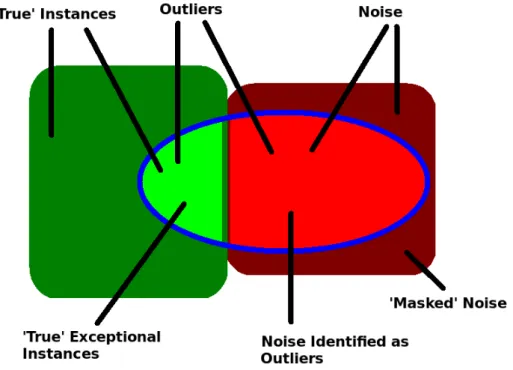
1.1 Noise, Exceptional Instances and Outliers . . . 7
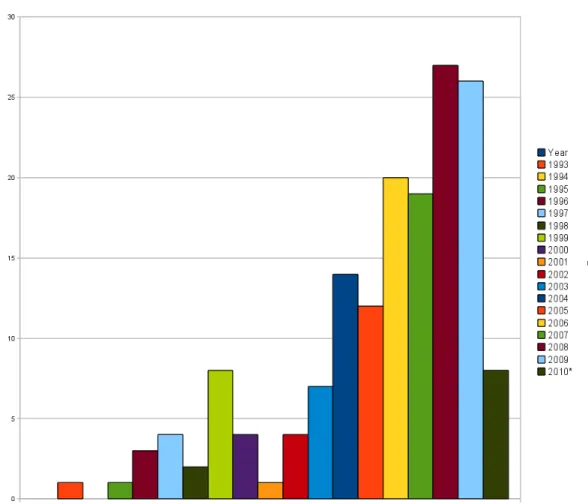
3.1 Data Quality Papers Retrieved by Year . . . 29
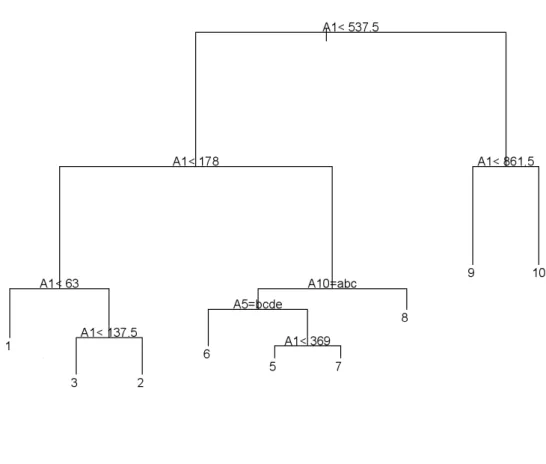
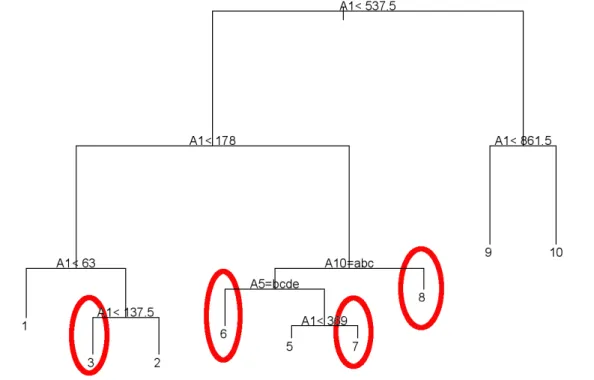
4.1 Unpruned Tree . . . 53
4.2 Pruned Tree . . . 54
4.3 Pruning of a Tree . . . 55
5.1 Project Start Year Histogram . . . 67
5.2 Project Close Year Histogram . . . 67
3.1 Initial Search and Second Search Compared . . . 26
3.2 Paper Categorisation vs Domains . . . 31
4.1 Algorithm for the preparation of a data set for all noise handling techniques . 50 4.2 Complexity Parameter Table . . . 53
4.3 Algorithm for robust filtering procedure . . . 56
4.4 Algorithm for predictive filtering procedure . . . 58
4.5 Algorithm for filtering and polish procedure . . . 60
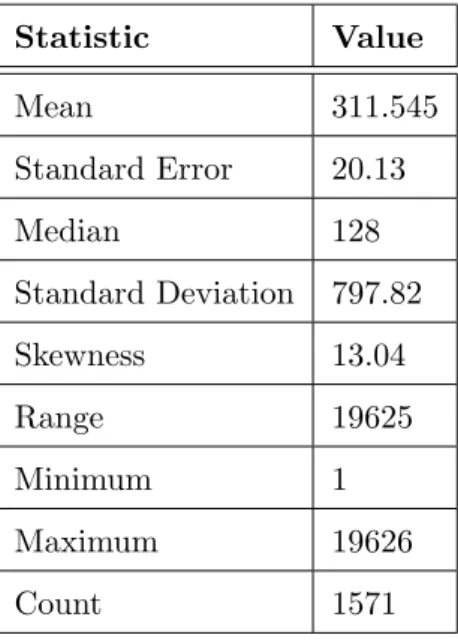
5.1 Descriptive Statistics for UFP . . . 65
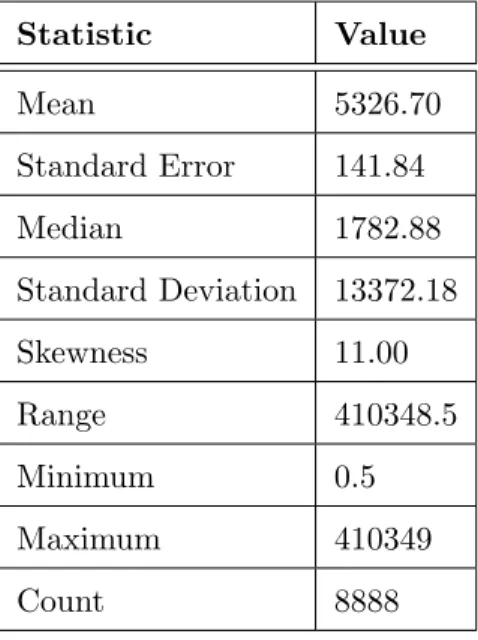
5.2 Descriptive Statistics for Effort . . . 66
5.3 Number of Projects for Industry Sector . . . 69
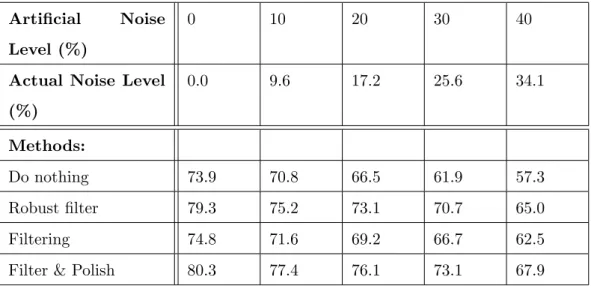
5.4 Classification accuracy - EDS data . . . 73
5.5 Misclassified v. Classified Instances by Data Quality Technique . . . 77
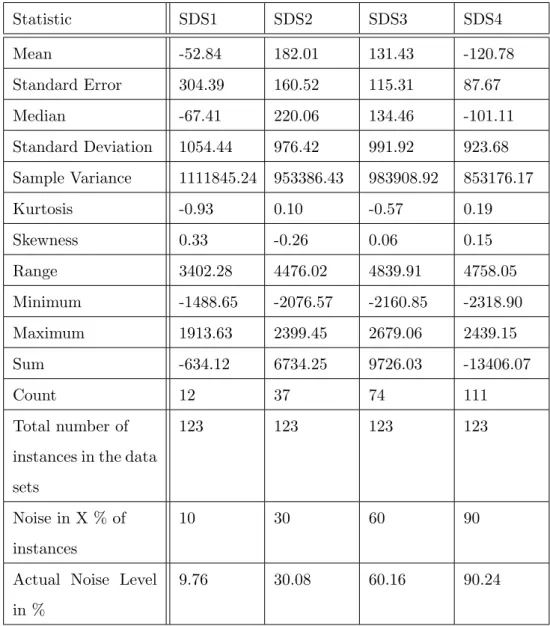
6.1 Summary of the Simulated Data Sets . . . 85
6.2 Comparison of Precision, Recall, F1-Score and Cohen’s Kappa . . . 88
6.3 Summary of the Residual Mean Comparisons . . . 90
7.1 Innovation . . . 157
7.2 Concurrency, Team/Customer Complexity . . . 160
7.3 Team/Management Experience . . . 162
7.6 Derived Variables . . . 165
7.7 SDS1 Robust Filtering Classifications . . . 167
7.8 SDS1 PF 1+ Classifications . . . 167
7.9 SDS1 PF 2+ Classifications . . . 167
7.10 SDS2 Robust Filtering Classifications . . . 167
7.11 SDS2 PF 1+ Classifications . . . 168
7.12 SDS2 PF 2+ Classifications . . . 168
7.13 SDS3 Robust Filtering Classifications . . . 168
7.14 SDS3 PF 1+ Classifications . . . 168
7.15 SDS3 PF 2+ Classifications . . . 169
7.16 SDS4 Robust Filtering Classifications . . . 169
7.17 SDS4 PF 1+ Classifications . . . 169
7.18 SDS4 PF 2+ Classifications . . . 169
7.19 SDS1 Robust Filtering Mean Comparison . . . 170
7.20 SDS1 Predictive Filtering Mean Comparison . . . 171
7.21 SDS1 Filtering and Polish Mean Comparison . . . 172
7.22 SDS2 Robust Filtering Mean Comparison . . . 173
7.23 SDS2 Predictive Filtering Mean Comparison . . . 174
7.24 SDS2 Filtering and Polish Mean Comparison . . . 175
7.25 SDS3 Robust Filtering Mean Comparison . . . 176
7.26 SDS3 Predictive Filtering Mean Comparison . . . 177
7.27 SDS3 Filtering and Polish Mean Comparison . . . 178
7.28 SDS4 Robust Filtering Mean Comparison . . . 179
7.29 SDS4 Predictive Filtering Mean Comparison . . . 180
First and foremost I would like to thank my supervisor Martin Shepperd, not only for his academic guidance and assistance, but also for his patience and personal support. I am truly grateful.
I would also like to thank Bhekisipho Twala. His input and supervision was crucial for large parts of this thesis. Ngiyabonga!
Thanks to Michelle Cartwright and Steve Counsell for their work as second supervisors. Many thanks to Traci Hall who showed a lot of patience and goodwill. I hope I was not too testing.
Thanks too to Mark Stephens and Ambikesh Jayal for their practical assistance in the investigations carried out for this thesis, and thanks to Rahul Premraj for his help in the early stages of this PhD.
I would also like to thank my grandfather, Gerhard Liebchen for his interest and financial support.
Introduction
“[...]they can be analyzed to unearth costly corporate habits; they can be manipulated to divine
1.1
Importance of Data Quality
In empirical software engineering the most important input is data. Data are used to predict, discover and to decide on new strategies. They are also used to indicate that new strategies are working, or what impact new techniques have. It is interesting to see then, that data quality in empirical software engineering appears to be somewhat neglected in publications and even in data analyses. It is all the more astonishing since, as De Vaux and Hand [37] stated, 60-95% of the effort of data analysis is spent on the cleaning of data. This poses the question: Is data quality not as important in empirical software engineering?
In other research areas like information systems and data mining the impact of poor data has been recognised as an issue which needs to be addressed by database designers and data users alike. Redman [147] for instance stated that poor data quality is an issue which impacts on “all segments of the economy: companies, governments, and academia and their customers”, and Wand and Wang [193] warned of the “severe impact of poor data quality on the effectiveness of an organisation”. Therefore poor data quality is likely to have a ‘severe impact’ on empirical software engineering too!
Redman stated that low data quality increases operational costs and can impact on oper-ations, tactics and strategies. As operational impacts he listed lowered customer satisfaction, increased cost and lowered employee satisfaction. Tactical impacts affect decision making, implementation and re-engineering. They also increase organisational mistrust. Strategic impacts result in difficulties in setting and executing strategies. They contribute to issues of ownership, affect the ability to align organisations with strategies, and they divert manage-ment attention. What does that mean for empirical software engineering? The customers of empirical software engineers are practitioners. If the results researchers are producing is of low quality, practitioners will ignore the research community since it does not provide meaningful answers, rendering the researchers’ efforts pointless exercises.
1.2
What is Data Quality?
The most widely used definition of data quality defines it as “fitness for purpose” [194, 147, 175, 63, 145]. This definition for data quality is derived from a more general quality definition as used by Crosby for instance [34]. Since this purpose is subjective and important to consider, data quality’s characteristics or dimensions are subjective too [147, 194], and cannot be assessed independent of the people who use the data [175]. This means that the domain the data are used in has to be an important consideration. There does not appear to be a general agreement on the dimensions of data quality [195]. Whilst Wand and Wang [193] define accuracy, completeness, consistency, and timeliness as dimensions of data quality; Redman [147] lists more than 10 dimensions. Redman [147] made the trenchant observation that his list cannot be comprehensive since as indicated above data quality dimension depend on the user’s view of the data, pointing towards a reason for this lack of consensus about data quality dimensions. Redman categorised his dimensions into four groups:
(i) Dimensions related to the data model, (ii) Dimensions related to the data values, (iii) Dimensions related to data presentation and (iv) Dimensions related to information technology.
Redman also mentioned a possible fifth group which includes dimensions related to the enterprise level of an organisation. From these groups Redman categorised issues of data quality:
• “Issues associated with data views (the models of the real world captured in the data), such as relevancy, granularity, and level of detail.
• Issues associated with data values, such as accuracy, consistency, currency, and com-pleteness.
• Issues associated with the presentation of data, such as the appropriateness of the format, ease of interpretation, and so forth.
• Other issues such as privacy, security, and ownership.” [148]
In empirical software engineering the analysis of data is often based on historical data pro-vided by industry [66]. Since most analysts do not have influence on the ‘data views’, the presentation of the data and issues of privacy, security, and ownership, and since these issues do not generally pose problems to researchers due to their academic background and educa-tion, the issues associated with the data values are of special interest to empirical software engineering research.
Timeliness and currency, that is, how valid historical data is at a given point in time, are interesting issues for empirical software engineering, considering that old project data might no longer be relevant any more, and predictions or decisions based on this data could be compromised by this non-currency or untimeliness. For example, research suggests that productivity changes over time [144]. Therefore historical software productivity data might not reflect current software processes leading to inaccurate conclusions.
De Vaux and Hand [37] also pointed to timeliness when they mention that data quality can deteriorate due to transformations, changed definitions and changed understanding. In contrast Orr stated, “if data quality is a function of its use, there is only one sure way to improve data quality-improve its use!” According to this statement the usage of data promotes its quality revision.
In terms of the quality of a single data item De Vaux and Hand [37] simply categorised data quality issues, or “bad data” (as De Vaux and Hand name them), as missing or distorted data. Missing data can easily be identified, but distortions or noise are less easy to discover. Whilst it might be possible to demonstrate the presence of noise, the absence of noise cannot be proven. Noise can be introduced and is created in all phases of data evolution; during data collection, during preliminary analyses and in the data modelling phase. Noise can be created by distorting data from the outset during data collection. It may also be introduced whilst transcribing, transferring, merging or copying the data, or, as mentioned above, data quality issues might be introduced due to the deterioration of the data. This means that analysts should at least be suspicious of the data they are using.
1.3
What is Noise?
Whilst there is consensus about the data quality definition of “fitness for purpose”, there is no consensus about the definition of noise. Manago and Kodratoff [118] stated that “noise is present when a knowledge base does not truly reflect the environment we want to learn from”. They are indicating that the causes of noise lead analysts to build inaccurate models. According to their definition, noise is “wrong information, lack of information or unreliable information”. The term “unreliable information” is interesting, since the information is not incorrect, but “unreliable”. Manago’s and Kodratoff’s definition is also interesting since it incorporates missingness. Thus their definition of noise includes any instance which could pose problems for a machine learner.
Brodley and Friedl [23, 24] declared that noise can be identified because it goes “against the ’laws of the domain’”. This is slightly confusing since it overlaps with their definition of outliers. They defined an outlier as an instance “that does not follow the same model as the rest of the data, appearing as though it comes from a different probability distribution”. This definition of noise is also adopted in a later paper by Brodley and Friedl [25]. Gamberger et al. [58] distinguished between two types of errors, systematic and random, where random errors are seen as noise. In [57] Gamberger and Lavraˇc also defined only random errors as noise, but in [59] Gamberger et al. used the term noise in a broader sense and included not only random errors but also outliers, which is similar to Brodley’s and Friedl’s defintion of noise. The conflation of the terms noise and outliers is typical in the machine learning domain, since both issues pose problems to machine learners. Brodley and Friedl attempt to solve this problem by searching for instances which are “outliers in any model” [23, 24, 25]. For this purpose Brodley and Friedl used several outlier detection algorithms and combined their results according to majority and consensus rules, where for the consensus rule all algorithms have to identify an instance as outlier in order to be considered as noise, and where for the majority rule the majority of algorithms have to identify an instance as outlier in order to be considered as noise. 1
The issue arising, considering these views on noise and outliers, is whether outliers are poor data quality instances. Are they ‘bad data’ as defined by De Vaux and Hand [37]? They are not missing, and if data are exceptional instances as accepted by Brodley and Friedl they are not necessarily inaccurate. Noise can be seen as “unwanted disturbance” of signals or data [124, 70]. Outliers do not have to be ‘unwanted’. If they are ‘true’ instances they can contain valuable information about new trends in a domain. Therefore the distinction between ‘true’ instance and inaccurate instance is important, depending on the domain.
This thesis investigates data quality in software engineering data sets, with specific focus on accuracy of data. ‘True’ instances which are exceptional and appear as outliers are not seen as ‘unwanted’ since they contain valuable information about the problem domain. In order to resolve the conflation of the terms noise and outliers, they will be defined as follows:
• Outliers are instances with exceptional values in comparison with the rest of the data.
• Noisy instances are unwanted instances with inaccurate values.
The Venn diagram in Figure 1.12shows the relationship of noise, outliers, ‘true’ instances and exceptional ‘true’ instances. Noise are data which are inaccurate. Since their creation differs fundamentally from ‘true’ instances, even if these ‘true’ instances are exceptional, they theoretically reflect this difference in creation in their values and therefore appear as outliers. Noted should also be another type of noise, marked as ‘masked’ noise in Figure 1.1. These are instances, which appear ‘true’, but which are inaccurate. This ‘masking’ can be due to two factors. Firstly, random values can coincidentally take on values which appear ‘true’. This should be a seldom occurrence if the noise is ‘truly’ random. Secondly, noise can be fabricated intentionally such that it appears ‘true’. In this thesis the focus is on random noise and not on systematic noise. As the intentional fabrication of ‘masked’ noise follows a system, it is considered beyond the scope of this thesis.
2Note that the diagram shows that the proportion of outliers identified as noise is higher than the pro-portion of ‘true’ exceptional instances. This is expected since ‘true’-outlier instances are considered to be exceptional.
1.4
Class and Attribute Noise
Another aspect related to noise is whether the noisy values exist in dependent or independent variables. A number of researchers from the machine learning community [210, 181, 89, 205] extended the discussion about noise to two subcategories of noise; attribute noise (noise in the independent variables) and class noise (noise in the dependent variables). Zhu and Wu [210] stated that there has been substantial research carried out in the detection and handling of class noise, but attribute noise has been neglected. Zhu and Wu provided the following definitions for attribute and class noise: “The quality of the attributes indicates how well the attributes characterize instances for classification purpose; and the quality of the class labels represents whether the class of each instances is correctly assigned.” The class label, according to Zhu and Wu, is also a target concept which when performing classification is characterised by the attributes. Therefore it is an issues which is very much tied to the specific problem of learning a classifier, since attribute noise will hamper the classifier’s ability to predict a class variable.
The importance of the difference between attribute and class noise has to be tightly coupled to the “fitness for purpose” as well as the domain of the data, and is not always appropriate. In software effort analysis for instance, the target concept is measured effort. For the application of decision trees which assumes the classification of problems this target concept has to be discretised. These discretised values do still have to be considered as measured values since they are based on measured values. One could say that only the granularity is changed. It is not classified (or ‘assigned’) through the analysis of the remaining attributes. In fact, it is only one attribute which was chosen to be the class variable by the analysts.
The notion of a class label combines two aspects. Firstly, the class variable is a target concept with association to attributes describing an instance and their relationship to the class variable. In respect of effort analysis the target concept is chosen from a number of attributes of a data set. Each of the other attributes could be used as target concept if it would serve a purpose. That means that the quality of the “other” non-target attributes can
be treated as class variable too and cleaned in the same way as the “original” class variable. In fact this is an approach Teng [179, 180, 181] followed when polishing data sets. Secondly, Zhu and Wu suggested a difference in the creation process of class values and attribute values, when they stated that class noise is likely to be cleaner since, as they explain with an example from the medical domain, the analyst will take more care to allocate a class to a set of attributes. This suggests that the class variable according to Zu and Whu is not measured, but allocated and due to being allocated, cleaner. Since class variables are not necessarily allocated and since they can be measured values too, the conclusion that class variables are cleaner is not necessarily true.
One of Zhu and Wu’s conclusions based on a number of experiments states that attribute noise is usually “less harmful” than class noise. Brodley and Friedl [25] came to the same conclusion and subsequently focussed their work on class noise. Since class noise is considered more “harmful” the main focus of this thesis is class noise too. Also, since the data is mea-sured software project data and class variables and attribute variables are interchangeable, this distinction between the two terms is not considered to be necessary for the discussion of noise in this thesis.
1.5
Research Goals and Thesis Objectives
This thesis aims to investigate data quality and specifically noise in software engineering data sets. Three data cleaning approaches, represented by one cleaning technique each, will be compared for their data cleaning effectiveness. Outliers and noise are often treated as one, but in this thesis the focus is on noise solely. Whilst the three approaches are usually used to deal with noise and outliers, the three representing techniques are tested for ability to deal with ‘true’ noise.
The following additional objectives were identified for this thesis. To:
• Provide clarification and distinctions of the terms noise and outliers
The terms outliers and noise are often used interchangeably. Whilst they are overlap-ping, they are fundamentally different in creation and concept. This thesis provides clarification of the two terms3.
• Carry out a systematic literature review searching the empirical software engineering literature for evidence of data quality considerations
The work in this thesis highlights an important gap in empirical software engineering. This thesis will show to what extent data quality and noise have been dealt with in the empirical software engineering community.
• Conduct a multi-pronged approach to investigate the effectiveness of three noise handling techniques
A single investigation is deemed insufficient to investigate the capabilities of noise han-dling techniques, since differentiating between noise and outliers is not trivial, and since the investigated noise cleaning techniques are derived from traditional noise han-dling techniques where noise and outliers are combined. Therefore a multi-pronged approach will be conducted to investigate the effectiveness of the three noise handling techniques. A multi-pronged approach is also beneficial in order to overcome short-comings of a single investigation. Whilst the two investigations are based on a real
3
world dataset where the ‘true’ noise level cannot be known, the third investigation is based on simulated data in order to have complete certainty about the underlying noise levels. A disadvantage of simulated data however is that it could be questioned how realistic it is. This is addressed by modelling the simulated dataset on a cleaned version of a real world dataset.
• Highlight possible shortcomings of current automated noise handling tech-niques
Noise handling is only one part of a bigger data cleaning process. It will be shown that noise handling techniques should be integrated into a data cleaning process.
1.6
Thesis Structure
Chapter 2 describes data cleaning and noise handling in disciplines other than empirical software engineering. It shows that noise handling is only a subtask of the data cleaning process. It presents the three noise cleaning approaches, which are represented by three noise cleaning techniques tested in this thesis. Chapter 3 reports on a systematic literature review, focussing on how data quality has been dealt with in the empirical software engineering community.
Chapter 4 describes three noise cleaning techniques which are tested in this thesis. Chapter 5 presents two investigations comparing the effectiveness of the previously pre-sented noise cleaning techniques on the basis of the analysis of a real world data set. Since the true level of noise in the data set cannot be known, two separate proxy measures, namely predictive accuracy and the detection of implausible values, are applied to evaluate the three noise cleaning techniques. The studies presented in Chapter 5 highlighted limitations of anal-yses based on real world software engineering data sets. The subsequent study presented in Chapter 6 is based on simulated data sets modelled on a real world software engineering data set. Random noise was introduced in these simulated data sets and they were then subjected to the three noise cleaning techniques introduced in Chapter 4. This has the advantage that the noise cleaning techniques’ abilities can be tested in an environment where the noise levels are known.
The thesis concludes with Chapter 7 providing a summary of the presented work, listing the contributions of this thesis. Limitations of the work with pointers to possible future work in the field of noise handling in empirical software engineering are listed too.
Noise Detection and Noise
Handling
2.1
Noise Detection and Noise Handling
Chapter 1 provided an introduction to the topic of data quality with a brief discussion about the importance of data quality considerations and the issue of noise. Since this thesis has its focus on data quality and data accuracy in software engineering data, the topic of how data quality has been addressed in research communities other than the empirical software engineering community with a special focus on noise handling needs to be discussed first. This chapter continues the data quality discussion from Chapter 1 by first addressing the data cleaning process. It then continues with a discussion of noise treatment options.
2.2
The Data Cleaning Process
Since data quality is defined as fitness of data for the purpose the data was intended for, the purpose will also influence data cleaning definitions. Maletic and Marcus stated in [116] and later in [117] that various definitions exist for data cleansing depending on the academic field they are used in. Whilst some areas like data warehousing connect the terms data cleansing and data cleaning with the merge/purge problem, where the focus is on the
elimination of duplicate records resulting from merging two or more databases, other research areas connect the term with different data quality dimensions. For instance M¨uller and Freytag [131] classified data anomalies into syntactic, semantic and coverage anomalies, which are affected by the data quality dimensions completeness, validity, schema conformance, uniformity, density and uniqueness. These categorisations are reflected in the data cleansing approaches identified by M¨uller and Freytag. They listed parsing, data transformation (where data is transformed such that it adheres to a given format), integrity constraint enforcement, duplicate elimination and statistical methods. Only statistical methods deal with the type of noise that this thesis is concerned with.
Maletic and Marcus described data cleansing as an interactive procedure and state that “serious data cleansing involves decomposing and reassembling the data” [117]. Kimball [96] broke down this process of decomposition and reassemblance into six steps:
1. Elementising 2. Standardising 3. Verifying 4. Matching 5. Householding 6. Documenting
This means that data cleaning is a non-trivial process which not only consists of identifying problematic instances (Kimball’s first four steps) and dealing with these instances (house-holding), but it also comprises the documentation of the data cleaning process and its results to allow replicability of the whole process.
Other variations [116, 131, 117] of the data cleaning process models exist, but the basic structure is the same:
• Define and determine error types [116, 131, 117] (Kimball’s steps 1 and 2)
Values outside of this range are considered implausible.1
• Search and identify error instances [116, 131, 117] (Kimball’s steps 3 and 4)
Search for instances containing age values outside of the range identified in the previous step.
• Correct the uncovered errors [116, 131, 117] (Kimball’s step 5)
Delete or correct implausible-age instances.
• Post-processing [131] (Kimball’s step 6)
Document which instances were corrected or deleted.
Post-event data cleaning, cleaning already collected data, often focusses on outlier detec-tion where outliers and noise are treated as unwanted [117]. This is likely connected with the fact that it is difficult to distinguish ‘true’ noise from outliers without domain knowledge. Maletic and Marcus stated also that exceptions are often indicators of the presence of noise. The problem with treating all outliers as noise can lead to the elimination of valid values which are not noisy [180]. However, outlier detection can be seen as a starting point for noise detection, especially if one follows Brodley and Friedl’s assumption that noisy instances are “outliers inany model” [25].
Maletic and Marcus [117] classified outlier detection approaches into four categories: sta-tistical, clustering, pattern-based and association rules. Statistical outlier detection utilises descriptive statistics such as the mean, the standard deviation and the range. These are used in conjunction with statistical confidence intervals. Although this approach is not considered very precise it is simple and fast. Clustering is a distance based outlier detection approach often using measures such as Euclidian distance. Pattern-based approaches attempt to es-tablish a pattern in the majority of the data and instances not conforming with this pattern are seen as outliers or noise. Association rules establish associations between different at-tributes, therefore they also establish patterns. Instances not conforming with these patterns are seen as suspect and treated as noise [117].
1
As mentioned earlier data errors can be either eliminated or corrected. Teng [181] identi-fied another outlier/noise handling approach2where errors can be ignored and left unchanged in the source. This approach would require the incorporation of robust algorithms, such that the influence of data errors can be limited.
The following two sections will discuss practical implementation of the three noise han-dling approaches.
2.3
Robust Algorithms and Filtering
The problem with ignoring noise and outliers is that the analyses of the data can lead to issues such as overfitting3. In order to avoid these problems robust algorithms need to be applied which avoid spurious results by reducing the influence of noise and outliers from the analyses [31]. According to Teng [181] the issue with ignoring noise and outliers is that they can still influence findings and therefore result in incorrect data analysis. That means a model is built and its complexity is reduced by ignoring outliers, but the outliers still have influence on the built model.
Gamberger and colleagues [58, 59, 60] used this principle for their saturation filter in order to filter out the ignored instances. Their saturation filter builds a model which is simplified when too complex, by eliminating instances leading to overfitting. They argued that their filtering algorithm avoids overfitting since the results of the noise elimination process will not influence the following analysis of the data and that therefore a hypothesis based on this analysis will not be influenced by the noise, thus combining robust algorithms and the filtering principle. In [60, 59] Gamberger and colleagues combined this saturation filter with a classification filter. Their tests on medical data sets indicate that all variations of the filters improve predictive accuracy. Saturation filter and the combination of saturation filter and
2Remember, in machine learning outliers equal noise. Whilst this is not sufficient for the work presented in this thesis it has to be recognised as an starting point for noise handling.
3
Overfitting is a phenomenon where the results of an analysis describe relationships of a specific set of data, but these relationships are not transferable to other sets of data because they are spurious and therefore misleading in regards to the ’real’ underlying relationships [134].
classification filter performed better than the classification filter by itself. They concluded that the combination of saturation and classification filter eliminated the instances which had the highest probability of being noisy. Their evaluation was based on two data sets from the medical domain with categorical dependent variables.
John [78] also utilised robust algorithms. A decision tree model is built which is simplified by pruning back over complex nodes. The difference between John’s approach and the saturation filter approach by Gamberger et al. is that John repeats the pruning process until no more instances can be removed using this approach. He argued that the repetition of the process decreases the influence of noisy instances. He argued that excluding noise and outliers from the data set limits the impact of spurious findings but leads to information inefficiency since less data is available for the analysis. This approach was tested by John on 21 data sets from the UCI [136] database repositories. Whilst increasing predictive accuracy it reduced the size of the decision trees by on average 70%. Since reducing the size of a model (in John’s case the decision trees) reduces the influence of data instances by ignoring them, instances are essentially eliminated after an initial model is built. This therefore reduces the data sets substantially too.
2.3.1 Filtering
Brodley and Friedl [25] noted that it is important to find algorithms which distinguish between noise and exceptional data values such that valid data does not get deleted during the noise elimination process. They compared a single algorithm filter, a consensus ensemble filter and a majority ensemble filter against each other. Brodley and Friedl stated that their approach differed from conventional outlier detection methods (the single algorithm filter) since it did not define outliers “relative to a particular model” as robust algorithms do. Their approach to noise detection is built on the premise that noise is independent of the data’s underlying model. It combines a partitioning filter with an ensemble filter. A partitioning filter splits a data set into training set and test set. A data set is split inton parts creating
n training sets each out ofn-1 parts of the original data set, as such producing n classifiers which testn test sets. A classifier “tags” an instance as noisy if the classifier predicted value
for the dependent variable does not match the actual value.
Additionally Brodley and Friedl introduced the concept of multiple base classifiers for their ensemble filter. A base classifier is a noise detection algorithm. Brodley and Friedl used three base classifiers, a decision tree classifier, a nearest neighbour algorithm and a linear machine algorithm. For a consensus ensemble filter all of the base classifiers have to misclassify an instance to identify it as noisy. For a majority ensemble filter more than half of all of the base classifiers have to “tag” an instance as noisy. The single algorithm filter represented the traditional outlier detection mechanisms in their tests where training data and test data are the same. Brodley and Friedl evaluated the methods on five data sets with nominal and ordinal dependent variables. They concluded that the ensemble filters performed better in identifying noisy instances. The consensus ensemble filter was judged to retain most instances whilst eliminating less noisy instances. The majority filter eliminated more noisy instances, but also more ‘true’ instances.
Summarising two approaches of filtering can be applied. In both a model is built on a set of data and tests of misclassification or adherence to rules identify noisy instances. The two approaches differ by either keeping test set and training set the same (like robust algorithms), or by training a model on a different set of data and using it to test another set of data.
2.4
Correction of Instances
The third noise handling approach is noise correction which is also sometimes referred to as polishing. Correcting the imperfections has the advantage that more data for the analysis of the dataset will be available. It is based on two phases. The first step is identification of noisy instances. This is followed by the adjustment of the identified instances. This method was used by Teng [179, 180, 181]. Teng utilised a C4.5 decision tree for the identification of noisy instances by using misclassifications of instances utilising cross-validation similar to Brodley and Friedl [25]. The filtered data set was then used to build a new C4.5 tree model to predict new values for all attributes by switching each attribute from independent
to dependent variable. Teng stated that the correction or polishing can successfully repair the data to some extend and therefore enhance the quality of the dataset. Teng evaluated the method on data sets with nominal or ordinal attributes only, and concluded that polishing was more successful in improving predictive accuracy than robust algorithms and predictive filtering.
2.5
Summary
This chapter discussed the issue of how data cleaning has been addressed in research commu-nities other than the software engineering community with a special focus on noise handling and noise detection. It showed that the data cleaning process is a non-trivial process, and that noise handling and noise detection are subtasks of the overall data cleaning process. They have to be integrated into a data cleaning process to allow the input of domain knowledge and allow replicability of the data cleaning task. Noise detection identifies noisy instances by analysing a set of data and identifying instances which do not follow an established model. This chapter identified two different noise detection approaches:
• Training and test sets are the same, allowing the influence of identified instances.
• Training and test sets differ, thus reducing the influence of identified instances. In both cases the identified instances are eliminated from the data sets. A third noise handling approach corrects instances rather than filtering them out, aiming to ensure information retention.
This chapter also showed that noise detection and noise handling is often combined with outlier detection and outlier handling. Since as shown noise and outliers are overlapping but fundamentally different, the focus in this thesis is purely on noise. There are many outlier detection mechanisms available, but their true noise handling capabilities are not tested. This is essentially the motivation for the work carried out for this thesis. Instead of proposing new algorithms, existing algorithms should be evaluated for their appropriateness for the different domains in empirical software engineering.
In this thesis the three approaches of noise handling will be tested for their adequacy for software engineering data. The three approaches are represented by three noise handling techniques, robust filtering, where training and test sets are the same, predictive filtering, where training and test sets are different, and filtering and polish, where noisy instances are corrected.
Before describing the three noise handling techniques in detail in Chapter 4 the following chapter will focus on the treatment of noise in the software engineering community.
Noise Handling in Empirical
Software Engineering
3.1
Introduction
Whilst Chapter 1 and 2 highlighted the importance of data quality for data analyses, defined the basic terminology needed in order to distinguish noise from outliers and examined the treatment of noise in research communities other than the empirical software engineering community, this chapter describes to what extent the empirical software engineering com-munity has addressed data quality issues and specifically noise in software metrics data. Although data quality dimensions and issues might be recognised in empirical software engi-neering literature, the issue of noise in the raw data sets appear to be addressed sparsely. In their well known book Fenton and Pfleeger [51] list amongst other data quality dimensions the accuracy of data, but noise is only discussed as a difference between actual and predicted values (i.e. the goodness of a model’s fit).
In order to assess the current state of affairs of data quality and noise handling in empirical software engineering a systematic literature review has been carried out. The objectives of this literature review are described in Section 3.2 and the method of literature identification is described in Section 3.3. Section 3.4 describes the findings with a more detailed examination
of key papers relevant to the investigations of this thesis. Section 3.5 concludes this chapter summarising the state of affairs of data quality in empirical software engineering literature with connections drawn to the work presented in this thesis.
3.2
Objective for the Literature Review
The aim of this literature review is to identifyall relevant studies and provide an overall and coherent picture of how data quality has been addressed in the empirical software engineering community. In order to produce a literature review as unbiased and repeatable as possible a systematic literature review [98] was carried out.
The main objective for the literature search was to discover which studies explicitly considered noise or data quality in empirical software engineering, and how these studies addressed this problem. Since the focus of this thesis is data accuracy, the focus of this literature review was also on accuracy (noisiness) as a measure for data quality, and not on other dimensions of data quality, described in Chapter 1. These dimensions might still have featured in some of the retrieved papers, but accuracy must have featured in some form too. The following further sub-objectives were identified to aid the analysis of the results of the literature review:
• How significant do the community consider noise to be (in principle and in practice)?
• How do empirical analysts address this problem?
• Are there techniques that might be deployed to independently assess the quality of a given data set?
The results of the separate searches described in the next section were combined and then the retrieved articles were checked against the inclusion criteria. These criteria are that the article must:
• Focus on an empirical investigation of some aspect of software engineering or address some methodological issue relevant to such empirical research,
• Address data noise explicitly,
• Be refereed,
• Be written in English.
3.3
Method of Identification of Relevant Literature
In order to survey the empirical software engineering literature concerning the subject of data quality, a systematic literature review was carried out. In recent years there has been increasing interest in establishing software engineering as an evidence based discipline and a crucial part of this process is the systematic review [98]. Systematic reviews are widely adopted in many other disciplines such as medicine, social policy, educational psychology, etc.. A systematic review is the process which requires an exhaustive scanning of all avail-able literature that satisfies some agreed protocol that, amongst other things, will contain an unambiguous description of the inclusion criteria, which for the presented review were provided in Section 3.2, that a study must satisfy in order to be entered into the review.
The literature review consists of two parts. An initial literature search was carried out and the results of the subsequent analysis were presented to researchers of the software engi-neering community at PROMISE 2008 [109] where the audience, which included experienced researchers, expressed surprise. The feedback from the participants of the PROMISE 2008 workshop [65] resulted in a review of the initial search with special focus on the search terms. In order to improve the literature search the members of the program committee of PROMISE were contacted and asked to point at any of their publications or publications they were aware of which might fit the search objective listed in Section 3.2. The email used to ask the 23 program committee members is attached in Appendix A. Attached to the email was the list of papers found during the initial search. 11 replies were received of which five replies suggested 25 papers not retrieved by the initial search. 12 of these papers were deemed to conform to the search criteria. The relevant papers were then examined and suitable search terms were extracted. These search terms were then applied on several search engines.
Table 3.1 shows a comparison of the initial search strategy and the subsequent search strategy. It can be seen that the first search only used the search phrase “‘data quality’ AND software”. This was deemed too limiting. The second search was adjusted such that search terms extracted from the PROMISE program committee papers were included. This was
done to allow re-capture of the already captured papers. Some of these search terms may appear as very specific (i.e. “Issues Arising from the Data Collection” and “recorded with enough consistency and completeness”), but the method of extracting search terms from the papers was seen as a systematic approach. It also aimed to ensure that the PROMISE program committee papers were retrieved by the search. Whilst the initial search only utilised the bibliographic databases ScienceDirect, SCOPUS and IEEE Xplore, the second search additionally utilised the ACM and Springer databases. Note, Table 3.1 shows that in the initial search the journal Empirical Software Engineering was searched separately. This was not necessary in the subsequent search since it is published by Springer Verlag and since the Springer search engine was used.
Issues were encountered with the bibliographic search engines. Since the first search the interface of IEEE Xplore was changed, and the search results were not consistent with the first search. It is recognised that this is a problem for the validity of this literature review. To overcome this issue a name search was carried out to find additional publications of authors who resulted in a positive hit in the initial search and the second search.
Both searches omitted duplicate papers1, which brought the final number of retrieved papers to 161. To reach this number hundreds of abstracts of papers retrieved from the bibliographic databases were scanned to determine if they concerned empirical software en-gineering applications. This was supplemented by an exhaustive, hand search of those sources considered to be particularly relevant, namely the conference series of ESEM, METRICS, ISESE, PROMISE and EASE2. It is recognised that the lack of online availability of pub-lished studies may slightly restrict the results of the literature review, however the author of this thesis is confident that the search has covered the major empirical software engineering publication venues. Therefore it is considered that the results provide an adequate view of the state of affairs in the empirical software engineering community.
After the search papers which were difficult to categorise were re-examined to clarify the
1
Papers that report the same empirical study are only counted once using the most recent publication, e.g. [41, 82, 83] describe the same study and so only [83]
2Results from EASE proceedings were limited to 2008, 2007 and 2006 due to the lack of online availability of the remaining proceedings.
Table 3.1: Initial Search and Second Search Compared
Initial Search Second Search Time January 2008 January 2009
Search Terms “data quality” and software
derived from terms found in papers from PROMISE PC - software AND (“noisy data” OR “data quality” OR noise OR “inconsistent pieces” OR “er-roneous data” OR “clean the data” OR “data cleaning” OR “Issues Arising from the Data Collection” OR “recorded with enough consistency and completeness” OR “not very consistent”)
Bibliographic Databases
ScienceDirect, SCO-PUS, IEEE Xplore
ACM, IEEE Xplore, ScienceDirect, Sco-pus, Springer
Conferences ESEM, METRICS, ISESE, PROMISE
and EASE
(2006,2007)
ESEM, METRICS, ISESE, PROMISE and EASE (2006, 2007, 2008) Additional Search Journal Empirical Software Engineer-ing
Name search of leading authors from found papers
Inclusion of previous hits
Hits 23 161
Inclusion Criteria
written in English, published in peer reviewed publication, mentioning of data quality and noise according to our definition
categorisation3.
3The searches were carried out by G. Liebchen. The flagged papers were read and categorised by M. Shepperd (30%) and G. Liebchen (%70). If a paper’s categorisation was difficult, both researchers read the paper and discussed the categorisation in order to find agreement.
3.4
Findings of the Systematic Literature Review
161 papers were considered relevant following a extensive literature review. This could be seen as surprising considering how many papers are written in the empirical software engineering domain every year4, and considering that one of the inclusion criteria was that papers should simply address data quality in some respect. One would expect more papers at least mentioning some sort of data quality or noise consideration. A reference to all papers and their classifications for this literature analysis can be found in Appendix B in Table 7.3. Figure 3.1 gives a breakdown of the 161 papers by year. Note that 2010 is incomplete. Nonetheless there seems something of an increase over time, suggesting that the community is giving the topic of data quality more explicit attention.
The earliest paper which the literature search could locate is by Li and Malaiya [106], who considered noise in the software quality domain in 1993. They state that noise is problematic for the prediction of software reliability growth models, and they applied smoothers to deal with this effect. Li and Malaiya’s definition of noise falls into what is considered a mixture of outliers and noise in this thesis. The paper was included in the search nevertheless since its aim was to improve data quality.
Although a substantial majority of papers, 138 out of 161, considered data quality to be a threat to analysis of empirical data (see Table 7.3), not all papers agreed with this proposition. Indeed one author, Wessl´en, suggested that the random, i.e. unbiased nature of noise meant that it could be ignored since presumably it would average out in the long run [199]. Whilst this may mean that measures of centre are largely unaffected there may be considerable impact upon the variance and the ability to fit and differentiate between predictors, and therefore noise can still pose a problem. Thus one cannot remain so sanguine.
4
Note, that the literature review did not put any limits on the age of the papers. In order to get a feel for the number of papers written in the empirical software engineering domain, the search phrase “empirical AND “software engineering”’ was entered in the basic searches of the ACM, IEEE Xplore, ScienceDirect, Scopus and Springer databases (data: 01/08/2010), resulting in the following counts of retrieved papers; ACM-6345, IEEE Xplore-1343, ScienceDirect-5103, Scopus-2382, Springer-2152. The total is in excess of 17000. Therefore only 161 out of 17000 (about 1%) papers written in the empirical software engineering literature explicitly discussed data quality.
Wessl´en also notes the possibility of intentional errors and states that these should be dealt with by validating the data, a sentiment hard to disagree with!
A small minority (14%) did not explicitly state if poor data quality could have a negative impact. In those cases Table 7.3 indicates this with a “?”. Biffl and Gutjahr explain their trust in the quality of the data by referring to a quality data collection process and state that the remaining noise will not impact the results of their analysis since they are believed robust “enough”. The concept of robust “enough” results is interesting, since the robustness should be able to be measured. This robustness could be tested by injecting noise and observing how robust the concept is at differing noise levels. This approach has been adopted by for instance by Berlin et al. [15] and Ahmed and Muzaffar [2].
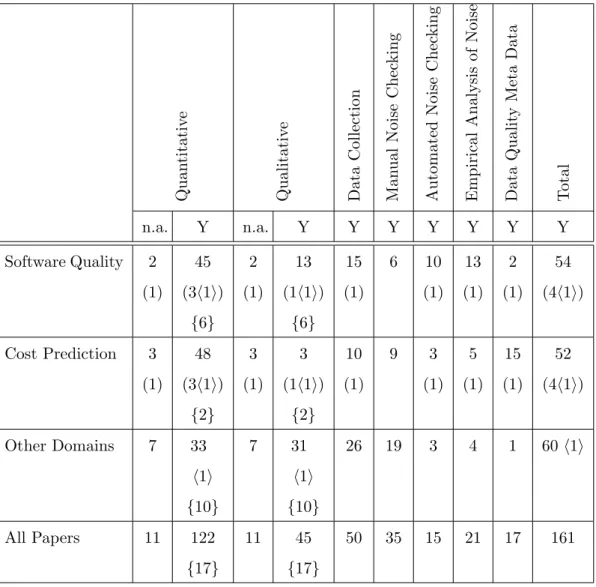
The papers cover a range of topics within empirical software engineering. These in-clude: meta-analysis, defect prediction and reliability modelling, effort prediction, PSP, reuse, change data analysis and studies evaluating different noise reduction strategies in software engineering datasets. Two of the domains were predominant, cost/effort prediction, which included productivity and schedule analysis, and software quality analysis, which included defects and defect predictions. Table 3.2 summarises the findings for these two domains of the papers. It shows the categorisations of the quality domain, the cost domain, the other remaining domains and the categorisations of all papers. 55 papers (34%) con-cerned the quality domain. 52 papers (32%) fell into the cost domain, and 60 papers (37%) were attributed to the “other” group. Some papers covered more than one domain. That explains why the counts do not equal the absolute total of 161. Four papers concerned both the software quality domain and the cost domain, of which one paper was found to cover all three groups, which was in fact the paper reporting about the initial literature search [109]. The majority of papers, 122 (76%), focussed on data quality of quantitative data, 17 papers (11%) were concerned with quantitative and qualitative data and 45 papers (28%) were concerned with data quality of qualitative data (e.g the papers by Li et al. [105] and Babar and Zhang [11] focused on data derived from interviews). An early paper by Johnson [80] highlighted the importance of quality review documents as a basis for software development reviews, but Johnson also pointed out the importance of accuracy of the metrics
Table 3.2: Paper Categorisation vs Domains
( ) = Paper in software quality domain and in cost prediction domain;h i= Paper in all domains;
{ }= Paper concerns qualitative and quantitative data;
n.a. = Paper did not state clearly if the concern was with quantitative/qualitative data.
Quan titativ e Qualitativ e Data Collection Man ual Noise Chec king Automated Noise Chec king Empirical Analysis of Noise Data Qualit y Meta Data T otal n.a. Y n.a. Y Y Y Y Y Y Y Software Quality 2 (1) 45 (3h1i) {6} 2 (1) 13 (1h1i) {6} 15 (1) 6 10 (1) 13 (1) 2 (1) 54 (4h1i) Cost Prediction 3 (1) 48 (3h1i) {2} 3 (1) 3 (1h1i) {2} 10 (1) 9 3 (1) 5 (1) 15 (1) 52 (4h1i) Other Domains 7 33 h1i {10} 7 31 h1i {10} 26 19 3 4 1 60 h1i All Papers 11 122 {17} 11 45 {17} 50 35 15 21 17 161
used in the review process. The data quality considerations raised in this paper were picked up by Lappalainen in [102] who added that quality issues may arise in PSP data because the data collection is one of two tasks software engineer have, and their need “to switch her context of thought from solving the problem (design, coding, etc.) to the recording of data” causes issues. Johnson and Zhang [79] only refer to data quality by citing [80].
11 papers did not specify whether the data quality concern was about quantitative or qualitative data.
3.4.1 How Was Poor Data Quality Dealt With?
After reporting what domains considered data quality and what data was subject of the data quality concerns, this subsection focusses on the approaches researchers have adopted to deal with poor data quality.
The results in table 3.2 indicate that the most favoured method (50 papers) of combating poor data quality is to avoid data quality problems through the data collections process. This was merely a suggestion in most papers which commended this course of action, since researchers in empirical software engineering most of the time are not included in the data collection process and therefore have to work with secondary data [66]. Frequently suggested was the use of automation of data collection processes and input validations, like range checking, in order to avoid data input errors. Combating data quality during the data collection phase could be characterised as a noise prevention activity.
Since as indicated above data analysis in empirical software engineering is often reliant on the use of historical software engineering datasets, noise prevention as data quality im-provement will not be available for most researchers. This leads to researchers applying data cleaning procedures to data sets post event. Possibly due to the apparent ease of application the most prominent form of data cleaning is the manual data quality checking. Typically this involves increasing one’s confidence in a data set by some manual intervention such as independent scrutiny or the use of triangulation, for example measuring the same attribute in different ways or through inter-rater reliability analysis. This cleaning or scrubbing precedes the main analysis.
An example for this is [33] where automatically collected data was compared with man-ually collected data in order to determine how error prone manual data collection process is. The quality of the base line data quality of the automatically collected data was ensured by a visual inspection.
18 papers (11%) used data quality meta data in order to improve data quality. Some data sets, most notably the ISBSG project [75] effort and productivity benchmark data set, contain meta data that describe the perceived quality of each case or project. For ISBSG quality is graded between A (highest quality) and D (lowest quality). This is quite important for situations where organisations elect to contribute project data to a central repository and thus there is a reduction in control over collection procedures. In the situation of ISBSG the classification is principally guided by the completeness of a case, in other words high quality data are interpreted as possessing low levels of missingness, which could be misleading for analysts if they equate this classification to the level of noise in a data set. In this literature review the studies that utilised the ISBSG adopted the strategy of only using data graded as A or B. Note though that this does not accord with the view that noise concerns the difference between the “true” and recorded values for a data item. Indeed a complete case may contain many inaccuracies.
Two areas of data quality discussion in empirical software engineering which are directly related to the research presented in this thesis are the automated noise detection and the empirical analysis of noise prevalence. Table 3.2 shows that 16 papers (10%) carried out some sort of automated noise detection, and 21 papers (13%) carried out a empirical analysis of noise in software engineering data sets.
Next, papers which utilised automated noise checking are going to be discussed. After this, papers with empirical analysis of noise are going to be focussed on, followed by a discussion of paper which reported on automated noise checking combined with and empirical analysis of noise with the aim to assess the effectiveness of the noise checking procedures presented.
3.4.2 Automated Noise Checking
As mentioned in Chapter 2 automated noise checking is mostly carried out by utilising a machine learning algorithm to identify the noise.
Moses [130] presented a Bayesian probability model to assess the correctness of subjec-tive categorisations of inter-modular cohesion. He used the cohesion classifications for six FORTRAN modules of 163 students to show that subjectivity could be inferred from agree-ment established using a Bayesian probability model. He states that this method could also possibly be used to quantify subjectivity in the field of cost/effort prediction. Moses also commented that no judgement about the quality of the student data could be made due to lack of information, but he suggested that the quality of the data might not have been the best due to interactions of the student raters.
Colombo et al. [32] also employed a Bayesian approach to deal with the impact of noise in software process data in order to avoid overfitting. The utilisation of a Bayesian network as robust algorithm has to be done since software process data “typically” contains noise. They investigated if class/switch events could be allocated to the developer who produced them. They analysed the log files of three Java programmers who produced about 10,000 class/switch events each. The results of their analysis showed that the Bayesian approach can be used to establish if a change was carried out by the same developer or by two different developers.
Rubin et al. [152] automatically eliminate incorrect change log entries by applying rules for correct change log entries in a software process mining tool (i.e. ignoring exceptional and infrequent change commits). Their results showed that their tool can be used to obtain process models and to analyse and verify some properties of software processes.
The remaining papers which utilised automated noise checking incorporated their inves-tigations with empirical analyses of the data quality problem and will be discussed following the next subsection which only discusses papers carrying out empirical analysis of data qual-ity without the employment of automated noise checking.
3.4.3 Empirical Analysis of the Data Quality
The topics of noise detection and handling are important, but their effectiveness can only be tested empirically. It is also important to consider the impact of poor data and its magnitude in software engineering data. In order to do this empirical investigations gathering and analysing data about data quality must be carried out. This is a non-trivial task since in many cases the ‘true’ value of a data item may be unknown. Thus unless the value is implausible in some way, the level of noise in a data set may be difficult to measure. However, an important example of data quality assessment, and an early paper on the topic, comes from Johnson and Disney [83]. They report that as part of the data recording process of the Personal Software Process (PSP) for 89 projects completed by ten participants they discovered 1539 primary errors. However, it must be stated that almost half (46%) of the errors were incorrect calculations and so can be addressed by the provision of better tool support. Another significant problem they encountered were missing data. There is a good deal of research on data imputation [112], but it is considered to be beyond the scope of this thesis. Overall Johnson and Disney concluded that poor PSP data could lead to misleading conclusions about the PSP itself, and in order to improve data quality manual data collection should be avoided and “external measures” should be used which can be interpreted for triangulation purposes.
At times the empirical analyses were rather limited. For instance, as mentioned earlier Counsell et al. [33] carried out a visual inspection of automatically and manually gathered data, and concluded that manual gathered data is error prone. Koru and Tian [99] included a question in their questionnaire for 119 contributors of open source projects where they enquire about the “consistency” of data in defect databases, when they carried out a survey about defect handling strategies in open source projects. The majority of contributors stated that their data was consistent, which appears not surprising since they were judging their own efforts.
In [184] Thomson and Holcombe inspected the change data repositories for 17 student-led software projects manually with the aid of comparison tools, and three types of errors were discovered. According to the authors type one error related to missingness or non-usage of
the repository, type two error related to inaccurate data, and type three error related to errors which were due to “well known limitation” of the change data system used. Thomson and Holcombe warned in conclusion about the quality not only of data collected by students, but also of data in change data repositories in general.
Bachmann and Bernstein [12] investigated the data quality of software process data in change data repositories. The bug tracking data bases, which were also partially used for change requests, of five open source systems and one closed source system were checked for inconsistencies. First rules were applied to identify suspect instances which followed an additional manual inspection. Their quality measures included the rate of fixed bug reports, the rate of duplicate bug reports, the rate of invalid bug reports, and the rate of empty commit messages and the rate of linked bug reports. The closed source project showed lower values for duplicate bug reports and invalid bug reports than the open source projects (both about 1%). These lower values were due to the closed source project bug tracking database not being publicly available, and due to “well-planned” testing activities. Since the remaining data quality measures fell in the same range of the open source projects, the authors concluded that data quality differs “from project to project”, and that it was not possible to differentiate between open source or closed source data based on data quality alone. The bug reports in all databases were “badly” linked, and source code changes were untraceable “due to empty messages or missing bug report links”. Invalid and duplicate bug reports for open source projects varied between 12 and 34 % (duplicates) and 4 and 34 % (invalid reports), which indicates poor quality bug report information.
The investigations by Mendes[120] and Mendes et al. [123] were both based on the same data when investigating cost estimations for web projects. According to the authors data quality of effort data was ensured by asking the companies which collected the data how the data was collected. 83% of the projects based their effort data on more than just guestimates indicating sound data. Whether this fact can really be seen as an indicator for good data quality appears arguable.
In [92] Khoshgoftaar et al. investigated the impact of noise on missing data imputation in software quality data. They used a large military command, control, and communications
system data set (CCCS) to produce four data sets with varying noise levels. Two of the produced data sets contained inherent noise, noise already in the data set for the outset, and artificial noise. One data set only contained inherent noise, and one according to the authors did not contain any noise. This is interesting considering the statement by De Vaux and Hand that the absence of noise cannot be proven [37]. Koshgoftaar et al. reported that the noise free data set was achieved with the help of “expert input and several [unspecified] data analysis procedures”. The authors concluded that regardless of t