PATHOLOGICAL INTERNET USE AMONG COLLEGE STUDENTS: THE PREVALANCE OF PATHOLOGICAL
INTERNET USE AND ITS CORRELATES
A Dissertation Presented to
The Faculty of the College of Education of Ohio University
In Partial Fulfillment
of the Requirements for the Degree Doctor of Philosophy
Michael D. DiNicola March 2004
© COPYRIGHT 2004 Michael D. DiNicola ALL RIGHTS RESERVED
This dissertation entitled
PATHOLOGICAL INTERNET USE AMONG COLLEGE STUDENTS: THE PREVALANCE OF PATHOLOGICAL INTERNET USE
AND ITS CORRELATES
BY
MICHAEL D. DINICOLA
has been approved for the
Department of Counseling and Higher Education and the College of Education
by
Thomas E. Davis
Professor, Department of Counseling and Higher Education
James L. Heap Dean, College of Education
DINICOLA, MICHAEL D. PhD. March 2004. Counseling and Higher Education. Pathological Internet Use among College Students: The Prevalence of Pathological Internet Use and its Correlates (207pp.)
Director of Dissertation: Thomas E. Davis
Seven hundred thirty-one traditional age (18-24) college students from a large Midwestern university were assessed with an online survey for an impulse control disorder related to their Internet use. Students reporting four or more symptoms of an impulse control disorder related to their Internet use were categorized as Pathological Internet Users. Seven percent of students in the present study met criteria for
Pathological Internet Use. The results of the present study suggest that male students may be significantly more likely to engage in Pathological Internet Use than female students. The present study predicted that freshmen (first-year) students would report significantly more symptoms of Pathological Internet Use than upperclassmen. However, this study did not find significant differences in terms of pathological behaviors or
cognitions based class standing. The students were also asked to report on how their Internet use impacted various areas of functioning including: current relationships, academic success, getting adequate sleep, and being late for or missing classes. Only 1.2% of students reported their Internet use had negatively impacted their current relationships while 7.9% reported negative impacts on their academic success, 14% reported negative impacts on being late for or missing classes, and 20.7% reported negative impacts on their ability to get enough sleep. Suggestions and considerations are
offered for conducting further research online. Finally, the present study offers suggestions for future research of Pathological Internet Use in the college student population and general population.
Approved:
Thomas E. Davis
Acknowledgements
First, I would like to thank Tom Davis for his guidance and support as my advisor and dissertation chair. I would like to thank my dissertation committee members Gordon Brooks, Dana Heller-Levitt, and George Johanson for their feedback that helped to
improve this project and my personal research skills. Additionally, I thank Richard Davis for allowing me to utilize portions of his Online Cognitions Scale. Many thanks also go to David Hannum for his technical support in developing the online survey and to
Michael Williford for his assistance in obtaining the random sample of student email addresses. Thanks to my parents Mike and Peggi DiNicola for always being there throughout my academic career and life in general. Finally, I would like to thank my wife, Jenny DiNicola, for her support and encouragement in this long process.
Table of Contents
CHAPTER ONE: INTRODUCTION...12
Background of the Study ...12
Pathological Internet Use Defined ...13
Pathological Internet Use in the College Student Population...15
Statement of the Problem...18
Significance...20
Primary Research Questions ...22
Definitions Relevant to the Present Study ...23
Delimitations and Limitations of the Study ...25
Delimitations of the Study ...25
Limitations of the Study...26
CHAPTER TWO: REVIEW OF THE LITERATURE ...30
Introduction to the Literature...30
General Theories of Pathological Internet Use (PIU)...31
Goldberg’s Internet Addiction Theory...31
Davis’ Cognitive-Behavioral Model of PIU ...34
Suler’s Eight Factors of PIU ...39
Grohol’s Three Stage Model of PIU...41
Hall & Parson’s Internet Behavior Dependency...43
Challenges to PIU Theories and Research...45
Theories of Pathological Internet Use Related to College Students ...48
Chickering’s College Student Development Theory and PIU...51
General Research of Pathological Internet Use ...53
Young’s Internet Addiction Research...53
Brenner’s Internet Addiction Research...59
Armstrong, Phillips, and Saling’s Internet Addiction Research ....61
Research of Pathological Internet Use Related to College Students ...63
Anderson’s Internet Addiction Research ...63
Scherer’s Internet Dependency Research ...68
Davis, Smith, Rodrigue, and Pulvers’ IAD Research...69
Morahan-Martin and Schumacher’s PIU Research ...71
Kubey, Lavin, and Barrows’ Internet Dependency Research...73
Davis, Flett, and Besser’s Problematic Internet Use Research...77
Summary of the Literature ...80
CHAPTER THREE: METHODOLOGY ...83
Primary Research Questions and Hypotheses...83
Identification of the Population ...84
Data Collection Procedures...84
Instrumentation ...86
Demographic Information Sheet...86
Cognitive-Behavioral Checklist...87
Online Cognitions Scale ...89
Data Analysis Procedures ...93
Two-way ANOVA Considerations...95
Assumptions of the Data...96
CHAPTER FOUR: RESULTS ...97
Sample Demographics ...97 Research Question 1 ...98 Research Question 2 ...108 Research Question 3 ...109 Research Question 4 ...111 Supplemental Data ...114
CHAPTER FIVE: SUMMARY AND CONCLUSIONS ...119
Summary of the Study ...119
Advantages and Challenges of Online Research ...121
Advantages of Online Research...121
Challenges of Online Research...122
Recommendations for Future Online Research ...124
Conclusions...127
Research Question 1 ...127
Research Question 2 ...133
Research Question 3 ...134
Research Question 4 ...139
Summary and Recommendations for Future Research...144
REFERENCES ...149
APPENDIX A: Request for Exempt Status ...157
APPENDIX B: Project Outline Form for Institutional Review Board ...160
APPENDIX C: Demographic Information Sheet ...182
APPENDIX D: Cognitive-Behavioral Checklist (CBC) ...184
APPENDIX E: Online Cognitions Scale (OCS) ...186
APPENDIX F: Permission to Use OCS ...190
APPENDIX G: Permission to Use OCS Online ...192
APPENDIX H: Permission to Modify OCS ...194
APPENDIX I: Online Survey ...196
APPENDIX J: Recruiting Flyers ...203
APPENDIX K: Recruiting Email Message ...206
LIST OF FIGURES FIGURE 1: Davis’ Cognitive-Behavioral Model of Pathological Internet Use (PIU) ... 35
FIGURE 2: Grohol’s Model of Pathological Internet Use (PIU) ... 42
LIST OF TABLES TABLE 1: Comparison of Pathological and Non-Pathological Internet Users ...99
TABLE 2: PIU Comparisons by Class Standing ...100
TABLE 3: PIU Symptoms Reported ...105
TABLE 4: PIU Symptoms Reported by Class Standing ...106
TABLE 6: Number of PIU Symptoms Reported by Pathological Internet Users ...108
TABLE 7: Two-way ANOVA analyzing Group Differences by Class Standing and Gender...110
TABLE 8: Average Number of PIU Symptoms Reported by Gender and Class Standing ...113
TABLE 9: Internet Use Impact on Various Areas of Functioning ...116
TABLE 10: Correlations of OCS-subscales, Hours Online, and PIU Symptoms ...117
CHAPTER ONE: INTRODUCTION Background of the Study
The growth of the Internet has impacted almost every facet of life in the United States and most developed countries. This technology has changed the way people interact, shop, search for jobs, get directions, how they work, and how they spend leisure time. This list could include an almost unlimited number of other ways in which the Internet has changed people’s lives. In most cases, utilization of the Internet has improved people’s lives with its ease of use and ever-growing amount of content. However, in some cases excessive use of the Internet has been linked to significant impairment in critical areas of functioning including social, academic, career, and physical health (Anderson, 2001; Grohol, 1997; Young, 1998). Therefore, Pathological Internet Use (PIU) has become a growing area of concern, interest, research, and debate.
PIU is a psychological dependence on the Internet (Kandell, 1998). Historically, PIU has been “characterized by (a) an increasing investment of resources (time, energy, money, etc.) in Internet-related activities, (b) unpleasant feelings (anxiety, depression, emptiness) when offline, (c) an increasing tolerance to the effects of being online, and (d) denial of the problematic behaviors” (Kandell, 1998). Essentially, Internet use becomes pathological when it interferes with one or more major areas of life functioning such as significant relationships, occupation, school, mental health, or physical health (Holmes, 1997).
Previous definitions (Goldberg, 1996; Young, 1997; Kandell, 1998) of PIU have focused assessments of Internet-related behaviors via self-reported symptoms on
checklists. The major problem with these checklists is that they may be tainted by subjects’ attempts to adhere to perceived rules of social appropriateness (Davis, Flett, & Besser, 2002). The present study will focus upon the assessment of self-reported cognitions, behaviors, and negative outcomes related to Internet use. The present study employs a checklist based on previous studies (Anderson, 2001; Armstrong, Phillips, and Saling, 2000; Young, 1998), but the items are updated to reflect the way college students currently use the Internet. The present study seeks to place additional emphasis upon the cognitions involved in PIU. The assumption being that persons using the Internet in a pathological manner think differently than healthy Internet users and will therefore report different thoughts about their time online (Davis, 2001b). The primary assessment utilized attempts to eliminate previous PIU screening questions that have become obsolete due to the evolution of the Internet. The assessment employed also seeks to de-emphasize screening questions which focus only on the amount of time spent online and include questions that add the dimension of cognitions associated with the type of content accessed online. Additionally, the present study will seek to explore potential correlates of PIU and group differences among college student Internet users. The findings of this study may be useful to professionals in various educational and mental health settings. Pathological Internet Use Defined
Despite the lack of agreement among various studies and operational definitions of PIU, many of the operational definitions of the disorder could meet the established
criteria for an Impulse-Control Disorder Not Otherwise Specified based on current the American Psychiatric Association’s Diagnostic and Statistical Manual of Mental Disorders (2000) criteria (Anderson, 2001; Beard & Wolf, 2001; Shapira, Goldsmith, Keck, Khosla, & McElroy, 1999; Young, 1998). The essential trait of an impulse control disorder is the inability to control an urge to perform an act that is harmful to the
individual or others (DSM-IV-TR). Typically, the individual feels a growing sense of tension or arousal prior to committing the action. While the action is in progress, the individual may have feelings of gratification, pleasure, or relief. The positive feelings might be followed by guilt, regret, or self-reproach. The following nine criteria are consistently supported in the literature (Anderson, 2001; Armstrong, et al., 2000; Morahan-Martin & Schumacher, 2000; Scherer, 1997; Young & Rogers, 1998) and are consistent with DSM-IV-TR criteria for a person suffering from an impulse control disorder: (a) preoccupation with the Internet or Internet related activities, (b) tolerance in terms of a need to spend increasing amounts of time online in order to achieve desired excitement, (c) repeated attempts to control, reduce, or stop Internet use or to avoid a particular type of content, (d) withdrawal symptoms including restless or irritability when attempting to cut down or stop Internet use, (e) Internet use to escape problems or as a means of relieving dysphoric mood (e.g., helplessness, guilt, anxiety, depression), (f) lying to family members, significant others, employers, or therapist to conceal extent of involvement with the Internet or type of content accessed online, (g) Has committed illegal acts online (e.g., hacking into computer networks, copying files illegally,
has jeopardized or lost a significant relationship, job or educational opportunity because of involvement with the Internet, (i) guilt about the amount of time spent online and/ or guilt related to the activities engaged in online. These nine criteria will be a major focus of the literature review and the present study due to their parsimony and heuristic value. Pathological Internet Use in the College Student Population
Since the mid 1990’s, Internet use has skyrocketed among all segments of the US population and especially on America’s college campuses (Jones, 2002). College
students were one of the first groups to utilize the Internet on a large scale, and among the first to begin experiencing problems associated with excessive Internet use. The current generation of college students grew up at a time when the Internet was probably
introduced into their lives at a very young age (Jones, 2002). Furthermore, residential college students live and work in an environment that is conducive to PIU (Kandell, 1998). Internet use is the norm in the college student population and is essentially required by most colleges and universities. Even as this project was under construction, the Internet has grown substantially in relation to the ease of Internet access and means of access such as wireless hubs, cellular phones, and personal digital assistants that all provide new routes to the Internet.
Whether or not a person can become psychologically addicted or dependent on the Internet and whether PIU should be added to the next revision of the Diagnostic and Statistical Manual of Mental of Disorders-Fourth Edition (DSM-IV-TR) as a clinical disorder are still unanswered questions (Shaffer, 2002). However, the research clearly indicates that some individuals are experiencing negative consequences from their time
spent online (Anderson, 2001; Brenner, 1997; Morahan-Martin & Schumacher, 2000). Furthermore, a brief search on the Internet can demonstrate that there are already clinicians willing to offer treatment for this very new problem without much quality research to back up their actions. Therefore, in order to better define the problem of PIU and determine best practices for treatment, additional research is warranted.
Dr. Ivan Goldberg (1996) was the first to use the term Internet Addiction
Disorder. Goldberg’s original term was known as Pathological Computer Use Disorder. Goldberg (1996) first proposed the term Internet Addiction on an online message board. Initially, Goldberg offered his definition of Internet Addiction as a joke, but was
subsequently overwhelmed by the response of individuals who responded to his message with serious concerns about their own or others’ Internet use. Later, Goldberg (1997) recommended that the term Pathological Computer Use was more appropriate than Internet Addiction to describe individuals spending excessive amounts of time online and experiencing negative consequences as a result.
Goldberg (1996, 1997) is not alone in proposing definitions of Internet Addiction, PIU, or Pathological Computer Use. Anderson (2001), Greenfield (2001), Grohol (1999), Hall and Parsons (2001), Young (1997), and others have proposed their own definitions of PIU. The construct of PIU has also been called many names in the literature and research such as Computer Addiction, Internet Addiction Disorder, Problematic Internet Use, and Cyber Addiction (Orzack & Orzack, 1999). Many other writers have offered their opinions and critiques of these definitions and a scant amount of empirical research has been conducted to date. This scarcity of empirical research into the phenomenon
known as PIU suggests a need for further research. The scarcity of quality research in this area is even greater when subpopulations such as the college student population are considered, thus providing the justification for the present study.
Dr. Kimberly Young’s (1996) research ignited considerable debate and interest from the research community and general public. Young (1998) constructed a study that involved using the DSM-IV definition of pathological gambling as a model for defining Internet Addiction. The purpose of the study was to determine if Internet use could become addictive and to identify the severity of problems created by Internet overuse. Young’s study also sought to identify criteria for diagnosing Internet Addiction.
Young (1998) justified utilizing pathological gambling as a model since she believed it was the disorder most closely similar to Internet Addiction in terms of etiology. Both pathological gambling and Internet Addiction can be defined as impulse control disorders that do not involve an intoxicant. The study utilized eight of ten items from the DSM-IV screening criteria for pathological gambling. Although, subsequent research (Davis, Flett, & Besser, 2002; Caplan, 2002; Kubey & Lavin, 2001; Morahan-Martin & Schumacher, 2000) and review (Beard & Wolf, 2001; Davis, 2001a; Griffiths, 1998; Holmes, 1997; Shaffer, 2002) has challenged some of Young’s (1998) techniques and findings, her research did provide the basis for later inquiries about PIU.
Recent studies of PIU have turned their focus toward specific populations. Anderson (2001), Hall and Parsons (2001), Kandell (1998), Morahan-Martin and Schumacher, 1997; and Kubey, Lavin, and Barrows (2001) focused their research and theories on the college student population. The present study seeks to add to the body of
research concerning a clinical definition of PIU and its prevalence among and impact upon the college student population. For the purposes of this study, the term Pathological Internet Use will be used interchangeably with terms such as Computer Addiction,
Internet Addiction Disorder, Problematic Internet Use, and Cyber Addiction to refer to the same phenomenon. It will be assumed that from a clinical standpoint, Pathological Internet Use is the more appropriate term for the construct in question. This assumption is based on the nine symptoms of Pathological Internet Use meeting the established criteria for an Impulse Control Disorder Not Otherwise Specified (ICDNOS) in the DSM-IV. However, the original author’s terminology will be utilized in the review of the literature for this study.
Statement of the Problem
The problem of the present study is to explore the prevalence and correlates of PIU among the college student population. Understanding this phenomenon is
particularly important due to the college student population’s vulnerability to this problematic behavior (Anderson, 2001; Hall & Parsons, 2001; Morahan-Martin & Schumacher, 2000; Scherer, 1997; Kandell, 1998). There is a minimal amount of research into PIU among the general population. The scarcity of PIU research is even more profound when subpopulations such as college students are considered. An additional problem is that previous research has often used samples that are not sufficiently diverse due to the sampling methods employed. The subjects recruited in some studies (Armstrong, Phillips, & Saling, 2000; Brenner, 1997; Young 1996) nearly ensured that pathological behaviors would be found because the participants were
self-identified as having problems with their Internet use or searching for information about PIU on the Internet.
PIU will be conceptualized comprehensively and in terms of its etiology. Many variations of definitions have been offered to describe the construct of PIU, but rarely has the current research been cross-referenced or the assessments validated (Davis et al., 2002). Therefore, the present study seeks to further clarify the construct of PIU by exploring its various dimensions and correlates of the construct with three research tools: a demographic information sheet, the Cognitive-Behavioral Checklist (CBC), and two subscales from the Online Cognitions Scale (OCS). The demographic information sheet collected information such as gender, hours spent online, and class standing. The CBC assessed for presence or absence of the nine symptoms of PIU as described previously. The CBC was designed to be an improvement over previous PIU research tools. The checklist is based on prior research and assessments of PIU (Anderson, 2001; Armstrong et al., 2000; Brenner, 1997; Davis et al. 2002; Greenfield, 2000; Kubey et al., 2001; Morahan-Martin & Schumacher, 2000; Young, 1998). The full version of the OCS consists of 36-items that assess four facets of PIU. The assessment yields scores for Impulsive Problematic Internet Use, Lonely/depressed Problematic Internet Use, Distraction Problematic Internet Use, Social Comfort Problematic Internet Use, and a total Problematic Internet Use score. The OCS has demonstrated high internal consistency as a total measure of PIU with an alpha level of .94 and for each of its subscales: social comfort = 0.87, loneliness/depression = 0.77, diminished impulse control = 0.84, and distraction = 0.81 (Davis et al., 2002). Only the OCS subscales for
loneliness/depression and diminished impulse control will be utilized due to the
limitations of the online survey employed. The dimensions of loneliness/depression and diminished impulse control have been supported by prior PIU research (Greenberg, Lewis, & Dodd, 1999; Morahan-Martin & Schumacher, 2000; Orzack & Orzack, 1999; Shapira, 2000; Young & Rogers, 1998).
Significance
The Internet is a relatively new phenomenon; therefore fairly little research has been conducted about its misuse or overuse. Currently, there are an estimated 143 million Americans accessing the Internet on a regular basis (Armas, 2002) and that number continues to grow daily (Anderson, 2001) with about 2 million new Internet users going online for the first time each month (Armas, 2002). About 90% of school age children are current Internet users (Armas, 2002); these children will eventually be the next generation of college student Internet users. Overall, full-time college students make up about 28% of all Internet users (Anderson, 2001). Therefore, if there are problems associated with excessive Internet use, the college student population is a good population to examine for these problems.
College students may be more prone to develop problems associated with excessive Internet use due to a variety of factors including developmental issues (Kandell, 1998) and easy Internet access (Anderson, 2001). Increasingly, college students are required to own computers, complete assignments online, and communicate with professors and fellow students online (Jones, 2002). The Internet connections on college campuses are often high-speed connections. These fast Internet connections
allow users to view content more quickly, utilize interactive applications, and permit the use of more sophisticated online applications. The Internet connections on college campuses are usually free of charge, available on a 24-hour basis, available in student housing, and in a variety of buildings on college campuses. Wireless connections to the Internet via wireless hubs, cell phones, and personal digital assistants are also becoming more common. The need for a lab, a room, or even a place to connect a computer is pushing the growth of the Internet into a wider range of locations and activities. The Internet seems to be evolving much like cellular phones in that they can be connected and used almost anywhere without being tethered to one location by wires. Consequently, Internet use will continue to increase because it will be easier, faster, and more
convenient; this trend will likely be most evident on America’s college campuses where the Internet users tend to be computer savvy.
Excessive Internet use in the college student population has been linked to poor academic performance (Griffiths, 1998, 2001; Kubey, Lavin, & Barrows, 2001; Leon & Rotunda, 2000), low self-esteem (Greenberg, Lewis, & Dodd, 1999), depression (Young & Rogers, 1998), loneliness (Morahan-Martin & Schumacher, 2000), and other
psychological disorders (Shapira et al., 2000). When all of the aforementioned factors are considered, the case for further research into excessive Internet use among college students and the construct of PIU is quite compelling.
The construct of PIU is also worthy of study from the stand point that the construct fits with in the parameters of an Impulse Control Disorder Not Otherwise Specified as stated in the DSM-IV-TR (Beard & Wolf, 2001; Davis et al., 2002; Young,
1997). Since the cognitions and behaviors that make up the construct of PIU fit within parameters that the mental health field has determined to be worthy clinical attention. Behaviors and thoughts that may cause harm to individuals should be evaluated to better understand their prevalence and possible negative outcomes. This type of research is necessary to identify individuals that may be at-risk for developing PIU and ultimately to create best practices for assessment, treatment, and prevention of PIU.
The results of the present study could prove to be beneficial for mental health practitioners along with professionals and paraprofessionals in higher education. The results should provide a clearer picture of cognitions and behaviors involved in PIU among college students and how extensive the problem is or if a real problem exists. The present study is also designed to reveal potential negative outcomes related to PIU. Furthermore, the current study may suggest a direction for future research and portions of the results could possibly generalize to other educational settings and/or other segments of the general population.
Primary Research Questions
RQ1: What percentage of college students report symptoms that are consistent with the definition of PIU?
RQ2: Is there an interaction between gender and class standing that impacts the number of PIU symptoms reported?
RQ3: Are there group differences in the number of PIU symptoms reported by students based on their class standing?
RQ4: Are there group differences in the number of PIU symptoms reported by students based on their gender?
Definitions Relevant to the Present Study
Class Standing: For this study, participants will report their class standing as “Freshman”, “Sophomore”, “Junior”, “Senior”, or “Graduate Student” in the
demographic portion of the study.
College Student: For the purpose of this study, a college student will be a person enrolled for 12 or more credit hours at a college. This study will focus primarily on “traditional age” college students ranging in age from 18-24.
Email: “A system for sending and receiving messages electronically over a computer network, as between personal computers” (Houghton Mifflin Company, 2000).
Ethnicity: Participants’ ethnic status will be self-reported on the demographic information sheet. Participants will have the following options to choose from when reporting their ethic status: Caucasian/White, African American/Black, Latino/Hispanic, Asian, Native American, Mutli-Ethnic, or Other.
Gender: For this study, gender is considered the same as an individual’s
biological determination of human sex. Subjects will designate themselves “Female” or “Male” on the demographic portion of the survey.
internet: “Worldwide network of computer networks that use the TCP/IP network protocols to facilitate data transmission and exchange” (Princeton University, 1997).
Internet: Howe (2001) stated, “(Note: capital "I"). The Internet is the largest internet (with a small "i") in the world. It is a three level hierarchy composed of backbone networks (e.g. ARPAnet, NSFNet, MILNET), mid-level networks, and stub networks. These include commercial (.com or .co), university (.ac or .edu) and other research networks (.org, .net) and military (.mil) networks and span many different physical networks around the world with various protocols, chiefly the Internet Protocol. Until the advent of the World-Wide Web in 1990, the Internet was almost entirely unknown
outside universities and corporate research departments and was accessed mostly via command line interfaces such as telnet and FTP. Since then it has grown to become an almost-ubiquitous aspect of modern information systems, becoming highly commercial and a widely accepted medium for all sorts of customer relations such as advertising, brand building, and online sales and services. Its original spirit of cooperation and
freedom have, to a great extent, survived this explosive transformation with the result that the vast majority of information available on the Internet is free of charge. While the web (primarily in the form of HTML and HTTP) is the best known aspect of the Internet, there are many other protocols in use, supporting applications such as electronic mail, Usenet, chat, remote login, and file transfer.”
MUD / online game: A Multi-User Domain (MUD) is a class of multi-player interactive game, accessible via the Internet. A MUD is essentially a real-time chat forum with structure; it has multiple locations like an adventure game. The MUD may include features such as combat, traps, puzzles, magic, and an economic system (Howe, 2001).
World Wide Web (WWW): “The complete set of documents residing on all Internet servers that use the HTTP protocol, accessible to users via a simple point-and-click system” (Houghton Mifflin Company, 2000).
Delimitations and Limitations of the Study Delimitations of the Study
The scope of this study is limited to full-time college students who choose to access this study online during a three-week time frame. Included in the present study are students that attend a large, Midwestern public university.
Another delimitation of the present study is the construct of PIU. PIU is still a relatively new hypothetical construct. There is a great amount of disagreement in the current research as to a precise operational definition of PIU (Davis, 2001a; Griffiths, 1999; Young, 1997). The Cognitive-Behavioral Checklist (CBC) is a research tool that was developed specifically for the present study based on previous research and
assessments (Anderson, 2001; Armstrong, Phillips, & Saling, 2000; Brenner, 1997; Davis, Flett, & Besser, 2002; Morahan-Martin & Schumacher, 2000; Young, 1998). However, the CBC has not been validated against other established measures, thus the CBC’s psychometric properties have not yet been determined. The subscales of the Online Cognitions Scale (OCS) utilized in this study are still experimental research tools and have not been normalized across groups, but they been validated against other established measures and researched with college student samples (Davis, et al., 2002). This delimitation adds to the complexity of the data analysis and understanding of the construct of PIU. The scope of this study focuses upon self-reported cognitions,
behaviors, and negative outcomes reported on the CBC and subscales of the OCS at one moment in time. The scores on the CBC and the OCS may change at times in the future because subjects may alter their subjective feelings about their Internet use or may alter how they use the Internet.
Limitations of the Study
Survey research is among the most common research approaches in the social and behavioral sciences (Harris, 1998). Surveys are useful self-report measurements to question subjects about their attitudes, behaviors, and demographic information. Some of the advantages of survey research include convenience, cost effectiveness, and the
potential participant anonymity (Cozby, 1993; Harris, 1998). The survey is often thought of as a current “snapshot” of the subject’s present behaviors and attitudes (Cozby, 1993).
Two major considerations in survey research are the sampling techniques and the construction of the survey instruments utilized (Cozby, 1993). The present study is a non-probability sampling of the college student population. Non-probability sampling means that there is no way of knowing the probability of any member of the population being selected for the research. Therefore, generalization of the results from the sample to the whole population may be limited (Cozby, 1993). The instruments used in the present study primarily utilize closed-ended questions for the CBC, the OCS, and the demographic information sheet. Closed-ended questions are a more structured approach than open-ended questions. Consequently, the answers are easier to code and the
Furthermore, the present study is a correlational research study that attempts to explore the relationships among several variables involved in the construct of PIU. Therefore, there will be no attempt to manipulate or alter the participants or their positions on any variable (Harris, 1998). The purpose of a correlational study is to observe and measure the data related to the research questions. The lack of experimental control in surveys, the independent completion of the surveys by participants, and the overall inability to control the environment in which the surveys are completed serve as additional limitations of this design. Therefore, the lack of experimental conditions or control in correlational design, suggest that it is often not appropriate to draw inferences about how one variable may influence another (Harris, 1998).
A final potential limitation present in the current study is the utilization of an online survey. All data will be collected by the use of a survey published on the World Wide Web (WWW). The main potential disadvantage of utilizing Internet surveys is the possibility of sample bias of Internet surveys may tend to draw a technically savvy, well educated, and male-dominated sample (Coomber, 1997). However, the evolution of the Internet has seen increasing numbers of women online (Nielsen Net Ratings, 2003), thus reducing out a bias towards male participants. Furthermore, since the target population is college students, a population that tends to be technologically proficient and well
educated, this bias is not of serious concern. Internet use is essentially the norm for today’s college students, therefore the Internet is a logical place to survey college students.
Additional challenges related to collecting data online are associated with the technology itself (Stewart, 2003). For example, the software used to collect data online may not be compatible with some older computers or certain operating systems. Additionally, precise response rates cannot be accurately determined for online surveys due to the plethora of reasons that potential participants might not complete or ever view the survey. Although it can be assumed that some potential participants declined to participate when they access a survey online, there are several other reasons the
recruitment of a potential participant might be unsuccessful including: (a) online server failure when the participant tried to access the survey, (b) the subject contacted does not check his/her university email account, (c) the email address supplied was defective, (d) the email address was set to forward to a second email address that was defective, (e) the message was blocked or filtered as junk mail (spam) by the recipient’s Internet or email service provider, (f) the message was sent to the recipient, but it was delivered in the junk mail box and not read, or (g) The recipient deleted the message before reading it because it was from an unknown sender or unfamiliar subject.
Since all students were not required to utilize the university’s email system, additional participants were solicited via flyers posted in university owned housing. The flyers posted in the student housing included a brief description of the research and tear-off mini flyers with a World Wide Web (www) address to access the online questionnaire. Due to the long web address required to access the online survey
(http://iliad.cats.ohiou.edu/html/surveys/C3682509C2E14B078A3E67DC37DA3799.html), it is assumed that the vast majority of the sample was obtained from the students contacted
via email (these individuals were not required to manually type the web address into their web browsers). Additionally, the online survey did not provide a means for tracking which source of recruiting lead the subject to participate in the study.
Despite these limitations online survey research offers several advantages over more traditional research methods for the researcher and for the overall quality of the research itself. Stewart (2003) cited the following advantages to collecting data online: (a) Questionnaires administered over the Internet tend to be cheaper to produce than traditional paper and phone surveys. (b) Large populations can be reached on the Internet. (c) Response rates online tend to be faster than traditional methods. (d) Data processing is simpler and more accurate by enabling the researcher to download data directly into statistical analysis software reducing human error in data entry and the need to interpret participants’ handwriting is eliminated. Enhanced data accuracy and data freshness (speed with which the data can be collected, interpreted, and disseminated) benefit the entire research community (Shaeffer & Dillman, 1998).
CHAPTER TWO:
REVIEW OF THE LITERATURE Introduction to the Literature
Everyday new users log onto the Internet for the first time and everyday some users have problems related to their time spent online. Recently, several researchers and clinicians have suggested that some individuals may suffer from Internet Addiction (Anderson, 2001; Brenner, 1997; Davis, Smith, Rodrigue, and Pulvers, 1999; Goldberg, 1997; Young, 1996, 1998) or Pathological Internet Use (Davis, 2001a; Davis, Flett, & Besser, 2002; Holmes, 1997). The idea that individuals could become addicted to the Internet much like a drug or pathological gambling has fueled considerable controversy, debate, and ongoing research.
“Can people become dependent upon the Internet?” and “Should Pathological Internet Use be added to the next revision of the DSM-IV as a clinical disorder?” are just a few of the still unanswered questions related to this phenomenon. However, the research clearly indicates that some individuals are experiencing negative consequences from their time spent online (Anderson, 2001; Armstrong, Phillips, & Saling, 2000; Benner, 1997; Davis, Smith, Rodrigue, & Pulvers, 1999; Young, 1997). Additionally, there are clinicians willing to offer treatment for this very new problem without much research to back up their actions (Hall & Parsons, 2001). Therefore, in order to better define the problem of Pathological Internet Use (PIU) and determine best practices for treatment, additional research is needed.
General Theories of Pathological Internet Use Goldberg’s Internet Addiction Theory
Much of the early literature on PIU is anecdotal in nature. The roots of the phenomenon known as PIU can be traced back to reports of computer addiction in the 1970’s and 1980’s (Shotton, 1991). Shotton conducted a study to determine the profile of the typical dependent computer user. The study postulated that psychologically
dependent computer program users spent more hours using the computer and had difficulty in limiting the amount of time they spent using the computer. Later, Griffiths (1995) would provide an operational definition of technological addictions. Griffiths hypothesized that technological addictions were behavioral and not chemical addictions that involved human and computer interaction. Griffiths (1998) again modified his definition of Internet Addiction to include salience of the activity to the user, changes in mood when engaged in online activities, an increasing tolerance and need for more of the online activity, presence of withdrawal symptoms, and a tendency to relapse after the online activity is discontinued.
The term Internet Addiction Disorder was first introduced by Goldberg (1996), via the online mailing list, “Psychology of the Internet.” Goldberg posted a message suggesting that there was a need for an Internet Addiction support group. It should be noted that Goldberg first proposed the definition of Internet Addiction Disorder as a joke. However, when Goldberg realized that many people took his joke as a serious description of problems they were experiencing, he realized that there was a need to help these individuals. Later, Goldberg recommended that the term Pathological Computer Use was
more appropriate than Internet Addiction Disorder to describe individuals spending excessive amounts of time online to the point that it impacted health. The criteria for this new disorder stated that the use of computers consumes so much time that the individual experiences psychological discomfort and reduced occupational, social, work-related, family-related, financial, mental, or physiological functioning.
Goldberg (1997) further clarified his definition of internet addiction by stating the following: “maladaptive pattern of Internet use, leading to clinically significant
impairment or distress as manifested by three or more of the following, occurring at any time in the same 12-month period:
(I) tolerance, as defined by either of the following:
(A) A need for markedly increased amounts of time on Internet to achieve satisfaction
(B) markedly diminished effect with continued use of the same amount of time on the Internet
(II) withdrawal, as manifested by either of the following (A) the characteristic withdrawal syndrome
(1) Cessation of (or reduction) in Internet use that has been heavy and prolonged.
(2) Two (or more) of the following, developing within several days to a month after Criterion I:
(a) psychomotor agitation (b) anxiety
(c) obsessive thinking about what is happening on the internet (d) fantasies or dreams about the
internet
(e) voluntary or involuntary typing movements of the fingers (3) The symptoms in Criterion 2 cause distress or
impairment in social, occupational, or another important area of functioning
B) Use of the Internet or a similar online service is engaged to relieve or avoid withdrawal symptoms
(III) Internet is often accessed more often or for longer periods of time than was intended (IV) There is a persistent desire or unsuccessful efforts to cut down or control Internet use
(V) A great deal of time is spent in activities related to Internet use (e.g., buying Internet books, trying out new WWW browsers, researching Internet vendors, organizing files of downloaded materials.)
(VI) Important social, occupational, or recreational activities are given up or reduced because of Internet use.
(VII) Internet use is continued despite knowledge of having a persistent or recurrent physical, social, occupational, or psychological problem this is likely to have been caused or exacerbated by Internet use (sleep deprivation, marital difficulties, lateness for early
morning appointments, neglect of occupational duties, or feelings of abandonment in significant others)
Davis’ Cognitive-Behavioral Model of PIU
Davis (2000) proposed a cognitive-behavioral model of PIU in an effort to better describe the disorder and address some of the shortcomings of prior models and
definitions. Davis noted that the use of the term “addiction” to describe unhealthy Internet use is incorrect. Addiction typically refers to a physiological dependence between a person and some form of stimulus. The DSM-IV does not use the term addiction to describe pathological use of any stimulus. Instead, the DSM-IV uses the terms dependence for chemical misuse and pathological for excessive gambling.
Therefore, Davis (2000) concludes that Pathological Internet Use is the most appropriate term to describe problematic Internet use. Young (1996), also made similar suggestions that was more closely related to impulse control disorders than addictions.
Davis (2000) further clarified his model by positing that there are two types of PIU: specific and generalized. Specific PIU refers to people who become dependent on a specific type of utility on the Internet. Specific pathological use includes persons who overuse the Internet to access sexual material, auction services, stock trading, and gambling. It is assumed that this type of pathological use is content specific and would most likely be present in another context even if the Internet were not available to the individual. Specific PIU is connected to one facet of the Internet and is not dependent on other Internet uses. Generalized PIU is a general and multidimensional overuse of the Internet. A person with generalized PIU will often waste time online without a specific
purpose. Some examples of generalized pathological use include excessive use of chat rooms, instant messaging, online games, and e-mail. There is an assumption that the generalized disorder is related to the social aspect of the Internet.
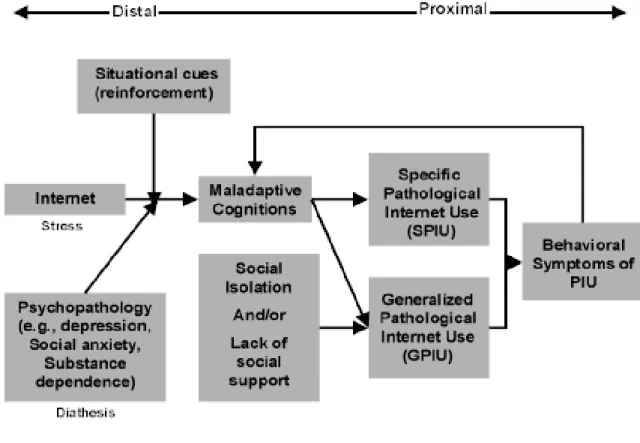
Davis (2000) constructed a model of PIU based on the assumption that PIU is the result of faulty cognitions paired with behaviors that serve to strengthen or preserve the dysfunctional response (see Figure 1). In this model, causes of the PIU are placed on an etiological chain ranging from distal to proximal. Distal causes are near the beginning of the problem. Proximal causes are found toward the end of the chain.
Figure Caption
Figure 1. Davis’ (2000) Cognitive-Behavioral Model of Pathological Internet Use (PIU) detailing the etiology of PIU.
Davis (2000) utilized a diathesis-stress framework to explain the distal contributory causes of PIU. Under the diathesis stress framework, dysfunctional behavior is the result of a pre-existing susceptibility (diathesis) and a life experience (stress). The Cognitive-Behavioral Model suggests that psychopathologies such as depression, social anxiety, or substance abuse are necessary as a distal cause for the symptoms of PIU to occur. The psychopathology does not cause the symptoms of PIU by itself, but is a basic component in the etiology of the disorder.
The Cognitive-Behavioral Model assumes that the original psychopathology will leave the individual more susceptible to developing symptoms of PIU. The initial exposure to the Internet or a new online technology is labeled as the stressor in the diathesis-stress model. This initial exposure to the new technology is viewed as a distal cause of the development of the disorder. Davis (2000) noted that the exposure to a new technology would be a more empirically testable event than a person’s first exposure to the Internet. Some examples of the exposure to a new Internet technology include the first time an Internet user utilizes a pornographic web site, an online auction, or a chat room. None of these events are viewed as a cause of pathological use, but each may be contributing factors.
One of the key factors in whether or not a person continues to utilize new
technologies is the reinforcement they receive from the experience (Davis, 2000). If the individual has a positive experience with the new technology, she or he is reinforced to continue its use. This positive experience serves to condition the individual to attempt to repeat the use of the new technology in order to receive the same positive reinforcement
he or she experienced previously. This form of operant conditioning continues until the person searches for new online applications to achieve similar positive physiological reinforcement. Based on this model, any stimulus that becomes associated with the principal conditioned stimulus may become a secondary reinforcer. Therefore, events and objects associated with being online such as the sound of the modem connecting, the feel of typing on a keyboard, or the sight of a computer may become secondary
reinforcers and lead to the response that has been conditioned. These types of secondary reinforcers can encourage the development of symptoms of PIU and help to maintain the related symptoms.
According to Davis (2000), one of the most important facets of the cognitive-behavioral model of PIU is the occurrence of maladaptive cognitions. These maladaptive cognitions are proximal causes of the disorder and are sufficient to cause symptoms of PIU. Davis (2000) divides these maladaptive thoughts into two categories: thoughts about self and thoughts about the world. Maladaptive thoughts about self are
characterized by a ruminative cognitive style. Persons with a ruminative cognitive style are constantly thinking about online activities rather than on other life issues. It is assumed that persons with a ruminative cognitive style will experience PIU for longer periods of time and with more severe symptoms than individuals who do not have this cognitive style. Some other maladaptive cognitions include self-doubt, low self-efficacy, and negative self-assessments. These individuals likely have a negative self-concept and utilize the Internet to receive positive feedback in a non-threatening environment.
Persons who are suffering from cognitive distortions about the world will generalize specific events on the Internet to more global trends in the real world. Davis (2000) gives the following examples of global distortions: “The Internet is the only place I am respected,” “Nobody loves me offline,” “The Internet is my only friend,” or “People treat me badly offline.” “This all-or-nothing thinking is considered a maladaptive
cognitive distortion that exacerbates the individual’s Internet dependence” (Davis, 2000). Either of the previously mentioned cognitive distortions is activated automatically
whenever a stimulus associated with being online is encountered.
In terms of symptoms, Davis’ (2000) Cognitive-Behavioral Model of PIU is generally in agreement with Young (1996). However, Davis (2000) places a greater emphasis on the cognitions involved in the disorder than earlier research. The most prominent symptoms of the disorder are obsessive thoughts about the Internet, reduced impulse control, lack of ability to stop using the Internet, and a belief that the Internet is the individual’s only social support. These individuals will often believe that the
Internet is the only place where they can have positive feelings about themselves and the outside world.
Other symptoms of the disorder include thoughts about the Internet while offline, looking forward to future time online, and spending excessive amounts of money on Internet related expenses. The amount of time spent in previously enjoyable and/or essential activities is reduced in favor of additional time online (Young, 1996).
Significant relationships also suffer as a result of the pathological user becoming more isolated due to their time spent online. As users become more isolated, they will tend to
develop guilty feelings about their spent time online. Lies are often used to conceal the extent of the users time online. Pathological users often realize what they are doing is socially unacceptable, but do not know how to control their online behavior. Ultimately, pathological users feel a diminished sense of self worth and become entangled in a cycle that results in broadening the symptoms of PIU. These various problems can exist within specific or generalized PIU.
Suler’s Eight Factors of PIU
Suler (1999) hypothesized that differentiating between healthy and PIU could be accomplished by examining 8 factors. “One’s passion for the Internet can be healthy, pathologically addictive, or somewhere in between” (Suler, 1999). The eight factors to determine the nature of a person’s relationship with the Internet include:
I) The number and type of needs being addressed by the online activity. Internet users may attempt to meet physical, intrapersonal, interpersonal, or spiritual needs. The more needs the user attempts to address via the Internet, the more important the Internet becomes for that person. II) The underlying degree of deprivation of unmet needs. The more the
user’s underlying needs have been stifled or denied, the more the user will look for ways to meet those needs. The Internet is often a place where these needs are more easily met than the real world.
III) The type of Internet activity. The more features that a particular activity involves, the more needs the user may attempt to meet via the Internet. “Different types of Internet activities can vary greatly in how they
influence different needs. Environments that combine a variety of features may address a wider spectrum of needs and, consequently, may be more captivating” (Suler, 1999).
IV) The effect of the Internet on user’s real-life ability to function. Functioning may be impacted in the areas of physical health, work
performance, and significant relationships. The number of these areas that are impaired by Internet use and the profundity of the disruption will expose the seriousness of the pathology.
V) Subjective feelings of distress. Warning signs of Pathological Internet Use often include feelings of depression, frustration, anger, guilt, and alienation related to the user’s Internet activities.
VI) Conscious awareness of needs. “The more a person understands his motivations, the more they lose their power as the unconscious thing leading to compulsive Internet use” (Suler, 1999). A person acting out repressed needs through Internet activities is merely conducting a cathartic activity that will have to be repeated endlessly unless the real unmet needs are addressed. “Working through underlying needs means that one
resolves the conflicts or deprivations related to the Internet activities, in part, by consciously understanding what those needs entail” (Suler, 1999). VII) Experience and the phase of the involvement. As Internet users gain
their real world needs or the novelty of the Internet wears off. Experience often helps users avoid activities that require excessive involvement. VIII) The balance and integration of in-person and cyberspace living. Healthy
Internet use involves an integration of online activities and relationships with real world relationships and activities. “Pathological Internet Use often results in an online life that is completely isolated from one’s in-person life and even guarded against perceived intrusions from the real world” (Suler, 1999).
Grohol’s Three Stage Model of PIU
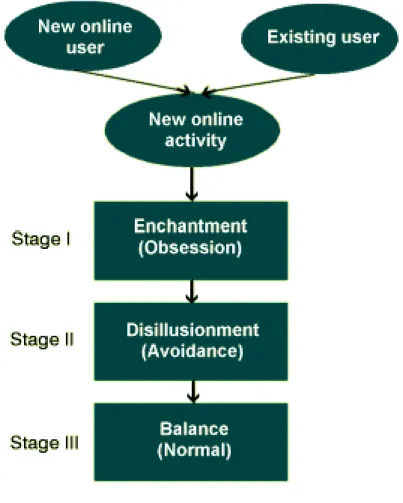
Grohol (1999) suggested that PIU follows a rather simple three-stage progression in both new and existing Internet users (see Figure 2). In stage one, the user is
“enchanted” with the new technology or new application on the Internet. This
enchantment or obsession with new activity results in an overuse of the technology until the subject moves into stage two. In stage two, the online user becomes disillusioned or even bored with the new technology on the Internet and begins to avoid using the
technology due to the overuse. This avoidance will last until the subject moves into stage three. In stage three, the user finds a balance and begins to use the new technology at a “normal” level that does not interfere with the subject’s other areas of functioning.
Figure Caption
Figure 2. Grohol’s Model of Pathological Internet Use that demonstrates the development of PIU in three stages.
Grohol’s (1999) Model of PIU makes several assumptions. First, the model assumes that some people simply get “stuck” in the first stage when they encounter a new technology on the Internet. These individuals that get stuck in the first stage may need assistance in advancing to the second and third stages. It is assumed that experienced
Internet users will have an easier time moving through the three stages than less
experienced or new Internet users. Grohol (1999) hypothesized that “all online activity is phasic to some degree, all people will eventually get to Stage III on their own. Most adults online will also learn how to responsibly integrate the Internet into their lives.” However, some individuals will take longer than others to make this progression. Finally, Grohol, concluded that existing Internet users my re-enter this model as they encounter new activities on the Internet.
Unfortunately, Grohol’s model does not address many important factors that may contribute to PIU such as pre-existing or newly developed mental health issues (Shapira, et al., 2000). The model suggests that PIU only occurs when an Internet user encounters a new online activity, but does not allow for the possibility that an activity that is not necessarily new to the user could be used in a pathological manner at later time. It would seem possible that a new stressor (example: end of a significant relationship) could create a situation in which an activity that was previously neutral online activity (example: instant messaging) could later be used in a pathological manner as suggested by Davis’s (2000) cognitive-behavioral model of PIU. Furthermore, this model does not address the reality that some Internet users seem to be unable to reduce or control their use of certain types of activities online (Jones & Minatrea, 2001).
Hall & Parsons’ Internet Behavior Dependency
One of the latest attempts to define PIU, Hall and Parsons (2001), directly attacked the definitions of their predecessors such as Goldberg (1996), Griffiths (1998), Kandell (1998), and Young (1996). Hall and Parsons (2001) noted that previous
attempts at defining Internet related disorders were based on DSM-IV criteria for either pathological gambling or substance dependence, but did not address other critical issues related to the disorder. The first critical issue often ignored by previous definitions was the failure to address co-morbid mental health issues (Shapira, Goldsmith, Keck, Khosa, & McElroy, 2000). Second, many of the studies were conducted online, which is probably not appropriate for separating normal behavior from unhealthy behavior (Griffiths, 1998). Third, there has often been no attempt to discriminate between time that is spent online for normal work and online time that is pathological in nature. Finally, previous definitions begin with an assumption of pathology and are deficient in theoretical basis (Grohol, 1999).
Hall and Parsons (2001) offered Internet Behavior Dependence (IBD) as an improved definition of Internet-related disorders. The definition offered was consistent with an addictions point of reference and assumed that persons addicted to the Internet would demonstrate several “dependent” conditions that were previously reported by Rasmussen (2000). The expected conditions included: failure to fulfill major role requirements at home, work, or academically; more time online with less pleasure;
agitation when not online; failed attempts to reduce, control, or eliminate time online; and continued use despite knowledge of physical, mental, and social difficulties related to extreme use (Rasmussen, 2000). Hall and Parsons (2001) state that they do not utilize a model of pathology for Internet related problems. First, it is assumed that excessive Internet use is a relatively harmless problem in living that is an attempt to compensate for lack of satisfaction in other areas of functioning. Second, average individuals can correct
the behaviors associated with excessive Internet use. Finally, Hall and Parsons (2001) postulate that IBD is created by a maladaptive coping style that can be treated with cognitive-behavioral treatments. The definition of IBD attempts to provide a person-centered and holistic alternative to the previous definitions of PIU.
Hall and Parsons (2001) do an adequate job of assessing weaknesses of the previous research and definitions, but fail to provide a viable alternative operational definition of PIU that is empirically testable or superior to those which are currently available. In fact, Hall and Parsons (2001) seem to contradict themselves when they suggest that clinicians should be aware of and “use with caution” assessments such as Brenner’s (1997) Internet-Related Addictive Behavior Inventory (IRABI) and the C— IRABI-II (Chou & Hsiao, 2000). However, problems exist with most, if not all of the current assessment tools for PIU (Davis, 2001b).
Challenges to PIU Theories and Research
Determining what level or type of Internet use is pathological is one of the greatest challenges and controversies related to PIU. Grohol (1997) and Holmes (1997) suggested that one of the major problems in diagnosing and defining PIU is the limited research into what is normal Internet use. Armstrong, Phillips, and Saling (2000) noted that little is known about the similarities and dissimilarities between PIU and other types of addictions or compulsions. Grohol (1997) suggested that mental health professionals often attempt to, “look for and diagnose that which does not fit within their cognitive paradigm of what is ‘normal.’” Grohol (1997) also questioned if it is really possible to
define Internet overuse or abuse since most of the data on normal Internet use is preliminary in nature.
One caveat of the research that supports the notion that there still is not an ideal way to define normal Internet use is the wide range of average time spent online reported by various studies. For example: the average subjects in Holmes (1997) reported an average of 19 hours per week spent online, Benner (1997) reported that dependent users spent an average of 11 hours per week, and Morahan-Martin and Schumacher (1997) stated that pathological users spent an average of 8.5 hours online per week. Each of these authors used varying standards to determine what type of level of Internet use was unhealthy. One constant among all research into PIU has been the finding that
pathological behavior and consequences are positively correlated with increased hours online regardless of how the study operationally defined the construct of PIU (Anderson, 2001; Brenner, 1997; Holmes, 1997; Morahan-Martin & Schumacher, 1997; Young, 1998). Holmes (1997) further suggested that it is relatively simple to define when
Internet use is pathological: the use of the Internet interferes with other parts of one’s life. Due to the wide range of time spent online in various studies, Grohol (1997) concluded that time spent online alone was not adequate to make a determination of what level of internet use is normal and what is harmful. “We cannot define overuse of the Internet based solely upon time spent online, since estimates still vary widely as to what is considered normal or appropriate (from 5 hours to 20 hours per week). We cannot examine criteria used to help diagnose other addictive disorders, since they appear to be relatively commonplace even amongst casual Internet users” (Grohol, 1997). Holmes
(1997) supported this position by stating that what a person does online is probably as important as how much time that person spends online. Davis (2001b) noted that pathological use is not solely in the user’s behaviors, but also in their cognitions.
Essentially, pathological users not only behave differently, but they also think differently than a healthy Internet user and in many cases experience negative outcomes due to their Internet use (Griffiths, 2001; Morahan-Martin & Schumacher, 1997; Kubey, Lavin, & Barrows, 2001).
An additional challenge in researching this issue with the college student population is what may be defined as normal or average Internet use may vary greatly based on academic major (Anderson, 2001). Anderson found that students in science and technology related majors often reported spending significantly more time online and more symptoms of PIU. Davis et al. (1999) also suggested that the size (large versus small) and type (public versus private) institution might be an additional variable to consider in exploring college student Internet use. Grohol (1997) finally concluded that the current research is preliminary, cloudy, contradictory, and not conclusive.
Consequently, Grohol concluded that the current research does not support the existence of an Internet Addiction disorder. However, the weaknesses of the current literature have encouraged rather than discouraged a greater quantity and in some cases, quality research into the question of Internet Addiction.
Davis (2001b) noted previous assessments of PIU were contaminated or
methodologically unsound for various reasons. Most of the assessments let the subject know exactly what aspect of their behavior is being measured simply by reading their
names. Some examples of these obvious assessments include the Internet Addiction Test (Young, 1999), Internet-Related Addiction Behavior Inventory (Brenner, 1997), and Internet Related Problem Scale (Armstrong, Phillips, & Saling, 2000). Davis (2001b) suggested that assessments of PIU should predict rather than describe Internet-related behavior. The general research suggests that there are a significant number of persons experiencing problems that fit the various definitions of PIU. Most research of PIU is finding small but significant numbers of people who are reporting problems worthy of further research and in some cases clinical attention. Consistently, the literature that has not supported attempts to refute the existence of PIU, is almost exclusively a critical review or critique. Real scientific research has not been able to completely explain why some individuals have been reporting similar problems in increasing numbers of studies since the mid 1990’s.
Theories of Pathological Internet Use Related to College Students Kandell’s Theory of College Student Internet Use
Kandell (1998) suggested that college students are particularly vulnerable to Internet Addiction for several reasons. Reasons for college students being susceptible to PIU include: psychological and developmental characteristics of young adults, easy access to the Internet, and the expectation of Internet use. Kandell (1998) suggested that PIU in the college student population is similar to compulsive exercise. Exercise is generally healthy and for most people necessary to maintain fitness. Most individuals can exercise without serious consequences, however some individuals become dependent on the positive feelings that exercise arouses. The positive feelings fuel the individual to
exercise to a point that actually diminishes the individual’s health. In a similar fashion, the Internet has become a required learning and communication tool for most, if not all college students. Kandell’s supposition that college students are an at-risk population for PIU has been consistently supported in the literature (Anderson, 2001; Armstrong, Phillips, & Saling, 2000; Hall & Parsons, 2001; Morhan-Martin & Schumacher, 1997).
Kandell (1998) stated that the most critical factors that add to the vulnerability to PIU of college students are psychological and developmentmental issues which persons of traditional college age typically encounter. “Traditional-age college students (and non-students of this age as well) face two important tasks: (a) development of a firm sense of identity and (b) development of meaningful, intimate relationships, both emotionally and physically, with romantic partners” (Erikson, 1963). Successful completion of these developmental tasks is not automatic and some individuals do not successfully complete these developmental tasks. “The demands of these transitions, especially for students, who must balance academic requirements, frequently produce a good deal of stress, depression, interpersonal problems, and other psychological
symptoms” (Kandell, 1998).
The first factor contributing to the vulnerability of college students is related to the stage of life developmental issues. For example, most addictive behaviors such as drinking, drug abuse, gambling, sex, exercise, and eating disorders start or increase during this stage of life (Kandell, 1998). Kandell (1998) hypothesized that addictive behaviors serve two purposes for traditional college students. First, the addictive behavior acts as a coping tool for students who are not effectively handling the
developmental challenges required by this stage of life. Next, these addictive behaviors then act as a pathological mechanism to resolve these developmental challenges. The Internet may serve as a place where students attempt to resolve unmet needs.
The second factor contributing to the vulnerability of college students is the free and relatively easy access to the Internet (Kandell, 1998). Many colleges provide free and unlimited Internet use to their students. Hourly usage fees that may have limited excessive use have been replaced by set fees for unlimited access; thus eliminating financial reasons for limiting time online. Most colleges provide students access to the Internet in academic buildings and increasing numbers of colleges are providing high-speed access in student housing and at various locations via wireless Internet access points. In comparison to the general population, 86% of college students have gone online, versus 59% of the general population (Jones, 2002).
The third factor that contributes to the vulnerability of college students to PIU is the encouragement and often requirement of Internet use in college classes (Kandell, 1998). The Internet is often a natural extension of the classroom, however it is very easy for students to move from working on an academic assignment to surfing the Internet, checking e-mail, or talking in a chat room. For most students this momentary diversion will not have long-term consequences. In contrast, the student who cannot limit his or her time in this diversion will likely experience problems in one or more areas of development and functioning.