Performance Evaluation of Job Scheduling and
Resource Allocation in Apache Spark
A Thesis Submitted to the
College of Graduate and Postdoctoral Studies
in Partial Fulfillment of the Requirements
for the degree of Master of Science
in the Department of Computer Science
University of Saskatchewan
Saskatoon
By
Habib Ado Sabiu
Permission to Use
In presenting this thesis in partial fulfilment of the requirements for a Postgraduate degree from the University of Saskatchewan, I agree that the Libraries of this University may make it freely available for inspection. I further agree that permission for copying of this thesis in any manner, in whole or in part, for scholarly purposes may be granted by the professor or professors who supervised my thesis work or, in their absence, by the Head of the Department or the Dean of the College in which my thesis work was done. It is understood that any copying or publication or use of this thesis or parts thereof for financial gain shall not be allowed without my written permission. It is also understood that due recognition shall be given to me and to the University of Saskatchewan in any scholarly use which may be made of any material in my thesis. Requests for permission to copy or to make other use of material in this thesis in whole or part should be addressed to:
Head of the Department of Computer Science University of Saskatchewan
176 Thorvaldson Building, 110 Science Place Saskatoon, Saskatchewan S7N 5C9
Canada
OR
Dean
College of Graduate and Postdoctoral Studies University of Saskatchewan
116 Thorvaldson Building, 110 Science Place Saskatoon, Saskatchewan S7N 5C9
Abstract
Advancements in data acquisition techniques and devices are revolutionizing the way image data are collected, managed and processed. Devices such as time-lapse cameras and multispectral cameras generate large amount of image data daily. Therefore, there is a clear need for many organizations and researchers to deal with large volume of image data efficiently. On the other hand, Big Data processing on distributed systems such as Apache Spark are gaining popularity in recent years. Apache Spark is a widely used in-memory framework for distributed processing of large datasets on a cluster of inexpensive computers. This thesis proposes using Spark for distributed processing of large amount of image data in a time efficient manner. However, to share cluster resources efficiently, multiple image processing applications submitted to the cluster must be appropriately scheduled by Spark cluster managers to take advantage of all the compute power and storage capacity of the cluster. Spark can run on three cluster managers including Standalone, Mesos and YARN, and provides several configuration parameters that control how resources are allocated and scheduled. Using default settings for these multiple parameters is not enough to efficiently share cluster resources between multiple applications running concurrently. This leads to performance issues and resource underutilization because cluster administrators and users do not know which Spark cluster manager is the right fit for their applications and how the scheduling behaviour and parameter settings of these cluster managers affect the performance of their applications in terms of resource utilization and response times.
This thesis parallelized a set of heterogeneous image processing applications including Image Registration, Flower Counter and Image Clustering, and presents extensive comparisons and analyses of running these applications on a large server and a Spark cluster using three different cluster managers for resource allocation, including Standalone, Apache Mesos and Hodoop YARN. In addition, the thesis examined the two different job scheduling and resource allocations modes available in Spark: static and dynamic allocation. Furthermore, the thesis explored the various configurations available on both modes that control speculative execution of tasks, resource size and the number of parallel tasks per job, and explained their impact on image processing applications. The thesis aims to show that using optimal values for these parameters reduces jobs makespan, maximizes cluster utilization, and ensures each application is allocated a fair share of cluster resources in a timely manner.
Acknowledgements
I would like to express my sincere appreciation to everyone who helped make this work possible. My utmost gratitude goes to my incredibly patient supervisors; Dr. Dwight Makaroff and Dr. Winfried Grassmann, who helped me immensely throughout my Masters program at the University of Saskatchewan. Thank you for providing me with endless support, guidance, and your valuable time. I would also like to thank my perpetually tolerant committee members: Dr. Derek Eager, Dr. Kevin Schneider and Dr. Seok-Bum Ko, for their insightful comments and constructive suggestions. Finally, I would like to thank my parent and siblings for their continuous encouragement and support.
This thesis is gratefully dedicated to the memory of my beloved father, Ado Sabiu and
to my lovely mother, Hadiza Mukhtar Sarkinbai, who has always been my role model and
inspiration. Thank you for all the love and support.
Contents
Permission to Use i
Abstract ii
Acknowledgements iii
Contents v
List of Tables vii
List of Figures viii
List of Abbreviations ix
1 Introduction 1
1.1 Big Data Framework Concepts . . . 2
1.2 Distributed Image Processing . . . 4
1.3 Thesis Motivation . . . 4
1.4 Thesis Statement . . . 6
1.5 Thesis Organization . . . 6
2 Background and Related Work 7 2.1 Background . . . 7
2.1.1 Definitions . . . 7
2.1.2 Overview of Apache Spark . . . 11
2.1.3 HDFS and Spark RDD Partitions . . . 12
2.1.4 The Concept of Resource in Spark . . . 13
2.1.5 Spark Runtime Architecture . . . 13
2.2 Spark Cluster Managers . . . 15
2.2.1 Spark Standalone . . . 16
2.2.2 Apache Mesos . . . 17
2.2.3 Hadoop YARN . . . 19
2.3 Resource Allocation Modes . . . 21
2.3.1 Static Resource Allocation . . . 21
2.3.2 Dynamic Resource Allocation . . . 22
2.4 Related work . . . 24
2.4.1 Job Scheduling and Resource Allocation in Distributed Systems . . . 24
2.4.2 Image Processing on Distributed Systems . . . 31
2.5 Summary . . . 35
3 Experimental Design 36 3.1 Hardware and Software Configurations . . . 36
3.1.1 Sever Configurations . . . 36
3.1.2 Spark Cluster Configurations . . . 36
3.2 Chosen Parameters . . . 37
3.2.1 Parameters to Control Resource Scheduling and Allocation . . . 38
3.2.2 Parameters to Control Number of Parallel Tasks Per Job . . . 38
3.2.3 Parameters to Control Speculative Execution of Tasks . . . 38
3.2.4 Parameters to Control Resource Size Per Spark Executor . . . 39
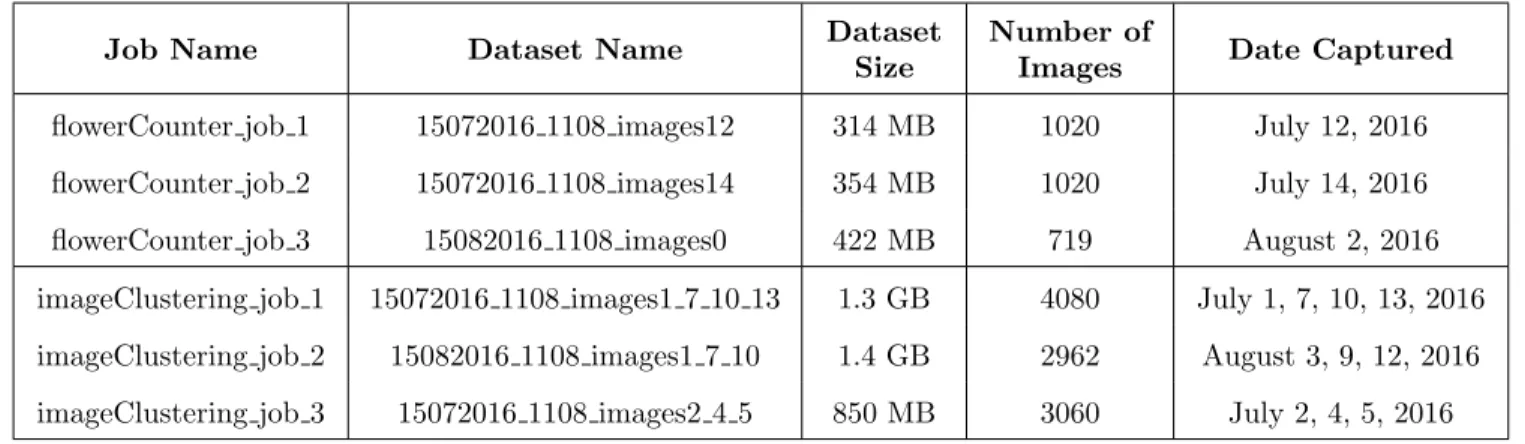
3.4 Description of Datasets . . . 41
3.5 Workload Applications . . . 42
3.5.1 Sequential and Distributed Versions . . . 43
3.5.2 Image Registration . . . 44
3.5.3 Flower Counter . . . 45
3.5.4 Image Clustering . . . 47
3.6 Description of Experiments . . . 48
3.6.1 Submitting Applications to Server and Cluster . . . 49
3.6.2 Experimentation Parameter Settings . . . 49
3.7 Summary . . . 51
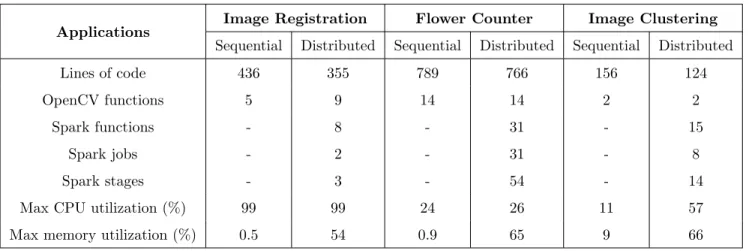
4 Experimental Results and Discussion 52 4.1 Workload Applications Resource Characteristics . . . 52
4.2 Performance of the Sequential and Distributed Applications . . . 55
4.3 Evaluating Makespan Differences of Multiple Runs . . . 58
4.4 Impact of Spark Resource Allocation Modes on Makespan . . . 60
4.4.1 Resource Utilization Under Static Resource Allocation . . . 60
4.4.2 Resource Utilization Under Dynamic Resource Allocation . . . 63
4.4.3 Submitting New Set of Jobs After Cluster Utilization Drops . . . 66
4.4.4 Factors Affecting the Makespan . . . 67
4.5 Impact of Speculative Execution of Tasks on Makespan . . . 71
4.5.1 Analysis of Speculation on the Workload Applications . . . 73
4.6 Impact of Spark Executor Size on Makespan . . . 78
4.7 Analysis of Makespan Performance Improvements . . . 83
4.8 Summary . . . 84 5 Conclusions 86 5.1 Thesis Summary . . . 86 5.2 Thesis Contributions . . . 87 5.3 Future Work . . . 88 References 90
List of Tables
2.1 Spark Schedulling Configuration Parameters . . . 14
2.2 Characteristics of the Cluster Managers Tested . . . 15
2.3 Spark Dynamic Resource Allocation Configuration Parameters . . . 23
3.1 Testbeds Hardware Configurations . . . 37
3.2 Cluster Resources . . . 38
3.3 Drone Images Characteristics . . . 42
3.4 Still Camera Images Characteristics . . . 42
3.5 Workload Applications Characteristics . . . 43
3.6 Parameter Configurations for all Experimental Sets . . . 50
List of Figures
1.1 MapReduce pipeline [62] . . . 3
2.1 Spark architecture [32] . . . 11
2.2 Running applications on Spark [31] . . . 16
2.3 Running applications on Mesos [29] . . . 18
2.4 Running applications on YARN [44] . . . 20
4.1 CPU and memory resource usage: Standalone/static/1 core/2 GB/32 MB/no speculation . . 54
4.2 Initial Makespan Measurements - Cluster and Single Machine . . . 56
4.3 Multiple runs of the same experimental setup: Static/1 core/2 GB/32 MB/no speculation . . 59
4.4 Resource utilization of Standalone with static resource allocation . . . 61
4.5 Resource utilization of YARN with static resource allocation . . . 62
4.6 Resource utilization of Mesos with static resource allocation . . . 63
4.7 Resource utilization of Standalone with dynamic resource allocation . . . 64
4.8 Resource utilization of YARN with dynamic resource allocation . . . 65
4.9 Resource utilization of Mesos with dynamic resource allocation . . . 65
4.10 Resource utilization of two group of workloads . . . 67
4.11 Makespan comparison: static/1 core/2 GB/no speculation . . . 68
4.12 Makespan comparison: dynamic/1 core/2 GB/no speculation . . . 69
4.13 Makespan comparison: static with and without speculation/1 core/2 GB . . . 72
4.14 Makespan comparison: dynamic with and without speculation/1 core/2 GB . . . 73
4.15 Tasks running times of the Image Clustering application . . . 75
4.16 Tasks running times of the Flower Counter application . . . 76
4.17 Tasks running times of the Image Registration application . . . 77
4.18 Makespan of various executor sizes on Standalone without speculation . . . 80
4.19 Makespan of various executor sizes on YARN without speculation . . . 81
4.20 Makespan of various executor sizes on Mesos without speculation . . . 82
List of Abbreviations
API Application Programming Interface DRF Dominant Resource Fairness FIFO First In First Out
HDFS Hadoop Distributed File System HPC High Performance Computing JVM Java Virtual Machine
MPI Message Passing Interface
NDVI Normalized Difference Vegetation Index RAM Random Access Memory
RDD Resilient Distributed Datasets SLA Service Level Agreement SLO Service Level Objectives SQL Structured Query Language YARN Yet Another Resource Negotiator
Chapter 1
Introduction
Big Data frameworks such as Hadoop [62] and Spark [69] are used for distributed processing of large datasets that scale to thousands of processors and terabytes of Random Access Memory (RAM) in cluster configurations. Hadoop is the open source implementation of the MapReduce framework [14] developed by Google in 2004. MapReduce provides a strategy for implementing and executing large scale data intensive applications in parallel on clusters. This parallel execution of applications reduces the latency between the submission of jobs and the availability of results, helping in batch processing of large datasets. Spark [69] was introduced in 2010 to support certain classes of applications that are not suitable for MapReduce such as iterative machine learning algorithms and interactive requests. The primary advantage of Spark over other data processing engines such as Hadoop is the use of distributed memory abstraction called Resilient Distributed Datasets (RDD), which provides in-memory computation and supports coarse-grained transformations to improve performance of interactive request and iterative algorithms. In-memory is a concept used to store massive amounts of data in the main RAM of computers across a cluster to provide fast access to the data and minimize the requirements of disk I/O.
Modern image data acquisition devices such timelapse cameras and drones equipped with multispectral cameras generate large amounts of image data used in sophisticated image processing, statistical, and machine learning algorithms to extract useful information for crop breeders and producers. This thesis proposes using Spark as a viable means of distributing and running multiple image processing applications concurrently on a cluster to minimize jobs makespan (that is the total time that elapses from submitting the first job until the end of the job that finishes last). In order to share cluster resources efficiently, the multiple jobs submitted to the cluster must be appropriately scheduled by the cluster manager to take advantage of all the compute power, memory and networking capacity of the cluster. Spark relies on three cluster managers including a) Standalone which comes as part of the Spark distribution, b) Mesos, and c) YARN for job scheduling and resource allocation. In addition to supporting three different cluster managers, Spark provides two modes of resource allocation: static allocation and dynamic allocation; as well, many configuration parameters are available that control speculative execution of tasks and size and number of resources to allocate to the submitted applications.
The default mode for resource allocation available on the three Spark supported cluster managers consid-ered in this thesis is Static Resource Allocation. With this approach, applications are assigned resources at
the start of execution, and hold on to them for their whole duration. Although this approach could provide speedup gains in a single user or a batch oriented cluster, it is not ideal in a shared cluster where multiple ap-plications need to run concurrently, since apap-plications that are not able to utilize all their allocated resources may still hold on to them. This increases the makespan of the set of applications and leads to inefficient utilization of cluster resources.
Initial experiments that were performed showed that the default parameter settings for this approach allow applications to grab all the cluster resources when running on Standalone and Mesos cluster managers, or request very minimal number of executors regardless of available resources when running on YARN clus-ter manager. Since this is not efficient for sharing clusclus-ter resources between multiple applications, Spark introducedDynamic Resource Allocation, which is specifically designed to dynamically adjust the resources that applications use based on the current workload. With Dynamic Resource Allocation, applications can request additional resources when they need them, and give these resources back to the cluster manager when they are no longer used, leading to better cluster utilization and efficient resource sharing between multiple applications.
There are also many configuration parameters that control the behaviour of this resource allocation mode such as the initial, minimum and maximum number of executors that could be allocated to applications, when to remove executors that have been idle for more than a certain duration of time and the duration for which pending tasks must wait before an application can request a new executor. The default settings for these parameters are not sufficient, however, to share resources efficiently between multiple applications running concurrently on a shared cluster. Finally, different cluster managers have different job scheduling and resource allocation policies, which could affect the performance of image processing applications.
Cluster administrators must decide which cluster manager is the best fit for their specific type of applica-tions, what mode of resource allocation to use, and how to tune the multiple scheduling and resource allocation parameters of Spark to get the best application performance and efficient resource utilization. Therefore, it is very important to understand if and how the different resource allocation policies implemented in the three Spark cluster managers affect performance. This thesis analyzes and evaluates the performance impact of the two different job scheduling and resource allocation modes available on Spark, including static and dynamic allocation, and explore the various Spark configurations that control speculative execution of tasks, resource size and the number of parallel tasks per job, and their effects on image processing applications.
1.1
Big Data Framework Concepts
MapReduce [14] is a programming model for distributed processing of large datasets on clusters of commodity hardware (relatively inexpensive and widely available), where nodes in the cluster are equipped with both storage and computation resources. The MapReduce algorithm is made up of two phases, namely Map and Reduce. The Map phase takes a dataset of key/value pairs, applies a user defined function to all the elements
in the dataset and generates a set of intermediate key/value pairs as output. The Reduce phase aggregates the intermediate key/value pairs from Map output and merge all the values with the same intermediate key. Figure 1.1 shows the various stages of MapReduce. Since many real world data processing tasks can be modelled in this way [14], MapReduce has been widely adopted in both academia and industry for batch processing of large datasets [56]. The advantages of MapReduce are that it provides a simple model that supports automatic parallelization, fault-tolerance, data distribution and load balancing. It is also easy to scale big data processing over multiple computing nodes using this model.
Figure 1.1: MapReduce pipeline [62]
Hadoop is an open source framework for distributed processing of large datasets using a cluster of comput-ers. The framework implements the MapReduce programming model for large scale data processing across clusters of commodity machines, and uses the Hadoop Distributed File System (HDFS) [51], which is a high-throughput and reliable distributed file system for easy storage and retrieval of large datasets across multiple machines. Hadoop provides high-availability and fault tolerance in case of node failures. The initial version of Hadoop is tightly coupled to the MapReduce programming model; today’s big data processing applications require new and more complex data processing engines that can handle modern workloads such as interactive SQL, real-time streaming, machine learning, and graph processing.
Although MapReduce is very powerful for distributed batch processing of large datasets, it does not perform well for two classes of applications: iterative algorithms that perform a set of operations multiple times on the same subset of a dataset such as machine learning applications, and interactive data mining where users runs multiple queries over the same subset of data. This is because MapReduce shuffles intermediate data to an external storage e.g. disk, therefore, for applications that reuse intermediate data multiple times, disk or network I/O would become a bottleneck. In these applications, keeping intermediate data in-memory
can substantially improve performance. To address this, researchers proposed Resilient Distributed Datasets (RDDs) [68] that allows applications to keep intermediate data in memory, in a parallel and fault-tolerant way, and reuse the data multiple times, therefore, providing a substantial performance improvement. RDDs are the basic data abstraction in Apache Spark.
Spark [69] is a general engine for large-scale distributed data processing that supports both batch and streaming processing. Using in-memory computation, Spark increases its performance over other frameworks, such as Hadoop, in two types of computation: 1) iterative algorithms that reuse intermediate results across multiple computations and 2) interactive data mining where users run multiple queries over the same subset of data. Spark provides high-level APIs in different programming languages including Java, Scala, Python and R, making it easier to write distributed image processing applications using several image processing libraries already implemented in these languages. It also supports higher-level tools including Spark SQL for SQL and structured data processing, MLlib for machine learning, GraphX for graph processing, and Spark Streaming.
1.2
Distributed Image Processing
The advancement of image acquisition tools such as modern cameras, sensors, satellites and drones has made capturing of large scale image data possible. This provides great opportunity for both science and industry to apply sophisticated image processing, statistical, and machine learning algorithms on large scale images to extract useful information, which could be used for a vast number of applications in areas such as Agriculture, Geographic Information System, Medicine and Security. As the volume of data becomes large, the main concern is how to store and process the generated data in a cost and time efficient manner. Modern image processing algorithms such as image registration [73], image segmentation and object recognition [4] are complex and resource intensive. Fast and efficient execution of these algorithms on a large dataset requires substantially more computation and storage power than that of a traditional desktop computer.
1.3
Thesis Motivation
Distributed processing of large datasets across multiple nodes on a cluster has been gaining popularity in recent years. For such large clusters, multiple applications with different resource requirements could run along side each other concurrently. Therefore, it is very important to ensure that multiple applications are able to share cluster resources efficiently in order to achieve maximum cluster resource utilization and minimize jobs makespan on shared clusters.
This thesis proposes using Apache Spark to speedup processing of large image data in a time and cost effective manner. Although some stages within the workload applications used in this thesis do not necessarily make use of the main advantage of Spark - keeping intermediate data in memory, these sets of applications
still benefit from using other features such as distributed processing and optimization of the implementation of various machine learning algorithms.
Among the many distributed data processing frameworks available, Spark was chosen for implementing and executing the workload applications used in this thesis: Spark is a stable, popular and widely used engine for large-scale distributed data processing. Furthermore, Spark has the advantage of providing supports for many modern programming languages including Python - the language in which the sequential versions of the applications are originally written. This substantially reduces the software development process of converting the sequential Python code to Spark, and provides the ability to use the same processing pipeline and easily integrates with other libraries available in Python. Spark provides a Standalone cluster manager as part of its distribution, which implements a simple FIFO scheduling for multiple concurrently running applications. In addition, Spark applications can be submitted to Apache Mesos [25] and Hadoop YARN [56] clusters. Mesos was started in 2009 with the aim of improving resource utilization by dynamically sharing resources among multiple frameworks (such as Spark applications). YARN was introduced in next generation version of Hadoop [62], and provides many improvements over the initial version. The basic idea behind YARN is to separate the programming model from job scheduling and cluster resource management. This makes it easy to port and run several other programming models such as Spark on top of YARN.
In contrast, the Hadoop framework is written for Java. There are no Python APIs provided by Hadoop out of the box at the time of writing this document. Applications written in Python need to be translated using third party libraries into a Java jar file. In addition, other third party Python frameworks exist for working with Hadoop. It is difficult, however, to provide a fair experimental performance analysis of the workload applications in Hadoop. These experiments and analysis are beyond the scope of this thesis.
Cluster administrators are responsible for the scheduling and allocation of cluster resources (i.e. CPU cores and memory) across multiple applications. This leads to performance issues because they must decide which cluster manager is the best fit for the applications. In addition, they must understand the benefits and overhead of enabling dynamic resource allocation on top of the different supported cluster managers, and how the various scheduling and resource allocation parameters of Spark affect the performance of multiple concurrent applications in terms of makespans and overall cluster resource utilization. Therefore, there are two motivations for this work:
• The first motivation is to parallelize a set of heterogeneous image processing applications to see if they are properly amenable to the Spark platform and in particular to being executed concurrently, and also investigate the amount of resources that are required for the distributed version of the applications running on Spark to compare with the sequential version running on a server equipped with large amount of resources. Although some of the stages in the image processing applications do not make use of the various characteristics and benefits of Spark, such as keeping intermediate data in memory, the experiments in this thesis will attempt to identify if distributed processing of these applications can provide substantial performance improvement over the traditional sequential processing.
• The second motivation is to perform an in-depth analysis of the performance implication and potential overhead of enabling dynamic resource allocation on top of the three different Spark supported cluster managers including Standalone, Mesos and YARN, and how different parameters affect the performance of multiple heterogeneous image processing applications in terms of makespan and the overall cluster resource utilization.
1.4
Thesis Statement
This thesis intend to determine whether the Spark cluster managers can be configured to reduce the makespan for image processing applications, and improve cluster resource utilization. As a case study, three applica-tions, Image Registration, Flower Counter, Image Clustering, originally written in Python will comprise the cluster workload. A set of performance experiments with various scenarios will evaluate quantitatively the performance impact of Spark configuration parameters that control resource scheduling and allocation, num-ber of parallel tasks per job, speculative execution of tasks and resource size per Spark executor, in terms of selected performance measures, including jobs makespan, CPU and memory utilization and jobs waiting and execution times.
1.5
Thesis Organization
The rest of the thesis document is organized as follows. Chapter 2 describes the background and reviews related work. Chapter 3 gives a detailed description of the hardware and software configurations of the testbeds used for evaluation, as well as the design of various experiments used in the thesis. Chapter 4 presents the results of the performance of image processing applications on different Spark cluster managers, under various job scheduling and resource allocation parameters settings. In this chapter, the results of running both the sequential and distributed version of the workload applications on the testbeds are compared and analysed. Finally, Chapter 5 presents the conclusions and contributions of the thesis along with future work.
Chapter 2
Background and Related Work
This chapter provides a detailed description of Apache Spark, including the components of a Spark application, data access from HDFS, different cluster managers that support Spark and the various policies they use for node management and resource allocation. The first part of the chapter defines and explains some of the important terms used in this thesis, as well as provides an overview of the Spark architecture, its resource structure, how applications are submitted and run, the different resource allocation modes available in Spark and how to enable them, and the various parameters that control Spark behaviour. The second part of the chapter discusses the three Spark cluster managers including Spark Standalone, Apache Mesos, and Hadoop YARN and their architecture and resource allocation policies. Apache Mesos and Hadoop YARN cluster managers are not exclusively used with Spark, but are available to allow many BigData Analytics applications to share cluster resources efficiently. Finally, the last part of the chapter presents a literature survey and describes related work.
2.1
Background
2.1.1
Definitions
This section provides definitions of the various terms used in this thesis. Most of the material provided has been adapted from the Spark online documentation page.1
Resilient Distributed Datasets (RDDs):
Resilient Distributed Datasets [68] are a fault-tolerant, distributed memory abstraction for in-memory pro-cessing of large datasets on a cluster. The RDD is the primary data abstraction in Spark. It represents an immutable, partitioned collection of elements that can be operated on in parallel. An RDD stores informa-tion about how it was computed (its lineage), and uses this informainforma-tion to reconstruct partiinforma-tions from the datasets in case of failure.
Application:
A Spark Application is a self-contained unit of computation (i.e. program) that runs user-supplied code written using the Spark API to process data. It consists of a single driver process and a set of executor processes distributed across hosts in a cluster. A Spark application can be a single batch job, an interactive session with multiple jobs, or a long-lived server process running and continually satisfying user’s requests.
Driver program:
A Spark Driver program is a process that creates a SparkContext and runs themain method of a Spark
Application. TheDriveris the process that runs user code which creates RDDs, and performs transformation and actions. It is also responsible for converting the SparkApplicationinto tasks and scheduling the tasks to run on the executors allocated to the application by the cluster manager. The task scheduler resides in the
Driver and distributes tasks among worker nodes. Therefore, the two important roles of a Driver program are converting user programs into tasks and scheduling tasks on executors.
SparkContext:
ASparkContext is the main entry point for a SparkApplication. It creates the connection to a Spark cluster and allows the Spark Driver program to access the cluster through a cluster manager. It can also be used to create RDDs, accumulators and broadcast variables on the cluster. When a SparkApplication starts, the first thing it does is create aSparkContext object that contains information about the application, and tells Spark how to access the cluster. Only oneSparkContext may be active per SparkApplication’s JVM at any given time.
SparkConf:
A SparkConf is a Spark object that stores a list of configurations for a Spark Application defined by the application programmer. TheDriver program createsSparkContext and passes these configurations to it as key-value pairs that define application properties, such as application name and required resources. When a
SparkConf object is created, it loads values from any spark-related Java system properties set in the appli-cation. Furthermore, parameters set directly on theSparkConf object take priority over system properties.
Executors:
Executors are processes launched on worker nodes and are responsible for executing the individual tasks in a given Spark Job and returning results to the Driver program. In addition, they provide in-memory storage for RDDs that are cached by user programs, through a service calledBlockManager that lives within each executor. RDDs are cached directly inside ofExecutors, therefore, tasks can run alongside the cached data. Each Spark Application consists of a set of Executor processes that stay alive for the duration of the
application and run tasks in multiple threads. This provides the benefits of isolating applications from each other, since each SparkApplication gets an independent set ofExecutor JVMs that only run tasks and store data for that application.
Job:
A Job is a set of computations, consisting of multiple tasks grouped into one or more stages and submitted to SparkDAGScheduler for computing the result of an action in parallel on different executors. A SparkJob
is triggered in response to Spark actions such asMap, Collect andCount and spawns multiple tasks. When a Spark job is triggered, an execution plan is created according to the lineage graph. The executing Job is then split into stages, where stages contain multiple transformations and actions. Generally, aJob computes the partition of a single RDD by applying different Spark actions (i.e. computations). However, to compute the partitions of an RDD, a Spark Job can also use other RDDs that are part of the target RDD’s lineage graph (i.e. all its parent RDDs).
Stage:
Spark jobs are divided into Stages. AStage is a physical unit of execution which consist of a set of smaller parallel tasks (i.e. one task per RDD partition) of a particular Job grouped together. Stages are divided based on computational boundaries, and all tasks within a particular stage depend on each other and can only work on the partitions of a single Spark RDD. However, a Stage can be associated with many other dependent parent stages. Therefore, submitting aStagecan trigger execution of a series of dependent parent stages.
Tasks:
Tasks are the smallest individual unit of execution that can run on Executors. Each Stage in a Spark
Application consists of a set of tasks that are scheduled and send from aDriver program to anExecutor by serializing a function object. TheExecutor de-serializes the command, and executes it on different partitions of a Spark RDD. Tasks are spawned one by one for eachStage and partition. In addition, a Task can only belong to one Stage and operate on a single RDD partition. Furthermore, all tasks in a Stage must be completed before the stages that follow can start.
Cluster manager:
Spark relies on cluster managers to launch executors [32]. Cluster managers are pluggable, external services responsible for scheduling and allocating cluster resources such as CPU and memory to applications. Each Spark application runs an independent set of processes on the cluster. These processes are coordinated by the application’s SparkContext which connects to the three different cluster managers that support Spark, including Spark Standalone, Apache Mesos and Hadoop YARN.
PySpark:
Spark was originally written in Scala, a language that compiles to bytecode for running on Java Virtual Machine (JVM) [45]. However, the open source community has developed a toolkit called PySpark2 that usesPy4J3library to interface with Spark’s RDDs (which are JVM objects). PySpark is a Spark Python API that exposes the Spark programming model to Python. This API allows programmers to perform various transformations and actions on Spark’s RDD using Python.
Image processing applications such as the benchmark applications used in this thesis are easily imple-mented in Python4 using various open source libraries such as the open source computer vision library
-OpenCV.5Moreover, the PySpark API easily allows programmers to parallelize applications that are already written in Python to take advantage of the extremely high-performance data processing enabled by Spark’s Scala architecture. This is especially important to programmers that are already familiar with Python be-cause it allows them to write programs in the language they are most familiar with, perform distributed transformations on large datasets and retrieve results in a Python-friendly notation. In addition, image processing applications implemented using PySpark can take advantage of other Python based scientific computing libraries such as NumPy for fast and efficient processing of large binary datasets.
Hadoop Distributed File System (HDFS):
The Hadoop Distributed File System [51] is a high throughput and fault-tolerant distributed file system that is designed to be deployed on inexpensive commodity machines. It is one of the modules included as part of the Hadoop distribution and is suitable for storing large datasets. The HDFS has a master/slave architecture, with a single master called the NameNode that manages the file system namespace and regulates access to files by clients, and many DataNodes that manage local storage attached to the nodes.
NameNode:
The NameNode is the central component of the HDFS file system [62]. TheNameNode does not store the files data itself; rather, it stores the directory tree of all files in the file system, and keeps track of the locations across the cluster where files are stored. Client applications talk to the NameNode whenever they wish to locate a file on the file system such as during operations like add/copy/move/delete. When applications need access to a file stored on HDFS, the NameNode returns a list ofDataNodes where the data is stored.
2
http://spark.apache.org/docs/2.1.0/api/python/(2 Mar, 2018)
3https://www.py4j.org/(2 Mar, 2018) 4https://docs.python.org/2.7/(9 Apr, 2018) 5https://opencv.org/(9 Apr, 2018)
DataNode:
DataNodes store actual data in the file system [62]. A functional file system has multiple DataNode in-stances on a cluster, which communicate with each other and replicate data. Applications can also directly communicate withDataNodes, once theNameNode has provided data location.
2.1.2
Overview of Apache Spark
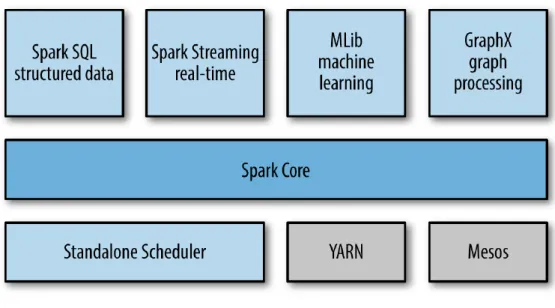
Figure 2.1 shows the various core components of Apache Spark. A summary of each of the core Spark components is provided below. An extensive description can be found in Karau et al. [32]. The workload applications used in this thesis utilize many of the Spark Core APItransformationsandactions. Other Spark components including Spark SQL, Spark Streaming, MLlib, and GraphX are not used in this thesis but a brief description is provided for completeness.
Figure 2.1: Spark architecture [32]
Spark Core API:
The Spark Core component is the foundation for Spark’s data processing. It handles basic functionalities such as scheduling and monitoring of jobs, efficient memory management, fault recovery and interacting with various data sources. Spark core also defines APIs for Resilient Distributed Datasets (RDDs), and the different types of transformations such asmap, filter, reduceByKey which creates a new RDD from existing data, and actions such asreduce, collect, count which perform a computation on an RDD and return a value.
Spark SQL:
The Spark SQL is a library built on top of Spark to provide facilities to perform SQL like queries such as extract, transform and load (ETL) on Spark RDDs and other data sources including Hive6tables, Parquet,7 and JavaScript Object Notation (JSON).8 The library allows developers and users to run ad hoc queries using Structured Query Language (SQL) and Hive Query Language (HQL), therefore, easing the process of extracting and merging various datasets and making them available for other applications such as machine learning.
Spark Streaming:
Spark Streaming is a high throughput, fault tolerant and scalable API that enables processing of live streams of data from various data sources such as Kafka,9 Flume10and HDFS. The API uses the Discretized Stream objects, which represents a continuous stream of data divided into small batches. Discretized Stream is built on Spark’s Core RDD’s API, therefore, RDD transformations and actions can be applied to the mini batches of the input data for real-time processing.
MLlib:
Spark’s MLlib is a machine learning library used for different types of machine learning applications such as classification, regression, clustering, and collaborative filtering. It implements many commonly used algorithms including Naive Bayes, Logistic Regression, Support Vector Machine, Linear Regression and K-means, as well as lower-level machine learning primitives including a generic gradient descent optimization algorithm. It also provides support for data import and model evaluation.
2.1.3
HDFS and Spark RDD Partitions
The Hadoop Distributed File System (HDFS) use the concept of blocks to store files [51]. When a user stores a large file in HDFS, the NameNode divides this file into various chunks and stores these chunks in blocks on differentDataNodes. When a user stores a file in HDFS that is smaller than the block size, however, the file will only occupy the amount of the underlying physical storage it requires, not the entire block.
HDFS is designed to store large datasets at the terabytes scale; therefore, it is not optimal for storing large number of small files [62], that are considerably smaller than the specified HDFS block size. There are several reasons for this.
Firstly, a large number of small files can populate HDFS namespace quickly, and because there is names-pace limitation, this could result in underutilizing disk snames-pace. Secondly, every HDFS block has metadata
6https://hive.apache.org/(9 Apr, 2018) 7 https://parquet.apache.org/(9 Apr, 2018) 8https://www.json.org/(9 Apr, 2018) 9https://kafka.apache.org/(9 Apr, 2018) 10https://flume.apache.org/(9 Apr, 2018)
that theNameNode records and stores in memory. Therefore, storing a large number of small files increases the total number of blocks and the metadata theNameNode must handle in RAM.
Furthermore, for MapReduce applications, Hadoop tries to start one mapper per HDFS block on the machines where the data is stored to minimize network transfer of data from the storage node to the processing node. Large files are more likely to be stored on the same cluster node as opposed to small files which can be spread-out across the cluster. Having one mapper per small block could result in resource wastage and increase latency, because there is an overhead to start a mapper, and these mappers would only process a small amount of data, and eventually be allocated to other tasks by the scheduler.
When reading data from a distributed file system such as HDFS, Spark tries to utilize the file system’s distributed data partitions to determine the number of RDD partitions to create. During execution, Spark creates RDD partitions on the node containing the data block and allocates data processing (typically a single task per RDD partition) with minimum data transfer across the network. Spark provides various transformations such as repartition, coalesce and repartitionAndSortWithinPartition that could be used to re-assign the number of RDD partitions at runtime.
2.1.4
The Concept of Resource in Spark
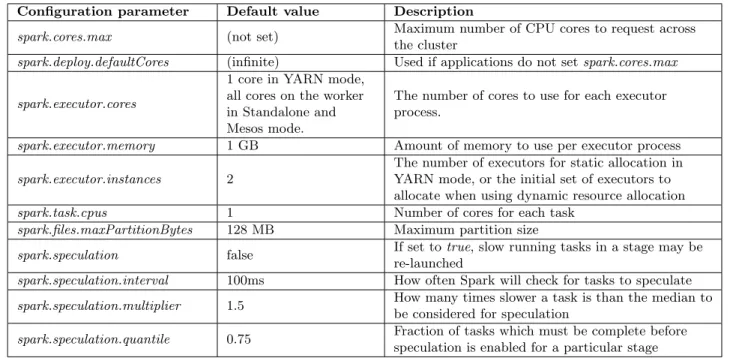
As mentioned in Section 2.1.1, executors are the resource unit in Spark. They contain a number of CPU cores and memory, which are controlled byspark.executor.cores andspark.executor.memory respectively. By default, each executor process is made up of 1 GB memory in all cluster managers, 1 CPU core in YARN mode, and all the available cores on the worker in Standalone and Mesos modes. Each task occupiesspark.task.cpus
number of CPU cores. Therefore, by tuning these parameters, the number of tasks that could simultaneously run on an executor may be adjusted, thereby improving the overall cluster utilization. Table 2.1 shows some of the important scheduling parameters that could be configured in Spark to improve resource utilization and job response times.
2.1.5
Spark Runtime Architecture
Spark uses a uniform interface to submit an application to every supported cluster manager. The arguments passed to this submission script determine from which cluster manager (Standalone, Mesos, YARN) to request resources. The script also loads the default Spark configuration values from the configuration file and passes them on to the application. Generally, configuration values explicitly defined by the application’sSparkConf
take the highest precedence, then arguments passed to the submission script, then values in the default configuration file.
A code snippet for WordCount application written in PySpark is shown in Listing 2.1. This application reads in a text file from HDFS and creates a Spark RDD of the file. The application then counts how often each word occurs in the RDD. The output is a series of text files written to HDFS. Each line in the output files contains a word and the count of how often it occurred.
Table 2.1: Spark Schedulling Configuration Parameters
Configuration parameter Default value Description
spark.cores.max (not set) Maximum number of CPU cores to request across the cluster
spark.deploy.defaultCores (infinite) Used if applications do not setspark.cores.max
spark.executor.cores
1 core in YARN mode, all cores on the worker in Standalone and Mesos mode.
The number of cores to use for each executor process.
spark.executor.memory 1 GB Amount of memory to use per executor process spark.executor.instances 2
The number of executors for static allocation in YARN mode, or the initial set of executors to allocate when using dynamic resource allocation spark.task.cpus 1 Number of cores for each task
spark.files.maxPartitionBytes 128 MB Maximum partition size
spark.speculation false If set totrue, slow running tasks in a stage may be re-launched
spark.speculation.interval 100ms How often Spark will check for tasks to speculate spark.speculation.multiplier 1.5 How many times slower a task is than the median to
be considered for speculation
spark.speculation.quantile 0.75 Fraction of tasks which must be complete before speculation is enabled for a particular stage
Listing 2.1: WordCount in PySpark [3]
"Import the necessary libraries"
from pyspark import SparkConf, SparkContext
"Read a text file from HDFS and create an RDD from the file"
sc = SparkContext(appName="WordCount") text_file = sc.textFile("hdfs://...")
"Count the occurrence of each word in the RDD"
counts = text_file.flatMap(lambda line: line.split(" ")) \ .map(lambda word: (word, 1)) \
.reduceByKey(lambda a, b: a + b)
"Save the result back to HDFS"
counts.saveAsTextFile("hdfs://...")
On application submission, Spark connects to the specified cluster manager to acquire executors on nodes in the cluster. The number of executors to request depends on the number of tasks in the application and the configuration values set to control resource size per executor. For example, if spark.task.cpus configuration parameter is set to 1 and each executor is set to have 1 CPU core usingspark.executor.cores configuration parameter, then 1 executor would be requested from the cluster manager per task, as long as the total number of allocated cores does not exceedspark.cores.max orspark.deploy.defaultCores for applications that
do not set spark.cores.max parameter. The cluster manager allocates executors to the application based on availability and configuration values. Spark then sends the application code to the executors, this allows
SparkContext to run tasks on these executors.
In this architecture, each Spark application gets its own set of executor processes, and holds on to the executors for the duration of the whole application. The application’sSparkContext schedules tasks on the cluster and runs these tasks in multiple threads. Both the driver program and the executors communicate with each other throughout the lifetime of the application. This lets Spark isolate applications from each other both on the scheduling side, since each driver schedules its own tasks, as well as the executor side because tasks from different applications run in different JVMs. However, data can not be shared between different applications without first writing it to an external storage.
2.2
Spark Cluster Managers
Distributed computing has been the centre of modern data processing in many big organizations. In this type of architecture, a large number of commodity computers are grouped together to form a cluster of computers. These clusters are often shared by many applications with varying resource requirements. Therefore, there is the need for efficient resource sharing in order to achieve high resource utilization. Cluster managers are responsible for the scheduling and allocation of cluster resources (CPU and memory) across multiple applications.
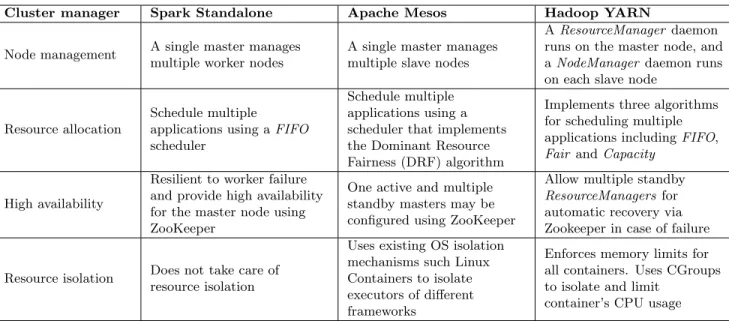
Table 2.2: Characteristics of the Cluster Managers Tested
Cluster manager Spark Standalone Apache Mesos Hadoop YARN
Node management A single master manages multiple worker nodes
A single master manages multiple slave nodes
AResourceManager daemon runs on the master node, and aNodeManager daemon runs on each slave node
Resource allocation
Schedule multiple
applications using aFIFO scheduler
Schedule multiple applications using a scheduler that implements the Dominant Resource Fairness (DRF) algorithm
Implements three algorithms for scheduling multiple applications includingFIFO, Fair andCapacity
High availability
Resilient to worker failure and provide high availability for the master node using ZooKeeper
One active and multiple standby masters may be configured using ZooKeeper
Allow multiple standby ResourceManagers for automatic recovery via Zookeeper in case of failure
Resource isolation Does not take care of resource isolation
Uses existing OS isolation mechanisms such Linux Containers to isolate executors of different frameworks
Enforces memory limits for all containers. Uses CGroups to isolate and limit
container’s CPU usage
This section gives an overview of the different cluster managers available in Spark, and looks in more detail at their nodes management, resource allocation, high availability, and resource isolation. Spark does not need to be aware of the underlying cluster manager it runs on, as long as applications are able to acquire executor
processes, and these executors can communicate with each other. This enables Spark runs on different cluster managers. Figure 2.2 shows how applications run on Spark. A summary of the various characteristics of the three cluster managers evaluated in this thesis is provided in Table 2.2.
Figure 2.2: Running applications on Spark [31]
2.2.1
Spark Standalone
The Spark Standalone cluster manager is a simple cluster manager available as part of the default Spark distribution. It has high availability for the master, is resilient to worker failures, has capabilities for managing resources per application, and can run alongside an existing Hadoop deployment and access HDFS data.
Node Management
Standalone uses a single master to manage and coordinate multiple worker nodes. Each worker node is con-figured to provide the cluster with a certain amount of CPU and memory resources. Applications submitted can specify the amount of the resources (CPU cores and memory) they need per executor from the cluster manager.
Resource Allocation
Applications submitted to the Standalone cluster manager are scheduled in FIFO order, and each application will try to use all available nodes by default. Subsequent applications submitted will be queued and must wait for the first application to run to completion before they can start running jobs, even if the first application is not using all the resources allocated to it, unless the appropriate configuration parameters are set. The Standalone cluster manager currently only supports FIFO scheduling.
To allow multiple concurrent users, application developers must set spark.cores.max configuration pa-rameter within their applications to limit the number of cores the applications request across the cluster. Moreover, the cluster administrator may setspark.deploy.defaultCores parameter to set the maximum num-ber of cores each application submitted to the cluster may request. Setting these configurations will prevent applications from monopolizing the entire cluster when using static resource allocation on the Standalone cluster manager.
High Availability
The standalone cluster manager is resilient to worker failure, since applications can simply restart the tasks that were lost on other available workers. Spark can be configured to launch multiple Masters in the same cluster, connected to a ZooKeeper [28] instance. In the event of master failure, ZooKeeper (a distributed coordination system) selects a new master from the list of standby masters in a timely manner, a process called leader election. The new Master would recover the old Master’s state, and then resume scheduling. Master failure only affects scheduling of new applications. The Spark cluster can also use Local File System to recover applications and workers upon a restart of the master process.
Resource Isolation
The Standalone cluster manager only handles resource allocation, including keeping track of available and allocated resources. It does not take care of resource isolation.
2.2.2
Apache Mesos
Apache Mesos [25] is a distributed, highly available, and fault-tolerant cluster manager that is designed to act as the kernel for dynamically sharing cluster resources among multiple frameworks. Mesos abstracts cluster resources from multiple nodes in a cluster, including CPU, memory, and disk and allows them to be viewed and used between multiple frameworks as if they were a single, very large server [29]. Mesos uses containers to isolate processes from different applications, therefore allowing applications to run alongside each other on the same computer without interfering. Figure 2.3 shows how Mesos abstracts cluster resources and shares them between different applications. At the lower lever are the physical machines, consisting of both computing and storage resources. The OS kernel provides access to underlying physical or virtual resources. The Mesos kernel runs on top of the OS kernel on every machine in the cluster and abstracts the physical resources of these machines using the same principles as the OS kernel, only at a different level of abstraction.
Node Management
Mesos uses a master/slave architecture to manage cluster nodes. In this architecture, a single master pro-cess manages multiple slave propro-cesses running on each cluster node. The master propro-cess provides resource offers to frameworks and launches tasks on the slave nodes. It also handles communication between tasks
Figure 2.3: Running applications on Mesos [29]
and frameworks. The slave nodes manage physical resources such as CPU, memory and disk, and execute framework tasks. Slave nodes are Mesos’s equivalent of Spark’s worker nodes. Frameworks are applications that run on Mesos (e.g. Hadoop and Spark) and consist of two parts, namely the scheduler and the executor. The scheduler negotiates with the master and handles resource offers and task monitoring, while executors accept and process tasks. Since resource scheduling is the responsibility of both the Mesos master’s allocation module and the framework’s scheduler, this is referred to as two-level scheduling. Mesos slaves periodically report their available resources to the master’s allocation module. The master makes decisions as to which framework to offer the available resource and advertises this resource offer to the selected framework. The framework can decide to reject the offer if it does not satisfy its resource requirements. On accepting the offer, the framework’s scheduler sends tasks and resources to use for each task to the master, which finally sends the tasks to slaves for execution.
Resource Allocation
Mesos provides organizations with the ability to define their own resource allocation policies using a pluggable allocation module. By default, Mesos uses a fair-sharing resource allocation algorithm called Dominant Resource Fairness (DRF) [17] to allocate resources to frameworks. The DRF algorithm aims to share multi-dimensional resources (e.g. CPU and memory) across multiple users. A framework’s dominant resource is the most demanded resource type for that framework such as CPU, memory or disk. DRF computes the framework’s total share of this resource (dominant share), and tries to maximize the minimum dominant share in the system. For example, if user A runs CPU-intensive tasks and user B runs memory-intensive tasks, DRF attempts to equalize user A’s share of CPUs with user B’s share of memory. This implies that user A would get more CPU and less memory, while user B would get less CPU and more memory. Whenever there are available resources and tasks to run, the scheduler selects the user with the smallest dominant share and allocates resources to it first.
High Availability
All Mesos slaves and running frameworks depend on Mesos master to manage the slave nodes and offer resources to active frameworks. In order to prevent cluster failures, Mesos provides the ability to configure multiple masters, with one active master, and the remainder operate on standby. The active master stores only the list of active slaves, active frameworks, and running tasks. This information can be used to compute the number of resources allocated to each framework and the allocation policy. In the event of a master failure, Mesos uses ZooKeeper to select a new master from the list of standby masters.
Resource Isolation
Mesos uses existing OS isolation mechanisms such Linux Containers to limit resources (CPU, memory, net-work bandwidth) of framenet-works and isolate executors of different framenet-works running on the same Mesos slave.
2.2.3
Hadoop YARN
The Hadoop YARN [56] cluster manager is part of the second-generation Hadoop version 2 distribution. YARN allows multiple data processing engines with diverse programming models to run alongside Hadoop MapReduce on the same cluster and have access to centralized datasets stored on HDFS [51]. In YARN, resource management and job scheduling/monitoring are handled by separate daemons consisting of global
ResourceManager and per-application ApplicationMaster [44]. Figure 2.4 shows the high-level YARN archi-tecture.
TheResourceManagerdaemon runs on the master node and arbitrates resources among all applications. It consists of a Scheduler which is responsible for allocating resources to applications, andApplicationManager
which is responsible for accepting job submissions and negotiating the first container to run Application-Master. The per-application ApplicationMaster is responsible for negotiating container resources from the
ResourceManager’s Scheduler, tracking the status of allocated containers and monitoring tasks execution progress.
Node Management
A NodeManager runs on each slave node; it is responsible for managing containers running on the node. It also monitors container’s resource usage such as CPU, memory, disk and network, and it reports their status to theResourceManager.
Resource Allocation
YARN’s ResourceManager contains a pluggable global scheduler which is responsible for partitioning and allocating cluster resources to various applications. By default, YARN implements different schedulers
in-Figure 2.4: Running applications on YARN [44]
cluding the previously mentionedFIFO Scheduler,Fair Scheduler which aims to share cluster resources fairly among all running jobs, and Capacity Scheduler which allows sharing of a Hadoop cluster among organiza-tions by providing each organization with a guaranteed share of overall cluster capacity. Organizaorganiza-tions can also implement their own resource allocation policies, however, as per requirements and resource availability.
High Availability
High availability is achieved in the YARN cluster manager through an Active/Standby architecture. At any point in time, there is only one activeResourceManager, and one or more in standby mode waiting to take over in case the active ResourceManager fails. In the event of failure, automatic recovery via Zookeeper can be enabled. In addition, cluster administrators can trigger an action to transition one of the standby
ResourceManagers into active mode through the Command Line Interface (CLI). On the other hand, when theApplicationMaster fails, the ResourceManager detects this failure and starts a new instance on another container. In the event of a container failure, theNodeManager detects this failure event and launches a new container replacement. It also restarts all tasks execution on the new container.
Resource Isolation
YARN automatically enforces memory limits for all containers that it controls. Containers must have a maximum memory size defined when created. If the sum of all memory usage for processes associated with a
single YARN container exceeds this maximum, YARN will kill the container. YARN uses CGroups to isolate and limit container’s CPU usage, since this must be done at the kernel level. CGroups enables users to set limits on the amount of CPU resources granted to individual processes such as YARN containers.
2.3
Resource Allocation Modes
2.3.1
Static Resource Allocation
By default, Spark uses Static Resource Allocation to share resources on all the three supported cluster managers. With this approach, applications are assigned resources statically, and hold on to them for the duration of their lifetime. The Spark execution model allows applications to reuse resources by having a long running thread which resides in the executor process. This provides many performance optimizations relating to speed which include: efficient data sharing in memory, fine-grained partitioning and low latency scheduling because there is no need to start a new executor process for each newly submitted task; instead a long running process accepts and runs many small tasks. However, this speed-up gain comes with a cost, since idle applications may hold on to resources for a very long time, even if they are not being used.
To limit the amount of resources applications use per executor process, the application programmer needs to set the appropriate configuration parameters (spark.executor.cores and spark.executor.memory) within their application to specify the number of cores and memory to request per executor from the cluster manager. The default value for spark.executor.cores is set to 1 in YARN mode and all available cores on the worker machine in Standalone and Mesos coarse-grained modes. The value ofspark.executor.memory is set to 1 GB in all the three cluster managers by default. Using the default values for these parameters means that only one executor (with 1 GB memory and all available CPU cores on the worker machine) per application will run on each worker in Standalone and Mesos modes. On the other hand, applications submitted to a YARN cluster manager would request two executor instances for running tasks by default, each having 1 CPU core and 1 GB memory regardless of the available resources in the cluster. Setting the appropriate values for the configuration parameters that control resource size per executor would allow applications to run multiple executors on the same worker node.
Users can also use spark.cores.max to set the maximum number of CPU cores to request for a single application from across the cluster in Standalone and Mesos mode. On the YARN cluster manager, the
spark.executor.instances controls how many executors to allocate on the cluster. Cluster administrators may set spark.deploy.defaultCores parameter to control the total number of cores to give to applications that do not set the maximum CPU resources they need. Statically assigning these values might result in unnecessary increase in latency for applications, and inefficient utilization of cluster resources. Overall, the resource scheduling problems introduced by using static partitioning include the following:
resources it does not use. Meanwhile, other applications can not be executed becausespark-shell is still running and holding on to the resources.
2. Starvation of other applications: If a single application occupies lots of resources without releasing them, other application will be queued.
3. Lack of elastic resource scaling ability: It is hard to estimate, with reasonable precision, the amount of resources an application will require for efficient execution. For example, in an iterative workload such as data exploration in which a user runs many short commands iteratively, static allocation of cluster resources would lead to inefficient utilization.
2.3.2
Dynamic Resource Allocation
To address the above issues, Spark provides aDynamic Resource Allocation mode which dynamically adjusts the resources applications use based on the available workload. This means that applications may give resources back to the cluster if they are no longer used and request them later when they need to use them again. This is very useful in a multi-tenant shared cluster where multiple applications need to share cluster resources. This feature is available on all three Spark supported cluster managers considered in this thesis.
Resource Allocation Policy
Dynamic resource allocation requests and releases executors at run-time based on available workload. Spark provides various configuration parameters that control when and how to request more resources from the cluster manager when there are more pending tasks, and free these resources when they are no longer needed.
Request Policy: Applications using dynamic resource allocation would request more executors when there are pending tasks to run. Having pending tasks implies that the existing set of executors are in-sufficient to simultaneously run all tasks that have been submitted but not yet finished. Spark requests executors in rounds, the actual request is triggered when there have been pending tasks for spark.dynamic-Allocation.schedulerBacklogTimeoutseconds, and then triggered again every spark.dynamicAllocation.sustain-edSchedulerBacklogTimeoutseconds thereafter if the queue of pending tasks persists. The number of executors requested in each round increases exponentially from the previous round. For instance, an application will add 1 executor in the first round, and then 2, 4, 8 and so on executors in the subsequent rounds. The motivation behind this policy is a slow start in case only a few more executors are needed and exponential growth in case it turns out that many executors are actually needed.
Removal Policy: The removal policy is simple, Spark removes the executors that have been idle for more than spark.dynamicAllocation.executorIdleTimeout seconds, since executors should not be idle if there are still pending tasks to be scheduled.
Enabling Dynamic Resource Allocation
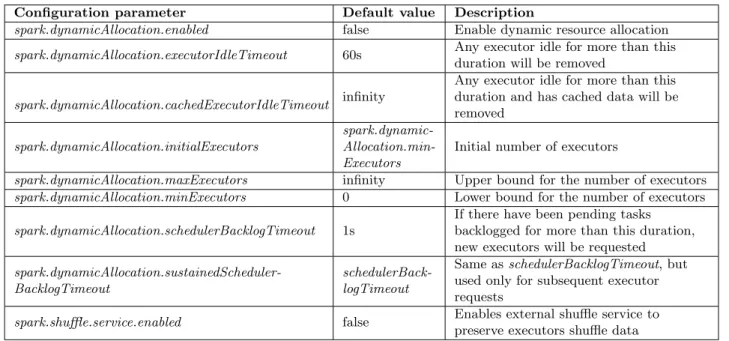
To enable dynamic resource allocation on Spark, two important configurations need to be set and multiple other optional settings that control the behaviour of this feature as shown in Table 2.3. First, applications need to setspark.dynamicAllocation.enabledandspark.shuffle.service.enabledto true. In addition, anexternal shuffle service must be set on each worker node in the cluster.
Shuffle in Spark is an all-to-all communication across the cluster. It involves a lot of data serialization, network IO, and disk IO because the shuffled data needs to be serialized and transferred over the network to other machines or written to a local file. When executing Spark operations that cause shuffling to occur such asrepartition,coalesce,groupByKey, andreduceByKey, not all values for a single key necessarily reside on the same partition or node. As a result, Spark generates a set of map tasks to organize the data, and a set of reduce tasks to aggregate the shuffled data. The individual map tasks store their results in memory. Shuffle operations can consume a substantial amount of heap memory, however, because they utilize various in-memory data structures to organize records.
When data does not fit in memory, Spark sorts the data and spills it to disk. This introduces additional overhead of disk I/O and garbage collection. Furthermore, a shuffle generates a large number of intermediate files on disk which are preserved until the corresponding RDDs are no longer needed. This is done in order to prevent re-creation of shuffle files when the RDD lineage is re-computed.
Table 2.3: Spark Dynamic Resource Allocation Configuration Parameters
Configuration parameter Default value Description
spark.dynamicAllocation.enabled false Enable dynamic resource allocation spark.dynamicAllocation.executorIdleTimeout 60s Any executor idle for more than this
duration will be removed
spark.dynamicAllocation.cachedExecutorIdleTimeout infinity
Any executor idle for more than this duration and has cached data will be removed
spark.dynamicAllocation.initialExecutors
spark.dynamic- Allocation.min-Executors
Initial number of executors
spark.dynamicAllocation.maxExecutors infinity Upper bound for the number of executors spark.dynamicAllocation.minExecutors 0 Lower bound for the number of executors spark.dynamicAllocation.schedulerBacklogTimeout 1s
If there have been pending tasks backlogged for more than this duration, new executors will be requested
spark.dynamicAllocation.sustainedScheduler-BacklogTimeout
schedulerBack-logTimeout
Same asschedulerBacklogTimeout, but used only for subsequent executor requests
spark.shuffle.service.enabled false Enables external shuffle service to preserve executors shuffle data
Normally, Spark executors exit either on successful completion or failure. In both cases, all the data written by the executor is no longer needed and can be safely discarded. On the other hand, using dynamic resource allocation allows executors to be removed when the application is still running. Removing the shuffle files written by this executor implies that a recompute of this data needs to be performed when the
![Figure 1.1 shows the various stages of MapReduce. Since many real world data processing tasks can be modelled in this way [14], MapReduce has been widely adopted in both academia and industry for batch processing of large datasets [56]](https://thumb-us.123doks.com/thumbv2/123dok_us/9845195.2477550/13.918.138.782.308.649/mapreduce-processing-modelled-mapreduce-academia-industry-processing-datasets.webp)
![Figure 2.2: Running applications on Spark [31]](https://thumb-us.123doks.com/thumbv2/123dok_us/9845195.2477550/26.918.196.726.212.515/figure-running-applications-on-spark.webp)
![Figure 2.3: Running applications on Mesos [29]](https://thumb-us.123doks.com/thumbv2/123dok_us/9845195.2477550/28.918.229.705.115.345/figure-running-applications-on-mesos.webp)
![Figure 2.4: Running applications on YARN [44]](https://thumb-us.123doks.com/thumbv2/123dok_us/9845195.2477550/30.918.202.724.114.524/figure-running-applications-on-yarn.webp)