MEDIATING MODERN MUSIC: NADIA BOULANGER CONSTRUCTS IGOR STRAVINSKY
KIMBERLY A. FRANCIS
A dissertation submitted to the faculty of the University of North Carolina at Chapel Hill in partial fulfillment of the requirements for the degree of Doctor of Philosophy in the
Department of Music
Chapel Hill 2010
¸
ABSTRACT
Kimberly A. Francis: Mediating Modern Music: Nadia Boulanger Constructs Igor Stravinsky (Under the direction of Annegret Fauser)
In 1925, French pedagogue, composer, performer, and conductor Nadia Boulanger
proclaimed that no composer could provoke such profound thoughts and intense enthusiasms as Igor Stravinsky. Beginning in the 20s, Boulanger promoted the Russian expatriate
unceasingly in her private teachings, her public lectures, and her press releases. And as thegrande dameof the Conservatoire Américain after 1921, Boulanger held the power to introduce Stravinsky to the world in the early twentieth century. In the Château de
Fontainebleau just outside of Paris, she taught countless students the discipline necessary to understand the infinite beauty of music. In this milieu, Boulanger served as cultural mediator between the Russian master and her beloved students until her death in 1979.
exchange led to numerous other projects, and Boulanger eventually assumed responsibility for securing commissions for Stravinsky, conducting and performing in premieres of his music, and copy-editing his manuscripts. In particular, this dissertation will explore Boulanger’s involvement with theSymphony of Psalms, theSymphony in C, Stravinsky’s Mass, and his opera,The Rake’s Progress. Yet, despite this key role, Boulanger’s voice has all but been erased from the literature. As a result, generalities, anecdotes, and rumors are all that account for the current scholarship about Stravinsky and Boulanger’s involvement. Drawing on newly-discovered correspondence, scores, and analytical materials, my
To my family and
ACKNOWLEDGEMENTS
This dissertation would never have been possible without the support network that has surrounded me for the past five years. First, a huge debt of gratitude is owed to my advisor, Annegret Fauser, without whose unflagging encouragement I would never have been brave enough to explore thefondsBoulanger. To the rest of the members of my committee:
Severine Neff, you taught me to engage carefully and thoughtfully with the music itself; Tim Carter, you are proof that one’s best ideas are often borne of debate with a formidable
opponent. I thank you for your inimitable candor. Jon Finson, your elegance and
professionalism in all things academic has served as an inspiration; and to Mark Katz, my thanks for your always open door and willingness to extend yourself well beyond what was officially required of you.
read at the Southeast Chapter Meeting of the American Musicological Society held at Salem College (2009) and at the meeting of the Society for American Music in Denver, CO (2009). Also, portions of Chapter 4 were read at the bi-annual conference on Feminist Music and Theory at the University of North Carolina, Greensboro (2009). I am indebted to my session chairs, fellow panelists, and audience members for their elucidating and perceptive
comments.
The majority of my research was conducted at the Département de la Musique of the Bibliothèque Nationale de France. My most heartfelt thanks to Catherine Massip for her warm welcome and to her staff who indefatigably trucked all over the library’s holdings to bring me countless reels of microfilm or whatever reserve document my curiosity drove me to consult. Thanks are also due to Ulrich Mosch, Johanna Blask, and the librarians of the Paul Sacher Stiftung who so generously facilitated my research in Basel, Switzerland, and to Maureen Carr who helped smooth my entry into life in Basel. I would like to thank
Christiane Kriloff and Laurence Languin of the Médiathèque Nadia Boulanger of the
Conservatoire Nationale Supérieur Musique et Dance de Lyon, and Sarah Dorsey for sharing her knowledge of the Louise Talma papers at the Library of Congress. I would also like to thank the European American Music Distributers and Boosey and Hawkes for graciously allowing me to reprint material from published Stravinsky scores in this dissertation. Finally, to the librarians at UNC-Chapel Hill, especially Diane Steinhaus, I extend enormous thanks for your flexibility and assistance with all manner of concerns.
suggested this project to me five years ago. For her generosity, both professional and personal, over the course of this project, I am incredibly grateful.
I have been lucky enough to study under some of the most brilliant and creative musicological minds I know. To Mark Evan Bonds, Lori Burns, David Garcia, Anne
MacNeil, Paul Merkley, John Nadas, and Jocelyn Neal, my sincerest thanks for all that each of you have taught me. My thanks also to Suzanne Cusick, whose gentle encouragement and wonderful insights are manifest in parts of the Introduction and Chapter 1 of this dissertation. I would especially like to thank Tamara Levitz for her unflinching support of this project. I am most indebted to you for your ability to tell me what youdidn’tlike about this work, as much as I am for your boundless enthusiasm and erudition. From you I have learned that compelling work springs from that which is truthful and exacting.
To my friends, it is you who have kept me balanced both at home and abroad. Many thanks to: Kevin Bartig, Michael and Stephanie Berec, Molly and Jason Breckling, Pat Brehl, Ana Conboy, Samantha Englander, William Gibbons, Julie Hacquard, Victor Herbiet,
Mathieu Langlois, Claire Launchbury, Alicia Levin, Avila Lotoski, Narcisz Magyara, Christine O’Connor, Allison Portnow, Ryan Salter, Matt Todd, Cedric Segond, Amanda Shoaf-Vincent, Felicity Smith, Joni Spigler, Michael Unger, and Jeffrey Wright. A special thank you to Lisa Holinger, Gregor Muntwiler, and Bruna. I will treasure the memories of fasnachtand hiking in the foothills of the Alps for the rest of my life.
this dissertation at least twice and has always claimed (sometimes convincingly) to have enjoyed it, I am tremendously grateful. Goodness only knows what I would have done if my “other advisor” hadn’t always been a phone call away.
To Brian, there are no words. You are the epitome of unconditional love. You patiently supported every crazy idea, every paper draft read to you after the umpteenth revision, and every weekend where I disappeared into my world of Boulanger and Stravinsky. I love you, and I thank you. Finally, to Emily Brynn, you are too young to
Table of Contents
List of Figures ... xiv
List of Tables ...xv
Note on Translations ... xvii
Abbreviations... xviii
Introduction Archival Collections ...5
The Stravinsky-Boulanger Correspondence ...6
Additional Documents of the Bibliothèque Nationale de France ...10
Scores: Autographs, proofs, and printed materials ...13
Materials of the Centre internationale Nadia et Lili Boulanger...16
Methodology...19
Feminist Musicology/Feminist Methodologies ...20
Transnationalism and Cultural Mediation ...25
Cultural Capital...30
Summary...35
1. Foundations (1929-1932): Boulanger, Stravinsky, and theSymphonie de
psaumes...41
In the Beginning: Nadia Boulanger as Cultural Authority ...43
Boulanger and Stravinsky, A Partnership Begins...47
“Il reste encore des questions”: Nadia Boulanger Edits theSymphonie de psaumes...50
The All-Important Piano-Vocal Score ...54
Boulanger’s Edits, Stage One ...56
Beyond Proof-Reading: Boulanger’s Edits to the Second Movement...67
Boulanger’s Edits, Stage Two...72
Ostinato Treatments ...73
Pattern Completion ...77
“The Inestimable Qualities of You Heart and Ear”: Boulanger’s Analysis of theSymphonie de psaumes...83
Analysis, First Movement...86
Analysis, Third Movement ...96
Analysis, Second Movement ...108
A Partnership Formed ...116
2. Surviving Exile: Nadia Boulanger, Igor Stravinsky, and theSymphonie en ut, 1937-1944 ...119
FromSymphonie to Symphonie: Boulanger and Stravinsky’s Projects from 1932-1937 ...122
Back to America: Boulanger’s 1937 and 1938 Tours...128
Exiled in America ...141
Romantic Entanglements ...146
American Reunions...153
Editing theSymphonie en ut ...158
Alexei Haïeff and theSymphonie en ut...171
“Don’t do this to love, do this to know”: Analyzing theSmphonie en ut...175
Out of Exile...194
3. Redefining a Partnership, Recreating an Icon: Nadia Boulanger Interprets Igor Stravinsky’sMesse...199
Boulanger’s Transnational Religious Network...202
Stravinsky and Religion...206
Boulanger and Stravinsky’s Religious Dialogue ...209
Establishing a Legacy: Boulanger’s Return to Paris...217
The FinishedMesseand Boulanger’s 1949 Performances ...227
Boulanger’s Lectures on Stravinsky’sMesse...236
Solesmes, 1950 ...237
Zurich, 1972...242
Effect Produced by the Whole: The Music of Stravinsky’sMesse...253
After Solesmes, 1950-1972...265
4. The Final Project:The Rake’s Progress, 1948-1952...270
The Writing of an Opera ...273
Composition in Early Cold War America...287
After Europe: The Reception of a Rake...289
The Music of an Opera ...301
The Summary Sketches...302
Boulanger’s Piano/Vocal Score ...314
A Partnership Ends ...340
5. Epilogue: Boulanger and Robert Craft’s Stravinsky ...342
Boulanger Teaches Stravinsky’s Twelve-Tone Music ...346
Stravinsky’s Failing Health...354
Boulanger and Stravinsky, the Extant Literature...359
In the End...368
Appendix I: Correspondence Transcriptions ...370
Appendix II: Syllabus, Course d’Analyse et de Chant, 1935-1936...381
Appendix III: Advertisement for Nadia Boulanger and Igor Stravinsky’s Class at the École Normale de Musique...383
Appendix IV: Folios 7-12 of Boulanger’s analysis of theSymphonie en ut, Rés. Vm. Ms. 1218 (3)...384
Appendix V: Nadia Boulanger’s Lectures on Stravinsky’sMesse...387
List of Figures
I.1:Boulanger-Stravinsky connections ...9
1.1:Igor Stravinsky,Symphonie de psaumes, Boulanger’s copy of the autograph Manuscript ...50
1.2:Nadia Boulanger and Igor Stravinsky, analysis of theSymphonie de psaumes, First Movement ...87
1.3:Nadia Boulanger and Igor Stravinsky, analysis of theSymphonie de psaumes, Third Movement ...97
1.4:Nadia Boulanger, analysis of theSymphonie de psaumes, Third Movement, mm. 1-8...103
1.5:Nadia Boulanger, analysis of theSymphonie de psaumes, Second Movement...110
1.6:Nadia Boulanger, analysis of theSymphonie de psaumes, Second Movement...114
2.1:First page of proofs for the piano/vocal reduction ofPerséphone. ...124
2.2:Nadia Boulanger and Igor Stravinsky in Gerry’s Landing, Cambridge, Massachusetts, date unknown (probably January 1941)...157
2.3 a-c:Nadia Boulanger’s analytical notes for the Symphonie en ut, first movement ...177
2.3d:Nadia Boulanger’s analytical notes for theSymphonie en ut, third and fourth movements ...178
2.4 a-b:Nadia Boulanger’s notes to theSymphonie en ut, first movement ...188
4.1:Rehearsal pianist annotations.The Rake’s Progress, Continuity Draft, Act I, ii, R. 108-6-108.5 ...303
List of Tables
I.1:Letters sent by the Stravinsky family to Boulanger, F-Pn ...7
I.2:Third-party correspondents, F-Pn ...8
I.3: Relevant Rés. Vm. Dos. Documents...12
I.4:Stravinsky scores owned by Boulanger, 1930-1969...13
I.5:Documents of the Centre internationale Nadia et Lili Boulanger...18
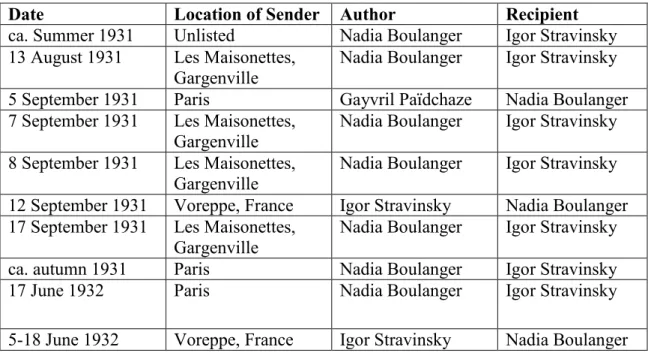
1.1:Correspondence concerning theSymphonie de psaumes, 1931-1932 ...56
1.2: Musical materials used to edit theSymphonie de psaumes, 1931-1932...57
1.3:Comparison of Boulanger/Stravinsky and van den Toorn Analyses...94
1.4:Stravinsky’s treatment of Vulgate 150,Symphonie de psaumes, Mvt. III ...105
2.1:Stravinsky scores owned by Boulanger 1934-1938 ...122
2.2:Archival materials for theSymphonie en ut,fondsBoulanger ...175
2.3: Boulanger’s analytical notes,Symphonie en ut, first movement...181
2.4: Boulanger’s proportions for theSymphonie en ut...190
2.5:Comparison of Cone and Boulanger’s internal divisions, Symphonie en ut, first Movement ...191
3.1:Boulanger’s concerts containing Stravinsky repertoire, 1947-1948 ...222
4.1:Tempi changes in Boulanger’s copy ofThe Rake’s Progress, Vma. 4010, 1951...315
4.2:Additional changes notated in Boulanger’s piano/vocal score, Vma. 4010, 1951...323
E.1:Stravinsky pieces included in Boulanger’s Wednesday Afternoon Classes post-1958...346
E.2:Stravinsky scores owned by Boulanger, 1963-1971...348
Note on Translations:
Unless otherwise noted, all translations in this dissertation are my own. Where possible, and informative for the reader, I have retained the original styling. All spellings of names (i.e. Païtchadze and Strawinsky) and locations also appear as they were in the originals. I have not considered as misspellings the consistent absence of diacritical markings (meaning all
Abbreviations
CNSMD Conservatoire Nationale Supérieur Musique et Danse de Lyon, Lyon, France fB,F-Pn fondsBouanger, Bibliothèque Nationale de France—Boulanger archives,
National Library of France
CINLB Centre Internationale Nadia et Lili Boulanger—International Nadia and Lili Boulanger Foundation
F-Pn Biblithèque Nationale de France—National Library of France Ms. Manuscrit—Manuscript (autograph materials)
N.L.a. Lettres Autographes, nouveau fonds—Autograph letters, new collection Rés. Vm. Dos. Réserve Vm. Dossier—Miscellaneous reserved (unpublished/autograph)
Materials in the Bibliothèque Nationale de France
Introduction
This letter is to say how much my thoughts these days are not only of memories of the beloved Stravinsky, but [also] of you in my life, and my musical life, which you made possible. Of course, he will always be with “us.” You, who brought his music and the best in
all music to all of us, your pupils, we shall be, as we were and are, eternally grateful.1 Alexei Haïeff to Nadia Boulanger, 18 April 1971
On 18 January 1925, a diminutive, bespectacled man sat in a restaurant just outside Vassar
College across from a distinguished, middle-aged woman. They spoke in French—his
encumbered by a thick, Russian accent, hers marked by only the most proper of Parisian
inflections—and over lunch they discussed the events that had brought them both to tour the
United States that winter. They had no way of knowing, but this short tête-à-tête between
Nadia Boulanger and Igor Stravinsky, marked the first of many to come.2The dialogue these
two musicians began at this polite luncheon in upstate New York developed into a
forty-six-year partnership that would see the pair discuss more than forty musical projects while
helping shape the course of twentieth-century music.
1Letter from Haïeff to Boulanger, 18 April 1971,F-Pn, N.L.a. 74 (205-206).
2Boulanger’s first recorded meeting with Stravinsky took place on 18 January 1925. Boulanger,F-Pn,
By 1925, Nadia Boulanger and Igor Stravinsky had become members of modernism’s
vanguard, and though they had maintained a passing professional acquaintance of each other
since the early 1920s, they otherwise remained unlikely friends. Boulanger’s was a sober
world of pedagogy and performance that, for the most part, was far removed from the
Russian exile’s flashy Parisian coterie.
Yet, by virtue of both Boulanger and Stravinsky being highly-visible participants
within the Parisian avant-garde community, their artistic spheres occasionally overlapped.
Anecdotes speak of Stravinsky appearing at the occasional Boulanger class in the 1920s, and
as early as 1923 he sent “Mademoiselle Nadia Boulanger” an autographed copy of his
re-orchestratedL’Oiseau de feu.3The organ arrangement of his “Ronde des princesses” and “Berceuse et Finale,” also fromL’Oiseau, followed in 1924.4Moreover, the pair shared several colleagues in common, among them the Princesse de Polignac, Maurice Ravel, and
Sergey Koussevitzky. For her part, Boulanger began reviewing Stravinsky’s music for theLe Monde musicalin 1923, and she lectured on it extensively during her 1925 tour of the United States.5These two musicians knew each other, but at a professional distance.
This changed in September 1929 when Stravinsky proposed Boulanger assume the
musical education of his younger son, Soulima. Boulanger accepted, and within two weeks
the eighteen-year-old Stravinsky had been packed off to Paris. At some point, Soulima’s
3For a discussion of Stravinsky’s pre-1930 visits to Boulanger’s studio see, Stephen Walsh,
Stravinsky: A Creative Spring, Russia and France, 1882-1934(New York: Alfred A. Knopf, 1999), 408.
4Stravinsky,Oiseau, “Ronde des princesses” and “Berceuse et Finale,”F-Pn, Vmg. 22962.
5Nadia Boulanger, “Concerts Koussevitzky,”Le Monde musical34 (Nov 1923), 365. For a transcript
work on his father’s music became the subject of his weekly lessons with Boulanger, and
through it, the French pedagogue became drawn into the outer orbit of Stravinsky’s
compositional process while Stravinsky’s compositional process was also pulled into the
orbit of Boulanger’s professional activities. In January 1931, Boulanger assumed editorial
responsibility for the revision of the piano/vocal score of theSymphonie de psaumes, an experience which resulted in her transcribing an analysis of the piece that she exchanged with
Stravinsky a year later.
These interactions laid the foundation for a creative dialogue between Stravinsky and
Boulanger that would last until the early 1950s and a friendship that would endure until
Stravinsky’s death in 1971. Following theSymphonie de psaumes, Boulanger was entrusted with organizing commissions for Stravinsky, conducting his works, and performing in their
premiere. These experiences became an integral part of her curricula and lecture materials,
and she used her exchanges with Stravinsky to design and organize her own writings on the
composer and to aid the international progression of his career.
Despite this unique involvement, few details have been published concerning
Stravinsky and Boulanger’s interaction.6Conventional narratives concerning these two icons
would have us believe that Boulanger was but a friend of the composer’s family and a
passing professional acquaintance of the composer. Most Stravinsky scholars who choose to
6Outside of the general Boulanger biographies, there is little extant literature on her and Stravinsky’s
partnership: see Carole Jean Harris, “The French Connection: The Neoclassical Influence of Stravinsky, through Boulanger, on the Music of Copland, Talma, and Piston,” PhD diss., State University of New York at Buffalo, 2002. Robert Craft, Stravinsky’s amanuensis, included Boulanger sparingly in his publications: see his Stravinsky: Glimpses of a Life(New York: St. Martin’s Press, 1992), 310; and Craft and Vera Stravinsky, eds., Dearest Bubushkin:Selected Letters and Diaries of Vera and Igor Stravinsky(London: Thames and Hudson, 1985). Boulanger makes no appearance in the conversation books produced by Robert Craft and Igor
mention Boulanger have locked her in a peripheral function, segregating her to the domestic
sphere. She has suffered through depictions of her as either Ned Rorem’s doting disciple of
the great composer or, in Robert Craft’s words, nothing more than a “prodigious
proof-reader.”7Thus, in the Stravinsky literature, Boulanger’s pedagogical voice has been reduced
to a whisper, though a whisper dedicated to Stravinsky’s neoclassical oeuvre even to the
detriment of her own reputation following his turn to serialism in 1952.
Deep within recent publications, particularly the new, two-volume biography on
Stravinsky by Stephen Walsh, glimmer details of a richer story.8Here and there Walsh
touches upon Boulanger’s trespasses into the inner sanctum of Stravinsky’s creative process,
particularly where it concerned helping the Russian expatriate to secure American
commissions and performances.9Other encouraging details rest within the sparse literature
on Boulanger. Her biographer, Jérôme Spycket, cites excerpts from Boulanger’s letters where
she apologizes to Stravinsky for the delayed delivery of corrections to his scores. I am
particularly indebted to Jeanice Brooks’s work on the materials of thefondsBoulanger, the enormous archive bequeathed to various libraries in France and the United States by the
pedagogue following her death in 1979. In Brooks’s article on this collection, she gives a
listing of just some of the scores and letters now part of the archive that once belonged to
Boulanger and that concern the composer and his family. Her work suggests that there is
extant evidence that could tell a fascinating story of both the friendship shared by Stravinsky
7Craft,Glimpses of a Life, 310.
8
Stephen Walsh’s:Stravinsky: A Creative Spring; and idem,Stravinsky, the Second Exile: France and America, 1934-1971(New York: Alfred A. Knopf, 2006).
and Boulanger and the development of musical modernism in general—one that could not be
collapsed within the image of the passive, subservient helpmate image.
Archival Collections
I went in search of these and other primary sources that might allow me to circumvent the
problematic secondary literature. What I found in the archives far surpassed my expectations.
Over the course of their acquaintance, these musicians exchanged materials for more than
forty-three projects; Boulanger’s archives alone hold fifty-four different scores, many of
which are annotated by both her and Stravinsky, are in various states of completion, and
present analyses found nowhere else. The findings of my work are largely indebted to my
reading of these new, unpublished documents located in thefondsBoulanger of the
Bibliothèque Nationale de France , the StravinskySammlungof the Paul Sacher Stiftung and the private archives of the Centre international Nadia et Lili Boulanger.10From these various
archives, I have collected relevant letters, programs, diaries,11teaching/lecture notes, daily
10Supplementary documents have also been supplied by the Loeb Music Library of Harvard
University and the Mediathèque Nadia Boulanger of the Conservatoire de Musique et de Danse of Lyon, France.
11Boulanger, Agendas, 1907-1979,F-Pn, Rés. Vmf. Ms 60-108. According to the online
calendars,12music manuscripts/published scores, sketchbooks, and miscellaneous personal
documents. Combined, they provide evidence with which to extrapolate a detailed account of
the artistic discussion maintained by Boulanger and Stravinsky for more than forty years.
The Stravinsky-Boulanger Correspondence
Essential to this dissertation are the over 800 letters that I consulted at thefondsBoulanger and the StravinskySammlung. The Stravinsky family alone sent 389 letters to the French pedagogue between 1929 and 1979, all now collected at the Bibliothèque Nationale de
France (see Table I.1). The often dramatic letters, particularly those written by the two sons,
Soulima and Theodore, inform Boulanger about the family’s lives centered around Igor
Stravinsky. 406 of the remaining items were exchanged between Boulanger and Stravinsky
themselves. Some of these are already in print, published by Robert Craft, but as Jeanice
Brooks and others have shown, Craft’s edition is “heavily flawed” and edited without
indication.13Furthermore, he published exclusively those letters written by Stravinsky, and in
omitting Boulanger’s responses, very often deleted pivotal discussions concerning the
composer’s oeuvre, his working methods, and her artistic motivations.14
12Boulanger, Calendars, 1941, 1946–79,F-Pn, Rés. Vmb. Ms. 88. The pages of the calendars reveal
much of Boulanger’s early post-WWII activity. Also recently made available, are three homemade notepads that Boulanger kept as diaries from 1941–43. Boulanger, Notepads,F-Pn, Rés. Vmd. Ms. 53 (1-3). These documents made it possible to reconstruct a sense of Boulanger’s daily movements during the war years more accurately in this dissertation.
13Craft,Selected Correspondence, 236–61. Craft’s edition is highly problematic owing to translation
and transcription errors. Furthermore, he excised sections of several letters without indication, and cites other letters that were never actually sent. (Or if they were, Boulanger discarded them uncharacteristically.).
14Once a week, the originals of these materials become available for consultation, and I highly
Table I.1Letters sent by the Stravinsky family to Boulanger,F-Pn
Name N.L.a. shelfmark Microfilm
roll
Dates
Stravinsky, Anna
Mother.
N.L.a. 108 (85-87) 28148 1930-1935
Stravinsky, Catherine
First wife
N.L.a. 108 (88-96) 28148 1929-1937
Stravinsky, Kitty (Catherine)
Granddaughter
N.L.a. 108 (97-101) 28148 1959-1970
Stravinsky, Denise
Daughter-in-law
N.L.a. 108 (102-107) 28148 1939-1976
Stravinsky, Françoise
Daughter-in-law
N.L.a. 108 (108-114) 28148 1946-1972
Stravinsky, Igor N.L.a 108 (115-310) 28148 1929-1969
Stravinsky, Milène
Daughter N.L.a. 108 (312-318) 28148 1969-1975
Stravinsky, Soulima
Son and student of Nadia Boulanger
N.L.a. 108 (319-387) 28148 1929-1977
Stravinsky, Theodore
Son N.L.a. 109 (1-62) 28149 1931-1980
Stravinsky, Vera de Bossett
Second Wife N.L.a. 109 (63-87) 28149 1939-1956
The Paul Sacher Stiftung holds all of Boulanger’s 255 letters to Stravinsky, which are
of a remarkable intimacy found nowhere else in the literature. When compared with the
correspondence she maintained with others, such as Aaron Copland, it becomes obvious that
Boulanger typically remained trapped in a position of teacher first and peer second; the
letters to Stravinsky are clearly written to someone Boulanger considered an intimate friend.
Her prose is at times uncomfortably emotional and raw, exposing her private opinions,
reactions, and motivations—material that has heretofore been lacking from our
understanding of this famously taciturn woman. Joined together in dialogue, it is Boulanger
Supplementing these texts are the letters of mutual friends and acquaintances found in
both the StravinskySammlungand theF-Pn. Numerous people wrote to Boulanger about Stravinsky, painting with their insights a colorful backdrop against which larger projects play
out. Particularly elucidating are the letters of Mildred Bliss, Samuel Dushkin,15Edward
Forbes, Alexei Haïeff, Marcelle de Manziarly, Igor Markevitch, Nicolas Nabokov, Louise
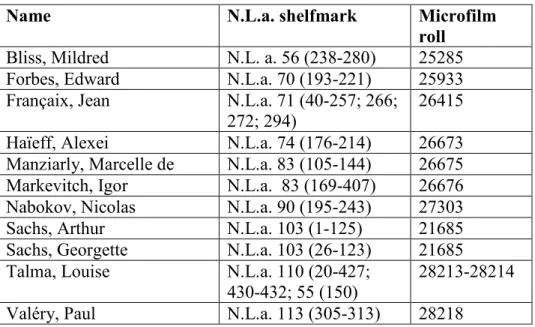
Talma, and Paul Valéry16(Table I.2 contains the shelf-marks for those letters held at the F-Pn).
Table I.2Third-Party correspondents,F-Pn
Name N.L.a. shelfmark Microfilm
roll
Bliss, Mildred N.L. a. 56 (238-280) 25285
Forbes, Edward N.L.a. 70 (193-221) 25933
Françaix, Jean N.L.a. 71 (40-257; 266;
272; 294) 26415
Haïeff, Alexei N.L.a. 74 (176-214) 26673
Manziarly, Marcelle de N.L.a. 83 (105-144) 26675
Markevitch, Igor N.L.a. 83 (169-407) 26676
Nabokov, Nicolas N.L.a. 90 (195-243) 27303
Sachs, Arthur N.L.a. 103 (1-125) 21685
Sachs, Georgette N.L.a. 103 (26-123) 21685
Talma, Louise N.L.a. 110 (20-427;
430-432; 55 (150) 28213-28214
Valéry, Paul N.L.a. 113 (305-313) 28218
These letters inform the reader of Boulanger’s mediation between Stravinsky and her
students, friends, and colleagues. They also reveal her efforts to perform, edit, lecture on, and
15Correspondence sent by the following people to Stravinsky is housed at the Paul Sacher Stiftung:
Mildred Woods Bliss, John Alden Carpenter, Aaron Copland, Samuel Dushkin, Marcelle de Manziarly, Winaretta Singer, and Paul Valéry.
16TheF-Pnalso holds Stravinsky’s letters to Marcelle de Manziarly. See N.L.a. 11 (86-119). For more
arrange commissions for Stravinsky’s compositions. Working through these documents it
becomes apparent that the network that connected Stravinsky and Boulanger is far larger than
most often portrayed; Boulanger and those associated with her were involved with much of
Stravinsky’s activity, beginning in the mid-1920s (see Figure I.1).
Figure I.1Boulanger-Stravinsky connections
For this reason, these documents offer a rich resource for re-configuring the external
networks by which Stravinsky operated.17
17The categories of “student,” “friend ,” and “colleague ” were tremendously fluid amongst those of
theBoulangerie. This chart illustrates only some of the myriad ways Boulanger was able to connect people to Stravinsky. In certain cases, i.e. Koussevitzky, Boulanger was not responsible for introductions with the
Igor Stravinsky Nadia Boulanger Students Jean Françaix Alexei Haïeff Jean Papineau-Couture Claudio Spies Glenn Watkins Friends Richard Hammond Arthur Sachs Paul Valéry Professional Contacts Pierre Boulez Edward Forbes Sergei Koussevitzky Willy Strecker Aaron Copland Marcelle de Manziarly
Additional Documents of the Bibliothèque Nationale de France
The Bibliothèque Nationale de France also holds various personal documents catalogued in
folders ordossiersheld in the library’s reserve section. The state of this part of thefondsis still in flux, though one can now consult most items on microfilm. Documents concerning
specific activities—for example, Boulanger’s work with the Société Musicale Indépendante,
or her visa applications for various tours—are grouped together. Less-easily categorized
documents are organized by year under titles such as “Séjour aux États-Unis,” “1939 tour,”
or simply “Documents d’archives” (see Table I.3). The range of materials collected in these
dossiers is vast, and it is not always clear what one will find, but the rewards are often worth
the search.18
composer , but she did mediate relationship between the two at various points in time. The shelf marks for those whose letters are available at theF-Pnbut were not cited in Table 2 are: Aaron Copland, N.L.a. 63 (122–71) and N.L.a. 294 (23-28); Sister Edward Blackwell, N.L.a. 105 (292-358); Jean Papineau-Couture, N.L.a. 92 (144, 147–83, and 186–88); Sister Ignatia Dourney, N.L.a. 105 (362-407); Richard Hammond, N.L.a. 74 (242-309); Winnaretta Singer-Polignac N.L.a. 94 (193-358) and 97 (182–83); Francis Poulenc, N.L.a. 95 (85-95, 98-130, 96-97); Claudio Spies, N.L.a. 107 (175-318); Glenn Watkins, N.L.a. 115 (351–55); and Katharine Wolff, N.L.a. 117 (100-310).
For more on Boulanger’s relationship to Copland see: Mark DeVoto, “Copland and the ‘Boulangerie’,” inCopland’s Connotations: Studies and Interviews, ed. Peter Dickinson (Woodbridge, UK: Boydell and Brewer, 2002): 3-13; Annegret Fauser, “Aaron Copland, Nadia Boulanger, and the Making of an ‘American’ composer,”Musical Quarterly89 (2006): 524–54; Howard Pollack,Aaron Copland: The Life and Work of an Uncommon Man(Urbana: University of Illinois Press, 199), 45-50. For more on Boulanger and the circle of the Princesse de Polignac see: Jeanice Brooks, “Nadia Boulanger and the Salon of the Princesse de Polignac,” Journal of the American Musicological Society46 (1993): 415–68; Myriam Chimènes, “Nadia Boulanger et ses Mécènes: connivences sociales,” inNadia Boulanger et Lili Boulanger,ed. Laederich, 99-112; Sylvia Kahan, Music’s Modern Muse: A Life of Winaretta Singer, Princesse de Polignac(Rochester, NY: University of Rochester Press, 2003), 294-325; and eadem., “‘Quelque chose de très raffiné et de très musical’: la
collaboration entre Nadia Boulanger et Marie-Blanche de Polignac ,” inNadia Boulanger et Lili Boulanger, ed. Laederich, 85-98.
18There is, for example, a frantic letter in Rés. Vm. Dos. 148 (24) written from Duncan Phillips to
Filed away in this series of folders are the concert programs Boulanger collected over
the course of her lifetime.19These programs span the length of three microfilm reels and
reference concerts from 1902 until 1973. This is where one finds the programs for the private
premieres ofPerséphone, theDumbarton Oaks Concerto, and theSonate pour deux pianos— events all masterminded by Boulanger. There are also numerous examples of concerts
containing Stravinsky’s music in which Boulanger was the performer, conductor, or
organizer.
Also included in Rés. Vm. Dos.are the syllabi for Boulanger’s Wednesday afternoon classes from 1934-1939 and 1946-1979.20Stravinsky’s works figure prominently
throughout, sometimes before they were available through publication. Indeed, for the
majority of their relationship, Boulanger received Stravinsky’s scores in autograph form from
him directly or from his publisher. Reading these syllabi, it is clear that Boulanger was the
first voice to present much of Igor Stravinsky’s music to generations of students, and that the
composer depended on her for this. Furthermore, the design of the classes and the excerpts
selected reflect Boulanger’s intimate familiarity with these pieces—particularly the
neo-classical compositions—drawn from first-hand experience discussing and editing them
alongside the composer.
19Boulanger, Programmes, 1901–73,F-Pn, Rés. Vm. Dos. 195; Jeanice Brooks, “Noble et Grande
Servante de la Musique: Telling the Story of Nadia Boulanger’s Conducting Career,”Journal of Musicology14 (1996): 92-116; and Alexandra Laederich, ed., “Au clavier et au pupitre: les concerts de Nadia Boulanger de 1901 à 1973,” inNadia Boulanger et Lili Boulanger, 173–90.
20Boulanger, Les Cours de la rue Ballu, ‘Les cours du mercredi’, 1934–39; 1946–79,F-Pn, Rés. Vm.
Table I.3Relevant Rés. Vm. Dos. contents
Folder Title (translated into English)
Shelfmark Microfilm No.
Wednesday Afternoon
Classes Rés. Vm. Dos. 128 Vm bob 31970
École Normale Documents Rés. Vm. Dos. 127 Vm Bob 31970 Société Musicale
Indépendante
Rés. Vm. Dos. 138 Vm Bob 32624
Activity during 1932 Rés. Vm. Dos. 140 Vm Bob 32625
Activity during 1936 Rés. Vm. Dos. 141 Vm Bob 32625
Materials relating to tours of
the United States Rés. Vm. Dos. 143 Vm Bob 32625
1939 tour Rés. Vm. Dos. 144 Vm Bob 32626
Exile in the United States Rés. Vm. Dos. 145-149
Vm Bob 32626-32627
Archival documents Rés. Vm. Dos.
150-152
Vm Bob 32627-32628
Programs Rés. Vm. Dos. 195 Vm Bob
34028-24031
Scores: Autographs, Proofs, and Printed Materials
As I mentioned earlier, Boulanger and Stravinsky began exchanging scores as early as 1923.
Fifty additional scores would follow over the next forty-six years.21 It is perhaps only fitting
that these musical scores and their annotations should tell the story of Boulanger and
Stravinsky’s partnership more vividly than any of the other items in the archival collections I
consulted. The following table lists the various scores authored by Stravinsky contained in
21There are three different places to locate these items. The call-numbers for some are referenced at
Boulanger’s collection (see Table I.4).22Throughout the course of this dissertation, I return
to these scores, weaving their details into the narrative of each project, and allowing the
music to stand in dialogue with the other archival materials.
Table I.4Stravinsky scores owned by Boulanger (F-Pn), 1930-1969
Work Type of Score A
n n ot at ed Date Shelfmark Capriccio Autograph two-piano
reduction X 1930 Ms. 17941
Symphonie de psaumes
Copy of the autograph orchestral score
X 1931 Gr. Vma. 476
Proofs for the
piano/vocal (p/v) score, also entitled “pages bleues” (Paris: Édition Russe de Musique, 1930)
X 1931 Rés. Vma. Ms. 245
Revised p/v score (Paris: Édition Russe de Musique, 1931)
X 1931 Rés. Vma. 317
Original analysis and sketches23
X 1931-1932
Rés. Vma. Ms. 984
Perséphone Proofs p/v score, three different versions (Paris: Éditions Russe de Musique, 1934)
X 1934 Rés. Vma. Ms. 316
Copy of the autograph orchestral score (1934 version –given to NB in
X 1934 Gr. Vma. 474
22The SS,CH-Bpsalso holds all the extant Stravinsky sketch materials. These are of slightly less
importance to this work, seeing as there is no evidence that Boulanger was ever involved in the pre-compositional stage of Stravinsky’s creative process (with the possible exception of theSonata for Two Pianos). The sketches offer little information to confirm this. Ultimately, the sketch-books do provide a unique point of comparison for understanding the effectiveness of Boulanger’s analytical sketches which, at times, show an uncanny ability to mirror Stravinsky’s processes.22
Work Type of Score A n n ot at ed Date Shelfmark 1947) Bogoroditse devo; later Ave Maria Autograph original given to Boulanger (probably during the revision process of 1949)
1934 Rés. Vma. Ms. 980
Jeu de cartes Copy of the autograph orchestral score
X 1937 Vma.4004
Concerto en Mib
(Dumbarton Oaks
Concerto)
Proofs of the autograph orchestral score used by Boulanger to conduct the piece, (Mainz: B. Schött’s Söhne, 1938)
X 1938 Rés. Vma. 315
Autograph two-piano reduction
X 1938 Ms. 17945
Published two-piano score (Mainz: B. Schott’s Söhne, 1938), given to NB in 1941.
X 1938 Vma. 4002
Revised two-piano score X 1938 Vmg. 22935
Symphonie en ut Copy of the autograph orchestral score, mvt. I and II
X 1941 Rés. Vma. Ms. 1218 (1-2)
Boulanger’s sketches and analyses of the symphony
1942? Rés. Vma. Ms. 1218 (3) X
Autograph score, two-piano reduction, mvt I
X Undated Rés. Vma. Ms. 1039
Autograph score, two-piano reduction, mvt. I-IV
X 1940 Rés. Vma. Ms. 982 (1-3); 983 (1-2); and 984
Copy of autograph for two-piano reduction24
X Undated Vma. 4015 (1-3)
24This score also states that it comes with Boulanger’sesquissesor analytical notes. They are missing
Work Type of Score A n n ot at ed Date Shelfmark Four Norwegian Moods
Copy of the autograph orchestral score
X 1942 Vmb. 4455
Piano-Rag-Music
Copy of the published score (London: J & W Chester, 1920)
X 1942 Vmg. 22930
Circus Polka Copy of the autograph score
1942 Vmb. 4452
Copy of published score (New York: Associated Music Publishers, 1942)
X 1943 Vmg. 22920
Apollon Musagète
Copy of autograph score X 1943 Vmb. 5461
« Danse Sacrale » from
Le Sacre du printemps
Autograph orchestral
score X
1943 Ms. 17946; Bob 6378
Sonate pour deux pianos
Score missing, but referenced in dedication toCircus Polkaand in letters X 1943-1944 Danses concertantes
Copy of published two-piano score (New York: Associated Music Publishers, 1942)
X
1944 Vma. 4001
Scherzo à la
Russe Copy of the autographorchestral score X 1945 Vma. 4013
Symphony in Three Movements
Copy of autograph score (draft of first
movement)
X 1945
Gr. Vma. 475
Undated but likely from 1941-45 are her copy of the autograph orchestral score for
Oedipus Rex(Vma. 4006); incomplete autograph of the revisedPastorale(Rés.Vma. Ms. 981); new Latin version of thePater Noster(published score, New York: Boosey and Hawkes, 1949, Vmh. 8581; copy of the autograph, Vmg. 22928); original autograph sketches forScènes de ballet(Ms. 17942); and a copy of the published score for theStar Spangled Banner(New York: Mercury Music Corp., 1941, Vmh. 8582).
Work Type of Score A n n ot at ed Date Shelfmark
Messe Copy of the autograph
score,Gloriamvt.
X 1945 Vmg. 22923
Copy of autograph score X 1947 Vmg. 22925 Published score (New
York: Boosey and Hawkes, 1948)
X 1949 Vmg. 22924
Hommage à Nadia Boulanger
Original autograph score
1947 Ms. 17940
Orpheus Copy of the autograph
score
X 1948 Vma. 4008
The Rake’s Progress
Autograph Summary Sketches
X 1951? Rés. Vma. Ms. 329 (1-3)
Copy of the published score (New York: Boosey and Hawkes, 1951)
X 1951 Vma. 4010
Undated but probably from the 1946-1951 period is a copy of the autograph score for the
Ebony Concerto(Vma. 4003).
Credo Published Score (New
York: Boosey and Hawkes, 1949)
1952 Vmh. 8580
The Flood Published Score (New York: Boosey and Hawkes, 1963)
1963 Vmg. 22922
Elegy for J.F.K. Published Score (New York: Boosey and Hawkes, 1964)
X 1964 Vmg. 12520A
Sacre du printemps
Published Sketches (New York: Boosey and Hawkes, 1969)
X 1969 Vma. 4011-4012
Materials of the Centre internationale Nadia et Lili Boulanger
The materials of the Centre internationale Nadia et Lili Boulanger are extensive and a
dedication and organizational skill of her team of secretaries. These archives are housed in
the heart of Paris, and, as if haunted by the ghost of the two sisters, are still watched over by
the bust of Lili Boulanger that had served as the imposing centerpiece of Boulanger’s salon
after 1913.25Boulanger’s teaching supplies (articles, lecture notes, analytical sketches, and
other varia) line the Foundation’s walls and are stacked upon the floor. Here, they retain their
original filing, organized alphabetically by subject or composer. Added to this are several
binders of photographs, the majority of which remain unpublished and continue to be
controlled by the Foundation.
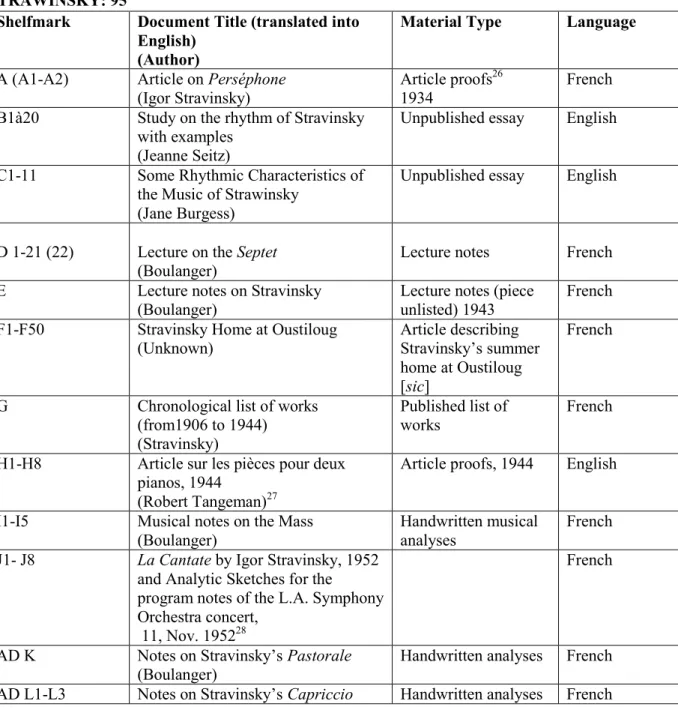
A wealth of materials are contained within the collection that pertain to Stravinsky.
These include items such as unpublished studies written by Boulanger’s students, article
proofs by Stravinsky himself, Boulanger’s lecture notes on various pieces—among them the
Septet,Cantate, and two lectures on theMass—and analytical notes that were not included as part of theF-Pndonation (see table I.5).
The volume of information represented by these binders alone is remarkable. Add to
that the possibility to cross-reference other files held by the Centre and one marvels at the
possibilities this archive presents. It fell well beyond the scope of my project to provide an
in-depth study of each of the documents discovered here, and instead I chose to focus on one
specific composition, Stravinsky’sMesse, for which the Bibliothèque Nationale evidence was minimal. The remainder of these documents await another scholar and further visits to
the Foundation, before their wealth can be fully mined.
25The statue was commissioned of Lucienne Heulvelmann after Lili Boulanger won thePrix de Rome
Table I.5Documents of the Centre Internationale Nadia et Lili Boulanger
STRAWINSKY: 95
Shelfmark Document Title (translated into English)
(Author)
Material Type Language
A (A1-A2) Article onPerséphone (Igor Stravinsky)
Article proofs26 1934
French
B1à20 Study on the rhythm of Stravinsky with examples
(Jeanne Seitz)
Unpublished essay English
C1-11 Some Rhythmic Characteristics of the Music of Strawinsky
(Jane Burgess)
Unpublished essay English
D 1-21 (22) Lecture on theSeptet (Boulanger)
Lecture notes French
E Lecture notes on Stravinsky (Boulanger)
Lecture notes (piece unlisted) 1943
French
F1-F50 Stravinsky Home at Oustiloug (Unknown)
Article describing Stravinsky’s summer home at Oustiloug [sic]
French
G Chronological list of works (from1906 to 1944)
(Stravinsky)
Published list of works
French
H1-H8 Article sur les pièces pour deux pianos, 1944
(Robert Tangeman)27
Article proofs, 1944 English
I1-I5 Musical notes on the Mass (Boulanger)
Handwritten musical analyses
French
J1- J8 La Cantateby Igor Stravinsky, 1952 and Analytic Sketches for the
program notes of the L.A. Symphony Orchestra concert,
11, Nov. 195228
French
AD K Notes on Stravinsky’sPastorale (Boulanger)
Handwritten analyses French
AD L1-L3 Notes on Stravinsky’sCapriccio Handwritten analyses French
26Igor Stravinsky,“Igor Strawinsky Nous Parle dePerséphone,”Excelsior(29 April 1934): 579–81.
This is where Stravinsky wrote of his technique: “Mon nez est. Ma technique est.” Boulanger referenced this quote repeatedly in lectures on the composer afterwards.
27Later published as “Stravinsky’s Two-Piano Works,”Modern Music22 (1945): 93-98. 28Secretarial annotations suggest this lecture was also part of a series on BBC talks and talks on
Shelfmark Document Title (translated into English)
(Author)
Material Type Language
(Boulanger)
AD M1-M6 Analysis of theChants Russes (Boulanger)
Handwritten analyses French
AD N1-N32 Analysis and lecture for the Mass,1972
(Boulanger)
Boulanger’s lecture notes on theMass
French
AD O1-O3 Analysis of thePater NosterandAve Marie
(Boulanger)
Handwritten analyses English
NB+AD –P1-P Various Notes (Boulanger)
Various
NB Q1-Q5 Chronology of works and notes (Boulanger)
Chronological list of Stravinsky’s works alongside other compositions written in the same years
French
CA R1-R2 Lecture notes on theMass, 1972 Lecture notes French
S1-S35 Lecture by Stravinsky on Art and Creation
(Stravinsky)
Lecture notes French
Methodology
To connect these materials and place them in a meaningful context I use a rigorous
methodology that combines archive-based historical research with musical analysis and the
tools of cultural and critical theory. This approach is relatively new to research on musical
modernism in general and Stravinsky in particular. For this dissertation, I join the burgeoning
work of such scholars as Brigid Cohen, Mary Davis, Annegret Fauser, and Tamara Levitz
who are beginning to explore new, interdisciplinary ways of engaging modernist
historiographies.29For my own project, I draw theoretical constructs from an array of sources
29Mary Davis,Classic Chic:Music, Fashion, and Modernism(Berkeley and Los Angeles: University
in the humanities including theories of post-structural feminism, transnationalism, cultural
transmission, and cultural capital.
Feminist Musicology/Feminist Methodologies
This dissertation is first and foremost a feminist account of Boulanger’s career and the role
she played in mediating Stravinsky’s compositions. It is all too easy when exploring the
relationship of two strong characters such as Boulanger and Stravinsky to struggle between
serving two masters. Even more dangerous is the pull to invert any claim to Boulanger’s
primacy in her relations with Stravinsky.30In lieu of doing either, I have chosen to center
this dissertation on Boulanger, using feminist theories and methodologies as framing devices.
In so doing, I join with modernist scholarship that seeks to reinterpret, in Suzanne Cusick’s
words: “woman’s work and the culturally feminine so that they cease to be marginalized and
devalued, but might be re-interpreted as important elements of musical culture.”31
I argue that throughout her career, as Boulanger crafted a public image for
Stravinsky, she did so by performing—in the Judith Butler sense—gendered discourses with
great success.32Whenever possible, I highlight these gender discourses and consider how
they interacted with and informed Boulanger’s professional mobility, analytic approaches,
Corpses” (Paper read at the Annual Meeting of the American Musicological Association, Quebec City, QC, 1-4 November 2007); Brigid Cohen, “Wolpe’s ‘Geschichte der Verknüpfungen’: Reflections on Writing and Community,”Mitteilungen der Paul Sacher Stiftung19 (2006): 17-21; and eadem, “Migrant Cosmopolitan Modern: Cultural Reconstruction in Stefan Wolpe’s Musical Thought,” PhD diss., Harvard University, 2007.
30Suzanne Cusick discusses the relative difficulty that resides in writing about women’s work in:
“Gender, Musicology, and Feminism,” inRethinking Music, ed. Nicholas Cook and Mark Everist (New York: Oxford University Press, 1999), 490.
31Cusick, “Gender, Musicology, and Feminism,” 497.
32Judith Butler,Gender Trouble: Feminism and the Subversion of Identity(New York: Routledge,
and pedagogical constructs. Thus my work follows in the same vein as that of feminist
musicologists Marcia Citron, Annegret Fauser, Ellie Hisama, and Judith Tick, who have
recently begun the task of reconsidering how women artists in particular, and gender in
general, have played a role in shaping the modernist canon.33Via this emphasis, I place
Boulanger and Stravinsky’s activities along what Judith Tick describes as the “continuum of
possible adaptations and resistances between individuals and society and between men and
women who, as composers and musicians, are bound together as much as torn apart by the
ideology surrounding music and gender.”34
Indeed, as this dissertation shows, Boulanger is a particularly difficult figure to situate
within the musicological continuum, because her activity so often fell outside of
conventional models of the creative process. Though she composed early in her career,
Boulanger abandoned this activity in the mid-1920s.35She did not serve as an official editor
for Stravinsky’s music, and her intermittent work as conductor or performer was never tied to
any one particular orchestra or ensemble. Instead, Boulanger was a teacher, a vocation
33Marcia Citron,Gender and the Musical Canon(Urbana: University of Illinois Press, 2000);
Annegret Fauser, “The Making of an ‘American’ composer,” 524–54; eadem., “La Guerre en Dentelles: Women and thePrix de Romein French Cultural Politics,”Journal of the American Musicological Society51 (1998): 83-129; Ellie Hisama,Gendering Musical Modernism(Cambridge and New York: Cambridge University Press, 2001); Hisama and Ray Allen, eds.,Ruth Crawford Seeger’s Worlds:Innovation and Tradition in Twentieth-Century American Music(Rochester: University of Rochester Press, 2007); and Judith Tick,Ruth Crawford Seeger: A Composer’s Search for American Music(New York: Oxford University Press, 1997).
34Judith Tick, “Charles Ives and Gender Ideology,” inMusicology and Difference, ed. Ruth Solie
(Berkeley and Los Angeles: University of California Press, 1993), 105.
35For Boulanger’s compositional activities see: Caroline Potter, “Nadia Boulanger’s and Raoul
disparaged by accusations of feminization, itself equated with inferiority.36This gendered
devaluing of her, such as in Virgil Thomson’s metaphor of Boulanger as a “musical
midwife,” placed and continues to place her in a marginal position, rendering her as neither
the established composer nor the composer-in-training, a reality which has tarred her with the
stigma of historical irrelevance.37
My work calls this into question, specifically by reconsidering the ability of the
“Master Teacher” to imbue music with canonical worth. This was especially true of
Boulanger’s engagement with Stravinsky’s oeuvre. It was Boulanger’s cultural capital that
helped in part to assert a canonical place for Stravinsky’s music amongst a younger
generation of students who went on themselves to propagate her ideas across the globe.
Boulanger’s pedagogical acumen meant that she could successfully execute her valuation of
Stravinsky’s music oftentimes before his works had even been published. Boulanger’s ability
to influence the canon was invaluable to the development of musical traditions, especially
those that included Stravinsky. It is this activity that Cusick argues feminist musicology
ought to reintroduce as a powerful contribution to the musicological literature, as it informs
the “means by which people are inculturated, and taught behaviours that will eventually be
markers of gender, ethnicity, and class.”38
36For this disparaging view of the teaching profession in early twentieth-century America see: Carol
Oja,Making Music Modern:New York in the 1920s(New York: Oxford University Press, 2003), 201–03 and 221–27; Nadine Hubbs,The Queer Composition of America’s Sound: Gay Modernists, American Music, and National Identity(Berkeley and Los Angeles: University of California Press, 2004), 133; and Tick, “Charles Ives,” 95.
37“Being midwife to developing musical nations would seem to be her basic role.” Virgil Thomson,A
Virgil Thomson Reader(Boston: Houghton Mifflin, 1981), 391.
Moreover, lest I re-inscribe notions of Boulanger operating solely as Stravinsky’s
helpmate, it is essential to remember that in validating Stravinsky’s music, Boulanger
validated her own authority as a pedagogue. Boulanger’s advocacy for Stravinsky also served
to promote the neoclassic aesthetic over and above the work of serialists like Arnold
Schoenberg or “systematic composers” like Olivier Messiean. In championing Stravinsky,
Boulanger championed her own school, and in fighting for his music, shaped the circle that
would continue to validate her own teaching practices. As we shall see, it is easy to lose sight
of this self-validation amongst the powerful rhetoric employed by Boulanger in her creative
dialogue with Stravinsky. Yet this motivation was at least in part responsible for Boulanger’s
fervent support of her favorite composer. For in devotion to him, Boulanger was subtly
miming the devotion she wished to inspire in her own pupils for her teachings.
In large part, this wish to empower Boulanger and implicate her professional agency
when working with Stravinsky was my motivation for choosing the verb “constructs” for the
title, and one of the dominant themes, of this dissertation. I do not mean to suggest that
Boulanger constructed Stravinsky the man, rather that Boulanger constructed an image of
Stravinsky—his personality, his compositional process, his legacy—that she then taught to
the public. The Stravinsky that Boulanger mediated developed in a two-part process that
corresponds with the first and second halves of this dissertation. Boulanger crafted her
construction of Stravinsky primarily, as we shall see, from firsthand exposure to Stravinsky
and his music between 1930 and 1946. She gained an understanding of his compositional
proclivities and motivations, personality and sense of humour, by observing (and, I believe,
dissertation, a treatment similar to other exegetes that Valerie Dufour has connected with
Stravinsky, including Charles-Albert Cingria, Roland Manuel, André Gide, and others.39
After the Second World War when Boulanger separated from Stravinsky—she moved
back to Paris, he remained in the United States—Boulanger’s manufacturing of the
composer’s identity became entirely her own. Her presentations on Stravinsky grew to be
increasingly the stuff of memory, of times past (jadis). In this second half of the dissertation, the idea of construction takes on an even greater artificiality, in that the Stravinsky Boulanger
presented post-1946 was a direct reflection of who Boulanger wished Stravinsky to be, and
what she wished him to represent for music, and less perhaps of the realities of his
compositional activity, especially after 1952 when he turned to serialism. This is the
Stravinsky of Boulanger’s more dogmatic period, and is the persona most commonly
presented in the few historical accounts about her, given that Boulanger only authorized
biographical efforts in the final decade of her life. Simultaneously, this is the Stravinsky who
more clearly reflects Boulanger’s own self and her own desires for the future of music,
because this persona was designed primarily by her selective memories.
Thus feminism serves as a framing device that focuses the other discoveries of this
dissertation. Through it, I present an active, complex Boulanger—a woman fraught with
contradictions, yet vibrantly passionate about her musical practices. Through the various
projects presented in this dissertation, I shift gears and lenses as I explore the various shades
of Boulanger’s kaleidoscopic relationship to Igor Stravinsky and his music. This theoretical
framework informs and is informed by the music-theoretical insights I read in the sketches
and scores of the archives and in the rhetoric found within the two musician’s letters.
39See Valerie Dufour’s work on Stravinsky’s co-authors and assistants up until the 1940s,Stravinski et
Transnationalism and Cultural Mediation
After gender, this dissertation is primarily about location. By location, I mean both
geographical positionings, such as those tied to nation-states, and locations within cultural
networks, which in Boulanger and Stravinsky’s cases so often mapped onto
transnational/trans-Atlantic systems. In reconfiguring the cultural landscape over which
Boulanger’s ideas travelled, and the methods she used to propagate these ideas, I borrow
theoretical constructs from the field of transnational studies and notions of cultural
transmission.40Previously, the musicological use of these theories has most commonly
focused on the mediation of subaltern or diasporic cultural traditions in relation to a dominant
culture, particularly concerning people of color and their relationship with Western nations.41
I wish to extend this theoretical usage, to show that these constructs can be useful to
explorations of topics positioned closer to the “center” of academic inquiry. Though neither
Boulanger nor Stravinsky fall into the traditional experiential paradigms explored in
transnationalism studies, they too held positions that oscillated between standing squarely
within the dominant culture and also outside of it—positions that they were able to put to
powerful use. In my work, I interrogate Boulanger and Stravinsky’s shifting relations to
dominant cultural discourses during the modernist era, especially to explore how they
exploited their shifting hybrid positions as cultural insiders/outsiders to add further credence
to their avant-garde identities. Furthermore, I consider how Boulanger established
40My model of cultural transmission has also been informed by recent work on cultural transfer,
especially that undertaken by musicologists, Mark Everist and Annegret Fauser. See:Music, Theater, and Cultural Transfer: Paris 1830 to 1914(Chicago: University of Chicago Press, 2009). See also, Michael Werner and Michel Espagne, eds.Transferts: Les Relations interculturelles dans l’espace franco-allemand (XVIIIeet XIXesiècle)(Paris: Editions Recherche sur les Civilisations, 1988).
41Ethnomusicologists have also begun addressing the intersections of cultural mediation,
pedagogical conduits that transcended national boundaries, thereby complicating further her
use of modernist discourses that were themselves so heavily rooted in national politics but
inherently dependent upon trans-Atlantic systems of transmission.
“I do not accept that anyone is permanently fixed by his or her identity.”42In his
seminal book,Routes, James Clifford discusses the ways in which culture traverses the globe and the roles people play in its diffusion. The above quotation, asserts the fundamental
theoretical kernel that lies at the heart of Clifford’s writing: identities are fluid, dependent on
context, and malleable if manipulated by the right actor. His words also summarize
Boulanger’s own chameleon-like persona. She could frame herself and Stravinsky in fluid
and flexible ways, depending on where she was, and which culture she was interacting with.
Boulanger was, as transnational models suggest, “‘anchored in’ while also transcending one
or more nation-states.”43Hers was a cultural affiliation centered in Paris, France, and
extending outwards to England, Canada, the United States and South America. Eventually,
she made inroads in the former Soviet Union, Hungary, Poland, Japan, and China. As we
shall see, depending on where Boulanger was situated and to which audience she was
speaking, she could alter her cultural message while still retaining authority. Boulanger was
one of the main actors in what Carol Oja describes as the “conduit for artistic exchange” that
the Atlantic became after 1920.44This was in part because of Boulanger’s ability to appeal
to North Americans through the authority of the French tradition, while also asserting a
42James Clifford,Routes: Travel and Translation in the Late Twentieth-Century(Cambridge, MA:
Harvard University Press, 1997), 12.
43 Brenda S.A. Yeoh, Michael W. Charney, and Tong Chee Kiong, eds.Approaching
Transnationalisms: Studies on Transnational Societies, Multicultural Contacts, and Imaginings of Home (Boston: Kluwer Academic, 2003), 17.
message of music’s “universal” language. Consider Khagram and Levitt’s work on
transnational systems where they state that “some people function as transporters and
transmitters of new ideas and practices, while others act as translators or transformers.”45In
her negotiations with America patronesses, her lectures in Switzerland, and her concerts in
England, to name just three examples, Boulanger became this translator for Stravinsky. She
transported his music via her performances, and by extension, the performances and
teachings of her students
Music was to Boulanger a second home, a second culture. She could oscillate
between belonging to the French tradition, place emphasis on her Russian heritage via her
mother, or suggest that she was familiar with American traditions by virtue of her many
students, depending on what her role required of her. Glenn Watkins attributes Boulanger’s
success in large part to her French nationality, given that, after World War I, studying in
France was the dominant option for Americans who had previously travelled to Germany
instead.46It was in this transnational situation that Boulanger espoused her own brand of
neoclassicism. As Carol Oja writes, transnationalisms of the 1920s bore a “syncretic process
of international exchange in which aspects of neoclassicism were manipulated and fused to
form different breeds in different contexts.” In Boulanger’s own pedagogical spaces,
neoclassicism became, as described by Alan Kendall, “a means to transcend national
45Sanjeev Khagram and Peggy Levitt, eds.,The Transnational Studies Reader(New York: Routledge,
2008), 6.
46Before World War I, the following composers and scholars all went to Leipzig or Berlin to study
boundaries,” or, an international aesthetic.47Her particular brand of neoclassicism allowed
Boulanger to void notions of culture belonging to any one nation or being the purview of any
one national language.
Thus, in an environment as politically charged as inter-war Europe, where nationality
carried with it a great deal of baggage and could lead to jingoism or other forms of
discrimination, Boulanger attempted to mediate nationality with internationalism, belonging
to two cultures at once or none at all. In this space, Boulanger wielded a great deal of cultural
power, resonating with Clifford’s comment that political power is directly related to: “who
deploys nationality or transnationality, authenticity or hybridity, against whom, with what
relative power and ability to sustain hegemony.”48
In her position as educator, Boulanger navigated the complex task of mediating the
music of Igor Stravinsky to various audiences. He was also a cultural outsider by, after 1913,
never “belonging” to the culture in which he lived. In Paris, he was not Parisian, in America,
he was not American. Boulanger stood in compassionate relation to this, because, even as a
Parisian in Paris, she was a woman, and therefore a relative outsider in the male-dominated
world of musical production. Boulanger’s brilliance resided in not only acknowledging this
imbalance, but in then using it as a manipulative tool that allowed her access to an unspoken,
hidden authority. Her activity took place in interstitial locations: The Conservatoire
Américain; her rue Ballu apartment. By entering the cultural dialogue from the periphery,
Boulanger could manipulate the center. She did so adroitly, and, as we shall see, soon after
the 1920s, her periphery became the center only to recede into the boundaries again after the
47Alan Kendall,The Tender Tyrant: Nadia Boulanger, A Life Devoted to Music(London: Macdonald
and Jane’s, 1976), 24.
1950s push towards what Nadine Hubbs refers to as the “decline of tonal modernism in
America…and the ascent of complexity music.”49In this dissertation, I will follow
Boulanger’s transnational network from the moment Stravinsky encountered it fully in 1930,
through its collapse during the Second World War, to Boulanger’s post-war attempts at
reconstruction and its eventual dilution after 1950.
One final theme that this dissertation will address that relates to the idea of cultural
positioning is the notion of community versus isolation. Especially interesting to me is the
question of how Boulanger mapped Stravinsky’s geographical and cultural difference onto
notions of his artistic genius. In his text,The Location of Culture, Homi K. Bhabha writes that culture is defined in:
those moments or processes that are produced in the articulation of cultural difference. These “in-between” spaces provide the terrain for elaborating strategies of selfhood—singular or communal—that initiate new signs of identity, and innovative sites of collaboration, and contestation, in the act of defining the idea of society itself.50
In defining Stravinsky, Boulanger made him an artistic visionary, one whose extreme
position at the cutting-edge of musical production also isolated him. This metaphor of
“solitude” dialogues interestingly with Boulanger’s attempts to construct an international
concept of modernist art. By suggesting that Stravinsky’s extraordinary talents caused him to
stand “outside” of the community, Boulanger facilitated a way by which Stravinsky could be
received as an outsider without attributing his difference to his Russian heritage. Stravinsky’s
music was so unique, that, in Boulanger’s mind, it isolated him. He stood at the boundaries
49Nadine Hubbs,Queer Composition, 71.