Promoting
Pedestrian-Friendly
Design
in
Downtown
Redevelopment
This article
examines
how
cities regulatedowntown
urban
design
and
the effectof
theseapproaches
inshaping
the builtenvironment.
The
lackof urban
design
controlsfor
buildingplacement,
elevationand
other featurescan
open
thedoor for
new
development
tobe designed
toaccommodate
theautomobile
at theexpense
of
pedestrians.Downtown
Greensboro,
NC,
a
city that allowswide
latitude indowntown
design,has
witnessed thedevelopment
of
downtown
projectsthat diverge significantly
from
a
pedestrian-oriented typology, resulting indowntown
blocks thatseem
more
appropriatefor
thesuburbs than a
dense,"walkable"
downtown.
The
article looks atseveralcitiesto
demonstrate
how
designstandards
and
guidelineshave
raised thebar for
downtown
development
- affecting the designof not
only buildingsbut
also streetscapeimprovements
and
public spaces.
The
article surveysdowntown
design
standards inDenver,
Austin,Durham,
and
Chapel
Hill,and
compares
recentdowntown
projects inGreensboro
with thegoals
of
these standards.The
author
findsthatdevelopment
regulations indowntown
Greensboro
are tooopen-ended
toensure
thebuiltenvironment
of
thefuture
puts "pedestriansfirst.'"New
public buildingshave
notenhanced
the pedestrian experience indowntown
Greensboro
to date.Philip
Hervey
INTRODUCTION
This
articleexamines
how
cities reguratedowntown
urban designand
the effect of theseapproaches
in shapingthebuiltenvironment.The
lackof urbandesign controlsforbuildingplacement,
elevation
and
otherfeaturescanopen
thedoor
fornew
development
tobedesignedtoaccommodate
the
automobile
at theexpense
of pedestrians.Downtown
Greensboro.NC.
acity thatallowswide
latitude indowntown
design, has witnessed thedevelopment
ofdowntown
projects that divergesignificantly
from
a pedestrian-orientedtypology,resulting in
downtown
blocks thatseem more
appropriate
for thesuburbs
than
adense,
"walkable"
downtown.
Examples
from
Greensboro.
NC.
includeanofficebuildingsetoff thestreetby 200
feetand
surroundedon
three sidesby
parkinglots,anew
buildingwithno
windows
atthesidewalklevel,
and
apark with smallbenches
oriented
toward
asurfaceparkinglot.On
theother hand,many
citiesacross theUnitedStatesconsiderdowntown
design as warranting careful scrutinyin order to preserve the pedestrian character of
downtown
streets.The
article looks at several ofthese cities to
show
how
design standardsand
guidelines
have
raised the bar fordowntown
development
- affecting the design of not only buildingsbut also streetscapeimprovements and
public spaces.
Philip
Hervey
received aMaster
of Regional
Planning
from
the Universityof North
Carolinaat
Chapel
Hill in 2000. This articleexpands
on
hismaster'sthesis. DesignGuidelinesforRevitalizingDowntown
Durham,
switching
thefocus
toDOWNTOWN
GREENSBORO
Historic
and
Emerging Development
Patterns
Greensboro
has
experienced
significantchanges
over the past30
to40
years; themost
dramatic
from
theimplementation of urban renewalprojects.
These
efforts included theremoval
ofbuildings,thereconfigurationof
downtown
streets,and
the addition of parking indecks
and
surface parkinglotsthroughouttheCentralBusinessDistrict.Today,
Elm
Street stands out as themost
preserved areainthe citycore.On
Elm
St..many
two-storyandsignificantlytallerbuildings,including the 20-story Jefferson-Pilot building, abut thesidewalk,
forming
acontinuous
street wall for several blocks. Fartheraway from
theElm
Street corridorto the eastand
west,downtown
quicklybecomes more
auto-oriented, as the street walldisintegrates
due
to the infusion oflarge parkinglotsthat
have
opened gaps
inbetween
buildingsorconsume
allora largeportionofcityblocks (seeFigure 1).
Fringe
downtown
areasnow
are attractingnew
development.
Major
projectsunderway downtown
include
condominiums
on
Church
Street,two
blocks eastofElm
Street,andalargebuildingfortheYMC
A
on
thewesternedge
ofthe CentralBusinessDistrict.Several buildings
on
Elm
Streethave been renovated injust the last year.A
project that appears to be gatheringmomentum,
withanonprofit organization calledAction
Greensboro
taking thelead, callsfor theadditionofamajor
downtown
parkand
concert hall setamid
mid-riseofficebuildings.The
projectwould remove
several small-scale buildings that provide storefrontretail space.A
question
thatremains
iswhether
new
development
-
buildings
as well as plazas, streetscapeimprovements
and
other projectsin thepublic
realm -
willenhance
people's
experienceofthebuiltenvironment.Inparticular,
will
new
development
buildon
the traditionalpattern
thatresulted
inElm
Street?
Or,
alternatively, will the
design
ofnew
projectsbe
automobile-oriented
—
suburban
—
and
impede
Street
Type
Localstreet
Minorthoroughfare
Majorthoroughfare
Minimum
Maximum
StreetSetback StreetSetback0/30
0/35 0/45
None
None
None
Minimum
InteriorSetbacks
feet;5feetif
setback required
Maximum
Height
None
None
None
Parking Requirements
Exempt Exempt Exempt
Table 1. CentralBusiness DistrictZoning Standards:
Greenshon
or
discourage
pedestrian activity?These
are questions ofurban
design.Urban
Design:
A New
Concern?
Improving
people'sexperienceofdowntown
hasemerged
asan
issue in anew
planning
initiative in
downtown
Greensboro.
Action
Greensboro
has
developed
acenter
citydevelopment
plan identifying areas formajor
initiatives,including a
minor
leagueballparkand
a concert hall/plaza
on
Elm
Street(mentioned
above).
The
planseeks,among
otherobjectives,"to createconnectedandpedestrian-friendlystreets,
transit,andparking."(ActionGreensboro, 2002)
Development
regulations for theCentral
BusinessDistrict,however, providethecitylimited influenceoverthedesignof
new
projectsinthecitycore.
The
cityhasnotadopted design guidelines fordowntown
development,
leavingthe
zoning
ordinanceas theprimarytoolforregulating design.Yetthisisa
weak
tool because each city's Central Business Districtzoningregulations requiredowntown
projectsto
meet few
ifany
buildingorsitestandards (see Table 1).
The
lackof design standardsmeans
thecity cannot assure that
new
development
meets
designobjectivessuchas creating orpreservingpedestrian-friendly streets.
One
common
objective forpromoting
walkablestreets is the creation of
"outdoor
rooms,"
requiringbuildingstobebuilt atornearthe
sidewalkformingthewallsoftheroom.
New
traditionalneighborhooddevelopment
zoning districts revealhow
zoning can
be used to bring buildings tothestreet, asoftenTND
districts establish "build-to" lines to ensurebuildingsareclosetothestreet.Greensboro's
Traditional
Neighborhood
zoning, forexample,
requiresthatbuildingsbe
no
more
thanfive feetfrom
the curb
-
a restrictive standardcompared
withthecity'sCentralBusinessDistrictregulations.
One
could argue thatGreensboro's
setback standards for the CentralBusiness
District areeffectively
discouraging designs
that place abuildingatthe
edge
ofthesidewalk,especiallyon
narrower
streets.The
City's requiredsetbacksfor theCentral BusinessDistrictare35feetforminor
thoroughfares
and 45
feetformajor
thoroughfares,measured from
the street centerline (a zero footminimum
setbackappliesifthestreetissufficiently wide).The
standardmeans
that buildingson
narrower
streetsmust
bepushed back
tomeet
thesetback requirement.
Buildings
built off the sidewalkdo
not reflect thedowntown's
historic buildingpattern.Indeed, the buildingsthat lineElm
Street
-
includingtheWoolworth's
on South Elm,
¥"'
thesceneofthe historic 1
960
sit-inby
the"GreensboroFour"
-
may
be too close to the street tomeet
theCity'ssetbackrequirement.
Because
ofthedepthofthe setback standards, several recent
downtown
buildings proposed to be built
up
to the sidewalk requiredvariances
from
theCity before
thedevelopment
could proceed.(Averett,2002)
On
the other hand, anexample
ofa building thateasilymet
Greensboro's setback standardsisthe
Wrangler
Headquarterson North
Elm
Street (see Figure 2).The
building,which
has anElm
Street address, is situated roughly
200
feetfrom
Elm
Street,withsurfaceparkingareasinfrontand
tothe sides-
adesignthat ismore
reminiscent of asuburban
officepark
thandowntown. The
placement
of the building off the streetwas
"amatter of choice,"
according
to the City's Subdivision Plansoffice.(Person,2002)
REGULATING
URBAN
DESIGN
Urban
design is intended to bring order,clarity
and
apleasing
harmony
to thepublicrealm
of towns
and
cities.The
publicrealm
is best defined as thenetwork
of
public
spaces
—
streets, squares, plazas,parks
and
sidewalks—
thatcomprise
theconnective
tissueof spaces
that citizensshare in their daily lives. It is thesepublic
spaces
thatmost
clearly definea
city.-City
of Raleigh
Urban
Design
Guidelines
(April2002)
Cities are turning tothe
development review
process, in particular
by adopting
downtown-specific
zoning
standardsand
designguidelines,to gaininfluenceoverdowntown
urban
design. Citieseagerto attract
development
tothedowntown
coremay
be reluctant
toadopt
more
stringent requirementstopreservenebulousobjectivessuchas "pedestrian scale" or "character."Yet without
effectivedesignstandards,
new
development
may
be
less than ideal. Insteadof
storefrontsand
attractivepublic spaces,
downtown
sidewalkscouldbecome
apedestrianno-man's
landlinedwithany
number
ofbarriers:surface parking,dumpsterpads.
faceless
building facades
and
drive-through
establishments.
An
example
showing
thechallengesa citycan face in controlling urban design in the
absence
ofzoning
standards ordesign guidelinesis the
YMCA
project indowntown Durham.
Urban
Design
Dilemma:
The
YMCA
inDowntown
Durham
Priortotheadoption of
new
Downtown
Design
Overlay
Districts in2002,
the Cityhad
little influenceover urban
designfor projectsproposed
in theCentral
Business
Districtoutside
theDowntown
Loop
-
a series ofone-way
streetsthat
wrap
around
the historicdowntown
core.1For
the Central Business District, the City's
zoning
ordinancespecified
no
standardsforeven
themost
basic design issues,
such
as heightand
buildingplacement.
The
zoning requirements
were
notnecessarilyabarrier topedestrian-scale
development
as projectsdid nothavetomeet
parkingrequirementsor
deep
setbackstandards.However,
the standards didlittletopromotea preferred buildingpattern;design options areanopen
slate.An
example
of the designquandary
is theYMCA
building atMorgan
and
Foster Streets.Today
the building is situated close toMorgan
Street,withparkingbehindthe building,hiddenfrom
the
main
street.An
alternativescenariocouldhave
just as easily
happened:
a large parking loton
Morgan
Streetwiththebuildingtoward
the rearofthe site (a striking contrast to its rather large
neighbor across FosterStreet),the
Durham
Centreoffice tower,
and parking
garage.Because
ofspecialcircumstances,not
development
regulations, theYMCA
in theend had
redesigned the project buildinginamanner
thatwas somewhat
compatible with goalsoftheCity'sComprehensive
Plan.In 1996. with
Durham
operatingunder
theold zoning ordinance, theYMCA
brokeground
on
anew
49,000-square-foot
athletic centerand
a13,000-square-foot
day
carecenter,adevelopment
thatrepresentedabout$9
millioninnew
downtown
investment.
The
project alsofilledina portionofa largesurfaceparkinglot.The
siteisinan important area- between
thedowntown
coreand
arun-down
areachosen
for construction ofDurham
Central Park.
One
ofthemost
significant issues forplannerswas
theYMCA's
initialplantoplacetheparkinglotinfrontofthe structures
-
ineffectTHE
DURHAM
CENTRE
Everyone
finds itannoying
to searcharound
a building ... lookingfor
theproper
entrance.When
you
know
justwhere
the entrance is,you
don'thave
tobother thinkingabout
it. It's automatic- you
walk
in, thinkingabout
whatever
'son
your
mind, looking atwhatever
catchesyour
eye—
you
are notforced
topay
attention to theenvironment
simply to get around. Yet the entrance tomany
buildings ishard
tofind; they are not "automatic" in this sense.-ChristopherAlexander,et al,
A
PatternLanguage,
1977From
adistance the 14-storyDurham
Centrestandsoutasone
ofthetalleststructures thatform
the skylineofdowntown
Durham,
N.C.
The
officetower
at300 West
Morgan
Street isthemost prominent
building
on
thenorthernedge
ofthecity'sCentralBusinessDistrict;nearbylow-risebuildings includeahot
dog
business, aMcDonald's
and
atirefranchise. Yet,from
the vantage point oftheMorgan
Streetsidewalkin frontofthe
Durham
Centre itisalmostasifthebuilding isnoteven
there.I
Thisisbecausethe220,000-square-foot buildingissituatednot
on
thestreetbut threestoriesabove
the sidewalk, atopa
780-space
garage
-
an
extreme
example
of
abuildingentrancethat, as
Christopher
Alexander
writes,isnot "automatic."
Consider
theeffectofelevating
the office buildingabove
the streetforpedestrianslookingto
get
from
Morgan
Streettothe front door.
From
thestreet, locating the front
door
to the officetower
first requires finding the
opening
in the garage'smasonry
facade
over
which
adark
blue sign says"330
W.
Morgan
St.building entrance."
From
there
one
is faced with achoice-eitherclimbthree
flightsofstairs orride theelevatorto thetopofthe deck.
The
"front"door
leading intothe building'slobby is there,aswell as alarge plaza.
While
a hard-to-find building entrancemay
be problematic, a1999
plan fordowntown Durham
highlights otherconcerns aboutelements
oftheDurham
Centre design; in particular the effect oftheparking garagethatextendsthelengthofafullcityblock.
The
Downtown Durham
Master
Plan includesaphoto ofthe
development
asanexample
of "poorly designed ground-floorlevelsand
imposing
size"ofaparkingstructure,concludingthatthegarage "provideslittlestreet-level interestfor pedestrians"(
Durham
Figure3.
A
signnexttothesidewalkinfrontoftheYMCA
buildingdirectspeopletotherearentrance.The
Citywanted
todiscouragethissuburban-style designon
thisdowntown
lot that fronts amajor
streetand
isjustacrossthestreetfrom
theDurham
Centre parking garageand
tower.The
Citymay
have had
littleinfluenceoverthesiteplanhadthepropertybeenalreadyzonedCentral
BusinessDistrict,which,asnoted above,contains
no
setbacks,heightor buildingbulkstandards.The
YMCA
project,though, required rezoning.The
organization alsowanted
theCitytocloseSeminary
Street-
which
isatthe rearofthe site
-
soitcoulddevelop inthe rightof way.The
CityrefusedtocloseSeminary,butagreedtotherezoning. Priortothe votethe
YMCA
had
indicated itwould
revise the siteplanwhen
itreturned forsite plan approval (Cruse, 2000).
The
new
site plan placed the buildingon
thecomer
ofFoster
and
Morgan
streets.Durham
alsogave
theorganization
some
right-of-wayfrom
SeminaryStreet, but theCity obtainedsome
ofthedevelopment
siteto provideextrasidewalkwidth alongFoster,enhancing apedestrian connection with the proposedCentralPark tothe rearofthe
YMCA.
As
a result, theYMCA-
not a surfaceparkinglot
-
now
anchors acomer
of amajor
downtown
intersection and the access to Central Park toand
from
downtown
was
improved.However,thebuilding entryisorientedtowardtherear,not themain
street.Morgan
Street.A
signnexttothesidewalkonMorgan
Street directspeopletotheentranceatthe rear (seeFigure3);largelettersspelling"Exit" are
on
aglassdoorthatopens onto
Morgan.
The
leverage theCityhad due
totherequired rezoningforthe siteprovidedtheCity additional influenceoverthesitedesignthatitotherwisewould
nothave.
Without
the specialneedsoftheYMCA.
theCitymay
nothave been
abletonegotiate for asite plan City officials preferred. In short, the
development
regulationswere
not sufficient to ensure thedevelopment
met
the city's goals fordowntown
urbandesign.Urban
Design
Tool:
Zoning
for shaping the design of a
downtown
projeet.Zoning
authorityprovidesurban-designcontrolsby enabling acity todictatethe bulkand
heightofa building,how
itfitson
alot,and
theusesallowedinthe structure.
The
standardshave
aprofound
influence
on
theexperience of
anurban
area,enablingcitiestoprotectlight
and
aircirculationinadense urban environment.
Whether
buildings are nestled to the sidewalk, asopposed
to setback
from
the street with parking in front, affects the quality of the urban experience for pedestrians.Robin
S.Cook
Jr., in hisbook
Zoning for
Downtown
Urban
Design,
writes thaturban
designisrelatedtofourimportanturban concerns:
visual quality (aesthetics), functional qualities
(movement
of peopleand
vehicles),environmental qualities(sun,aircirculationand
shade),and
urban experience.Urban
experience.Cook
says,is
produced
by the diversityof
uses,the diversity
of
architectureand
othervisual
stimuli, theamenities,
open
spaces
or
activeand
passive recreation,and
the interactionof
diversepeople
with
each
other
inthese
complex
surroundings.
Complexity,
surprise,diversity
and
activity are the essenceof
cities.
The
converseof
this is exclusivityof
function,which
should be
avoided
(P-' 13).
Zoning
typicallyisappliedhorizontally,dividing sections ofacity intodistinct zones, establishingpermitted uses
and
specifying requirements for setbacks,lotwidthand
parkingspaces.Zoning
alsocan beusedata finerlevelofdetail to
encourage
or discourage certain uses at the building level.
(Durham
City-County Planning Department. 2002)Durham's
Downtown
Strategy, released in June 2002. discussesthe potential of"verticalzoning" toencourage
averticalmix
of usesby
specifying theusespermitteddepending
on
thebuildinglevel.Zoning
could require pedestrian-oriented uses at the street level, including shops, restaurantsand
otherusesthat attracttheinterestof those passing by.
Examples
of uses that aremore
appropriatefor
upper
floors includelaw
offices, apartmentlobbies, brokerage offices
and
other spaces thatinvolvelittle
human
activity.Another
zoning concept available to cities is"narrow
usezoning,"usedasameans
toencouragecertain uses
depending on
the area.For example,
Durham's
Downtown
Strategy
recommends
limitingusesin street-levelspaceinthe
Downtown
Plan'sproposedentertainment corridorto restaurants, bars,smallretailestablishmentsandotherbusinesses
that likelyoperateintotheeveninghours.
Zoning
also enables cities to use incentives,suchasdensity
bonuses
ortransferofdevelopment
rights,toinfluenceurbandesign.Cook
statesthatincentivezoningisthe"cornerstoneof urban-design
control."
He
saysthatthecity'scontroloverdensity-
theright todevelopatagivenintensity-
providescities
with
a"carrot"
fornegotiating
with
developers.
One
potentialpublic benefitisrequiring the developertofoot the costofimprovements
to apublicorsemipublicareaatthesite,orcontributeto a
fund
paying
foroff-siteimprovements.
Also,thecityhasadditionalinfluenceoverthedesign of
structures
and
how
they fit in the context oftheadjacent area.
Urban
Design
Tool:
Design
Guidelines
Design
guidelines
enable
cities to exertadditional influence
over
designby
serving as amechanism
thatextendsthelevelofdesign reviewbeyond
setbacks,heightrestrictionsand
other basicrequirements of a
development
ordinance. Designguidelinescanaddress acity'surbandesign objectives fornotonlybuildings,but alsothedesignof parking
structures
and
lots, public spacesand
streetscape projects-
affecting thedesign ofpublic as wellasprivate projects. Ilene
Watson
(2001) elaborateson
how
design guidelinescompare
with zoning:Design
guidelinesprovide
amore
detailedimage
than thebroad
goalsof
the
comprehensive
plan, yet they allowgreater
flexibilityand
creativity in addressing design issues than is typicallyfound
in a zoningbylaw. Itis criticalthatany
design guideline be clearenough
to be understoodby
thepublic-
notjust by professional architectsor
planners. ...Creating
clear
and
understandable
guidelines is also important for ensuring
Guidelines
can be
written toencourage
orrequire that projects
meet
variouscity objectives forthedowntown
builtenvironment.Forexample,
when
Denver
adopted an urban
designreview
program
forahistoricsectionofitsdowntown,
one
ofthe city's objectives
was
the preservationand
enhancement
ofthe pedestrian-friendly characterof
streets.Many
of Denver's
guidelineswere
written to achieve this objective, including the
requirementthatbuildingstobenestledagainst the
sidewalk, as well as nexttoexistingbuildings, to preservecontinuity ofthe "street wall"(City
and
County
ofDenver
1998).Thisisan important design consideration as studiesshow
that in order foradowntown
environment
tofunction
well forpedestrians,
itmust
be
compact
(Cook).
Guidelinesare
more
flexiblethan thestandardsdictated
by
zoning.Flexibilitydoesnot necessarilymean
optional,ascitiesinthedevelopment review
processcanrequiredeveloperstodemonstrate
why
certainguidelinesarenot addressed.
An
importantissue to resolveis the degree ofspecificity inthe
guidelines(Watson).
This
is thedilemma
between
prescriptive
guidelines
which
are
regulatory
and
rigid,and
descriptiveguidelines
which
are
focused
on
providing input into the designprocess
and
flexibility.Descriptive
guidelines allowmore
creativityand
areadaptable
to the conditionsof
the site, butcan be
so
open
to interpretation that itcan be
difficult to refuse a
development
thatshows
only
aminimal
response
todesign
issues.This
typeof guideline
often indicates that a certain response to a
design
issue is"encouraged"
or
"discouraged.
" ...Prescriptive
guidelines
are
lessopen
to interpretation butcan
inhibit exploring various design options,and
sometimes
may
even
prohibit
agood, creative
design solution."
Implementing
Downtown
Design
Standards
Itisagiventhat politicalconsiderations
would
affect
how
far a citywould
be able togo
toincorporate
new
design standards in thereview
process.
Moving
from
anon-regulatory
environment
to a restrictive system, such as theprocess
used
inDenver's
Lower
Downtown
(LoDo)
district,would
betaking a bigleap.Denver
has several layers ofdevelopment
reviewaffectinghow
projectstakeshapeinLoDo.
Anyone
proposingtodeveloprealpropertyinLoDo
must
consult theB7
Zone
DistrictOrdinance,theDenver
Comprehensive
Plan, theNeighborhood
Plan, the Streetscape Plan.
Ordinance
109, theLandmark
PreservationCommission's Design
Guidelines for
Lower
Denver
Landmarks
and
Landmark
Districtsand supplementary
guidelines to thatdocument
(Cityand
County
ofDenver,
2000).
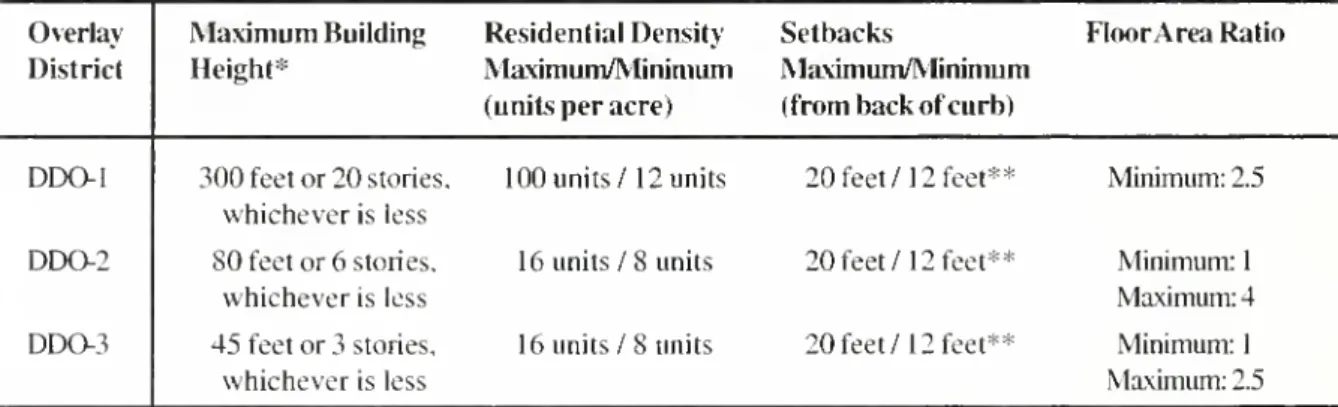
Overlay
Maximum
Building ResidentialDensity Setbacks FloorArea
RatioDistrict Height*
Maxim
urn/Minimum
(unitsperacre)Maximum/Minimum
(
from
backofcu rb )DDO-1
300feetor20stories,whicheverisless
100units/ 12 units 20feet/ 12feet** Minimum:2.5
DDO-2
80feetor6stories,whicheverisless
16units/ 8 units 20feet/ 12feet** Minimum: 1
Maximum:
4DDO-3
45feetor3stories,whicheveris less
16units/ 8 units 20feet/12feet** Minimum: 1
Maximum:
2.5*Development Review Board
may
approve building heights 10 percentabovemaximum. TheBoardofAdjustmentmaygrantadditional height orhear appealsasto
DRB
decisionsregardingheight.**Above20feet,buildings
may
bebuilt toproperty line;columnsmaybe placedinthe portionofany sidewalklocatedonprivateproperty to supportanybuildingabove the20-footheight.
Table2.
Downtown
Design OverlayDistrictStandardsPotentiallyless
imposing
optionsare illustrated in therecommendations
for Austin's (Texas) program,which
theAustin CityCouncil
adoptedby
resolutionon
May
18,2000
(City of AustinDowntown
Report,
January 2002).
The
cityidentifiedseveralapproachesfor
implementing
theDowntown
Austin Design Guidelines
fornew
buildings, streetscape,parkingdecks, publicspaces
and
other projects:•
Codify
some
of the guidelines in the city'sdevelopment
ordinances.
An
example
is requiring in thedevelopment
ordinance thatretail space at street level be incorporated in
parkingstructures in the
downtown
area. • Establishsome
oftheguidelines ascitypolicyor departmental policy (such as planning or
publicworks).
•
Adopt
theguidelinestoapplythem
tothecity'sown
civilor buildingprojects.• Incorporate the guidelines in
matrices
to evaluate public/private projectsthatseekpublic funding.•
Develop
asystem
toprovideopportunities forfeedback,
review
and
revisionto see that theguidelinesare
working
ashoped.• Place the Austin
Design
Commission
in an advisory roletoreview
significantdowntown
projects fordesign guidelineconformance.
In
North
Carolina,
development review
processesinDurham
and Chapel
Hill illustratetwo
approaches
forimplementing
downtown
design standards in thereview
stages.Durham,
N.C.
Inthe
summer
of2002.Durham
adopted
new
Downtown
Design
Overlay
Districts in areasadjacent to the
Downtown
Loop
in an effort to achieve designobjectivesintheDowntown
Plan,suchasactivestreetfrontage
and
pedestrianscale. Standards for the overlay districts (see Table 2)supercede those oftheunderlyingzoningdistricts.
The
overlay districts taper thedevelopment
intensity for areas further
away
from
theCentral BusinessDistrict core,and
closertothesurrounding neighborhoods. Overallthestandardsare stringent relative to the CentralBusiness
District.The
setbacks provide space for sidewalks
and
while preventing buildingsfrom
being setback
far offthe street.
The
minimum
floorarearatioof2.5inthe
DDO-
1 requiresbuildingstobe ofa substantialsize,preventing low-scale
development
likea hotdog
stand
on
FosterStreet northoftheDurham
Centre.Despitethe increasedregulations, theprocess
isdesignedtobe
more
streamlinedbecausemajor
projects are
reviewed
inastandardsiteplanreview processoverseen by
theDevelopment
Review
1.2.4 Massing, Height, Scale
&
Rhythm
Goal:Designbuildings thatareappropriatelyscaledfortheir
functionandwithrespectto theircontext.
Guidelines:
a. Buildingheightshouldgenerally relatetoandalign withneighboringstructures.Design one-story
buildings withsufficientheightto relateinscaletothe
surroundingstructures.
b. Tallbuildingsareencouragedwheretheymay
providevisualinterest,frame viewcorridors,or relate
tolargerscaledstructures.
c. Wherebuildingheight ormassingvarygreatlyfrom
thesurroundings,compatibilitymaybeachieved throughfenestrationand baypatternsandstreet level details.
d. Designbuildings withanarchitecturalandurban
scalecompatiblewithneighboringdevelopments.
e. Incorporateupperstorysetbackstoreducethe
apparentbuildingmass,preservethe streetlevel
scale,andallowforsun accesstoadjacentbuildings
andpublicspaces.
f. Buildupontherhythmsandproportions established
by adjacentbuildingswhileemployingapaletteof
rhythmstoavoidmonotonousrepetition. g. Incorporate theverticalandhorizontallinesof
adjacentbuildings,whereappropriate.
h. Buildingsshouldrelate tothehumanscale through
theuseofarchitecturalelements,proportion, materials,andsurfacearticulation.
Standards:
i. Maintain consistentmassingandperceivedbuilding
heightatthe streetlevel,regardlessofthe overall bulkorheightofthebuilding.
j. Avoidlargeunarticulatedmonolithic buildings.Break
downtheapparent scaleof buildingsexceeding50
feetinlengthbythearticulation ofseparatevolumes
intoacoherent, hierarchical architecturalcomposition. Figure4.
Durham
DesignManual
exampleBoard
instead of themajor
special use permitprocess.
The
review
process
consistsof
aDowntown
Design
Review
Team
thatreviews
development
intheoverlaydistrictsforcompliance
with the
design
guidelines.The
review
team
includes
representativesfrom
City
staff,an
appointee
by
the CityManager
and two
citizenappointees. Its
recommendations
are included in theplanning
staff report to theDevelopment
Review
Board,which
handlessiteplanapprovals.The
Design
Guidelinesaddress buildings, publicspace
and
streetscape.
The
guidelines
are organizedby
topic,such
as"site"design, a relateddesign issue or goal, followed
by
the applicableguidelines
or standards.The
manual
states, "guidelines aresuggestedflexibleways
tomeet
thestated goal, while standards are direct, concrete
requirementsformeetingthatgoal."(Cityand
County
of
Durham,
2002) Figure4
illustratestheapproach.One
ofthefirsttestcases will beaproposaltobuildtwin27-storyconcreteandbrick
condominium
buildings,replacingthedilapidated
and
vacantHeart ofDurham
Hotel(Curliss,2002).The
siteiswithinthe
Downtown
Design
Overlay-1.The
design ofthe310-footbuildings,
which
would
house456
units,consists
of
concrete balconies
and
possibly
prefabricated brick panels.
The
CityCouncil
approved
the rezoning despitesome
misgivings.Mayor
Bill Bellwas
quoted
as saying of therezoning vote: "I
had
alot oftrepidation. I don'twant
itto be aCabrini Green...Ifthat happens, Iwill
have
made
a mistake."Chapel
Hill. N.C.The
Town
ofChapel
Hill's regulationsand
policies
emphasize
the street-edge indowntown
development,
enhancing
pedestrians' experience ofthebuiltenvironment.Development Ordinance
Standards
For
propertiesin thedowntown
Town
Center
zoning
districts, theChapel
HillDevelopment
Ordinance
establishes heightand
development
intensity standards (floor area ratios).
Minimum
setbacks are set at zero, allowing buildings tobeup
against the sidewalk. Table 3summarizes
theTown
Center-2district,which
coversmost
ofthedowntown
commercial
core.A
standard
thatcould
be
atodds
with
pedestrian-friendlydesignisthe
minimum
parking requirement,which
formost
nonresidentialusesis1 space per
400
square feet of floor area.The
residentialrequirementis I spaceperdwellingunit.
While
meetingthisstandardcouldrequiresubstantial off-streetparking, otherTown
standards serve tominimize
the impact of parkingon
thestreetedge.For
theTown
Center
zoning
districts,ifasetbackisprovided
between
thebuildingand
thestreet,thesetback
cannot
beused
for parking.However,
parkingcan
be placed tothe sideofthe building;depending on
the sizeofthelot,theparkingcouldcreatea significant
gap
inthestreet wall.Thisissuemay
be less of aconcern
in adowntown
where
HeightRestrictions
Primary
/Secondary'44' /67"(nonresidential)'
44'/90'(residential)
Floor
Area
Ratio1.84to2.26 1.97to2.42
Minimum
Lot
Width
15feet
Street, Interior, SolarSetbacks
Ofeet
Parking
Requirement
1per
400
sq.ft.offloor areaJ
1
Theprimaryheightlimitismeasuredatthepropertylines;thesecondary heightlimitstandardiscalculated as follows: foreach
foot intotheinterior,thebuildingheightcan be increasedby 1footuptothesecondary heightlimit.Forexample,10feet inthe interiorofalot,abuildingcould beastallas54feet.
:
Thepermittedintensitycan be higherifaproposeddevelopment meets bonusthresholdsforaffordablehousing and/or
mixed-usetargets.Thebonusformixed-usedevelopment,whichappliesonlytothe
Town
Center, appliesifat least50percentbutnot morethan 75 percent ofthe floorareaiscontainedindwellingunits,andtheremainderisdevotedto nonresidentialuses.1
For nonresidentialprojects thatqualify for thebonusdescribedabove,thesecondarylimitisincreasedto90feet.
4
For general businessuses, offices,banks andothersimilar uses.Theresidentialparkingrequirementisonespace per dwelling
unit.
Table3.
Town
Center-2 HeightRestrictions, Intensity Regulationsand
Parking RequirementsFigure5. Top ofthe Hillbuildingat thecorner ofEast Franklin Street
and
SouthColumbia
Avenue.lotsripefor
redevelopment
arerelativelysmall.For citiessuch
asGreensboro
thathave
largeparking lotsand
other "redevelopable"downtown
tracts, thiscould
be a significant issuebecause
of the potentialfor large "side" surfaceparkinglots.Other
options
formeeting
theparking
requirementincludemaking payments
totheTown
Parking
Fund
at$3,600 per required
space, providing parkingoff-sitewithin 1,200feetofthebuildingentrance,
and
submittingaTransportationManagement
Plan statinghow
alternativemodes
of
transportation will beencouraged.
Severalrecent projects
have
made
use oftheTMP
option,which
couldincludeprovidingparkingor apayment
tothe parkingfund.Examples
include providing bicyclesfortenantsatanapartmentbuilding,and
installing
showers and
bicycle storageareas.Note
thattheDevelopment
Ordinance
hasno
maximum
setbackthatwould
requirebuildingstobe
at ornear
thesidewalk,
but
economic
considerations obviate
theneed
for that indowntown
Chapel
Hill.Much
oftheexistingstreet-levelshops
and
restaurantson
the town'sbusiestdowntown
street.Franklin
Street,occupy
storefronts that linethe sidewalk;
few
businesseson
Franklin provide on-site parking.A
reason isthat
downtown
businesses
can
feed
off thesignificant pedestrian traffic
generated
by
thepresence
of the adjacentUniversity
ofNorth
Carolina
campus,
populartransitroutes, the base ofdowntown
office workers,and
Town-owned
parking.
The
Town
has recognizedtheimportanceofinfill
development
where
parking has erodedthepedestrian scaleofthestreet;the
Downtown
SmallArea
Plan, forexample,
identifies"development
opportunity" areas
where
theTown's
goal is toencourage
new
development
that creates street-level activity.A
key
areaisWest
Rosemary
Street,aparallel street toFranklin
one
blocktothenorth:thisarea containslarge
University-owned
surface parkinglots,small-scalebuildings,andbuildings with on-site parking.Special
Use Permit Requirement
The
Town
ofChapelHillundercertainconditionshas increased input
on
the design ofproposed
downtown
projects of a certain size.The
Town
requiresnonresidential projectswith 20,000 square feet or
more
floor space to obtain a SpecialUse
Permit. Flexibility afforded
by
this review process enabled amajor
mixed-use project at a prominentdowntown
intersection tobebuilttothepropertylines,anchoring a
comer
once
occupiedby
agas station.InapprovingtheSpecial
Use
Permitforthebuilding,which housesthe
Top
oftheHillrestaurant(seeFigure 5), the Council agreed towaive
the ParkingFund
payments, enabling thedevelopment
toproceed
without
any
off-streetparking.The
SpecialUse
Permit process
includes review of the plansby
theCommunity
Design
Commission, which
can
influence the projectdesign.
The
process also requires a finding that theproposed
development
isinconformance
with theComprehensive
Plan.For
projectsproposed
in theTown
Center,theTown
checks
forcompliance
withthe
Downtown
Chapel
HillSmall
Area
Plan, acomponent
oftheComprehensive
Plan.The
Downtown
Small
Area
Plan
has
asupplemental
11-page
Downtown
Design
Guidelines section aswellasother design-related
goals
and
objectives.The
Design
Guidelines areflexible, stating that
development
"should"meet
certainobjectives(Town
ofChapel
Hill,2000).The
majorguidelines include:•
No
more
thantwo
stories in height at thepropertyline;
• Include
alcoves
and
special treatments at entries;• Storefront
type
windows
adjacent
to thesidewalk;
• Buildatthepropertyline;and,
•
Use
natural materialson
the exteriors.Incases
where
a projecthasless than20,000
squarefeetoffloor area,thereforenotrequiringa
Special
Use
Permit, theTown
lacks theproceduralleverage
toconsider
theDowntown
Design
Guidelinesintheproject design.For
largerprojectsthe guidelines
can have
an effect.The
Franklin Hoteltobebuilton
West
FranklinStreetisagood
example
of a casewhere
theDesign
Guidelines played a factor in the ultimateoutcome.
During
the public
hearing
on
the SpecialUse
Permit
request, the architect
contended
thedesignmet
allofthemajorguidelines,includingthebuilding's
two-storyheightatthe street
(Town
ofChapel
Hill.2001).The
guidelinesmay
have
helped reducethe scaleofthe project as the
Town's
Development
Ordinance
standards forthe
Town
Center
allow buildings to be astall as fourstories atthe property line.DEVELOPING
AN
URBAN
DESIGN
PROGRAM
Orienting buildings topublicstreets
will
encourage walking
by providing
easy
pedestrian
connections,
by
bringing
activitiesand
visuallyinterestingfeatures closer to the street
and
by
providing
safetythrough
watchful
eyes.-
PeterCalthorpe.The
Next
American
MetropolisThisarticlecontendsthattheadoption of design
standards
fordevelopment
indowntown
Greensboro
-
new
zoningregulationscoupled with design guidelines-
could
playavitalroleshapingthe built
environment
asnew
projects take over parking lotsand
other under-utilizeddowntown
sites.
While
an urban designprogram
couldtakemany
forms,some
design
standards should be consideredasfundamental
elementsthatmust
be includedinasetofdowntown
designguidelines ornew
zoning
standards.A
sampling ofdowntown
designguidelinesand
zoning
standards in three U.S. cities-
included hereinordertoconsiderapproaches
outsideNorthCarolina
-
providesan
idea ofwhat
could
be consideredasfundamental
issuestobe addressedinregulating
downtown
design.Table4 summarizes
the design issues addressed in
review
processesadopted
orproposed
fordowntown
districts inDenver,
Pittsburghand
Austin, Texas.To some
degree, thecitieseach
addresstheseurban
designelements:
windows,
buildingentries,"build-to"lines, height,and
building step-backs forupper
floors. LikeDurham,
each
cityalsoadopted
theapproach
oftailoringdesign guidelines tospecific districts withina
downtown.
Standard
Austin
Denver (LoDo)
Pittsburgh
Buildings/General
Floor-
Area
Ratio(FAR)
•
vBuildtotheStreet/Sidewalk
V
••
Height Limits
•
•/ VHeight
Minimums
•
vBuildingStephacks
Above
Certain Level^
•
S
Mixed-Use
Preferred•
V
V
Mixed-Use
Target (Percentage) forBlock
•
Transparency
Requirement
(Windows)
/
•
•
SpecialGuidelinesforSpecific
Areas
•
V
•
Articulate Entries
V
</s
Varietyof Scales
V
v
MultipleEntries for
Large
Buildings/
•/V
Provide
Cover
forPedestrianson Sidewalk
</Guidelines
on
BuildingMaterialss
/
V
BuildingsRequire Base. Middle,
and
Top
•
Encourage
PublicArtinProjectsV
•
V
Parking
Below-Grade
Preferred •/Screen Parking
from
Street -/•
Mixed-Use
ParkingStructure Standards•
High
Quality Materials•
VerticallyOriented Architecture •/
Plazas/Parks
Locate in
High-Use Areas
•
Microclimate
Design
(Breezes,Sun.Shade)
•
>/ VSeatingStandards
V
V
Locate
Food
Service inorNear
Space
s
Ensure
Good
PedestrianAccess
from
Streets
V
S
Provide Visual
Complexity
inDesign
V
Streetscape
Manual
Developed
withIllustratedStreetscape •/V
Standards
Install StreetTrees
•
V
/
Provide Barriers
Between
Pedestrian. Street^
Pedestrian Lighting
V
VPaving V
•
Lighting
•
S
•
StreetFurniture
•
V
VTable4:
Comparison
of DesignIssuesAddressedinDesignGuidelinesand
ZoninginDowntown
Austin,Denver
and
PittsburghThe
table alsodemonstrates
that cities areextendingtheinfluenceof designcontrols
beyond
issuessuch
as architectural features or siteorientation ofa building; thesecitiesalso include standards fordesigning parking lots
and
garages,pla/.as
and
parks,and
streetscapeelements,
includinglighting, trees,signs
and
benches.How
Do
Projects inGreensboro
StackUp?
Returning to Greensboro,
how
welldo
recentdowntown
projectsadheretoothercities'downtown
design standards?
The
followingfour projects are cited here as they reveal the variety of projectdesign that has taken place in
Greensboro
and
Durham
followingtheheyday
of urban renewal. •Greensboro
News
&
Record
newspaper
complex
has justone
entrance accessiblefrom
the public sidewalk,on
Market
Street.Surface parking
lots are locatedon
street corners,some
portionsbehindaperimeter chainlink fence that stretches
along
the public sidewalk.The
site itselfcould be consideredunderdeveloped
foraCentralBusinessDistrictlocation: inadditiontotheparkinglots,a
one-story building occupies a large portion ofthe siteacross thestreet
from
anew
multi-modal
transportation center.
Early
Childhood Center
(late 1990s) is aone-story buildingsetoff thecornerof
Eugene
Street
and
FriendlyAvenue
with asuburban-style free-standing sign placed next to the
parking lot
on
Eugene
Street.Justone
door-with
no
door
handleon
the outside-
opens
ontothe sidewalk.
To
reachthebuilding'smain
entrance,
which
isorientedtoward
theparkinglot,
from
thepublicsidewalk, a pedestrianwould
have
towalk around
a landscaped area intoDesign
IssueDesign
GuidelinesRelated
toDesign
IssueNews
&
Record
1. Lackof
windows
forlargeportionof building2
One
publicentrancetomainbuilding3. One-story cinderblock building
4. Surfaceparkinglots(and chain linkfences)on
perimeter
1. Transparencyspecifications forincluding
windows
instreet-levelandupper-level portionsof buildings(-)
2
Orientationandarticulationofthepublicentrance(-)3. Height/FARminimums(-)
4. Buildtopropertylineswherefeasible(-)
EarlyChildhood Center
1. BuildingsetbackoffEugeneStreet 2. Surfaceparkinglotexposedtostreet
3. One-storybuilding.
4.
Day
carenotapedestrian-orientedactivity5. Entrance orientedtoparkinglot
1. Buildtopropertylineswherefeasible(-)
2
Parking screening standards(-) 3. Height/FARminimum
(-)4. Zoningrequirementthatstreet-levelspace contain pedestrian-orienteduse(-)
5. Orientationandarticulationofthepublicentrance(-)
Greeasboro's
downtown
library1. Buildingbuilt tosidewalkedge
2
Main
entranceoffChurchStreetsidewalk3. Covered
walkway
onChurchStreet1. Buildto sidewalk edge(+)
2
Oriententrancetothe street(+)3. Includearchitectural featuresproviding pedestrian
protectionfromtheelements!+
)
Wrangler
Building1 .
Buildingbuilt200feetoff
Elm
Street2. Parkingexposedto street
3. Entrance orientedtosidewalkthatextends through parkingareasto
Elm
Street1. Buildto sidewalkedge(-)
2
Screen parkingfromstreet(-)3. Oriententranceto thestreet (+/-)
(+)Appearsto meetintentof guideline.(-)Doesnotmeetintentofguideline.
Table5:
How
Key
Downtown
DesignStandards Relateto Projects inGreensbcthe
driveway
and
through a pull-up area for vehicles.•
Greensboro
Public
Library
( 1998), built tothe
edge
ofChurch
Streettwo
blocks north ofthe
newspaper complex.
The
design of thecity's 100,000-square-foot two-story library
building
meets
severalofthecommon
designguidelinesadopted
by
othercitiesdiscussedinthisarticle.
These
featuresincludean arcadedstreet-level facade that provides protection
from
the weather,and
an articulatedmain
building entrance.
•
The Wrangler
building
(1994), despite itsNorth
Elm
Streetaddresswrittenover
itsfront entrance, sitsback
roughly200
feetfrom
thecornerofNorth
Elm
and
Bellemeade
Streets.The
building's surface parking lot frontstwo
streets,withinwhich
signs arepostedwarning
people
that theparking
is forWrangler
employees and
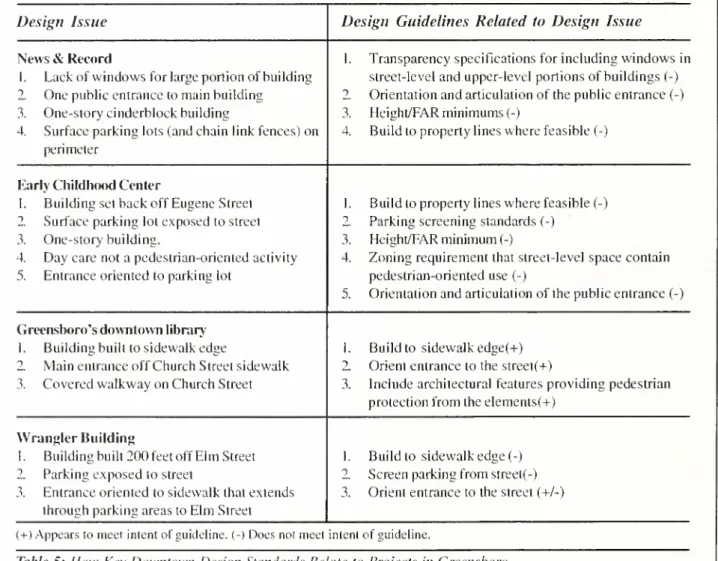
visitorsonly.Table 5 describes
how
designelements
foreachprojectrelatewith building design guidelines adoptedinothercities.
With
thepossibleexception oftheGreensboro
Public Library,theapplicationof a typical set of
design
guidelineson
theseprojects likely
would
have
required redesigns to address issuessuch
as buildingplacement and
orientation
and
designofthebuildingentrance.The
table,which
listsonlyafew key
featuresand
related standards,suggeststhattheapplicationof typical
urban design
standardswould
have
requiredsignificant alterationtobuildingdesignand
thesiteplan.
Compliance
with thestandardsisno
simple
task.For
example, simply
moving
theWrangler
buildingtoElm
Streetwould
stillleave a largeportionofthesitecoveredby
surface parking. Putting theparkinginawell-designeddeck
would
appeartobea better solution;however,thiswould
entail significantly higher projects costs for a buildingofthissize.
Greensboro doesnothavetolookfarfor potential design standards that
would
promote
pedestrian-friendly
development
intheCentralBusinessDistrict.The
City'sTraditionalNeighborhood
DistricthasbeenintroducedinSouthside,aneotraditionaldevelopment underconstructionjustsouth ofrailroadtracks
from
the
downtown
core.The
zoning district includesDesign
Guidelines forpromoting
"human
scale"design, including:
•
Buildings
thatavoid
long,monotonous.
Figure6.
YMCA
centerunderconstruction indowntown
Greensboro (Spring 2002).uninterrupted walls orroofplanes.
•
Commercial
structures thatincorporate
awnings
or arcades,which
may
projectover
thesidewalk into the streetright-of-way with cityapproval;
•
Ground
floor retail, service, restaurant,and
other
commercial
uses with displaywindows
on
aminimum
offiftypercentofthefirstfloor front to provideviews
into the interiorof
buildings;• Entrances
and
storefronts facing the street.(Cityof
Greensboro, 2002)
Though
tailored for"new
urbanist" projects,these standards are not necessarily inappropriate
for the
CBD,
as other cities-
as this article hasshown
- have adopted
similarurban
design
standardsfortheir
downtown
cores.CONCLUSION
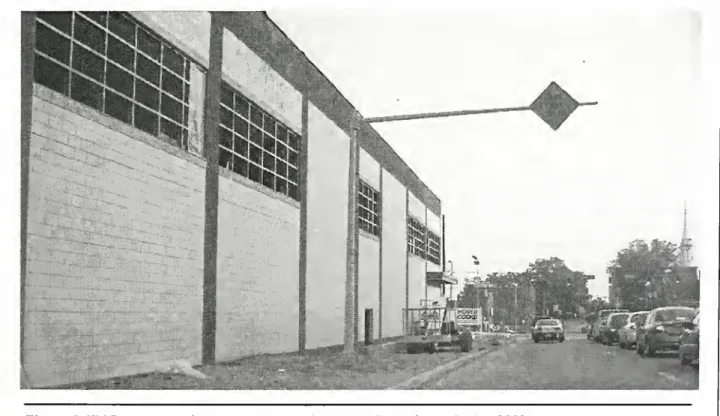
Inrecent
months,
workers have
been
erecting a largeYMC
A
facilityatthecornerofSpringStreetand
Market
Streetindowntown
Greensboro,acrossMarket
Streetfrom
a Firestone tire dealerand
aHardee'sRestaurant.
With
each passingweek
thebuilding took shape, filling
much
ofa cityblock
that iswrapped
on
three sidesby
one-way
streets.During
the earlystagesof construction passersby could look throughthebuilding'sincompleteexteriorwalls
and watch
thework
going
on
inside.As
the building nearedcompletion workers
filled in thegaps
in the facade.The
second
storynow
featuresbands
ofwindows
thatwrap
around
much
ofthebuilding.The
street level,where
peoplewould
bewalking
by, featuresone
main
entrance butno
windows -
essentially a blank facade.To
some
degree,adesignthatsealsthebuildingfrom
thestreet
makes
sensegiventhefast-movingtrafficon
theone-way
streets outsideand
thesuburban
characteracross
Market
Streetwhere
theHardee'sand
Firestone buildings are situated in surface parkinglots.Importantissuesclearlyextendbeyond
thesiteplan
and
buildingdesign-includingstreetwidth
and
theprovision ofon-streetparking,street treesand
benches.The
cumulative
effect of buildings that areclosedofftothestreet,providinglittlestreet-level
interest
from
the vantage point of the sidewalk.means
thesedowntown
blocks as theybecome
developed
willstillbefarremoved
from
achievingthe characterof
Greensboro's
Elm
Street.These
areas will fail to achieve a "walkable"city
form
other cities are striving for in adopting design guidelinesfortheirdowntowns.
In Pittsburgh, the city'sover-arching goal of
itsurban design
program
is"pedestriansfirst."(CityofPittsburgh. 1998a) Inotherwords,develop for
people, not automobiles. It is easy to picture an
urban
environment
that fits Pittsburgh's ideal: Buildings, notparking
lots, fronting streets;storefront
windows,
not solid walls,along
thesidewalk;accessibleplazas withadequateseating, sun,shade,
and
aircirculation; buildingsofa scalethat
enhances,
not
overwhelms,
the street environment.Development
regulations
indowntown
Greensboro
aretooopen-ended
toensurethebuiltenvironment
ofthefuture puts "pedestriansfirst." Infact,the recent projectsreviewed
in this article suggest thatnew
buildingsmay
notenhance
thepedestrian
experience
ineach
downtown.
The
implications are significant:
A
downtown
that isinviting topedestrians is a
downtown
thatcreatesa lively
and
diverseatmosphere
thatcan
draw
people
away from
theauto-orientedsuburbs.REFERENCES
ActionGreensboro.Center
City/Downtown
Development.[Online]http://
www.actiongreensboro.org/task_centercity.html
[2/17/02]
Alexander. Christopher,etal.1977.
A
PatternLanguage.OxfordUniversityPress.
New
York.TheAustinAmerican-Statesman. 1999.Austinfaces
turning pointinshaping an urbanhome.The
AustinAmerican-Statesman.August29:Jl.
Averett.Loray.2002.Zoning EnforcementOfficer.City ofGreensboro.Interview,April 18.
Barrett.Barbara,andJ.
Andrew
Curliss.2000.CountyGreetsProjectWarmly.Raleigh
News
&
Observer,March
4:Al.Bickley,Rah.1998.Tower's
Woe
isDowntown's,Too. RaleighNews
&
Obsener.December
10:D
1.
Bureauof Planning, City ofPortland. CentralCity CityofPittsburgh.
Downtown
Plan:Plan Document. Fundamental Design Guidellin.es. hup:// 1998. [Online] http://www.city.pittsburgh.pa.us/www.planning.ci.portland.or.us/pl_des.html
downloads/documents/PLANDOC.PDF
[3/16/02] [March3.2000]
Calthorpe,Peter. 1993. TheNextAmerican City ofPittsburghDepartmentof City Planning. 1998.
Metropolis. Ecology,
Community
and
the Pittsburgh StreetscapeComponents
Catalog:American Dream. PrincetonArchitectural Press, The WalkableCity Project. [Online]http://
New
York.New
York. www.city.pittsburgh.pa.us/downloads/documents/StScpCat.pdf[February 2000] City ofAustin.2000.
Downtown
DesignGuidelines(Draft).[Online] http://www.ci.austin.tx.us/ CityofRaleighPlanningDepartment. 2002.Cityof
downtown/0100/design0100.htm[3/13/00] Raleigh
Urban
DesignGuidelines. [Online]http://www.raleigh-nc.org/planning/CP/UDG/
Cityof Austin.January 2002.
Downtown
Report: UDG_final_draft.htm[May
2002] T>Downtown
DesignGuidelines. [Online] http://m
D
m
www.ci.austin.tx.us/downtown/downloads/ Cook,RobertS.Jr. 1980.Zoningfor
Downtown
Urban CDH
07_0102.pdf Design:
How
CitiesControlDevelopment.D.C.>
Heath andCompany,
Lexington.Mass.CityandCountyof Denver. 2000. Applicationfor _)
rn
Design Review: Design
Review
Processand Cruse,Steve.Durham
City/CountyPlanningZ
SubmittalRequirementsforDenver
Landmark
Department.Interview.February 2000.z
StructuresandDistricts.[Online] http://
D
m
www.denvergov.org/content/template3572.asp Curliss.J.Andrew.
Durham
DevelopsDoubleVisions.CO CD
Raleigh
News
&
Observer,August 16.2002:A
1 .Z
CityandCountyof Denver. 1995.DesignGuidelines
Downtown
SmallAreaPlan.Town
ofChapelHill."D
I
for
Landmark
Structuresand
Districts. 2000. TJX
CityandCountyof Denver. 1991.DesignGuidelines CityandCountyof
Durham
PlanningDepartment andm
<
m
for
Lower
Downtown
Streetscape.Duncan
Associates.June2002.Land
Regulation DiscussionSeries.Volume
Six:Downtown
<
CityandCountyof Denver. 1998. DesignGuidelines Strategy [Online]http://www.ci.durham.nc.us/ for
Lower
Downtown
(Supplemental).[Online] departments/planning/www.denvergov.org. SP6_Downtown_Strategy.pdf [August2002] CityandCountyofDenver.August2000.
Lower
mDurham
City/CountyPlanning Department.Durham
Downtown
NeighborhoodPlan. [Online] DesignManual.April2002. www.denvergov.org/admin/template3/forms/neighborhood_plan.pdf
Durham
City/County Planning Department.Durham
City/CountyZoning Ordinance. [Online]http:// City of Greensboro.Parking
Sen
icesReview.April www.ci.durham.nc.us/planning/zoneord/1997. index.html[January25,2000]
CityofPittsburgh.
Downtown
Plan:DesignDurham
City/County Planning Department.Historic-Guidelines. 1998[Online]http:// Districts
and Landmarks
Overlay.www.city.pittsburgh.pa.us/downloads/
documents/UDGUTDE.PDF
[March3.2000]Durham
City/County Planning. InterimTransitOriented
Development-Compact
NeighborhoodCity ofPittsburgh. 1998.
Downtown
Plan:Executive OverlayDistrictSummary.
[Online]http://www.city.pittsburgh.pa.us/downloads/
documents/EXECSUMM.PDF
[March3,2000]Durham
OfficeofEconomic
andEmployment
Development. 1999.
Downtown Durham
MasterPlan[Online]http://www.ci.durham.nc.us/
departments/econodev/Master_Plan/Default.htm
[February20.2000]
Encyclopedia.com.Austin.[Online]http:// www.encyclopedia.com/articles/00912.html.
[3/13/00]
Glassberg,Ronnie. 2000.Turning
Over
aNew
Leaf: American Tobacco RenovationCould ReinventDowntown.
The(Durham)
Herald-Sun, February27:Al.
Sansom,James,and William Kalkhof. 2000.
A
chancetochangethefaceof
downtown: The
timetodeveloptheAmericanTobaccopropertyisnow.
Raleigh
News
&
Observer, February27:A
19.Shirvani. Hamid. 1981.Urban DesignReview:
A
Guidefor Planners. PlannersPress.AmericanPlanningAssociation.Chicago.111.
Town
ofChapelHill. 1998.Downtown
DesignGuidelines.[Online]http://
townhall.townofchapelhill.org/pdfs/
Downtown_Design_Guidelines.pdf
[May
15.2002]
Her,David. 1995.
The Magic
Kingdom comes
tolowerdowntown
Denver.Cyberwest Magazine. June9.Kakissis,Joanna.2000.DenverinspiresRaleigh
leaders.Raleish
News
&
Observer,March
25:B
1 .Town
ofChapelHill.2001.Summary
MinutesofaBusinessMeetingoftheChapelHill
Town
Council:November
12.2001 [Online]http:// townhall/records/minutes/2001/011112.htm[May
15,2002]
Kalkhof. William.2000.Presidentof
Downtown
Durham
Inc.Interview,March
14.Kearl.BirutaCelmins. 2000.
A
Brief HistoryofAustin. TheAustinHistory Center. [Online] http://www.ci.austin.tx.us/library/lbahcatx.htm[March
20,2000]
Lower
Downtown
NeighborhoodPlanWeb
Site. 1998.[Online]http://www.lodoneighborhoodplan.org/
N
Hntroduction.htm[March25.2000],Person,Jimmy.2002.Subdivision PlansReviewer, City ofGreensboro.Interview.April 18.
Rivera.Dan. andBillBishop.2000.High-tech
companies leadingthecharge
downtown.
AustinAmerican-Statesman.
March
3:A
1 .Town
ofChapelHill. 1998.Summary
ofKey
Town
Center ZoningDistrictProvisions(ChapelHillDevelopmentOrdinance):
May
19, 1998.Watson, Ilene.
An
Introduction toDesignGuidelines. PlanningCommissionersJournal.Winter2001.
[Online]http://www.plannersweb.com/wfiles/ wl57.html
NOTES
1
Projects intheHistoric Districtwithinthe