Characterization of a "Low-Risk" Cohort of Gleason 7 Prostate Cancer Patients
By
Kathleen F. Mcfhnley, DO
A Master's Paper submitted to the faculty of the University of North Carolina at Chapel Hill
inpartial fulfillment of the requirements for the degree of Master of Public Health in
the Public Health Leadership Program
2
Table of Contents
Part 1
1.1 Literature Review ………. 4
1.2 Appendix A: Prostate Cancer Risk Stratification ………. 16
1.3 Appendix B: Study Selection Methodology ………. 21
1.4 Appendix C: Quality and Evidence Tables ……….. 23
Part 2 2.1 Original Manuscript ...………... 35
2.2 Manuscript Tables and Figures ……… 48
2.3 Appendix D: Detailed Methods ……… 57
2.4 Appendix E: Strengths and Limitations ………... 65
2.5 Appendix F: Study Implications ……….. 68
4
ABSTRACT
Purpose
Evaluate the outcomes of men with Gleason 7 prostate cancer followed on active surveillance in
the published literature.
Methods
We conducted a PubMed search including variations of the terms prostate cancer, active
surveillance, and Gleason 7 disease. We supplemented this search with a detailed review of
cited references. We analyzed and critiqued relevant articles for study design, sample size,
eligibility criteria, outcomes, length of follow-up, data sources, statistical methods, and risk of
bias.
Results
After title and abstract review of 125 articles identified by our PubMed search and the addition
of four articles discovered during our detailed References review, we identified five relevant
studies. Conclusions from these studies are different, as are the measures, outcomes, and study
inclusion criteria. Risk of bias is high and generalizability is severely limited.
Conclusion
Little reliable data about the safety of following men with Gleason 7 prostate cancer on active
5
INTRODUCTION
Prostate cancer is the most commonly diagnosed cancer among men in the developed world.1 In the United States this year, an estimated 220,800 men will receive a new diagnosis of prostate
cancer and 27,540 will die of the disease.2 Among men newly diagnosed with prostate cancer, approximately 90% will pursue definitive treatment (surgery or radiation therapy)3, 4 and the majority will experience at least one long-term adverse effect due to this treatment.5 The
disease’s high incidence, treatment morbidity, and long natural history have provoked extensive
public health discussions about overdiagnosis and overtreatment.
To reduce the overtreatment of low-risk prostate cancer (Appendix A, Table 1.1),6-8 active surveillance protocols began in the late 1990’s. On protocol, enrolled patients with
low-risk prostate cancer undergo biannual PSA testing, an annual digital rectal exam, and a repeat
prostate biopsy as frequently as every 12 months. Worsening PSA kinetics, progression of
clinical stage on rectal exam, or changing biopsy characteristics trigger definitive treatment. The
reported mortality for prostate cancer is <1% among men with low-risk prostate cancer on active
surveillance protocols with long-term follow-up.9
The qualifying criteria for intermediate-risk prostate cancer (Appendix A, Table 1.1)
includes Gleason 7 disease (Appendix A, Table 1.2), which, is the most common Gleason sum
on prostate biopsy.10 With the objective of further mitigating prostate cancer overtreatment, we examined the literature for studies including men with Gleason 7 disease followed on active
6
METHODS
Search Strategy
To identify published studies addressing our question of how men with Gleason 7
prostate cancer fare on active surveillance, we conducted an advanced PubMed search
combining MeSH and text word terms on June 9, 2015 following consultation with a Cancer
Information Librarian in the Health Sciences Library at the University of North Carolina, Chapel
Hill. We did not apply any limitations on language or publication date. Our specific search
strategy was:
(Prostatic Neoplasms[mesh] OR prostatic neoplasms[tw] OR prostatic neoplasm[tw] OR Prostate Cancer[tw] OR Prostate Cancers[tw] OR Cancer of the Prostate[tw] OR
Prostatic Cancers[tw] OR Prostatic Cancer[tw]) AND active surveillance[tw] OR surveillance[tw]) AND (Gleason 7[tw] OR Gleason Score 7[tw] OR Gleason Score=7[tw] OR Gleason Score<7 OR Gleason score 3+4[tw])
The search yielded 125 articles for review. We supplemented this search with a detailed
examination of cited references from the retrieved articles, which yielded an additional 4 relevant
studies for review.
Study Selection
We reviewed the titles and abstracts of all articles to identify the publications most likely
to address the study question. We further reviewed the Methods and Results section of 10
articles to determine relevance to our study question. Our inclusion criteria required the articles
review clinically- or oncologically-significant outcomes for men with localized Gleason 7
prostate cancer followed on active surveillance. Clinically- or oncologically-significant
outcomes included Gleason score progression on repeat biopsy, progression to radical treatment,
time to radical treatment, prostate cancer specific survival, and overall survival. We excluded
7 original research. We excluded studies of men with localized prostate cancer followed
exclusively on watchful waiting protocols. In contrast to active surveillance, which involves
close monitoring and administration of curative treatment in response to disease progression
detected by PSA kinetics, a change in disease characteristics identified on repeat biopsy, or a
palpable change on digital rectal exam, watchful waiting advises androgen deprivation when
prostate cancer becomes symptomatic,11 most commonly from osseous metastases or urinary obstruction.12 The objective of active surveillance is selective delayed intervention with curative intent among men meeting specific disease criteria, whereas symptom palliation is the goal in
watchful waiting. For this reason, expectations for prostate cancer-specific survival and overall
survival are quite different between men followed on modern active surveillance protocols and
men followed on watchful waiting.
Data Abstraction and Quality Assessment
We analyzed the articles relevant to our study question for the following details: study
design, sample size, study outcome(s), length of follow-up, study participants and eligibility
criteria, relevant demographic data including age and baseline PSA, data sources, measurement,
statistical methods, main results, and any study funding or author conflicts of interest.
Extrapolating key study quality assessment items from the STROBE criteria,13 we graded each study based upon the strength of the design, study size (with a focus upon the number of
men with Gleason 7 prostate cancer included in the study), study outcome data, length of
follow-up, and risk of bias. Each study received a grade of 1 (lowest) to 3 (highest) in each of these five
categories, for a total score of 3-15. For study design: case series received 1 point, single cohort
8 size: studies with <50 men with Gleason 7 prostate cancer received 1 point, 50-100 men with
Gleason 7 disease received 2 points, and studies with >100 men with Gleason 7 prostate cancer
received 3 points. For oncological relevance and evaluation of study outcomes: studies limited
to progression to radical treatment received 1 point, studies of intermediate outcomes such as
biochemical recurrence among those receiving curative intervention received 2 points, and
studies evaluating overall or prostate-cancer specific survival received 3 points. Length of
up was graded: 1 point for <3 years up, 2 points for ≥3 years but <6 years
follow-up, and 3 points for ≥6 years of follow-up. Finally, points were inversely assigned in relation to
the perceived risk of bias within the study: studies at the highest risk of bias received 1 point,
studies with an intermediate risk of bias received 2 points, and studies with little perceived bias
received 3 points.
RESULTS
After title and abstract review of 125 articles identified by our PubMed search and the
addition of four articles identified during our detailed References review, we identified a total of
seven relevant articles14-20 (Appendix B, Figure 1.1). Upon comprehensive review of the seven relevant articles, three captured the same active surveillance source population from the
University of Toronto.14, 15, 18 Accordingly, we chose the most recent publication from this group for data abstraction and quality assessment, as this publication captured the longest clinical
follow-up period.18 In total, we performed complete data abstraction and quality assessment for five studies16-20 (Appendix C, Tables 1.1 and 1.2). The studies varied significantly in overall quality, ranging from a score of 6 to 13 on a 15-point scale designed for grading observational
9 The included studies reported various outcomes of men with Gleason 7 prostate cancer
followed over time on active surveillance.7, 17-20 The study designs, measures, population size, length of follow-up, evaluated outcomes, and findings are quite variable.
Three studies report findings from single institution prospective active surveillance
databases with detailed measures and triggers for curative treatment.17, 18, 20 Of these three cohort studies, only Cooperberg et al.’s study of men with intermediate-risk prostate cancer followed on
active surveillance at the University of California, San Francisco provides a control group.17 The remaining studies from the University of Toronto18 and Royal Marsden Hospital in the United Kingdom20 are single cohort studies reporting the outcomes of men enrolled on institutional active surveillance protocols, a fraction of whom had intermediate risk disease. The two final
studies in this review from Stattin et al.19 and van den Bergh et al.16 include data generated from larger studies; within these studies, the authors abstracted data on men with intermediate risk
disease followed on an uncertain combination of active surveillance and watchful waiting.16, 19 Stattin et al. used data collected during the National Prostate Cancer Register of Sweden
Follow-up Study to retrospectively evaluate the outcomes of men diagnosed with localized prostate
cancer, some of whom had Gleason 7 disease.19 van den Bergh et al. compiled a case series of men enrolled in the European Randomized Study of Screening for Prostate Cancer with
screen-diagnosed Gleason 7 disease followed expectantly.16
Despite the large studies from which several of the included articles draw their study
populations, the number of men with Gleason 7 disease in the studies is small, ranging from 29
to 93 men.17, 19 Follow-up of these small numbers of men ranges from 22 months to 8.2 years.19, 20
10 Three studies evaluated the oncologically-critical outcomes of overall survival or
prostate-cancer specific survival.16, 18, 19 The first study, van den Bergh et al.’s case series of men with Gleason 7 prostate cancer, reported 68% 6-year overall survival and 100% 6-year
cancer-specific survival, leading the authors to suggest that active surveillance might be an option for
selected patients with screen-detected Gleason 3+4 disease.16 The second study, Stattin et al.’s study of men with localized prostate cancer from the National Prostate Cancer Register of
Sweden Follow-up Study, reported that men with intermediate-risk disease followed on
surveillance were more than twice as likely to die of prostate cancer as were men with low-risk
disease followed on surveillance (5.2% [95% CI: 3.7-6.9%] vs. 2.4% [95% CI: 1.2-4.1%]).19 While the third study from Klotz et al. at the University of Toronto did not provide specific
survival data for men with intermediate-risk disease, the study reported that men with Gleason
3+4 disease were nearly twice as likely to transition from active surveillance to radical treatment
(OR 1.83 [95%CI: 1.086-3.097]; p=0.0233) compared to men with Gleason ≤6 disease.18 The remaining two active surveillance cohort studies also evaluated the transition to curative
treatment.17, 20 On univariate analysis, van As et al. identified an association between Gleason 7 disease and a shorter time to radical treatment in the Royal Marsden active surveillance cohort
(HR 2.43 [95% CI 1.39-4.25]; p=0.002). On multivariate analysis adjusted for initial PSA,
clinical T stage, free/total PSA ratio, PSA density, percent positive cores, number of positive
scores, prostate volume, and maximum percentage cancer involvement in any core, this
association was no longer significant. Finally, in the University of California, San Francisco
active surveillance cohort, Cooperberg et al. reported that men with intermediate risk disease
11
DISCUSSION
We identified five studies that include men with Gleason 7 prostate cancer followed on
active surveillance. Drawing any conclusions from these studies presents a challenge, as the
included study populations, length of follow-up, and evaluated outcomes are quite different. At
face value, two studies suggest that active surveillance is appropriate for men with Gleason 7 or
intermediate risk prostate cancer.16, 17 In contrast, two studies report that men with Gleason 7 disease followed on active surveillance do not fare well, with markedly higher rates of
prostate-cancer specific death19 and transitions to curative treatment.18 The final study reports an association between Gleason 7 disease and a shorter time to radical treatment on univariate
analysis; however, this association loses significance upon multivariate analysis.20 The risks of various biases and the influence of these biases upon study findings are critical to understand
before determining whether men with Gleason 7 prostate cancer can be safely followed on active
surveillance.
Of the studies captured in this review, the National Prostate Cancer Register of Sweden
Follow-up Study provides the highest quality statistical analysis, has the longest follow-up,
includes the largest number of men with Gleason 7 prostate cancer followed on active
surveillance, and has the most generalizable study population, including 90% of all patients in
Sweden 70 years or younger with a low- or intermediate-risk prostate cancer diagnosed from
January 1, 1997, through December 31, 2002.19 The study evaluated the oncologically-critical outcomes of prostate-cancer specific mortality and overall survival, concluding that men with
low-risk prostate cancer may be safely followed on active surveillance. In contrast, men with
intermediate-risk disease followed on surveillance were more than twice as likely to die of
12 While the study19 has multiple strengths, fundamental flaws in study group composition and the definition of surveillance used in the research design limit extrapolation of study findings
to our review question. The intermediate-risk group defined in the study included men with a
Gleason score ≤7 and a PSA <20 ng/mL. In total, this group included 936 men; however, only
93 of these men had a Gleason score of 7. Analyses were stratified by risk-level, rather than by
Gleason score. The influence of disease aggressiveness (as reflected by the Gleason score) vs.
total disease burden (as reflected by PSA value) upon the outcomes of men with intermediate
risk disease followed on active surveillance cannot be determined from the provided data.
Additionally, an inherent selection bias that affects overall and prostate-cancer specific survival
exists in this observational cohort, as healthy patients with intermediate-risk prostate cancer were
likely counseled to undergo curative treatment, whereas men with multiple comorbidities were
likely encouraged to pursue surveillance or watchful waiting. The influence of this bias would
positively skew the magnitude of the study results. Finally, treatment for men on surveillance in
this nationwide observational cohort was a mixture of active surveillance and watchful waiting.
As previously reviewed, prostate cancer-specific survival and overall survival is quite different
among men on modern active surveillance protocols as compared to men followed on watchful
waiting. The ratio of men followed on active surveillance compared to watchful waiting in the
study population is uncertain.
Similar to the National Prostate Cancer Register of Sweden Follow-up Study19, van den Bergh et al.’s case series of 50 men with screen-detected Gleason 7 prostate cancer also included
men followed on both active surveillance and watchful waiting.16 However, in stark contrast to the lower prostate cancer- specific survival rates among intermediate-risk men reported in the
13 among men with Gleason 7 prostate cancer who were followed expectantly. No prostate
cancer-specific deaths in a population of men with Gleason 7 disease managed with a mixture of active
surveillance and watchful waiting is quite remarkable and raises concerns for selection bias. In
total, the European Randomized Study of Screening for Prostate Cancer, which is the source
population for this case series, enrolled 162,387 men in seven European centers.21 From four participating sites, van den Bergh et al. identified 50 men with Gleason 7 prostate cancer
followed expectantly. The authors omit specific information concerning the identification of
these men and any applied exclusion criteria, which severely hampers interpretation and
generalizability of the study’s findings.
While the studies from Stattin et al.19 and van den Bergh et al.16 lack uniform follow-up for men with Gleason 7 prostate cancer, the remaining studies included in our review follow men
on single-institution active surveillance protocols with well-defined follow-up measures and
triggers for curative treatment.17, 18, 22 Unfortunately, each study is also plagued by significant deficits limiting application to our study question regarding how men with Gleason 7 prostate
cancer fare on active surveillance.
Klotz et al.’s cohort of men on active surveillance at the University of Toronto includes
72 men with Gleason 3+4 disease followed for a median of 6.8 years. Unfortunately, while the
study is well presented and examines the oncologically-critical outcomes of overall survival and
prostate-cancer specific survival, these outcomes are not stratified by risk group or Gleason
score. On univariate logistic regression analysis, men with Gleason 3+4 prostate cancer are
nearly twice as likely to transition from active surveillance to radical treatment compared to men
14 adjusted for PSA, clinical stage, age, race, PSA density, or percentage core involvement, is
uncertain. This uncertainty limits the generalization of the study’s findings.
Cooperberg et. al’s cohort of men on active surveillance at the University of California,
San Francisco includes 90 men with intermediate-risk disease, though only 29 of these men had
Gleason 7 disease.17 While this is the only study to directly compare the outcomes of men with intermediate-risk prostate cancer followed on a well-defined active surveillance protocol to a
control group of low-risk prostate cancer patients followed on the same active surveillance
protocol, the authors’ classification of low- and intermediate-risk disease restricts extrapolation
to our study question. The authors’ included men with Gleason score 2-6 (Appendix A, Table
1.2) and CAPRA score 0-2 (Appendix A, Table 1.4) as low-risk and men with Gleason score 7
and CAPRA score 3-5 as intermediate risk. By CAPRA score, men with higher volume Gleason
6 disease fit in the intermediate-risk category and, in fact, compose the majority of the study’s
intermediate-risk group. The oncologic acceptability of this classification is debatable.23, 24 As a result, Cooperberg et al.’s conclusion of no difference in cancer progression, PSA doubling time,
or progression to active treatment between low- and intermediate-risk men followed on active
surveillance may not apply specifically to men with Gleason 7 disease.
The last prospective active surveillance cohort in our review includes 39 men with
Gleason 7 prostate cancer followed on protocol at the Royal Marsden Hospital. van As et al.
found Gleason 7 disease was associated with a shorter time to radical treatment on univariate
analysis, though not on multivariate analysis. With a time-dependent solitary outcome, the
study’s significant limitation is its 22 month median follow-up, which is far too short to draw
any generalizable conclusions. Additionally, the study fails to account for personal preference as
15 surveillance transition to curative treatment over time because of personal preferences or
anxiety,25 this is a significant confounder which requires measurement and adjustment.
CONCLUSION
We identified five studies that included men with Gleason 7 prostate cancer followed on
active surveillance. Conclusions from these studies are different, as are the measures, outcomes,
and study inclusion criteria. Weighing the risk of bias and generalizability of these studies, little
reliable data about the safety of following men with Gleason 7 prostate cancer on active
surveillance can be extrapolated. Further research, with more rigorous study designs and
statistical analyses, is needed before offering active surveillance as a management strategy to
17 Table 1.1: Most widely used risk strata for newly diagnosed prostate cancer.6-8
Risk Category PSA Gleason Score Clinical Exam
Low ≤ 10 ng/mL and ≤ 6* and T1c, T2a^
Intermediate PSA > 10 to 20 ng/mL or 7 (3+4 or 4+3) * or T2b^ High PSA > 20 ng/mL or 8-10* or T2c or higher^
*
Refer to Table 1.2 ^
18 Table 1.2: Gleason scoring for prostate carcinoma.26
Gleason Pattern Description
1 Circumscribed nodule of closely packed but separate, uniform, rounded to oval, medium-sized acini that are larger than Gleason pattern 3 glands. 2 Fairly circumscribed nodules; may have minimal infiltration of glands at the
edge of the tumor nodule;
Glands are more loosely arranged and not quite as uniform as Gleason pattern 1 glands.
3 Discrete glandular units;
Typically smaller glands than seen in Gleason pattern 1 or 2; Infiltrates in and amongst non-neoplastic prostate acini; Marked variation in size and shape;
Smoothly circumscribed small cribriform nodules of tumor. 4 Fused micro-acinar glands;
Ill-defined glands with poorly formed glandular lumina; Large cribriform glands;
Cribriform glands with an irregular border; Hypernephromatoid
5 Essentially no glandular differentiation: composed of solid sheets, cords, or single cells;
Comedocarcinoma with central necrosis surrounded by papillary, cribriform, or solid masses
When evaluated by pathology, each prostate cancer biopsy specimen receives a primary
and secondary Gleason pattern score of 1-5; added together, these numbers provide the total
Gleason biopsy score of 2-10. The first number represents the most common pattern in the
specimen, while the second number represents the highest grade tumor in the specimen.
For example, if a prostate biopsy specimen has 80% Gleason 3 prostate cancer and 20%
Gleason 4 prostate cancer visible within the biopsy core on low-power magnification, the patient
19 Table 1.3: Clinical staging of prostate cancer.27
Clinical Stage Interpretation
T1a Prostate cancer detected in ≤ 5% of resected tissue from a transurethral resection of the prostate; no palpable tumor on digital rectal exam (DRE) and no visible tumor on imaging
T1b Prostate cancer detected in > 5% of resected tissue from a transurethral resection of the prostate; no palpable tumor on DRE and no visible tumor on imaging
T1c Prostate cancer identified on prostate needle biopsy; no palpable tumor on DRE and no visible tumor on imaging
T2a Palpable tumor in ≤ ½ of one side of the prostate on DRE and/or visible tumor ≤ ½ of one side of the prostate on imaging
T2b Palpable tumor in > ½ of one side of the prostate on DRE and/or visible tumor in > ½ of one side of the prostate on imaging
T2c Palpable tumor, or visible tumor on imaging, involving both lobes
T3a Palpable tumor, or visible tumor on imaging, extends beyond the prostate capsule
T3b Palpable tumor, or visible tumor on imaging, invades the seminal vesicle(s)
20 Table 1.4: The University of California, San Francisco Cancer of the Prostate Risk Assessment (CAPRA) score.28
Variable Range Points
PSA (ng/mL) 2.0-6.0
6.1-10.0 10.1-20.0 20.1-30.0 > 30.0
0 1 2 3 4 Gleason score
(primary/secondary)
1-3/1-3 1-3/4-5 4-5/1-5
0 1 3
Clinical stage T1/T2*
T3a*
0 1 % positive biopsy cores <34% positive
≥34% positive
0 1
Age <50 years old
≥50 years old
0 1 *
Refer to Table 1.3.
The overall CAPRA score is determined by adding the points for each variable category.
Men are then classified as low-, intermediate-, or high-risk as follows:29
Risk Category CAPRA Score
Low-risk 0-2
Intermediate-risk 3-5
High-risk 6-10
22 Figure 1.1: Overview of study selection methodology.
PubMed
Terms: Prostatic Neoplasms OR prostatic neoplasms OR prostatic neoplasm OR Prostate Cancer OR Prostate Cancers OR Cancer of the Prostate OR Prostatic Cancers OR Prostatic Cancer AND active surveillance OR surveillance AND
Gleason 7 OR Gleason Score 7 OR Gleason Score=7 OR Gleason Score<7 OR Gleason score 3+4
Inclusion Criteria:
Men with Gleason 7 prostate cancer followed on active surveillance
3 relevant studies identified
3 studies reviewed in detail and included: Choo 2002,14 Klotz 2005,15van den Bergh
200916
3 (Choo 2002,14Klotz 2005,15Klotz 201018) of 7 studies from same source population;
5 total studies for review: Cooperberg 2011,17Klotz 2010,18Stattin 2010,19van As 2008,20van den Bergh
200916
Subsequently Excluded upon Abstract Review: Oncologically irrelevant outcome data (n = 9), basic science of prostate cancer studies (n = 4), novel tests, treatments, and imaging studies (n = 36), studies with no data on men with Gleason 7 prostate cancer
(n = 20), men not followed on active surveillance (n = 35)
Subsequently Excluded upon Methods/Results Review: Men not followed on true active surveillance (n=10)
4 additional studies identified from References: Cooperberg 2011,17 Klotz 2010,18Stattin 2010,19van As 200820
Exclusion Criteria:
Prostate cancer review articles and expert opinion pieces (n = 8)
Table 1.1: Description of included studies.
Citation Study Population Data Source/
Measures
Analysis Outcome(s)/Results Funding/
COI
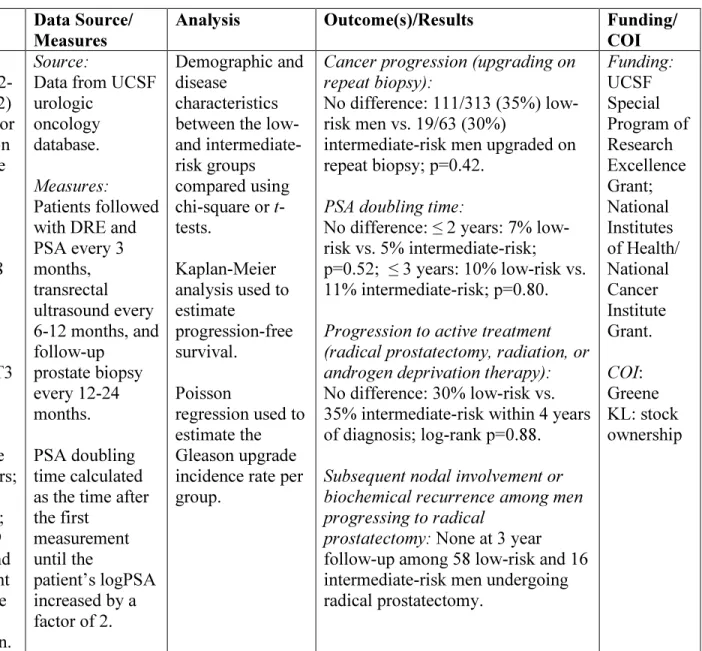
Cooperberg MR, et al. 201117
Inclusion Criteria: Men
with low (Gleason score 2-6 AND CAPRA score 0-2) (Appendix A, Table 1.4) or intermediate-risk (Gleason score 7 OR CAPRA score 3-5) prostate cancer followed on active surveillance at UCSF; Minimum of 1 follow-up biopsy or PSA value 6-18 months after diagnosis. Exclusion Criteria: CAPRA score 6-10,
Gleason score 8-10, or cT3 disease;
<1 year follow-up.
Demographics: Mean age
at diagnosis: 62.8 ± 8.1 yrs; Intermediate risk group older (64.9 vs. 62.3 years; P<.01), higher PSA (10.9 vs. 5.1 ng/mL; P<.01), and greater tumor involvement (20.4% vs. 15.3% positive biopsy cores; P < .01) compared to low-risk men.
Source:
Data from UCSF urologic
oncology database. Measures: Patients followed with DRE and PSA every 3 months, transrectal ultrasound every 6-12 months, and follow-up prostate biopsy every 12-24 months. PSA doubling time calculated as the time after the first
measurement until the
patient’s logPSA increased by a factor of 2.
Demographic and disease
characteristics between the low- and intermediate-risk groups compared using chi-square or t -tests.
Kaplan-Meier analysis used to estimate
progression-free survival.
Poisson
regression used to estimate the Gleason upgrade incidence rate per group.
Cancer progression (upgrading on repeat biopsy):
No difference: 111/313 (35%) low-risk men vs. 19/63 (30%)
intermediate-risk men upgraded on repeat biopsy; p=0.42.
PSA doubling time:
No difference: ≤ 2 years: 7% low-risk vs. 5% intermediate-low-risk; p=0.52; ≤ 3 years: 10% low-risk vs. 11% intermediate-risk; p=0.80. Progression to active treatment (radical prostatectomy, radiation, or androgen deprivation therapy): No difference: 30% low-risk vs. 35% intermediate-risk within 4 years of diagnosis; log-rank p=0.88. Subsequent nodal involvement or biochemical recurrence among men progressing to radical
prostatectomy: None at 3 year
25
Citation Study Population Data Source/
Measures
Analysis Outcome(s)/Results Funding/
COI
Klotz L, et al. 2010 18
Inclusion Criteria:
Prostate cancer diagnosed within 12 months of study entry confirmed by central pathologic review;
No previous
treatment for prostate cancer;
Men <70 years old with “favorable-risk” disease = Gleason ≤6, PSA ≤10 ng/mL, and clinical stage T1b-T2b;
Men ≥70 years old with “favorable-risk” or
intermediate risk disease = Gleason score ≤7 (3+4 only) or PSA ≤15 ng/mL, and clinical stage T1b-T2b. Exclusion Criteria:
Clinical stage ≥T2c, nodal or metastatic disease
Demographics:
Median age: 70.3 years; 71% of patients “favorable risk” & 29% intermediate-risk and either >70 years of age or with significant comorbidity.
Source: Data from prospectively collected database at Sunnybrook Health Sciences Centre, University of Toronto. Measures: PSA every 3 months for 2 years and then every 6
months in stable patients;
Confirmatory biopsy 6-12 months after initial biopsy and then every 3-4 years until age 80.
Patients re-classified as higher risk and offered radical intervention for
Kaplan-Meier survival analysis and log-rank test used to analyze overall survival, cause-specific survival, time to stopping active surveillance, and time to PSA failure.
Cox proportional hazards
regression analysis used to determine the hazard ratio between non– prostate cancer mortality and prostate cancer mortality. Univariate logistic regression analysis used to determine the likelihood of being treated based upon PSA
KM Analyses:
Overall survival for entire cohort:
353/450 (78.6%) at median follow-up of 6.8 years; 10-year overall survival 68% (95% CI: 62-74%). Prostate cancer-specific survival for
entire cohort:
5-year cancer-specific survival: 99.7%;
10-year cancer-specific survival: 97.2%.
Time to PSA failure for entire cohort:
Median 48 months in 117 patients treated with radical therapy after stopping active surveillance.
Time to stopping active surveillance for entire cohort:
At 2, 5, and 10 years, the likelihood that a patient remained on
surveillance was 84, 72, and 62%, respectively.
Cox Proportional Hazards analysis for the entire cohort:
Hazard ratio for non-prostate cancer to prostate cancer mortality = 18.6 (95% CI 7.6-45.7) at 10 years.
26
Citation Study Population Data Source/
Measures
Analysis Outcome(s)/Results Funding/
COI
Klotz L, et al. 2010 18
PSA doubling time <3 years, histologic upgrade on repeat prostate biopsy, or
development of a palpable nodule. Biochemical recurrence defined as PSA >0.2 ng/mL for patients who underwent surgery and the PSA nadir + 2 ng/mL for patients who received radiation.
at baseline (>10 ng/mL vs. ≤10 ng/mL), stage at baseline (≥T2 vs. <2), and Gleason score at baseline (> 6 vs. ≤ 6).
Univariate logistic regression analysis:
Likelihood of proceeding for radical treatment related to Gleason score (odds ratio, 1.83, 95% CI 1.086-3.097); P =.0233) and T stage ≥T2a (odds ratio, 2.02; 95% CI 1.305-3.133; P= .0016).
Stattin P, et al. 201019
Inclusion Criteria:
Men enrolled in the National Prostate Cancer Register of Sweden
Follow-up Study diagnosed with clinical stage T1–2 prostate cancer between 1/1/97 and 12/31/2002 with a Gleason score ≤7, PSA <20 ng/mL, no lymph node
Sources: National Prostate Cancer Registry, Swedish Population Register,
Cause of Death Register, and review of death certificates. Distribution of patient characteristics by treatment group compared using chi square and t- tests.
Pepe and Mori test used to
Death from prostate cancer: Death was attributed to prostate cancer in 58/2021 (2.9%) patients in the surveillance group, 56/3339 (1.7%) patients in the prostatectomy group, and 40/1429 (2.8%) patients in the radiation therapy group. Within the surveillance group, 14 men with low-risk disease (1.3%)
27
Citation Study Population Data Source/
Measures
Analysis Outcome(s)/Results Funding/
COI
Stattin P, et al. 201019
or bone metastases, and treated with surveillance (including active
surveillance and watchful waiting) or curative intent (including radical
prostatectomy or radiation).
Exclusion Criteria: Primary hormonal treatment, Gleason 8-10 tumors, missing PSA, stage, grade, or treatment data.
Demographics:
Mean age of surveillance group 64.7 ± 4.6 vs. 61.2 ± 5.3 for prostatectomy group vs. 63.4 ± 4.9 years for the radiation group; In total, 2021 men in the surveillance group (93 with Gleason 7 disease), 3399 in the surgery group (601 with Gleason 7 disease), and 1429 in the radiation group (280 with Gleason 7 disease). Treatment data and surveillance termination information extracted from individual medical records by research nurses a median of 4 years after the date of diagnosis. Measures: No surveillance protocol; “active surveillance” group a mixture of men followed on surveillance and watchful waiting by individual physicians across Sweden. No defined triggers for transition to curative treatment. analyze the difference in the cumulative incidence of mortality between treatment groups. Cox proportional hazards model and competing- risks regression models used to determine relative risk of low- (clinical stage T1a-c, Gleason score ≤6 [or WHO grade I-II], and serum PSA <10 ng/mL) vs. intermediate-risk (clinical stage T2 or Gleason score 7 or serum PSA ≥10 ng/mL) groups.
died of prostate cancer, compared to 44 (4.7%) men with intermediate risk disease.
The calculated cumulated prostate cancer–specific mortality after 10 years of follow-up was 3.6% (95% CI: 2.7- 4.8%) in the surveillance group vs. 2.4% in the prostatectomy group (95% CI: 1.8- 3.3%) vs. 3.3% (95%CI: 2.5-5.7%) in the radiation therapy group.
Among those with low-risk disease, prostate cancer–specific mortality was 2.4% (95% CI: 1.2- 4.1%) in the surveillance group, 0.4% in the prostatectomy group (95% CI: 0.13-0.97%) and 1.8% in the radiation therapy group (95% CI: 0.65- 4.0%). Among those in the intermediate-risk category, prostate cancer– specific mortality was 5.2% (95% CI: 3.7-6.9%) in the surveillance group, 3.4% (95% CI: 2.5- 4.7%) in the prostatectomy group, and 3.8% (95% CI: 2.6-5.4%) in the radiation therapy group.
Among patients with intermediate risk disease, the risk of calculated
28
Citation Study Population Data Source/
Measures
Analysis Outcome(s)/Results Funding/
COI
After a median follow-up time of 4 years, 692/2021 (34%) patients on
surveillance received deferred treatment, which was radical prostatectomy for 277 men, radiation therapy for 207 men, and hormonal therapy for 208 men.
cumulative prostate cancer–specific death was significantly lower among patients in the prostatectomy group than among patients in the
surveillance group (RR 0.49, 95% CI: 0.34-0.71).
After multivariable adjustment, there was a lower risk of prostate cancer– specific mortality among those in the prostatectomy group than among those in the surveillance group (RR 0.49, 95% CI: 0.34-0.71), and among those in the radiation therapy group than among those in the surveillance group (RR 0.70, 95% CI: 0.45-1.09).
Death from competing causes: 413/2021 (20.4%) patients on active surveillance died in follow-up vs. 286/3399 (8.4%) of the surgery patients vs. 196/1429 (13.7%) of the radiation therapy patients.
29
Citation Study Population Data Source/
Measures
Analysis Outcome(s)/Results Funding/
COI
group, and 14.2% (95% CI: 11.7-16.9%) in the radiation therapy group.
Death from all causes:
Calculated all-cause mortality at 10 years of follow-up was 23.4% (95% CI: 21.3-25.8%) in the surveillance group, 11.3% (95% CI: 10.0-12.9%) in the radical prostatectomy group, and 18.3% (15.7-21.3%) in the radiation therapy group. van As NJ
et al. 200820
Inclusion Criteria: Men ages 50-80 years old with clinical stage T1–T2a, N0–NX, M0–MX
adenocarcinoma of the prostate with serum PSA <15 ng/ml, Gleason score ≤7, primary Gleason grade ≤ 3, and ≤50% positive biopsy cores. All men were required to be of adequate health and fitness to undergo radical
treatment. Exclusion Criteria: None specified. Demographics: Source: Data from prospectively collected database at Royal Marsden Hospital. Measures: Serum PSA monthly in year 1, every 3
months in year 2, and every 6 months thereafter. DRE every 3 months for 2 years, then every
Univariate and multivariate Cox regression analysis used to compare baseline clinical variables (initial PSA level, Gleason score, clinical T stage, free/total PSA ratio, PSA density, % positive
cores, number of positive cores, prostate volume, and
maximum core involvement) and
Time to radical treatment:
At a median follow-up of 22 months (range: 1–56 months), 238/336 patients (73%) remained on active surveillance, 65/336 (20%)
underwent radical treatment, 16/336 (5%) switched to watchful waiting because of increasing comorbidity, and 7/336 (2%) died of other causes. 15/39 patients with Gleason 7
disease proceeded for radical treatment, compared to 50/287 patients with Gleason ≤3+3 disease. Median time to treatment was 15 (range: 1–40) months.
Among those undergoing treatment,
30
Citation Study Population Data Source/
Measures
Analysis Outcome(s)/Results Funding/
COI
Median patient age 67 (range 50-79) years, median initial PSA 6.4 ng/ml (range 0.2-14.9), and 17% median biopsy cores involvement (range 4-50%).
6 months thereafter. Repeat biopsy at 18 -24 months and then every 2 years.
Indications for radical treatment included a PSA velocity >1 ng/ml/yr, a Gleason score ≥4+3, or >50% core involvement on repeat biopsy. Biochemical failure after radical treatment was defined as a PSA > 0.2 ng/ml after radical prostatectomy, or nadir + 2 after radiation
therapy.
time to radical treatment.
4/65 experienced biochemical recurrence; no metastases or prostate cancer deaths have occurred.
Univariate analysis showed that initial PSA level (HR 1.15, 95% CI: 1.07-1.23; p< 0.001), free/total PSA ratio (HR 0.87, 95% CI: 0.83-0.92; p< 0.001), PSA density (HR 55.67, 95% CI: 8.71-355.83; p<0.001), Gleason score (HR 2.43, 95% CI 1.39-4.25; p=0.002); maximum percentage involvement of any core (HR 2.21, 95% CI: 1.34-3.65;p = 0.002), % positive cores (HR 1.74, 95% CI 1.06-2.86; p=0.03), clinical T stage (HR 1.86, 95% CI: 1.06-3.25, p=0.03), number of positive cores (HR 1.64, 95% CI1.00-2.69; p=0.04), and prostate volume (HR 0.98, 95% CI 0.97-0.99; p=0.04) were associated with time to radical treatment.
31
Citation Study Population Data Source/
Measures
Analysis Outcome(s)/Results Funding/
COI
van den Bergh RCN, et al. 200916
Inclusion criteria: Dutch,
Swedish, and Finnish men 50-75 years of age
participating in the European Randomized Study of Screening for Prostate Cancer who had screen-detected prostate cancer with Gleason 7 disease (3+4 or 4+3) on biopsy. Patients self-selected expectant management.
Exclusion criteria: Men
with positive lymph nodes or distant metastatic disease.
Demographics:
Mean age 69.5 (range: 59.6-76.2) years; 44/50 (88%) with Gleason 3+4 disease; 6/50 (12%) with Gleason 4+3 disease; Mean PSA 5.7 ng/mL (range: 2.5-15.9); Mean PSA density 0.18 (range: 0.05-0.54); 40/50 (80%) cT1c; 9/50 (18%) cT2; 32/50 (64%) with 1 or 2 positive
Source: Follow-up data collected from patient charts; mortality information obtained from National Registries. Measures: Men followed “expectantly” were followed with a mixture of active surveillance and watchful waiting by individual physicians at four centers participating the the European Randomized Study of Screening for Prostate Cancer in Sweden, Finland, and the Netherlands.
Kaplan-Meier method and log-rank test used to analyze prostate cancer-specific survival, overall survival and treatment-free survival. In a subgroup analysis, men with favorable risk Gleason 7 disease (PSA ≤10.0 ng/mL, cT1c/T2, PSA density <0.2 ng/mL/mL, and two or fewer positive biopsy cores) were compared to men with less
favorable risk Gleason 7 disease using the Kaplan-Meier method and log-rank test.
Prostate cancer-specific
survival:
6-year cancer-specific survival: 100%
Overall survival:
6-year overall survival: 68%;
Treatment-free survival: 6-year treatment-free survival: 59%
Median time to deferred active therapy was 1.4 (IQR 0.7-3.0) years. Subgroup Analysis: Men with less favorable risk Gleason 7 disease (29/50 men) were more likely to transition to deferred active therapy than were men with favorable risk Gleason 7 disease (log- rank p<0.001).
Funding:
Beckman Coulter Ltd.; Dutch Cancer Society; Netherlands Organization for Health Research and Development; 6th Framework Program of the EU; Europe against Cancer; Swedish Cancer Society; Schering Plough; Abbot; Gunvor and Ivan Svensson’s Foundation; Af Jochnick’s Foundation;
Academy ofFinland; Cancer Society of Finland; Sigrid Juselius Foundation; Competitive
32
Citation Study Population Data Source/
Measures
Analysis Outcome(s)/Results Funding/
COI
cores; 10/50 (20%) with 3 or 4 positive cores; Mean 6.7 total biopsy cores (range 5-12).
No defined triggers for transition to curative treatment.
COI:
Schröder FH: Ferring Ltd;
Glaxo-Smith Kline; Bayer; Schering; Cougar
33 Table 1.2: Quality assessment of included studies.
Author Study
Design
Points Sample
Size
Points Primary
Outcome(s)
Points Follow-up Points Bias Points Total
Cooperberg MR, et al. 201117 Single institution prospective cohort with control group
3 Total: 466 men Subset of Gleason 7 men: 29
1 - Gleason score progression on repeat biopsy - PSA kinetics - Progression
to active treatment
1 Mean: 51 months (range: 14-140 months) months for intermediate risk men
2 ++ 2 9
Klotz L, et al. 201018
Single institution prospective cohort
2 Total: 450 men Subset of Gleason 7 men: 72
2 - Overall survival - Prostate-cancer specific survival
3 Median: 6.8 years (range: 1-13 years)
2 ++ 2 10
Stattin P, et al. 201019
National population-based retro-spective cohort
2 Total: 6849 men; Subset of Gleason 7 men: 93
2 - Prostate-cancer specific mortality - Risk of death
from competing causes - Death from
all causes
3 Median: 8.2 years (IQR 7.1-9.7 years)
34
Author Study
Design
Points Sample
Size
Points Outcome(s) Points Follow-up Points Bias Points Total
van As NJ, et al.20
Single institution prospective cohort
2 Total: 326 men Subset of Gleason 7 men: 39
1 - Time to radical treatment
1 Median: 22 months (range 1-56 months)
1 ++ 2 7
van den Bergh RCN, et al. 200916
Case series 1 Total: 50 men, all with Gleason 7 prostate cancer
1 - Cancer-specific survival - Overall survival - Treatment-free survival
3 Mean: 3.4 years (range: 0.0-11.6 years)
1 +++ 1 6
36 Characterization of a “Low-Risk” Cohort of Gleason 7 Prostate Cancer Patients: Results from
the Shared Equal Access Regional Cancer Hospital (SEARCH) Database
Kathleen F. McGinley1,2, Xizi Sun2,3, Lauren E. Howard2,3, William J. Aronson4,5, Martha K. Terris6,7, Christopher J. Kane8, Christopher L. Amling9, Matthew R. Cooperberg10,
and Stephen J. Freedland2,11
1
Division of Urology, Department of Surgery, Duke University, Durham, NC;
2
Division of Urology, Veterans Affairs Medical Center, Durham, NC;
3Department of Biostatistics and Bioinformatics, Duke University, Durham, NC; 4
Urology Section, Department of Surgery, Veterans Affairs Greater Los Angeles Healthcare System, Los Angeles, CA;
5Department of Urology, UCLA School of Medicine, Los Angeles, CA; 6
Section of Urology, Veterans Affairs Medical Center, Augusta, GA;
7
Department of Urology, Georgia Regents University, Augusta, GA;
8Urology Department, University of California San Diego Health System, San Diego, CA; 9
Department of Urology, Oregon Health Sciences University, Portland, OR;
10
Department of Urology, UCSF Helen Diller Family Comprehensive Cancer Center, San Francisco, CA;
11Division of Urology, Department of Surgery, Samuel Oschin Comprehensive Cancer Center,
37
ABSTRACT
Purpose
To examine if there is a subset of men with Gleason 7 (3+4) prostate cancer who may be potential
candidates for active surveillance.
Materials and Methods
We used the SEARCH database to identify 870 men undergoing radical prostatectomy from 2001-13
with >8 biopsy cores and complete clinical information. We compared characteristics of men who
fulfilled low-risk disease criteria (clinical stage T1c/T2a; biopsy Gleason ≤6; PSA ≤10 ng/mL) with
the exception of biopsy Gleason 7 (3+4) vs. men who met all 3 low-risk criteria. Logistic regression
was used to test the association between biopsy Gleason and pathological features. Biochemical
recurrence was examined using Cox hazards analysis. To examine whether there was a subset of men
with low-volume Gleason 7 with comparable outcomes to low-risk men, we repeated all analyses
limiting the percentage positive cores to ≤33% and positive cores to ≤4, ≤3, or ≤2.
Results
Gleason 7 low-risk men had increased risk of pathological Gleason ≥4+3 (p<0.001), positive margins
(p=0.070), extracapsular extension (p<0.001), seminal vesicle invasion (p=0.005), and higher
biochemical recurrence (HR 1.65, p=0.006). Using increasingly strict definitions of low-volume
disease, at ≤3 positive cores there was no difference in adverse pathology between groups (all p>0.1),
except higher pathological Gleason score (p<0.001). Biochemical recurrence was similar in men with
Gleason 6 or Gleason 7 (3+4) (HR 1.39; p=0.254).
Conclusion
Among men with PSA≤10 ng/mL and clinical stage T1c/T2a, those with Gleason 7 (3+4) in ≤3 total
positive cores have similar rates of adverse pathology and biochemical recurrence as men with
38
INTRODUCTION
Active surveillance is an attractive option to avoid overtreatment for men with low-risk
disease typically defined as Gleason score ≤6, PSA ≤10 ng/mL, clinical stage ≤T2a,30 low
disease volume on biopsy (limited by percentage or total number of positive cores),31-34 and low
PSA density.35, 36 Among men meeting these criteria, prostate cancer specific mortality is low
and radical treatment is avoided.9 Limited data exist on the inclusion of men with
intermediate-risk prostate cancer, including Gleason 7, into active surveillance protocols. In the University of
Toronto’s active surveillance cohort, 72 (17%) men had Gleason 3+4. Relative to men with
Gleason score ≤6, those with Gleason 3+4 were 1.8 times more likely to undergo radical
treatment.30 Conversely, Cooperberg et al. reported that among 90 men with intermediate-risk
disease undergoing active surveillance at UCSF, there was no difference in progression-free
survival or the proportion of men undergoing treatment within a four year period versus men
with low-risk disease.37 Most recently, Musunuru et al. presented an abstract reporting lower
overall survival and cause-specific survival in 237 patients with PSA>10ng/mL or Gleason score
7 or clinical stage T2b/2c followed on active surveillance at a single institution.38
As Gleason 7 is now the most common score on biopsy,10 we examined if there was a
subset of men with Gleason 7 (3+4) who would be reasonable candidates for active surveillance.
We hypothesized that by defining PSA, clinical stage, and volume criteria on biopsy, we could
identify a group of men with Gleason 7 (3+4) who would be candidates for active surveillance,
39
MATERIALS AND METHODS
Study population
After obtaining IRB approval, data from patients at Veterans Administration (VA)
Medical Centers (Palo Alto, CA; West Los Angeles, CA; San Diego, CA; Durham, NC;
Augusta, GA) were combined into the Shared Equal Access Regional Cancer Hospital Database
(SEARCH). As few men treated prior to 2001 had adequate prostate sampling (defined as >8
cores), we limited analyses to men treated in 2001 or later biopsied per physician standard
practice (n=2,810). We excluded men with missing data on race (n=3), PSA (n=16), biopsy
Gleason (n=24), pathological Gleason (n=15), clinical stage (n=170), number of cores taken
(n=282), number of positive cores (n=39), positive margins (n=14), extracapsular extension
(n=14), seminal vesicle invasion (n=6), and surgical technique (n=10). Of the remaining 2,217
men, 870 met our study criteria of PSA ≤10 ng/mL, biopsy Gleason ≤7 (3+4), clinical stage T1c
or T2a, and >8 cores on biopsy. In a subset analysis, we further excluded men with missing PSA
density data (n=132). In this subset, 738 men met study inclusion criteria.
We compared men who fulfilled the criteria of AUA low-risk disease (clinical stage
T1c/T2a, biopsy Gleason ≤6 and PSA ≤10 ng/mL)6-8 with the exception of biopsy Gleason 7
(3+4) (henceforth “Gleason 7 low-risk”) versus men who met all 3 criteria for AUA low-risk.
We used this definition of low-risk disease for comparison because active surveillance is a
recommended treatment option for men meeting these criteria in the National Comprehensive
Cancer Network Guidelines.8
Statistical analysis
Differences in demographic and clinicopathological features between the Gleason 7
40 variables, Wilcoxon rank-sum tests for non-normally distributed continuous variables, chi-square
tests for categorical variables, and Fisher’s exact test for categorical variables with any cell count
≤5.
Crude and adjusted logistic regression models were used to test the association between
risk group (Gleason 7 low-risk vs. AUA low-risk) and pathological features (pathological
Gleason score [≤6 vs. ≥4+3], positive margins, extracapsular extension, and seminal vesicle
invasion). Models were adjusted for age at surgery (continuous), surgery year (continuous), race
(white vs. black vs. other), number of biopsy cores (continuous), surgical center, surgical
technique, clinical stage (T1c vs. T2a), and PSA (log-transformed, continuous).
On average, men were evaluated every 3 months in the first year post-operatively, every
6 months in years 2-3, and annually thereafter. Biochemical recurrence was defined as a single
PSA >0.2 ng/mL, two consecutive PSAs of 0.2 ng/mL, or secondary treatment for elevated PSA
in the post-operative period. Hazard ratios (HR) for biochemical recurrence between Gleason 7
low-risk and D’Amico low-risk were analyzed using Cox proportional hazards analysis,
adjusting for age at surgery (continuous), surgery year (continuous), race (white vs. black vs.
other), surgical center, surgical technique, clinical stage (T1c vs. T2a), PSA (log-transformed,
continuous), and biopsy cores taken (continuous). Biochemical recurrence was examined using
the Kaplan-Meier method and comparisons between the groups were performed using the
log-rank test.
All analyses were repeated with matching of the percentage or number of positive biopsy
cores between the Gleason 7 low-risk and the D’Amico low-risk group, including positive cores
41 In a subset analysis including men with PSA density data, all analyses were repeated
limiting the PSA density threshold between the Gleason 7 low-risk and the D’Amico low-risk
group at ≤0.30, ≤0.25, ≤0.20, ≤0.15, and ≤0.10 ng/mL/g.
Statistical analyses were performed using Stata 13.1 (Stata, Corp., College Station, TX,
USA). Statistical significance was two-sided with p<0.05.
RESULTS
D’Amico Low-Risk Patients vs. Gleason 7 Low-Risk Patients
Baseline characteristics of the 870 men who met inclusion criteria are shown in Table
2.1. Among them, 495 (57%) had D’Amico low-risk and 375 (43%) had Gleason 7 low-risk.
The Gleason 7 risk group had a more recent median surgery year versus the D’Amico
low-risk group (2011 vs. 2008; p<0.001), were more likely to have a robotic prostatectomy (47% vs.
32%; p<0.001), and undergo a pelvic lymph node dissection (PLND) (67% vs. 38%; p<0.001).
Among men whose cancer did not recur, median post-operative follow-up was significantly
shorter in the Gleason 7 low-risk group (22.0 vs. 48.8 months; p<0.001). As expected, Gleason
7 low-risk men had higher pre-surgery PSA (5.6 vs. 5.3 ng/mL; p=0.011), more positive cores (4
vs. 2; p<0.001), and higher rates of extracapsular extension (15 vs. 7%; p<0.001), seminal
vesicle invasion (8 vs. 2%, p<0.001), and positive lymph nodes (2 vs. <1%; p=0.024) versus
D’Amico low-risk men. Consistent with Gleason grading on prostate biopsy, Gleason 7 low-risk
men were more likely to have higher pathological grade versus D’Amico low-risk men (13 vs.
46% Gleason 2-6; 62 vs. 44% Gleason 3+4; 24 vs. 10% Gleason ≥4+3; p<0.001). There were no
significant differences in patient age, race, or clinical stage.
The Gleason 7 low-risk group had higher pathological Gleason scores, more
extracapsular extension, and more seminal vesicle invasion, in both crude and adjusted models
42 groups. Gleason 7 risk men had higher rates of biochemical recurrence than D’Amico
low-risk men (log-rank, p=0.003; Figure 2.1a).
In order to identify if there were subsets of men with Gleason 7 low-risk disease with
outcomes similar to D’Amico low-risk men, we assessed the effect of limiting the analysis to
men with low-volume disease, using varying definitions of “low-volume”. As the definition of
low-volume became increasingly strict (i.e. fewer cores positive), the HR for biochemical
recurrence between the Gleason 7 low-risk group and the D’Amico low-risk group became
increasingly smaller (i.e. closer to 1) (Table 2.3). At ≤3 positive cores, the difference in
biochemical recurrence risk between the Gleason 7 low-risk and the D’Amico low-risk group
lost statistical significance (HR 1.39; p=0.254).
Analysis of Gleason 7 Low-Risk Patients vs. D’Amico Low-Risk Patients with ≤3 Total Positive
Cores
As biochemical recurrence risk was comparable between the Gleason 7 low-risk and
D’Amico low-risk group when restricted to men with ≤3 total positive cores, we repeated the
analysis comparing baseline characteristics (Table 2.4), risk of adverse pathology (Table 2.5),
and biochemical recurrence risk (Figure 2.1b) between these groups. There were 334 men (68%)
with D’Amico low-risk disease and ≤3 positive biopsy cores and 157 men (32%) with Gleason 7
low-risk disease and ≤3 positive biopsy cores. Consistent with the larger cohort of men
previously reviewed, the Gleason 7 low-risk group with ≤3 total positive cores had a more
recent median year of surgery than the D’Amico low-risk group (2010 vs. 2007; p <0.001), were
more likely to undergo a robotic prostatectomy (47% vs. 27%; p<0.001), and PLND (64% vs.
35%; p<0.001). Median post-operative folup was significantly shorter in the Gleason 7
43 limiting the number of positive cores to ≤3, men in the Gleason 7 low-risk group were more
likely to have 2 or 3 positive cores versus the D’Amico low-risk group (p<0.001). Consistent
with biopsy Gleason grading, pathological Gleason scores were higher in the Gleason 7 low-risk
group compared to the D’Amico low-risk group (17 vs. 53% Gleason 2-6; 61 vs. 38% Gleason
3+4; 22 vs. 9% Gleason ≥4+3; p<0.001). There were no significant differences in patient age,
race, PSA at diagnosis, clinical stage, or rates of extracapsular extension, seminal vesicle
invasion, positive margins, or positive nodes between groups.
The likelihood of the Gleason 7 low-risk group having a pathological Gleason score ≥4+3
remained statistically greater than the D’Amico low-risk group (p=0.005) (Table 2.5). However,
the risk of positive margins, extracapsular extension, and seminal vesicle invasion were similar
between the Gleason 7 low-risk and the D’Amico low-risk group. There was no significant
difference in biochemical recurrence risk between the two groups (log-rank, p=0.331; Figure
2.1b).
Supplementary Table 2.1 shows the stratification of D’Amico low-risk and biopsy
Gleason 3+4 low-risk men by year of surgery. Over time, the number of Gleason 7 low-risk men
undergoing surgery is increasing.
Subset Analysis: D’Amico Low-Risk Patients vs. Gleason 7 Low-Risk Patients with PSA Density
Data
An alternative means to select “low-risk” men with Gleason 7 is to limit to men with low
PSA density. To address this, we evaluated progressively lower PSA density thresholds, and
found that men with Gleason 7 low-risk had significantly higher biochemical recurrence risk
than the D’Amico low-risk group, until the PSA density was ≤0.10 ng/mL/g, when results were
44
DISCUSSION
Limited and conflicting data on the outcomes of men with intermediate-risk prostate
cancer on active surveillance exist. As Gleason 7 disease is now the most common score on
biopsy,10 we examined if a subset of Gleason 7 prostate cancer patients had similar outcomes to
low-risk patients and thus could be reasonable potential active surveillance candidates. Using
the SEARCH database of men undergoing radical prostatectomy, we compared men who
fulfilled the D’Amico low-risk disease criteria versus men with Gleason 7 low-risk prostate
cancer, but who otherwise fulfilled the D’Amico low-risk disease criteria. We explored
associations between risk group, pathological features, and biochemical recurrence, with
matching of PSA density (subset analysis) and the percentage or number of positive cores
between the Gleason 7 low-risk and the D’Amico low-risk group. We found that among men
with PSA≤10 ng/mL and clinical stage T1c/T2a, those with Gleason 7 (3+4) prostate cancer and
a PSA density ≤0.10 ng/mL/g had similar rates of adverse pathology and biochemical recurrence
as men with Gleason ≤6. The number of men meeting this PSA density threshold was ~2% of
SEARCH over the study time period. We found that among men with PSA≤10 ng/mL and
clinical stage T1c/T2a, those with Gleason 7 (3+4) prostate cancer in ≤3 positive cores had
similar rates of adverse pathology and biochemical recurrence as men with Gleason ≤6. The
number of men meeting this cutoff was ~6% of SEARCH. The inclusion of these men on active
surveillance protocols would reduce prostate cancer overtreatment, and additional study is
warranted to assess the safety of this approach.
Previous studies established higher rates of biochemical recurrence, metastases, and
cancer specific death39-41 in men with Gleason 7 versus those with Gleason ≤6. The
45 strongly correlate with primary Gleason grade (3 vs. 4).30, 42 While active surveillance for
low-risk disease has made progressive in-roads to mitigate prostate cancer overtreatment, a decrease
in non-curative initial management among men with intermediate-risk prostate cancer has been
observed in U.S. population level datasets.3
Our interest in the possible expansion of active surveillance to a defined population of
men with intermediate-risk prostate cancer is shared. In a European multi-institutional dataset,
Gandaglia et al. reported no significant biochemical recurrence difference between 564 men with
Gleason 3+4 organ-confined disease and 926 men with Gleason 3+3 organ-confined disease who
preoperatively met PRIAS criteria for active surveillance.43 In a single-institution radical
prostatectomy dataset, Kwon et al. identified 217 men with Gleason 3+4 disease who otherwise
fulfilled at least one common active surveillance protocol criteria (Hopkins,35 MSKCC,32
PRIAS,44 Miami,33 UCSF,45 or Toronto30). They found the rate of pathologically aggressive
disease would not significantly increase with expansion of active surveillance criteria to include
Gleason 3+4 under most contemporary protocols.46
In a retrospective review of 2,323 men who underwent radical prostatectomy for Gleason
3+4 at six European institutions, Ploussard et al. determined that 46% had unfavorable disease at
final pathology. However, by narrowing their selection criteria to men with PSA ≤10 ng/mL,
PSA density ≤0.15 ng/mL/g, clinical stage T1c, and ≤2 positive cores, the rate of adverse disease
was 19%, leading the authors to conclude that expanding active surveillance to these men may be
acceptable provided strict adherence to selection criteria.47
Similar to Ploussard’s analysis, we explored a PSA density of ≤0.15 ng/mL/g and ≤2
46 similar between Gleason 7 low-risk and D’Amico low-risk group with ≤2 positive cores in our
cohort, we found a threshold PSA density of ≤0.10 ng/mL/g was needed to achieve similar
outcomes between the groups. In SEARCH, <4% of men had Gleason 7 low-risk disease and ≤2
positive cores on biopsy. However, by increasing our cut-point to ≤3 total positive cores, we
nearly doubled the number of men included as “low-risk” while still maintaining no significant
difference in pathological outcomes or biochemical recurrence. With the objective of
minimizing overtreatment, we elected to proceed with the less stringent criterion of ≤3 total
positive cores.
Including men with Gleason 7 (3+4), PSA ≤10 ng/mL, clinical stage T1c/T2a, and ≤3
total positive cores would considerably expand the population eligible for active surveillance. In
our study, among men with Gleason 7 low-risk disease, 42% had ≤3 total positive cores on
biopsy. Men meeting our Gleason 7 low-risk disease criteria with ≤3 total positive cores
comprised 10+% of the entire SEARCH population over the past two years.
Our study has the inherent limitations of all retrospective analyses. While our dataset
included men from five VA centers, central pathology review was not completed. Changes in
Gleason grading during our study period may limit study validity. Pathologic findings serve as
intermediate endpoints for aggressive disease and may not predict disease-specific or overall
survival; overall survival was not included as few deaths occurred in the cohort. Year of surgery
and follow-up length between our D’Amico low-risk and Gleason 7 low-risk groups were
significantly different and introduce possible bias. As SEARCH is a radical prostatectomy
database, an inherent selection bias exists. Finally, as all men with Gleason 3+4 low-risk in our
dataset underwent radical prostatectomy, it is unknown if their outcomes with intervention
47
CONCLUSION
Among men with PSA≤10 ng/mL and clinical stage T1c/T2a, those with Gleason 7 (3+4)
prostate cancer in ≤3 total positive cores have similar rates of adverse pathology and biochemical
recurrence as men with Gleason ≤6 disease. This finding, if confirmed in additional cohorts, may
expand active surveillance protocol inclusion criteria to further reduce prostate cancer
overtreatment.
EXTERNAL FUNDING
49 Table 2.1: Baseline characteristics between D’Amico low-risk* and biopsy Gleason 3+4 low-risk patients
D’Amico low-risk N=495 (57%)
Gleason 7 low-risk
N=375 (43%) p-value
Age, mean ± SD 60.6 ± 5.8 61.4 ± 6.2 0.070†
Year of surgery 2008 (2005, 2010) 2011 (2007, 2012) <0.001‡
Race, n (%) 0.100§
White 252 (51) 164 (44)
Black 212 (43) 181 (48)
Other 31 (6) 30 (8)
PSA (ng/ml) 5.3 (4.3, 7.0) 5.6 (4.6, 7.0) 0.011‡
Clinical Stage (%) 0.333§
T1c 405 (82) 297 (79)
T2a 90 (18) 78 (21)
# Cores 12 (10, 12) 12 (11, 12) <0.001‡
Positive cores 2 (1, 4) 4 (3, 6) <0.001‡
Follow-up (months) 48.8 (23.4, 84.5) 22.0 (8.1, 50.3) <0.001‡
Surgical Technique, n (%) <0.001§
Open RRP 286 (58) 172 (46)
Perineal prostatectomy 32 (6) 17 (5)
Laparoscopic prostatectomy 21 (4) 9 (2)
RARP 156 (32) 177 (47)
Pathological Gleason score, n (%) <0.001§
2 – 6 229 (46) 50 (13)
3+4 216 (44) 234 (62)
4+3, 8 – 10 50 (10) 91 (24)
Extracapsular extension, n (%) 35 (7) 56 (15) <0.001§
Seminal vesicle invasion, n (%) 10 (2) 30 (8) <0.001§
Positive margins, n (%) 178 (36) 157 (42) 0.074§
PLND performed, n (%) 186 (38) 253 (67) <0.001§
Positive lymph nodes, n (%) 1 (<1) 7 (2) 0.013#
Cells display median (25th percentile, 75th percentile) unless otherwise noted
P-value calculated using † t-test, ‡ rank sum test, § chi-square test, or # Fisher’s exact test
*D’Amico low-risk patients had PSA≤10, clinical stage T1c-T2a, biopsy Gleason ≤6, and more than 8 cores taken on biopsy.
Biopsy Gleason 3+4 low-risk patients had PSA ≤10, clinical stage T1c-T2a, biopsy Gleason 3+4, and more than 8 cores taken on biopsy.
50 Table 2.2: Odds ratios for risk group predicting pathological features between D’Amico low-risk and biopsy Gleason 3+4 low-risk patients.
OR 95% CI p –value
Pathological Gleason ≥ 4 + 3
Crude 2.85 1.96 – 4.15 < 0.001
Adjusted* 2.22 1.47 – 3.36 < 0.001
Positive margins
Crude 1.28 0.97 – 1.69 0.076
Adjusted* 1.32 0.98 – 1.79 0.070
Extracapsular extension
Crude 2.31 1.48 – 3.60 < 0.001
Adjusted* 2.60 1.60 – 4.23 < 0.001
Seminal vesicle invasion
Crude 4.22 2.03 – 8.74 < 0.001
Adjusted* 3.10 1.42 – 6.78 0.005