http://www.ijorl.com pISSN 2454-5929 | eISSN 2454-5937
Original Research Article
Comparison of tonsillectomy by coblation and tonsillectomy by
conventional method
Neha Mihir Karathia
1*, Atul H. Kansara
2INTRODUCTION
Operations on tonsils and adenoids are performed since many years. Tonsillectomy is still a very common surgical procedure. There are various modalities to perform surgery (diathermy, laser, harmonic scalpel, radiofrequency cautery, cryosurgery and coblation). Among these, dissection and snare method are commonly done by ENT surgeons.
Coblation tonsillectomy was initially introduced in 2001 following which a great amount of articles have been published either to confirm its efficacy or to reject that because of unsatisfactory or unproven outcomes with undesirable cost-effectiveness.1,2 It involves passing a
radiofrequency bipolar electric current through a medium of normal saline, resulting in a plasma field of highly ionized particles, which in turn break down intercellular bonds and thus melt tissue at low temperature at around 40-70ᵒC and shallow depth of injury 50-150 µm.1
ABSTRACT
Background: Operations on tonsils and adenoids are performed since many years. Tonsillectomy produces an open wound that heals by secondary intention. Tonsillectomy is still a very common surgical procedure. There are various modalities to perform surgery (diathermy, laser, harmonic scalpel, radiofrequency cautery, cryosurgery and coblation). Among these, dissection and snare method are commonly done by ENT surgeons.
Methods: We carried out the prospective cross-sectional study to compare intraoperative blood loss, time taken for the surgery, post-operative pain score, degree of slough formation and complications between these two methods. Results: Average time for surgery on coblation side was less (15.1 min) than conventional side (36.04 min). For haemostasis on conventional side, all patients required bipolar cauterization while on coblation side only 8 patients (16%) required hemostasis. Average blood loss on coblation side (left) was 3.40ml while on conventional side (right) 25.57 ml. In my study, mean pain score on 1st day, 2nd day, 5th and 10th day of surgery was 6.18, 4.10, 2.30 and 1.64
on conventional side and 4.36, 3.00, 1 and 0 on coblation side. In my study, only one patient had Secondary haemorrhage on conventional side on 7th day.
Conclusions: The use of coblator reduces the time required for surgery, per-operative blood loss is very much less, chances of damage to surrounding structures are less, charring of tissue is less, post-operative severity of pain after 24 hours is very much less than that of dissection method. Slough formation was more on coblation side as compared to conventional side.
Keywords: Tonsillectomy, Coblation, Conventional method, Hemostasis
1Department of ENT, The Oxford Medical College, Hospital and Research Centre, Yadavanahalli, Bangalore,
Karnataka, India
2Department of ENT, AMC MET Medical College, L.G. Hospital, Maninagar, Ahmedabad, Gujarat, India
Received: 13 February 2020 Revised: 22 March 2020 Accepted: 27 March 2020
*Correspondence: Dr. Neha Mihir Karathia,
E-mail: [email protected]
Copyright: © the author(s), publisher and licensee Medip Academy. This is an open-access article distributed under the terms of the Creative Commons Attribution Non-Commercial License, which permits unrestricted non-commercial use, distribution, and reproduction in any medium, provided the original work is properly cited.
Electrocautery burns the tonsillar tissue and assist in reducing the blood loss through cauterization.3 The CO
2
laser energy can create intense localized heating sufficient to vaporize both extra and intracellular water, producing a coagulative necrosis.4,5 The Microdebrider is
a powered rotary shaving device with continuous suction often used during sinus surgery.6,7 Coblation method
uses radiofrequency energy to ionize NaCl in a saline medium, producing ionized saline layer. It creates temperature of 40°-70° C and shallow depth of injury 50-150 µm.1
Other modalities are not used regularly considering the cost of the equipment. Adenoidectomy was done in patients in whom it was required.
Tonsillectomy produces an open wound that heals by secondary intention. The newer techniques have advantages over traditional technique for intra operative blood loss, post-operative pain, morbidity and wound healing.
With this in mind this study was made at our institute of 50 patients undergoing tonsillectomy for comparing effects of two different methods of dissection - one is dissection with conventional method and other is dissection with coblation method.
METHODS
A prospective cross study comprising of 50 patients who were having chronic tonsillitis was done to see the effect of dissection with conventional method and with use of coblator. The cases were included of either sex, who attended the ENT department of L.G. hospital from May 2016 to June 2018. This study was approved by our Institutional Ethical Committee. In the same patient, tonsillectomy on right side is by conventional method and left side coblation method. Then the results were compared on both sides in all the patients. Both the methods were carried out in a single patient so that the individual patient factors were nullified and each patient becomes their own control. We have measured the weight of the gauze pieces pre-operatively and again measured the change of weight in blood-soaked gauge pieces post-operatively, and considered change of 1 gm in weight equal to 1 ml blood loss. Postoperative pain was assessed on 1st, 2nd, 5th and 10th postoperative days. The pain was
assessed using visual analogue scale (VAS). We have graded pain intensity as mild if the score is 1-3, moderate 4-6 and severe 7-10.8,9
Inclusion criteria
All cases with recurrent and chronic tonsillitis.
Exclusion criteria
Cases with acute infection, severe systemic illness,
RESULTS
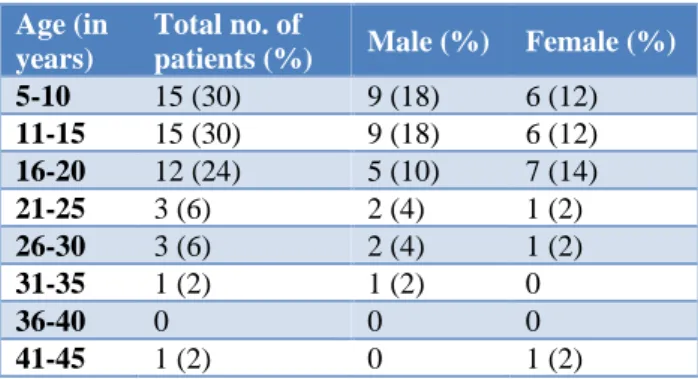
The age group in study which contains maximum patients is from 5 to 15 years.
As far as sex is concerned, 28 patients were males and 22 patients were females.
In this study, age distribution suggests that children have more problems related to tonsil and adenoid than adults (Table 1).
Table 1: Age and sex distribution.
Age (in years)
Total no. of
patients (%) Male (%) Female (%)
5-10 15 (30) 9 (18) 6 (12)
11-15 15 (30) 9 (18) 6 (12) 16-20 12 (24) 5 (10) 7 (14)
21-25 3 (6) 2 (4) 1 (2)
26-30 3 (6) 2 (4) 1 (2)
31-35 1 (2) 1 (2) 0
36-40 0 0 0
41-45 1 (2) 0 1 (2)
Table 2: Time taken for surgery.
Time taken (min)
Right
(conventional side)
Left (coblation side)
5-10 - 7
11-20 2 37
21-30 16 6
31-40 18 -
41-50 13 -
51-60 1 -
Table 1 shows that in our study, 56% patients were male while 44% were female. In my study, most common indication for tonsillectomy was chronic tonsillitis with adenoid hypertrophy.
Time taken for the surgery was calculated by time from putting an incision on the tonsils to the achievement of haemostasis.
Table 2, shows that time taken for the surgery on left side (coblation side) was less than right side (conventional side). Average time for surgery on left side was 15.1 min and on right side 36.04 min.
of Malaysia, which is due to controlled ablation and plasma field creation (Table 3).
In my study, this result is not consistent with Indian Journal of Otolaryngology Study, Noordzij’s study and IOSR study.Here it may be due to learning phase of the operative surgeon as it is a newer technique.
Table 3: Comparison of operative time of my surgery with other studies.
Study
Mean operative time taken for the surgery (in minutes)
Conventional side
Coblational side
My study 36.04 15.10
Indian journal of otolaryngology study- September 2012
11.00 15.00
Noordzij’s
study-August 2006 6.33 8.22
Iosr study- April
2017 11.80 16.40
Malaysian study 7.24 4.21
Table 4, shows that for haemostasis on right side, all patients required bipolar cauterization for varied bleeding points while on left side only 8 patients (16%) required coagulation.
On right side, bipolar cauterization was done by electrocautery whereas on left side, haemostasis was achieved by coagulation mode of coblator.
Table 4: Number of bleeding points required control.
Number of bleeding points required control
Conventional side (by bipolar cauterization)
Coblational side (by coagulation mode of coblator)
1 8 0
2 10 4
3 9 2
4 5 1
5 8 1
6 4 0
7 5 0
8 1 0
We used dissection and ligation method for tonsillectomy on right side and for that we ligated lower pole with silk thread on right side in every patient, which was counted as 0.
Table 5, shows that 4 patients required ligation of single bleeding point other than lower pole on right side, only single patient was required ligation at two sites. Single bleeding point was ligated on left side at lower pole.
Table 5: Number of bleeding points required ligation.
Number of bleeding points required ligation
Conventional side (right)
Coblational side (left)
1 4 1
2 1 0
3 0 0
Table 6, shows that on left side, 47 patients (94%) had blood loss less than 10ml while on right side, all the patients had blood loss greater than 10 ml. We had measured the weight of the gauge pieces pre-operatively and again measured the change of weight in blood sacked gauge pieces post-operatively, and considered change of 1 gm in weight is equal to 1 ml blood loss.
Average blood loss on coblation side (left) was 3.40 ml while on conventional side (right) 25.57 ml. So, this table shows benefits of coblation on blood loss.
Table 6: Gauze pieces required and blood loss on each side.
No. of gauze pieces used per patient
Blood loss in ml per patient
Conventional side (right)
Coblational side (left)
0-5 0-10 0 47
6-10 11-20 13 3
11-15 21-30 25 0
16-20 30-50 12 0
Table 7, shows that my study results that blood loss on coblation side was less than that of conventional method, is in concurrence with IOSR study, Indian journal of otolaryngology studyand Malaysian study.10-13 This may
be due to coblator machine’s specificity of ablation and coagulation at same time.
Noordzij’s study shows that blood loss on both sides, coblation and conventional was same (<10.00 ml) which is not in agreement with our study.
Odynophagia was seen in 4 patients. Voice change was seen in one patient.
After 24 hours, 4 (8%) patients had earache and single patient had odynophagia. Complain of bleeding from tonsillar fossa (done by conventional method) was only seen in one patient which was seen after 7 days due to secondary haemorrhage and was controlled by oral antibiotics, hydrogen peroxide and adrenaline gargles.
Table 8, shows that in first 24 hours, 33 patients had mild pain over left side while 32 patients had moderate pain on right side. This may be attributed due to less tissue damage on left side by coblation tonsillectomy.
Table 7: Comparison of blood loss during my study with other studies.
Study
Mean blood loss during surgery (in ml)
Conventional side
Coblational side
My study 25.57 3.40
Isor study 43.44 18.74
Indian journal of otolaryngology study
34.00 11.00
Noordzij’s study <10.00 <10.00
Malaysian study 57.40 11.80
Table 8: Severity of pain in first 24 hours (VAS - visual analogue scale - pain scale).
Side No
pain
Mild (1-3)
Moderate (4-6)
Severe (7-10)
Conven-tional side (right)
0 18 32 0
Cobla-tional side (left)
0 33 17 0
I have compared pain score post tonsillectomy on 1st, 2nd,
5th and 10th day in my study. In IOSR study,they have
compared pain sore on 1st, 2nd and 7th day post
tonsillectomy.
I have compared pain score (on 1st and 2nd day of surgery)
of my study with ISOR study and the results are in agreement that severity of pain on coblator side is less than conventional side. It may be due to low temperature and low voltage and therefore less tissue damage. Less pain in patients facilitates early return to normal diet after surgery (Table 9).
Table 9: Comparison of pain score of my study with other study.
Study
Pain score within 24 h of surgery
Pain score on 2nd day after surgery
Conven-tional side
Coblation side
Conven-tional side
Cobla-tion side
My
study 6.18 4.36 4.10 3.00
Iosr
study 7.42 3.92 6.20 3.64
In my study, mean pain score on 5th and 10th day of
surgery was 2.30 and 1.64 on conventional side and 1 and 0 on coblation side.
In IOSR study, mean pain score on 7th day of surgery on
coblation side was 2.74 and conventional side was 3.52.
These results show that as the days pass, post-operative pain decreases early on coblator side which facilitates patients for early return to normal diet after surgery.
My study showed that all patients had mild to moderate degree of slough on right side and moderate to severe degree of slough on left side.
As considered in physiology, slough formation is a protective mechanism and is a part of wound healing. It appears generally within 3-6 hours after the surgery. We have graded slough formation in our study as partially filling the tonsillar fossa, completely filling the fossa, slough also present outside the fossa like anterior pillar, uvula.
Table 10: Comparison of degree of slough in IOSR study.
Study
Slough (in%): tonsillar fossa healing on 1st day of surgery
Slough (in%): tonsillar fossa healing on 2nd day of surgery
Slough (in%): tonsillar fossa healing on 7th day of surgery
Conventional
side Coblation side
Conventional
side Coblation side Conventional side
Coblation side IOSR
study12 40% 80% 47% 74% 18% 45%
Study showed that with the use of coblation, slough formation and so, healing process is more on coblation side than conventional.
concludes that my study result is in agreement with IOSR study.
Post-operative haemorrhage
In my study, only one patient had haemorrhage on right side on 7th day (secondary haemorrhage). This is not in
agreement with Noon et al study. It described significantly higher haemorrhage rate in coblation as compared to diathermy which may be due to delayed healing.14
DISCUSSION
We have compared coblation technology with conventional technique for tonsillectomy in 50 patients to compare intraoperative blood loss, post-operative pain, severity of slough and surrounding structure damage. In my study, in all patient’s right side of tonsil was removed by conventional technique and left side by coblation.
The age group in study which contains maximum patients is from 5 to 15 years which contains 30 patients which is 60% of the total patients. As far as sex is concerned, 28 patients were males and 22 patients were females. Most common indication for tonsillectomy was chronic tonsillitis with adenoid hypertrophy (19 patients out of 50).
Average time for surgery on coblation side was less 15.1 min and conventional side 36.04 min. This shows that time taken for the surgery on left side (coblation side) was less than right side (conventional side). In my study, this result is not consistent with Indian journal of otolaryngology study, Noordzij’s study and IOSR study.10-12 My study results that operation time on
coblation side is less than conventional side is consistent with other study of Malaysia,which is due to controlled ablation and plasma field creation.13
For haemostasis on conventional side, all patients required bipolar cauterization for varied bleeding points while on coblation side only 8 patients (16%) required haemostasis which was achieved by coagulation mode of coblator. For haemostasis 4 patients required ligation of single bleeding point other than lower pole on conventional side, only one patient was required ligation at two sites. One bleeding point was ligated on coblation side at lower pole.
Average blood loss as per weight of blood-soaked gauze pieces on coblation side (left) was 3.40 ml while on conventional side (right) 25.57 ml. This result that blood loss is in concurrence with IOSR study, Indian journal of otolaryngology study and Malaysian study.10,12,13 This
may be due to coblator machine’s specificity of ablation and coagulation at same time. Noordzij’s study shows that blood loss on both sides, coblation and conventional was same (<10.00 ml) which is not in agreement with our study.11
Post-operatively throat pain was present in all patients. Other complaints within 24 hours were earache (in 4 patients), fever (in one patient), vomiting (in one patient), odynophagia (in 4 patients) and voice change (in one patient).
Post tonsillectomy within first 24 hours, 33 patients had mild pain over coblation side while 32 patients had moderate pain on conventional side. In my study, mean pain score on 1st day, 2nd day, 5th and 10th day of surgery
was 6.18, 4.10, 2.30 and 1.64 on conventional side and 4.36, 3.00, 1 and 0 on coblation side. I have compared pain score (on 1st and 2nd day of surgery) of my study
with ISOR study and the results are in agreement that severity of pain on coblator side is less than conventional side. It may be due to low temperature and low voltage and therefore less tissue damage.
With the use of coblation, slough formation was more on coblation side than conventional. In IOSR study, degree of slough on coblation side is more than conventional side which indicates tonsillar fossa healing which may be due to precise removal of tissue and less tissue damage.12
This concludes that my study result is in agreement with IOSR study.12
In my study, only one patient had haemorrhage on conventional (right) side on 7th day (secondary
haemorrhage). This is not in agreement with Noon et al study, which described higher hemorrhage rate in coblation as compared to diathermy which may be due to delayed healing.14
CONCLUSION
After observation and discussion of 50 cases we can conclude that the clear field in tonsillar surgery which is very important is easily achieved by use of the coblator. The use of coblator reduces the time required for surgery, reduces blood loss, reduces chances of damage to surrounding structures like anterior pillar, posterior pillar, and uvula. Less charring of tissue with coblation as compared to bipolar cauterization used in conventional method. Smoke production or fogging during surgery with coblation method is less as compared to electrocautery.
Post-operatively, severity of pain after 24 hours is very much less than that of dissection method, which facilitates the patients to early return to normal diet. Slough formation was more on coblation side as compared to conventional side.
Funding: No funding sources Conflict of interest: None declared
REFERENCES
1. Burton MJ, Doree C. Coblation versus other surgical techniques for tonsillectomy. Cochrane Database Syst Rev. 2007;(3):CD004619.
2. Polites N, Joniau S, Wabnitz D, Fassina R, Smythe C. Postoperative pain following coblation tonsillectomy: randomized clinical trial. ANZ J Surg. 2006;76(4):226-9.
3. Robert HO, Coleman JA, Courey MS. Clinical applications of laser in otolaryngology - Head and Neck surgery. Laser Surg Med. 1994;15:217-48. 4. Kimsey Rodriguez K, Nicole Murray N, Guarisco
JL. Power Assisted Partial Adenoidectomy. Laryngoscope. 2009;112:8:26-28.
5. Koltai PJ, Chan J, Youner A. Power assisted adenoidectomy: total and partial resection. Laryngoscope. 2002;112(8):29-31.
6. Vaughan AH, Derkay CS. Microdebrider Intracapsular Tonsillectomy. ORL. 2007;69:358-63. 7. Johnson L, Charles MM, Ravindra GE.
Complications Adenotonsillectomy. Laryngoscope. 2009;112(8):29-31.
8. Rakesh S, Anand TS, Payal G, Pranjal K. A prospective, randomized, double blind study of coblation versus dissection tonsillectomy in adult patients. Indian J Otolaryngol Head Neck Surg. 2012;64(3):290-4.
9. Noordzij JP, Affleck BD. Coblation versus unipolar electrocautery tonsillectomy: a prospective
randomised single blind study in adult patients. Laryngoscope. 2006;116(8):1303-9.
10. Nallasivam M, Sivakumar M. A comparative study of coblation versus conventional tonsillectomy. ISOR J Dental Med Sci. 2017;16(4):102-7.
11. Noordzij JP, Affleck BD. Coblation versus unipolar electrocautery tonsillectomy: a prospective randomised single blind study in adult patients. Laryngoscope. 2006;116(8):1303-9.
12. Rakesh S, Anand TS, Payal G, Pranjal K. A prospective, randomized, double blind study of coblation versus dissection Tonsillectomy in adult patients. Indian J Otolaryngol Head Neck Surg. 2012;64(3):290-4.
13. Zainon I, Salim R, Khairi M, Daud M. Coblation tonsillectomy versus dissection tonsillectomy: A comparison of intraoperative time, intraoperative blood loss and post op pain. Med J Malaysia. 2014;69(2):74-8.
14. Noon AP, Hargreavas S. Increased post-operative haemorrhage seen in adult coblation tonsillectomy. J Laryngology Otol. 2003;117:704-6.