AENSI Journals
Australian Journal of Basic and Applied Sciences
ISSN:1991-8178
Journal home page: www.ajbasweb.com
Corresponding Author: S. Amira, Department of Mathematics, Faculty of Science and Mathematics, Universiti Pendidikan
Sultan Idris, 35900 Tanjong Malim, Perak, MALAYSIA. E-mail: [email protected]
A Reactive Navigation for a Mobile Robot: An Improvement for Modified Virtual Semi
Circle Approach
1S. Amira, 2R. N. Farah, 3N. Irwan, 4R.L. Zuraida and 5M.H. Hafiz
1 2 4Department of Mathematics, Faculty of Science and Mathematics, Universiti Pendidikan Sultan Idris, Perak, Malaysia.
3Department of Communication Technology and Network, Faculty of Computer Science and Information Technology, Universiti Putra
Malaysia, Malaysia.
4Department of E-Commerce, Faculty of Technology and Information Science, International Islamic University College Selangor, Malaysia.
A R T I C L E I N F O A B S T R A C T
Article history:
Received 15 September 2014 Accepted 5 October 2014 Available online 25 October 2014
Keywords:
Autonomous Mobile Robot, Unmanned Ground Vehicle, Modified Virtual Semi Circle, Ultrasonic Range Finder Sensor, Path Planning.
Background: An important task for navigation is to navigate an autonomous mobile robot. An autonomous mobile robot has to gain the information from its environments to successfully reach it predetermined goal without any collision. There are many type of mobile robots existed. One of an autonomous mobile robot is known as Unmanned Ground Vehicle (UGV). UGV can be an autonomous vehicle. An improvement for Modified Virtual Semi Circle (MVSCi) is proposed to navigate a UGV that is equipped with five ultrasonic range finder sensors. Objective: The objective of this paper is to improve a reactive navigation for a UGV path planning. Results: The proposed method enhances the time processing for the UGV. It computes shortest time processing, smoothness of velocity, shortest path, and successfully navigates the UGV towards goal location without any collision. Conclusion: The improvement of MVSC produces simplest path planning and a cost effective UGV.
© 2014 AENSI Publisher All rights reserved. To Cite This Article: S. Amira, R. N. Farah, N. Irwan, R. L. Zuraida and M.H. Hafiz., A reactive Navigation for a Mobile Robot: An Improvement for Modified Virtual Semi Circle. Aust. J. Basic & Appl. Sci., 8(22): 35-39, 2014
INTRODUCTION
Surveillance issues have received an increasing amount of attention among the researcher. The application of the unmanned ground vehicle through civilian as well as military applications is increasing as well (David Anisi and Petter Ogren, 2009). There are several types of unmanned vehicles are introduced such as unmanned ground vehicle (UGV), unmanned aerial vehicle (UAV) for in the air, unmanned underwater vehicle (UUV) and unmanned sea-based vehicle (USV) for surface craft. (R. N. Farah et. al., 2013). However, this research is focusing on UGV types of mobile robot only.
UGV can be in an autonomous vehicle category. An autonomous mobile robot travels from the start location to the goal location without the need of human intervention (Gu. J. and G. Qixin., 2011). The path planning for navigating the UGV is divided into two; local path planning and global path planning. Local path planning gains the environment information from sensors. It directly uses the sensor’s information command
that control motion without constructing global map (R. N. Farah et. al.,2014). UGV with global path planning
is necessary to build the environment model by implementing any method existed such as map model method and network grid based modeling method (Guo and Liu, 2010). The optimal path with shortest path selection, the smoothness of velocity and successfully travel toward goal location without trapped is mainly become the main attention for the researcher nowadays.
An improvement of Modified Virtual Semi Circle (MVSCi) approach proposed an improvement works
from MVSC approach proposed by R. N. Farah et. al.,2014. MVSC is a new reactive navigation approach path
planning based on Virtual Semi Circle (VSC) proposed by S.H Tang et. al.,2013. VSC approach mainly
developed based on the “situated-activity paradigm” and “divide and conquer” strategy. This strategy is a
simplified techniques by applying motion law based on navigation cases (Minguez et.al., 2004). The MVSCi is a
real-time based navigation, it is mainly used the data from the sensory information to execute it path planning, The UGV in this research is known as Mobile Guard UGV- Truck Surveillance (MG-TruckS).
Methodology:
This paper proposed MVSCi approach to simplify the previous modules in MVSC. This approach reduces
the amount of modules in MVSC from four modules to three modules. The MVSCi approach enhances the time
processing of evaluating the path planning for the UGV. The proposed approach is divided into two phases which are detection phase and avoidance phase. Detection phases only keep one module of MVSC known as division. Meanwhile, avoidance phase keeps the original works of MVSC decision and motion generation’s module.
A. Detection phase:
Detection phase present the division modules for the MVSCi approach. The information of the workspace
area of the MG-TruckS is collected by the ultrasonic range finder.
i. Division:
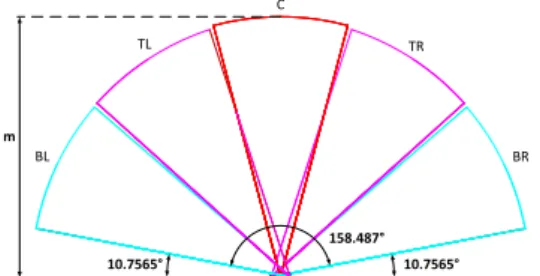
There are five ultrasonic range finder sensors is equipped to detect the position of the obstacles in the workspace area. Therefore, the space area of the sensors array is divided into five subspaces. Each subspaces are
BL (Bottom Left), TL (Top Left), C (Centre), TR (Top Right), and BR (Bottom Left). Each of the ultrasonic range
finder sensor arrays has 30°radius of detection with 3 meter distance range. The sensors have been arranged to
produce 158.487° total angle of the sensor arrays for forward looking motion with the existence of 1°blind zone. The sensor arrangement has been discussed in MVSC approach. Fig. 1 shows the subspace for five ultrasonic range finder sensors in MVSC.
S0
S330.0° S290.0°S4
79.0°
S130.0°
0.24 m0.11 m
2.87785 m113.3013 in
30 15
3015
3015S0S3
S4S2
90.0°
30.0°
30.0°
336.5°30.0°S1
0.24 m0.11 m
2.87785 m113.3013 in
301530153015
10.7565° 10.7565°
C
TL
BR BL
TR
158.487° 3 m
Fig. 1: The subspaces for five ultrasonic range finder sensors in MVSC (R.N Farah et. al., 2014).
BR TR
0
1
A B
C a b
c
Blind Zone at approximate to 10
Fig. 2: The approximation length from 1° blind zone area.
Fig 2. above shows the implementation of the Isosceles Triangle Theorem (equation i) to find the maximum length for the blind zone. Since the maximum length of AB is approaching 1.75 cm and it is a small value, hence the existence of the blind zone is significantly ideal.
𝑎
sin 𝐴 = 𝑏
𝑠𝑖𝑛𝐵 (i)
100 𝑐𝑚
sin 89.5= 𝑏
sin 1 (ii)
𝑏 sin 89.5 = 100 sin 1 (iii)
≈ 1.75 𝑐𝑚 (iv)
S0 S3 S2S4
90.0°
30.0°
79.0°
S130.0°
0.24 m0.11 m
2.87785 m113.3013 in
3030 3030303015
30303030303015
30303030303015S0 S3
S4S2
90.0°30.0°
30.0°
79.0°
S130.0°
0.24 m0.11 m
2.87785 m113.3013 in
303030303030153030303030301530303030303015
10.7565° C TL BR BL TR 0.5 m 1 m 1.5 m 2 m 2.5 m 3 m S0
S3 S2S4
90.0°
30.0°
79.0°
S1
30.0°
0.24 m0.11 m
2.87785 m113.3013 in
3030 3030303015
30303030303015
30303030303015S0 S3
S4S2 90.0°30.0° 30.0° 79.0° S1 30.0°
0.24 m0.11 m
2.87785 m113.3013 in
303030303030153030303030301530303030303015
C
TL
BR TR
1
1 1 2
2 2 2 2 3 3 3 3 3 4 4 4 4 4 5 5 5 5 5 6 6 6 6 6
Fig. 3: The region for each subspace of ultrasonic range finder sensors
Once the obstacle has been detected by the ultrasonic range finder sensors, the influence zones will be generated from the obstacle position. There will be three layers of influence zone known as first influence zone, second influence zone and third influence zone. The first influence zone is generated within 0.00 m and 1.00 m distance from the obstacle position, while second influence zone is generated between 1.01 m and 2.00 m from the obstacle position. Meanwhile, the third influence zone is generated between 2.01 m and 3.00 m distance from the obstacle. Therefore, once the obstacle has been detected, the sensory information will define the region and the influence zone area for the position of the obstacle. The construction of the influence zone is shown in Fig. 4.
Obstacle i Third Influence Zone
Second Influence Zone
First Influence Zone
Obstacle
Fig. 4: The formation of the influence zone.
B. Avoidance phase:
The mobile robot must have the ability to create a free collision path planning especially in an unknown environment. It requires the mobile robot to plan it motion to reach it predetermined goal when there is no prior knowledge of them (Y. Zhu et. al., 2012). Avoidance action takes place if there is a detection of the obstacle from the ultrasonic range finder sensors.
ii. Decision:
The UGV will then decide it path planning towards goal based on the position of the obstacles within the region of obstacle position and the area of the influence zone. The path planning fulfills the conditions below: Condition 1: If the UGV is in the first influence zone, then the UGV will navigate as near as it can be toward the obstacles.
Condition 2: If the UGV is in the second influence zone, then the UGV will navigate away from the obstacles. Condition 3: If the UGV is in the third influence zone, then the UGV will navigate closer the obstacles.
iii. Motion generation:
The direction of motion of the UGV (𝜃𝑟𝑖) is decided on the decision step. The velocity value will depends
on the 𝜃𝑟𝑖 where 𝑣𝑟 = 𝑣𝑚𝑎𝑥 if the UGV navigation has no obstacles detection otherwise, the UGV will reduces
the velocity.
Experimental results:
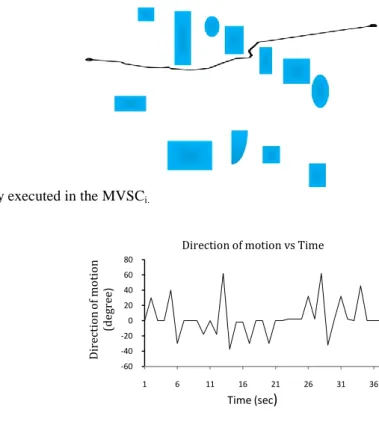
The proposed MVSCi is demonstrated by simulations result. A reactive UGV path planning gain the
Fig. 5: Trajectory executed in the MVSCi.
Fig. 6: The direction of motion for the UGV.
Conclusions:
A reactive navigation of UGV has been proposed. The direction of motion will totally depend on the situation of the environments of the UGV. The simple algorithm will directly produce a simple path planning and reduce the computational time. Hence, a large memory is not necessary. Since the MVSCi reduced the
number of modules from it original works, it helps to reduce the processing time for the UGV to generate it new trajectory. The path planning shows it is not makes any unnecessary obstacles avoidance. Therefore the improvement of MVSC will help to reduce the computational burden and optimized with shortest path taken.
ACKNOWLEDGMENT
The authors would like to thank the Ministry of Higher Education of Malaysia under the fundamental research grant (RAGS) 2013-0011-1040-72 for financial support.
REFERENCES
Anisi, D. and O. Petter, 2009. Minimum Time Multi-UGV Surveillance. Optimization and Coorperative Control Stratergies., Springer Berlin Heidelberg, 31-45.
Farah, R.N., N. Irwan, R.L. Zuraida, M.H. Hafiz and Umairah, 2013. Challenging of Path Planning Algorithms for Autonomous Robot in Known Environment, presented at the Proceedings of the 3rd International Conference on Mathematical Sciences, Kuala Lumpur, Malaysia.
Farah, R.N., N. Irwan, R.L. Zuraida, M.H. Hafiz and Umairah, 2014. Challenging of Path Planning Algorithms for Autonomous Robot in Unknown Environment. Lect. Notes Inf. Theory, 2(1): 121-125.
Farah, R.N, N. Irwan, R.L. Zuraida, S. Amira and M.H. Hafiz, 2014. Path Planning for Mobile Robot Based on Reactive Collision Avoidance Method. Aust. J. Basic & Appl. Sci., 8(11): 1-7.
Farah R.N, N. Irwan, R.L. Zuraida, S. Amira and M.H. Hafiz, 2014. Modified Virtual Semi-Circle
Approach for a Reactive Collision Avoidance of a Mobile Robot in an Outdoor Enviroment presented at the 4th
International Malaysia-Ireland Joint Symposium on Engineering Science and Business, Penang Island, Malaysia.
Gu, J. and Qixin C., 2011. Path Planning for Mobile Robot in a 2.5-Dimensional Grid-Based Map., Industrial Robot: An International Journal, 315-321.
Guo, J. and L. Liu, 2010. A Study if Improvement of D* Algorithm For Mobile Robot Path Planning In Partial Unknown Environment, Kybernetes, 39 (6): 935-945.
Miguez J., J. Osuna, L. Montano, 2004. A “Divide and Conquer” Strategy Based On Situations to Achieves -60
-40 -20 0 20 40 60 80
1 6 11 16 21 26 31 36
D
ir
ec
ti
o
n
o
f
m
o
ti
o
n
(degr
ee
)
Reactive Collision Avoidance in Troublesome Scenarios. IEEE International Conference on Robotics and Automation, 4: 3855-3862.
Tang S.H., C.K. Ang, D. Nakhaeinia, B. Karasfi and O. Motlagh, 2013. A Reactive Collision Avoidance Approach for Mobile Robot in Dynamics Environments. Journal of Automation and Control Engineering, 1(1): 16-20.