Production of Low Ester (LM)
Pectin by De-esterication of
High Ester (HM) Apple Pectin
I. Alemzadeh
, A.A. Saifkordi
1, D. Kahforooshan
1and P. Nahid
1In this paper, LM pectin production from commercial apple pectin by using acid, alkali and ammonia methods in the presence of ethanol was studied. Also, the eect of dierent parameters such as, temperature, time, acid, alkali and ammonia treatment in LM pectin production were evaluated. In all the experiments, low temperature showed a better inuence from a recovery, purity and low de-polymerization viewpoint. Optimum conditions in the acid method reached at pH = 2, t= 17 hrs andT = 30
C, in the alkaline method reached at pH = 11,
t= 3 hrs and T = 5
C and in the ammonia method reached at 2 N ammonia and T = 5
C, were determined.
INTRODUCTION
Pectin is obtained mainly from the waste materials of apple, orange, grapefruit and lemon juice produc-tion 1]. Pectins with an ester level over 50% based on the total level of carboxylic acid and ester, are described as high ester pectin (HM). They are used to form jams and jellies having soluble solid levels near 65%. Formation of the gelled state requires high levels of dissolved solids and acidic pH. High methoxyl pectin does not contain sucient acid groups of forming gel or precipitate with calcium ions. As the pH is gradually reduced, the pectin is capable of forming gel at rst, at a very high sugar content, of around 80%. Pectins, modied so as to have an ester level equal to or under 50%, are described as low methoxyl or low ester pectins (LM), which are used to form gels having reduced soluble solid levels. They form gels with or without sugar in the presence of divalent cathions. They are, therefore, used in low calorie or dietetic foods 2]. Low methoxyl pectins are produced by further de-esterication to a point where less than 50% of the total carboxyl groups are esteried. If this process is carried out using acid or alkali, the balance exists as free acid groups. Low methoxyl pectins form
*. Corresponding Author, Department of Chemical Engi-neering and Petroleum, Sharif University of Technology, Tehran, I.R. Iran.
1. Department of Chemical Engineering and Petroleum, Sharif University of Technology, Tehran, I.R. Iran.
gel by reaction with calcium and are believed to gel by the egg box mechanism 1].
There are four dierent methods for the prepara-tion of low ester pectin from high ester pectin. HM pectin demethylation could be eected by: (a) Acid (b) Alkali (c) Enzyme and (d) Ammonia in alcohol or concentrated aqueous ammonia demethylation and amidation 3,4].
Low methoxyl pectins produced by enzyme demethylation have been found to be inferior in quality to those produced by other methods, because of the non random distribution of methyl ester groups among molecules of the pectin and because of the removal of very small units, such as non-uronide materials. Acid demethylation removes special units at a high rate, leading to the production of pectin having a higher percentage of poly galacturonic acid. The main disadvantage of acid treatments is the slowness of the reaction. It may be speeded up by using higher temperatures, but this results in the de-polymerization of the pectin chains. Alkaline demethylation is rapid but the removal of methyl ester groups is accompanied by the de-polymerization of the pectin chains and the rate of de-polymerization is faster than the rate of demethylation as the temperature increases 5].
The use of ammonia in alcoholic or concentrated aqueous ammonia systems results in a low methoxyl pectin that contains amide groups. It has been found that the percentage of amide groups in the pectin plays a positive role in gel formation and contributes to gel texture and strength 6,7].
In this study, attempts were made to determine the experimental procedures required to prepare low es-ter apple pectin, due to its high utility as a gelling agent and very versatile thickeners, with dierent treatment methods using acid, alkali and ammonia. The eect of dierent parameters on LM pectin production were also studied and compared.
MATERIALS AND METHODS
Raw Material
The experiments were eected using commercial apple pectin obtained from Fluka, Switzerland (Degree of Es-terication (DE) 74.3% and viscosity average molecular weight of 32000 Dalton). All the chemical solutions utilized were analytically pure.
Acid Demethylation
Acid demonstration was studied in an aqueous solution of an acid alcohol mixture (heterorganic solution) while a mixture of water acid suspension was used as the homogenic solution 8,9]. After preparing a solution of pectin at the level of 2% in the case of an heterorganic mixture, an equal volume of the ethanol solution (60%) and 0.1 N hydrochloric acid were added to the pectin solution. The solution prepared as described was stirred continuously, while the temperature was kept constant at 30 and 50C during the demethylation
reaction. After the desired mixing time, the samples were separated with centrifugation at 3000 rpm. The separated LM pectin was washed with 60 and 96% ethanol v/v until it was free of chlorides and dried at 60C, ground and analyzed. In the homogen method,
a sample of 1 g of apple pectin was dissolved in 20 ml of distilled water and acidity was controlled by 0.1 N hydrochloric acid. After one night, the pectin precipitates was separated by centrifugation for 20-30 min at 20-3000 rpm. The precipitate was washed with 100 ml of 60% ethanol nal washing was done with 96% ethanol and then dried at 50C 10].
Alkali Demethylation
To a 1% pectin solution, 1 N NaOH solution was added to give a pH of the desired value. The temperature was maintained at 5-15C over a period of 2.5-3 hrs.
An equal volume of 95% ethanol was added to the reaction mixture, with enough 0.1 N HCl to adjust the pH value to 5. The mixture was stirred, allowed to stand for 20 min and separated by centrifugation at 2000 g. The separated cake was suspended in 50% ethanol at pH 5.2, in order to remove the undesired salt. It was, then, suspended in 95% ethanol for 20 min and was pressed and dried at 60C and analyzed 5].
Demethylation with NH
4OH
Samples of 125 ml 1% pectin solution were prepared and stored at 5C at 20 min. 100 ml of NH
4OH 1 N
and ethanol mixtures with a ratio of 1:1 were added, mixed and stored at 5C. NH
4OH demethylation was
started by mixing the samples and solution and con-tinuously stirring the reaction mixtures at the desired temperature. The separation and washing are similar to alkali demethylation and the amidation degree is determined 6].
Physico Chemical Analysis of Samples
The degree of esterication, methoxyl, galacturonic acid content, moisture and ash were determined ac-cording to the methods described by authors 11,12-14]. The intrinsic viscosity was measured by an ubbelholde viscometer, which is a glassware viscometer with 5.5 ml inherent volume and 0.5 mm capillary diameter. It was tested with 0.155 M of NaCl solution with ow time of 105s. This method was described by Hwang 13]. The viscosity average molecular weight of the pectin was calculated by the following Mark Houwink equation in NaCl solution 10,13]:
Degree of Esterication (DE) :D E = 32
;95% ] = 9:5510
;2
M
0:73 w
where ] is the intrinsic viscosity (ml/g) and M w, is
the viscosity average molecular weight.
Reaction rate constants of de-esterication were calculated by using a rst order reaction, according to the data observed by other investigators 3]:
K= 1 t `
n c
o c
where c
o is the initial degree of esterication and c is
the degree of esterication at timetin minutes.
RESULT AND DISCUSSION
In order to obtain information on the production of pectin with a low esterication degree, three dierent chemical treatments of commercial apple pectin were eected, using acid, alkali and ammonia under pre-scribed conditions. The experiments were eected in parallel and the data observed showed the average of the two parallel repeated tests carried out.
Acid Demethylation
Table 1 shows experimental conditions for the acid demethylation of pectin. De-esterication was eected under homogen and hetrogen conditions. For homogen
Table1. Experimental conditions for acid demethylation
of pectin.
Samples
De-esterication pH
Acid
T(
C)
Time
(hrs)
1 Hemogen 1.5 30 17
2 00 2 00 00
3 00 1 00 00
4 00 3 00 00
5 Hetrogen 2 00 00
6 00 00 50 4
7 00 00 30 48
treatment, the temperature and time were constant at 30C and 17 hrs, respectively, but pH was changed from
1 to 3. For hetrogen treatment, pH was constant, but the temperature and time were changed.
The characteristics of sample (LM) pectins pro-duced under dierent treatments and conditions are presented in Table 2. Characteristics of the product are recovery, humidity, ash, methoxyl, galacturonic acid, esterication degree, average molecular weight and the reaction rate of demethylation. Comparing the data in Table 1 and the results in Table 2 shows that, homogen treatment of sample 4, with an 85% recovery and pectin with an average molecular weight of 32000, is more favorable. For hetrogen treatment, sample 5, with an 87.9% recovery average molecular weight of 32000, is more acceptable. Comparing the results of sample 2, using homogen treatment, with sample 5, using hetrogen treatment, shows that hetro-gen treatment results in the production of LM pectin with a higher recovery and average molecular weight. For other hetrogen samples, such as sample 6, de-esterication is low (40%), due to a high temperature of 50C. Also, the percent of recovery is low at 50%
and ash content is high, which could be related to an impurity of the sample. So, conditions for acid de-esterication are related to higher recovery and purity viewpoints, which could be summarized asT = 30
C,
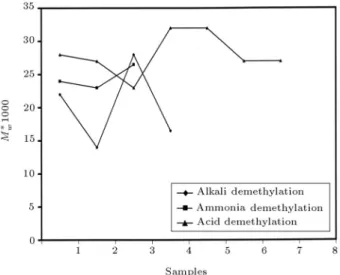
pH = 2 and time = 17 hrs under hetrogen conditions. According to Table 1, viscosity, average molecular weight and rate of reaction are compared for all the samples higher temperature resulting in higher rates of de-esterication (sample 6). The average Mw for all the samples is presented in Figure 1, which shows that sample 5 has an Mw of 32000 under hetrogen conditions.
The eect of pH could be seen from sample nos. 3, 4 and 5. The high concentrations of acid increase reaction rate but decrease viscosity average molecular weight by de-polymerization. Therefore, the highest de-polymerization is observed at pH 1 (sample 3).
The most recovery is obtained at intermediate
Figure1. Viscosity average molecular weight (Mw) for
pectin samples after acid, alkali and ammonia demethylation.
Table 2. Characteristics of samples after acid demethylation of pectin.
Samples
Specication
1
2
3
4
5
6
7
Recovery %
84 80 80.3 85 87.9 66.5 50.6Humidity %
16 18 18.6 13.46 14.02 10 5.2Ash %
13 13 3.47 1.4 1.4 3.1 5.4Methoxyl %
3.41 6.01 7.8 9 8.31 6.51 7.46Galacturonic Acid %
31.9 42.7 78.65 74.46 78.88 78 95.8Esterication Degree %
43.1 66.7 44 58.4 50.0 40 40Intrinsic Viscosity (ml/g)
171 166 143 186 186 166 166Viscosity Average (Mw)
28500 27500 22300 32000 32000 27500 27500concentrations of acid, due to the high degradation of pectin at high concentrations of acid. Also, it could be seen that the most rapid de-polymerization compared to de-esterication is observed at high concentrations of acid, for sample no. 3, which results in a lower average Mw.
The eect of temperature and time on the demethylation process is presented in Tables 1 and 2. Comparing the characteristics of samples 5 to 7, shows that by increasing temperature and decreasing time, re-covery and viscosity average molecular weight decrease (sample 6). Also, it could be clearly found that by increasing time, methyl ester groups are less available for reaction and this will slow down the reaction rate. Increasing treatment time also increases purity. Thus, in order to reach favorable results in acid demethylation and a lower degree of esterication, longer treatment time and a lower temperature should be used.
Alkali Demethylation
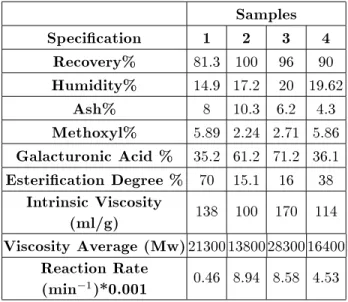
For alkali demethylation, the eect of pH and tem-perature were studied at about equal de-esterication treatment times (Table 3). According to Table 3, for samples 2 and 3, temperature is signicantly dierent but pH is constant. For samples 1 and 4, temperature and pH are varied. Table 4 shows the characteristics of the studied samples from alkali demethylation. The selected variables for the alkali demethylation treat-ment were temperature and pH as indicated in Table 4. The viscosity average molecular weight is plotted in Figure 1. Comparing the results in Tables 3, 4 and Figure 1, shows that temperature has a signicant inuence on the process of de-esterication. So that, using higher temperature can cause an increase in the reaction rate, but, in contrast, increases the rate of de-polymerization, which results in a decrease in the molecular weight. Therefore, high temperature is undesirable for the demethylation of pectin, as it causes molecular weight loss. For sample 3, at a lower temperature under alkaline conditions, higher purity and average molecular weight are observed, respectively. The most favorable conditions for alkali de-esterication is observed for sample 3 at: pH = 11,
T = 5 C and
t= 3 hrs.
Comparing data for acid and alkali
demethyla-Table3. Experimental conditions for alkaline
demethylation of pectin.
Samples pH
T(
C) Time (hrs)
1 10 10 2.5
2 11 15 3
3 11 5 3
4 12 7 2.5
Table 4. Characteristics of samples after alkaline
demethylation of pectin.
Samples
Specication
1 2 3 4
Recovery%
81.3 100 96 90Humidity%
14.9 17.2 20 19.62Ash%
8 10.3 6.2 4.3Methoxyl%
5.89 2.24 2.71 5.86Galacturonic Acid %
35.2 61.2 71.2 36.1Esterication Degree %
70 15.1 16 38Intrinsic Viscosity
(ml/g)
138 100 170 114Viscosity Average (Mw)
21300138002830016400Reaction Rate
(min
;1)*0.001
0.46 8.94 8.58 4.53tion, shows that the rate of acid demethylation is lower than the rate of alkali demethylation although alkali demethylation requires more close control of operating conditions. The other disadvantage of alkali treatment is low purity and high de-polymerization of pectin chains, which results in pectin with a lower average molecular weight (Figure 1).
NH
4OH Demethylation
To compare NH4OH demethylation with the other
two methods, similar experiments were carried out (Table 5). The results are presented in Table 6, which present the characteristics of pectin with ammonia treatment, under dierent conditions of temperature and ammonia concentration.
Treatment with 2 N NH4OH at 30
C presented
the fastest reaction rate (sample 2), but caused a high reduction in molecular weight. Therefore, it could be seen that as the temperature decreased and the NH4OH concentration increased, the molecular
weight losses decreased (sample 3). A similar eect of temperature and concentration of NH4OH was
ob-served in amidation. From Table 6, it is clear that low temperature in the ammonia treatment of native pectin results in LM pectin with higher molecular weight and amidation%, respectively (Figure 1). So,
Table 5. Experimental conditions for ammonia
demethylation of pectin for 2.5 hrs.
Samples
concentrations (N)
Ammonia
T(
C)
1 1 30
2 1 30
Table6. Characteristics of samples after ammonia
demethylation.
Samples
Specication
1 2 3
Recovery %
60.4 80.3 37.6Humidity %
6.5 7.4 12Ash %
10 5.8 2.4Methoxyl %
3.61 2.42 4.2Galacturonic Acid %
23.2 25.3 26.5Degree of Esterication %
65 47 46.5Inherent Viscosity (ml/g)
152 145 166Viscosity Average Mw
243002280027400Reaction Rate (min
;1)*0.001
0.95 3.1 2.61Amidation %
1.6 4.2 7.5more favorable conditions are observed for sample 3 under 2 N ammonium hydroxide at 5C.
CONCLUSIONS
The eects of acid, alkali, and ammonia treatments on LM pectin production from commercial apple pectin were investigated. Each data point was the average of two parallel repeated experiments. In acid demethy-lation of pectin, higher yield is observed at hetrogen conditions, pH 2, 30C and 17 hrs treatments, which
resulted in pectin with an average molecular weight of 32000 with 50% esterication degree, 79% galacturonic acid and 88% recovery. For alkali treatment, the eect of pH, temperature and time was studied on yield, moisture, ash, galacturonic acid and degree of esterication. The signicant results reached at DE = 16%, galacturonic acid 71%, recovery 96% and average molecular weight under these conditions was 28300. The results show that higher yield is observed at a lower temperature of 5C, a longer treatment time of
3 hrs and pH of 11. For NH4OH demethylation, the
eect of NH4OH normality, temperature and the same
treatment time were studied on percent recovery, which shows that higher NH4OH concentration and a lower
temperature of 5C resulted in lower percent recovery,
pectin with higher purity, DE = 46%, amidation of 7.5%, galacturonic acid of 26.5%, percent recovery of 38% and average Mw of 27400. For a commercial pectin, an ester content of 34%, amide content of
11%, galacturonic acid content of 91%, with molecular weight of 100000, on an ash and moisture free basis, was obtained 3]. Under experimental conditions prescribed for acid, alkali and ammonia demethylation, LM pectin was produced with some dierent specications.
REFERENCES
1. Colin, D.M. \Industrial pectin: Sources, production and application", Carbohydrate Polymers, 12, pp
79-99 (179-990).
2. Reginald, H.,The Chemistry and Technology of Pectin, A.C. Press, Inc., New York, USA, pp 30-55 (1991). 3. El-Nawawi, S.A. and Heikal, Y.A. \Factors aecting
the production of low-ester pectin gels",Carbohydrate Polymers,26, pp 189-193 (1995).
4. Kim, W.J., Smit, C.G.B. and Rao, V.N.M. \Demethy-lation of pectin using acid ammonia",J. Food Sci.,43,
pp 74-78 (1978).
5. El-Nawawi, S.A. and Heikal, Y.A. \Production of a low ester pectin by de-esterication of high ester citrus pectin",Carbohydrate Polymers,27, pp 191-195
(1995).
6. Nelson, N. \Intermediate amid pectins", U.S. Patent,
4, 065,614 (1997).
7. Eschinasi, M. \Pectic substances with varying methoxyl content and process control", U.S. Patent,
4, 016.351 (1997).
8. Norsker, N., Jensen, M., Nissen, J.A. \Enzymatic gelation of sugar beet pectin in food products",Food Hydrocolloids,14, pp 237-243 (2000).
9. Grassin, I. \Process for the production of juices from fruit and vegetable", U.S. Patent 5,567, 335 (1996).
10. Speiser, R., Eddy, C.R. and Hills, C.H. \Kinetics of de-esterication of pectin",J. Phys. Chem.,49, p 563
(1945).
11. Cready, M.C., Methods in Food Analysis, A.C Press, Inc, New York, USA (1970).
12. Fu, J.T. and Rao, M.A. \The inuence of sucrose and sorbitol on gel transition of low-methoxyl pectin +Ca+2 gels", Food Hydrocolloids,
13, pp 371-380
(1990).
13. Hwang, J.K. and Kim, C.J. \Extrusion of apple pommace facilitates pectin extraction",J. of Food Sci.,
639, pp 841-843 (1998).
14. Kim, W.J., Rao, V.N.M. and Smith, C.J.B. \The eect of chemical composition on comprehensive mechanical properties of low- ester pectin gels",J. Food Sci.,43,