THE NEGATIVE EFFECTS OF FREE TRADE AGREEMENTS ON SURVIVAL MIGRATION: THE MEXICO-US AND MOROCCO-EU AGREEMENTS COMPARED
Melina Juárez
A thesis submitted to the faculty of the University of North Carolina at Chapel Hill in partial fulfillment of the requirements for the degree of Master of Arts in the Department of Political Science, Concentration TransAtlantic Studies.
Chapel Hill 2013
iii Abstract
MELINA JUAREZ: The Negative Effects of Free Trade Agreements on Survival Migration: The Mexico-US and Morocco-EU agreements compared
(Under the direction of Anna Brigevich, Gary Marks, and John Stephens)
Although immigration is not a new phenomenon, the changing dynamics of our modern world have put the issue at the forefront of national and international discourse. However, immigration is viewed as a voluntary act and is addressed differently from other forms of movement, such as those of refugees and asylum seekers.
iv
v
Acknowledgements
I would like to acknowledge all the help and support from Dr. Anna Brigevich. Her constant attention and constructive feedback helped me through the whole writing process. I also counted on an amazing support network of family and friends. A special thank you to my sister, Alejandra, and my brothers for helping me out of tough times during the year of writing.
Dr. Maria Victoria Gomez, Marcos Ramirez Berceo and the faculty at the Universidad Carlos III de Madrid in Spain deserve important acknowledgements for allowing me the full academic expression that helped me develop my analytical capacities. This also extends to my colleagues in Spain- Jolien Spoormans, Bradley Forder, Valerie Arnohld, and Spyridon Chairetis for creating an environment of inclusion and expression that I had never experienced in my academic career.
I would also like to acknowledge my friend and comrade- Wendy Montero. Her unwavering emotional and intellectual support has helped me work through trying situations. Comrade Alan Benjamin also deserves special thanks for pushing me and constantly renewing my faith in my own abilities. Erica Gonzalez, I also thank you for your support and friendship.
vi
Table of Contents
INTRODUCTION..……….. 1 ECONOMIC MIGRANT VS. REFUGEE………... 3 CASE STUDY COMPARISON: The NAFTA treaty
between the U.S. and Mexico versus the AAEU treaty
between the E.U. and Morocco ………8 THE NORTH AMERICAN FREE TRADE AGREEMENT
BETWEEN THE U.S. AND MEXICO………...………...… 11 Privatization Wave ………...….. 14 Competitive Advantage and Food Insecurity ………..18 THE ASSOCIATION AGREEMENT BETWEEN
THE EUROPEAN UNION AND MOROCCO ………...……….. 25 Privatization Wave ………. 29 Competitive Advantage and Food Security ………32 SURVIVAL MIGRATION FROM MEXICO TO
THE U.S. AND FROM MOROCCO TO SPAIN ………….……….…... 33 DID NAFTA AND THE AAEU CREATE
vii List of Tables
1. NAFTA maize prices per ton……… 20
2. Food prices in Mexico ………. 23
3. E.U. agricultural subsidies, 1995-2005 ……… 32
viii List of Figures
1. Mexico average producers prices of selected crops ……….. 22
2. GINI Index and GDP growth in Morocco, 1996-2008 ……… 37
3. GINI Index and GDP growth in Mexico, 1994-2006 ……….. 37
Introduction
Although immigration is not a new phenomenon, the changing dynamics of our modern world have put the issue at the forefront of national and international discourse. Public opinion regarding immigration fluctuates depending on the strength of the economy. During times of financial difficulties, like we are seeing presently, public opinion turns against immigration. The common notion is that immigration hurts local economies because immigrants take jobs from native workers and use up social services.
These perceptions of immigration are based on the belief that immigration is a voluntary act. It is believed that immigrants leave their homes voluntarily to seek out better lives in other countries, such as in the United States. However, in reality, voluntary immigration only applies to a small percentage of all immigrants. There are many factors that influence a person’s decision to immigrate. One important factor is a poor economy in their native country.
2
homes; they are being forcibly displaced. This work will look at this subset of immigrants that abandon their homes due to the economic factors mentioned above.
This paper will explore this involuntary facet of immigration by looking at the phenomenon through a human rights perspective. It will attempt to add to the literature supporting the concept of the immigrant as an economic refugee. The topic of economic refugees has begun to take importance in the world of human rights. However, there is no international institutional framework in place to address the issue. The international community continues to follow the immigrant/refugee dichotomy, placing people in either category based on outdated international standards (Betts, 2010).
Refugee and immigration policies of nation-states rely heavily on the United Nations’ terminology and charters. The U.N. defines a refugee as someone who, “owing to a well-founded fear of being persecuted for reasons of race, religion, nationality, membership of a particular social group or political opinion, is outside the country of his nationality, and is unable to, or owing to such fear, is unwilling to avail himself of the protection of that country." (United Nations High Commissioner for Refugees, 2012).
3
Under this expanded definition, it could be argued that poor economic conditions caused by free trade agreements help to qualify immigrants as economic refugees. To achieve this, the paper will examine the roles of free trade agreements in sender countries and how these agreements have affected their economies. The implementation of free trade
agreements entails socioeconomic restructuring that disproportionately affect the poorest sectors of society. I argue that some forms of immigration are humanitarian issues because the root causes for such immigration are external and beyond the control of the immigrant. These external factors affect the basic survival capacities of immigrants, forcing them to emigrate from their countries.
This paper is structured as follows. First, I outline the difference between economic migrant and an economic refugee, and introduce the concept of survival migration. Then, I explain my methodological approach: case study analysis of the North Atlantic Free Trade Agreement (NAFTA) between Mexico and the US and the Association Agreement (AAEU) between the EU and Morocco. Following that, I explain the unintended economic
consequences of the free trade agreements on the populations of Mexico and Morocco. In the final section, I show evidence of how the agreements have led to survival migration in these countries, creating a class of economic refugees. I conclude by summarizing my findings and suggesting that further research is needed on the causes and patterns of survival migration.
Economic Migrant vs. Refugee
4
refugee regime to aid nation-states in coping with these waves. This regime was mainly aimed at victims of the Holocaust and consequent displacements in Eastern Europe due to the Soviet expansion. As Betts (2010: 363) notes, “the refugee regime was created for a specific era and for specific circumstances”. However, new factors have emerged that have led to the displacement of peoples.
The antiquated directives of the refugee regime have led to patchwork conventions and treaties trying to address these emerging factors. Nation-states are left to create their own institutional responses while keeping in line with the outdated definitions outlined in the United Nations’ conventions. Nonetheless, the UN does make a distinction between a refugee and an economic migrant.
The UN defines an economic migrant as someone who, “voluntarily leaves his country […] moved exclusively by economic considerations”, (United Nations High Commissioner for Refugees, 1979, Chapter II); this has been used by the international community to perpetuate the migrant/refugee dichotomy. This definition of an economic migrant helps to quickly and easily classify those that are perceived to merit refugee status and protection, lessening the burden on nation-states in terms of cost and in the amount of people they accept into their countries.
Yet, as noted previously, the UN also adds further qualifications for distinguishing between an economic migrant and a refugee that have been greatly ignored by countries when applying the directives. The UN believes that victims of economic measures could possibly be considered refugees if those economic measures destroy the economic
5
This is a highly controversial issue. Economic measures, such as the free trade agreements discussed in this paper, are perceived as a necessary step in economic development for Third World countries. Acknowledging that these measures cause
displacement of peoples is not politically viable in any industrialized nation. Acceptance of this fact would require the reevaluation of not only free trade, but of the entire economic from which it is derived, as well as a radical paradigm shift.
The refugee regime is the international safety net for displaced peoples (Betts, 2010). For economic migrants there are no international support mechanisms or immigration regime to respond to their needs (Farer, 1995). Despite the UN’s lack of framework for addressing the issues of economic migrants, there have been some international responses that provide a preliminary basis for institutional action. This “hodge-podge” of rules and norms is mostly based on human rights directives (1995). The United Nations Commissioner for Refugees (UNHCR) has admitted the need for protection for those that fall out of the refugee regime and called for these new emerging norms to be complementary to the 1951 standards (Foster, 2009).
Alexander Betts (2010: 361) describes the concept of survival migration (economic migrants) as, “people who have left their country of origin because of an existential threat for which there is no domestic remedy”. An existential threat would constitute any threat to a person’s basic rights, which have been defined and accepted in the international arena as including the right to security, liberty, and subsistence.
6
rights: the International Covenant on Economic, Social and Cultural Rights and the International Covenant on Civil and Political Rights.
The International Covenant on Economic, Social and Cultural Rights (ICESCR), entered into force on January 3, 1976. The ICESCR outlined a set of rights people are entitled to and that should be protected by the signatory countries: the right to work (Article 6), and the right to an adequate standard of living (Article 7) that includes sufficient levels of food, clothing, and housing (United Nations General Assembly, 1966a). Under the ICESCR, any state that is unable or unwilling to provide basic subsistence, including shelter and medical care, to their populations is found to be violating the Covenant (Foster, 2009, pp. 280).
The International Covenant on Civil and Political Rights (ICCPR), entered into force on March 23, 1976. Article 2 of the ICCPR states that, “in no case may a people be deprived of its own means of subsistence”, (United Nations General Assembly, 1966b). It also calls for the protection of the right to freely pursue their economic, social and cultural
development (1966b). These agreements helped to cement socioeconomic rights as parts of a broader definition of what constitutes human rights.
The United Nations Declaration of Human Rights signed in 1948, similarly
7
The second element to Betts’ (2010) definition of survival migration relates to the capability of states to provide domestic solutions or remedies to the problems pushing emigration. States must be able to guarantee and protect the basic rights of their populations. If a country is not willing or able to, survival migrants are forced to escape their deprivations, which constitutes crossing borders into other countries that will help them attain their basic rights.
Violation of a socioeconomic right is not directly stated by the UNHCR as a qualifier for determining refugee status. The fear of persecution is a deciding factor in the economic migrant/refugee dichotomy. A person who fears persecution falls under the category of a refugee, however, the term ‘persecution’ is used vaguely within UN directives. To the human rights community, ‘persecution’ is considered as any threat or violation of human rights (Farer, 1995). Therefore, economic migrants fearing the deprivation or being deprived of their basic human rights to subsistence and economic stability should be considered refugees under the scope of these Conventions.
Socioeconomic factors are not produced in a vacuum. They are strongly linked and formed by underlying political conditions. For example, as Betts (2010: 362) writes, “in Haiti, North Korea, and Myanmar […] significant numbers of people have fled neighboring countries not because of well-founded fear of individualized persecution, but more often because of serious deprivations of socioeconomic rights related to the underlying political situation”.
8
protection. A new refugee regime model is needed to incorporate the growing phenomenon of economic refugees. Survival migration is an international phenomenon and requires and international response. An international institutional framework is needed to address the plight of economic refugees and to recognize the importance and scope of survival migration.
The next section will discuss the two case studies used for this analysis. The following sections will further expand each case study presenting information first for NAFTA and its effects on Mexico. This will be followed by the case of the AAEU and its own effects on the Moroccan socioeconomic landscape. A discussion will follow on how the effects of NAFTA and the AAEU have placed a great number of Mexican and Moroccan nationals on the track to survival migration.
Case Study Comparison: The NAFTA treaty between the U.S. and Mexico versus the
AAEU treaty between the E.U. and Morocco
The North American Free Trade Agreement (NAFTA) between the United States, Canada, and Mexico will serve as a case study in this analysis. I chose NAFTA primarily because of its scope and importance; it was one of the first major trade agreements signed in the Western Hemisphere. Signed in 1994, NAFTA created an area of commerce with 450 million people (Office of the United States Trade Representative, 2010).
NAFTA also involves two important actors in the world of migration: Mexico and the United States. Because the most important migration patterns occur between Mexico and the United States, only data for these two NAFTA members will be used. South to North
9
contemporary mass migrations have surpassed the migration numbers of pre-NAFTA decades.
Apart from the geographical factor of a common border, the United States and Mexico have much common history. The borders of the American Southwest have shifted over the centuries creating pockets of Mexican-American communities within United States territories. These historical communities have served as bases for migrants through the decades.
Government policies also played a role in helping to strengthen networks and ties between communities in the United States and Mexico. Most notably, the guest workers or Bracero programs instituted during and after World War II helped to bring thousands of Mexican workers into the United States. Thousands of Mexican men were recruited and brought to work in American farms, orchards, and other important agricultural sectors
(Garcia, 1980). The workers stayed throughout the crop seasons and many stayed on after the end of the program, both legally and illegally. The years spent working in the United States helped them create important networks and communities that would help newly arriving migrants in the decades to follow.
The second case study has similar connections between its actors. This paper will use the case of the Association Free Trade Agreement between the European Union and
Morocco. Because analyzing the entirety of the European Union goes beyond the limits of this paper, only the data for Spain will be presented.
Spain was chosen because of its important historical and economic connections to Morocco. Like in the case of the United States and Mexico, Spain and Morocco are
10
Heelsum, 2009: 1555) have noted, “Moroccan migration is, by any measure, amongst the most significant in the world. It encapsulates all of the major changes that have occurred in the migration to Europe over the last few decades”. Moroccans constitute a large portion of the immigrant population in Spain. Similar to their Mexican counterparts vis-à-vis the United States, Moroccans have strong ties to Spain.
Spain and Morocco have centuries of shared history with periods of conflict and confrontation, but they also share many cultural and ethnic characteristics especially in the southernmost regions of Spain (Aguirrebengoa, 2000). Until gaining independence in 1956, Morocco was a Franco-Spanish ‘protectorate’. The northern regions of Morocco were under Spanish rule while the French ruled the southern region (Arango & Martin, 2005).
Morocco, also like Mexico, participated in guest workers programs with European countries. Beginning in the 1960’s and 1970’s, Morocco signed guest worker agreements with Germany, the Netherlands, and Belgium helping create a trajectory for migration into Europe. Once the guest worker agreements were finalized, many of the Moroccan workers stayed on and later brought their families to their new European homes (Collyer et al., 2009). These ties helped to create networks and communities for new immigrant arrivals, just as the case of Mexican migrants in the United States.
Another reason for the importance of the Morocco-Spain case study is due to the geopolitical weight of these countries in European politics. The decolonization process in North Africa left European-North African relations in the hands of the southern
11
This paper will explore the intended and unintended consequences of the Free Trade Agreements (FTAs) implemented in Mexico and Morocco. Primary focus will be placed on the processes of privatization and the changes to the agricultural sectors of these two
countries and how these influence the dynamics of South to North migration patterns. It will also explore the concept of survival migration in the context of the FTAs and their disruption of international economies.
The North American Free Trade Agreement between the U.S. and Mexico
The North American Free Trade Agreement was signed in 1992, after years of negotiations between Canada, the United States, and Mexico. The Agreement took effect in 1994 and single-handedly created the biggest free trade area in the Western Hemisphere uniting a population of over 450 million people from three different countries. NAFTA’s main
objective was to create a free trade zone where capital, goods, and services could flow freely between borders. NAFTA also promoted investment and fair trade between the American, Mexican, and Canadian free trade area. (NAFTA Secretariat, 2013).
The Agreement eliminated tariffs and banned the implementation of any new custom duties on services and goods in the three countries. Before NAFTA, the United States levied high tariffs for their products from the steel, agriculture, and textile sectors (Thorbecke & Eigen-Zucchi, 2002). However, Mexican tariffs were decreased after signing onto the General Agreement on Tariffs and Trade (the GATT) in 1986 (2002). They continued to decrease in order to meet NAFTA’s requirements.
12
automotives. Import licenses similarly protected the Mexican agricultural sector and made the importation of American agricultural products difficult. Non-Mexican firms were not legally allowed to own land or factories on Mexican soil, creating difficulties for foreign investment (Thorbecke & Eigen-Zucchi, 2002).
Immediately after signing onto NAFTA, Mexico eliminated roughly fifty percent of all its tariffs on industrial goods imported from the United States (Trade Promotion
Coordinating Committee, 2008). By 2008, all tariffs on U.S. agricultural exports to Mexico were to be eliminated (Trade Promotion Coordinating Committee, 2008).
A schedule for the elimination of tariffs was put into place to acclimate domestic sectors to the changes caused by the entry into free market competition with the United States and Canada. The tariffs on automobiles were cut by half after the implementation of the Agreement and the remaining tariffs for the automobile industry were to be phased out within the next ten years. The quotas for the textile industry also were to be reduced within ten years to allow American and Canadian firms access to the Mexican market. The Mexican financial sector was modified to allow American and Canadian access to ownership of Mexican land and firms. The liberalization of land and firm ownership was scheduled over the next seven years following implementation of the Agreement (Thorbecke & Eigen-Zucchi, 2002).
13
guaranteed protection against measures that would put their products in uneven competition with domestic products. In order to prevent the violation of this clause, the NAFTA countries must get approval from all signatories before implementation of any economic measure relating to trade.
NAFTA created several bodies to handle the directives of the Agreement; one such body is the NAFTA Secretariat. The NAFTA Secretariat was established under Article 2002 of NAFTA and is responsible for resolving any trade disputes between the signatory
countries. It also administers any disputes between the governments and private businesses. For example, in 2003 the multinational Corn Products International (CPI) filed a claim against the Mexican government for levying a tax on high fructose corn syrup in beverages. In 2008, a NAFTA Secretariat tribunal ruled on the side of CPI, forcing Mexico to pay $58.4 million to the multinational for its claimed losses (Carlsen, 2011). Mexico’s reason for imposing the taxes had been to protect Mexican sugar cane producers due to the difficulty in entering the American cane sugar industry (2011).
14
By allowing itself to be turned into an economic laboratory, Mexico hoped for greater prosperity. Yet, the process of liberalization meant the loss of sovereignty over many aspects of its economy. The structural adjustment necessary for the implementation of NAFTA and to comply with the directives of the consequent International Monetary Fund bailout (to be discussed in the following section) led to an important socioeconomic and political crisis in Mexico. As researcher Laura Carlsen (2011) writes, “the nation that was slated for prosperity when it signed NAFTA has become an international example of severe structural problems”. In the following section, I explore the variety of ways NAFTA changed the Mexican socioeconomic landscape from privatizations to the effects of the elimination of subsidies.
Privatization Wave
Years before the signing of NAFTA, the Mexican government put forward measures that drastically altered the Mexican socioeconomic landscape. These changes were meant to prepare the Mexican economy for the implementation and enforcement of NAFTA directives. They were designed to help Mexico benefit fully from the supposed bounty the neoliberal reforms would bring to the Mexican people.
In 1994, despite the reforms, foreign investment in Mexico shrank following a panicked sell-off of Mexican government bonds by U.S. speculators. With the help of U.S. president Bill Clinton, the then-president of Mexico, Ernesto Zedillo brokered a deal with the International Monetary Fund (IMF) in 1995. The IMF ordered a $20 billion bailout for the Mexican economy conditioned by a strict package of reforms, mainly privatizations (Bacon, 2004: 45). The IMF sought to open the many Mexican state-owned enterprises to
15
Revolution of 1910. Because the wave of privatizations goes beyond the scope of this paper, I only present the reforms to the ejido land structure and to the banking sector, which
compose an important part of the reforms package.
Land and liberty: Changes to the Mexican constitution.Land rights have been a divisive issue throughout Mexican history. Since gaining independence from Spain, there has been a constant struggle for the right to land, culminating in the Mexican Revolution of 1910. Apart from calling an end the dictatorship of Porfirio Diaz, a key demand of the
revolutionaries was access to the fertile lands of Mexico monopolized by wealthy foreigners and the Mexican elite. The famous peasant leader, Emiliano Zapata, whose rallying cry was ‘tierra y libertad’- land and liberty, embodied these demands.
In 1917, a new Mexican constitution was drafted that included the demands of Zapata and millions of peasants to return Mexican lands to the Mexican people. Article 27 of the new constitution proclaimed all land and subsoil minerals as property of Mexico and all Mexicans (Speed, 2008: 44). Between 1917 and 1991 over 100 million hectares of land were redistributed (Alvarado, 2008).
The parcels of land were quite small ranging from one to five hectares and were distributed communally and individually. The parcels of land or ejidos were formally owned by the Mexican government and could not be bought or sold by non-Mexican citizens, making it difficult for foreign investments to penetrate into the Mexican agricultural sector.
16
land, helping recreate the huge latifundios the 1910 Revolution fought to destroy. As Bacon (2008: 58) writes, “reforms began the reconcentration of land in the hands of wealthy
investors and agricultural companies, while many ejidarios became agricultural wageworkers or left for the cities”. It has been reported that approximately two million Mexican farmers were displaced by the change in Article 27 and by the eventual flood of foreign buyers (Carlsen, 2011).
The banks, Foreign Direct Investment, & the job-creation myth.To open the Mexican economy to foreign investors as directed by NAFTA and the IMF, the Mexican banking system was sold off to international capitalists (Faux, 2003). The biggest movement of capital under NAFTA was not a product of trade, instead, it came through banking
acquisitions and mergers, most important of which was “Citibank’s purchase of Mexico’s main bank, Banamex”, (Flores-Macias, 2008).
It was believed that privatization of the banks would lead to an increase in foreign direct investment (FDI). The new surge of foreign capital would help the Mexican economy expand and grow to be an important competitor in the free market. However, due to the 1995 peso crisis, foreign investors lost confidence in Mexico. Faux (2003) notes that, “lending to Mexican business actually dropped from 10 percent of the country’s gross domestic product in 1994 to 0.3 percent in 2000”. Inflation also increased from 7.1 percent in 1994 to 52 percent by 1995, prompting banks to cease lending (Flores-Macias, 2008). The newly privatized banks opted out of loans that would develop Mexico’s internal economy and instead focused on high-risk consumer lending with faster repayment schemes (Faux, 2003).
17
Mexican economy or create jobs. Instead, the FDIs to Mexico were insufficient to prompt adequate job growth and have, “actually been associated with some trends enhancing inequality”, (Alvarado, 2008). The Mexican economy has grown at a stagnant rate of 2.8 percent per year from 1994 to 2005, putting it behind South Korea and Ireland two favorites of free trade proponents (2008).
A year after the implementation of NAFTA, Mexico lost 1 million jobs (Bacon, 2004). And while the FDIs after NAFTA did create 4.4 million jobs in the period between 1994 and 2002, an estimated 6.5 million people entered the Mexican workforce in the same period leaving 2 million jobless (Alvarado, 2008). The jobs created were mainly in sectors focused on export production. Although the maquiladora (factories producing solely export products) industry had been present in Mexico before NAFTA, in 1994 this sector surpassed both tourism and oil as Mexico’s top earner. In that same year, the maquiladora workforce increased by more than six percent, adding six hundred thousand jobs to the Mexican
economy (Bacon, 2004). Maquiladoras operated in the northern border region of Mexico and relied heavily on cheap Mexican labor. Workers at these factories produced and assembled products for exportation, mainly electronics and textiles and helped to produce 53% of the total Mexican exports (Heredia, 2000).
It was believed that the FDI flows would, “create jobs and raise wages as a result of technology transfer and competition”, (Flores-Macias, 2008). As with the case of the
18
The ‘technological transfer’ brought through FDIs were implemented in export-producing sectors, such as maquiladoras, and did not reach other sectors that continued to be labor intensive. FDIs also failed to have a positive affect on wages. In 1995 the average monthly earnings of a Mexican worker were 3,067.87 Mexican pesos; in 1997 those wages dropped to a low of 2,550.74 starting an upward trend that culminated at 3,245.54 pesos by 2004 (Alvarado, 2008).
The privatization of industries also caused the decrease in wages. For example, longshoremen working at nationalized Mexican ports in the late 1980s earned an average of $100 to $160 (U.S. dollars) a day, today those wages have been cut in half to $40 to $50 per day (Bacon, 2008: 59). As economist and Mexican government official, Carlos Heredia (2000: 4) stated, “trade liberalization sharpens structural inequalities and income disparities in the Mexican economy. This is unequivocal”.
Competitive Advantage and Food Security
NAFTA was drafted following the principles of competitive advantage. The competitive advantage model requires countries to focus production on crops that have a higher yield rate with lower costs than their trading partners (Carlsen, 2011: 2). For Mexico, this meant a reduction in production of major crops that could not compete in the market with U.S. or Canadian competitors. These crops included maize, barley, soy, beans, and wheat. These crops, however, constitute a major portion of Mexican food staples.
19
Agricultural Subsidies.Article 704 of the North American Free Trade Agreement states that countries involved in the Agreement shall only conduct governmental support measures (subsidies) that, “have minimal or no trade distorting or production effects” (NAFTA Secretariat, 2013). Both Mexico and the United States had agricultural subsidy programs in place pre-dating the implementation of NAFTA. Yet, although the signing of the Agreement required both parties to reassess and modify their programs to meet the requirements set forth in NAFTA, farmers in the United States still enjoy higher government aid than Mexican farmers (Alvarado, 2008; Faux, 2003).
Beginning in 1991, the Mexican government created governmental agencies charged with aiding the agricultural sector. That year the Agricultural Marketing Board (ASERCA in its Spanish acronym) was founded in order to provide support for producers in surplus-producing regions (Yunez-Naude & Paredes, 2004). In 1995 in preparations for NAFTA, a new set of direct payment subsidies was introduced. This program called Procampo gave direct assistance to farmers based on hectare ownership (Alvarado, 2008: 81). Procampo funds were directed at farmers producing basic staple crops, including: barley, beans, maize, cotton, soy, sunflower, and wheat (Yunez-Naude & Paredes, 2004).
20
The subsidies implemented by the Mexican government were meant to cushion Mexican producers from the highly subsidized American products entering the market during the fourteen-year grace period allotted in the Agreement. However, two factors impeded the efficiency of this tactic. First, despite the subsidies for Mexican farmers, the United States Congress continued to expand and increase subsidies for American agriculture.
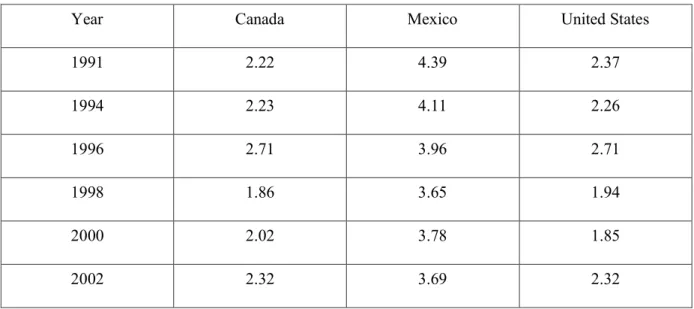
Faux (2003: 2) writes, “Funding for farm programs [in Mexico] dropped from $2 billion in 1994 to $500 million by 2000. Meanwhile, the U.S. Congress massively increased subsidies for corn, wheat, livestock, dairy products and other farm products exported to Mexico. American farmers now receive 7.5 to 12 times more in government help than Mexican farmers do”. Hufbauer and Schott (as cited in Alvarado, 2008) reveal that in the period between 1998 and 2000, the average subsidy from the U.S. government to an American farmer was $20,803 per year; Mexican farmers on average only received $740 from the various Mexican subsidy programs. Mexican farmers could not compete with their American and Canadian counterparts. The price for maize dropped dramatically. Table 1 compares maize prices for all three NAFTA countries, beginning in 1991.
Table 1 NAFTA Maize Prices per kilo
Year Canada Mexico United States
1991 2.22 4.39 2.37
1994 2.23 4.11 2.26
1996 2.71 3.96 2.71
1998 1.86 3.65 1.94
2000 2.02 3.78 1.85
21
2003 2.15 3.75 2.20
Change over time 0.07 (-3.15%) 0.64 (-14.58%) 0.17 (-7.17%)
Adapted from (Alvarado, 2008, pp. 80). Data are average prices in U.S. dollars.
The prices for Mexican corn in 1991 reflected the highly subsidized condition of the crop, yet as the years after NAFTA progressed a general downward trend in prices becomes evident. Out of the three competitors, Mexican maize lost the most value. From 1991 to 2003, Mexican maize producers lost an average of sixty-four cents, while Canadians only lost seven cents and American farmers seventeen cents (Alvarado, 2008). The trends in Canadian and American corn prices also show fluctuations and losses; however, overall the decrease in prices is minimal compared to those of their Mexican counterpart.
22
Source: Yunez-Naude & Paredes “Mexican Agriculture 10 Years After NAFTA Implementation”,
(2004).
The second factor affecting the efficiency of the subsidies is the speed of liberalization of the agricultural sector- Mexico did not utilize the full grace period for introducing American agricultural goods. Instead, Mexican officials allowed imports of corn over the allotted NAFTA quotas for every year beginning in 1994. This was due to the high demand from the livestock and starch industries. It was also thought that flooding the Mexican market with cheap American corn would help drive down domestic prices and combat inflation (Alvarado, 2008).
23
ingredient in tortillas (a fundamental component of the Mexican diet), increased dramatically.
David Bacon (2004) tracked the changes in basic foodstuffs in the northern Mexicali Valley, an area that experienced the dramatic shift in agricultural production from basic foods to seasonal vegetables and fruits as dictated by competitive advantage. Table 2 below illustrates the price changes from 1995 to 1997.
Table 2 Food Prices in Mexico
Product 1995 1997
Chicken (kilo) 4 10
Milk (gallon) 7 17.50
Beans (kilo) 3.50 9
Adapted from (Bacon, 2004, pp. 35). Prices are in Mexican Pesos.
Despite the price increases, wages for agricultural workers (the principal industry of the region) in Mexicali stagnated. In 1996, workers in the onion fields would receive an average wage of 50 Mexican pesos per day (6.87 U.S. Dollars in 1996) (Bacon, 2004). This meant that families’ wages would go mostly for food.
24
Under NAFTA, Mexico follows the food security trends dictated by the neoliberal free market. This means that countries are considered ‘secure’ if it has enough money to import its food (Carlsen, 2011). This goes hand in hand with the principal of competitive advantage because it allows Mexico to focus on the production of export crops. Lowering of the trade barriers in Mexico made the importation of food cheaper than to continue domestic production of major food staples; and the price difference serves as, “disincentives to
domestic food production and encouraging reliance on imported food”, (Gonzalez, 2002: 474). The reduction of the subsidies given by the Mexican government also helped in slowing domestic production by limiting the tools, such as research and technology, that helped improve the competitiveness of domestic production
Laura Carlsen (2011) outlines the dramatic increase on import dependence. She notes that before NAFTA, Mexico spent only $1.8 billion (U.S. dollars) on food importation, but in 2011, 17 years after implementation, Mexico imported a total of $24 billion worth of food (Carlesen 2011). Mexico is now the world’s number one importer of powdered milk, an indicator of infant malnutrition (2011). According to the Yunez-Naude & Paredes (2004), for the period between 1983 and1990, Mexico imported a total of 7,157.12 metric tons of basic crops (barley, beans, maize, sorghum, soybeans, and wheat). This number more than doubled to 16,184.92 metric tons for the 1994-2001 period, with maize, sorghum, soybeans, and wheat more than doubling their import numbers (Yunez-Naude & Paredes, 2004).
25
basic foodstuffs) has only continued to rise in the last decade. In 2008, eighteen million Mexicans lived in food poverty, this number increased by two million in 2010 sending the total number of Mexicans in food poverty to twenty million (2011). Carlsen (2011) also writes that in 2011, there were a reported 728,909 Mexican malnourished children under five years of age.
The Association Agreement between the European Union and Morocco
While Mexico and the United States were signing NAFTA, Morocco and the European Union began talks to implement their own free trade agreement in 1992 (Rutherford,
Rutström, & Tarr, 1997). The Agreement propelled by the French-Spanish EU presidency of 1995 was signed by Morocco in 1996. Given the conditions of Morocco’s industrial
capacities, the Association Agreement included monetary aid that would be earmarked for specific infrastructure projects and towards improving and expanding access to education (Löfgren, El-Said, & Robinson, 20001: 133). This aid package would be implemented during the first five years of the Agreement.
26
Morocco’s due to advantages in industrial/agricultural capabilities), and the gradual liberalization of Morocco (Frances & Corron, 2004: 70).
The liberalization directives included clauses that aimed at protecting Moroccan industries. Article 14 of the Association Agreement with the European Union (AAEU) allows Moroccan authorities to implement temporary measures aimed at protecting industries or firms that are undergoing restructuring. The measures would be put in place if the
difficulties facing these firms or sectors will “produce major social problems”. These special measures cannot be implemented for more than five years and import duties placed on
European products through these measures cannot exceed 25% ad valorem (European Union, 2000: 6).
The AAEU also calls for the abrogation of official state aid that distorts competition, with the exception of those sectors outlined in the European Steel and Coal Community agreement. The state subsidies were given a grace period of five years, after which the Moroccan government can petition for another five-year extension if necessary (2000: 10). Funds used for infrastructure and restructuring of industry are included within this category of state aid, allowing Morocco to enhance its competitiveness during the first years of the Agreement.
27
meaning that total removal of tariffs in this sector would be completed by the year 2003 (Frances & Corrons, 2004: 71).
Special protection was given to goods in Annex 4. These are goods produced in Morocco whose sectors would face intense competition in the open European market: wicker products, cosmetics, clothing, handcrafted goods, automobiles, and pharmaceuticals. A grace period of three years was allotted for Annex 4 goods, but beginning in 2003 tariffs were decreased by 10 percent per year (2004: 70-71). Tariffs for these goods were completely eliminated by 2012.
Similar to NAFTA, the AAEU includes directives allowing for the liquidation and repatriation of profits by foreign firms. Article 34 guarantees the free movement of capital and profits (2000: 10). Yet, the AAEU does not include the same clauses for the movement of workers. The Agreement includes language relating to Moroccan workers legally present and authorized to work in Europe, stating that these authorized workers will be afforded the same non-discriminatory treatment and benefits as European workers. Undocumented workers are specifically cast out of these protections.
The Agreement states that, “the provisions […] shall not apply to nationals of the Parties residing or working illegally in the territory of their host countries”, (2000: 16). For the case of NAFTA, there is no specific clause addressing the issue of an undocumented or irregular workforce. Instead, the United States and Mexico entered into a separate agreement aimed at dispelling the criticisms of NAFTA for lacking mechanisms for coping with the displacement of workers it had caused. The North American Agreement on Labor
28
The issue of undocumented immigration is the source of much tension between Europe and North Africa, much like it is between the United States and Mexico. The French-Spanish presidency gave strong impetus to the AAEU viewing it as a means to further
involve Morocco in the issue of clandestine immigration into Europe. Morocco’s geopolitical characteristics position it as both an important sender of immigrants and as a transition point in step-migration. Since the early 1990’s, Spain and Morocco have sought to cooperate on diminishing the undocumented immigration flows stemming from the North African country. The aid packages included within the AAEU were brokered through these negotiations and meant to entice Morocco into assisting the EU in “stopping illegal immigration”, (White, 2001: 29).
Despite the hopes of reducing undocumented immigration, the consequences of liberalization set the stage for increased migration from Morocco to Spain and to the rest of Europe. White (2001: 27) notes, “as Morocco begins to implement an Association Accord […] its economy will undergo sharp economic dislocations that will likely increase migration pressures to Spain”. Much like the supporters of NAFTA promised economic growth to Mexico, the EU had raised the hopes of economic prosperity for Moroccans. When the gains of the AAEU failed to materialize and instead helped fuel inequality, many Moroccans were placed on the path of survival migration.
The next section will outline the unintended effects of the Association Agreement. It will discuss how these effects contributed to the growth of inequality and poverty in
29
Privatization Wave
Morocco has been on the path towards liberalization since the early 1980’s. In 1983, Morocco began the implementation of structural adjustment measures dictated by the development loans from the IMF and World Bank. These measures included a series of privatizations and reduction of price controls (Davis, 2006). Along with these measures, the Moroccan government began a modernization program the mise à niveau. This program was meant to attract foreign investment by modernizing and revitalizing local Moroccan
industries (Marquez, 2000).
Further liberalization was pursued in the years before the signing of the AAEU. The first years of the 1990’s saw a progressive dismantling of Morocco’s tariff regime. By 1993, Morocco was poised to lower some tariffs to a maximum of 45% and revoking import-licensing requirements (Rutherford, et al, 1997).
30
Landownership patterns in Morocco vary greatly from those of Mexico. This is primarily due to Morocco’s monarchical regime and colonial legacy. The reinstatement of the monarchy in Morocco in 1956 served to concentrate the best agricultural lands in the hands of the royal family and elites. There are roughly 8.7 million hectares of cultivatable land in Morocco (Arango & Martin, 2005: 261). Yet, the majority of this land is under the ownership of the royal family, including much of the 1.2 million irrigated hectares. “These irrigated areas, said to be controlled by the king’s extended family in cooperation with foreign firms, provide 80 percent of Morocco’s citrus and wine grapes and 33 percent of its vegetables”, (2005: 261). Vegetables and fruits are major agricultural export goods for Morocco (Löfgren et al, 2001: 130). The unequal ownership of the best-irrigated lands leads to serious inequality in the access to markets and to the distribution of profits.
The royal family has used the liberalization process to acquire not only land, but also firms creating monopolies in different sectors. In 1990, Morocco passed the privatization law that mandated the opening of 40 percent of state-owned companies (Davis, 2006: 92).
Moroccan officials have embarked on a process of ‘selective privatization’, a process that has conveniently led to the acquisition of liberalized enterprises by the royal family. As Davis (2006: 92) notes, “the royal family’s holding company […] Omnium Nord Africain, a financial empire built up by the King Hassan II and one of the largest enterprises in Africa, has purchased many of the Moroccan companies privatized”.
Similar to the Mexican example, the largest involvement of foreign capital in
31
percent stake in Maroc Telecom, the Moroccan state-owned telecommunications company. The selling of the shares provided Morocco with a windfall of $2.2 billion (Denoeux, 2001: 75).
The revenue from these sales helped Morocco balance its budget for those fiscal years. However, these one-time sales could not be counted on to fill the budget gaps left from the removal of tariffs, which constituted an important source of government revenues.
Futhermore, FDIs for the later part of the 1990’s only averaged about $300-400 million per year (White, 2001: 28).
Also similar to the case of NAFTA and Mexico, the AAEU failed to deliver on the promises of job creation. Sources vary in their estimates of how many jobs the Moroccan economy has created in the late 1990’s; some analysts cite 200,000 (Denoeux, 2001: 69) while others put the estimate between 89,000-120,000 (Garcia, 2000: 217) jobs per year. Yet, these figures still fail to absorb the number of new entrants to the job market, which averaged 300,000 per year for that same period in the 1990’s (Denoeux, 2001: 69). Unemployment steadily rose from seventeen percent in 1997, to 18 percent in 1998, to twenty-three percent in 2001 (2001: 69). Youth aged 15-34 were especially affected constituting 83 percent of those unemployed (Garcia, 2000: 217).
32
Competitive Advantage and Food Security. Despite gaining access to the European Union’s markets, Morocco’s main exports (fruits and vegetables) faced intense competition. Much like the situation with Mexican maize, Moroccan fruits and vegetables faced many barriers resulting from unfair advantages to their European competitors.
Spain has similar climate regions to Morocco and produces similar agricultural goods, such as oranges, grapes, and tomatoes (White, 2001: 27). Spain and Italy are the EU’s largest producers of vegetables sharing 50% of the market. They also constitute two-thirds of all EU tomato production (European Commission, 2007: 41). Spain possesses over 25 million hectares of agricultural land of which 25% is arable (2007: 40). Over eleven percent of this land is utilized for permanent crops. In 2000, Spain cultivated 288 thousand hectares of citrus trees alone (2007: 50).
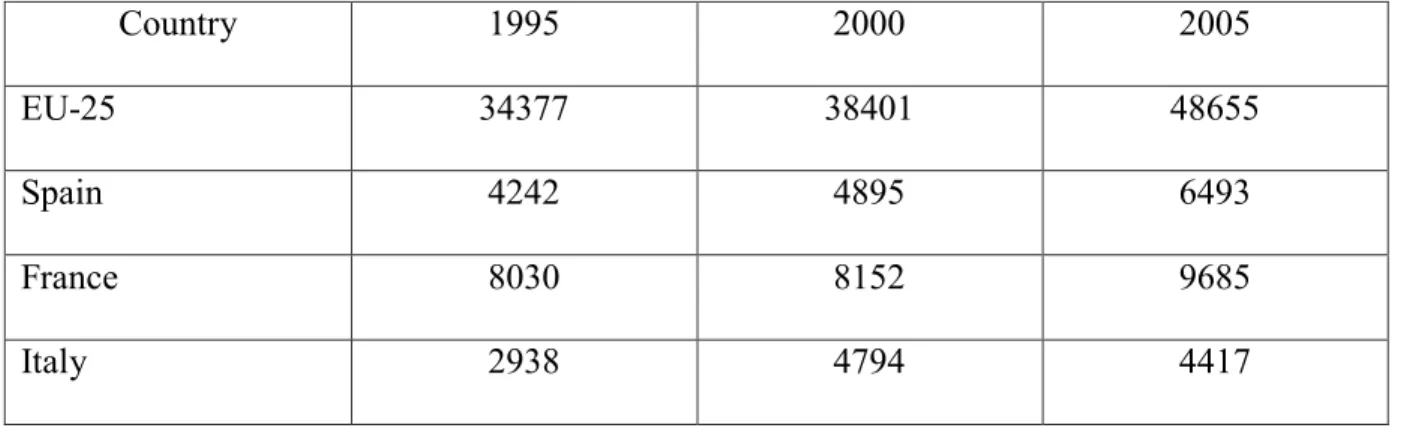
Despite Morocco having to remove its tariffs and subsidies for various goods, its EU competitors still benefit from agricultural subsidies. Table 3 summarizes the breakdown of subsidies for the chosen EU countries for the period between 1995 through 2005. The subsidy figures were chosen for Spain, France, and Italy due to their high competition rate with Moroccan agricultural products.
Table 3 EU Agricultural Subsidies, 1995-2005 (in millions of €)
Country 1995 2000 2005
EU-25 34377 38401 48655
Spain 4242 4895 6493
France 8030 8152 9685
33 Source: European Commission (2007: 28).
Survival migration from Mexico to the U.S. and from Morocco to Spain
The socioeconomic externalities of NAFTA and the AAEU can be classified as migration push factors. The mass dislocation of farmers along with the insufficient job growth greatly impacted the economic security of the Mexican and Moroccan populations. The stagnant wages and high unemployment and underemployment numbers coupled with rising food prices create unstable economic conditions. These factors aid the decision to migrate for many households (Massey, 1998).
Although Mexican immigration to the United States is a historical trend due to proximity and historical ties, immigration numbers have heavily increased since the
implementation of NAFTA. NAFTA required the liberalization and mobility of capital and resources; however, the movement of workers was not included in the requirements. As Massey (1998: 25) writes, “The consolidation of Mexican markets under NAFTA, in short, unleashed precisely the sort of social, political, and economic transformations that have served as engines of international migration elsewhere in the world”.
International migration, however, was not the first choice for many Mexican
34
During the 1980’s, immigration numbers averaged constantly at 170,000 border crossings per year (Flores-Macias, 2008). The years of reforms leading up to the
implementation of NAFTA saw a sharp increase in the number of Mexicans entering the United States; the period of 1990 through 1993 reached 330,000 people immigrating to the United States (2008). The number of Mexicans entering the United States jumped by 61% to 550,000 in the year 2000 and continued to grow to 500,000 for each consecutive year (2008). Undocumented immigration increased from 79% to 87% of total migration (2008).
Although not stated directly in the Agreement, it was hoped and unofficially touted that NAFTA would serve to decrease the flow of South to North migration. Alvarado (2008: 75) writes,“one of the hopes on both sides of the U.S.-Mexico border was that increasing economic integration with the U.S. through trade and investment linkages […] would aid in improving living standards and employment in Mexico, and thus reduce unauthorized immigration”. While trade and FDIs did serve to integrate the Mexican and American economies, the export-focused Mexican economy is now highly vulnerable to economic fluctuations in the U.S (as cited in Alvarado, 2008: 77) .
35
result of urbanization and refers to the material conditions in which rural migrants find themselves once in the cities. In contrast to ‘classical’ poverty, ‘modern’ poverty
encompasses many issues of exclusion that lead to poverty, such as exclusion from: the job and consumer markets, housing, and civil society (in terms of the vulnerability of this segment of the population to drugs, crime, and violence).
While ‘classical’ poverty has been constant since the colonial era in Morocco, the development of ‘modern’ poverty has gone hand in hand with the era of liberalization. Urbanization in Morocco began in earnest during the implementation of the structural adjustment schemes dictated by the IMF and World Bank in the 1980’s. Rural population by the early 1990’s constituted less than 50 percent of Morocco’s population, yet, 70 percent of the poor were found in rural areas (Löfgren et al, 2001: 131).
In 1991 the poverty rate in Morocco stood at 13.1 percent (Löfgren et al, 2001: 132). By 1999, the poverty rate had risen to 19 percent meaning that 5.31 million Moroccans survived on one dollar per day (Denoeux, 2001:70). The early 1990’s marked the beginning of a drastic decline in living standards for Moroccans. Davis (2006: 91) summarizes the changes, “about one-third of Moroccan territory suffers infant mortality rates of over 50% […] In rural areas, poverty is estimated to be 27%, and in some parts of the country it reaches 37%. Extreme poverty in rural areas tripled during the 1990’s and 45% of the entire
Moroccan population is now classified as vulnerable to poverty”.
36
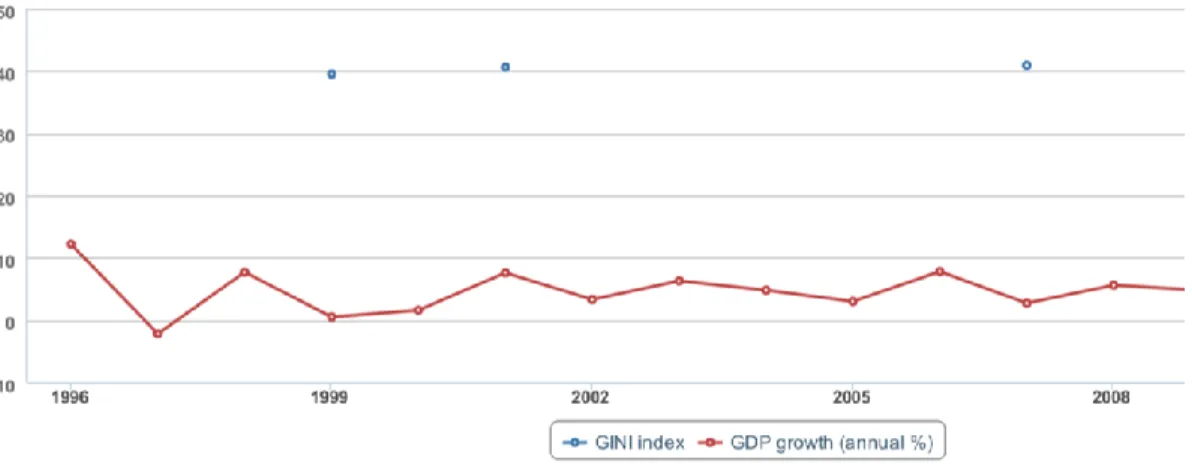
2011 (World Bank, 2013). Figure 2 illustrates the drastic decrease in GDP growth as well as the constant GINI Index for the years 1996-2008.
The GINI Index for Mexico has also not shown much improvement since the
implementation of NAFTA. In 1994, the GINI Index for Mexico stood at 51.9; six years later in 2000, it remained the same until drastically decreasing in 2004 to 46.1. However, by the end of 2008, it had once again risen to 48.3 (World Bank, 2013). GDP growth has also been stagnant since 1994. Figure 3 outlines the GDP growth rate and the GINI Index for Mexico for the period between 1994-2006. The lowest growth rates were registered in 2002 at 0.8% and in 2008 at 1.2% (2013).
The GINI Index measures the distribution of wealth in a country. The number 0 represents perfectly equal distribution of income and resources, while perfect inequality is represented as 100. Most countries in Western Europe have relatively low GINI Indexes. For example in the year 2000, Spain had a GINI Index of 34.7, Norway 25.8, Germany 28.3, and Sweden 25. For non-European countries, however, the GINI Indexes are higher denoting higher inequality. For the same year 2000, the GINI Index in Tunisia was at 40.8; for 2002 Brazil recorded a GINI Index of 59.4 and Honduras 58.9 (World Bank, 2013).
37
FIGURE 2: GINI Index and GDP Growth in Morocco, 1996-2008
Source: World Development Indicators
Figure 3: GINI Index and GDP Growth in Mexico, 1994-2006
Source: World Development Indicators
38
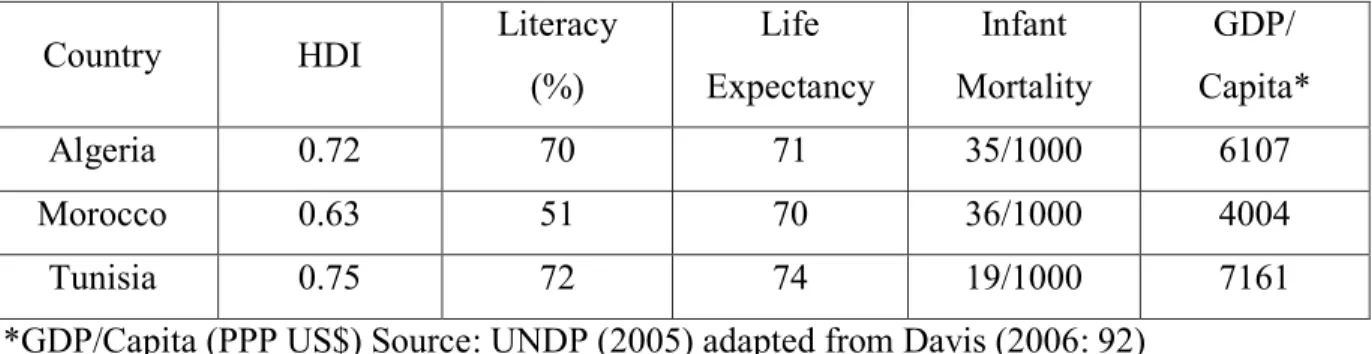
the rhetoric of effectiveness of FTAs in developing the socioeconomic realities of populations.
TABLE 4 Development Indicators for the Maghreb, 2003-2004
Country HDI Literacy
(%)
Life Expectancy
Infant Mortality
GDP/ Capita*
Algeria 0.72 70 71 35/1000 6107
Morocco 0.63 51 70 36/1000 4004
Tunisia 0.75 72 74 19/1000 7161
*GDP/Capita (PPP US$) Source: UNDP (2005) adapted from Davis (2006: 92)
The decline in standard of living affected emigration rates. Garcia (2000: 221) notes that by the year 2000, two million Moroccan nationals (8 percent of the population) were living abroad. While many Moroccans migrated to Belgium, France, and Italy, many more crossed the 8-mile Strait of Gibraltar into Spain.
A survey conducted in 1998 for the Moroccan newspaper Le Journal, found that 54 percent of those surveyed would “certainly” emigrate if they could, while 17 percent
answered that they would “probably” emigrate (Arango & Martin, 2005: 262). Spanish data for the 2000-2002 period went hand in hand with the survey results. Undocumented
39
Although the decision to migrate is influenced by complex motivations, economic insecurity plays a decisive role in the final decision. As was presented in the previous sections, the directives of NAFTA and the AAEU served to create a set of migration push factors that led to an increase in South to North migration. By failing to create the expected job growth, the FDIs facilitated by the FTA’s directives proved unable to absorb the
increasing urban populations. Meanwhile, food poverty and malnutrition became rampant. This dire situation must be factored into the complex motivations surrounding the decision to immigrate.
Did NAFTA and the AAEU create economic refugees?
In order to analyze whether NAFTA and the AAEU served as a engines of forced displacement of Mexicans and Moroccans after their implementation, it is necessary to transpose the effects of the FTA’s onto the definitions of economic refugees as presented in this paper.
First, both of the Agreements are general economic measures imposed on populations without discrimination. The implementation of NAFTA affected all Mexican citizens just as the AAEU affected all Moroccans, although, some groups of people were affected more than others in both countries. For example, Mexican farmers were undoubtedly impacted to a greater extent than any other part of the population in Mexico. The displacement of two million people due solely to an economic directive can be viewed as a humanitarian crisis. The internal movement of those two million farmers set-off a chain of events that
reverberated throughout Mexican society.
40
throughout Mexican urban areas and shantytowns began cropping up over night. Squatting and land invasions were not uncommon before the implementation of the NAFTA. However, before NAFTA, the Mexican government held ownership of all lands and could grant the legal title of the land to families after they had lived on the plot for a dictated amount of years (Bacon, 2004: 129). This helped those families gain access to water and electricity as well as to become part of the town their plots were adjoined to.
Another group greatly impacted by NAFTA are the indigenous populations of Mexico. On January 1st, 1994 the first day of the implementation of NAFTA an indigenous group from the Mexican state of Chiapas released a communiqué. In their statement, the Ejercito Zapatista de Liberación Nacional (EZLN) announced their armed struggle stating that their fight was for, “work, land, housing, food, health care, education, and
independence”, (as cited in Chomsky, 1999: 122). Although the struggle of the Zapatistas began in years previous to NAFTA, their uprising was triggered by the implementation of the Agreement. According to Chomsky (1999: 122), the Zapatistas saw NAFTA as a “death sentence for Indians, a gift to the rich that will deepen the divide between narrowly
41
Both groups were directly affected by the economic measures imposed by Mexican government.
Moroccan farmers suffered from similar conditions as their Mexican counterparts. The unfair competition in agricultural products and the monopolizing of the best lands in the hands of the royal family, led to many farmers abandoning their land for opportunities in the cities. There they encountered the same problems facing those caught in rural to urban migration patterns in Mexico- high unemployment, discrimination, and the tough decision to emigrate.
Figure 4 illustrates the trends in unemployment for the years 1996-2008. Youth unemployment has remained higher than that of the general population. It was especially high during 1998 when total unemployment reached 19.1 percent the youth unemployment rate hit a high of 35 percent. The trend slowly decreased for both the general population and for youth. In 2000, unemployment dropped considerably to 19.3 percent for youth and 13.6 percent in total. That same year, emigration by those with a tertiary education was estimated at 18.6 percent. By 2006, official unemployment stood at 9.7 percent, while youth
42
Figure 4: Unemployment in Morocco, 1996-2008
Source: World Development Indicators
Secondly, NAFTA directives have helped create a socioeconomic environment that denies basic rights to the Mexican populace. Existential threats to their subsistence
capabilities have been produced through implementation of the Agreement. The millions of displaced farmers and agricultural workers that rushed to the urban centers in northern Mexico were used as pools of surplus labor to drive down wages. American corporations developed ‘agro-business empires’ through out northern Mexico helping supply cheap food products for American consumers (Bacon, 2004: 126). Bacon (2004: 127) writes, “thousands of workers were brought […] from extremely poor indigenous communities in Oaxaca. Wages were kept low in order to make Baja’s strawberries and tomatoes cheaper in Los Angeles supermarkets. In 2000, the minimum wage was 37.4 pesos […] while a kilo of meat cost 38 pesos in the local market”. Wages have not been able to keep up with the
43
subsistence farming, however, the end of subsidies and the increasing food prices have contributed to a crisis in malnutrition.
The same has occurred in Morocco, where the main exports are now goods assembled from imported products. In 2000, 45 percent of all imported goods were re-exported as finished products (Frances & Corron, 2004: 75). The industries most affected by this practice are the textile and electronic industries, mirroring the maquiladora effect seen in Mexico (2004: 62).
Food importation has also signaled the rise of malnutrition in Morocco. Morocco now imports sugar, cereals, meat, and livestock feed (2004: 61). UNICEF (2010) reports that up to 43 percent of Moroccan children under five years of age suffered from malnutrition for the 2006-2010 period. Two percent of these children were severely underweight and twenty three percent suffered from moderate to severe stunting due to malnutrition (2010).
44
regions within Mexico; yet, NAFTA directives overruled the well being of tens of thousands of families in favor of corporate profits.
The liberalization of Mexican industries broke the deep connection between the Mexican nation-state and its citizens. Mexican society was structured as a corporatist, paternalistic state with all rights enumerated in the Constitution guaranteed by the
government (Speed, 2008: 42). “The Mexican Constitution of 1917 also established social rights based on premises of social justice and human dignity”, (2008: 44). However, the nature of neoliberalism requires that states limit their interventions in the economy by reducing social welfare and assistance programs (2008: 27).
The Mexican government was forced to break its corporatist bond to its citizens. This social and institutional restructuring helped lead to the deepening of social unrest and
rendered the government incapable of providing a domestic remedy to the unrest and the poverty running rampant through post-NAFTA Mexico. NAFTA eliminated state protections for Mexican citizens, yet it did not provide a social contract of its own (Faux, 2003). NAFTA on its own did not, however, create the poverty levels in Mexico, but it served to compound and accelerate the rates of impoverishment (Bacon, 2004:16). It also helped to deepen and widen the underlying sociopolitical issues bubbling within Mexican society.
45
Mexico, the United States, Morocco, and Spain have all signed onto the United Nations conventions outlining the basic human rights. Mexico signed the ICCPR and the ICESCR on March 23rd, 1981. The United States signed the ICCPR on June 8th, 1992 and the ICESCR on October 5th, 1977 (although the United States Congress never ratified this last Convention). Spain ratified both treaties on April 27th, 1977 followed by Morocco two years later on May 3rd, 1979 (United Nations General Assembly, 1979). Yet, none of the government have taken steps to uphold those treaties.
Instead, they have created and implemented free trade agreements that have resulted in the violation of the socioeconomic and political rights they swore to protect. The violation of these rights outlined by the United Nations and the definitions put forth by the proceeding Conventions helps to classify those Mexican immigrants affected by NAFTA and the
Moroccan immigrants affected by the AAEU as economic refugees. Not only are these immigrants escaping the violation of their basic human rights, they are also in many cases escaping persecution due to their activities defending these rights. Teachers, students, miners, farmers, and other sectors have led movements against NAFTA and AAEU measures.
46 CONCLUSION
The current school of thought governing our economic system proposes free trade as a means of development. However, as the case studies have shown, free trade can lead to unintended disruption of internal economies to the detriment of the native populations. Both cases studies demonstrate patterns of poverty and unemployment in the less developed trading partners i.e. Mexico and Morocco. Free trade agreements in both cases have compounded socioeconomic factors that play critical roles in creating survival migration.
The case studies presented would have benefited from more detailed information regarding the situation in Morocco. However, information on the socioeconomic conditions in Morocco is difficult to research given the political situation of the country (a monarchy that allows little freedom of expression) and the language barrier (most information is in Arabic or French). Comparing only two case studies for this analysis also limits the scope of the study.
47 References
Alvarado, E. (2008). Poverty and inequality in Mexico after NAFTA: Challenges, setbacks and implications. Estudios Fronterizos, 9 (17), pp. 73-105.
Aguirrebengoa, P.L. (2000). El Magreb y el Proceso Euromediterraneo: Una perspectiva Europea y Española. In Magreb: Percepcion Española de la estabilidad en el
Mediterraneo, prospectiva hacia el 2010 (pp. 236-266). Madrid: Instituto Español de Estudios Estrategicos.
Arango, J., & Martin, P. (2005). Best Practices to Manage Migration: Morocco-Spain. International Migration Review, 39 (1), pp. 258-269.
Bacon, D. (2004). The children of NAFTA: Labor wars on the U.S./Mexico border. Berkeley: University of California Press.
Bacon, D. (2008). Illegal people: How globalization creates migration and criminalizes immigrants. Boston: Beacon Press.
Betts, A. (2010). Survival migration: A new protection framework. Global Governance, 16, pp. 361-382.
Carlsen, L. (2011) NAFTA is starving Mexico. Foreign Policy in Focus. Inter-Hemispheric Resource Center Press.
Chomsky, N. (1999). Profit over people: Neoliberalism and global order. New York: Seven Stories Press.
Collyer, M., Cherti, M., Lacroix, T., & van Heelsum, A. (2009). Migration and
Development: The Euro-Moroccan experience. Journal of Ethnic and Migration Studies, 35 (10), pp. 1555-1570.
Davis, D. (2006). Neoliberalism, Environmentalism, and Agricultural Restructuring in Morocco. The Geographical Journal, 172 (2), pp. 88-105.
Denoeux, G.P., (2001). Morocco’s Economic Prospects: Daunting challenges Ahead. Middle East Policy, 8 (2), pp. 66-86.
European Commission. (2007). Agricultural Statistics: 1995-2005. (Eurostat Pocketbooks). Luxembourg: Office for Official Publications of the European Communities.
Retrieved from:
http://epp.eurostat.ec.europa.eu/cache/ITY_OFFPUB/KS-ED-07-001/EN/KS-ED-07-001-EN.PDF.
48
Farer, T. (1995). How the international system copes with involuntary migration: Norms, institutions and state practices. Human Rights Quarterly, 17, pp. 72-100.
Faux, J. (2003). NAFTA failed Mexico. The American Prospect. 14(7), pp. 35-37.
Flores-Macias, G. (2009). NAFTA’s unfulfilled immigration expectations. Journal of Social Justice, 20, pp. 435-41.
Foster, M. (2009). Non-refoulement on the basis of socio-economic deprivation: The scope of complementary protection in international human rights law. New Zealand Law Review, pp. 257-310.
Frances, G.E., & Corrons, A.L. (2004). La Politica Comercial de Marruecos: De la
liberizacion a a la modernizacion. Informacion Comercial Española, 819, pp. 59-81.
Garcia, B.L. (2000). Marruecos, Singularidad de Una Relacion Historica. El Marruecos de Mohamed VI. In Magreb: Percepcion Española de la estabilidad en el Mediterraneo, prospectiva hacia el 2010 (pp. 203-234). Madrid: Instituto Español de Estudios Estrategicos.
Garcia, J.R. (1980). Operation Wetback: The Mass Deportation of Mexican Undocumented Workers in 1954. Westport, CT: Greenwood Press.
Gonzalez, C. (2011). Institutionalizing Inequality: the WTO agreement on agriculture, food, security, and developing countries. Columbia Journal of Environmental Law, 27 (2), pp. 433-490.
Ghoshal, A., Crowley, T. (1983). Political versus economic refugees. Review of Social Economy, 41 (2), pp. 124-35.
Heredia, C. (2000). The Mexican economy: Six years into NAFTA. Presented at The Development GAP & the Economic Policy Institute. 21 January 2000. Washington, D.C.
Löfgren, H., El-Said, M., & Robinson, S. (2001). Trade Liberalisation and the Poor: A dynamic rural-urban general equilibrium analysis of Morocco. In Sébastien Dessus, Julia Devlin and Raed Safadi (Eds.). Towards Arab and Euro-Med regional
integration (pp. 129-146). Paris: OECD.
Marquez, J.M.M. (2000). El Desarollo Economico y Social del Magreb: Desafios y oportunidades. In Magreb: Percepcion Española de la estabilidad en el
Mediterraneo, prospectiva hacia el 2010 (pp. 68-103). Madrid: Instituto Español de Estudios Estrategicos.