Persistence and potential causes of reduced net CH4 consumption under elevated CO2 in a temperate forest
Lindsay Laura Dubbs
A dissertation submitted to the faculty of the University of North Carolina at Chapel Hill in partial fulfillment of the requirements for the degree of Doctor of Philosophy in the
Department of Environmental Sciences and Engineering.
Chapel Hill 2009
Approved by:
Stephen Whalen (Advisor) Emily Bernhardt
ii
2009
ABSTRACT
Lindsay Laura Dubbs: Persistence and potential causes of reduced net CH4 consumption under elevated CO2 in a temperate forest
(Under the direction of Stephen C. Whalen)
Impacts of the projected increase in atmospheric CO2 on other biogeochemical cycles are uncertain. In a two-year study, Phillips et al. (2001) reported a 16 to 30% decrease in net consumption of atmospheric CH4 by soils in CO2-enriched plots in a temperate loblolly pine (Pinus taeda) forest. Consumption by upland soils accounts for ~30 Tg CH4 y-1 and is the only terrestrial sink for atmospheric CH4, which is a greenhouse gas with radiative forcing second only to CO2. However, it is uncertain whether decreased atmospheric CH4
consumption represents a transient or sustained response of forest-soil systems to elevated CO2.
This research focused on field observations aimed at investigating the strength and persistence of reduced atmospheric CH4 consumption by temperate forest soils under elevated CO2 at the same study site. It further investigates the causes of this response by CH4 oxidizing and producing communities through field and laboratory experiments.
Rates of soil-atmosphere CH4 exchange were repeatedly measured over 3 y from permanently established sampling sites at the Free Air Carbon Dioxide (FACE) site in the Duke Forest, where CO2-enriched plots of a loblolly pine forest are maintained at
iv
This study and previous work give a nearly continuous 8 y record of reduced net
atmospheric CH4 consumption in CO2 -enriched plots that suggests this is likely a sustained negative feedback to increasing atmospheric CO2.
ACKNOWLEDGEMENTS
Steve Whalen has been my mentor for seven years now. I am very grateful for all that I have learned from him including, but not limited to, how to be an honest and dedicated scientist, caring teacher, and quiet leader; how to build and fix instruments and field
equipment myself; how to write more clearly and scientifically; and perhaps, most importantly, that I should lighten up a bit.
My dissertation committee has been incredibly helpful to the completion of my research and studies with their time and attention, pointed questioning, guidance, and kind words. Thank you to Drs. Emily Bernhardt, Rob Jackson, Frederic Pfaender, and Howard Weinberg.
Several other professors have also been great mentors to me during my graduate school years, especially Drs. Robert Wetzel, Donald Lauria, Joe von Fischer, and Ram Oren. I cannot thank them enough for their time, candid and interesting conversations, and
inspiration.
Lance Leonhardt, an amazing biology and environmental science teacher, first lit the fire in me and gave me every reason to keep following my curiosity. I thank him for his excitement that was truly contagious.
vi
Nettles, David Cooley, and Jeff Pippen made visits to the FACE site something to look forward to. I thank Ramon Garcia who was very generous with statistics guidance. Whalen lab group members (Eric Fischer, Jeff DeBerardinis, Priscilla Benson, Brian Chalfant, Marsha Fisher, Gina Panasik, Joelene Diehl, Ken Fortino, and Dendy Lofton) have been great colleagues and I thank them for their company and conversation. David Singleton was an incredibly patient and knowledgeable teacher of molecular biology, even though our method never did work. I also am very thankful for the dedicated staff of ESE that I have interacted with on a regular basis. Jack Whaley, Donna Simmons, Deborah Williams, Robin Whitley, Jim Wallace, Melody Levy, Ann Goodwin, Elise Pohl, Rebecca Riggsbee Lloyd, and Linda Brezin have made navigating graduate school much more enjoyable and easy. I thank Glenn Walters, Randy Goodman, Cliff Burgess, and Fred Bevin of the ESE design studio, who were there to answer any question about instruments, find any part, or build anything I needed.
My family and friends have been resilient and determined in their encouragement, interest, and support of my research and studies. I would especially like to thank my parents, Barry and Dawn Dubbs, my brother, Nate, and William Dodge for their patience and
constant flow of encouragement over the past few months.
TABLE OF CONTENTS
TABLE OF CONTENTS ... vii
LIST OF TABLES ... xi
LIST OF FIGURES ... xii
LIST OF ABBREVIATIONS AND SYMBOLS ... xiv
CHAPTER 1: INTRODUCTION ... 1
Elevated CO2 And Temperate Forests ... 1
Methane In The Pedosphere... 3
Observed Effects Of Elevated CO2 On CH4 Dynamics In Soils ... 6
Ecosystem-Level Changes That May Influence CH4 Dynamics In Temperate Forests ... 7
Research Objectives ... 9
Dissertation Structure... 10
References ... 12
CHAPTER 2: REDUCED NET CH4 CONSUMPTION IS A SUSTAINED RESPONSE TO ELEVATED CO2 IN A TEMPERATE FOREST ... 20
Abstract ... 20
viii
Field Site ... 23
Gas Flux Measurements ... 24
Soil Physicochemical Measurements ... 25
Calculations And Statistics ... 26
Results ... 27
Environmental Variables ... 27
Patterns In Net CH4 Flux ... 27
Discussion ... 29
Overall Patterns Of Net CH4 Consumption And Environmental Correlates ... 29
Differences In Net CH4 Consumption Between CO2 Treatments ... 31
Potential Reasons For Reduced Net CH4 Consumption Under Elevated CO2 ... 33
References ... 37
CHAPTER 3: INHIBITION OF CH4 CONSUMPTION BY SECONDARY CARBON COMPOUNDS IN THE TISSUES AND EXUDATES OF TEMPERATE FOREST PLANTS EXPOSED TO ELEVATED CO2 ... 48
Abstract ... 48
Introduction ... 49
Methods... 51
Field Site ... 51
Plant Exudate Collection ... 52
Soil Assays And Incubation ... 54
Statistical Analysis ... 55
Throughfall And Leaf Leachates ... 55
Duff Leachates ... 56
Organic Acids From Root Exudates ... 56
Discussion ... 57
References ... 62
CHAPTER 4: REDUCED NET CH4 CONSUMPTION CAUSED BY CHANGES IN THE SOURCES AND TRANSPORT OF SOIL GASES IN A TEMPERATE FOREST EXPOSED TO ELEVATED CO2 ... 74
Abstract ... 74
Introduction ... 75
Methods... 77
Field Site ... 77
Soil Gas Sampling ... 78
Soil Cores ... 79
Methane Sample Measurements ... 80
Diffusivity ... 80
Environmental Measurements ... 81
Calculations And Statistical Analysis ... 81
Results ... 83
Depth Profiles Of CH4 Concentrations... 83
Depth Profiles Of Net CH4 Consumption And CH4 Production ... 83
Effective Diffusivity ... 84
Discussion ... 85
x
CHAPTER 5: CONCLUSION ... 100
LIST OF TABLES
Table
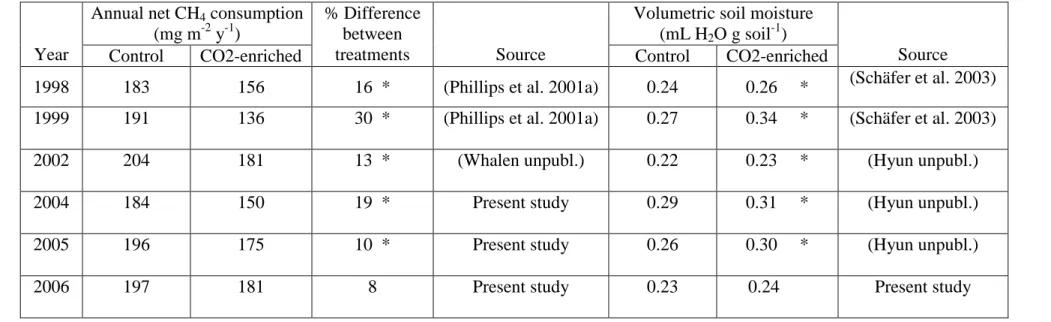
2.1. Annual time-integrated rates of net CH4 consumption and volumetric soil moisture………43
4.1. Effective diffusivity (PCH4) and corresponding calculated net CH4 flux (JCH4; µg m-2 h-1), measured net CH4 flux (µg m-2 h-1), and soil moisture in control
xii
LIST OF FIGURES
Figure
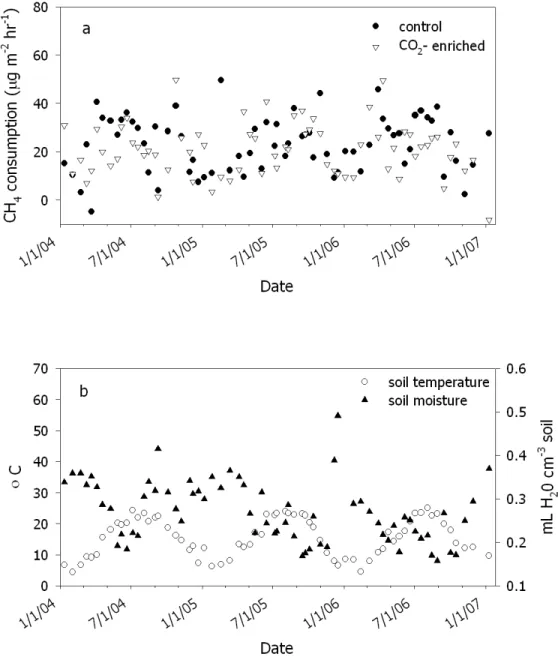
2.1. Time series for rates of net atmospheric CH4 consumption by forest soils under CO2-enriched and ambient atmospheres and time series for changes in mean soil and mean volumetric soil moisture………..44
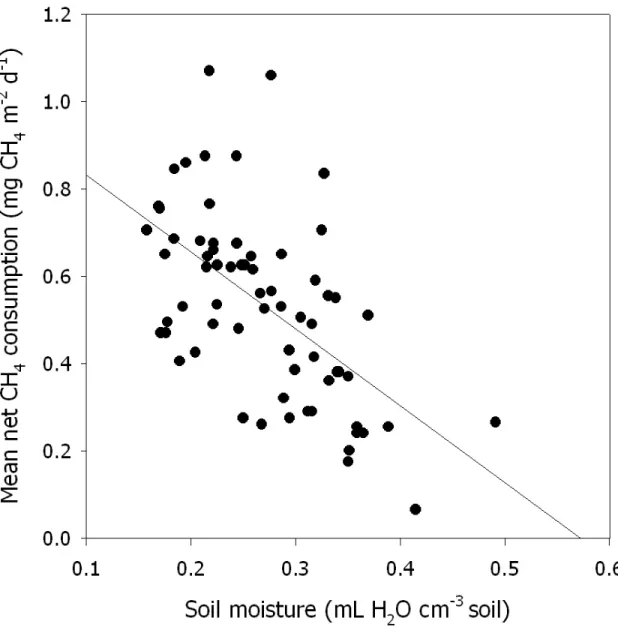
2.2. Relationship between net atmospheric CH4 consumption and volumetric soil moisture………45
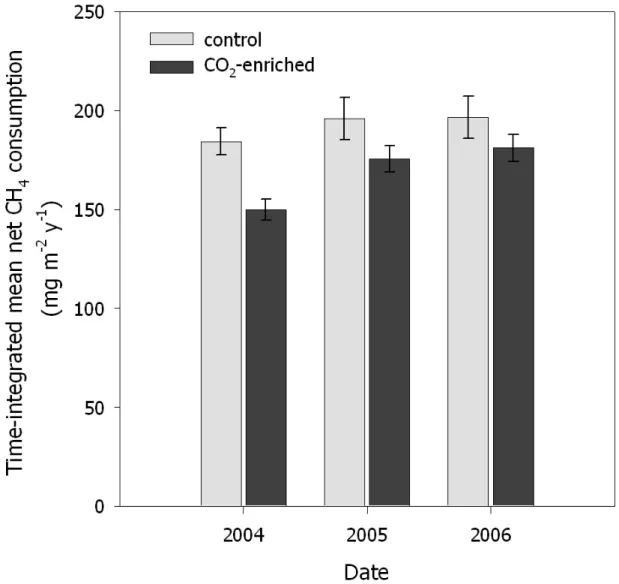
2.3. Annual time-integrated net CH4 consumption by temperate forest soils under ambient and elevated concentrations of CO2 for 2004 through 2006………..46
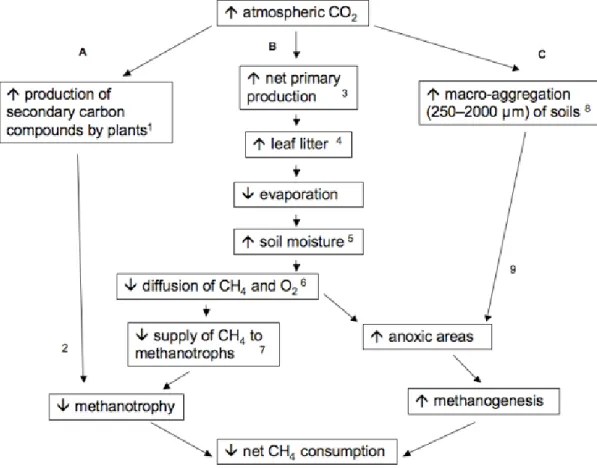
2.4. Conceptual model of the impact of forest ecosystem responses to elevated CO2 that influence soil CH4 cycling dynamics……….………...47
3.1. Conceptual model of the impact of forest ecosystem responses to elevated CO2 that influence soil CH4 cycling dynamics………67
3.2. Mean first order rate constants (k; d-1) for CH4 consumption in temperate forest soils amended with deionized water or throughfall from CO2-enriched or control plots……….68
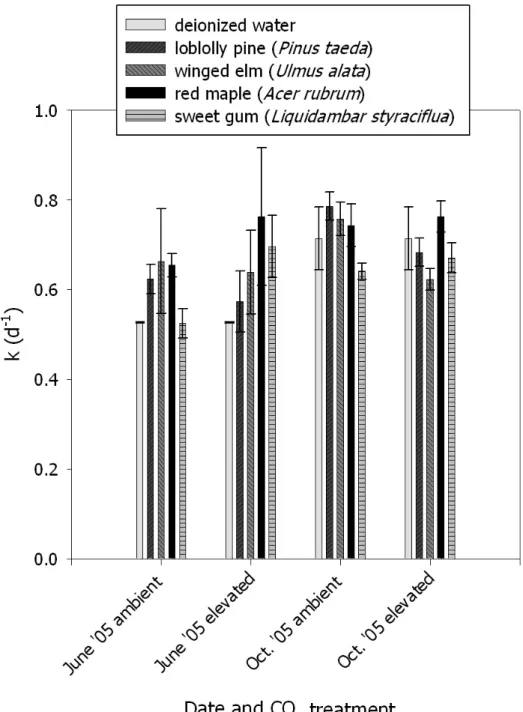
3.3. Mean first order rate constants (k; d-1) for CH4 consumption by temperate forest soils amended with leaf leachate from the four most dominant trees within the control and CO2-enriched plots………...69
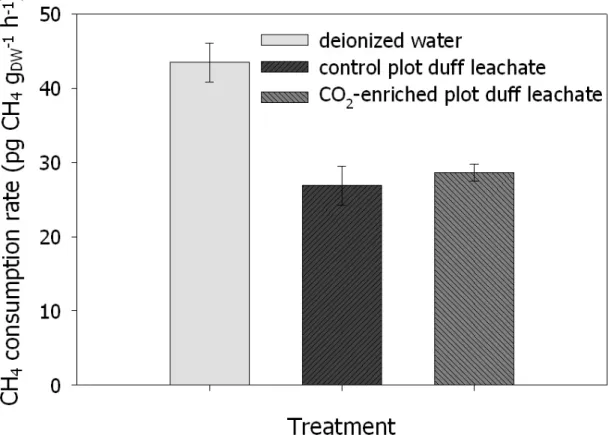
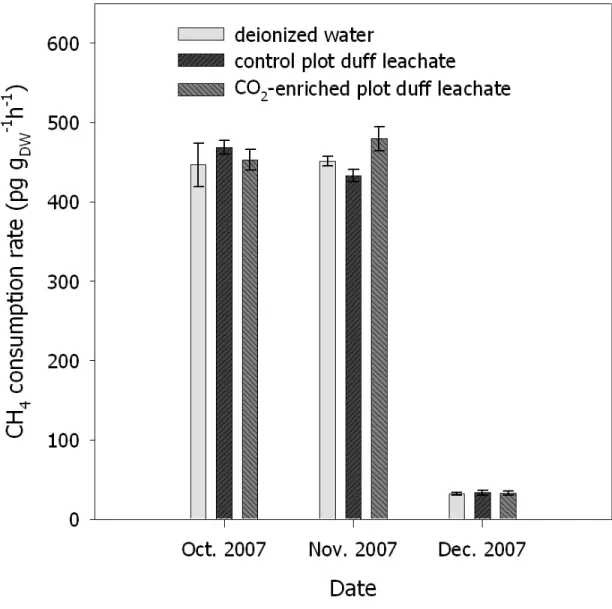
3.4. Rates of CH4 consumption by forest soils amended with deionized water or duff leachates from CO2-enriched or control plots………..70
3.5. Rates of CH4 consumption by forest soils amended with duff leachates or deionized water………....71
3.7. Rates of CH4 consumption by forest soils amended with deionized water or levulinic acid, an organic acid determined to be a primary root exudate from loblolly pine (Pinus taeda) trees grown under elevated CO2………..73
4.1. Conceptual model of the impact of forest ecosystem responses to elevated CO2 that influence soil CH4 cycling dynamics………96
4.2. Composite depth profiles of CH4 in soils in forest plots exposed to elevated CO2 or the ambient atmosphere (control) ………...97
4.3. Mean rates of net CH4 consumption in forest soils from plots exposed to elevated CO2 or the ambient atmosphere (control) ……….98
xiv
LIST OF ABBREVIATIONS AND SYMBOLS
FACE free air CO2 enrichment
k rate constant
α p-value acceptance threshold
D0,CH4 diffusion coefficients of CH4 D0,Rn diffusion coefficients of Rn PRn permeability of Rn
JCH4 flux of CH4
CHAPTER 1: INTRODUCTION
Elevated CO2 and temperate forests
The present-day atmospheric CO2 concentration of approximately 380 mL L-1
(NOAA 2008), exceeds the highest concentration measured in ice core samples from before the Industrial Revolution by almost 100 mL L-1 (Barnola et al. 2003). The atmospheric concentration of CO2 is expected to continue to increase, mainly as a result of fossil fuel emissions and destruction of vegetation (Forster et al. 2007). Models project that atmospheric CO2 concentrations, by the end of the present century, will exceed the pre-industrial concentration by up to 270% (Friedlingstein et al. 2006). A rising atmospheric CO2 concentration is of concern because it is a long-lived greenhouse gas with a radiative forcing of 1.66 W m-2, exceeding the radiative forcing of all other trace atmospheric gases that control climate (Forster et al. 2007). Increasing atmospheric CO2 is also of significance because it is continuously exchanged between the atmosphere, the ocean, and the terrestrial biosphere through biogenic processes such as photosynthesis and respiration (Schlesinger 1997). Rates of photosynthesis and respiration are further controlled by temperature and water availability, and changes in the concentrations of CO2 and other greenhouse gases are expected to elicit changes in air temperature and the hydrologic cycle that may vary
2
are less clear. An understanding of ecosystem responses at all levels to elevated CO2 is important to predicting future climates as they can, in turn, feed back to the biogeochemical cycling of CO2 and other greenhouse gases.
Attempts at understanding terrestrial biological and biogeochemical responses to elevated CO2 have ranged in size and complexity from individual potted plants, to open-top chambers containing a community of plants, to large scale manipulations of intact
ecosystems designed to embrace the entire suite of interactions and feedbacks among plants, microbial communities and elemental cycles. Each of these approaches has associated strengths and weaknesses. Physiological studies conducted in small and simple modeled ecosystems have been ineffective at capturing the complexity of ecosystem component interactions and feedbacks. On the other end of the spectrum, free-air CO2 exchange (FACE) technology has been employed to conduct ecosystem-level studies where tall vegetation and their surrounding ecosystems are exposed to elevated CO2 with minimal alterations of surrounding microenvironments (Hendrey et al. 1999b). The primary criticism of FACE experiments is that they are initiated by exposing an ecosystem to an abrupt increase in atmospheric CO2, which may not fully represent how ecosystem components will react to the contemporary monotonic increase in the concentration of CO2 in the Earth’s atmosphere (Klironomos et al. 2005).
C to roots, the forest floor and soils with a small increase in soil C storage (Allen et al. 2000, Matamala and Schlesinger 2000, Schlesinger and Lichter 2001, Jastrow et al. 2005, Lichter et al. 2005, Lichter et al. 2008, Pritchard et al. 2008, Hoosbeek and Scarascia-Mugnozza 2009), increased soil respiration (King et al. 2004, Bernhardt et al. 2006, Taneva et al. 2006), and variable changes in N cycling (Billings and Ziegler 2005, DeLucia 2005, Finzi et al. 2006a) and soil community composition (Larson et al. 2002, Billings and Ziegler 2005, Billings and Ziegler 2008). The initial increase in net primary production in response to elevated CO2 is predicted to slow with time as ecosystems become more N-limited (Finzi et al. 2006b), although N-limitation has yet to appear in temperate forests after 6 y of CO2-enrichment using FACE technology (Finzi et al. 2006a).
However, observations (McMurtrie and Comins 1996) and ecosystem models (Newton et al. 2001) indicate that biological responses to elevated CO2 and biogeochemical feedbacks vary widely on different timescales. For instance, down-regulation of
photosynthesis has been commonly reported for CO2-fertilized model and intact forest ecosystems after as little as two years (reviewed by Amthor 1995, Leakey et al. 2009). Over longer time trajectories, initial response functions of all ecosystem components from trees to microbes can be expected to adjust physiologically and demographically on different time scales through modification of biogeochemical feedbacks (Korner 2000). Thus short-and long-term responses to elevated atmospheric CO2 must be distinguished.
Methane in the pedosphere
4
reduced hydrocarbon, and a long-lived (9 to 15 y) greenhouse gas directly and indirectly contributing more than half of the radiative forcing of CO2 (0.9 and 1.6 W m-2, respectively; Schindell et al. 2005), through warming of the troposphere and its participation in the stratospheric chemistry of ozone and water vapor formation (Wuebbles and Hayhoe 2002). The global atmospheric CH4 concentration has more than doubled since the Industrial Revolution to reach a present-day average concentration of ~1780 µL L-1 (NOAA 2008). Methane is spatially and temporally variable in the troposphere, with a higher concentration in the Northern Hemisphere where emissions are higher, and a minima corresponding to increased photochemical destruction during summer months.
While destruction by the hydroxyl radical in the atmosphere is the largest sink for CH4, the only known biological sink for CH4, and the largest natural source of CH4 are sited in the pedosphere. The balance between rates of CH4 production (methanogenesis) and CH4 consumption (methanotrophy) determines whether a soil is a net source or sink for
atmospheric CH4, and the strength of that source/sink. Methane production usually exceeds consumption in wetland environments, accounting for about 69% of emissions to the
concentrations (< 12 mL L-1), such as in upland soils, and ‘low affinity oxidation’, which occurs at CH4 concentrations > 40 mL L-1, such as in the oxic zone of wetlands (Le Mer and Roger 2001). Known controls on CH4 consumption by low affinity methanotrophs are water table position, which dictates the size of the oxic zone necessary for methanotrophy, pH, and temperature (reviewed by Whalen 2005). Demonstrated controls on atmospheric CH4
consumption by high affinity methanotrophs in upland soils include temperature (Crill 1991, Castro et al. 1995, Phillips et al. 2001a, Steinkamp et al. 2001), soils nitrogen (Schnell and King 1994, 1995), and rate of supply of CH4 to the subsurface aerobic zone of oxidation (King and Adamsen 1992, Dörr et al. 1993, King 1997).
6
occurring in some well-drained upland soils. Waterlogged aggregates support localized zones of methanogenesis and oxic sites support methanotrophy.
Observed effects of elevated CO2 on CH4 dynamics in soils
Experiments examining the effect of elevated CO2 on net CH4 emissions from wetland soils unequivocally indicate that CH4 emissions increase when wetland plants, plant communities, or ecosystems are grown under elevated CO2. Increases in CH4 emissions from wetland soils ranged from 10.9% in a pot study of a rice cultivars grown under CO2 at 200 mL L-1 above ambient concentrations (Lou et al. 2008) to 60% when rice fields were exposed to elevated CO2 (300 mL L-1 above ambient) in open-top chambers (Ziska et al. 1998). The increase in net CH4 emissions was markedly similar to the range (38 to 58%) seen in a Japanese rice paddy exposed to elevated CO2 via FACE technology (Inubushi et al. 2003).
Investigations of soil-atmosphere CH4 exchange in CO2-enriched ecosystems that normally function as atmospheric CH4 sinks are few and show mixed results. Ambus and Robertson (1999) reported a 22% reduction in CH4 consumption by soils in model Populus tremuloides (deciduous forest) ecosystem exposed to elevated CO2, while Phillips et al. (2001a) showed annual reductions in CH4 consumption of 16% and 30% in CO2 fumigated plots (200 mL L-1) relative to plots exposed ambient atmospheres in a 2 y study in a
CH4 consumption. Further, Mosier et al. (2002) saw no impact of CO2 level on rates of CH4 exchange between soils and the atmosphere in a semi-arid, mixed grassland community.
If the observed CO2-induced increases in net CH4 emissions are extrapolated to the global scale, the wetland (natural and agricultural environments) source strength in the atmospheric CH4 budget will increase by 29 and 160 Tg annually with a 200 to 300 mL L-1 increase in atmospheric CO2 concentration (Chen and Prinn 2005). At the same time, models suggest that the annual forest sink of 24 Tg y-1 for CH4 (Ridgwell et al. 1999) can be
expected to decline from between 3.8 to 7.2 Tg as atmospheric CO2 concentrations increase by 200 mL L-1. However, more empirical data are needed before we can rely on these predictions of changes in CH4 source and sink terms with increasing atmospheric CO2. The few extant observational records of < 2 y in forest ecosystems and < 3 y in wetlands are insufficient to distinguish between transient and equilibrium responses of forest and wetland ecosystems to elevated CO2 and the impact of those responses on CH4 cycling.
Ecosystem-level changes that may influence CH4 dynamics in temperate forests
Several CO2-induced changes in temperate forest ecosystems may help to explain the observed decline in net CH4 consumption under elevated CO2. Changes in plant productivity, chemistry, and allocation of C under elevated CO2 impacts the quantity and quality of C in the ecosystem, and the supply and availability of C to soil organisms. Some C compounds, such as phenolics, tannins and terpenes inhibit metabolism and growth by some soil
8
Lichter et al. 2008) and increased root productivity and mortality (Pritchard et al. 2008). Enhanced root exudation of organic acids has been observed in a pot study of Pinus echinata seedlings (Norby et al. 1987), while greater litter fall in both FACE and microcosm studies (Allen et al. 2000, Lichter et al. 2005, Lichter et al. 2008, Liu et al. 2009) has been reported under elevated CO2. Further, several researchers have seen changes in the abundance of secondary C compounds in tissues and root exudates between plants grown under elevated and ambient CO2 (Peñuelas and Estiarte 1998, Verburg et al. 1999, Tuchman et al. 2002, Billings and Ziegler 2005, Wetzel and Tuchman 2005a). Secondary C compounds, such as phenolics and terpenes, inhibit metabolism and growth by broad groups of soil bacteria (Souto et al. 2000), and specifically, methanotrophs (Amaral and Knowles 1997, 1998).
Reduced net CH4 consumption under elevated CO2 in temperate forests may also be the result of higher soil moisture and the associated reduction in diffusion of atmospheric gases. Reduced gas diffusivity has been demonstrated (Dörr et al. 1993) to control rates of CH4 supply to the usual subsurface locus of CH4 oxidation (e.g. Whalen and Reeburgh 1992), which is itself substrate-limited in well-drained forest soils, based on kinetic
consumption in forest soils by as much as 43% (Dong et al. 1998, Brumme and Borken 1999).
Finally, reduced diffusion of atmospheric O2, because of thicker leaf litter and higher soil moisture, along with higher soil respiration (Bernhardt et al. 2006, Taneva et al. 2006), and increased soil aggregation (Hoosbeek and Scarascia-Mugnozza 2009) under elevated CO2 may increase the incidence of anoxic microsites where anaerobic microbial metabolism, such as methanogenesis, is possible. Since net CH4 consumption in upland soils is the net effect of CH4 consumption in the oxic soil profiles and CH4 production in anoxic microsites, increased incidence of anoxic loci can alter this balance, reducing rates of net CH4
consumption or shifting localized areas to net CH4 sources. Horn and Smucker (2005) found when soil aggregates were saturated with water, the redox potential decreased rapidly, making these soil aggregates transiently anoxic within an otherwise oxic profile.
Research objectives
This is a follow-up study to previous research reported by Phillips et al. (2001a), who saw 16 and 30% annual reductions in rates of net CH4 consumption by soils in a temperate forest enriched with elevated CO2. The cause(s) of the decline in rates of net CH4
10
organic compounds from the surrounding forest ecosystem on CH4 oxidizing communities, higher soil moisture and an associated reduction in the supply of CH4 to the zone of CH4 oxidation, or a shift in the rates of consumption and production by CH4 oxidizing and producing communities, respectively.
Model projections of future climates are strongly dependent on atmospheric
concentrations of radiatively and chemically important trace gases, such as CH4. Therefore, my intention is for this research to be used to improve model projections of future climates, with special attention to the feedbacks of elevated CO2 on ecosystem components that control CH4 dynamics within forest soils.
Dissertation structure
This dissertation has been written as 5 chapters. Chapters 2 through 4 were written with the intention of submitting each chapter as individual manuscripts. Chapters 1 and 5 introduce and conclude, respectively, the body of work. Chapter 2 shows an extension of the previous 2 y record of soil-atmosphere exchange of CH4 in CO2-enriched and free-air
12 References
Allen, A. S., J. A. Andrews, A. C. Finzi, R. Matamala, D. D. Richter, and W. H. Schlesinger. 2000. Effects of free-air CO2 enrichement (FACE) on belowground processes in a Pinus taeda forest. Ecological Applications 10:437-448.
Amaral, J. A. and R. Knowles. 1997. Inhibition of methane consumption in forest soils and pure cultures of methanotrophs by aqueous forest soil extracts. Soil Biology and Biochemistry 29:1713-1720.
Amaral, J. A. and R. Knowles. 1998. Inhibition of methane consumption in forest soils by monoterpines. Journal of Chemical Ecology 24:723-734.
Ambus, P. and G. P. Robertson. 1999. Fluxes of CH4 and N2O in aspen stands grown under ambient and twice-ambient CO2. Plant and Soil 209:1-8.
Amthor, J. S. 1995. Terrestrial higher-plant response to increasing atmospheric CO2 in relation to the global carbon cycle. Global Change Biology 1:243-274.
Baggs, E. M. and H. Blum. 2004. CH4 oxidation and emissions of CH4 and N2O from Lolium perenne swards under elevated atmospheric CO2. Soil Biology and Biochemistry 36:713-723.
Barnola, J.-M., D. Raynaud, C. Lorius, and N. I. Barkov. 2003. Historical Carbon Dioxide Record from the Vostok Ice Core.in O. R. N. L. Carbon Dioxide Information Analysis Center, Department of Energy, editor. Trends: A Compendium of Data on Global Change, Oak Ridge, Tenn., U.S.A.
Bernhardt, E., J. Barber, J. Pippen, L. Taneva, J. Andrews, and W. Schlesinger. 2006. Long-term effects of free air CO2 enrichment (FACE) on soil respiration. Biogeochemistry 77:91-116.
Billings, S. A. and S. E. Ziegler. 2005. Linking microbial activity and soil organic matter transformations in forest soils under elevated CO2. Global Change Biology 11:203-212.
Billings, S. A. and S. E. Ziegler. 2008. Altered patterns of soil carbon substrate usage and heterotrophic respiration in a pine forest with elevated CO2 and N fertilization. Global Change Biology 14:1025-1036.
Brumme, R. and W. Borken. 1999. Site variation in methane oxidation as affected by atmospheric deposition and type of temperate forest ecosystem. Global Biogeochemical Cycles 13:493-501.
Castro, M. S., P. A. Steudler, J. M. Melillo, J. D. Aber, and R. D. Bowden. 1995. Factors controlling atmospheric methane consumption by temperate forest soils. Global Biogeochemical Cycles 9:1-10.
Chen, Y.-H. and R. G. Prinn. 2005. Atmospheric modeling of high- and low-frequency methane observations: Importance of interannually varying transport. Journal of Geophysical Research 110: D10303.
Conrad, R. 1996. Soil microorganisms as controllers of atmospheric trace gases (H2, CO, CH4, OCS, N2O, and NO). Microbiological Reviews 60:609-640.
Crill, P. M. 1991. Seasonal patterns of methane uptake and carbon dioxide release be a temperate woodland soil. Global Biogeochemical Cycles 5:319-334.
DeLucia, E. H., J. G. Hamilton, S. L. Naidu, R. B. Thomas, J. A. Andrews, A. Finzi, M. Lavine, R. Matamala, J. E. Mohan, G. R. Hendrey, and W. H. Schlesinger. 1999. Net primary production of a forest ecosystem with experimental CO2 enrichment. Science 284:1177-1179.
DeLucia, E. H., D. J. Moore, and R. J. Norby. 2005. Contrasting responses of forest ecosystems to rising atmospheric CO2: Implications for the global C cycle. Global Biogeochemical Cycles 19: GB3006.
Denman, K. L., G. Brasseur, A. Chidthaisong, P. Ciais, P. Cox, R. E. Dickinson, D.
Hauglustaine, C. Heinze, E. Holland, D. Jacob, D. Lohmann, S. Ramachandran, P. L. da Silva Dias, S. C. Wofsy, and X. Zhang. 2007. Couplings Beteen Changes in the Climate System and Biogeochemistry.in S. Solomon, D. Qin, M. Manning, J. Chen, and M. Marquis, editors. Climate Change 2007: The Physical Sciences Basis. Contributions of the Working Group I to the Fourth Assessment Report of the Intergovernmental Panel on Climate Change. Cambridge University Press, Cambridge, United Kingdom and New York, NY, USA.
Dong, Y., D. Scharffe, J. M. Lobert, P. J. Crutzen, and E. Sanhueza. 1998. Fluxes of CO2, CH4, and N2O from a temperate forest soil: the effects of leaves and humus layers. Tellus 50B:243-252.
Dörr, H., L. Katruff, and I. Levin. 1993. Soil texture parameterization of the methane uptake in aerated soils. Chemosphere 26:697-713.
14
Finzi, A. C., D. J. P. Moore, E. H. DeLucia, J. Lichter, K. S. Hofmockel, R. B. Jackson, H.-S. Kim, R. Matamala, H. R. McCarthy, R. Oren, J. S. Pippen, and W. H. Schlesinger. 2006a. Progressive nitrogen limitation of ecosystem processes under elevated CO2 in a warm-temperate forest Ecology 87:15-25.
Finzi, A. C., R. L. Sinsabaugh, T. M. Long, and M. P. Osgood. 2006b. Microbial community responses to atmospheric carbon dioxide enrichment in a warm-tempeate forest. Ecosystems 9:215-226.
Forster, P., V. Ramaswamy, P. Artaxo, T. Berntsen, R. Betts, D. W. Fahey, J. Haywood, J. Lean, D. C. Lowe, G. Myhre, J. R. Nganga, R. Prinn, G. Raga, M. Schulz, and R. Van Dorland. 2007. Changes in Atmospheric Constituents and in Radiative Forcing.in S. Solomon, D. Qin, M. Manning, J. Chen, M. Marquis, K. B. Averyt, M. Tignor, and A. J. Miller, editors. Climate Change 2007: The Physical Sciences Basis. Contribution of the Working Group I to the Fourth Assessment Report of the Intergovernmental Panel on Climate Change. Cambridge University Press, Cambridge, United Kingdom and New York, NY, USA.
Friedlingstein, P., P. Cox, R. Betts, L. Bopp, W. von Bloh, V. Brovkin, P. Cadule, S. Doney, M. Eby, I. Fung, G. Bala, J. John, C. Jones, F. Joos, T. Kato, M. Kawamiya, W. Knorr, K. Lindsay, H. D. Matthews, and T. Raddatz. 2006. Climate- Carbon Cycle Feedback Analysis: Results from the C4MIP Model Intercomparison. Journal of Climate 19:3337-3353.
Hamilton, J., E. DeLucia, K. George, S. Naidu, A. Finzi, and W. Schlesinger. 2002. Forest carbon balance under elevated CO2. Oecologia 131:250-260.
Hanson, R. S. and T. E. Hanson. 1996. Methanotrophic bacteria. Microbiological Reviews 60:439-471.
Hendrey, G. R., D. S. Ellsworth, K. F. Lewin, and J. Nagy. 1999. A free-air enrichment system for exposing tall forest vegetation to elevated atmospheric CO2. Global Change Biology 5:293-309.
Hoosbeek, M. and G. Scarascia-Mugnozza. 2009. Increased litter build up and soil organic matter stabilization in a poplar plantation after 6 years of atmospheric CO2
enrichment (FACE): final results of POP-EuroFACE compared to other forest FACE experiments. Ecosystems 12:220-239.
Horn, R. and A. Smucker. 2005. Structure formation and its consequences for gas and water transport in unsaturated arable and forest soils. Soil and Tillage Research 82:5-14. Ineson, P., P. A. Coward, and U. A. Hartwig. 1998. Soil gas fluxes of N2O, CH4 and CO2
Inubushi, K., W. Cheng, S. Aonuma, M. M. Hoque, K. Kobayashi, S. Miura, H. Y. Kim, and M. Okada. 2003. Effects of free-air CO2 enrichment (FACE) on CH4 emission from a rice paddy field. Global Change Biology 9:1458-1464.
Jastrow, J. D., R. M. Miller, R. Matamala, R. J. Norby, T. W. Boutton, C. W. Rice, and C. E. Owensby. 2005. Elevated atmospheric carbon dioxide increase soil carbon. Global Change Biology 11:2057-2064.
King, G. M. 1997. Responses of atmospheric methane consumption by soils to global climate change. Global Change Biology 3:351-362.
King, G. M. and A. P. S. Adamsen. 1992. Effects of temperature on methane consumption in a forest soil and in pure cultures of the methanotroph Methylomonas rubra. Applied Environmental Microbiology 58:2758-2763.
King, J. S., P. J. Hanson, E. Bernhardt, P. Deangeliss, R. J. Norby, and K. Pregitzer. 2004. A multiyear synthesis of soil respiration responses to elevated armospheric CO2 from four forest FACE experiments. Global Change Biology 10:1027-1042.
Klironomos, J. N., M. F. Allen, M. C. Rillig, J. Piotrowski, S. Makvandi-Nejad, B. E. Wolfe, and J. R. Powell. 2005. Abrupt rise in atmospheric CO2 overestimates community response in a model plant-soil system. Nature 433:621-624.
Korner, C. 2000. Biosphere responses to CO2 enrichment. Ecological Applications 10:1590-1619.
Larson, J., D. R. Zak, and R. L. Sinsabaugh. 2002. Extracellular enzyme activity and metabolism of root-derived substrates beneath temperate trees growing under elevated CO2 and O3. Soil Science Society of America Journal 66:1848-1856.
Le Mer, J. and P. Roger. 2001. Production, oxidation, emission and consumption of methane by soils: A review. European Journal of Soil Biology 37:25-50.
Leakey, A. D. B., E. A. Ainsworth, C. J. Bernacchi, A. Rogers, S. P. Long, and D. R. Ort. 2009. Elevated CO2 effects on plant carbon, nitrogen, and water relations: six important lessons from FACE. Journal of Experimental Botany:erp096.
Lichter, J., S. H. Barron, C. E. Bevacqua, A. C. Finzi, K. F. Irving, E. M. Stemmler, and W. Schlesinger. 2005. Soil carbon sequestration and trunover in a pine forest after six years of atmospheric CO2 enrichement. Ecology 86:1835-1847.
16
Lichter, J., M. Lavine, K. A. Mace, D. D. Richter, and W. H. Schlesinger. 2000. Throughfall chemistry in a loblolly pine plantation under elevated atmospheric CO2
concentrations. Biogeochemistry 50:73-93.
Liu, L., J. S. King, F. L. Booker, C. P. Giardina, H. L. Allen, and S. Hu. 2009. Enhanced litter input rather than changes in litter chemistry drive soil carbon and nitrogen cycles under elevated CO2: a microcosm study. Global Change Biology 15:441-453. Lou, Y., K. Inubushi, T. Mizuno, T. Hasegawa, Y. Lin, H. Sakai, W. Cheng, and K.
Kobayashi. 2008. CH4 emission with differences in atmospheric CO2 enrichment and rice cultivars in a Japanese paddy soil. Global Change Biology 14:2678-2687.
Matamala, R. and W. H. Schlesinger. 2000. Effects of elevated atmospheric CO2 on fine root production and activity in an intact temperate forest ecosystem. Global Change Biology 6:967-979.
McMurtrie, R. E. and H. N. Comins. 1996. The temporal response of forest ecosystems to doubled atmospheric CO2 concentration. Global Change Biology 2:49-57.
Mosier, A. R., J. A. Morgan, J. Y. King, D. LeCain, and D. G. Milchunas. 2002. Soil-atmosphere exchange of CH4, CO2, NOx, and N2O in the Colorado shortgrass steppe under elevated CO2. Plant and Soil 240:201-211.
Newton, P. C. D., H. Clark, G. R. Edwards, and D. J. Ross. 2001. Experimental confirmation of ecosystem model predictions comparing transient and equilibrium plant responses to elevated atmospheric CO2. Ecology Letters 4:344-347.
NOAA. 2008. Carbon dioxide, methane rise sharply. Page
http://www.noaanews.noaa.gov/stories2008/20080423_methane.html. NOAA News. Norby, R. J., E. H. DeLucia, B. Gielen, C. Calfapietra, C. P. Giardina, J. S. King, J. Ledford,
H. R. McCarthy, D. J. P. Moore, R. Ceulemans, P. De Angelis, A. C. Finzi, D. F. Karnosky, M. E. Kubiske, M. Lukac, K. S. Pregitzer, G. E. Scarascia-Mugnozza, W. H. Schlesinger, and R. Oren. 2005. Forest response to elevated CO2 is conserved across a broad range of productivity. Proceedings of the National Academy of Sciences of the United States of America 102:18052-18056.
Norby, R. J., E. G. O'Neill, W. G. Hood, and R. J. Luxmoore. 1987. Carbon allocation, root exudation, and mycorrhizal colonization of Pinus echinata seedlings grown under CO2 enrichment. Tree Physiology 3:203-210.
Phillips, R. L., S. C. Whalen, and W. H. Schlesinger. 2001. Influence of atmospheric CO2 enrichment on methane consumption in a temperature forest soil. Global Change Biology 7:557-563.
Pritchard, S. G., A. E. Strand, M. L. McCormack, M. A. Davis, A. C. Finzi, R. B. Jackson, R. Matamala, H. H. Rogers, and R. Oren. 2008. Fine root dynamics in a loblolly pine forest are influenced by free-air-CO2-enrichment: a six-year-minirhizotron study. Global Change Biology 14:588-602.
Ramakrishnan, B., T. Lueders, R. Conrad, and M. Friedrich. 2000. Effect of soil aggregate size on methanogenesis and archaeal community structure in anoxic rice field soil. Fems Microbiology Ecology 32:261-270.
Ridgwell, A. J., S. J. Marshall, and K. Gregson. 1999. Consumption of atmospheric methane by soils: a process-based model. Global Biogeochemical Cycles 13: 59-70.
Saari, A., P. J. Martikainen, A. Ferm, J. Ruuskanen, W. De Boer, S. R. Troelstra, and H. J. Laanbroek. 1997. Methane oxidation in soil profiles of Dutch and Finnish coniferous forests with different soil texture and atmospheric nitrogen deposition. Soil Biology and Biochemistry 29:1625-1632.
Schindell, D. T., G. Faluvegi, N. Bell, and G. A. Schmidt. 2005. An emission-based view of climate forcing by methane and tropospheric ozone. Geophysical Research Letters 32: LO4803.
Schlesinger, W. H. 1997. Biogeochemistry: An Analysis of Global Change. 2nd edition. Academic Press, San Diego,CA.
Schlesinger, W. H. and J. Lichter. 2001. Limited carbon storage in soil and litter of experimental forest plots under increased atmospheric CO2. Nature 411:466-469. Schnell, S. and G. M. King. 1994. Mechanistic analysis of ammonium inhibition of
atmopsheric methane consumption in forest soils. Applied Environmental Microbiology 60:3514-3521.
Schnell, S. and G. M. King. 1995. Stability of methane oxidation capacity to variations in methane and nutrient concentrations. FEMS Microbiology Ecology 18:285-294. Sexstone, A. J., N. P. Revsbech, T. B. Parkin, and J. M. Tiedje. 1985. Direct measurement of
oxygen profiles and denitrification rates in soil aggregates. Soil Science Society of America Journal 49:645-651.
18
Souto, X. C., G. Chiapusio, and F. Pellissier. 2000. Relationships between phenolics and soil microorganisms in spruce forests: significance for naterual regeneration. Journal of Chemical Ecology 26:2025-2034.
Steinkamp, R., K. Butterbach-Bahl, and H. Papen. 2001. Methane oxiation by soils of an N limited and N fertilized spruce forest in the Black Forest, Germany. Soil Biology and Biochemistry 33:145-153.
Striegl, R. G. 1993. Diffusional limits to the consumption of atmospheric methane by soils. Chemosphere 26:715-720.
Suwa, M., G. G. Katul, R. Oren, J. Andrews, J. Pippen, A. Mace, and W. H. Schlesinger. 2004. Impact of elevated atmospheric CO2 on forest floor respiration in a temperate pine forest. Global Biogeochemical Cycles 18: GB2013.
Taneva, L., J. S. Pippen, W. H. Schlesinger, and M. A. Gonzalez-Meler. 2006. The turnover of carbon pools contributing to soil CO2 and soil respiration in a temperate forest exposed to elevated CO2 concentration. Global Change Biology 12:983-994. Teh, Y. A., W. L. Silver, and R. Conrad. 2005. Oxygen effects on methane production and
oxidation in humid tropical forest soils. Global Change Biology 11:1283-1297. Tuchman, N. C., R. G. Wetzel, S. T. Rier, K. A. Wahtera, and J. A. Teeri. 2002. Elevated
atmospheric CO2 lowers leaf litter nutritional quality for stream ecosystem food webs. Global Change Biology 8:163-170.
Verburg, P. S. J., W. K. P. Van Loon, and A. Lükewille. 1999. The CLIMEX soil-heating experiment: soil response after 2 years of treatment. Biology and Fertility of Soils 28:271-276.
von Fischer, J. C. and L. O. Hedin. 2002. Separating methane production and consumption with a field-based isotope pool dilution technique. Global Biogeochemical Cycles 16: 1034.
Wetzel, R. G. and N. C. Tuchman. 2005. Effects of atmospheric CO2 enrichment and sunlight on degradation of plant particulate and dissolved organic matter and microbial utilization. Archiv für Hydrobiologie 162:287-308.
Whalen, S. C. 2005. Biogeochemistry of Methane Exchange between Natural Wetlands and the Atmosphere. Environmental Engineering Science 22:73-94.
Whalen, S. C. and W. S. Reeburgh. 1996. Moisture and temperature sensitivity of CH4 oxidation in boreal soils. Soil Biology and Biochemistry 28:1271-1281.
Wuebbles, D. J. and K. Hayhoe. 2002. Atmospheric methane and global change. Earth-Science Reviews 57:177-210.
Yavitt, J. B., T. J. Fahey, and J. A. Simmons. 1995. Methane and carbon dioxide dynamics in a northern hardwood ecosystem. Soil Science Society of America Journal 59:796-804.
Zausig, J., W. Stepniewski, and R. Horn. 1993. Oxygen concentration and redox potential gradients in unsaturated model soil aggregates. Soil Science Society of America Journal 57:908-916.
Ziska, L. H., T. B. Moya, R. Wassmann, O. S. Namuco, R. S. Lantin, J. B. Aduna, A. Abao Jr., K. F. Bronson, H. U. Neue, and D. Olszyk. 1998. Long-term growth at elevated carbon dioxide stimulates methane emission in tropical paddy rice. Global Change Biology 4:657-66.
CHAPTER 2: REDUCED NET CH4 CONSUMPTION IS A SUSTAINED
RESPONSE TO ELEVATED CO2 IN A TEMPERATE FOREST
Abstract
resulting in reduced rates of net atmospheric CH4 consumption. Our study extends previous observations of reduced net atmospheric CH4 consumption at CO2-enriched plots at this site to nearly 8 continuous years, suggesting that this is likely a sustained negative feedback to increasing atmospheric CO2.
Introduction
The atmospheric concentration of CH4 has more than doubled since the Industrial Revolution to a present-day value of ~1782 µL L-1 (Forster et al. 2007). This
generalized increase is of concern because CH4 is second only to CO2 among trace atmospheric constituents with respect to radiative forcing and is also chemically active in the atmosphere, playing an important role in stratospheric and tropospheric ozone
chemistry (Denman et al. 2007).
The atmospheric concentration of CO2 has increased parallel to that of CH4, and is projected to reach 730 mL L-1 by 2100, a level that exceeds the preindustrial
concentration by 260% (Forster et al. 2007). Although the unprecedented rate of change in the atmospheric concentrations of CO2 and CH4 over the last 250 y and the influences on climate are well documented, the reasons for changing abundances are not entirely clear. Model projections of future climate are strongly dependent on atmospheric
22
understanding of the linkage between biogeochemical processes and the troposphere with respect to trace atmospheric constituents that influence climate, and further identification of the interactions between biogeochemical cycles that impact exchange of trace gases between soil or water and the atmosphere.
The balance between rates of CH4 production (methanogenesis) and consumption (methanotrophy) determines whether a soil is a net source or sink for atmospheric CH4. Methane production usually exceeds consumption in wetland environments, accounting for about 69% of emissions to the atmosphere from natural sources (Wuebbles and
Hayhoe 2002). In contrast, well-drained soils generally display net consumption of CH4, and constitute the only biological loss term in the atmospheric CH4 budget. Little is understood about the effect of elevated CO2 on biogeochemical processes affecting CH4 cycling dynamics. However, Phillips et al. (2001a) previously showed, in a short term (2 y) study, annual reductions in CH4 consumption of 16% and 30% in CO2-fumigated plots relative to plots exposed to ambient atmospheres in an upland temperate forest. Similar investigations on shorter time scales (weeks to 2 mo) report reduced atmospheric CH4 consumption under elevated CO2 in a deciduous forest (Ambus and Robertson 1999), and give mixed results for a grassland (Ineson et al. 1998, Baggs and Blum 2004), although results in these studies include nitrogen x CO2 fertilization interactions. In contrast, Mosier et al. (2002) reported no CO2-induced response in atmospheric CH4 consumption in a shortgrass steppe over 4 y.
al. 2007). The few extant observational records of < 2 y, however, are insufficient to distinguish between transient and equilibrium responses of forest ecosystems to elevated CO2 or to determine whether the observed response will be sustained. Ecosystem models indicate that plant/community responses to elevated CO2 and biogeochemical feedbacks can change over time (Newton et al. 2001). It is therefore critical to identify the long-term trajectory of the sign and magnitude of change.
Our study was conducted in an aggrading temperate forest where experimental plots had been continuously fumigated with CO2. Our objectives were to: (a) extend a previous 2 y record of soil-atmosphere exchange of CH4 in CO2-enriched and free-air (control) plots (Phillips et al. 2001a) to establish the long term response of atmospheric CH4 consumption under elevated CO2; and (b) relate environmental measures (soil moisture and temperature) to rates of gas exchange to determine if treatment-wise differences or interactions in these well known controls on soil methanotrophy may account for reduced atmospheric CH4 consumption in CO2 enriched plots. A firmer understanding of the feedback between increasing atmospheric CO2 and the rates and controls on CH4 oxidation in forest soils will aid in the refinement of process-based models that contribute to larger efforts directed at predicting future climates.
Methods
Field site
24
Series (Oh and Richter 2005). Average normal air temperature ranges from 3.6 ° C in January to 25.3 ° C in July and annual precipitation averages 1209 mm (State Climate Office of North State Climate Office of North Carolina 2003-2009). Soil physical
characteristics are similar between CO2 treatment plots, with the exception of soil organic matter, which averaged 4.6% in CO2-enriched plots, and only 3.4% in control plots. Averages for all control and elevated CO2 plots (0 to 20 cm depth zone) for soil particle density, bulk density, and pH were 2.5 g cm-3, 1.2 g cm-3, and 5.7 units, respectively. Soil texture was 9% clay, 42% silt, and 49% sand.
Site characteristics are fully documented in Hendrey et al. (1999a) and briefly described here. The experiment consists of eight circular 30-m diameter plots. Four treatment plots (referred to as “CO2-enriched”) are fumigated with CO2 to maintain atmospheric CO2 concentrations 200 mL L-1 above ambient levels, while three additional treatment plots are fumigated with ambient air to replicate micrometeorological effects associated with CO2 addition. A fourth is subjected to ambient air without fumigation. The latter four plots are referred to as “controls”. Continuous (24 h d-1) fumigation was initiated in August 1996, but was reduced to daylight hours only from 2003 to present.
Gas Flux Measurements
diameter x 11 cm height) permanently deployed in three plots of each treatment at the conception (1999) of our initial investigation remained intact and were revisited for this study. Collars of similar design were deployed in each quadrant of two additional plots (one plot, each treatment) in 2006. Polyvinyl chloride covers fitted with a sampling port and capillary bleed were emplaced on soil collars for CH4 flux determinations.
Headspace samples were withdrawn into 10 mL gastight glass syringes at zero time and at 0.5 h intervals thereafter to 2 h. Collars were open to litterfall and rainfall between sampling sessions.
Gas samples were analyzed for CH4 by flame ionization detection gas
chromatography (Shimadzu model GC 8 A; precision expressed as the coefficient of variation for 10 replicate injections of a 0.94 mL CH4 L-1 standard was < 3%) within 10 h of collection, well within our predetermined holding time of 24 h. Sample separation was accomplished on a 1-m length x 0.32 cm diameter molecular sieve 5A column with an ultrahigh purity N2 carrier gas (33 mL min-1). Injector and detector temperatures were set at 90 oC and 140 oC.
Soil Physicochemical Measurements
26
dataloggers. In conjunction with CH4 flux determinations, soil temperature was
measured at 3 cm intervals from 1 cm to 19 cm depth with a multithermistor temperature probe.
Calculations and statistics
Area-based rates of net CH4 consumption were calculated from chamber geometry and the time-linear change of CH4 concentration in chamber headspaces. Annual rates of net CH4 consumption were determined by integrating for the calendar year daily, area-based data from each sampling occasion. Average soil temperature was calculated as the mean of equally spaced observations taken to 19 cm.
We analyzed for differences in CH4 flux between CO2 treatments with the same statistical model used in a previous study (Phillips et al. 2001a). The mixed effects linear model considered CO2 treatment as the main effect, with soil moisture, temperature and time (continuous) as covariates. The model was a nested, hierarchical design with plot nested inside CO2 and quadrant nested within plot. Unequal sampling intervals required the use of a time-series covariance structure, where correlations decline as a function of time. Only significant interactions remained in the model. The same model with a different nesting structure was used to analyze overall net CH4 flux and environmental variables, in which quadrant was nested within plot and CO2 was simply an effect.
Results
Environmental variables
Air temperatures averaged 15 °C or 16 °C annually for each calendar year. Soil
temperatures ranged from 4 °C to 25 °C (Fig. 2.1), closely tracking air temperatures (not
shown) and showed an average of 16 °C for the entire study. Overall, soil moisture
varied from 0.16 to 0.49 mL H2O cm-3 soil, and averaged 0.27 mL H2O cm-3 soil. Calendar year means for CO2-enriched plots were consistently higher than means for control plots (Table 2.1). Differences between treatment means for soil moisture were significant in 2004 and 2005, but not 2006. Over the entire study (n = 68), the average soil moisture for the CO2-enriched treatment (0.28 mL H2O cm-3 soil) was significantly higher than for the control treatment (0.26 mL H2O cm-3 soil).
Patterns in net CH4 flux
Net CH4 consumption (flux from the atmosphere to the soil) was generally found at all individual soil chambers and was always calculated for each plot if fluxes from all four quadrants were averaged. However, net CH4 production (flux from the soil to the atmosphere) was also observed, from 17 individual quadrants on 16 separate dates, giving 22 observations of net CH4 production in 880 total records. Net CH4 production was found almost twice as often in CO2-enriched chambers as in control chambers (14 versus 8 observations). Rates of net CH4 production from individual chambers varied from 0.01 mg m-2 d-1 to 0.08 mg m-2 d-1 while rates of net CH4 consumption from individual
Chamber-28
showed consistently high or low values. Although there was no clear seasonal pattern, rates of net CH4 consumption were frequently higher in the summer than the winter months (Fig. 2.1).
There was a strong inverse relationship between soil moisture and plot-averaged rates of net CH4 consumption (Fig. 2.2). At the chamber level, the mixed-effects model used to test the factors contributing to overall net CH4 fluxes showed that soil moisture was significantly related to net CH4 flux in 2006, when soil moisture probes were installed proximal to chamber collars, but not in 2004 and 2005 when probes were randomly located within quadrants. Overall, net CH4 consumption decreased with
increasing soil moisture. The model showed no relationship between soil temperature and net CH4 flux.
Differences in net CH4 consumption between CO2 treatments
When the entire data were considered (880 observations; each treatment), the mean net rate of CH4 consumption in control chambers was 7.5% higher than in CO2-enriched chambers, 0.55 (± 0.03 SEM) versus 0.51 (± 0.03) mg m-2 d-1. The difference was significant. The disparity in net CH4 consumption rates between treatments showed interannual variability. Mean rates for controls in 2004, 2005 and 2006 were 0.53 (± 0.06), 0.54 (± 0.06) and 0.56 (± 0.05) mg CH4 m-2 d-1. These values were higher by 10, 4 and 9% than corresponding annual averages for CO2-enriched chambers. There was no seasonal pattern in the relative difference in net CH4 consumption rates between
The mixed-effects model used to test the factors contributing to the variability in net CH4 consumption between treatments indicated that CO2 significantly interacted with soil moisture. Soils from CO2-enriched plots consumed less CH4 than soils from control plots, and the difference between CO2 treatments increased with increasing soil moisture. Soil temperature had no effect.
The time-integrated rates of net CH4 consumption in control plots were 184, 196 and 197 mg m-2 y-1 in 2004, 2005, and 2006 (Fig. 2.3). Comparable values for CO2 -enriched plots were lower by 19, 10, and 8% at 150, 175 and 181 mg m-2 y-1. Differences between treatments were significant in 2004 and 2005 and nearly significant in 2006 (p=0.10).
Discussion
Overall patterns of net CH4 consumption and environmental correlates
30
day rate estimates of net CH4 consumption, these annual values are at the low end of estimates for North American temperate forests, which largely fall between 320 and 2560 mg m-2 y-1, but have a strong New England bias (Smith et al. 2000b). Gas diffusivity has been demonstrated (Dörr et al. 1993) to control rates of CH4 supply to the usual
subsurface locus of CH4 oxidation (e.g. Whalen et al. 1992), which is itself substrate-limited in well-drained forest soils, based on kinetic considerations (Bradford et al. 2001). Soil texture influences diffusivity (Ball et al. 1997), with clay soils showing net CH4 consumption rates an order of magnitude lower than sandy soils (Dörr et al. 1993). It is likely that the fine texture of soil at our study site limits transport of atmospheric CH4 down-profile, resulting in comparatively low area-based rated of net CH4 consumption.
the observations of the influence of low temperatures on CH4 consumption southward. The average net CH4 consumption rate of 0.39 mg CH4 m-2 d-1 for the 12 of 68 sampling dates at soil temperatures < 10 oC was lower by 32% than the mean of 0.58 mg CH4 m-2 d-1 at higher temperatures. Differences in the strength of the temperature-CH4 flux relationship at low temperatures between the past (Phillips et al. 2001a) and present investigations may have accounted for the disparity in the observed relationship between these variables when the entire data from each study were considered.
In contrast to temperature, we observed a strong (inverse) linear relationship between net CH4 consumption and soil moisture (Fig. 2.2), which explained 34% of the variability in the entire data, and proved significant in the mixed-effects model for the 2006 data when moisture probes were sited in proximity to soil collars. This confirms previous observations of reduced net CH4 consumption with increasing soil moisture at this site (Phillips et al. 2001a, McLain et al. 2002) and is consistent with other in situ seasonal studies in forest soils. However, our site is apparently less sensitive than many others to changes in soil moisture, as this factor explained 59 to 88% of the variability in net CH4 consumption across a range of forest ecosystem types (Castro et al. 1994, Lessard et al. 1994, Steinkamp et al. 2001, Butterbach-Bahl and Papen 2002, Price et al. 2004).
Differences in net CH4 consumption between CO2 treatments
32
compelling evidence for a temporal decline in the magnitude of the reduction in net CH4 consumption in CO2-enriched plots compared with controls when our entire data are considered (Table 1). Investigations of soil-atmosphere CH4 exchange in CO2-enriched ecosystems that normally function as an atmospheric CH4 sink are few. In the most directly comparable study to our own, Ambus and Robertson (1999) reported a 22% reduction in CH4 consumption by soils in model Populus tremuloides ecosystems
exposed to elevated CO2. Ineson et al. (1998) observed that rates of net atmospheric CH4 uptake were three times greater in ambient CO2 soils relative to CO2-enriched plots in an N-fertilized sward of Lolium perenne. However, a subsequent investigation (Baggs and Blum 2004) found a significant interaction between N fertilizer application rate and CO2 on net atmospheric CH4 consumption. Mosier et al. (2002) saw no impact of CO2 level on rates of CH4 exchange between soils and the atmosphere in a semi-arid, mixed grassland community.
This study adds to previous efforts (Phillips et al. 2001a, Whalen unpublished) to uniquely provide a nearly continuous 8 y record of reduced atmospheric CH4
CO2 fumigation and initial sampling (Phillips et al. 2001a), consistently lower annualized rates of net CH4 consumption in soils from CO2-enriched plots relative to controls, and lack of strong evidence that the magnitude of the CO2 enrichment effect has declined with time all suggest that reduced net atmospheric CH4 consumption is a sustained, equilibrium response of this forest soil to elevated CO2.
Potential reasons for reduced net CH4 consumption under elevated CO2
Although reduced net atmospheric CH4 consumption is likely a sustained negative feedback by soil to CO2-enrichment at our study site, causative factors are difficult to identify, as the destructive sampling necessary for process-level investigations is limited to maintain ecosystem integrity. However, the significant moisture x treatment
interaction in our mixed effects model indicates that site-wise differences in net CH4 consumption are at least in part moisture-related. Several demonstrated effects of CO2 -enrichment on above- and below-ground processes within forest ecosystems feed back on soil moisture and by extension soil CH4 cycling dynamics (Fig. 2.4).
34
moisture conservation (Schäfer et al. 2003). The direct link between increased soil moisture and diffusion-limitation to CH4 oxidizers is well established (Striegl 1993, Castro et al. 1995, Whalen and Reeburgh 1996). Persistently higher moisture content and reduced net atmospheric CH4 consumption in CO2-enriched plots relative to controls (Table 2) is consistent with a reduction in substrate supply to methanotrophs (Fig. 2.4; pathway B). The excess of litterfall under elevated CO2 also directly adds to diffusional resistance in soils within these plots. Experimental litter removal has been shown to increase rates on net atmospheric consumption in forest soils by as much as 43% (Dong et al. 1998, Brumme and Borken 1999).
Independent reports of anoxic microzones (Sexstone et al. 1985, Zausig et al. 1993) and methanogenic activity in macroscopically oxygenated soils (Yavitt et al. 1995, Saari et al. 1997, von Fischer and Hedin 2002, Teh et al. 2005) indicate that simultaneous CH4 production and consumption are occurring in some well-drained upland soils with anoxic aggregates supporting localized zones of methanogenesis and oxic sites
supporting methanotrophy. Increased soil moisture under elevated CO2 likely favored development of additional microsites supporting methanogenesis (Fig. 2.4; pathway B). Previously we found no evidence of methanogenic activity in sieved soils from this site (Phillips et al. 2001b), but a subsequent investigation (McLain and Ahmann 2008) reported CH4 production in intact soil cores, with stronger activity in soils from CO2 -enriched plots. It was suggested (McLain and Ahmann 2008) that sieving in our earlier study destroyed anaerobic microsites. In the present study, our more frequent
higher rates in CO2-enriched plots. Increased respiration in CO2-enriched plots (Bernhardt et al. 2006) may have also directly provided additional substrate for methanogens, as the pathway in anoxic aggregates of forest soils appears to be CO2 reduction rather than acetate cleavage (Teh et al. 2005).
Other feedbacks to CO2-enrichment beyond plant-mediated changes in soil moisture may also have impacted CH4 cycling dynamics in these soils. Hoosbeek et al. (2009) reported an increase in soil macro-aggregation (250–2000 µm) under elevated CO2 in a temperate Populus x euramericana plantation. The soil aggregates contained higher concentrations of C and N, providing loci of microbial activity. Enhanced
respiratory O2 consumption by microbes may increase the incidence of anoxic microsites favorable for methanogenesis (Fig. 2.4, pathway C). Elevated CO2 also induces increased concentrations of secondary compounds such as phenolic and tannins in plant tissues (Gebauer et al. 1997, Peñuelas and Estiarte 1998, Wetzel and Tuchman 2005b; Fig. 2.4; pathway A) and enhances root exudation of organic acids (Norby et al. 1987).
Methanotrophs characteristically localized in upper mineral layers of forest soils (Whalen et al. 1992) show a high sensitivity to phenolics, monoterpenes and bulk organics from the overlying O horizon at environmentally relevant levels (Amaral and Knowles 1997, 1998). Enhanced production of inhibitory chemicals delivered in a larger mass of litterfall and subsequently leached to upper mineral layers could have reduced methanotrophic activity in enriched CO2 plots.
36
vegetation (DeLucia et al. 1999, Hamilton et al. 2002, DeLucia et al. 2005, Norby et al. 2005, Finzi et al. 2006a; Fig. 2.4; pathway B). Any attendant increase in soil moisture could effect a decrease in net atmospheric CH4 consumption as observed here. A process-based model of atmospheric CH4 consumption by soils indicates an aggregated forest sink of 24 Tg CH4 y-1 (Ridgwell et al. 1999). A decline in soil CH4 consumption of the magnitude observed here (~15%; Table 2.1) across all forest biomes gives a decrease of 3.6 Tg CH4 y-1, a value that is not inconsequential as it represents 10% of the model estimate (Ridgwell et al. 1999) of 38 Tg CH4 y-1 for the total soil sink.
References
Allen, A. S., J. A. Andrews, A. C. Finzi, R. Matamala, D. D. Richter, and W. H.
Schlesinger. 2000. Effects of free-air CO2 enrichement (FACE) on belowground processes in a Pinus taeda forest. Ecological Applications 10:437-448.
Amaral, J. A. and R. Knowles. 1997. Inhibition of methane consumption in forest soils and pure cultures of methanotrophs by aqueous forest soil extracts. Soil Biology and Biochemistry 29:1713-1720.
Amaral, J. A. and R. Knowles. 1998. Inhibition of methane consumption in forest soils by monoterpines. Journal of Chemical Ecology 24:723-734.
Ambus, P. and G. P. Robertson. 1999. Fluxes of CH4 and N2O in aspen stands grown under ambient and twice-ambient CO2. Plant and Soil 209:1-8.
Amthor, J. S. 1995. Terrestrial higher-plant response to increasing atmospheric CO2 in relation to the global carbon cycle. Global Change Biology 1:243-274.
Baggs, E. M. and H. Blum. 2004. CH4 oxidation and emissions of CH4 and N2O from Lolium perenne swards under elevated atmospheric CO2. Soil Biology and Biochemistry 36:713-723.
Ball, B. C., K. E. Dobbie, J. P. Parker, and K. A. Smith. 1997. The influence of gas transport and porosity on methane oxidation in soils. Journal of Geophysical Research 102:23301-23308.
Bernhardt, E., J. Barber, J. Pippen, L. Taneva, J. Andrews, and W. Schlesinger. 2006. Long-term effects of free air CO2 enrichment (FACE) on soil respiration. Biogeochemistry 77:91-116.
Borken, W. and R. Brumme. 1997. Liming practice in temperate forest ecosystems and the effects on CO2, N2O and CH4 fluxes. Soil Use and Management 13:251-257. Bradford, M. A., P. Ineson, P. A. Wookey, and H. M. Lappin-Scott. 2001. Role of CH4
oxidation, production and transport in forest soil CH4 flux. Soil Biology and Biochemistry 33:1625-1631.
Brumme, R. and W. Borken. 1999. Site variation in methane oxidation as affected by atmospheric deposition and type of temperate forest ecosystem. Global Biogeochemical Cycles 13:493-501.
38
Butterbach-Bahl, K. and H. Papen. 2002. Four years continuous record of CH4-exchange between the atmosphere and untreated and limed soil of a N-saturated spruce and beech forest ecosystem in Germany. Plant and Soil 240:77-90.
Castro, M. S., J. M. Melillo, P. A. Steudler, and J. W. Chapman. 1994. Soil moisture as a predictor of methane uptake by temperate forest soils. Canadian Journal of Forest Resources 24:1805-1810.
Castro, M. S., P. A. Steudler, J. M. Melillo, J. D. Aber, and R. D. Bowden. 1995. Factors controlling atmospheric methane consumption by temperate forest soils. Global Biogeochemical Cycles 9:1-10.
Crill, P. M. 1991. Seasonal patterns of methane uptake and carbon dioxide release be a temperate woodland soil. Global Biogeochemical Cycles 5:319-334.
DeLucia, E. H., J. G. Hamilton, S. L. Naidu, R. B. Thomas, J. A. Andrews, A. Finzi, M. Lavine, R. Matamala, J. E. Mohan, G. R. Hendrey, and W. H. Schlesinger. 1999. Net Primary Production of a Forest Ecosystem with Experimental CO2
Enrichment. Science 284:1177-1179.
DeLucia, E. H., D. J. Moore, and R. J. Norby. 2005. Contrasting responses of forest ecosystems to rising atmospheric CO2: Implications for the global C cycle. Global Biogeochemical Cycles 19: GB3006.
Denman, S. E., N. W. Tomkins, and C. S. McSweeney. 2007. Quantitation and diversity analysis of ruminal methanogenic populations in response to the
antimethanogenic compound bromochloromethane. FEMS Microbiology Ecology 62:313-322.
Dong, Y., D. Scharffe, J. M. Lobert, P. J. Crutzen, and E. Sanhueza. 1998. Fluxes of CO2, CH4, and N2O from a temperate forest soil: the effects of leaves and humus layers. Tellus 50B:243-252.
Dörr, H., L. Katruff, and I. Levin. 1993. Soil texture parameterization of the methane uptake in aerated soils. Chemosphere 26:697-713.
Finzi, A. C., D. J. P. Moore, E. H. DeLucia, J. Lichter, K. S. Hofmockel, R. B. Jackson, H.-S. Kim, R. Matamala, H. R. McCarthy, R. Oren, J. S. Pippen, and W. H. Schlesinger. 2006. Progressive nitrogen limitation of ecosystem processes under elevated CO2 in a warm-temperate forest Ecology 87:15-25.
Basis. Contribution of the Working Group I to the Fourth Assessment Report of the Intergovernmental Panel on Climate Change. Cambridge University Press, Cambridge, United Kingdom and New York, NY, USA.
Gebauer, R. L. E., B. R. Strain, and J. F. Reynolds. 1997. The effect of elevated CO2 and N availability on tissue concentrations and whole plant pools of carbon-based secondary compounds in loblolly pine ( Pinus taeda ). Oecologia 113:29-36. Hamilton, J., E. DeLucia, K. George, S. Naidu, A. Finzi, and W. Schlesinger. 2002.
Forest carbon balance under elevated CO2. Oecologia 131:250-260.
Hendrey, G. R., D. S. Ellsworth, K. F. Lewin, and J. Nagy. 1999. A free-air enrichment system for exposing tall forest vegetation to elevated atmopsheric CO2. Global Change Biology 5:293-309.
Hoosbeek, M. and G. Scarascia-Mugnozza. 2009. Increased litter build up and soil organic matter stabilization in a poplar plantation after 6 years of atmospheric CO2 enrichment (FACE): final results of POP-EuroFACE compared to other forest FACE experiments. Ecosystems 12:220-239.
Ineson, P., P. A. Coward, and U. A. Hartwig. 1998. Soil gas fluxes of N2O, CH4 and CO2 beneath Lolium perenne under elevated CO2: The Swiss free air carbon dioxide enrichment experiment. Plant and Soil 198:89-95.
King, G. M. and A. P. S. Adamsen. 1992. Effects of temperature on methane consumption in a forest soil and in pure cultures of the methanotroph Methylomonas rubra. Applied Environmental Microbiology 58:2758-2763.
Korner, C. 2000. Biosphere responses to CO2 enrichment. Ecological Applications 10:1590-1619.
Lessard, R., P. Rochette, E. Topp, E. Pattey, R. L. Desjardins, and G. Beaumont. 1994. Methane and carbon dioxide fluxes from poorly drained adjacent cultivated and forest sites. Canadian Journal of Forest Resources 74:139-146.
Lichter, J., S. H. Barron, C. E. Bevacqua, A. C. Finzi, K. F. Irving, E. M. Stemmler, and W. Schlesinger. 2005. Soil carbon sequestration and trunover in a pine forest after six years of atmospheric CO2 enrichement. Ecology 86:1835-1847.
40
McLain, J. and D. Ahmann. 2008. Increased moisture and methanogenesis contribute to reduced methane oxidation in elevated CO2 soils. Biology and Fertility of Soils 44:623-631.
McLain, J. E. T., T. B. Keppler, and D. M. Ahnman. 2002. Belowground factors mediating changes in methane consumption in a forest soil under elevated CO2. Global Biogeochemical Cycles 16:1050-1064.
Mosier, A. R., J. A. Morgan, J. Y. King, D. LeCain, and D. G. Milchunas. 2002. Soil-atmosphere exchange of CH4, CO2, NOx, and N2O in the Colorado shortgrass steppe under elevated CO2. Plant and Soil 240:201-211.
Newton, P. C. D., H. Clark, G. R. Edwards, and D. J. Ross. 2001. Experimental
confirmation of ecosystem model predictions comparing transient and equilibrium plant responses to elevated atmospheric CO2. Ecology Letters 4:344-347.
Norby, R. J., E. H. DeLucia, B. Gielen, C. Calfapietra, C. P. Giardina, J. S. King, J. Ledford, H. R. McCarthy, D. J. P. Moore, R. Ceulemans, P. De Angelis, A. C. Finzi, D. F. Karnosky, M. E. Kubiske, M. Lukac, K. S. Pregitzer, G. E. Scarascia-Mugnozza, W. H. Schlesinger, and R. Oren. 2005. Forest response to elevated CO2 is conserved across a broad range of productivity. Proceedings of the
National Academy of Sciences of the United States of America 102:18052-18056. Norby, R. J., E. G. O'Neill, W. G. Hood, and R. J. Luxmoore. 1987. Carbon allocation,
root exudation, and mycorrhizal colonization of Pinus echinata seedlings grown under CO2 enrichment. Tree Physiology 3:203-210.
Oh, N. H. and D. D. Richter. 2005. Elemental translocation and loss from three highly weathered soil-bedrock profiles in the southeastern United States. Geoderma 126:5-25.
Peñuelas, J. and M. Estiarte. 1998. Can elevated CO2 affect secondary metabolism and ecosystem function? Trees 13:20-24.
Phillips, R. L., S. C. Whalen, and W. H. Schlesinger. 2001a. Influence of atmospheric CO2 enrichment on methane consumption in a temperature forest soil. Global Change Biology 7:557-563.
Phillips, R. L., S. C. Whalen, and W. H. Schlesinger. 2001b. Response of soil methanotrophic activity to carbon dioxide enrichment in a North Carolina coniferous forest. Soil Biology and Biochemistry 33:793-800.