“Life is at a standstill;” Quality of life after lower extremity
trauma in Malawi
Racquel E Kohler, Ph.D*,
Harvard TH Chan School of Public Health; Dana Farber Cancer Institute
Jared Tomlinson, MD, Tiyamike Eletima Chilunjika, MBBS, Sven Young, MD, PhD,
Department of Surgery, Kamuzu Central Hospital, Lilongwe, Malawi; Department of Orthopaedic Surgery, Haukeland University Hospital, Bergen, Norway
Mina Hosseinipour, MD, MPH, and
Department of Medicine, University of North Carolina at Chapel Hill, UNC Project, Lilongwe Malawi
Clara N Lee, MD, MPP
Department of Surgery, University of North Carolina at Chapel Hill; Lineberger Comprehensive Cancer Center; Cecil Sheps Center for Health Services Research
Abstract
Purpose—Low- and middle-income countries face a disproportionate burden of death and disability from injuries, many of which are due to road traffic accidents or falls. Lower extremity injuries in particular have implications not only for physical disabilities affecting work and school performance, but also for quality of life (QOL) of the individual. This qualitative study explores the psychosocial impact and QOL changes due to lower extremity injuries among trauma patients in central Malawi.
Methods—We transcribed and translated interviews with 20 patients who received care for a trauma to the lower extremity at a tertiary hospital in Lilongwe. We used NVivo to organize and thematically analyze the data.
Results—Participants reported limitations in physical functioning, activities of daily living, social roles, and vocational and social activities. Limited mobility led to unplanned long term disruptions in work, personal financial loss, and household economic hardship. As a result psychological distress, fears and worries about recovery, and poor perceptions of health and QOL were common. Several contextual factors influenced patient outcomes including socioeconomic status, religious beliefs, social networks, local landscape, housing structures, and transportation accessibility.
*Corresponding Author: 450 Brookline Ave, Boston, MA 02115, Phone: 617.582.7733, Fax: 617.582.8728, [email protected].
HHS Public Access
Author manuscript
Qual Life Res
. Author manuscript; available in PMC 2017 July 18.Published in final edited form as:
Qual Life Res. 2017 April ; 26(4): 1027–1035. doi:10.1007/s11136-016-1431-2.
A
uthor Man
uscr
ipt
A
uthor Man
uscr
ipt
A
uthor Man
uscr
ipt
A
uthor Man
uscr
Conclusions—Lower extremity trauma led to physical suffering and ongoing social and economic costs among Malawians. Injuries affecting mobility have broad QOL and economic consequences for patients and affected family members. Interventions are needed to improve post-injury recovery and QOL. Better access to trauma surgery and social and welfare support services for people living with disabling conditions are needed to alleviate the consequences of injuries.
Keywords
quality of life; injury; trauma; lower extremity; Malawi; Africa
Background
Over 1 billion people live with disabilities, many of which are injury-related; in fact, injuries cause over 11% of disability-adjusted life years worldwide [1]. Low- and middle-income countries (LMIC) face a disproportionate burden of disabilities and injuries; over 90% of road traffic injuries (RTI) occur in LMIC and many involve trauma to the lower extremity [2,3].
In many African cities, road users are at increased risk of accidents due to poor road infrastructure, high traffic volume, poor driver training, poor law enforcement, and lack of physical separation between vehicles and vulnerable road users (e.g., pedestrians and bicyclists) [4]. Although it is the least motorized region of the world, Africa has the highest road traffic mortality rate and the highest age-standardized mortality for injuries including RTI.
For those who survive a traumatic injury, severe physical impairment and psychological distress can lead to short- and long-term disabilities. A trauma to the lower extremity may be followed by a series of negative events that can lead to major changes in life circumstances and quality of life (QOL) for many months or years following an accident [5]. These types of injuries may be particularly damaging for people in rural Africa, where agriculture and physical labor account for a large portion of economy and labor force, and physical
functioning and mobility are important for employment and financial security. Additionally, injuries are more common among young adults and can have catastrophic financial
repercussions at the individual and household levels [6].
African hospital-based registry and survey data have documented that young, male residents are at increased risk of injuries, which are commonly due to road traffic accidents, falls, and violence. However, the literature focuses on quantifying mortality and describing the epidemiology of injuries [7-10]; few studies explore the non-fatal aspects and outcomes of injuries [11,12]. To date, little qualitative research has explored the post-injury experience from the patient perspective against the background of poverty and limited resources in Africa.
In Malawi, one of the most resource-limited countries in Africa, the burden of injuries is increasing. The World Health Organization estimates that Malawi has the third highest rate of road traffic deaths worldwide (35 deaths per 100,000 population) [13]. Alcohol and drug use, violence, and occupational risks contribute to unintentional injuries and RTIs [14].
A
uthor Man
uscr
ipt
A
uthor Man
uscr
ipt
A
uthor Man
uscr
ipt
A
uthor Man
uscr
Although Malawi has made improvements in transportation, poorly maintained roads and limited rural access to paved, all-weather roads remain challenges [15]. RTIs were the leading injury and cause of injury-related death followed by falls and assaults among trauma patients in central Malawi [7,16].
The objective of this study was to describe injury-related changes in QOL and the psychosocial impacts of lower extremity injury among patients in Malawi.
Methods
Design
We conducted a study of patients at Kamuzu Central Hospital (KCH) receiving outpatient or inpatient care for injuries to the lower extremity, including hips to toes. Patients over the age of 15 years were eligible. Written and verbal informed consent was obtained from all participants included in the study prior to starting the interviews. This study was reviewed and approved by the University of North Carolina at Chapel Hill Institutional Review Board and the Malawi National Health Services Research Committee.
Setting
The study was conducted at KCH, a tertiary care hospital in Lilongwe, the capital of Malawi. KCH has a catchment area of approximately 6 million people covering the central region of the country. Most Malawians (85%) live in rural areas and approximately half live below the poverty line [17,18]. Approximately 26% of the population lives within 2 kilometers of an all-weather road and over 77% of the labor force works in agriculture [15,17]. In general daily transportation involves walking, although some people use bicycles and minibuses for traveling longer distances. Basic health care is provided by the
government at public health centers, small district hospitals, and larger tertiary hospitals, but there is no emergency response or trauma management system in place.
Data collection
We developed an interview guide with questions about the injury, home living situation, social interactions, employment, transportation, and perceived health and QOL (Online Resource Table 1) generally trying understand the lived experience [19]. We intentionally recruited women and men, inpatients and outpatients, and patients with different kinds of lower extremity injuries to get a range of perspectives. Potential participants were identified by orthopedic clinicians (including JT) during inpatient ward rounds as well as orthopedic and prosthetic outpatient clinics. Two local interviewers, who were trained in qualitative research methods and were fluent in English and Chichewa, approached patients to review study information and obtain informed consent before conducting individual interviews either in a private clinic room or screened-off area of the ward. Interviewers conducted and recorded semi-structured interviews with patients in Chichewa. Recordings were transcribed and translated into English by the interviewers. The mean length of interviews was 41 minutes (range 25-60). Interviewers documented non-verbal expressions and summarized their initial impressions as field notes.
A
uthor Man
uscr
ipt
A
uthor Man
uscr
ipt
A
uthor Man
uscr
ipt
A
uthor Man
uscr
Data analysis
We created a document summary for all transcripts to capture the flow of the interview identifying the actors, actions, consequences, and setting [20,21]. We took an inductive, iterative approach to analyzing the transcripts, notes, and summaries. We developed an initial code list using insights from the data and started to organize it based on QOL categories from the interview guide. Additional codes were included to supplement the starting code list with other concepts that emerged from the data and captured the local experience and social context. Two coders (JT and REK) independently reviewed transcripts using the revised code list. We identified recurrent themes and patterns across groups by looking at code co-occurrences and frequencies, moving from specific instances to more broad concepts and QOL domains [22]. We used NVivo software (QSR International) to organize and code the data.
Results
Sample characteristics
We conducted individual interviews with 20 patients. Half of the participants were from rural villages, 10 were male, 15 were married, and the mean age was 41 years, ranging from 21-85 (Table 1). Six identified their main source of income/employment as farming, though many others also farmed or sold crops for additional income. In terms of the cause and nature of injuries, a majority (14) of the patients had a fractured leg and ten of the injuries resulted from accidents with vehicles, motorcycles, or bicycles. The mean number of days between the incident and interview was 91.
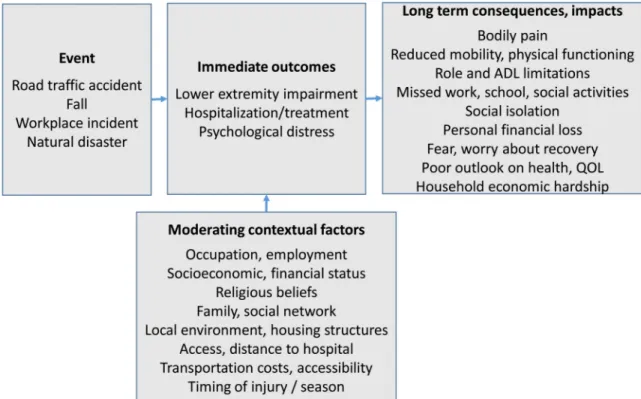
Overarching themes of outcomes and consequences of lower extremity injuries are described below in addition to moderating contextual factors which also played a role in patient outcomes and QOL (Figure 1).
Physical functioning limitations affected activities of daily living (ADL)
Almost all participants reported pain when trying to move or walk, which restricted ADL, particularly in the weeks immediately following the accident. Pain kept them bed-ridden and house-bound; many had difficulties getting dressed, using the toilet, and bathing for many weeks. Preparing and cooking food was not feasible for many female participants, which left them feeling unfulfilled.
Although ADL were impaired greatly at the onset of the injury, personal hygiene capabilities improved gradually with healing. However, as participants became more mobile with assistance from “sticks” (i.e., crutches), they described sleepless nights and swollen legs after days with a lot of movement. Reduced strength, energy, and physical functioning affected patients beyond the initial recovery period. Although a few were not very mobile at the time of the interview, others further out from treatment complained about not moving as fast as they wanted and feeling weak.
“The pain is still there even now when I walk long distances and when I try to bend my leg.”
A
uthor Man
uscr
ipt
A
uthor Man
uscr
ipt
A
uthor Man
uscr
ipt
A
uthor Man
uscr
–Female, age 21
Local environment and housing structures limited mobility
Mobility difficulties were exacerbated by local landscape and building structures such as hilly areas, steep slopes, terraces, steps, and dirt floors in and around homes. Participants often had problems reaching latrines and water taps because they were outside:
“We have a pit latrine 60 meters away from the house that gives me a challenge as well whenever I needed a toilet or to take a bath […] 60 meters away plus poor landscape - it becomes a nightmare. With poor landscape you may end up aggravating the injury as well.”
– Male, age 22
Getting around was especially challenging in the rainy season; therefore, some chose to “stay at home to avoid pain” instead of venturing outside.
Managing the pain
Although participants received prescription medication from the hospital to help alleviate pain and discomfort from devices, many needed additional relief. Those with resources purchased over-the-counter medicine at local dispensaries to supplement the prescriptions, whereas others could not afford additional pain killers:
“After I finished those prescribed at the hospital I stopped taking any. This is because I don't have money to go over the counter.”
– Female, age 38
Minibus accessibility and transportation costs
Because many participants lived in rural areas with dirt roads, they typically walked or biked to a paved road where they could take minibuses into the city for work, social activities, or health care needs. Participants described how reaching, boarding, and riding minibuses was difficult, uncomfortable, and often not feasible after their injury because of the limited space in crowded buses. Many described feeling like a burden to other passengers because they needed space to stretch their leg out or store their crutches and because they delayed the bus when they boarded slowly. Whereas one woman noted, “public transport isn't friendly for injured people like us,” other participants expressed disappointment about the lack of accommodations for people requiring assistance. A few recounted negative interactions and altercations with minibus drivers as a result of their needs and requests. Additionally, the cost of transportation was prohibitive; participants recalled long, painful trips walking to the hospital as the only option “because of financial problems”. In fact, some could no longer afford the minibus fare and delayed care:
“I was supposed to report to the clinic on 16th February last month but I failed because of transportation. My coming today was possible because I sold my jacket.”
– Male, age 26
A
uthor Man
uscr
ipt
A
uthor Man
uscr
ipt
A
uthor Man
uscr
ipt
A
uthor Man
uscr
Reduced social interactions and community participation
Mobility limitations also led to social isolation and limited participation in social activities for multiple months. Pain was particularly bothersome when walking long distances, which caused some to “miss a lot of things” including church, school, and community activities. Women in particular were disappointed they could not participate in community activities “like attending funerals, cheering the sick, and also attending church services.”
Nearly everyone reported decreased contact with friends and relatives after the injury. Most patients thought they lost contact because of how far away they lived from their social networks and that contacts could not afford transportation to visit them. However others thought their friends “disappeared” because they “fear I will be begging money from them”. Being a burden to family and friends came up frequently; patients did not want to ask for too much assistance or request visits “because they [friends or relatives] have their own business to attend to.”
Social network support
Despite reporting less social contact, over half received emotional support and prayer from church members who visited them. Some church friends helped financially or supported them with “maize flour, money, chickens”. However, relatives usually provided more material and financial support and were also most likely to be caretakers. Spouses and children were common sources of encouragement and emotional support; but again, participants felt guilty about being reliant on their family caretakers, though they were grateful for the help they received:
“They help me in so many ways, they cook for me, wash my dishes and some of my clothes. They are such caring relatives, they are there for me.”
–Female, unknown age
Personal financial loss
Because the injury was unexpected and none of the participants had financial protection, the economic impact of the injury was a central theme across interviews. Nearly all participants described financial distress they and their families experienced after being injured. However, a few participants reported little to no change in income: a male farmer already finished his seasonal farm work, a widow supported by her sons, and a secondary school student dependant on his parents. The remaining participants described multiple consequences which led to losses in economic productivity and major changes in personal and household financial status, particularly if the injured patient was the main income source.
Common concerns involved lacking financial security to meet basic family needs, relying on others for assistance, and feeling helpless because they could not work or contribute in their usual role.
“Now I rely on what little money my brother gets. It is pathetic. Financial restrictions are the biggest problem at the moment.”
- Male, age 30
A
uthor Man
uscr
ipt
A
uthor Man
uscr
ipt
A
uthor Man
uscr
ipt
A
uthor Man
uscr
Missed work and reduced income
Patients frequently expressed feeling they “cannot do anything” because one must “rely on legs to do everything” so they could not maintain employment. Participants were physically unable to do their jobs or even reach their workplaces because of mobility and transportation issues. Some formally employed patients took unpaid leave, whereas others lost their jobs or discontinued informal jobs. Participants working for hire informally worried about the uncertainty of their future hiring potential. Although almost everyone also ran a side business or small farm to support their families, the physical demands often became too much . Many said something similar to “I cannot manage to do farming” or “it's very difficult for me to do those things” (referring to bending over in fields, planting and harvesting crops, and carrying produce to markets). Depending on when they were injured some patients “missed the whole season” to plant and cultivate, whereas others had “lots of work waiting” and worried the harvest might be lost.
Financial coping strategies force lifestyle changes
Despite using different financial coping strategies, being unable to work for many months led some patients to deplete their savings. One patient ran out of money and used her “business capital for household items…food and other necessities.” Some also lost assets; for example, participants had to sell farm equipment, bicycles, and clothes for rent, food, and transportation to the hospital. A few were forced to leave their homes or move in with family because of lost income. Some even cut back on essentials, such as food or
transportation and relied on resources from social networks.
Changes in social roles and feelings of inadequacy
Participants worried about being able to carry out normal family roles. Women were particularly upset about missing their responsibilities and felt inadequate because they were “not doing anything as a woman”. They felt guilty about their children and spouses having increased workloads and household chores. Many male participants had previously supported relatives and were ashamed that they could no longer provide for their families.
“ [In] Malawian culture a husband is the one who finances the family, and when you get problems like these [motioning toward leg] it eventually affects the whole family at large.”
– Male, age 43
The younger patients we interviewed were also troubled about not being able to help their families with chores and farm work; they were also concerned about how the injury interrupted their schooling and career goals.
“I dropped out from secondary school because of my injury. It was difficult and impossible for me to continue there.”
- Female, age 21
A
uthor Man
uscr
ipt
A
uthor Man
uscr
ipt
A
uthor Man
uscr
ipt
A
uthor Man
uscr
Fears and worries about recovery
Participants expressed substantial worries and anxiety, particularly about needing to return to work and about their family's welfare. Concerns about the ability to perform at school or work at their prior level were common. Although a few patients were hopeful of a full recovery, others were afraid of amputation or that they would never regain physical functioning and health.
“I don't know what the doctors will tell me next. I'm living a worried life at the moment. I fear that doctors will cut my leg off one day.”
–Male, age 22
Being constantly worried led to psychological distress for some participants. The “terrible experience” consumed their thoughts; they were sad and had trouble focusing on anything other than the accident or injury.
Poor outlook on health and QOL
Participants' perceptions of their general health and QOL were often negative and bleak; they were discouraged by their physical health status and suffering, which left them worried, sleepless, and fatigued. Many expressed feelings of hopelessness – e.g., “everything has stopped” and “it's like the earth is upside down.” One man said “everything has changed from good to bad” and described living a “miserable life because of poverty.” Unmarried participants who lived far from family lacked a support network to assist them financially. Some reported weight loss and deteriorated health. They noted changes from before the injury, felt they could not continue life normally, and reported lower QOL, which all had severe implications on their outlook.
“I'm worried because I miss my normal life. I'm not enjoying life either, with pain I cannot focus much on other things of life […] Right now I'm heartbroken because of this injury.”
–Male, age 39
Religious beliefs and acceptance
Participants spoke about their faith to help cope with the changes; their beliefs gave them hope for recovery and improvements in their situations. Many relied on their trust and hope in God; they prayed for peace and healing.
“I have sisters in Christ who come to see me to encourage me not to stop praying because in Jesus there is healing and so much power.”
– Female, unknown age
Although a few thought their accident was a bad omen, most noted it was unpredictable, out of their control; religious beliefs helped them give meaning to their circumstances as part of God's plan.
A
uthor Man
uscr
ipt
A
uthor Man
uscr
ipt
A
uthor Man
uscr
ipt
A
uthor Man
uscr
Household economic hardship
The injury also affected families, primarily through financial loss. Parents were concerned about their children's schooling and future because they could no longer afford school fees and uniforms or give their children enough attention. Some participants recalled their children missing class to help with household chores or care for them. Families experienced dietary changes in frequency, amount, and variety of foods because of less income. Some participants' spouses experienced changes in employment and income because of care-taking and household responsibilities.
“My husband is the lone financier now. His work has been affected because sometimes he doesn't stay long at his workplace because he has to assist me at home since I do almost nothing.”
-Female, age 25
Discussion
This qualitative study found that Malawians who sustained a lower extremity injury
experienced substantial physical morbidity, work disruption, changes in social activities, and feelings of dependency, which led to social isolation, personal and household economic loss, and psychological distress. Limited mobility led to limitations in performing ADLs and reduced capacity to make a living or continue with vocational goals. The consequences of injury affected patients' perceived overall QOL including physical, social, financial, mental, and emotional well-being. Injuries led to circumstances where many Malawians experienced significant changes in lifestyle and QOL.
Our findings are supported by a study of orthopedic trauma patients in Uganda where the authors identified social, economic, and health care system factors affecting injuries [11]. Economic loss was common, which also had implications for the Ugandan patients' families because most were breadwinners with multiple dependents. However, the Ugandan study included few women, who we found had substantial guilt and distress about not maintaining usual family responsibilities on top of financial stress after surgery and treatment. The Lancet Global Surgery Commission estimates that over a quarter of people having surgery experience financial catastrophe, which sometimes leads to impoverishment because of lack of financial risk protection [23].
Limitations in ADL were also reported in a survey of Nigerians who experienced a RTI [12]. The authors found high rates of reduced earnings and job loss among those who were disabled, and many patients were unable to go back to work after the RTI. Similarly, Mock and colleagues reported that two-thirds of Ghanaians with a long-term injury-related disability were less able or unable to perform their usual activities [10].
Structural or environmental factors like accessing care and navigating the health system played a role in injury care in Uganda, however, transportation and terrain were the major obstacles mentioned in the present study [11]. Traditional medicine was a common
alternative to hospital treatment in Nigeria and preferred among some Ghanaians, but we did not observe the same utilization patterns or attitudes toward traditional medicine in our study
A
uthor Man
uscr
ipt
A
uthor Man
uscr
ipt
A
uthor Man
uscr
ipt
A
uthor Man
uscr
[10,12]. We specifically asked about use of traditional healers and only one of the Malawians we interviewed reported going to a traditional healer. Many participants acknowledged the accidental nature of their injury and that traditional healers would not be helpful under these circumstances.
Emotional distress and mental health problems have been reported in South African patient populations experiencing orthopedic or traumatic brain injuries (TBI) [24,25]. Although TBI patients also reported feelings of hopelessness, fear and anxiety about the future, and perceptions that they were a burden to their family and society, many reported improved QOL through engaging in work and social activities [25]. However, social support and interactions did not influence mental health or posttraumatic stress disorder among orthopedic trauma patients [24]. Recovering from and adjusting to life after a lower extremity trauma puts Malawians at a considerable disadvantage which can contribute to challenges long after the accident. Immediate care and recovery programs could be designed to provide psycho-social support and physical and occupational therapy may help patients increase QOL post-injury and speed up their return to work/school.
That said, one of the most important factors for helping patients return to their pre-injury QOL as soon as possible is scaling up modern trauma surgery. Patients treated with modern principles of fracture care can ambulate without pain soon after surgery [26]. With a severe under capacity for trauma surgery at KCH, patients were receiving conservative
management for many injuries that are no longer treated in this way in most middle and high income countries [27]. A modest scale up of orthopedic trauma services could help reduce this burden in the future [28,23].
Our findings suggest injured patients and families lack adequate resources and support and therefore may benefit from interventions connecting them to social-welfare services, loans, or micro-credit programs to help mitigate the injury-related financial hardship affecting QOL. Limited access to public services and employment restricted the ability of injured and disabled participants to participate fully in their communities which affected their QOL, thus prevention of unintentional injuries is also important.
Limitations of this study must be noted, including a lack of generalizability to other populations, including those not presenting to the hospital and those outside of Malawi, and a biased convenience sample of trauma patients from one hospital. However, the goal of this study was to understand QOL implications taking the local context into consideration. Although we included participants at various stages of recovery, all of our participants were less than 6 months out from their injury. Studies of patients further away from their injury and those whose injuries resulted in permanent disabilities are warranted. Given these limitations, it is essential that future research investigate the nature of economic loss among people with traumatic injuries, and its relationship with overall QOL. Still, these findings highlight the aspects of people's lives that are influenced by lower extremity injuries, and add value to the existing literature by describing impacts on QOL from the patient perspective. By using qualitative methods we were able to identify and explore multiple factors influenced by lower extremity injury, rather than providing associations between social and economic variables.
A
uthor Man
uscr
ipt
A
uthor Man
uscr
ipt
A
uthor Man
uscr
ipt
A
uthor Man
uscr
Conclusion
To our knowledge, this is the first in-depth study of QOL perceptions among Malawian patients who experienced a lower extremity injury. In treating patients with these injuries, it is important to consider not only the direct physical consequences, but also how personal, social, and environmental factors can affect QOL. The negative impacts of injury
substantially add to the global burden of disability and suggest a comprehensive recovery care approach is needed to maintain and improve health and QOL outcomes. The fact that poverty is exacerbated by lower extremity injuries highlights the need for policies and programs to meet the surgical, social, and rehabilitation needs of people with mobility challenges.
Supplementary Material
Refer to Web version on PubMed Central for supplementary material.
Acknowledgments
The authors would like to thank the surgery and orthopedic departments at Kamuzu Central Hospital and UNC Project Malawi for their assistance with this study. REK was supported by UNC Cancer Care Quality Training Program through the National Cancer Institute (R25 CA116339) and the Dana-Farber/Harvard Cancer Prevention Fellowship (3R25 CA057711). The contents are solely the responsibility of the authors and do not necessarily represent the official views of the NIH.
References
1. Lozano R, Naghavi M, Foreman K, Lim S, Shibuya K, Aboyans V, et al. Global and regional mortality from 235 causes of death for 20 age groups in 1990 and 2010: a systematic analysis for the Global Burden of Disease Study 2010. The Lancet. 2012; 380(9859):2095–2128. doi:http:// dx.doi.org/10.1016/S0140-6736(12)61728-0.
2. Organization, W. H. WHO global status report on road safety 2013: supporting a decade of action. World Health Organization; 2013.
3. Murray CJ, Vos T, Lozano R, Naghavi M, Flaxman AD, Michaud C, et al. Disability-adjusted life years (DALYs) for 291 diseases and injuries in 21 regions, 1990–2010: a systematic analysis for the Global Burden of Disease Study 2010. The Lancet. 2013; 380(9859):2197–2223.
4. Marquez PV, Farrington JL. The challenge of non-communicable diseases and road traffic injuries in sub-Saharan Africa: an overview. 2013
5. Clay FJ, Newstead SV, McClure RJ. A systematic review of early prognostic factors for return to work following acute orthopaedic trauma. Injury. 2010; 41(8):787–803. [PubMed: 20435304] 6. de Ramirez SS, Hyder AA, Herbert HK, Stevens K. Unintentional injuries: magnitude, prevention,
and control. Annu Rev Public Health. 2012; 33:175–191. DOI: 10.1146/annurev-publhealth-031811-124558 [PubMed: 22224893]
7. Samuel JC, Akinkuotu A, Villaveces A, Charles AG, Lee CN, Hoffman IF, et al. Epidemiology of injuries at a tertiary care center in Malawi. World journal of surgery. 2009; 33(9):1836–1841. [PubMed: 19597877]
8. Kobusingye O, Guwatudde D, Lett R. Injury patterns in rural and urban Uganda.(Brief Article). Injury Prevention. 2001; 7(1):46. [PubMed: 11289535]
9. Casey ER, Muro F, Thielman NM, Maya E, Ossmann EW, Hocker MB, et al. Analysis of traumatic injuries presenting to a referral hospital emergency department in Moshi, Tanzania. Int J Emerg Med. 2012; 5(1):28.doi: 10.1186/1865-1380-5-28 [PubMed: 22682499]
A
uthor Man
uscr
ipt
A
uthor Man
uscr
ipt
A
uthor Man
uscr
ipt
A
uthor Man
uscr
10. Mock C, Boland E, Acheampong F, Adjei S. Long-term injury related disability in Ghana. Disability & Rehabilitation, 2003, Vol.25(13), p. 732-741. 2003; 25(13):732–741. DOI: 10.1080/0963828031000090524
11. O'Hara NN, Mugarura R, Slobogean GP, Bouchard M. The orthopaedic trauma patient experience: a qualitative case study of orthopaedic trauma patients in Uganda. PLoS One. 2014;
9(10):e110940.doi: 10.1371/journal.pone.0110940 [PubMed: 25360815]
12. Juillard C, Labinjo M, Kobusingye O, Hyder AA. Socioeconomic impact of road traffic injuries in West Africa: exploratory data from Nigeria. Injury prevention. 2010 ip. 2009.025825.
13. [Accessed Feb 2015] Global Health Observatory Data: Road Traffic Deaths. 2013. http:// www.who.int/gho/road_safety/mortality/traffic_deaths_rates/en/
14. [Accessed Nov 2015] Evaluation, I. f. H. M. a. Malawi Country Profile; Global Burden of Disease.
http://www.healthdata.org/malawi
15. Malawi's infrastructure: A continental perspective. (Policy Research Working Papers): The World Bank; 2011.
16. Tyson AF, Varela C, Cairns BA, Charles AG. Hospital mortality following trauma: an analysis of a hospital-based injury surveillance registry in sub-Saharan Africa. J Surg Educ. 2015; 72(4):e66– 72. DOI: 10.1016/j.jsurg.2014.09.010 [PubMed: 25451718]
17. WorldBank. Malawi Overview. 2013. http://www.worldbank.org/en/country/malawi/overview
18. Integrated Household Panel Survey 2010-2013; Household Socio-Economic Characteristics Report. Zomba. Malawi: National Statistical Office; 2014.
19. Creswell, J. Qualitative Inquiry and Research Design: Choosing among Five Approaches. 2nd. Sage Publications, Inc; 2006.
20. Strauss, A., Corbin, JM. Basics of Qualitative Research: Techniques and Procedures for Developing Grounded Theory. SAGE Publications; 1998.
21. Glaser, BGS. The discovery of grounded theorystrategies for qualitative research. Chicago: Aldine; 1967.
22. Lasch KE, Marquis P, Vigneux M, Abetz L, Arnould B, Bayliss M, et al. PRO development: rigorous qualitative research as the crucial foundation. Quality of Life Research. 2010; 19(8): 1087–1096. [journal article]. DOI: 10.1007/s11136-010-9677-6 [PubMed: 20512662]
23. Meara JG, Leather AJM, Hagander L, Alkire BC, Alonso N, Ameh EA, et al. Global Surgery 2030: evidence and solutions for achieving health, welfare, and economic development. The Lancet. 386(9993):569–624. DOI: 10.1016/S0140-6736(15)60160-X
24. Maselesele VM, Idemudia ES. The role of social support in the relationship between mental health and posttraumatic stress disorder amongst orthopaedic patients. 2013; 36(1) 2013.
25. Soeker MS, Van Rensburg V, Travill A. Individuals with traumatic brain injuries perceptions and experiences of returning to work in South Africa. Work. 2012; 42(4):589–600. DOI: 10.3233/ wor-2012-1414 [PubMed: 22523048]
26. Gosselin RA, Heitto M, Zirkle L. Cost-effectiveness of replacing skeletal traction by interlocked intramedullary nailing for femoral shaft fractures in a provincial trauma hospital in Cambodia. Int Orthop. 2009; 33doi: 10.1007/s00264-009-0798-x
27. Haug L, Wazakili M, Young S, Van den Bergh G. Longstanding pain and social strain: patients' and health care providers' experiences with fracture management by skeletal traction; a qualitative study from Malawi. Disabil Rehabil. 2016; :1–8. DOI: 10.1080/09638288.2016.1207109 28. Young S, Banza L, Mkandawire N. The impact of long term institutional collaboration in surgical
training on trauma care in Malawi. SpringerPlus. 2016; 5(1):1–5. [journal article]. DOI: 10.1186/ s40064-016-2050-7 [PubMed: 26759740]
A
uthor Man
uscr
ipt
A
uthor Man
uscr
ipt
A
uthor Man
uscr
ipt
A
uthor Man
uscr
Figure 1. Quality of life consequences experienced by Malawian patients with lower extremity injuries
A
uthor Man
uscr
ipt
A
uthor Man
uscr
ipt
A
uthor Man
uscr
ipt
A
uthor Man
uscr
A
uthor Man
uscr
ipt
A
uthor Man
uscr
ipt
A
uthor Man
uscr
ipt
A
uthor Man
uscr
T ab le 1Characteristics of patients with lo
wer extr
emity trauma (n=20)
No. Sex Residence Age Marital status Occupation
Days since injury
*
T
ype of injury
Cause of injury
5 F Urban 78 Di v orced F armer 83 Brok en le g
Fell at home during storm
6 F Urban UK Married Security guard 45 Brok en le g
Fell into drain during storm
7 F Urban UK Married Landlady 83 Brok en foot Fell w alking 8 F Urban UK W ido w
Small scale retailer
35
Brok
en le
g
Fell chasing thief
11 F Rural 25 Married F armer 47 Brok en le g
Struck by v
ehicle 13 F Rural 21 Married Student 118 Brok en le
g, knee injury
Sports injury 16 F Rural 39 Married
Small scale retailer
60
Brok
en le
g, ankle
Fell from minib
us 17 F Rural 69 W ido w F armer 65 Brok en le g Fell w alking 19 F Urban 36 Married Business 49 Brok en le g Fell w
alking at mark
et 20 F Rural 38 Married Business 135 Brok en ankle
Fell from bik
e 1 M Urban 24 Married Machine operator 151 Brok en le g
Struck by v
ehicle 2 M Urban 36 Married W atchman 112 Brok en le g
Struck by motorbik
e 3 M Urban 39 Married Carpenter 127 Brok
en foot, dislocated hip
Fell at w
ork 4 M Rural 25 Married F armer 130 Brok en le g Fell of f bik e 9 M Urban 22 Single Student 65 Brok en le g
Struck by v
ehicle 10 M Rural 22 Single Student 62 Brok en le g Car accident 12 M Urban 30 Married
Small scale retailer
91
Dislocated hip
Struck by v
ehicle 14 M Rural 43 Married F armer 132 Brok en le g
Struck by v
ehicle 15 M Rural 62 Married Steel f ix er 99 Brok en le g
Struck by v
ehicle 18 M Rural 85 Married F armer 124 Brok en le g
Fell, crushed during storm
Notes
:
* Days from injury to intervie
w; UK, unkno
wn age w
as either not documented or not specif