T e c h n i c a l R e p o r t N
o2 0 0 4 / 2 3
Core Security Requirements Artefacts
Jonathan D. Moffett,
Charles B. Haley,
Bashar Nuseibeh
21
stJune 2004
Department of Computing
Faculty of Mathematics and Computing The Open University
Walton Hall, Milton Keynes MK7 6AA United Kingdom http://computing.open.ac.uk
l
ISSN 1744-1986Core Security Requirements Artefacts
Jonathan D Moffett Charles B Haley Bashar Nuseibeh Security Requirements Group
Department of Computing The Open University, UK
{J.Moffett, C.B.Haley, B.Nuseibeh}@open.ac.uk
Abstract
Although security requirements engineering has recently attracted increasing attention, it has lacked a context in which to operate. A number of papers have described how security requirements may be violated, but apart from a few hints in the general literature, none have described satisfactorily what security requirements are.
This paper proposes a framework of core security requirements artefacts, which unifies the concepts of the two disciplines of requirements engineering and security engineering. From requirements engineering it takes the concept of functional goals, which are operationalised into functional requirements, with appropriate constraints. From security engineering it takes the concept of assets, together with threats of harm to those assets. Security goals aim to protect from those threats, and are operationalised into security requirements, which take the form of constraints on the functional requirements.
In addition we explore the consequences of the fact that security is concerned with the protection of assets, while computers only provide interfaces. We show how to specify the relationship between security requirements and the specification of software behaviour, using Jackson's Problem Frames approach.
Table of Contents
1. Introduction... 3 1.2 Background ... 3 1.3 Outline of Paper ... 6 2. The Framework ... 6 2.1 Artefacts... 62.2 The Core Artefacts Diagram... 9
2.3 Process Overview... 13
2.4 Problem Frames ... 14
3. Case Study... 16
3.1 System Business Goals and Functional Requirements ... 16
3.2 Case Study Part I: from System Security Goals to System Security Requirements ... 17
3.3 Case Study Part II: From System Security Requirements to Software Security Specifications ... 20
4. Discussion... 25
4.1 Security Goals ... 26
4.2 Security Requirements ... 27
4.3 Analysing Security Requirements... 31
4.4 Covert Channels ... 33
4.5 A Multi-domain Approach... 34
4.6 Security Functions ... 35
4.7 Security Policies... 36
5. Open Issues ... 39
5.1 Security Requirements in the Presence of Implementation Fla ws... 39
5.2 The Need for a Taxonomy of Constraints... 39
5.3 Data-driven Security Requirements... 40
5.4 Specification Notation... 41
5.5 Risk analysis ... 42
5.6 Scalability... 42
When you are up to your elbows in alligators, you must never forget that you set out to drain the swamp. [anon]
1.
Introduction
The subject matter of this paper is the description of the core artefacts that are needed to carry out security requirements engineering; this is the process of eliciting, specifying and analysing the security requirements of a system. It is a development of our earlier paper [42].
We propose a framework which integrates the concepts of the two disciplines of requirements engineering and security engineering. From requirements engineering it takes the concept of functional goals, which are operationalised into functional requirements, with appropriate constraints. From security engineering it takes the concept of assets, together with threats of harm to those assets. Security goals aim to protect assets from those threats, and are operationalised into security requirements, which initially take the form of (a subset of) the constraints on the functional requirements.
This paper has a view of security requirements, based on the following principles:
• The "what" of security requirements – its core artefacts – must be understood before the "how" of construction and analysis.
• Security cannot be considered as a feature of software alone; it is concerned with the prevention of harm in the real world. We must therefore consider both the security requirements of real-world systems and the specification of software that demonstrably meets those requirements.
• Since security is largely concerned with prevention of misuse of system functions, security requirements can most usefully be defined by considering them at the same level as functional requirements, and as constraints upon them.
Scope of the Framework
This framework has been developed in order to understand the place of security requirements within the development of an individual application, and our proposals are limited by that scope. The application will, of course, be developed in the context of a software operating environment, a hardware environment, and a human cultural environment. All of these environments will have properties which impact upon the application. However, we have not covered these in this paper. In particular, we believe that there are many issues with regard to the properties of the software operating environment, which need to be tackled in later work.
1.2 Background
Although security requirements engineering has recently attracted increasing attention, it has lacked a context in which to operate. This lack was pointed out by Baskerville [6], where he presents three generations of security design methods:
• Checklists: these are lists of points to be checked, on the assumption that experie nce of previous applications can be applied to the current one.
• Mechanistic engineering methods: a process is used, which focuses on security in isolation from other aspects of system design.
• Integrated design: A development process includes security as a facet of the whole development.
Unfortunately he was unable to point to any examples of integrated design methods that were used in practice. His comments apply to design, but it is also true today that there is no satisfactory integration of security requirements engineering into requirements engineering as a whole. In this section we review existing literature, in order to show the truth of this statement, and then motivate the remainder of the paper by showing why it matters.
1.2.1 Previous Definitions of Security Requirements
Extensive work has been carried out on security requirement during the last few years. However, there has been a lack of a satisfactory definition of them. Work on the subject has tended to be carried out independently by the security and requirements communities.
The Security Community
From the security community side, there are several papers on security requirements. Tettero [54] defines security requirements as the confidentiality, integrity and availability of the entity for which protection is needed. While we accept that this is a clear definition, we will argue below (section 4.2) that it is too abstract. Lee et al [34] point out the importance of considering security requirements in the development life cycle, but do not define them.
ISO/IEC 15408 [25] does not define them in its glossary. However, in one place they are depicted as being at a higher level than functional requirements, but elsewhere the reference to "security requirements, such as authorisation credentials and the IT implementation itself" appears to us as being at too low a level! However, although we do not find the definition of security requirements very consistent, the inclusion of assurance requirements (the "degree of confidence" required in the security mechanisms of a system) is important although we have not attempted to address it in this paper.
The Requirements Community
There have also been several relevant papers on the requirements community side. Heitmeyer [20] shows how the SCR method can be used to specify and analyse security properties, without giving the criteria for distinguishing them from other system properties.
A number of papers have focussed on security requirements by describing how they may be violated. For example, McDermott & Fox [38], followed independently by Sindre & Opdahl [50] and elaborated by Alexander [2], describe abuse and misuse cases, extending the use case paradigm to undesired behaviour.
Liu, Yu & Mylopoulos [37] describe a method of analysing possible illicit use of a system, but omit the important initial step of identifying the security requirements of the system before attempting to identify their violations.
van Lamsweerde and colleagues have written several papers on the subject. In the latest [55] he uses the concept of security goals, but does not define what he means by security requirement or give an example of one. Antón & Earp [5] use the GBRAM method to operationalise security goals for the generation of security policies and requirements, but also do not define security requirements.
Firesmith [15] defines security requirement as "any requirement that specifies a minimum, mandatory amount of security", which does not take us much further forward.
None of the above define what security requirements are. On the other hand, when discussing non- functional requirements, of which he regards security as one, Kotonya [30] defines them as "restrictions or constraints" on system services and similar definitions can be found in other text books. Rushby [46] appears to take a similar view, stating "security requirements mostly concern what must not
happen". Using the Tropos methodology, Mouratidis et al [43] state that "security constraints define the system’s security requirements". Our own view, elaborated in the remainder of this paper, is consistent with these definitions: that security requirements are most usefully defined as requirements for constraints on system functions.
1.2.2 The Importance of Security Requirements
We distinguish between the goals of stakeholders and the requirements of the system, as agreed by the customer1. Individual stakeholders may have different and conflicting goals, which need to be elicited by the requirements engineer. On the other hand the system's requirements must be free of conflicts, because the resolution of conflicts between goals is the job of the requirements engineer, not the implementer.
It is important to know what security requirements are, because the issue of their definition in actual applications is not trivial. Consider the description of a clinical information system in [4]. The report presents a view of the security goals of a Clinical Information System from the point of view of the doctors. It makes explicit assumptions that the doctors should have control of the system, while the administrators should be subordinate. It is well known that, in many health services, there is a power struggle between doctors and administrators. In a hypothetical system in which that power struggle has not been resolved, we can consider two hypothetical sets of candidate security requirements. In set 1, proposed by the doctors, some actions are considered legitimate for doctors, but prohibited for administrators. In set 2, proposed by the administrators, the situation is reversed; some actions that would have been legitimate by the standards of report 1 are security violations, and vice versa. It cannot be left to the
1
implementers to resolve conflicts between points of view; a requirements document must state unambiguously what is to be allowed or prohibited to whom; i.e. what are the constraints that are to be imposed on the use of functions of the system. Only then can we analyse the requirements for misuses or abuses.
1.3 Outline of Paper
The remainder of this paper is organised as follows. Section 2 introduces the artefacts and places the m in a framework: 2.1 discusses artefacts generally, and distinguishes between core and support artefacts; 2.2 illustrates the core security artefacts and their dependencies by means of a diagram (figure 1); 2.3 discusses the process implications of the dependencies; and 2.4 briefly introduces problem frames, the notation with which we illustrate the relationship between system requirements and software specifications.
Section 3 is a case study, which uses the framework concepts and shows how they are applied. It is in four parts: 3.1 introduces the application; 3.2 shows how its system security requirements are derived from security goals; 3.3 shows alternative designs by which the problem frame, consisting of a software specification interacting with its surrounding domains, satisfies the security requirements; and 3.4 reviews the case study.
Section 4 expands on our introduction by discussing the main artefacts in the light of the case study: in sections 4.1 – 4.3 security goals, security requirements and their analysis are discussed; sections 4.4 – 4.7 cover covert channels, the need for a multi-domain approach, security functions and security policies.
This paper has inevitably left open many issues, and section 5 considers some of them: security in insecure systems; the need for a taxonomy of constraints; data-driven security requirements; specification notations; and the place of risk analysis in this framework. Section 6 concludes the paper.
2.
The Framework
2.1 Artefacts
Requirements engineering rightly concentrates on deciding what is to be done, before deciding how to do it. This paper follows the spirit of requirements engineering by concentrating on the "what" before the "how". In this paper we use the term artefact to describe the "whats", or objects, of security requirements engineering.
By artefact we mean any object that is created as part of the process of system development. Typically artefacts are documents, electronic or otherwise, but they could include physical models, test rigs, and other things. We make the distinction between core artefacts and support artefacts.
We assume that the system development process has recognisable stages, each of which produces artefacts that are successively closer representations of a working system. These are core artefacts. They are ordered in a hierarchy that describe the system, progressing from the most abstract to the final concrete working
system. This hierarchy is a hie rarchy of abstraction, and does not imply the waterfall model of linear progress; progress may be made concurrently or iteratively, rather than in a linear fashion. Indeed, we have pointed out in an earlier paper [44] that requirements and architecture cannot be separated: the "Twin Peaks" concept.
At early stages core artefacts are typically documents or prototypes. The final core artefact is the working system itself, consisting of a combination of physical and software items.
Core artefact documents contain statements of two kinds, following Jackson's notation [28]:
• Statements that describe the assumed or given structure or behaviour of some aspect of the system or its environment. These are indicative statements characterised by the use of "is/are" for factual descriptions.
• Statements that describe the required structure or behaviour of some aspect of the system. These are optative statements, characterised by the use of "shall". To give an example, the optative statement that a door shall be secure from intruders can be achieved in one of two ways2:
• A high security lock shall be installed on the door, or
• The existing door lock is secure.
The latter statement is a trust assumption [17], which is used to place a bound upon the extent of analysis that is considered necessary (see also section 2.4 below).
The core artefacts in which we have most interest in this paper are, on the mainstream requirements engineering side: goals, requirements, and the components and structure of the system architecture; and on the security engineering side: assets, threats and control principles.
Support artefacts are artefacts that help to develop, analyse or justify the design of a core artefact. They may represent formal analysis, informal argument, calculation, example or counter-example, etc. They are the by-products of processes whose aim is to help produce verified and valid core artefacts: either constructive processes which help create them, or analytical processes which test them, both internally (verified) and in relation to their senior artefacts in the hierarchy (valid).
We concentrate on core artefacts, because it is their production which drives the need for development and analysis processes from which support artefacts emerge. Nothing in this paper should be construed as doubting the importance of support activities and artefacts, but they are only important to the extent that they ensure the quality of the core.
2
Dependencies between Artefacts
In a hierarchy of artefacts, there are dependencies between artefacts. For example, an operationalised requirement is dependent upon a goal from which it has been derived, because alteration of the goal is likely to cause alteration of the requirement. We will call this kind of dependency hierarchical dependency. There is also a reverse kind of dependency: feasibility. If it proves impossible to implement a system that satisfies all the optative properties of a requirements specification, then this will force a change in the goals or requirements; the higher- level artefact is dependent on the feasibility of the artefacts below it in the hierarchy.
Although the processes are not the main concern of this paper, the dependency relationships ha ve an important implication for the structure of development processes:
• If an artefact is dependent upon the implementation of another artefact for its feasibility, then if the implementation is not feasible, there must be an iteration path in the process, back to the ancestor from its descendant.
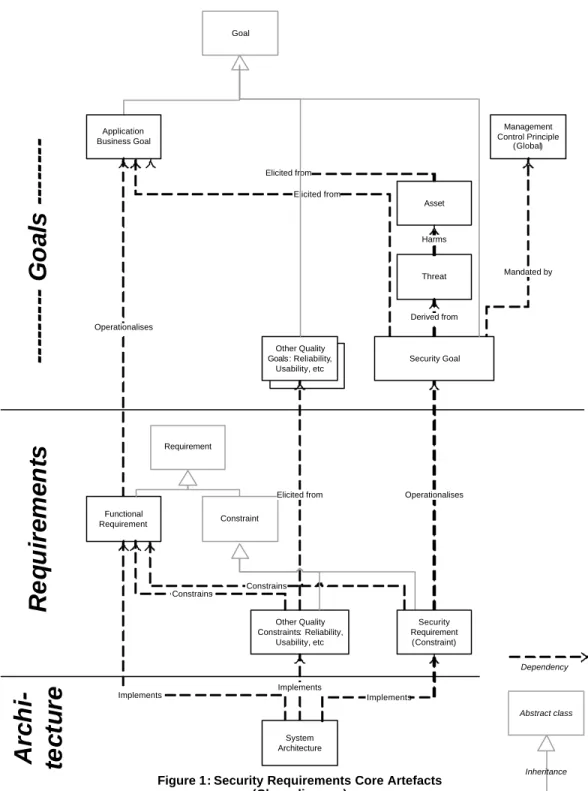
Management Control Principle (Global) Application Business Goal Asset Threat Goal Requirement Constraint Operationalises Elicited from Mandated by Harms Derived from Operationalises
Figure 1: Security Requirements Core Artefacts (Class diagram) Abstract class Inheritance Constrains Dependency Elicited from Security Goal Functional Requirement Other Quality Goals : Reliability, Usability, etc Other Quality Constraints: Reliability, Usability, etc Elicited from Security Requirement (Constraint) Constrains Implements Implements System Architecture
---
G
o
a
ls
-
-R
e
q
u
ir
e
m
e
n
ts
A
rc
h
i-te
c
tu
re
Implements2.2 The Core Artefacts Diagram
Our view of the core artefacts and their relationships is shown in Figure 1. It is a class diagram, with dependency associations. Some classes inherit from the abstract classes Goal, Requirement and Constraint, and these inheritance relations are shown in grey. The dependency associations are shown as black dashed lines, and are interesting because the dependencies drive the security requirements process.
2.2.1 Application Artefact Types
Three columns of application artefact are shown and, in addition, global management control principles:
• The first column shows the application functionality artefacts that would be needed even if security were not under consideration;
• The second column shows the additional application quality artefacts that are needed in order to provide qualities such as usability to the system;
• The third column shows the additional application security artefacts that are needed in order to provide security to the system;
• Management control principles apply globally throughout an organisation and provide constraints that would otherwise have to be derived repeatedly for each security risk analysis. Examples that are directly relevant to security are the principles of Least Privilege (no one shall have more privilege than needed for the performance of their duties) and of Separation of Duties (for important transactions, no single person shall be able to perform all parts of the transaction).
Application Functionality
This column represents the artefacts that are needed in a conventional life-cycle model in order to produce a working system. Beyond the structure imposed by Goals, Requirements and Architecture, we do not intend to place any constraint on the development process or method that is used.
Application Quality
This column represents the artefacts that are needed in order to provide qualities such as usability and performance to the system3. They are included in the consideration of security requirements, as it is typically not feasible to implement all the desired qualities of a system, and it may be necessary to trade off security against other qualities.
Application Security
This column represents the artefacts that are needed in order to introduce security into the system. They are briefly introduced here. More detail of the concepts can be found in risk management books such as Alberts & Dorofee [1].
• The relevant assets of a system are those assets of the organisation that could result in harm if the system were misused. They have a dependency upon the application business goals because the goals will determine which portion of the organisation's assets may be affected by the system.
• The type of harm that can happen depends upon the asset type, e.g.
3
Security is generally considered to be a "quality", but it is considered separately because it is the focus of this paper.
Money: loss
Information: exposure, corruption, loss, etc
• The security goals of the system owner are derived from a combination of three different sources:
The possible harm to assets; Management control principles;
Application business goals, which will determine the applicability of management control principles, e.g. by defining those privileges that are
needed for the application prior to excluding those that are not.
Note that other legitimate stakeholders may have other security goals that conflict with these (see section 1.2.2 above); the set of relevant security goals may be mutually inconsistent, and inconsistencies will need to be resolved during the goal analysis process, before a set of consistent requirements can be reached.
On the other hand, the goals of attackers are not considered to be a part, even negated, of the security goals of the system, and influence them rather obliquely. See 2.2.2 below
• The (primary) security requirements of the system operationalise the security goals by expressing them as constraints on the functions of the system (see 2.2.3 below). They are dependent on the definition on those functions, since they are constraints upon them. Like any other set of requirements, any inconsistencies need to be removed.
It may not be feasible to implement these primary security requirements without additional functionality. In that case derived security requirements of the system are added. It may be necessary to revisit the system architecture, adding security functionality and/or modifying the existing security requirements.
2.2.2 Security is not Football
The goals of the system owner and other legitimate stakeholders are not directly related to the goals of attackers, because Security is not Football. It is not a zero sum game. In football, the goals won by an attacker are exactly the goals lost by the defender. However, security is different; there is no exact equivalence between the losses incurred by the asset owner and the gains of the attacker. To see this, look at two examples:
• Robert Morris unleashed the Internet Worm [52], causing millions of dollars of damage, apparently as an experiment without serious malicious intent. The positive value to the attacker was much less than the loss incurred by the attacked sites.
• Many virus writers today are prepared to expend huge effort in writing a still more ingenious virus, which causes no or trivial damage (screen message "You've got a Virus"). Here the positive value to the attacker, judged by the amount of effort he is prepared to invest, is much greater than the loss incurred by the attacked site. Generally, there is no simple relationship
between the gains of a virus writer and the losses incurred by those who are attacked.
The consequences of security not being a zero sum game include:
• The evaluation of possible harm to an asset can be carried out without reference to particular attackers, with the caveat that, if the impact on the defender depended on the particular attacker, then the individual attacker would need to be considered when setting security goals. In the approximate world of risk analysis, this is unnecessary in practice.
• Consideration of the goals of attackers cannot be used simply to arrive at the goals of a defender to prevent harm, i.e. their security goals. In view of the point above, it is not necessary, either.
2.2.3 Security Requirements
We define security requirements to be the constraints, on functional requirements, that are needed to achieve security goals.
A simple example of such a constraint is:
The system shall not provide Personnel Information except to members of Human Resources Dept.
Note that the constraint ("shall not … except to …") is secondary to the function ("provide Personnel Information"); it only makes sense in the context of the function.
There may also be temporal constraints:
The system shall not provide Personnel Information outside normal office hours;
and complex constraints on traces:
The system sha ll not provide information about an organisation to any person who has previously accessed information about a competitor organisation (the Chinese Wall Security Policy, [9]).
Availability requirements will need to express constraints on response time: The system shall provide Personnel Information within 1 hour for 99% of requests.
We note that this differs only in magnitude from a Response Time quality goal, which might use the same format to require a sub-second response time.
This paper does not claim to provide a complete taxonomy of constraints nor, since this is a framework rather than a process or method, does it attempt to mandate a specification language. There are discussions of some of the issues in sections 5.2 and 5.4 below.
2.2.4 Goals, Requirements and Architecture
The horizontal view shows three phases of development of the artefacts: Goals; Requirements; and Architecture. We indicate briefly here what we mean by each of these terms:
• Goal: something that any stakeholder wishes to achieve or avoid.
• Requirement: a functional requirement, which describes a function to be provided by the system in terms of an operation that can be used by an agent; or a constraint on a functional requirement. The constraint is an expression of a security or other quality requirement, e.g., performance, usability, etc.
• System architecture: a description of a means of achieving requirements, in terms of the interactions between relevant domains. The problem frame approach that we use for our case study is one such description; it describes how a software specification in a structure of domains satisfies system requirements.
2.3 Process Overview
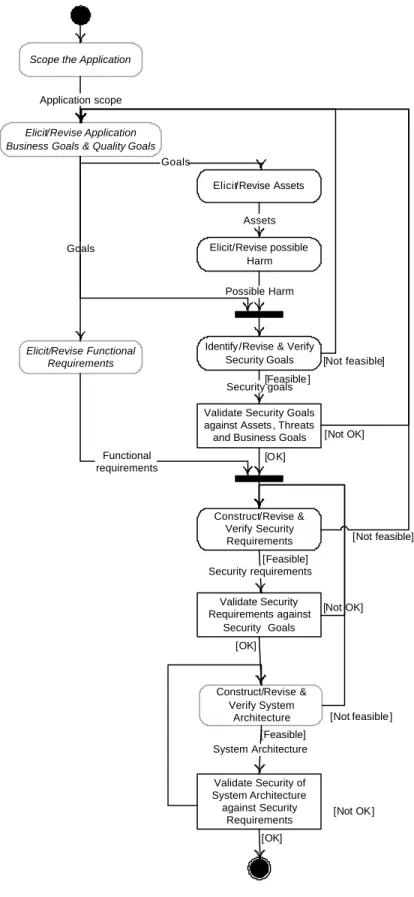
The dependencies among the core artefacts influence the possible ways in which a security requirements process can be constructed. The process diagram is shown as figure 2; the following points should be noted:
• There are two columns, corresponding to the "normal" application development process and quality goals, and the development of security requirements. It is assumed that no explicit activity is needed to elicit the organisation's control principles, and these can therefore be fed directly into the Identification of Security Goals activity.
• Lines coming out of the bottom of an activity box indicate the successful completion of an activity and, except for Validation boxes, carry with them a core artefact into the next activity.
• Lines coming out of the side of an activity box denote failure and imply the need to iterate back up the process in order to revise an earlier activity. Failure can be one of two kinds:
• It has been found to be infeasible to create a consistent set of the artefacts that are constructed by that activity, or
• Validation of the artefacts against a higher level, e.g. validation of security requirements against security goals, shows that they fail to meet their aims. This occurs if it has not been possible to construct a satisfactory correctness argument or a vulnerability has been found (see section 4.3.2 below).
The iteration may "cascade" upwards if the architecture is not feasible without a revision of the business or security goals.
[Not feasible] Scope the Application
Elicit/Revise Application Business Goals & Quality Goals
Elicit/Revise Functional Requirements
Identify /Revise & Verify Security Goals Elicit/Revise Assets Elicit/Revise possible Harm Application scope Goals Assets Possible Harm
Validate Security Goals against Assets , Threats and Business Goals
Security goals[Feasible ]
[Not OK] [OK] [Not feasible] Construct/Revise & Verify Security Requirements Validate Security Requirements against Security Goals Security requirements [Feasible] [OK] Construct/Revise & Verify System Architecture Validate Security of System Architecture against Security Requirements System Architecture [Feasible] [OK] [Not OK] [Not OK] [Not feasible ] Functional requirements Security Validation General System Activity
Security Activity ( Construct/Verify)
Figure 2: Security Requirements Process Overview (Activity Diagram) Goals
2.4 Problem Frames
We use a notation based on Jackson's Problem Frames [28] as a tool in our case study (section 3.3 below) to help derive software security requirements. This section presents some background information on problem frames. We do not
claim that this is the only possible approach, but it is the most useful one of which we are aware.
In common with other approaches, such as the Concert framework [56], the Problem Frames approach recognises that requirements can exist at several levels of abstraction. In this approach the focus is on the relationship between requirements on the real world system, which Jackson calls simply "requirements", and requirements on the software, which he calls the "specification". Where there is any ambiguity, we refer to the former as system requirements" and the latter as the software specificatio n.
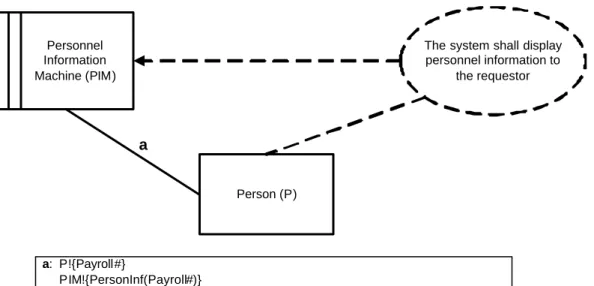
When using problem frames, a requirements engineer describes problems by describing the interaction of domains. The notation describes the domains in a problem along with the interconnections between them. For example, in our case study (section 3.1 below) the requirements elicitation process for an automatic door produces the need for a machine4 to display personnel information on request, with requirement the system shall display personnel information to the requestor. Figure 3 shows the initial problem description. There are only two domains: the Personnel Information Machine, conventionally shown with two bars in the box to denote that it will be the subject of the software specification; and Person, containing people. The requirements are shown in the oval with a dashed line. The connection between the domains is shown by a line between their interfaces. It is labelled a to give a reference to a description of the interaction phenomena between the domains. In this case there are two:
P!{Payroll#} and PIM!{PersonInf(Payroll#)}
P! and PIM! denote that the phenomena are initiated by the Person and machine domains respectively, followed by the contents of the phenomena; P can supply a payroll number, and PIM can return the personnel information for that payroll number.
Correctness Arguments
A major aim of this approach is to show, by means of a correctness argument, that the problem frame's domains, interactions and specification will satisfy the system requirements. This argument may be both positive and negative:
The positive argument will attempt to demonstrate why the problem frame satisfies the requirements. However, it is often impossible to produce a complete formal proof of this.
The negative argument tests the problem frame by searching for contradictions to the argument. In the case of security requirements these are called vulnerabilities. A vulnerability is discovered, as described by van Lamsweerde [55] in a different context, by negating the requirement and then attempting to show that the
4
In our view of problem frames the machine may be an abstract entity; for example, the Personnel Information Machine and Credentials Administration Machine that are discussed in 3.3.3 might both be implemented in the same physical computer.
negation of the requirement can be satisfied. They are discussed further in section 4.3.2 below.
Further Notation
We have found it necessary to extend beyond the standard notation of Problem Frames in order to describe security requirements adequately, in two respects: trust assumptions; and a causal specification language.
We introduce trust assumptions [17] in order to make explicit the assumed properties of domains on which the satisfaction argument depends. They are denoted by ovals with irregularly dashed lines. Examples are found in our case study, e.g. section 3.3.2 below.
The use of a causal specification language is needed because Jackson's book on Problem Frames uses state- machine diagrams for the specification of required software behaviour. Although guards on transitions can be shown in this notation, they are guards whose satisfaction is sufficient to enable behaviour. Security constraints need stronger guards also, whose satisfaction is necessary to enable behaviour. We are therefore using, as our specification language, a causal notation derived from our earlier notation [41] to describe a machine or domain specification. The relationship between the interactions described above is specified to be:
P!{Payroll#} shall cause PIM!{PersonInf(Payroll#)}
shall cause prescribes that the first interaction shall always result in the second one. The other element of the notation that we use in this paper is shall prevent, which prescribes that the first interaction shall always prevent the second one from occurring. It overrides shall cause.
3.
Case Study
This case study, of a Personnel Information display system, is used to illustrate the framework that we have set out above and to bring out further issues for discussion. It is unrealistically simple, to enable points to be illustrated easily. We use an informal notation for goals, and a notation for requirements that is based on Problem Frames, as discussed in section 2.4 above.
3.1 System Business Goals and Functional Requirements
We assume that the business goals have been elicited and that there is only one goal:
G1: Provision of people's personnel information to them.
We assume that initial requirements have been elicited and that there is only one functional requirement:
REQ1: On request from a Person (member of People), the system shall display personnel information (PersonInf) for a specified payroll number (Payroll#) to that Person.
The problem frames diagram shown in Figure 3 is a first attempt at representing the requirement. It shows a Person interacting with the Machine, as a result of which specified personnel information is displayed.
a: P!{Payroll#}
PIM!{PersonInf(Payroll#)}
Figure 3: Initial Problem Description
The system shall display personnel information to the requestor Personnel Information Machine (PIM) Person (P) a
The specification of the behaviour of the PIM is:
1. P!{Payroll#} shall cause PIM!{PersonInf(Payroll#)}
3.2 Case Study Part I: from System Security Goals to System
Security Requirements
In this section we will first discuss how to derive security goals and then how to obtain security requirements for this application.
3.2.1 Security Goals System Security Risk Analysis (Assets & Harm)
Asset Identification
Examination of the business goal G1 reveals only one relevant asset: personnel information. Other assets would need to be considered in a fuller example, including: tangible assets such as money, products, or the computers themselves; and intangibles such as reputation.
Harm Identification
There are at least the following types of possible harm to personnel information: H1: Unauthorised disclosure.
H3: Unavailability.
Security Goals
Having identified the relevant harm, we need to take the step of stating security goals for this application, the prevention of relevant harm:
SG1: Confidentiality: Prevent unauthorised disclosure of personnel information. SG2: Integrity: Prevent unauthorised alteration of personnel information.
SG3: Availability: Ensure availability of personnel information. 3.2.2 From Security Goals to Security Requirements
We have now derived and valued the organisation's security goals for a particular kind of asset. These goals need to be related to the possible behaviour of the system, i.e. its functional requirements, in order to be expressed as security requirements, i.e. constraints on those functional requirements.
Each security goal needs to be examined for possible relevance, and then the goals must be operationalised to derive constraints on functional requirements. Two separate tasks have to be carried out:
• Use domain knowledge to transform the entities described in the security goal into entities described in the functional requirement. In this case the task is trivial, as the security goals directly refer to personnel information.
• Transform Confidentiality, Integrity and Availability into constraints on the operations that are used in functional requirements.
Security Requirements for Confidentiality
In order to derive constraints for Confidentiality, we need to know who is authorised to access personnel information. In this case we assume that only members of Human Resources (HR) Department are so authorised. We can therefore state the following constraint:
REQ1/SR1: The machine shall display personnel information only to members of HR Dept.
This is the application's only security requirement for Confidentiality
Security Requirements for Integrity
Integrity is about ensuring that assets are not altered without authority, but none of the operations of the Personnel Information Display System alter information,
so there are no constraints on operations that are derived for this security goal. This application has no security requirements for Integrity.5
Security Requirements for Availability
An Availability goal will be translated into temporal constraints on every functional requirement, but for brevity we do not pursue it here.
Correctness Argument
Although we are not working with problem frames in this section, it is till appropriate to attempt to make a correctness argument, that our security requirements will satisfy the security goals. At an informal level, this has been carried out by the paragraphs above. At a practical level, the analyst may wish to question the step from "authorised" to "members of HR Dept". Is this a necessary and sufficient set of people? What about senior managers? Should all members of HR Dept be authorised? For the purpose of this example, we will assume that the requirement is correct.
3.2.3 Security Requirements Model
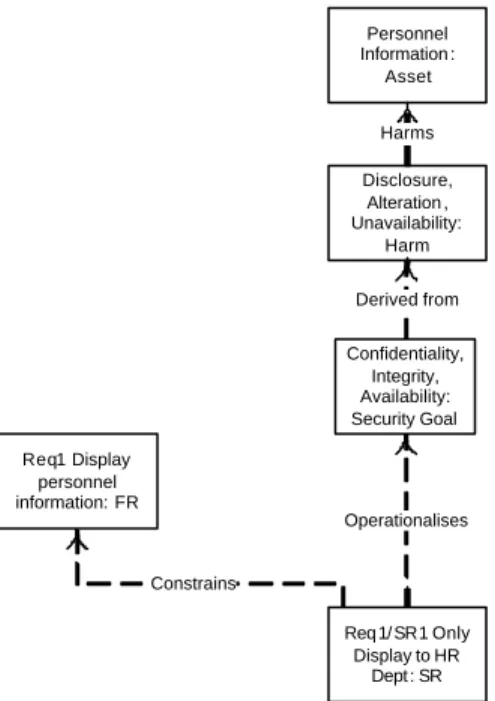
The security requirements and their context for this system are shown below in figure 4. This is a simplified instantiation of the meta- model of figure 1; only security goals are shown.
Personnel Information : Asset Disclosure, Alteration , Unavailability: Harm Harms Derived from Operationalises
Figure 4: Security Requirements for Payroll Information Display System
Constrains Confidentiality, Integrity, Availability: Security Goal Req1 Display personnel information: FR Req 1/ SR1 Only Display to HR Dept : SR 5
We assume that there is a requirement for accuracy regardless of whether the application has any security goals, and do not consider accuracy in this paper.
3.3 Case Study Part II: from System Security Requirements to Software Security Specifications
In this part we will examine how a Software Security Specification can be derived from the derived System Security Requirements. Note the difference between requirements REQ1 (section 3.1) and REQ1/SR1 (section 3.2.2):
• REQ1 is a functional requirement upon the behaviour of the Machine, and will therefore be (in transformed form) a part of the software specification.
• The security requirement REQ1/SR1 is a constraint that could be applied either in the Person or the Machine domain. It can be achieved either by: restricting membership of the Person domain to members of the HR Dept; or by ensuring that the Machine domain is able to identify whether or not a request has been submitted by a member of HR Dept, rejecting it if not.
A design decision is therefore needed before we can deal with the impact of the security requirement REQ1/SR1on the Machine.
3.3.1 Introducing the Security Requirements into the Problem Frame The problem frame diagram in Figure 3 does not show how the security requirement REQ1/SR1 fits into the picture. There are two issues that have to be resolved by system design decisions:
• Where should the security constraint be implemented – in the Person domain, the Personnel Information Machine domain, or both?
• How should we introduce meaning to "members of HR Dept"?
At the risk of repetition, we stress that this is a system design decision, in the domain of system engineering. It may or may not have an impact on the problem frame diagram, in any of the following ways:
• Adding constraints to the machine specification or the properties of other domains
• Altering the interactions between domains
• Introducing additional domains to the problem.
We will first deal with the first question, which is relatively straightforward, before discussing the issue of representation of identity in answer to the second one. What follows is an informal architectural design exercise for the system. 3.3.2 Constraining the Person Domain
We could solve the security requirement by requiring the Person domain to contain only members of HR Dept, which states that no one but HR Dept members can interact with the machine. Although this is not a detailed design exercise, we illustrate some ways in which this might be achieved:
• By physically isolating the machine from any network and using physical or procedural access control (either a lock or a guard to prevent unauthorised use of the machine)
• By using a network firewall to prevent access from any terminals except those in HR Dept, for which physical or procedural protection is in force.
If we make either of these design decisions, then REQ1/SR1 is satisfied outside the machine domain, and there is no need to consider REQ1/SR1 in the machine's software specification. The Problem Frame diagram in Figure 5 presents a solution using a locked room approach.
Figure 5 illustrates one of the principle uses of trust assumptions, limiting the scope of an analysis. To ensure that REQ1/SR1 is truly discharged, the analyst would in theory be required to examine how access to the room is limited to HR Dept members, bringing structural integrity and key management into the problem. The trust assumption obviates this need by simply stating that the analyst trusts the stated indicative property (that access is limited to HR Dept members) is true, thereby justifying changing the domain membership from
People to HR Dept Members.
Figure 5: Design with Locked Room
The system shall display personnel information to people, but only if they are
members of HR Dept Personnel Information Machine (PIM) in locked room HR Dept Members (HRDM) a Trust Assumption: Only HR Dept members
can enter room
a: HRDM!{Payroll#} PIM!{PersonInf(Payroll#)}
The specification of the behaviour of the PIM is identical to that of the original problem description (section 3.1 above), because the PIM has no part in implementing the security requirement :
Correctness Argument
The positive correctness argument for meeting the security requirement is straightforward:
• The only way to use the machine is by entering the room
• The only people who can enter the room are members of HR Dept, thus satisfying the security requirement.
The negative argument tests each of these steps in turn. Are there any vulnerabilities in the statements that:
• the only way to use the machine is by entering the room? In this case the analyst was sufficiently confident that a trust assumption was not thought to be necessary.
• the only people who can enter the room are members of HR Dept? Here the analyst had sufficient doubt about it that a Trust Assumption was attached to this statement. The risk behind the trust assumption will need to be accounted for during a security risk analysis exercise.
3.3.3 Security Constraint in the Machine
We now consider the issues involved in implementing the security constraint in the machine, instead of (or as well as) in the People domain. It will now be necessary to include some information relating to the identity of the requestor in the interaction between P and PIM. There are several possibilities for changing the P! and/or the PIM! interactions.
To illustrate the number of design possibilities, here are two that we reject:
• Encrypting the information in the PIM! interaction so that it can only be understood by a member of HR Dept. This has the disadvantage of needing a lot of functionality in the Person domain and, without some elaboration, is inflexible.
• Include a constant password (known to all members of HR Dept) in the P!
interaction, and "hard code" knowledge of the password in the Machine. The Machine is required to refuse the request unless the password is correct. This is cheap to implement, but suffers from the obvious vulnerabilities of shared and unchanging passwords.
Instead we will use a simple version of user identification and authorisation in which, with each request, the Person provides a User Id and credentials. UserId is the claimed identity of the person who submits the request. Credentials are authentication information, such as a password, that provides assurance that the interaction has actually been initiated by the person who is identified by UserId. This design decision is attractive for a variety of reasons, including:
• Use of a personal identity makes it possible to provide Accountability (which requires verification of who has carried out an action), which is often an organisational goal.
• Use of a user / credentials combination is familiar, implementable in standard ways, relatively cheap and adequately secure for many purposes6.
The original requirements are unchanged, but there are two additional functions, which we assume are already in existence, for giving people their UserId and credentials, which are stored in a Credentials Store.
FUN1: Administrators shall give UserId and credentials to members of the HR Dept.
FUN2: Administrators shall store UserId, credentials and HR Dept affiliation in the credentials store, for members of the HR Dept.
Correctness Argument
Since we have changed the problem frame, it is necessary to iterate the correctness argument, that these requirements satisfy the system goals. However, since the security requirement is unchanged, we do not need to do this here.
PIM Problem Frame
The design is shown in figure 6. Each time a request is submitted, PIM submits the UserId and credentials for validation, and only fulfils the request if they are valid.
b: P!{ UserId, credentials, Payroll# } PIM!{ PersonInf (Payroll#) | No } c: PIM!{ Validate (UserId , HR, credentials) } CS!{ Yes | No }
Figure 6: Design with Authentication
The system shall display personnel information to people, but only if they are
members of HR Dept
People (P)
c
Trust Assumption Presentation of UserId with valid HR credential s means person is member
of HR Dept Personnel Information Machine (PIM) Credentials storage (CS) Trust Assumption Credentials storage is correctly administered and secure b
The specification of the behaviour of the PIM system is now as follows:
1. P!{ UserId, credentials, Payroll#} shall cause PIM!{ Validate(UserId, HR, credentials) } 2. if isValid(UserId , credentials))
PIM!{ Validate(UserId, HR, credentials) } shall cause CS!{Yes} else PIM!{ Validate(UserId, HR, credentials) } shall cause CS!{No} 3. CS!{Yes} shall cause PIM!{ PersonInf(Payroll#) }
6
Of course it also has certain well-known vulnerabilities, which would need to be considered in the risk analysis.
4. CS!{No} shall cause PIM!{ No }
The truth or falsity of the isValid predicate is determined by the contents of the Credentials Store.
Correctness Argument
The positive correctness argument for meeting the security requirement is as follows:
• The only way for a person to use the machine is by entering a request including UserId and credentials
• The only people who can present a UserId with valid HR credentials are members of HR Dept
• The machine will not satisfy that request without first validating the credentials by an interaction with the credential store.
• The credentials store will only return Yes if the UserId is for a member of HR Dept and has valid credentials.
• The machine will not satisfy the request unless the answer is Yes.
Again, the negative argument tests each of these steps in turn, highlighting those that are in doubt by means of trust assumptions.
Credentials Administration Problem Frame
Since the administration of identities and credentials has entered the problem, our problem frame context needs to be expanded.
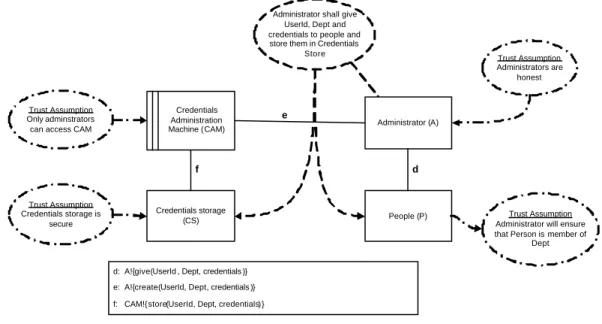
Figure 7 shows how credentials are administered, showing that a human Administrator gives a UserId, Dept affiliation and credentials to People, and then provides the same information to the Credentials Administration Machine (CAM). This causes the CAM to store the information in the Credentials Store. The specification of the behaviour of the CAM machine is as follows:
1. A!{create(UserId, Dept, credentials)} shall cause CAM!{store(UserId, Dept, credentials)}
Credentials storage (CS)
f
d: A!{give(UserId , Dept, credentials )} e: A!{create(UserId, Dept, credentials )} f: CAM!{store(UserId, Dept, credentials)}
Figure 7: Administration of Credentials
People (P) d
Trust Assumption Administrator will ensure that Person is member of
Dept Administrator (A)
Trust Assumption Only adminstrators
can access CAM
Trust Assumption Credentials storage is secure Trust Assumption Administrators are honest e Credentials Administration Machine (CAM)
Administrator shall give UserId, Dept and credentials to people and store them in Credentials
Store
3.4 Review of the Case Study
What steps did we go through in our attempt to define the requirements for a workable secure system? We can identify the following:
• An initial definition of system requirements and problem frame in section 3.1
• A revised definition of the system requirements to include security requirements, in section 3.2.2
• Introduction of the security requirements into the problem frame in section 3.3.1, using the UserId approach, which is infeasible with the original Problem Frame
• A solution, using the UserId approach, in section 3.3.3. This was infeasible with the original problem frame. The problem frame needed modification.
• Since the problem frame had changed, it was necessary to iterate the correctness argument, that the requirements met the goals, although this was trivial in this case
• This finally enabled us to define a software specification that, given the trust assumptions, could be argued to satisfy the system requirements.
4.
Discussion
A number of issues have arisen in the course of expounding our view of security requirements artefacts.
4.1 Security Goals
4.1.1 Characteristics of Security Goals
An organisation's security goals have some characteristics which make them hard to manage:
• They cannot immediately be discharged by the specification of requirements, but have to be re-interpreted at each iteration of the design.
• They may interact with each other.
Security Goals are not Discharged by Security Requirements
At every iteration between requirements and design, whenever a new functional requirement is introduced that requirement must be evaluated against the security goals and appropriate security requirements introduced. One cannot assume that the existing security requirements are sufficient in the presence of new functional requirements.
For example, although some security requirements may be necessary to achieve the Confidentiality goal, they may not be operating in isolation. We will assume that there is also an Availability goal to be achieved, and that one of the means of achieving Availability is to perform regular data backups. A Backup functional requirement will therefore be introduced at a later iteration of our requirements. This implies in practice that a copy of the information exists that can be read using a function that was not defined in our original requirements. Unconstrained use of this function can violate the Confidentiality goal, and therefore there will need to be a security requirement that constrains its use. At a still later stage, an engineer's access to the Machine for maintenance purposes can also provide access to the information, using yet another function, which generates yet further security requirements.
The original security goal has not changed, but at each iteration of the requirements, when additional functions are introduced, additional security requirements to constrain the use of those functions may need to be added.
Security Goals Interact
Security goals interact. For example, it might be decided to introduce an encryption function in order to achieve Confidentiality. This is a new function for the system, and its use must be evaluated against all the security goals. One of those goals is Availability, and analysis shows that Availability is threatened by the loss of a secret key; our solution to confidentiality has undermined Availability. Therefore further measures need to be taken to ensure that the Availability goal is still met, either by ensuring that the secret key is always available or by reconsidering the design decision.
4.1.2 Are All Security Goals Negative?
Most security goals should be represented as the avoidance of harm. We have sympathy with the view of van Lamsweerde in [55], where only Confidentiality is described as an Avoid goal, with Integrity and Availability being Maintained and Achieved. However, it is necessary to consider the amount of possible harm in order to decide how important each goal is.
We are leaving it as an open question at present whether there are other application security goals, which do not need to be related to the possibility of harm to assets. For example:
• Is Anonymity a separate goal, or is it better regarded as a means of achieving a goal such as Confidentiality?
• Should provision of the Provenance of information, to help judge the amount of reliance that can be placed on the information, be regarded as a separate goal?
In neither case do we have a definitive answer.
It is clear that other security goals can be stated directly, if they arise from an organisation's management control principles, derived from previous experience of the need for security. For example, the Principle of Least Privilege – that no one should have more authority than is needed to carry out there duties – may have been adopted generally by an organisation. It can be used directly to derive system security requirements without the need fo r a detailed consideration of possible harm. However, the lack of a "value" – an assessment of the amount of harm that it prevents – for a goal of this kind makes it more difficult to manage when trade-offs become necessary.
4.1.3 Derived Security Goals
Where do security goals come from? The obvious source is as described above, from threats of harm to an organisation's assets, e.g. a bank's goal not to lose its own money.
However, they may arise indirectly from other goals. An example of this is a bank's goal to maintain a good reputation. A necessary condition is that it should be able to demonstrate its commitment to protect its customers' money, in addition to its own. Therefore there is a derived goal – protect customers' money – which depends upon the bank's Reputation goal. So, eliciting security goals cannot be done from a narrow security perspective; all of the organisation's main goals have to be taken into account.
4.2 Security Requirements
4.2.1 Why Define Security Requirements at all?
As remarked in the Introduction, there seems to be a curious reluctance in previous published work to define any explicit representation of security requirements. We have already made the point in motivating our work (section
1.2.2 above) that their representation is important because of the possibility of conflict between stakeholders. In addition, since traceability of requirements is essential, we need to be able to refer to each individual security requirement. If we accepted that it is necessary to be able to refer to security requirements, why have we chosen to define them as constraints? We do not claim to be correct in defining security requirements as constraints on functional requirements; we are proposing a software engineering approach, not carrying out scientific research. Our reasoning for proposing this as a useful definition is as follows:
• Requirements specifications, in general, describe the functions (or operations or services) to be provided by a system.
• It is clearly desirable for the specification to describe security requirements in a way that enables them immediately to be related to the functions.
• Constraints upon functions are a natural way to do this.
Other candidate forms for security requirements, which we have rejected, are:
• Security goals. Security goals are necessary as a starting point, but they are more abstract than functional requirements, and may conflict. If designers were only given security goals to work with, it would be necessary for the m to carry out further work that belongs in the domain of the requirements engineer: decid ing how the security goals should be operationalised in the requirements; and resolving conflicts when necessary.
• Security functions. A security function such as encryption is part of the solution, and the specification of security requirements in terms of security functions may lead to a non-optimal and/or an incomplete design.
It appears to us that, in order to ensure that requirements engineers and system designers each work within their appropriate limits, the appropriate boundary between security requirements engineering and security design is provided by our proposal.
Why a Software Security Specification Cannot Be Considered Alone
We are insisting that security requirements must be regarded as a systems engineering problem, and that software security cannot be considered on its own. This contrasts with Michael Jackson's explicit focus [28] on the computer and its software. There are several reasons for our approach, which needs a broader approach than his because the concerns are wider:
• Security goals, unlike functional goals, cannot be discharged by the specification of a suitable constraint or function; they must be considered at every iteration of the development activity.
• Security analysis needs to consider several domains simultaneously.
• Security requirements may constrain domains other than the machine.
4.2.2 Residual Security Requirements?
It is often stated that security is only as strong as its weaknesses, and it is therefore important for it to be complete. We must therefore ask whether, by specifying constraints on the functions that are to be provided by an application, we have produced a complete set of security requirements?
If we assume that we have a complete statement of the organisation's security goals, and have taken them all into account in deriving the constraints, then the answer is Yes. It would be tempting to include another requirement for an application: "and nothing else must happen" so as to ensure that the designers do not assume that they need do nothing else to ensure a secure system.
However, we have no means of expressing what we mean by "nothing else", so we are stating a general goal, rather than providing a specification of security requirements to a designer, and there is no point is adding "and nothing else" to the security requirements. However, we should recognise that the security goals have not been discharged by the specification of constraints on system functions; that is a necessary, but not sufficient, condition for the satisfaction of the security goals by the implementation.
This is a proper separation of concerns. To take an example from the case study, the organisation has a security goal of Confidentiality of Personnel Information. If it is to achieve this goal, then it will have to state security requirements on a number of activities and domains, including securing the engineer’s hardware interface and communications infrastructure. By proposing a new application we have introduced some additional functions by which the security goal could be breached and the security requirements for the new application is properly and completely expressed as appropriate constraints on the functions.
Two issues arise:
1. Additional functionality introduced in the design;
2. The properties of the machine within which the application is embedded.
Additional Functionality Introduced in Design. When the system requirement results in a design, then the implementation of that design may result in additional functions, adding ways in which security goals could be violated, e.g. through the engineer’s hardware interface or through a hacker intercepting communications. In order to achieve the organisation’s security goals, additional operational security requirements will need to be derived, from the security goal, for the engineer’s system and the communications infrastructure.
Machine Properties. The application will almost always be run on an existing operating system and using existing utilities. This software will provide additional functionality, and therefore expose the application to additional risks. Analysis of these risks is essential, and the security requirements for the application will need to take them into account, but the risk analysis of this software is independent of, and prior to, the development of security requirements for the application.
So, our conclusion is that, if the analysis has been done thoroughly, the security constraints do constitute the complete set of security requirements for the application as far as it is understood at that point. However, the organisation's security goals are never discharged until there is an implemented system, and the security goals must be revisited whenever additional functionality is proposed during the course of development.
4.2.3 Security Requirements and Security Properties
Security "properties" are often referred to, especially in formal specifications; for example, Heitmeyer [20] gives examples, some of which are predicates on state, and others predicates on the relationship of successive states. We need to consider how they fit into this framework. Most security properties are expressed in terms of constraints on traces of the behaviour of a system, and this fits in very well with our own view of security requirements as constraints on the operations of a system. It emphasises that realistic security requirements are likely to be far more complex than the simple constraints that we have used in this paper.
Some security properties may, of course be expressed at a lower level than system requirements, and it will only be possible to discuss them at that lower level. There are security properties, such as "no covert channels", which do not conform to the constraint model. They are like the "and nothing else must happen" requirement of section 4.2.2 above, and we take the same view, that they are not a concern for system security requirements, but must be addressed at a design or implementation level.
4.2.4 Quality Constraints and Security Requirements
A set of requirements can contain many constraints on functions, derived from a variety of goals, e.g. constraints arising from all the other quality goals that are relevant to a system, such as performance and reliability. If we examine a constraint, such as the following, how do we know that it is a security requirement?
The machine shall not display Personnel Information except to members of HR Dept.
The answer is, we cannot identify this as a security requirement from its contents alone. Why not? Consider a hypothetical Personnel Information Display System in an environment in which the honesty and discretion of all users has never been in any possible doubt, so that the organisation has no need of any security goals at all. However, it has a goal of Comprehensibility, and the Personnel Information is so difficult to understand that it is considered essential for all information to be interpreted by members of HR Dept, rather than being directly available to all users. Then, although there is no Confidentiality goal, the constraint has been derived in order to satisfy the Comprehensibility goal, and it would be reasonable to call it a comprehensibility requirement, not a security requirement.
From this we conclude that any particular constraint is identified as a security requirement by the source goal from which it is derived, and not from its contents.
Of course, a constraint can be derived from multiple goals and therefore belong to multiple categories.
4.3 Analysing Security Requirements
Although this paper is not about analysis, some comments about its role are needed. We make the conventional distinction between verification and validation:
• Verification is about the analysis of an artefact on its own, ensuring its completeness and internal consistency;
• Validation is about the relationship of the artefact to the artefacts from which it is derived: in the case of goals and requirements, whether the system requirements satisfy the system goals and whether the software specification satisfies the system requirements.
We demonstrate, using a very simple example from our case study, that analysis is possible and useful at an early stage. There is a security requirement that People who are not members of HR Dept are prohibited from displaying personnel information. Analysis (in this case informal) shows that this constraint does not prohibit a member of HR Dept who is currently suspended, possibly because of allegations of dishonesty, from seeing personnel information. This will certainly be regarded by the customer as an example of unauthorised access, so that the security requirement, as stated, is invalid. A more tightly specified security constraint is needed and will be straightforward to generate.
4.3.1 Internal Analysis (Verification)
Security requirements are simply a set of statements, and are therefore subject to the same kind of internal analysis as any other similar set. Taken as a whole are the functional requirements and their associated constraints complete and mutually consistent? For example, security constraints can be mutually inconsistent or conflict with safety constraints. This verification activity is not special to security requirements, and we do not discuss it further.
4.3.2 External Analysis of Security Requirements (Validation)
Even if internal analysis of the requirements has verified that they are consistent, validation is still necessary at two stages.
• Are the system security requirements a valid refinement of the security goals?
• Is the problem frame, including its software security specification and trust assumptions, a valid refinement of the system security requirements?
At each stage there are two kinds of analysis that are appropriate:
• Construction of a correctness argument, that the refinement is correct;
• Vulnerability analysis: the discovery of flaws in the system security requirements so that they do not satisfy the security goals (first stage); or