Self-consistent continuum solvation (SCCS): The case of charged systems
C. Dupont, O. Andreussi, and N. Marzari
Citation: The Journal of Chemical Physics 139, 214110 (2013); doi: 10.1063/1.4832475 View online: http://dx.doi.org/10.1063/1.4832475
Self-consistent continuum solvation (SCCS): The case
of charged systems
C. Dupont,1,2,a)O. Andreussi,2and N. Marzari2
1Institut Carnot de Bourgogne, UMR 6303 CNRS - Université de Bourgogne, BP 47870,
F-21078 Dijon, France
2Theory and Simulation of Materials (THEOS), École Polytechnique Fédérale de Lausanne,
Station 12, 1015 Lausanne, Switzerland
(Received 26 July 2013; accepted 7 November 2013; published online 4 December 2013)
The recently developed self-consistent continuum solvation model (SCCS) [O. Andreussi, I. Dabo, and N. Marzari, J. Chem. Phys.136, 064102 (2012)] is applied here to charged species in aqueous solutions. Describing ions in solution represents a great challenge because of the large electrostatic interactions between the solute and the solvent. The SCCS model is tested over 106 monocharged species, both cations and anions, and we demonstrate its flexibility, notwithstanding its much reduced set of parameters, to describe charged species in solution. Remarkably low mean absolute errors are obtained with values of 2.27 and 5.54 kcal/mol for cations and anions, respectively. These results are comparable or better than the state of the art to describe solvation of charged species in water. Finally, differences of behavior between cations and anions are discussed.© 2013 AIP Publishing LLC. [http://dx.doi.org/10.1063/1.4832475]
I. INTRODUCTION
Many chemical or biochemical reactions occur in solution, and in particular in water; it is thus of outmost importance to properly describe solvent effects in quantum simulations. Most often the solvent plays such a fundamental role that chemical processes cannot be properly described when omitting it. Nevertheless, a full explicit description of all solvent molecules is both extremely expensive and often not necessary; and many continuum models have been devel-oped. Among the most popular, one can mention the family of SMx models developed by Truhlar and co-workers,1–6
the widely used PCM model of Tomasi and co-workers,7–9
and the COSMO model of Klamt and Schüürmann.10 While
all these developments have been implemented in quantum chemistry codes, recently, starting from the dielectric model proposed by Fattebertet al.,11–13a new continuum model has
been developed by Andreussi et al.,14 building on the pre-vious developments of Scherlis et al.13 This self-consistent continuum model (SCCS) has been shown to offer high accuracy (mean absolute errors around 0.3–0.4 kcal/mol on large sets of neutral molecules and 1.2 kcal/mol on a complete set of 248 molecules), with an elegant and compact formulation, which relies on a much reduced number of parameters, and solving the ill-conditioning issues that affected the original dielectric model (see also Refs.15and
16 for slightly different, but not variational, implementa-tions). In addition, the SCCS approach has been designed for first-principles molecular dynamics (MD) simulations, plane wave basis sets, and periodic boundary conditions, thus allowing the extension of continuum solvation to a wider range of applications. We note that recent developments in classical density functional theory (DFT) for liquids have
a)Electronic mail: [email protected]
been applied to solvation properties, and joint DFT17,18 also
appears as a promising approach to extend the capabilities of solvation models in first-principles simulations.
Despite their high accuracy, continuum models present limitations when dealing with ions and numerous efforts have been dedicated to study solvation of charged species. Never-theless, no model has allowed to reach the same absolute ac-curacy that obtained for neutral compounds. For example, ap-plications of SMx4–6or related models19–21that lead to mean
absolute errors below 1 kcal/mol (often around 0.5 kcal/mol) for neutral molecules give errors for charged species that are at least 4 kcal/mol. Other investigations based either on PCM,9 on the Miertus-Scrocco-Tomasi model,22,23 or on
hybrid approaches24 also report errors of several kcal/mol
for ions. Hence, reaching chemical accuracy (lower than 1 kcal/mol), as is the case for neutral molecules represents a great challenge.
Of course, charged species are associated to strong elec-trostatic effects and interactions with the solvent that compli-cate the description of the solute-solvent interactions. In fact solvation energies for ions are typically one order of magni-tude larger than for neutral compounds. Given these strong interactions, the role and definition of the cavity surrounding the solutes play an even more important role than for neutral species. Several efforts9,25,26have been dedicated to improve
the definition of cavities for charged species, but it remains a most critical step in trying to reach high accuracy.
A second source of uncertainty comes from the lack of experimental data for ions. In particular, no direct experimen-tal measurements are possible for the solvation free energies of single ions. Several papers3,27–29have addressed this point
and provided databases for solvation energies, but the field still lacks in its comparison with the case of neutrals.
Despite these limitations, the study of charged species in solution cannot be avoided: ions act as reaction intermediates
214110-2 Dupont, Andreussi, and Marzari J. Chem. Phys.139, 214110 (2013)
in numerous chemical reactions and charged species in so-lution are also fundamental in electrochemistry, inorganic chemistry, and biochemistry. In this paper, the SCCS model is applied to charged species — both cations and anions. The definition of the cavity is found to be of crucial importance, and we exploit the great flexibility of the model to improve its accuracy for ions solvation. The article is organized as follows: after a brief description of the main features of the model, new parameterizations are reported for both cations and anions, and a careful analysis of the mean absolute errors (MAE) obtained is performed. The overall qualitative behav-ior for anions and cations is discussed, together with the main limitations and the possible improvements of the proposed approach.
II. METHODOLOGY
Since a detailed description of SCCS model is reported in the original paper,14 only its main features are recalled here for the sake of clarity. Both electrostatic and non-electrostatic short-range interactions are defined as function-als of the electronic density of the system, and are optimized self-consistently with the solute in a first-principles calcula-tion. The solvation free energy is defined as
Gsol =Gel(0, ρmin, ρmax)+(α+γ)S+βV , (1)
where all the empirical parameters of the model have been listed explicitly.
In particular, the first term in the above equationGel( 0, ρmin, ρmax) refers to the electrostatic contributions, which are computed from the electrostatic interaction of the so-lute charge density with a dielectric medium surrounding a molecular shaped cavity built around the solute, following Refs. 11 and 12. Such a cavity is defined as an optimally smooth function of the electronic density of the solute in terms of two thresholds, ρmin andρmax: regions of space in which the electronic density is greater thanρmaxare assigned a vacuum-like permittivity ( =1) while, as the electronic density falls below ρmin, the static permittivity of bulk di-electric (=0) is considered. References11–14iterated on the optimal form for the dielectric function. The second part of the solvation energy in Eq. (1) corresponds to the non-electrostatic contributions, which in the SCCS model are as-sumed to be proportional to the quantum surface S and the quantum volumeV of the solute. BothSandV are defined in SCCS in terms of isosurfaces of the electronic density30 and
thus enter self-consistently into the problem. Among the non-electrostatic terms,γSrefers to the cavitation energy, withγ
the experimental surface tension, while the sum ofαS+βV
is related to repulsion and dispersion terms, withαandβ cor-responding to two tunable parameters. In summary, of the six parameters which enter the SCCS definition of solvation free energy, two correspond to well characterized bulk properties of the solvent (0andγ), while the other four represent
intrin-sic properties of the solvent-solute interaction. We note thatγ
andαappear together, and only their sum is relevant. We have kept these separate to investigate future non-aqueous solvents and to possibly avoid refittingα. While first-principles sim-ulations could provide some estimates of these parameters,
the very compact representation of the solvation free energy in terms of such a limited number of parameters allow to fit them on experimental results.
In this study, the SCCS model is applied to a large set of 106 monocharged species — both cations (51) and an-ions (55) — representative of different chemical families. This set is based on the one previously defined by Cramer
et al.4 for the SM6 model and is detailed in the
supplemen-tary material.44 Compared to the database defined in Ref.4,
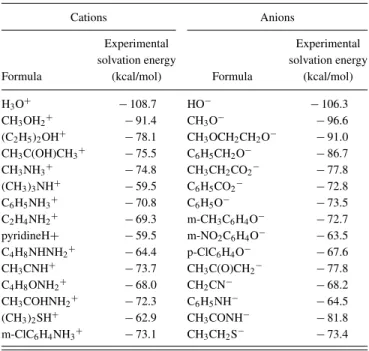
one cation and five anions are missing, due to convergence is-sues. In Truhlar’s studies, these six species all correspond to clustered ions (i.e., inclusive of explicit solvent molecules). In fact, besides these six ions, in the remaining set 7 cations and 18 anions have been clustered in the study of the SM6 model,4while, we stress, no explicit water molecules are used in our study. This database was selected for two reasons. First, it allows an accurate comparison with results of the SM6 model.3Then, as already mentioned, experimental solvation energies for ions are scarce, and this set is certainly one of the most extended databases available in the literature. To fit the tunable parameters of SCCS, two reduced sets composed of 15 cations and 15 anions are considered and described in TableI, together with their experimental solvation energies. These subseries of anions and cations are chosen to be repre-sentative of both the diversity of chemical families available in the whole set and the mean absolute error of the complete database.
All calculations have thus been performed modelling the aqueous solution via the SCCS approach, as implemented in the open sources Quantum ESPRESSO package.31 This is based on density-functional theory with periodic-boundary conditions using the Martyna-Tuckerman correction32 to avoid spurious periodic charged images, recently extended to this case of continuum solvation.33 The generalized gradient approximation (GGA) has been applied in the Perdew-Burke-Ernzerhof (PBE)34 form for the
TABLE I. Reduced sets of cations and anions used for fitting the SCCS parameters. Experimental solvation energies are given in kcal/mol.
Cations Anions
Experimental Experimental solvation energy solvation energy Formula (kcal/mol) Formula (kcal/mol)
H3O+ −108.7 HO− −106.3
CH3OH2+ −91.4 CH3O− −96.6
(C2H5)2OH+ −78.1 CH3OCH2CH2O− −91.0
CH3C(OH)CH3+ −75.5 C6H5CH2O− −86.7
CH3NH3+ −74.8 CH3CH2CO2− −77.8
(CH3)3NH+ −59.5 C6H5CO2− −72.8
C6H5NH3+ −70.8 C6H5O− −73.5
C2H4NH2+ −69.3 m-CH3C6H4O− −72.7
pyridineH+ −59.5 m-NO2C6H4O− −63.5
C4H8NHNH2+ −64.4 p-ClC6H4O− −67.6
CH3CNH+ −73.7 CH3C(O)CH2− −77.8
C4H8ONH2+ −68.0 CH2CN− −68.2
CH3COHNH2+ −72.3 C6H5NH− −64.5
(CH3)2SH+ −62.9 CH3CONH− −81.8
exchange-correlation functional and Vanderbilt ultrasoft pseudo no space potentials (USPP) were used from the PSli-brary of Dal Corso.35,36 Plane wave cut offs of 40 and 400 Ry have been used for wave functions and charge densities, respectively. To provide good convergence, simulation-cell sizes have been defined with the following criteria: the cell dimensions need to be 25 Å larger than the largest dimension of the ion, or to be at least 30 Å for small ions.
Calculations have also been performed with GAUSSIAN 0337 and GAUSSIAN 09,38using the PBE exchange
correla-tion funccorrela-tional. This allows a comparison of the SCCS model with two flavors of IEF-PCM.39,40 While both versions of
IEF-PCM are based on the same physical model, they differ, among other things, in the definition of the molecular cavity and in the way polarization charges are represented numeri-cally. For geometry optimizations, the double zeta 6-31G(d) basis set has been considered, while energies have been com-puted with the triple zeta 6-311+G(d,p) basis set.
III. RESULTS
A. General behavior
In the application of the SCCS model to neutral molecules,14 two optimal sets of parameters were proposed,
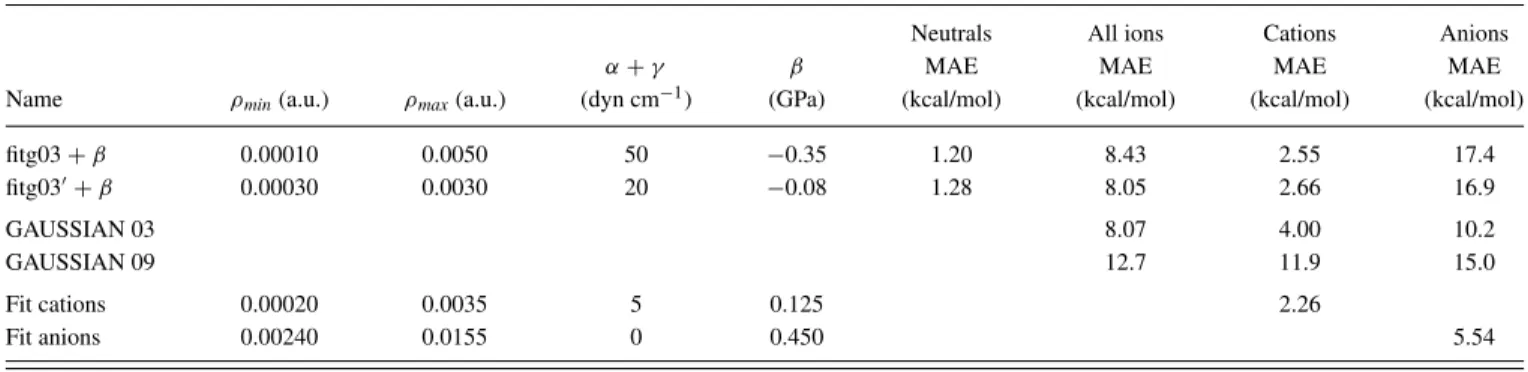
namely,fitg03+βandfitg03+β, referring to different fits of the electrostatic and non-electrostatic parameters. As the first step in the present study, the same sets of parameters are applied to the case of charged species in solution and the val-ues obtained are reported in TableII.
At first glance, MAEs appear to be very high compared to those of the neutral set: in fact MAE around 10 kcal/mol are obtained for the complete set of ions, as opposed to 1.2 kcal/mol for the case of neutrals. Nevertheless, due to the strong electrostatic interactions existing between the charged solute and the solvent, solvation energies for ions are, on aver-age, ten times larger than those for neutral molecules. Thus it could be more consistent to discuss the percentage error than the MAE: in this case, the value of 14.3 % obtained for ions is clearly of the same order of magnitude than the one of neutral molecules. Besides, these results also compare well with IEF-PCM models. In particular, MAE obtained with both GAUS-SIAN 03 and GAUSGAUS-SIAN 09 are in the same range, with val-ues of 8.09 and 12.7 kcal/mol, respectively. If the SM6 model
of Truhlar and co-workers3 is considered: a MAE between 4.19 and 14.95 kcal/mol was found for a similar set of ions, and depending on the functional and on the basis set used.
While the above considerations are relevant for an all pur-pose model, it is worthwhile to analyze the accuracy of the SCCS approach separately for the specific cases of cations or anions. In fact, despite having solvation free energies of the same order, MAE for anions are more than six times larger than the ones for cations. This difference of behavior has al-ready been evidenced in previous studies3,4and can be related
to the more localized charge of cations compared to anions. By restricting the analysis to the case of cations, a MAE of 2.55 kcal/mol is obtained with the fitg03+ β set of pa-rameters. Compared to previous results in the literature, this value is clearly remarkable: it stands below the best value of 2.72 kcal/mol obtained by Truhlar and co-workers3 using clustered ions (i.e., ions with explicit water molecules) in the set, and also clearly outperforms the PCM model of both GAUSSIAN 03 and GAUSSIAN 09 (see TableII).
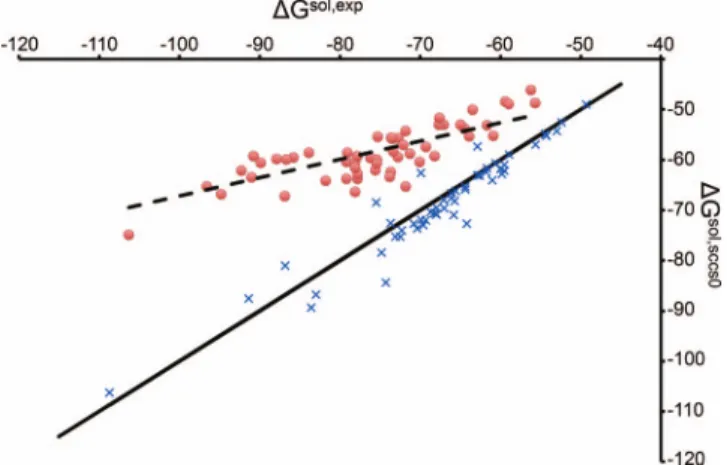
For the case of anions, it is important to notice a systematic deviation from the experimental results. In particular, by comparing the calculated solvation energies (Gsol,SCCS) to the experimental ones (Gsol,exp), as reported
in Figure1, it is clear that solvation energies for anions are systematically underestimated. This has to be compared to the case of cations, whose solvation energies are either over or underestimated and stand close to the ideal fit (solid line in Figure1). These results suggest that anions, or all charged species, might benefit from a different parametrization and this is investigated in Sec.III B.
B. New parameterization of the SCCS model for charged species
1. Cations
A new optimization of the 4 parameters in the SCCS models has been performed iteratively, by alternate mini-mizations of the MAE for a the reduced set of cations (see Table II) in the two-dimensional subspace of electrostatic (ρminandρmax) parameters and in that of the non-electrostatic
(αandβ) parameters. The final iteration on these electrostatic parameters is reported in Figure2(a). According to the results, an excellent MAE of 2.07 kcal/mol is obtained when using
TABLE II. Mean Absolute Errors (MAE) in kcal/mol for the two sets of parameters defined in the original article.14Previous values for neutral molecules (from Ref.14) are listed, while MAE (in kcal/mol) are reported for charged species (all ions, cations and anions). Results obtained with the IEF-PCM model implemented in either GAUSSIAN 03 or GAUSSIAN 09 are also reported. Finally, new fits obtained in this paper for cations and anions are also reported.
Neutrals All ions Cations Anions
α+γ β MAE MAE MAE MAE
Name ρmin(a.u.) ρmax(a.u.) (dyn cm−1) (GPa) (kcal/mol) (kcal/mol) (kcal/mol) (kcal/mol)
fitg03+β 0.00010 0.0050 50 −0.35 1.20 8.43 2.55 17.4
fitg03+β 0.00030 0.0030 20 −0.08 1.28 8.05 2.66 16.9
GAUSSIAN 03 8.07 4.00 10.2
GAUSSIAN 09 12.7 11.9 15.0
Fit cations 0.00020 0.0035 5 0.125 2.26
214110-4 Dupont, Andreussi, and Marzari J. Chem. Phys.139, 214110 (2013)
FIG. 1. Calculated solvation energiesGsol,SCCS(in kcal/mol) as a function of experimental dataGsol,exp(in kcal/mol) for all cations (×) and anions (•) considered. The solid line represents the ideal fit (slope=1), while the dotted one represents the fit for anions.
ρmin=0.0002 a.u. andρmax=0.0035 a.u., for instance. It is
important to stress that, as reported for neutral molecules, a continuum of (ρmin;ρmax) pairs leads to this low MAE, thus
pointing to a correlation between the two.
We note in passing that, for the same range of ρmin
and ρmax plotted in the figure, neutral molecules14 show a
smoother evolution with MAE between 0.4 and 4.6 kcal/mol, while for cations, the MAE is comprised between 2.07 and 13.8 kcal/mol. This result confirms the larger contribution of electrostatic phenomena for charged species compared to neutral.
Starting from the best (ρmin; ρmax) pair, the last step of optimization of the non-electrostatic parameters is reported in Figure2(b). Qualitatively, the behavior of cations towards non-electrostatic parameters is similar to the one already men-tioned for neutrals,14showing a linear relationship betweenα +γ andβ. As suggested for neutral solutes, such a
behav-ior can be rationalized in terms of the small sizes of the sys-tems considered, for which a strong coupling between quan-tum surface and quanquan-tum volume is expected. Quantitatively, no further improvement occurs after this last optimization of non-electrostatic parameters, with only a negligible modifica-tion of the MAE is observed with respect to the final value of 2.07 kcal/mol for the selected group. Finally, as the best set of parameters is applied on the whole ensemble of cations, an overall MAE of 2.27 kcal/mol is obtained. This value is remarkable: it corresponds to a percentage error of 3.34%, much better than that obtained for neutral molecules.
2. Anions
The same iterative procedure described above has been applied to model the solvation energies for anions. Due to the comparatively poor results for the initial sets of parameters, a wider range of values for ρmin andρmax has been
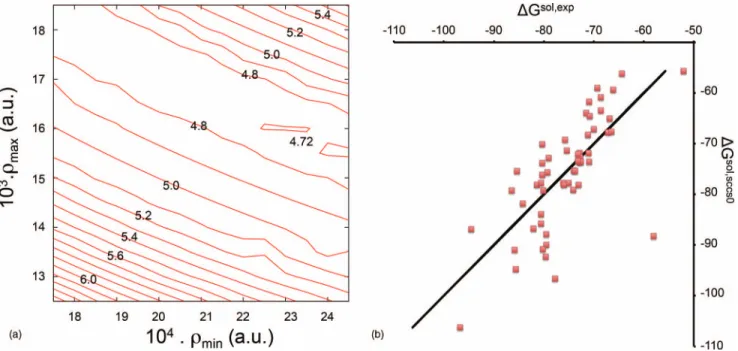
consid-ered. The final step of the optimization of the electrostatic parameters is reported in Figure3(a), withρminin the range
between 0.00175 and 0.00225 a.u. andρmax between 0.0125
and 0.0185 a.u., both one order of magnitude larger than the case of neutral species and cations.
Qualitatively the evolution of the MAE with ρmin and
ρmax is similar to the one already discussed for cations. In
particular, anions present a sensitivity towardsρminandρmax
similar to the one already mentioned for cations. This con-firms the stronger influence of electrostatic parameters for charged species. The non-electrostatic parameterization is re-ported in the supplementary material,44and leads to an identi-cal behavior as the one discussed for cations: a linear relation-ship betweenα+γ andβ. Only the range of values differs: largerβ leads to lower MAE, a symptom of the larger repul-sion for the solvent water molecules associated to the anions. Following these successive optimizations, a very good MAE
FIG. 2. MAE (in kcal/mol) calculated with respect to the experimental solvation energies for the 15 cations of the reduced database: optimization of (a) electrostatic parameters with β = 0.125 GPa and α + γ = 5 dyn/cm, and (b) non-electrostatic parameters withρmin = 0.00020 a.u. and ρmax
FIG. 3. (a) Mean Absolute Error (in kcal/mol) calculated with respect to the experimental solvation energies, for the 15 anions of the reduced database: influence of electrostatic parameters withβ=0.450 GPa andα+γ=0 dyn/cm. (b) Calculated solvation energies (in kcal/mol) as a function of experimental ones (in kcal/mol) for all anions, forρmin=0.0024 a.u.,ρmax=0.0155 a.u.,β=0.450 GPa andα+γ=0 dyn/cm. The ideal fit (slope=1) is identified by the black line.
of 4.71 kcal/mol is obtained for the reduced set. As for cations, this value is somewhat increased when all anions are considered, reaching a global MAE of 5.54 kcal/mol. Qual-itatively, the overall behavior is clearly improved compared to the experimental values. In fact, at variance with the re-sults of Figure 1, a more homogeneous distribution is ob-tained (see Figure3(b)), with solvation free energies that are both over and underestimated. Nevertheless, some discrepan-cies still remain. In fact, if most of solvation energies are well described with relative errors well below average, some an-ions still present high discrepancies (up to 30 kcal/mol for H2C=CHCH2O−, for instance). Given the relatively small
set we have used (only 55 anions), it is difficult to perform an accurate analysis in terms of the different chemical func-tionalizations of the solutes. However, according to the de-tailed values reported in the supplementary material,44 it
ap-pears that electronic delocalization (for instance anions with aromatic rings) leads to low relative errors since a more dis-tributed charge density decreases the interaction between the solvent and the solute, this could lead to higher accuracy. We conclude mentioning also some of the fundamental is-sues in describing anions in density-functional theory — a notoriously challenging case, where often local or semi-local exchange correlation functionals fail to bind the additional electrons. Hybrid functionals ameliorate this failure, but the correct asymptotic behaviour of the charge density cannot be achieved with functionals that do not have the correct long-range behaviour — hence further studies in this direction would certainly be warranted.
C. Discussion
The performance of the SCCS model can now be dis-cussed in comparison with other continuum solvation mod-els. In particular the IEF-PCM model, implemented in
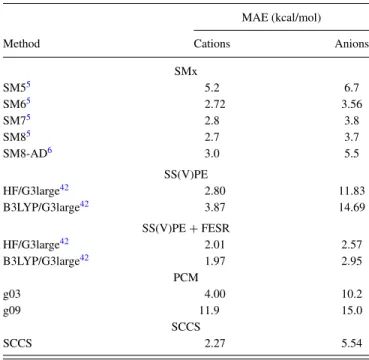
GAUSSIAN 03 and GAUSSIAN 09, the SMx family, the SS(V)PE model, as well as its combination with the FESR correction41,42 are considered here. Results from SMx,5,6
SS(V)PE,42 and SS(V)PE+FESR42 represent a very good
point of comparison, since they are based on a closely similar database. Nonetheless, it is important to keep in mind that the simulations reported in Refs.5and6contain calculations on clustered ions, namely ions surrounded by water molecules, which are not included in the present work and which de-liver significant improvements with respect to a purely con-tinuum picture.3All SMx, SS(V)PE, and SS(V)PE+FESR
re-sults from the literature are reported in TableIII, together with those obtained with SCCS, g03, and g09 in this study.
214110-6 Dupont, Andreussi, and Marzari J. Chem. Phys.139, 214110 (2013)
TABLE III. Mean Absolute Error (MAE) for cations and anions. Results for SM5, SM6, SM7, and SM8 are extracted from Ref.5, while values for SM8-AD are from Ref.6. In all these cases, 52 cations and 60 anions are studied. These include 8 clustered cations and 23 clustered anions. Values for SS(V)PE and SS(V)PE+FESR are from Ref.42and correspond to 51 cations and 60 anions from the Minnesota Solvation Database. Values for PCM / g03, PCM / g09, and SCCS come from this study and correspond to a reduced data set of 51 cations and 55 anions, but without any explicit water molecules.
MAE (kcal/mol)
Method Cations Anions
SMx
SM55 5.2 6.7
SM65 2.72 3.56
SM75 2.8 3.8
SM85 2.7 3.7
SM8-AD6 3.0 5.5
SS(V)PE
HF/G3large42 2.80 11.83
B3LYP/G3large42 3.87 14.69
SS(V)PE+FESR
HF/G3large42 2.01 2.57
B3LYP/G3large42 1.97 2.95
PCM
g03 4.00 10.2
g09 11.9 15.0
SCCS
SCCS 2.27 5.54
strongly correlated, thus confirming the great flexibility of the model to reproduce the chemistry at play with a very minimal set of parameter. For comparison, parameterization of SMx models is based on the intrinsic chemical nature of each atom, obtained first through the optimization of a charge model and then of the SM model itself; as a consequence, several dozen of parameters are required. In addition, the model is fully vari-ational (e.g., as opposed to SS(V)PE-FESR), and so it can be straightforwardly used in first-principles molecular dynamics or in response/perturbation theory (e.g., optical spectra from time-dependent DFT).
In order to understand the different behavior of charged species in SCCS, it is apparent from TableIIthat anions and cations require different shapes for their cavity, and the opti-mal thresholds obtained confirm this observation. In fact, val-ues ofρmin andρmax leading to the minimum MAE for an-ions are around one order of magnitude higher than the ones considered for either cations or neutral molecules. The larger density thresholds for anions lead to smaller cavities, in agree-ment with previous results,43 and this is highlighted by the
example of acetamide, reported in Figure4.
By comparing the cavities optimized for the different pro-tonation states of the acetamide molecule, it is possible to ra-tionalize the behavior of the model for the dielectric func-tion and to address its possible limitafunc-tions. Both anions and cations show dielectric cavities with a sharper interface with respect to the neutral solute, as can be seen from the smaller separation between the two isosurfaces of the electronic den-sity corresponding to the onset of the dielectric (grey surface) and to the dielectric reaching its bulk value (blue surface).
FIG. 4. Representation of the cavity of cationic (left), neutral (center), and anionic (right) protonation states of acetamide. Surfaces corresponding to the limit of vacuum region (associated toρmax) are reported in blue, while sur-faces corresponding to bulk solvent (associated toρmin) are in gray. The op-timized thresholds of each specific case have been used, namely, (ρmin;ρmax)
=(0.0002;0.0035) a.u. for the cation, (ρmin;ρmax)=(0.0001;0.0050) for the neutral, and (ρmin;ρmax)=(0.0024;0.0155) a.u. for the anion.
Moreover, the two interfaces are shown to be closer to the so-lute for both the protonated (positive) and the deprotonated (negative) species.
The latter finding is consistent with the expected behav-ior of a polar solvent on charged systems, which should be dominated by Coulomb monopole-dipole interactions, lead-ing nearby solvent molecules to get closer to the solute. Such a stronger coordination of solvent molecules happens regard-less of the sign of the charge of the solute, even though some asymmetries can be expected between solvated cations and solvated anions in water, due to the different coordina-tion mechanisms mediated by oxygen lone-pairs or hydrogen-bonds, respectively. On the other hand, the sharpness of the optimized dielectric interface cannot be explained solely with electrostatic considerations, as the stronger coordination of solvent molecules due to charged solutes would suggest a more slowly varying dielectric function. In particular, the di-electric constant of the environment immediately surround-ing a charged species is expected to be much lower than its bulk value, since the first solvation shell of water molecule presents a much reduced rotational freedom due to the co-ordination with the solute. Non-electrostatic interactions, in particular hydrogen-bonds, are probably responsible for the behaviors of the dielectric functions in charged species.
FIG. 5. (a) Electronic densities of the three species plotted along the carbon-carbon axis, and in the insets, the corresponding dielectric functions, each of them computed with the optimized parameters (cations, neutrals, and anions, respectively reported above). For comparison, the dielectric functions for the three species, but computed with the parameters optimized for neutrals are reported in panel (b), while the dielectric functions computed on the neutral electronic density with the three different sets of parameters are reported in panel (c).
set of parameters cannot be found which provides the correct description of the solute cavity as a function of the solute to-tal charge, the flexibility of the model allows us not only to accurately describe the separated cases, but points to future expansions that could be made aware of the local charge en-vironment.
D. Conclusions
The revised self-consistent continuum solvation model SCCS is applied here to charged species. Its flexibility and ac-curacy, already demonstrated for neutral molecules, are con-firmed in the study of both cations and anions. As expected, due to the stronger interactions into play, higher mean abso-lute errors, but lower relative errors, are obtained when com-pared to neutrals. In particular, after optimization of both the electrostatic and non-electrostatic parameters, MAEs of 2.27 and 5.54 kcal/mol are found for standard test sets of cations and anions, respectively. These values place the SCCS model among the best solvation continuum models available. In fact, for anions, only the SM6 model, when tested over a set that includes selectively clustered anions (i.e., including explicit water molecules), and the SS(V)PE model in combination with its non-variational correction (FESR) offer better results, while for cations even SM6 displays a higher MAE (with the SS(V)PE + FESR combination comparable but marginally better than SCCS). We thus conclude that the SCCS model is able to reach accurate solvation energies for charged species, while preserving the variational nature of its formulation and its straightforward implementation in extended or periodic systems and associated planewave basis sets. The different parametrization of the model for the case of anions, as op-posed to cations and neutrals, warrants further studies on the description of anions with more accurate functionals, able to correctly describe the highest-occupied orbital and the ex-ponential charge-density decay (a very challenging task), or more detailed physical models of the solute-continuum inter-actions that can preserve the variational nature of the func-tional formulation.
1C. J. Cramer and D. G. Truhlar,J. Am. Chem. Soc.113, 8305 (1991). 2C. J. Cramer and D. G. Truhlar,J. Comput. Chem.13, 1089 (1992).
3C. P. Kelly, C. J. Cramer, and D. G. Truhlar,J. Chem. Theory Comput.1,
1133 (2005).
4C. P. Kelly, C. J. Cramer, and D. G. Truhlar,J. Phys. Chem. B110, 16066
(2006).
5A. V. Marenich, R. Olson, C. P. Kelly, C. J. Cramer, and D. G. Truhlar,J. Chem. Theory Comput.3, 2011 (2007).
6A. V. Marenich, C. J. Cramer, and D. G. Truhlar,J. Chem. Theory Comput. 5, 2447 (2009).
7A. Fortunelli and J. Tomasi,Chem. Phys. Lett.231, 34 (1994). 8B. Mennucci and J. Tomasi,J. Chem. Phys.106, 5151 (1997). 9V. Barone, M. Cossi, and J. Tomasi,J. Chem. Phys.107, 3210 (1997). 10A. Klamt and G. Schüürmann,J. Chem. Soc. Perkin Trans. 21993, 799. 11J. L. Fattebert and F. Gygi,J. Comput. Chem.23, 662 (2002). 12J. L. Fattebert and F. Gygi,Int. J. Quantum Chem.93, 139 (2003). 13D. A. Scherlis, J. L. Fattebert, F. Gygi, M. Cococcioni, and N. Marzari,J.
Chem. Phys.124, 074103 (2006).
14O. Andreussi, I. Dabo, and N. Marzari,J. Chem. Phys.136, 064102 (2012). 15V. M. Sánchez, M. Sued, and D. A. Scherlis,J. Chem. Phys.131, 174108
(2009).
16J. Dziedzic, H. H. Helal, C. K. Skylaris, A. A. Mostofi, and M. C. Payne, Europhys. Lett.95, 43001 (2011).
17S. A. Petrosyan, J. Briere, D. Roundy, and T. Arias,Phys. Rev. B75,
205105 (2007).
18K. Letchworth-Weaver and T. Arias,Phys. Rev. B86, 075140 (2012). 19C. C. Chambers, G. D. Hawkins, C. Cramer, and D. G. Truhlar,J. Phys.
Chem.100, 16385 (1996).
20J. Li, G. D. Hawkins, C. Cramer, and D. G. Truhlar,Chem. Phys. Lett.288,
293 (1998).
21J. Li, G. D. Hawkins, P. Winget, D. A. Liotard, C. Cramer, and D. G.
Truhlar,Theor. Chem. Acc.103, 9 (1999).
22S. Miertus, E. Scrocco, and J. Tomasi,Chem. Phys.55, 117 (1981). 23C. Curutchet, A. Bidon-Chanal, I. Soteras, M. Orozco, and F. J. Luque,J.
Phys. Chem. B109, 3565 (2005).
24J. R. Pliego, Jr. and J. M. Riveros,J. Phys. Chem. A105, 7241 (2001). 25M. Orozco and F. J. Luque,Chem. Phys.182, 237 (1994).
26D. M. Chipman,J. Chem. Phys.116, 10129 (2002).
27J. R. Pliego, Jr. and J. M. Riveros,Chem. Phys. Lett.332, 597 (2000). 28J. R. Pliego, Jr. and J. M. Riveros,J. Phys. Chem. B104, 5155 (2000). 29J. R. Pliego, Jr. and J. M. Riveros, Phys. Chem. Chem. Phys.4, 1622
(2002).
30M. Cococcioni, F. Mauri, G. Ceder, and N. Marzari,Phys. Rev. Lett.94,
145501 (2005).
31P. Giannozzi, S. Baroni, N. Bonini, M. Calandra, R. Car, C. Cavazzoni, D.
Ceresoli, G. L. Chiarotti, M. Cococcioni, I. Dabo,et al.,J. Phys.: Condens. Matter21, 395502 (2009).
32G. J. Martyna and M. E. Tuckerman,J. Chem. Phys.110, 2810 (1999). 33O. Andreussi and N. Marzari, “Electrostatics of continuum solvation
mod-els in periodic boundary conditions” (to be published).
34J. P. Perdew, K. Burke, and M. Ernzerhof,Phys. Rev. Lett.77, 3865 (1996). 35A. Dal Corso, PSlibrary version 0.2.3, see http://qe-forge.org/
projects/pslibrary.
36A. A. Adllan and A. Dal Corso,J. Phys.: Condens. Matter23, 425501
214110-8 Dupont, Andreussi, and Marzari J. Chem. Phys.139, 214110 (2013)
37M. J. Frisch, G. W. Trucks, H. B. Schlegelet al., GAUSSIAN 03, Revision
C.02, Gaussian, Inc., Wallingford, CT, 2004.
38M. J. Frisch, G. W. Trucks, H. B. Schlegelet al., GAUSSIAN 09, Revision
A.02, Gaussian Inc., Wallingford, CT, 2009.
39B. Mennucci, E. Cances, and J. Tomasi,J. Phys. Chem. B 101, 10506
(1997).
40G. Scalmani and M. J. Frisch,J. Chem. Phys.132, 114110 (2010).
41A. Pomogaeva, D. Thompson, and D. M. Chipman,Chem. Phys. Lett.511,
161 (2011).
42A. Pomogaeva and D. M. Chipman,J. Chem. Theory Comput.7, 3952
(2011).
43D. M. Chipman,J. Phys. Chem. A106, 7413 (2002).
44See supplementary material athttp://dx.doi.org/10.1063/1.4832475for the