Cover Page
The handlehttp://hdl.handle.net/1887/66480 holds various files of this Leiden University dissertation.
Author: Liu, Y.
Exploring Images with Deep
Learning for Classication, Retrieval
and Synthesis
Copyright© 2018 Yu Liu, All Rights Reserved ISBN 978-94-6375-139-1
Printed by Ridderprint BV, The Netherlands
An electronic version of this dissertation is available at Link https://openaccess.leidenuniv.nl/handle/1887/9744
Exploring Images with Deep
Learning for Classication, Retrieval
and Synthesis
Proefschrift
ter verkrijging van
de graad van Doctor aan de Universiteit Leiden, op gezag van Rector Magnicus prof.mr. C.J.J.M. Stolker,
volgens besluit van het College voor Promoties te verdedigen op woensdag 24 oktober2018
klokke 11.15 uur
door
Yu Liu
Promotiecommissie
Promotors: Prof. dr. J.N. Kok Dr. M.S. Lew Overige leden: Prof. dr. A. Plaat
Prof. dr. T.H.W. Bäck Prof. dr. W. Kraaij
Prof. dr. H. Trautmann (University of Münster)
Prof. dr. A. Hanjalic (Delft University of Technology) Prof. dr. ir. B.P.F. Lelieveldt
Dr. ir. R. Poppe (Utrecht University)
Yu Liu was nancially supported through the China Schol-arship Council (CSC) to participate in the PhD programme of Leiden University. Grant number 201406060010.
Advanced School for Computing and Imaging
This work was carried out in the ASCI graduate school. ASCI dissertation series number: 387
Contents
1 Introduction 1
1.1 Motivation . . . 2
1.2 Background and Related Work . . . 2
1.2.1 Classication . . . 3
1.2.2 Retrieval . . . 6
1.2.3 Synthesis . . . 8
1.3 Thesis Outline and Research Questions . . . 10
1.4 Main Contributions . . . 15
1.4.1 Models and algorithms . . . 15
1.4.2 Practical scenarios . . . 16
1.4.3 Empirical analysis . . . 17
2 Convolutional Fusion Networks for Image Classication 19 2.1 Introduction . . . 20
2.2 Convolutional Fusion Networks . . . 22
2.2.1 Network architecture . . . 22
2.2.2 Training procedure . . . 26
2.2.3 Comparisons with other models . . . 27
2.3 Fully Convolutional Fusion Networks . . . 27
2.3.1 Semantic segmentation . . . 28
2.3.2 Edge detection . . . 29
2.4 Experiments . . . 30
2.4.1 Image classication on CIFAR . . . 30
2.4.2 Image classication on ImageNet . . . 34
2.4.3 Transferring deep fused features . . . 37
2.4.4 Semantic segmentation on PASCAL VOC . . . 39
2.4.5 Edge detection on BSDS500 . . . 40
2.5 Chapter Conclusions . . . 42
3 Recognizing Image Edges 43 3.1 Introduction . . . 44
3.2 Relaxed Deep Supervision . . . 46
3.2.1 Network details . . . 46
CONTENTS
3.3 Pre-training Procedure . . . 51
3.4 Experiments . . . 53
3.4.1 Implementation details . . . 53
3.4.2 Ablation study on BSDS500 . . . 53
3.4.3 Cross-dataset generalization . . . 56
3.4.4 Computational cost . . . 58
3.5 Chapter Conclusions . . . 58
4 DeepIndex for Image Retrieval 59 4.1 Introduction . . . 60
4.2 Bag of Deep Features . . . 61
4.2.1 Spatial patches . . . 61
4.2.2 Feature extraction and quantization . . . 63
4.3 DeepIndex . . . 63
4.3.1 Single DeepIndex . . . 63
4.3.2 Multiple DeepIndex . . . 65
4.3.3 Global image signature . . . 66
4.4 Experiments . . . 67
4.4.1 Datasets and metrics . . . 68
4.4.2 Results and discussion . . . 68
4.4.3 Comparison with other methods . . . 71
4.5 Chapter Conclusions . . . 72
5 Image-Text Matching for Cross-modal Retrieval 73 5.1 Introduction . . . 74
5.2 Recurrent Residual Fusion . . . 75
5.3 Matching Network . . . 79
5.3.1 Feature extractor . . . 79
5.3.2 Feature embedding . . . 80
5.3.3 Bi-rank loss . . . 80
5.4 Experiments . . . 82
5.4.1 Results and discussion . . . 82
5.4.2 Comparison with other approaches . . . 84
5.4.3 Model ensemble . . . 85
5.5 Chapter Conclusions . . . 86
6 Cycle-consistent Embeddings for Cross-modal Retrieval 87 6.1 Introduction . . . 88
6.2 Related Work . . . 90
6.3 Cycle-consistent Embeddings . . . 91
6.3.1 System architecture . . . 92
6.3.2 Formulation . . . 93
6.3.3 Full objective . . . 94
CONTENTS
6.4 Experiments . . . 98
6.4.1 Experimental setup . . . 98
6.4.2 Comparisons with baseline methods . . . 100
6.4.3 Analysis of late-fusion inference . . . 101
6.4.4 Comparisons with state-of-the-art approaches . . . 103
6.4.5 Eect of feature encoders . . . 105
6.5 Chapter Conclusions . . . 106
7 Joint Matching and Classication 107 7.1 Introduction . . . 108
7.2 Joint Matching and Classication Network . . . 110
7.2.1 Multi-modal input . . . 111
7.2.2 Multi-modal matching . . . 111
7.2.3 Multi-modal classication . . . 113
7.3 Training and Inference . . . 117
7.4 Experiments . . . 119
7.4.1 Experimental setup . . . 119
7.4.2 Results on multi-modal retrieval . . . 121
7.4.3 Results on multi-modal classication . . . 122
7.4.4 Parameter analysis . . . 124
7.4.5 Component analysis . . . 127
7.4.6 Comparison with other approaches . . . 130
7.4.7 Computational cost . . . 132
7.5 Chapter Conclusions . . . 132
8 Applications of Image Synthesis 133 8.1 Image-to-Image Translation . . . 134
8.1.1 Methodology . . . 135
8.1.2 Instantiation network . . . 138
8.1.3 Experiment setup . . . 140
8.1.4 Results on photo↔label . . . 140
8.1.5 Results on photo↔sketch . . . 141
8.2 Fashion Style Transfer . . . 143
8.2.1 Methodology . . . 145
8.2.2 Network architecture . . . 150
8.2.3 Experiment setup . . . 152
8.2.4 Results and discussion . . . 154
8.2.5 Ablation study . . . 156
8.2.6 Limitations and discussion . . . 158
CONTENTS
9 Conclusions 159
9.1 Main Findings . . . 160 9.2 Limitations and Possible Solutions . . . 162 9.3 Future Research Directions . . . 163
Bibliography 167
List of Abbreviations 179
English Summary 181
Nederlandse Samenvatting 183
Chapter 1
1. INTRODUCTION
1.1 Motivation
In 2018, the number of mobile phone users will reach about 4.9 billion. Assuming an average of 5 photos taken per day using the built-in cameras would result in about 9 trillion photos annually. In addition, these photos are frequently uploaded, shared and retrieved in social networks and thus have become an important part of our daily lives. However, it is challenging to mine semantically meaningful visual information from such a huge amount of data. Thanks to the major advances of deep neural networks since 2012, they have been a powerful tool to help analyze visual content for a variety of tasks and have triggered a massive amount of research in content based multimedia analysis and computer vision. This thesis aims towards developing new paradigms and architectures in deep learning to address three common and important research themes: classication, retrieval and synthesis. As shown in Figure 1.1, we visibly depicts the three themes.
Classication is the most fundamental task in the eld of computer vision. It aims to correctly predict the class label for a given image, for example, we can use a classication model to classify the input horse image. In addition to image-level classication, we also study the tasks of pixel-level classication, including semantic segmentation and edge detection. (Chapters 2 and 3) Retrieval aims to eciently search for similar samples from the database to
the query. For instance, we develop a retrieval model to retrieve similar horse images. Besides, we also consider the cross-modal retrieval problem between images and texts, and do some work to bridge the modality gap between vision and language. (Chapters 4, 5, 6 and 7)
Synthesis is able to generate new image samples that never existed in the image database. For example, by training a synthesis model, we can translate a horse image to a zebra image. In addition, we can synthesize diverse zebra images based on dierent branches of the network. In this thesis, we mainly focus on two synthesis applications: image-to-image translation and fashion style transfer. (Chapter 8)
In the next sections, we rst introduce the background and developments related to the three themes in recent years. Then we present the thesis outline, our research questions and main contributions.
1.2 Background and Related Work
1.2 Background and Related Work
Classification Theme
Input Image
Synthesis Theme Retrieval
Theme
Horse
Segmentation Edge detection Class label
Similar horse images in the database
Horse-to-zebra translation
Figure 1.1: Conceptual illustration of the three research themes in this thesis, in-cluding classication, retrieval and synthesis.
processing. By distilling high-level semantic information with deep network archi-tectures, deep learning approaches can help narrow the gap between visual represen-tations and human-level vision. In recent years, deep learning has been extensively studied in the eld of computer vision to help tackle many challenging tasks, such as image classication, image retrieval and image synthesis.
1.2.1 Classication
In recent decades, exploiting and developing convolutional neural networks (CNNs) [3] has been a leading and promising trend in computer vision community. CNNs can explore high-level visual concepts in images by employing deep architectures com-posed of multiple neural layers. In 2012, Krizhevsky et al. [4] procom-posed a new CNN model named AlexNet for generic image classication, which has been a mile-stone in the developments of CNNs. Its success in the ImageNet Large Scale Visual Recognition Challenge (ILSVRC) competitions [5] motivates a huge amount of work leveraging CNNs to solve various vision tasks. According to the empirical observa-tions in [6], CNNs based approaches can achieve new state-of-the-art performance for dierent recognition tasks by ne-tuning the ImageNet models on the target datasets. We summarize the related work on classication from the following four aspects.
Increasing the depth
1. INTRODUCTION
Layer 1
Layer 2
Layer N
…
Layer
Layer
…
More
L
ay
ers
Prediction
Layer 1
Layer 2
Layer N
…
Prediction Fusion Module
Layer 1
Layer 2
Layer N
…
Prediction Feature Encoder
(BoW, VLAD, Fisher Vector, etc.)
(a)
(b)
(c)
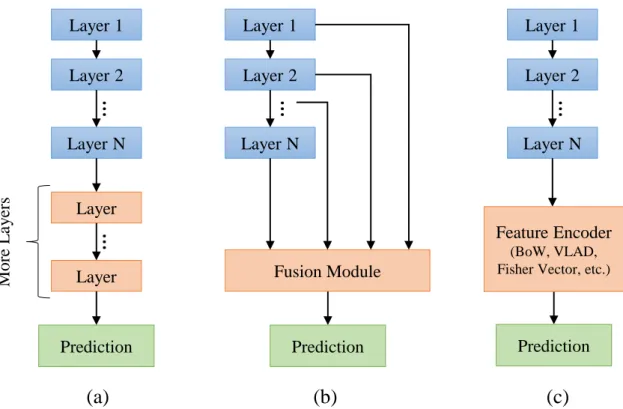
Figure 1.2: Illustration of three classication pipelines. (a) increasing the depth with more new layers. (b) fusing intermediate layers to produce an aggregation feature. (c) encoding deep features with sophisticated feature encoders.
from several layers (e.g. LeNet [3] and Alexnet [4]) to several tens of layers (e.g. VGGnet [7] and GoogLeNet [8]). However, training deeper networks becomes more dicult because of vanishing gradients and degradation. To overcome this chal-lenge, Highway networks [9] and ResNet [10] proposed to add shortcut connections between neighboring layers, which can help alleviate the vanishing gradient issue and ease the training convergence. Their approaches have promoted the study on constructing deeper neural networks (e.g. hundreds of layers) and breaking the po-tential bottleneck that may limit the learning capabilities. Furthermore, extended studies [11, 12, 13, 14] based on ResNet provided additional insights by delving into the residual learning mechanism. Nevertheless, it is non-tractable to optimize much deeper neural networks due to the large amount of network parameters and the expensive cost of physical memory.
Fusing multiple layers
1.2 Background and Related Work
is important to note that intermediate activations (i.e. convolutional layers) can also provide informative and complementary clues about images, including low-level boundaries, textures and spatial contexts. Therefore, researchers [15, 16] began to transfer their attention to intermediate layers, and explored their inuence on the classication performance. In contrast to using pre-trained models, extensive research eorts [17, 18] turned to training deep fusion networks where multi-level intermediate layers are fused together by adding new side branches. It is worth noting that the fused information occurs not just from adjacent layers but from the earliest layers as well. In the literature, deep fused representations have been shown to generate better predictions due to integrating the strengths of dierent intermediate layers within deep neural network.
Encoding deep features
Although CNNs are able to express more powerful visual features, they have weak robustness to severe geometrical deformations and spatial contexts. Fortunately, sophisticated encoding techniques including BoW [19], VLAD [20] and Fisher Vec-tor [21] have been adopted to address these issues. Motivated by the strengths of encoding techniques, it is natural to encode deep features to further improve their discriminatory power (Figure 1.2(c)). To obtain local features from CNN models, most approaches [22, 23, 24, 25] have examined local patches or region proposals in one image. The local CNN features are used to construct a visual codebook, based on which an encoder technique can be used to aggregate them to a deep image representation. For example, Gong et al. [22] employed image patches at multiple scales, and then aggregated local patch responses at the ner scales with the VLAD method. Yoo et al. [25] utilized multi-scale dense local CNN features to compute the Fisher Vector kernels.
Pixel-level classication
1. INTRODUCTION
1.2.2 Retrieval
One of the primary aims of image retrieval is to search for similar images (usually based on pictorial content) to the query from the database. It has become important to numerous practical scenarios (e.g. Google image search, face recognition, etc.) and therefore has triggered a massive amount of research activities in both multi-media and computer vision elds [19, 38, 39]. Bag-of-Words (BoW) is one of the most widely-used models in image retrieval systems, where local features, such as SIFT [40] and color clues [41], are quantized to visual words based on a pre-trained codebook. Then, similar to document retrieval [19, 39], an inverted index struc-ture is built with the visual words towards making the retrieval system scalable and ecient. However, image retrieval remains challenging in bridging low-level image representations and high-level semantic concepts.
Image retrieval
To alleviate the above challenge, recent works in the literature have paid attention on utilizing deep visual features for image retrieval [42, 43, 44]. The work of Wan et al. [42] suggested that a deep CNN model pre-trained on a large dataset can be trans-ferred to new content-based image retrieval (CBIR) tasks and ne-tuning the model with a similarity metric could further boost the retrieval performance. Babenko et al. [45] focused on holistic descriptors where the whole image was mapped to a single deep feature vector. They further designed a simple global image descriptor based on sum-pooled convolutional features for image retrieval. Zheng et al. [46] proposed a deep embedding method using deep features as global and regional signatures in-stead of a Hamming embedding[47]. It is an incorporation of the SIFT descriptor and CNN features and could achieve promising improvements. Moreover, Zheng et al. [48] presented a comprehensive review on SIFT and CNN-based methods and discussed the benets of integrating SIFT and CNN features.
Cross-modal retrieval
1.2 Background and Related Work
Text Query: An old man holding a camera while walking with a small brown dog.
Image Query
(1) a cat snuggled next to luggage on the floor. (2) a cat laying in front of luggage on the floor. (3) a white, blue and black cat lays on the floor near several suitcases.
(4) a brown cat sleeping in a black piece of luggage.
(5) a cat sitting in a black piece of luggage.
(a) Image-to-text retrieval (b) Text-to-image retrieval
Figure 1.3: Example of cross-modal retrieval. (a) Given an image query, related text samples are retrieved to describe the image. (b) For a text query, it can search for several image samples from the database. The matched samples are highlighted with green color.
approaches are usually developed for cross-modal retrieval (Figure 1.3). This task remains challenging due to the heterogenous representations and the cross-modal gap between vision and language, which is also a core issue for other multi-modal applications such as image captioning [55, 56] and visual question answering [57, 58], zero-shot recognition [59, 60].
With the increasing progress of deep learning, research eorts have been made to incorporate Canonical Correlation Analysis (CCA) [61] into deep neural net-works [49, 50, 51, 62, 63]. However, existing deep CCA models rely on expensive decorrelation computations, which limit their generalization abilities at large-scale data. Alternatively, a number of recent approaches [52, 55, 64, 65, 66] address the task by designing two-branch networks to embed visual and textual features into a common latent space, and then learn latent embeddings by optimizing a ranking loss to discriminate matched and unmatched image-text pairs. For instance, Wang et al. [53] built a simple and ecient matching network to preserve the structure re-lations between images and texts in the latent space. To associate image regions with words, the attention mechanism was integrated into visual-textual embedding models [67, 68]. In addition to the pairwise ranking loss, recent approaches [69, 70] leveraged extra loss functions (e.g. instance loss and classication loss) to enhance the discrimination of the learned embedding features.
1. INTRODUCTION
Fake
Real
Generator
Discriminator
0
1
FakeReal Input
Figure 1.4: Illustration of the GAN framework. In this example, given a labelled map, the generator can synthesize a fake photo image similar to the real one, but The discriminator learns to correctly classify real and fake images.
1.2.3 Synthesis
Together with the increasing progress of deep neural networks, numerous approaches based on supervised learning have been developed to address diverse image trans-lation tasks, such as contour detection [31], semantic segmentation [26] and face conversion [78]. However, these supervised models highly depend on a large amount of fully labelled image pairs which are time consuming to create manually and some-times biased when collecting annotated data. In addition, some ground-truth data are not available in some cases, for example, the painting stylization transfer be-tween Monet to Van Gogh. Driven by these limitations, researchers have turned to examine unsupervised learning approaches to break the bottleneck of limited data.
Generative adversarial networks
1.2 Background and Related Work
guide image generation conditioned on class labels [86], attributes [87], images [88] and texts [84].
Image-to-image translation
GANs have shown great success on the task of general-purpose image-to-image trans-lation [88], which learns to model mapping functions between dierent image do-mains. Many recent approaches [89, 90, 91, 92] were focused on using unpaired images to tackle the problem of unsupervised image translation. In addition to the adversarial constraint, they further exploited extra constraints to enhance relations of two dierent domains. On the one hand, some of them [89, 90, 93] fed image sam-ples into a unied encoder to discover their common representations. Then another generator was used to translate common representations to samples in the target domain. On the other hand, some work [92, 94] attempted to relate two dierent domains by using additional self-constraints within one domain. Representatively, CycleGAN [94] proposed a cycle-consistency constraint that can reconstruct the input image itself.
Fashion style transfer
1. INTRODUCTION
1.3 Thesis Outline and Research Questions
In Section 1.2, we have introduced recent advances on the three research themes. Although deep learning is leading state-of-the-art performance for numerous tasks, we should notice its limitations and challenges, such as theoretical interpretability, model complexity, training with limited data, etc. There is still considerable space for promoting the developments of deep learning. In the next research chapters (Chapters 2-8), we propose new approaches to address the research questions (RQ) and challenges in terms of the three research themes. In Chapter 9, we discuss our main ndings, limitations & possible solutions and future research directions.
Chapter 2 aims to address the rst research question RQ 1: How can we develop a simple and ecient deep fusion network upon a plain CNN? As discussed in Section 1.2.1, some works [17, 18, 26, 31] attempt to create new side branches upon a plain CNN and integrate multi-level interme-diate layers to generate a fused representation. However, they still have two main limitations. First, some of them spend a large number of new param-eters creating the side branches. For example, DAG-CNNs [18] add several fully-connected layers on top of intermediate convolutional layers, which will largely increase the total number of parameters. Second, the fusion mod-ules for integrating dierent side branches are inferior. DAG-CNNs [18] and FCN-8s [26] use a simple sum pooling to fuse the side branches, which fails to consider the weights of dierent side branches. Although HED [31] employs a 1×1 convolution to learn the fused weights, they are shared over spatial
dimensions, failing to discover the spatial properties. In this chapter, we pro-pose a novel convolutional fusion network (CFN) built on top of plain CNNs, which can aggregate intermediate layers with adaptive weights and generate a discriminatively fused representation. This chapter is based on the published papers [107, 108]:
Liu, Y., Guo, Y., and Lew, M.S., On the Exploration of Convolu-tional Fusion Networks for Visual Recognition. Proceedings of the 23rd International Conference on MultiMedia Modeling (MMM), 2017. (Best Paper Award)
Liu, Y., Guo, Y., Georgiou, T., and Lew, M.S., Fusion that mat-ters: convolutional fusion networks for visual recognition. Multi-media Tools and Applications, 2018.
1.3 Thesis Outline and Research Questions
can generally act as a fundamental task for other high-level vision applica-tions, like object detection and segmentation. Recently, the developments in the design of edge features have moved from carefully-engineered descrip-tors [109, 110, 111, 112] to hierarchical deep features [29, 30, 31, 113]. Nev-ertheless, we should still realize one dicult issue in edge detection that is caused by false positives: many non-edge pixels are incorrectly predicted as edges when comparing with the human annotated ground-truth. To correct the false positives earlier, HED [31] imposes the ground-truth supervision on the intermediate layers while training the deep model. However, using only a general supervision (i.e. the ground-truth annotation) for all the layers is inconsistent with the diverse representations of hierarchical layers. In addi-tion, the general supervision can not be well-suited to all intermediate layers. In contrast to using the general supervision, we propose and develop relaxed deep supervision (RDS) within convolutional neural networks for robust edge detection. This chapter is based on the published paper [114]:
Liu, Y. and Lew, M.S., Learning Relaxed Deep Supervision for Better Edge Detection. Proceedings of the 29th IEEE Conference on Computer Vision and Pattern Recognition (CVPR), 2016.
In Chapter 4, we move our attention to the retrieval theme and tackle the third question RQ 3: How can we incorporate deep visual represen-tations into the inverted index structure for accurate and ecient image retrieval? A robust image retrieval system should be typically opti-mized regarding two factors: accuracy and eciency. To increase the retrieval accuracy, some works [22, 42, 45] begin to utilize deep visual features to dis-cover the similarities among images. However, they are inecient due to rely-ing on the nearest neighbourrely-ing search. To maintain the eciency, traditional methods [19, 39], take advantage of the inverted index structure that is able to reduce computational time and memory cost for scalable image search. Re-garding both the accuracy and eciency, we exploit a DeepIndex framework for accurate and ecient image retrieval, by incorporating deep visual fea-tures into the inverted index scheme. This chapter is based on the published paper [115]:
Liu, Y., Guo, Y., Wu, S., and Lew, M.S., DeepIndex for Accurate and Ecient Image Retrieval. Proceedings of the 5th ACM on International Conference on Multimedia Retrieval (ICMR), 2015.
1. INTRODUCTION
years, a variety of multi-modal deep neural networks have been proposed to model the matching task [52, 53, 76]. However, the multi-modal matching per-formance is still far from competitive with the intra-modal tasks, for example, image retrieval. In this chapter, we introduce an ecient approach to couple visual and textual features based on a new recurrent residual fusion (RRF) building block. This chapter is based on the published paper [64]:
Liu, Y., Guo, Y., Bakker, E.M., and Lew, M.S., Learning a Recur-rent Residual Fusion Network for Multimodal Matching. Proceed-ings of the 16th IEEE International Conference on Computer Vision (ICCV), 2017.
In terms of cross-modal retrieval, in Chapter 6 we further pose the fth research question RQ 5: How can we preserve both inter-modal cor-relations and intra-modal consistency for learning robust visual and textual embeddings? Currently, there are two main paradigms to per-form visual-textual embeddings. The rst one is to learn a common space where related images and texts can be unied into similar latent embed-dings [52, 53, 76]. Second, it exploits dual embedembed-dings by reconstructing an input feature in the source space to be the one in the target space [72, 76, 77]. Both the latent and dual embeddings can capture inter-modal semantic cor-relations between visual and textual data. In addition, they can be combined together to integrate individual advantages. However, they fail to preserve the intra-modal semantic consistency, i.e. image-to-image and text-to-text. Importantly, a robust embedding method should be able to reconstruct rep-resentations of both the source and target modalities. To achieve this, we propose cycle-consistent embeddings in a deep neural network for matching visual and textual representations. This chapter is based on the submitted journal paper [116]:
Liu, Y., Guo, Y., Liu, L., Bakker, E.M., and Lew, M.S., Cy-cleMatch: A Cycle-consistent Embedding Network for Image-Text Matching. Submitted to IEEE Transactions on Multimedia (In Re-vision).
1.3 Thesis Outline and Research Questions
to correct the biased sentences and improve the image-text matching. Ad-ditionally, the matching component can help the classication component to generate a discriminative multi-modal representation. Unlike many current approaches which only focus on either multi-modal matching or classication, we propose a unied network to jointly learn Multi-modal Matching and Clas-sication (MMC-Net) between images and texts. This chapter is based on the submitted paper [118]:
Liu, Y., Liu, L., Guo, Y., and Lew, M.S., Learning Visual and Tex-tual Representations for Multimodal Matching and Classication. Pattern Recognition, vol 84: 51-67, 2018.
Chapter 8 presents two applications about image synthesis: image-to-image translation and fashion style transfer.
For image-to-image translation, we pose the seventh research question RQ 7: What factors will aect the performance of generative models on the translation tasks? Image-to-image translation between dierent domains is a common image synthesis task, with the aim of arbitrarily manipulating the source image content given a target one. To tackle the challenging case of un-paired image-to-image translation, CycleGAN [94] presents a cycle-consistency loss by reconstructing the generated image back to the source domain. In con-junction with the original adversarial loss, the cycle-consistency loss is bene-cial to constrain the unsupervised domain mappings. CycleGAN has become a fundamental approach for general-purpose image-to-image translation, while few work investigate the important factors within it. To address the problem, we present an extensive and empirical study on cycle-consistent generative networks. This work is based on the published paper [119]:
Liu, Y., Guo, Y., Chen, W., and Lew, M.S., An Extensive Study of Cycle-Consistent Generative Networks for Image-to-Image Transla-tion. Proceedings of the 24th International Conference on Pattern Recognition (ICPR), 2018.
1. INTRODUCTION
clothing images are not always available to users or consumers. Therefore, we pose a more practical task, that is, person-to-person clothing swapping, where the input condition is also a person image like the reference image. In this case, the goal becomes transferring the wearing clothes between two person images. It is more challenging as the desired clothes worn on the condition person image have varying deformations due to dierent human poses. To tackle this challenge, we propose a novel multi-stage generative network (SwapGAN) that integrates three generators to perform a multi-stage synthesis process. This work is based on the submitted journal paper [120]:
Liu, Y., Chen, W., Liu, L., and Lew, M.S., SwapGAN: A Multi-stage Generative Approach for Person-to-Person Fashion Style Trans-fer. Submitted to IEEE Transactions on Multimedia (In Review). Finally, Chapter 9 summaries the main ndings from the research of this
thesis. Also, we discuss the limitations and potential solutions, and point out directions for future research.
Additionally, this thesis draws on insights and experiences from the related work in other publications during my PhD studies:
Liu, Y. and Lew, M.S., Improving the Discrimination between Foreground and Background for Semantic Segmentation. Proceedings of the 24th IEEE International Conference on Image Processing (ICIP), 2017.
Liu, Y., Guo, Y., and Lew, M.S., What Convnets Make for Image Cap-tioning. Proceedings of the 23rd International Conference on MultiMedia Modeling (MMM), 2017.
Guo, Y., Liu, Y., Lao, S., Bakker, E.M., Bai, L., and Lew, M.S., Bag of Surrogate Parts Feature for Visual Recognition. IEEE Transactions on Mul-timedia, vol 20: 1525-1536, 2018.
Shan, H., Liu, Y., and Stefanov, T., A Simple Convolutional Neural Net-work for Accurate P300 Detection and Character Spelling in Brain Computer Interface. International Joint Conference on Articial Intelligence (IJCAI), 2018.
Guo, Y., Liu, Y., de Boer, M.H.T., Liu, L., and Lew, M.S., A Dual Prediction Network for Image Captioning. Proceedings of the 19-th IEEE International Conference on Multimedia and Expo (ICME), 2018.
1.4 Main Contributions
Guo, Y., Liu, Y., Bakker, E.M., Guo, Y., and Lew, M.S., CNN-RNN: a large-scale hierarchical image classication framework. Multimedia Tools and Applications, vol 77: 10251-10271, 2018.
Guo, Y., Liu, Y., Georgiou, T., and Lew, M.S., A review of semantic seg-mentation using deep neural networks. International Journal of Multimedia Information Retrieval, vol 7: 87-93, 2018.
Jia, Q., Fan, X., Liu, Y., Luo, Z., and Guo, H., Hierarchical projective invariant contexts for shape recognition. Pattern Recognition, vol 52: 358-374, 2016.
Guo, Y., Liu, Y., Oerlemans, A., Lao, S., Wu, S., and Lew, M.S., Deep learning for visual understanding: A review. Neurocomputing, vol 187: 27-48, 2016.
Guo, Y., Lao, S., Liu, Y., Bai, L., Liu, S., and Lew, M.S., Convolutional Neural Networks Features: Principal Pyramidal Convolution. Proceedings of the 16th Pacic-Rim Conference on Multimedia (PCM), 2015.
1.4 Main Contributions
The research of this thesis contributes at three levels: models and algorithms, prac-tical scenarios and empirical analysis.
1.4.1 Models and algorithms
From Chapter 2 to Chapter 8, we develop new approaches based on deep learning to address the research questions regarding the three themes. The key contributions in these approaches are listed below.
An ecient deep fusion model for image classication. We propose a novel deep fusion network, the convolutional fusion network (CFN), where we can e-ciently integrate multiple intermediate layers in CNNs with adaptive weights. In addition, our CFN is adaptive to not only image-level classication, but also pixel-level classication.
A diverse deep supervision algorithm for edge detection. In contrast to prior work using a general supervision, we develop relaxed deep supervision (RDS) with additional relaxed labels. Consequently, more discriminative layers can process more false positives in edge detection. RDS can incorporate the diversities into the supervisory signals to improve the performance of edge detection.
1. INTRODUCTION
with the inverted index scheme. Our approach takes advantage of the discriminatory capabilities of deep features and the ecient search of the inverted index.
An ecient image-text matching model for cross-modal retrieval. We develop a novel recurrent residual fusion network (RRF-Net) to couple visual and textual features. Since RRF-Net connects the residual learning with the recurrent mechanism, it can recursively improve visual-textual embeddings while sharing the network parameters. In addition, we develop a fusion module to eciently integrate intermediate recurrent outputs.
A cycle-consistent embedding algorithm for cross-modal retrieval. To pre-serve both inter-modal correlations and intra-modal consistency, we propose cycle-consistent embeddings by cascading dual mappings and reconstructed mappings in a cyclic fashion. Our embedding method can eectively promote the performance of cross-modal retrieval, compared to traditional embedding methods.
A unied model for multi-modal matching and classication. We propose a unied network (MMC-Net) to jointly model multi-modal matching and classi-cation. Our approach can suggest that combining the matching and classication components can help boost each other. In addition, we employ a multi-stage training algorithm to make the two components compatible.
Two extended deep generative models for image-to-image translation. As few work investigate the important factors within cycle-consistent generative networks (CycleGAN), we present two extended models, namely Long CycleGAN and Nest CycleGAN, and then conduct an extensive and empirical study on the models. Our work examines the benets of using more generators and cycles on the generation quality.
A multi-stage generative model for fashion style transfer. In contrast to traditional non-parametric approaches, we propose a novel multi-stage generative network (SwapGAN) to transfer the clothing style in one person image to another one. The SwapGAN model can be trained end-to-end with three dierent generators and one discriminator.
1.4.2 Practical scenarios
In addition to improve the performance of diverse tasks, our research also aims towards adapting to practical scenarios in real world.
1.4 Main Contributions
improve the retrieval accuracy, and the inverted index scheme is more ecient than the nearest neighboring search.
Joint multi-modal matching and classication. In practice, we may need to search for similar samples as the query sample, and know its class label as well. Motivated by this need, we develop MMC-Net (in Chapter 7) to unify both multi-modal matching and classication in one model, unlike prior approaches which focus on either matching or classication. Our work shows a simple and ecient way to fulll the two tasks simultaneously.
Person-to-person fashion style transfer. Prior work performs the clothes-to-person style transfer, however, in practice stand-alone and at clothing images are not always available. Instead, our work (in Chapter 8) aims to address a more practical case, in which the goal is to swap the clothes between two person images directly. This task becomes more challenging due to varying human poses. Our SwapGAN is proposed to solve this practical problem by cascading three generators in a multi-stage manner.
1.4.3 Empirical analysis
Furthermore, this thesis provides numerous experiments and in-depth analysis, which can help motivate further research on the three research themes.
Fusion that matters deep neural networks. Instead of deepening neural net-works with more layers, our CFN model (in Chapter 2) is an ecient alternative to improving the capabilities of CNNs while maintaining the model complexity. In the experiments, we provide a detailed analysis to verify the eectiveness of CFN. In addition, we compare CFN with other deep models and oer an extensive dis-cussion about them. Moreover, our CFN can be adaptive to dierent computer vision tasks like image classication, semantic segmentation, edge detection, etc. In a nutshell, our work suggests that deep fusion networks can eciently promote the feature representational abilities of plain CNNs.
Cycle-consistency that matters visual-textual embeddings. Our proposed cycle-consistent embedding approach (in Chapter 6) is an integration of three em-beddings, namely dual embedding, reconstructed embedding and latent embedding. Our approach can model both inter-modal correlations and intra-modal consistency while matching visual and textual representations. In the experiments, we conduct a comparable analysis between our approach and existing embedding approaches. The superiority of our approach over others can increase the awareness of using cycle-consistency for multi-modal research tasks.
1. INTRODUCTION
Chapter 2
Convolutional Fusion Networks for
Image Classication
In the previous chapter we have introduced the background and research questions for this thesis. Starting with this chapter, we begin to answer the research questions with our proposed approaches. In this chapter, we address how we can develop a simple and ecient deep fusion network upon a plain CNN (RQ 1).
Despite recent advances in deep fusion networks, they still have limitations due to expensive parameters and weak fusion modules. To address this issue, we propose a novel convolutional fusion network (CFN) to integrate multi-level deep features and fuse a richer visual representation. Specically, CFN uses 1×1 convolutional
layers and global average pooling to generate side branches with adding only a few parameters, and employs a locally-connected fusion module, which can learn adap-tive weights for dierent side branches and form a better fused feature. Moreover, we propose fully convolutional fusion networks (FCFNs) that are an extension of CFNs for pixel-level classication, including semantic segmentation and edge de-tection. Our experiments demonstrate that our approach can achieve consistent performance improvements for diverse tasks.
Keywords
2. CONVOLUTIONAL FUSION NETWORKS FOR IMAGE CLASSIFICATION
2.1 Introduction
A signicant progress on convolutional neural networks is increasing their depth to learn more powerful visual representations. In particular, the depth has increased from several layers (e.g. LeNet [3] and Alexnet [4]) to several tens of layers (e.g. VGGnet [7] and GoogLeNet [8]). Nevertheless, training a very deep network is extremely dicult because of vanishing gradients and degradation. To overcome this challenge, recent work in both Highway networks [9] and ResNet [10] proposes to add shortcut connections between neighboring convolutional layers, which are able to alleviate the vanishing gradient issue and ease the training stage. Nevertheless, it is non-tractable to optimize very deep neural networks due to their large amount of parameters and the expensive cost of physical memory.
An alternative is to explore integration with the existing intermediate layers in a deep neural network, rather than deepening the network with new layers. Commonly, the topmost activations in deep networks (i.e. fully-connected layers) serve as discrimi-native visual representations to describe the image content. However, it is important to note that intermediate activations (i.e. convolutional layers) can also provide informative and complementary clues about images, including low-level textures, boundaries, and local parts. Therefore, researchers [15, 16, 25] have given greater attention to intermediate layers, and evaluated their contributions regarding image recognition performance. In addition, a large number of approaches [16, 23, 24, 121] have leveraged sophisticated encoding schemes (e.g. BoW, VLAD and Fisher Vec-tor) to further encode intermediate feature activations. These approaches extract deep features from o-the-shelf CNNs without training new networks.
Moreover, extensive research eorts [17, 18, 26, 31] have turned to explicitly train-ing deep fusion networks where multi-level intermediate layers are fused together by adding new side branches. As a result, the deep fused representation allows us to integrate the strengths of individual layers and generate superior prediction. Although these deep fusion networks have achieved promising performance, they may spend a large number of additional parameters required for generating the side branches [18]. In addition, their fusion modules (e.g. sum pooling) do not fully consider the importance of dierent side branches. Motivated by this problem, this chapter focuses on the research question RQ 1: How can we develop a simple and ecient deep fusion network upon a plain CNN?
To address this question, we propose a convolutional fusion networks (CFN), which is a new fusion architecture to integrate intermediate layers with adaptive weights. To be specic, CFN mainly consists of three key components: (1) Ecient side outputs: we use ecient 1×1 convolution and global average pooling [122] to
2.1 Introduction
Image airplane
Main branch
automobile bird cat deer dog frog horse ship truck
Main branch Side branch 1 Side branch 2
Feature maps in CNN Feature maps in CFN
Figure 2.1: Illustration of features activations of the last convolutional layer in (a) CNN and (b) CFN. The CIFAR-10 images are used here. Compared with CNN, CFN can learn complementary clues in the side branches to the full depth main branch. For example, the side branch 1 mainly learns the boundaries or shapes around objects, and the side branch 2 focuses on some semantic parts that re strong near the objects.
early prediction and late fusion strategy [18]. (3) Locally-connected fusion: we propose to adapt a locally-connected layer to act as a fusion module. It allows us to learn adaptive weights for dierent side outputs and generate a better fused repre-sentation. Figure 2.1 visually compares the feature activations learned in CNN and CFN, respectively. It can be seen that aggregating multi-level intermediate layers is essential to integrate their individual information.
The contributions of this chapter are as follows:
We propose a new fusion architecture (CFN) which can provide promising insights towards how to eciently exploit and fuse multi-level features in deep neural networks. In particular, to the best of our knowledge, this is the rst attempt to use a locally-connected layer as a fusion module.
We introduce CFN models to address the image-level classication task. The results on the CIFAR and ImageNet datasets demonstrate that CFN can achieve promising improvements over the plain CNN. In addition, we transfer the trained CFN model to three new tasks, including scene recognition, ne-grained recognition and image retrieval. By using the transferred model, we can achieve consistent performance improvements on these tasks.
2. CONVOLUTIONAL FUSION NETWORKS FOR IMAGE CLASSIFICATION
edge detection. As a result, FCFN, as a fully convolutional extension, reveals the strong generalization capabilities of CFN for diverse tasks.
The rest of this chapter is organized as follows. Section 2.2 introduces the details of constructing the proposed CFN for image-level classication problem. In addition, we compare and highlight the dierences of CFN from other deep models. The FCFN counterpart for pixel-level classication is described in Section 2.3. Section 2.4 presents experimental results that demonstrate the performance of CFN and FCFN on various visual recognition tasks. Finally, Section 2.5 concludes this work and point out two future directions.
2.2 Convolutional Fusion Networks
In this section, we introduce the details of building CFN on top of a plain CNN model, and formulate its training procedure. In addition, we compare its dierences from other deep models.
2.2.1 Network architecture
First, we show a general architecture of a plain CNN model. As illustrated in Fig-ure 2.2, it mainly comprises of successive convolutional layers and pooling layers. In addition, a 1×1 convolutional layer followed by global average pooling is used
because of its high eciency [8, 10, 122]. Based on this plain CNN, we can de-velop the proposed CFN by adding new side branches from intermediate layers and aggregating them in a locally-connected fusion module. Figure 2.3 illustrates the architecture of the proposed CFN. Our CFN is built on top of a plain CNN. To be specic, CFN mainly consists of the following three key components.
(1) Ecient side outputs
Prior work often added new fully-connected (FC) layers in the side branch [18], but this strategy may severely increase the number of parameters. Instead, CFN is able to eciently create the side branches from the intermediate layers by adding only a few parameters. First, the side branches are built from the pooling layers (Figure 2.3). Each side branch has a 1×1 convolutional and global average pooling
as well. All 1×1 convolutional layers must have the same number of channels so that
they can be integrated together. Then, global average pooling (GAP) is performed over the 1×1 convolutional maps so as to obtain a one-dimensional feature vector,
called the GAP feature. As a result, the side branches have the similar top layers (1×1 Conv and GAP) to the full-depth main branch. One dierence is that the 1×1
2.2 Convolutional Fusion Networks
Input image
…
Conv 1 Conv 2 ConvS-1 ConvS 1×1 Conv GAP
P ooli n g P re d ict ion FC P ooli n g P ooli n g
…
Figure 2.2: The general pipeline of a plain CNN model. Note that one 1×1
convo-lutional layer and global average pooling are used on the top layers.
Input image
…
Conv 1 Conv 2 ConvS-1 ConvS 1×1 Conv GAP
P
ooli
n
g
Side branch S-1
Stack S Locally connected P re di ct ion FC Side branch S
( Main branch )
P ooli n g … P ooli n g … … …
Side branch 2
Side branch 1
Figure 2.3: The general pipeline of the proposed CFN. First, the side branches start from the pooling layers and consist of a 1×1 convolution layer and global average
pooling. Then, all side outputs are stacked together. A locally-connected layer is used to learn adaptive weights for the side outputs (drawn in dierent color). Finally, the fused feature is fed to the FC layer to make a better prediction.
concise formulation, we consider the full-depth main branch as another side branch.
Assume that there are S side branches in total and the last side branch (i.e. S-th)
indicates the main branch. We notate h(i,js) as the input of the 1×1 convolution in
the s-th side branch, where s = 1,2, . . . , S and (i, j) is the spatial location in the
feature maps. As the 1×1 convolution has K channels, its output associated with
the k-th kernel is denoted as fi,j,k(s) , where k = 1, . . . , K. Let H(s) and W(s) be the
height and width of features maps derived from thes-th 1×1 convolution. Then, the
global average pooling performed over the feature mapfk(s) is calculated by
gk(s)= 1 H(s)W(s)
H(s) X
i=1 W(s)
X
j=1
fi,j,k(s) , (2.1)
Where gk(s) is the k-th element in the s-th GAP feature vector. We notate g(s) = [g1(s), . . . , gK(s)], a 1×K dimensional vector, as the GAP feature from the s-th side
2. CONVOLUTIONAL FUSION NETWORKS FOR IMAGE CLASSIFICATION
Final
pr
edict
ion
FC
Fuse
……branch 1
…
GAP Prediction 1
FC
……branch 2 GAP Prediction 2
……branch S GAP Prediction S
… … …
FC
…
(a)
Fu
sed
f
eat
ur
e
Fuse
……branch 1
…
GAP
FC
……branch 2 GAP
……branch S GAP
… …
Final
pr
edict
ion
(b)
Figure 2.4: Comparison between EPLF and EFLP. (a) The schematic pipeline of EPLF strategy; (b) The schematic pipeline of EFLP strategy.
(2) Early fusion and late prediction
Considering how to incorporate the side branches, some work [18, 26, 31] used an early prediction and late fusion (EPLF) strategy. In Figure 2.4a, EPLF computes a prediction from the GAP feature using a fully-connected layer and then fuses side predictions together to make the nal prediction. In contrast to EPLF [18], in which a couple of FC layers are added, we present another strategy called early fusion and late prediction (EFLP). EFLP rst fuses the GAP features from the side branches and obtains a fused feature. Then, a fully-connected layer following the fused feature is used to estimate the nal prediction. As seen in Figure 2.4b, EFLP has fewer parameters due to using only one connected layer. Assume that each fully-connected layer hasCunits that correspond to the number of object categories. The
fusion module has Wf use parameters. Quantitatively, we can compare the number
of parameters between EFLP and EPLF by
WEF LP =K(C+ 1) +Wf use < WEP LF =SK(C+ 1) +Wf use. (2.2)
Hence, we make use of EFLP to fuse intermediate features earlier due to its eciency. We observe that EFLP can achieve the same accuracy as EPLF, though EPLF contains more parameters. More importantly, the fused feature in EFLP is able to act as a richer image representation, however, EPLF cannot generate such a rich fused representation. In the experiments, we transfer the fused feature in EFLP to diverse vision tasks and show its promising generalization ability.
(3) Locally-connected fusion
2.2 Convolutional Fusion Networks
…
Sum-pooling
S 1
K K
(a)
…
Convolution
K K
S 1
(b)
…
Locally-connected
K K
1 S
(c)
Figure 2.5: Comparison of three fusion modules. (a) No weights: Sum-pooling fu-sion has no weights; (b) Sharing weights: Convolution fufu-sion learns sharing weights over spatial dimensions, as drawn in the same color; (c) No-sharing weights: Locally-connected fusion learns no-sharing weights over spatial dimensions, as drawn in dier-ent colors. To learn elemdier-ent-wise weights, we use the 1×1 kernel size.
fused feature. To the best of our knowledge, this is the rst attempt to apply a locally-connected layer to a fusion module.
At rst, we stack all GAP features together from g(1) to g(S), and form a layer G
with size of 1×K ×S, see Figure 2.3. For example, the s-th feature map of G is g(s). Then, one LC layer which hasK of no-sharing lters is convolved overG. Each
lter has 1×1×S kernel size. Since LC is able to learn adaptive weights for dierent
elements in the GAP features which measure the importance of the side branches, it is able to produce a better fused feature. Finally, the fused feature convolved by LC also has a 1×K shape, denoted as g(f). The i-th element ing(f) is expressed:
gi(f) =σ S X
j=1
Wi,j(f)·gi(j)+b(if) !
, (2.3)
where i = 1,2, . . . , K; σ indicates the ReLU activation function. Wi,j(f) and b(if)
represent the weights and bias for fusing the i-th elements of GAP features from
dierent side branches. The number of parameters in the LC fusion is K×(S+ 1).
Using these additional parameters gives the benet of adaptive fusion while it does not require any manual tuning.
To clearly demonstrate the advantage of the LC fusion module, Figure 2.5 compares LC fusion with other fusion methods. In Figure 2.5a, the sum-pooling fusion simply sums up the side outputs together without learning any weights, whereas this way treats each side branch equally and fails to consider their dierent importance. In Figure 2.5b, the convolutional fusion can learn only one sharing lter over all spatial dimensions (as drawn with the same blue color). In contrast, LC enables the fusion module to learn independent weights over each local eld (i.e. size 1×1×S) (drawn
2. CONVOLUTIONAL FUSION NETWORKS FOR IMAGE CLASSIFICATION
these parameters are a negligible proportion of the total number of the network parameters.
2.2.2 Training procedure
CFN has a similar training procedure as a standard CNN, including forward pass and backward propagation. Assume a training dataset which contains N images: {x(i), y(i)}, where x(i) is the i-th input image and y(i) is its ground-truth class label.
W indicates the set of all parameters learned in the CFN (including the LC fusion
weights). The full objective is to minimize the total loss cost
argminW 1
N N X
i=1
L(f(x(i);W), y(i)), (2.4)
wheref(x(i);W)indicates the predicted class ofx(i). We use the softmax loss
func-tion to compute the cost L. To minimize the loss cost, the partial derivatives of
the loss cost with respect to any weight are recursively computed by the chain rule during the backward propagation [3]. Since the main parts in the CFN model are the side branches, we will induce the computations of their partial derivatives. We consider each image independently for notational simplicity.
First, we compute the gradient of the loss cost with respect to the outputs of the side branches. Taking thes-th side branch as an example, we compute the gradient
of L with respect to the side output g(s) ∂L
∂g(s) =
∂L ∂g(f) ·
∂g(f)
∂g(s), s= 1,2, . . . , S. (2.5)
Second, we formulate the gradient of L with respect to the inputs of the side
branches. Let a(s) be the input of the s-th side branch. As depicted in Figure 2.3, a(s) corresponds to the pooling layer. However, the input of the main branch,
de-noted as a(S), refers to the last convolutional layer (i.e. convS). It is important to
note that the gradient ofa(s) depends on several side branches. To be more specic,
the gradient ofa(1) is inuenced byS branches; the gradient ofa(2) needs to consider
the gradient from the 2-nd to S-th branch; but the gradient of a(S) is updated by
only the main branch. Then, the gradient of L with respect to the side input a(s)
can be computed via
∂L ∂a(s) =
S X
i=s ∂L ∂g(i) ·
∂g(i)
∂a(i), (2.6)
where iindexes the related branch that contributes to the gradient of a(s). It needs
2.3 Fully Convolutional Fusion Networks
2.2.3 Comparisons with other models
To get more insights into CFN, we compare it with other deep models.
Comparison with CNN. Typically, a plain CNN only estimates a nal prediction based on the topmost layer. As a result, the eects of intermediate layers towards the prediction are implicit and indirect. In contrast, CFN connects the intermedi-ate layers using additional side branches, and fuses them to jointly make the nal predictions. In this way, CFN allows us to take advantage of intermediate layers explicitly and directly. This advantage explains why CFN is able to achieve more accurate prediction than a plain CNN.
Comparison with DSN. Deeply supervised nets (DSNs) [125] are the rst model to add extra supervision to intermediate layers for earlier guidance. As a result, it can improve the directness and transparency of learning a deep neural network. Therefore, we can view DSN as a loss fusion model. Instead, CFN still uses one supervision towards the nal prediction derived from the fused representation, however it is able to increase the eects of the loss cost on the intermediate layers without adding more supervision signals. In a word, we clarify that CFN is a feature fusion model. It is important to note that there is no technical conict between CFN and DSN, so combining these two models together is a promising research direction.
Comparison with ResNet. ResNet [10] addresses the vanishing gradient prob-lem by adding densely shortcut connections. CFN has three main dierences with ResNet: (1) The side branches in CFN are not shortcut connections. They start from pooling layers and merge into a fusion module together. (2) In contrast to adding a linear connection in a residual block, we still use the non-linear ReLU in the side branches of CFN. (3) CFN employs a sophisticated fusion module to gen-erate a richer feature, rather than using the simple summation employed in ResNet. As mentioned in the ResNet work, when the network is not overly deep, for example having 11 or 18 layers, ResNet may show few improvements over a plain CNN. How-ever, CFN can obtain some considerable gains over CNN. Hence, CFN can serve as an alternative for improving the discriminative capabilities of not-very-deep models, instead of purely increasing the depth. ResNet tells us that depth that matters, but CFN concludes to fusion that matters.
2.3 Fully Convolutional Fusion Networks
2. CONVOLUTIONAL FUSION NETWORKS FOR IMAGE CLASSIFICATION
networks to their corresponding fully convolutional networks (FCNs) by replacing the fully-connected layers with more convolutional layers. FCNs are able to infer any size of images without requiring specic input dimensionality. In this section, we introduce fully convolutional fusion networks (FCFN), which are used for two representative pixel-level classication tasks: semantic segmentation and edge de-tection. Similar to CFN, FCFN models are able to learn better pixel predictions based on the locally-connected fusion module.
2.3.1 Semantic segmentation
Semantic segmentation intends to predict a category label for spatial pixels in an image. FCN-8s [26] is a milestone model in the development of employing CNNs for semantic segmentation, and yields signicant improvements in comparison with non-deep-learning approaches. First, FCN-8s is ne-tuned from the VGG-16 model [7] pre-trained on the ImageNet dataset [5]. Then, it adds two side branches to the full-depth main branch, which allow to integrate both coarse-level and ne-level pixel predictions to improve the semantic segmentation performance. Particularly, FCN-8s uses a simple sum-pooling to fuse the multi-level predictions. In contrast to FCN-8s, we extend the proposed CFN model and build the FCFN counterpart for generating fused pixel features. Moreover, we use two locally-connected layers in a two-stage fusion manner.
Recall that the locally-connected (LC) fusion module is able to learn independent weights for each spatial pixel in an image. We need to extend its formulations to be suitable for the LC fusion module in FCFN. In the rst fusion module, two branches involvingK channels of feature maps are taken as input. Note that the top
layers are upsampled 2 times to retain the same spatial dimensions as the bottom layers. We consider the adaptive weights of each channel separately and reshape each two-dimensional feature map to a one-dimensional feature vector. For example, gk,i(1)
indicates the feature activation of thei-th pixel of thek-th channel in the rst branch,
andg(2)k,i is the corresponding activation in the second branch, wherei= 1, . . . , H×W
and k = 1, . . . , K. Therefore, the fused pixel feature is given by
gk,i(f) =σ
2 X
j=1
Wk,i,j(f) ·gk,i(j)+b(k,if) !
, (2.7)
The number of parameters in this fusion module is H×W×C×2, where C is the
number of object categories. Moreover, the second fusion module integrates coarser feature maps with the output of the rst fusion module. Let gk,i0(1) be the activation
in the coarser layer. For notational simplicity, the activation gk,i(f) from the output
2.3 Fully Convolutional Fusion Networks
fusion is
g0k,i(f)=σ
2 X
j=1
Wk,i,j0(f)·gk,i0(j)+b0k,i(f) !
, (2.8)
where gk,i0(f) represents the nal fused feature by using the two-stage fusion.
Con-sidering the computation of the loss cost with respect to the ground-truth, we still employ the softmax loss function and accumulate the loss of all pixels together.
L=−
H×W X
i=1 K X
k=1
h(yi =k) logpk,i, (2.9)
whereyi is the ground-truth pixel label. h(yi =k) is equal to 1 whenyi =k, and 0
otherwise. The predicted pixel probability is normalized with the softmax function, where pk,i =
exp(g
0(f)
k,i )
PK
k=1exp(g
0(f)
k,i )
. As above, we give the loss computation for one image, but it is straightforward to extend it to a mini-batch size of images. Likewise, we use the SGD with mini-batch to train the entire FCFN model.
2.3.2 Edge detection
The problem of edge detection is to extract semantically meaningful edges in im-ages, Typically, edge detection acts as a low-level task, but has signicant contri-butions to other high-level visual tasks, such as object detection and image seg-mentation. Driven by the increasing developments of deep learning, edge features have moved from carefully-engineered descriptors such as Canny [109], gPb [126] and Structured Edges (SE) [127]), to discriminative deep features [29, 30, 31]. In particular, HED [31] is the rst work to use FCNs for end-to-end edge detection, and leads to state-of-the-art performance on well-known benchmarks. HED inte-grates the strengths of ecient end-to-end FCNs [26] and additional deep supervi-sion [125].
In contrast to HED that uses a convolutional fusion module, our FCFN fuses ve intermediate side branches with a locally-connected layer. To be specic, one side branch generates a feature map where the activations measure the probabilities of pixels being edges. Five feature maps from side branches stack together, and are reshaped from (H, W,5)to (H×W,5). We compute the fused prediction gi(f)
gi(f) =σ
5 X
j=1
Wi,j(f)·gi(j)+b(if) !
, (2.10)
wherei= 1, . . . , H×W. The sigmoid cross-entropy loss function is
Lf use=−
H×W X
i=1 h
βilogg (f)
i + (1−βi) log(1−g
(f)
i )
i
2. CONVOLUTIONAL FUSION NETWORKS FOR IMAGE CLASSIFICATION
where the parameter βi regulates the importance of edge and non-edge pixels, as
mentioned in [31]. It is important to note that we also impose the intermediate supervision on the side branches similar to [31, 125], to discard the negative edges in the earlier intermediate layers. The loss cost in the k-th side branch (i.e. k = 1, . . . ,5) is represented as follows
L(sidek) =− H×W
X
i=1 h
βilogg (k)
i + (1−βi) log(1−g
(k)
i )
i
, (2.12)
where gi(k) accounts for the predicted probability of the i-th pixel being an edge
point. Finally, the overall loss cost in FCFN integrates a fused loss term and ve intermediate loss terms together:
L=Lf use+
5 X
k=1
L(sidek) . (2.13)
This edge detection network is also ne-tuned end-to-end from the VGG-16 model and updated with the SGD algorithm with mini-batch.
2.4 Experiments
This experimental section evaluates the performance of the proposed CFN for image-level classication and FCFN for pixel-image-level classication. First, we train the CFN models on the datasets: CIFAR-10/100 [128] and ImageNet 2012 [5]. Then, we transfer the trained CFN model to three new tasks, including scene recognition, ne-grained recognition and image retrieval. Moreover, we train the specic FCFN models for semantic segmentation on the PASCAL dataset [129], and edge detection on the BSDS dataset [126], respectively. All experiments were conducted using the Cae library [130] on a NVIDIA TITAN X card with 12 GB memory.
2.4.1 Image classication on CIFAR
2.4 Experiments
Table 2.1: Two plain CNN models built for the classication experiments on the CIFAR-10/100 dataset.
CNN-A CNN-B
Input 32× 32 RGB image
5× 5 × 64 conv, ReLU 3 ×3 × 96 conv, ReLU
3 ×3 × 96 conv, ReLU
3× 3 max-pooling, stride 2. Dropout ratio 0.5
5× 5 × 64 conv, ReLU 3 × 3 ×192 conv, ReLU
3 × 3 ×192 conv, ReLU
3× 3 average-pooling, stride 2. Dropout ratio 0.5
5× 5 × 64 conv, ReLU 3 × 3 ×192 conv, ReLU
3 × 3 ×192 conv, ReLU
1 ×1 × 192 conv, ReLU
8 ×8 global average pooling. Dropout ratio 0.5
10 or 100-way fully-connected layer Softmax classier
Network architecture and training details
We employ two plain CNNs models to build their CFN counterparts. Table 2.1 describes the two CNNs used for CIFAR-10/100, called CNN-A and CNN-B. (1) CNN-A is a shallow network similar to the Cae-Quick model [130]. It has three 5×5 convolutions and a 1×1 convolution. The global average pooling is performed
over the 1×1 convolutional maps. Finally, a fully-connected layer with 10 or 100
units is used to predict object categories; (2) CNN-B replaces each 5×5 convolutional
layer in CNN-A with two 3×3 layers, as suggested in VGGnet [7]. In addition,
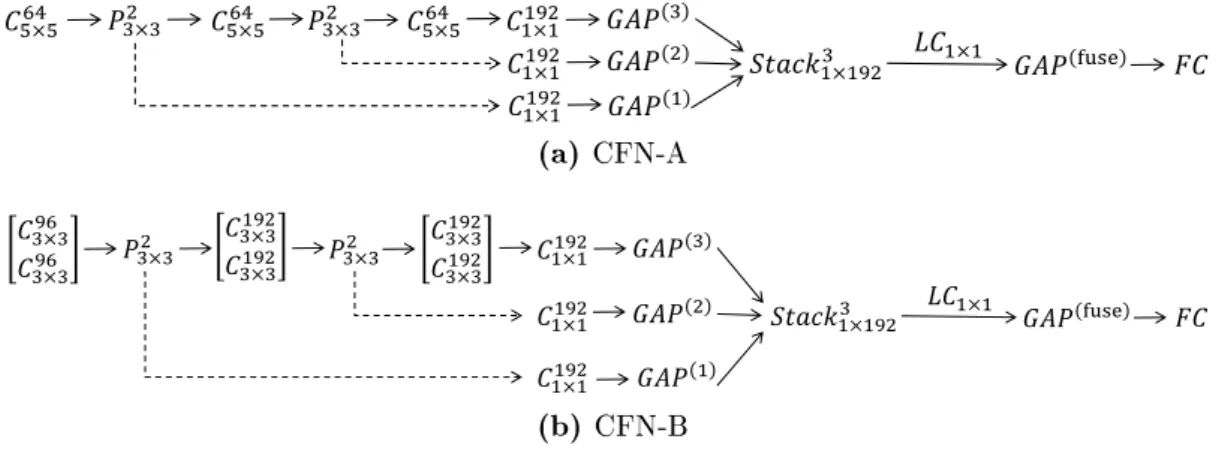
CNN-B utilizes more feature channels than CNN-A. Note that, when training the CNN-CNN-B model on the CIFAR-100 dataset, the rst and second convolutional layer use 192 channels instead of 96 channels. Correspondingly, the CFN-A and CFN-B models are built upon CNN-A and CNN-B respectively, by constructing two additional side branches after the pooling layers, as depicted in Figure 2.6(a) and (b).
We use the same hyper-parameters to train CNN and CFN, for example, a weight decay of 0.0001, a momentum of 0.9, and a mini-batch size of 100. The learning rate is initialized with 0.1 and is divided by 10 after 10×104 iterations. The whole
training will be terminated after 12×104 iterations. As for CFN, the initialized
weights in the LC fusion module are set to 0.333, as there are three side branches in total (including the full-depth main branch).
Results and discussion
2. CONVOLUTIONAL FUSION NETWORKS FOR IMAGE CLASSIFICATION
𝐿𝐶1×1
𝑆𝑡𝑎𝑐𝑘1×1923
𝐶5×564 𝑃3×32 𝐶5×564 𝑃3×32 𝐶5×564 𝐶1×1192
𝐶1×1192
𝐶1×1192
𝐹𝐶
𝐺𝐴𝑃1
𝐺𝐴𝑃2
𝐺𝐴𝑃3
𝐺𝐴𝑃fuse
(a) CFN-A
𝐿𝐶1×1 𝑆𝑡𝑎𝑐𝑘1×1923
𝑃3×32 𝑃
3×32 𝐶1×1192
𝐶1×1192
𝐶1×1192
𝐹𝐶
𝐺𝐴𝑃1 𝐺𝐴𝑃2 𝐺𝐴𝑃3
𝐺𝐴𝑃fuse 𝐶3×396
𝐶3×396
𝐶3×3192
𝐶3×3192 𝐶3×3
192
𝐶3×3192
(b) CFN-B
Figure 2.6: Illustration of the proposed CFN models built for the CIFAR dataset. For the convolutional layers (denoted asC), the right lower number indicates the kernel
size; the right upper numbers indicate the number of channels. For the pooling layers (denoted as P), the right lower numbers indicate the window size; the right upper
numbers equal the size of strides.
Table 2.2: Error rates (%) of image classication on the CIFAR-10/100 test set (without data augmentation). Better results are in bold face. CFNs can outperform the baseline CNNs by adding only a few parameters.
Model #Parameters CIFAR-10 CIFAR-100
CNN-A 0.224M (basic) 15.57 40.62
CNN-Sum-A 0.224M (basic) + 0.025M (side) + 0 (fusion) 15.33 40.32
CNN-Conv-A 0.224M (basic) + 0.025M (side) + 4 (fusion) 15.19 40.15
CFN-A 0.224M (basic) + 0.025M (side) + 768 (fusion) 14.73 39.54
CNN-B 1.287M (basic) 9.28 31.89
CNN-Sum-B 1.287M + 0.074M (side) + 0 (fusion) 8.84 31.42
CNN-Conv-B 1.287M + 0.074M (side) + 4 (fusion) 8.68 31.16
CFN-B 1.287M + 0.074M (side) + 768 (fusion) 8.27 30.68
(1) CFN achieves∼1% improvements on the classication performance compared to
the plain CNNs (both CNN-A and CNN-B). For example, on the CIFAR-10 dataset, CFN-A and CFN-B obtain 14.73 and 8.27 error rates that are ∼1% lower than the
results of CNN-A and CNN-B, that are 15.57 and 9.28, respectively. The comparison between CFN and CNN demonstrates the eectiveness of fusing multi-level inter-mediate layers. Additionally, CFN is able to improve the expressive capabilities of deep neural networks for learning superior visual representations.
(2) In order to analyze the advantage of using the LC fusion, we also implement the existing sum-pooling fusion and convolutional fusion methods, denoted as CNN-Sum and CNN-Conv. By comparing CFN with CNN-CNN-Sum and CNN-Conv, we can observe that the LC fusion outperforms the other two fusion methods by a considerable margin. Hence, learning adaptive weights is essential to generate a better fused feature.

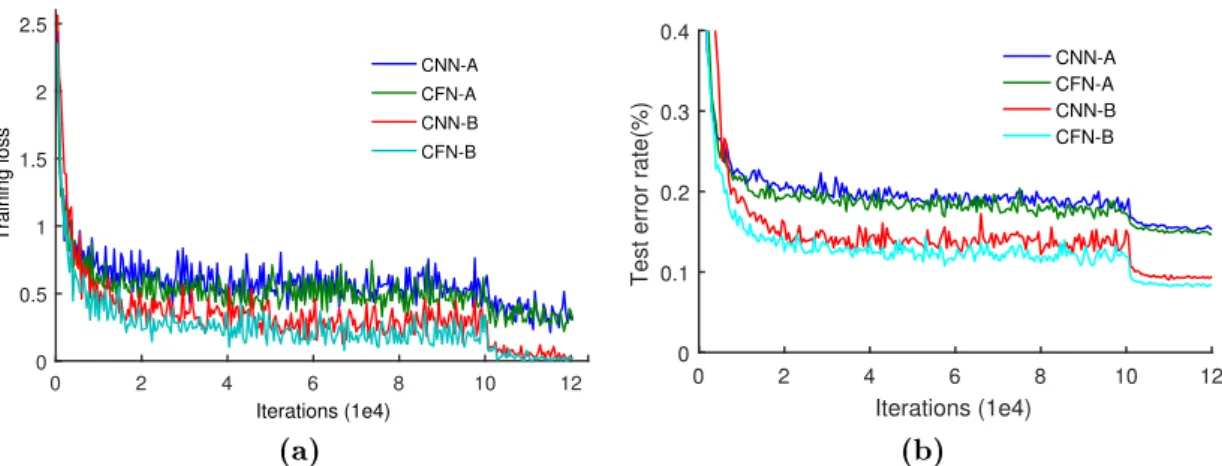

![Figure 4.2: Visualizing the CNN features for three groups of im-ages from the Holidays dataset [47].](https://thumb-us.123doks.com/thumbv2/123dok_us/8211056.2177037/71.892.127.602.391.602/figure-visualizing-cnn-features-groups-ages-holidays-dataset.webp)