The handle http://hdl.handle.net/1887/23005 holds various files of this Leiden University dissertation
Author: Stoutjesdijk, Regina
Title: Children with emotional and behavioral disorders in special education : placement, progress, and family functioning
Children
with
emotional
and
behavioral
disorders
in
special
education
Placement,
progress,
and
family
functioning
Children with emotional and behavioral disorders in special education: Placement, progress, and family
functioning
Thesis, Leiden University, The Netherlands
ISBN: 978‐90‐5335‐776‐7
Author: Regina Stoutjesdijk
Printing: Ridderprint BV, Ridderkerk, The Netherlands
Cover: Robert Kanters, Ridderprint BV, Ridderkerk, The Netherlands
Copyright © 2013, Regina Stoutjesdijk
All rights reserved. No parts of this publication may be reproduced, stored in a retrieval system, or
transmitted in any form or by any means, mechanically, by photocopy, by recording, or otherwise, without
Children
with
emotional
and
behavioral
disorders
in
special
education
Placement,
progress,
and
family
functioning
PROEFSCHRIFT
ter verkrijging van
de graad van Doctor aan de Universiteit Leiden,
op gezag van Rector Magnificus prof.mr. C.J.J.M. Stolker,
volgens besluit van het College voor Promoties
te verdedigen op donderdag 16 januari 2014
klokke 15.00 uur
door
Regina
Stoutjesdijk
geboren te Ridderkerk
Promotores:
Prof. dr. E. M. Scholte
Prof. dr. H. Swaab
Overige leden:
Prof. dr. I. A. van Berckelaer‐Onnes
Prof. dr. P. van den Broek
Prof. dr. C. Espin
Prof. dr. C. Rieffe
Prof. dr. J. Veerman (Radboud Universiteit Nijmegen)
C
ontents
Chapter 1 General introduction 7
Chapter 2 Special needs characteristics of children with emotional and
behavioral disorders that affect inclusion in regular education
17
Chapter 3 Behavioral and academic progress of children displaying
substantive ADHD behaviors in special education:
A one‐year follow‐up
37
Chapter 4 Behavioral and academic progress of children with high‐
functioning autism spectrum disorders in special education:
A one‐year follow‐up
57
Chapter 5 Impact of family functioning on classroom problem behavior
of children with emotional and behavioral disorders in special
education
77
Chapter 6 General conclusions and discussion 97
References 109
Appendices
Nederlandse samenvatting (Summary in Dutch) 121
Dankwoord (Acknowledgements) 131
Curriculum Vitae 133
List of publications 135
G
eneral
Introduction
1
Introduction
For children with disabilities a regular classroom can be a challenging environment. In
order to function adequately and make optimal use of their learning abilities and potential,
they generally require educational support specifically tailored to their needs. This
specialized support can be offered in a variety of settings ranging in restrictiveness, i.e.
from a regular classroom to placement in a special school. During the past decades, a
considerable body of research has emerged in the field of special education focusing on
topics such as the characteristics of children with disabilities in special education, the
special educational services used by this population, and the potential benefits of special
educational placement and services with regard to behavioral and academic progress and
development.
However, despite this high research interest, several issues remain under explored
when it comes to children with an emotional or behavioral disorder (EBD) as their primary
disability. For one, there is a need for a better understanding of factors that determine the
restrictiveness of special educational placement of this population. Also, relatively little is
known about the behavioral and academic progress of children with EBD in special
education, and the possible differential influence of educational setting on progress
outcomes. Further, more insight in factors that relate to academic and behavioral
functioning of this population in special education is needed (Scholte, 2008). Such
information is important to extend knowledge of learning environments that best fit the
special needs of children with EBD, and is relevant for improvement of interventions and
pedagogical strategies that aim to support the cognitive and social‐emotional development
of these children.
Special Education from an International and National Perspective
The implementation of special education and the diversity of provisions available to
children with special educational needs differ from country to country. Often special
educational placement and services are part of a continuum increasing in restrictiveness,
i.e. ranging from regular classrooms, resource rooms, separate classes in regular school
buildings to special schools (Stephens & Lakin, 1995). Irrespective of how special education
takes form, a key component of special educational policy in many countries is the
movement towards inclusive education (Ainscow & César, 2006), which entails the
ambition to educate as many children with disabilities in a regular classroom as possible.
This striving originates from the concern that the rights of children with disabilities are
contravened by segregating them from the curriculum and practices of regular education,
and from typically developing peers (Lindsay, 2007). Another aspect that gave rise to this
special education reform was the increasingly questioned idea that education for children
with disabilities in segregated settings would be more effective than in regular education.
To enforce their intentions of developing educational policies towards inclusive education,
Nations Educational Scientific and Cultural Organization (UNESCO), 1994), which declares
that all children, including children with disabilities, have the right to express their wishes
with respect to education, and must have the opportunity to be educated in regular
schools.
In view of the idea of inclusive education, professionals who make decisions about
special educational services and placement have to consider the least restrictive
environment (LRE) for a child with a disability. The LRE is the school environment where
children with disabilities can be educated with typically developing peers of the same age
to the maximum extent appropriate (McLeskey, Landers, Williamson, & Hoppey, 2012). It is
suggested that full inclusion is the most ideal situation, which means that children are
educated in a regular education classroom for the majority of the school day (Stephens &
Lakin, 1995).
Special education in the Netherlands aimed at providing support and facilities for
children with a wide range of disabilities in a variety of segregated settings with their own
area of expertise for almost half a century. Eventually, this resulted in 15 different types of
special schools for children with mild to severe special educational needs (Meijer, 1994).
Under the international influence of reforming educational policy towards inclusive
education, the segregation of students with disabilities from regular education became less
and less desirable. Also, the number of children with disabilities in special education kept
increasing, and possibilities for children with disabilities to integrate in society were
worrisome, partly due to the stigmatizing effect of having received education in a special
school (Stoutjesdijk, 2011). Therefore, in 1998, the ‘Weer Samen Naar School’ policy1 was
registered in the Primary Education Act arranging the support and integration of children
with mild disabilities in regular education (Algemene Rekenkamer, 2005). Five years later,
the Centers of Expertise Act was adopted promoting the inclusion of children with severe
disabilities in regular schools by allowing parents to decide in consultation with teachers
whether special educational support for their child will be provided in a special school or in
a regular school (Ministerie van OCW [Ministry of Education], 2006). Furthermore, with
this legislation, the structure of the Dutch special educational system changed, dividing it
into four different clusters with their own area of expertise regarding teaching and caring
for children with severe disabilities. Cluster 1 offers special education for the visually
impaired (1 % of all children within special education), Cluster 2 for the hearing impaired
and/or children with serious speech and language problems (14 %), Cluster 3 for children
with cognitive and/or physical disabilities (41 %), and Cluster 4 for children with
developmental, behavioral, and/or emotional disorders (44 %) (CBS, 2009). Although today
Dutch parents have a choice to place their disabled child in a regular school setting, the
number of children with severe disabilities in special schools still exceeds the number in
regular schools (Stoutjesdijk, Lemstra, & Jongbloed, 2007). It can therefore be concluded
Introduction
that despite the measures taken by the Dutch government to stimulate the inclusion of
children with special educational needs in regular education, the implementation of
inclusive education is still in a rather premature state. Particularly when compared to
countries such as the United States, Great Britain, and the Scandinavian countries, which
are perceived as the instigators of this special educational reform, and where full inclusive
education is common practice. In order to boost the inclusion of children with severe
disabilities in regular education, a future policy by the name of ‘Passend Onderwijs’2 is
prepared by the Dutch Government and expected to take effect in August, 2014. With this
policy, regular schools are obligated to support and educate children with severe
disabilities or to find an appropriate alternative in the least restrictive environment
possible. Furthermore, the admission criteria are being rescinded, thereby increasing the
focus on individual learning needs and potential instead of laying the emphasis on disorder
labels and disabilities (Passend Onderwijs, 2013).
Effects of special educational settings
Beneficial aspects of inclusive education mentioned by advocates appear to relate
primarily to the social dimension of being in the presence of, and interaction with, typically
developing peers (Koster, Nakken, Pijl, & Van Houten, 2009). Examples of such positive
effects are improved social and communicative functioning, strengthened self concept, but
also increased generalizability of skills (Harris, Handleman, Kristoff, Bass, & Gordon, 1990;
Hunt, Farron‐Davis, Beckstead, Curtis, & Goetz, 1994). On the other hand, arguments put
forward for more restrictive environments include the provision of intensive individual
attention and specialized support, and a lower likelihood of social exclusion (Landrum,
Tankersley, & Kauffman, 2003; Mesibov & Shea, 1996; Monchy, Pijl, & Zandberg, 2004).
Over the years, several studies have been conducted focusing on the effectiveness
of inclusive education for children with disabilities on behavioral, social, and academic
outcome measures, whether or not compared to typically developing peers or children
with disabilities in special schools or special classrooms. In the next chapters of this thesis
the findings of these particular studies will be discussed. Overall, the results of these
studies show great variability regarding the developmental benefits experienced in
different settings for different populations. Due to this, the positive effects of placement in
an inclusive setting compared to placement in a more restrictive setting and vice versa
remain unclear (Lindsay, 2007; Mesibov & Shea, 1996). Although the results of these
previous studies are inconclusive, they do provide important insight into progress and
development of children with disabilities in a special educational setting. However, most of
these studies included children with mild academic disabilities. Studies focusing on
outcomes of children with severe disabilities in special education are much less available,
in particular studies aimed at children with specific emotional and behavioral disorders
such as ADHD and ASD. Therefore, little is known of the behavioral and academic progress
made by these populations and of differences in progress between children enrolled in a
variety of special educational settings.
Children with Emotional and Behavioral Disorders in Special Education
As mentioned above, a disability category distinguished in Dutch special education is that
of children with developmental, behavioral, or emotional disorders (Cluster 4).
Internationally comparable categories are children with emotional and behavioral
disorders (EBD) or children with serious emotional disturbance (SED) (Stephens & Lakin,
1995). In order to increase the correspondence with terminology used in international
journals we maintained the term EBD consistently throughout the chapters of this thesis to
refer to the Cluster 4 population. To be eligible for special education in the Netherlands,
children have to meet specific criteria designed by the Dutch government. If they do, they
are entitled to special educational support within the cluster that serves their specific
disability. The Dutch admission criteria for Cluster 4 are as follows: (a) a developmental,
behavioral, and/or emotional disorder according to the Diagnostic and Statistical Manual
of Mental Disorders – Fourth Edition, Text Revision (DSM‐IV‐TR; American Psychiatric
Association (APA), 2000) accompanied by (b) serious impairments preventing attendance
of regular education, deficiencies which (c) the continuum of regular educational care
cannot handle without additional help. In addition, the defining characteristics of the
diagnosed disorders including the impairments should not be limited to the school
environment alone, but must also be present at home and/or during leisure activities
(Ministerie van OCW [Ministry of Education], 2006).
These criteria suggest that the Cluster 4 disability category accommodates a
considerably heterogeneous population of children with a variety of disorders, educational
needs and abilities. National studies examining the Cluster 4 population and studies
conducted internationally with EBD/SED populations indeed depict this variation (e.g. LCTI,
2007; Wagner, Kutash, Duchnowski, Epstein, & Sumi, 2005). However, despite its
heterogeneity, there are several deficits that can be pointed out that are typical of this
population. Study findings show that the majority of the children with EBD in special
education display maladaptive and disruptive behaviors (Cartledge & Johnson, 1996; Lane,
Barton‐Arwood, Nelson, & Wehby, 2008). Also, their interpersonal social skills are found to
be less developed than in typically developing peers or peers with other disabilities
(Wagner, 2005), often resulting in inappropriate interaction with classmates and teachers
(Downing, Simpson, & Miles, 1990). Additionally, task‐related behaviors such as sustained
attention and motivation are often impaired, and academic underachievement throughout
the whole educational curriculum is frequently reported (Lane et al., 2008). Due to the
variety of negative behavioral patterns that are characteristic of children with EBD they are
Introduction
Kaufmann, & Lloyd, 1993; Kauffman & Landrum, 2009). Studies show that regular
classroom teachers are least tolerant of the behavior and placement of children with EBD
in their classrooms, compared to children with other disabilities (Cartledge & Johnson,
1996). When examining the distribution of children with EBD over the continuum of special
education, it can be seen that these children are placed more often in more restrictive
educational settings compared to children with other disabilities, such as intellectual or
physical disabilities (De Greef & Van Rijswijk, 2006; Epstein, Nelson, Polsgrove, Coutinho, &
Quinn, 1993; Stephens & Lakin, 1995). However, the reasons for this disproportional
distribution are poorly understood (Kauffman, Lloyd, Hallahan, & Astuto, 1995).
In this thesis we focus on children with EBD in general, and Attention Deficit
Hyperactivity Disorder (ADHD) and Autism Spectrum Disorders (ASD) in particular. ADHD
and ASD are among the most common childhood developmental disorders (Bush, 2010;
Fombonne, 2009), and the most frequently encountered disorders in children in special
education in the Netherlands (LCTI, 2007).
Autism Spectrum Disorders
Autism Spectrum Disorder (ASD) corresponds to pervasive developmental disorder (PDD)
as described in the DSM‐IV‐TR (APA, 2000), representing a broader spectrum of distinct
disorders with similar characteristics, namely autistic disorder, Asperger syndrome,
Pervasive Developmental Disorder Not Otherwise Specified, and Childhood Disintegrative
Disorder. Current estimates of prevalence for ASD are approximately 1 %, with males being
diagnosed four times more often than females (Fombonne, 2003; 2009; Gezondheidsraad,
2009).
Characteristic impairments of ASD are pervasive qualitative impairments in the area
of social skills and communication, and restricted and stereotyped patterns of behavior
and interests (American Psychiatric Association (APA), 2000). Applying traditional teaching
methods in a regular classroom that includes children with ASD can be a challenging task.
For example, the group‐wise verbal instructions and explanations used in regular settings
are often ineffective means to communicate because of the communication and language
difficulties experienced by children with ASD. Furthermore, various academic difficulties
are observed in children with ASD such as having trouble transitioning between tasks and
organizing tasks, and difficulties with written expression and abstract reasoning (e.g.
Church, Alisanski, & Amanullah, 2000; Harrower & Dunlap, 2001). In addition attention
problems reflected in inattentive and hyperactive symptoms were found to be very
common among children with ASD (Ashburner, Ziviani, & Rodger, 2010). Apart from these
academic challenges, classroom problem behavior originating from difficulties with
emotion regulation, such as frustration, stubbornness, and temper tantrums, was
frequently reported (Lecavalier, 2006).
Attention Deficit Hyperactivity Disorder
According to the criteria of the DSM‐IV‐TR (APA, 2000), Attention Deficit Hyperactivity
Disorder (ADHD) is characterized by problems such as excessive motor activity, inability to
sustain attention, difficulty in taking turns, and interrupting others due to impulsivity.
These problems should persist over six months and cause significant impairments of daily
functioning in multiple settings such as home and school. Three subtypes of ADHD are
distinguished: predominantly inattentive type, predominantly hyperactive‐impulsive type,
and combined type (APA, 2000). Approximately 8 % of the school‐age children are
diagnosed with ADHD (Centers for Disease Control and Prevention (CDC), 2012; Skounti,
Philalithis, & Galanakis, 2007). Furthermore, ADHD is three times more common in males
than in females (Gunning, 2007).
The disorder characteristic symptoms are particularly present in situations where
skills related to executive functioning are strongly required (Barkley, 2006). It is therefore
not surprising that a classroom can be a challenging environment for children diagnosed
with ADHD. Academic underachievement is very common within this population,
regardless of cognitive abilities (Barry, Lyman, & Klinger, 2002), and is found to persist into
adolescence resulting in negative academic prospects across the lifespan (Daley &
Birchwood, 2010; Ek, Westerlund, Holmberg, & Fernell, 2010). Additionally, symptoms of
opposition, defiance, and aggression are often associated with ADHD (LeFever, Villers,
Morrow, & Vaughan, 2002; Owens et al., 2005), just as difficulties in social interaction with
classmates and teachers (Batzle, Weyandt, Janusis, & Deviett, 2010; Hinshaw, 2002;
McConaughy, Volpe, Antshel, Gordon, & Eiraldi, 2011).
Family Functioning in Relation to Problem Behavior
Nowadays, it is widely acknowledged that the development and severity of problem
behavior is the result of the interplay between child characteristics and environmental
influences (Bronfenbrenner, 1986; 2005). For school‐age children the nuclear family is one
of the principal environments in which development takes place. Study findings
consistently show that, apart from child temperament and academic underachievement,
family risk factors are most strongly associated with the onset and persistence of
behavioral problems (e.g., Herrenkohl, Herrenkohl, Rupert, Egolf, & Lutz, 1995; Nelson,
Stage, Duppong‐Hurley, Synhorst, & Epstein, 2007; Patterson, DeBaryshe, & Ramsey,
1989). Several aspects of poor family functioning are reported that have a strong negative
impact on children’s social‐emotional development and thereby increasing the risk of
emotional and behavioral problems (Scholte & Van der Ploeg, 2013), namely poor parental
responsiveness to a child’s needs (Stormshak, Bierman, McMahon, & Lengua, 2000),
negative parent‐child communication (Burke, Loeber, Lahey, & Rathouz, 2005), inadequate
Introduction
providing family support (Vance, Bowen, Fernandez, & Thompson, 2002), and a disturbed
relationship between parents (Gilman, Buka, Kawachi, & Fitzmaurice, 2003).
According to Bronfenbrenner’s ecological model (1986) the environments in which
a child’s development takes place are mutual dependent resulting in the transfer of
learned behaviors from one context to another, for example from home to school. A
manner by which such a transfer might occur is through coercive interactions (Patterson,
2002). Negative interaction between children and caregivers can reinforce maladaptive
behavioral responses. Such coercive interactions can be generalized to a classroom setting
with teachers and peers, in which the maladaptive behaviors may escalate to more severe
disruptive behavioral problems, especially when there are classmates with behavioral
problems (Kellam, Ling, Merisca, Brown, & Ialongo, 1998; Patterson, 2002).
With regard to children with EBD receiving special educational support, research
results indicate that they are significantly more likely to live in poorer functioning families
with several risk factors associated with the development of problem behavior than
children with other disabilities or typically developing children (Wagner et al., 2005).
Reasoning from the ecological model and the coercive interaction theory we may
hypothesize that adverse family circumstances or poor family functioning might contribute
to the severity and continuity of problem behavior displayed by children with EBD in the
classroom. If such a mechanism indeed is present, it would counteract the support
provided to these children by the special educators during the daytime at school, and
diminish the effectiveness of the special educational interventions. However, as far as we
know, studies examining the relation between family functioning and classroom problem
behavior for children with EBD in special education are virtually unavailable. Therefore, the
impact of family functioning on classroom problem behavior could not be determined for
this specific population so far.
Objectives and Overview of this Thesis
Considering that our understanding of several relevant topics concerning children with EBD
in special education remains relatively limited, the main objectives of this thesis are (1) to
shed light on factors that predict the level of restrictiveness of special educational
placement of children with EBD, (2) to gain insight into factors that relate to progress and
influence classroom problem behavior of children with EBD, and (3) to broaden our
understanding of learning environments that are beneficial for children with high‐
functioning ASD (HFASD) and children with ADHD. Such information might be considered in
procedures of decision making about special educational placement in the least restrictive
environment and could serve as input for the improvement of special educational
intervention strategies.
The results described in the different chapters of this thesis are based on a
educational support (Cluster 4) in either special schools or regular schools. Each chapter is
based on a manuscript that can be read separately. A degree of overlap between the
chapters is therefore inevitable.
Chapter 2 describes a study in which predictors of placement in special educational
settings varying in restrictiveness were examined. For this purpose, characteristics of
children with EBD placed in either a special school or a regular school with special support
were compared on several parameters such as problem behavior, academic performance,
and family functioning. Subsequently, it was examined which of these characteristics were
the strongest predictors of placement in a more restrictive educational setting.
Chapters 3 and 4 report findings of a one‐year follow‐up study that focused on a
differential influence of special educational setting on progress outcomes of children
diagnosed with ADHD and ASD, respectively. Outcome measures include disorder‐specific
symptoms, general problem behavior, and academic achievement. In addition, differences
between settings regarding the use of pedagogical strategies in the daily classroom
support were explored, as was the contribution of these strategies to positive outcomes.
In chapter 5 the influence of poor family functioning on classroom problem
behavior of children with EBD receiving special educational support is examined. Analyses
were performed for externalizing, internalizing, and total problem behavior separately.
Finally, in chapter 6, the findings reported in the previous chapters are integrated
and discussed, and implications for future research and practice are presented.
S
pecial
Needs
Characteristics
of
Children
with
Emotional
and
Behavioral
Disorders
that
Affect
Inclusion
in
Regular
Education
2
Regina Stoutjesdijk
Evert M. Scholte
Hanna Swaab
Abstract
The aim of this study was to determine the discriminating special needs characteristics of children
with emotional and behavioral disorders (EBD) that predict restrictiveness of placement in special
education. The focus was on dynamic factors instead of static factors. To this end, 235 children
with EBD in special schools and 111 children with EBD in regular education were compared in
terms of behavioral, emotional, academic, and environmental variables. Measurements used were
the Child Behavior Checklist and Teachers’ Report Form, information in the children’s assessment
reports, and the Family Questionnaire. In a logistic regression analysis eight variables were found to
be relevant predictors for placement in special schools instead of regular education. Relational
problems between child and caregiver, academic performance, and the age at which the child
received youth care for the first time were identified as the three predictors that could most affect
the inclusion of children with EBD in regular education. Implications of these findings for future
research and practice are discussed.
Special needs characteristics that affect inclusion in regular education
Introduction
Children with emotional and behavioral disorders (EBD) like autism spectrum disorders,
attention deficit hyperactivity disorders, and conduct disorders experience difficulties in
numerous developmental areas, such as social adaptation and academic achievement
(Landrum & Singh, 1995; Panacek & Dunlap, 2003; Reid, Gonzalez, Nordness, Trout, &
Epstein, 2004; Wagner, Kutash, Duchnowski, Epstein, & Sumi, 2005; Williams‐White,
Scahill, Klin, Koenig, & Volkmar, 2006).
Because of these many difficulties, in Western societies children with EBD are
generally placed in facilities for special education tailored to their needs. Although the
structure of special education differs from country to country, these facilities usually cover
a continuum ranging from standard education in a regular classroom to education in
combination with residential treatment. In general, the educational policies of most
countries are aimed at placing children with disabilities in the least restrictive environment
(Lindsay, 2007). The aim to place as many children with disabilities as possible into
mainstream education is registered in the Salamanca Statement (UNESCO, 1994) which
declares that all children, including children with disabilities, must have the opportunity to
be educated in regular schools. In other words, regular educational facilities must be
‘schools for all’. The statement is based on children’s rights and the concern that these
rights are contravened by segregating children with disabilities from the mainstream
educational curriculum and practices (Lindsay, 2007). Several countries support the
ideology of the Salamanca Statement and therefore made or continued to make
considerable efforts to adapt their educational policies, in order to contribute to the aim of
inclusion. In Great Britain, for example, the Special Educational Needs and Disability Act
was introduced (2001), in the Netherlands the Expertise Centers Act (2003), and in the
United States the Individuals with Disabilities Education Act (1997).
Research on the distribution of children with disabilities over the continuum of
special education demonstrates that children with EBD are usually placed in educational
settings of a more restrictive type (Cullinan, Epstein, & Sabornie, 1992; De Greef & Van
Rijswijk, 2006; Denny, Gunter, Shores, & Campbell, 1995; Stoutjesdijk & Scholte, 2009),
also because EBD is considered the most challenging group of disabilities to be handled in
regular education (regardless of whether additional support is available) (Hallenbeck,
Kaufmann, & Lloyd, 1993; Kauffman & Landrum, 2009). A similar picture emerges when a
comparison is made between children with EBD and children with other forms of
disabilities, such as physical handicaps or learning disabilities, in special education; children
with EBD are more often placed in segregated classrooms or separated facilities (De Greef
& Van Rijswijk, 2006; Epstein et al., 1993; Stephens & Lakin, 1995). Given the considerable
efforts on the part of governments to offer children with disabilities the opportunity to be
emotional and behavioral disorders in these school settings is relatively limited. This is an
important matter to address not only in the light of children’s abilities and educational
rights, but also considering the findings that some children with EBD are being placed in
more restrictive settings than strictly necessary (Epstein & Cullinan, 1994; Hallenbeck et
al., 1993). Furthermore, once a placement decision has been made, few of these children
change their educational setting (Buysse & Bailey, 1994). When more is known about the
special educational needs of children with EBD that affect inclusion in regular education,
interventions can be aimed at these components so that more children with EBD can
attend regular schools.
In order to answer the question stated above, it is important to determine the
variables that contribute to the differences in levels of restrictiveness of children’s
placements. This means that research investigating the variables that actually predict these
differences is needed. Previous studies on predictors of placement of children with EBD in
facilities for special educational care has suggested that demographic variables such as low
socio‐economic status (SES) (La Paro, Olsen, & Pianta, 2002; Westendorp, Brink, Roberson,
& Ortiz, 1986), ethnicity (Cohen et al., 1990; Westendorp et al., 1986), young age
(Robertson et al., 1998), male gender (Westendorp et al., 1986), and low IQ (Kauffman,
Cullinan, & Epstein, 1987) all contribute to the prediction of educational placement at a
more restrictive level, together with variables that indicate stress in family functioning,
such as maternal depression (Robertson et al., 1998; Westendorp et al., 1986), parental
marital history (Westendorp et al., 1986), child maltreatment (Jonson‐Reid, Drake, Kim,
Porterfield, & Han, 2004), and quality of home environment (La Paro, Olsen, & Pianta,
2002). An interesting and rather surprising factor is that in most of these earlier studies
static variables such as gender, age, and ethnicity were the most prominent predictors of
educational placement setting, whereas dynamic variables such as behavioral,
psychological, and academic measures had no or little effect although these are the main
factors indicating students’ (educational) needs (Kauffman et al., 1987; Robertson et al.,
1998). This means that, despite previous research, there is still a lack of understanding
which dynamic variables determine differences in educational placement. Such variables
are important to identify, because unlike static variables, they can be used for intervention
purposes. With this in mind, the goal of the present study is to determine the dynamic
variables that can predict educational placement, so that interventions in regular schools
can be aimed more directly at these special educational needs in order to increase
possibilities to provide ‘need‐tailored’ education for children with EBD. In contrast with
existing research, the most obvious static variables age, gender, and ethnicity which tend
to suppress the importance of dynamic variables in the prediction of placement setting,
have therefore been controlled for in this study.
This study also includes academic performance (a variable that is a major indicator
Special needs characteristics that affect inclusion in regular education
thoroughly. This in response to research findings by Westendorp et al. (1986) and Buysse
and Bailey (1994), who still found gaps in the knowledgebase concerning factors that
contribute to the prediction of placement and indicated that future research should
examine the pieces missing from the puzzle by including family characteristics and
academic functioning as well. To date only few studies have been conducted which used
this as a starting point, and included children with EBD who receive inclusive education in
regular classrooms beside children who go to more restrictive facilities.
Furthermore, in previous research the decisions about both eligibility and
assignment to a specific form of special education were made by the same authorities. In
the study described here, the placement process was conducted in the Netherlands and
consists of two parts according to the current statutory regulations. In the first step, an
independent committee decides if a child is eligible for special education. If so, in the
second step parents decide in consultation with the child’s (future) educators whether the
child will be placed in an inclusive setting or in a special school. This way the procedure not
only guarantees that people who are most aware of the child’s behavioral and educational
needs are involved in the process of placement decision, but it also ensures that what is
measured are not factors that relate to formal decisions on special education eligibility, but
only factors related to placement.
With regard to the aim of this study two research questions were formulated: (1)
What are the differences and similarities between the characteristics of children with EBD
in inclusive settings and children with EBD in special schools in the Netherlands? And (2)
which of these differences contribute most to the prediction of the level of restrictiveness
of educational placement in the Netherlands?
Method
Procedure
The educational system in the Netherlands includes regular and special education. Since
1998, special education consists of four different clusters with their own area of expertise
regarding teaching and caring for children with disabilities. Cluster 1 offers special
education for the visually impaired (1 % of all children within special education), Cluster 2
for the hearing impaired and/or children with serious speech and language problems (14
%), Cluster 3 for children with cognitive and/or physical disabilities (41 %), and Cluster 4 for
children with emotional and behavioral disorders (EBD) (44 %) (CBS, 2009). To be eligible
for special education, children have to meet cluster specific criteria designed by the Dutch
government. If so, children are entitled to receive a form of special education within the
cluster that supports their disability. Whether this special educational care is provided
within a separate facility or within a regular school with additional support (inclusive
Netherlands have a choice to place their disabled child in a regular school setting, the
number of children with disabilities in special schools still exceeds the number in regular
schools (Stoutjesdijk, Lemstra, & Jongbloed, 2007). So it can be concluded that the
movement towards inclusive education for all children with disabilities in the Netherlands
is still in a rather premature state compared to some other countries.
380 parents of 4‐ to 12‐year old children who receive special educational support
within Cluster 4 were requested to participate in the study by filling in questionnaires
which could be returned to Leiden University. For the selection of parents, a random
sample was taken of seven out of sixteen special schools and of two out of four
educational services providing for special educational care in regular schools. Special
schools connected to residential facilities were left out. Parental consent was obtained
with regard to providing information about their children by the school and by teachers,
who were also asked to fill in some questionnaires. Eventually, questionnaires were filled
in by parents and teachers for 346 children.
Apart from questionnaires, data was also obtained by examining information in
assessment reports of the children with help of an inventory list. This list was used to
collect demographic features of the children in the sample, like age, sex, and living
conditions, but also to record the presence of relevant child and family risk factors.
Students of Leiden University gathered this information as part of their master thesis in
Education and Child Studies. Before they set to work on the data collection, they received
detailed instructions on how to list, define, and interpret the concepts in the inventory list
and the information in the reports.
Participants
The sample of the present study consists of 346 children with EBD who grew up in an
urban part of the Netherlands. They all met the criteria of cluster 4 special education,
which are as follows: (a) a developmental, behavioral, and/or emotional disorder according
to the Diagnostic and Statistical Manual of Mental Disorders – Fourth Edition, Text Revision
(DSM‐IV‐TR; American Psychiatric Association (APA), 2000) accompanied by (b) serious
impairments to attain regular education which (c) the continuum of regular educational
care can not provide for without additional services (Ministerie van OCW [Ministery of
Education], 2006). Examples of serious impairments are relational problems with
classmates and/or teachers, to be a danger to others and/or oneself, and severe
motivational and attention problems. Two groups were studied: one group of 235 children
(Mage of 9.8 years, SD=1.98) placed in separated facilities for special education (Special
School) and one group of 111 children (Mage of 10.4 years, SD=1.79) who receive special education in regular classrooms for most of the school day (Inclusive Education). The mean
age of both groups did not differ significantly (p > .05). The distribution of boys and girls in
Special needs characteristics that affect inclusion in regular education
group, and 89 % and 11 % for the Inclusive Education group). Around 85 % of the children
in both samples had a Caucasian ethnic background. Regarding the level of support
services in both groups, there were no differences in program factors. The special schools
and regular schools did not provide for additional treatment like family support or
residential care, and only focused on care related to educational disabilities. In special
schools this care was provided by specialized teachers and teacher aides
(paraprofessionals). The teachers in regular schools were trained and coached by
professionals from special educational services. Also, students with EBD in regular
classrooms received support from learning support teachers (either visiting or based at the
school).
Measures
To determine the factors that could contribute to the prediction of educational placement
of children with EBD, studies on the relationship between risk factors and the development
of problem behavior were examined. The results showed that temperament, family risk
factors, academic performance, and SES were mostly associated with behavioral problems
(Eckenrode, Rowe, Laird, & Brathwaite, 1995; Herrenkohl, Herrenkohl, Rupert, Egolf, &
Lutz, 1995; Nelson, Stage, Duppong‐Hurley, Synhorst, & Epstein 2007; Papp, Cummings, &
Schermerhorn, 2004; Rae‐Grant, Thomas, Offord, & Boyle, 1989). Nowadays, the main
consensus is that emotional and behavioral problems in children are not caused by single
risk factors, but are the result of interactions between characteristics of the child and risk
and protective factors in the child’s environment, such as family factors, school, and leisure
activities. To be able to systematically investigate the variety of risk factors, so‐called
‘multiple‐risk models’ were introduced (Bronfenbrenner & Morris, 2006; Greenberg,
Lengua, Coie, & Pinderhughes, 1999; Scholte, 1998). In the present study this multiple‐risk
model approach was also used to structure the multitude of factors that could contribute
to the prediction of educational placement of children with EBD. Together with the results
of the before mentioned studies on placement predictors, this gives good suggestions of
variables that should be taken into account when examining placement issues of children
with EBD, namely child factors (problem behavior and cognitive functioning), child and
family risk factors (including the number of years of education of the caretakers and out‐
of‐home care), and family functioning.
Problem behavior. The Dutch versions of the Child Behavior Checklist (CBCL; Verhulst, Van
der Ende, & Koot, 1998) and the Teachers’ Report Form (TRF; Verhulst, Van der Ende, &
Koot, 1997) were used to obtain problem behaviors assessed by respectively the child’s
caregiver and the child’s teacher. Both instruments provide a total scale score (Total
Problems), two broad band scale scores (Internalizing Problems and Externalizing
Attention Deficit/ Hyperactivity Problems, Oppositional Defiant Problems, and Conduct
Problems). Parents and teachers can rate behavioral and emotional problems by answering
118 questions with a response set (0 = not true, 1 = sometimes true, 2 = very true). From
both instruments the summary scale t scores of Internalizing Problems and Externalizing
Problems were used in this study. With regard to the Dutch version of the CBCL and TRF,
satisfactory psychometric characteristics for these two subscales were reported
(Cronbach’s alpha (α) > 0.87, test‐retest reliability (r) > .81) (Verhulst, Van der Ende, &
Koot, 1997).
Cognitive functioning. In this study, the concept cognitive functioning contains academic
performance and IQ. Academic performance over the previous six months in comparison
with peers is represented by a four‐point scale (1 = weak (more than 10 months behind), 2
= below average (between 5 and 10 months behind), 3 = average (no arrears), and 4 =
above average (more than 1 month ahead). This classification is based on a method
recommended by the Dutch government to assess educational progress annually. The
assessment battery consists of tests for reading, spelling, and math and gives an indication
of the performance level of students in terms of months of education compared to a norm
group of peers. The tests all meet the psychometric requirements of tests for diagnostic
purposes with a Cronbach’s alpha of 0.83 or higher for the subscales on reading, 0.86 or
higher for the subscales on math, and 0.87 or higher for the subscales on spelling (CITO
[Central Institute for Test Development], 2009). The variable academic performance is
derived from averaging the outcomes on the tests for reading, math, and spelling. IQ
scores were obtained from the assessment reports in which the Wechsler Intelligence
Scale for Children ‐Revised (WISC‐R; Van Haasen et al., 1986) was used to measure
intelligence.
Child and family risk factors. The data concerning the risk factors were obtained through
examining the assessment reports of the children. These assessment reports were
composed by school psychologists and used by a commission to determine the need for
special education for the children in this study. They therefore contain extensive
information about the functioning of the children and their families. A total of eight risk
factors were subtracted from the information found in the files of the children. Psychiatric
problems of parents, psychiatric problems of siblings, child maltreatment, sense of
parenting incompetence, relational problems between child and caregiver, and out‐of‐
home care were coded in a binary fashion as absent or present. The first five of these risk
factors were indicated as present if the assessment reports contained information of
mental health services, child services or social services that explicitly mentioned these
factors. Out‐of‐home care was indicated as present if reports about the child mentioned
Special needs characteristics that affect inclusion in regular education
Also, the continuous variable age at which the child came in contact with youth care for
the first time was obtained from the reports. Contact with youth care is defined as any
request for care or referral that is followed upon. Last, the continuous variable Years of
Education was assessed by calculating the highest number of years of education of the
caregivers in the house‐hold.
Family functioning. To gain insight into family functioning the Family Questionnaire was
used (Van der Ploeg & Scholte, 2008), an instrument comparable to the Family
Environment Scale of Moose and Moose (1981). Family functioning is measured by five
subscales, namely Organization (the strictness of rules that regulate the family
interaction), Communication (the extent to which caregivers communicate in an open and
harmonious way with their children), Partner Relationship (the quality of the relationship
between caregivers), Responsiveness (the extent to which caregivers have an eye for the
(developmental) needs of their children), and Social Support (the perceived amount of
support from persons outside the family). Each subscale comprises nine items. These five
subscales together constitute one overall scale measuring Total Family Functioning.
Respondents can mark each item on a five‐point scale (1 = strongly disagree, 2 = disagree,
3 = neutral, 4 = agree, and 5 = strongly agree). The internal consistency of the subscales is
measured with Cronbach’s alpha and was found to be between 0.83 and 0.97. The test‐
retest reliability was measured by computing interclass correlations between the first and
second measure and resulted in coefficients above 0.75 for all subscales. This indicates
that the psychometric properties of the instrument all meet the validity and reliability
requirements set out for instruments serving diagnostic purposes (Evers, Van Vliet‐Mulder,
& Groot, 2000; Myers & Winters, 2002). The raw scores on the subscales were used in the
analyses to represent the five continuous variables measuring family functioning.
Data Analysis
To conduct the statistical analyses, SPSS (Statistical Package for Social Sciences) 17 was
used. The analysis of the data consists of two parts. First, independent sample t‐tests were
performed between the groups Inclusive Education and Special School on the before
mentioned variables on the domains of the multiple‐risk model to examine the differences
and similarities between children with EBD in both groups. Effect sizes were calculated for
all significant findings. For this purpose standardized mean differences (d) were used,
where an effect size of .20 is considered small, .50 medium, and .80 large (Cohen, 1992).
Second, two logistic regression analysis procedures were performed to determine
the most reliable and robust prediction of educational placement for children with EBD.
Based on the theoretical background on which the variables in this study were selected
and the aim of the study, initial logistic regression analyses were done for all variables
domains and represented variables to include in the final regression model (Hilbe, 2009;
Hosmer & Lemeshow, 1989; Nelson et al., 2007). This way the most parsimonious model to
explain the data can be found considering the sample size and the relatively large number
of variables, while model overfitting and production of numerically unstable estimates is
avoided (Hosmer & Lemeshow (1989).
In order to be considered for the final analysis, an omnibus χ² statistic needed to be
significant (p < .05) for each domain. Subsequently, only individual factors within each
domain that were statistically predictive (p < .05) for educational placement according to
the Wald statistic, were included in the final logistic regression model to identify the
variables that most accurately predict educational placement setting.
Prior to the analyses, all relevant variables were inspected for outliers. Univariate
outliers were investigated by boxplots and were defined as scores that differed from the
median by two standard deviations or more (Field, 2005). Multivariate outliers were
examined using the Mahalanobis distance with p < 0.001 (Tabachnik & Fidell, 1996). Two
cases were identified as both a univariate and a multivariate outlier and were deleted. In
addition, the variables were screened for singularity and multicollinearity. Singularity was
examined by calculating Pearson correlations. The correlation matrix showed that none of
the variables were highly correlated (r > 0.90) (Tabachnik & Fidell, 1996). Next, the
collinearity statistics were evaluated. For all variables, the Variance Inflation Factor (VIF)
was lower than 10 and the Tolerance was above 0.1. Both statistics indicate no cause for
concern (Field, 2005; Stevens, 2002).
Results
Differences and Similarities in Characteristics
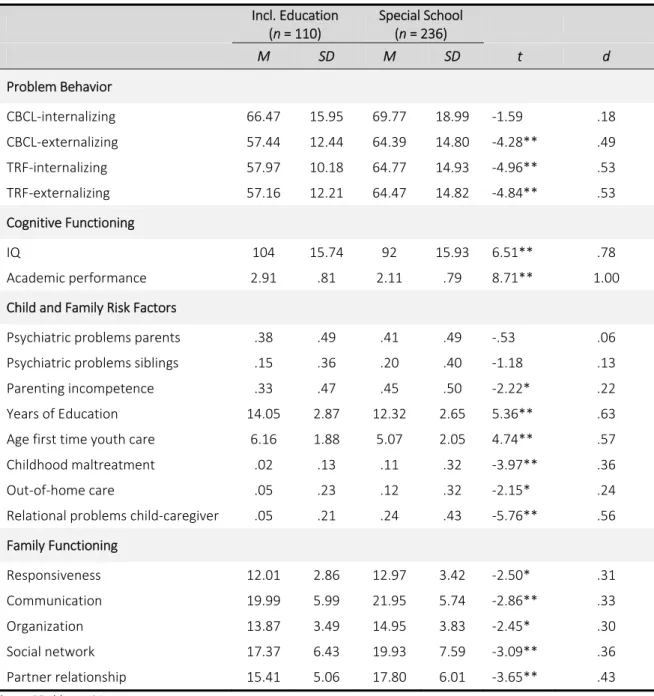
The results of the independent sample t‐test between the two groups of children for the
variables indicating problem behavior, cognitive functioning, child and family risk factors,
and family functioning are presented together in Table 1.
Significant differences between groups were found on almost all variables within
the four domains to the prejudice of children in special schools. Children in special schools
receive significantly higher scores on the problem scales TRF‐internalizing, TRF‐
externalizing, and CBCL‐internalizing than children in inclusive education. Furthermore,
children in special schools have significant lower IQ’s and perform less well on academic
tasks in comparison to their peers, than children in inclusive education.
The results on the domains concerning child and family risk factors and family
functioning show a similar picture. Children in special schools were significantly younger
when they first received youth care than children in inclusive education. Also, they
experienced childhood maltreatment, out‐of‐home care, and relational problems with
Special needs characteristics that affect inclusion in regular education
incompetence was more frequently reported within families of children in special schools
than within families of children in inclusive education, and the number of years of
education was significantly lower for families of children in special schools. Regarding the
family functioning data it was found that families of children in special schools had
significantly higher scores on all subscales measuring family functioning. This indicates that
parents of children in special schools report more difficulties with regard to
responsiveness, communication, organization, social network, and partner relationship
than parents of children in inclusive education. No differences between groups were found
according to parents’ ratings on internalizing behavior and the occurrence of psychiatric
problems of parents and siblings.
Determining Predictors
In order to determine statistically significant predictors of educational placement, initial
logistic regression analyses were performed. In the following part the results of these
analyses will be examined for each domain separately.
Problem behavior. Initial logistic regression analysis of the behavioral factors showed a
statistically significant omnibus χ² for the problem behavior domain as a whole (χ² (4) =
48.61, p < .01). Of the four variables entered into the equation, TRF‐externalizing (B = .04,
SE = .01, Wald = 10.87, p = .001), TRF‐internalizing (B = .04, SE = .01, Wald = 13.88, p =
.000), and CBCL‐externalizing (B = .03, SE = .01, Wald = 8.25, p = .004) turned out to be
significant predictors of educational placement within the problem behavior domain.
CBCL‐internalizing proved not to be a statistically significant predictor and is therefore not
included in the final model for further analyses.
Cognitive functioning. For the cognitive functioning domain as a whole a statistically
significant omnibus χ² was found (χ² (2) = 77.51, p < .01). Both IQ (B = ‐.03, SE = .01, Wald =
10.40, p = .001) and academic performance (B = ‐1.00, SE = .18, Wald = 32.64, p = .000)
were significant predictors of educational placement setting.
Child and family risk factors. The results of the initial logistic regression analysis for this
domain showed a statistically significant omnibus χ² for the risk factors domain as a whole
(χ² (8) = 81.46, p < .01) with the following three factors being significantly predictive of
educational placement: relational problems between child and caregiver (B = 1.76, SE =
.53, Wald = 11.07, p = .001), age of first time youth care (B = ‐.34, SE = .07, Wald = 23.15, p
= .000), and Years of Education (B = ‐.22, SE = .05, Wald = 20.18, p = .000). The other five
risk factors were not statistically significant predictors and were therefore not included in
the final model for further analyses.
Table 1
Independent Samples t‐tests for Groups Inclusive Education and Special School on Problem Behavior, Cognitive Functioning, Child and Family Risk Factors, and Family Functioning
Incl. Education
(n = 110)
Special School
(n = 236)
M SD M SD t d
Problem Behavior
CBCL‐internalizing 66.47 15.95 69.77 18.99 ‐1.59 .18
CBCL‐externalizing 57.44 12.44 64.39 14.80 ‐4.28** .49
TRF‐internalizing 57.97 10.18 64.77 14.93 ‐4.96** .53
TRF‐externalizing 57.16 12.21 64.47 14.82 ‐4.84** .53
Cognitive Functioning
IQ 104 15.74 92 15.93 6.51** .78
Academic performance 2.91 .81 2.11 .79 8.71** 1.00
Child and Family Risk Factors
Psychiatric problems parents .38 .49 .41 .49 ‐.53 .06
Psychiatric problems siblings .15 .36 .20 .40 ‐1.18 .13
Parenting incompetence .33 .47 .45 .50 ‐2.22* .22
Years of Education 14.05 2.87 12.32 2.65 5.36** .63
Age first time youth care 6.16 1.88 5.07 2.05 4.74** .57
Childhood maltreatment .02 .13 .11 .32 ‐3.97** .36
Out‐of‐home care .05 .23 .12 .32 ‐2.15* .24
Relational problems child‐caregiver .05 .21 .24 .43 ‐5.76** .56
Family Functioning
Responsiveness 12.01 2.86 12.97 3.42 ‐2.50* .31
Communication 19.99 5.99 21.95 5.74 ‐2.86** .33
Organization 13.87 3.49 14.95 3.83 ‐2.45* .30
Social network 17.37 6.43 19.93 7.59 ‐3.09** .36
Partner relationship 15.41 5.06 17.80 6.01 ‐3.65** .43
* p < .05, ** p < .01
Family functioning. The five variables of family functioning were included into an initial
logistic regression analysis. A statistically significant omnibus χ² was found for the family
functioning domain (χ² (5) = 18.88, p < .01). Of all subscales, the partner relationship factor
turned out to be the only underlying predictor of educational placement (B = .05, SE = .03,
Wald = 3.92, p = .048) and was therefore the one factor to be included into the final