Lucrări ştiinŃifice Zootehnie şi Biotehnologii, vol. 41 (1) (2008), Timişoara
METHOD TO STARCH CONTENT DETERMINATION FROM
PLANTS BY SPECIFIC WEIGHT
PROCEDEU DE DETERMINARE A CON
ł
INUTULUI DE
AMIDON DIN PLANTE CU AJUTORUL GREUT
Ăł
II
SPECIFICE
WIDMANN NORGIA*, GOIAN MIRCEA*, IANCULOV IOSIF*, DUMBRAVĂ DELIA**, MOLDOVAN CAMELIA**
* Faculty of Agriculture, Timişoara, România
** Faculty of Agrofood Products Technology, Timişoara, România
In this work, the used methods (chemical and physical) to quantitative starch determination from plants were replaced with a simple, fast, exactly method, in which the starch percent was determined with the help of specific weight. Were analyzed four potato varieties (Hansa, Sieglinde, Nicola and Linda), from a German private sours. The potato crops were achieved in Schöngeising, Germany, at 25-30 km from Munich on an experimental ground with a 100 m2 area. In this purpose were used both the classical and biodynamical crop methods
Key words: starch, specific weight, potatoes, biodynamical methods
Introduction
Starch (C6H12O5)n is the most important poly-glucide in the vegetal kingdom; is formed from α-D-gluco-pyranose with a high polymerization degree, of thousands order. In small quantity is present in all the vegetative plant organs. In high quantity is present in granulated form in the grain caryopsis, in seeds, in tubers and even in the wooden stems endoderm [Pârvu, 1997].
Starch is formed by α-glucose binding chains and contains two components [Ianculov, 2005]:
- α-amylose, unbranched, with poly-disperse chain that vary in the molecular
mass from 150.000 to 600.000 Daltons; amylose is water insoluble, but forms hydrated mycelium’s which form a blue color with iodine;
- amylopectin, very branched, that contain 600-6000 glucose remainders; the essential glycosidic bound are α (1→ 4), but the ramification points are given by the α (1→ 6) bound; his molecular weight are of 200.000-1.000.000 Daltons; amylopectin formed colloidal or mycellar solutions, which give a red-violet color with iodine.
It could not speak of a proper starch pharmaco-dynamic action. The physical action notion is not suitable. Due to their physical properties show a protection, drying, or in some proportion steeping vat action. Larger is his utilization as pharmaceutical excipient in pills, tablets, dragees.
In powder form and as ointments, starch is used in dermatology, and the starch glycerolate are a base for the hydrophilic ointments. In surgery starch are used for fix bandages manufacture.
In industry, starch is used for preparation of ethanol, buthanol, acetone, lactic acid etc. Also, is used in the textile industry, food industry, in laboratories etc. [Gherghi et al., 1983].
Materials and Methods
There were used four potato breeds obtained from a private source in Germany, country in which potatoes are cultivated and consumed frequently:
For the experiments achievement was used following four potato varieties, obtained from a German private source, country were this potato varieties are frequently cultivated and consumed:
• Hansa - ovoid form, shiny yellow peel, yellow pulp resistant to depositing;
• Sieglinde - long ovoid tubers, in the kidney form, shiny yellow peel, yellow
pulp;
• Nicola – oblong ovoid form, dark- yellow pulp, high water content, fine
aroma;
• Linda – oblong, oval, almost long tubercles, dark- yellow pulp, fine aroma.
The potatoes growing was made in Schöngeising, Germany, at 25- 30 km near Munich, on an experimental plot of land with 100 m2 surface, on a brown soil with a pH of 6.5-6.7 and with a high content of phosphorus and kalium and a low content of magnesium. The potatoes were seeded in 2005, in the April second decade, and the tubercles were cropped in the September first decade. The atmospheric conditions were unfavorable for the potatoes production: warm and dry weather during almost the whole vegetation period, rain come only in August.
There were used classic cultures as well as biodynamic culture methods. Concerning classic methods, there were used chemical fertilizers from the German „Lebosol”:
- Aminosol, a 9% fertilizer solution based on organically fixed nitrogen having
amino- acids as nourishing substance;
- Magphos, which has 30 % P2O5, 3 % N and 7 % MgO in his composition,
having phosphorus as nourishing substance;
- Kalium450, which contain 3 % N and 31 % K2O.
These solutions were mixed in 1:5:1 volume reports and were dubbed in quantity of 0.05 l on the classic conditions cultivated potatoes surface.
• the 500 preparation obtained by introduction of the cow dung in an cow horn that gave birth to 3 calfs; in 3 September 2005, this cow horn was burying at approximate 50 cm and draw out on 28 February 2006; the horn dung was blended with 12 l of rain water;
• the wheat straw compost, blended with vegetal mass (leaves, weeds, young
branches); the fermentation period of this biodynamic preparation was of 4 weeks, after which was blended with a small quantity of rain water.
The two biodynamic preparations were mixed together and then scattered on the experimental plot of land after it was ploughed [Steiner, 1977; Sattler, 2003; 2005].
The common methods for starch determination could be chemical and physical (polarimetrical).
The chemical methods are based on the enzymatic or acid starch hydrolysis, then on the volumetric or gravimetric determination of the glucose that is formed.
The physical methods are based on starch dissolving and determination of the solution poalrimetric deviation. The obtained values through this way refer to raw starch, because, about starch are dissolved both product dextrins and hemi-celluloses. The results obtained by this method are satisfying for potato starch content determination, because the accompanying substance proportion are low and the optic activity of this are small [Ianculov and Filimon, 2003].
In the achieved experiments, the percent content of starch was calculated with the help of specific weight. In this purpose was determined the weight of a 10 potato tubers quantity, both in air and after their immersion in a water glass. The specific weight was calculated with following relation:
gsp =
2 1
1
W
W
W
−
were:gsp = specific weight of the vegetal material, in g; W1 = air weight of the vegetal material g;
W2 = the weight of the analyzed vegetal material, completely immersed in water, in g.
For determination of the total starch content are used the following relation (Talburt and Smith, 1959; Vasanthan and colab, 1999):
amd = 17546 + 199.07 (gsp – 1,0988) where:
amd = starch content of vegetal material, in %
Results and Discussions
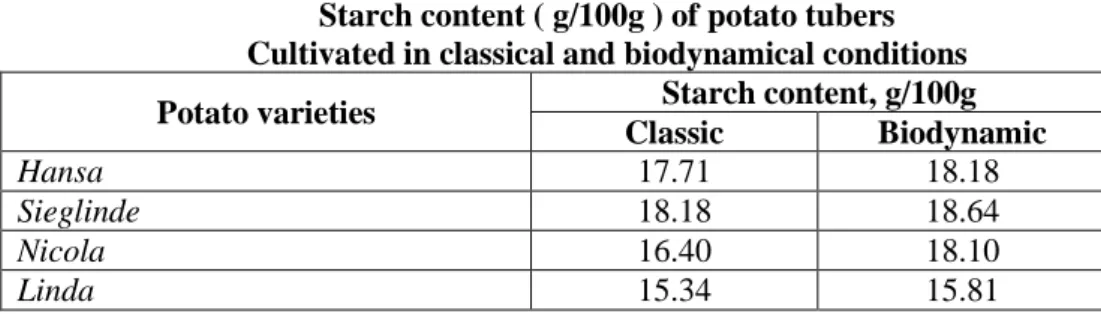
Potato tubers cultivated in classical conditions, contain 15.34-18.18 % starch. The obtained results are similar to speciality literature data [Vasanthan et al., 1999; Christie, 1984].
Concerning potatoes cultivated in through biodynamic farming methods there can be observed a significant increase of the starch content, the obtained values being higher with about 3-12% for all cultivated potato breeds, values between 15.81-18.64.
Table 1 Starch content ( g/100g ) of potato tubers
Cultivated in classical and biodynamical conditions
Potato varieties Starch content, g/100g Classic Biodynamic
Hansa 17.71 18.18
Sieglinde 18.18 18.64
Nicola 16.40 18.10
Linda 15.34 15.81
The explanation is that the use of biodynamic preparates has blot detrimental agents out of the today’s chemical or ecological Agriculture, and there was accomplished a living soil with extra energy and protection as well as true natural conditions in which potatoes could develop healthy with an increased vitality unlike potatoes cultivated in chemical conditions. These potatoes become more able to fight against detrimental agents and are more storage resistant.
Through potatoes obtained in biodynamic conditions there can be obtained some healthier food products, which will contribute to a normal human life according to actual and following needs. These aliments transmit more vitality and the possibility to receive the unimaginable benefic vibrational-energetic dimension existing in these nutrients.
Conclusions
The conclusion due to the research is that fertilizers used to increase potato growth represent an ecological risk because they penetrate potato’s tissues, they affect their metabolism and change the chemical composition of the tubercles, reducing the content of their active principles.
The shortcomings of „traditional farming” can be blot out through the use of „biodynamical farming”, which should consider in large, natural connections all the surrounding factors. The secret of this Agriculture rests in the wisdom of managing all preparatory phases referred to the soil, compost, seed, as well as the natural biodynamic preparates obtained from plants and the administration mode on the field. Through biodynamic farming the soil structure is being recovered, which imprints plants and implicit foods an increased vitality. In biodynamic farming, through the way of executing work, it can be pursued that plants develop healthy and obtain more healthy food products.
This study has proved the benefaction of biodynamic farming through cultivating some potato breeds in biodynamic conditions, whom there had been administrated in homeopathic doses on the field biodynamic preparates as well as muck compost (animal and vegetal rests) on the field, for remineralisation of the soil and accomplishing a living soil with extra energy and protection. The tubercles of the in biodynamic conditions cultivated potatoes showed higher values concerning the content of active principles and energetically values.
This study tries to be a planting for cultivating all plants (not only potatoes) in biodynamic conditions.
It is necessary for this farming mode to take size in the future, so that biodynamic farming should become a true salvation for the human of the 21st Century.
Bibliography
1. Pârvu, C. (1997) - Universul plantelor. Mică enciclopedie; Ed.
Enciclopedică, Bucureşti, 32.
2. Ianculov, I. (2005) - Biochimie, vol. 1, Ed. Orizonturi Universitare, Timişoara, 119-120.
3. Gherghi, A., Burzo, I., Mărgineanu, L., Deneş, S, Dobreanu, M., Pattantzus, K. (1983) - Biochimia şi fiziologia legumelor şi fructelor; Ed.
Academiei RSR, Bucureşti, 16-84.
4. Steiner, R. (1977) - Bazele spiritual-ştiinŃifice pentru prospectarea agriculturii; Ed. Triada, 71-143.
5. Sattler, R. (2003) - Ferma biodinamică, Ed. Wisinghausen, 18-24.
6. Sattler, R. (2005) - Hrană vie din agricultura biodinamică, Ed. Wisinghausen, 18-30.
7. Ianculov, I., Filimon, M. (2003) - Analiza biochimică, Ed. Orizonturi Universitare, Timişoara, 120.
8. Talburt, W.F., Smith, O. (1950) - Potato processing; Ed. Westport C. T., The Avi Publishing Company, 17.
9. Vasanthan, T., Bergthaller, W., Driedger, D., Yeung, J., Sporus, P. (1999) - Starch from Alberta potatoes: wet isolation and some
physicochemical proprieties, Food Res. Int, 32, 355-365.