The Treatment of E-Commerce and Software in German Foreign Trade
Statistics
Part A:Treatment of e-commerce A 1 Introduction
This discussion paper gives an outline of the methodological treatment of e-commerce and software in Germany's foreign trade statistics and of the methodological problems we are faced with in this context. In the text below the following definitions are used:
E-commerce: Transactions conducted over the internet or other electronic networks. Goods or services are ordered via these networks, the delivery is done on-line or off-line.1
Software: Machine-readable information stored on a data carrier (i.e. diskettes, CD-ROMs, magnetic tapes) used to reproduce programs, data, sound or images.
According to the definition above, the term e-commerce mainly means the way goods are being purchased, and it is not evident, whether these products are "normal" goods or digitalized information supplied electronically. Therefore on-line delivery is equivalent to the delivery of software over the internet and will be treated in part B.
Both e-commerce and software are features of the modern economy in a rapidly expanding information society. Nevertheless, until now the National Statistical Offices in the EEC-countries have not provided much information on these topics. The question is whether "new" forms of trade, such as e-commerce or the product "software" are to be included in surveys already existing or whether they should be covered by new surveys. If e-commerce takes place across national frontiers or software is sold to customers abroad, the idea of integrating these transactions into foreign trade statistics is quite obvious. Furthermore, foreign trade statistics have reached a high degree of harmonization in the EEC-countries.
As is well known, collection of foreign trade statistics was exclusively the business of customs authorities up to 1.1.1993. In 1993, when the member countries of the European Union abolished their internal customs frontiers, they introduced a system of direct notification of statistical offices to keep track of external trade within the Community (the
so-called Intrastat system), whereas data collection on foreign trade with "third" countries, i.e. countries outside the EEC, kept being done by the customs authorities in the traditional way. It is a characteristic feature of the Intrastat system that the businesses concerned submit their declarations directly to the statistical offices. Another characteristic feature is the system's very close linkage with the value added tax system, allowing the advance turnover tax returns, which businesses have to submit to the local tax offices on a monthly basis, to be (indirectly) verified. It is important to know that German statistics on foreign trade rely on two data collection systems, but the methodological principles applied for trade with EEC countries are similar to those applied for trade with non-EEC countries.
Foreign trade statistics, based on the traditional survey of customs declarations, are statistics on merchandise trade, i.e. on the trade in goods, and the Intrastat-system, too, covers only the cross-border trading of goods. This principle is also laid down in the relevant regulations of the EEC having regard to Intra- and Extra-Community trade statistics. These regulations stipulate that „ ‚goods‘ means all movable property, including electric current“.2 The German law on foreign trade statistics is somewhat more precise, using the term „things“ and therefore making clear that the purpose of the foreign trade statistics is to collect data on physical trade across frontiers and not on trade in services or immaterial products (such as data delivered on-line).
A2 Statistics on foreign trade and e-commerce
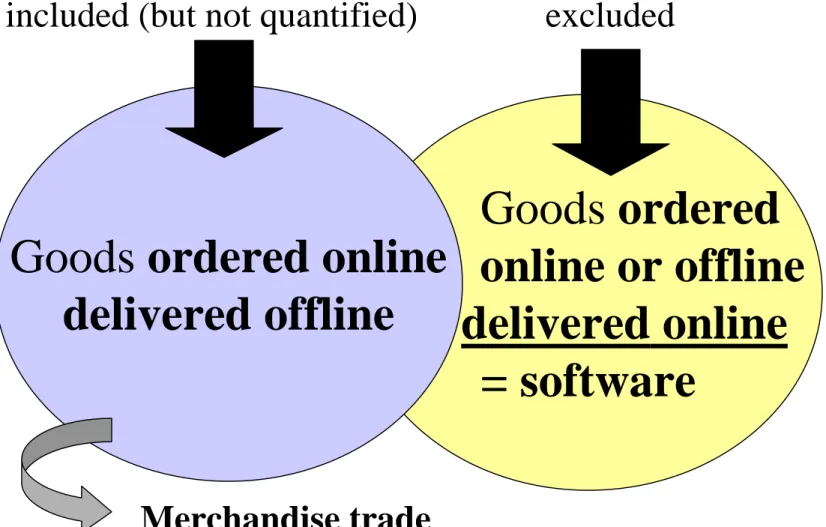
According to the definition used, e-commerce means that purchase and/or delivery is done over the internet. Therefore data delivered abroad on-line are not included in the results of foreign trade statistics (see diagrams 1 and 2). Diagram 2 illustrates the consequence: this diagram shows the case of a company delivering "conventional" books, on the one hand, and selling the content of these books on-line to customers abroad, on the other hand. Though the data sent on-line are to some extent a substitute for the books, the company has only to submit statistical declarations for the books actually sold.
"Normal" goods ordered on-line and delivered abroad in a physical form are included in the results of foreign trade statistics. However, in that case foreign trade statistics do not reveal, whether the order was placed on-line or in the "traditional" way (via telephone etc.), because
1 Definition given in the pilot study on trade statistics undertaken by the Federal Statistical Office of Germany
the way of placing an order is not recorded as a variable of foreign trade statistics. Summing up, we can say that a certain part of e-commerce is included in the statistical results of foreign trade statistics, but at the moment it is not possible to quantify it.
A3 Ways to quantify merchandise trade based on e-commerce
If one accepts in a first step that statistics on foreign trade are actually statistics on merchandise trade, one might nevertheless ask the question on how to quantify that part of foreign trade that was initiated by on-line orders (diagram 3). From the point of view of data collection, this is not difficult to achieve: a new "kind of order" variable could be included in the customs declarations and in the Intrastat declarations. Digit 1 might encompass "traditional" ways of order, whereas digit 2 might characterise on-line orders (diagram 4). Alternatively, it would also be possible to make use of variables already existing such as the statistical procedure, enlarging only the number of possible subdivisions. So, after a modification of the legal basis of foreign trade statistics, in particular of the respective EEC regulations, it would be possible to quantify that part of foreign trade that stems from e-commerce.
The question is if this actually makes sense. The question on the kind of media used for the sale or purchase of goods is not very important to the majority of users of external trade statistics. Foreign trade figures are mainly used for market research, and therefore the kind of information most users are actually interested in is information on the product sold or bought, on the trading countries and on the values of the goods in question. In addition, other shortcomings of foreign trade statistics are even more obvious. To give you an example: the Federal Statistical Office of Germany is undertaking a pilot survey on a voluntary basis in the context of foreign trade statistics in order to identify that part of foreign trade that can be attributed to intra-company trade. In our opinion, it is far more important to have information on the extent of intra-company trade than on the number of orders coming in on-line.
Furthermore, the declarants are obliged to use a very detailed product classification, including some 10 300 product codes. Therefore, the introduction of just one new variable might considerably increase the number of lines to be processed by some companies and enlarge their statistical burden in terms of the costs incurred. Yet it is a well known fact that European policy aims to reduce the bureaucratic burden on companies. Thus, some variables have been
excluded from the Intrastat system in the last few years and small companies have actually benefited from different simplifying procedures.
As a conclusion, the Federal Statistical Office of Germany does not pursue the target to introduce a variable into foreign trade statistics that would allow us to quantify that part of foreign trade that can be attributed to e-commerce. The FSO of Germany carried out pilot studies on e-commerce in retail and wholesale trade statistics. In my opinion, these statistics are better suited to examine the importance of e-commerce and the influence it has on trade than foreign trade statistics.
Part B: Treatment of software
B1 Legal regulations on the declaration of software
The question if software should be regarded as a object of foreign trade statistics has been under discussion for a long time. In Germany, the system of foreign trade statistics in operation until 1993, which was entirely customs-based, did not treat software as an object of statistical observation and the only thing to be declared was the value of the carrier media. Owing to a cut-off threshold, which was applied in the customs-based data collection system3, even these data were frequently not recorded.
The principle that only the carrier media and not the information or software itself was subject to registration in foreign trade statistics was also valid for most of the time during which the Intrastat system has been in force. The philosophy behind this decision was quite simple: software was considered to be a service and therefore it should be excluded from foreign trade statistics.
Nevertheless, the argument was raised that at least packaged software (e.g. Microsoft products) should be recorded in the same way as other goods in foreign trade statistics. As a result, the EEC regulations on intra-EU and extra-EU trade were modified at the end of last year, introducing a distinction to be made between standardized software products and
No 1172/95 of 7.5.1995, article 2 b).
3
software products generated for one particular client.4 Now, the exemption is restricted to software produced for one particular client:
Data shall not be required for the following goods: (...) Goods used as carriers of information such as floppy disks, computer tapes, films, plans, audio- and videotapes, CD-ROMs which are traded in order to provide information, when developed to order for a particular client or when they are not the subject of a commercial transaction, as well as goods which complement a previous delivery e.g. an update, and for which the consignee is not invoiced.
B2 Distinction between packaged software and software for particular clients
The regulations quoted above exempt data carriers, used for providing information and thus containing software, from statistical declaration, when they were developed for a particular client. As a consequence, standardized software products such as programs for word processing have to be declared with their full market values. But how shall we treat complex programs, e.g. those for accounting, that exist in a standardized basic version which is adapted to the needs of individual clients later on? This example shows that there are transitions between standardized and "individual" software, and the foreign trade statisticians in charge of examining and correcting the statistical declarations submitted by companies have the difficult job to decide which transactions should be exempted from declaration. Thus, the EEC regulations quoted above do not indicate a criteria for classifying software either as standardized or as "individual", and the practical cases we are dealing with clearly show that the regulations should state more precisely what a phrase like (software) "developed to order for a particular client" really means.
B3 Linking to a data carrier
The EEC regulations exempt software for particular clients from declaration, if it is sent abroad on "normal" data carriers such as CD-ROMs or diskettes. But what is the correct valuation of software if it is linked to hardware? In this case the rules for the determination of the statistical value (value free at border) apply. That means that software linked to hardware (e.g. stored on the hard disk) is recorded in foreign trade statistics with its full value. That means that a program developed for a particular customer is not covered by the survey if it is delivered separately e.g. on CD-ROM, but it is included in the value of the computer if it is stored on the hard disk.
This different valuation of software dependent on the fact whether or not it is delivered separately from hardware items is not very satisfying. As a result, the meaningfulness of the unit values of hardware products suited to „transport“ software is negatively affected by the described way of valuation. In the described case, it might be a good idea to change the regulations describing how to determine the statistical value, so that "individual" software is excluded from the statistical survey even if it is linked to hardware products.
B4 Licences for using software
As stated above, foreign trade statistics only provide information on the trade in goods across borders. If a licence for the use of a (standardized) software program is already granted and later expanded to a larger number of computers, but no new data carrier is sent abroad, this transaction is not recorded in foreign trade statistics. If, however, a CD-ROM with a standardized software program is sold abroad and this consignment is linked to the permission of installing this program on 50 personal computers, we are again confronted with a case, which is not regulated in a clear way. We consider that it would be justified if this CD-ROM was recorded with the total value of 50 programs.
B5 Information transmitted on-line
Now we can return to the beginning of this lecture, to the question if information delivered on-line and transmitted via the internet should be recorded in foreign trade statistics. The question whether information traded on-line can be regarded as trade in goods can be answered in different ways. The regulations in foreign trade statistics are very clear in this regard: digitalized information without a data carrier is not considered as a good and therefore excluded from foreign trade statistics. This point of view was supported by most delegations during discussions in the WTO some years ago. But the opposite view was also voiced, pointing to the fact that a number of products which traditionally have been delivered as "goods" can now be sent across networks in digital form and that this speaks in favour of treating on-line deliveries in the same way as deliveries of "normal" goods (diagram 5). From the point of view of data collection, one could imagine that new product codes were created for information delivered on-line.
1917/2000 of 7 september 2000, in each case annex 1 (list of exemptions).
Nevertheless, the methodological problems statisticians are faced with even now, when dealing with software on data carriers, make it quite clear that experts in foreign trade statistics are not very keen on integrating on-line-transactions in the survey.
Furthermore, one should keep in mind that in EEC countries foreign trade statistics are based on control mechanisms which ensure complete recording of foreign trade and which are not suitable for on-line-transactions. First, we cannot have customs clearance the way it is practised in the Extrastat system and public opinion is presently not in favour of controlling data flows on the internet. Second, in the case of on-line-transactions, it is not possible to compare statistical Intrastat declarations submitted by companies with equivalent declarations made in the framework of the VAT-system on intra-community deliveries or dispatches, because VAT laws classify these transactions as services.
B6 German foreign trade statistics: data on selected IT-products
As we have seen, the recording and valuation of software is frequently quite difficult, and the problems encountered also affect the valuation of hardware. Despite all these problems faced by declarants and foreign trade statisticians charged with checking on the declarations, the values recorded for some products typical of the information society are quite impressive. Thus, according to the foreign trade statistics collected, Germany's imports of personal computers amounted to the value of 7,3 bn. DM and exports of 5,7 bn DM in the year 2000. In the same period software exports constituted 2 bn. DM, imports being 1,3 bn. DM. The products shown in the table are only a small proportion of all IT products, but nevertheless their share in the total German foreign trade was 0,6 % for exports and 0,9 % for imports in 2000. Improving the regulations and practices of recording and valuation software is therefore a task that has to be tackled soon.
German foreign trade in selected IT products (year 2000) 1000 DM
Code number Import Export
PC-system 1 8471 49 90 2318,4 906,1 PC (only CPU) 8471 50 90 5028,6 4839,5 PC (total) 7347,0 5745,6 Software on CD-ROM 8524 31 00 574,1 364,2 8524 39 10 803,3 433,8 Software on diskette 8524 91 00 384,8 417,9 8524 99 10 175,6 72,7 Software on magnetic tape 8524 40 00 24,7 23,4
Total of software 1962,5 1312,0
1
Diagram 1: In which cases is e-commerce
recorded in the statistics of foreign trade?
Goods
ordered
online or offline
delivered online
= software
Goods
ordered online
delivered offline
included (but not quantified)
excluded
Diagram 2: Trade with books
Germany
France
Company A
Company F 1
Company F 2
Company F 3
Case 1: Physical transport across
the frontier
Books are sold across the frontier
=> part of the foreign trade
statistics
Case 2: Online-Transmission
Books are transmitted online,the
French recipient prints the books =>
not part of the foreign trade statistics
Diagram 3: International Merchandise Trade and
e-commerce
Goods ordered
offline
Goods ordered
online
Ways to
quantify this
part ?
Art der Bestellung