Disability)
Sally E. Shaywitz, MD,*Bennett A. Shaywitz, MD†
Objectives
After completing this article, readers should be able to: 1. Define dyslexia and its relationship to intelligence.2. Distinguish dyslexia from other disorders that feature reading difficulties. 3. Describe the process of diagnosing dyslexia.
4. Characterize the management of dyslexia. 5. Discuss the prognosis of dyslexia.
Definition and History
Developmental dyslexia is characterized by an unexpected difficulty in reading in children and adults who otherwise possess the intelligence and motivation considered necessary for accurate and fluent reading. Historically, dyslexia initially was noted in adults in the latter half of the nineteenth century, and developmental dyslexia first was reported in children in 1896. In the 1920s, it was believed that defects in the visual system were to blame for the reversals of letters and words thought to typify dyslexia. Subsequent research has shown, however, that in contrast to a popular myth, children who have dyslexia are not unusually prone to seeing letters or words backwards. Rather, they have significant difficulty in
namingthe letters, often calling a “b” a “d” or reading “saw” as “was.” The problem is linguistic, not visual.
Epidemiology
Dyslexia represents one of the most common problems affecting children and adults; the prevalence in the United States is estimated to be 5% to 17% of school-age children, with as many as 40% reading below grade level. Dyslexia (or specific reading disability) is the most common and most carefully studied of the learning disabilities, affecting at least 80% of all individuals identified as being learning disabled. Recent epidemiologic data indicate that like hypertension and obesity, dyslexia fits a dimensional model. Within the popula-tion, reading ability and reading disability occur along a continuum, with reading disability representing the lower tail of a normal distribution of reading ability. Good evidence based on sample surveys of randomly selected populations of children now indicate that dyslexia affects boys and girls comparably (Fig. 1); the long-held belief that only boys suffer from dyslexia reflected sampling bias in school-identified samples.
Dyslexia is a persistent, chronic condition that stays with the individual his or her entire life; it does not represent a transient “developmental lag” (Fig. 2). Over time, poor readers and good readers tend to maintain their relative positions along the spectrum of reading ability.
Dyslexia is both familial and heritable, which provides opportunities for early identifi-cation of affected siblings and often for delayed but helpful identifiidentifi-cation of affected adults. Thus, up to 50% of children of dyslexic parents, 50% of siblings of dyslexic children, and 50% of parents of dyslexic children may have the disorder. Replicated linkage studies implicate loci on chromosomes 2, 3, 6, 15, and 18.
Pathophysiology
Converging evidence from a range of neurobiologic investigations demonstrates a disrup-tion in left hemisphere posterior reading systems, primarily in left
temporo-parieto-*Professor of Pediatrics and Co-Director, NICHD-Yale Center for the Study of Learning and Attention.
†Professor of Pediatrics and Neurology and Co-Director, NICHD-Yale Center for the Study of Learning and Attention, New Haven, CT.
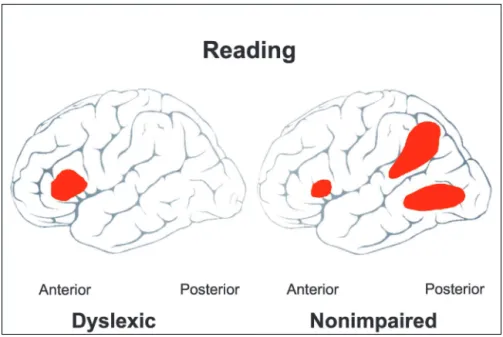
occipital brain regions, in dyslexic readers, with a relative increase in brain activation in frontal regions in dyslexic compared with nonimpaired readers (Fig. 3). These neu-ral systems are part of a widely distributed neuneu-ral system relating spoken language to the written word.
These neurobiologic data are consistent with a strong consensus among investigators in the field that the cen-tral difficulty in dyslexia reflects a deficit within the language system, although other systems and processes may contribute to the difficulty. The language system is conceptualized as a hierarchical series of components. At higher levels are neural systems engaged in processing, for example, semantics, syntax, and discourse. At the lowest level is the phonologic module dedicated to pro-cessing the distinctive sound elements that constitute language. The functional unit of the phonologic module is the phoneme, defined as the smallest discernible seg-ment of speech. For example, the word “bat” consists of three phonemes: /b/ /ae/ /t/. To speak a word, the speaker retrieves the word’s phonemic constituents from his or her internal lexicon, assembles the phonemes, and utters the word. Conversely, to read a word, the beginning reader initially must divide the word into its
underlying phonemes. Phonemic awareness—the insight that all spo-ken words can be pulled apart into phonemes—is deficient in children and adults who have dyslexia. Re-sults from large and well-studied populations that have reading dis-ability confirm that a deficit in pho-nology represents the most robust and specific correlate of reading dis-ability in young school-age children and adolescents.
Basically, reading comprises two primary processes: decoding and comprehension. In dyslexia, a defi-cit at the level of the phonologic module impairs the ability to seg-ment the written word into its un-derlying phonologic elements. As a result, the reader experiences diffi-culty in decoding and identifying the printed word. The phonologic deficit is domain-specific; that is, it is independent of other, nonpho-nologic linguistic abilities. In par-ticular, the higher-order cognitive and linguistic functions involved in comprehension, such as general in-telligence and reasoning, vocabulary, and syntax, are intact. The pattern of a deficit in phonologic analysis contrasted with intact higher-order cognitive abilities offers an explanation for the paradox of otherwise intel-ligent people who experience great difficulty in reading. According to the model, a circumscribed deficit in a lower-order linguistic (phonologic) function blocks ac-cess to higher-order proac-cesses and to the ability to draw meaning from text. The affected reader cannot use his or her higher-order linguistic skills to access the meaning until the printed word has been decoded and identified. For example, an individual who knows the precise mean-ing of the spoken word “apparition” will not be able to use that knowledge of the meaning of the word until he or she can decode and identify the printed word on the page, thereby appearing not to know the word’s mean-ing.
Diagnosis
At all ages, dyslexia is a clinical diagnosis. The clinician seeks to determine through history, observation, and psychometric assessment, if there are: 1) unexpected difficulties in reading (ie, difficulties in reading that are
Figure 1. Prevalence of reading disability in research-identified (RI) and school-identified (SI) boys and girls. Schools identify about four times as many boys as girls, reflecting primarily externalizing behavioral characteristics that are more likely to bring boys to a teacher’s attention. This skewed prevalence rate reflects referral bias, and when actual reading scores are used to identify children, there is no significant difference in the prevalence of dyslexia between boys and girls. Data adapted from Shaywitz, Shaywitz, Fletcher, and Escobar, 1990. Copyright © 2002, S. Shaywitz.
unexpected for the person’s cognitive capacity, as shown by his or her age, intelligence, or level of education or professional status) and 2) associated linguistic problems at the level of phonologic processing. No one single test score is pathognomonic of dyslexia. As with any other medical diagnosis, the diagnosis of dyslexia should reflect a thoughtful synthesis of all available clinical data. Dys-lexia is distinguished from other disorders that may prominently feature reading difficulties by the unique, circumscribed nature of the phonologic deficit, which does not intrude into other linguistic or cognitive do-mains.
In the preschool-age child, a history of language delay or of not attending to the sounds of words (trouble playing rhyming games with words, confusing words that sound alike, trouble learning to recognize letters of the alphabet), along with a positive family history, represent significant risk factors for dyslexia. In the school-age child, presenting complaints most commonly center on school performance (“She’s not doing well in school”), and often parents (and teachers) do not appreciate that the cause is a reading difficulty. A typical picture is a child who may have had a delay in speaking, does not learn letters by kindergarten, and has not begun to learn to read by first grade. The child progressively falls behind,
with teachers and parents puzzled as to why such an intelligent child has difficulty learning to read. The reading difficulty is unexpected based on the child’s ability, age, or grade. Even after acquiring decod-ing skills, the child generally re-mains a slow reader. Thus, bright dyslexic children may learn labori-ously how to read words accurately, but they do not become fluent readers, recognizing words rapidly and automatically. Dysgraphia of-ten is present and is accompanied by laborious note-taking. Self-esteem frequently is affected, par-ticularly if the disorder has gone undetected for a long period of time.
The level of education or profes-sional status of an accomplished ad-olescent or young adult provides the best indication of cognitive ca-pacity; graduation from a competi-tive college and, for example, com-pletion of medical school and a residency indicates a superior cognitive capacity. For bright adolescents and young adults, a history of phono-logically based reading difficulties, requirements for extra time on tests, and current slow and effortful reading (ie, signs of a lack of automaticity in reading) are the sine qua non of a diagnosis of dyslexia. We emphasize that a history of phonologically based language difficulties, la-borious reading and writing, poor spelling, and the need for additional time in reading and in taking tests provides indisputable evidence of a deficiency in phonologic pro-cessing that, in turn, serves as the basis for, and the signature of, a reading disability.
Assessment of Reading
Reading is assessed by measuring decoding, fluency, and comprehension. Among the currently available normed tests of phonologic analysis for young children is the Comprehensive Test of Phonological Processing (CTOPP). It consists of measures of phonologic aware-ness, phonologic coding, and working memory as well as rapid naming. It has a national standardization for chil-dren ranging in age from 5 years to adulthood. In the school-age child, one important element of the evalua-tion is how accurately the child can decode words (ie,
Figure 2. Trajectory of reading skills over time in nonimpaired and dyslexic readers. Ordinate is Rasch scores (W scores) from the Woodcock-Johnson reading test (Woodcock and Johnson, 1989) and abscissa is age in years. Both dyslexic and nonimpaired readers improve their reading scores as they get older, but the gap between the dyslexic and nonimpaired readers remains. Thus, dyslexia is a deficit, not a developmental lag. Data adapted from Francis, Shaywitz, Stuebing, Shaywitz, and Fletcher, 1996.
read single words in isolation). This is measured with standardized tests of single real word and pseudoword reading, such as the Woodcock-Johnson III and the Woodcock Reading Mastery Test. Difficulties often emerge on tests of spelling, which depend on these same abilities. Reading fluency (reading connected text) is assessed by oral reading aloud, using the Gray Oral Reading Test. This test consists of 13 increasingly diffi-cult passages, each followed by five comprehension ques-tions. Single-word reading efficiency may be assessed by using the Test of Word Reading Efficiency (TOWRE), a test of speeded reading of individual words. For screen-ing by primary care physicians in the office, we recom-mend listening to the child read aloud from his or her own grade level reader. Keeping a set of readers from kindergarten through grade 4 available in the office serves the same purpose and does not require the child to bring in schoolbooks. Oral reading is a very sensitive measure of reading accuracy and, even more importantly, of reading fluency.
The most consistent and telling sign of a reading disability in an accomplished young adult is slow and laborious reading and writing. It must be emphasized that the failure either to recognize or to measure the lack
of automaticity in reading is per-haps the most common error in the diagnosis of dyslexia in older chil-dren and in accomplished young adults. Simple word identification tasks will not detect a person who has dyslexia but is sufficiently ac-complished to be in honors high school classes or to graduate from college and attend law, medical, or any other graduate school. Tests relying on the accuracy of word identification are inappropriate for diagnosing dyslexia in accom-plished young adults because they reveal little of the person’s struggles to read. It is important to recognize that because they assess reading accuracy but not automaticity (speed), the reading tests com-monly used for school-age children may provide misleading data on bright adolescents and young adults. The most critical tests are those that are timed, which are the most sensitive to a phonologic def-icit in a bright adult. However, very few standardized tests for young adult readers are admin-istered under timed and untimed conditions, with the exception of the Nelson-Denny Reading Test. Any scores obtained on testing must be considered relative to peers who have the same degree of education or profes-sional training.
Physical and Neurologic Examination and
Laboratory Tests
A general physical examination has a very limited role in the evaluation of dyslexia. Primary sensory impairments should be ruled out, particularly in young children. In specific instances, examination for the features of sex-linked genetic disorders, such as Klinefelter syndrome, that may be associated with language and reading prob-lems also may be productive. Otherwise, the examination should be governed by any nondyslexic symptoms that indicate specific areas of concern. Results of the routine neurologic examination usually are normal in children who have dyslexia. Laboratory measures, such as imaging studies, electroencephalography, or chromosomal analy-sis, are ordered only if there are specific clinical indica-tions. At this time, functional imaging is restricted to research studies and is not used for clinical diagnosis.
Figure 3. Schematic of brain activation maps in nonimpaired and dyslexic readers engaged in phonologic processing during the pseudoword rhyming test. Nonimpaired readers activate: 1) an anterior system in the left inferior frontal region; 2) a parieto-temporal system involving the angular gyrus, supramarginal gyrus, and posterior portions of the superior temporal gyrus; and 3) an occipito-temporal system involving portions of the middle and inferior temporal gyrus and middle occipital gyrus. In contrast, dyslexic readers demonstrate a relative underactivation in both posterior systems and an increased activation in the inferior frontal gyrus. Copyright © 2002, S. Shaywitz.
Treatment
The management of dyslexia demands a lifespan perspec-tive. Early in the child’s life, the focus is remediation of the reading problem. As a child matures and enters the more time-demanding setting of secondary school, the emphasis shifts to the important role of accommoda-tions. The primary goal of effective intervention pro-grams is to remediate the underlying problem in phone-mic awareness, but all too frequently the standard instruction provided through remediation is too little, too general, and too unsystematic. Most recently, based on the work of the National Reading Panel, evidence-based reading intervention programs have been identi-fied that provide instruction in the most important ele-ments of reading. Effective interventions used with younger children and even with older children include programs to improve phonemic awareness (PA), which is the ability to focus on and manipulate phonemes (speech
sounds) in spoken syllables and words. The elements found to be most effective in enhancing PA, reading, and spelling skills include teaching children to manipulate phonemes with letters, focusing the instruction on one or two types of phoneme manipulations rather than on multiple types, teaching children in small groups, and providing systematic explicit instruction rather than inci-dental instruction. Providing instruction in PA is not sufficient to teach children to read. Effective intervention programs encompass teaching phonics, that is, making sure that the beginning reader understands how letters are linked to sounds to form letter/sound correspon-dences and spelling patterns. Also critical to teaching phonics is explicit and systematic instruction. Phonics instruction enhances children’s success in learning to read, and systematic phonics instruction is more effective than “whole word” instruction, which teaches little or no phonics or teaches phonics haphazardly or in a “by-the-way” approach.
Fluency refers to the ability to read orally with speed, accuracy, and proper expression. Fluency is critically important because it allows for the automatic,
attention-free recognition of words, thus permitting these atten-tional resources to be directed to comprehension. Al-though fluency is an important component of skilled reading, it often is neglected in the classroom. The most effective method to build reading fluency is guided peated oral reading, in which the child reads aloud re-peatedly to a teacher, an adult, or a peer and receives feedback. The evidence indicates that guided oral read-ing has a clear and positive impact on word recognition, fluency, and comprehension at many grade levels and applies to both good readers and those experiencing reading difficulties. The evidence is less secure for pro-grams for struggling readers that encourage large amounts of independent reading, that is, silent reading without any feedback to the student. Thus, even though independent silent reading is intuitively appealing, the evidence at this time does not support its contribution to improved reading fluency. No doubt there is a correla-tion between being a good reader and reading large amounts, but there is a paucity of evidence for a causal relationship. In contrast to teaching phonemic awareness, phonics, and fluency, interventions for reading comprehension are not well established. In large measure this reflects the nature of the com-plex processes influencing reading comprehension. The limited evi-dence indicates that the most effective methods to teach reading comprehension involve teaching vocabulary and teaching strategies that encourage active interaction be-tween reader and text.
Large-scale studies to date have focused on younger children; as yet, few or no data are available on the effect of these training programs on older children. The man-agement of dyslexia for students in secondary school and especially college and graduate school is primarily related to accommodation rather than remediation. High school and college students who have a history of childhood dyslexia often present a paradoxic picture: they are similar to their unimpaired peers on measures of word recogni-tion, but they continue to suffer from the phonologic deficit that makes reading less automatic, more effortful, and slow. For readers who have dyslexia, extra time is an essential accommodation that allows them the time to decode each word and to apply their unimpaired higher-order cognitive and linguistic skills to the surrounding context to determine the meaning of words that they cannot decode entirely or rapidly. Other helpful accom-modations include allowing the use of laptop computers
It
is important to appreciate that phonologic
difficulties in dyslexia are independent of
intelligence.
with spelling checkers, tape recorders in the classroom, recorded books (materials are available from Recording for the Blind and Dyslexic, www.rfbd.org), access to syllabi and lecture notes, use of tutors to “talk through” and review the content of reading material, alternatives to multiple-choice tests (eg, reports or orally adminis-tered tests), and a separate quiet room for taking tests. With such accommodations, many students who have dyslexia now are completing studies successfully in a range of disciplines, including medicine. It is important to appreciate that phonologic difficulties in dyslexia are independent of intelligence. Consequently, many highly intelligent boys and girls have reading problems that often are overlooked and even ascribed to “lack of moti-vation.” When counseling patients who have dyslexia, pediatricians should bear in mind that at least two Nobel laureates, Niels Bohr and Barry Bennacerraf, were dys-lexic.
People who have dyslexia and their families frequently consult their physicians about unconventional ap-proaches to the remediation of reading difficulties. In general, very few credible data support the claims made for these treatments (eg, optometric training, medication for vestibular dysfunction, chiropractic manipulation, and dietary supplementation). Finally, pediatricians should be aware that no one “magic” program remedi-ates reading difficulties; a number of programs following
the guidelines provided earlier have proven to be highly effective in teaching struggling children to read.
Suggested Reading
Francis DJ, Shaywitz SE, Stuebing KK, Shaywitz BA, Fletcher JM. Developmental lag versus deficit models of reading disability: a longitudinal, individual growth curves analysis.J Educ Psychol.
1996;88:3–17
Report of the National Reading Panel.Teaching Children to Read: An Evidence Based Assessment of the Scientific Research Litera-ture on Reading and its Implications for Reading Instruction.
NIH Pub. No. 00-4754. Washington, DC: US Department of Health and Human Services, Public Health Service, National Institutes of Health, National Institute of Child Health and Human Development; 2000
Shaywitz S. Current concepts: dyslexia.N Engl J Med.1998;338: 307–312
Shaywitz S. Overcoming Dyslexia: A New and Complete Science-Based Program for Reading Problems at Any Level.New York, NY: Alfred A. Knopf; 2003
Shaywitz SE. Dyslexia.Scientific American.1996;275:98 –104 Shaywitz SE, Fletcher JM, Holahan JM, et al. Persistence of
dys-lexia: The Connecticut Longitudinal Study at Adolescence.
Pediatrics.1999;104:1351–1359
Shaywitz SE, Shaywitz BA, Fletcher JM, Escobar MD. Prevalence of reading disability in boys and girls: results of the Connecticut Longitudinal Study.JAMA.1990;264:998 –1002
Shaywitz SE, Shaywitz BA, Pugh KR, et al. Functional disruption in the organization of the brain for reading in dyslexia.Proc Natl Acad Sci USA.1998;95:2636 –2641
Woodcock RW, McGrew KS, Mather N. Woodcock-Johnson III.
PIR Quiz
Quiz also available online at www.pedsinreview.org.
1. According to current theories, dyslexia ismost likely the result of a defect in: A. General intelligence.
B. Phonemic awareness. C. Problem-solving.
D. Visual-motor coordination. E. Vocabulary acquisition.
2. A 16-year-old high school junior does very well in daily classwork and grasps concepts well, often
explaining complex ideas to his classmates. Yet, he performs poorly on written tests, which he usually does not complete. Among the following, themost likely reason for his poor test scores is:
A. Decreased motivation. B. Drug or alcohol abuse. C. Lack of reading fluency. D. Mood disorder.
E. Visual-auditory dysfunction.
3. Among the following, themost useful intervention for the patient described in the previous question is: A. Less challenging courses.
B. More time to take tests. C. Optometric training. D. Psychiatric intervention.
E. Toxicology screening.
4. Among the following, thebest method for building reading fluency is: A. Guided repeated oral reading.
B. Independent silent reading. C. Listening to recorded books. D. Reader-text interaction.