www.ijtes.net
An Ontology-based Model for Contextual
Recommendations in e-learning
Dalibor Petković1, Nebojša Denić2, Goran Perenić3 1
University of Niš, Pedagogical Faculty in Vranje, Partizanska 14, 17500 Vranje, Serbia
2 University of Priština, Faculty of Science and Mathematics, Ive Lole Ribara 29, 38220 Kosovska Mitrovica, Serbia 3
University of Priština, Faculty of Science and Mathematics, Ive Lole Ribara 29, 38220 Kosovska Mitrovica, Serbia
To cite this article:
Petković, D., Denić, N. & Perenić, G. (2017). An ontology-based model for contextual
recommendations in e-learning.
International Journal of Technology in Education and
Science (IJTES), 1(1), 18-23.
This article may be used for research, teaching, and private study purposes.
Any substantial or systematic reproduction, redistribution, reselling, loan, sub-licensing,
systematic supply, or distribution in any form to anyone is expressly forbidden.
Authors alone are responsible for the contents of their articles. The journal owns the
copyright of the articles.
Volume 1, Issue 1, Winter 2017
An Ontology-based Model for Contextual Recommendations in e-learning
Dalibor Petković, Nebojša Denić, Goran Perenić
Abstract
Dramatic increase of learning resources has made the process of learning a time-consuming task for learners to find relevant resources. Recommender systems are increasingly being developed in E-Learning systems to find relevant resources and facilitate both learning and teaching process. The learning style is defined as the learners’ preferences in the way they seek and understand information in the learning process. Although many work have been published in the field of recommender systems in E-learning systems, more research should be conducted to study contextual information such as learning style to create more relevant recommendations. We focus the leaning style in order to create an ontology model for recommender systems. To establish this goal, the following objectives should be achieved: to review six aforementioned learning style models, to investigate what are the basic components (properties) of users’ learning style and to present an ontology model for creating recommendations using learning style.
Keywords: Ontology, collaborative, recommendation system, learner, education.
Introduction
Dramatic increase of learning resources has made the process of learning a time-consuming task for learners to find relevant resources (Yu et.al, 2007). Recommender systems are increasingly being developed in E-Learning systems to find relevant resources and facilitate both learning and teaching process (Souali et.al, 2011). However, finding relevant resources can be complicated within E-learning environment duo to the diverse learning context of learners. In fact, the learners have various interests, different levels of expertise as well as different learning styles which impact on their learning process. Hence recommender systems have to be aware of learners’ context to adapt recommendations to learners’ context (Verbert et.al, 2012).
At present, contextual information has been employed as a main source for the accuracy of predictions in recommender systems (Baltrunas, 2008). Several studies have shown that using contextual information can increase the performance of recommender systems (Adomavicius and Tuzhilin, 2015). Many definitions have been presented for the term of context from different disciplines such as social science, psychology and computer science but there is not yet any consensus on what exactly context is (Bazire and Brézillon, 2005).
The learning style is defined as the learners’ preferences in the way they seek and understand information in the learning process. Each learner has a specific learning style which differs from others therefore considering the learning style is an influential factor on enhancing the recommender systems (Basheer et.al, 2013). Moreover, the absence of matching between recommendations and learners’ learning style may lead to lose of learners’ motivation to study and use the system (Hamada, 2012).
Although many work have been published in the field of recommender systems in E-learning systems (Sikka et.al, 2012), more research should be conducted to study contextual information such as learning style to create more relevant recommendations. Therefore, in this study, we focus the leaning style in order to create an ontology model for recommender systems.
19
International Journal of Technology in Education and Science (IJTES)
The main goal of this research is to design an ontology model for a RS which incorporate users’ learning style to generate more relevant recommendations for learners in E-learning systems. We use ontologies to model knowledge about the learner (user context), knowledge about the content and the domain knowledge (the taxonomy of the domain being learned). Among the existing learning styles’ models we chose ILS (Index of Learning Style) to develop the ontology model for recommender system; also we use Spreading Activation to incrementally update the interest score of the concepts in the user profiles.
In this study we expect to incorporate semantic knowledge from ontologies with collaborative user preference information effectively by designing a collaborative recommendation and investigate the basic components (properties) of users’ learning style.
For more clarification of the problem in the following sections, brief descriptions of six learning styles as well as the attributes that a context-aware recommender system should have for E-learning systems have been discussed. The paper is structured as follows. Section 2, we review the term of context and six learning models. Section 3 discusses previous work relevant to this paper. In Section 4, we present the ontology model to express learning style model about the learner. Section 5 describes the ontology based recommendation in detail. The prototype implementation and preliminary results are described in Section 6. Finally, Section 6 concludes the paper and points out directions for future work.
Method
Learning Styles
In a learning environment, the learning style defines each learner’s preferences in the way he/she approaches the learning process. Educators and researchers consider the learning style as an important factor that contributes to the learning process. In the last decade, many researchers investigated the issues of learning style and proposed the most important feature of e-learning systems, which is personalized learning. Since each learner has his/her learning preferences, enhancing the learning systems to have the ability of classifying differences in the skills and preferences of the learner is of vital importance.
VARK is considered to be one of the classical learning theories in the educational field. The VARK model categorizes individuals as visual, auditory, read/write, and kinesthetic [12]. Usually visual learners prefer to be treated with symbols and charts but auditory learners use listening to contact with the world. Read/write learners use text while kinesthetic learners are active in nature. In VARK, identifying a learner’s mode involves using an instrument to detect the learning preference. The instrument consists of 16 questions and there is only one answer for each question. Sometimes, there can be a mixture of styles for a person (i.e. multiple models) which is called multi-model learners (Fleming and Mills, 2010).
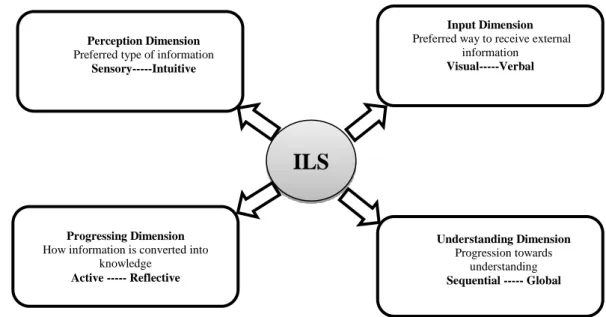
The Index of Learning Style (ILS) model by Felder-Silverman (Felder and Spurlin, 2015) describes the teaching and learning styles in engineering education. The ILS is an often used and well investigated instrument to identify the learning styles (ref). As illustrated in figure 1, ILS Model can classify learners according to a scale of four dimensions; processing, perception, input and understanding (Latham et.al, 2012). Each of these dimensions consists of contrastive attributes. The ILS model represents an individual’s learning style as points along four dimensions that indicate both the strength and the nature of their learning style preference. Each learning style dimension relates to a step in the process of receiving and processing of information, The ILS is assessed using a 44-question forced-choice questionnaire (11 questions per learning style dimension), that assigns a style and score for each dimension. In addition to the formal assessment questionnaire, the ILS model describes typical learner behaviors that can be used to informally group types of learners (Latham et.al, 2012).
Figure 1. ILS components
Ontology Method
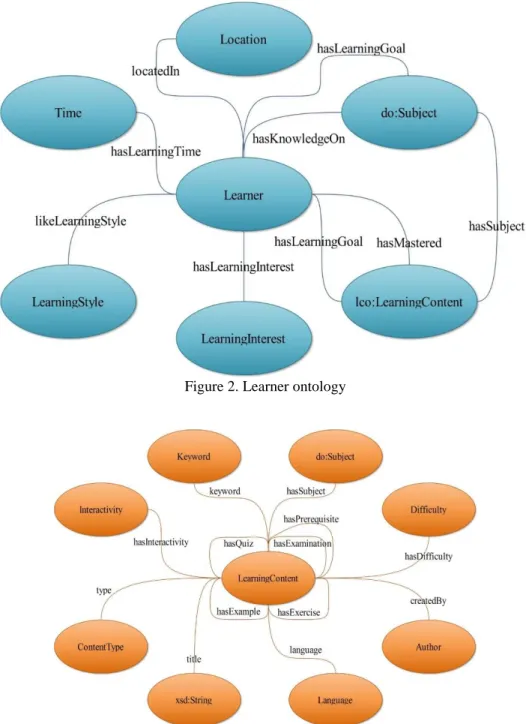
We use ontologies to model knowledge about the learner (user context), knowledge about the content, and the domain knowledge (the taxonomy of the domain being learned). Within the domain of knowledge representation, the term ontology refers to the formal and explicit description of domain concepts, which are often conceived as a set of entities, relations, instances, functions, and axioms. By allowing learners or contents to share a common understanding of knowledge structure, the ontologies enable applications to interpret learner context and content features based on their semantics. Furthermore, ontologies’ hierarchical structure lets developers reuse domain ontologies (e.g., of computer science, mathematics, etc.) in describing learning fields and build a practical model without starting from scratch. In our system, we have designed three ontologies: Learner Ontology, Learning Content Ontology, and Domain Ontology. The Learner Ontology shown in Figure 2 depicts contexts about a learner, e.g., subject or particular content already mastered, learning goal, available learning time, current location, desired learning style, and learning interests. The learning goal may be an abstract subject or a particular content. lco and do stand for Learning Content Ontology and Domain Ontology, respectively. Properties of contents as well as relationships between them are defined by the Learning Content Ontology (see Figure 3). The relation hasPrerequisite describes content dependency information, i.e., content needs to be taken before the target content. Actually, nowadays most of the departments in university provide a course dependency chart when issuing their courses. The Domain Ontology is proposed to integrate existing consensus domain ontologies such as computer science, mathematics, chemistry, etc. The domain ontologies are organized as hierarchy to demonstrate topic classification.
Augmenting Collaborative Recommendation
We take the goal of the recommender system to be the presentation of personalized recommendations for a particular target user. To accomplish this task, there are three broad categories of knowledge that may come into play: social, individual, and content knowledge. Social knowledge covers what we know about the large community of users other than the target user, whereas individual knowledge refers to what we know about the target user. Content knowledge encapsulates domain knowledge about the items being recommended. Recommender systems based on collaborative filtering utilize explicit or implicit ratings collected from a population of users. Without the advantage of deeper domain knowledge, collaborative filtering models are limited in their ability to reason about the relationships between item features and about the underlying factors contributing to the final recommendations.
Progressing Dimension
How information is converted into knowledge
Active --- Reflective
Understanding Dimension
Progression towards understanding
Sequential --- Global Perception Dimension
Preferred type of information
Sensory---Intuitive
Input Dimension
Preferred way to receive external information
Visual---Verbal
21
International Journal of Technology in Education and Science (IJTES)
Figure 2. Learner ontology
Figure 3. Learning content ontology
Ontology-based Personalized Recommendation
Learning Profiles by Spreading Activation
We use Spreading Activation to incrementally update the interest score of the concepts in the user profiles. In our current implementation, the users’ item based ratings are utilized to propagate interest scores in the user profiles.
Conclusion
As the amount of electronic course content becomes very large, providing adaptive and personalized content recommendation is significant for today’s e-learning systems. In this paper, we present a semantic recommendation approach for learning content based on ontology. For future work, we plan to incorporate additional learner contexts, e.g., available learning time, location, learning style, and learning interests into the recommendation process in order to make the system more comprehensive and intelligent. We also plan to consider the shared-knowledge among group members so as to recommend content to a group of learners.
We have presented our approach to collaborative recommendation that effectively incorporates semantic knowledge from ontologies with collaborative user preference information. Our approach not only outperforms traditional collaborative filtering in prediction accuracy but also offers improvements in coverage. Although accuracy metrics are important, in order to fully satisfy a user’s recommendation needs, other measures such as diversity of recommendation lists and uniqueness of recommended items must be considered. In our future work, we plan to further evaluate the advantages of our ontological approach in terms of coverage, diversity, personalization, and cold-start performance.
References
Ahmad, M., & Matoo, M. J. F. (2013). A Review of Ontologies Ontology Engineering and OWL for Representing Contextual Information. International Journal of Advanced Research in Computer Science and Software Engineering, 3(5).
Adomavicius, G., & Tuzhilin, A. (2015). Context-aware recommender systems. In Recommender systems handbook (pp. 191-226). Springer, Boston, MA.
Baltrunas, L. (2008, October). Exploiting contextual information in recommender systems. In Proceedings of the 2008 ACM conference on Recommender systems (pp. 295-298). ACM.
Bazire, M., & Brézillon, P. (2005, July). Understanding context before using it. In International and Interdisciplinary Conference on Modeling and Using Context (pp. 29-40). Springer, Berlin, Heidelberg. Basheer, G. S., Ahmad, M. S., & Tang, A. Y. (2013, March). A conceptual multi-agent framework using ant
colony optimization and fuzzy algorithms for learning style detection. In Asian Conference on Intelligent Information and Database Systems (pp. 549-558). Springer, Berlin, Heidelberg.
Fleming, N., & Mills, C. (2010). VARK: A Guide to Learning Styles. 2001. Last accessed on, 30.
Felder, R. M., & Spurlin, J. (2005). Applications, reliability and validity of the index of learning styles. International journal of engineering education, 21(1), 103-112.
Hamada, M. (2012, December). Learning style model for e-learning systems. In International Conference on Active Media Technology (pp. 186-195). Springer, Berlin, Heidelberg.
Latham, A., Crockett, K., McLean, D., & Edmonds, B. (2012). A conversational intelligent tutoring system to automatically predict learning styles. Computers & Education, 59(1), 95-109.
Martínez, J. P., Vosou, A., Villarreal, G. L., & De Giusti, M. R. (2010). An ontology-based context aware system for Selective Dissemination of Information in a digital library. Journal of Computing, 2.
Souali, K., El Afia, A., Faizi, R., & Chiheb, R. (2011, April). A new recommender system for e-learning environments. In Multimedia Computing and Systems (ICMCS), 2011 International Conference on (pp. 1-4). IEEE.
Sikka, R., Dhankhar, A., & Rana, C. (2012). A survey paper on e-learning recommender system. International Journal of Computer Applications, 47(9), 27-30.
Yu, Z., Nakamura, Y., Jang, S., Kajita, S., & Mase, K. (2007, July). Ontology-based semantic recommendation for context-aware e-learning. In International Conference on Ubiquitous Intelligence and Computing (pp. 898-907). Springer, Berlin, Heidelberg.
23
International Journal of Technology in Education and Science (IJTES)
Viola, S. R., Graf, S., & Leo, T. (2006, December). Analysis of Felder-Silverman index of learning styles by a data-driven statistical approach. In Multimedia, 2006. ISM'06. Eighth IEEE International Symposium on (pp. 959-964). IEEE.
Author Information
Dalibor Petkovič University of Niš
Pedagogical Faculty in Vranje Partizanska 14, 17500 Vranje Serbia
Contact e-mail: [email protected]
Nebojša Denić
University of PrištinaFaculty of Science and Mathematics,
Ive Lole Ribara 29, 38220 Kosovska Mitrovica Serbia
Goran Perenić University of Priština
Faculty of Science and Mathematics